

Where Desert Meets the Sea: A Guide to Mexico’s Northwest Pueblos Mágic by Scott Paton - HTML preview
Download the book in PDF, ePub, Kindle for a complete version.
Chapter 4 Durango
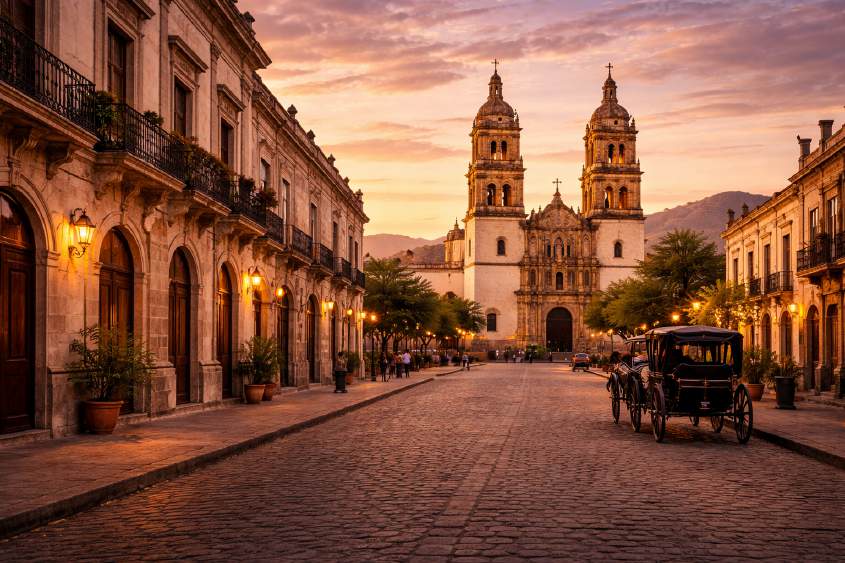
Durango City—officially Victoria de Durango—was founded on July 8, 1563 by Spanish explorer Francisco de Ibarra. The site was chosen near Cerro del Mercado, a hill rich in silver and iron, and quickly became the capital of the colonial province of Nueva Vizcaya, which stretched across much of northern Mexico and into the present-day U.S. Southwest. The name “Durango” came from Ibarra’s hometown in Spain, while “Victoria” was added in 1826 to honor Guadalupe Victoria, Durango’s own independence hero and the first president of Mexico.
Durango’s history is layered: indigenous cultures long thrived here before the Spanish arrived, miners once carved fortunes from the earth, and revolutionaries like Pancho Villa left their mark on the city. Its historic center, filled with baroque churches, neoclassical palaces, and colonial mansions, is one of the most beautiful in northern Mexico and is part of the UNESCO-recognized Camino Real de Tierra Adentro route.
Pueblos Mágicos and Durango
In 2001, Mexico launched the Pueblos Mágicos program to honor towns that preserve cultural heritage, folklore, architecture, and traditions while offering visitors a uniquely authentic experience. Today, more than 170 towns across the country proudly carry the designation, drawing travelers to places beyond the big cities.
Durango is home to two Pueblos Mágicos:
● Nombre de Dios, founded in 1562, even older than Durango City itself. Known as the
“Villa de los Cuatro Templos”, it is rich in colonial history and natural wonders like El Saltito waterfall. It officially joined the Pueblos Mágicos list in 2018.
● Mapimí, a historic mining town tied to the legendary Camino Real de Tierra Adentro,
famous for its desert landscapes, ghost towns, and the eerie Zone of Silence.
Together, Durango City and its Pueblos Mágicos weave a narrative of conquest, faith, resilience, and culture—inviting travelers to step into a living museum where history is never far from daily life.
Nombre de Dios, Durango – The Village of Four
Temples and Waterfalls
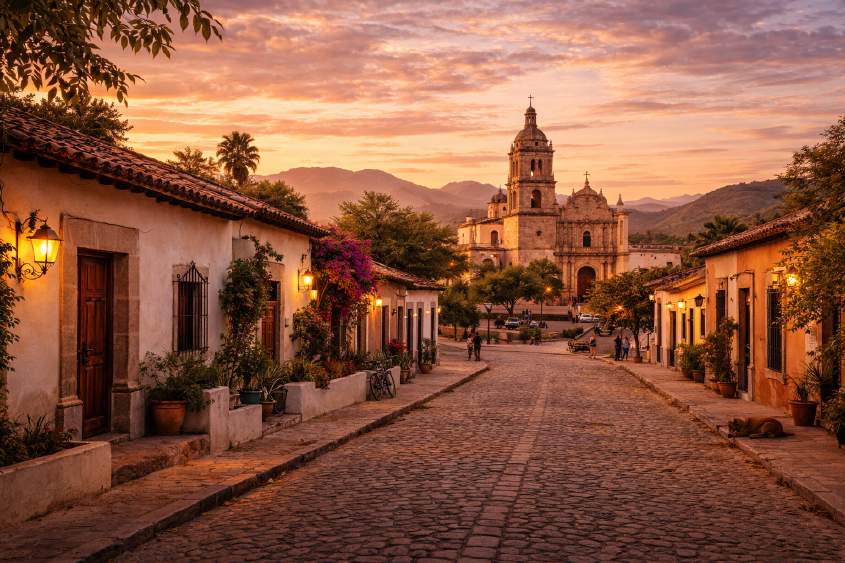
There’s a moment, just before you arrive in Nombre de Dios, when the landscape begins to shift. The road from Durango City dips into rolling hills, cypress groves appear by the riverside, and suddenly a stone arch rises before you, declaring this place the “Tierra del mestizaje y buen mezcal.” That’s your welcome sign.
This Pueblo Mágico, only 45 minutes south of the state capital, has a magic that isn’t loud or flashy. It doesn’t need to be. Its story is older than Durango City itself, its plazas whisper of colonial history, and its waterfalls, alive with the sound of rushing water in the rainy season, remind travelers that nature has always been at the heart of life here.
Nombre de Dios is a place of balance—between past and present, quiet and celebration, faith and daily life.
History & Culture Founded in 1562 by Fray Pedro de Espinareda, Nombre de Dios became the first Spanish settlement in northern New Spain, beating Durango City by six years. It stood as the starting point for evangelization in the region, and here, the first Catholic Mass in northern Mexico was celebrated.
At that time, the region belonged to Nueva Vizcaya, a sprawling province that stretched across what is now Durango, Chihuahua, parts of Coahuila, and even into what is today the United States. The settlement’s strategic location on the Camino Real de Tierra Adentro tied it to the great silver route, linking central Mexico with the far northern mines.
Nombre de Dios is also called the “Villa de los Cuatro Templos”, a name earned because of its collection of historic churches, each one a guardian of centuries of devotion and artistry.
● Parroquia de San Pedro Apóstol (1570–1790): The town’s heart, facing the Plaza de
Armas. Its baroque façade carries the heraldic shields of Castilla and León, tying it directly to Spain’s colonial authority.
● Templo de San Francisco (1566): Once part of a Franciscan convent, today only its
ruins remain, marking the earliest efforts to evangelize the Acateco people.
● Ermita de la Purísima Concepción: A humble chapel with 16th-century images painted
on its walls, often locked except on weekends.
● Templo de Jesús Nazareno: Crafted by artisans from Michoacán, its wooden ceiling
and a dramatic painting of souls in purgatory make it one of the most atmospheric temples in Durango.
Wandering among these temples isn’t just a walk through town—it’s a journey into the spiritual roots of northern Mexico.
Getting There
From Durango City: The easiest route is to take Highway 45 south toward Zacatecas. In less than an hour (about 53 km), the road delivers you to Nombre de Dios.
By bus or colectivo: Regular services connect Durango City with Vicente Guerrero, passing through Nombre de Dios. Taxis are another option for a more direct trip.
From Zacatecas: The drive north is longer, around 3.5 hours, but offers a scenic journey through valleys and the Sierra Madre foothills.
Where to Stay
Nombre de Dios is a small town, and that’s part of its appeal. You won’t find luxury resorts here. Instead, expect modest inns, rustic guesthouses, and family-run accommodations where the real charm lies in hospitality.
Many travelers choose to base themselves in Durango City, where boutique hotels and historic mansions offer more comfort, and then make day trips into Nombre de Dios. But staying in the pueblo itself allows you to experience the slower rhythms of life—waking up to church bells, strolling to the plaza for morning coffee, and chatting with locals who treat visitors like old friends.
What to See and Do
El Saltito Waterfall
Before even reaching town, the Cascada El Saltito steals the show. About 15 minutes outside Nombre de Dios, this 20-meter waterfall tumbles into the Río Mezquital. Unusually, the viewpoint is right at the same height as the falls, so you’re face-to-face with the curtain of water. From there, a staircase winds down through a forest of towering sabinos (cypress trees) to the river’s edge.
In the rainy season (late May to August), El Saltito swells dramatically, its roar echoing across the canyon. Even in drier months, the setting is pure magic—a quiet escape where you can snap photos, sit in the shade, and breathe in the scent of wet earth.
The Four Temples
Once inside the town, the temples are the stars. Each one is a time capsule: from the grandeur of San Pedro Apóstol to the solemn ruins of San Francisco, from the quiet Ermita to the artistry of Jesús Nazareno. Visiting them all is like piecing together a centuries-old puzzle of faith and architecture.
Plaza de Armas
At the center of town, the Plaza de Armas is where daily life unfolds. Vendors sell snacks and cool drinks, children chase pigeons, and families gather in the evenings to chat. It’s the kind of place that reminds visitors that the heart of a pueblo is not in its buildings, but in its people.
Mezcal Vinatas Durango is proud of its Denominación de Origen mezcal, and Nombre de Dios is one of the best places to experience it. Along the road, small vinatas (distilleries) open their doors to travelers. At places like Tradiciones Mezcaleras or El Malpaís, mezcaleros walk visitors through the process—from planting agave pups in the fields, to roasting the piñas in stone pits, to fermenting and distilling.
The patience required is humbling: some agaves take up to a decade to mature before they’re ready for harvest. Tasting the roasted piña fresh from the oven is unforgettable—it has the chewy sweetness of pineapple, laced with smoke and honey.
Tastings often end in family kitchens, where mezcal is poured into small glasses and paired with homemade fruit preserves, sometimes spiked with chile for a surprising kick.
Natural Escapes
Beyond El Saltito, other spots invite exploration. The Balneario Los Salones, shaded by riverside trees, is ideal for a dip on a hot day. During the rainy season, hidden waterfalls and swimming holes appear, rewarding those who venture off the beaten path.
Food to Try
If there is one dish that defines Nombre de Dios, it is the gordita. These thick tortillas, split and stuffed with fillings like beans, chicharrón, cheese, or nopales, are everywhere in town. The most famous are Doña Elisa’s gorditas, a family tradition that has lasted more than sixty years. The line outside her eatery often spills down the street, proof that everyone agrees on their flavor.
What makes them special? They’re cooked in wood-fired clay ovens, which gives them a smoky, slightly crisp shell that contrasts beautifully with the soft fillings. Travelers quickly learn that the best way to try them all is to bring friends, order a variety, and share bites.
Pair them with a glass of local mezcal, and you’ve got a meal that captures the spirit of Durango: simple, hearty, and unforgettable.
Practical Tips
● Best Time to Visit: Late May through August for the waterfalls at their fullest. The town
is pleasant year-round.
● Clothing: Comfortable walking shoes for temple visits and waterfall stairs; a light jacket
for cool evenings.
● Food & Drinks: Gorditas are a must—arrive hungry. Try several fillings. Don’t miss local
mezcal tastings.
● Souvenirs: Mezcal bottles, handmade fruit preserves, and regional crafts.
● Pace: Half a day is enough to see the highlights, but a full day lets you enjoy the slower
rhythm of pueblo life.
Closing Reflection
Nombre de Dios is not a place of grand spectacles—it’s a place of gentle revelations. A waterfall tucked into cypress groves. A centuries-old fresco hidden in a quiet chapel. A gordita, crisp on the outside, warm and comforting inside. A sip of mezcal that tastes like smoke and sunlight distilled.
What makes this Pueblo Mágico unforgettable isn’t just its history or its natural beauty, though both are remarkable. It’s the way it welcomes visitors into its rhythm of life, where time slows down and the essentials—good food, sacred spaces, laughter in the plaza—take center stage.
Travelers leave Nombre de Dios with more than souvenirs. They carry the memory of water on their skin, smoke on their tongue, and the warmth of strangers who felt like family. It is, truly, one of Durango’s most magical secrets.
Mapimí, Durango – Desert Legends and the Ghosts of
Ojuela
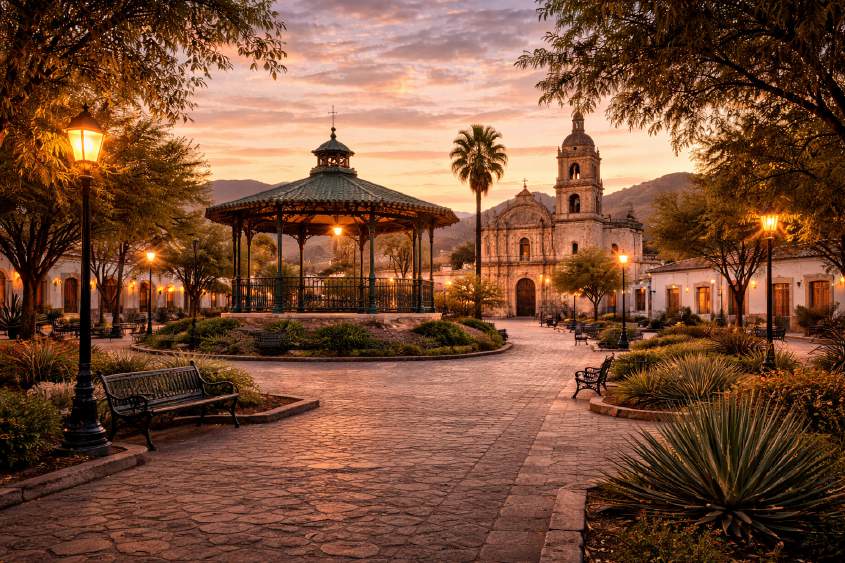
The desert has a way of keeping secrets. It swallows voices, amplifies silence, and stretches time across its endless horizon. In the heart of the Durango desert lies Mapimí, a Pueblo Mágico that feels both timeless and surreal. Its name, of Cocoyome origin, means “high hill”—a fitting title for a place that rises out of arid plains with stories of silver, revolution, and mystery.
Travelers come here for the thrill of crossing the Ojuela suspension bridge, once the longest wooden bridge in Latin America, and for the eerie quiet of the ghost town that clings to the cliffs beside it. But Mapimí is more than just a mining relic. Its cobbled streets have hosted revolutionaries like Miguel Hidalgo and Benito Juárez, its church bells once rang for miners and soldiers alike, and its desert is home to one of Mexico’s strangest natural enigmas—the Zona del Silencio.
This is a place where history and myth walk side by side, where every ruin has a tale to tell, and where silence itself seems to hold meaning.
History & Culture The roots of Mapimí stretch back over a thousand years, when the Cocoyome, Tobosos, and Suma people inhabited this land. The Spanish arrived in the 16th century, drawn by precious metals. In 1598, the Santa Rita mine was founded, sparking the rise of the Ojuela settlement. At its peak, Ojuela thrived with over 4,000 inhabitants, powered by rich veins of silver, gold, and lead.
The mine’s lifeline was the Ojuela Bridge, designed in 1892 by Wilhelm Hildenbrand, a German engineer who also worked on New York’s Brooklyn Bridge. Spanning 315 meters across a deep canyon, it allowed ore to be carried out more efficiently. For decades, the mine fed Spain’s empire and Mexico’s industrialization, until a flood in 1932 silenced it forever. Today, only ruins remain—a ghost town of collapsed walls, old shops, and a church petrified in time.
Mapimí’s role in Mexican history extends beyond mining. In 1811, Miguel Hidalgo, father of the independence movement, was held prisoner here during his final march north. Later, in 1864, Benito Juárez made Mapimí the temporary seat of his itinerant government while resisting the French Intervention. Walking through the museums today, travelers still see the beds where Juárez slept and relics of Hidalgo’s captivity.
Culturally, Mapimí is part of the Camino Real de Tierra Adentro, the historic silver route linking Mexico City to Santa Fe. Its baroque Santiago Apóstol Church (1772) still dominates the town center, its single tower visible from afar. Inside, saints gaze down from centuries-old altars, reminders of the miners’ faith in the midst of hardship.
Getting There
Mapimí is remote, but that’s part of its magic.
● From Durango City: A drive of about 3.5 to 4 hours (roughly 280 km) through desert
and highland plains.
● From Torreón: The nearest big city, just 1 hour away by car, making it the most
common jumping-off point.
● By Bus: Services run between Durango and Torreón, with stops in Mapimí. From there,
taxis or colectivos can take you to Ojuela and surrounding sites.
● Road Tips: Expect tolls—some travelers note the Durango–Mapimí toll road is among
the priciest they’ve encountered. Bring cash.
Where to Stay
Mapimí’s lodging options are limited, but that’s part of its charm.
● Hotel Viva Villa: A cozy budget-friendly option in town, often praised for its rock walls,
beams, and simple comfort.
● Posada Violeta: Another local choice, though availability can be tricky. Travelers often
recommend confirming via WhatsApp rather than relying on online booking.
● Nearby Torreón or Gómez Palacio: For those wanting more amenities, these cities
(within an hour’s drive) offer chain hotels and boutique stays.
In true pueblo fashion, don’t be surprised if guesthouses feel more like staying with family than in a formal hotel.
What to See and Do
Ojuela Ghost Town & Bridge
The star of Mapimí is the Ojuela ghost town, about 26 km from the main plaza. Crossing the suspension bridge—315 meters long and swaying 100 meters above the canyon floor—is both terrifying and exhilarating. Beyond it lies the crumbling settlement that once buzzed with miners’ lives: shops, cantinas, a market whose whispers seem to echo still.
Guided tours lead into the Santa Rita mine, where visitors walk through damp tunnels lined with calcite crystals, tools frozen in place, and even naturally mummified animals once used for labor. At the end, a small museum displays minerals, fossils, and black-and-white photos of the town in its prime. For adrenaline-seekers, ziplines fly across the canyon, offering a bird’s-eye view of the bridge.
Plaza de Armas & Santiago Apóstol Church
Back in town, life revolves around the Plaza de Armas, shaded by trees and surrounded by colonial facades. The Santiago Apóstol Church, built in 1772, is a baroque treasure with its cantera stone façade and single bell tower. Inside, images of Santa Rita de Casia watch over the faithful.
Benito Juárez House Museum One of the most fascinating stops is the Benito Juárez Museum, housed in the building where Mexico’s president once stayed during the French Intervention. His bed and personal items are preserved, alongside historic photographs and a scale model of the Ojuela Bridge.
Recinto Hidalgo
Another historic site is the Recinto Hidalgo, where Miguel Hidalgo rested as he was taken north as a prisoner in 1811. The modest house still carries the weight of that moment in Mexican independence.
Cristo de Mapimí
A modern addition to the skyline, the Cristo de Mapimí statue towers above the town. From here, visitors see the pueblo sprawled below, framed by desert hills.
El Rosario Caves
About 24 km from town, the Rosario Caves hide spectacular stalactites and stalagmites formed over centuries. Guided tours illuminate “rooms” with names like the Wedding Cake and the Backbone, each formation carved drop by drop over millennia.
Zona del Silencio
Perhaps the most mysterious attraction is the Zona del Silencio, inside the Mapimí Biosphere Reserve. Here, myths claim compasses spin wildly, radios go silent, and strange lights appear in the desert sky. Scientists attribute the phenomenon to magnetic anomalies, but legends of extraterrestrial encounters and paranormal events make it a favorite for the curious.
Food to Try
Mapimí’s dining scene is simple but hearty.
● El Lejano Oriente: A local favorite where visitors rave about northern-style meats and
“pepitos montes” (breaded chicken sandwiches).
● Home-style cooking: Groups can sometimes arrange private meals in local homes,
with spreads of chile rellenos, stews, and tacos.
● Menudo: A traditional northern soup made from beef tripe, corn, and chili broth, often
served for breakfast after a long night.
As in much of Durango, meat takes center stage, often grilled or stewed, and meals are best paired with a cold soda or local mezcal from nearby regions.
Practical Tips
● Best Time to Visit: October through April offers cooler, comfortable weather. Summers
are extremely hot, often over 40°C.
● Clothing: Lightweight clothes for daytime, but carry a jacket for evenings. Sturdy shoes
are essential for mine tours and ghost town ruins.
● Cash Only: Bring pesos, especially for entrance fees (120 pesos for Ojuela, extra for
ziplines).
● Souvenirs: Locally mined minerals, quartz, and moonstones make unique keepsakes.
● Pace: Allow at least a full day to explore the bridge, mine, museums, and town center.
Add another half-day if visiting the caves or Zona del Silencio.
Closing Reflection
Mapimí is a place of contrasts. A desert town where silence tells stories louder than words. A ghost settlement where empty walls remember lives once full of noise and ambition. A suspension bridge that once carried ore but now carries the weight of imagination.
Here, history is not polished—it’s raw, layered, and sometimes haunting. You walk across Ojuela’s swaying planks, and suddenly you’re a miner in the 19th century. You step into Juárez’s modest quarters, and the fight for a republic feels close. You stand under the desert stars in the Zona del Silencio, and myths begin to feel like truth.
Mapimí doesn’t just invite you to see its sights—it asks you to feel them. To let the desert’s stillness seep into your bones, to listen to the echoes of the past, and to carry its mysteries with you long after you’ve left.