

TTC.Exploring Language Teaching Methods, Theories, and the Teacher’s Role by Saeideh Mahrami - HTML preview
Download the book in PDF, ePub, Kindle for a complete version.
3.sociocultural theory by Vygotsky
This theory was developed by Lev Vygotsky. Sociocultural theory emphasizes the fundamental role of social interaction and cultural context in the development of learning and cognition. It suggests that language acquisition and knowledge construction are deeply influenced by social relationships and environment.
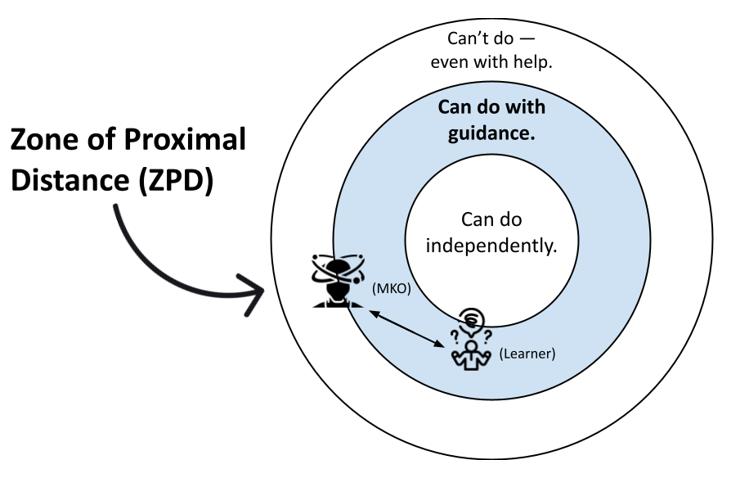
Zone of Proximal Development (ZPD) is the gap between what a learner can do independently and what they can achieve with guidance. Teachers and peers provide assistance (e.g.hints, encouragement) to help learners move from their current abilities to higher levels of competence.
Scaffolding is the other concept related to this theory. It is temporary support provided by a teacher or a more knowledgeable peer to help learners perform tasks within their ZPD. Modeling language use, giving prompts, or breaking tasks into smaller, manageable steps. It is recommended to gradually reduce support as the learner becomes more capable.
Interaction with others is essential for learning. Language develops through dialogues and shared activities, enabling learners to internalize knowledge. Conversations, collaborative tasks, and peer discussions help construct meaning.
Vygotsky"s sociocultural theory highlights the importance of teaching methods that engage learners socially, culturally, and collaboratively, ensuring that language learning is both interactive and deeply connected to the real world.