

Journey into the Heart of Religions by N. Fakhr - HTML preview
Download the book in PDF, ePub, Kindle for a complete version.
Hindu Sects
The next evening, when they arrived at the wedding, Mr. Akal came to welcome them and took them to the area where the guests were sitting around separate tables.
Mr. Akal led them to a table where two men and a young boy were sitting. One of the men was slightly overweight. He was wearing a suit and a turban. He had a long black beard held close to his face, and if you looked carefully, you could see a thin black net over it, as if it were keeping his long beard from hanging down.
The second man wore a long white shirt and white trousers. His son, who was about five years old, was sitting beside him. There was a red dot on the boy’s forehead.

Mr. Akal introduced the man in the turban as Mr. Mehtab and the other man as Mr. Rajesh. He said that they were both friends from his university days.
Then Mr. Akal left them and went away.
After a few minutes of silence, Sina asked his father, “What is that mark on Mr. Rajesh’s son’s forehead for?”
“Why don’t you ask him yourself?” his father said.
Sina asked the little boy, but apparently he did not speak English, so he looked at his father. His father translated Sina’s question into Hindi. But the boy looked at his father again. It seemed that he didn’t know the answer either and wanted his father to explain it.
Mr. Rajesh said, “In India, people believe that the ‘evil eye’ can bring bad luck or illness. So, to protect children from the evil eye, people sometimes use a dark substance called kajal to put a mark on the child’s forehead or behind the ear. The idea is that this makes the child look less attractive and protects the child from the evil eye.”
“Did Vishnu tell people to do this?” Sina asked.
Mr. Rajesh shrugged. “I don’t think so. Actually, it’s an old custom.
“And I suppose you’ve already talked to Mr. Akal about Hinduism, because you seem to think that all its teachings come from Vishnu.”
“Isn’t Vishnu the Supreme Brahman in Hinduism?” Sina asked.
Mr. Rajesh shook his head sadly.
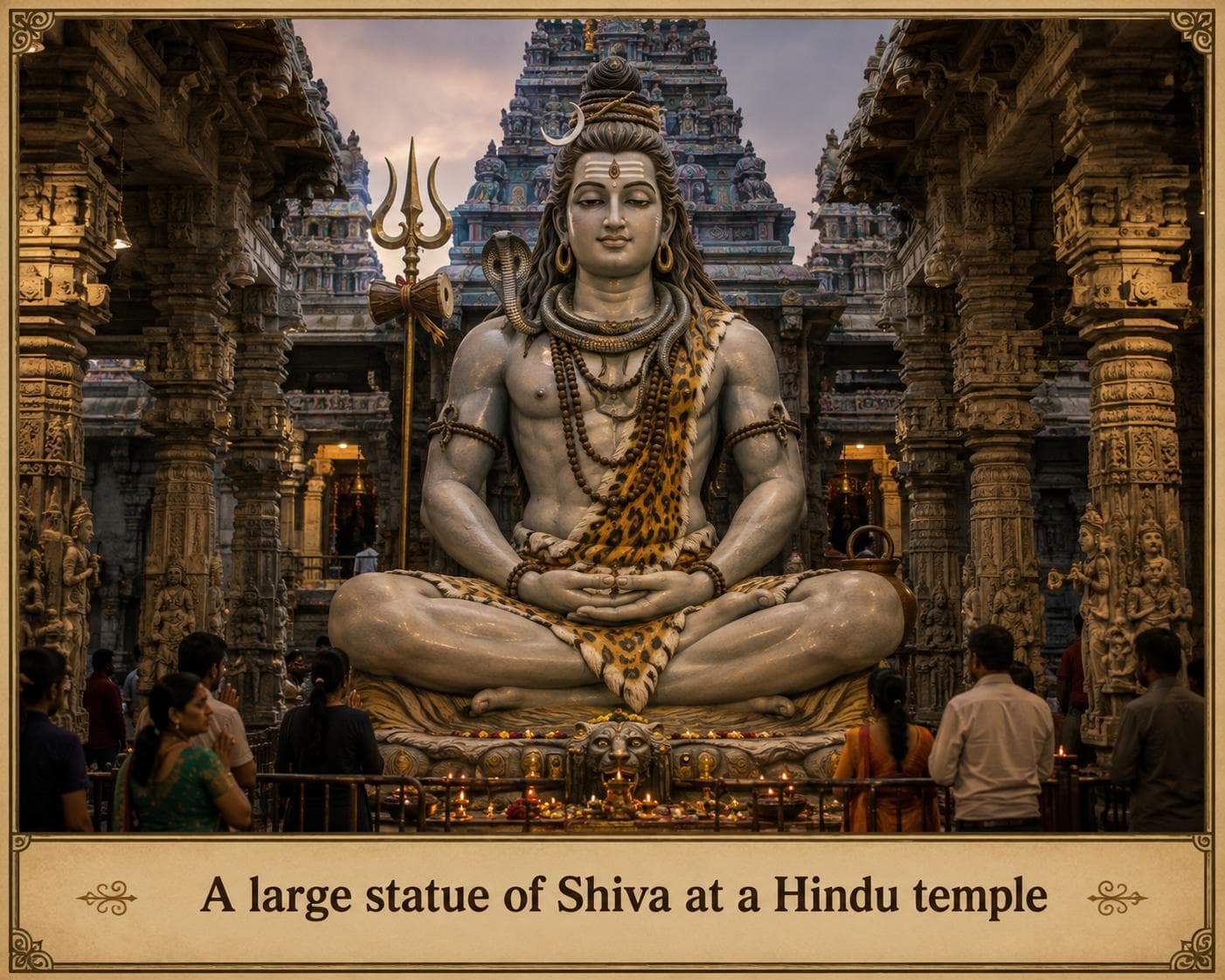
“Actually, the Supreme Brahman is Shiva. Shiva is the true God, the true Brahman. Shiva is everything and is present in everything. He creates, preserves, destroys, reveals, and conceals everything. Everything is a manifestation of him.
“Shiva has different forms and aspects. Brahma is another name for Shiva’s creative aspect, and Vishnu is Shiva’s preserving aspect. So in reality, both are Shiva—the same Shiva who creates everything, preserves what he has created, and then destroys it so that he can create it again.”
“So you don’t believe in the Puranas and the Vedas?” Sina asked.
Mr. Rajesh’s eyes widened slightly.
“Of course we do! They are our sacred texts.”
“Then how do you know that the Supreme Brahman is Shiva and not Vishnu?”
“First, we have many rational and philosophical reasons for believing in a God with the qualities of Shiva. Second, we have seen many miracles of Shiva that confirm this belief.”
Sina smiled. “You have miracles too?”
“Of course. There have been great miracles in the past, and even today sick people are sometimes healed at temples where Shiva is worshipped. All these things show us that Shiva confirms our beliefs and our faith.”
Sina asked Mr. Rajesh to tell him about one of those miracles.
Mr. Rajesh thought for a moment and then began:
“About 1,200 years ago, in the ninth century, there was a king who ruled a region of India. One of his ministers was named Manikkavasagar. He was sent to a neighboring region to buy horses. On his way, he met a holy man who seemed very unusual.”
“What does ‘holy man’ mean?” Sina asked.
Mr. Rajesh said, “It means someone who is connected with Shiva in a special way and has gained this ability through worship and giving up worldly pleasures. People do not doubt what such holy men say, and they follow them.
“Manikkavasagar became a follower of this holy man and chose him as his teacher and spiritual guide. He decided to serve him, do what he told him, and let his teacher guide the growth of his spirit and knowledge. He gave up worldly life and began to live as an ascetic. He even spent the money meant for buying the horses on rebuilding a ruined temple.
“When the king heard what had happened, he angrily ordered Manikkavasagar to return so that he could be thrown into prison. But the holy man told Manikkavasagar not to worry because the horses he was supposed to buy would be delivered to the palace within a day or two.
“The holy man gathered jackals from the forest and turned them into horses. Then he took the form of a horse trader and delivered them to the king. The king was pleased and released Manikkavasagar. But that very night, the horses turned back into jackals and ran away.
“The angry king arrested Manikkavasagar again and chained him on the hot sand beside a river. Then, miraculously, the river flooded. Manikkavasagar was unchained and taken back to prison. Everyone in the area was ordered either to help repair the damage along the riverbank or to pay someone to work in their place.
“There was a poor old woman who could do neither. So the holy man appeared in the form of a worker and told her that he would work for her. But when the worker went to the riverbank, he was lazy. Sometimes he danced, and sometimes he disturbed the other workers.”
“When the king came to inspect the work, he saw what the worker was doing and struck him on the back with his stick. Suddenly, the worker disappeared. But the pain from that blow was felt on the backs of the king, his ministers, his servants, the villagers, and every living creature in the world—including Manikkavasagar.”
When Mr. Rajesh reached this part of the story, tears filled his eyes.
He continued, “When the king saw this miracle, he realized that the worker had been the Supreme Shiva himself. After that, Manikkavasagar became a holy man.
“During all this time, until he was finally freed, Manikkavasagar had been singing special religious hymns. Those hymns still exist today. He also performed other miracles. For example, he made the mute daughter of a Buddhist king of Sri Lanka speak. This miracle caused the king of Sri Lanka and all his people to become Shaivite Hindus.
“Near the end of Manikkavasagar’s life, Shiva appeared once again and personally wrote down some hymns for him. Hindu monks and priests asked Manikkavasagar what those hymns meant. After explaining their meaning to them, he walked toward the shrine of Shiva and disappeared before everyone’s eyes.
“Hundreds of people saw and confirmed all these miracles.”

When Mr. Rajesh finished his story, Sina stared at him in amazement. He was silent for a few moments and then said:
“If Shiva once showed people through these miracles that they should worship him, why doesn’t he perform another miracle now and settle the disagreement between you and Mr. Akal about who the true Brahman is?
“He has done it before, and as you said, everything is under his control—in fact, everything is a manifestation of him. So nothing could stop him from doing it. Isn’t it a shame that Mr. Akal and the others should remain mistaken, even though they are Hindus and also belong to the chosen Aryan people?”
Mr. Mehtab, who had been listening to the conversation, said, “And the disagreement is not just between Mr. Akal and Mr. Rajesh. There are about a billion Hindus in the world, and they belong to different sects.”
“What is a sect?” Sina asked.
“Different sects are different branches of the same religion,” Mr. Mehtab explained. “For example, some Hindus are Vaishnavites, like Mr. Akal. Some believe that Ganesha is the Supreme Brahman and belong to a Ganesh-worshipping sect. Others believe that Shakti is the Supreme Brahman. And some Hindus do not believe in any particular god at all. They see Hinduism mainly as a collection of teachings and moral lessons about how to live.
“Even these sects are divided into smaller groups. For example, some Shaivites believe that Shiva has never had an avatar—that he has never come to Earth in the form of an earthly being. So they do not accept the story Mr. Rajesh just told.”
Mr. Rajesh looked a little annoyed. “But that is history, and you can’t simply refuse to accept history.”
“History can be changed,” Mr. Mehtab replied. “In the history books I have read, there is no mention of these miracles during the time of that king. They appear only in Shaivite religious texts.”
Mr. Rajesh laughed. “Here we go again—the same argument we used to have when we were students.”
Sina asked Mr. Rajesh, “Are the teachings of your sect different from those of other Hindu sects?”
“Not very different,” Mr. Rajesh replied. “But we Shaivites place more value on giving up worldly pleasures and living an ascetic life. We believe in living simply.”
“What do you gain from living simply and following the teachings of Hinduism?” Sina asked.
Mr. Rajesh replied, “By following Shiva’s teachings, we gain good karma. Then, in our next life, we are born as someone with a better life and better behavior. But if we live an ascetic life, worship Shiva, repeat his name, and meditate, we can escape the repeated cycle of death and rebirth sooner, and our existence can become completely one with the Supreme Brahman.”