

Journey into the Heart of Religions by N. Fakhr - HTML preview
Download the book in PDF, ePub, Kindle for a complete version.
A Trip to India
A week later, Sina and his father were on a plane flying to New Delhi, the capital of India.
Sina said to his father, “Last week, I told my teacher in class about the chicken and the egg, and he really liked my answer. But yesterday he told me that whether the chicken or the egg came first actually depends on what language we are speaking.”
His father looked at him in surprise. “What did he mean?”
“Well, if we ask the question in Persian, we say, ‘Which came first, the chicken or the chicken egg?’ The Persian word we use literally means ‘chicken egg.’ So the answer is that the chicken came first.”
“All right. So in what language would the answer be the other way around, with the egg coming first?”
“My teacher said that if he answered the same question in English, it would be different. In English, they just say egg. They use the word egg for the eggs of all kinds of birds—and even for the eggs of other animals, such as insects.
“So if we translate the English question word for word into Persian, it really means, ‘Which came first, the chicken or the egg?’—not ‘the chicken or the chicken egg?’
“Now we can’t say, ‘A chicken egg must come from a chicken,’ because the egg could have been laid by another kind of bird, including one of the ancestors of today’s chickens. A mutation could then have caused a chicken like the ones we know today to hatch from that egg.
“So if we ask the question in English, the answer is that the egg came first. A chicken is a bird, so it had to hatch from an egg. But that egg could have been laid by a bird that was not itself a chicken, but one of the chicken’s ancestors.
“So first there was the egg, and then the first chicken hatched from it.”
His father stroked his beard again and said, “Your teacher is a clever man.”
Jainism
A little excited, Sina asked his father, “Do Indians worship cows?”
“There are many religions in India,” his father replied, “and in some of them, cows are treated with special respect. Jainism and Hinduism are examples.
“Among Hindus, cows have traditionally been very important because people depend on them in many ways. They use cow’s milk to make dairy products and food, cattle to help plow fields, and cow dung as fertilizer. But they do not eat beef. In fact, they believe that animals should not be killed.”
“But we make even more use of cows,” Sina said. “We eat their meat and even make leather from their skin, but we don’t treat cows as sacred.”
“That’s true. Traditionally, Jains have used milk and other dairy products. But today, some Jains choose not to use them because they believe modern dairy farming causes suffering to cows.”
“I’ve never heard of Jainism before,” Sina said. “What kind of religion is it? If they are so careful about not harming animals, what do they eat?”

“Jainism is a very ancient religion. It began around 2,700 years ago. Until about the eighth century AD—around 1,300 years ago—it was supported by rulers in large areas of India.”
“What do you mean by ‘supported by rulers’?”
“I mean that some rulers in different parts of India followed Jainism. They encouraged people to follow the same religion and built many temples for it. Later, as Hinduism and Islam grew, rulers changed their religions. Some Jain temples were destroyed, and Hindu temples and mosques were built in their place. People were sometimes encouraged, and sometimes forced, to change their religion.
“Today, Jainism has about four million followers.
“One of the most important teachings of Jainism is that we should not harm any living thing, and that all living things are equal.”
“You mean people, cows, and even trees are equal? Equal in what way?”
“They are equal in the sense that they all have a right to live and should not be harmed. But Jains also give different levels of importance to living things depending on how many senses they have. Plants, for example, are given less importance, while humans, who have five senses as well as the ability to think, are given the greatest importance.
“Even so, Jains try not to harm a tree unless they have to. They are careful not to step on insects when they walk, and because it is harder to see insects in the dark, they may avoid going out at night.
“They believe that harming an animal through carelessness is still wrong, even if you did not mean to do it. Some very devout Jains even avoid farming because they do not want to harm worms and other tiny creatures living in the soil. They may also avoid eating honey because honey is food made by bees.”
Sina asked, “What does ‘devout’ mean?”
“It means someone who takes the teachings of their religion very seriously and tries carefully to follow them. Very devout Jains may even avoid eating root vegetables such as potatoes and onions because pulling a plant out of the ground may harm tiny living creatures in the soil.
“They are also careful not to use rude or hurtful words. However, Jain teachings do allow the use of force in some situations, such as when a soldier must defend life.
“They believe that people should tell the truth. They should also never take something that has not been freely and honestly given to them.
“In Jainism, renouncing worldly life is also considered a very good thing.”
“Renouncing worldly life?”
“It means giving up things such as wealth, possessions, work, and family life.”
“Then what do they do?”
“Jains who choose this way of life become monks or nuns. They may travel from place to place on foot, often barefoot, and live on food that other people give them.”
“So they don’t work, and other people give them some of the food they worked for so they won’t starve?” Sina asked. “Why is that considered a good thing in their religion?”
“Jains look at it differently. They focus on the fact that the person has given up wealth, possessions, work, and family life, which is a very difficult thing to do. They don’t see giving food to a monk or nun as supporting someone who refuses to work. Instead, by giving them food, they believe they are sharing in a good deed.”
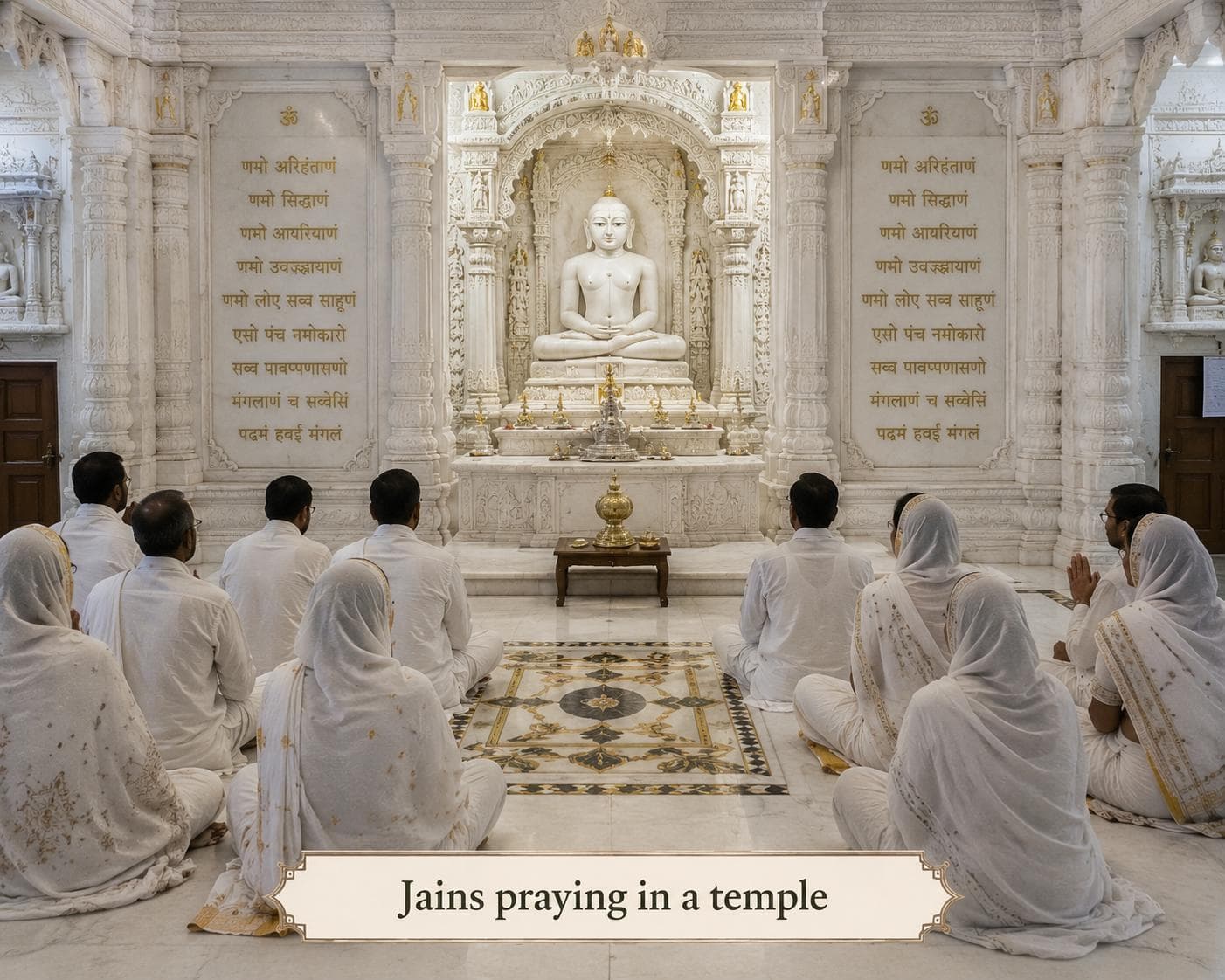
“Jains have a special fast called Santhara, which means fasting until death. When someone feels that death is near and believes that they have completed all their duties in life, they may decide to gradually reduce the amount of food and drink they take until, little by little, they die.
“This process takes about twelve years. It is considered a very valuable and deeply spiritual act. It requires great strength and determination to give up worldly things, and the person who does it must have reached true wisdom and true faith.”
Sina asked, “True wisdom and true faith?”
“We’ll talk about what ‘true wisdom’ and ‘true faith’ mean later,” his father said.
Sina asked, “So, after a Jain has done all these good things and then dies from the fast, what happens? What does someone who gives up worldly life get that could be better than being alive and enjoying life with their family, in their own home, with money and comfort?”
“Well,” his father said, “Jains believe that the universe was never created and will never be destroyed. It has always existed and always will. They also believe that there are laws that govern the universe, and that if we live according to those laws, we can find happiness.”
Sina interrupted him. “Then they must have a good religion, because there really are laws that govern the universe. If we understand them and pay attention to them, they can make our lives much easier. Our teacher says that everything in the universe follows the laws of physics, like the laws of gravity, electricity, magnetism, and motion.
“One of the laws of motion says that for every action, there is an equal reaction in the opposite direction. A balloon is a good example. When the air rushes out one way, the balloon moves the other way. Rockets that travel into space work according to the same law. So Jains must care a lot about science and knowledge.”
“Well, according to an Indian census, about 94 percent of Jains could read and write. But the laws that Jainism talks about are something different.
“Jains believe that if a person does certain good things and avoids certain bad things, they gain good karma. This can lead to a happier next life.”
“Next life?” Sina asked. “Do they have heaven and hell? And what is karma?”
“Jains believe that our actions create karma that becomes attached to the soul. Good actions create good karma and bad actions create bad karma. You can think of it as something a little like developing a good or bad character, although karma is not exactly the same thing.”
“So if someone keeps doing good things, they gain good karma?”
“Yes. Good karma can lead to a better life after death. They may be born as a happier person in better circumstances, either here on Earth or in another world.
“Bad karma can lead to a more difficult next life. A person might even be reborn as an animal or an insect. But the final goal is to become free from all karma and escape the cycle of being born again and again.”
“Our teacher says that scientific laws were discovered through repeated experiments and observations,” Sina said. “So how did Jains discover these laws? They say the universe was never created and has always existed. So they don’t believe that a god created it. And if there is no creator god, then there couldn’t have been a prophet sent by that god to tell people these things. Have Jains actually seen what people are reborn as after they die?”
“It’s true that Jains don’t believe in a god who created the universe,” his father said. “They believe that every soul has the potential to become completely free and perfect. Karma is what keeps the soul trapped in the cycle of birth and death.
“By living in the right way, a person can gradually become free from karma. When the soul is completely free, it no longer has to be born again.”
“Free from what?”
“Free from suffering, karma, and being born again and again in different bodies. This state is called nirvana. A completely free soul has perfect peace, eternal happiness, and complete knowledge.”
“Complete knowledge?” Sina asked. “Why is that so important?”
“Because in Jainism, those who reach complete knowledge can understand the true nature of the universe and show others the way to freedom.
“The most famous of these teachers was Mahavira. He lived about 2,500 years ago. Jains believe that he was a human being who reached complete knowledge and taught others the way to become free from the cycle of rebirth.
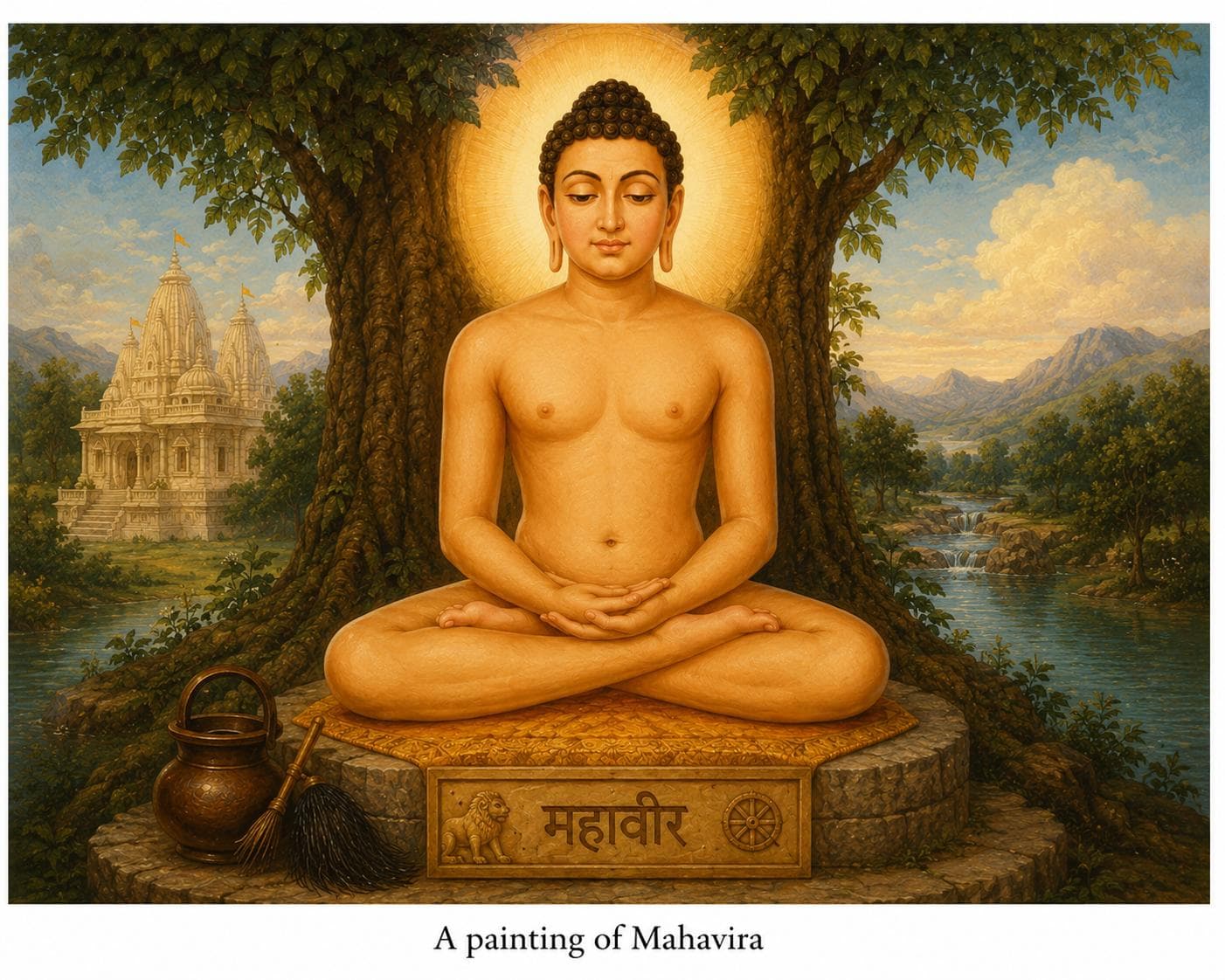
“His teachings were later passed down in Jain sacred texts. One of the oldest of these is called the Acaranga Sutra.”
“Dad, you said Jains might be born in a better world. What kinds of other worlds do they believe in?”
“They believe there are pleasant worlds above our world and worlds filled with suffering below it. Those with good karma may be born in the higher worlds, while those with bad karma may be born in the lower worlds.”
Sina looked confused. “Now I’m confused! Do they have heaven and hell or not?”
Father said, “You see, son, we usually call a place heaven or hell when we believe it was created by a god to reward or punish people. The good and bad worlds that Jains believe in were not created by a god for that purpose.
“People are born in these worlds according to their karma. After living there for some time, they die and are born again in another world, or even here on Earth. Only those who become completely free from karma can finally escape this cycle of birth and death forever.”
“How do Jains know that Mahavira really reached complete knowledge and freedom, and that his teachings are true?” Sina asked.
“One thing that can make Jains more confident in their beliefs is stories about miracles. For example, there is a story about a boy from another religion who was bitten by a snake. A spirit was said to have entered someone and guided the boy to a Jain temple. There, a religious ceremony was performed. The boy not only recovered, but even began to dance.
“Jains who believe this story may see the boy’s recovery as evidence that their religious teachings about the laws of the universe are true.”
“Dad, you said Jains believe that through good actions and true faith, they can become free from karma. You told me what some of those good actions are. But what does ‘true faith’ mean?”
“Well, imagine that you and I travel to Isfahan and see Si-o-se-pol Bridge over the Zayandeh River. After seeing it yourself, you believe that Si-o-se-pol exists. Your belief comes from seeing it directly.
“I don’t need to tell you every day, ‘Be careful not to lose your faith in the existence of Si-o-se-pol!’ But religious beliefs are not always like that.
“For example, suppose someone believes that performing a certain religious ceremony can help cure a sick person, like the boy who was bitten by the snake. If the ceremony worked every single time, without exception, there would be little reason to worry about losing faith in it—just as you don’t have to struggle to keep believing that Si-o-se-pol exists.
“But sometimes the sick person does not recover. Even then, religious believers may be expected to keep their faith and not doubt the teachings they believe to be true. In Jainism, having complete confidence in the teachings of the Jinas is considered part of right faith. Doubt and wrong belief are considered obstacles on the path to a better rebirth and, ultimately, freedom from rebirth.”

Sina looked at some of the Indian passengers on the plane and asked his father, “Could any of them be Jains?”
“Maybe,” his father said. “After all, Jains are people just like you and me and everyone else. Their religious beliefs are simply different from ours.
“They eat, laugh, travel, go to school and university, and live ordinary lives. Sometimes they follow the teachings of their religion, and sometimes they do things their religion tells them not to do—in other words, they sin.”
Hinduism
The airport in Delhi, the capital of India, was not very clean, and there was a slightly unpleasant smell in the air. The city was crowded and noisy, and the smell was even stronger there. Most of the cars were old, and the drivers honked their horns a lot. Dogs and other animals could be seen everywhere.
Whenever their car stopped at a red light, poor children came up to it and begged for money or food. Many of them were carrying even younger children in their arms. Homeless families could sometimes be seen along the streets as well.
On some streets that were being repaired, and around buildings under construction, they saw women wearing Indian saris and working with shovels and pickaxes.
At last, they reached their hotel. The hotel grounds were clean, and the unpleasant smell was not as strong there.
“What is that bad smell we keep smelling everywhere?” Sina asked his father.
“I don’t know,” his father replied.
The next day, they went together to a university. Sina’s father was going to attend a meeting there with scientists from India and other countries, and he was also going to give a talk.
He told Sina that his friend, Mr. Akal, was bringing his son along so that the two boys could play together in the university gardens.
Mr. Akal’s son was the same age as Sina, and like Sina, he could speak English.
“My name is Arman,” the boy said.
“We have the name Arman in Persian too,” Sina told him.
“But my name is a Hindu name,” Arman said. “It means ‘wish.’”
Sina looked surprised. “Arman means almost the same thing in Persian!”
Arman asked, “Do you like my country?”
“Your country is very unusual,” Sina said. “Delhi is very crowded, and I’ve seen families who seem to be homeless in many parts of the city. There are a lot of poor people. And I hope you don’t mind me saying this, but the city seems dirty.”
“I’ve been to other countries too,” Arman said, “and I think you’re right. Families here can be large and have many children. Many homes, especially in poor neighborhoods, don’t have toilets. There are also animals wandering freely through the streets. And many people don’t have jobs. All these things are part of the reason the city looks the way it does.”
“Arman, you said your name is a Hindu name. What did you mean?”
“I’m a Hindu, and my family chose this name for me. It’s like Muslim families giving their children names such as Muhammad.”
“What’s your last name?”
“Many people in India don’t have family names. My family doesn’t have one either. I’m Arman, son of Akal.”
When Sina’s father and Mr. Akal finished their work and returned, Mr. Akal invited Sina and his father to have dinner at their home. Then they said goodbye and left.
At lunch, Sina said to his father, “Mr. Akal’s son is named Arman. I thought Arman was an Iranian name. It’s interesting that in India it means ‘wish’ too.”
His father said, “Thousands of years ago, groups of people who spoke related Indo-Iranian languages migrated into areas that are now Iran and India. And during the last thousand years, Persian also became widely used in parts of India because of the long historical connections between the two regions.
“So it isn’t surprising that we sometimes find similar words and names in both places, especially since Iran and India are not very far from each other. Maybe Iranians and Indians have more things in common than we realize.”
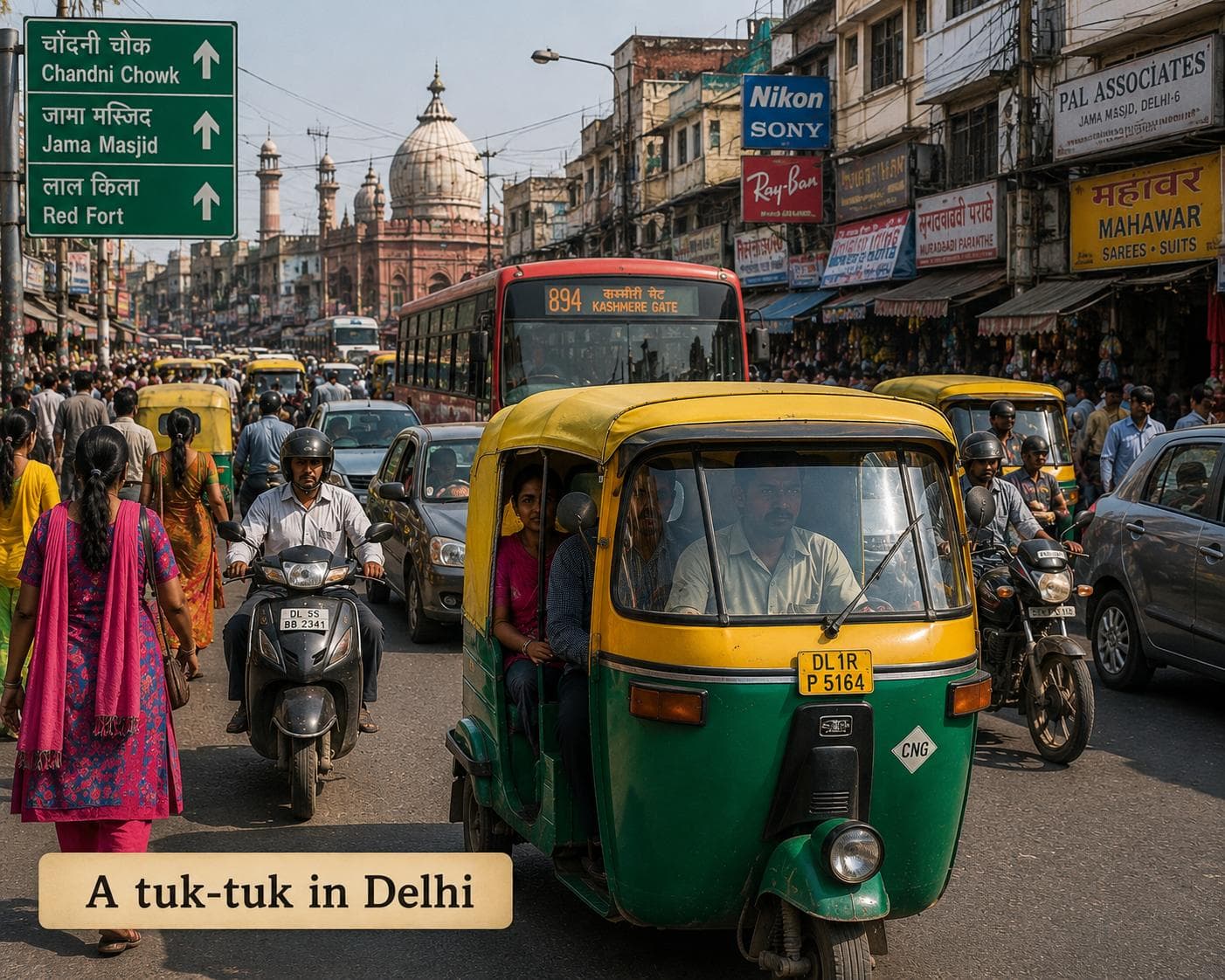
Near sunset, Sina and his father got into one of the taxis waiting outside the hotel. These taxis were really small, covered three-wheeled vehicles, with one wheel in front, two in the back, a seat for the driver, and a seat for passengers behind him. The drivers honked their horns constantly as they moved through the crowded streets.
They passed several temples and a mosque. Finally, they reached the street where Mr. Akal lived. He was waiting there to show them the way to his house.
As they walked down the street, Mr. Akal warned Sina not to step on some lemons and chilies that had been tied together with a string. Sina also noticed strings with one lemon and seven chilies hanging outside some of the houses.
“What are those?” he asked.
“They are called totka,” Mr. Akal explained. “People hang them outside their doors to protect themselves from the evil eye and to bring good luck and success. They usually replace them every week.
“Some people believe that a totka absorbs the effects of the evil eye. So if someone steps on a used one, the bad luck it has absorbed may pass to that person.
“Others say that the lemons and chilies keep away Alakshmi, the goddess of poverty and bad luck. They believe that she likes sour and spicy things, so the lemon and chilies satisfy her and keep her from entering the house.”
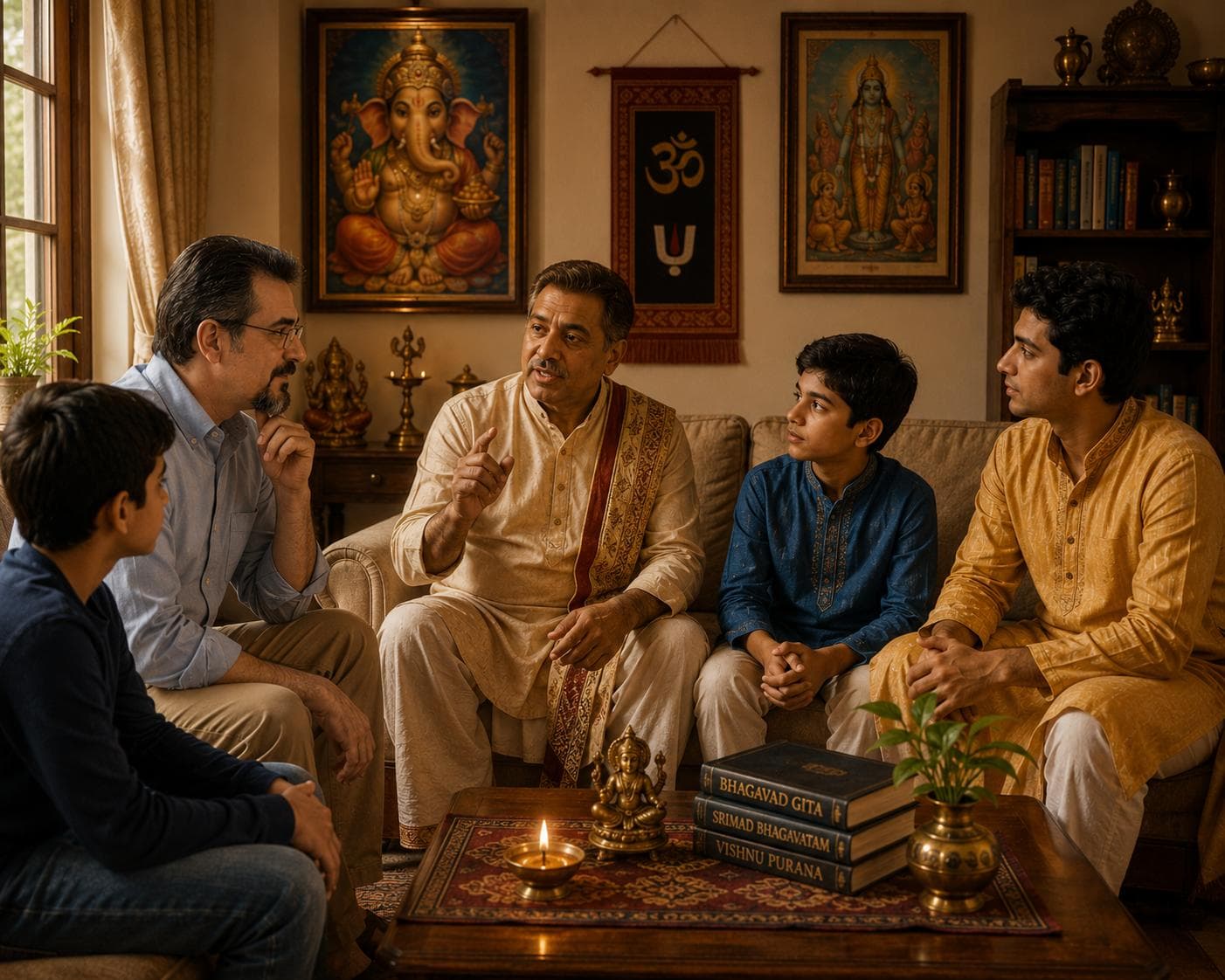
At the house, Mr. Akal introduced his family. His wife, sons and daughters, mother, and one of his brothers were there. There was also a woman dressed in white. She came into the room for a short time but did not stay with the others.
Mr. Akal explained that she was the wife of another brother who had died several years earlier.
“Yes, I remember how sad you were when your brother died,” Sina’s father said. “He was very young. I’m surprised that his wife still lives with your family.”
After everyone sat down, Mr. Akal turned to Sina.
“You seem like a clever boy. Tell me, do you like India? What have you found most interesting here?”
“The things I’ve seen in Delhi haven’t been as interesting as the things I had heard about India,” Sina replied.
“What had you heard?”
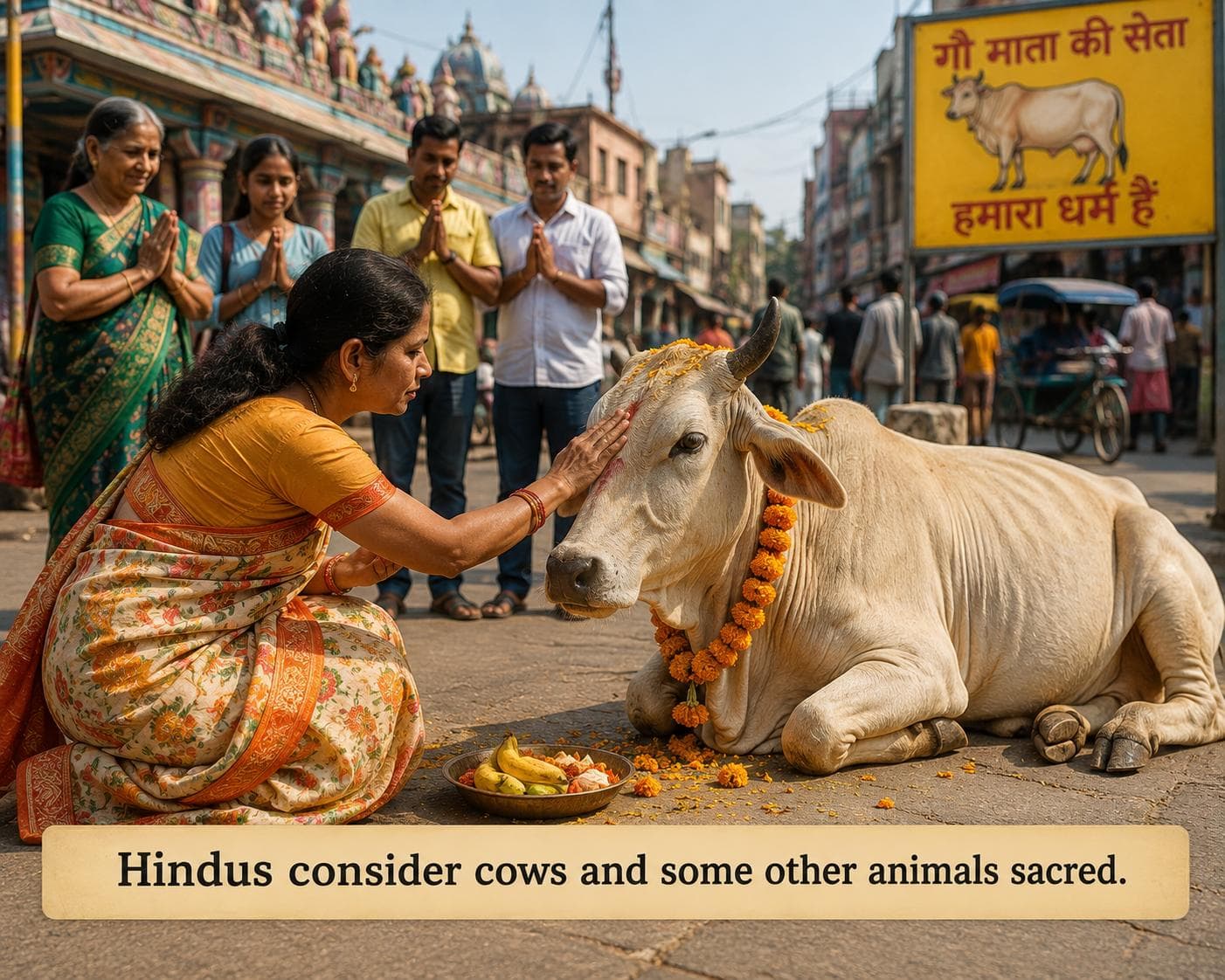
“I had heard that some people in India worship animals. But my father told me that you don’t worship them. You just treat them with special respect.”
“According to Hindu teachings, some animals are considered very sacred,” Mr. Akal said, “but we don’t worship them. We Hindus worship the one who created the universe.”
“How do you worship him?” Sina asked.
“To worship a god means to remember him, ask him for help, and live according to the teachings and ways of life he has shown us.”
“How does he give you his teachings?”
“In the past, he came to Earth several times in earthly forms. He taught many truths and showed people the right way to live.”
“What did this god say when he came to Earth?”
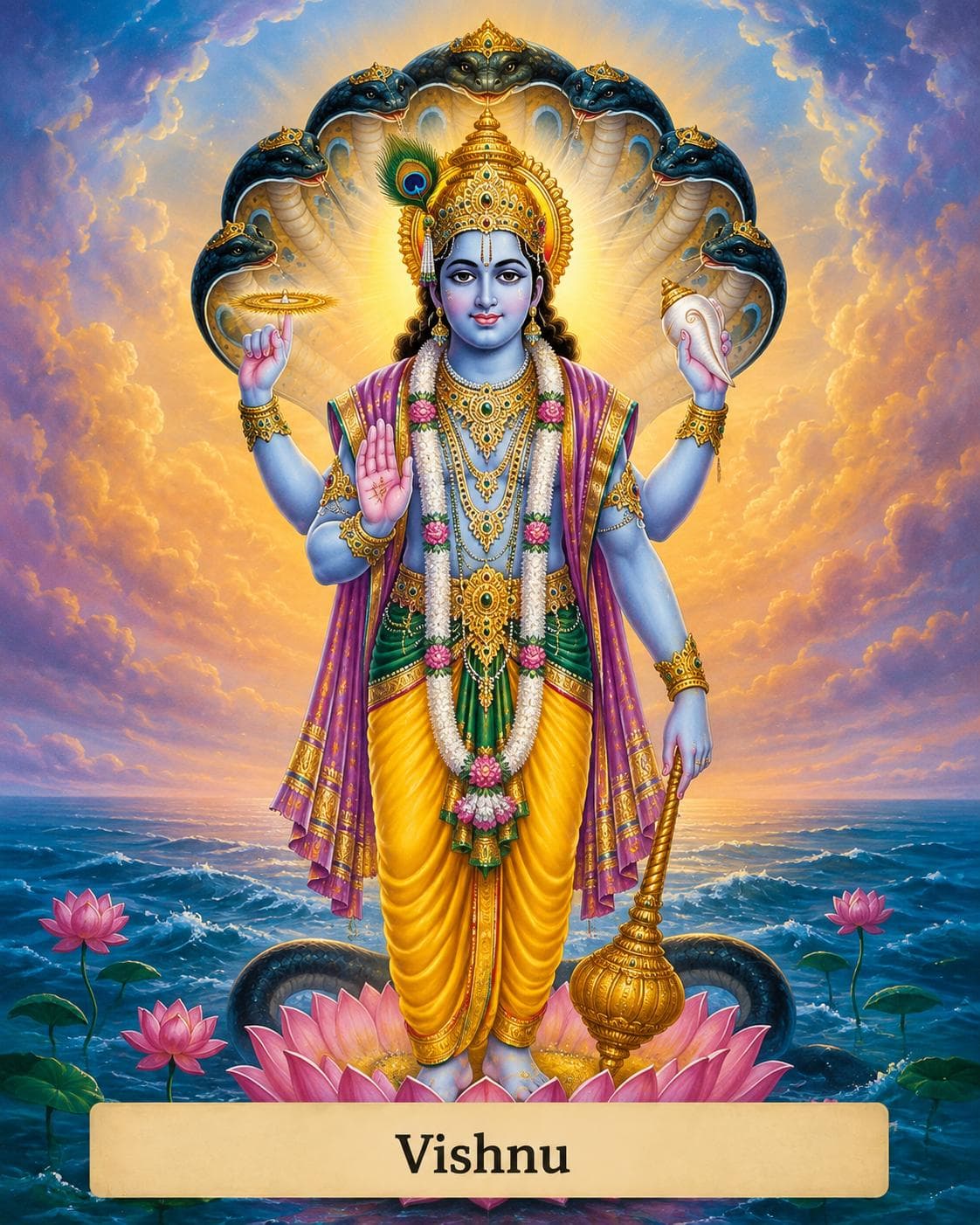
“He taught that the true reality—the reality that existed before everything else, exists in everything, will remain after everything else, and is the source of everything—is Vishnu himself. Vishnu is the great Brahman.”
“Brahman?” Sina asked.
His father said, “Brahman means the ultimate reality and source of everything. In Mr. Akal’s branch of Hinduism, Vishnu is believed to be this supreme reality.”
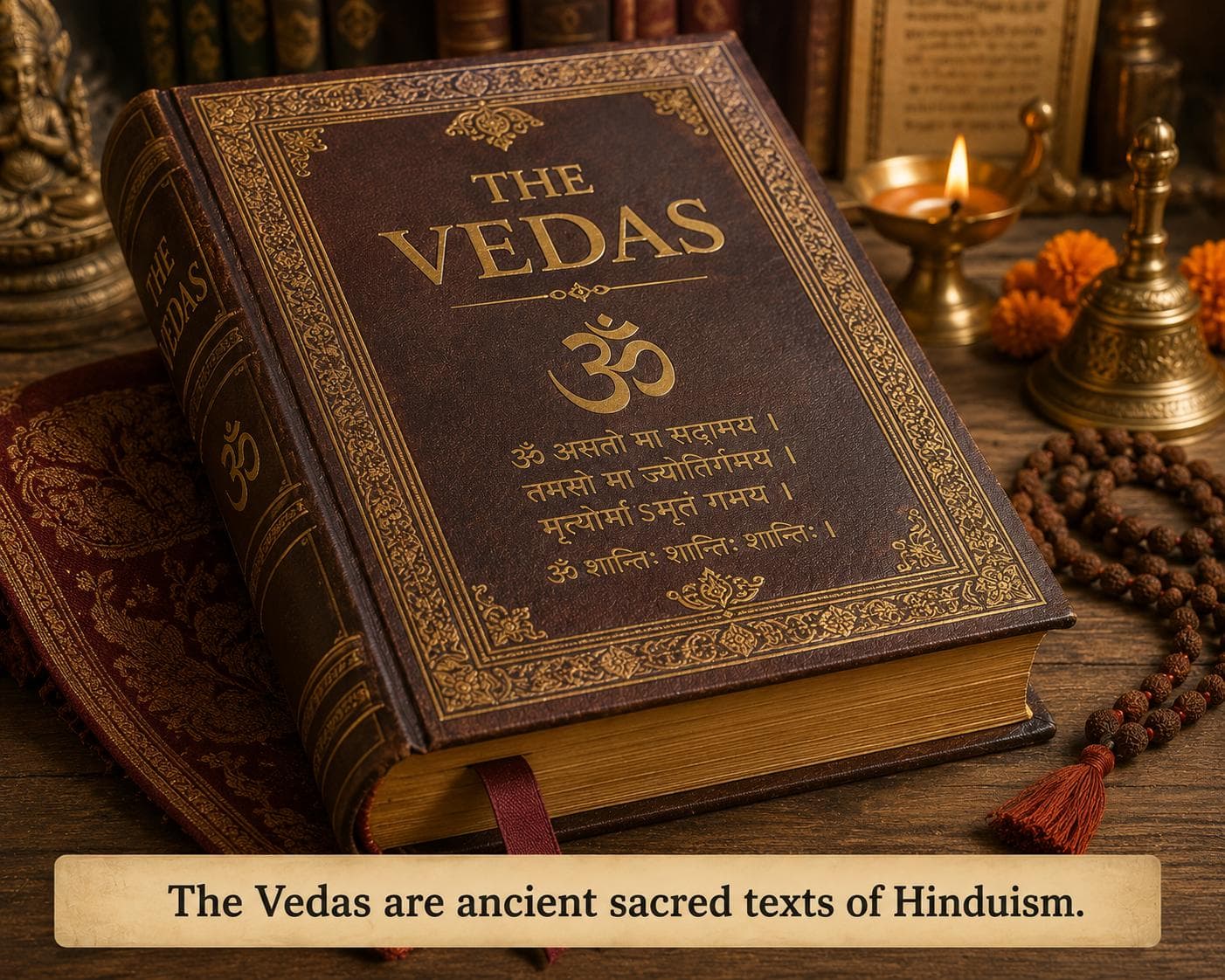
Mr. Akal continued, “Vishnu has appeared on Earth in different forms. We call these earthly forms of Vishnu avatars. Wise people passed down his teachings, and we also have ancient sacred writings called the Vedas and the Puranas.”
“Do these writings still exist?” Sina asked.
“Of course they do. The Vedas contain ancient hymns, prayers, and religious teachings. The Puranas contain stories about the gods, the universe, kings, heroes, and great religious figures. We also use some of the prayers and hymns from the Vedas in our worship.”
“What do the Vedas and Puranas say about how the universe came into being?” Sina asked.
“According to our ancient teachings, the universe is created and destroyed again and again. One day in the life of Brahma lasts 4.32 billion human years. During this enormous period, worlds exist and are eventually destroyed. Then comes Brahma’s night, which lasts another 4.32 billion years. After that, creation begins again.”
“Does Brahma create the universe, or does Vishnu?” Sina asked.
“Brahma is the god who creates the worlds, but Vishnu is above him. You could say that Brahma carries out Vishnu’s work of creation. Unlike Vishnu, Brahma does not live forever. His life lasts an incredibly long time—about 311 trillion human years. During that time, he creates the worlds again and again. When his life finally ends, another Brahma takes his place and continues the work.”
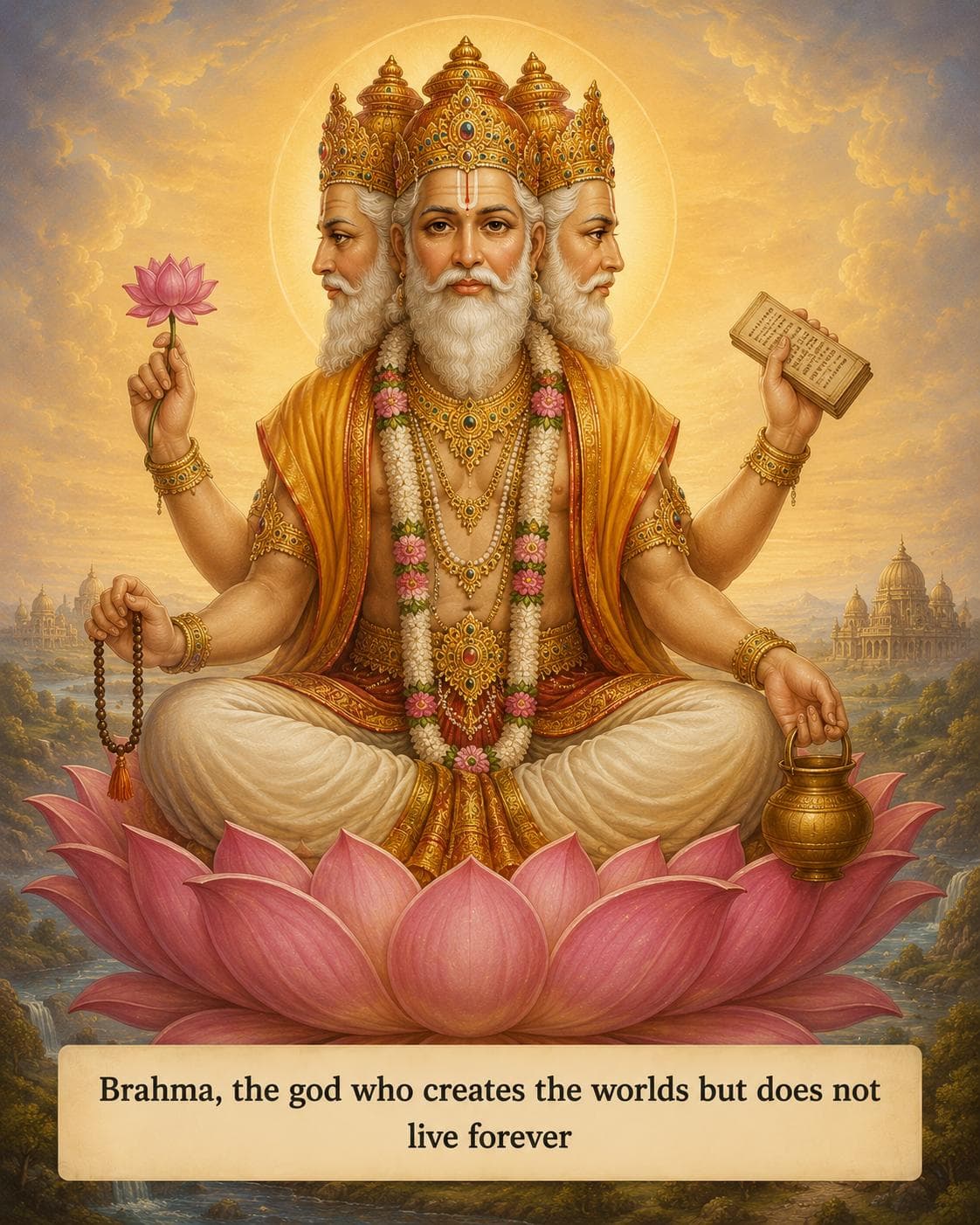
“So, if I understand you correctly,” Sina said, “you believe in an all-powerful and eternal Supreme Being called Vishnu. Vishnu brings Brahma into existence, and Brahma creates the worlds. But even Brahma’s life eventually comes to an end.”
“Yes, exactly,” Mr. Akal said. “Time itself also passes through four great ages.
“Vishnu has appeared in our world in different earthly forms. According to a well-known tradition, there are ten major avatars of Vishnu. Two of the most important are Rama and Krishna. Their stories are told in our sacred writings.”
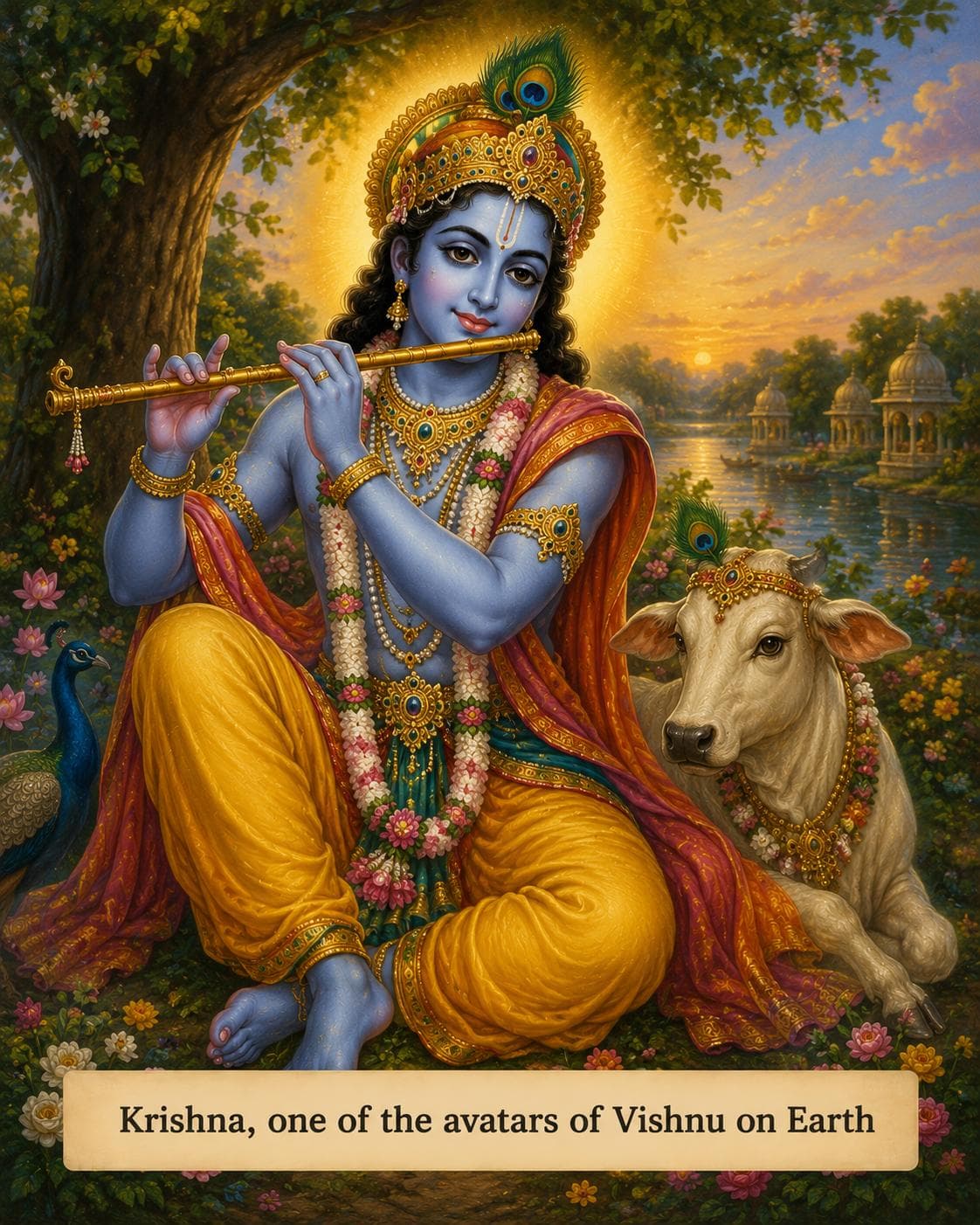
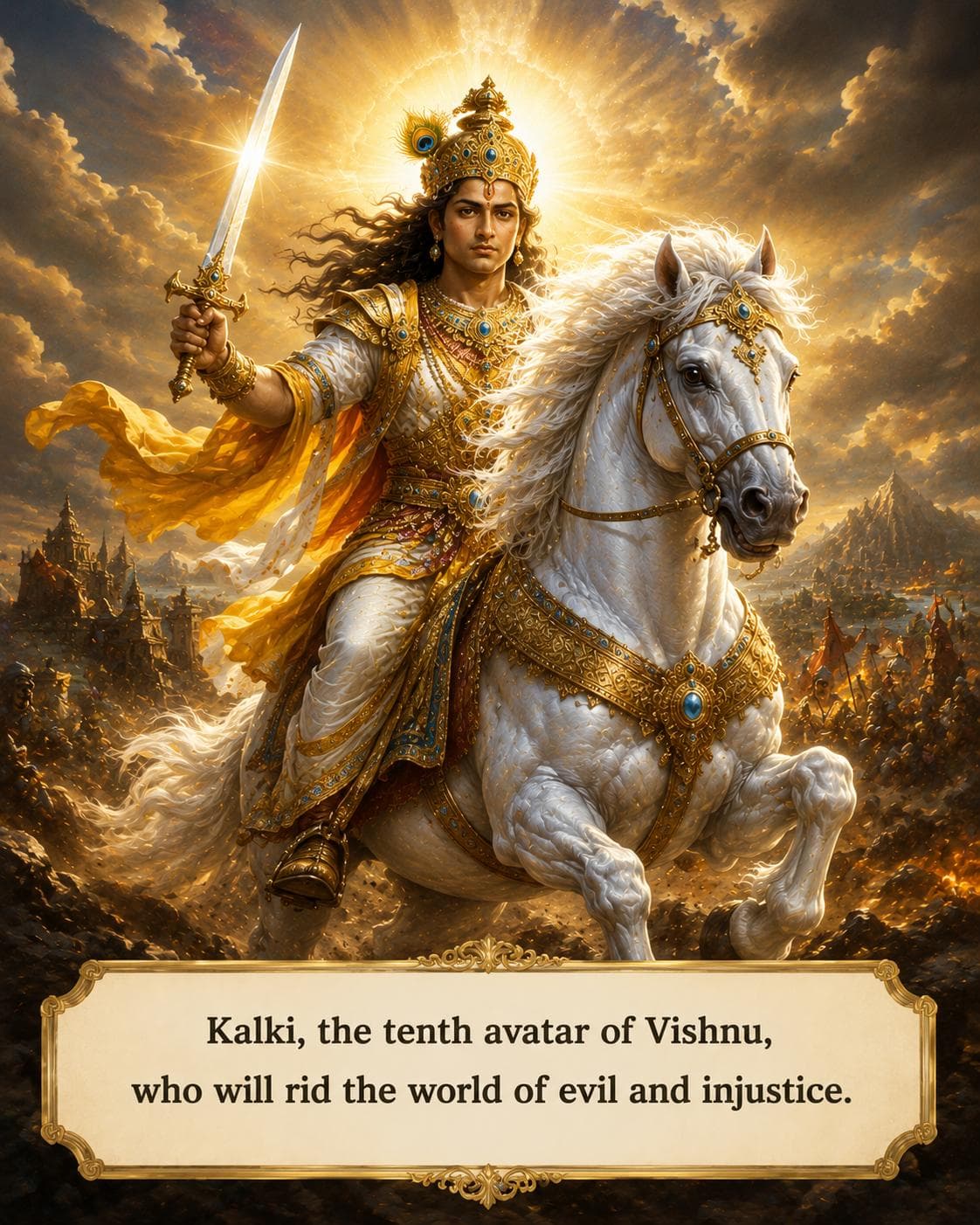
“The tenth avatar will be a man called Kalki. He will come riding a horse and carrying a sword. He will fight evil, cruelty, and wicked people and restore goodness and justice to the world.
“Then a new Golden Age will begin. It is called Satya Yuga and lasts 1,728,000 years. After that come three other ages. The last is a dark age, and when it ends, the cycle begins again with another Golden Age.”
Sina looked very surprised.
“But Jainism says something completely different about the universe. It says that the universe was never created and will never be destroyed. Are you sure that what the Puranas say is true?”
Mr. Akal’s younger brother had been silent until now, listening eagerly to his brother. He answered Sina.
“When a god came to Earth as an avatar and gave us the Vedas and the Puranas, the wise men of the chosen Aryan people wrote down his words. Since then, many Hindus have memorized these texts. Some people who memorized all the Vedas and Puranas were even younger than ten years old. Not a single word of these sacred texts has changed in the last six thousand years.
“When the Mughals and the British ruled India, they tried to change them, but they could not. Don’t you think that this itself is evidence that Hinduism is true?”
“You said ‘the chosen Aryan people,’” Sina said. “Chosen for what? Are only Aryans supposed to be Hindus?”
“No. Hinduism is the true religion for the whole world, and its teachings and ways of life are meant to bring happiness to everyone. But the Aryans were chosen to be the first people to receive this religion. Its truths were given to their wise men so that, through them, all the people of the world could learn the truth.”
“What teachings and ways of life does your religion have?” Sina asked.
Mr. Akal said, “There are eternal rules, or an ‘eternal way,’ that all Hindus must follow, no matter which caste they belong to. These include honesty, not harming living things, purity of intention, goodwill, kindness, patience, forgiveness, generosity, and giving up worldly pleasures.”
“I know that giving up worldly pleasures means staying away from the pleasures of this world,” Sina said. “That was considered good in Jainism too. I understand the other things you mentioned. But what does ‘caste’ mean?”
“Hindu teachings divide society into four castes, or classes,” Mr. Akal explained. “The first is the Brahmins, the religious leaders. The second is the rulers and warriors, whose duty is to govern and protect society. The third includes merchants, landowners, farmers, cattle owners, and moneylenders. The fourth consists of people who serve the other three classes.
“This division is described in the Vedas. People born into one of these classes should not do the work of another class, and they should not marry people from another class.
“Our actions and the karma we collect in this life determine which class we will be born into in our next life.
“There are also people outside these four classes. They have been called ‘untouchables,’ or Dalits. The Indian government is trying to end the caste system, but religious Hindus believe that it is part of the teachings of their religion.”
Sina looked a little upset.
“So if someone is born a Dalit or into the servant class and wants to work hard to get a better job or a better position in life, Hindus stop them?”
“Yes,” Mr. Akal’s brother said. “Moving into another class is against the teachings of Hinduism.”
“How do you stop them?”
Mr. Akal answered, “In the past, when the rulers and kings were Hindus themselves, they made laws that prevented people from moving from one class to another. But now that the government is against the caste system, Hindu believers themselves have to make sure that people from lower classes are not given the jobs of higher classes or allowed to marry their children.
“Of course, religious Hindus are satisfied with the class they are born into and don’t try to enter the professions of a higher class.”
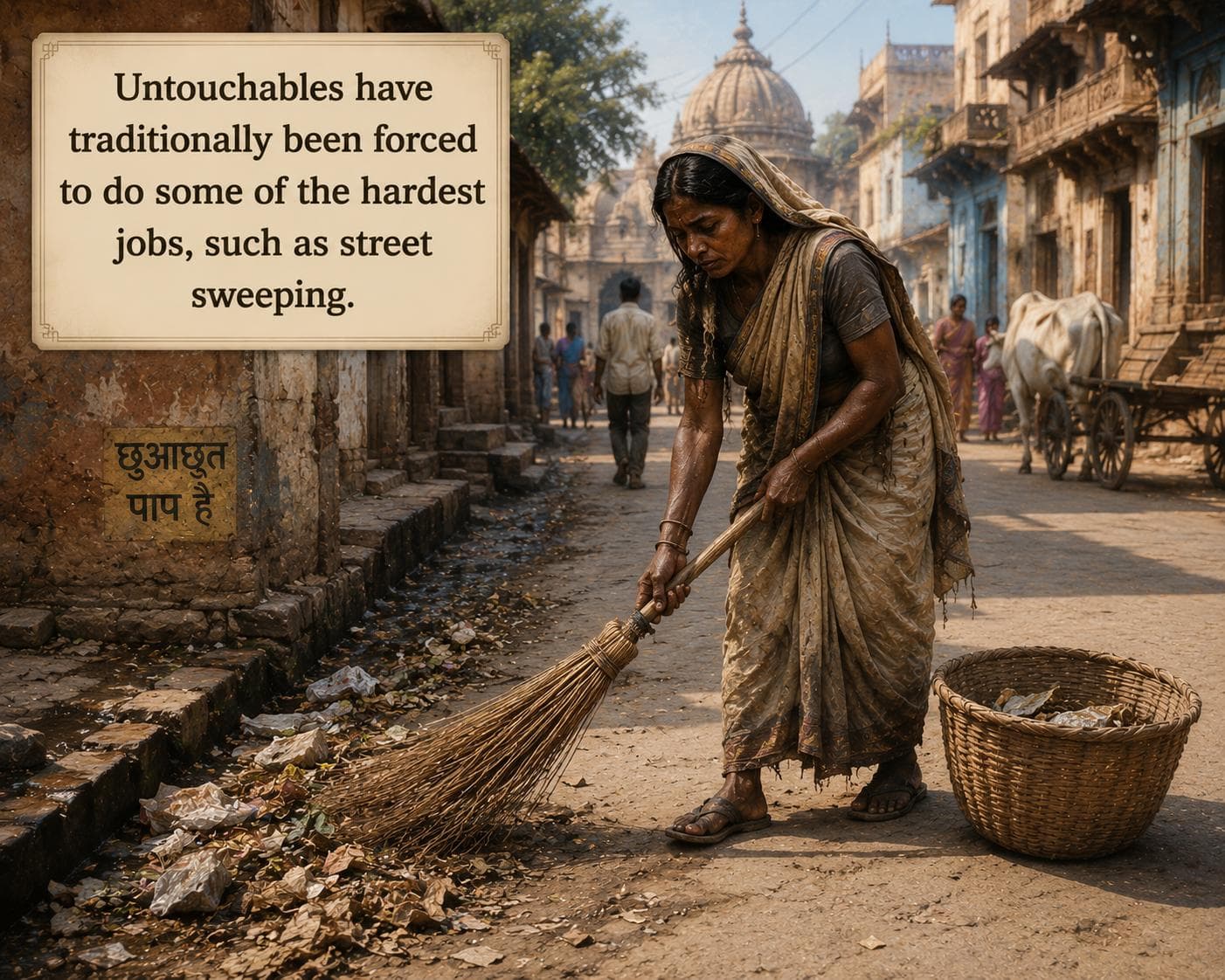
“How many people belong to the lowest group, the Dalits or untouchables?” Sina asked.
“About sixteen percent of India’s population,” Mr. Akal replied. “That means around two hundred million people.”
“But when you told me about the teachings of your religion—the ‘eternal way’—you talked about forgiveness, generosity, and not harming living things. Isn’t this hurting a human being who hopes to improve their life and wants to be happy in this world?”
Mr. Akal’s brother replied, “That person’s life is the result of the karma they have earned. We must not interfere with Vishnu’s work, because we cannot understand his wisdom or his reasons.”
“What happens if you do interfere and help that person?”
“Going against the teachings of the Vedas increases our bad karma.”
Sina thought for a moment.
“I thought Hindus liked and followed the teachings of Hinduism because all those teachings were good. But now it seems that they follow whatever the Vedas tell them to do because they want to gain good karma.
“For example, if they are told, ‘Stop two hundred million people from improving their lives, and you will gain good karma and be born into a better class in your next life,’ then they do it, even if those people suffer, lose hope, or become unhappy.
“And if the Vedas say, ‘Don’t hurt animals. Be kind to them,’ everyone follows that teaching and feels proud that their religion teaches something good. But suppose the Vedas also said, ‘Don’t let sparrows have nests.’ Would they destroy the sparrows’ nests to gain good karma, even though the poor birds would suffer?”
Mr. Akal stared at the ground. After a few seconds, he said, “I think Hinduism has been interpreted incorrectly on this matter. I don’t really agree with the caste system myself.”
His younger brother looked upset.
“But brother! It is a religious teaching. The Brahmins, who are our religious scholars, approve of it too. Surely following it must be better for all of us. Our own thinking cannot be wiser than what the gods have told us. They know what is best for us, and they want us to be happy.”
Sina asked, “If Vishnu wanted to teach the right way of life to everyone in the world through the Aryans, why didn’t he succeed?
“I guess most Hindus live in India. If I’m right, that means he didn’t achieve what he wanted. You said your sacred texts were given to people six thousand years ago, but even until about thirteen hundred years ago, many people in India were Jains. And even today, Iranians, who are also Aryans, know very little about Hinduism.
“If people’s happiness is so important to Vishnu that he is willing to come to Earth himself, and even fight to bring about the Golden Age, wouldn’t it have been better for him to show himself clearly to people everywhere and in every age, so that everyone could share in that happiness?
“After all, you believe he has already done this several times for some people on Earth, so it cannot be impossible for him.
“At least that would settle the disagreement between you and your brother about whether the caste system is right. Vishnu himself could tell people what they should do today.”
Mr. Akal’s brother replied, “We don’t know why Vishnu and the gods don’t do what you suggest, and we don’t interfere in the decisions of the gods. But perhaps people today have enough intelligence to find the true religion and the right way to live, so Vishnu sees no reason to come to Earth again.
“He still guides people indirectly through the Brahmins. Even today, if people want to know which religion is true and whether Vishnu is the true God, they only need to look at the good teachings of our religion and all the miracles in it.”
“What miracles?” Sina asked.
“Isn’t it a miracle that thousands of years ago our sacred texts said that one great cycle of the world lasts 4,320,000,000 years? That number is very close to the age scientists now estimate for the Earth—about 4,500,000,000 years.”
Sina looked at his father in surprise.
“Dad, if that’s really true, it’s amazing, isn’t it?”
His father replied, “The 4.32 billion years mentioned in the Hindu teaching we have been discussing is a period in a cosmic cycle. It is not an estimate of the age of the Earth. Scientists estimate that the Earth is about 4.54 billion years old, while the universe is about 13.8 billion years old.”
Mr. Akal said, “There have been miracles in Hinduism that cannot be doubted and that many people know about. One example is the miracle of a man named Nambi Andar Nambi, who lived about a thousand years ago. His father was a priest at a small temple of Ganesha in southern India.
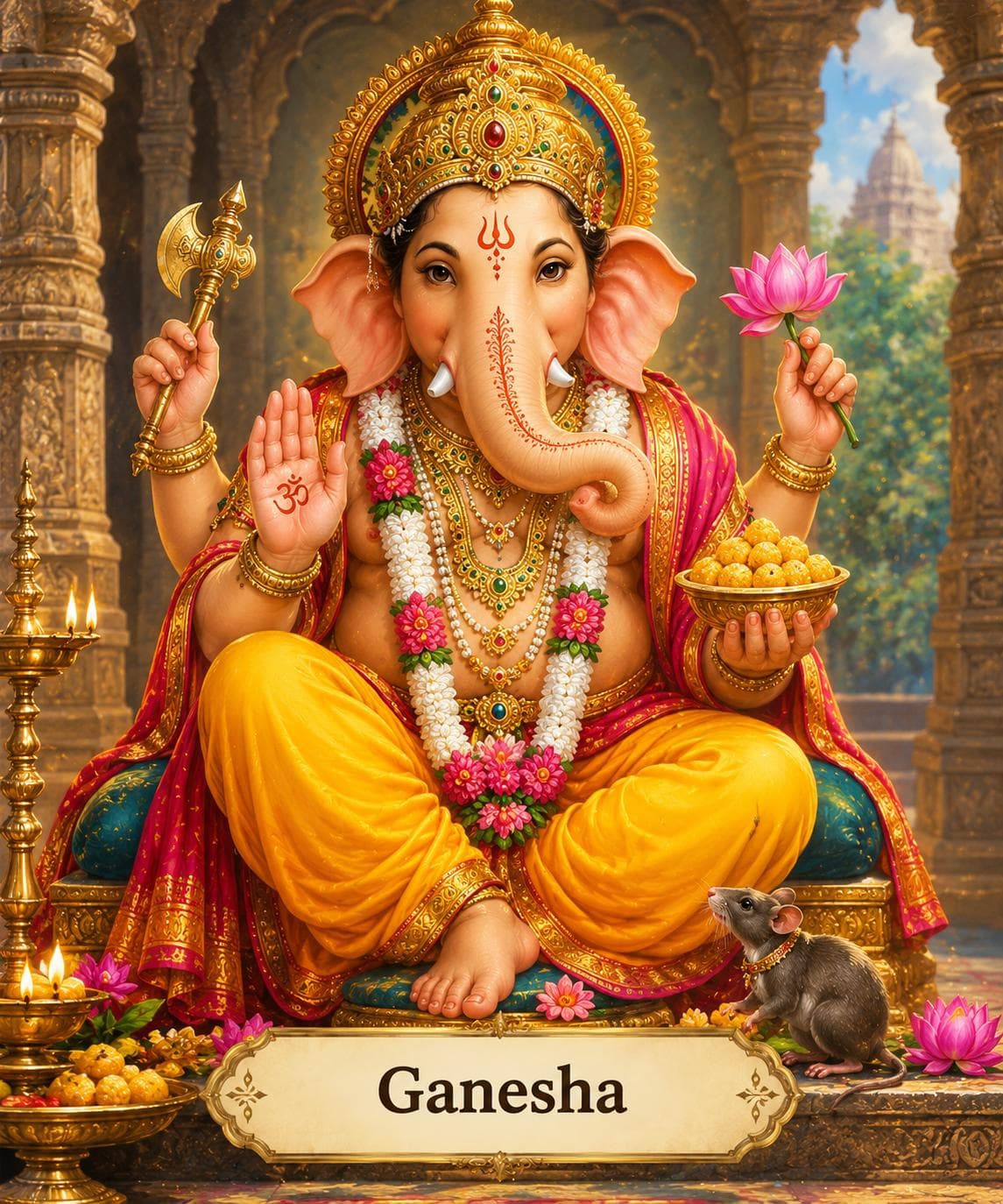
“Ganesha is one of the gods whom we believe helps people with the problems and difficulties of this life. People pray to him to remove obstacles from their lives, and they offer food to him.”
“Does that god live and eat food like us?” Sina asked.
“He is alive, but not in the same way we are,” Mr. Akal replied. “We believe that we should prepare food from plant ingredients, without meat, eggs, or fish. We prepare it ourselves, and while we are making it, we keep our minds focused on God and remember him in our hearts.
“We should not taste the food while preparing it to see if it tastes good. What we think and feel about God while making the food gives it a spiritual quality and makes it pleasing to him.
“Then we place the food in front of the statue of our god, and he is the first to taste it. We cannot see how he does this, but we have faith that he tastes it. After that, we can eat the food ourselves.
“In this way, ordinary food becomes spiritual food. It increases our good karma and brings blessings into our lives.”
“It seems that karma is very important to Hindus,” Sina said.
“Karma not only determines what kind of life we will have in our next birth,” Mr. Akal said. “It also affects what kinds of good or bad things we will do in that life.”
“So someone with good karma will do good things, and someone with bad karma will do bad things. Is that right?”
“Very good! You’re a clever boy.”
“Then if someone does good things now, that shows that he collected good karma in the past. And if he collected good karma in his previous life, that must have been because he had collected good karma in the life before that.
“If so, you can’t really blame someone for doing something bad. He does bad things because of the bad karma he collected before. And that bad karma came from bad things he did in an even earlier life. This chain goes back into a past with no beginning. So in the end, it isn’t really up to him what he does now.”
“No, my boy, it isn’t quite like that,” Mr. Akal said. “We also have free will. We are free to do something bad or not to do it. We are not forced to do bad things.”
“So which one decides what we do—our karma or our free will?”
“It is something between the two.”
“I don’t understand.”
“These are complicated questions that great Vaishnava philosophers have dealt with,” Mr. Akal said. “In recent decades, Vaishnava religious thought and philosophy—what we call Vaishnava theology and philosophy—have even been taught at some European universities, such as Oxford.”
“So you don’t believe in heaven and hell after all,” Sina said. “People simply receive the reward or punishment for what they do through the kind of life they are born into next.”
“We have heaven and hell too,” Mr. Akal replied. “When a human or an animal dies, its soul is taken to the world of the dead. Yamaraja, the ruler of the world of death, rules there.
“Yamaraja’s servants bring the dead person’s soul before him, and the person’s good and bad deeds are read out. Yamaraja then decides whether the soul should be sent to Svarga Loka, the heavenly world, or Naraka Loka, the hellish world.”
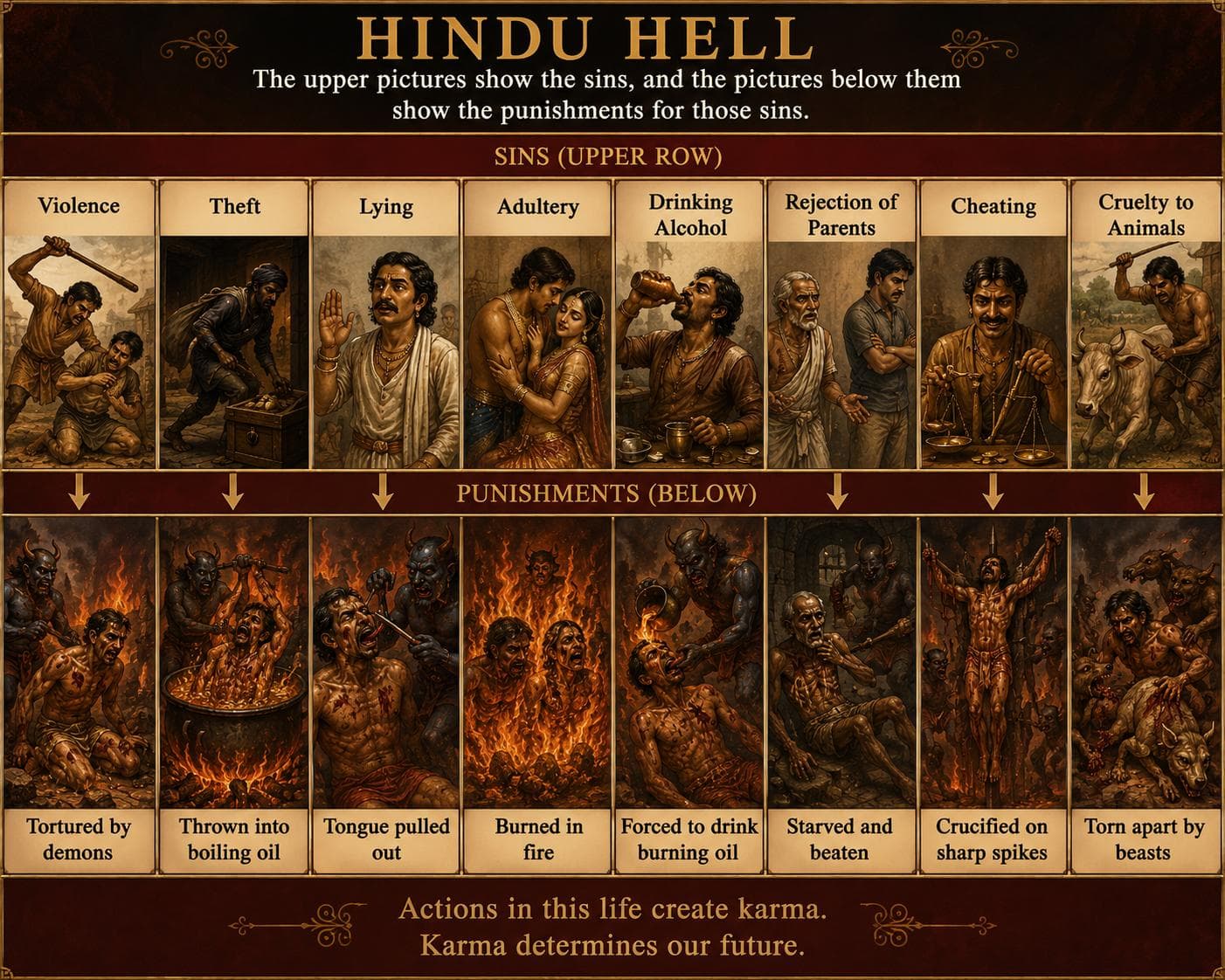
“Since almost everyone commits some sins during life, a person’s soul usually spends at least a short time in hell. After being cleansed of those sins, the soul goes to heaven.
“Only three groups do not go to hell: holy people who have spent their whole lives worshipping, people who die in holy places, and those who have reached moksha—freedom from being born again.
“After the souls of the dead have received the rewards for their good deeds and the punishments for their bad ones, they are born again in a form and situation that match their karma.”
“Please continue the story about Nambi,” Sina said.
“Yes. One day, Nambi’s father had to go to another village, so he asked Nambi to perform the puja1 for Ganesha at the temple in his place.
“Nambi tried to perform the worship as well as he could. But somehow he felt that Ganesha was not eating the food he had offered him. Nambi was heartbroken. He cried and cried and began hitting his head against the temple wall.
“Suddenly, the statue of Ganesha spoke and told him to stop. Then Ganesha began eating the food.
“Nambi was delighted when he saw the food in front of Ganesha disappearing. He asked Ganesha to teach him everything he needed to know about religion, and Ganesha did.”
“I suppose Nambi himself told other people this story,” Sina said. “Do you think we should believe him?”
Mr. Akal’s brother laughed.
“Actually, when Nambi’s father returned and Nambi told him what had happened, his father didn’t believe him either. So he went to the temple himself and saw with his own eyes that Ganesha was eating the offered food.
“Later, Nambi became one of the best-known religious figures at the court of King Rajaraja Chola. He is a historical person, so there can be no doubt that this event really happened.”
“What does ‘a historical person’ mean?” Sina asked his father.
“It means someone who really existed,” his father explained. “His name and the time when he lived are mentioned in historical sources studied by historians. In other words, the person himself is not just a character from a legend.”
Mr. Akal continued, “There are many more miracle stories in Hinduism. For example, about seven hundred years ago, a man named Jnanadeva placed his hand on a buffalo, and the animal recited verses from the Vedas for a whole hour. Many people saw it with their own eyes. After that, both Jnanadeva and the buffalo were honored and treated as sacred. Today, the shrine of the buffalo and a statue of Jnanadeva in the town of Alandi are visited by pilgrims.”
Sina said, “I’m not saying that people like Nambi or Jnanadeva didn’t really exist. But I can’t easily believe that such strange things really happened to them.”
Mr. Akal’s brother looked a little upset.
“Do you mean that all those respected and trustworthy people, great scholars and Brahmins who spent their lives worshipping, doing good deeds, and trying to keep their thoughts and actions free from dishonesty and impurity were lying? Do you think the wise men who collected Vishnu’s words in the Vedas and Puranas, and who were known for their honesty and trustworthiness, wanted to deceive people?”
Sina shrugged.
“I don’t know. But when I was very young, my father used to tell me that a horned monster walked through the streets at night and carried away children who went outside alone. He told me this so I wouldn’t want to leave the house by myself at night. He insisted that the story was true, and I trusted him, so I believed it.”
Sina’s father laughed.
“I have to admit that I no longer think it’s right to tell children stories like that. But at the time, I only wanted to protect Sina, even though I knew I wasn’t telling him the truth.”
Sina said, “I still find it strange that respected people whom others trust would tell them something that isn’t true. I was surprised when I found out that my father had done that to me.
“But it seems much, much stranger to me that a buffalo could talk for an hour, or that a statue could eat food and make it disappear. My mind tells me that, between these two possibilities, I should believe the one that is less strange. And the less strange possibility is that a respected person made up a story because he thought it would be good for people. I’ve seen that kind of thing happen many times.”
Mr. Akal’s brother looked unhappy. He said nothing more and stared at the floor, quietly whispering what sounded like religious prayers.
Mr. Akal smiled at Sina.
“Look, my boy. There are three worlds. The first is Bhuloka, the earthly world, where we live in physical bodies. The second is Antarloka, the inner world, which belongs to good spirits and higher beings. The third is Brahmaloka, the world of God and the gods.
“All these worlds exist together and within one another. But in our ordinary lives, we are aware only of the earthly world. We do not see the greater reality of the other two worlds, even though they exist within and around our own world.
“The beings of those other worlds—good spirits and gods such as Ganesha and the other 330 million gods of Brahmaloka—help us humans grow and develop in complicated ways that we cannot see. But sometimes we can clearly see the results of what they do.
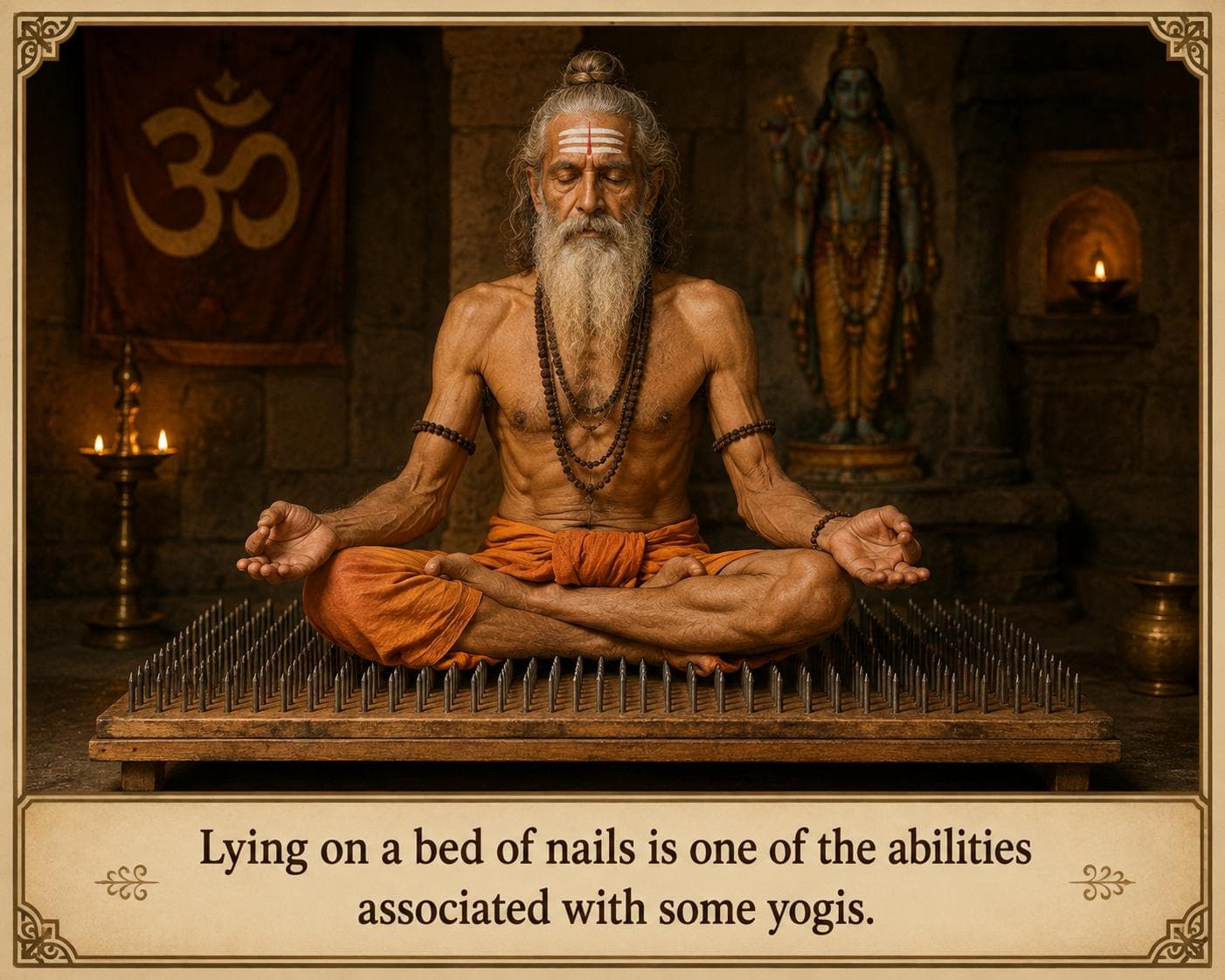
“In its simplest form, this may be a prayer being answered when someone is in need, or a person suddenly knowing about a danger before it happens. More advanced examples can be seen in the powers of yogis, great Hindu holy men. These powers are called siddhis. For example, yogis can disappear, fly, see the past and the future, enter other people’s bodies, and control things.”
“Miracles such as the ‘Milk Miracle,’ which everyone saw, happen through the direct action of a god, without anyone even asking for a miracle.”
As Mr. Akal spoke, his brother seemed to feel better. He looked at Sina and his father again. His smile had returned, and he waited to see how Sina would react to what his brother had said.
“Have you ever seen yogis or Hindu holy men do any of these things yourself?” Sina asked.
“I haven’t seen them myself,” Mr. Akal replied, “but many people around me whom I trust have told me that they have.”
Mr. Akal’s brother spoke excitedly.
“I have seen something myself. Once, I saw the spirit of a holy man enter the body of one of my friends and take control of him. My friend began doing things he had never done before and saying things he had never said before.
“And after two months of living like a holy man—fasting, meditating, and repeating sacred words—I began to see things that I could never have believed before. Many times, while I was somewhere between sleeping and waking, I was able to speak with Vishnu. Vishnu showed himself to me and told me truths about Hinduism.”
Mr. Akal confirmed that his brother had had these experiences. He said there was little point in describing such experiences to someone who had never experienced them personally.
Sina looked very surprised.
“What is the story of the Milk Miracle?” he asked.
Mr. Akal closed his eyes for a few seconds and then said, “Yes. I will never forget that date. It was September 21, 1995. Before sunrise, a Hindu man at a temple here in Delhi brought some milk to offer to a statue of Ganesha.
“Besides being the god who helps people overcome problems and obstacles, Ganesha is also the god of art, knowledge, and wisdom. Artists and scholars also ask him for help with problems in these areas. He has shown so many miracles and signs of greatness that even some Jains and Buddhists pray to him.”
Sina listened to Mr. Akal’s story with great interest.
Mr. Akal continued, “The man held a spoonful of milk from the bowl next to the statue’s trunk and saw the milk disappear.”
“Trunk?” Sina asked in surprise.
Mr. Akal laughed. “Yes, a trunk. Ganesha came to Earth with a human body and the head of an elephant, so his statues are made that way too.
“By noon, news of what had happened had spread everywhere. People discovered that statues in Hindu temples all across India were drinking the milk offered to them.
“The news soon spread outside India too. Hindu temples in the United States, Britain, Canada, the United Arab Emirates, and Nepal reported the same thing. Milk sales rose sharply in Hindu communities, and people stood in lines hundreds of meters long outside temples to try the miracle themselves.
“People from every part of society confirmed the miracle—from ordinary people to doctors, lawyers, and engineers. Some were deeply religious, while others had only weak religious beliefs. Ganesha accepted offerings from Christians, Muslims, Sikhs, and atheists too.
“News cameras around the world began showing the event live. I think your father must remember it.”

Sina turned toward his father with his mouth open in surprise, waiting to hear what he would say.
His father looked at Sina’s surprised face and then turned to Mr. Akal.
“Yes, I remember it. As far as I remember, scientists from India’s Ministry of Science were sent to a temple in Delhi to investigate. They added some coloring to milk and held a spoonful of it next to a statue.
“As the level of milk in the spoon went down, they saw that the part of the statue below the spoon became covered with the colored milk. They believed that the effect was caused by capillary action, which results from forces between the molecules of a liquid and the surface of a solid object. Capillary action is the same physical effect that helps water move through very narrow spaces, such as the tiny tubes inside plants.
“In fact, when they held a spoonful of milk against a solid surface—especially one that was already wet—some or all of the milk could be drawn from the spoon onto the surface, depending on the material. Gravity would then pull the milk downward.
“Of course, this explanation did not change the minds of Hindu believers, but little by little, the lines became shorter.”
Sina frowned slightly.
“Mr. Akal, when you told the story, I thought the statue was making a large amount of milk disappear. The way you described it could easily make me—or anyone else in my place—believe it was a miracle. And because you are an educated and respected person, I might trust what you say and then believe that Hinduism is the true religion and that Ganesha or Vishnu are the true gods of this world.
“But after just a few short explanations from my father, what seemed like a miracle to me became a simple scientific event.
“If my father weren’t here, maybe I would become a Hindu tonight!
“Don’t you think something similar might have happened to the stories about Nambi or the buffalo reciting the Vedas? Maybe a simple event changed as the story was told and eventually became a miracle.”
Mr. Akal waved his hand from side to side.
“No, not at all. I can explain the Milk Miracle too.”
Just then, the widow of Mr. Akal’s late brother came into the room and said that dinner was ready. Then she left.
Everyone got up for dinner, and Hinduism was not discussed again for the rest of the evening. Mr. Akal invited Sina and his father to the wedding of another one of his brothers, which would take place two nights later.
As Sina and his father were leaving, everyone came to say goodbye except the widow of Mr. Akal’s late brother.
The next day, Sina and his father visited a Hindu temple.
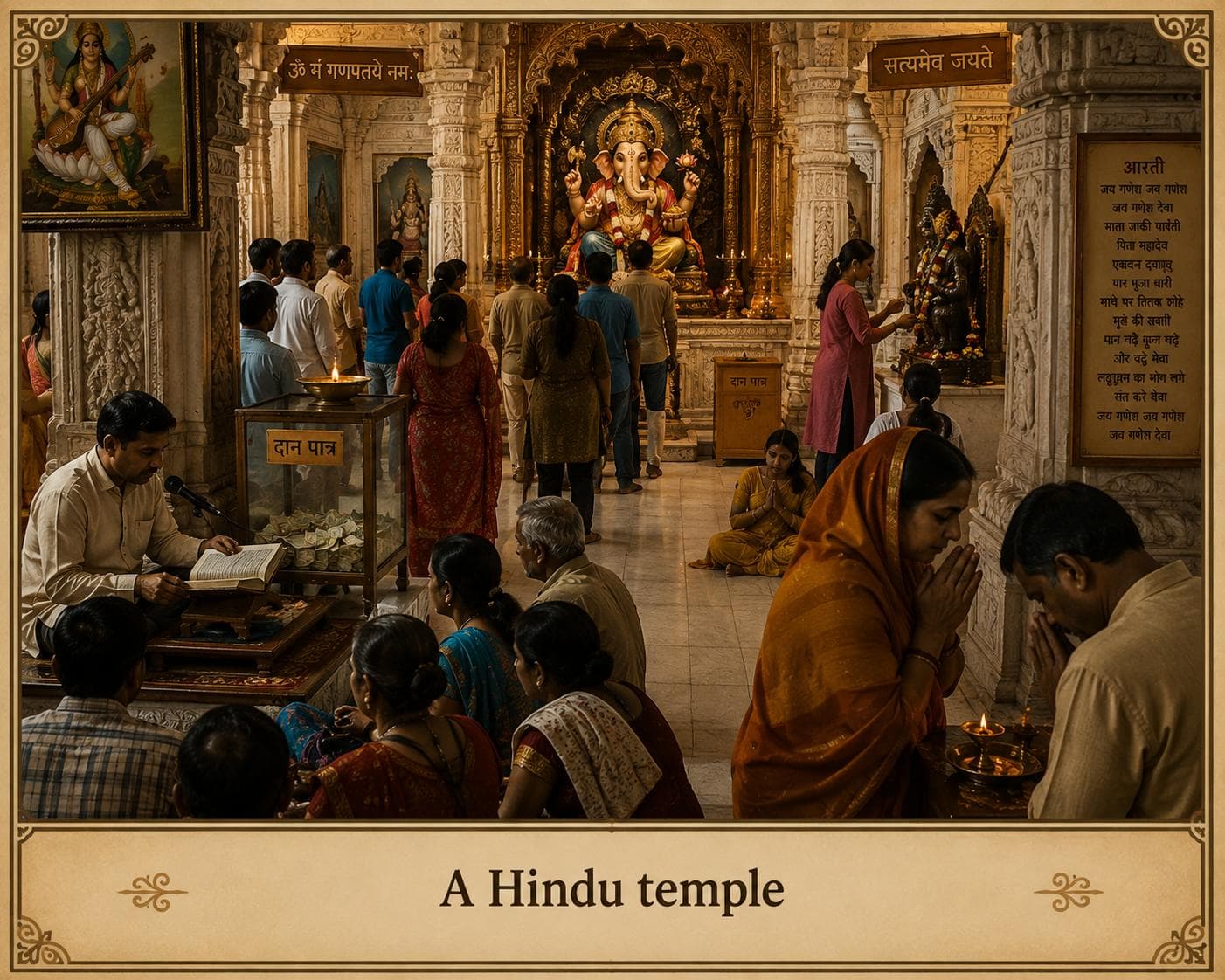
The temple was very clean and smelled pleasant. People took off their shoes before entering. In one corner, a man was reading aloud from a book while several people sat in front of him and listened.
There were several statues around the temple, and people showed respect to them. There was also a glass donation box where people put money.
Some people came in with ordinary expressions on their faces, showed their respect, and left. But others looked deeply sad, as though they desperately needed their prayers to be answered. They stood before a statue and looked at it with pleading eyes.
After visiting the temple, Sina’s father decided to buy an envelope for the money he wanted to give as a wedding gift to Mr. Akal’s brother.
At a shop that sold gift envelopes, every envelope had a one-rupee2 coin attached to it. Sina’s father asked the shopkeeper why.
The shopkeeper replied, “Many Indians believe that even numbers can bring bad luck and that numbers ending in one bring good luck. So when people give money as a gift, they often choose an amount ending in one. That’s why we attach a one-rupee coin to the gift envelope beforehand. People also often put amounts such as eleven rupees into temple donation boxes.”