

Journey into the Heart of Religions by N. Fakhr - HTML preview
Download the book in PDF, ePub, Kindle for a complete version.
Which Came First, the Chicken or the Egg?
Sina’s father came into the room and picked up the globe from the table. He gave it a little spin and stared at one spot on it.
Sina looked up from his schoolbook and asked, “What are you looking for?”
“India. So, son, how was school today?”
“It was good. Oh, Dad! Which came first, the chicken or the egg?”
“Why do you ask?”
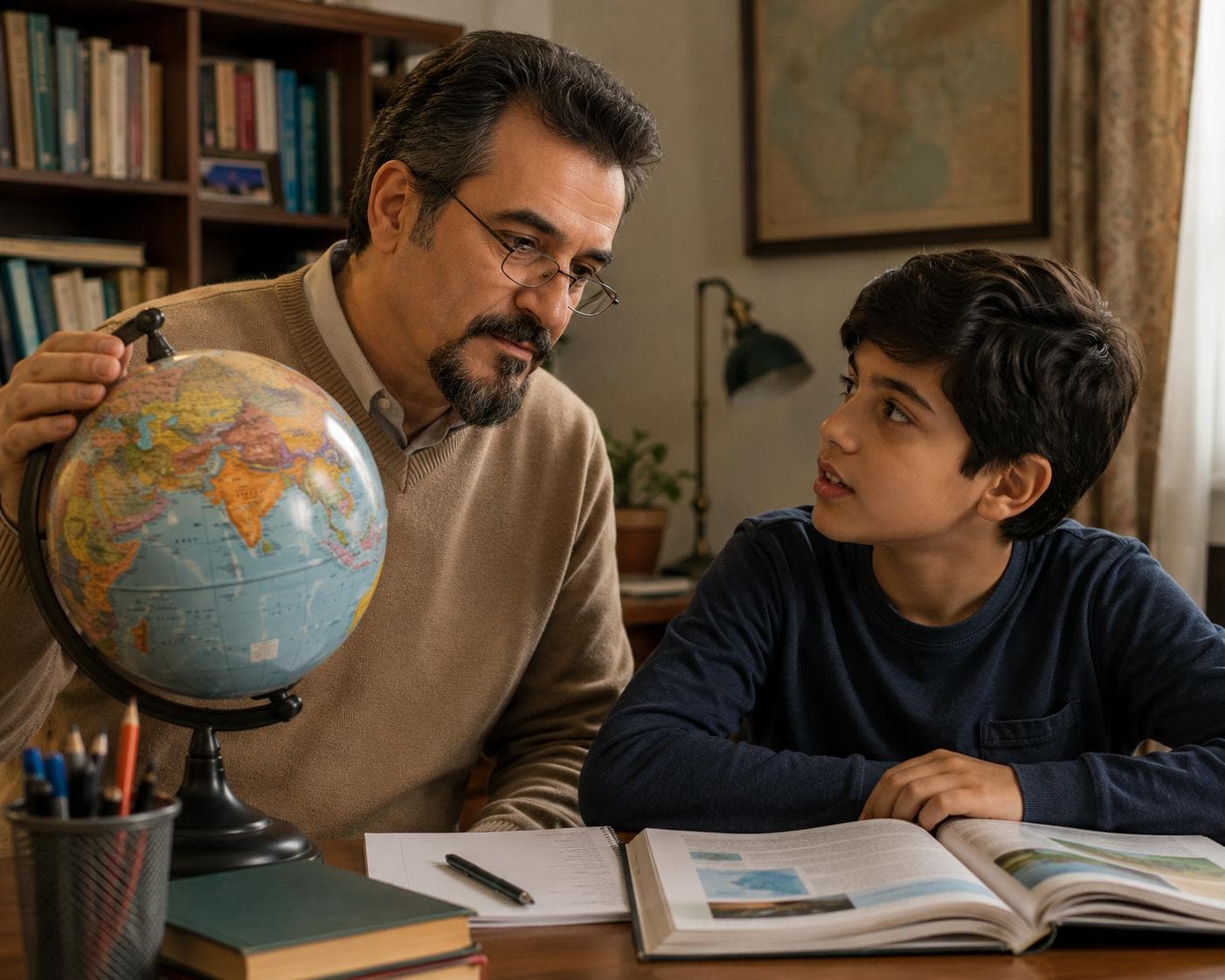
“One of my teachers said today that there are some questions we can never answer, so it is better to just leave them alone. Like the question of which came first, the chicken or the egg. We know that one of them must have come first and produced the other. But it happened so long ago that nobody was there to see which one came first.”
His father stroked his short beard, put the globe aside, and said, “It’s true that there are some questions we may never be able to answer. But I think people give up a little too quickly on this particular question. I think we can answer it.”
Sina closed his book, turned toward his father, and asked eagerly, “How?”
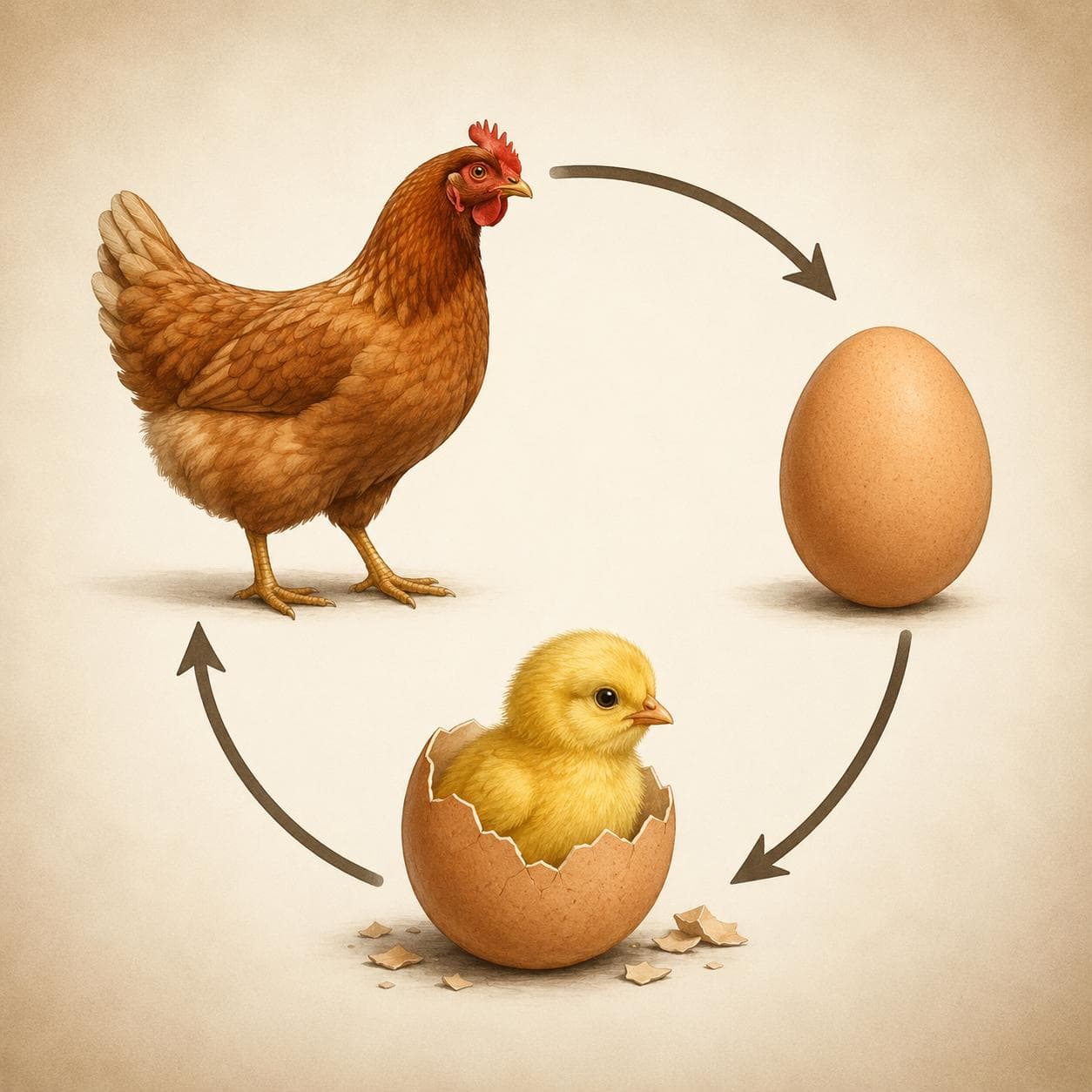
“Well, the question is: ‘Which came first, the chicken or the egg?’ In Persian, the word for a chicken’s egg literally means ‘chicken-egg.’ So a chicken-egg can only exist after there is a chicken to lay it. Otherwise, we wouldn’t call it a chicken-egg. For example, if an egg is laid by a duck, we call it a ‘duck egg,’ not a ‘chicken-egg.’ So there must first be a chicken before there can be a chicken-egg. That means the egg could not have come first. The chicken came first.”
“But the chicken must have come from an egg, and that egg must have been laid by another chicken.”
“That’s the point. A chicken does not necessarily have to hatch from an egg laid by a chicken. It could hatch from an egg laid by another kind of bird. The chick that became the world’s first chicken hatched from an egg, but that egg was not laid by a chicken. It was laid by another bird that looked a lot like a chicken but was not actually a chicken.”
“But the baby that comes out of that bird’s egg should be the same kind of bird as its mother. And when it grows up, it should become the same kind of bird.”
Then Sina smiled and said, “Dad! Are you teasing me, or are you really trying to find a proper answer?”
His father laughed. “I really am trying to find a logical and scientific answer. But first I need to know whether you have heard of evolution.”
“I don’t know what evolution is, or what it has to do with this question.”
“Sina, do you know what a cell is?”
“Yes. A cell is the smallest unit that living things are made of. We learned that in science class, and I’ve seen it in documentaries too. Many living things, such as bacteria, consist of just one cell. The cell divides into two, and each part becomes a new bacterium. Each of the new bacteria is just like the bacterium it came from.”
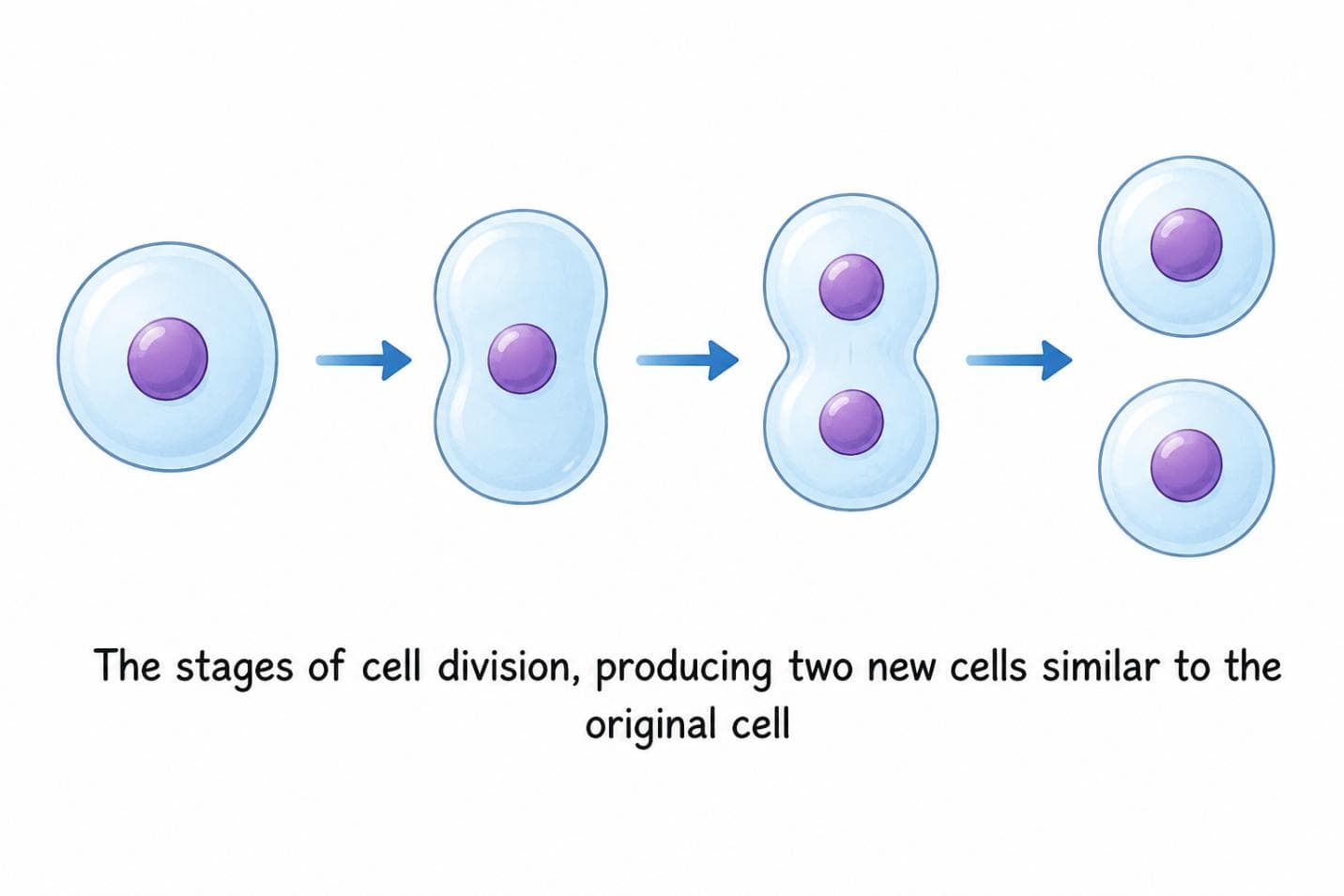
“Very good! You already know the most important things you need to understand evolution. From here, it’s quite simple.
“Sometimes chemicals, strong radiation from the sun, radiation from atomic explosions, or other things can cause changes in cells. When those cells divide and produce new cells, the new cells may not be exactly like the original cell. They may lose the ability to do certain things. For example, they might no longer be able to use some kinds of food they take in from their surroundings. Or they might lose the ability to divide and make new cells.
“These changes in cells, caused by chemicals, radiation, or other things, are called ‘mutations.’ It is as if the cell has changed from its usual form into a new one. We can see the effects of the mutation when the original cell divides and produces new cells. The changes that happened in the original cell then appear in the new cells.”
Sina asked, “So these changes can make the new cells unable to do certain things? Does that mean mutations make the new cells unhealthy?”
“Yes. That often happens, and many mutated cells die. But sometimes a change gives them a useful new ability. For example, some harmful bacteria that used to be killed by a medicine may develop a mutation that helps them survive that medicine. The medicine no longer kills them.
“In that case, the mutation has helped the bacteria. The mutated bacteria are now resistant to the medicine, so their numbers increase. People then have to develop new medicines to kill them.
“As you can see, in this way a new kind of bacterium can appear. It is very similar to the old one and causes the same disease, but it has gained a new ability. So we can say that it has evolved. It can survive, reproduce, and spread. This process is called ‘evolution.’”
Sina asked, “So what does evolution have to do with the chicken and the egg?”
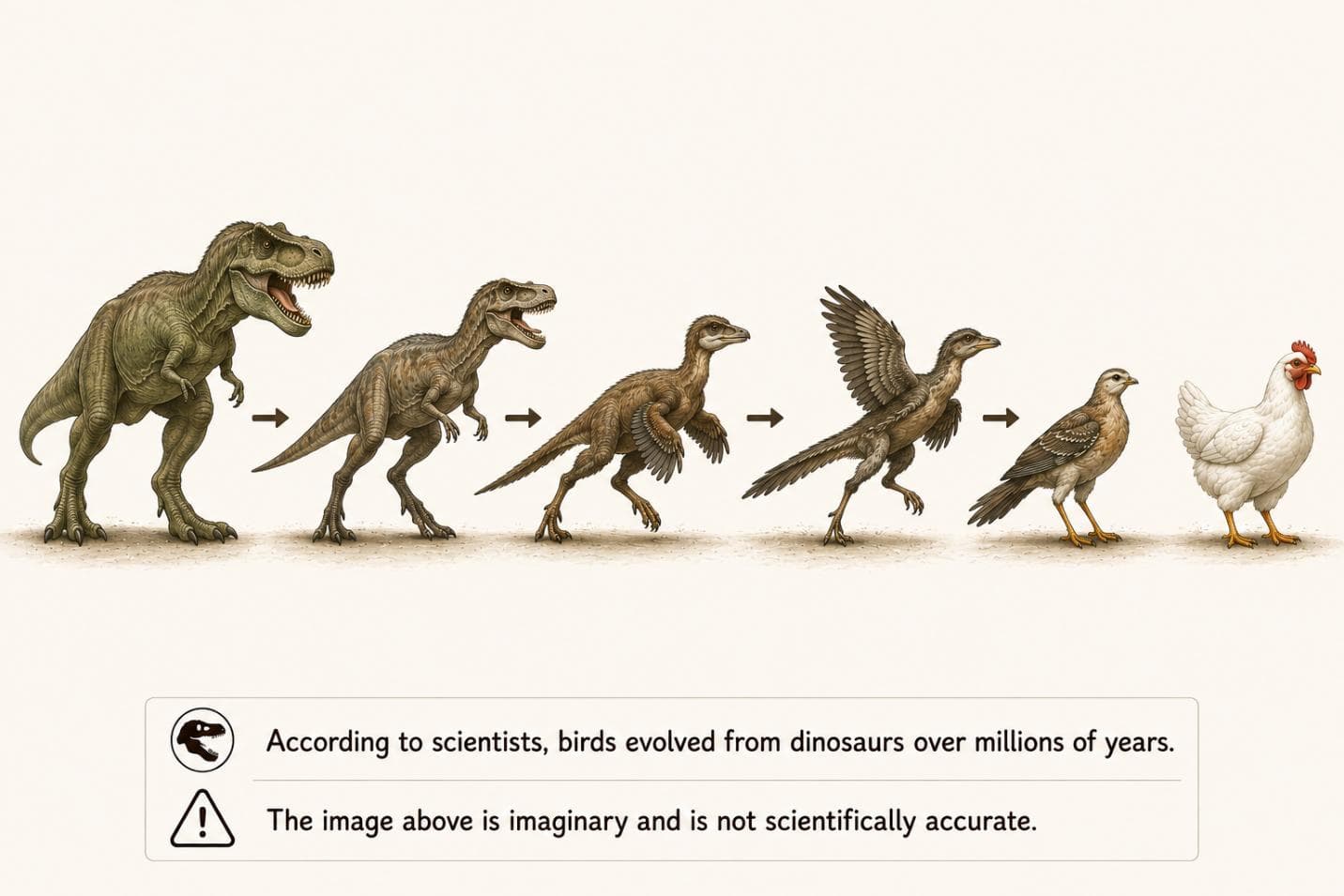
Father said, “Well, all the living things we see on Earth today have changed through evolution over hundreds of millions of years. Life began with single-celled organisms, and over time many different kinds of animals and plants evolved from them. Chickens are part of this story too.
“So if we could go back in time and find out when the birds we now call chickens first appeared, we would eventually reach a time when the first chicken hatched from an egg laid by another kind of bird. That bird would have looked very much like a chicken, but it would not have been quite the same. A mutation had caused a change in the cell that would grow into the baby bird. Because of that change, the bird that hatched was a little different from its mother—different enough for us to call it a chicken, while calling its mother and the birds before her the ancestors of today’s chickens.”
Sina thought about this for a moment. Then he said, “Dad, you said the cell that was going to become the chicken had a mutation. Does a chick really grow from just one cell? Is a chick like a bacterium?”
“Yes, it does start from one cell. Inside a fertilized egg, there is a cell surrounded by the yolk and the egg white. That cell begins to divide and make more cells. At first, this is a little like the way single-celled organisms divide. But as the number of cells grows, they begin to develop in different ways, following instructions contained in the original cell. Some become bone cells, some become muscle cells, some form the brain and nerves, some form the eyes, and some eventually form feathers.
“In short, as the cells keep dividing, the different parts of the chick’s body begin to develop. And as I said, the instructions that guide this process were already there in the original cell.”
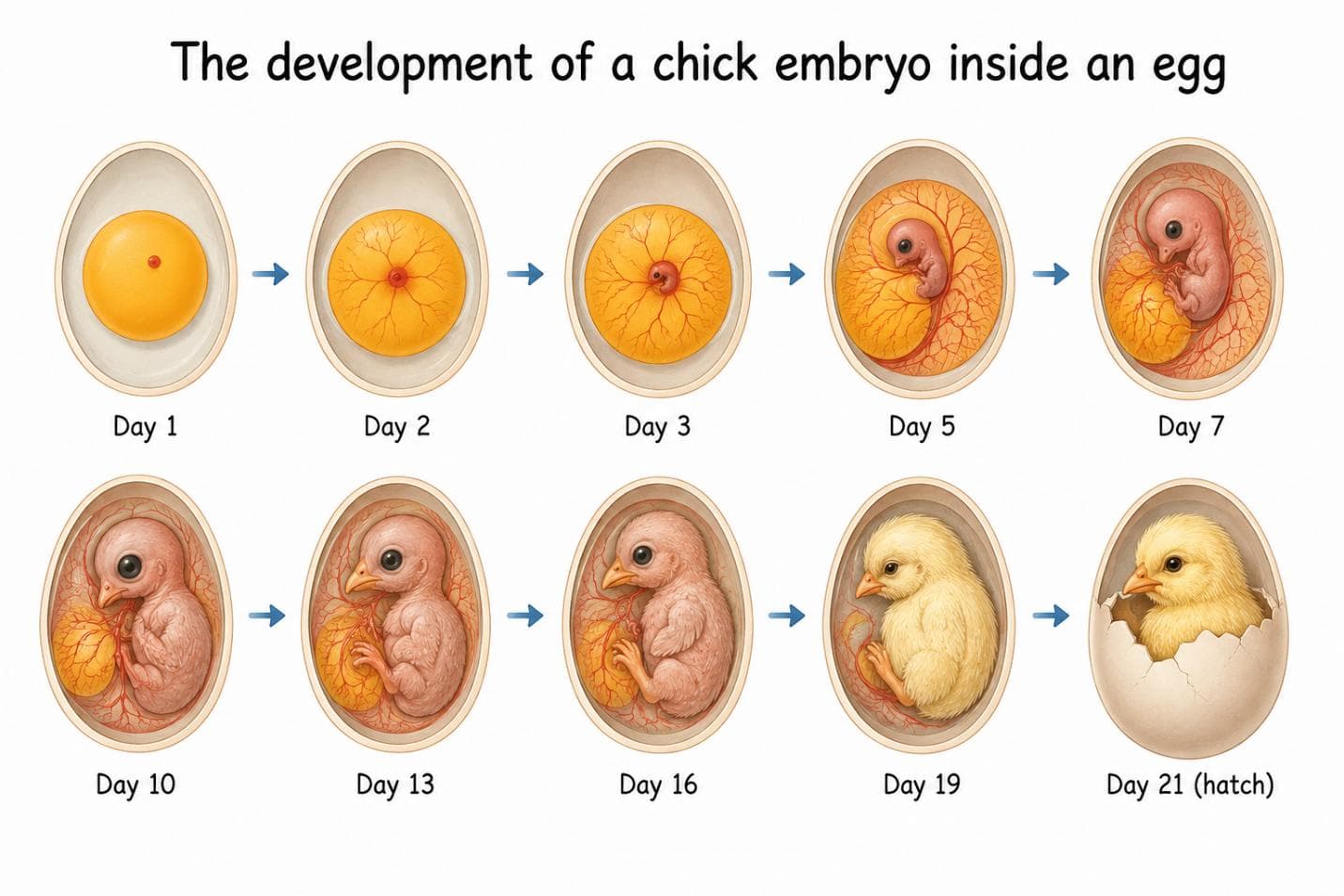
“Now, if there is a mutation in that first cell, the bird that eventually hatches may be a little different from its mother. For example, the mother might have long legs, while her chick might grow up to have shorter legs.
“If that difference does not make it harder for the chick to survive—or if it actually helps—the chick may grow up and reproduce. Its young may inherit the same new feature, such as shorter legs. Over many generations, changes like these can build up. Eventually, we may have a kind of bird that we call a chicken.
“And once there are chickens laying eggs, we can call those eggs chicken eggs. So in that sense, the chicken came first, and the chicken egg came afterward.”
Sina said happily, “I’m going to tell my teacher about this tomorrow! By the way, Dad, which country were you looking for?”
“India.”
“What for?”
“I wanted to see how far it is from Iran, so I could guess how long our flight would take.”
Sina’s eyes widened in surprise. “Our flight? Are we going to India?”
His father smiled. “Yes. In a few days, we’re going to India for a week. It’s a trip for my university work.”
Sina’s father was a university professor and sometimes had to travel for his job. In the past, most of his trips had been inside Iran, and he usually traveled alone. But since Sina’s mother had passed away, he tried not to travel as much. And when he did have to go away, he tried to come back quickly.
“You mean you’re taking me with you?” Sina asked. “What about school?”
“We don’t really have another choice. Your grandparents live in another city, and I don’t feel comfortable asking your aunt’s family to look after you for a whole week. So tomorrow I’ll go to your school and ask for permission for you to miss a few days. Then we’ll go to India together. Would you like to see India for yourself?”
“Of course I would!” Sina said excitedly. “Indian fakirs, snake charmers, people who can stop trains just by staring at them... India is full of strange and amazing things! Dad, can I call Amir and tell him we’re going to India?”
“You mean your classmate? Sure, call him.”