

Journey into the Heart of Religions by N. Fakhr - HTML preview
Download the book in PDF, ePub, Kindle for a complete version.
Sikhism
Mr. Mehtab shook his head and said, “Rajesh, my friend! To escape the cycle of death and rebirth, we should not give up the pleasures of life. We should enjoy the good things in life and, in other words, live naturally. We should live according to our nature. We should also work and earn a living.”
Sina looked at Mr. Mehtab again, this time more carefully. His suit and shoes looked expensive, and with the turban on his head, his clothes looked quite different from those of all the other guests.
So Sina asked him, “Do you follow a religion other than Hinduism?”
Mr. Mehtab proudly lifted his head and said, “Yes. I am a Sikh.”
“It seems that your religion is very different from Hinduism and Jainism,” Sina said. “Both of them consider giving up worldly pleasures something valuable that can help them in their next life.”
“That’s right,” Mr. Mehtab said. “Sikhism is different. In Sikhism, we worship only one God.”
“It seems that Hindus also worship one God,” Sina said. “For example, either Shiva alone is the Supreme Brahman or Vishnu alone is the Supreme Brahman, and the other gods have been created by that one God.”
Mr. Mehtab replied, “Hindus believe in one source from which the universe came, but they also worship lesser gods. They pray to them, ask them for help, make vows to them, and bring them offerings. Sometimes they also believe that these gods have come to Earth. But we deal with only one God. Of course, we believe that this one God has servants who carry out his work.
“We believe that God has created countless worlds like our own. Our religion says that everything came from God. He is the one who does everything, and without him, nothing exists.
“He created the universe gradually, not all at once in the form we see today. In other words, it was not that the Sun, Moon, and Earth simply appeared at his command. At first, everything was like air. Then it became water, and after that it became stone. From this last form came the Earth, the Moon, and the Sun.
“Since what our religion says is very similar to today’s scientific theory about the development of the universe, don’t you think this amazing fact shows that Sikhism is true and comes from God?”
Sina looked at his father and, with a movement of his head, asked what he thought.
His father said, “Well, the theory accepted today by most cosmologists, and supported by a great deal of evidence, says that after the Big Bang, about 13.8 billion years ago, our universe began expanding from an extremely small and dense state, somewhat like a balloon expanding.
“The particles that make up matter gradually gathered together in different parts of this expanding space. In some places, large amounts of matter collected together. The strong gravity of these dense masses produced enormous pressure and temperature at their centers. Eventually, nuclear reactions began inside them, and burning stars were born.”

“These nuclear reactions produced more complex atoms. Eventually, they provided the different elements—such as oxygen, nitrogen, and iron—needed to form planets, including the Earth, and also the Moon.
“From these elements came complex molecules such as proteins and sugars, and from complex molecules, life eventually appeared on Earth.
“So according to this theory, it is true that matter in the early universe was in a gaseous state. But there was no stage in which all of that gas turned into water or liquid.”
Sina turned to Mr. Mehtab.
“I think there are some similarities between the Sikh story of creation and what science has discovered today, but there are differences too. So I don’t think we can say that the Sikh creation story contains some miraculous scientific knowledge.”
Mr. Mehtab said, “But you have to remember that Guru3 Nanak and the Gurus who came after him could not explain those scientific facts to the people of their time in the way you and I understand them today. They had to explain everything simply, at a level that people back then could understand.”
“What my father just explained was understandable to me, and I’m only a schoolboy,” Sina replied. “Atoms as the basic units of matter, gas, explosions, expansion, and even nuclear reactions—at least at the simple level that I understand them—aren’t so difficult that the person you mentioned couldn’t have explained them to people.
“It only took me a few days to learn these things. I think there must also have been many people back then who could have learned them in a few days from the person you mentioned.
“By the way, what was his name?”
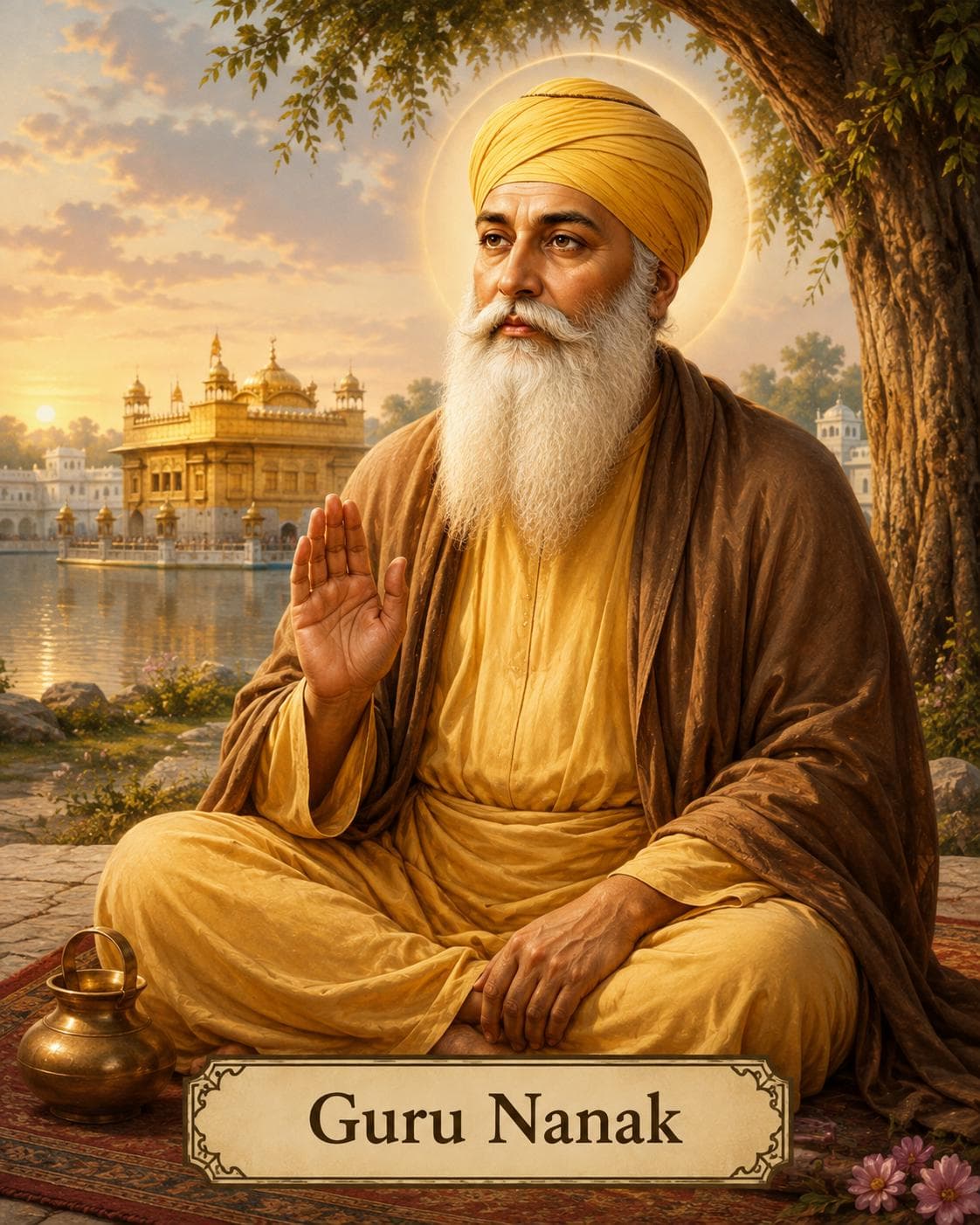
“Guru Nanak,” Mr. Mehtab replied. “He was the person through whom God introduced Sikhism to the people.”
“Why do you believe him?” Sina asked.
Mr. Mehtab said, “When Guru Nanak was young, he was honest and good, and he spent a great deal of time thinking deeply.
“One day in 1499, about 500 years ago, he disappeared. His clothes were found beside a river, but no matter how much people searched, they could not find him. Three days later, Guru Nanak appeared again.
“On the first day, he remained silent. People kept asking him where he had been and what had happened to him, but he said nothing. On the second day, he finally spoke and said:
“‘There is no Hindu and no Muslim. So which path should I follow? I shall follow God’s path. God is neither Muslim nor Hindu. The only path I should follow is God’s path.’
“Guru Nanak said that during those three days, he had been taken into the presence of God. He was given a cup to drink, and God told him:
“‘This is the cup of remembering God’s Name. Drink it. I am with you. I bless you and help you grow. Whoever remembers you, I will be with them. Go, rejoice in my Name, and teach others to do the same.’”
 “And people believed him and accepted what he said?” Sina asked.
“Not that easily,” Mr. Mehtab replied. “He performed miracles. For example, during a drought, he filled a pool with water, and this caused many people to believe in him. Besides, his teachings show that he wanted nothing but what was good for people. Anyone who reads them can see that he could not have been a liar or a deceiver.”
Sina asked about the teachings of Sikhism.
Mr. Mehtab replied, “According to Guru Nanak, life should be full of activity, creativity, honesty, responsibility, self-control, and good intentions. He considered this kind of life better than an ascetic life spent mainly in meditation and worship.
“He emphasized three important principles. First, help people in need. Second, earn an honest living without cheating or taking advantage of other people’s work. Third, always remember God so that you stay away from sin.”
“What things are considered sins in your religion that remembering God helps you avoid?” Sina asked.
“There are five great sins in our religion: anger, greed, attachment to worldly things, lust, and pride. All the teachings of Sikhism are found in the Guru Granth Sahib.”
“Is that a book that Guru Nanak brought from God?”
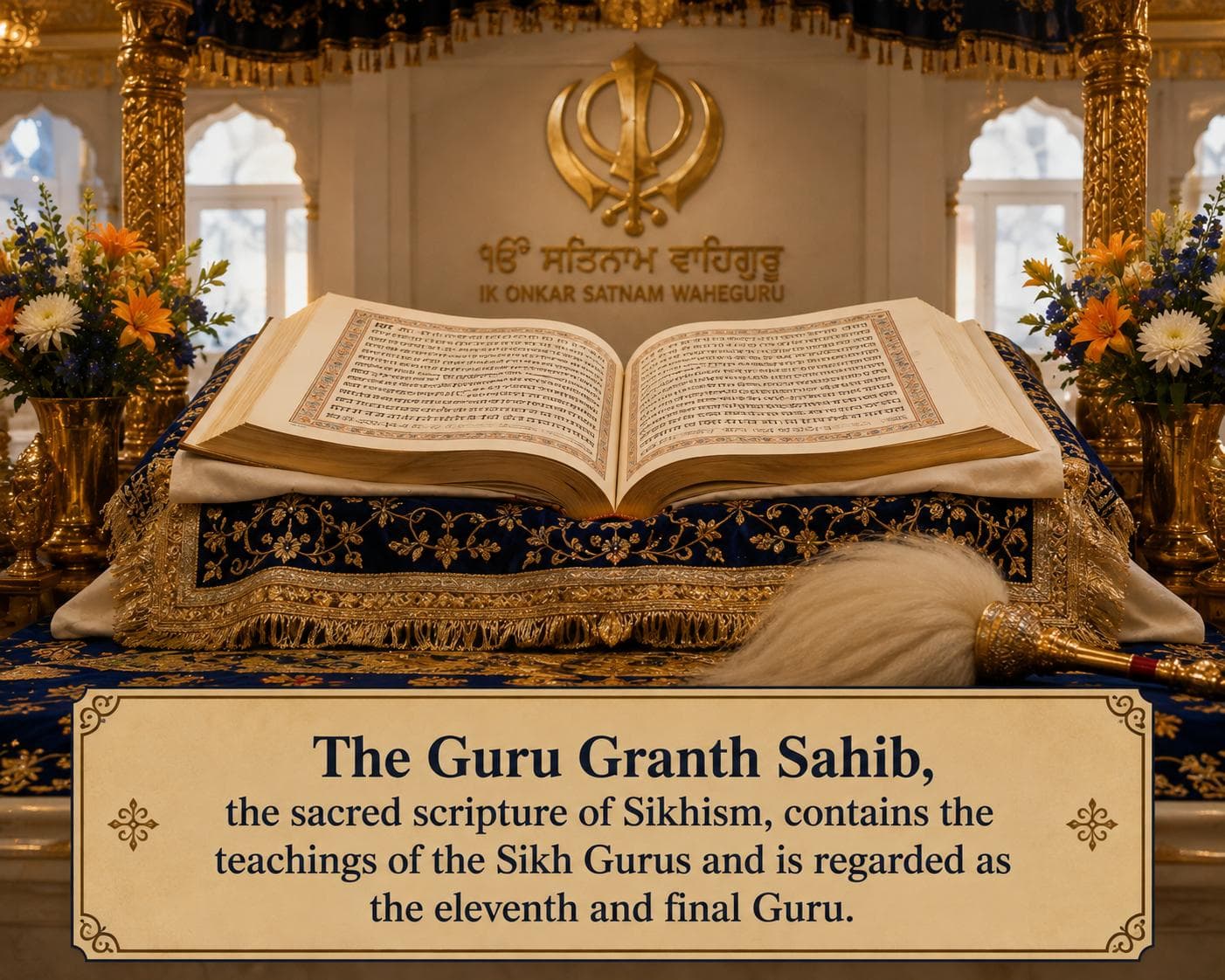
“No. It is a collection of teachings given by Guru Nanak and the nine Gurus who came after him. They too had been chosen by God. When each Guru died, his sacred spirit and authority as Guru passed to the next Guru.”
 “What do you mean by the Guru’s sacred spirit and authority?” Sina asked.
“It means that God gave the Guru special knowledge that allowed him to guide people, tell them what God wanted from them, and teach them how they should live.
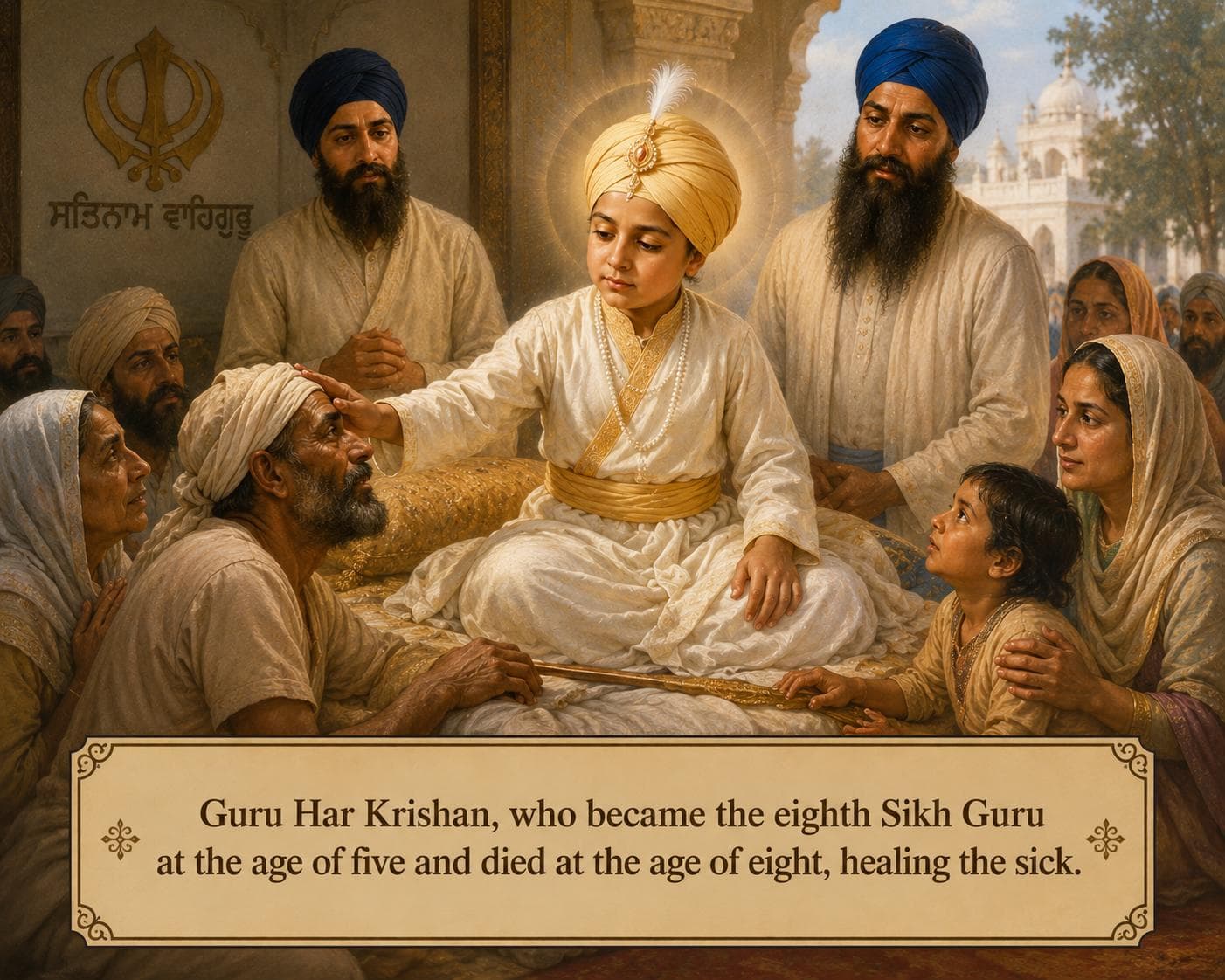
“For example, Guru Har Krishan, the eighth Sikh Guru, lived from 1656 to 1664. He succeeded his father, Guru Har Rai, when he was only five years old. When he died at the age of eight, his uncle became the next Guru.
“Finally, after ten human Gurus, the Guru Granth Sahib was declared the eleventh and final Guru, and the line of human Gurus came to an end. From then on, people were to turn to this book to learn their duties and the right way to live.
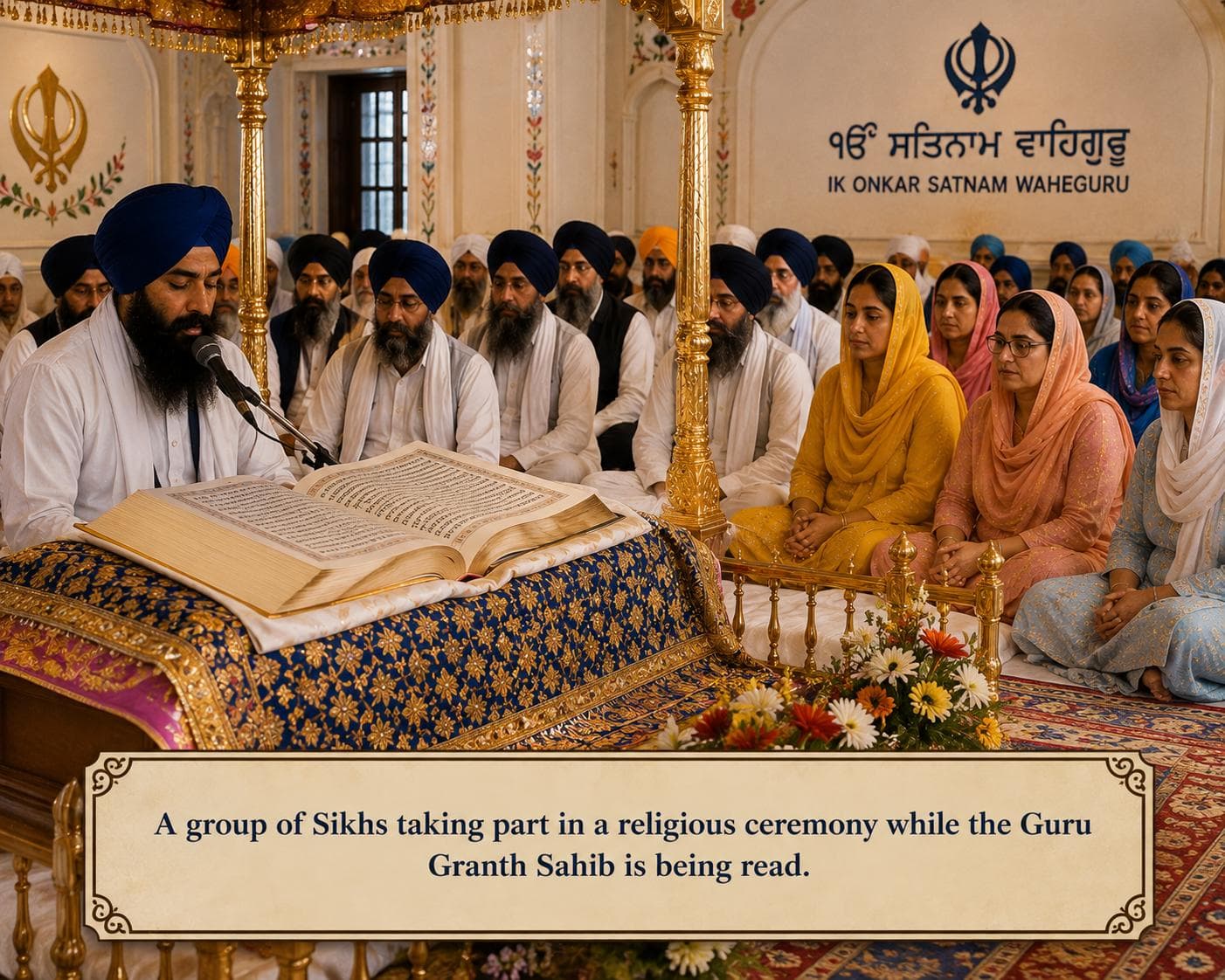
“In our religion, we do not have priests. A person can become a reader of the Guru Granth Sahib, and both men and women may do this. Some of these readers are highly respected, and people ask them religious questions. They must be able to explain the meaning of the Guru Granth Sahib to people.”
Sina’s father said, “That sounds quite similar to what priests and other religious leaders do.”
Mr. Mehtab continued, “Our religion is different from Hinduism and Islam. Our religion is based on belief in one God.
“We believe that all human beings are equal. Men and women, whatever their beliefs, are all equal before God. We do not believe in dividing people into castes as Hindus do.
“We do not worship any other gods, and visiting graves as a religious practice is also forbidden in our religion. Fasting is not allowed either. Men and women are encouraged to cover their bodies and heads in the way taught by the Gurus. Begging and living as an ascetic are also forbidden.”

“Lying, speaking badly about people behind their backs, and boasting about yourself are forbidden. A person should not praise himself.
“Drinking alcohol, taking drugs, and smoking are forbidden in our religion. However, using cannabis to help with religious meditation is allowed.
“Divorce is also forbidden except under special circumstances. For some of us who have gone through a special ceremony somewhat like baptism, cutting our hair or beard is forbidden.”
Sina looked at his father. “What is baptism?”
His father replied, “It is a religious ceremony, somewhat like a ceremony in which a person formally becomes a member of a religion.”
Mr. Mehtab said, “By following these teachings, we Sikhs—about 30 million of us—are better off financially than the rest of the people of India, whether they are Hindu, Muslim, or Jain, and we live well. All of this is a blessing from our religion.”
Sina was quiet for a few moments, thinking. Then he said, “Mr. Mehtab, if there are people in the world who live better lives than you do, would you be willing to leave your religion and follow theirs? Then at least you could cut your hair and beard. It must be difficult to wash them and take care of them.”
Mr. Mehtab said, “I will do anything difficult that my religion asks me to do.”
“Then I suppose you don’t expect other people—for example, Hindus—to choose your religion just to escape the difficult rules of their own religion.”
Just then, Mr. Akal came over to the table where his old friends were sitting. Smiling, he said, “I see you’re having quite a conversation.”
Sina’s father said, “Mr. Akal, I don’t see your late brother’s wife, who lives with your family, among the guests. Is she not feeling well?”
Mr. Akal said, “Well, it’s a little difficult to explain.”
Mr. Rajesh said, “Let me explain. Widows are considered bad luck. They are not allowed to marry again, and they must always wear white. They should not wear jewelry or attend celebrations. Even seeing a widow when you are leaving home is considered bad luck.”
Sina asked Mr. Rajesh, “What does ‘bad luck’ mean?”
“It means that something bad may happen to you. For example, you may fail to do what you went out to do, or something else may go wrong.”
“How did they find out that widows bring bad luck?” Sina asked. “Did they test it and find that fewer bad things happened after people saw women who weren’t widows, but more bad things happened after they saw widows?”
Mr. Akal said, “Well, these are old beliefs passed down from earlier generations. People follow them just to be safe and to feel more at ease.”
Sina said, “I think women like going to wedding celebrations. Living with that woman hasn’t made you miss this wedding, but living with you has made her miss this wedding and many other things. If she lived in another country, among people with different beliefs, she could have been at a wedding like this tonight.”
Mr. Mehtab said, “My boy, are you saying that perhaps Mr. Akal is the one who has brought bad luck to her?”
Mr. Mehtab laughed, and everyone else laughed too—even Mr. Akal. Then Mr. Akal invited everyone to have dinner.
Worship
A few days later, Sina and his father were on the plane back to Iran.
Sina asked, “Dad, what does it mean to worship something?”
His father said, “Well, we should look at when people who believe they worship something actually use this word. When people believe that a supernatural being or power can affect the natural course of their lives, they begin to ask it for help in different ways.”
“What does ‘supernatural’ mean?”
“It means something that we cannot directly see or detect with our senses or with any instrument, but that we believe exists. For example, suppose we believe that there is a being called Ganesha who can solve problems in our lives and can also see us and hear what we say. Then we believe in a supernatural being.
“Now we may try to gain his favor. We may pray to him, give offerings such as money placed in a temple donation box, make vows, or do other things like these, hoping that he will grant our wishes. When we do these things, we say that we worship Ganesha.
“If we also believe that this supernatural being created our world and the worlds after death, and told us what we should or should not do in order to be happy, then we obey his commands too. We call that worship as well.”
“So that’s why the Hindus we met said they don’t worship cows,” Sina said. “They only respect them because of their religion. They don’t ask cows for help, and they don’t get their rules for living from cows.”
“Yes,” his father said. “I think you’ve understood it correctly. There is another form of worship too. A person may imagine himself in the presence of that supernatural power and praise it. He may describe his god as generous, powerful, wise, great, and so on. At the same time, he may show his own humility before his god through words and actions—by lowering his head, bowing, prostrating himself, lying face down, or standing respectfully.”
It was dark outside now. Sina was sitting beside the airplane window, trying to look at the stars. The window was not very clean, and he could barely see a few of the brightest ones.