

Journey into the Heart of Religions by N. Fakhr - HTML preview
Download the book in PDF, ePub, Kindle for a complete version.
Summer Vacation
Sacred Things
Sina came into the house, greeted his father, and said happily, “Today was our last class. We only have our exams left, and then summer vacation finally begins.”
His father smiled and said, “How quickly time passes! So, son, what subject was your last class?”
“Science,” Sina said. “Actually, we had already finished all our lessons, so our teacher talked about some other things. For example, he said that Galileo believed day and night were caused by the Earth turning around itself. He was sentenced to death and had to take back what he had said. Dad, couldn’t Galileo show people why he had reached that conclusion?”
“Of course he could,” his father said. “And he did. He explained his reasons in detail in a book. But the problem was that the Christian holy book described the Earth as the center of the universe and said that the Sun moved around the Earth.”
Sina asked, “Then why, after people saw Galileo’s reasons, did they still believe the holy book instead?”
“Because they considered that book sacred.”
“Then first you have to tell me what ‘sacred’ means.”
His father said, “Something is sacred when, in our minds, it is different from other things of the same kind. For example, if a certain stone is sacred to someone, that person will not treat it in the same way as other stones.”
“I keep the stones I collected by the sea last year in a special place. Does that mean those stones are sacred to me?”
“Those stones are precious to you, but if you are also afraid of disrespecting them, then they are sacred to you. In that case, you do not simply love those stones. You also believe that there is some power, either inside the stones or outside them, that may punish you if you ‘disrespect’ them. This ‘disrespect’ can begin simply by treating those stones as no different from other stones. Even if someone says that there is nothing special about them, you may feel upset—and you may believe that the power connected with them is also offended.
“People can become sacred too. Sometimes people believe that a certain person is different from ordinary human beings because that person never makes mistakes and always knows what is true. Then that person becomes sacred to them. They accept whatever that person says and do not question it, because ordinary people can make mistakes and their words can be doubted.
“If you discuss the words of that sacred person with them and question whether those words are true, they may become upset because you are treating the sacred person like an ordinary human being whose words can be criticized and questioned. They may see this as an insult because, in their minds, you have brought that sacred person down to the level of ordinary people. The same thing can happen with the words of a sacred book.”
Sina looked surprised. “I don’t understand how something becomes sacred.”
“To tell you the truth, I don’t know exactly all the ways in which something becomes sacred,” his father said. “But I think one of the most important ways is through the widespread use of the media.”
“What is the media?”
“Television, radio, books, speeches, the internet, and even school lessons are all ways of giving information to people. Each of these is a form of media.
“During my life, I have seen people who were once not considered sacred at all and were treated like everyone else in their country. But after years of constant promotion through all these forms of media, some people began to see them as sacred. In the eyes of those people, everything they said became true and could no longer be questioned. If this continues for many years, and even parents take part in passing these ideas on to their children, that person may remain sacred for centuries.”
Sina said, “So, from what you’re saying, maybe we shouldn’t argue with people about the things they consider sacred. For example, perhaps I shouldn’t have questioned the Vedas in India, because the Hindus might have been offended.”
His father laughed. “Would they have been upset? I think some of them probably would. But people usually do not like to think that something became sacred to them because of years of teaching and repeated messages. They prefer to believe that they reached the conclusion that, for example, a certain book is sacred and everything in it is true because of evidence, reasoning, and good arguments.
“So if you question it, they may try to give you whatever logical reasons come to their minds. In this way, they can show both you and themselves that their belief is based on such reasons, and they can also try to remove your doubts.
“But people who have power may punish those who express doubts, so that others will stop questioning sacred beliefs and people will not lose their faith in them. That is what the Church did to Galileo. The Church was very powerful at that time, and it banned Galileo’s book. Galileo himself took back what he had said and publicly said that he was sorry so that he would not be burned, but he remained under house arrest for the rest of his life.”
“Was anyone really executed for believing something like that,” Sina asked, “or did the Church only threaten people?”
“Before Galileo, there were other thinkers who had reached the same or similar conclusions. Some of them, such as Giordano Bruno in Rome, Vanini in Toulouse, and Fontanier in Paris, were burned. All of this happened before Galileo’s trial.”
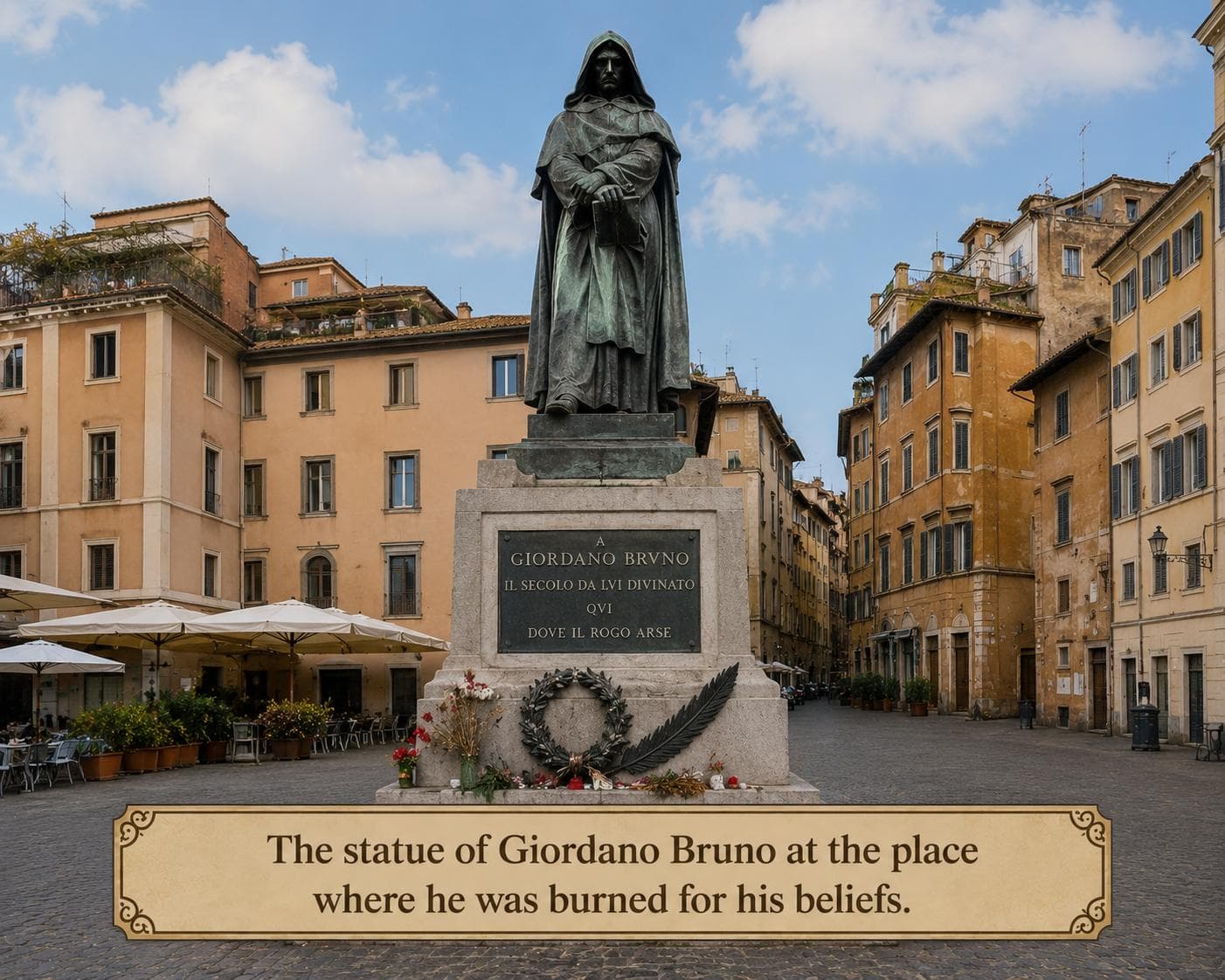
Sina looked shocked. “Didn’t people protest against this?”
His father sighed. “No, son. People sometimes even celebrated at such events because they believed that someone who had insulted what they considered sacred deserved to be punished. People were even afraid that insulting sacred things might anger supernatural powers and cause them to take revenge on people through famine, floods, earthquakes, or disease So they fully supported punishing anyone who had insulted what they considered sacred.”
Sina became silent and thoughtful, and his father went back to his reading.
A few minutes later, Sina said, “I’d like to learn more about what people around the world believe. I wish we could travel to other countries and see what religions people have.”
“That’s a good idea,” his father said. “Actually, I’ve wanted you to learn more about the religions of the world too. That’s why I’m already making plans for a trip during your summer vacation.”
Sina’s eyes lit up with excitement.
“Where are we going?”
“To Japan.”