

Journey into the Heart of Religions by N. Fakhr - HTML preview
Download the book in PDF, ePub, Kindle for a complete version.
People Without Religion
They all went to the restaurant. Erik and the driver were going to sit at another table, away from Sina and his father, but Sina’s father invited them to sit with them so that they could continue their conversation.
Their table was close to the table where the restaurant owner was sitting.

Sina asked Erik to tell him the story he had promised to tell.
Erik began:
“I was born into a Christian family. My parents were not very religious, but I had a kind grandfather who was deeply religious. He encouraged me to memorize verses from the Bible. He wanted me to grow up to be a true believer.
“As I grew older, I began to think that there were problems with some Christian beliefs. I started wondering whether Christianity could really have come from God. I even began to have doubts about the existence of God himself.
“I talked to my grandfather about these problems. Usually, he could not give me an answer that convinced me. But whenever he saw that my faith in Christianity was becoming weaker, he told me that I should not give up Christianity because of one or two problems.
“He said I needed to study a great deal before I could be sure that the questions and objections I had about Christianity and the Bible had no good answers from Christian scholars.”
Sina asked, “What did you do? Did you study a lot?”
Erik said:
“I met friends who belonged to other religions and had questions similar to mine. They were often told the same thing: that they had to study their religions very deeply before they had the right to reject them.
“That did not seem fair to me.”
Sina asked, “What exactly was unfair about it?”
Erik replied:
“Well, when I was very young, my grandfather would sometimes ask me, ‘What is your religion?’
“I would say, ‘I’m a Christian.’
“He was happy when I said that, and he encouraged me. As I grew older, he was always pleased that I was a Christian.
“But he never told me that I first had to study Christianity very deeply before I could call myself a Christian.
“In fact, when I said that I was a Christian, I was also saying, in a way, that I did not believe the other religions were true, or at least that I did not think they were as true as Christianity. So I had more or less rejected all those religions without studying them carefully.
“But my grandfather never told me that I had to study all those religions deeply and listen to the answers of their religious scholars before rejecting them.
“There was something else, too. He could never give me convincing answers to the problems I found in Christianity. Of course, he gave me many answers, but none of them convinced me. Sometimes his answers actually made my doubts stronger.
“So eventually I realized that he, too, had accepted Christianity without carefully studying all the alternatives, and he had rejected other religions without studying them carefully either.
“I came to think that behind his advice that I should remain a Christian was mainly his love for his religion.
“Later, I reached the conclusion that I could not be certain whether God exists or not. Today, I am an agnostic.”
Sina asked, “What does agnostic mean?”
Erik said:
“People who do not follow a religion can have different ideas about whether there is a God or a creator of the universe.
“One group believes that some kind of God or creator exists, but they do not belong to a religion. Some of them think that the creator cannot be like the gods described by religions and that this creator has not sent any religion to human beings. Such a person may believe in a creator without following a religion.
“The second group are agnostics. They say that human beings cannot prove, through reason and the means of knowledge available to us, either that God exists or that God does not exist. So when it comes to the existence of a creator of the universe, we should not claim to know what we cannot know. We cannot say with certainty that there is a God, but we cannot say with certainty that there is no God either.”
“Of course, different agnostics can have different opinions about religion. I personally do not believe that any of the religions I have studied has shown that it was sent by God.
“The third group are atheists. Atheists do not believe that a god created the universe. They think the universe does not need a divine creator to explain its existence, and many atheists think that gods are ideas created by human beings.”
Erik continued:
“When my grandfather realized what I believed, he tried to make me afraid of a world without religion. He often told me that if people stopped believing in God and religion, evil and disorder would spread everywhere.”
Sina said, “Maybe he was right. If everyone gave up religion, perhaps bad behavior would become more common.”
Erik replied:
“I don’t think we can say that. Sweden itself is an interesting example. It is a prosperous and generally safe country, even though religion plays a much smaller part in many people’s lives than it once did.
“Recent international surveys show that Sweden is one of the less religious countries in Europe. In a large survey conducted in 2024, only about 33 percent of Swedish adults said that they believed in God. Another study based on the same period found that about 47 percent identified with a religion, while only about 8 percent said they prayed every day.”
Sina said, “But if only about one-third believe in God, how can almost half of the people belong to a religion?”
Erik smiled.
“Because those are different things. Being officially connected with a religion does not necessarily mean that you believe all of its teachings, or even that you believe in God.
“Some people identify themselves as Christian because of their family, culture, traditions, or childhood, even though religion has very little importance in their daily lives.
“So when we talk about religion, we have to be careful about what we are measuring. Religious identity, belief in God, and religious practice are not the same thing.”
Sina thought for a moment and said, “So someone could say, ‘I’m a Christian,’ but not believe in God?”
“Yes,” Erik replied. “That may sound strange at first, but it happens. In fact, an earlier large survey of Western Europe found that even among people who identified as Christians in Sweden, some said that they did not believe in God.”
Sina asked, “But what about what your grandfather said? Maybe people can live without religion, but don’t they need to believe in God in order to know what is right and wrong?”
Erik said:
“That is another question researchers have asked people.
“In a recent international survey, only about 10 percent of people in Sweden said that believing in God is necessary in order to be moral and have good values. About 89 percent said it is not necessary.”
Sina said, “So most Swedish people think someone can be a good person without believing in God?”
“Exactly,” Erik said. “But there is another important difference. Believing that there may be something beyond the physical world is not the same as having religious faith.
“For example, in a large European survey, people were given several choices. They could say that they believed in a personal God, that they believed in some kind of spirit or life force, that they did not know what to think, or that they did not believe in any God, spirit, or life force.
“In Sweden, only about 10 percent said that they believed in a personal God. About 43 percent believed instead in some kind of spirit or life force, 20 percent said they did not know what to think, and about 28 percent said they did not believe in any God, spirit, or life force.
“The numbers were very different in some other European countries. About 65 percent in Poland believed in a personal God, compared with 37 percent in Spain, 30 percent in Italy and Finland, 22 percent in Germany, 21 percent in France, 18 percent in the Netherlands, 14 percent in Denmark, and only about 10 percent in Sweden.”
Sina asked, “So believing that there is some kind of spirit or power in the universe does not necessarily mean that someone believes in the God of a religion?”
“Exactly,” Erik replied. “And that difference is important when we think about what my grandfather used to say. He was not simply saying that society needs people to believe that something exists beyond the physical world. He believed that people need religious faith—with its teachings about God, its commandments, and its rules about right and wrong—or society will become immoral and fall into disorder.
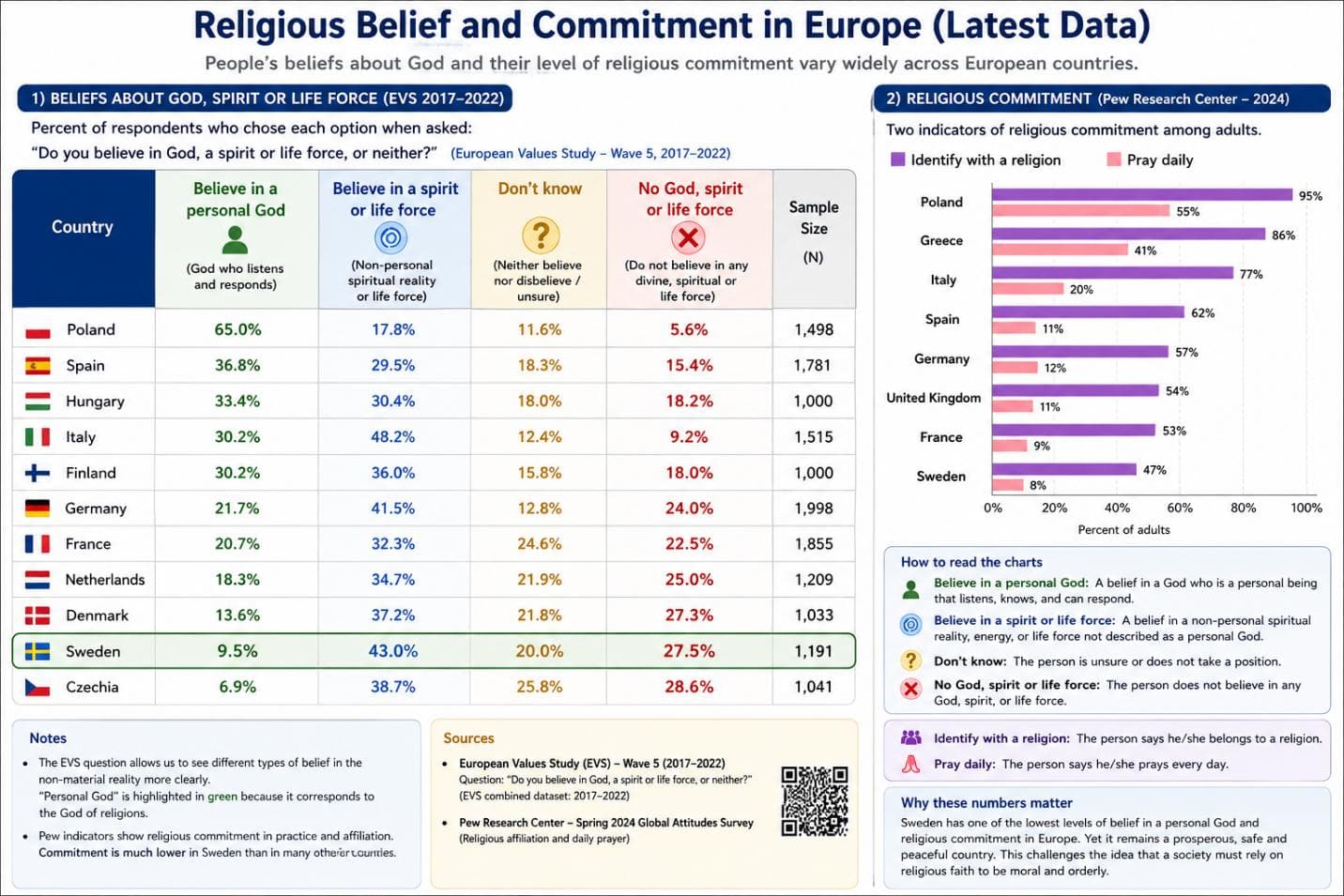
“More recent surveys also show how low religious commitment is in Sweden. In a 2024 international survey, only 47 percent of Swedish adults identified with a religion, and only 8 percent said they prayed every day. Yet Sweden has not become a society without laws, morality, or social order.
“Of course, this does not prove that having less religion makes a country safer or better. It only shows that my grandfather’s claim was too simple: a society does not necessarily lose morality and fall into chaos when religious faith becomes less common.”
At that moment, the owner of the restaurant, an Iranian man, came over to their table.
“Excuse me,” he said to Erik. “I couldn’t help hearing what you were saying to this young man. You were telling him that people can live without religion, and that when someone accepts Christianity, in a way he has rejected other religions.”
For a moment, everyone looked at him in surprise.
Then Sina’s father smiled and said:
“Please, sit with us. If you have something to say, we would be happy to hear it.”