

Journey into the Heart of Religions by N. Fakhr - HTML preview
Download the book in PDF, ePub for a complete version.
The Bahá’í Faith
The restaurant owner sat down. Looking sometimes at Erik and sometimes at Sina, he said:
“The one God speaks to humanity from time to time through His messengers and guides people. In fact, all religions have the same source. They have come to bring people together, overcome the divisions that have developed throughout history, and help humanity move toward peace. Abraham, Moses, Jesus, Zoroaster, Buddha, and Muhammad all served the same divine purpose.”
Erik said, “But different religions say very different things. Why do you think they all originally taught the same thing?”
The restaurant owner replied, “Because over time, people misunderstood, changed, or distorted some of their teachings. That is why the religions now seem so different from one another.”
Sina asked, “But you weren’t there when any of them taught their religions. So how do you know that they originally said the same thing and that their teachings were changed later?”
The restaurant owner said, “This is not something I discovered myself. It is one of the teachings of Bahá’u’lláh.”
“Who is Bahá’u’lláh?” Sina asked.
“He is the messenger of God who came after Muhammad.”
“But the Prophet of Islam said that no prophet would come after him.”
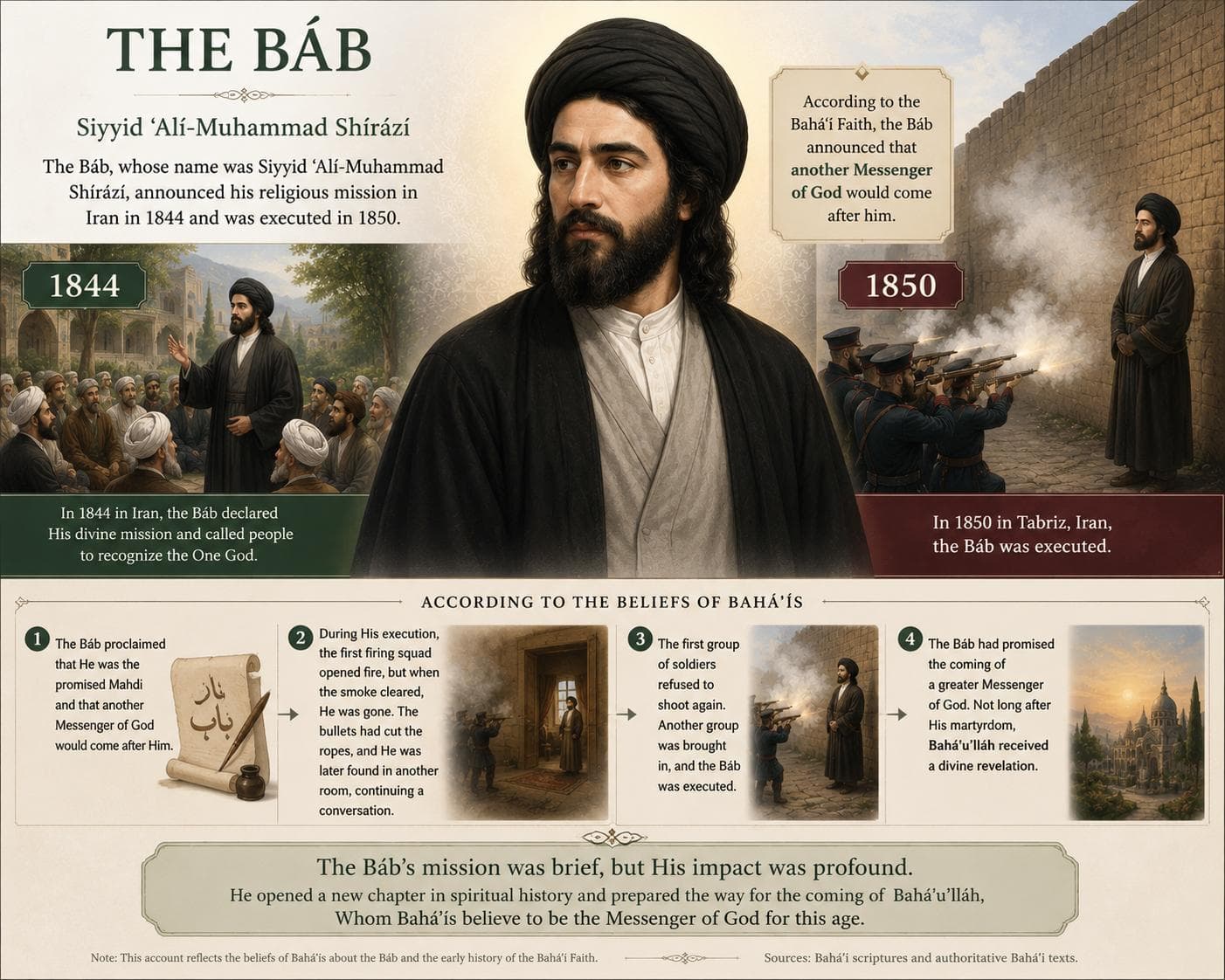
The restaurant owner said, “Muslims were also promised the coming of a great figure who would guide humanity, whom they call the Mahdi. In 1844, a man in Iran known as the Báb announced that he was this promised figure. He also taught that an even greater messenger of God would soon appear.”
Sina looked very surprised.
“When did this happen?”
“In 1844,” said the restaurant owner. “The Báb announced his mission in Iran and later spoke of the coming of another messenger of God.”
Sina turned to his father.
“Did this really happen?”
His father replied, “There really was a man named Siyyid ‘Alí-Muhammad Shírází, who became known as the Báb. He made religious claims and started a new religious movement in Iran. He was executed in Tabriz in 1850.”
The restaurant owner said to Sina, “Bahá’ís believe that something extraordinary happened during his execution. According to the Bahá’í account, the Báb and one of his followers were tied up before a large firing squad. The soldiers fired, but when the smoke cleared, the Báb was gone. The bullets had cut the ropes, and he was later found in another room, continuing a conversation that had been interrupted earlier. The first group of soldiers then refused to fire at him again, so another group was brought in, and the Báb was executed.”
He continued:
“The Báb had said that another messenger of God would soon appear. Not long after the Báb’s death, Bahá’u’lláh received a divine revelation.”
Sina looked at his father again, as if asking him to explain.
His father said, “After the Báb’s death, several of his followers made claims connected with the figure he had promised. One of them was Mírzá Husayn-‘Alí Núrí, later known as Bahá’u’lláh.
“He had been a follower of the Báb. In 1852, he was imprisoned in a terrible underground prison in Tehran called the Síyáh-Chál. Bahá’ís believe that while he was imprisoned there, he received the first signs of his divine mission. Years later, in 1863, while he was in Baghdad, he openly announced to some of his followers that he was the messenger foretold by the Báb.”
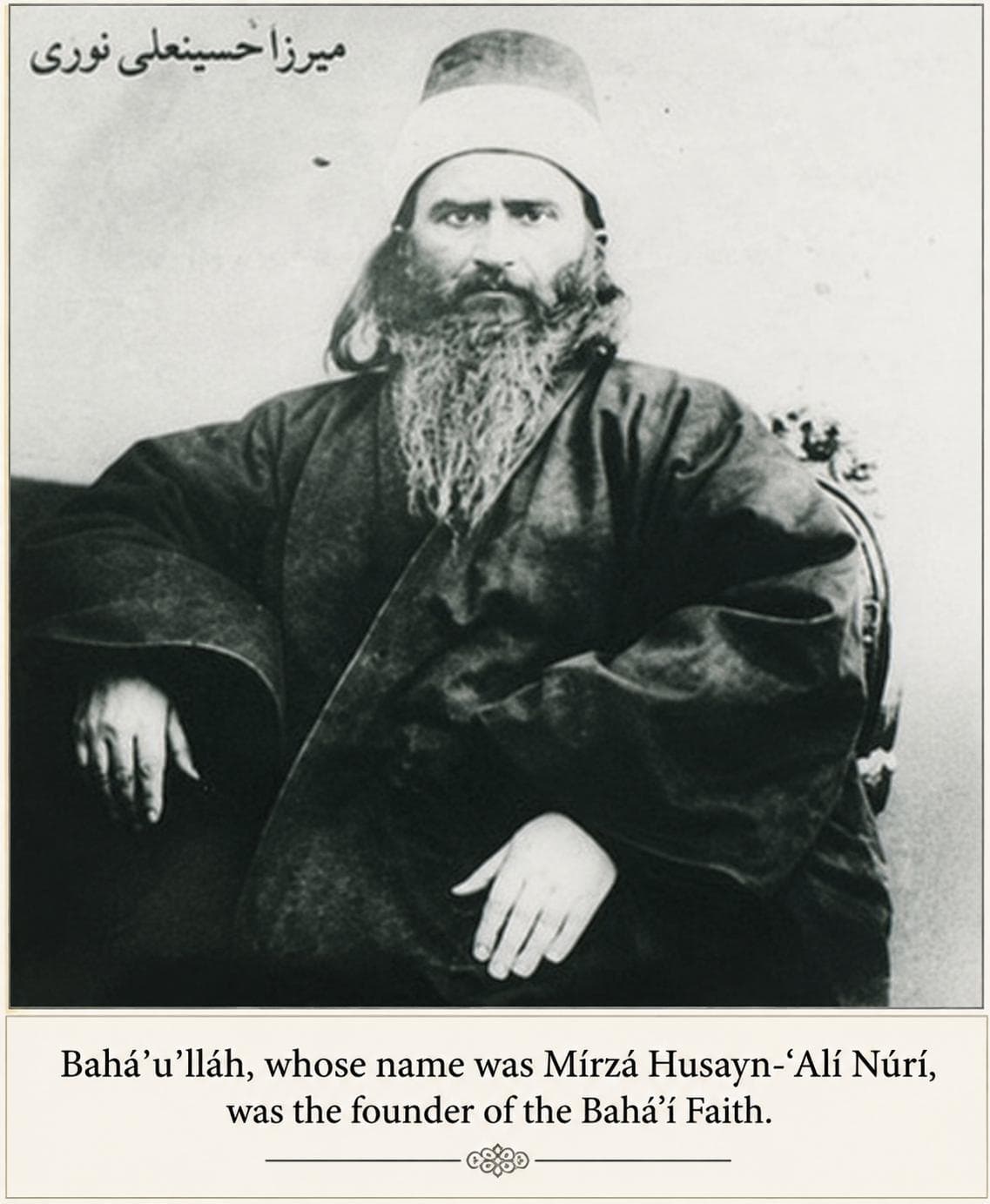
The restaurant owner said, “The name Bahá’u’lláh means ‘Glory of God.’ Bahá’u’lláh brought a new religion called the Bahá’í Faith. Some of its laws are different from those of Islam.
“In our religion, women and men are spiritually equal. From the age of fifteen, Bahá’ís are responsible for certain religious duties, including obligatory prayer and fasting.
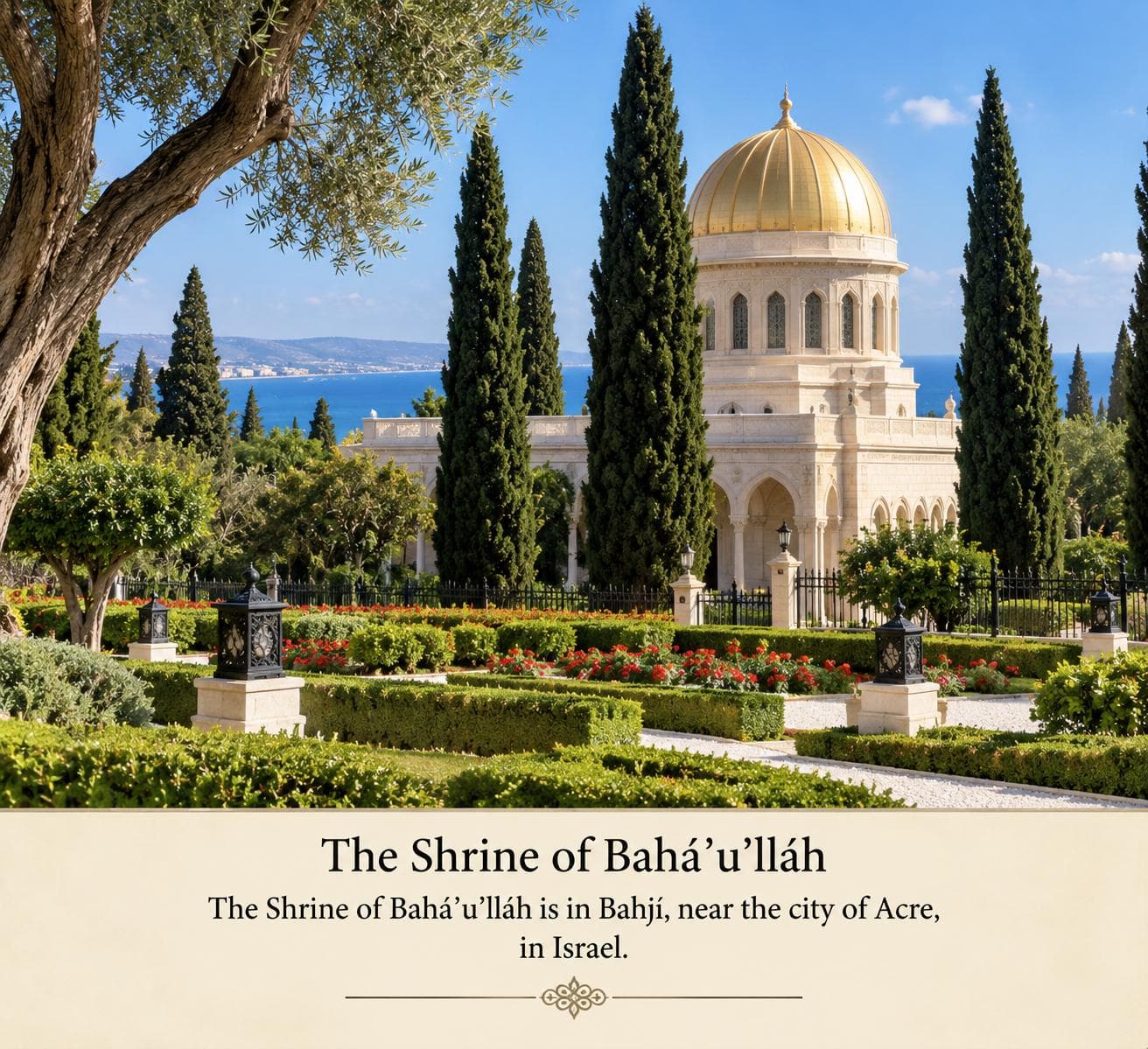
“Bahá’u’lláh gave us three obligatory prayers: a short one, a medium one, and a long one. A Bahá’í chooses one of these to say. The rules are different for each prayer. When saying an obligatory prayer, we face the Qiblih, which is the Shrine of Bahá’u’lláh at Bahjí, near the city of Acre.”
“Alcohol and drugs used for intoxication are forbidden. For a Bahá’í marriage, the man and woman must choose each other freely, and the consent of all their living parents is normally required.”
“Our fast lasts for nineteen days.”
Sina asked, “Why nineteen days? Muslims fast for a whole month, which is about thirty days.”
The restaurant owner replied, “Because the Bahá’í calendar is different from the Islamic calendar. In the Bahá’í calendar, a year has nineteen months, and each month has nineteen days. Our fasting period is one of these nineteen-day months.”
Sina quickly calculated it in his head.
“Nineteen times nineteen is 361. But a year has about 365 days.”
“Exactly,” said the restaurant owner. “Four extra days are added, or five in a leap year. They are called Ayyám-i-Há, or the Intercalary Days. They are days of hospitality, generosity, charity, and celebration. After them comes the nineteen-day fasting period. During those nineteen days, Bahá’ís who are required to fast do not eat or drink between sunrise and sunset.”
Sina asked, “And if you don’t do these things, you go to hell, right?”
The restaurant owner shook his head.
“Not exactly. In the Bahá’í Faith, heaven and hell are not physical places where people are sent after death. They describe spiritual conditions.
“A person who becomes spiritually closer to God is in a condition that we call heaven. Being far from God is like hell. After death, the soul continues its journey and can continue to progress toward God.”
Sina thought for a moment.
“That still sounds a little like heaven and hell to me. The difference seems to be that instead of being places, they are conditions of the soul.”
“Yes,” said the restaurant owner. “That is a good way to put it.”
Sina then asked:
“But why do you believe all this? Did Bahá’u’lláh perform any miracles to show people that he really was a messenger of God?”
The restaurant owner said, “His miracle still exists today. His miracle is his book.
The Kitáb-i-Aqdas, which is written in Arabic, is a book that no one can produce anything like. We believe that this book is a revelation from God to Bahá’u’lláh. Anyone who reads it can see that its style and language could not be the work of an ordinary human being.
Another remarkable thing is that Bahá’u’lláh did not receive a formal education at a school. Like other children from wealthy families of his time, he was educated at home, but he did not have extensive formal schooling. We Bahá’ís believe that his extraordinary knowledge came from God.
He was born in Tehran, the capital of Iran, in 1817. His father was an important government official, and from an early age, people were impressed by his intelligence and knowledge.
Today, there are millions of Bahá’ís around the world.”

Sina asked, “All religions say that we should help other people and do good things. So what is the benefit of praying in the particular way taught by the Bahá’í Faith, or fasting in the particular way that it teaches?”
The restaurant owner replied, “According to the Bahá’í Faith, God created human beings so that they could know Him better through worship and by following His teachings.
Knowing God is one of the purposes of human life. If we live in the way God has taught us and follow His commandments, we grow closer and closer to this purpose.”
Sina asked, “Suppose someone comes today and says that he is a new messenger of God. He brings a book, and his followers say that no one can produce a book like it. Then he teaches people a new way of worshipping God. What should we do?”
The restaurant owner replied, “We should not believe such a person, because Bahá’u’lláh said that another Manifestation of God would not appear before at least one thousand years had passed.
After him, he appointed his son ‘Abdu’l-Bahá as his successor and the authorized interpreter of his teachings.
Later, the administrative system of the Bahá’í Faith developed. At its highest level is an institution called the Universal House of Justice. It has nine members who are elected every five years. It can make decisions about matters that are not specifically covered in the Bahá’í sacred writings, according to the needs and conditions of the time.
The Universal House of Justice is based in Haifa, Israel.”
Sina’s father said, “As far as I know, the story of the succession was a little more complicated than that.
Bahá’u’lláh appointed ‘Abdu’l-Bahá as his first successor. He also gave another of his sons, Mírzá Muhammad-‘Alí, a position after ‘Abdu’l-Bahá in the order of succession.

But later, a serious conflict developed between the two brothers. ‘Abdu’l-Bahá, who had become the leader of the Bahá’í community, accused Mírzá Muhammad-‘Alí of breaking the Covenant and expelled him from the Bahá’í community.”
The restaurant owner thought for a moment and then said, “That shows that people can always be tempted and turn away from the right path.”
Sina asked, “But if Bahá’u’lláh himself had given both brothers a place in the order of succession, why did such a serious conflict develop between them? And how can we know which brother was right?”

The restaurant owner replied, “I can recommend some books that will help you learn more about the Bahá’í Faith. I’m sure you can find an answer to that question in them.”
Sina asked, “So you haven’t read those books yourself?”
“No,” the restaurant owner admitted. “I haven’t. But I’m sure that after reading them, you will understand why the Bahá’í Faith is true.”
Sina thanked the restaurant owner for his explanations.
A few minutes later, they all left the restaurant and continued on their way to see other parts of the city.