

Journey into the Heart of Religions by N. Fakhr - HTML preview
Download the book in PDF, ePub, Kindle for a complete version.
The Origin of the Universe
As they walked through the park under a cloudy sky, Sina’s father began telling them the story of how humans came to understand the universe:
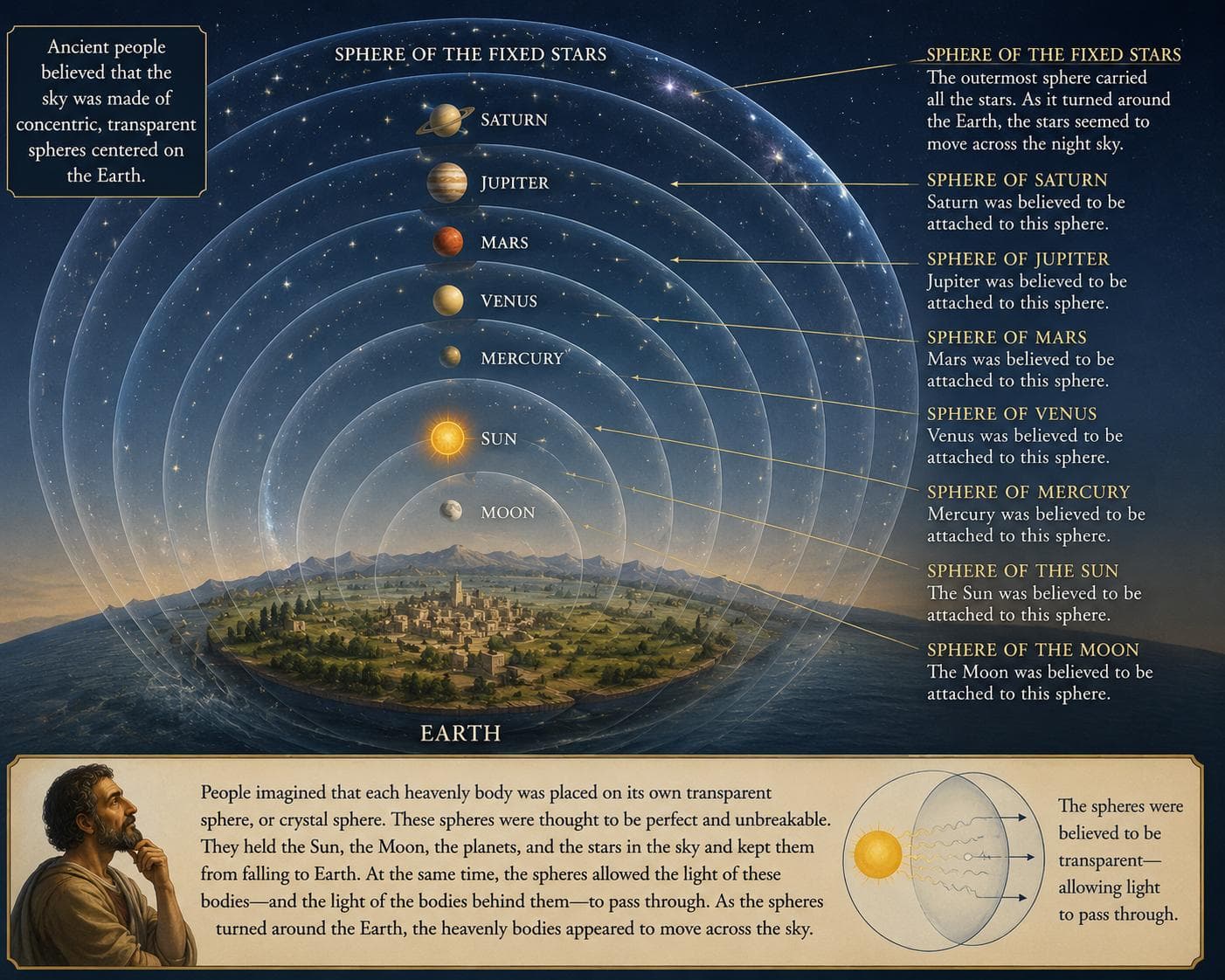
“In very ancient times, many people around the world thought that the land they lived on was flat and ended somewhere. They often saw their own land as an important or central part of the world, and They believed that the sky was made of several transparent spheres surrounding the Earth. The Sun, the Moon, the planets, and the stars were each placed on different spheres. They thought that these spheres held the heavenly bodies in the sky and kept them from falling to Earth, while still allowing their light—and the light of objects on the spheres behind them—to pass through. As the spheres turned around the Earth, the Sun, the Moon, the planets, and the stars moved with them.
“Of course, people in different parts of the world did not imagine the universe in exactly the same way. Each civilization had its own stories and ideas about the shape of the world and how it had begun.
“The ancient Egyptians believed that in the beginning, the first waters covered everything, and then dry land rose out of the water. They believed that the sky and the earth were originally joined together, so the Sun, the Moon, and the stars were all on the earth. Then the gods separated the sky from the earth and moved the Sun, the Moon, and the stars to their places in the sky.
“People in many ancient civilizations also connected the movements of the Sun, the Moon, the planets, and the stars with their gods. Some even thought that certain objects in the sky were themselves gods. Some people also believed that the positions of these objects in the sky were signs of the gods’ decisions or of events that were going to happen on Earth. So they looked at the sky and studied the positions of the stars and planets to try to predict good and bad events in the future.
“The Babylonians, who lived thousands of years ago in a land much of which is now part of Iraq, had a great civilization and carefully observed the sky. In some of their ideas about the universe, the human world was surrounded by waters, with heavenly worlds above it and an underworld below it. After sunset, the Sun passed into the unseen part of the world and appeared again in the east the next day.
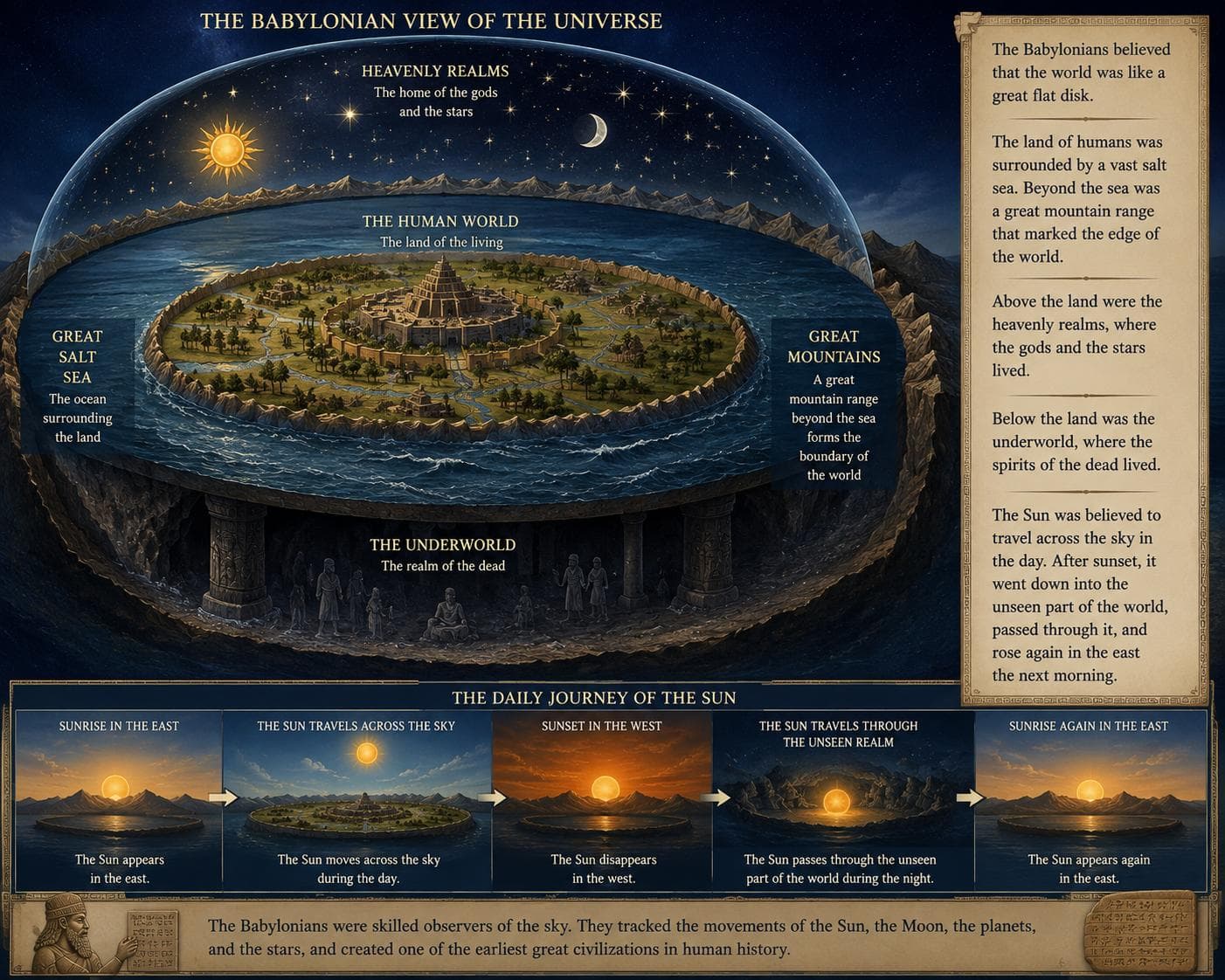
“In ancient ideas about the universe, the world was usually not just the place where humans lived. People also imagined other worlds where gods and the dead lived.”
The father continued:
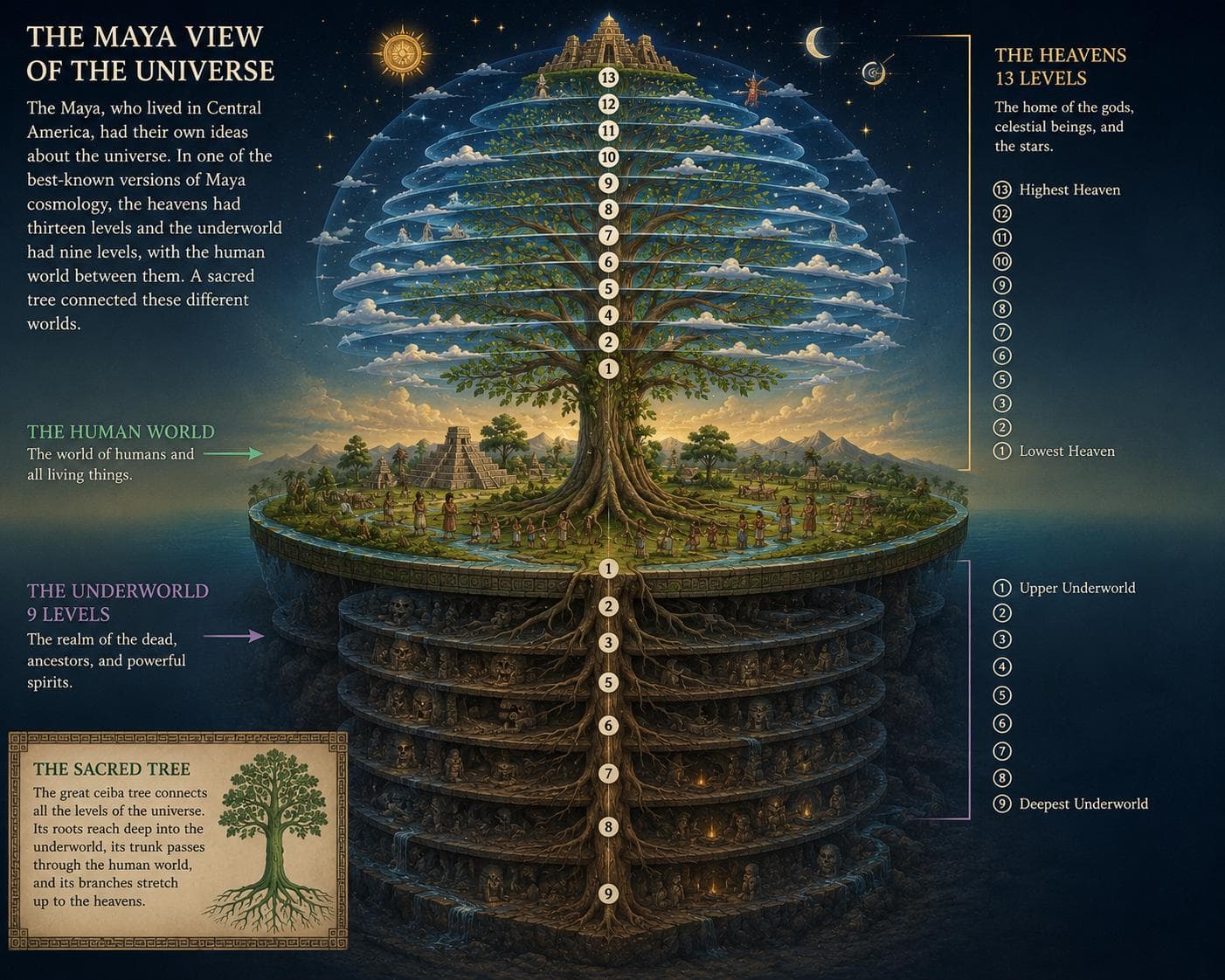
“The Maya, who lived in Central America, also had their own ideas about the universe. In one of the best-known versions of Maya cosmology, the heavens had thirteen levels and the underworld had nine levels, with the human world between them. A sacred tree connected these different worlds.”
“However, humans did not only tell stories. They also observed the sky, and little by little they tried to explain the shape and movement of heavenly objects more accurately.
“Ancient Greek scholars had discovered that the Earth was round. However, most scientific models of that time still placed the Earth at the center of the universe and imagined the Sun, the Moon, the planets, and the stars moving around it.
“Not every scholar agreed. For example, Aristarchus, a Greek scholar who lived around the third century BC, proposed that the Earth and the planets moved around the Sun. But his idea did not become the accepted view at that time.
“In ancient China, too, there were different ideas about the shape of the universe. In one important model, the Earth was thought to be flat and the sky round, with the heavens moving around the Earth.”
The father paused for a moment and continued:
“For centuries, models that placed the Earth roughly at the center of the universe were very common. The Sun, the Moon, the planets, and the stars were each given a place in the heavens, and heavenly spheres were used to explain their movements.
“But with the invention of the telescope, humans were able to observe the sky much more closely than before.”
Sunam asked:
“Why wasn’t the telescope invented earlier? Hadn’t people learned how to make glass before then?”
Sina’s father said:
“Yes, they had. Humans had been making glass for thousands of years before the telescope was invented. Even lenses existed before the telescope. But having glass and lenses does not mean that people will immediately invent every device that can be made from them.
“In 1608, the first known telescopes were made in the Netherlands. A year later, Galileo heard about the invention. He made his own telescopes, improved them, and pointed them toward the sky.
“Galileo’s observations provided very important evidence against the old picture of the universe. For example, he saw several moons moving around Jupiter. This showed clearly that at least some objects in the sky moved around something other than the Earth. His observations of the planet Venus also agreed much better with a model in which the planets moved around the Sun.
“Of course, these observations alone did not prove every detail of the movements of the Earth and the planets. Other scientists, both before and after Galileo, also played important parts in developing the new model of the solar system.
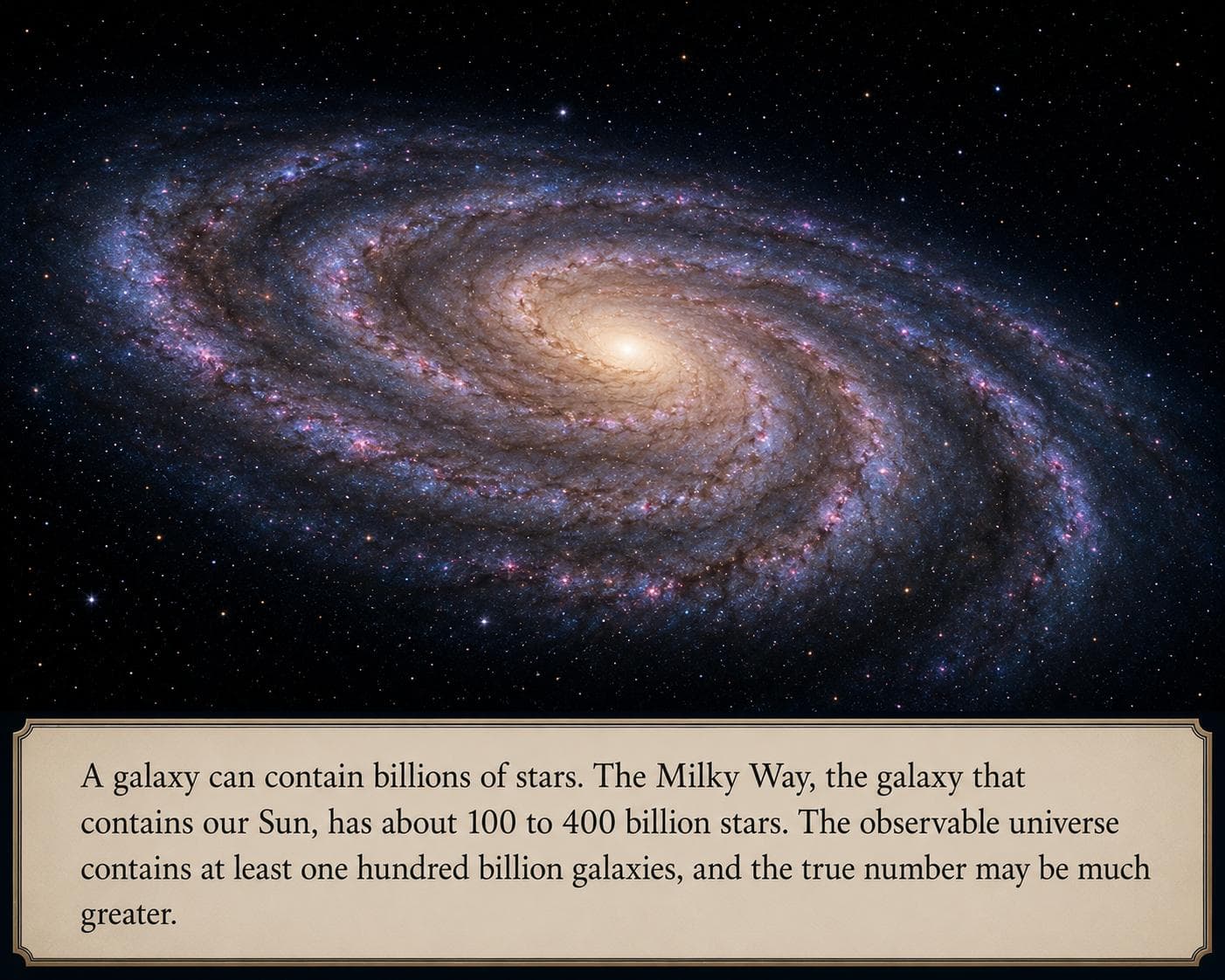
“As telescopes and astronomy improved, humans discovered that the Sun was not the center of the universe either. The Sun is only one of the stars in a huge galaxy called the Milky Way. Scientists today estimate that the Milky Way contains about 100 to 400 billion stars.”
Sina said:
“You mean there could be four hundred billion stars just in our own galaxy?”
His father said:
“Yes. And the Milky Way is only one galaxy.
“As telescopes became more powerful, humans discovered that some of the faint patches of light in the sky were actually other galaxies very far away. Today, we know that the observable universe contains at least one hundred billion galaxies, and some estimates suggest that the true number may be much greater—even around two trillion galaxies. We still do not know the exact number.”
Sunam asked:
“Do all these galaxies move around something? I mean, have we finally discovered where the center of the universe is?”
Sina’s father said, “These galaxies do not all orbit around one common center. Scientists’ observations show that, on very large scales, the universe is expanding, and most distant galaxies are moving farther away from us and from one another.”
Sina asked, “If they are moving away from one another, then they must have been closer together in the past. Right?”
His father said, “Yes. By measuring how fast galaxies are moving apart and using the laws of physics, scientists can, in a way, run the movie backward in their calculations. The result is that the universe was once much smaller, hotter, and denser than it is today. According to our best measurements, about 13.8 billion years ago, the universe was in an extremely hot and dense state, and it has been expanding ever since. We call the beginning of this expansion the Big Bang.
“But we should not imagine the Big Bang as something like a bomb exploding at one point in empty space and throwing matter outward. Space itself was expanding, and as it expanded, the distances between different parts of the universe increased. Scientists have also found many important pieces of evidence that support this idea. This is why the Big Bang theory has become the main scientific theory for explaining the early history of the universe.”
Sonam asked, “So did the stars and the Earth begin moving away from one another from the moment of the Big Bang?”
Sina’s father smiled and said, “No. At that time, there was no Earth and there were no stars. In the very earliest moments, there were not even atoms and molecules like the ones we know today. The universe was extremely hot. As the universe expanded, it cooled, and particles gradually became able to join together. Hundreds of thousands of years after the Big Bang, atoms formed.
“Later, gravity caused large amounts of gas to gather together in some parts of the universe. Huge clouds of gas formed, and as they became more compressed, the temperature and pressure at their centers increased. Eventually, the temperature at the center of some of these clouds reached millions of degrees, and a process called nuclear fusion began. In this process, the nuclei of light atoms join together and release a great amount of energy. When this process begins, a star is born and starts to shine. Our Sun is one of these stars.
“Some stars return large amounts of material to space at the end of their lives, and some massive stars die in enormous explosions called supernovas. Many of the heavy elements in the universe were made inside stars and during events connected with the deaths of stars.
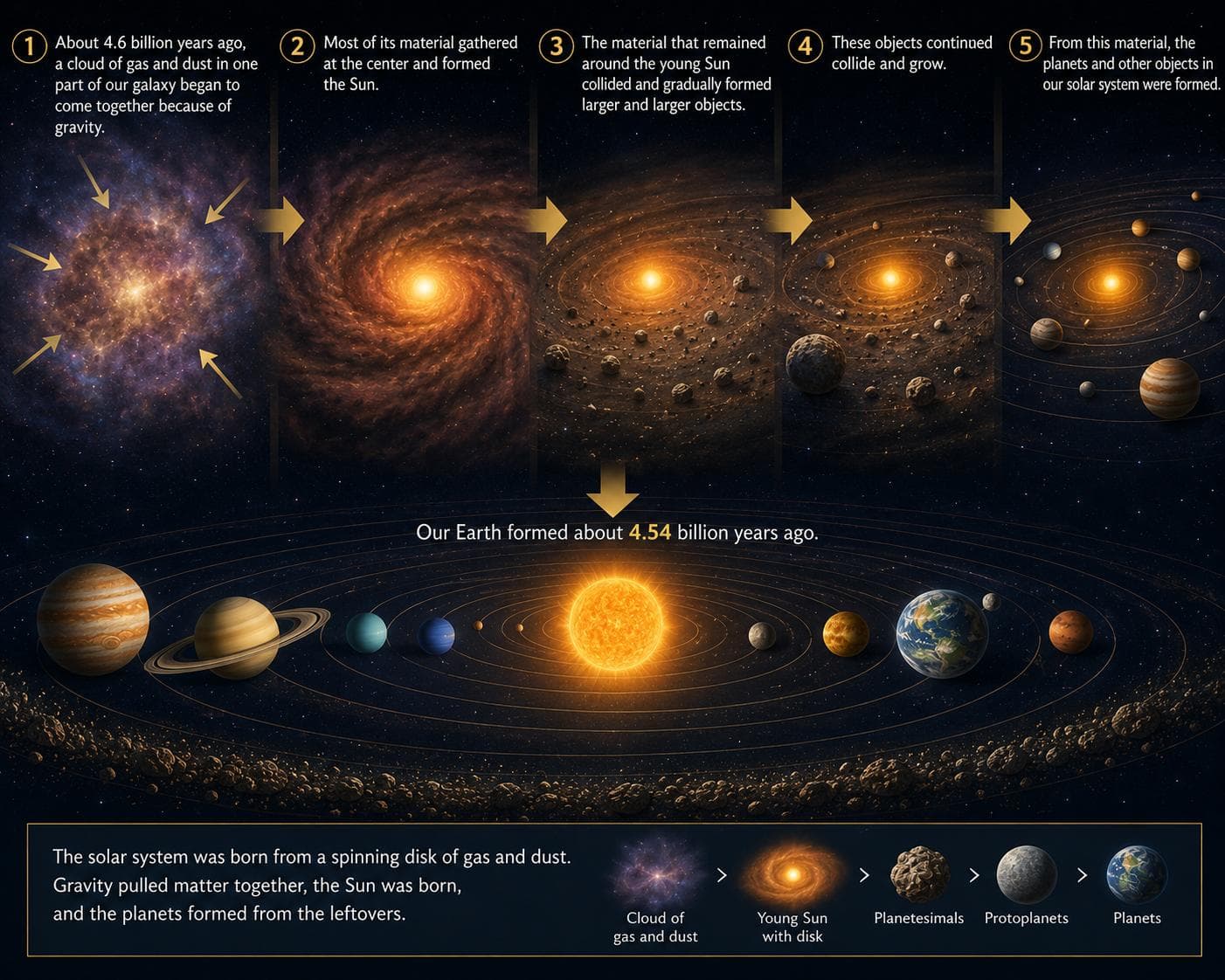
“About 4.6 billion years ago, a cloud of gas and dust in one part of our galaxy began to come together because of gravity. Most of its material gathered at the center and formed the Sun. The material that remained around the young Sun collided and gradually formed larger and larger objects. From this material, the planets and other objects in our solar system were formed. Our Earth formed about 4.54 billion years ago.
“In the years ahead, when you study more physics and chemistry, you will learn how scientists can measure radioactive materials in certain rocks to find their ages and, from this, calculate the age of the Earth.”
Sina’s father paused for a moment and then continued:
“The oldest known signs of life on Earth are more than 3.5 billion years old. The earliest living things were very simple, single-celled organisms. For billions of years, life on Earth consisted mostly of these simple organisms.
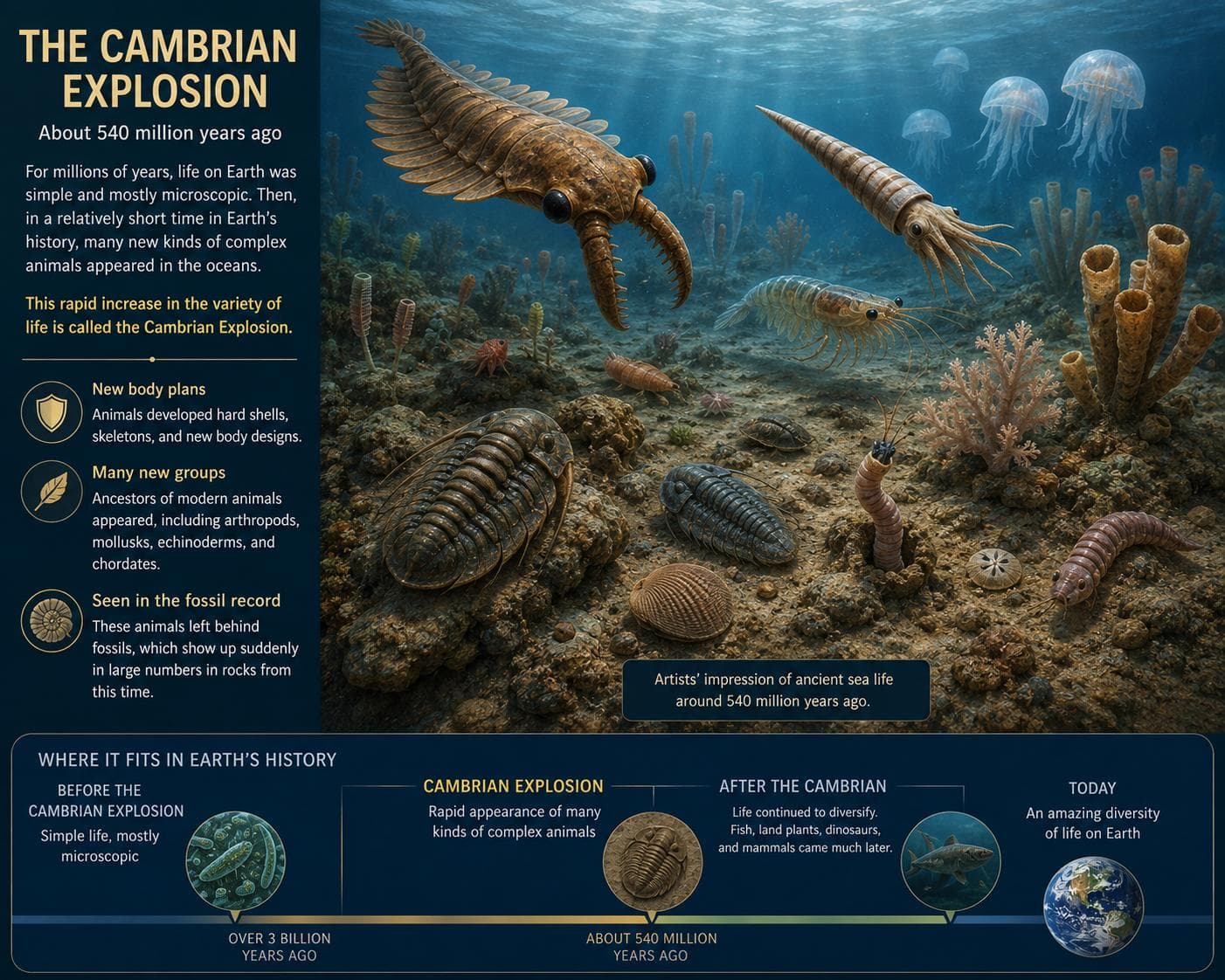
“But gradually, more complex living things appeared. Multicellular animals existed before 540 million years ago, and around 540 million years ago, the variety of marine animals increased greatly. Scientists call this period the Cambrian Explosion.
“The earliest vertebrates and fish-like animals also appeared more than 500 million years ago, and during the hundreds of millions of years that followed, many different kinds of fish evolved. Plants also began spreading across the land more than 400 million years ago, and later insects and other animals became common on land.”

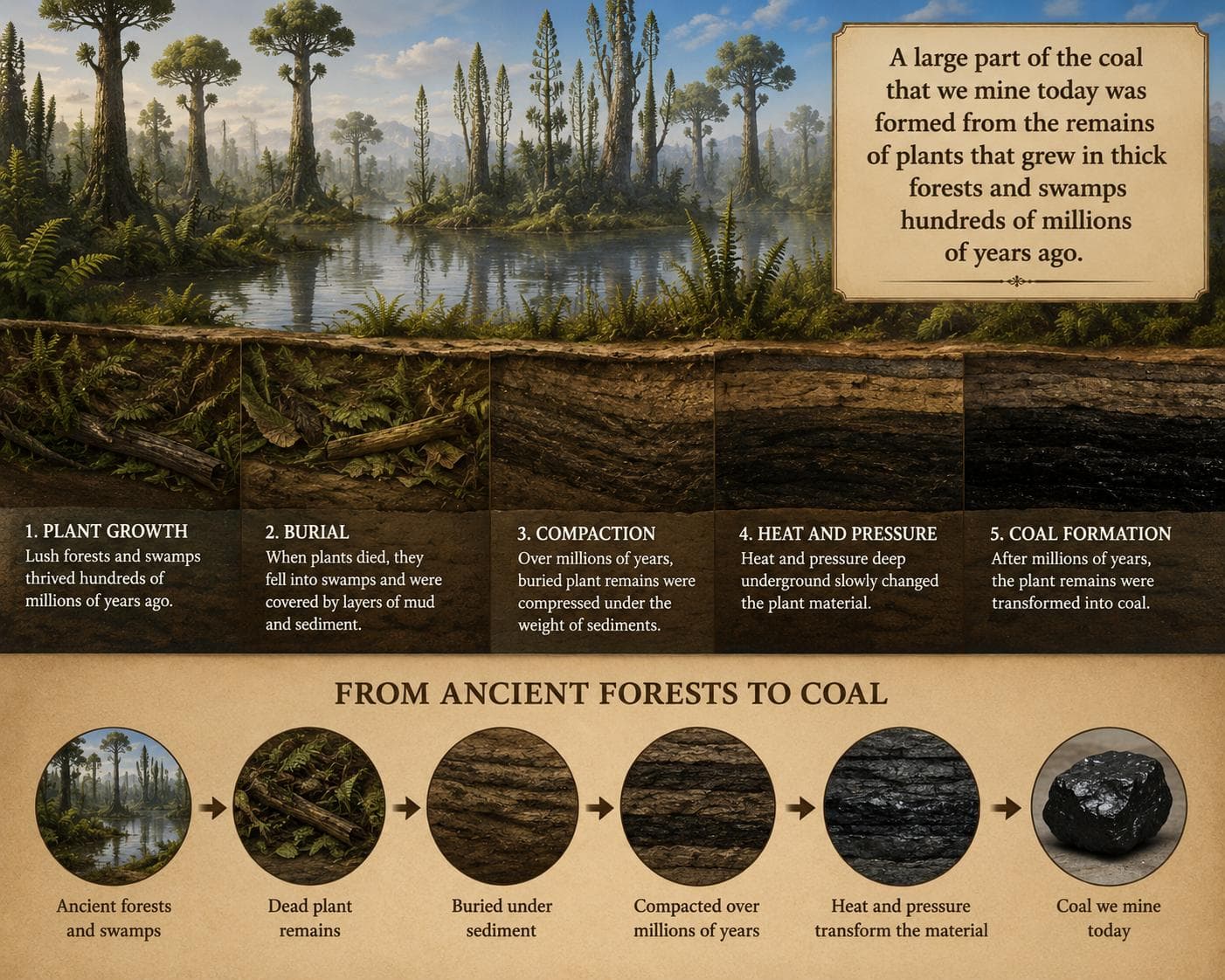
“A large part of the coal that we mine today was formed from the remains of plants that grew in thick forests and swamps hundreds of millions of years ago. After these plant remains were buried, heat and pressure gradually changed them into coal over millions of years.
“Dinosaurs appeared much later. The first dinosaurs appeared about 230 million years ago, and non-bird dinosaurs lived on Earth until about 66 million years ago. But not all dinosaurs disappeared. One group of dinosaurs evolved over time into the birds we see today. This is why scientists now consider birds to be a group of dinosaurs.

“By studying rocks, mountains, sediments, and a huge number of fossils, scientists have learned that the Earth has constantly changed over hundreds of millions of years. The climates of different regions have changed, seas have advanced and retreated, and even the continents have slowly moved. A place that was once at the bottom of a sea may now be part of a mountain. Under such changing conditions, some species became extinct, while others changed over many generations.”
Sonam asked, “How do animals adapt to these changes?”
Sina’s father said, “When living things reproduce, their offspring are not exactly like one another or exactly like their parents. There are small differences between them, and some of these differences can be inherited. Genetic mutations are one of the causes of these differences.
“For example, imagine a land with a warm climate that slowly becomes colder over thousands of years. Suppose some animals live there that cannot tolerate cold weather very well. Some of them, because of inherited differences, may be a little better at surviving in the cold than others. For example, their bodies may be able to store more fat under their skin.
“These animals will have a better chance of surviving and having offspring in the colder climate. If this ability can be inherited, some of their offspring will have it too. After many, many generations, animals that are better able to survive the cold may become more common.
“This process is called natural selection. If changes like these continue for a very long time, a population may eventually become so different from its ancestors that a new species develops. So one mutation in one animal does not suddenly create a new species. Changes usually build up in a population over a great many generations.”
Sonam asked, “But you call evolution a theory. Doesn’t theory mean that scientists are not sure whether it is true?”
Sina’s father said, “No. We talked about hypotheses and theories before, but the word theory has a special meaning in science. A hypothesis is a possible explanation that can be tested. Scientists examine it by comparing it with observations and evidence. Some hypotheses turn out to be wrong and are rejected.
“A scientific theory is much more than a guess. It is a broad explanation that is supported by a large amount of evidence, has been tested in many different ways, and explains many observations at the same time.
“For example, scientists have found enormous numbers of fossils in rocks of different ages. They can compare the bodies of living things, study their DNA, observe inherited changes from one generation to another, and even observe evolution happening in populations today. These different kinds of evidence fit together.
“So when scientists call evolution the theory of evolution, the word theory does not mean that evolution is just a possibility someone has imagined. Evolution—the fact that populations of living things change over generations and that different species share ancestors—is supported by a great amount of evidence. The theory of evolution explains how and why these changes happen.”
Sonam said, “So a scientific theory is not the same thing as an ordinary guess.”
“Exactly,” Sina’s father said. “In everyday speech, people sometimes use theory to mean a guess. But that is not what scientists mean when they use the word.”
His father continued:
“The story of human beings is also part of this long history of evolution. The distant ancestors of humans and modern chimpanzees shared common ancestors millions of years ago. Later, their evolutionary paths separated.
“The earliest members of the genus Homo, the group to which modern humans belong, appeared more than two million years ago. They were different from us in the shape of their bodies and skulls and in the size of their brains.
“Over time, different human species appeared, and some of them became extinct. Our own species, Homo sapiens, appeared in Africa about 300,000 years ago.”
Sonam asked, “So we humans are also the result of evolution?”

His father said, “Yes. A great amount of evidence from fossils, genetics, the structure of living things, and other branches of science supports this.”

Mr. Maragheh, who was walking a few steps behind them with his wife, called out, “Although it’s cloudy today and Tokyo’s heat is more bearable, I think I’d rather go back now.”
Sina and his father stayed in Tokyo for a few more days and visited some of the city’s sights. Then they returned to Iran.
On the plane, Sina’s father asked, “Would you like to take another trip this summer—to Sweden?”
Sina said happily, “Nothing could be better!”