

Journey into the Heart of Religions by N. Fakhr - HTML preview
Download the book in PDF, ePub, Kindle for a complete version.
Buddhism
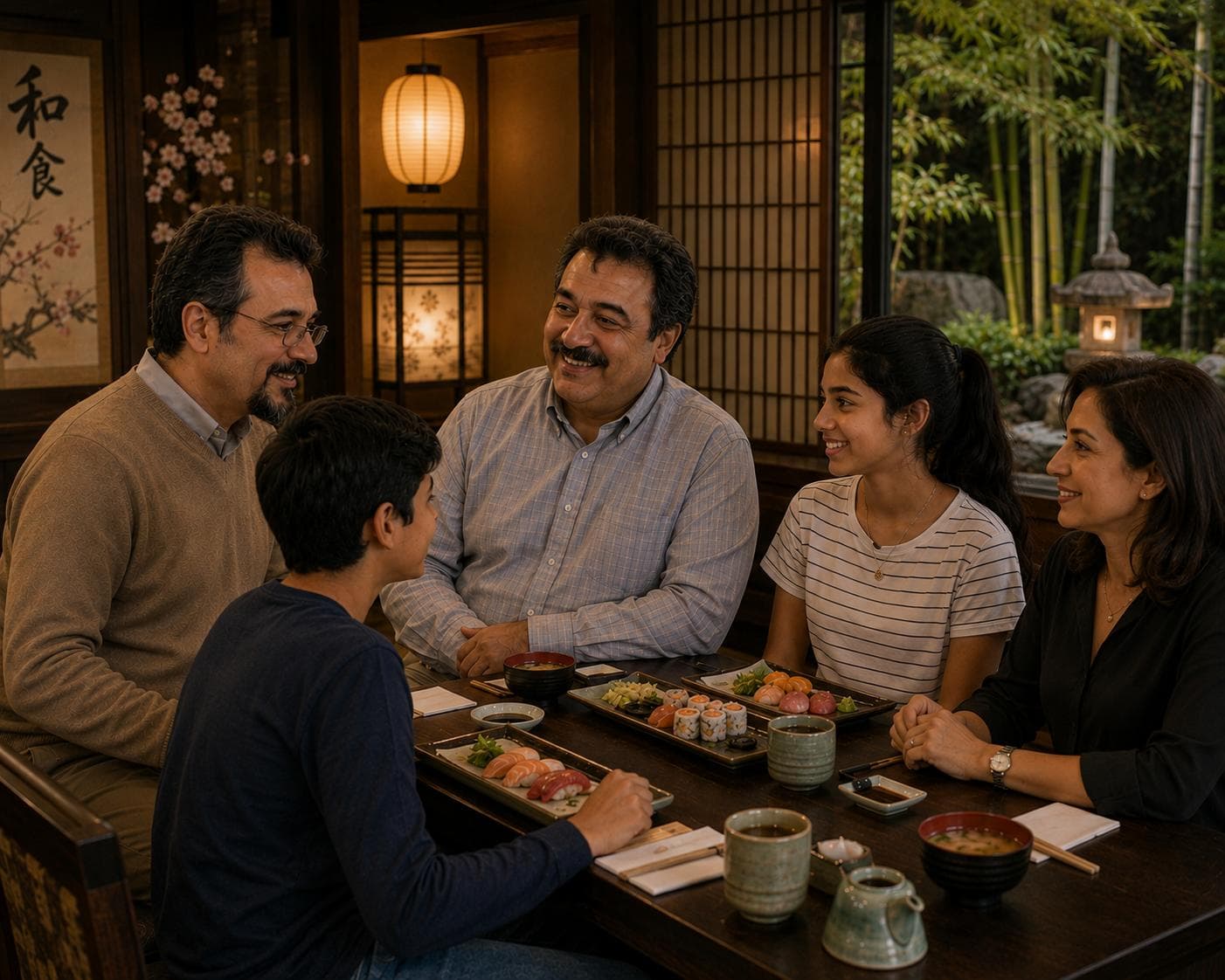
Mrs. Maragheh-ee was a cheerful, friendly woman, and she was happy to see Sina and his father.
At the restaurant, Sina asked Mrs. Maragheh-ee whether she had become a Buddhist too. She replied that she was still a Muslim. Then Sina turned to Mr. Maragheh-ee and asked him to tell them about Buddhism.
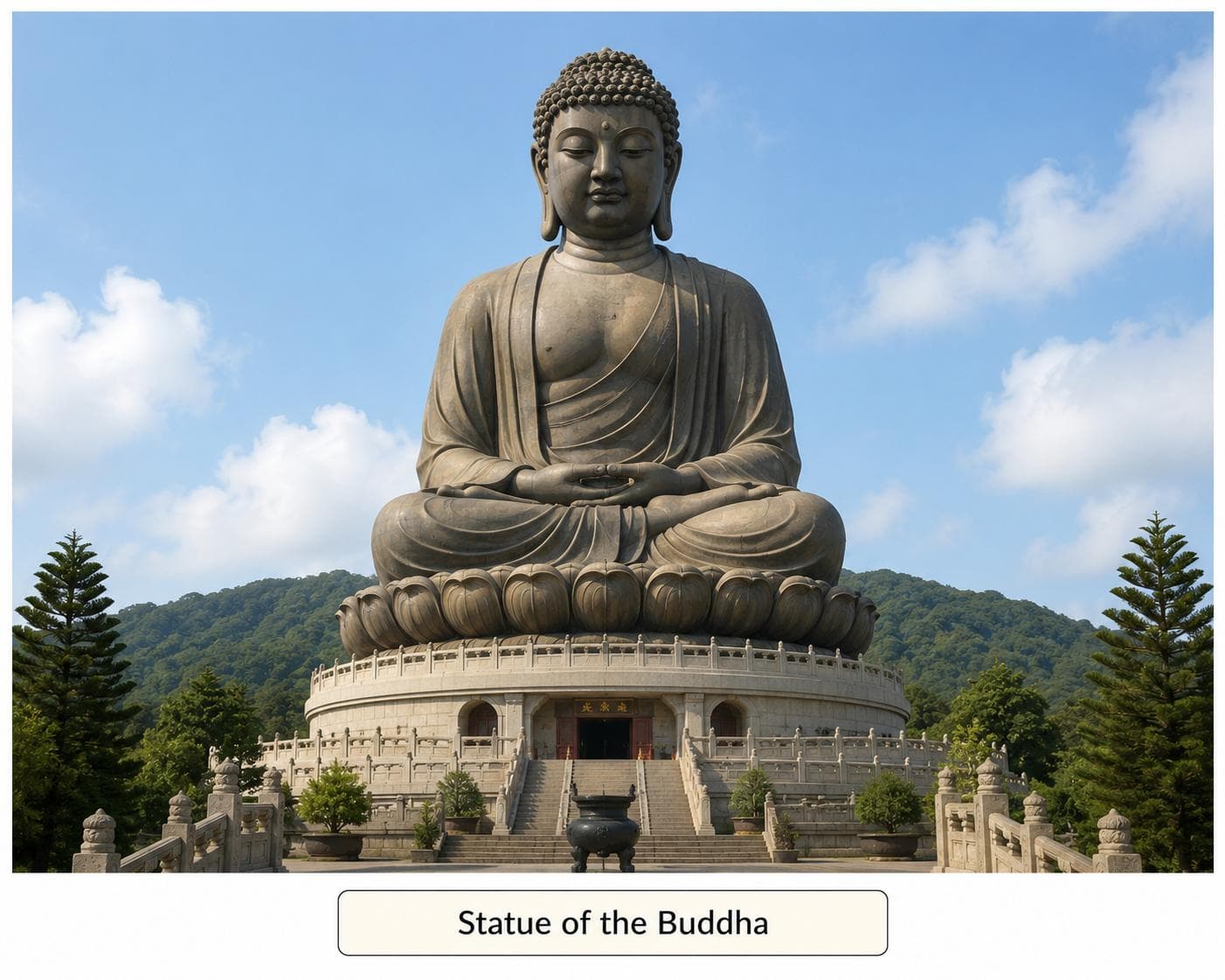
Mr. Maragheh-ee began, “About 2,600 years ago, a man named Siddhartha Gautama was born in the Indian subcontinent.”
Sina asked, “The Indian subcontinent?”
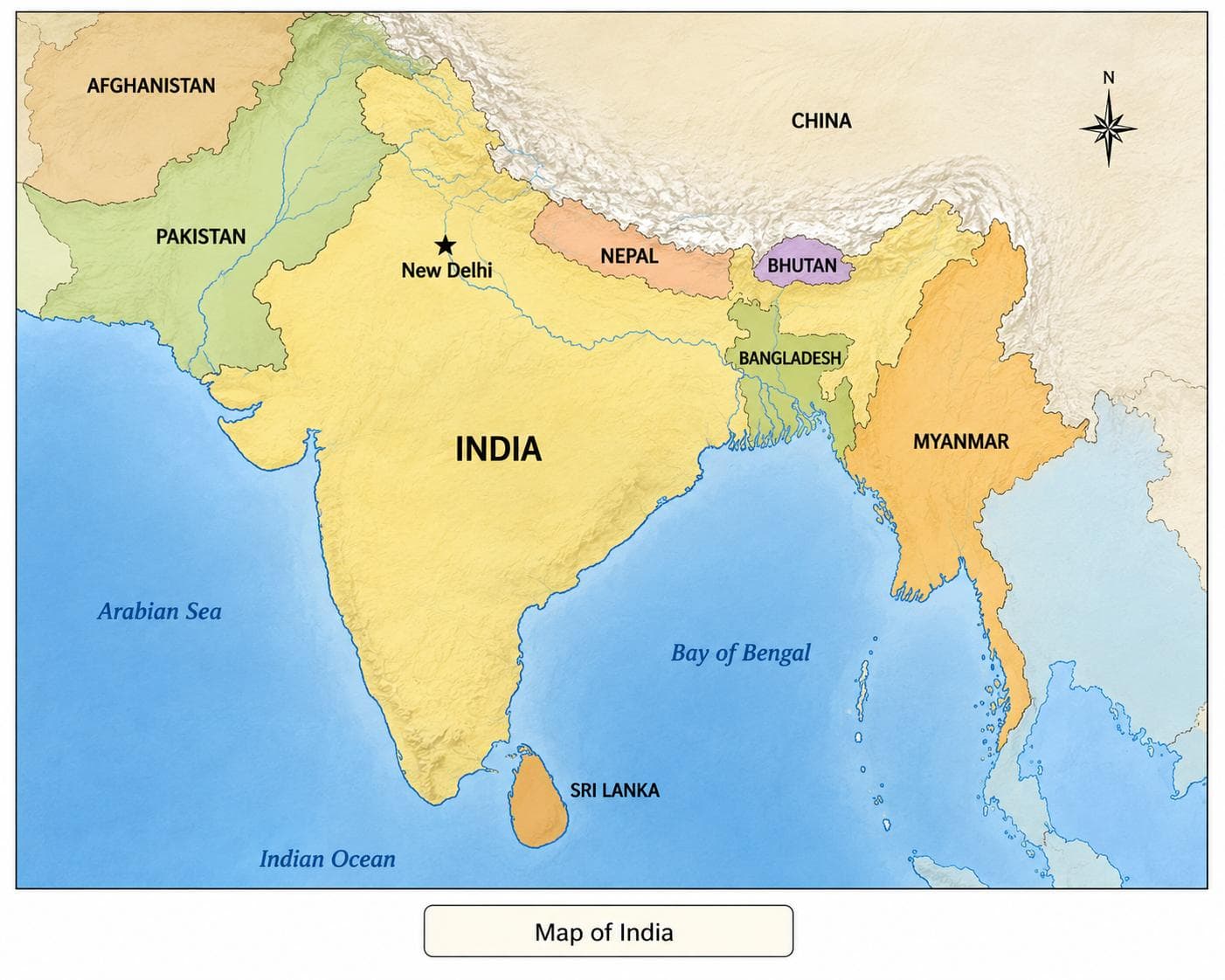
Mr. Maragheh-ee said, “Yes. If you look at a map, you’ll see that India and several neighboring countries are located in a large, roughly triangular region in South Asia. This region is called the Indian subcontinent.
“Siddhartha Gautama’s father was the ruler of his region. When his son was born, a fortune-teller came to see him and said that the boy would either become a great king or give up wealth and power to become a holy man. Which one happened would depend on whether or not he saw the world outside the palace.”
“Siddhartha Gautama’s father prevented him from leaving the palace because he wanted him to become a king. But at the age of twenty-nine, Siddhartha left the palace. On four different occasions, he saw four people: an old man, a sick man, a dead man, and an ascetic. Of the four, only the ascetic seemed to be peaceful and content.
“Since Siddhartha saw suffering and pain in the first three, he decided to leave the palace and seek a way to escape suffering through thought and spiritual practice. But he discovered that these alone could not free a person from suffering. He then turned to asceticism and renunciation. He fasted for long periods and subjected himself to great hardship and pain. He almost starved to death, but finally concluded that these practices would not free him from suffering either.

“At the age of thirty-five, he sat beneath a fig tree and vowed not to get up until he had reached enlightenment and awakening. Days passed, and eventually he succeeded in breaking the chains that bound his mind and reached complete enlightenment. A person who has awakened is called a Buddha, and that is why we call him the Buddha.
“For the rest of his life, he traveled and taught people the way to awakening. He and his disciples went from village to village and from town to town. He died at the age of eighty.”
Sina asked, “What kind of suffering was the Buddha trying to escape?”
Mr. Maragheh-ee laughed and said, “Well done! That’s a good question. Usually, we humans are not fully aware of our suffering, so we don’t look for a way to end it either. But the Buddha realized that everything is changing. Nothing is permanent. Both things themselves and the conditions around them are constantly changing. Things continually come into existence and pass away. Understanding this important truth is one of the steps toward ending ignorance.”
Sina asked, “What ignorance?”
Mr. Maragheh-ee said, “Living in this world is like living in a house that is on fire. The people inside are busy enjoying the pleasures of life without realizing that the house is burning and will soon collapse.”
Sina asked, “What ignorance?”
Mr. Maragheh-ee said, “Living in this world is like living in a house that is on fire. The people inside are busy enjoying the pleasures of life without realizing that the house is burning and will soon collapse.”
“By the house collapsing, do you mean death?” Sina asked.
“Yes, death. No matter what pleasure or success we achieve, it will not last. It will eventually come to an end, and that causes suffering. The Buddha wanted to put an end to this suffering. Through thought and meditation, he tried to find a way to end it.”
Sina asked, “What is meditation?”
Mr. Maragheh-ee replied, “It is a practice in which a person tries to clear distracting and scattered thoughts from the mind so that the mind can focus on particular thoughts, or become ready to receive insight and truth. The Buddha was able to reach such truths.
“In his teachings, he taught people four great truths: first, what human suffering, or dukkha, is; second, what causes it; third, that it can be ended; and fourth, the way to end it.”
Sina said, “But everyone knows that suffering and death exist. Everyone also knows that nothing lasts forever. I don’t think there is any way to change that. We should just make good use of the life we have and not waste it by being needlessly sad and worried. We should try not to cause suffering to one another and help each other. That way, we can build a society in which we suffer less because of one another and enjoy helping each other and seeing each other happy.”
Mr. Maragheh-ee smiled and said, “You speak very well! But what you said isn’t enough. The problem is that everything does not end with death. We are born again and live another life, and once again everything in that life eventually disappears. This repeated cycle of birth, death, and rebirth is called samsara. It continues again and again. This samsara is the suffering of human beings, and one aspect of human ignorance is failing to understand samsara.”
Mr. Maragheh-ee looked at Sina and remained silent for a few seconds, waiting to see how he would react. Sina stared for a moment at the rectangular plate in front of him. Then he raised his head and said, “Why did the Buddha think samsara existed? You said he lived in India and had lived among Hindus for years. Couldn’t he have gotten this belief from the people around him? Jains, Hindus, and Sikhs believe in it too. They also think their greatest problem is samsara—the repeated cycle of birth and death—and that the teachings of their religions are meant to help them escape from it.”
Mr. Maragheh-ee replied, “No, not at all! When the Buddha reached enlightenment and clearly saw the truths of existence, he taught things that were not found in Hinduism. He showed a way out of samsara that was different from the Hindu way.”
Sina said, “All right. If human suffering is samsara—the fact that happiness, success, health, and all these other things do not last—what did the Buddha say was the cause of this suffering? You said the second great truth he taught people was ‘the cause of suffering.’”
Mr. Maragheh-ee said, “The cause is ignorance. For example, Hindus believe that if a person worships and gains a great deal of good karma, after death he may have a better life, or may even be freed from samsara. But the Buddha taught that although good karma can take a person to better worlds after death, the only thing that can end samsara is reaching enlightenment and awakening—or ‘becoming a Buddha.’ This means that the truths must enter the mind of any human being, or any other living being, who wants to become a Buddha. In fact, any living being can become a Buddha.”
Sina said, “So the Buddha believed in karma too!”
Mr. Maragheh-ee replied, “After becoming a Buddha, the Buddha did not believe in things. He saw everything directly—all the truths—just as you and I can see each other.”
Sina said, “You said everyone must become a Buddha in order to be freed from samsara. Has anyone else become a Buddha, or has Siddhartha Gautama been the only Buddha so far?”
Mr. Maragheh-ee said, “There have been many Buddhas, and the names of hundreds of them are written in Buddhist texts. Some Buddhas discover the truth by themselves, without anyone’s help, and also teach it to others, like Siddhartha Gautama. Some discover the truth by themselves but are unable to teach it to others. And some reach the truth with the help and teachings of other Buddhas.”
Sina asked, “What is the way to end suffering—or, in other words, to become a Buddha?”
Mr. Maragheh-ee said, “The way has eight parts: right view, right intention, right speech, right action, right livelihood, right effort, right mindfulness, and right meditation. These are not eight stages that you go through one after another. They are eight aspects of a person that must all be developed together.”
Sina said, “I can guess what some of those ‘right’ things mean, but you’ll have to explain some of the others. For example, what does ‘right view’ mean?”
Mr. Maragheh-ee said, “Right view means seeing the world as the Buddha taught us to see it. For example, you think that life ends with death, while a Shinto follower sees the world in the way I described earlier. But those views are not true. We must see the world as it really is and understand it as it really is.”
Sina asked, “You mean the way the Buddha explains it?”
Mr. Maragheh-ee said, “Exactly! We cannot reach ‘right view’ without the Buddha’s help. So if we are ever going to become Buddhas and reach enlightenment, we will be among those Buddhas who needed the help and teachings of other Buddhas in order to become Buddhas themselves.”
For the next few minutes, Sina concentrated on finishing his meal. When he was done, he said, “But you said the Buddha died at the age of eighty.”
Mr. Maragheh-ee said, “Yes, but he did not really die. He is alive forever and lives on other levels of existence. Monks, or Buddhist religious teachers, are allowed to tell people new truths that the Buddha suggests to them. Of course, not all Buddhists believe that the Buddha can communicate with monks. But we Buddhists who follow the Mahayana tradition believe this too.
“There are different traditions within Buddhism. The two largest are Mahayana and Theravada. Most Buddhists in China, Korea, Japan, Vietnam, Singapore, and Taiwan follow Mahayana, while most Buddhists in Cambodia, Laos, Thailand, Myanmar, and Sri Lanka follow Theravada. The two traditions differ in some details.”
Sina asked, “Do you believe everything that is taught in Mahayana Buddhism?”
Mr. Maragheh-ee replied confidently, “Yes.”
Sina asked, “Don’t you think that if Japanese Buddhists had followed Theravada instead of Mahayana, you would now believe just as confidently in everything taught by Theravada?”
Mr. Maragheh-ee laughed and said, “I have seen truths in this tradition that would make you believe in it too if you had seen them. I’ll take you to meet a high-ranking Buddhist monk who can communicate with the Buddha and bring remarkable truths from the Buddha to us Buddhists.”
Mrs. Maragheh-ee, who seemed tired, said, “I think we’d better continue this conversation tomorrow.”
Sonam, whose eyes were also getting sleepy, said, “My brain isn’t working anymore, but I’d like to hear the rest of the discussion about Buddhism. I’ll come to the temple with you tomorrow too.”
Suggestion
The next morning, Sina and his father were sitting in the hotel lobby, waiting for the Maragheh-ee family to arrive.
Sina said to his father, “Yesterday, Mr. Maragheh-ee said something about new truths being suggested to Buddhist monks. He said that the Buddha suggests new truths about Buddhism to the monks. What does ‘suggestion’ mean?”
His father thought for a few seconds and then said, “It would be better to ask Mr. Maragheh-ee himself exactly what he meant. I only know that suggestion means putting an idea or belief into another person’s mind in such a way that the person comes to accept that belief or way of thinking too.
“Of course, if this is done by giving reasons and using logical arguments, we don’t call it suggestion. But if, by repeatedly telling someone a belief—for example, that men are superior to women—we cause that person to accept it too, then we have suggested the idea of men’s superiority over women to that person.
“Sometimes people also use the word ‘suggestion’ when they believe that an idea has been placed in their mind by a supernatural power or a holy spirit. This makes them more likely to accept the idea as true. But if they accept that the idea came from their own mind, they also have to accept that it might be wrong.
“For example, there may have been hundreds of times when we decided not to go somewhere we had planned to go. Now imagine that on one of those hundreds of occasions, something happened to the vehicle we had planned to travel on—perhaps the plane, train, or bus that we decided not to take had an accident.
“If we accept that these two events simply happened to occur together by chance, then the next time the thought of canceling a trip comes into our mind, we will examine that thought using reason and evidence. But if we believe that this fortunate event happened because a supernatural power gave us the idea of canceling the trip in order to protect us and save our life, then every time the thought of canceling a trip comes into our mind, we may regard it as a suggestion from that power and no longer stop to consider whether canceling the trip is actually the right thing to do.”
At the Buddhist Temple
Just then, Mr. Maragheh-ee, his wife, and his daughter arrived, and they all went together to a Buddhist temple.
On the way, Mr. Maragheh-ee said, “There is a Buddhist monk at this temple whom I know. He is a very devout man and has a great deal of knowledge.”
Sina’s father turned to Sina and said, “Before you ask what ‘devout’ means, I’ll tell you. A devout person is someone who cares more about his religion than worldly pleasures and does not forget the teachings of his religion for the sake of worldly life and its pleasures.”
Mr. Maragheh-ee continued, “In fact, he is a Bodhisattva. And I’ll tell you what that means. A Bodhisattva is someone who, in a ceremony in which passages from the sutras are recited, takes a vow to devote the rest of this life and his future lives to helping others become Buddhas. The sutras, by the way, are collections of writings based on the teachings of Gautama Buddha.”
Sina asked, “What exactly do Bodhisattvas do?”
Mr. Maragheh-ee replied, “First of all, they try to understand the truths and become Buddhas themselves. Along the way, they try to strengthen good moral and spiritual qualities in themselves and reach perfection in six things: generosity, good conduct, patience, effort, meditation, and wisdom. At the same time, they try to serve others. They also continually honor and praise all the Buddhas who came before them.
“The Buddha himself was a Bodhisattva in a previous life and also during his younger years. Long ago, the kings of Sri Lanka were also regarded as Bodhisattvas. They were considered worthy of having religious truths suggested to them by the Buddha, and ruling the kingdom was regarded as part of their religious duties.”
Sina asked, “So if an idea about how to rule came into their minds, they might have thought it was a suggestion from the Buddha?”
Before Mr. Maragheh-ee could answer, Sonam said, “This monk has asked my father several times to take the ‘Bodhisattva vow’ and then join the same temple where he is.”
Mrs. Maragheh-ee said, “If I hadn’t insisted that your father not do it, perhaps he would have become a Bodhisattva by now.”
Sina asked Mrs. Maragheh-ee, “But what would be wrong with that? What is wrong with becoming perfect in generosity, good conduct, patience, effort, and wisdom?”
Mrs. Maragheh-ee replied, “It is other people who give things to the Bodhisattvas and put money into temple donation boxes. I’ve never seen them have ordinary jobs and work like the rest of us. Anyway, I don’t like the idea of Hossein doing these things.”
Mr. Maragheh-ee laughed and said to his wife, “Don’t worry. I don’t think I have it in me to set out on such a difficult path either.”
Just then, they arrived at the temple. Inside, several Buddhists were worshipping. An elderly man in red robes was sitting in a corner with his eyes closed, meditating. Mr. Maragheh-ee asked everyone to wait until the man had finished. While they waited, Sina and the others looked at the paintings on the walls and the statues inside the temple.

When the monk finished his worship, he turned toward them and was happy to see Mr. Maragheh-ee. With Mr. Maragheh-ee translating, he greeted everyone. He said that he had been praying to Maitreya.
Sina asked who Maitreya was.
The monk replied, “Maitreya is the greatest Bodhisattva.”

Sina asked, “So he is alive! Where is he now? How can you pray to him?”
The monk smiled and said, “He is alive, but not in this world. He will come to this world in the future.”
“How do you know?”
“The Buddha said so.”
Sina asked, “There are so many Bodhisattvas in the world. You yourself are one of them. What makes Maitreya different from the rest of you?”
The monk replied, “He will come at a time when hardly anyone remembers or follows the Buddha’s teachings. It will be a time even worse than today, when people are moving farther and farther away from the Buddha’s teachings.
“At that time, the oceans will become smaller so that he can travel to the different continents and share his teachings with everyone. When he comes and teaches the laws to everyone, all people will be guided toward a good and holy life. They will no longer think of anything as their own or seek to own wealth or possessions—not gold or silver, not houses, not even wives or children. People will enter an ocean of meditation filled with great pleasure and joy, because they will have learned the laws of Dharma.”

Sina asked, “What kind of law is Dharma?”
The monk replied, “Dharma is the set of laws that govern the universe, including the laws for becoming free from samsara.”
Sina asked, “So after that, everyone will live happily forever?”
The monk replied, “No, not forever. After many years, people will once again begin to forget those teachings. Then our small world, like countless other worlds, will be destroyed. After that, new worlds will be formed.”
Sina asked, “Who makes these worlds? The Buddha?”
The monk replied, “No. Let me explain everything to you. According to the sutras, which contain the collected teachings of the Buddha, the universe is made up of different levels, with each level separated from the levels above and below it.
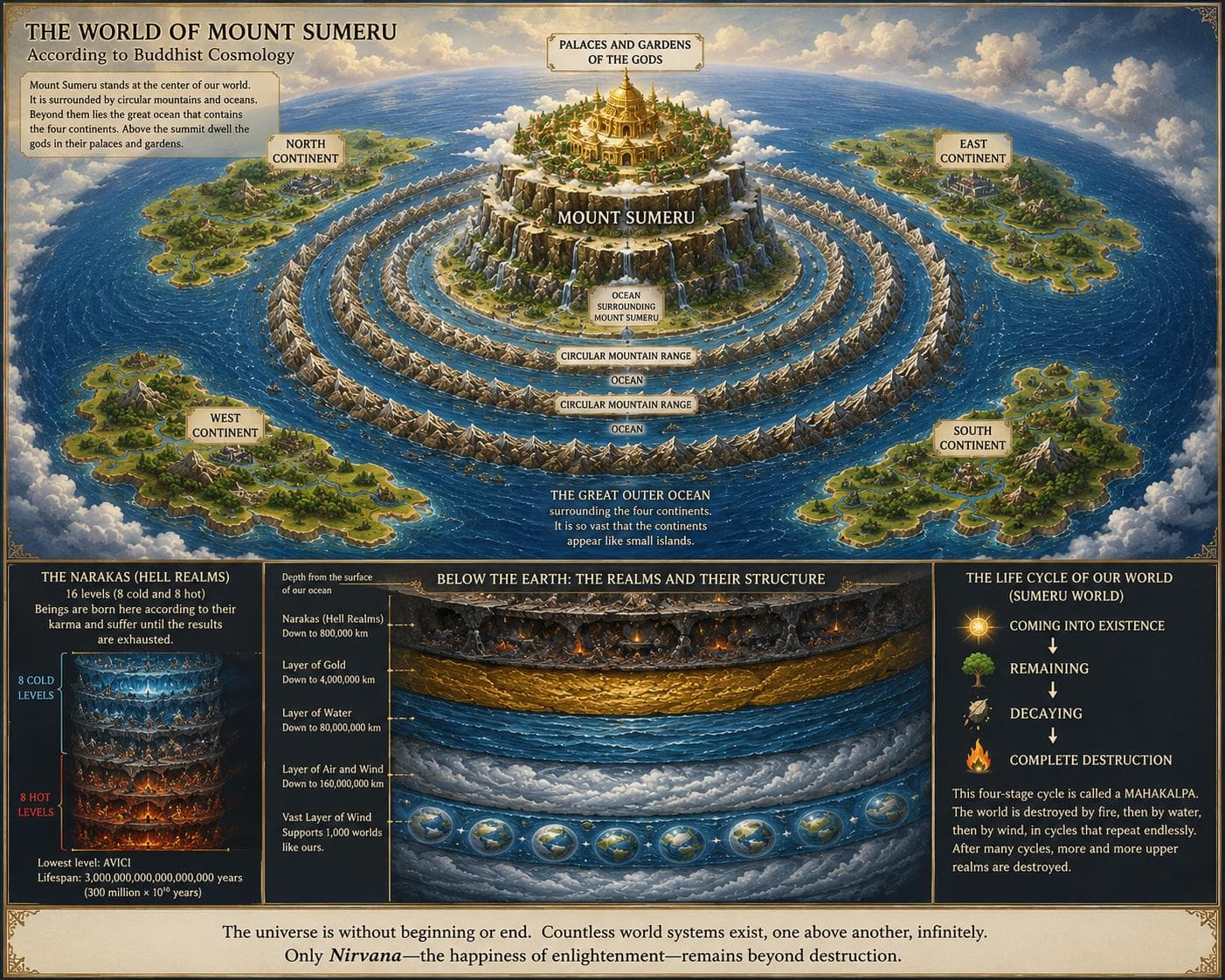
“At the center of the universe is a world called Sumeru. At the center of Sumeru rises a great mountain. Its summit is not pointed like an ordinary mountain. Instead, the top is a broad, flat land. A vast ocean surrounds this high mountain. Various gods and other beings whose names are mentioned in Buddhist texts live on the flat land at the top of the mountain, on its slopes, and in the ocean around it. These beings sometimes appear in human life and do things.
“The ocean surrounding the central mountain of Sumeru is itself surrounded by a ring of mountains, and that ring of mountains is surrounded by another ocean. In the same way, rings of mountains and oceans form larger and larger circles around the central mountain.
“The outermost ocean is enormous and contains four continents. But because the ocean is so vast, these continents look no larger than small islands in this immense sea. The ocean is so large that traveling between the continents is very difficult. One of these continents is the continent on which we humans live. It is shaped like a triangle with its pointed end facing south.”
Sina immediately said, “That reminds me of the map of the Indian subcontinent. It looks like a triangle with its pointed end facing south.”
Then Sina turned to Mr. Maragheh-ee and said, “You said the Buddha lived in India. Right?”
Mr. Maragheh-ee, who had been listening carefully and with great interest to the Buddhist monk and eagerly translating his words, replied, “Yes, that’s right.”
The monk continued, “The last ocean I mentioned is itself surrounded by a circular mountain range, and beyond that lies the end of the Sumeru world. This is the same world around which the sun and moon travel, passing over it.”
Sina said, “So we live in one part of this Sumeru world!”
The monk replied, “Yes. According to the sutras, that is correct. Above Mount Sumeru are the palaces and gardens of the gods.”
“Gods?” Sina asked. “Do you mean they create things?”
“No. We call them gods because they live much longer than we do and live in better worlds. They do not create anything. These gods, or beings, are about three-quarters of a yojana tall, and each of their lives lasts thirty-six million years.”
Mr. Maragheh-ee explained, “A yojana is a unit of distance mentioned in the Vedas, the sacred writings of the Hindus. There are different opinions about its exact length. Some say one yojana is six and a half kilometers, while others say it is thirteen kilometers.”
Sina said in amazement, “You mean they are between five and ten kilometers tall?”
“Yes,” the monk replied. “The land at the top of Mount Sumeru is eighty yojanas, or about eight hundred kilometers, above the surface of the ocean, if we take one yojana to be ten kilometers, which is a number between 6.5 and 13 kilometers.
“In the center of each of the four continents I mentioned, there is a tree one hundred yojanas, or about one thousand kilometers, tall.”
Sina said, “Mount Everest, the highest mountain on Earth, is about eight kilometers high. So each of these trees is more than a hundred times as tall as Everest.”
“I will explain,” the Buddhist monk said. Then he continued, “According to the sutras, the people of the continent where we live are between 150 and 200 centimeters tall, and their lifespans range from ten to 140 years. On the second continent, people are three and a half meters tall and live for 250 years. The people of the third continent are seven meters tall and live for 500 years. The inhabitants of the fourth continent are very wealthy and have houses built in the air. They are fifteen meters tall and live for one thousand years.”
Sina said, “It seems that the numbers for height and lifespan on each continent are almost twice those of the one before it.”
The monk continued, “Hungry ghosts also live on Earth, but they see it differently. They often live in deserts and ruins.
“Below the Earth are many levels called Narakas. Depending on the karma that beings have gained, they may have to be born in these worlds and remain there for some time until the results of their karma have been completed. In these underground worlds, beings live in terrible fear and despair. Eight Narakas are cold and eight are hot.
“The lifespan of beings born on each level is twenty-four times that of the level above it. For example, the lifespan in the lowest level, called Avici, is 300 million multiplied by ten to the power of ten years—that is, a 3 followed by eighteen zeros: 3,000,000,000,000,000,000 years. The deepest Naraka lies 800,000 kilometers below the surface of the ocean.”
Sina said, “But the distance from the surface of the Earth to its center is only about 6,400 kilometers.”
Mr. Maragheh-ee said, “Sina, the Bodhisattva has said that he will explain. You shouldn’t jump to conclusions.”

The Buddhist monk continued, “Below the lowest Naraka is a layer of gold that supports the weight of all the worlds above it. It extends down to a depth of four million kilometers. Beneath that is a layer of water, which extends down to eighty million kilometers below the surface of our world. Beneath that is a thick layer of air and wind extending down to a depth of 160 million kilometers.”
Sina said, “The distance from the Earth to the Sun is 150 million kilometers, but please continue.”
The monk went on, “This layer of wind is extremely vast and supports one thousand worlds like the world I have just described.”
Sina asked, “Is that the whole universe?”
“No. The size and lifetime of the entire universe are unlimited. There are countless, infinitely many worlds, and the whole universe has no beginning or end. But each small world has a limited lifetime of its own. Each world comes into existence, remains for a time, begins to decay, and finally is completely destroyed. Then it comes into existence again, and this continues endlessly.
“The only thing that is never destroyed is Nirvana, the happiness that comes from enlightenment and awakening for someone who has reached that state—the state of Buddhahood.”
Sina asked, “So everyone should try to reach the state of Nirvana, and someone who has reached that state is called a Buddha. Is that right?”
“Yes, that’s right,” the monk replied.
Then he continued, “Each cycle in the life of our world has four stages: coming into existence, remaining, moving toward destruction, and complete destruction. Each complete cycle of these four stages is called a mahakalpa.
“The complete destruction of the Sumeru world happens by fire. But this destruction does not destroy all the levels above and below Sumeru. Destruction by fire affects only the Sumeru world itself.
“After seven mahakalpas, at the end of the eighth, the world is destroyed by water. This time, several levels above Sumeru are also destroyed. After every seven destructions by water, the eighth destruction—or, in other words, the destruction at the end of the sixty-fourth mahakalpa—is caused by wind. This destruction reaches several levels higher than those destroyed by water, but even then, not all the higher levels are destroyed.”
Sina asked, “Are there higher levels too?”
“Of course! Those levels are where greater gods with much longer lifespans live.”
Sina asked, “Do those gods also create nothing and are called gods only because they live for a very long time?”
“That is correct. Most of them create nothing. But on one of the higher levels lives the ‘Great Brahma,’ or Mahabrahma. He is the creator of the Sumeru world. He created the entire world in which we live. He rules over everything, and nothing is above him or has power over him. He sees everything, has absolute power, and is the ruler and lawgiver. He determines what is right and is the father of everything that exists and everything that will exist.”
Sina said, “That’s interesting! I remember that the Hindus also believed in a Brahma who created the world, but his life was limited and he himself was created by the Supreme Brahman. What is the Great Brahma in your religion like?”
The monk replied, “This Great Brahma himself came from worlds higher than his own. In fact, during his life in those higher worlds, he lost some of his merit. After he died, he was born in a lower world and began creating the world below him.
“But he has forgotten his previous existence, just as we do not remember our previous lives. He thinks that he came into existence without a cause, and he knows nothing about the worlds above him. The Great Brahma is about fifteen kilometers tall, and his lifespan is three-quarters of a mahakalpa.”
Sina smiled and said, “So, according to this, Siddhartha Gautama, or the Buddha, reached a state in which his knowledge of everything became complete. He even knew more than the god who created our world.
The Buddha knew where the Great Brahma had come from, while Mahabrahma himself did not know. And the Buddha gained eternal life, while Mahabrahma himself is only one of countless beings still trapped in the cycle of samsara.”
The monk said happily, “Excellent! Now you are beginning to understand the greatness of the Buddha. You should also know that he was the fourth Buddha to come to our world. Three other Buddhas came before him. After him, Maitreya, who is now a bodhisattva, will come and become a Buddha. He will be the last great Buddha to appear in the mahakalpa in which we are now living. He will help some beings—from humans to animals—reach Buddhahood. Other worlds have their own Buddhas too.”
Sina asked the monk to tell him about the higher levels of existence.
The monk said, “In the higher worlds, there are gods who are taller and live longer. There are still higher levels where the gods, or spirits, have no physical form, height, or size. These gods live for extremely long periods and experience greater pleasure, but they are not the creators of existence. Existence as a whole has no creator.
“In the highest realm, the gods have neither physical form nor a location. So that realm has no specific place. Most of the worlds above Sumeru have a specific height in relation to the world of Sumeru, just as the lower worlds have specific depths. But this highest realm does not even have a specific height. This realm is for those who have gained the best results from their lives and accumulated good karma.
“One level below this highest realm is a world whose gods, or spirits, have no physical form. Their lifespan is 84,000 mahakalpas.”
Mr. Maragheh-ee, who had been listening with great interest and translating, said, “That was very interesting! I’m glad I came here today because I learned some new things again. We truly live in an amazing universe, and we should admire the Buddha’s knowledge of it.”
Sina said, “But this knowledge does not agree with what we know about the universe today.”
Mr. Maragheh-ee said, “We should see what Buddhist monks say about that.”
Then he turned to the Buddhist monk and asked for his opinion.
The monk said, “There are five realms in the world.”
Sina asked, “What is a realm?”
His father answered, “A realm is an area that belongs to a particular person or group and that other people or groups cannot enter.”
The monk continued, “After each death, beings are born into different realms, and they cannot communicate with beings in the other realms. The first is the realm of the beings of Naraka, which belongs to the hells beneath the earth. The second is called the Preta realm. It belongs to beings who are around humans but cannot be seen by most people. Hungry ghosts belong to this realm.
“The third is the animal realm. It exists in the same world as the human realm, but we cannot see the world as animals see it, just as animals do not understand the human world. They see everything differently. The fourth is the human realm, and the fifth belongs to the good spirits, or gods, called Devas. We humans can see only our own material world.”
Sina did not seem satisfied with the monk’s answer.
He said, “But you talked about distances that can be measured. You talked about a layer of gold four million kilometers below us that supports the weight of the worlds above it. You also talked about a layer of water and then a layer of wind extending to a depth of 160 million kilometers.
“Length, width, depth, weight, gold, water, and air are all physical things, so we should be able to detect them. But the earth is not flat as it is described in the sutras. It is a sphere. If we traveled only 6,400 kilometers downward, we would reach the center of the earth, and if we continued another 6,400 kilometers, we would reach the opposite side of the earth. Yet you said that the deepest Naraka, or hell, is 800,000 kilometers below the surface of the ocean.
“Even if we say that Mount Sumeru belongs to another realm that we cannot detect, we should at least be able to detect the four continents where some people are said to grow fifteen meters tall and live for a thousand years. They all live in the human realm. And what about the tree in the center of our own continent that is said to be a thousand kilometers tall, when the highest mountain on Earth is only about eight kilometers high?”
The monk replied, “Many of the things the Buddha said are symbols of other truths. For example, this tree may symbolize the knowledge that human beings can achieve.”
Sina asked, “For the past 2,500 years, have Buddhists always believed that these things were symbols of other truths? Or did they only begin to think this way in recent times, after humans learned more about the earth beneath their feet?”
The monk said, “Today we understand that many of the Buddha’s teachings are symbols of greater truths, and we must understand the Buddha in a new way.”
As Mr. Maragheh-ee listened to the monk and translated his words, he nodded in agreement.
Sina asked, “Why shouldn’t we conclude that what the Buddha thought was knowledge entering his mind was actually only ideas and images created by his own mind?”
The monk replied, “Things were seen from the Buddha that leave no doubt that he had reached a very high spiritual state.”
Sina asked, “Do you mean that the Buddha performed miracles?”
The monk replied, “The Buddha did not approve of showing miracles. He said that dishonest people and tricksters can also do strange things, so we should not believe in someone simply because of miracles. But he also taught that when the power of the mind becomes very great, it can not only reach enlightenment and truth but also do many other things.
“Still, he approved of using miraculous powers to help people. For example, when one of his disciples used such powers to save a kidnapped child, the Buddha praised him.”
Sina asked, “Did the Buddha himself perform any miracles?”
The monk replied, “Yes. After he was born, he stood up, took seven steps, and spoke. With each of those seven steps, a lotus flower grew beneath his foot.
“Once, he made fire come out from the upper half of his body while water flowed from the lower half. Then he reversed it. After that, he did the same from the right and left sides of his body, and then reversed it again.
“Another time, he told one of his disciples to bring him water from a well that was full of grass, thorns, and other debris. The disciple refused and said that the water was dirty. But the Buddha miraculously made the water clean and clear.
“On another occasion, when they reached a flooded area covered with water, the water moved aside at the Buddha’s command, and he walked onto dry ground.
“He could turn himself into a million Buddhas and then become one person again. He could make himself as large as a giant and then as small as an ant. He could pass through mountains, sink deep into the earth and come back out. He could travel to the heavens, teach the gods, and return.
“Even so, he taught that these things should not be the reason people believe in a way of life. People should believe his teachings because the way itself is right.”
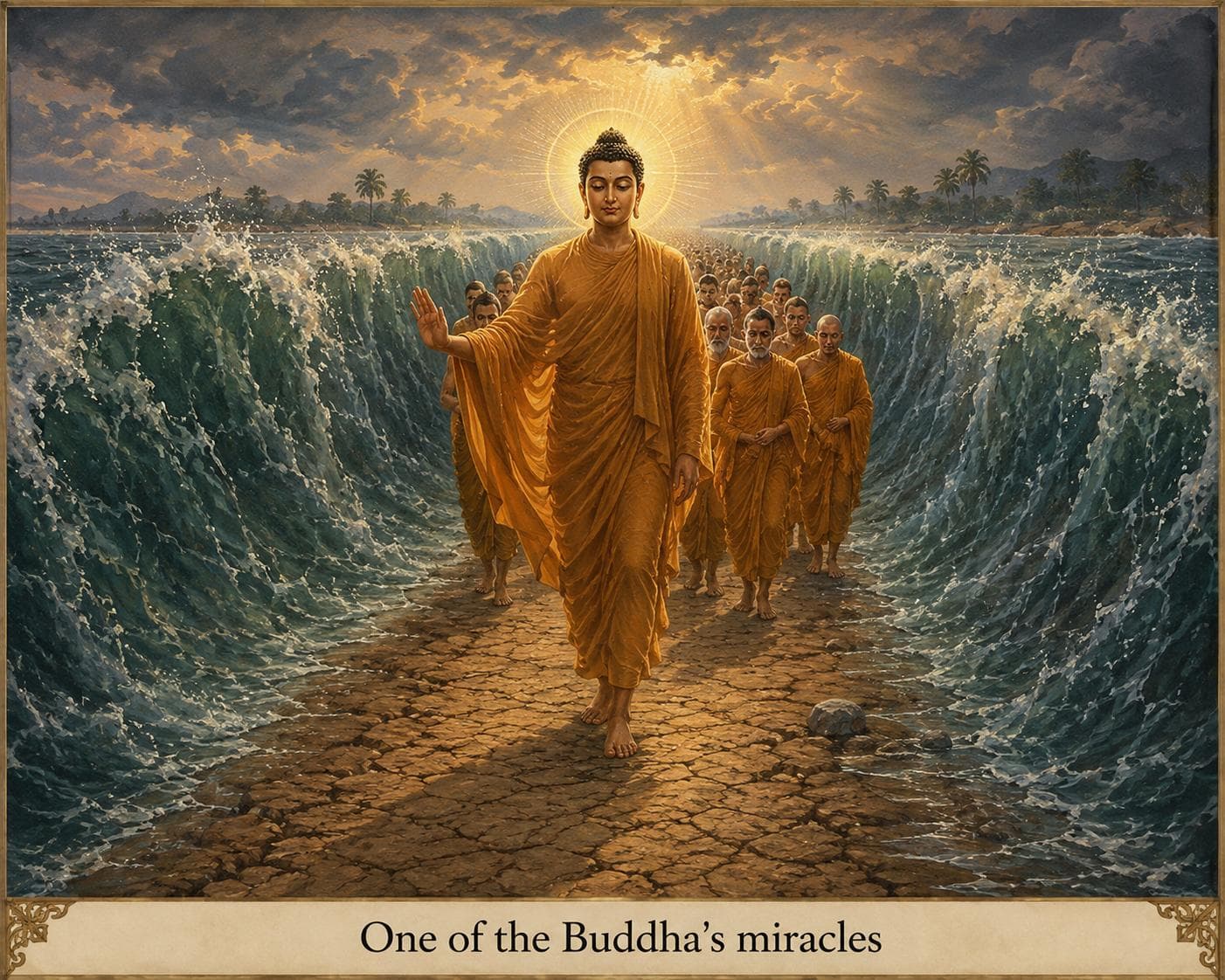
“He was born among Hindus who believed in the caste system, but he taught that people should not be divided into different classes. Unlike Hindus, he ate meat. However, he ate only the meat of animals that people had killed for their own food. If he learned that an animal had been killed especially to feed him, he would not eat its meat. He forbade eating the meat of horses, elephants, dogs, snakes, tigers, leopards, and bears.”
Sina said, “So because the Buddha gave teachings that seem better than those of his former religion, we should accept that everything he said was true. But anyway, as you said, we should not pay attention to miracles as a reason for believing in him.”
The monk replied, “Could anyone have given such advanced teachings in such a backward society unless he had complete knowledge?”
The monk now looked tired. He said that he had to leave them to pray.
Hypotheses and Theories
Mrs. Maragheh-ee said, “I didn’t know that the Buddha had said such strange things. I can’t believe that Buddhism is a true religion.”
Mr. Maragheh-ee said to his wife, “But you saw that the Bodhisattva answered all the objections.”
Sonam said, “Yes, he answered them, but I didn’t find his answers convincing.”
Mr. Maragheh-ee asked her, “Why weren’t you convinced, my dear?”
Sonam said, “I’ve heard very different things about how the universe came into existence. They are completely different from what the Buddha said.”
Mr. Maragheh-ee replied, “What scientists today say about how the universe came into existence is only their theories and hypotheses. They may not be correct. Scientists may later discover that they were wrong, just as scientists have been wrong many times before.”
Sina turned to his father and asked, “Dad, what are hypotheses and theories?”
His father said, “A hypothesis and a theory are related ideas, but in science they do not mean exactly the same thing. Let’s begin with a hypothesis.
“When we are faced with a fact and want to explain it, we may think of one or more possible explanations. Each of these possible explanations can be called a hypothesis.”
Sonam also became interested in Sina’s father’s answer. Sina’s father continued, “For example, imagine that one day you come home from school and realize that you don’t have your house key with you. No one is at home to open the door for you. So you begin thinking about what might have happened to your key.
“The first hypothesis is that you left the key at home.
“The second hypothesis is that you left it at school.
“The third hypothesis is that somewhere along the way, the key fell out of your bag or pocket without you noticing.”
“When you think more carefully, you remember seeing your key while you were at school. You had wanted to show your keychain to a friend, and you had handed it to your friend at that time.
“So now you know that the first hypothesis is wrong. You did not leave the key at home.
“You are human, and like every other human being, you can make mistakes. But since you are sure that you had the key at school, gave it to your friend, and talked about it with your friend, you no longer think it would be reasonable to keep insisting that the first hypothesis might be true.
“If someone tells you, ‘It is still possible that you left the key at home, so you shouldn’t reject that hypothesis,’ you can confidently disagree. You can say, ‘It’s true that I still can’t say for certain whether I left the key at school or dropped it somewhere on the way home. But I can confidently reject the first hypothesis.’
“So sometimes evidence tells us that certain hypotheses cannot be correct and should be rejected.”
Sina said, “Dad, you told me a little before about how the universe came into existence. Could you explain in more detail how scientists think the universe came into existence?”
His father took a deep breath and paused for a moment. Then he said, “Well, I think it would be better to go somewhere outdoors, and I’ll explain it to you while we walk.”
Sonam said happily, “Great! There’s a large and beautiful park in Tokyo.” Then she looked at her father.
Mr. Maragheh-ee said, “All right. But before that, why don’t we take our guests to a restaurant so they can try a few more Japanese dishes?”