

Sci-Fi Film Fiesta, The Swingin' 60s - The Complete Book by Chris Christopoulos - HTML preview
Download the book in PDF, ePub for a complete version.

Image by Chatgpt
Attack Of The Antibodies!
While waiting for the airlock to re-flood, antibodies attack Cora and fasten themselves onto her body as if she were bacteria. Grant and the others hurriedly and frantically get Cora through the airlock and into the ship where it is apparent that Cora cannot breathe. Grant and the other men find themselves performing the highly enviable task of pulling antibody molecules off strategically affected areas of Cora’s (Raquel Welch’s) body! The structures detach rather quickly as soon they begin crystallizing and Cora is finally extricated from their deathly grasp.
Proteus is once again under way where its passage lies through the middle ear then through the endolymphatic duct and back into the vascular system, before penetrating into the brain and the location of the clot.
With 12 minutes remaining, Carter with coffee in hand reaches for the empty sugar container for his sugar fix but is disappointed to find it empty, protesting in frustration, “of all the time to run out of sugar!” I can’t help thinking of Loyd Bridges’ character in “Flying High” muttering in frustration about what a time it was to give up amphetamines.
Back aboard the Proteus while passing through the inner ear, Cora and Grant discuss Duval with Cora pointing out that he “he's much too innocent, much too involved with his work, to realize what's going on around him” and that “he believes in an absolutely free interchange of information between scientists of different countries” which of itself in the context of the Cold War would be enough to make him be viewed with suspicion.
Just as Grant raises the possibility that Cora’s perception of Duval might be influenced by her fondness or even love for him, Michaels and Duval can be heard arguing loudly about whether Duval, having repaired the laser, should test it. Duval wishes to use the laser at the time of the operation as he does not “want to put any extra strain on the connections by running unnecessary tests.” Michaels puts Duval’s stubborn insistence down to him only wishing to satisfy his “damned ego.” Final Destination
With only 8 minutes remaining, the crew of the Proteus has entered the base of the brain, the realm of the “the human mind.” Grant, Cora and Duval are fascinated by what they are witnessing while Michaels true to form remains at the chart. Duval then goes off into one of his glassy-eyed mystical reveries proclaiming, “yet all the suns that light the corridors of the universe shine dim, before the blazing of a single thought…” which is surprisingly completed by Grant: “proclaiming in incandescent glory the myriad mind of man." Michaels, not one given to appreciating matters of a philosophical and spiritual nature, sarcastically retorts, “let me know when we pass the soul.”
Hollywood just loves these Judaeo-Christian ruminations and homilies concerning the existence and importance of the human soul and the character of Duval doesn’t disappoint by providing the expected trite observation about how “the finite mind cannot comprehend infinity, and the soul which comes from God is infinite.” Michaels, who obviously missed out on Sunday school points out to Duval, “take a close look at your soul, and your infinity, and your God out there and you'll find it's nothing but a combination of atoms, molecules and certain chemicals involving proteins.” In answer to Michael’s rational mechanistic and materialistic view of the universe, Duval points out that he left out one important thing: “The Breath of God!” Well, thanks for clearing that up for us! We’re completely convinced now.
It certainly cleared things up for Grant who by the time they have reached the clot is firmly convinced that someone like Duval does not fit the profile of a fanatic. Someone possessing religious convictions, a deep faith and belief in a supreme God being turning into some kind of a dangerous fanatic? Perish the thought! Never! Couldn’t happen!
Grant now has enough faith in Duval to insist that he and Cora exit the ship and perform the operation with the laser. With 6 minutes to go, Michaels is not surprisingly all for them taking the Proteus and high-tailing it out of there to the “removal point.”
Time is now definitely of the essence because if they overstay, the process of miniaturisation will start and if they grow big enough to pose a danger to the body’s system the white corpuscles will swarm to destroy them as they would any invader. With only two minutes to get to removal point, there will only be four minutes in which to operate.
Grant settles the matter by cutting the ship’s power while Michaels becomes more and more hysterical ranting that he is in charge and that Grant has supposedly allowed Duval the opportunity to carry out his nefarious plan to murder Benes.
Rather than remain on board the ship, Grant decides to venture out to see if he can assist Duval and Cora. Duval successfully manages to activate the laser and begins to clear the clot to allow the blood to flow again and hopefully relieve the pressure on a few key vessels.
Meanwhile, back aboard the Proteus, Michaels convinces Owens to come below to inspect the escape hatch through which he says fluid is seeping. As Owens inspects the hatch and discovers nothing wrong, Michaels knocks him out with a winch crank. Michaels then restores power to the ship and takes the helm.
With time about to run out, Duval is managing to clear an area around the large central nerve, unaware that in the distance the Proteus is manoeuvring into a position that will line it up with the central nerve.
Suddenly, with full power and full speed, Michaels directs the Proteus on a collision course with the central nerve. Just at that point the three crew mates outside the ship notice what’s happening and are dumbstruck, but Grant quickly springs into action and calls for the laser. Grant uses the laser now as a weapon (wide beam and full power) with which to rake one side of the Proteus’ hull propelling her away from the nerve and into an area of dendrites.
Time has now run out with the minute recorder registering “0” minutes, with white corpuscles responding to the impact and with Michaels now physically trapped within the mortally wounded Proteus.
Back in the control and operating rooms, the insistent and urgent sound of a warning siren signals the end of the countdown’s march to “0”, the time at which the crew of the Proteus must be immediately extracted even if “it means killing Benes.” No amount of caffeine, glucose or nicotine can quell Carter’s frustration as he thumps the table and exclaims, “Damn it to hell!”
Realizing that they’ll have to make it out on their own, Duval, Grant and Cora will have to exit Benes’ body via the optic nerve to the corner of the eye. The gravity of their situation is becoming apparent as they witness the stricken Proteus growing visibly larger before their very eyes.
The trio then notice the presence of huge monstrous white corpuscles starting to ooze toward the Proteus where “they'll ingest the ship and everything in it!”
Grant decides to go back aboard the ship by entering through the tear in the hull, to hopefully rescue Michaels and Owens. Owens is only now regaining consciousness, so Grant tells him to suit up as fast as he can. The pinned and trapped Michaels is frantically trying to disengage himself in the bubble helm section of the ship. It is to no avail,however as a white corpuscle (macrophage) engulfs the bubble, breaks through and suffocates Michaels, “the one who's been sabotaging the mission.” (as if we didn’t know!)
Grant and Owens then attempt to abandon ship before the white corpuscles engulf, crush and dissolve it. All the while, Duval and Cora have been employing the power unit and laser to target the white corpuscles and keep them off the sub, but without success.
As Grant struggles against a monstrous white corpuscle, Duval aims the laser and strikes with a direct hit allowing Grant to be released to swim away. Duval then manages to zap another monster when the laser finally gives up the ghost and dies.
While white corpuscles are swarming all over the ship’s hull and are ingesting its remains, back in the operating room preparations are being made for a trephination procedure. Suddenly, Carter is struck with a moment of inspiration by considering what he would do if he “were in their place” and had run out of time. He goes on to explain that “I’d abandon the ship before I grew to dangerous size and use the few extra minutes to get out the quickest way possible, on my own.” With quick realization, Reid completes the thought with, “along the optic nerve to the eye.”
Shortly through a large magnifier Reid looks into Benes' right eye, where he is able to make out the four members of the crew swimming in Benes' tears. He then uses a microscope slide to lift out a teardrop containing the crew. Reid quickly and carefully makes his way to the miniaturization room and sets the slide gently down on the center hexagon.
Carter, from above looks down into the miniaturization room, and observes the four specs on the glass slide continuing to grow until they return to their normal size, if a bit worse for wear after the ordeal of their…..
Fantastic Voyage!
Points of interest
Having the rights for a paperback novelisation based on the screenplay, Bantam Books approached Isaac Asimov to write it. Due to delays in filming, the novelisation was released six months before the movie. Asimov felt that the script was full of plot holes and received the go-ahead to write the book the way he wanted.
Otto Klement and Jerome Bixby came up with the idea for the film and sold it to Fox, which claimed that the film would be "the most expensive science-fiction film ever made."
Bixby delivered several scripts for movies which are featured in this blog such as, “Curse of the Faceless Man” (1958), “It! The Terror from Beyond Space” (1958), “The Lost Missile” (1958) all of which were featured in my “Big Fat Book of Sci-F Films of the 1950s.”
Director Richard Fleischer also directed Disney's first science fiction movie, “20,000 Leagues Under the Sea” (1954) which also is featured in this blog. Fleischer had been a pre-med college student for a time.
The film’s budget was set at $5 million but rose to $6 million, with $3 million going to the sets and $1 million on test footage.
“Fantastic Voyage” was Raquel Welch’s first role at Fox, and was put under contract to the studio after being spotted in a beauty contest. Raquel Welch claimed in her 2013 book that she was infatuated with Stephen Boyd in making this movie, but he apparently declined her advances.
The score was composed and conducted by Leonard Rosenman who deliberately wrote no music for the first four reels of the film, before the crew of Proteus enter Benes’ body. “Fantastic Voyage” is reportedly the first American feature film with no musical score for the opening credits, which featured only electronic pulse and sound effects.
The film won two Academy Awards and was nominated for three more:
• Won: Best Art Direction – Color (Jack Martin Smith, Dale Hennesy, Walter M.
Scott, Stuart A. Reiss)
• Won: Best Special Effects (Art Cruickshank)
• Nominated: Best Cinematography (Ernest Laszlo)
• Nominated: Best Film Editing (William B. Murphy)
• Nominated: Best Sound Editing (Walter Rossi)
“Fantastic Voyage” is included among the American Film Institute's 1998 list of the four hundred movies nominated for the Top 100 Greatest American Movies.
Who can forget the scene where the male crew members remove attacking antibodies from Raquel Welch! Director Fleischer at first allowed the actors to grab whatever they liked. However, the men exercised sufficient self-control and refrained from removing the offending antibodies from Welch's breasts. After a second try during which they all this time focused their efforts at liberating Welch’s breasts, Fleischer decided to resort to a bit of careful choreography with the result that appears in the film’s final cut.
In a move that would surely have sparked many a medical student’s interest in medicine and biology, medical schools showed clips from the movie to illustrate concepts in human anatomy, physiology, and immunology.
The scenes of crew members swimming outside the sub were shot on dry sound-stages with the actors suspended from wires. To create the impression of swimming in a fluid-like environment, the scenes were shot at fifty percent greater speed than normal, then played back at normal speed.
Of course, the real star of the "Fantastic Voyage" would have to be its special effects. Despite not having the benefit of today’s computerized digital effects, the scenes depicting the internal functioning of the human body from the microscopic perspective appear believable.
The special effects were also in keeping with the times in which “Fantastic Voyage” was released: 1960s hippy-groovy-far out man-what a trip-psychedelia.
“Fantastic Voyage” is punctuated by a series of dramatic and suspenseful events in which something inevitably goes wrong such as the scenes involving the temporarily stopped heart, the excursion into the lungs, the passage through the inner ear, the need to remain completely silent and still in the operating room and so on…..
Unfortunately, the characters are somewhat stereotypical and rather wooden and stodgy. For instance, we have the true to type hero, his love-interest token female whose presence is invariably questioned at some point, and the inevitable morally weak and cowardly traitor.
Let’s not forget the usual simplistic mix of politics and religion that mainstream Hollywood likes to indulge in. Take for instance, Duval’s constant babbling on about “the miracle of life” complementing his glassy-eyes stare of wonder and awe at the miraculous nature of what he is witnessing. This is in contrast to the godless, defeatist, traitorous atheism (ie., Communist) of Michaels. Well, such black and white distinctions might appeal to many at something like a Trump rally.
“Fantastic Voyage” is one of those films with which some viewers just love to demonstrate their cleverness by gleefully and seriously pointing out the evident plot or logic holes. They’ll crap on about the size of air molecules, time limits, objects left behind in Benes’ body and so on and so on……It’s just a bloody film! Enjoy it as entertainment - as a piece of “What If?”
I shudder at the thought of “Fantastic Voyage” actually being remade in today’s times. You can be sure that the fun and sense of adventure will be quashed and replaced with a politically correct ‘tick the box’ approach in terms of gender roles, racial and ethnic inclusion and diversity, sexual orientation and on and on. Add to that crammed full forced layer of virtuous goodies, a layer of CGI / AI extravaganza to dazzle the senses and utterly overwhelm the story. Of course, we’ll have all the back-stories of all of the characters whether or not we want it or care. Just keep the box of Kleenex handy for those inevitable syrupy soap-opera moments. As for the morally weak and evil crew member? It’ll be a guy (among a bunch of limp token guys) for sure. Fear not, for all will be well under the leadership of a determined, strong female captain steering the ship along outraged feminist currents. And there you’ll have it: another ruined streaming service sci-fi film! I guess every stupid action eventually results in an equally stupid and opposite reaction – even after nearly 60 years.
Finally, ignoring the unlikely possibility of shrinking human beings, “Fantastic Voyage” raises some interesting considerations concerning the miniaturization of medical technology. I don’t think many of us would be surprised to learn that pills containing cameras and other sensors might one day be routinely used to monitor the internal function and condition of patients’ bodies. Not would it be considered as outlandish to expect tiny molecular-sized nano-bots to enter our systems to perform various procedures or to assist our immune systems by targeting and destroying viruses and bacteria.
It would also be a pretty safe bet that our descendants will be born with micro-chips or implants that will record and contain a life-time’s worth of an individual’s medical information. This will have implications for society in terms of how the personal information will be stored, who will have access to it and the purposes that information could be put to. Could people be judged or assessed or discriminated against based on such information resulting in them being excluded from certain activities and benefits that others enjoy? These are serious matters with potentially harmful consequences. Worth thinking about as technology seeps from our smart watches that monitor our activities, movements, location and the electrical activity of our bodies and eventually leeches into our very bodies in the form of micro-scopic implants and nano-chips – all with our unwitting consent!
As the human race reaches further out into interstellar space, there is another also another universe for us to explore, that of Inner Space through which we will embark on a………
Fantastic Voyage!
***************
Queen of Blood (1966)
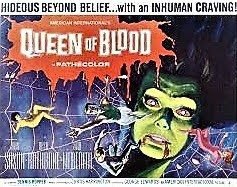
A rather cheap hybrid sci-fi / horror film with capable performances, strikingly eerie

and vibrant visuals and haunting atmosphere.
Directed by Curtis Harrington
Screenplay by Curtis Harrington
Based on story “A Dream Come True”
by Mikhail Karyukov, Otar Koberidze
Produced by George Edwards, Samuel Z. Arkoff Cinematography: Vilis Lapenieks
Edited by Leo H. Shreve
Music by Leonard Moran
Production company: Cinema West Productions Distributed by American International Pictures
Running time: 81 minutes
Budget: $65,000
Box office: $17.3 million (as at 1 Oct 1966)
Cast
John Saxon as Allan Brenner
Basil Rathbone as Dr. Farraday
Judi Meredith as Laura James
Dennis Hopper as Paul Grant
Florence Marly as Alien Queen
Robert Boon as Anders Brockman
Don Eitner as Tony Barrata
Forrest J. Ackerman as Farraday's aide
An alien species from another planet signals Earth to make formal
contact with humanity.
The alien spaceship crashes on Mars.
A distress transmission is sent to Earth.
Earth dispatches a ship to attempt a rescue.
On Mars, the alien spacecraft is located.
Only a single dead alien humanoid is found aboard the ship.
An alien rescue shuttle had left Mars but crashed on the moon, Phobos. A green-skinned alien female is found alive aboard the wrecked shuttle.
For the rescue mission’s crew, their troubles are only just about to
begin!
(Spoilers follow below…..)
The movie opens with title and credits shown over watercolour paintings by John Cline, consisting of alien and other-worldly landscapes and images.
A narrator tells us:
"The year 1990, the problem of travelling to the moon has been solved for many
years. Space stations have been built there and authorised personnel come and go
as they wish, but the moon is a dead world. And the great question about space still
remains, does life exist on another planet? To seek an answer to this question, the
major powers of the world have been actively preparing at the International Institute
of Space Technology to explore the planets Venus and Mars."
“We've been picking up these signals now for three days”
At the International Institute of Space Technology, communications expert and astronaut Laura James monitors strange signals believed to be emanating from another planet in our galaxy. Allan Brenner has come to see Laura for a lunch date.
On an alien world, a sun sets over a beach. The alien species appear to be quite similar to ours on Earth. Their technology seems to be somewhat more advanced than our own.
Allan and Laura are joined for lunch by Paul Grant and Tony Barrata. Their luch, however is soon interrupted by an announcement calling on all personnel to assemble for an important message from Dr. Farraday.
We next arrive at a spacious plaza reminiscent of similar settings from which totalitarian leaders might address the masses on the glorious achievements of their regimes. Here, Farraday informs the assembled personnel that a message sent by another civilisation in space has been deciphered. The message informs the people of Earth that an ambassador will be dispatched to Earth from the aliens’ planet:
“As many of you know for several weeks now we have been receiving organised
signals from a far galaxy. This morning our code experts finally deciphered the
message…..a spaceship to bring their ambassador to our planet earth! They believe our atmospheric conditions will support their form of life which apparently is similar
to our own…...I'm sure the entire world will await the arrival of this spaceship.”
Meanwhile, on the alien planet a spherical-shaped spaceship appearing like an over-sized Vostok craft is prepared and launched. Prior to the main ship’s arrival to Earth, a probe is sent to Earth and is seen streaking across the sky before landing in the ocean. After the capsule is retrieved it is sent to the Institute’s labs for study. A video log of the alien ship's entire flight is located in the probe and shows that the aliens' craft had crash-landed on Mars.
Professor Farraday believes there may be survivors on the alien ship and calls a press conference for the next morning.
At the press conference, Farraday proposes the fast-tracking of a rescue mission using the spaceship, Oceano. The proposal is met with oodles of Soviet-era style clapping! Supply ships are soon sent en-mass to the moon, where Farraday and his staff have relocated to moon base Luna 7 to supervise the rescue mission.
“You're going to be the most famous girl in America.”
Although it is an honour to be selected as part of the crew for the rescue mission, Laura is upset that Allan Brenner will not be on the Oceano rescue ship with her.
Later, as the rescue ship is launched Allan forlornly watches it depart in his spacesuit from the surface of the moon.
“We've progressed 75 million miles toward Mars.”
After a successful launch, the Oceano some time later encounters a “sunburst” that causes damage to some of the ship's instruments. The Oceano enters the orbit of Mars using emergency instruments and the crew begin their search for the alien spacecraft. Upon locating the craft’s whereabouts, the Oceano lands on Mars close to its location.
SUCCESSFUL LANDING ON MARS:
ALIEN SPACESHIP DISCOVERED
“Single Dead Astronaut Found On Spacecraft:
Mystery Deepens.”
Anders Brockman enters the alien craft only to discover the dead alien crew member. Meanwhile back on the Moon base, it is concluded that “there must be more than one dead man” and that “the others must have boarded a rescue rocket which…….is marooned someplace else on Mars - it's the only possible explanation!” Allan Brenner and Tony Barrata then put a proposal to Farraday that involves taking the smaller rocket, Meteor to Mars and immediately deploying surveillance satellites.
“The slightest miscalculation would mean complete disaster.”
In order to overcome Farraday’s concerns over fuel consumption, Brenner suggests that they land on Phobos, then take the rescue ship to the surface of Mars and return to Earth on the Oceano.
After Farraday agrees to the plan, the Meteor enters orbit around Mars. The satellite is deployed and the Meteor lands on the Martian moon, Phobos. The Meteor must depart the moon within thirty minutes or Allan and Tony will be stuck on Phobos for a week. A stroke of good luck has resulted in the Meteor having landed close to the supposed alien rescue ship, which was presumed to have landed elsewhere on Mars.
Brenner and Barrata proceed towards the alien rescue ship in which they come across an apparent single survivor, a green-skinned female wearing a spacesuit. As she seems to be in some distress, the two astronauts help her back to the Meteor.
The Alien female is placed in a seat aboard the Meteor while Brenner and Barrata decide who will remain behind, as the craft can only carry two.
After the coin toss, Brenner crash lands on Mars during a scarifying Martian sand storm. He then manages to carry the alien back toward the Oceano. Meanwhile, Brockman and Grant managed to find themselves lost in the sandstorm while looking for Brenner and the alien. As the storm abates, Grant enters the Oceano bearing the alien. Except for her green-hued skin colour, the alien female is quite human-like in appearance.
It is determined that there is not enough fuel to retrieve Tony Barrata on Phobps. However, Farraday assures Brockman that a rescue ship will be dispatched to rescue Tony. As long as he “uses his emergency ration sparingly, he ought to be able to hold out very well.”
The alien begins to recover and fixes with her gaze in turn, Paul Grant, then Cmdr. Brockman and finally, Allan. Her expressive, suggestive and magnetic eyes and smile seem to have a strong effect on the males almost as if they are being bombarded by a mass of pheromones over which they have little control.
It is a different story when the alien catches sight of Laura where the change in her countenance suggests that she resents the presence of possible competition. When it comes to the task of assigning the duty of looking after their new passenger, Laura is exempted on the grounds that their “visitor doesn't get along very well with her own sex."
“She's probably the most valuable specimen for scientific research in
the history of our planet.”
As the Oceano departs Mars, Paul demonstrates to the alien how to drink water from a bottle. She drinks the water, but refuses solid food. One of the crew comments, “perhaps she is only accustomed to some sort of liquid nourishment.” The irony of this comment will soon become apparent.
Brockman wants to study the alien’s blood and believes it may be high in chlorophyll. When she becomes aware that a syringe is about to be used on her, she recoils in horror and knocks the needle to the floor, breaking it. Brockman observes, "this is more than some childish fear of the needle. Perhaps she has an extremely low pain threshold. Perhaps...but we mustn't do anything that may affect her health adversely.” He concludes that their priority is “to get her back to Earth safely.”
The sleep period buzzer sounds and Paul has the first watch. He proceeds to record his notes on tape: “I've spent more time with her than the others and I think that I've noticed something about her that the others haven't noticed yet. She has…..” Now what do you imagine he would have said about their new passenger?
Paul’s observations are interrupted by a peculiar buzzing sound. As he walks to the back of the cabin to investigate, a red hue seems to permeate the confines of that section of the cabin. Suddenly, a hand is placed on Alan’s shoulder. When he turns to look, he finds himself gazing into the illuminated eyes of the alien. He is held fast as she approaches closer, somewhat seductively. It is as if Paul is mesmerised and stripped of the will to move and escape the alien’s deadly embrace.

Image by Chatgpt
“Now we know how she feeds at least”
The next morning, Brockman enters the cabin and sees Paul who appears to be asleep on duty. He tries to wake Paul, who slumps over in his chair. Brockman then pronounces Paul dead while Laura goes back to check on the alien passenger. Paul's wrist shows evidence of a wound and bleeding. Suddenly Laura's scream alerts the others. The crew then observe the alien lying on her back deeply asleep and apparently satiated with a trickled of blood on the corner of her mouth. It appears as if “she's gorged herself with fresh blood and now she's digesting like a boa.” Brockman observes, "now we know how she feeds at least." Allan declares that "she's a monster" and simply wants to destroy their deadly passenger.
Brockman proposes another course of action and it involves considerations that may very well apply to our own civilisation when we eventually come into contact with an extraterrestrial alien species:
“How can we expect her to conform to our ideas of proper behaviour. She's not
necessarily aware that she has done wrong, wrong - from our point of view that is, but she's much more than just an animal. She comes from a highly evolved planet,
technologically evolved, yes. But what about their social structure? Moral concepts
as we recognise them maybe non-existent in their society. They may be some sort
of intellectual insect which…. probably feed on the blood of some lower form of
animal life on that planet as we do on ours.”
Brockman then suggests as a temporary solution to their dilemma that they feed her with blood plasma.
“Into the wastes of outer space; it's a fitting grave for an astronaut.”
After Laura reports the situation to Farraday, Paul Grant's body is given a space burial service. Allan is disturbed by the fact that there seemed to be no sign of a struggle when Paul was killed. Brockman believes that a form of anesthetic in the alien’s saliva allowed her to feed without any resistance from Paul. Allan seems to be unconvinced and feels that something else was involved.
“It sounds ghoulish.”
For a time the alien is successfully fed on the ship’s supply of blood plasma and if that was to run out then the crew will resort to using transfusions of their own blood to supply her with the nutrition she requires.
Later, while Brockman records his notes on tape, his attention is suddenly drawn to the presence of the alien standing at the entrance to her room. The strange buzzing sound is also emanating from that direction. The alien seems to appear and then disappear like a phantom as she approaches ever closer toward the commander. It is quite evident that the alien is exerting a kind of hypnotic power over his will and senses. Brockman struggles against this force and tries to draw his gun and point it at the alien but drops it as he mentally succumbs and sinks into the illuminated vortex of her eyes.
“Makes me sick even to look at her.”
The next day with Brockman dead, Allan decides to secure the alien by tying her down securely to her bunk-bed. He is now fully convinced that she hypnotised his crew-mates before killing them and consuming their blood. In accordance with Farraday’s orders, Brockman's body is to be returned for autopsy.
During the next sleep cycle, Laura lies in her bunk asleep in the same section of the cabin where the alien is secured. While Alan is reading a book in the forward section of the cabin, the alien begins to awaken. Employing a power which seems to emanate from her mind and through her eyes, she manages to burn through the ropes securing her arms to the chair. The alien vampire’s shadow then passes over a sleeping Laura as she moves towards her next prey, Allan.
Laura suddenly awakes, gets up and notices the ropes limply lying on the empty bunk-bed. As she slowly makes her way to the control room, a wet slurping sound can be heard signalling the vile activity taking place out of sight. Laura’s worst fears are about to be confirmed by the shocking vision from hell that meets her eyes: the alien crouched over Allan and greedily feeding vampire-like on his blood. It is a sight that is at the same time both terrible and sensual. Gone is the bold red colour of the alien’s form-fitting outfit. It is replaced by something closer to skin-tone suggesting nudity, something sexual or perhaps reflecting the fact that she is drained of nourishment and needs replenishment?
Laura and the alien engage in a physical tussle during which Laura manages to scratch the alien's back. Her adversary notices with horror her own green blood on her fingers and runs off shrieking – the only sound we have heard coming from her lips.
Allan is on the floor gradually regaining consciousness while Laura applies a bandage to the wound on his wrist. When Allan declares that he is alright, he and Laura go to check on the alien predator. They soon find her laying on a bed, dead with a pool of green blood on the floor below her outstretched arm. Allan deduces the reason why she wouldn't allow the blood sample to be taken from her: she's a haemophiliac and would bled to death.
“To them we're just animals to be eaten. We can't let these creatures
breed on earth.”
After the Oceano eventually manages to land on Earth, Laura opens a cabinet to discover that it is filled with red pulsating eggs lying in a green gel. Allan conjectures that the alien is of royal decent and is possibly a queen of her species and “that's why they sent her. She wasn't just an ambassador, she was a queen. A queen bee. Maybe this is how their society is set up. A queen who does all the breeding. Or maybe their planet was dying and they just sent her to bring her kind to Earth.” Allan is convinced that they must destroy the eggs while Laura reminds him that it’s “not for us to decide. Scientists from all over the world have been waiting for us to bring back something living. They'll keep them under control.” On this shaky note of faith, suddenly more eggs are discovered when another cabinet is opened. Perhaps there are eggs secreted all over the ship.
“You brought back something unique and marvellous from another
world - you can be very proud.”
“But doctor, they're deadly!”
With a disturbing lack of decontamination procedures, Farraday bustles in with his staff to retrieve the eggs after brushing off any objections to retaining them for study. The implications for the future of humanity are suggested by a close-up of the red pulsating eggs on a tray being borne by one of the staff…….
Points of Interest
Queen of Blood (a.k.a. Planet of Blood) is a 1966 science fiction horror film produced by George Edwards and Samuel Z. Arkoff and directed by Curtis Harrington. The film is based on the screenplay for the earlier Soviet feature film Mechte Navstrechu (A Dream Come True). Special effects footage from that film, along with footage from the Soviet science fiction film, Nebo Zovyot (Battle Beyond the Sun) were used.
A Dream Come True was about a queen from another planet and Harrington wanted his film to be about a vampire in outer space so he made that character a female to match the Russian footage.
Queen of Blood was released by American International Pictures as a double feature with Blood Bath.
Director Harrington made Queen of Blood back-to-back with Voyage to the Prehistoric Planet, which also incorporated footage from the Soviet films. Both films starred Basil Rathbone.
The film was shot at Major Studios in downtown Los Angeles and was shot in six days largely due to the use of a non-union crew who were required to work long hours.
In the film the alien vampire paralyses her victims with her glowing eyes, and employs a beam of heat from her eyes to burn through a rope that has been used to secure her arms. The effect of the alien vampire's glowing eyes was achieved by directing pencil-thin beams of light into Florence Marly's eyes.
If you feel that the plot is somewhat familiar then you’ll recall It! The Terror From Beyond Space made several years earlier and the later sci-fi classic, Alien made in 1979.
During the first half of the film, Queen of Blood recycles footage - mainly long shots - from Soviet movies and incorporates American segments and new dialogue to produce something which does work together and has some degree of coherence. The Soviet footage is a testament to the Russian film makers of the time but its overuse during the first half of the Queen of Blood tends to slow the tempo down quite a bit. The best part of the film is the second half leading up to and featuring the onboard scenes as the crew of the spaceship contend with their deadly passenger and the overall atmosphere surrounding the voyage back from Mars.
A novelisation of the film, written by Charles Nuetzel, was published by Greenleaf Classics. The cover illustration featured a nude Florence Marly as the alien queen. Haemophilia which the alien vampire queen was afflicted with, became known as the "royal disease" because it is an hereditary disorder once common among the royalty of Europe who often married one another and were often related.
“One should not be shocked by anything we find out there.”
(Farraday)
No truer word may have been spoken when it comes to encountering ‘intelligent’ life outside of our own planet. When we do eventually encounter extraterrestrial life, we may need to dispense with our previous preconceptions about what that life will be like. For example;
• How reality is perceived: May be vastly different (incomprehensible?) to our
own.
• Appearance: No reason to expect it to be humanoid.
• Motivations: Instinct for survival could be more important than curiosity,
altruism, mutual exchange of ideas, commerce and trade and desire for friendly co-existence.
• Morality: There may be no concept of “right” and “wrong” or codes of ethical
behaviour. Instinct and survival imperatives could dictate actions devoid of motives based on justice, ‘humanity,’ malice or evil as we understand such concepts.
The safest course of action to adopt when we inevitably come into contact with ‘intelligent’ extraterrestrial entities is to presume nothing and expect anything. Our survival may very well depend on it.
****************
Marooned (1969)
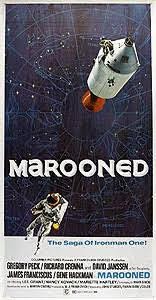
This tightly structured, well-acted and workmanlike film is beautifully directed and

neatly combines aspects of human behavior and technological dilemma.
Directed by John Sturges
Produced by M. J. Frankovich
Screenplay by Mayo Simon
Based on “Marooned” by Martin Caidin
Cinematography: Daniel L. Fapp
Edited by Walter Thompson
Distributed by Columbia Pictures
Running time: 134 minutes
Budget: $8–10 million
Cast
Gregory Peck as Charles Keith
Richard Crenna as Jim Pruett
David Janssen as Ted Dougherty
James Franciscus as Clayton Stone
Gene Hackman as Buzz Lloyd
Lee Grant as Celia Pruett
Nancy Kovack as Teresa Stone
Mariette Hartley as Betty Lloyd
Scott Brady as Public Affairs Officer Frank Marth as Air Force Systems Director
Craig Huebing as Flight Director
John Carter as Flight Surgeon
Walter Brooke as Network Commentator
Vincent Van Lynn as Aerospace Journalist
George Gaynes as Mission Director
John Forsythe (uncredited) as The President (voice only) Tom Stewart as Houston Capcom
Bill Couch (uncredited) as Cosmonaut
“Spacecraft systems are go”
The early morning serene stillness slowly heralds the dawning of a new day. At the same time an abbreviated staccato countdown proceeds toward another dawning of a new day in which the fabric of Nature’s tranquil curtain is about to be rent by the rude sharp thrust of humanity’s spear of technological optimism.
Three US. astronauts (commander Jim Pruett, "Buzz" Lloyd, and Clayton "Stoney" Stone) are to be the first crew of an experimental space station on an extended duration mission.
Their Apollo spacecraft is named, “Ironman One,” conjuring up impressions of Marvelled invincibility and superhuman powers. The mission seems to exude supreme confidence and after a successful launch which appears to be quite routine and within the capsule (despite the bone-jarring lift-off) surprisingly serene and sedate, it is observed by one of the astronauts, “Hey, it looks like a fine day down there! I can see all the way from Gibraltar to Greece. Coming up on the terminator, should be in our first sunset in a few minutes.”
The only thought given to any problem or difficulty seems to lie with obtaining a clearer picture for the cameras.
After 22 minutes into the flight, the crew will set about “the business of the flight plan” involving a rendezvous on docking with the Saturn 4B orbital laboratory. The lab very much like the Skylab of the 1970s we’re familiar with.
Routine, predictability, training and technology combine to achieve the successful completion of the docking procedure with the orbital laboratory into which the crew of Ironman One will transfer and where they will live and work for the next seven months.
According to the Public Affairs Officer, “this will be a test of the spacecraft, the systems and most of all the men in preparation for interplanetary deep-space missions which are now being planned.”
Apparently with the moon landings under its belt and with rendezvous and docking procedures along with extra vehicular activities having become something of a walk in the park, humanity is now optimistically setting its sights further afield, perhaps in this case to Mars.
About five months into the mission problems begin to emerge in which it is observed there is a serious decline in the ability to perform simple manual tasks, along with lack of sleep, fatigue and weight loss. Lloyd in particular has begun to exhibit erratic behavior and substandard performance. His physical appearance and demeanor speaks volumes. Equipment is beginning to fail, mistakes are being made and the wrong kind of problems and priorities are being fixated on.
In the face of these developments, NASA management decides to end the mission early.
After closing down the S-4B lab, the Apollo spacecraft prepares for separation followed by automatic sequence of retrofire. Routine, predictability, training and technology should combine to enable them to start their “descent across Australia towards the splash point in the Pacific some 400 miles south of Midway Island.” All they now need to do is wait for confirmation of retrofire….
“Ironman One, Ironman One, this is Houston CapCom, do you read?”
Space is no place for hubris and over-confidence. If care is not taken and respect is not given, space will kill you. Humans are not evolved to live and work in space for very extended periods of time. The only way that can be achieved is to terraform the new environment or bio-engineer humans to cope with the hostile conditions.
There is only in reality the thin skin of a spacesuit, a spacecraft or habitat that separates one from being alive or being sucked into oblivion. Technology does fail and humans do make mistakes and space is unforgiving of both.
If the recent process of extended lock-downs and social distancing has taught us anything, it is that being social and gregarious creatures, humans can experience difficulties when cut off from normal social activities and interactions. No selection process can possibly anticipate and eliminate all the possible psychological and other group dynamic factors and problems that are likely to occur on extreme long duration space flights and planetary colonisation.
Nor will public affairs spin be able to completely and effectively white wash this supposed “successful prelude to the long-term space voyages that some day will be normal and routine…” as after a tense period of attempting to communicate with Ironman One, the message is received, “We have negative retrofire. Negative, no burn.”
“We're prepared for every contingency”
Then why has the unexpected happened? Why doesn’t Mission Control know what’s wrong? If “all parameters are normal,” then why didn’t retrofire function as expected?
And so Ironman One continues to trail a line of “why’s” as it traces its orbit in the silence of space to the accompaniment of a single solemn and sustained note drawn from the music of the spheres. No place for a Strauss waltz here!
Mission Control soon comes up with a possible solution to the Apollo crew’s dilemma which involves trying retrofire with their primary engine by using manual command to get ignition as their automatic control system is out.
For news service and public consumption under the directive to “keep it trivial. Keep it routine;”
“We received word from Ironman: One of a malfunctioning switch that has prevented retrofire on their last orbit. They'll bypass the switch. At
their next orbit we'll try manual retrofire.”
However it is sensation that sells and the public might very well be confronted by headlines such as these;
IRONMAN PRIMARY ENGINE & THRUSTERS FAIL!
FEARS FOR IRONMAN CREW – MAROONED IN SPACE!
Unfortunately, the Ironman crew’s second attempt at retrofire also fails despite the fact that an indicator event light showed green suggesting that they had retrofired. Somewhere at sometime a butterfly had flapped its wings and now the crew of an Apollo space craft find themselves facing the prospect of being marooned in orbit around the earth. Perhaps the butterfly has long since died….
While the problem facing the crew and the mission is being worked on, an important element is being overlooked – the wives of the astronauts. They have been watching the events unfold and everyone has forgotten about their presence.
In any crisis or tragedy, there is more at stake than those immediately involved in it. Family, loved ones and friends are also impacted. Military wives and partners often know much of what comes with the territory of having a relationship with someone who is in the army, navy or who works as a test pilot or an astronaut. It doesn’t always make it any easier knowing about the potential dangers and so it is no surprise when one of the wives wryly comments, “Well, I guess it's time to go home and light the fires and mind the kids” while another observes, “we learned the best thing is for us girls to keep our feelings to ourselves and let the men get on with their jobs.” (Some feminists have at this point probably curled up into a fetal position!) Of course, their demeanour, expressions and gestures suggest something quite different, especially after having to internalise such stress and uncertainty for up to 15 years!
“I'm the responsible officer”
The press conference presided over by Charles Keith reminds us of many of the political press briefings we’ve witnessed in which information is massaged, misinformation is disseminated, truth and facts are distorted, fault and blame is apportioned and redirected, and many words are used without much of value being said. In the process, trust in authority is steadily diminished in the eyes of the public.
Keith is the responsible officer for withholding the news about the retrofire malfunction from Washington but he wont make a statement as to why.
A positive spin is being placed on this very serious situation when Keith informs the assembled press that “approximately 15,000 people are trying to isolate and correct this malfunction. Every resource of the NASA and our industrial contractors is being used to the fullest.”
In addition, he states that the crew are “in no immediate danger” despite the fact that if the crew of Ironman One cannot get the engine to fire, the spacecraft will continue orbiting the Earth “until orbital decay slows it down sufficiently for it to re-enter the atmosphere” and gets burn to a crisp in seven years.
Keith answers this possibility with what can only be described as a lie and rallying call of human hubris: “We're prepared for every contingency.” Countless butterflies are at this moment flapping countless pairs of wings – prepare for that if you can!
For the astronauts there is little to do but wait “for Ground to analyze the entire telemetry” and come up with a plan to bring them down. Jim Pruett is obviously of “the right stuff” generation who relies on his long practical experience to settle into a relaxed state of mind. Buzz Lloyd appears to be not taking the situation well, as can be gauged from his strangulation of the liquid food tube. He prefers to take action, any kind of action rather than sit and wait for Ground to tell them what to do. Lloyd is ruled more by his emotions and is of a more sensitive and imaginative bent than his fellow astronauts. “Stoney” appears to be ruled by logic and analytical thinking. His attention is focused not on the crew’s predicamenton but instead on the forming hurricane northeast of Cuba – an obvious complicating factor in the film’s plot as we learn that “she's gonna be a big beast.”
“I want to talk about a rescue mission”
There is by now little doubt that the crew are effectively marooned in orbit around the earth. Their space craft does not have enough fuel left to use the reaction control system as a backup to initiate atmospheric entry. Nor do they have enough fuel to re-dock with the station and wait for rescue.
At a meeting presided over by Keith, recommendations for the US president are on the agenda. What stands out is the almost callous and insensitive nature of the proceedings that can only be described as being the product of an overly bureaucratic mindset.
First, a prepared statement is to be issued at the meeting’s conclusion stating that "every effort is being made to discover and correct the spacecraft malfunction in accordance with contingency plans designed to meet such emergencies."
Secondly, a report is to be issued which places a positive spin on the tragedy by “emphasizing the high degree of safety and success in the program thus far.” To add insult to injury “the accident will be compared to the failure of an experimental aircraft” and that “it'll be noted that in the development of such aircraft, a 10 percent pilot loss is considered acceptable.”
Thirdly, for public consumption and political considerations the president is to issue a speech “emphasising the courage and determination of the crew and their final wish, that the program be continued without pause.”
It is only Ted Dougherty who speaks up for the Ironman crew to propose launching a rescue mission, but it seems that logic will provide an insurmountable barrier. There seems to be next to no hope for a rescue flight to reach the crew before their oxygen runs out in under two days. In addition, there are no backup launch vehicles available at Kennedy Space Center in Florida. As for using an experimental US. Air Force lifting body, the X-RV, and launching it on an Air Force Titan IIIC booster rocket, neither one is man-rated, nor is there sufficient time to put a newly crewed NASA mission together. The Titan IIIC may be on the way to nearby Cape Canaveral Air Force Station for an already-scheduled Air Force launch, but it is pointed out that many hundreds of hours of preparation, assembly, and testing would be involved.
And the numbers keep adding up and filling in “the big picture”: twelve days + four days + five days + three weeks + $50 million + .02 percent workforce deaths. In Keith’s mind this equation adds up to a rejection of Ted’s rescue proposal - “reduced to digitals and computerised…..A rational approach.”
Ted Dougherty’s only answer to this is to demand as chief astronaut that something be done, even if it means that some of the preparation items be set aside. After all, what can he tell his fellow pilots who are dying? It would be tantamount to leaving wounded or missing fellow soldiers behind in a time of war.
Keith, in his role as head administrator can only prioritise things in terms of the mission’s overall goals and success. In his view, the three astronauts are “professionals” and that all consciences can be salved by assuming they would share the sentiments contained in the platitude: "Take what you've learned. Get on with the next mission." In other words, individuals are expendable. Just something like what a politician might say to justify the deaths of soldiers ordered to fight in wars.
The clash between acting according to one’s feelings and notions of what is right versus conduct based on a set of rules is finally resolved by recognition that there are not only “pilots” up there but “friends” who are “in trouble” and that it is the right thing to do to at least “try to get them down” and trust in those involved to achieve the impossible.
Olympus
The US President contacts Keith and informs him “as a friend” that he is right in his stance on the Ironman situation “and for the right reasons.” However, he points out to Keith that “if we do it your way, 200 million people are going to start raising hell.” The president goes on to point out that perception is more important than following logic and that “the world is watching us and what we do about rescuing these men.” To do nothing to rescue the stricken crew “is going to be disaster for me, for you and for your program.”
It seems that not surprisingly political considerations and national prestige are uppermost in the president’s mind as no mention is really made of the necessity of saving the lives of three fellow human beings just because it is the right thing to do.
The extent of the degree of management of the flow of news and information is apparent from the broadcast picked up by the Ironman crew:
… “confirmed tonight that the SPS engine failed to fire leaving America's three
astronauts in orbit some 285 miles above the Earth, circling the globe every 94
minutes. They are now approaching the west coast of Africa.
No word has been issued as to the cause of the malfunction beyond the statement
made by Dr. Keith at the news conference held this morning in that contingency
plans have been developed to meet every conceivable emergency….”
“They don't make mistakes, do they?”
The three astronauts are not only battling time and a lack of oxygen, they soon find they are also in a battle with Mission Control and within themselves
Here are three intelligent and active individuals feeling that their destinies are being decided by desk jockeys with “slide-rules” and who would much rather take the initiative by donning their “hard suits and fix this bird.”
As they prepare for an EVA to work on the engines, the crew is informed that a rescue mission is being put together with a launch to occur in just over 40 hours.
The crew’s desire to take “affirmative action” to repair their vehicle is quashed by Mission Control. Keith informs them that their use of oxygen outside the spacecraft would mean an unacceptable trade-off in oxygen consumption for “passive breathing.” Put simply, they just don’t have the oxygen to spare.
The crew is told that their only option is to “go into low-tide mode,” lower their oxygen pressure, “execute a full emergency power down” and take their pills. This could prove to be psychologically disastrous for the astronauts as it would be far better if they could see themselves as active participants in arriving at a solution to the problem they are faced with.
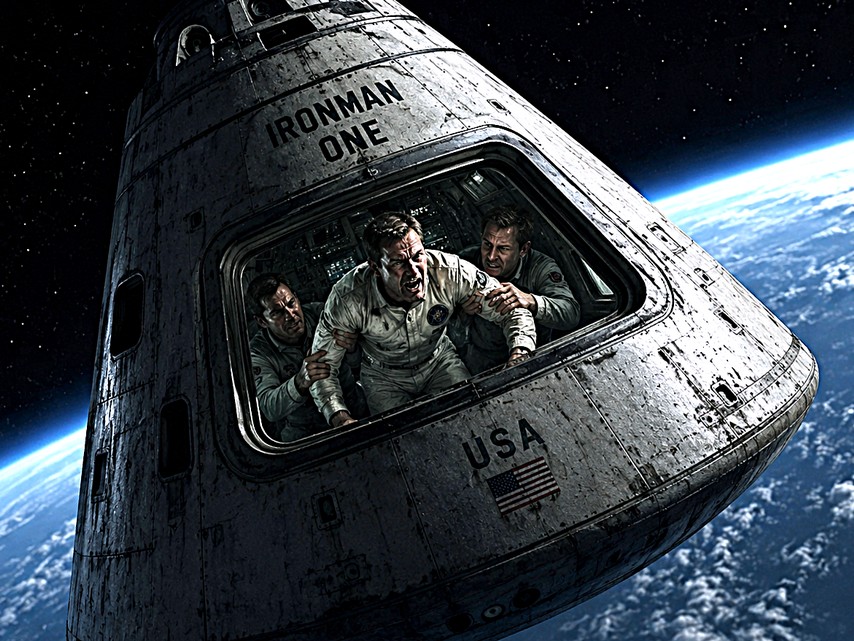
Image by Chatgpt
Not surprisingly, Buzz goes into conspiracy mode and thinks that Mission Control is lying and that “they want us to buy it while we’re sleeping.” In the end the crew agrees to acquiesce to Mission Control’s request and the ship soon powers down - except for that damn little green light…..
Meanwhile, back on Terra-firma, the tension is ramped up with problems with the rescue craft flight simulation as well as with the hurricane which has changed course with eighty-mile winds and heading straight for the launch site. ETA: 7 or 8 hours.
Back in the orbiting space craft, the sleep period monitors seem to correlate with each individual astronaut’s nature and personality. Stoney’s telemetry show that he is in “deep, dreamless sleep” and has therefore made a “nice adjustment.” Pruett’s having nightmares which is not surprising since he’s “an angry, active guy, frustrated” and feeling helpless. Nor is it unexpected that Buzz has not been taking his pills which doesn’t bode well for his mental and physical stability.
Instructions have been issued by Keith to keep the crew informed instead of busy and to “kid them along.” This almost seems like an insult to their intelligence and the resulting pathetic attempt at humorous patter and banter does nothing to lighten the sense of doom and gloom within the confined interior of the space craft.
Intelligent, educated and professional men with nothing to do are likely to focus their minds on matters that could act to magnify their problems, affect their overall well-being and damage their relationship with one another.
Stoney takes refuge in the job he was trained for - “observe systems under stress.” Pruett of the old school, dolefully reflects on the fact that he has never made enough money “in this business” and that after so many years he doesn’t have a dime. What’s more, he’s now too old to get the Mars shot. (Don’t worry Pruett, you’d still be waiting for another 50 to 100 years before that would ever happen!!!) As for Buzz? Frustrated, neurotic and belligerent.
A crew of three sharing a destiny but separated by light years in terms of who they are as individuals. One sees only purpose in “devotion to truth” which others might view as lacking in imagination. Another has too much imagination and sees what he feels and what others cannot see. The third clings to reality and experience with which to navigate his way through a constantly changing present into an uncertain future that may no longer have any use for him.
We’ll leave the stranded astronauts for now as they giggle almost hysterically at the absurd irony of the notion that the experts and those in charge “don’t make mistakes.” The pressure valve is released just a tiny bit…...
“You're letting us say goodbye”
Rescue preparations are under way with the XRV suspended beneath an Air Force CA3 helicopter on its way to the launch pad. It’s appearance is something like “a thick arrowhead” and has been modified to carry four men. It is definitely a design concept of the 1960s for a shuttle-type re-usable space craft. I think it looks a lot better than the near-autonomous flying tic-tacs that are now beginning to shuttle crew and supplies between earth and the International Space Station.
Operating in a similar fashion to the Space Shuttles of the 1980s – early 2000s, we learn that the “XRV will plunge into the atmosphere at 17,000 miles per hour, a flaming meteor coming back to Earth. When it breaks down into the lower atmosphere, the speed will drop to only a few hundred miles per hour and Dougherty will be flying a high-speed glider, an airplane without power. He'll take that bird straight in towards Edwards Air Force Base to land on the long runway out there in the California desert.”
But wait! Of course, there’s a complication. The hurricane has turned and is heading straight for the launch site despite having earlier been predicted to head out to sea. Yet again, we have the question being asked: “How in the hell can they make a mistake like that?” After all, they don’t make mistakes, do they? Another god-damned butterfly flapped its wings somewhere!
The wives are now brought to the control room to speak to their husbands and are cautioned that they will notice “some degeneration” but that they are nevertheless to show their husbands how confident they are. The wives know that they are there to say goodbye.
What can one say to a loved one in such circumstances?
As Celia begins speaking with her husband, Frank she latches on to everyday trivial matters like his fathers’ cold, buying new shoes, losing a bill to the insurance – anything mundane that avoids the unthinkable. Frank the realist and practical man, believes he knows the score and just wants to let Celia know how much he loves her, that she can depend on his friend Dougherty after he’s gone, and that she is to remember that he “had a real good day today.”
Stoney doesn’t express his emotions as one might expect. His feelings are more internalized as his wife reaches out him via some banter about her “little project” in which her “experimental hypothesis” consists of missing him like mad and how positively his paper was received. Stoney’s feelings then abruptly break through to the surface in a fierce display of optimism and belief that they’ll indeed make it back. For him, perhaps it’s not just all in the numbers – “remember that.”
Betty has to witness the mental and emotional collapse of her husband, Buzz. It is almost impossible to witness the sudden degeneration of a loved-one before your very eyes and not be able to do anything about it. You don’t want to remember the unrecognisable stranger that person has become and would rather hold on to the image of the person you knew and loved throughout your life. We’re only human after all and sometimes the urge to run and escape from what terrifies and overwhelms us is too strong.
Buzz has retreated within himself and is consumed by irrational feelings of guilt and responsibility for what has happened. HE broke the washing machine and couldn’t fix it and they’re all blaming him now! That’s why “it's all falling apart up here.” If only they’d give him the tools to fix it! As Buzz goes through a meltdown he has to be sedated by his crew mates.
“Because of men like these, we've taken the first step off this little
planet.”
As launch time approaches, the hurricane batters the launch area and threatens to cancel the mission. The tension mounts as the countdown proceeds and wind speed picks up. All personnel in the control room are advised “that prior to 1:20, we'll call a hold if we have a problem.”
At just after T-minus two minutes, we learn that the launch site is “now beginning to feel the real force of Hurricane Alma...”
“Minus 90 seconds and counting”
“T-minus 70 seconds and counting, mark”
“T-minus 60 seconds and counting….”
THEN AT T-MINUS 60 SECONDS….
“Hold! Hold!”
“Shut her down!”
“The launch is scrubbed”
“The launch is scrubbed”
A sense of doom, defeat and inevitability soon descends on Mission Control and within the space craft. Pruett’s words convey an acceptance of the crew’s likely fate as he stoically informs those on the ground that “whatever happens to us, you can't let it affect the program. You've done a great job, really…..it's nobody's fault.” Then the signal is lost.
After a brief statement to the press, Keith answers questions put to him concerning the fate of the space program, an investigation of the accident, our purposes in space and the morality of putting men into space without adequate (fill in the word – safeguards? preparation?) and whether the results gained are worth the lives lost. All very necessary questions to ask and which should always be considered. We’ll be in trouble if we ever stop asking such questions.
Keith’s response is also both expected from his position and vantage point and quite valid. He believes that because of men like these, we've taken the first step off this little planet” on our way “to the stars, to other worlds, other civilizations” and that inevitably “men will be killed in this effort.”
This was true at the start of the age of space exploration and will continue to be the case long after Space – X, Virgin Galactic and Artemis have become a distant memory. We are going to lose lives in space as a result of unforeseen accidents, equipment failures, human error, over confidence, taking short cuts, cost cutting, bad luck, fluttering butterfly wings and so on.
“The numbers, Mr. Keith, the numbers!”
Suddenly a weather technician breaks in and interrupts Keith n mid-sentence to inform him that the eye of the storm will pass over the Cape permitting a launch of Dougherty’s rescue vehicle to rendezvous with the Apollo command module hopefully in time to save the crew.
Dougherty will have to rendezvous without an onboard computer program but he is confident he can if Mission Control can get him “in the ballpark.” That’s good enough for Keith who proclaims, “Then we are go for launch!”
In the meantime, the Soviet Union has launched a Voskhod on an unspecified mission as the NASA rescue mission launch is made just as the eye of the storm passes over the Cape and the winds begin to rise.
Keith cuts through all the extraneous procedural matters and qualifications and gets to the heart of each matter. One in particular involves oxygen consumption and the fact that there’s not enough oxygen left for three men in the amount of time that’s available.
The inescapable conclusion is that there might be sufficient oxygen for two men to make it. A moral and ethical decision will need to be made at some point – soon.
“In the middle of another heartbeat”
And so the countdown to launch resumes while outside there’s “no wind, absolute silence. Overhead nothing but black night and brilliant stars...There's an eerie hush over everything here. No rain, no wind. The lives of three men are measured by their fading heartbeats...”
There’s been an 180° turn around in attitude and priority in terms of the value placed on human life that was evident at the earlier meeting presided over by Keith at the start of the engine failure problem. One of the reporters on the scene at he rescue mission comments that the service tower is expendable, “but the three men in Ironman One are not”
As the countdown to launch proceeds, the tension is highlighted by the rapid fire sequence of camera shots of Keith, the astronauts’ wives, the control room personnel, the countdown status board and so on.
After the successful launch of the rescue craft, we return to the suffocating atmosphere of despondency within the claustrophobic confines of Ironman One. Stoney deals with the situation in his characteristic way by enumerating the effects of anoxia. None of the crew even seem particularly interested in responding to Houston CapCom. After all, what could they possibly offer them?
Pruett finally responds to Keith who informs the crew that they successfully launched the rescue craft through the eye of the hurricane and that it’s on its way to rendezvous with them in 55 minutes time.
This leads to the issue of oxygen supply which Keith is gradually trying to guide the crew’s thinking towards. His unconscious rubbing of his neck suggests someone who is desperately walking on egg shells while trying to avoid coming to the point about something too confronting and unthinkable.
In Fifty-five minutes the crew will be dead if they continue to use oxygen at their present rate of consumption. As to what can be done about this, Keith tells them almost cryptically, “you must think,” that they must talk it over and that “any effective action must be taken immediately.” Earlier, such considerations would have been settled in Keith’s mind based on logic, what the numbers say and what procedure would determine. Not so easy when one has to speak directly with those being impacted and basically having to inform them in one way or another that they must decide which one of them is to die in order for the other two to live.
With the unthinkable decision to made now firmly in their hands, the crew of Ironman one debate what to do. Stoney draws on reason and suggests they “figure the odds” whereby they might survive by taking double the amount of sleeping pills to reduce oxygen consumption. Pruett rejects his idea as being unlikely to conserve enough oxygen to be successful. Lloyd offers to leave since he’s “the weakest” and is "using up the most oxygen." Pruett overrules him and instead orders his crew mates to don their helmets while he attempts to fix the engine, despite the fact that this option has already been dismissed by mission control.
It is pretty apparent that Pruett being the veteran, the commander and an experienced practical and realistic man, has already taken the decision and the responsibility for who is to be sacrificed so that others may live. Keith cannot make such a decision, Mission Control cannot make such a decision. Nor can his crew mates for whom he is responsible make such a decision.
After Pruett goes out of the hatch, Lloyd at first seems to want to believe he is going to fix the engine but he really knows as well as Stoney does what Pruett intends to do. Loyd then makes a move to go after Pruett and stop him. Stoney, however restrains Lloyd to prevent him from ripping the umbilicals they are attached to.
As both astronauts watch Pruett from the hatch, a hiss of air escapes his suit from a large gash torn on a part of the ship’s exterior. Losing consciousness, Pruett drifts away from the ship as Lloyd and Stoney look on.
Pruett’s wife is told about her husband’s death by Keith over the phone. Imagine having to learn of something like that via a phone call. It is obvious, however that she already knew from the moment she left the observation booth as did the others present judging from their body language. For her benefit she is informed that her husband died in the performance of his duty while attempting to repair the spacecraft.
Back in Ironman One, Stoney has to contend with a delirious and almost infantile Loyd along with the effects of oxygen deprivation. His mind alternates between his anchor of rational thought and an unaccustomed hallucinatory state of consciousness brought about by the lack of oxygen.
With the sudden appearance of the Soyuz spacecraft, Keith attempts to engage Stoney’s with the former mind-set he usually operates on. Nevertheless, Stoney struggles to comprehend the cosmonaut's gestures or comply fully with Keith's instructions.
The Soviet ship cannot dock with the Apollo command module but it does have a life-saving supply of oxygen. Stoney and Lloyd are instructed to open the hatch using the lever but under no circumstances are they to blow the hatch. Loyd in his delirious state of mind of course blows the hatch causing the ship to move further away from the Soyuz craft.
Lloyd and Stoney will now have to traverse 50 feet of space to get to the Russian cosmonaut. After a nudge from Stoney, Lloyd drifts away from the ship and sails past the cosmonaut, just out of his reach.
Dougherty arrives on the scene in the X-RV and begins a spacewalk to retrieve the astronauts. The Soviet cosmonaut uses a torch to shine a light on the body of Lloyd who is drifting slowly away from the Apollo space craft. Dougherty retrieves him using a manoeuvring pack, similar to the kind that will be used later in the 1980s.
After moving his vessel closer to the Apollo craft, the cosmonaut enters the Apollo and tries to attach an incompatible oxygen tank onto Stone's suit. Dougherty returns with Lloyd and transfers his oxygen to Stoney’s suit helping to further revive him.
In a nice piece of detente which will be a feature in later missions of the 1970s, the two surviving Ironman crew members are transferred to the rescue ship. Meanwhile, on the ground there is utter pandemonium as everyone erupts with jubilation and sirens wail as if an enormous pressure valve has suddenly been opened.
After the rescue, the X-RV executes retrofire to return to Earth and the Soviet vessel returns to its previous orbit. The final scene then fades out with the image of an abandoned Ironman One adrift in orbit.
Points of Interest
“Marooned” was based on the 1964 novel “Marooned” by Martin Caidin. The original novel featured a single-pilot Project Mercury capsule of the early 1960s while the film depicted an Apollo command and service module accommodating three astronaut along with a space station somewhat like Skylab of the 1970s. The book’s author, Caidin acted as the film’s technical adviser. He also makes a brief appearance in the film as a reporter describing the arrival of the X-RV at Cape Canaveral.
The film was released less than four months after the Apollo 11 Moon landing and there must have been pressure to achieve as much realism and authenticity in its depiction of the Apollo mission. NASA, along with North American Aviation and Philco-Ford, assisted with the design of the film's hardware, including the crew's chairs inside the capsule, the orbiting laboratory, the service module, as well as replicas of actual facilities, such as the Mission Operations Control Room at Johnson Space Center in Houston and the Air Force Launch Control Center at Cape Canaveral Air Force Station. In fact, the Apollo Command Module used in making the film was an actual "boilerplate" version of the "Block I" Apollo spacecraft.
When “Marooned” was eventually produced with John Sturges as director and Mayo Simon as screenwriter, the budget was $8 million. It went on to win an Academy Award for Best Visual Effects for Robie Robinson.
You’ll notice that in the film the central role of a flight director is absent. It may have been felt that the inclusion of a flight director might distract from the tense interplay and clash of will and personality between Keith and Dougherty.
The tragic fate of the Apollo 1 crew would have been fresh in people’s minds adding poignancy to the dilemma being faced by the on-screen crew of Ironman One. “They never make mistakes, do they?”
In many ways, the film was strangely prescient in light of what later occurred with the actual Apollo 13 mission. According to astronaut Jim Lovell, a certain un-named 1969 film in which another ‘Jim’ (Pruett) faces death in space had given his wife nightmares. Fortunately, both crews got back alive with the exception of course of Pruett in the film. For the Apollo 13 crew, the need for the astronauts to be a part of the overall plan and solution to the problem being faced was extremely important.
Speaking of astronauts’ wives, it might be tempting for some people to view the three women featured in the film as being just stereotypical females of the 1960s fulfilling their expected roles as dutiful wives of men who charge around doing manly stuff. I find these women, however to be far more interesting and believable than many modern female characters in an opportunistic film industry who are often portrayed in an unedifying manner as angry, sinewy, sweaty, ponytail swishing, active wear clad action heroes with a penchant for beating up men and assaulting their genitals!
The three astronauts’ wives in the film perhaps have the most difficult and nightmarish role imaginable and it shows clearly through their words and gestures. On-screen female characters that possess and convey class, poise and style hold more interest and value than screaming feminist harpies. Just include more women in on-screen space sci-fi and real-life space programs, shut up and get on with it without all the 21st century band-wagon virtue-signaling gender-based hoopla!
In many ways, I actually preferred this film to something like “2001, A Space Odyssey” as it seemed to be far more grounded in reality, rather than trying too hard to trip over itself with over-long visual gymnastics to the accompaniment of Strauss. With the then recent moon landing, the film hints at what may be possible just on the horizon such as preparation for a Mars mission (well, ok we know what happened to that dream!), an orbiting laboratory like the later Skylab and the rescue vehicle being a prototype for the later re-usable Shuttle, as well as a hint of detente and cooperation in space. Then there is the element of human drama involved along with the ever-present danger being a part of space exploration. If you think that last feature didn’t amount to much, try holding your breath for more than a couple of minutes!
****************
2001: A Space Odyssey (1968)
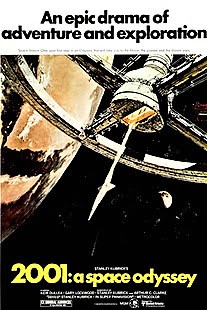
An important and innovative sci-fi classic film but one that is often too highly

overrated
Directed by Stanley Kubrick
Screenplay by Stanley Kubrick, Arthur C. Clarke Produced by Stanley Kubrick
Cinematography: Geoffrey Unsworth
Edited by Ray Lovejoy
Production company: Stanley Kubrick Productions Distributed by Metro-Goldwyn-Mayer
Running time: 142 minutes
Budget: $10.5–12 million
Box office: $146 million
Cast
Keir Dullea as Dr. David Bowman
Gary Lockwood as Dr. Frank Poole
William Sylvester as Dr. Heywood Floyd
Daniel Richter as Moonwatcher, the chief man-ape Leonard Rossiter as Dr. Andrei Smyslov
Margaret Tyzack as Elena
Robert Beatty as Dr. Ralph Halvorsen
Sean Sullivan as Dr. Roy Michaels[3]
Douglas Rain as the voice of HAL 9000
Frank Miller as mission controller Edward Bishop as Aries 1B lunar shuttle captain Edwina Carroll as lunar shuttle stewardess
Penny Brahms as stewardess
Heather Downham as stewardess
Alan Gifford as Poole's father
Ann Gillis as Poole's mother
Maggie d'Abo as stewardess (Space Station 5 elevator) Chela Matthison as Mrs. Turner, Space Station 5 reception Judy Keirn as voiceprint identification woman (Space Station 5) Vivian Kubrick as Floyd's daughter, "Squirt"
Kenneth Kendall as BBC announcer
The film opens with pitch blackness – a complete absence of light and matter as if at the moment before the universe came into being. On this science and religion can agree: in the beginning there was darkness until...until….until, and that is what the sustained musical note sets us up for as it gradually rises to a crescendo of sound. Our expectation is then met with the view of our planet suspended in the inky void of space with the sun seeming to emerge from behind and above it. Celestial gases and gravity have long worked their magic gradually coalescing to form light and life-giving stars and planets and solar systems, so many of which come together to form constellations.
By some miracle, this single planetary jewel (perhaps one might be forgiven thinking - the only one in the universe) has been blessed with the addition of a single seemingly unique and miraculous element – LIFE!
Section I: The Dawn of Man
(On Becoming Human)
After the title sequence, we are presented with a view of Earth, as it was in Africa some 3,000,000 years ago. It is a time of long enduring drought where only the fittest and best adapted can survive.
A quirk of fate or a chance event 65 million years previously had allowed the species of mammals to survive after the reign of the dinosaurs was brought to an end with the collision of an asteroid with our planet.
The process of evolution eventually led to the development of primate apes which further branched out into hominid groups like Australopithecines until finally arriving at genus, Homo – us.
A small group of our ancient ancestors are seen occupying a group of caves overlooking a parched landscape. It is a miracle that they have managed to cling on to existence in the face of their never-ending struggle to stave off the ever-present possibility of extinction.
As predators and hunger constantly stalk our primitive ancestors, it is only luck, their social and family bonds and their deeply hidden potential of humanity and intelligence that combine to help them survive almost insurmountable odds.
A template for modern behaviour is embedded within the genetic make-up of our ancestral line as can be seen from the tribe’s confrontation with another hominid tribe over territory and resources, namely water. Unlike we modern humans, the confrontation merely consists of an angry display resulting in one side backing down.
The tribe’s existence consists of a constant round of foraging for roots, berries, fruit and leaves, and scavenging in competition with other species of animals. Unknown to our little group, they are literally surrounded by potential sources of nourishment in the form of their competitors. And yet ironically, they face starvation.
Even at night while huddled together in their caves, ever watchful, ever listening and alert for danger, a genetic blueprint is being laid down parts of which will still persist in the minds of many modern humans – fear of the night and of the unknown.
The terror of the night is replaced by the dawning of a new day and the start of the endless battle for survival. However, this day begins differently, for standing before the tribe as they awake is a new and startling feature in their familiar landscape– a monolithic structure.
There the object stands: indifferent, implacable and inscrutable. It’s straight lines and edges stand in sharp contrast to the natural features the tribe is familiar with. It’s unexpected presence causes confusion and consternation at first, but gradually individual members of the group draw closer to it until they and the rest of their comrades surround the object.
Another piece of the human genetic blueprint manifests itself in the form of curiosity as fear is supplanted by a desire to know the nature of this strange enigma. Even millions of years after this event modern humans attempt to understand the new and unfamiliar through the sense of touch in much the same way as the little tribe of our ancestors are doing with the strange Monolith.
Unknown to the hominids, they seem to be responding to some kind of force or energy that emanates from the Monolith. A connection of some type has been formed as if both the monolith and the hominids have responded to one another and indeed have found what has been long sought after. One stage of a journey has been completed for one while the journey for the other is now about to begin – as was clearly intended. By whom? By what? For what purpose?
Who would ever have dreamed that eons ago early in the creation of the universe, a
group of advanced beings evolved and assumed the role of caretakers of the
universe. Their mission was to encourage the development of new species
throughout the universe and in order to accomplish their aims it was they who
constructed the black rectangular Monoliths like the one our little hominid
ancestors encountered. It would be that Monolith that would have a profound effect
on the development of our own species. But this was not the only Monolith in
existence. Others were located at other points in the universe…….
The Monolith is no threat to the hominids and in their minds it can safely be consigned to their familiar landscape, a feature among many other features and easily forgotten about in their seemingly unchanging cycle of existence.
Something, however has indeed changed as we witness the leader of the hominid group sitting among a pile of bones. He picks up one of the bones and proceeds to hit another bone with it. Suddenly a palpable feeling of rage rises within him as notions concerning his new-found sense of power and control over his circumstances and his environment begin to coalesce in his mind. It is that mind that will begin to develop at an accelerated rate when the newly discovered tool is put to use in order to add meat / protein to the hominid diet. Destiny is about to be changed!
Once again another piece of the human genetic template is added whereby discoveries made have multiple uses and the product of these discoveries amount to being a double-edged sword. There can be a fine line between a useful tool for survival and creativity and a weapon of war and destruction. This becomes evident when we see another hominid from an enemy tribe advancing on the scene to drink from our little group’s watering hole. On this occasion, however something is different. It can be sensed in the very air itself. The leader of our group approaches tentatively at first and after summoning up increasing confidence, he attacks the enemy group’s leader with his newfound bone-tool. The enemy group is stunned by the spectacle of their adversaries wielding bones that can cause harm and so they withdraw. In addition to being a tool user, humankind is now on the path to conflict and warfare with its own kind.
As the leader throws his bone in the air, the camera follows its slow-motion path with the image cutting to a large space vessel floating in Earth’s orbit thus highlighting the duality of our natures: our ability to create and destroy. The prey have become the predators and eventually the new masters of the world…….
2001: Tycho Magnetic Anomaly (TMA-1)
To the accompaniment of music of the spheres in the form of a Strauss waltz, an Orion spacecraft performs effortless choreographed maneuvers a couple of hundred miles above the surface of the earth. Its sole passenger is Dr. Heywood Floyd, chairman for the National Council of Astronautics and he is sound asleep as his pen floats nearby in the weightless environment. Despite the majestic celestial performance unfolding before our eyes, the whole process by the 21 st century seems to have become so routine, mundane and familiar that it is not even sufficient to inspire awe and wonder anymore.
No doubt when Space-X, Virgin Galactic, Blue Origin and other private space tourism enterprises get going, we’ll have flight attendants at the ready to retrieve floating items for their well-healed passengers as they slumber through docking procedures, after briefly “ooing” and “aahhhing” at the breath-taking views. Space the final frontier for posting inane social media selfies, filming streaming service farces and staking corporate claims. Ah, nothing like human evolution at work.
After docking (a procedure which is itself oh so routine and almost autonomous in its execution) we next see Floyd enter the Space Station 5 reception area where he proceeds through the documentation and passport procedures. Like so much in our own reality, the process is largely automated. Floyd stands in front of a screen and goes through voice print identification before exiting the passport area.
From the scenes within the Space Station, we can see how a person’s identification, their acceptance for admission and inclusion, their means of communication and even their very existence is scanned, determined, stored, retained, monitored and validated by technology. More disturbingly it is widel and unquestioningly accepted and normalized. Beginning to sound familiar?
In the space station lounge, Floyd stops to make a phone call to his wife and five year old daughter. No longer a novel idea for modern audiences, he makes a video style call, something we routinely do these days with video chats using our laptops, tablets and phones.
Floyd’s daughter is having a birthday party but he will be away for a few days. Her mother is at the hair dresser and a nanny is looking after her. The chat shifts to a promise by Floyd to buy his daughter a birthday present – a perfect substitute for not being there in person at an important event. Thus the family life of a modern human child, relationships and communication mediated of course through the “wonders” of technology.
As Floyd makes his way through the station, we can see how sterile, functional and antiseptic the surrounds and decor are. In contrast to the brilliant white of the walls and lighting, there are the sixties red yuck futuristic modernist chairs. Straight lines, symmetry and form: all a reflection of modern man’s “evolved” nature and mentality that seems to abhor chaos, clutter and anything vaguely extraneous and bohemian.
At this point it is worth mentioning just how much we the viewer are placed in the position of being largely an outside observer of what transpires on screen. Conversations when they do occur are almost muted and consist of meaningless polite formulaic pleasantries with little substance. (Sound familiar?) Furthermore, there are few if any real extreme close-ups of characters to provide us with a sense of what they may be thinking and feeling. They may as well be wearing…...face masks! Even throughout the majority of the film, we have very little feel for any of the human characters and find it difficult to engage with them or feel any great empathy for them. Remember our little hominid friends? We had no trouble determining their thoughts and feelings despite their lack of language!
After his video phone call, Floyd sits in the lounge with a small group of people which includes three or more Russians. Despite the Cold War undertones, everything is conducted in a superficial friendly, warm and pleasant manner. Of course these are just preliminaries to the real purpose of the meeting – to glean important and valuable information about Floyd’s imminent journey to the moon base at Clavius and the mystery of what is taking place there. In fact the lack of communication and the denial of landing permission could from the Russians’ point of view result in conflict due to it being interpreted as a direct violation of the I.A.S. convention.
During their discussion, Floyd appears to be quite reticent and manages to evade answering directly by resorting to diplomatic responses that don’t convey much at all. One of the Russians informs Floyd that intelligence reports suggest that a serious epidermic of unknown origin has broken out at Clavius. Floyd resorts to the old political chestnut of not being at liberty to discuss the matter. Of course, the rumor of an epidemic may very well suit Floyd and his government’s purpose!
The meeting ends as it had begun – courteously and politely but not at all to the Russians’ satisfaction. And there we have Geo-political tensions simmering in the background and despite the superpowers having the capacity to destroy humanity many times over, conflict is generally conducted and hopefully averted before developing into a hot war via diplomacy, information gathering, counter-intelligence and subterfuge. No need yet to bash in anyone’s brains with a bone weapon.
Time for yet another celestial performance as Floyd aboard the Aries space shuttle journeys to the surface of the moon. The true wonders of space perform to an almost empty, inattentive and unappreciative house with the sole customer fast asleep in his chair once again. Besides, why look at the majestic views of space and relish the unique experience of space travel when alternative entertainment is available on the in-house screens.
In the context of the wider universe and despite Floyd’s perceived VIP importance, he and the rest of his species are little more than toddlers learning how to walk and use the toilet. They need to be instructed how to perform the most basic of functions with everything labelled for their benefit.
If only an asteroid had missed the earth 65 million years ago and a dinosaur descendant had instead encountered the Monolith 3 million years ago!
Eventually the Aries shuttle orbits the moon prior to undertaking landing procedure, with “procedure” being the operative word. Everything seems to have been reduced to this single concept with all notions of uniqueness and danger being eliminated and replaced by smug and complacent programmed routine.
Once at the moon base, Floyd proceeds to address a briefing held with senior personnel who are arranged around a “U” shaped table in a conference room. The topic of the discussion is the recent discovery that was made at Clavius which could be viewed as being the most significant discovery in the history of science.
Floyd’s presentation makes it quite clear that the story of an epidemic at the base is indeed a cover story as part of the need for security and secrecy covering the discovery. The rationale for this need for secrecy is ostensibly “the potential for cultural shock and social disorientation contained in the present situation if the facts were prematurely and suddenly made public without adequate preparation and conditioning.”
Floyd suggests that after facts and opinions have been gathered on the situation, a report will be made as to when and how the news will be released, subject of course to the decision of the “Council.” Just to underscore the last point, Floyd reminds his audience of the “security oaths” they will be required to give in writing covering anyone with knowledge of the current situation. Just a gentle brandishing of a bone weapon in the form of an implied threat! Naturally, Floyd’s audience readily acquiesces almost without demur.
Of course in the context of the Cold War situation back on earth, we can safely assume that one side will seek to obtain as much advantage from this “discovery” as possible. Therefore, secrecy and security will remain the order of the day and to hell with the public’s right to know. Ah, nothing like human evolution to strip away truth and honesty!
After the meeting, Floyd boards a lunar shuttle bus destined for the excavation site where the “discovery’ was made. Sitting with a couple of other official passengers, Floyd tucks into some lunch, the nature and origin of the prepared, prepackage and reconstituted food being somewhat uncertain. At least it tastes alright and is readily available. The irony of it all! Just 3 million years ago, so much effort would have gone into finding enough food to eat – food that you were responsible for finding and could appreciate and identify.
As the shuttle bus skims over the surface of the moon, the men discuss the photographs that have been taken by a lunar satellite. The true nature of the discovery and what is known about it finally emerges from the discussion. The TMA -1 Monolith was buried about four million years ago. It appears to be completely inert and is the first direct evidence of life beyond the earth. As to why it is there, whether it was abandoned, forgotten or left for a purpose – that would be anyone’s guess.
Upon arriving at he TMA-1 excavation site, we have a view of several small figures in space suits slowly making their way toward the excavation. The tension begins to mount as they start down the ramp toward the Monolith, where they begin to approach closer and surround it. Suddenly, one the suited figures, Floyd does what his ancient hominid ancestor did – reaches out his (gloved) hand to touch the surface of the Monolith.
Almost abruptly a photographer requests that the group of men line up before the alien artifact to have a group shot taken. Can you imagine if they had camera phones handy and there were no security concerns? There’d be selfies galore with pictures of pouting astronauts posing with the artifact appearing on Facebook and Instagram! Ah, nothing like human evolution to get one climbing all over, documenting and devaluing everything of significance and importance.
Suddenly, there is heard a powerful piercing sound, perhaps being emitted from the Monolith that is too much for the group of men to bear, causing them to block their ears before silence descends.
The piercing sound that just assailed the group at the TMA-1 excavation site is a signal to a third Monolith orbiting Jupiter. It is an indication to whoever constructed the Monoliths that human beings have reached a stage of development whereby they are ready to travel to another planet and proceed to the next stage of the evolutionary process.
Humanity’s evolutionary progress has been influenced by an advanced alien species and human beings are about to take their first baby steps out beyond the safety of their home into the wide universe. But what parts of themselves will they also be taking with them as they journey…..out there?