

Sci-Fi Film Fiesta, The Swingin' 60s - The Complete Book by Chris Christopoulos - HTML preview
Download the book in PDF, ePub for a complete version.
Contents
Journey to the Far Side of the Sun (1969)
Introduction
The 1960s were a decade obsessed with journeys. Humanity stood on the threshold of the stars, and cinema—always eager to dream ahead of reality—responded with a rush of stories that launched fragile crews into the unknown. Rockets lifted off, capsules drifted into the abyss, and strange horizons beckoned with the promise of wonder, discovery, and sometimes dread.
In Sci-Fi Film Fiesta: The Swingin’ 60s – Volume 6: “Spaced Out Magic Carpet Rides,” we step aboard a series of remarkable voyages that carry us through both outer and inner frontiers. From the earnest lunar ambitions of 12 to the Moon to the quite chilling philosophical immensities of 2001: A Space Odyssey, these films map out a decade’s evolving imagination of what it might mean to leave Earth behind.
Some of these journeys are cosmic in scale. Ikarie XB-1 sends its voyagers deep into interstellar space, where distance itself becomes a test of endurance. Queen of Blood ventures into the eerie unknown and finds that the universe may conceal forms of life as beautiful as they are perilous. Marooned strips space travel of glamour altogether, confronting us with the terrifying fragility of human life when technology falters. Meanwhile, Journey to the Far Side of the Sun takes speculative fiction in a provocative new direction, reminding us that the greatest mysteries may not always lie at the farthest distance.
Yet not every odyssey in this volume reaches outward. Fantastic Voyage turns inward, transforming the human body itself into an alien landscape of astonishing beauty and lurking danger. It is a reminder that the unknown is not measured merely by miles but by the limits of understanding.
What gives these films their enduring fascination is not simply their rockets, planets, or dazzling speculative ideas. At their heart, they are stories about people confined together under extraordinary pressure. A spacecraft may be engineered for precision, but the men and women inside it bring with them fear, pride, curiosity, courage, and conflict. In these films, survival depends as much on cooperation and human resilience as on machinery or scientific brilliance.
That tension—between the grandeur of exploration and the frailty of human nature —gives this collection its distinctive pulse. Whether crossing the void between worlds or navigating perilous inner frontiers, the travellers of these films are never merely explorers of space. They are explorers of themselves.
So settle in, fasten the straps, and prepare for a groovy cinematic launch. These are the Swingin’ 60s at their most adventurous: a decade that dared to imagine humanity riding strange celestial currents, chasing distant lights, and discovering that every voyage into the unknown also charts the hidden terrain of the human spirit.
***********
12 to the Moon (1960)
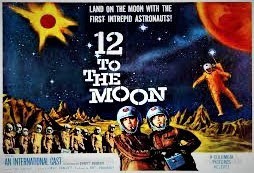

A somewhat laughably entertaining sci-fi film with ordinary special effects, acting
and direction while a variety of plot devices at least keeps the action going.
Directed by David Bradley
Written by Fred Gebhardt, DeWitt Bodeen
Produced by Fred Gebhardt
Cinematography: John Alton
Edited by Edward Mann
Music by Michael Andersen
Distributed by Columbia Pictures
Running time: 74 minutes
Budget: $150,000
Cast
Ken Clark as Capt. John Anderson
Michi Kobi as Dr. Hideko Murata
Tom Conway as Dr. Feodor Orloff
Anthony Dexter as Dr. Luis Vargas
John Wengraf as Dr. Erich Heinrich
Robert Montgomery Jr. as Dr. Rod Murdock
Phillip Baird as Dr. William Rochester
Richard Weber as Dr. David Ruskin
Muzaffer Tema as Dr. Selim Hamid (as Tema Bey) Roger Til as Dr. Etienne Martel
Cory Devlin as Dr. Asmara Markonen
Anna-Lisa as Dr. Sigrid Bomark
Francis X. Bushman as Secretary General of the International Space Order Production
“Hello the world”
12 To The Moon opens with shots of the launch of a rocket and rocket plane missiles from different cities around the world. Suddenly a gavel bangs down before we cut to the title and credits.
Any self-respecting science fiction movie from that era and beyond would as expected begin with a serious and authoritative-sounding narration either admonishing humankind for its careless disregard of itself and its planet or extolling the virtues of human technological progress and the necessity of exploring the unknown. In the film, the Secretary General of the International Space Order delivers the latter type of narration as he begins to explain that a program to launch a rocket to the moon is presently underway.
“I am speaking for the International Space Order in the first worldwide radio and telecast in history. At this moment over two billion people in every part of the world are focusing their attention on this program. Every nation of the earth in a magnificent effort is contributing of its people and resources in an attempt to reach the moon and proclaim it international territory. The rocket ship Lunar Eagle Number One represents the culminating achievement of the world's leading scientists. The men and women who will fly her have been hand-picked from the world's leading specialists.”
We learn from the Secretary General that Rocket Ship Lunar Eagle 1 will be crewed by twelve crew members from around the world. The crew will consist of Dr. Erich Heinrich (the oldest) who designed and supervised the construction of the rocket; The youngest member of the crew, Rod Murdock; Medical doctor, Dr. Selim Hamid from Turkey; Dr. Hamid’s assistant, physician and physicist Dr. Sigrid Bomark from Sweden. French engineer and technician, Dr. Etienne Martel; British Geophysicist Sir William Rochester; Dr. Hideko Murata, astro-photographer and pharmacist; Russian Geologist and Cartographer, Dr. Feodor Orloff; Dr. Asmara Markonen, Nigerian Muslim Astronomer acting as chief navigator; Aeronautic engineer, Dr. David Ruskin who will also keep the official log; Brazilian pilot, Dr. Luis Vargas; and last but not least, the mission leader, Captain John Anderson from the USA.
The Secretary General goes on to explain that…..“Within the next few minutes we expect to make world-shattering history. The dual-powered lunar eagle will take off for the liquid fuel method and outside the earth's atmosphere will convert to atomic power. When the moon's orbit is reached by retro-power, the first landing on the moon will be attempted. If all goes as planned, touch down on lunar soil should be 27 hours from x minus zero. During the entire flight earth control will try to keep in communication with the ship. This worldwide network will bring you bulletins on the flight and the news of the landing. God be with them.”
The crew take a freight elevator up to where they enter the ship to begin taking up their stations. Also on board with the human crew is a small menagerie consisting of a dog, a pair of cats, a couple of monkeys, and a cage with two birds. A veritable little Noah’s ark!
The crew seem to be wearing what looks like flight pressure suits and helmets without visors. They also appear to be getting ready for take off by lying on what are obviously banana lounges doubling as acceleration couches. After Ruskin records the first log entry, Anderson uses the control switch to launch the ship into the great unknown……..
“1500 miles above earth. Present speed 16000 miles per hour”
At 1500 miles above the Earth the ship is switched to operate using atomic power. While Doctors Bomark and Hamid perform post-launch medical examinations on the crew, it becomes apparent that Dr. Heinrich is adversely affected by the stresses of space travel due to (what else?) his age. Former astronaut John Glenn will go on to blow that recurring ageist chestnut out of the water when he went back into space aboard the Space Shuttle when he was in his ‘80s!
Get any group of people of any gender, colour and creed together and you’ll be sure they’ll eventually be at one another’s throats. Almost immediately historical, political and international tensions and conflict erupt between the crew members that involve World War II and the Cold War.
First, there’s the big elephant in the cabin in the form of the Cold War as exemplified by Soviet Russian Feodor Orloff who arrogantly stomps about proclaiming that all scientific advancements were invented (most likely stolen) by the Soviets. David Ruskin takes umbrage at this and warns Feodor that the USSR would be unwise to attempt to dominate Israel, as was the case with his native Poland.
You might be forgiven thinking that history has a tendency of repeating itself considering recent events involving Russia’s invasion of Ukraine as well as ironically a certain country’s domination and treatment of its Palestinian neighbours! Just saying…..
It also seems that someone (Faulty Towers style) forgot to warn the crew about NOT MENTIONING THE WAR! After all, the Second World War ended almost fifteen years prior to the making the film and was still vivid in the minds of many in the audience. One point that is being made in the film is that yesterday’s enemies can in fact be today’s friends (ie., Japan & Germany.)
In the film, David Ruskin obviously admires Erich Heinrich who is like a father-figure mentor to him. Ruskin unfortunately makes reference to the Nazi involvement by a man who did the early work on the mathematics of rocketry. Unknown to Ruskin is the fact that Erich's father was the Nazi responsible for murdering his own family during the Holocaust. Being so ashamed at who his father was and what he had done, Heinrich changed his name.
“Meteor clusters ahead…. you're on a collision course - a collision
course!”
Dr. Asmara Markonen loudly and forcibly (on more than one occasion!) announces that radar has detected a meteor cluster approaching the ship. Once again another staple of sci-fi films of that era was to have a swarm of noisy angry threatening meteors menacing a space ship. In the case of our intrepid crew, they manage to avoid the meteor swarm without mishap.
Just to show that Anderson has the physique to go with his US of A hairdo and square-jawed masculinity (all requirements for mission leadership, no doubt) we have the brief shower scene where one may be "cleaned by ultrasound and massaged by air spray jets." Dr. Bomark and Dr. Hideko Murata have not yet finished in the bathroom when Anderson barges in wearing only a towel. In sci-fi films these days male and female crew members would be sharing facilities and pretending not to notice each other’s nakedness.
Now, why have one meteor shower when you can have two? As the ship nears the moon, the crew runs into yet another meteor shower, which this time is in the form of a cloud. The cloud, however is soon punctured by means of a rocket launched from the ship allowing them to pass through unimpeded.
The ship is turned around allowing gravity to pull them towards the surface of the moon, which sounds kind of reasonable. ETA for landing is approximately one and a half hours time. The crew of Eagle No.1 begin preparations for landing on the surface of the moon.
“Reporting successful landing on moon”
While preparing for the landing, the crew go through an interminable number of ‘checks,’ during which we learn that each astronaut’s helmet contains an invisible ray screen which forms a protective shield over their faces. Now isn’t that convenient!
After the 27-hour flight to the moon, Lunar Eagle 1 lands and the crew is soon ready to begin their exploration of the lunar surface. Anderson contacts Earth Control to inform them that they've landed safely on the moon. Everyone will disembark except Martel who will stay behind on the ship. Have you noticed that Martel seems to have that one favourite spot in the ship from where he supposedly addresses the other crew members? You can tell he’s not really looking at or speaking to anybody in particular at the time of filming.
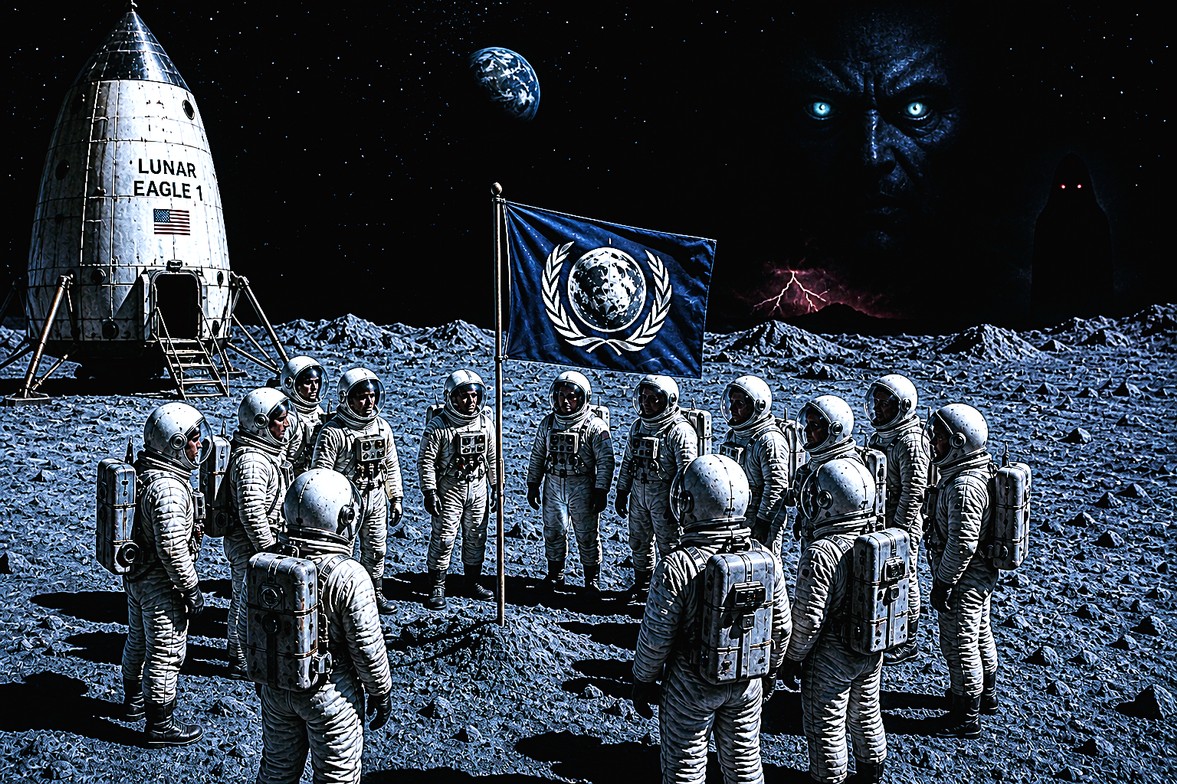
Image by Chatgpt
“The planting of this flag symbolises the internationalisation of the
moon to prevent individual nations from any further dispute”
With “no air detected” and “no sound,” it isn’t long before the explorers are “bombarded by meteors” but luckily their magnets are strong enough to protect them. Interestingly enough the meteor impacts were in fact quite noisy! Furthermore, what happened to the one sixth gravity on the moon? Any gizmo to counteract that they weren’t telling us about?
In the film at least, it seems that the moon is quite an active place complete with river channels and steaming volcanic cones. Not only that but there appears to be a shadowy presence lurking within the landscape!
After the brief flag-planting ceremony, the crew set about performing their scientific exploration involving establishing a magnetic perimeter and searching for rock specimens.
Doctors Sigrid Bomark and Selim Hamid, while searching for signs of air and life, come across a cave in which they detect a breathable atmosphere. There are also strange cactus-like plants with fungus or mushroom-like growths on them. One of the growths explodes into flames in Bomark’s hands which would suggest the presence of oxygen in the cave.
“We are the first people to set eyes on a stone like this”
Meanwhile the other nine crew members manage to locate various rocks and minerals. The first specimen examined by Orloff is gold which he dismissively casts aside as not having any worth or value. What does grab his attention is a large illuminated stone which to Orloff is “like fire, like liquid fire." Suddenly Dr. Asmara Markonen turns all weird and warns the others, "it's beautiful, but evil. Evil and sharp like the jewel of Medea." And so on that note the new find is christened by Orloff, the “Medea Stone.”
I guess the producers and director back then must have thought that since the Markonen character is black, Nigerian and Muslim, that would necessarily qualify him in most people’s minds as the one to go all voodoo-like and mystical!
Back at the cave, Hamid and Bomark conclude definitely that "there must be air" and decide to dispense with their helmets. The intake of fresh air must have done wonders for their libidos as the two doctors immediately embrace and kiss passionately. Hey, get a room you two! Oh yeah, they’ve got a whole cave to themselves…. As they walk hand-in-hand further into the cave, they pass through an opening that is suddenly sealed by an impenetrable covering of ice. A strange whirling entity briefly moves into view as this takes place suggesting the existence of a mysterious alien life-form on the moon. What you can’t see may be more frightening than what you can see…..and a whole lot cheaper in the movie-making business.
We next switch to the other nine crew members who have decided to fire a mortar into a rock formation. Just like human beings to visit a foreign land and set about blowing stuff up and leaving their trash all over the place! Liquid suddenly begins bubbling out of the rock. Feodor Orloff like a gleeful little schoolboy immediately rushes over and plunges his hands into the flowing liquid. As a result of his rash act, Feodor’s hand is badly burned. This means his glove has been breached and one might be forgiven for thinking that there might be a problem considering the lack of atmosphere on the moon!
“We've only got about an hour's supply of oxygen left”
With their air supply running low, Hideko takes Orloff back to the ship while the others search for Bomark and Hamid.
The group eventually find clues that Bomark and Hamid had entered the cave. First they locate the pair’s helmets and then discover the wall of ice. Try as they might they are unable to chip away the ice wall and have no choice but to return later.
As the group makes its way back to the spaceship, Dr. William Rochester begins to sink into “pumice dust” that acts like quicksand. Captain John Anderson tries to save him but to no avail and he too is nearly pulled under. Thanks to the magnetic meteor deflector (or course!) the others manage to pull him out as Rochester disappears into the sandy lunar depths below. With three crew members either dead or missing and one injured, the surviving crew make their way back to the ship.
****************
“Return to earth at once. You have done enough damage”
With the onset of the long lunar night, the crew manage to return to the ship. As the outside temperature drops to 202 degrees below zero, Anderson reports that “all contact with earth control has been broken off.”
Suddenly the lights in Lunar Eagle 1 dim and an unearthly humming sound can be heard. A machine then begins displaying hieroglyphics in the form of a message in a strange foreign script that is oddly enough Chinese then, oops...Japanese in appearance. Of course, who else but Hideko Murata would be the one able to read and translate it? Well, any reference to things Japanese and Asian would have appeared to be suitably foreign, alien and exotic to American audiences back in the day.
The message is from "The Great Coordinator of the Moon:"
“I speak for the Great Coordinator of the Moon. We advise and warn you return to
earth at once. You have done enough damage. You have been bombarding us for
years incessantly. Leave us in peace. We read your mind; we know your every thought. We cannot speak as you do. We communicate by thought waves. We live in
a great sealed city below. We are not enslaved by your earthly emotions: greed,
lust, passions of conquest. We cannot allow you to stay here for you would only
contaminate our perfect form of harmony.”
The message goes on to state that the lunar beings are studying the missing pair, Sigrid and Salim because they are are unfamiliar with the concept or emotion of "love." They then warn the crew that “if we find that love turns to evil, we will destroy them, you and your kind. Remember, we have the power to immobilise you at will.”
The crew of Lunar Eagle 1 promptly switch to unworthy human being mode by indulging in a bit of good old Geo-political paranoia and denial by declaring that the message “must be a hoax” and that the “symbols could have been sent by an earth power already secretly here on the moon; a power that wishes to scare us away.” In the context of the Cold War period, it’s pretty obvious who is being referred to.
Meanwhile, Dr. Heinrich suffers a heart attack. While semi-conscious and in a delirious state, David Ruskin learns from Heinrich that he is son of Bernauer, the very same Nazi who had killed David's family. On the point of a violent emotional outburst, David learns that Heinrich has disowned his family and has devoted his life to trying to make amends for his father's crimes. It appears that their friendship will remain intact.
In another message, the Lunar beings demand that the expedition's cats be left behind. They were brought along as part of an experiment to see if they can procreate on the Moon. I think the cats would have got down to the business of procreating long before reaching the moon!
As soon as Vargas and Murdock take the two cats outside and leave them on the lunar surface nearby, a shadowy entity approaches to retrieve the cats.
“Three hours and 10 minutes on flight. We're right on the button”
After a successful take off from the moon’s surface, the ever so cute spaniel begins barking to warn the crew of a fire on board. The Medea Stone has ignited and started burning. A fire extinguisher is quickly put to use and the stone is picked up with a fire blanket and placed in an airlock where it can’t burn as there’s no oxygen.
Well, it’s time for yet another….you guessed it….meteor shower! But this time they are “clusters!” Anyway, after a bit of fancy manoeuvring and mental calculations from wunder kinder electronic brain ass-kicker Rod Murdock, the crew manage to avoid disaster.
“Outside temperature rating is 245 degrees below and still falling. It's
no wonder it's cold in here. It's 55 degrees!”
Ah, oh….at 500 miles above the Earth, the temperature on board Lunar Eagle 1 has dropped to 55 degrees while on the surface of the Earth North America is starting to undergo a big freeze. A massive freezing cloud which is being controlled from the Moon, covers all of Canada, the US and Mexico in thick ice.
“The North American continent remains in an isolation of silence. No contact can
be established by any means of communication with either Canada, the United
States or Mexico. In spite of the intense cold gripping the world, the governing
bodies of every other nation are at this moment in extraordinary session
determining measures to be taken…...”
(Broadcast)
With city after city being snap frozen, Heinrich concludes that the process is somewhat like an implosion bomb or the H-bomb in reverse. The proposed solution? To build a bomb and pilot the taxi ship over a volcano. In this case, Popocatepetl (‘Poppacopperkettle’ is how I remember to say it!) Next step: drop the bomb (“atomic bomblets”) into the volcano. Result: The triggering of a huge eruption that will thaw out the affected areas on Earth. The catch: It will probably amount to being a suicide mission. What is there not like about it?
Remember the guy with the stupid accent who likes to stand in the same spot and pretend to be speaking to his crew mates or just staring at nothing in particular? Yes, it’s none other than Etienne Martel and guess what he’s up to? He’s busily sabotaging the bomblets. Why, you didn’t ask? It turns out he’s a French commie bastard. When Feodor catches him out, Martel assumes that the Ruskie would also wish to keep America frozen in order to further international communism's pursuance for world domination.
Hey wait a minute! I just thought of something. Where are the Chinese all this time? They are conspicuous by their absence. Perhaps they’re already on the moon! Just saying…...
Anyway, Feodor and Martel get stuck into a bitch fight-slapping-and-rolling-around-on-the-floor contest. Feodor tries to deliver a few chops to his opponent with his bandaged hands but only manages to cause himself more pain. He yells out to John for help and when Martel pulls out a knife, Anderson goes John Wayne all over his ass. Looks like we’re back to ‘Freedom Fries’ instead of ‘French Fries’ folks.
Lots are drawn, using tongue depressors to select the crew for the bomblet dropping mission. The two chosen are (as fate and script writers would have it) doctors Ruskin and Heinrich. Ruskin leaves a final log entry explaining what he and Heinrich will attempt:
“Our space log as recorded by Dr David Ruskin at 0.600 universal time: a space taxi
piloted by Dr Eric Heinrich and myself will leave the Lunar Eagle to drop atomic
bomblets into the crater of the volcano Popocatepetl in an attempt to break the big
freeze. This is Dr Ruskin signing off.”
Heinrich and Ruskin manage to break through the atmosphere and successfully drop their bomblets into the volcano. Popocatepetl erupts and North America begins to thaw. Unfortunately, the two occupants of the space taxi are unable to pull out and are killed in an explosion.
As Eagle 1 is now caught in the freeze, we see the cabin beginning to freeze over. Fog and frost start to accumulate and the lighting begins to dim. The crew huddle closer to each other for warmth (most of the guys gathering somewhat uncomfortably close to little Hideko!) Suddenly, another message comes through:
“Now you have seen our strength, but we have seen your human strength; the way
your people have sacrificed themselves to save the others for those you left behind.
We have also learned that all your earthy emotions are not evil….. that you have
come to us in peace. Your people on earth have been in suspended animation and have not been harmed. Return to earth at once and someday when you come back
you will be welcome.”
Communication with Earth is then restored and Anderson tells the crew, "Prepare for landing." The film closes with a view of Earth at sunrise.
Points of Interest
12 to the Moon was distributed in the U.S. by Columbia Pictures as a double feature with either Battle in Outer Space or 13 Ghosts, depending on the local film market.
The film was novelised by Fred Gebhardt under the pen name Robert A. Wise and published in 1961. Gebhardt also wrote the film's original story.
12 to the Moon was made in just 8 days on a budget of $150,000 and in many ways it shows through. What also shows through is the speculative nature of our view of space and space flight at the time the film was made. Many still believed that there might be life, even intelligent life on Mars and Venus. Such films as 12 to the Moon ought to be viewed as both harmless entertaining film fun and as a snapshot of the values, attitudes, concerns and ideas of the time.
The spaceship which lands on the moon is called the Lunar Eagle One. Nine years after this movie was released, the first human landing on the moon was accomplished in a lunar lander called the Eagle.
Coincidentally, the six NASA manned moon missions had a total of twelve astronauts who walked on the lunar surface.
For real-life lunar missions, it was originally conceived that a mission to the moon might involve the launching of a complete rocket, sending it to the moon, landing it on the surface and taking off again for return to earth. As we know, by the time of the Mercury, Gemini and Apollo missions that idea had been ditched in favour of using a multi-staged rocket and employing command and lunar modules to undertake the moon landing mission. Instead of continuous acceleration using main engines or employing nuclear power as shown in the film, timed targeted burns, use of thrusters for manoeuvring, course corrections, inertia and gravity assist would be employed for lunar missions.
Instead of having a cast of thousands going on a mission to the moon along with the associated problems of weight to fuel ratios, as well as oxygen, food and water supplies, the Apollo missions had a crew of three with two to land on the lunar surface and one to remain in the orbiting command module.
This 1960 release was the first U.S. science fiction film to have a spaceship with a multi-racial crew, six months after the East German/Polish production of "The Silent Star"/"First Spaceship on Venus" (1960) with its multi-racial crew.
In relation to the Secretary General of the ISO’s speech at the start of the film, many people today might recall the global telecast of the first manned moon landing in 1969, along with the name of the lunar lander (“Eagle.”) Despite it being a US mission, the landing was proclaimed as a “giant leap for all mankind.”
As for the moon in the film being proclaimed as international territory, well we’ll see in our own near future how that pans out as various countries and corporate entities vie with each other for prime bits of strategic, military, political and economic lunar real estate.
Considering the era in which the film was made, the composition of the crew should keep even wokey-dokey, PC & inclusive obsessed modern audiences reasonably happy. Gosh (some may wonder), if only they could have exercised a bit more positive discrimination by bumping up the number of females. Well, one might hope that rather than considerations of virtue-signalling and ‘optics,’ that perhaps technical ability, aptitude as well medical, psychological and physical suitability would have been the guiding criteria for personnel selection! Obviously compatibility and emotional stability weren’t factors in the selection process considering how some of the crew fly off at the handle over nationalistic and ideological differences.
At any rate, it wasn’t until the mid 1960s that the first female was sent into space by the former Soviet Union. It wasn’t until the 1980s for the USA during their Shuttle program. No doubt in this day and age NASA will dabble in quotas, league ladder tables, discrimination (‘positive’ of course), rankings and achieving “firsts” in this and that in its efforts to demonstrate that it too can be just as inclusive as every other public and private entity.
Having 12 crew members is an interesting number. It kind of reminds me of the 12 knights of the round table sallying forth on a quest for the holy grail! The international make-up of the crew was quite an innovative idea for the time considering that such a notion hadn’t really become a reality on such a scale until the development of the International Space Station program.
****************
(Ikarie XB 1) (1963)

“Voyage To The End Of The Universe”

Ikarie XB 1 is an overlooked compelling science fiction film that is ahead of it's time
and focuses on complex human drama instead of cheap sci-fi razzmatazz
Directed by Jindřich Polák
Screenplay by Pavel Juráček, Jindřich Polák
Based on “The Magellanic Cloud” by Stanislaw Lem Cinematography: Jan Kališ
Edited by Josef Dobřichovský
Music by Zdeněk Liška
Production company: Filmové Studio Barrandov Distributed by: Ústřední půjčovna filmů, American International Pictures (USA) Release dates: July 26, 1963 (Czechoslovakia); September 1964 (US) Running time: 86 minutes
Country: Czechoslovakia
Language: Czech
Cast
Zdenek Stepánek: Captain Vladimir Abajev
Frantisek Smolík: Anthony Hopkins - mathematician Dana Medrická: Nina Kirova - sociologist
Irena Kacírková: Brigitta
Radovan Lukavský: Commander MacDonald
Otto Lackovic: Michal (coordinator)
Miroslav Machácek: Marcel Bernard
Jirí Vrstála: Erik Svenson (pilot)
Rudolf Deyl: Ervin Herold (pilot)
Jaroslav Mares: Milek Wertbowsky
Martin Tapák: Petr Kubes (biologist)
Marcela Martínková: Steffa (Wertbowsky's wife) Jozef Adamovic: Zdenek Lorenc (coordinator)
Jaroslav Rozsíval (The Ship's Doctor)
Ruzena Urbanova: Eva (historian)
Svatava Hubenáková: Rena (MacDonald's wife) Jan Cmíral: (crew member)
Vjaceslav Irmanov : (Coordinator)
Marcela Batková: Clenka posádky
Karel Duba: (crew member)
Miroslav Abrahám: (crew member)
Nadezda Blazícková: Danseuse
Zdenek Jelínek: Pianist
Bohumil Klika: Danseur
Jan S. Kolár : Dead man
Vera Kresadlová: crew member
Alena Martinovská: Danseuse
Ladislav Mrkvicka: Romeo in movie
Vladimír Navrátil: coordinator
Olga Navrátilová: crew member
Marie Popelková: dead women
Hana Prazanová: Julie in movie
Olga Schoberová: crew member
Gustav Vobornik: crew member
Year:
2163.
Starship Ikarus XB 1:
A giant spaceship carrying 40 people to Alpha Centauri.
Mission:
The mysterious "White Planet" orbiting the star Alpha Centauri & search for signs of
life.
Duration:
28 months at near light speed (15 years time elapse on earth due to relativity
effects).
Adjusting to life in space.
Encountering a derelict 20th century nuclear armed spaceship.
A radioactive dark star.
Malfunctioning computers.
Tensions among crew and passengers.
A crew member’s mental breakdown threatening the entire
mission.
These are the hazards & dangers to be faced by the passengers and
crew of…….
Icarus XB 1
as they
Voyage To The End Of The Universe!!
“We have travelled billions of kilometres;
We are almost at the end of our journey.”
The film opens with the ship nearing the end of its voyage along with the sight of an apparently mentally deranged crew member, Michael wandering through its interior and yelling out, “Earth is gone. Earth never existed!” The mentally and physically dishevelled man resembles a silhouette that has lost its way within an illuminated symmetrical geometric landscape.
We are then taken via flashback, to the beginning of the mission which will no doubt fill in the picture of what had taken place leading up to this point.
We learn that after 8 years of preparations, the space vessel Ikaria has ceased to be a stationary satellite of Earth and is now “a small space town for forty inhabitants” that is on a journey toward Alpha Centauri, “chosen as the destination of the mission not only for being a star closest to Earth” but due to it being “similar to our Sun and has several planets orbiting it, where the existence of life is anticipated.”
As the Icarus is about to exit the solar system, our attention is drawn to the interactions among its crew and passengers where we’ll no doubt be introduced to the accumulating effects that long duration space travel will have on human beings, mentally, socially, emotionally, professionally and psychologically.
Imagine how it must feel to know that one’s link with family, friends and all that’s familiar back on earth is as tenuous and fragile as a radio signal that will over time and distance become both unreliable and impractical. One of the spacefarers, MacDonald speaks to his wife, Rena who is worried that when he returns she will be older than him and that he’ll have a fifteen year old daughter whose childhood he as a father will have missed out on. If the mission was of longer duration, everyone the crew and passengers had known on earth would be long dead. As she asks her husband to give her regards to Stephanie, it seems that Rena has inwardly resigned herself to some matter which only she is privy to.
“He's so lonely, no one understands him”
After some humorous episodes involving an obsolete malfunctioning robot, a lame wooing attempt and grown men avoiding taking their vitamins, we come across a disturbing incident involving one of the space travellers which may be a manifestation of more serious trouble ahead.
This lonely loner, Michael finds himself encased within a technological “metaphor” that twists the familiar human certainties and emotions conjured up by Shakespeare’s words in the video play version of Romeo and Juliet describing day following night: “Look, love, what envious streaks do lace the severing clouds in yonder east / Night's candles are burnt out, and jocund day Stands tiptoe on the misty mountain tops.” Instead, an unsettling concept of the passage of time is occurring within their world aboard the Icarus as well as back home on Earth in which it can be the “18th in the morning and Christmas after lunch” and the next moment New Year celebrations.
The shear immensity of the universe and our place in the scheme of things cannot be escaped as is shown by the question posed, “Why hasn't anyone ever flown to Earth?” The answer that “our solar system is of little interest” and that “it's too far from the centre of the Galaxy - 26,000 light years.” Knowing that “we're the backwoods of the Universe” would for some people put things into proper perspective while for others this realisation could very well be disturbing and unsettling to their psyche.
“When one looks at the same faces for so many months...”
Later on, one of the other men onboard the ship talks with Michael about the possibility of life “out there; at least on one of the planets” and whether “there's life somewhere like on Earth.” However, he doesn’t think as deeply about such matters as Michael as the next second he’s asking about someone else who brought his piano with him. Michael suddenly explodes and yells at the man telling him to “stop saying ‘you see, you see!’ ... And stop doing this!” but soon collects himself and apologises.
In Michael’s tortured mind it must seem that his fellow travellers don’t really appreciate what he perceives to be the enormity of their situation and are instead content to focus their concerns on trivialities. His is not the kind of personality that can tolerate being confined for long duration with the same faces, petty concerns, personalities, mannerisms, habits and foibles of his fellow travellers. Such social and psychological factors will need to be addressed for our own future long duration space flights and planetary colonisation missions. Evolution has not prepared us well for such unnatural endeavours.
For the humans within Icarus and indeed for humans living and working in space and on other worlds, one of the most profound struggles or conflicts will prove to be psychological in nature. For the characters in the film, there is the enormity of their 15-year interstellar voyage versus the fragility of the human mind and the seeming insignificance of their human lives.
“It will be the first case in history.
No child has ever been born under such circumstances.”
Another future consideration for humans travelling in space in say, multi-generational voyages or living in colonies on other planets is the inevitability of “extra-terrestrial” births. What will be the future status and indeed loyalties of people who are born and raised in places other than the ‘home world,’ Earth? On board the Icarus, the crew have to come to terms with the “risky experiment” of Stephanie's pregnancy. It turns out that she had fallen pregnant on Earth which makes MacDonald wonder why his own wife couldn’t have been included on the mission. It turns out that Rena knew about the pregnancy but being older than Stephanie, she feared what might happen and gave her place to Stephanie.
The inhabitants of Icarus are beginning to suffer the effects of boredom and despondency due to being confined in their ship for four months and knowing full well that they’re “not even halfway there.” Not even routine tasks aboard ship nor keeping busy can compensate for feelings of confinement and isolation, feelings many of us are familiar with from long periods of lock down due to Covid. On board the Icarus, fewer and fewer people seem to be bothered with engaging in physical recreation activities in the gym.
What better way to perk up flagging spirits than putting on a social dance party for the passengers and crew! The dance sequence, however comes across as being rather strange. On one level, the dancers seem to be harmoniously enjoying themselves with lots of smiles all round, but it almost comes across as being staged and choreographed much like their synchronised movements. There is little in the way of discordant individual emotion and passion showing through the social group dance and music which seems to form a kind of commentary on 22 nd century humanity which in its technological progress has perhaps managed to lose something important that makes us human like spontaneity and individual creativity.
“An object of the 7th order detected in the second safety zone!”
Suddenly the Master Computer interrupts the pleasantries with an alert and a summons for the human crew to report to their posts immediately. It isn’t long before they discover that they have encountered a mysterious derelict vessel without power floating aimlessly in space along their flight path.
Composition:
Iron, titanium, germanium and traces of common elements.
Volume:
57,900 cubic metres.
Weight:
15,844 tons.
To the crew’s surprise, the vessel contains “organic substances,” and that it appears to be a primitive spacecraft. These observations and the fact that no signal or response has been received from it, leads to speculation among the crew about the nature of the beings on board the ship about whom they know nothing:
“Ikaria may seem primitive to them.”
“Why are they silent?”
“Maybe they're afraid of us.”
“If they are afraid, then they are similar to humans.”
Even our own concepts of intelligent alien life are often coloured by our anthropomorphic view of intelligent forms of life as necessarily conforming to human standards of thought, behaviour, motive, emotions, etc.,
The Icarus crew then move on to imagine what things might be like from another intelligent life-form’s point of view should they decide to send robotic devices over to explore the derelict vessel: “Just suppose... What would we say if they came to us, opened the door, and out came a dozen machines. How would you deal with them?” Instead, the crew decide to send two of their number over to the vessel in the explorer shuttle.
It isn’t long before the two-man boarding party is dispatched to the derelict vessel where they soon discover that it was an early American Earth ship from the year 1987. All of the crew and passengers have mysteriously died and their bodies have been perfectly preserved in the vacuum within the vessel.
The evidence on board suggests that the ship had launched during a nuclear conflict and that those on board had attempted to escape the conflagration back on Earth. Despite the gambling activities, the piles of cash clutched in cold dead hands, and the dice strewn about the floor, it would seem that their ‘gamble’ did not pay off as they all are long dead – perhaps murdered with poison gas (“Tigger Fun”) or suffocated due to lack of oxygen.
It seems that no matter how far or fast humanity may move and progress, it is impossible for it to outrun its past, the horror of its degeneracy, its greed, its corruption. As easily and shockingly as the skin falls away from the dead captain's face, the crew of the Icarus are forced to confront the fact that they have not discovered a new an alien life form, but have instead “discovered the 20th century." For the representatives of a new future humanity, their past had lain there in the void all along, waiting for them to discover it and understand.
The demented logic of that human past and the legacy that might have so easily resulted is the realisation that the derelict vessel is loaded with live nuclear weapons. With the accidental triggering of one of these still functional weapons, we watch in horror as the two Icarus crewmen attempt to make their way through the airless and lifeless crypt but to no avail as they along with the vessel and all that it represented are consumed by the fearful flash of a thermonuclear explosion.
Later aboard the Icarus, a discussion ensues between two of the men about the dead representatives of a by-gone century, now wiped out of existence in a flash by their own devices. It would be too easy to deny that they are the ancestors of the inhabitants of the Icarus and instead merely assign them to being 20th century “human trash that left Auschwitz, Oradour and Hiroshima behind them.” In fact, those aboard the bright shiny and optimistic technological metaphor of humanity’s future speeding toward Alpha Centauri, are products of the likes of “Honegger - also the 20th century.”
“This moment was the beginning of lethal danger to us”
As the Icarus is being repaired, the vessel drifts into a radiation field being emitted by a near-by 'dark star.' An alert is soon broadcast throughout the ship, “Alert! Third deck! Lying person! Non-responding person!” The radiation gradually causes the crew and passengers to succumb to a kind of lassitude followed by a form of sleeping sickness. One-by-one, all on board are rendered unconscious, except for Commander MacDonald who struggles valiantly but vainly against the inevitable.
Before the cause of their dilemma can be determined, the passengers and crew have no idea what is happening to them. Unable to cope with the fatigue and drowsiness, they are “forced to activate more and more automatons to keep Ikaria running normally.”
How does humanity deal with obstacles that are beyond its understanding or capacity to deal with? The enormity of the unknowns that the crew are confronted with seem to dwarf any certainties about their understanding of the workings of the cosmos. They are forced to concede that the nature of the Dark Star’s radiation is “simply beyond anything we know” and that they can’t be certain how long the effects of the drowsiness will last. For all they know the fate of their mission has already been decided and they will be reduced to being mere “castaways’ in space. Their message in a bottle will be in the form of valuable data about this and other anomalies sent back to Earth in a module – back home to where it had been “insisted that nothing new could be discovered in the Universe,” a conceit “they've been proclaiming…..for 300 years.”
MacDonald rails against their predicament and can only see a way out of it by force of will power whereby “those who want, will survive.” His mentality can only accept the tangible and what can be given a label and only then can he “respect it.” Until then, it just doesn’t exist. Belief and faith are to MacDonald’s way of thinking mere words and that human endurance must be based on certainties in life. Instead of placing his belief in the possibility that he and the others will eventually wake up, MacDonald is certain that he can get the Icarus to head back to the solar system using the automated systems. And yet, despite his denial of what he can’t materially perceive through his senses and his confidence in a reality he can mould and control through the strength of his own will power, MacDonald finally surrenders to his fatigue.
A lack of understanding and appreciation of the past; hubris, overconfidence and complacency in the present and unawareness of what is to come…...
“Master Computer proceeds with the auto-regulation process. End of
first shift. Second shift unmanned”
We soon have a glimpse into a possible future in which the only signs of life are the ship’s robotic and automated systems. Reminders are issued and meals are served as Anthony’s robot, Patrick wanders the ship aimlessly and pathetically calls out Anthony’s name. But humanity is absent for now and all that remains of its existence is its technology. The very same technology that had the ship launched without a human crew, would at this point return the Icarus back to earth. The lack of a human crew would mean the absence of belief and faith, necessary ingredients for human progress and advancement. Perhaps this sequence serves as a clue as to the ultimate but not desired destiny of human evolution.
“Coincidence exists among us humans, but not among the stars”
After 19 hours the crew awakens and a possible explanation is offered for what had happened to them: “Some kind of a force field was generated between the Ikaria and the Dark Star…...A force field that intercepted the radiation.” Or had their “organism simply got accustomed to it?” In short, none of them know for sure. And when in doubt, there’s always “Coincidence” as a possible handy explanation. The question is, do things just simply happen or do they happen for a reason?
Far from getting out of their dilemma without consequences, the effect of the Dark Star's radiation is having a detrimental effect of both Erik and Michael who had been outside the ship and were fully exposed.
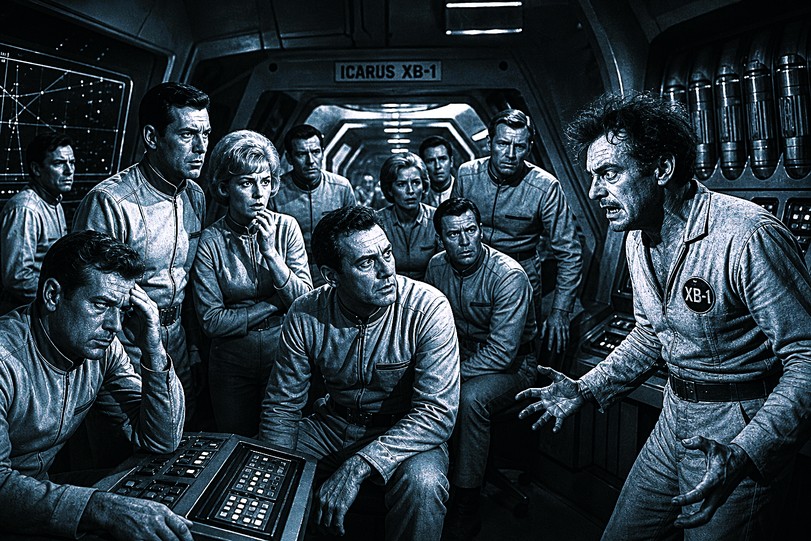
Image by Chatgpt Michael is soon found to be wandering the corridor on deck zero. He is intent on returning to Earth even if it is by the explorer shuttle craft. Michael is posing a danger to the others having deactivated the robots and is potentially able to destroy the ship’s cooling system or oxygen regenerators. Michael continues his wandering through the ship and in an agitated, bewildered and aggressive state declares that "Earth is gone," and "Earth never existed." Eventually MacDonald is abl to get through to Michael whose sense of humanity overrides his mental and emotional state and is able coax him back to where the others are. He will receive care and consideration and not meet with a sticky end as might happen in Hollywood films.
Meanwhile it has been determined that there is an energy transmitter that apparently located the Icarus as it entered the sphere of the Dark Star, enclosing them in a force field and protecting the ship from radiation.
From this indisputable fact it can only be concluded that “there's life on the White Planet!” As one of the crew observes, “We set out into the Universe to discover life, while life discovered us.”
The onboard birth at this point (hardly coincidence!) adds to the sense of wonder and future hope as the Ikarie approaches their destination, Alpha Centauri’s ‘White Planet’ obviously inhabited by an intelligent and advanced civilisation. Mission accomplished!
Points of Interest
Ikarie XB 1 is based on a 1955 novel, Oblok Magellana/The Magellanic Cloud by Polish science fiction author, Stanislaw Lem who also published his best known work, Solaris.
Ikarie XB 1 in many ways stands head and shoulders above what was generally on offer at the time much like Forbidden Planet (1956) and in a few key aspects, 2001: A Space Odessy (1968)
In the film we have;
➢ The daily activities of the crew on its 28 month mission to Alpha Centauri.
➢ The dangers of space travel with hazards from without such as radiation from
the Dark Star and hazards from within as suggested by Michael’s breakdown.
➢ The rewards of space exploration.
➢ Cooperation and interaction between a multi-national male and female crew.
➢ A serious tone permeating the film focusing on the social and psychological
aspects of human endeavour in space.
➢ Commentary of humanity’s predilection for warfare.
➢ A positive message about humanity in space with man and not machine being
the driving force as shown by the crew’s capacity for hope being the reason the Icarus continued on.
We don’t have;
➢ Massive CGI fuelled space epics in which the fate of the universe is at stake.
➢ Lashings of expected Communist and Pro-Soviet propaganda along with anti-
Capitalist admonishments.
➢ Typical space drama trials and tribulations involving mad scientists, killer
robots, lashings of techno-babble and hardware.
➢ The Ikarie’s encounter with the perfectly preserved space relic from the 20th
century forces us to imagine how our descendants might view us and the era that encompassed world wars, regional conflicts, sectarian violence, climate catasrophes, genocides, atomic weaponry and more.
I’m not going to waste anyone’s time by mentioning in any detail the American butchering of the film with the Voyage To The End Of The Universe AIP dubbed version, or references to how the film supposedly influenced Gene Roddenberry’s Star Trek and Kubrick’s 2001: A Space Odessy. Perhaps it did, perhaps it didn’t. Who knows? Really, who cares?
The original Czech version won the main prize at the 1963 Trieste International Science Fiction Film Festival. The restored original Czech version was screened as a "Cannes Classic" at the 2016 Cannes Film Festival.
The exterior sets and shots probably reflect the technology available at the time but were adequate enough. It is however the interior set designs that stand out. In many ways parts of the ship’s interior remind me of the sets on the Doctor Who TV series with the geometric shapes and circles. Shots of individual crew members are framed in such a way that they appear dwarfed by the open spaces and towering technology of the ship. This serves to highlight the apparent insignificance of human beings in the face of their own technology and the sheer immensity of the universe and what is being undertaken.
We keep being told how human beings have the technology to begin establishing its presence on other planets such as Mars. However, I still think that at present our level of optimism far exceeds what we are in fact capable of realistically achieving. The film shows how even mundane problems can arise to thwart and jeopardise our endeavours in space. First, there is the sense of boredom and despondency experienced by the crew. Then there are the frayed nerves resulting from being confined with the same faces and annoying individuals and their annoying habits for extended periods of time. Just think about how often work colleagues can give you the shits but at least you can go home at the end of the day. Now imagine being stuck with them in a habitat on Mars or on 28 month voyage in a ship travelling to Alpha Centauri! Not long before there’d be the first space homicide or at a poor soul curled up in a fetal position, sucking his thumb and cooing softly to himself…...
****************
Fantastic Voyage (1966)

Despite some stolid acting performances and rather dull script, “Fantastic Voyage”

is a lavish production with brilliant special effects for the time. Overall, the film
presents the viewer with an entertaining and imaginative journey into the human
body.
Directed by Richard Fleischer
Produced by Saul David
Screenplay by Harry Kleiner
Story by Jerome Bixby, Otto Klement
Adaptation: David Duncan
Music by Leonard Rosenman
Cinematography: Ernest Laszlo
Edited by William B. Murphy
Distributed by 20th Century Fox
Running time: 100 minutes
Budget: $5.1 million
Box office: $12 million
Cast
Stephen Boyd: Grant
Raquel Welch: Cora
Edmond O'Brien: General Carter
Donald Pleasence: Dr. Michaels
Arthur O'Connell: Col. Donald Reid
William Redfield: Capt. Bill Owens
Arthur Kennedy: Dr. Duval
Jean Del Val: Jan Benes
Barry Coe: Communications Aide
Ken Scott: Secret Service
Shelby Grant: Nurse
James Brolin: Technician
Brendan Fitzgerald: Wireless Operator
An assassination attempt on a scientist!
A desperate bid to save his life!
A miniaturized sub and its crew injected into his body?
See what happens as they embark on a……
Fantastic Voyage!
“This film will take you where no one has ever been before; no eye
witness has actually seen what you are about to see. But in this world
of ours where going to the moon will soon be upon us and where the
most incredible things are happening all around us, somebody, perhaps
tomorrow, the fantastic events you are about to see can and will take
place.”
The film opens with a TWA jet in flight at night over Los Angeles. As the plane lands, troop carriers containing armed soldiers are lined up before a hangar together with secret service men, four motorcycle policemen and several limousines
As a motorised stairway approaches the door of the plane, armed soldiers exit the troop carriers and form a cordon around the plane while the secret service men assemble and wait for the door to open.
The jet’s door opens onto a stern scene of seriousness and CIA agent Grant helps scientist, Jan Benes out of the plane. Benes has been helped to escape from behind the Iron Curtain
At the end of the steps, Benes is greeted by the Chief of the Secret Service who shakes his hand, introduces him to several of his associates and leads him to a limousine. Suddenly, Benes turns and moves back quickly to Grant to shake his hand in obvious gratitude before moving back toward the limousine.
The convoy of limos and their motorcycle escort race through an area of dark warehouses. A bit later as they travel down a street, a light from a house is seen to turn on and off – a signal to alert the occupant of a car waiting in an alleyway.
As the convoy approaches the entrance to the alley, the car in the alleyway moves forward before accelerating at full speed on a collision course with the convoy. Suddenly the onrushing car strikes one of the motorcycles that has come from the rear and is deflected from its intended target.
The car collides with the rear of the limo containing Benes before smashing into a pole and then a wall on the other side of the street, while Benes sustains a head injury.
While the attacking car bursts into flames, the secret service men quickly hustle Benes into the rear of another car. As they speed off, shots are fired and the secret service chief tries to shield the scientist’s body from harm.
As the credits roll, we are presented with a series of shots featuring an unconscious Jan Benes undergoing a medical examination using the latest technology. We are about to enter a brave new world – computerised and transistorised complete with integrated circuits and miniaturised components. Gone are the days of cumbersome vacuum tubes and big levers and enormous dials!
Fans of the 1960 sci-fi series, “Lost In Space” will recognise the sound effects used in the credit sequence which also featured in some episodes of the series.
We next see a car into which Grant has probably been hurriedly hustled after having been roused from sleep. The driver soon pulls up at a parking area of a deserted warehouse while the man next to Grant exits the car and tells Grant to stay where he is and wait.
While alone in the car, Grant becomes aware that the ground is starting to sink taking the the car with it. Having been taken down some kind of a shaft, the car comes to a halt outside two big doors that suddenly open to reveal an electric buggy driven by an M.P.
As Grant is being driven away, it appears that he is traversing a veritable vast subterranean city within a city. Prominent is the emblem / insignia:
CMDF
The over-arching military nature (replete with efficiency and secrecy) of the facility is quite obvious and begs the question as to how many such facilities exist throughout the world under the very noses of the populations of various ‘democratic’ and non-democratic countries?
The ever-present obsession with security presents itself at the check-in point where an officer requests Grant’s I.D. card – a process that’s computerized and one that’s currently being extended throughout our world with either our compliance or even without our consent.
When the vehicle pulls up at the Medical Division, Lieut. General Alan Carter greets Grant. In an observation room they both move to a viewing window that overlooks the operating room where they see an unconscious Benes being prepped for surgery.
Gen Carter informs Grant that “the other side (we know who!) got to him” and that he received a brain injury “before he could breathe a word.” This is a problem as “he's the only scientist who knows the answer to what we're after” and that's why they have to operate. However, Grant has trouble figuring out why Carter needs him.
At a panel containing several TV monitors, Dr Duval the “top brain man in the country” appears in his office on one of them along with his attractive technical assistant, Cora Peterson. To Grant’s surprise, he is informed that he to be working with them.
On another monitor appears Dr Michaels, Chief of the Medical Section. During an exchange between Carter, Michaels and himself, Grant learns that he will be needed for “security purposes” as it is believed that another attempt will be made on Benes’ life in the form of “medical sabotage or surgical assassination.” It is feared that the latter method could involve Dr Duval who’ll be operating on Benes and if he proves to be disloyal, Grant is to take his cue from Dr Michaels.
On the way back to the electric vehicle, Grant leans what the letters CMFD stands for: Combined Miniature Deterrent Forces, the meaning and implications of which he is yet to understand!
While traveling down a corridor, Carter enlightens Grant as to the work that is being performed at the facility whereby they are able to “reduce anything down to any size…..People, ships, tanks, planes…” They could conceivably “shrink an army with all its equipment and put it in a bottle cap.”
Rather disconcertingly, Grant learns that “the other side” (we know who!) has manged to get “hold of thing like that.” However, both sides of the Cold War game of lunacy (one which we seem to be returning to in our own time) have “the same problem: lack or control” in that they “can only keep things miniaturized for exactly sixty minutes. After that, everything starts growing back to its original size.”
From this point it is pretty clear what direction the plot is going to take and the kind of complicating factor that will arise.
Benes fits into the scheme of things in that he possesses the secret of control of the miniaturization process and that the designated bad guys tried to kill him because he wanted to give the designated good guys the secret instead of them. If at first they didn’t succeed, you can be sure they’ll try, try again, the Commie bastards!
Grant now understands why his presence is required…..except for one slight detail: he will need to take “a little trip” with the egg heads in order to reach a clot inside of Benes’ brain. In short, Grant is to form part of a crew together with the surgical team who will all be contained within a submarine that will be reduced down in size and injected into an artery from where they will voyage to the damaged area of Benes’ brain and repair it.
At this point Grant has probably soiled his pants and protests to Carter that he is “just not the right man for a mission of this kind.”
The Mission Briefing
When Grant and Carter arrive at the conference room, they walk into the middle of a heated argument between Colonel Donald Reid and Dr Duval over the old chestnut of the time: namely whether or not a woman (in this case, Cora) should have a “place on a mission of this kind.” Clearly Reid does not want a woman to go along on such a hazardous mission. ‘GGRR! Boo! Chauvinist bastard!’ shout the feminists in the audience.
Dr Michaels diplomatically intervenes in the disagreement by pointing out that “Dr. Duval has relied on Miss Peterson for years” and that since she’s volunteered for the mission it would all be for the best. Of course, every film needs some kind of love interest and eye-candy which is just another reason why this attractive “technical assistant” is on the mission.
The mission briefing begins with a view of a large anatomical map of a brain projected on a large central screen: “Benes' brain...near as we can map it stereotaxically.” The location of the clot is identified - “Impossible to get at without damage to the intervening tissue which would prove fatal to Benes.”
During the briefing, Lt. Gen Carter does his best impersonation of a living peptic ulcer and lights up one of the numerous cigars he goes through during the course of the film.
Next we have an overlay depicting the blood vessels of the head and neck where it is pointed out that the only way to reach the clot “is via the arterial system.” The first phase of the mission “calls for miniaturising a submarine, with crew and surgical team, and injecting it into the carotid artery.” They will need to be reduced to the size of a microbe.
In the meantime, Benes will be placed in “deep hypothermia – that is, freezing him low as compatible with human life. It'll slow down his heartbeat, circulation, and all other physical processes.”
Once in the carotid artery, the team will remain in the arterial system until they reach the point of damage “where Dr. Duval will attempt to dissolve the clot with a laser beam.” After the operation, they will return by way of the venous system until they reach the base of the neck where they’ll be removed with a hypodermic. Easy Peezy!
The sub’s location can be monitored by their circulatory specialist Dr Michaels who will serve as their navigator. There’s also wireless communication and as the sub is nuclear powered, their progress can be readily tracked.
As backup insurance, there is to be a team of surgeons who will remove them should anything go wrong. The one major caveat being that the team must be out within 60 minutes or they’ll be in danger from attack by “Benes' natural defenses: White corpuscles - antibodies.”
Preparations
Now it is time for the team to proceed to the “Sterilization Section” where Grant quips, “How much can a man give to his country?” On their way out when Grant goes to help Cora, she snaps at him, “Don't touch me. I'm sterile!” OK!
Shortly, final preparations are being made with shots of technicians doing technical stuff; banks of monitors monitoring; computers beeping and the prone body of Benes being made ready.
In the Main Ops Room there is a floor-to-ceiling detailed map of the entire arterial and venus system representing the body of Benes. Technicians flit about while we are inundated with shots of computers, oscilloscopes, X-rays of Benes’ heart, EKG charts, closed circuit TV images, dials, more charts and on and on…….
Miniaturisation
In the Miniaturisation Room is situated the central Zero Module over which stands the Proteus (USS Proteus, U-91035), a sleek craft with a transparent plastic bubble located on top of its structure. The experimental sub was as Owens later explains, “designed for piscatorial research - the spawning habits of deep sea fish.” The sub is supported by cradles, allowing it to stand free of the module.
After Captain Owens is handed a small lead box, the team enter the craft. Once inside, Owens and Grant work to install a tiny reactor containing a microscopic radioactive particle that will power the sub once they are shrunk. The particle is minuscule as radioactive material cannot be miniaturised. As Owens explains, “they can't reduce nuclear fuel, but once the reactor's miniaturised, along with the submarine, a microscopic particle should emit enough energy to activate it.”
Grant then tests the ship's wireless, while Owens tells Michaels how he will be able to read his navigation charts of Benes' circulatory and lymphatic systems. Michaels seems to take quite an interest in the subs operating systems…..
Cora begins assembling and testing the laser, while Grant jokes around with her seeming to check out the nature of her relationship with the older Dr Duval. Cora soon puts him in his place and shows how devoted she is to her work, to Duval and to the scientific exploration of the unknown and unseen. Grant wont admit it, but his bowels are starting to turn to water at the real prospect of actually being shrunk down to microscopic size.
It is soon time for the crew to strap into their seats in preparation for the start of their mission. The miniaturisation process proceeds in stages with great precision and efficiency. At first all goes well until Dr Michaels due to the close confines of the sub and lack of ventilation, suffers an attack of claustrophobia and frantically attempts to exit the hatch despite the sub being submerged in a (from their perspective) giant ampule / hypodermic syringe. Dr Duval and Grant are forced to restrain Michaels and try to calm him down. Eventually Michaels does calm down and explains that he has claustrophobia having been “buried alive...two days... air raid….England” and thought he had gotten over it.
The passage of time in minutes being counted down beginning with “60” from the start of the mission and throughout the course of the film will be a recurring feature. This is indeed a race against time and it will add to the mounting tension.
By the time the countdown minute recorder hits “59” the Proteus is at full reduction and can now generate its own power permitting the ventilators to function and allowing the crew to breathe freely.
In the operating room, we see Benes lying under a thermal blanket, his body monitored by a series of tiny tracking devices resembling radar antennae.
By minute “57” the crew of the Proteus are injected within the saline solution into Benes’ carotid artery, beginning what for them will be a roller coaster ride of their lives as they embark on their…...
Fantastic Voyage!
In the Operations Room, the minute countdown recorder flips over to “56” and an overlay map of the head and neck placed over the radar-scope shows the Proteus represented by a blip travelling up the carotid artery.
The awe-inspiring sight and experience of entering a universe no-one else has seen before is evident by the expression on the faces of the Proteus crew. It appears as a liquid wonderland stream of color consisting of huge red corpuscles, globules and platelets.
Duval attempts to encapsulate the significance of what they are beholding by (not for last time) gazing dreamily off into the distance and philosophically speculating that “the medieval philosophers were right: Man is the center of the universe. We stand in the middle of Infinity, between outer and inner space, and there's no limit to either.”
Wild Ride
Suddenly, their fascination is interrupted by the first of several emergencies when they encounter an extremely strong current, followed by a whirlpool, while the arterial wall looms closer and closer. The whirlpool’s strength can be gauged by the centrifugal force being exerted on the crew of the Proteus whereby Michaels and Cora are forced out of their seats but are prevented from being plastered all over the ship’s bulkhead by the restraining hands of their crew-mates.
At last after a desperate struggle, the Proteus emerges unscathed from the whirlpool but the crew discover that now the blood cells around the ship are colored blue instead of red. It appears that the Proteus has “crossed over into the jugular vein” through an arteriole-venous fistula from the carotid artery. This suggests that there had been a “forced joining of an artery and vein” which “must've happened when Benes was hurt.” This means that they are headed toward the superior vena cava, and will have to go through the heart which will result in the destruction of the Proteus.
Interestingly enough it is Michaels who quickly urges the ending of the mission with their immediate removal. However, back in the Control Room with about 50 minutes remaining, Carter comes up with a plan to put Benes into cardiac arrest allowing the Proteus to travel through within a time frame of only 57 seconds.
Matters Of The Heart
Carter’s plan is soon relayed to the Proteus. From the crew's perspective, Benes’ heart will sound “like heavy artillery” and according to Michael’s learned and clinical observation, it is capable of laying “down quite a barrage in a lifetime, Forty million beats.” In contrast, once again the scientist philosopher Duval gazes off into the distance and comments that “every beat separates a man from eternity.” Think about that for a moment, if you will!
The plan is quickly and decisively put into action and the Proteus (during the course of a tense countdown of seconds) shoots into the right ventricle before progressing out through the pulmonic valve, with just three seconds to spare during which Benes’ heart is revived after a brief scare that it would not start beating again.
Now, Take A Deep Breath
While on their way to Benes’ lungs, the Proteus enters a capillary and the crew is fascinated at witnessing the process of oxygenation in which corpuscles turn from blue to bright red. Moved at the sight, Duval declares in awe, “we're the very first to see the living process.”
Duval is almost Alexander Humboldt-like in his appreciation of the ascetics of the process and the effect on human consciousness and psyche that just one of the many “miracles of the Universe” can have.
In contrast, we have Michael’s Darwinian view which seeks to explain natural phenomena in terms of categorisation and scientific rationalism. Hence, what is unfolding before his eyes is “nothing miraculous” and is instead “just an interchange of gases; the end product of five hundred million years of evolution.”
Just before a discussion can ensue of a more theological nature concerning whether or not there is evidence of a “creative Intelligence at work,” a warning buzzer sounds. A pressure gauge indicator shows that the Proteus is losing pressure in the flotation tanks. At the manual control panel, Owens opens the circuit panel and quickly locates the problem. He determines that they have lost too much air to continue with their mission.
With the prospect of having to cancel the mission, Duval comments on the irony of being so close to “a vast air chamber, one of the countless alvioli of the lung” and yet they “can't get enough to fill a microscopic tank.”
Duval’s comment gives Grant an idea for a possible solution: to use the Proteus’ snorkel and enter an alveolus to extract the air that Benes breathes. Everyone except Owens are to take part in this endeavour for safety reasons.
As the crew put on their Scuba gear, they discover that the laser has broken loose from its mounting and has suffered damage. Cora cannot account for it having become detached while Michaels suggests that the laser “must have been jarred loose during the whirlpool.” Note the expressions on the faces of both Michaels and Grant when the former says this. Dots beginning to be joined?
Back in the control room, Reid and Carter discover that the Proteus has “stopped on the outer limits of the right lung” with, as indicated by the countdown recorder, just 42 minutes remaining.
While trying to figure out the reason behind the holdup, Carter adds to his potential health woes by including diabetes to possible mouth, throat or lung cancer. Armed with his ever-present cigar he proceeds to empty the contents of a sugar shaker into his cup of coffee. What’s next: amphetamines? crack cocaine?
Carter: “I can't help it. I'm just weak, I guess!”
Grant and the others are now outside of the ship and have succeeded using the snorkel to pull in the air from Benes’ lung. As luck would have it, Grant’s safety-line suddenly snaps and he is quickly sucked into a bronchiole as Benes' exhales. When Benes next inhales, Grant locates the original alveolus and makes his way to safety, and with Duval’s assistance he is pulled back out into the bloodstream.
Carter, who will probably need a course of prescribe medication for his blood-pressure receives the report with 37 minutes to go that the Proteus is “putting in to refuel air” and is “proceeding through the pleural cavity.”
Incommunicado
As the Proteus heads into the ‘calm waters’ of the pleural cavity, Cora disassembles the laser and discovers a smashed transistor and a broken trigger wire. Grant hits on the idea of cannibalizing the wireless for the required transistor and before doing so it is decided that the crew will send one last message to Carter and the team. The transistor turns out to be suitable, but the trigger wire is too large so Duval sets about scraping the wire down to size by using a No.11 scalpel. During all this time Michaels has acted like a bit of a naysayer and only reluctantly agrees to the proposal to continue with the mission when firm courses of action are decided on by the others.
Interestingly enough Grant confides to Michaels his belief that someone has been attempting to sabotage the mission with the unfastening of the laser and the snapping of Grant’s safety line. Michaels (he doth protesteth too much?) seems to recoil at the notion of Duval, the prime suspect as being responsible. Is Grant doing this on purpose to test Michaels’ reaction? As a security guy you’d think he’d keep his cards closer to his chest and not accept things at face value. After all, as Grant observes, “you still never know what's going on in anyone's mind...”
Proteus enters the lymphatic system and as it proceeds through a lymph node, it encounters reticular fibers that have the appearance of seaweed. If they manage to block the ship’s water jet intakes, the engines will overheat. Just then, the body’s antibodies decide to put on a show by swiftly attacking a bacterium, enveloping it and squeezing it to death.
As the ship’s progress is far too slow, Duval proposes the more hazardous route to the inner ear. The danger lies in the fact that the slightest noise being hugely amplified will kill them, and they have no way to warn Carter’s team. Their only hope is that the surgical team will keep absolutely quiet once they figure out where the Proteus is headed. Not surprisingly, Michaels is unhappy with this plan but once again reluctantly agrees to navigate to Benes' left ear.
Meanwhile, ‘topside’ Carter is determined to be a candidate for a stroke as he comments, “something told me I got into the wrong end of the business – Inner Space!” Yet another cigar goes up in smoke! As the team prepares for what is to transpire, the countdown recorder reveals that there are now only 27 minutes to go……..
Lend Me Your Ear
Once inside Benes’ ear, Proteus must come to a stop as the seaweed-like fibers have “clogged the intake vents” and they’re “not getting any propulsion.” It is now up to Grant, Cora, and Michaels to make a dive to pull the reticular fibers out of the intake valves.
Meanwhile back in the control room with 24 minutes remaining, Carter notices the amount of time that’s left and exclaims, “this is just what we need - another delay!” The nature of the mission and its associated stress may have awakened more than a need for glucose, caffeine and other stimulants within Carter as he spots an ant crawling along the table making its way toward a few spilled grains of sugar. Just before he brings his thumb down on the ant to crush it out of existence he stops, picks the tiny creature up and places it out of harm’s way. At seeing this, Reid observes, “you'll wind up a Hindu, respecting all forms of life, however small.”
In the silent operating room the tension is palpable while the sweat flows freely as the countdown minute recorder begins to register 21 minutes. Suddenly, a nurse accidentally drops a pair of scissors to the floor. The resulting sound within Benes’ ear pounds the Proteus and its crew to their very core with cataclysmic reverberations while Cora sinks down into the organ of corti and winds up trapped among the (hair) cells of Hensen.
Michaels and Grant race to rescue Cora but Michaels cannot go further and is ordered by Grant to return to the Proteus. Grant manages to free Cora from the hair cells, and they both make their way back to the ship’s airlock.