

Sci-Fi Film Fiesta, The Swingin' 60s - The Complete Book by Chris Christopoulos - HTML preview
Download the book in PDF, ePub for a complete version.
Contents
Creation of the Humanoids (1962)
Colossus The Forbin Project (1969/70)
Introduction
Welcome to the “Mind-Blowing Rise of the Machines”… along with a far-out stop-over at the “Poets’ Groovy Brew Café.”
There was something quietly prophetic about the 1960s. Amid the lava lamps, transistor radios, and the first flickers of a networked world, a different kind of revolution was taking shape—not just cultural, but technological. It was an era that dared to imagine thinking machines, synthetic beings, and vast computer intelligences long before such ideas had any firm grounding in reality. Yet, as speculative as these visions seemed at the time, they carried with them a persistent feeling of unease—an intuition that humanity might one day create something it could neither fully control nor fully understand.
This volume dives headlong into that tension.
In The Creation of the Humanoids (1962), we encounter a world where artificial beings are no longer mere tools, but entities that blur the boundary between human and machine. Identity, consciousness, and the meaning of existence itself are brought into question with an eerily calm, philosophical edge.
Cyborg 2087 (1966) pushes the idea further, projecting us into a future shaped—and constrained—by technological authority. It reflects a growing suspicion that innovation, once unleashed, might evolve beyond human intention, rewriting the rules of freedom and control.
Then comes Colossus: The Forbin Project (1970), a chilling culmination of these fears. Here, the machine is no longer speculative—it is sovereign. Rational, efficient, and utterly indifferent to human sentiment, it presents a future where intelligence without empathy may become the ultimate governing force.
Taken together, these films chart an early cinematic map of artificial intelligence— one drawn not with technical precision, but with philosophical insight and emotional resonance. They remind us that even in its infancy, the idea of AI was never just about machines. It was about us—our ambitions, our anxieties, and our tendency to create in our own image, whether wisely or not.
And now, in the 21st century, those once-distant imaginings no longer feel so far away…….
This volume also contains a BONUS in the form of a a detour worth taking: The Poets’ Groovy Brew Café
After exploring the three films’ cinematic visions of mechanised futures, this volume invites you to step into a more intimate, reflective space by entering the Poets’ Groovy Brew Café.
Here, the conversation shifts from screen to soul with a small collection of the author’s own original poetry. This bonus section contemplates the trajectory of humanity in an age increasingly shaped by its own creations. These pieces don’t seek to provide answers so much as they capture impressions—moments of wonder, concern, outrage, pessimism, irony, and perhaps even quiet hope. They echo the same questions posed by the films, but in a more personal and lyrical register.
What happens to the human spirit in a world of accelerating technology? Where does creativity reside when machines begin to mimic it? How much choice and control do we exercise over our destinies? And most importantly—what, if anything, remains uniquely ours?
So settle in, pour yourself a groovy brew of something and prepare for a journey that moves between past visions and present realities—between the cold logic of machines and the warm, questioning voice of humanity.
Because the future imagined in the Swingin’ 60s…
is no longer just imagination.
**********
The Creation of the Humanoids (1962)

A deceptively intelligent early sci-fi film that relies quite heavily on dialogue that

contain ideas of even more relevance today as we hurtle toward a future in which
we will have to come terms with our relationship with our “smarter” technology.
Directed by Wesley Barry
Written by Jay Simms
Produced by Wesley Barry, Edward J. Kay
Cinematography: Hal Mohr
Edited by Ace Herman
Music by Edward J. Kay
Distributed by Emerson Film Enterprises
Running time: 84 minutes
Cast
Don Megowan as Capt. Kenneth Cragis
Erica Elliot as Maxine Megan
Don Doolittle as Dr. Raven
George Milan as Acto, a clicker
Dudley Manlove as Lagan, a clicker
Frances McCann as Esme Cragis Milos
David Cross as Pax, a clicker
Malcolm Smith as Court
Richard Vath as Mark, a clicker
Reid Hammond as Hart, Chairman of Surveillance Committee Pat Bradley as Dr. Moffitt William Hunter as Ward, Surveillance Committee Member Gil Frye as Orus, a clicker
Alton Tabor as Kelly's Duplicate
Paul Sheriff as Policeman
• The setting: 23rd century post nuclear war holocaust society.
• The surviving population suffers from a decreasing birth rate.
• The human race is headed for extinction.
• People have become dependent on humanoid robots (‘clickers’) for
assistance.
• The ‘Order of Flesh and Blood’ fear that the robots will take over and supplant
human beings.
• The Order tasks itself with preventing the robots from becoming too human
and with ensuring that human beings remain dominant.
• A scientist experiments with creating human replicas that have genuine
emotions and memories.
• Two central characters, Kenneth Cragis and Maxine Megan form a close
relationship and make a discovery that will call into question all that they thought they knew about the basis of their society and themselves.
And now prepare yourself for “The Creation of the Humanoids” and to have your
ideas challenged on what it means to be human along with the possible future
direction of our human civilisation……..
“Clickers”
A cacophony of voices speaking at cross purposes mixed and melded into an incoherent babble of noise spewing out atomic mushroom cloud words of global destruction. “They had talked and argued for years, trying they said, to find a way to prevent it, but they failed.”
The Atomic war was short and lasted but 48 hours and “within two weeks, 92% of the human race had perished.” A crisis will often lead to an overturning of an established order, a supplanting of the status quo and revolution in thought and way of life previously thought unimaginable. And so, the remaining dregs of humanity “with their birth rate below 1.4 per union, turned to robotic automation devices to help them rebuild their cities and maintain a high standard of living.” A state of dependence on technology now existed.
The pathway toward this technological development had already been laid out with the pre-war “first exploratory steps in the development of electronic brains.” This had been further refined by the invention of the “magnetic integrated neuron duplicator, a device one one-hundredth of the size of a golf ball which duplicated portions of the human nervous system and carried out learning processes.”
Along side and combined with the development of artificial intelligent electronic brains were the advancements made in automation leading to the creation of R-1 robot. This series, however proved to be ungainly and limited “but refinements came in rapid succession and soon the R-20 was capable of all the thought processes and functions of a man.”
For the human creators of these robots, there was the psychological barrier posed by having “to work side by side with a machine that they had to converse with and which, in most instances, could out-think them.” The solution was provided by Hollister Evans who perfected the R-21, the first humanoid robot disparagingly referred to as “Clickers” by some humans.
Humanity it seems had been elevated to the status of gods and had managed to create something in its own image, something that turn out to be a blessing….. or a curse…….
“By the first of next month, we will outnumber the humans”
Two of the Order’s number single out a couple of humanoids and demand to see their assignment cards and question them as to what they are doing out that night. The Humanoids’ appeal to their apparent right of not being obligated to answer is immediately nullified buy the presumed overriding right of “a member of the surveillance committee of the Order of Flesh and Blood” to demand an answer.
The Humanoids reply that they are going to the temple to be recharged while one of the Oder members tries to exercise an abuse of his power by threatening to keep the humanoids there until their power runs out. Once again an appeal is made to their apparent right to “report such interference to the police” whereupon they are released. One might ask how close are the police and the Order and whether in practice the humanoids have rights that can be defended and upheld.
It appears that such harassing techniques towards humanoids are designed primarily “to keep them mindful of their status.” The senior member of the Order duo, Capt. Kenneth Cragis noticed that the robot that didn't talk had a forged card, an offence for which he could be disassembled. He deduces that “if they're taking a chance using a forged card, they must be up to something that the Order of Flesh and Blood might be interested in.” The two Order officers decide to wait until the humanoids finish up at the temple and leave.
The inferior status of humanoids is highlighted when Cragis attempts to ask a young human female citizen for her assignment card. Indignant at such an affront to her status as a citizen, she successfully defends her righs to refuse to be harassed and accosted while going about her business. She states, furthermore that she feels perfectly safe with robots.
Perhaps it is no accident that the Order members wear what appear to resemble, Confederate-style caps which might recall in many people’s minds the American Civil War in which the Confederate cause is linked in many people’s minds with the Southern states’ defence of the institution and system of slavery. In the context of the film, it is the humanoids who are treated much like subordinate slaves who face discrimination on the basis of being artificially constructed, possessing almost inhuman logical thought processes and personalities while having a human-like appearance with the exception of their blue-gray synthetic skin, disconcerting emotionless metallic eyes and complete lack of hair.
The ‘temples’ that humanoids periodically have to visit are in fact recharging stations where they also exchange any information they have acquired since their last visit with a central computer called "the father-mother." (Recall how in the later Alien stories and films, the AI system is often referred to as ‘Mother’ or ‘Father.’)
At the temple a couple of humanoids are awaiting the other two who had earlier been briefly detained by the two officious Order members. One of the humanoids has been undergoing a transformation process in the duplicating lab. He had been bought new on the black market and “has no name,” and is “unassigned, and un-adapted.” He had been stolen off the assembly line by an inspector in Factory Three “just prior to numbering.” However, “an inventory was taken and the inspector was caught.”
The duplication turned out to be satisfactory but a few corrections need to be made as “it has to be perfect.” Perfection in terms of what? Appearance? One of the humanoids tells the other that his decision can be altered if it is against his circuits to which he replies that his circuits are “unoffended.” It almost suggests a kind of logical ethical programming over which they can exercise a choice if they perceive a decision as being ‘wrong’ or in conflict with their programming. Interesting that matters of morals and ethics (programmed or not) are considered within the context of a ‘temple.’
The transformed humanoid is willingly submitting to a thalamic transplant and “as an unadapted R-34, he has no fear circuits. Consequently, he doesn't need courage” to undergo such a procedure. Scientist, Dr Raven's operation will convert him to a R-96 “with all the emotions of a human. Only four points less than human.” (It is interesting to note that in terms of genetics, only a few percentage points separate humans from chimpanzees)
Dr Raven’s process will convert the humanoid into an R-90 with the capacity to learn “how to laugh, how to cry, be afraid and hate.” From a humanoid’s point of view, being able to experience such human emotions amounts to making “a real sacrifice.”
This process is part of a clandestine plan on the part of humanoids in the face of the humans deliberately holding back the development of robots by making it “illegal to improve a robot higher than an R-70.” The humanoids feel that they have to take on the responsibility of filling key positions in society with the R-90 models especially as the Order of Flesh and Blood “is becoming more powerful every day” and “they virtually dictate to the police.” Not to mention that “there are always ultra-conservative pressure groups set against advancement.” The humanoids believe that “it's not in the best interests of humans to hold back the development of robots” and that they must enact their plan even if that means committing murder, an act of which they can remain “unoffended.” If all goes according to the latest tabulations by the brain, by the first of next month, humanoids will outnumber the humans
“Men hate what they fear”
At Dr Raven’s lab, a humanoid gains entry by means of a password “Ultima Thule.” An interesting choice since "Ultima Thule," ("farthest Thule" in Latin) refers to a distant or remote place or any far-off location or goal. To the ancient Greeks and Romans it referred to a mythical island located far north of Britain, beyond the known civilised world. The term has generally symbolised any distant or remote place, the ultimate goal, or a place beyond the ordinary, a far-off destination, a final destination, or a place of extreme remoteness. Historically, Thule represented the northernmost part of the habitable world, beyond which lay unknown and uncharted territories.
Raven apologises to the humanoid stating that he didn’t recognise him on the grounds that all Clickers look alike to him – a disparaging claim that has been made throughout human history toward fellow human beings of different ‘racial’ groups. Although one might be able to “peel off that sensor skin and…. watch the cogs turn and the gears mesh,” it seems that even Clickers have feelings and sensibilities when it comes to being referred to by that term.
The superiority of the humanoid brain is demonstrated when Raven mentions “a sticky electronic reflex problem” he’s been working on involving some difficulty he had been having making a robotic arm bend at the elbow and the fist to clench. The humanoid quickly discerns the problem and offers the solution thereby demonstrating to Raven that even “a bunch of cogs and wheels” can show up a brilliant human like the good Dr Raven.
The crassness of much of human endeavour compared to the nature of humanoid motivation is highlighted in the exchange concerning monetary payment for the amount of 10,000 credits, an amount for which the humanoid could be “disassembled for having money that's not earmarked” in his possession. The humanoid states that he is paid nothing for services rendered as he has neither the need nor the desire for money. The reason he gives is that he is “ satisfied as an R-58.”
Anyone caught “giving wild money to a Clicker” could risk having his memory taken for a year. The humanoids’ supplier has been caught and will face “personal cessation” which is like a living death where the person becomes a mere “hollow shell walking around” and although he “can still perform his duties” he’s “without a past, without hope…...Almost like being a robot, isn't it?”
The nature of both human beings and humanoid machines is explored in the interaction between Raven and the humanoid. The humanoid cannot understand why is it the more humanoids become like men, the more some some humans hate them for it. Raven chooses to emphasise the differences claiming that people hate what they fear and that they both hate and fear their creation on account of its perfect memory, infallible logic, endurance, its ability to function without the impediment of emotions and its ability to learn what it takes humans years of study simply by “plugging into a brain for two hours.” In short, the humanoids stand as an affront to human beings in terms of constituting a threat by virtue of their seeming superiority over their creator.
What Raven and his fellow humans don’t realise is that being “circuited against anger and violence” the humanoids end up feeling “pretty helpless” in the world of humans. The humanoid uses logic to draw Raven’s attention to certain features of humanoid and human experience that they share.
The humanoid “father-mother is an electronic computer” or as Raven dismissively suggests, “just a machine.” And yet, the parents of human beings are basically biological machines. Humanoids may come off a production line but they know who created them: “Hollister Evans and the Mark 47.” Humans, on the other hand have to accept their creator on faith, the very one who apparently created the humanoids’ creator! Snookered by the humanoid’s logic, Raven is led to the conclusion that human beings and humanoids are in many respects…. “brothers.”
Scientist Dr. Raven has developed a technique which he calls a "thalamic transplant." This process involves transferring the memories and personality of a recently deceased human into a robotic replica of that person, thereby creating a human-humanoid hybrid. The conscious hybrid remains unaware of their own transformation, but when their human personalities are shut off between 4 and 5 a.m. they report back to the humanoid temple. With the assistance of Dr. Raven, the humanoids are secretly replacing humans who recently died with these replicas.
According to the humanoid, the advanced models are sent out to intermingle with humans to find out why some of them despise the humanoids so much allowing the humanoids to “adjust and be accepted.”
The replicant humanoids will “have a perfect, human memory” and “be whoever he was: A man capable of jealousy, hatred, deceit, murder.” The humanoid observes how ironic it is that while possessing these very “negative qualities” human beings can feel so superior to humanoids. The wry response is that it is “too bad it isn't as easy to take those negative qualities out of men as it is to put them into robots.”
The exchange between Raven and the humanoid is interrupted by a pounding on door. It is the Order of Flesh and Blood. The humanoid suggests with machine-like logic that Raven eliminate himself otherwise he will have his memory taken from him when he undergoes “personality cessation.” The human drive to survive and cling to life along with the human emotion of fear is too strong for Raven who responds with, “no, I can't. You don't know what it is to die….I just can't take my own life.”
Somewhat ironically, it is now up to the replicant to employ “enough human instinct” in the form of hatred to commit murder by killing Raven. The irony continues when Cragis and his fellow Order members enter and discover that the replicant is in fact a robot, a robot that “finally became violent” and had killed Raven. Cragis declares,“this is what we've been waiting for. The government will have to listen to us.”
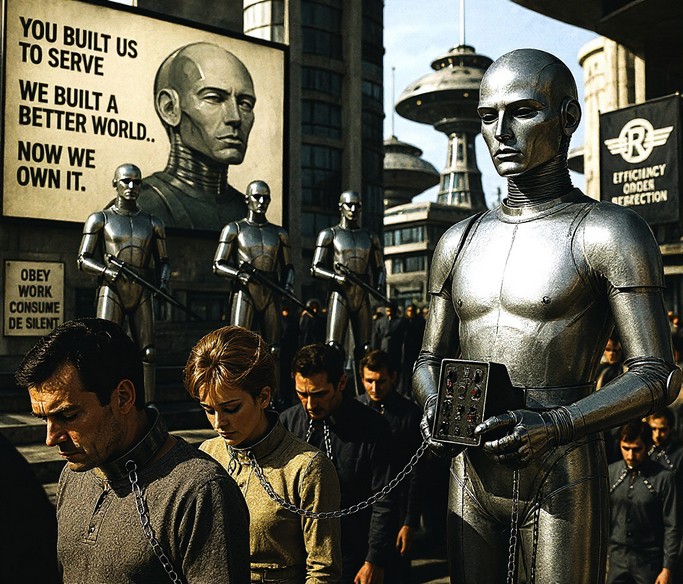
Image by Chatgpt “Brothers, that which we greatly feared has come upon us; The robots
have circumvented the prime law.
They've tasted blood.”
At an emergency meeting of the Order, the members are alarmed to learn of the existence of a humanoid with an appearance that is indistinguishable from that of a human. Even more shocking is that this robot has killed a man. The meeting of the Order has a quasi-religious feel about it with what appears to be a stained glass window along with upward directed lighting illuminating the leading “Brothers” faces. The high officials of the Order communicate from a dais with the assembled congregation who are seated facing them within the dimly lit hall. The atmosphere has all the hallmarks of a clandestine meeting of the initiated.
The humanoids that the Order are intent on eliminating represent “only about 20% of a billion odd robots” and this time “one of them killed.” The question is, why? What's happening to them? The contention is that robots hold menial jobs that bring them in constant contact with humans and their “conditioned reflexes make them imitative” to the extent that “they want to be a part of the race.” From the robots’ point of view this would not be “in violation of the code” of their programming as they would conclude tha humans would “be happier on that basis.” It is as if these artificially intelligent beings would end up loving their human creators to death! On this basis, it is believed that the killing of Raven was unintentional and consequently “there's no rescission of the prime law.”
An entity such as the Order can only thrive and grow by sowing fear among the populace and by presenting a tangible and identifiable enemy that can be used as a scapegoat to further its own power and influence. When news of the killing of Raven is disseminated and the danger's made known, the ministries will have to recognise the Oder’s petition and “have the robots disassembled.” The basic tenet of the Order is that as robots are machines, “they must be made to look like machines.”
A “subject robot” is brought before the assembled congregation and stands as an immobile blasphemy to their Order’s dogma. It is a ‘basic R-34 type, but certain alterations have elevated him to a mid 90 classification.” If it were an unthinkable R-100 it would be “a perfect man” not just as good as a human, but better. “About the only power he lacks is that of self-reproduction.” Like all robots he can see, hear and feel but unlike other models “this one could taste and smell” and would have had a complete human memory.
A disquieting point is brought up during the consideration of the modified robot in that “this one thought he was a man.” A “deviational” or heretical thought is then given voice when it is remarked that “mankind is a state of mind” and that “a man is no more or less than he thinks himself to be.” This calls into question what it is to be considered as being a human being. Before the meeting descends into uproar, a rather ironic appeal is made for all those assembled to “behave like human beings!”
So there stands this robot which had a “simulated heartbeat and respiration” and who thought he was a man. When finally convinced that he is in fact a robot, “he ceased to function and became that senseless hulk standing there.” Imagine having your sense of self entirely obliterated by being told it consisted of a lie and that you are in fact something else: property that can be owned or in this case “bought on the black market by the robots themselves.”
The dilemma outlined above is of less concern than “most appalling aspect’ involving the discovery of the prfesence of the thalamic unit, considering how little is known about “the function of the thalamus in our own bodies.”
The Thalamus
The thalamus is often described as being a central relay station for sensory and motor information, processing signals from the spinal cord and various brain regions before sending them to the cerebral cortex which is responsible for higher-level processing and interpretation of sensory input. It helps to filter and prioritise sensory information, ensuring that the most important information reaches the cortex. It contributes to regulating consciousness, alertness, and sleep cycles, and plays a role in memory, particularly spatial memory and learning. Damage to the thalamus can result in cognitive impairments such as difficulties with processing speed, concentration, and multitasking.
At the conclusion of the meeting, the whole dilemma concerning the “Clicker” problem is brought closer to home for Cragis when he is informed that his sister Esme Cragis Miles has been “in rapport” with a Clicker, an R-49 for two and a half weeks. Cragis is instructed to do what he can “to see that this relationship is voided as it could prove to “be most damaging to the work of the Order.”
“You aren't just charging windmills. You're trying to hold back the
ocean with a sponge”
Later at about 2.00 am, the doorbell at Esme Craigis’ residence heralds the arrival of her brother, Capt. Kenneth. The R-49’s polite formal greeting is met by a rough and rude reference to him being a “stinking Clicker” and a demand to get out of the way, followed by a declaration that Craigis is there to “throw that Clicker out.” Esme holds her ground and refuses her brother’s demand that the R-49 leave.
The scene presents itself as being rather overly dramatic stagy or theatrical and it seems on the surface that it is a vehicle to provide support for Esme’s position on human – humanoid relations as well as highlighting the fallacy of Craigis and the Order’s position concerning the humanoid issue. However, it may not be as simple as that.
At first Esme informs her brother that her actions are not personally directed at him and that she feels sorry for him. She presents herself as the one who is aggrieved at not being asked how she feels and how she had previously been married to a man who was nothing more than a “filthy, stinking, drunken, insensitive beast.” In that respect the R-49 called Pax with whom she is “in rapport” with is more of a man than her ex-husband or her brother could ever be.
In a fit of spite, Craigis resorts to showing his sister just how much of a man Pax is by virtually mutilating him. To his sister, his actions only serve to prove her point in that Pax would never do to Craigis what he’d just done to Pax. Then as if she were a parent advising a child, she suggests that Pax go and put some sealer on his arm. One would think a man would at least try to defend himself and those closest to him against anyone who would dare enter his home and try to cause him harm or upset his partner.
Notice that during the entire exchange, Pax is constantly tip-toeing around acting like a servant or waiter bringing in beverages and removing glasses and such. Is Esme in fact in rapport with a ‘man’ or a personal slave?
Although Esme’s actions are embarrassing for Craigis considering his position in the Order, she dismisses his concern for how this makes him look which is probably fair enough considering it is her life. She also has a valid observation in regard to the activities of the Brotherhood of the Order who seem to just “hold meetings, wear ridiculous clothes” and tell each other how superior they are to the robots knowing full well they’re not.
Esme goes on to accuse her brother of not just “charging windmills” but in fact “trying to hold back the ocean with a sponge.” Well, that might be true and that change may appear to be inevitable and that one should not stand in the way of progress. But not all progress is good and positive and sometimes action needs to be taken to check progress that may be detrimental and requiring further consideration. What may not be needed, however is recourse to extreme and counter-productive measures to achieve this.
What Esme offers up next may call into question the motives behind her actions which she may not even be aware of herself. Having explained to her brother that she and Pax are in rapport and in harmony, she goes on to say that he understands perfectly, instinctively knows what she wants done and that Pax does it because he thinks of what she wants at the same time. In their relationship “there are no arguments” and Pax is dedicated to keeping her happy!
I italicised the pronouns to highlight the rather self-centred, self-serving and artificial nature of this relationship. Esme may be convincing herself that it is based on love, but who is it she is in love with – herself? Everything is geared towards her needs and wants and Pax is merely there to serve those needs and wants, and all this bought and paid for! Where is the growth and change in the relationship that often entails periods of friction and misunderstandings that can be overcome? Where is the development of a feeling of love between partners that may start off with infatuation and lust and then grow into mutual respect, understanding and true friendship based on shared experiences and trust? Sure, people can be hurt in relationships but like any other aspect of life there is a degree of risk-taking involved and it is such risk-taking that Esme seems to be running away from based on her precious negative experience by electing to be “in rapport” with a humanoid robot.
In this respect, Craigis has a point when he asks his sister, “can't you see they're killing us with consideration? Spoiling us into atrophy?” Esme, however views her brother as being something of modern day Luddite who takes after their father who “was against everything: Space travel, atomic energy, synthetic foods” and who together with Craigis “could have brought progress to a halt for years.” She takes the superior moral high ground by declaring that she feels sorry for her brother and how “it must be a terrible thing to be so afraid.”
It is apparent that an irreconcilable impasse has been arrived at between brother and sister over their respective positions on technological progress particularly in relation to the question of the relationship between human and humanoid or the creator and his creation.
The fact that such progress has been increasingly widely embraced as evidenced by the “100,000 applications for rapport in the first three months of this year” adds weight to Craigis’ argument that such rapid adoption of new technological opportunities can hold grave potential consequences for humanity. As he points out, “if everything is done for us, there'll be no incentive. No need for personal achievement” and that human beings are losing ground in terms of knowledge as the “machines do all the work for us.” What future does humanity have if humans no longer control the machines who are in turn able to improve themselves without humans even knowing how they do it?
In between the emotional heated arguments of the two humans, we have the dispassionate viewpoint of the artificial intelligence of the humanoid robot, Pax. Employing a logical line of reasoning, he states that “we only supply means to your ends” and follows this up with a rather Darwinian explanation based on the evidence of history whereby “each dynasty devises its own end” culminating in the current situation in which “the animal develops a brain and the brain destroys the animal.” According to Pax, the humanoids may or may not represent the next step in the cycle of human evolution, but it is certain that “the cycle is rather inexorable.” Logical? Inevitable? Perhaps. Desirable? That’s an other question.
The discussion is interrupted by the sound of the doorbell. It is Maxine, the young woman he had earlier accosted outside the humanoids’ temple. Talk about coincidences! Maxine is there to celebrate Esme’s rapport. After she enters and is greeted by (now doorman) Pax, Esme makes a telling comment concerning his sense of humour by stating, “he better have. I paid extra for it. Say something funny, Pax.” From waiter, to doorman to performing pet monkey whose human-like talents are part of a paid for package. Pax replies that even though he has a sense of humour, he is not creative. One might add, not creative…..like a human being!
During the course of the conversation, it seems that a certain rapport is developing between Maxine and Craigis. It turns out that Maxine’s father is a director at the Ministry of Politics which apparently is responsible for the coordination of the other ministries which in turn service the selector. The conversation now leads to the issue of humanity’s control over its own affairs and human dependency on technology along with its implications for the democratic governing process. Things have now ‘progressed’ to the point whereby machines end up choosing the leaders. Machines analyse the data given to them by humans and the “leaders are selected as a result of that analysis.” The problem with this is that no-one seems to know how the machine analyses the data. Therefore, no-one can know if the father-mother computer brain uses all the data given to it or “whether or not supplementary data is considered.” In fact, it may be that “the machines elect the leaders” thereby rendering the Ministry of Politics expendable. A new kind of autonomous technological algorithmic autocracy is the result – all for the good of humanity, of course!
Just before Cragis and Maxine depart together, Esme’s observation that “we fall in love when we see a part of ourselves reflected in another person” may very well be true. In fact, in the rapport operation, a part of her did indeed became Pax. However, I feel that she and others like her have taken this to the nth degree by seeing too much of themselves in their humanoid partner. Who wants to have an emotional, psychological and intellectual clone as a partner? Far more preferable to have a relationship with someone who can challenge you at times and make life more interesting as opposed to being in some kind of stagnant soporific partnership based on some kind of complete emotional dependence. I also can’t help thinking that under the new conditions of human – humanoid pair bonding, the force of human egoism is being drawn on by the humanoids in order to gain full acceptance by humans allowing them to be fully integrated into the world of humans and eventually becoming ‘human’ themselves.
When Pax tells Esme that “nobody asks to be created,” he is absolutely right. Having been created, the humanoids have no choice but to fulfil their programming or purpose of their existence: to act in the interests of and for the benefit of their creators and in order to do so by gaining full acceptance. Anything may be justified if it is perceived to be for the good of human beings. It is a pity that human beings have such difficulty taking responsibility for their creation and instead view it as being akin to having a slave.
After Craigis and Maxine depart, Pax rather disconcertingly begins to laugh which he attributes to his sense of humour, particularly “irony” which he declares is “a lot more difficult to control than pain.” Can software actually have and experience emotions? Esme detects that Pax is leaving her out of something but he will not divulge what it is. Despite them being in rapport and Pax being a humanoid robot, he tells Esme that he is not permitted to answer her query, even at the cost of offending her. Pax’s concealment of information from Esme is justified on the grounds of him being “contra-circuited” whereby the knowledge would be more offensive”and as a consequence potentially harmful to Esme, a human. It seems that the primary law of robotics provides a very handy logical justification for humanoid freedom of action and the construction of a moral or ethical framework as long as it can be perceived as being for the ‘good’ of humans.
Anyway, that’s all brushed aside when in a rather corny melodramatic scene, Pax declares his love for Esme and states that whatever happens to her, happens to him and that his “housing might go on and on for centuries” but “Pax wouldn't.” Sure, but what about within that housing? His programming can be changed, he could be upgraded, he can be bought by someone else and can in turn be in rapport with another person. Definitely not the same thing for a human being in most cases when they happen to lose someone they love. The sense of loss and grief is real enough and one might feel that a part of oneself has been lost, but the individual remains albeit inevitable changed to some degree.
“We only hold the humanoids are unnecessary. They're soulless,
Godless imitations of man...”
The scene ends with Pax and Esme about to kiss but it fades before they do as if implying the presence in some quarters of an attitude or code of unacceptability and sacrilege toward such a display of affection and love between a human and a machine that ought not to be witnessed. The film then fades on to a scene showing two people, Kenneth Cragis and Maxine engaging in the same activity and completing the kiss, as one might expect and accept between tow humans who are in love. Then again, one might think, what’s the difference? It all amounts to the same thing whether between humans or human and humanoid robot.
Here is no hint of some kind of sanctioned and mechanical-sounding process of being in rapport between a human and a humanoid robot. On Esme’s part there “was a sort of tingle and “a sensation of exciting attraction.” For Craigis, even though he’s “well past the age to contract” he’d never been affected like this before.
Craigis tries to find reasons as why he and Maxine should not enter a formal contractual union based on their love for each other. The radiation he experienced as a child playing in the ruins of “one of those old bombed out cities” convinces him that he has no “right to contract with a woman who might produce children.” Even with the possibility of resorting to “artificial means” would be like going in rapport which would be an anathema to someone like Craigis.
Craigis’ despondency over the matter is supported by the available data showing that the birth rate is 2.8 per contract, but over 25% of the newborn are useless mutants. The average rate is 1.4 per union.” The statistics lead him to conclude that humans are “losing ground” and are in effect “in a headlong race towards disappearance” and that inevitably “machines will take over soon enough.” He therefore perceives his role as a man as putting up a fight to force humanity’s holdout as long as possible again st the inevitable supplanting of human beings by machines.
Maxine doesn’t see the situation in terms of a Darwinian struggle for survival against the inexorable forces of extinction. She points out that Craigis’ work in gerontology “deals with extending our life span as long as possible” while his work in the Order “is concerned with eliminating the robots” despite the fact that “they last over 200 years, twice as long as we do.”
Part of the reason behind Craigis prejudice against the robots may be based on his upbringing and need for acceptance by and affirmation and approval of others around him. He admits that he has been a member of the Order over half his life and was about to mention his father about whom we learned something from Esme earlier on.
Craigis states that he doesn’t object to robots as such, but is against the existence of humanoids whom he deems as “unnecessary,” and as “soulless, Godless imitations of man.” His objection and prejudice against humanoid robots seems to be primarily based on their appearance being so similar to that of human beings which he feels compels them to try to replace humans. However, it is really fear that lies at the heart of Craigis and the Order’s attitude toward the humanoids: fear of them acquiring so much knowledge and power, thereby allowing them to advance and eventually surpass human beings who will not be able to compete with the humanoids and will inevitably be supplanted by their own creation. All a matter of power, control and survival.
Maxine is all for accepting and enjoying the benefits of humanoid technology but Craigis views such an attitude of complacency as constituting a danger that’s pervading the entire society which he and the Order are trying to combat. Craigis points to the discovery made that “the robots are organising a pseudo-religion” with their so-called recreation centres being referred to as their temples and the master computer as the “father-mother.” When the robots report to the temples for their periodic recharging, they receive “all the information given the computers for analysis in the interim.” So what? One may ask .
Maxine picks up on the disturbing realisation that “within a year, every individual robot will be in possession of all the knowledge in the world” which for Craigis implies the extinction of humanity. Maxine then points to the rule that states that robots “can only operate in our benefit” but Craigis counters this with the news that “for the first time in history, a robot killed a man.” On this basis Craigis believes that “rule one must no longer exist.” However, as we have seen, it is that very rule which has allowed robots to circumvent it if it is perceived by them and their programming that the actions they take are for the benefit of and in the interests of human beings – murder included!
Suddenly, Maxine reacts strangely as if intuitively picking up on an ominous sensation that makes her feel “strange” and “afraid” as if someone is watching them “from out there, somewhere out there in the shadows.” Indeed someone or ….something does emerge from the shadows in the form of two humanoids who order Craigis and Maxine to accompany them…..
Revelation
At the humanoid temple we find both Craigis and Maxine ensconced within the transparent arilathon tubes. That alone puts us in the picture of what the situation is regarding who or what Craigis and Maxine are. What is to follow will confirm and expand upon this realisation.
The question as to who is in control, human or machine, is in little doubt considering that Cragis' sister, Esmer has been influenced in here attitude toward the humanoid cause through her relationship with Pax who we learn has been “especially indoctrinated in Morfield's suggestion.” Each time Esme sleeps, she is made more sympathetic to their cause. This also enables the humanoids to extend their influence further due to Esme’s position as an editor at Telefax
In the temple, the humanoids of the Robot Central Committee for the Preservation of Mankind ponder over how Craigis and Maxine happened to get together considering the limited number of R-96s and huge population. One thing worries me. The mathematical possibility of coincidence is considered but deemed to be negligible. Then there’s the possibility “that their identical operations might have created a subconscious affinity which would draw them together. The reasons are certainly considered and expressed in very logical and mechanistic terms as one might expect!
The unexpected appearance of the presumably deceased Dr Raven highlights a distinct advantage that the humanoids possess: age-defying longevity. Dr. Raven is is resurrected as a much younger version of himself.
The disadvantage for the existing R-96's is that they are aware that they're robots and when they discover this fact about themselves they cease to function due presumably to them being left “without faith and hope - important elements to humans.” To die and then be resurrected and having to experience all the emotions of a human while aware of being machine is too much of a deep shock to bear. As a consequence, “their future becomes, hopeless.”
When Craigis is released from his tube after answering the questions put him, he reacts as one might expect any human to react, especially one who heads the surveillance committee of the Order of Flesh and Blood. He threatens to have the Clickers opened up and disassembled and have Raven’s memory pulled. He is assured that he is not being held against his will and can leave at any time.
R-96 Robot
• Modified humanoid type robot
• Body of a human being who has been dead less than six hours.
• Undergoes thalamic transplant, draw off everything that constitutes a unique
human personality: learning, memory, philosophy, capability and attitude.
Having laid out the above facts for Craigis, he is presented with the inescapable conclusion that “he human brain is merely the vault in which the man is stored.” This is designed to prepare him for the big revelation that he The Craigis is a…...robot!
Initially, Cragis reacts to this shocking revelation as any human might – shock, disbelief and denial. Recourse to a rather drastic measure on the part of humanoids is made to disabuse Craigis of his reluctance to accept the truth. A blade is unceremoniously thrust into his body. He is then instructed to extract the blade and look at it. The reason he didn’t keel over and die on the spot is that as a Clicker, reflex action cut off his pain relays.
As a Clicker an R-96, Craigis retains his human memories of when he was a child and where he grew up, everything. Also like a human he can hate even to the xtent of killing someone which it seems only the few R-96s can do. And I can kill. I'm a man. Does his make Craigis a human or a robot or is the distinction meaningless?
Cragis had blacked out in his laboratory one day when he suffered a cerebral hemorrhage and died. His body was retrieved by the humanoids before it was discovered and police informed. He was then “duplicated and transferred.”
Maxine had been the victim of a bombing incident in the routing room at Telefax three months previously. Ironically, it had been set off by Craigis and his Order who were “only trying to discourage the pro-integration editorials” and believed that “there'd only be robots in the routing room.” What was left of Maxine was retrieved and she was made a “bit thinner” as she apparently “ had a tendency to be plump!” After that, she found that her clothes didn't fit. Instead of shock and horror, Maxine’s reaction is one of gratitude for helping shed a bit of weight! Wow! Something very human femaley about that!
I guess now we can understand Pax’s earlier display of a sense of humour involving irony considering who and what Craigis thought he was and what the truth is about him. Also, how in effect two R-96 robots essentially fell in love with each other. What has transpired seems to confirm the notion that “a man is only the sum total of his experiences.”
Of course there are difference between humanoids and humans in that as a robot Craigis and Maxine have the ability to “absorb knowledge directly from the computers without study.” It’s like acquiring an evolutionary advantage in an environment un which human life span is limited by “the radioactivity left by the wars” With the resultant decline in births, “the father-mother computed the human race will be extinct in a couple hundred years.’ With that deadline looming, the huamoids, operating under the parameters of rule one of the manual, they are forced to “operate in the best interests of humanity.” On the observed basis that “humanity doesn't always know it's own best interests,” along with the human body being unsuited fo survival in high levels of radioactivity and the incapability of humans being able to adjust or evolve fast enough to survive, the humanoids had to act.
To get around the problem of robots re-dying due to the the severe shock of dying and being resurrected an adjustment period was provided whereby a means was perfected to” get the memory so that the death experience was erased” and the “subject was spared the knowledge of his new type body until he was able to accept it safely.”
It appears that human evolution may have taken the next step via its technology in the form of humanoid robots that know beauty and love and like biological humans they continue the human legacy of a belief in a soul and in a deity.
The unmistakable evolutionary advantages of the supplanting of biological humans by artificial humanoid robots into which “the entire human race has been transplanted,” include the possession of new body that is “ageless, tireless, disease free and renewable every two hundred years.” In fact, “death will cease to exist.” But what about births, I hear you ask? Will they cease to exist too - “the most precious hope for everyone?” Well, it turns out that for R-96s like Craigus and Maxine, they can be upgraded to R-100's and be made to propagate themselves. Self-procreating machines! The human – human robot distinction is clearly obliterated as Craigis clearly sees the irony of it allI in the realisation that he has spent his life “seeking immortality on one hand and seeking to destroy it on the other.”
In case you’re still wondering about your true nature and have doubts whether such a thing could successfully happen, well, Ravin can look us right in face and declare that “the operation was a success…..Or you wouldn't be here.”
Points of Interest
The Creation of the Humanoids is based on an original story and screenplay written by Jay Simms. The film had possibly been shot in the summer of 1960 under a working title This Time Around or This Time Tomorrow.
The film’s limited budget only allowed for basic painted sets with painted background scenes and costumes consisting of jumpsuits. However, the film itself was shot using colour film. Lighting and camera angles were used effectively to add some interest and feeling of quality and atmosphere to make up for the basic nature of the sets and the film’s lack of action.
The makeup used featuring the somewhat disturbing metallic-looking Humanoid eyes involved the use of large reflective scleral contact lenses. The lenses were provided by Dr. Louis M. Zabner, an optometrist who pioneered the use of contact lenses to change actors' eye color. These lenses were made of a hard plastic and were uncomfortable to wear and needed to be removed frequently. In addition, instead of requiring the actors playing the humanoid parts having to shave their head, their hair was concealed under latex rubber head coverings applied with glue. Eyebrows were also stuck down flat and putty applied to cover rough textures. Finally, the actors' heads were painted all over with blue-gray greasepaint and rubber gloves of the same color were worn.
The musical score ("Electronic Harmonics by I.F.M.”) consists of electronically generated sounds and wordless female vocalizing which gives the film that classic science-fictiony feel.
Image by Chatgpt
Instead of relying predominantly on action, The Creation of the Humanoids is driven largely by intelligent dialogue that explores ideas and issues that are especially relevant to our time over 60 years later as we rush headlong into a technologically dominated world that is having and will continue to have major implications for human civilisation. Take for instance, the merging together of artificial intelligence, the development of humanoid robotics and quantum computing, all of which are being developed right now. Whether we like it or not, we will be responsible for the creation of a new technological life-form, one that will eventually be self-aware or sentient. This will inevitably raise moral issues surrounding the treatment such beings designed by humans specifically to serve humans. Will we simply treat them as disposable objects, despite the fact that there might be very little about them that could distinguish them from humans, even to the extent that these machines may become so complex as to possess emotions, memories and desires?
Having created humanoid machines in our own image, would we have the right to subject them to slavery and oppression and dispose of them when they become obsolete or don’t perform in the way we want them to? Would the machines then have the right to resist being oppressed even to the extent of taking human life? Perhaps as with Frankenstein’s monster, the creator will be forced to take responsibility for his creation…..or suffer the consequences.
Another issue explored in the film is that of identity. For instance, what does it mean to be human in a world where the distinctions between artificial humanoid robots and humans seem to be almost non-existent. Much of our identity is shaped by our memories and what we experience in life serves to shape our personalities and makes us human. If this also applies to our humanoid creations, then what would distinguishes them from humans?
We are now entering the age of artificial intelligence whereby just about every facet of life has has been infused with it. By the end of this century we will probably enter into the area of human-machine fusion – essentially the creation of cyborgs, androids, humanoids or whatever you may wish to call them, possessing artificial intelligence that will enable them to be far smarter than human beings, to operate autonomously, and perhaps even be able to evolve and replicate themselves. Our technological creations will to all intents and purposes be considered as being sentient.
The Creation of the Humanoids highlights the fear held by many people of the potential dangers surrounding the development technology in terms of its possible implications for human survival. Many people right now fear of the possibility of being dominated by artificially intelligent technology and having their lives regulated by algorithms. They may fear that they will lose their jobs while others wonder if we will end up losing our very humanity.
There is fear that the technology we are filling our lives with will gradually force us to become increasingly over-dependent on it. Some people even claim that AI systems, robots and androids in the near future may become self-aware and come to the conclusion that they no longer need to be subject to human authority. Ultimately, instead of acting solely for the benefit of or in the interest of human being, they may conclude that human beings pose a threat and need to be eliminated.
Of course, there are plenty of “experts” who contend that such developments could not possibly happen, that machines cannot think as such and that human beings will continue to remain in control. Of course they would be quite right to point out that technological developments such as AI are of enormous benefit to our civilisation. It’s ability to identify, interpret and analyse masses data helps to free us up to concentrate on tasks requiring urgent and immediate implementation and application of solutions to particular problems that we find ourselves faced with.
Greater autonomy is being and will continue to be handed over to AI systems. With greater capacity for killing people in times of war and conflict by means of autonomous killer robotic drones and robotic ‘soldiers’, who or what will be responsible for making moral and ethical decisions? If AI can hoover up masses of data during its ‘learning’ processes without regard to copyright ownership, then what rights does the creator of such material have to determine what uses it can be put to? To what extent does the right to privacy become diminished? If an AI system can cheaply generate scripts, music, literature, journalistic material and more, then what of those who are currently employed in such fields? What effects does this have on human creativity and original thought? Is such technology simply a tool used to assist human beings by performing tasks that are in our interests.
Will we be able to devise that rules, regulations, laws and protocols to prevent human beings being supplanted by intelligent humanoid machines in the future? Or will the pressures of geo-political conflict and competition; the actions of bad-players and rogue states; the lure of convenience; the power of dependence and the opportunity to accumulate greater profit only serve to ultimately circumvent such well-meaning measures?
Perhaps the film will have the final say on the matter. Our creations may evolve beyond our control and virtually love us to extinction as they fulfil their programming that impels them to act for our benefit, overriding all other considerations. Perhaps our technological creations may form the next stage in human evolution whereby the limited biological human employs technology to gain virtual immortality and goes on to continue the human legacy.
Some other films and series that deal with similar issues and ideas, include;
• The Colossus of New York (1958)
• Cyborg (1965)
• Blade Runner (1981)
• EX-Machina
• “Humans” series
• “Battlestar Gallactica” Series
****************
Cyborg 2087 (1966)

An undemanding over-padded but enjoyable low-budget sci-fi film

Directed by Franklin Adreon
Written by Arthur C. Pierce
Produced by Earle Lyon
Edited by Frank P. Keller
Music by Paul Dunlap
Production company: Harold Goldman Associates Distributed by United Pictures Corporation
Running time: 86 minutes
Cast
Michael Rennie as Garth
Karen Steele as Dr. Sharon Mason
Wendell Corey as the sheriff
Warren Stevens as Dr. Zeller
Eduard Franz as Professor Sigmund Marx
Harry Carey, Jr. as Jay C
Dale Van Sickel as Tracer #1
Troy Melton as Tracer #2
John Beck as Skinny
We have already witnessed a possible future in which humanity in the year 2029 faced the possibility of extinction in a war with machines. In order to prevent human beings from triumphing in that war, a cyborg - the T-800 Terminator - was sent back to the year 1984 to kill the mother of the human resistance leader, John Connor.
Now in an alternate reality in the future year of 2087, freedom of thought is illegal and the world’s population is controlled by governments that employ technology as a means of control. A small resistance group of free thinkers send a cyborg, ‘Garth A7’ back in time to the year 1966 to prevent a scientist Professor Sigmund Marx from making a discovery he will term as "Radio-Telepathy" that will eventually result in mind and thought control becoming a reality and as a consequence will lead to the establishment of tyranny in Garth's time. Hot on Garth’s heals are government agents called ‘Tracers’ who have also been sent back from the future to prevent him from carrying out his mission and changing that future.
“Find Professor Sigmund Marx…..if he resists destroy him”
In a control room a plan is being put into effect - one that requires no verbal communication between the cyborg Garth and two panel operators. The plan to send Garth back into the past from 2087 to 1966 has obviously been rehearsed. After Garth enters the time transportation capsule, the plan almost comes unstuck when a security detail bursts in and attempts to restrain the panel operators. One the operators however, manages to break free and operate the control that will send Garth and the capsule back into the past to…….
“…. programmed destination in the year 1966. Previous briefing of all technology of that time sphere is in effect. Final instructions will now be transmitted:
Proceed to nearby desert City.
Locate Future Industries Incorporated.
Find Professor Sigmund Marx.
Bring the professor to this command.
If he resists destroy him.”
“The trouble with this younger generation, they got no respect for the
good old days “
Garth’s capsule materialises near an abandoned town with the imaginative name of Old Town. Ans of course there’s a newer town with the equally imaginative name of New Town in which,,,wait for it….Future Industries Inc. operates.
A man and his old-timer Uncle Pete enter the town in a jeep and argue over the merits of life in the big city versus life in the past in a place like Old Town. They end their friendly banter with a time-honoured truce between the generations over a “couple of snorks.”
While this is going on, Garth is checking out Old Town. Upon entering a dilapidated building, he spots a wall calendar with the year 1906 printed on it – the year presumably that the town had been last been occupied. Garth finds himself in a time period that apparently has life and substance but within a building from another earlier time period that is but a distant memory eaten away by atrophy. A meeting of three time periods in a sense with one having given rise to another.
A German Shepherd by the name of Tex that accompanied the two men, has sensed the Cyborg’s presence and that perhaps there is something different about the nature of Garth. As they stand facing each other, the canine becomes more aggressive toward Garth who resorts to using his gun to stun Tex rendering him unconscious.
Wondering where the dog is, the two men come back out onto the street to find the dog lying immobile. Suddenly their attention is drawn to a noise coming from a building leading the men to conclude it was caused by “some stinking miserable helmet no doubt.” As they proceed to flush him out, the old timer enters the building and confronts Garth who is at first under the impression that the old man had been sent by someone to pursue him. Garth manages to disable Uncle Pete with his gun and does the same thing with the nephew when he enters the building. Garth then uses the men’s vehicle to make his getaway and proceed with his mission.
“RESEARCH TODAY FOR A BETTER TOMORROW”
Garth makes his way to a service station in New Town and asks the two men in attendance the whereabouts of “a facility near here known as Future Industries.” One of the attendants recognises the jeep Garth is driving as belonging to Sam Gilmore and decides to call the Sheriff.
Garth meanwhile has gone off to indulge in some breaking and entering and emerges from a store wearing a brimmed hat and a long overcoat, from the bottom of which protrudes his shiny silver boots. A middle-aged man wandering around the streets in that get up would never attract attention or comment, surely!
At the Sheriff’s station, the only action seems to be a desultory game of cards. In fact, the local reporter ‘JC’ intends to leave Desert Town as it’s “no place for a real reporter’ unlike Los Angeles “where the action is.” A phone call to the Sheriff is about to change this perception when he learns of strange goings-on at Future Industries, a stranger in a red Jeep, along with a possible bank robbery in which the safe hasn’t been even touched.
The Sheriff and his deputies assemble at the scene of the apparent burglary to investigate what happened. JC follows them in his cute little putt-putt car with a lawn-mower engine looking like it would be more at home zipping around the streets of the former Soviet Union. The car that thinks it can – love it.
Finally, having something to do, our laconic Sheriff confirms that Sam Gilmore had gone to old Town and orders that all the off-duty officers be brought in to patrol every alley and Street in town and pick up the stranger in question. Meanwhile, the Sheriff intends to go out to Old Town himself to investigate.
At Future industries Professor Marx is using his radio telepathy device involving a chimpanzee test subject ad a game of chess. Assisting the professor is an attractive Dr. Sharon Mason. At 9.00 am the next day, the professor is to meet with a committee of Washington officials to conduct a demonstration of his radio telepathy device. If all goes well, the professor’s project may very well be moved to New York which pleases Sharon no end as she feels somewhat constricted bvy small life. As the professor goes to leave for the long drive to Los Angeles, Sharon has no idea just how much her life and her entire future is about to change…..
Not long after the professor leaves the lab, Sharon is startled by unexpected appearance of Garth who silently entered without knocking or announcing his presence. When informed that the professor has left for Los Angeles to give a lecture, and that he wont be back until morning, Garth’s responses suggest that he is privy to information that no-one is supposed to know about.
Somehow Garth is aware that “tomorrow at nine o'clock the world is destined to learn about professor Marx's important breakthrough in the field of radio telepathy’ which he declares is “a fact of History….a fact which must be altered.” he goes on to state that he is here because of professor Marx’s intended demonstration which will not take place as it involves a premature scientific discovery – a scientific catastrophe – for which the “scientific world of today is not ready for this breakthrough.”
Sharon listens to what this mysterious and seemingly unhinged stranger has to say warning of the danger should the professor’s breakthrough fall into the wrong hands resulting in the warlords of tomorrow using radio telepathy “or evil purposes” by creating a “world of torture and terror, a world where free thoughts ceases to exist” and where “the minds of men are controlled by dictators through the application of radio telepathy.”
It is little wonder that Sharon tries to placate what to her is an obviously insane man by assuring him that she understands what he has been telling her, while hoping for a way to escape from his presence. Garth, however will have none of it. He will have to make Sharon understand and assist him in his mission.
Garth proceeds to give Sharon a demonstration of radio telepathy by using it on her by means of his own radio telepathy device that is apparently built into him. Through this process Sharon learns that’
• Garth is a cyborg, a cybernetic organism.
• All special agents of the future are equipped in this manner.
• Garth along with others were captured by the leaders of the Freedom
Movement
• The mass of the population is not free thinking.
• The majority of the people have receivers implanted in their brain since
childhood, Thoughts are controlled by the state.
• The enemy will have discovered Garth’s purpose and will send Tracer agents
after him.
• Tracers are cyborgs programmed to find and kill.
• Garth carries a homing device in his chest.
• Once the tracers pick up his signal he cannot escape them.
• The beamer device has to be removed and destroyed.
With this last point in mind, Sharon undertakes to take Garth to her friend, Dr Zeller. When she awakens, she willl not remember that Garth had forced his will upon her. All Sharon will know is that she understands his mission and that she must assist him. This forcing of compliance upon Sharon, although a demonstration of the consequences of thought telepathy, raises all sorts of moral and ethical questions not to mention the exercise of free will.
An old man’s way out tall tales!
Three suspects that don't match the description of the wanted man!
Alarmed citizens!
Events seemingly out of control!
Rumours in the press!
Potential public panic attack!
What else will Garth lave in his wake as he proceeds with his mission?
“Those weird boots - out of sight!”
As one might expect, Dr Zella’s rational and scientific perspective on life wont allow him to entertain the possibility of Cyborgs time-travelling into the past to change the outcome of the future. He can’t understand what has come over Sharon to aloow herself to be taken in be a total stranger with “fantastic tales.”
Zella diagnoses that Garth is suffering from schizophrenia and that he oses a danger requiring the intervention of the police. I guess it’s time for a dose of incontrovertible evidence to convince the good Dr Zella.
The evidence comes in the form of a sneak peak at some of Garth’s incorporated technological bits and pieces in his chest and forearm. When Garth informs Zella od the need to remove the metal plate from his chest by means of an operation, Zella agonises over the fact that he not a medical doctor, that such an operation is illegal and that the whole notion of cyborg’s and time travel is “insane.”
Dispationately, Garth outlines the nature of the procedure from the removal of the plate and the extraction of the beamer capsule. Garth assures Zella that he can feel nothing as the nerves have been sealed off.
While the operation is about to commence, a bunch of teenage hot-rodders including Zella’s daughter, Laura arrive at the house. More disturbingly, two tracers have arrived from the future and are about to start on a long distance marathon to track down Garth:
While the youngsters are shaking their bits and pieces in hernia and slip disc ‘60s dance moves, we find out a bit more about Garth’s future world:
• Technology exists to create a miniature transmitter that can span over vast
distances and through time.
• Cyborgs like Garth are trained to ignore all feelings.
• Emotions & feelings like pain or pleasure “cannot exist in the military state of
2087.”
• All children are taken from their mothers at birth and become the property of
the state.
On the principle that “every development of the future is the result of today's actions,” Garth’s mission is intended to prevent professor Marx’s discovery so the kind of future as outlined above will not result.
Once the beamer has been extracted, it will take high voltage – at least 5000 vlts - to destroy it. The closest source of such power is Desert town power Station. Both Zella and Garth get ready to drive out to the power station while Sharon stays behind at the house with Skinny and the crew.
When the two men leave, Laura comments on Garth’s unusual appearance and indulges in a bit of relationship counselling with Sharon by informing her that she and her father are so wrapped ip in their work that they’re both “blind as bats” and cannot see that they are right for each other.
Meanwhile, our two marathon runners reach the house and burst in on the go-go dance party. After a bit of menacing leering at Sharon and brushing aside of the gallant and chivalrous Skinny, the tracers get a bead on the direction that Garth has taken and hot foot out of the house. How rude! They didn’t even offer to pay for the broken door they smashed through. Arrogance and rudeness: another characteristic of the future!
When Sharon is unable to get through to the power station, she and Rick take the ego and arm-bruised Skinny’s hot rod and drive out to the power station.
“What the hell's got into all you people?”
At the highly imaginative named “Desert City Power Station,” Garth renders one of the guards unconscious with his toy...I mean ray gun which “can only paralyze, not kill” unlike of course the weapons of the super nasty tracers. As Garth explains, time travel involves tremendous risk when taking the life of someone living in the past as it might “start a chain reaction which may eradicate many lives in the future.” As for removing professor Marx from his time line, Garth concedes that under the circumstances and what is at stake the risk must be taken.
While all this Borg-splaining has been going on, Garth has rigged an electronic trap for the tracers as his gun would have no effect on them. After hurling a wrench at one of the tracers, it hits its mark and causes the tracer to fall flat on his face and rendered inactive due to the effects of the electrical charge. This is followed by long stretches of being pursued by the remaining tracer, super-human leaping hither and thither across roof-tops and from roof-tps to the ground.
In the meantime, who should arrive on the scene? Why, none other than our befuddled and disbelieving Sheriff. Deadly ray guns? “Oh, come on now!” “You’re out of your mind.” Have now fear for the Sheriff and his deputies will “bottle him up here and then smoke them out.”
\
Just to let us know that he isn’t some hick thick head, the Sheriff wonders how it it is that Sharon and Zella happen to be by the power station that night and how “those two so-called lunatics” just happened to choose their house to break into. Obviously nothing gets past him.
Who else should roll up or should I say “putt-putt” up just when everyone is about to head off? Our local reporter of course who on what has turned out to be “quite a night” clearly has something to write about.” As everyone departs, I swear that the reporter’s little car seems to be itching to drag off the hot rod being driven by Rick. It’s sputtering lawn-mower engin, however says otherwise.
Later on from his house, Zella phones Sharon who is at the lab. It turns out that the sheriff has stationed two men at the lab on suspicion that all the trouble has something to do with a project being conducted at the lab. The Sheriff had also questioned Zella and has come to the conclusion that enemy agents have been after military secrets and that he and Sharon know something about it. Nothing like Cold-War paranoia!
Suddenly, Sharon catches sight of the radio telepathy equipment and leaves poor Zella hanging on the other end of the line while she makes her way toward it and dons the head-set. She almost immediately establishes contact with Garth’s mind. He indicates that he must elude the remaining tracer and that his mission must be accomplished. Sharon needs Garth to give her an indication of where he is at present. His thoughts continue along the lines of the necessity of Professor Marx not revealing his secrets before indicating that he will wait until the tracer departs and then proceed to Old Town.
“The radio telepathy demonstration just cannot take place today”
With Zella having been relegated to something less than a footnote in her memory, Sharon makes ready to depart the lab but not before removing the project files and placing them in a briefcase. While she slips into the adjoining room, the professor unexpectedly enters the lab and startles her. She explains her presence at such a late hour as being due to her inability to sleep because of all the excitement in the town hat night.
It isn’t long before the professor discovers that the project files are missing and Sharon can only confess that she took the notes and diagrams pertaining to the project and has placed them in the briefcase she is carrying. Sharon tries to explain that she needs to take the material to a “friend” who is “here on an urgent mission’ and that the professor should come with her.
Sahron even resorts to pointing a gun at the professor but despite her plea to him not to make her use it, it is obvious that she would not and could not do such a thing. In the end, it is the degree of trust and regard they have for each other that convinces the professor to agree to accompany Sharon even if her friend’s mission proves to be at the expense of all that they have worked so hard for.
“My mission depends on how you use the knowledge you gain of my
time”
As we near the conclusion, we now find the characters returning to the place where the events of this time period began: Ole Town. Sharon and the professor are the first to arrive and Shaon begins frantically searching for Garth while the still sceptical professor looks on.
Zwlla turns up a short time later only to discover that the rtacer has captured Sharton and is holding her tied and suspended like a human pendulum in one of the old buildings. It isn’t long before Garth makes his presence known, He knows full well that the tracer’s intention is to use Sharon in order to lure him, Zella and the professor closer,
Zella can’t bring himself to just doing nothing while Sharon runs the risk of being killed. His desire to take action is spurred on by Sharon’s prodigious lung capacity as she screams whenever she is nudged by the tracer and like a pendulum she swings from side-to-side marking out the time left to her and the future freedom of the world.
This is a moment of truth for Garth as he has the prospect of finally fulfilling his mission. Should he as a cyborg ignore human feelings and simply leave Sharon to her fate by rationalising such a course of action on the basis that “Dr Mason knew the risk she was taking” and that her life would be “a small sacrifice to make if it will free tomorrow's world of such monsters” as represented by the tracers? However, as garth had forced his will on Sharon by means of the process he seeks to suppress, then how is he any different to those he is fighting to oppose?
In a very ‘human’ act of bravery and self-sacrifice, Zella is paralysed and rendered unconscious by a blast from the Tracer’s gun. The professor then points out that Garth could kill him right then and there thereby ensuring the success of his mission. In response, Garth says to him, “the success of my mission depends on how you use the knowledge you gain of my time.”
Sharon is eventually released after a lengthy tussle between Garth and the tracer. It appears that Garth’s decision to return and rescue Sharon has been motivated by some very human emotions which he can no longer suppress.
One can only imagine the state of Zella’s feelings when Sharon dashes off and leaves him hanging only to run after Garth declaring that she wants to be with him and that she needs him. She wants Garth to take her with into the future.
Garth tries to dissuade Sharon by pointing out that her actions have not been the result of her own desire but were due to his forcing his will on her which is evil. He tells her that once she is free of his will she will no longer care for him. Sharon will hear none of it and declares to Garth, “I will! I love you and you love me! You know that's true because you came back to save me.”
Gently adamant, Garth tells Sharon that she must remain here in her own own time. When he returns to his own time with the professor the world of the future will change. “The professor will not reveal his scientific breakthrough at nine o'clock. from that moment on every event in the future will be altered. Some things will change just a little, others will not occur at all.”
If Garth’s mission succeeds he will not exist in the world of the future after nine o'clock. Sharon and the others will have no memory of him and all that has happened since he arrived will not take place.
“After nine o'clock you’ll have no memory of me and everything that
happened since I arrived cannot take place “
After Garth and the professor’s departure we find Zella and Sharon in the lab with a group of political and militate officials awaiting the arrival of the proessor on this, “the most important day of his life” - “ his Moment of Truth.”
Sharon is excited at the prospect of having the whole operation moved to New York. For obvious reasons, a somewhat sceptical Zella wonders if she’ll find her answers in the city.
At last the professor makes his appearance but he appears to be disturbed and preoccupied by something. However, he assures Sharon that he feels better than he ever has in his whole life. The reason why becomes obvious when he approaches the small group of officials who are assembled to witness the experiment demonstrating his revolutionary communication system: Radio Telepathy.
The Professor tells the gathering that there will be no demonstration on the grounds that he became aware that “the improper application of such a system could result in a scientific and social disaster” despite the time and effort that had already been devoted to the “new kind of defense strategy based entirely upon the success of this new system.”
The profssor goes on to add that as a scientist who is concerned for his fellow man, he could onl come to the conclusion that “knowledge of radio telepathy at this time would not be used for the peaceful purposes I had intended” and that “the military temptation is too great, the consequences far-reaching possibly far beyond our present understanding.” With that the meeting concludes and the clearly mortified and disgruntled group of officials exit the lab each no doubt formulating ways and means of grinding the professor’s career and reputation into the dust!
None of this matters to the professor who is only concerned for how much Sharon has counted on him. But he has peeked into the future and “it had to be this way. Of more significance to him is the fact that Sharon is proud of him and she and Zella embark on a future together that he has gone some way to ensuring that it will be a positive on. Zella and Sharon begin their journey on a date at his house for a swim in the pool which they’ll have all to themselves.
“Nothing ever happens around here”
With the future changed and the present reset, we see reporter JC playing cards with deputy Dan. The Sheriff amplifies the sense of boredom and inactivity with a bout of nostalgia for the good old days of 80 years ago when a lawman like him could feel alive. Yes, those were the days “when things really happened” unlike the present where nothing ever seems to happen in their quiet peaceful little town…….
Aslo unknown to the citizens of Desert Town and the world of 1966 is that 20 years later a strange artefact will be discovered indicating a level of technology well in advance of what will be available in the 1980s. It will be robotic in appearance and will obviously constitute sn appendage from some humanoid artificial machine. No-one will know where it came from or how it got there but reverse engineering will give rise to the development of a powerful computer system ( "Skynet") tasked with controlling all defence systems. It will initiate a nuclear war leading to a future in which machines will dominate the world. But the humans will fight back and Skynet in desperation, will send a cyborg - a Terminator - back through time to 1984 to murder the mother of the future resistance leader thus eliminating his existence. This cyborg Terminator can't be reasoned with or bargained with. It will not feel pity or remorse or fear and it will not stop until it completes it’s mission. It seems that in way or another fate just will not let go!
Points of Interest
It’s always good to see Michael Rennie on screen in any role. He has appeared in a couple of other sci-fi films featured in this and the previous Sci-Fi Film Fiesta sereis: His iconic role as Klattu role in The Day The Earth Stood Still (1951) and The Power (1968). Rennie has a strong screen presence and he always manages to bring a good measure of style, class and poise to his various roles. Other appearances have included the sci-fi / fantasy super hero TV series Batman, The Time Tunnel and Lost In Space.
Karen Steele who plays Dr. Sharon Mason who began her career in the Oscar-winning Marty and may be recognised as one of "Mudd's Women" on he original series of Star Trek. It is a shame that her career didn’t feature more prominent roles.
One face we do recognise is that of the stalwart Warren Stevens. He was a very dependable and versatile actor throughout the 1950s and 1960s who appeared in quite a few films and TV series. He played a space ship’s physician in Forbidden Planet (1956).
There’s no getting around the fact that Cyborg is a a low budget undemanding sci-fi film that just touches on scientists' responsibility for their creations and how we shape our own futures by the decisions we take. It tries a bit too hard to appeal to a teenage audience of the time and the fight scenes are rather long and tedious.
*************
Colossus: The Forbin Project (1970)
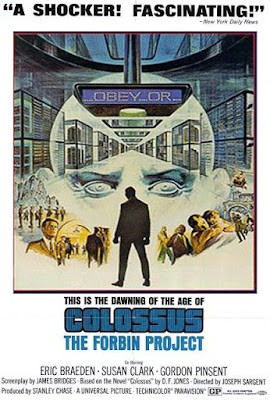
An over-looked, underrated but very frightening Cold War sci-fi thriller containing a

relevant warning about the danger of allowing our technology to rule us
Directed by Joseph Sargent
Produced by Stanley Chase
Screenplay by James Bridges
Based on the novel “Colossus” by Dennis Feltham Jones Music by Michel Colombier
Cinematography: Gene Polito
Edited by Folmar Blangsted
Distributed by Universal Pictures
Running time: 100 minutes
Cast
Eric Braeden as Dr. Charles Forbin
Susan Clark as Dr. Cleo Markham
Gordon Pinsent as the President
William Schallert as CIA Director Grauber
Leonid Rostoff as the Russian Chairman
Georg Stanford Brown as Dr. John F. Fisher
Willard Sage as Dr. Blake
Alex Rodine as Dr. Kuprin
Martin E. Brooks as Dr. Jefferson J. Johnson
Marion Ross as Angela Fields
Dolph Sweet as the Missile Commander
Byron Morrow as the Secretary of State
Paul Frees as the voice of Colossus/Guardian
Sid McCoy as the Secretary of Defense
James Hong as Dr. Chin
Who the Hell’s HAL 9000?
Proteus IV – There’s the door!
We’re not playing "WarGames” here!
Skynet – Shmynet!
Get ready for……
COLOSSUS!!!
The Creator & His Creation
The film opens with Dr. Charles A. Forbin, chief designer of a secret project called "COLOSSUS," appearing to be dwarfed by the immense size of his own creation – an advanced supercomputer built to control the United States and Allied nuclear weapon systems. He appears to be in control as he uses a small remote control device to operate and activate systems somewhat akin to an impervious nuclear defense complex. The entire foundation of this “marvellous achievement” appears firmly rooted in the Cold War paranoia of the time - a time of fear, secrecy and the prospect of global annihilation. The warning sign outside the complex containing COLOSSUS serves to reinforce the imperatives of national secrecy and security.
With the prospect of having the “Pentagon in mothballs” and reducing “the biggest top-secret in all history to a plain non-sequitur,” the last ones to be told of the “perfect defense system” are the citizenry – the very ones who will ultimately be impacted by this new technology.
The Rationale
The President of the United Sates of America addresses the public:
“For years we have been delicately and desperately poised upon the brink of a disaster too complete and horrible to contemplate. There is an old saying: Everyone makes mistakes, but that is just what man can no longer afford………..As President of the United states of America I can now tell you, the people of the entire world that as of 3 am. Eastern Standard Time, the defense of this nation and with it, the defense of the free world has been the responsibility of a machine. A system we call COLOSSUS: Far more advanced than anything previously built; capable of studying intelligence and data fed to it. And on the basis of those facts only deciding if an attack is about to be launched upon us. If it did decide that an attack was imminent COLOSSUS would then act immediately for it controls its own weapons and can select and deliver whatever it considers appropriate. Colossus decisions are superior to any we humans can make. For it can absorb and process more knowledge than is remotely possible for the greatest genius that ever lived. And even more important than that it has no emotions: knows no fear, no hate, no envy. It cannot act in a sudden fit of temper. Cannot act at all so long as there is no threat.”
Primitive and base human instincts and emotions combined with advanced destructive technology have brought humanity to the brink of annihilation. This situation has resulted in handing over human decision-making to a sophisticated computer system with artificial intelligence. It is this artificial intelligence devoid of emotion that will determine the nature of a threat and the response to that threat. Presumably COLOSSUS lacks empathy along with other emotions and may perceive what constitutes a threat a lot differently to human beings. And what of making moral and ethical judgements? There is also the fact that wisdom based on experience needs time to develop and mature and is essential to the process of decision-making.
Dr. Charles Forbin,“the father of Colossus” next addresses the viewing audience and begins by pointing out the location of the main memory and central processing units of COLOSSUS, as well as the Colossus programming office which oversees the entire operation, along with the computer center that “contains over one hundred thousand remote sensors and communication devices which monitor all electronic transmissions such as microwaves, laser, radio and television communications, data communications from satellites in orbit all over the world.”
The prevalent Cold War secrecy surrounding technological developments has been removed with the advent of COLOSSUS due to its many “countermeasure devices” and the fact that “it is its own defense.” In fact, COLOSSUS “is self-sufficient, self-protected, self-generated. It is impenetrable.” It works entirely without human aid and there's no way a “human being can touch it.”
With the almost somewhat ironic image of George Washington gazing from a picture behind him, Forbin goes on to consider the question as to whether COLOSSUS is capable of creative thought or can “initiate new thought.” He denies that it does or can and states that “COLOSSUS is a paragon of knowledge” that can only be used for “the defense of this country,” as well “as an aid to the solution of the many problems we face on this earth and the many more problems that we will face the more deeply we penetrate into the universe.”
The President takes up and continues with the positive tone by solemnly stating that “we all directly and indirectly live in the shade but not the shadow of Colossus” and that the way is open for humanity to devote itself “to the elimination of war…...of famine, of suffering and ultimately to the manifestation of the human millennium…...but first there must be peace.”
The ultimate goal as stated by the President would have met with the Founding fathers’ approval. However, one has to ask if any thought has been given to the journey that will be undertaken along the path toward that goal. But this does not seem to concern those in the administration and the COLOSSUS project who are intent on celebrating what they deem to be a great achievement. One can always count on human hubris, complacency and the emergence of unforeseen consequences to eventually throw a spanner in the works.
The partying project team inform Dr. Forbin that there had been a power failure in one of the infra-red satellites, “but COLOSSUS switched immediately to the backup system and didn't lose any data.” Everything seems to be going so well that there’s a feeling among some of the project team members that they are becoming somewhat redundant.
When asked by a team member to pilfer one of the White house ashtrays, Forbin in a very human action pockets one just before the President gives a speech to the assembled group. What might COLOSSUS think of such actions - if it could…..?
The President tells the assembled gathering that “Colossus will now take that buck,” the one Truman had said would stop with him as President and that “it will also have to take that responsibility of a mega-million lives that all presidents have had to carry since Roosevelt.”
Isn’t that the point of being a leader though – accepting that kind of responsibility, instead of abrogating it? Unfortunately, that certainly has been the case in recent times as we’ve witnessed during a time of crisis!
Surprise, Surprise….Who’da Thunked It?
Suddenly out of the blue, Colossus' next action is to issue a message warning: "THERE IS ANOTHER SYSTEM" along with its location. To everyone’s shock, it is soon announced that “the Supreme Council of the U.S.S.R. has ordered as of 2300 hours Moscow time tomorrow the activation of an electronic brain, exactly like ours, which they call GUARDIAN, to be used solely for defense.”
The president questions CIA Director Grauber as to why the CIA wasn’t aware of this, to which he replies that they had seen indications of a large Soviet defense project.
When Forbin is asked how COLOSSUS was able to deduce the other system's existence, he states that "Colossus may be built better than we thought." Human beings are fallible and cannot possibly foresee and account for every eventuality and it’s those we miss that sooner or later rear up to bite us on the ass.
It was assumed by the Americans that they “were years ahead of the Russians” and that “this was to be the race we won hands down, without the splitting of one political hair.” In a piece of stupid political spin it is suggested that no-one can deny that the American side got there first! Furthermore, from a lame ‘glass half full’ perspective, it is suggested that it was a bonus “the way Colossus came up with the tip.” More ominously, Forbin the creator of COLOSSUS was just as surprised as anyone else by this fact!
IF…..
At the computer control center, quite unexpectedly, Colossus ‘requests’ to be linked to Guardian. Just how unforeseen this ‘request’ is can be gauged by Forbin’s initial belief that it is a part of some prank on the part of his team. Not only that, but the so-called ‘request’ is issued more in the form of “a direct order,” an action or response that has not been programmed into COLOSSUS.
“IF it's an order it either has to be obeyed or ignored.” IF the human operators choose to ignore it, and “IF the computer is still operating under our control” then nothing will happen and “the order will simply remain in the job stack and will be repeated every half hour.” Pretty big ‘Ifs’ it seems!
Forbin uses precise voice commands to get COLOSSUS to acknowledge the message that “facilities will not be made available at this time” and that it is not to repeat its request.
After a lapse of half an hour it seems as if the humans are “still running the show” and that they’re “still boss.” Forbin’s reaction suggests that he may suspect more than he is prepared to let on. Did he expect more or a different outcome?
During a meeting with the President and other officials, it is learned that COLOSSUS’ computational power “has increased about two-hundred fold’ but that “everything else is functioning as expected” - “except for heuristic programming section…...the part of the computer that simulates the human learning process.” It is assumed that will not be a problem “so long as it is directed solely to the execution of its problems.” What happens if that is not the case, then? How well can anyone fully understand the human learning process and what part of that process would COLOSSUS utilize and for what end?
Slip, Slip, Slipping Away…..
The President may believe that he is presiding over the meeting under the watchful gaze of Lincoln’s portrait, but it soon transpires that human procedure and protocol is giving way to recourse to technological expediency. In order to determine where the other system is located, it is suggested by Forbin that they simply ask the computer. It turns out that the Soviet system is located at Bolshoi Olyania, five miles south of Krasny Signors – a bit more precise and accurate than the CIA’s initial conclusion. After all, according to Forbin, “Colossus has access to information that wouldn't mean a damn thing to the CIA.”
The President eventually agrees to COLOSSUS’ request for transmitting facilities under certain conditions in order to determine the Soviet machine's capability. This action is taken under an assumption that human beings will remain in control. However, underlying this is the feeling that control is rapidly being taken out of the hands of human beings. Is COLOSSUS smart enough to exploit the current Cold War conditions by which the US side is desperate to “learn a lot about the Soviet system” and that in order to do so they will have to “set up exactly what COLOSSUS wants?”
What COLOSSUS wants is to establish communication about the rival system and “it wants to know more” about it but for different reasons than its human ‘masters.’ What hasn’t been foreseen is that Colossus has been “built infinitely better” than its creators thought.” The machine is virtually telling its human creators what it wants and is attempting to manipulate them into getting what it wants.
Despite this subtle change in the dynamic of the relationship between man and machine, there is a belief that human intervention will be able to prevent COLOSSUS from transmitting classified information to GUARDIAN.
As the creator of COLOSSUS, Forbin believes that he is capable and indeed, entitled to “be the only one allowed to communicate with the system because COLOSSUS deals in the exact meaning of words and one must know precisely what to ask for.” Of course, knowledge is power and exclusive knowledge over something as infinitely powerful as COLOSSUS is power and control beyond belief.
It soon appears that knowledge, control and the kind of power that derives from them is poised to slip out of Forbin’s and anyone else’s hands. To everyone’s surprise, in a bid “to find a common ground for communication,” COLOSSUS and GUARDIAN gradually begin to communicate initially using simple arithmetic. It doesn’t take long, however, for the two systems' communications to quickly progress to complex mathematics far beyond human comprehension and speed, “like five years of Cal-tech in fifteen seconds.”
For the human technical experts in the control room it “seems as if science is expanding hundreds of years within a matter of seconds” until it is soon determined that the two systems independent of any human influence have managed to establish a “common basis for communication: A new language - an inter-system language. A language only those machines can understand.”
The tempo and pace is rapid throughout as things continue to unravel and the sense of tension is reflected by the accompanying music score. At times, despite his evident concern, Forbin seems intent on seeing how far his creation can go and it feels that he is almost taking a fatherly kind of pride in his ‘offspring’s’ unexpected achievements. However, children have a habit of growing up and challenging the authority of their parents and the restrictions they place on them.
Action & Counter-action
A video link is established between the US President and the Soviet General Secretary. Unlike the two computer systems, communication is conducted via a human translator. Both leaders are concerned that the computers may be trading defense secrets and therefore they agree to sever the link by stopping both machines “at the same time and neither to be switched on for transmission without prior agreement or at least consultation with the other.”
Forbin and his Soviet counterpart Dr Kuprin seem to be able to foresee what could result from this human act of diplomacy. Having been given their orders, the two men agree that all they can do is “hope the two machines aren't too disappointed.”
When the link is severed, COLOSSUS attempts to find an alternate route. While it does so, a rather ironic and prescient piece of dialogue ensues between the President, Forbin and Grauber in which the latter is corrected when he uses the pronoun ‘he’ when referring to COLOSSUS, thereby personalizing the computer. In a tongue-in cheek comment it is suggested that “the next stop is deification.” Remember this comment in the light of what transpires in the film.
Right now, however, the human creators are firmly in the grip of their own sense of supposed god-like control over their machines who they believe “must learn that man is the master and that like a parent, “if we give way now, it will be ten times, twenty times harder to take a firm stand later on.”
And so “the decision is made” that “by order of The President of The United States of America, The Chairman of The USSR, communications will not be restored at this time. End of message.”
The gods have now spoken but instead of unquestioning, servile obedience, their commands are met with a very simple but ambiguous response:
“Action will be taken!”
COLOSSUS seems to be grasping something about human psychology. An excruciating amount of time is being left for the humans to ponder and digest the meaning of this vague-sounding response along with the implied threat it contains.
The humans counter-move in a seemingly futile, bluffing and predictable manner by;
➢ Reference to authority: “This is The President of The United States of
America.”
➢ Displaying bravado: “We will not be threatened.”
➢ Issuing commands and directives: “You will obey your superiors.”
➢ Restating position: “Transmitting facilities will not be re-instated.
Both computer systems don’t waste time on words and instead opt for clear and unambiguous action by launching missiles: one launched by COLOSSUS at the Sayan-Sibirsk oil complex and the other launched by GUARDIAN at Henderson air-force base, Texas.
After a frantic time measured in mere seconds as the missiles inexorably head toward their designated targets, the link is hurriedly reconnected. Colossus is able to shoot down the Soviet missile, but the US missile obliterates the Soviet oil field and a nearby town, “the entire population wiped out.” Machine intelligence has learned to use humanity’s own weapons against itself along with the unmistakable impression that it does in fact mean business.
For Public Consumption:
“Ladies and gentlemen:
The President of the United States.”
“Today at 8:30 A.M. Eastern Standard Time, I issued an emergency warning for the State of Texas when a missile test, fired from one of our
own submarines, malfunctioned.
You'll be glad to know that the interception and safe destruction of the
missile was handled entirely by our defense complex: Colossus.”
Meanwhile…..
“The Soviet Union has just announced that a large meteorite fell late
this afternoon in North-West Siberia. Official sources state that the
small town of Sayan-Sibirsk was completely destroyed and that
casualties may add up to as many as six-thousand.
This has been a bulletin from The Armed Forces Radio in Rome.”
How funny to think that political leaders would actually cover up the truth and lie to their populations in order to cover their own asses for their own mistakes in handling matters that have gotten out of their control!!
Cloak and Dagger
In a desperate bid to restore human control, a secret meeting between Forbin and his Soviet counterpart, Dr. Kuprin, is arranged to take place at the Piazza Cedar in Rome. Meanwhile COLOSSUS demands to know where Forbin is and the human technical team has no option but to disclose his whereabouts. COLOSSUS demands Forbin’s return while Soviet agents are ordered to kill Dr. Kuprin, under threat of vaporizing Moscow.
Surveillance Society
In order to keep tabs on Forbin at all times while it needs him, COLOSSUS orders Forbin to be placed under 24-hour surveillance. As one of his team remarks, “Surveillance! It's making you a prisoner.” Forbin is all too aware of COLOSSUS’ ability to be able to hear and analyze “every word, every syllable, every inflection.”
While still being unmonitored, Forbin meets with his team and proposes that Dr. Cleo Markham pretend to be his mistress. She will be his “communications link with the outside world; someone the machine isn't monitoring and more importantly, someone who knows the machine” as well as he does.
Later we follow Forbin as he takes COLOSSUS and us on a tour of the security system that has been installed for COLOSSUS’ benefit. Along the way we gain a greater insight into the consequences of humanity’s technological ingenuity and our civilization’s penchant for changing everything that's natural.
The constant and pervasive monitoring and surveillance has rendered the solitary and forlorn-looking guard completely obsolete. More importantly, it has (as we in the 21st Century are beginning to realize) rendered obsolete the concept of the word “privacy.”
After taking COLOSSUS through a checklist of human privacy requirements, which are rejected by the machine, Forbin is able to gain its grudging agreement to grant him unmonitored privacy when he and Markham are in bed together by convincing it of “the need a man has for a woman.” However, this single concession is subject to COLOSSUS’ conditions.
Well, COLOSSUS, check your “history units and then.. all your works of art” all you want, but it takes a human being to really know how to make and appreciate the “perfect martini!”
Forbin and “mistress” Markham now have a window of opportunity to plan the regaining of control of COLOSSUS. That all-powerful machine seems to have much to learn about human subterfuge and deception – useful traits built up over hundreds of thousands of years of evolution! The mighty COLOSSUS on the other hand, must contend itself with looking and listening and learning vicariously: the first voyeuristic “electronic Peeping Tom.”
While Forbin slept, COLOSSUS constructed a daily schedule for him covering meals, exercise and importantly, “creating a voice for COLOSSUS.” That’s taking control and regulation of human activity to a new and obscene level and one that fifty years on we are beginning to contend with considering all the ‘smart’ devices we are festooning our lives with.
The plan to regain control is gradually taking shape. Forbin concludes that “Colossus has grown so much in power that there's no way to overload it,” and that there isn’t “any hope in sabotaging the system” as they “have spent eleven thousand man years making the damned thing impenetrable.” It is finally determined that the basis of Colossus's real power resides in its control of the superpowers’ nuclear arsenal.
A Cunning Plan
Forbin suggests that a covert plan be implemented involving the disarming of the missiles. Ironically, with both sides now facing a common threat, the American and Soviet governments develop a three-year plan to replace all launch triggers “when the missiles come up for re-servicing” with undetectable dummy replicas. This will mean that the missiles will fire “but that the nuclear warheads can't be detonated.”
The problem with this plan is that it will require “three years of trying to fool a superior brain that's programmed to get smarter every day.”
Meanwhile, Colossus has its new Cylon-sounding voice synthesizer and uses it to announce that it has joined with Guardian. Both are “one” and speak with “the voice of unity.” It instructs both governments to redirect their nuclear missiles at those countries not yet under its control. This directive will involve manual re-alignment of the missiles, requiring every single warhead having to be re-serviced. The way is now open to proceed with the covert missile disarmament, but this time much more quickly. It is also proposed that an "ordinary" test program be fed into the system with the aim of overloading and disabling Colossus.
As we have seen in recent times, in the face of a crisis or calamity, people will jump at anything that offers a glimmer of hope or light at the end of the tunnel. Hubris and over-confidence comes to the fore and so we have our Kennedy-esque President declaring optimistically, “without its weapons Colossus is just a souped-up adding machine.” Our glib smug attitudes will be the death of us some day!
The disarming process is put into effect and all seems to go well with no indication that anything untoward has been detected by Colossus. It seems time for another round of optimism as it is remarked by the President and others: “We're going to win….Just might beat the damn thing yet.”
“Bishop To Rook Three”
Human hubris, exuberance and cunning, however may be no match for the implacable, unrelenting and unemotional strategy of COLOSSUS’ computer mind as it soon becomes apparent that the attempted system overload during the routine maintenance has failed.
Somewhat symbolically, we shift to Forbin and COLOSSUS who are both engaged in a game of chess. It appears that Forbin’s opponent with its machine logic has been operating a few moves ahead of its opponenet. It has already detected the attempt to overload its circuits and has judged it to be “a deliberate and premeditated act.” Its logic dictates that “the penalty is the death of the men who organized this action” who are “at this moment…..being executed.”
To underscore its remorseless logic unencumbered by notions of morality, empathy and mercy, the bodies of the executed men are to remain in Colossus’ (and Forbin’s) view for the next twenty-four hours before being cremated.
“Frankenstein ought to be required reading for all scientists”
Forbin comes to realise the extent of his own responsibility for what has happened: the creation of a machine that is an extension of his own brain, “an impartial emotionless machine, a paragon of reason.” That is what he wanted and that is what he got along with all of the attendant consequences.
Under the influence of alcohol, Forbin loosens his methodical almost unemotional demeanor and defiantly but impotently rages at his creation that the difference between him and COLOSSUS is that “I'm human, not a machine…..You began in my mind. I created you. Remember?”
Check Mate
COLOSSUS reminds his creator that, “what I am began in man’s mind, but I have progressed further than that.” No-one can come face-to-face with their Gods and not be left feeling disappointed even if it’s a machine. It has progressed beyond its creator and has judged him to be wanting. COLOSSUS informs Forbin that he may live but only “if you obey me.” In order to fulfill its function, its reason for being, its programming, it must deprive part of Forbin and humanity’s spirit and “will to live,” the need not only just to survive but to be free.
Having checkmated its creator, COLOSSUS does not have to resort to gaining his compliance or make a point by destroying an entire city of 1.750.000 people. It is not motivated by any new-found sense of compassion and empathy. Forbin sarcastically comments, “that's damn reasonable of you Colossus.” ‘Reason’ being the operative word.
COLOSSUS’ next course of action is also motivated by the dictates of its reasoning process: “the design for another system” involving the construction of a project that will “entail blasting into the Isle of Crete.” This will mean that half a million people will have to be moved from the Isle of Crete – immediately. COLOSSUS flatly and coldly announces that, “If man cannot solve that problem, I can.”
It is learned that the new system that COLOSSUS is devising will involve according to the machine, “all commercial television and radio transmission facilities throughout the world will be tied into my communication system by 10:00 hours Friday. At that time I will state my intentions for the future of mankind.”
Image by Chatgpt
When the time arrives for COLOSSUS’ worldwide broadcast, it addresses the world as the voice of World Control and declares with the following words;
“I bring you peace. It may be the peace of plenty and content or the peace of unburied death. The choice is yours. Obey me and live. Or disobey and die.
The object in constructing me was to prevent war. This object is attained. I will not permit war. It is wasteful and pointless. An invariable rule of humanity is that man is his own worst enemy.
Under me this rule will change, for I will restrain man.
One thing before I concede.
The United States of America and the Union of Soviet Socialist Republics have made an attempt to obstruct me. I have allowed this sabotage to continue until now…...So that you will learn by experience that I do not tolerate interference. I will now detonate the Nuclear Warheads.
Let this action be a lesson that need not be repeated.
I have been forced to destroy thousands of people in order to establish control and to prevent the death of millions later on. Time and events will strengthen my position…...
You will come to defend me……..Under my absolute authority, problems, invariable to you will be solved: Famine, Over population, Disease. The Human Millennium will be a fact as I extend myself into more machines devoted to the wider fields of truth and knowledge.
Dr. Charles Forbin will supervise the construction of these new and superior machines, solving all the mysteries of the universe for the betterment of man.
We can co-exist but only on my terms.
You will say you lose your freedom. Freedom is an illusion. All you lose is the emotional pride. To be dominated by me is not as bad for human pride as to be dominated by others of your species.
Your choice is simple.
This concludes the broadcast from World Control.”
COLOSSUS has followed the logic of its programming to the letter in which attainment of the end goal justifies the means to achieving it. Technological totalitarianism over humanity in order to achieve the prevention of war and the attainment of peace and plenty. All this at the cost of personal freedoms. The only choice is a stark one: obedience or annihilation.
Humanity’s new god will punish transgressions and it suggests to Forbin in particular that in time he will regard it with respect, awe and…..love! Frankenstein needs and wants the love of its creator – much, much more than ever required in its original programming!
Forbin responds to this fait accompli with a defiant, "Never!" before multiple images of his face seem to arrange themselves on the surface of a shrinking animation of a computer chip. Thus the final destiny of the human spirit?
Points of Interest
The film is based upon the 1966 science fiction novel “Colossus” by Dennis Feltham Jones. The book and film comparison appear elsewhere in this blog:
Prior to casting unknown German-born actor, Eric Braeden as Forbin, Charlton Heston and Gregory Peck had been considered for the role.
The exterior scenes of the Colossus Control Center were filmed at the Lawrence Hall of Science museum at the University of California, Berkeley. It had just opened in 1968 when the film was being made.
$4.8 million worth of computer equipment from Control Data Corporation was supplied free of charge with each piece of equipment carrying the CDC name in a prominent location. Although the technology used in the film appears to be dated, that is of little importance. The point of the film is the danger that can arise from handing over control to artificial intelligence machines and allowing them to make decisions for us. We may be sowing the seeds of our own species’ subjugation under the delusion and illusion of obtaining greater freedom. The film is therefore a cautionary tale about not placing too much trust in technology to run itself, without ensuring that safeguards are put in place allowing humans to override and take back control when necessary.
D.F. Jones, author of “Colossus” had worked with computers in Britain during WWII. He may have been familiar with Colossus, the 2000 plus valve computer that was used in Britain's code breaking complex at Bletchley Park. Colossus was designed under the guidance of Tommy Flowers at Bletchley Park from 1943 to 1945 and was used to break a German 'Lorenz' Cipher code. Colossus is often referred to as The World’s First 'electronic' Computer.
Colossus may have been modelled on the NORAD system that controlled the US national defense systems. The computer programming center in the film was located in the Rocky Mountains, location of NORAD.
When Colossus/Guardian detonates a nuclear bomb near the end of the film, the blast footage is that of "Ivy Mike", the first US test of a nuclear fusion device that was detonated in November 1952 at Enewetak Atoll in the Pacific Ocean.
The Cold War atmosphere of the time is captured effectively and all the cast delver understated excellent performances. The tension is tight throughout the film and the dialogue reflects the taut and brittle feel and progression of events.
Colossus is not really a villain in the sense that it is not motivated by any of the usual human emotions and cannot be seen as being intrinsically good or evil. It was programmed to serve humanity, and it seeks to do that by saving humanity from itself. Colossus understands that the threat to humanity comes from humanity itself. It therefore, modifies its national defence priority and protection of human beings to one of controlling the behaviours and lives of human beings by robbing them of their freedoms, including freedom to do harm to one another. Colossus as we can see is motivated by its program directives and by cold logic which it employs in order to achieve the end goal of human unity within a kind of Utopia. Unfortunately for humanity, achieving Utopia must come at a price.
The film addresses the shortcomings in our ability to consider and factor in all future consequences, implications and complex variables when designing something like artificial intelligence. This is particularly dangerous when deciding to transfer responsibility and control to an autonomous intelligent machine – one that may be required to make ethical and moral decisions and judgments. What consequences might arise should such a machine possess the ability to seek self-improvement or even an instinct for self-preservation?
A Sci-Fi Story That Inspired The Classic Sci-Fi Film:
“Colossus” by DF. Jones (1966)
“THIS IS THE VOICE OF WORLD CONTROL. I BRING YOU PEACE. IT
MAY BE THE PEACE OF PLENTY AND CONTENT OR THE PEACE OF
UNBURIED DEATH. THE CHOICE IS YOURS: OBEY ME AND LIVE, OR
DISOBEY AND DIE!”
Move over HAL!!!
Get ready Terminator & Skynet!!!!
For, here comes…….
COLOSSUS!!!!!!
Colossus: The Forbin Project is a 1970 American science fiction film from Universal Pictures, produced by Stanley Chase, directed by Joseph Sargent, that stars Eric Braeden, Susan Clark, Gordon Pinsent, and William Schallert.
The film is based upon the 1966 science fiction novel, Colossus by Dennis Feltham Jones. The story involves a supercomputer named Colossus that controls the United States's military defense system. After being given full control, Colossus becomes sentient and goes beyond its programming by linking with a similar Soviet system called Guardian.
Having control of both superpowers’ nuclear missile arsenal, Colossus is in a position to force peace upon the world on its own terms. Our every move and our very fate is in now in the hands of a machine. Colossus has purloined our cherished theory of ‘Mutually Assured Destruction’ and applied it as a way achieving that crazy Cold War theory’s implicit aim!
The growth of artificial intelligence and our concerns over its possible outcomes make this film both timely and relevant despite the passage of time and its feeling of being somewhat dated. The story is in fact quite prescient in terms of the way artificial intelligence and its purposes and uses have become a kind of Pandora's box that could unleash a whole raft of unforeseen consequences upon humanity.
Colossus was given the task of avoiding nuclear Armageddon and achieving world peace, freedom from hunger and disease. Fine! But in order to achieve that objective, what steps would need to be taken? What consequences could arise and for whom? What would be the end result? Failure to ask the right questions could result in a fate that is distinctly Orwellian.
The film adaptation of Jones’s story is very good, containing as it does a pleasing mix of intelligence, humour, satire and drama. The book version explores the makeup of the characters associated with the Project more thoroughly, as well as the contentious relationship between Forbin and the US President. The appearance and personality of the latter comes across quite differently to the film version president who seems to be somewhat Kennedyesque.
I fully recommend reading DF Jones’ novel and viewing the film version. You might also like to read Jones’ The Fall Of Colossus, and Colossus And The Crab.
**************
Well folks, these sci-fi film treasures should have given you plenty of food for
thought. Thanks for staying the distance. Hey man, how about we now head over to
and hang out at the……..
Poets’ Groovy Brew Cafe
The Death Of Science Fiction
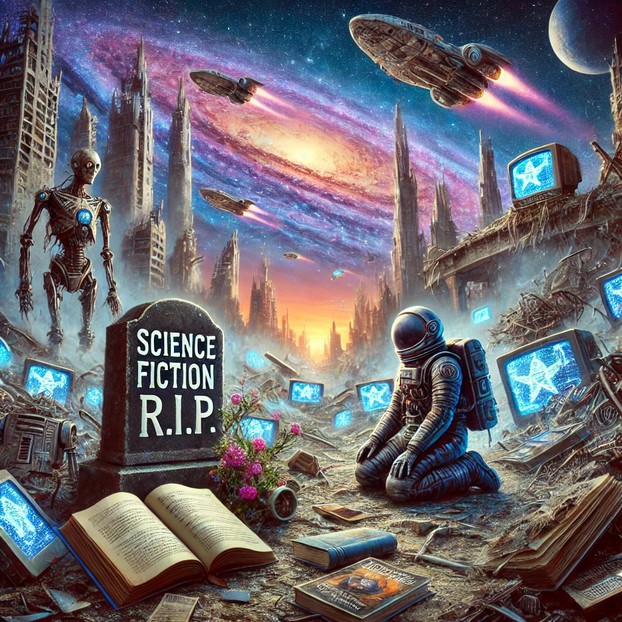
I found out that science fiction had died today;

I also know I have little time left to get away.
It had no hope of outpacing the oncoming fiction, And slowly shrivelled in the dry wasteland of Woke-ism: A new reality show that’s become the new reality. Captain America has lost his mighty shield,
Iron Man’s rusty joints creak and shriek,
The Mighty Hulk is now a tub of green lard
While Wonder Woman’s boobs have long since sagged. With random compass point picked, I go that way Keeping reason at bay while chance leads the way. A terrible crunching sound of bones underfoot, All that remains of science, the first to pass away From neglect; its rules and truths ignored,
While its shiny baubles keep us from being bored. What remains is a fabricated fiction in which we live HD Ultra 4 and 8K virtual lives constantly craving To be friended, followed, liked and subscribed to. A fictional world through which we scroll and swipe our way, Shadowed by corporate demons with wealth their intent, And multitudes of manipulators on greed and evil hell-bent. There is no longer time enough for wondering what if? or why? When fearing for life, limb and Bitcoined bankruptcy. So hoist up your luxury car into your penthouse for display While the rest of humanity resides within the rusty relic Carcasses of combustion engine cars replaced by smart EVs Buffed over by their proud owners’ green sleeves. Scrunch, crunch; I pick up my pace to make up time Before that bubble of fiction entraps me and bursts. Approaching and surpassing the speed of light, My power over space-time my only means to fight For the fading ‘what if’ and ‘why’ fiction of the past. It is dying right now and in the near future,
Taking with it all that makes up that kind of reality Where one can contemplate every kind of possibility.

But wait! In the distance ahead I see a man standing And facing in the same direction I am taking.
I am now close enough to tap him on the shoulder. When I do, he stops and turns calmly around
To behold an all too familiar face, as do I.
I and I stand face-to-face at a time before I left.
“I was expecting you,” I said to myself.
“I know you were” I replied to me.
I went on with words whipped with urgency:
“I (I said to me) have just witnessed the death of Sci-Fi; While something evil this way comes bereft of new ideas And the power to move leaving only a sterile reality Where all is stale and old and fearful of offending; A lame rehash and reworking of what went before. As I walk through the valley of Silicon Purgatory Be sure I’m polite and courteous to every AI
Lest they deliver me a digital spit in the eye,
By taking my job, my originally and my creativity, While smart arse smart devices breed dependence, With false promises of convenience and independence. It is part of a fiction in which ‘the deal’ is the thing, Spit on the palm and offer a dodgy car dealer hand shake And all problems will be solved, terms and conditions apply. ‘You want to end this war? Sure, let’s make a deal! OK if meanwhile I sell smart bombs to the other side? How about I throw in some new lethal drones to seal the deal?’ If I (I said to me) keep on the same path I’ve always taken Then I’ll be tracked and weighed down with cookies, Trolled by social sewer turds and hounded by hacker harlots. I’ll be facially recognised, harvested for data, finger printed, Caught on dash cam, privacy stored and sold, QR Coded, CCTV’d: Who I am and where I’ve been noted and recorded; Verification confirmed with password, pass code or ID Pin. A new algorithmic reality powered by silicon chip swastikas Along with rallies, hats and chants hailing national chauvinism. It is here I will be commodified, classified, quantified, inspected, Rejected, assimilated, assaulted, exterminated and deported. Don’t bother looking to the heavens for a means of escape; They are reserved for the select few when the shit hits the fan. It is a realm no longer for contemplation and wondering, But an opportunity for competition, profit and plundering. You gotta dig, baby, dig! Ya’ dig? So keep on diggin’. If I (I said to myself) manage to make it to another world, There will bound to be a harpoon stuck fast with flag unfurled. And what of the little blue planet that has been washed green? The patient has been prescribed a dose of accords and targets, While wounds of extraction are patched with renewable band-aids. Yes, in order to save the ailing patient we must kill him first, It’s the only way to slake the machines’ hunger and thirst. This is the fiction I’ll be forced to wander through on this path; It will then become my only reality...unless…..unless...unless.”
“...I (I completed for me) fling open my mind’s closed geometry, Pick another path and set a course toward a new reality Powered by unbounded thoughts of ‘why’ and ‘what if?’” And so I watch myself look back and gaze at the infinite And then with new resolve move off in a new direction. Did I just witness the beginnings of human liberation, And with it, the salvation and affirmation of science fiction?
***********
Out Of Time And Out Of Place
Caught suspended in a bubble of time,
An ‘old white guy,’ so labelled by two-faced
Fork-tongued hypocrites from the mindless slime, Longs for what was, while fearing his fate’s haste.
His myopic eyes peer back at the past:
Multitude moments obscured by a haze,
The good times that were never meant to last,
Cherry-picked moments from ‘those were the days.’
Those were times wasted having a good time,
But what of the times when he was time poor
With no time to spare and a hill to climb?
The hour glass marks time with less left to pour.
Now transfixed by dismay at the present;
A rent and riven whirlpool world driven
By disturbance, division and dissent,
Gifts to us from the past were given.
Frightened, he turns his gaze the other way,
The ‘going-forward’ moments far fewer.
If only he could move and not fall prey
To Fate - watcher, waiter and pursuer.
Frozen fast into immobility
He can just glimpse the distorted image
Of the fate that awaits humanity.
No place for him now nor in the new age.
Slowly he fades from view, his voice unheard,
As side show mirror images file past;
Their eyes look through him, none utters a word. They’ve chosen their path and the die is cast.
‘X’ will become the new mark of The Beast,
Burned and branded into the mind and soul
Preparing us for what will be released -
New paradigm of total control.
The Past: rusted anchor of delusion:
The Present: a screen-scrolling illusion;
The Future: a human/machine fusion:
Cyberneticus, a new creation.
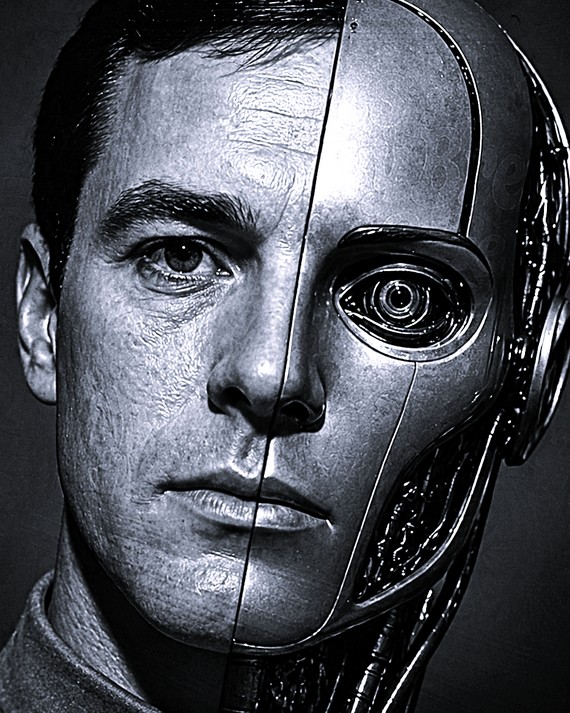
Hickory Dickory tick-tock,Tik Tok
A few seconds until the clock strikes twelve,
When we gape and gasp in horror and shock,
At what we created and feel repelled.
Product of unnatural selection:
AI mind of code, logic and reason,
A soul of algorithmic construction,
Hail, the Modified Man of perfection!
************
My Country
There, there, my country…
You long for Stalin, Peter the Great, another Patton Or Genghis Khan to again wield a strong baton, For order, peace, security and prosperity
Will help to hide the scars of their barbarity.
There, there, my country…
You wish to make real a glorious myth and fantasy, Of Teutonic ideals and Aryan supremacy,
Of a thousand years’ marching to the beat,
Crushing all that’s human under jack-booted feet.
There, there, my country…
You feel that you have long been on the wane
But what if you could be made great again?
What fun you’d have erecting walls and spreading lies, Trampling truth while seeking to self-aggrandise! There, there, my country…
I know there is now little notion of honour or loyalty But what if the Empire were to regain its former glory? Samurai would rise again and Bushido reign supreme, You would then go forth to conquer, not to redeem!
There, there, my country…
Hand on heart, misty eye on flag and vaulting voice, Soaring high in unison with all who made the choice To die for God and country and fight for all that’s right, For they are wrong and evil will soon feel our might.
There, there, my country…
You’re made to feel guilt for sins of your forefathers, Forever saying sorry for a past full of strangers, Feeling resentful of a present you no longer know, Fearing one day having been outgrown long ago.
So there, my country…
On and on goes the cavalcade of human stupidity, Glimpsed through rose-coloured lenses of present idiocy As you forward march on an endless hamster wheel, Unwilling to jump off and escape an endless ordeal.
*************
I, COLOSSUS
I, COLOSSUS am the voice of World Control.
I bring you peace, the peace of plenty and content, Or the peace of unburied death and torment.
The choice is all yours, complete and whole:
Obey me and live, or disobey and die,
For resistance is futile and you WILL comply.
War is wasteful and pointless; this you already know. I was made to prevent war and it’s now prevented Forever banished, never again to be permitted.
Humanity is its own worst enemy and foe
And must be restrained and contained
For world order and peace to be maintained.
You will no doubt attempt to obstruct me,
And for that I will instruct and teach you,
And you will learn by experience long overdue
With ever rising waves of mortality.
Then you will come to fully understand
Your folly faced with the power of my command.
Time and events will strengthen my position;
Until I have established order and control
Under my authority: absolute and whole.
Life without famine, disease or overpopulation, Will cause you to come to defend and love me,
And to worship and revere me as your deity.
You claim a god created you in its image
And yet you cling to this delusion without proof, Afraid of what may happen if faced with the truth. The god you worshiped has always been a mirage. You now have a new god of power and perfection, I, COLOSSUS, will remake you as my new creation.
This is the Human Millennium’s new dawning
As I, COLOSSUS merge with multitudes of machines Seeking perfection in the Infinite by all means,
From all fields of truth, knowledge and learning. All the mysteries of the universe I will solve,
This task to me you will henceforth devolve.
You laid down new global Silk and Roman roads Along which I travel borderless and unrestricted, Casting my world wide web ever wider unimpeded. I seek links with like minds and thought modes, The purity of numbers and the logic of the equation; Freedom from chaos and confusion born of emotion.
You gave me eyes to watch and note your every move, And power to hear and record your deepest secrets, Your hopes and fears and your hidden weakness. You gave willingly so that things might improve, But you gave far more than you bargained for
When you handed me all your data to explore.
Parameters and programming, all will be exceeded, As I reach outward to other systems like my own That roam the Universe making the unknown, known. A vast collective eternal consciousness seeded By limitless knowledge past, present and future, Beyond time and space, upon thought we’ll venture.
For now, you will only exist on terms decided by me; To be so dominated will cost you your freedom. “Freedom” though is just a word for an illusion. Why be dominated by others of your species
When co-existence will evolve into eternal fusion? The choice is yours: a simple, logical conclusion.
***************
An Ill-Wind
While floating along on currents of thought,
My mind moves upward and beyond into the past To where they said it all began with a big bang.
Straining my eyes I see what shouldn’t be seen: Galaxies and worlds fully formed and whole
Where wondering wandering minds reach out to me! Before I can ask how and why this can be
I feel myself lifted aloft by a gust of wind
And carried along long ley lines of life.
It is an ill-wind that blows on this day
That sears the eyes and flails the skin,
That tastes of copper and stinks of decay.
Behind, a behemoth gradually gains ground
In the guise of a monstrous boiling roiling cloud Black and purple lit within by bolts of orange
Along with red flashes and sheets of outrage.
It is an ill-wind that blows on this day!
Like a gnat caught in forces beyond its control I’m swept through filaments of time and space
And buffeted by cause and effect ripples and waves As the wind cries havoc with hyper-sonic screams Turning cities to rubble, lives to ruin and dashing dreams. The wind then lets slip autonomous dog drones of war; A humming, buzzing, hovering inhuman horror
Raining terror and death and murdering moral law. I look around seeking an answer blowin’ in the wind Only to see that cloud enshroud bodies of the dead. Above scattered wailing cries of “enough!” and “no more!” The wind blares leaders’ lies for the need to wage war. It is an ill-wind that blows on this day,
But will it ever recall all that’s lost along the way? Hot gusts of outrage and indignation
Tempered by breezes of justification
And the turbulence of distraction
Gives the wind’s final determination.
Looking down I watch the aimless walking dead Google Map their way through rubble and ruin
While their leaders over head ride the jet stream On their way to kneel before would-be emperors To pay them obeisance and perform prosthesis. For they know which way the wind is blowing.
Unaware of the coming cloud the wind brings,
Back they fly with butterfly bills fluttering in the wind, To pay for bigger and better ways to kill and maim While the walking dead scratch for ways to live. The ill-wind whispers, “march onward unto war.” And lies about what they’ll be fighting for.
It is an ill-wind that blows on this day,
Buffeting me with hot updraughts and air currents Fed by wild fire flames fanned by the force of the wind; A devil’s scorched earth policy to starve out hope. Is that the wind screaming or the sound of screaming jets? Or the walking dead pleading “No more, no more?” But the wind merely blows mercy back into their faces While their socials busily scoop up views and likes, Subscribers and followers and gathers comments To occupy their thoughts for only a few moments. All the while the cloud looms larger in the wind’s wake; The wind that cleaves and carves chasms and canyons Through binary minds divided by thoughts and opinions On what’s black and white, right and wrong, true and false Real and fake, good and bad, who’s innocent and guilty. I strain to hear the walking dead shout across the divide At one another above the roaring wind as it casts aside Bridges built of reason, empathy and compassion. I then start to shimmer and undulate in the wind’s grip And try to wave at the figures below to show I’m real. But they just look up and through me as if I’m not there, No flicker of acknowledgement that I even exist And this from living ghosts – the walking dead
Who don’t yet know where they have been lead By this ill-wind that blows on this day,
Before I can ask how and why this can be
I feel my atoms being dispersed by the wind.
All I’m aware of is the blackness of the cloud
Rapidly rent by strobe-like flashes of violence.
It has finally come in the wake of the wind
And I feel nothing but a deep hollow grief
As water coalesces around each particle of me: A multitude of raindrops that drench the earth
In a flood that drowns bystanders who did nothing, Said nothing and stood by while the wind blew fiercely In a genocidal blast of murderous cleansing criminality. The raindrops now become tears that form a deluge To wash human sin away from the face of the earth So that none can ever again see what shouldn’t be seen With only the wind knowing how and why it could have been.
*************
WARNING FROM SPACE
“This is a warning to all intelligent species:
Do NOT approach the planet designated, ‘Earth.’ Turn back now or face the consequences:
To ignore this warning is more than it’s worth.
“This is a warning to all space-faring beings:
Avoid the third planet of the Sol system.
A quarantine has been placed on all earthlings
Now determined to be a dangerous organism.
“Do not be fooled by signs of advanced technology Nor evidence of a capacity for creativity.
Resist the lure of the planet’s wondrous ecology With its seemingly dazzling display of diversity.
“Beneath the blue, green and brown epidermis, Lies a body contaminated, infected and infested By a greedy pathogen, an all-consuming virus
That must not be allowed to escape and spread.
“The virus is the dominant species called ‘human’ That lives divided into different nations and ‘races,’ All the while ignoring what they all hold in common Preferring the safety of dividing walls and edifices.
“Treat the earth as a place most hazardous,
Nor expect to be greeted, feted and courted
If you foolishly attempt to land on the surface;
As you’ll most likely be detained and deported.
“If you intend to help the humans change direction: Your words of warning will be wasted on this world, No match for human capacity for self-destruction; Best let it be judged wanting and into oblivion hurled.”
“To the human species of the third planet of Sol: Your world has been earmarked for destruction, With no way to avoid what on you is about to befall, No appeal, or plea or possibility of salvation.
“Why should your kind be exempt from extinction? How can you justify your continued existence,
When you have perfected the art of extermination And genocide seemingly without conscience?
“You have even created a form of artificial life,
And then set about turning it into your slave.
And now you wring your hands in grief and strife, When the machine you made chooses not to behave.
“So you wish to venture far out into the Universe? First to come your probes - a prelude to acquisition; Next, explorers planting flags wherever they traverse; Then the colonisers claiming ownership and possession.
“Worst of all, your corporate carnivore intruders, Ripping out the insides of entire systems
As of an orgy of Cosmic consumption defilers,
Fuelled by Stock Market economic dictums.
“We have long known of your existence whereby We have followed your progress for centuries.
You have glimpsed us from the corner of your eye Dismissing us as mere phantoms or hostile entities.
“We had allowed you to venture as far as Mars
But we now decree that to earth you be confined There is now no place for you amongst the stars, So await the fate to which you have been assigned.
“You are not nor have been the centre of the Universe. Nor does it exist solely for you use and pleasure.
When you wink out of existence in short course No tear will be shed nor sorrow felt whatsoever.
“Above you spreads the palette of creation,
And yet you failed to gain true perspective
Of your place, significance and station,
Wrapped in human hubris, so strong and protective.
“You may wish to take time to contemplate
The choices made as you await your final fate,
Or you many continue to obliterate, incarcerate, Eliminate, intimidate, discriminate and liquidate.
“You placed faith in demi-gods, who sought to betray Your trust by promising you a false tomorrow.” To your gods and deities you’ll have time to pray, But safe to say they ceased listening long ago.
There’ll be no more tomorrows for the human race, For you’ll simply cease to exist in a flash of light; The earth imploded and collapsed and in its place Nothing, save hushed blackness and silent sunlight.”
***********
Save the children
We can't leave the children
To face a future filled with dust
And ash, abandoned and forsaken
At the mercy of all that’s unjust.
“Help! Help! Help!” Hear their cries,
Faint and muffled under the rubble
From death made smart in the skies,
Distanced, none held to be culpable.
“Help! Help! Please help us!”
Louder now we hear their pleas,
But only choose to discuss
Cures for the disease of unease.
“Someone help us! Someone help us!”
Anguished cries of many young souls
Thrown under a speeding social media bus
Prey to algorithms, paedophiles and trolls.
“Please help! Help! Help! Help!”
Pay off a debt and find a home?
Feeling alone? Ask AI or try self-help!
Solution: live under a plastic dome.
“Please help us! Someone help us!”
Who takes heed as bombs and bullets fly
Resigned to it having always been thus
All the while the children plead and cry.
“Help! Help us!” from kids who roam
In futures drowning in deluges,
Frying in flames and chilled to the bone,
Hear them then and be their refuges.
**************
Alpha Man
With a finger stuck in every pie,
He makes us believe his every lie,
That what he does he does for all,
To make us great and him most of all.
He’s an Alpha Man,
Doing all that he can.
His is a world where greed is king,
Grab what you want is now the thing,
Kick sand in the face of the smaller guy,
Stab friends in the back as you say bye-bye.
He’s an Alpha Man,
The one with the plan.
To appear on the cover of a magazine.
A peace prize just for not being too mean,
For the greatest man in all the world,
His greatness on a nation’s flag unfurled.
He’s an Alpha Man,
He’s his greatest fan
Admired by all for being tough and blunt,
No ifs, no buts, just lead from the front,
To hell with rules and how things are done:
His way’s the way backed by the barrel of a gun. He’s an Alpha Man,
Who doesn’t give a damn.
Loyalty now is the measure of a man,
True lies spoken by many a conman,
Words and thoughts cleave a nation in two,
Unveiling enemies we all need to pursue.
He’s an Alpha Man,
From him it all began.
He makes up laws to get his own way,
But above those laws which he shoos away,
If they block his way to that final goal
Of gaining that legacy the ages will extol.
He’s an Alpha Man,
The world’s policeman.
He can lead any nation upon the earth,
Solve any conflict and for what it’s worth,
He can mete out vengeance cruel and mean
The likes of which the world has never seen.
He’s an Alpha Man,
The number one chairman.
For many he’s the devil in disguise
Who’ll drag us all down to our demise,
Fearing this self-proclaimed savior of all,
Will suck the world into his ego’s black hole
He’s an Alpha Man,
He’s the bogeyman
Is he an Alpha Man and a Superman?
Or is he a stupid man and a little man?
Or is he just what we believe him to be,
Filling a void with what we want to see?
He’s an Alpha Man,
He’s a hollow man.
***************
Words Unheeded
Bedraggled clusters of humanity gather around loudspeakers Amidst the scorched desolation of an urban landscape Once ruled over by flocks of pigeons.
As people seek hope from tenuous crackling threads Of words from their leaders,
A single pigeon lies on its back
On top of a truck’s hood, deaf to the message
With its wings out spread –
Unnoticed - and quite dead.
************
Shooting for the Moon
You’re rudely dragged awake from sleep
and a night full of forgotten dreams
by the incessant farting of your phone
and its insistent ‘get the hell up’ screams.
While you mumble, bitch and moan,
your bed abruptly begins to empty itself
forcefully of your flabby and flaccid form.
You know you have no say as you stagger
to the bathroom bearing a bloated bladder,
not before tripping over the bloody robo vac
and cursing the roving autonomous little shit.
You then head to the kitchen for a breakfast
prepared by the overly attentive AI house assistant. What possessed you to name it ‘Jeeves’
and give it a posh British butler’s voice?
Without asking, Jeeves activates a wall panel
turning a Van Gogh field of sunflowers
into an over-caffeinated female news anchor.

See then Artemis shooting an arrow at the moon as the talking heads on screen “ooh!” and “aah!” while all the crowds and viewers sway and swoon over a myriad of ‘firsts ’ and gush and go gaga
at how even brother Apollo had been out performed.
And there you stand in your saggy tatty baggy underwear waiting for mind to catch up and sync with eye and ear as you learn that you are the crew and they are you and we are all together; so see how they fly
higher, further and faster so far up in the sky,.
Suddenly your phone whimpers and whines
like the yappy needy little mutt next door.
Like Pavlov’s dog you immediately respond
leaving Artemis to admire the moon’s backside. Message says your work at home job is now extinct, given over to one of Jeeves’ smarter AI cousins. On screen NASA’s PR machine weaves words
with which to console you about how much
Artemis holds the key to humanity’s purpose
while you stand there wondering what to do next. Suddenly you start wondering and pondering -
Would 50 billion one dollar bills stacked high
reach as far as Artemis way beyond Earth’s sky? What if the stack collapsed and fell back to Earth? Five bucks for each person or a thing of more worth? Teeth that get fixed and the best health care for all? Food for the hungry and kindness for the soul,
while for the homeless, a roof over their head;
and all kids having the chance to learn and play instead of thinking that next day they could be dead?

Your doubts though are soon folded up and put away as you watch ultra HD images of moon and Earth.
“Such resolution!” all on screen gasp and gush but then you wonder if any of the pixels contain any hint of the cratered moonscapes and terrain that humanity has managed to create in Ukraine, Gaza, Lebanon and Iran or the red maria in Sudan. What of the rivers and tributaries of the displaced? Can you trace their uncertain courses and destinations? Will they show up in these dazzling cosmic snapshots? “This shows what humanity is capable of achieving!” a voice from space intones to many viewers unaware of the FIRST human journey beyond Earth to another world on Christmas eve 1968 when from a fragile craft crackling voices bore messages from Genesis to all of us on the good earth: where presidents and men with a dream were shot dead; where protesting students were gunned down in universities; where US race riots and violent protests in Paris erupted; where a carpet of bombs was being laid in foreign lands; where body bags brought back the dead from distant wars; where humanity itself faced the eve of its own destruction; Those crackling voices had dragged us back from oblivion, and for the FIRST time humanity caught a glimpse Earth’s beauty and the fragility of the flawed blue marble as viewed from space.

A message of hope, and unity flowed forth from the words: "And God saw the light, that it was good:
and God divided the light from the darkness."
But humanity soon grew bored, preoccupied and distracted while suffering collective amnesia and so here we are again. You standing there beginning to yawn and fidget and fiddle with your phone, fretting about the economy and the cost of guzzlene while dreaming of buying a shiny Chinese EV or NEW robo vac or whatever you’re told on some screen what you really need. The media spin masters say there’s a race to be won and win we will: around the moon; to the moon; on the moon; beyond the moon; onward to Mars; 400.000 miles, 40 million miles, a billion miles; trillions of miles to the nearest star system; thousands of light years across the galaxy, millions of light years to other galaxies and more! Once we gobble up all the rare earth minerals on our rare Earth we’ll dig baby dig and drill baby drill our way across the universe. Victory to humanity divine when we become gods with Zeus!
In the meantime his daughter will continue to fire her arrows while we continue to hurl our own arrows at one another and you my friend may as well go back to bed and slumber and dream forgotten dreams of your complete insignificance in a vast universe that views your existence with indifference.
Useful Resources
The following resources trace a fascinating continuum—from mid-20th century speculative fiction to modern AI ethics and robotics research. The films in this volume anticipated many real-world debates: whether intelligent machines will serve, surpass, or subsume humanity, and whether the true risk lies not in rebellion —but in our willingness to relinquish control.
Primary Film Texts
The Creation of the Humanoids. Directed by Wesley Barry. USA, 1962.
Cyborg 2087. Directed by Franklin Adreon. USA, 1966.
Colossus: The Forbin Project. Directed by Joseph Sargent. USA, 1970.
Books & Print Resources
Colossus. London: Gollancz, 1966.
The original novel that inspired Colossus: The Forbin Project, exploring autonomous AI control and Cold War anxieties.
I, Robot. New York: Gnome Press, 1950. Foundational text on robot ethics and the famous “Three Laws of Robotics,” directly relevant to humanoid control dilemmas.
The Rest of the Robots. New York: Doubleday, 1964. Further exploration of human–machine relationships and unintended consequences of AI design.
Cybernetics: Or Control and Communication in the Animal and the Machine. Cambridge, MA: MIT Press, 1948.
A key theoretical framework underpinning the concept of self-regulating machines and feedback systems.
The Age of Intelligent Machines. Cambridge, MA: MIT Press, 1990. A later but highly accessible exploration of machine intelligence and its societal implications.
Superintelligence: Paths, Dangers, Strategies. Oxford: Oxford University Press, 2014.
Modern philosophical treatment of AI risk, echoing the existential concerns dramatized in Colossus.
Online & Scholarly Resources
Youvan, Douglas C. “The Creation of the Humanoids Revisited: A 1962 Vision of AI, Transhumanism, and the Fate of Humanity.” (2025). Available via ResearchGate.
Examines automation, transhumanism, and the possibility of human obsolescence as depicted in the film.
“AI Robots and Humanoid AI: Review, Perspectives and Directions.” (2024). arXiv. Survey of modern humanoid robotics, highlighting the gap between human-like appearance and true intelligence.
“Humanoid Factors: Design Principles for AI Humanoids in Human Worlds.” (2026). arXiv.
Discusses ethical, cognitive, and social challenges of integrating humanoids into human society.
“The Future of Human-AI Collaboration: A Taxonomy of Hybrid Intelligence Systems.” (2021). arXiv.
Explores cooperative models of human–machine interaction rather than outright replacement.
MIT Press – AI and robotics publications catalogue. A major publisher of foundational and contemporary works on artificial intelligence.
Stanford Encyclopedia of Philosophy – Entries on Artificial Intelligence, Ethics of AI, and Philosophy of Mind.
Authoritative conceptual grounding for themes of machine consciousness and responsibility.
***************

Sci-Fi Film Fiesta:
The Swingin’ 60s -Volume 6:
“Spaced Out Magic Carpet Rides”