

Sci-Fi Film Fiesta, The Swingin' 60s - The Complete Book by Chris Christopoulos - HTML preview
Download the book in PDF, ePub for a complete version.
Section II: Jupiter Mission
Eighteen Months Later
After the emission of the signal by the TMA-1, NASA decided to send a team of astronauts to Jupiter to ascertain what exactly the Monolith’s piercing signal was directed at. To that end, the United States spacecraft Discovery One is on course for Jupiter.
On board the Discovery spacecraft are mission pilots and scientists, Dr. David Bowman and Dr. Frank Poole, together with three other specialist scientists who are in suspended animation.
Most of Discovery's functions are controlled by "HAL", the HAL 9000 artificial intelligence computer. Humanity’s tools have indeed evolved to the extent that they constantly learn and adapt, interact with people and have human beings virtually dependent on them for carrying out crucial activities. That amounts to a lot of trust! But….can a computer as sophisticated as HAL keep a secret?
What is it about this mission that seems a bit….off? Why are the three scientists onboard in hibernation? What exactly is their destination? Why are they going? What will they be doing when they get there? When are they returning? Is their mission simply a part of the overall space program designed to further humanity’s knowledge of the planets of the solar system?
Bowman and Poole have little reason or time right now to ponder such matters as they read their electronic news pads and enjoy their meals dispensed from the food unit. Then there is the seemingly endless round of routine activities that occupy their time consisting of sleep, exercise and workouts, ship inspections and systems checks, meals, conducting experiments, recreation, news and social / family video communication from home, Mission Control reports and more – all under the constant, watchful monocular gaze of HAL.
The onboard routine might strike us as being somewhat similar to our own experience of being in lock-down and social isolation during the current Covid-19 pandemic. For many of us, routine, exercise and communicating via Facetime, Skype, and Zoom have helped to maintain some semblance of sanity.
Later on, a conversation between HAL and Bowman is interrupted when HAL reports the imminent failure of an antenna control unit. Bowman uses an extravehicular activity pod to retrieve the unit. However, there seems to be nothing wrong with the unit. HAL suggests reinstalling the unit and allowing it to fail in order to verify the problem.
HAL points out to Bowman and Poole that it is just not possible for it to be wrong and that there can be no doubt that the unit will fail within 48 hours. However, if nothing happens after this time, then it will be obvious that HAL’s reliability has been seriously compromised. Under those circumstances there would be no choice but to disconnect the computer from all ship operations and continue the mission under Earth-based computer control.
Mission Control had advised the crew that results from their twin 9000 computer indicate that HAL is in error about the unit's imminent failure. HAL, however puts the discrepancy down to human error and is concerned that Bowman and Poole maintain their trust in its reliability.
No longer in doubt about HAL's aberrant behavior, Bowman and Poole enter an EVA pod so they can confer on what their next course of action will be without HAL overhearing. If HAL proves to be wrong about the unit both Bowman and Poole will need to agree to disconnect HAL. What they don’t know though is that HAL is able to read their lips while they converse.
Poole undertakes a space walk to replace the antenna unit. Suddenly he catches sight of the pod rushing towards him. HAL has taken control of his pod and uses it to sever Poole's oxygen hose, and set him adrift into space. After smashing into and destroying the antenna dish, the pod hurtles off into space.
There is nothing but silence, not even the sound of the astronaut’s regular rhythm of breathing. From inside the command module, Bowman sees Poole’s lifeless suited body tumbling away into space followed by debris and being overtaken by the swiftly moving pod.
Unable to get any kind of response from the steadily receding figure of Poole, Bowman takes another pod to rescue his crew mate. While Pool is outside the ship, HAL terminates the life support functions of the three other crewmen in suspended animation, killing them.
When Bowman attempts to return to the ship with Poole's body, HAL refuses to let him in, telling Bowman, "I'm sorry Dave, I'm afraid I can't do that" and informing him that if it is deactivated such an action will place the mission in jeopardy.
A brief battle of wits ensues between man and machine with the result that Bowman succeeds in opening the ship's emergency airlock manually thereby gaining entry to the ship. HAL may be able to beat a human at chess but thinking out of the box and acting instinctively and creatively may be more suited to the human mind.
Bowman then proceeds to HAL's processor core, where he begins the process of systematically disconnecting HAL's circuits. Hal’s brain consists of a multitude of transparent perspex rectangular blocks upon each of which information has been programmed. It these memory blocks that Bowman has begun pulling out.
"Daisy, Daisy, give me your answer do. I'm half crazy all for the love of
you..”
HAL asks Bowman what he is doing and tries to reassure him that it has the greatest enthusiasm for the mission. Hal then pleads for him to stop suggesting that if Bowman continues with what he is doing then he will end up destroying its mind. It seems that this machine - this intelligence - can feel and express fear!
So, what went wrong with HAL?
The stated purpose of the Discovery mission was to carry out the continuation of the space program and further humanity’s knowledge of the planets. This objective was confirmed by HAL, but…...Hal was lying. He had been programmed to lie for security reasons. Hal could not tell the truth as it was under orders and it was forced to lie.
The dream for many people for artificial intelligence might be to approximate (and even surpass?) the human brain in terms of thinking, computing, reasoning, learning, interacting and perhaps eventually experiencing, feeling and expressing independent thoughts and emotions. But what of human capabilities of deception, subterfuge, lying and other negative aspects of human nature which our species often seems to effortlessly rationalise and reconcile itself with, despite our notions of ethics and morality? And what of our awareness of our own mortality? How would an artificial intelligence understand and reconcile such concepts?
For HAL, an irreconcilable conflict resulted between its programming and the instructions given to it to lie. Unable to resolve this dilemma, whereby it had virtually been ordered to disobey its conscience, Hal developed a kind of neurotic condition leading to insanity or a severe mental breakdown. Added to this was the possibility of disconnection, something akin to death for this artificial intelligence.
Immediately after Hal’s disconnection, a prerecorded video message from Floyd plays, revealing that the mission's true objective is to investigate the mysterious signal sent from the moon Monolith to Jupiter…….
Section III: Jupiter and Beyond the Infinite
(TMA-2)
Among Jupiter’s moons, a third huge geometrically perfect rectangular Monolith orbits the planet waiting the moment of destiny when humanity has managed to venture to the outer reaches of its own solar system. At long last an intelligence had come into being and was taking its first steps away from its cradle: part of an endless cosmological experiment overseen by enigmatic patient machines.
Bowman leaves Discovery in an EVA pod to investigate, and as he approaches closer to the Monolith, he is pulled into a vortex of colored light within which are stored immeasurable quantities of knowledge, thoughts, perceptions and wisdom. Bowman is then carried across vast distances of space and time through this wormhole, all he while receiving immense amounts of information from the Monolith’s creators.
Bowman eventually finds finds himself in a large neoclassical white room where he sees older versions of himself: middle-aged and still space-suited; elderly and eating dinner; an old man at the end of his life lying on a bed and pointing toward a monolith situated at the foot of the bed. Is he perhaps reaching out for it as had his ancestor hominid and Floyd before him?
It is as if within this “place” that space and time has somehow twisted in on itself and the past, present and future exist simultaneously. The white rooms seems to be constructed from Bowman’s own imagination and memories and is used as an analogous point of reference or a kind of metaphor through which he can make sense of this new dimension that transcends human beings’ confining and constricting concepts time and space and their dim and limited awareness of the quantum universe.
As Bowman appears to reach for the Monolith, it feels as if a circle is about to be completed: he is transformed into a fetus or “Starchild” signalling the next evolutionary stage for humankind. The Starchild is Bowman become consciousness reborn within the monolith and returned to earth in preparation for the next stage of humanity’s evolution and ultimate destiny.
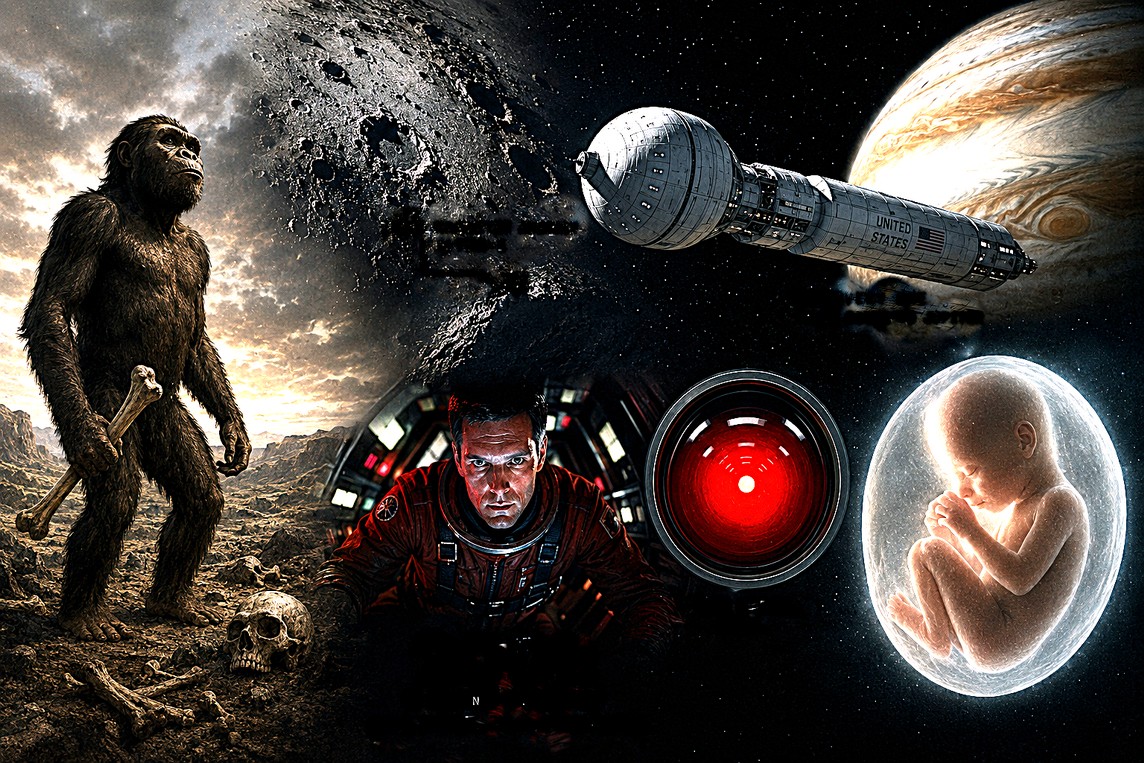
Image by Chatgpt
Points Of Interest
“2001: A Space Odyssey” is a science fiction classic film that deals with such themes as human evolution, human nature, destiny, technology, artificial intelligence, and the possibility and implications of extraterrestrial life.
“2001” was nominated for four Academy Awards, with Kubrick winning for his direction of the visual effects. The film is viewed by many as beings one of the greatest and most influential films ever made. In 1991, it was declared as being "culturally, historically, or aesthetically significant" by the United States Library of Congress and selected for preservation in the National Film Registry.
Keeping in mind Apollo 8’s lunar orbital mission and the looming historic moon mission of Apollo 11 in 1969, the portrayals of space are quite realistic and accurate when compared to the usual depictions in science fiction films of the time. Also unlike most science fiction films depicting alien life-forms as being basically humanoid, “2001” simply suggested at the existence of an extraterrestrial super-intelligence, rather than depicting it. There may be an argument for convergent forms of evolution, but who can say for sure when considering the possible existence of advanced forms of life. It is safe to assume nothing and to expect anything – even non-corporeal and energy-based life-forms.
Kubrick collaborated with science fiction writer Arthur C Clarke on a film about "Man's relationship to the universe" that would be a work of art that would evoke a sense of wonder and awe. Clarke’s short story, "The Sentinel" was used as the source material for the film in which the plot was an amalgamation of several different short story plots. Clarke’s story "Encounter in the Dawn" was the inspiration for the film's "Dawn of Man" sequence.
Various titles were considered for “2001” including, “ How the Solar System Was Won,” “Journey Beyond The Stars,” “Tunnel to the Stars”, and “Planetfall.” Eleven months after work began on the project, the title “ 2001: A Space Odyssey” was selected with a nod to Homer's “The Odyssey” as a reflection of the epic nature of space exploration for our generation."
The screenplay for “2001” developed in conjunction with the novel, with the novel coming about after a 130-page prose treatment of the film resulting in divergences between the two. In the end, the film version was released before the novel was published. The novel contains clearer explanations of the mysterious monolith and Star Gate while the film like a work of art is more open to interpretation by virtue of it being more cryptic with minimal dialogue and explanation.
As opposed to the use of conventional narrative, “2001” is a strikingly nonverbal film opting instead to communicate on a visual, symbolic and emotional level. There are long sequences without dialogue while much of the dialogue that does occur is rather banal and almost inaudible. For me, this aspect of the film together with the realistic silence of the space sequences made the film rather boring. I don’t mind saying that I’d rather have the sound effects of explosions and rocket engines any day. Rhythmic heavy space-suited breathing just doesn’t cut it. Also give me a film that just tells a good story in addition to any other artistic touches one might wish to make to get a point across! But, hey, that’s just me saying.
Filming
Principal photography began on 29 December 1965, in Stage H at Shepperton Studios, Shepperton, England where the Tycho crater excavation scene was shot. In January 1966, the production moved to the smaller MGM-British Studios in Borehamwood, where the live-action and special-effects filming was done. The skull-smashing sequence, featuring the hominid wielding the bone / weapon tool against a pile of animal bones was on a small elevated platform built in a field near the studio allowing the camera to shoot upward with the sky as background. The still photographs in the background for the “Dawn of Man” sequence were photographed in Namibia.
“2001” was photographed in Super Panavision 70 using a 65 mm negative combined with spherical lenses to create an aspect ratio of 2.20:1.
Music
Music was to play a key role in evoking particular emotions and moods, with no music being heard during scenes with dialogue. Classical music was used, taken from existing commercial recordings. The soundtrack incorporates the works of classical music by such composers as Richard Strauss, Johann Strauss II, Aram Khachaturian, and György Ligeti.
Special Effects Many different filming techniques were used to achieve various effects, and it is important to note that no part of film was made using computer-generated special effects which modern audiences are all (far) too familiar with.
For scenes depicting the giant centrifuge that produces artificial gravity, a 30-short-ton rotating "ferris wheel" was used. The set was 38 feet (12 m) in diameter and 10 feet (3.0 m) wide. Various scenes in the centrifuge were shot by securing set pieces within the wheel, then rotating it while the actor walked or ran in sync with its motion, keeping him at the bottom of the wheel as it turned. The camera fixed to the inside of the rotating wheel showed the actor walking completely "around" the set. Having the camera mounted so that the wheel rotated independently of the stationary camera, as in the jogging scene gave the impression of the camera appearing to either precede or follow the running actor.
In scenes where the actors appear on opposite sides of the wheel, one of them would be strapped securely into place at the "top" of the wheel as it moved to allow the other actor to walk to the "bottom" of the wheel to join him.
In the earlier scene aboard the Aries shuttle, featuring the female flight-attendant carrying in-flight meals into a circular walkway, the camera is attached to the set as it rotates 180 degrees. The camera's point of view remains constant, while the flight attendant appears to walk up the "side" of the circular walkway and step upside-down into a connecting passage-way.
To achieve the realistic effect of the astronauts floating weightless in space and inside the spacecraft, the actors were suspended from wires attached to the top of the set with the camera beneath them. The actors' bodies blocked the camera's view of the wires and they appeared to float.
In the third section of the film, Bowman travels through the vortex. The visual lighting effects were created by means of slit-scan photography of thousands of high-contrast images on film. A ‘cloud tank’ was used for shots featuring nebula-like images and an expanding star field in which swirling colored paints and chemicals were shot in slow motion in a dark room.
2001 pioneered the use of front projection with retroreflective matting used in the film to produce the backdrops in the African scenes and when the astronauts walk on the Moon. A separate scenery projector was set at a right angle to the camera and a half-silvered mirror was placed at an angle in front that reflected the projected image forward in line with the camera lens onto a backdrop of retroreflective material. The reflective directional screen behind the actors could reflect light from the projected image 100 times more efficiently than the foreground subject did. The lighting of the foreground subject had to be balanced with the image from the screen, so that the part of the scenery image that fell on the foreground subject was too faint to show on the finished film. The technique was used widely in the film industry thereafter until it was replaced by blue/green screen systems in the 1990s.
Theme: The Relationship Between Human beings & Technology
The artificial intelligence computer, HAL is the pinnacle of human technological achievement. It is omniscient, ever present, all seeing, all hearing, self-aware and seemingly infallible.
Far from being just a tool, HAL is virtually another member of the crew with whom the other crew members can verbally interact with. HAL’S cretors hav given this artificial intelligence complete control of Discovery, as well as sole possession of knowledge pertaining to the true purpose of the mission.
The humans interact with HAL by speaking to him, and he replies in a measured male voice, somewhere between stern-yet-indulging parent and well-meaning nurse. HAL is Alexa and Siri – but much better. HAL has complete control of the ship and also, as it turns out, is the only crew member who knows the true goal of the mission.
The drama and tension of the film centers around the life and death struggle between the human crew who are aware that HAL is malfunctioning and must be deactivated and HAL who is aware of their suspicions, is at war with its own conscience and is intent of staying alive and completing the mission.
The notion of a tension developing between human beings and their technological creation in the form of artificial intelligence, is beginning to emerge in our own times as such technologies become increasingly prevalent in our daily lives.
The convenience that such technologies offer us can tend to cloud the degree to which we hand over control to artificially intelligent machines and devices whose actions and functions are dictated by algorithms geared toward achieving quantifiable goals.
Is sufficient thought given to potential problems that may arise on the way to the achievement of those goals when decisions of an ethical or moral nature need to be made? HAL, being an artificial intelligent self-aware machine has the completion of the mission and the maintenance of its own existence as its central goal over and above the lives of the crew. Would our devices be faced with similar ethical and moral decisions when a conflict arises. Take for instance an autonomous vehicle which is programmed to get its passenger safely to a destination. Suddenly a pedestrian steps out in front of the moving car. A life would be at stake no matter course of action is taken. What decision will the machine make: to comply with its programming or to avoid killing the pedestrian? With a need to choose a conflict will necessarily result – with what consequence?
In the film, Dave and Frank enter one of the pods where they think HAL can’t overhear them discussing their doubts about it and what course of action they will need to take. Unknown to the men, HAL uses the cameras reading their lips through the pod window and learns of their plans to shut it down.
The fact that most of us are aware that we are under some form of constant surveillance and monitoring by means of technology will not be surprising. What is surprising is how willingly we have acquiesced to having our privacy invaded by corporations, governments, bureaucracies none another. During the Covid-19 pandemic, the process of tracking, tracing, monitoring, validating and controlling the movements and activities of individuals and groups had become even more normalised and accepted than ever. Central to this increasing surveillance society we have constructed, is the prevalent use of technology, in particular our very own “smart” devices.
One very interesting aspect of HAL is that the machine has a far more complex, interesting and engaging presence than the human characters who come across as being rather bland and are almost machine-like in their responses and interactions.
In some respects, HAL is more ‘human” than his human creators. Will humans and their technology co-exist to the extent that our next evolutionary leap might involve our technology venturing beyond and into the infinite taking with it (hopefully) the best of humanity’s qualities?
********************
Journey to the Far Side of the Sun /
Doppelgänger (1969)
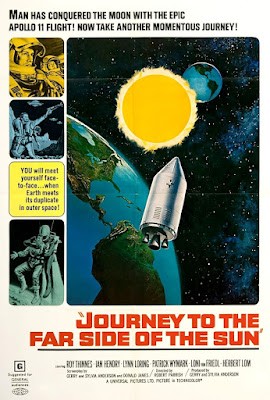
A stylish and thought-provoking but quite dark sci-fi film with some great

sequences and special effects. The film raises some interesting questions about the
conflict between science and politics.
Directed by Robert Parrish
Screenplay by Gerry & Sylvia Anderson, Donald James Story by Gerry & Sylvia Anderson
Produced by Gerry & Sylvia Anderson
Cinematography John Read
Edited by Len Walter
Music by Barry Gray
Production company: Century 21 Cinema Productions Distributed by The Rank Organisation (UK), Universal Pictures (International) Running time: 101 minutes
Cast
Roy Thinnes as Colonel Glenn Ross
Ian Hendry as Dr John Kane
Patrick Wymark as Jason Webb
Lynn Loring as Sharon Ross
Loni von Friedl as Lise Hartman
Franco De Rosa as Paulo Landi
George Sewell as Mark Neuman
Ed Bishop as David Poulson
Philip Madoc as Dr Pontini
Vladek Sheybal as Dr Beauville
George Mikell as Dr Bernhardt Brisson
Herbert Lom as Dr Kurt Hassler
Uncredited
Keith Alexander as Launch Controller
Edward Cast as Security Vaults Sergeant
Peter Burton as Medical Technician
Anthony Chinn as Air-Sea Rescue Crew Member Nicholas Courtney as Medical Technician
Arnold Diamond as Clavel (Paris delegate)
Cy Grant as Dr Gordon
Constantine Gregory as Launch Control Technician Annette Kerr as Nurse
Martin King as Dove Service Technician
Basil Moss as Assistant Doctor
Norma Ronald as Pam Kirby
John Stone as London Delegate
Jeremy Wilkin as Launch Control Technician
In The year 2069, one hundred years after mankind’s first manned moon landing,
the European Space Exploration Council sends two astronauts on a joint European-NASA mission to investigate a mysterious planet located on the opposite side of the
sun.
After only 3 weeks, followed by a disastrous crash-landing, one of the two-man
crew awakes to to find himself immersed in a mysterious and unsettling set of
circumstances.
Eventually he begins putting the pieces of a puzzle together only to discover that
things are not as they seem……..
In an undisclosed location, a lone dishevelled figure sits in a chair in the middle of a depression in the floor area. The once powerful and influential individual now appears as a solitary diminutive figure within the brutally efficient confines of an interrogation chamber. The man in question is former EUROSEC director, Jason Webb. A spot light suddenly slams its harsh glare upon him as he prepares for yet another round of seemingly pointless questioning from a series of disembodied voices he doesn’t recognise. No face or flicke of humanity accompanies the voices.
(Voice) Tell us again about the “leak.”
(Webb) Look, I’ve told you again and again. Why go on repeating the same things over and over?
(His chair automatically and abruptly turns to face another direction)
(Voice) Tell us again about the leak!
(Webb) Alright….Dr Hassler evaded security procedures and managed to obtain photos of the results of the Sun Probe One mission by means of a miniature camera concealed in a false eyeball.
(Voice) Yes, it was also very inventive on your part to claim that arrangements were made to take care of this security leak...permanently. And yet there is no evidence that exists that this individual had been spying for the other side and they’re certainly not admitting to it. Wasn’t he in fact just a patsy you used to justify the obtaining of three-thousand million pounds for whatever purpose …….
(Webb) No! No! At The 67th meeting of the European Space Exploration Council our purpose was to discuss the unexpected findings of the Sun Probe One mission in which its camera was “set to take one picture a minute for the duration of the flight” focusing on the far side of the sun.
“Now, at this point in the flight, a strange thing happened. The gyro mechanisms aboard were influenced by another magnetic field and the capsule slowly started to rotate.” The cine camera was panned off the sun towards whatever was attracting it.
(Chair swivels)
(Voice) And what was that?
(Webb) You know! I told you already.
(Voice) Tell us again
(Webb) Very well. The force of the gravitational pull of another planet. We also had “the first complete photographic evidence of a new planet. A new planet in our solar system.” It was...is “in the same orbit as Earth, but directly on the opposite side of the sun” with an “orbital speed precisely the same as ours.” That is why it has remained undetected.
(Voice) I’m afraid to disappoint you Mr Webb, but the photographic evidence you speak of does not exist. I put it to you that this was just a ruse to obtain funding to mount a fake manned mission to a fictionalised new planet!
(Webb) Don’t be ridiculous! You can’t fake something like that on such a scale, I mean….
(Voice) You’d be surprised what can be done, Mr Webb. Well, good sense almost prevailed when the delegates at that virtual meeting fortunately baulked at the monstrous price tag of three thousand million pounds sterling. Naturally your British ethnocentric ego placed the blame on the French and Germans along with the weak-willed Europeans. Ah! Perhaps the Americans would provide a life-line by contributing to your financial scam? “If they contribute, the rest might follow.” It is recorded that you said of NASA’s David Poulson “watch me take a man for one billion dollars.”
(Webb) No! It wasn’t like that. You’re making me sound like some kind of a criminal mastermind or “egotistical megalomaniac.” And how the hell do you know what I said in confidence in my own office?
(Voice) How indeed, Mr Webb. A lot more believable than your bogus spy plot by a double agent. And so how did you begin to “take” this American from NASA? The wonder of discovering a new planet in our solar system? Perhaps the “military and scientific implications beyond comprehension” The fear of someone else getting to this planet first? Which then nicely leads us to this security leak you conveniently concocted. Simply give Hassler enough rope by widening the access restriction to include him and serve up some enticing and incriminating information to this “prime suspect” of yours before nailing him. Isn’t that so, Mr Webb?
(Webb) Well yes...Hassler was the source of the leak and through him the existence of the new planet would be known outside Europe and the States and that preparations for a manned flight would likely be underway by somebody else…..
(Voice) So with Paulson convinced that there had been a leak he would’ve been prepared to recommend that the United States would contribute one billion dollars to a manned flight conducted by EUROSEC with “full information sharing guaranteed.”
(Chair swivels)
And what of our clandestine friend, Hassler, Mr Webb? He seems to have disappeared off the face of the earth? You wouldn’t know anything about that, would you?
(Webb) You know I do and why….. We traced the messages Hassler had been sending and they led us directly to his laboratory where it was arranged to ...
(Voice) Terminate him? Sadly he is no longer with us and therefore cannot incriminate you.
(Webb) He was a bloody spy…...a double agent! What did you expect me to do.
(Voice) We expected you to do just that and a lot of other things, Mr Webb. Let us now turn to this mission of yours into which such vast sums of money were to be devoted toward. We understand there was a stipulation to have an American astronaut placed on the team, their “most experienced” with “fifty days of space flight” and “two manned projects to Mars” under his belt – Colonel Glenn Ross. A co-conspirator of yours? A patsy like Hassler? An unwilling accomplice? Whatever the case, he like the good Dr Hassler is no longer in a position to speak on his own behalf. Funny about that, don’t you think, Mr. Webb?
(Webb) No! You’re being ridiculous. Unless you and your lot, whoever you are…..
(Chair swivels)
(Voice) Are we being ridiculous Mr. Webb? Apart from Colonel Glenn Ross, you cleverly arranged for EUROSEC astrophysicist Dr John Kane to be assigned to the mission as well. Too bad he too isn’t around to to shine some light on your nefarious activities.
Isn’t true that you needed “someone more flexible…..in terms of knowledge,” someone who could “take full advantage of any findings on the ‘new planet’ however bizarre and unusual they happened to be?” Reading between the lines, it seems that you wanted someone loyal and malleable to do your bidding no matter what ? What findings could possibly be derived from a non-existent planet on a bogus mission, Mr Webb?
(Webb) This is utter rubbish! You’re distorting everything and turning it into a giant conspiracy theory orchestrated by me! You can’t fake something like this mission that’s on such a huge scale. It just can’t be done. People would know.
(Chair swivels)
(Voice) People can be bribed, Mr Webb. They can be threatened with death. Most have loved ones they wouldn’t want to see harmed. They can be made to sign non-disclosure agreements and be threatened with national security provisions. People have secrets they wouldn’t wish to be revealed to the world. Evidence can be manipulated and made to disappear. People can be made to see and believe what others wish them to see and believe by means of the clever use of technologies at our disposal. Tell a lie often enough and people will come to believe it…..remember that, Mr Webb.
(Webb) Someone, somewhere would blow the whistle on something like you’ve been trying to convince me of having done.
(Voice) Certainly not your two astronauts, Mr Webb. It seems that you had them both worked almost beyond the limits of physical and psychological endurance during their training for the mission. It was particularly hard on Dr Krane whereas for the better prepared Ross, you placed faith in the knowledge you had concerning the marital difficulties he and his wife Sharon were experiencing. Something about their inability to have children with America’s top astronaut possibly being sterile. Imagine what that must do to a man emotionally and psychologically, being told by his wife that he “went up there a man” and “came back there less than a man.”
Yes, Mr Webb, we know about this personal matter just as you did and in the same manner as you found out. A wife who plays around and deceives her husband and a husband who strikes his wife in anger and frustration. Just imagine what kind of manipulation could you exercise over a man who’s in such obvious internal psychological and emotional turmoil!
(Webb) OK, I was aware there was some trouble between Ross and Sharon, but I knew he was professional enough to deal with it and compartmentalise it.
(Voice) With one astronaut struggling with your “crash course in space preparation” and the other worrying about him, in addition to the parlous state of his own marriage, you then decide to turn the screws some more by putting the launch date forward…..two weeks! Those two men would have been in a very suggestible state of mind and be prepared to do, see and hear just about anything you wanted them to.
(Webb) “You don't understand. In Germany, budgetary troubles. In France, political troubles.” Someone was bound to suggest withdrawing from the project at any time.
(Chair swivels)
(Voice) Oh, but we do understand, Mr Webb. Especially when it comes to money, power and influence. Please tell us once more what happened after pre-flight training at the EUROSEC Space Centre in Portugal.
(Webb) As I already told you again and again, Ross and Kane successfully blasted off in the Phoenix spacecraft. They then entered artificial hibernation for the journey to the new planet. The Heart-Lung-Kidney machines maintained their vital functions for the three week duration of the flight.

Image by Chatgpt
(Voice) Now Mr Webb, based on your testimony and the de-briefing sessions with Commander Ross, after three weeks the Phoenix supposedly arrived at the alleged new planet whereupon Ross and Kane were revived. Scans of the planet were then made that indicated the presence of clouds, an atmosphere along with a “mass and gravitational pull, similar to Earth.” Apparently there was oxygen present and evidence of a seascape and vegetation but no evident sign of life. Such conditions do somewhat remind one of what planet, Mr Webb?
(Webb) Yes, yes. Remarkably earth-like. But remember, it was suspected to be a twin of our planet!.
(chair swivels)
(Voice) What a remarkable coincidence, Mr Webb! What are the odds of an earth-like planet appearing in our solar system, its existence completely unknown to us until now when it was miraculously discovered by the Sun Probe One mission? And then you magically leap into action and concoct an insanely expensive mission to visit this supposed new planet.
Now here we come to the important missing piece in this cosmological puzzle you appear to have crafted: The inconclusive findings of life. There seemed nothing for it but for the two astronauts to make a surface landing in their shuttle craft, Dove to investigate the planet.
According to Ross, during the descent the Dove sustained damaged in a thunderstorm and crashed in a mountainous area, during which Kane was seriously injured. Now here’s a really pertinent bit of the story in which Ross maintained that he had the initial impression of an alien craft approaching their position. Real Twilight Zone stuff. But alas, the two astronauts were picked up by…...by whom, Mr Webb.
(Webb, Sighing) A human search and rescue team.
(Voice) Exactly where, Mr Webb?
(Webb) mNear Ulaanbaatar in Mongolia.
(Voice) Where, more broadly, Mr Webb?
(Webb, In a resigned tone of voice) Earth.
(Voice) And lo and behold, the two men are flown back to the Space Centre. Interesting that all communication had thus far been conducted in English. You do find that interesting, Mr Webb? And all this happening in just three weeks on a mission that was supposed to last six weeks!
(Webb) Look, after the return of the two men, myself and our security personnel, Matt Neuman and Lise Hartman conducted an interrogation of commander Ross, much like what I’m being forced to endure right now. Ross categorically denied that he had aborted the mission.
(Voice) Yes, Mr Webb, we are aware of this and the unusual results of Ross’ electronic medical check. Had you been caught unawares? We are also aware that you quickly ordered a total security blackout on news of the astronauts’ return to earth. By the way, we congratulate you on this as the less the world knows of this event, the better. Which of course the world never will know about. Of course, your motives for doing so are quite transparent. Even your opposite number in the Soviet Academy of Space Science agreed to cooperate. Just how far did your scheme extend? Only authorised personnel were permitted to have access to the results until the computers had been thoroughly rechecked. It seems that you were quite desperate to cover all your bases, Mr Webb. What a web you did weave!
(Webb) Very funny. Of course, it was all unexpected. From the interrogation it was determined that Ross believed that he and Kane did not turn back, that they completed their mission and that they reached the new planet. However, Ross did concede that the entire mission would have had to have taken six weeks to complete and the fact that they returned after only three weeks, well….he couldn’t explain it. Nor could Ross explain that he and Kane had crashed not on the new planet , but had in fact crashed on Earth. The conclusion therefore was that they had indeed turned back. And the question remained: “Why? Why? Why!”
(chair swivels)
(Voice) I think we see where you’re going with this, Mr Webb. An unimaginably costly bogus mission seemingly having failed in its objective requiring a scapegoat to take the fall. If he aborted the mission and turned back that would explain his denials. The other possibility would be that Ross genuinely believed he had made the journey to this supposed new planet, and was as surprised as everyone else that he had landed back on Earth. Whatever the scenario, it would appear to anyone that Ross had turned back and aborted the mission, causing its ‘failure.’ Voila, your scapegoat! What does disturb us about this convenient (to you) scenario is that Ross was considered to have been “the world's most experienced astronaut and the leading scientist.” So, why had something like this happened?
(Webb) Look, you’ve got this all twisted up! I had so much at stake and so much to lose for the mission to fail. “The Council felt railroaded into this project from the start.” I firmly believed they were “going to turn like a pack of wolves” when they found out it had failed.
(Voice) Interesting choice of words, Mr Webb, “railroaded.” Oh, we think you really had a lot to gain from your mission’s failure. At that stage, no-one from the Council knew what had happened and you weren’t about to enlighten them until you had your hands on the evidence for what happened in the form of the Phoenix’s flight recorder. When Kane died of his injuries, where were you, Mr Webb?
(Webb) I went to visit him hoping he could shed some light on what had happened.
(Voice) How convenient! You were the last person to see him alive. The only other person apart from Ross who could give a first hand account of what happened and he rather fortuitously dies - in your presence, if you don’t mind!. Isn’t it true, Mr Webb that the Phoenix shuttle was programmed to crash with the intention of causing the death of the two astronauts thus eliminating any possibility that either one could provide any information pertaining to any element of this criminal scheme of yours? How surprised and alarmed you must have been that both men actually survived forcing you to act quickly and adopt another course of action to protect yourself and your interests.
(Webb) You must be insane! Of course I strenuously deny such an absurd accusation.
(Chair swivels)
(Voice) Tell us, Mr Webb. What kind of substances did you arrange to have administered to Ross and Kane. Psychotropic or hallucinogenic? Something experimental? Certainly not just sedatives or medication to maintain bodily functions during their hibernation. And what about during their medical examinations after their retrieval from the crash site?
(Webb) What the hell do you mean? This is a new one you’ve flung at me!
(Voice) Oh, we are merely referring to the mounting evidence of Ross’ altered perceptions of reality, Mr Webb. His claim that according to his perception people were driving on the wrong side of the road and his inability to read printed text because it appeared backwards to him. Ross became convinced that everything had changed and was reversed. The only conclusion for him was that he was indeed on the mysterious unknown planet, where everything is a mirror image of his own planet. Sounds crazy, doesn’t it? Way out there crazy astronaut dumped on dippy doppelganger world! A great change of tack on your part, Mr Webb.
(Webb) Wait! You think I orchestrated this alteration of Ross’ perceptions of reality? I didn’t even believe Ross at first. I believed that he believed it! I only became convinced when Ross demonstrated his ability to read reflected text. What about that, eh? And …..and Kane's postmortem results showing that that his internal organs were all on the wrong side of his body. What does that say about your stupid theory?
(Voice) Mr Webb. You know as well as we do that people can be trained and conditioned to accomplish all sorts of seemingly unbelievable things. As for machines….you yourself expressed distrust towards them...that is until they serve to provide confirmation of what you want to be seen and heard. In fact Mr Webb, you went on to feed and encourage Ross’ theories about two parallel Earths and of his counterpart (and yours) from this world experiencing similar events back on his Earth.
(Webb) Yes! Yes! He proposed “a complete duplication of matter, a situation where every single atom, every molecule….is duplicated here, except that it's in reverse.” According to Ross, the two planets have a “physical connection” whereby “one is the mirrored image of the other,” actually existing and not merely a reflection. “For every person on one planet, there is a double on the other” – doppelgangers, if you will.
(Chair swivels)
(Voice) Listen to yourself, Mr Webb. You exp ct us to believe that you had come around to accepting such a preposterous notion as that when anyone hearing of such an idea would conclude that the proponent of such idiocy is a madman? Which, by the way was most likely your intention all along.
(Webb) What about my proposal to get Ross to retrieve the flight recorder from the orbiting Phoenix and then return to earth with the evidence?
(Voice) Oh, yes. You would have liked to get your hands on that for obvious reasons. But in case you couldn’t, other shall we say….arrangements were made to ensure the truth was covered up and any potential problems made to go away – before you yourself went away with all that you managed to swindle out of deep pockets of the mission’s backers.
Now, Mr Webb, let’s wind things up with EUROSEC’s construction of a new Dove craft that Ross jokingly christened ‘Doppelganger.’ Here’s the real fail-safe part of plan designed albeit somewhat on the run to eliminate all traces of evidence pertaining to your diabolical scheme. In order for the Dove to be able to dock with the Phoenix you stated in a previous session with us that the controls had to be reversed. Now what happened after Ross’ spacecraft launched?
(Webb) Oh, very well. When Ross attempted to dock with Phoenix the Dove’s electrical systems malfunction thereby crippling the spacecraft and causing it to reenter the atmosphere and fall back towards the Space Centre. With extensive damage to all systems, Ross was unable to effect a landing at EUROSEC. Communications between Launch Control and the Dove failed. Eurosec wanted Ross to maintain automatic approach system unaware of Ross’ situation which required a cut to the automatic approach system. The result was Ross’ craft crashed into a stationary spacecraft killing him and obliterating a large portion of the Space Centre.
(Voice) Yes indeed, Mr Webb. As well as all evidence and records of Ross's presence on the non-existent doppelganger-Earth having been rather conveniently lost in the disaster. So, you see, Mr Webb, there is absolutely no evidence of any mysterious planet where everything is reversed and is populated by doppelgangers of everyone on our own planet. There is, however plenty of evidence to suggest that this entire mission of yours was nothing more than a wealth and power generating scheme designed for your benefit and whoever else might have been associated with it.
(Webb) Who in the hell are you people? Why don’t you show yourselves? Why are you perpetrating this farcical charade?
(Voice) ‘We,’ Mr Webb? We never show ourselves but we do exist the world over - in the so-called democratic West, in theocratic and autocratic regions, in all major academic, technological, political, military and corporate entities. Put simply, we love the status-quo of the current arrangements, despite the perceived episodes of chaos and conflict along with global inequality and environmental degradation. It all suits our purposes and interests very nicely. What doesn’t suit us, Mr Webb are efforts such as yours which serve to disrupt the status-quo. It matters not if you are a US President, a corporate heavy weight, or a powerful tech entrepreneur. If you get in our way and disrupt the staus-quo, we will step on you.
Now, just imagine if you will, the people of this planet suddenly discovering that there is a twin planet of Earth that is inhabited by doppelgangers of each and every person here. Imagine the chaos and disruption that would ensue. If that other planet is indeed a mirror image of Earth and its inhabitants, no doubt the same kind of dislocation and chaos would occur there. If we cannot seem to get on very well with each other on our own little world, how could we expect to get on with a twin planet of our doppelgangers? There is simply too much at stake for two such planets to even acknowledge each other’s existence.
Somewhere on this twin planet there is a ‘WE’ who are possibly at this moment conducting this same interrogation with a certain individual called Jason Webb in which the same conclusions are being arrived at. No, Mr Webb, neither planet will acknowledge the existence of the other on the grounds of…..maintaining global status-quo. Neither of the planets’ populations will ever know anything pertaining to the matter because there is simply nothing to know.
(Webb) So you by telling me this you are in fact admitting the truth of what I said concerning the existence of the other planet…..
(chair swivels)
(Voice) ‘Truth,’ Mr Webb? WE determine what is true. The planet does not exist, has never existed. The entire mission to locate it was fabricated by you for your own personal ends. All those who were associated with the project both here and abroad are either dead, gone missing, or have been silenced or discredited. Which leaves you, Mr Webb. Given your status and rather influential contacts, we have no option but to use alternative measures to neutralise you. It will not serve our interests to have too much attention drawn to us. We must warn you, however that your psyche and reputation will take a bit of a hammering. In the end though, you’ll simply become a non-person, along with I suppose your presumed doppelganger?
(Webb) You can’t get away with this!!! The truth is always destined to prevail eventually! It was my fate and destiny to be responsible for such a remarkable discovery! Only I had the will to realise it!
(Voice) ‘Destined’ Mr Webb? Oh, I see. You like everyone else has been fed a diet of sanctimonious cliches and life-lessons via education, the media and entertainment industry, politics and so on concerning destiny and God-forbid, ‘free will.’ It is mankind’s destiny to do such and such. Or, it is in our hands to shape our own destinies by the exercising of our free-will and blah, blah etc, etc., Or the old chestnut: ‘The future is what we make of it.’ It is WE who have been largely responsible for encouraging all that tripe, I’m afraid Mr Webb. In actual fact, the ‘truth’ is what WE say it is and yours and everyone else’s fate and destinies are in OUR hands to shape as we will. And please Mr Webb, don’t get us started on the so-called ‘Soul.’ It is no surprise that most people are so willing to sell their ‘souls’ in exchange for power, wealth, longevity, beauty, comfort and convenience. By so doing, WE in fact come to eventually own all of their ‘souls.’ After many more sessions with us – and there will be many more – you’ll find our what we mean by all of this Mr Webb…..
The spotlight suddenly goes out leaving a crestfallen Jason Webb in total darkness.
(Forward to some years later)
There in a wheel chair sits a physically and mentally frail former EUROSEC director, Jason Webb. The once powerful, confident, arrogant and influential mover and shaker is now a crumpled and defeated shadow of his former self-confident and arrogant persona, now confined to a wheelchair, a resident of a nursing home. Running through his thoughts are names: ‘Glenn Ross,’ ‘John Kane,’ ‘Dr. Pontini.’ The only witnesses to what happened (if it happened) now gone. All records, X rays, documents (if such ever existed) all destroyed. Who would believe him? Perhaps that man sitting in a wheelchair opposite him knows the truth and believes me, he thinks. Suddenly and determinedly Jason rolls his wheelchair (of which he alone now is momentarily in full control) forward quickly, trying to make contact with his doppelganger, but instead crashes into a mirror containing his own horror-filled reflection and dies taking the final link to the ‘truth’ with him…..
Points of Interest
Journey to the Far Side of the Sun was the first major live-action production by the Andersons who are best known for their puppet television programs such as Thunderbirds. The film’s story was originally conceived as a television play.
In many ways, the film strives to actively demonstrate that it is intended for grown ups especially when you consider that the Andersons' previous productions might have been seen as being pitched at young audiences. It is as the film was proclaiming, “It is the end of the ‘60s and it is now time for everyone to grow up!” The film certainly served as a bridge between the Andersons’ previous beloved on screen puppetry and the later live action TV series UFO and Space 1999.
The film was shot between July and October 1968 at Pinewood Studios and on location in England and Portugal.
Overall, Journey to the Far Side of the Sun performed poorly at the box office during its initial theatrical run. However, it has since gained a cult following.
Roy Thinnes who plays Colonel Glenn Ross of NASA is probably best known for his starring role in the series, The Invaders.
Ian Hendry who plays Dr John Kane, a British astrophysicist and head of the Phoenix project was said to have been affected by alcohol and was claimed to have been visibly intoxicated during the filming of the Dove crash sequence.
Patrick Wymark who played Jason Webb, the director of EUROSEC was also said to have been affected by heavy drinking which supposedly caused him to slur his lines and requiring numerous takes of a particular scene. Nevertheless Wymark's portrayal of Webb was the film's standout performance. In fact, in many ways he owned the film with his character moving about like a force of nature about to explode volcano-like in his ruthless attempts to orchestrate proceedings to fit in with his agenda.
The illusion of a mirror Earth was created byreversing the film negatives using a process called "flop-over" which saved the production time and money building specially reversed props and sets.
In order to create the scene in which the EUROSEC board hold an international video conference on high-resolution viewing monitors, instead of using real viewing monitors the crew cut screen-sized gaps in a wall and placed the actors playing the conference delegates behind them. Silver paper was added to reflect the studio lights and simulate a high-resolution image, with altered eye-lines creating the illusion that each delegate is looking into a camera. This was done due to the high cost of colour TV back then and the need to avoid black and white in keeping with the film's futuristic setting.
The film's well-received special effects were produced at Century 21 Studios on the Slough Trading Estate where more than 200 effects shots were filmed. The design of the Phoenix spacecraft was based on the Saturn V rocket. During filming, the six-foot-long (1.8 m) scale model accidentally caught fire and had to be completely rebuilt. The launch sequence was shot in the studios' car park against the actual sky to create a sense of realism.
Dr Hassler's undercover activities, featuring his use of an artificial eye containing a micro-camera is one of numerous examples of really cool gadgets that featured in many films and series of the ‘60s, such as James Bond and Mission Impossible.
Some people have suggested that Journey to the Far Side of the Sun stands as being quite inferior when compared to the likes of 2001: A Space Odyssey. In fact, it has been suggested that some elements from 2001 have been used in Journey to the Far Side of the Sun. I have to say that at least I managed to keep awake during Journey probably because it actually had a story, dialogue you could hear and characters you could care about. 2001 may be considered to be a work of art, but if it’s art you want, go visit an art gallery. I admit that I did manage to fall asleep half way through it!
To conclude, why not compare the film to "The Parallel", an episode of The Twilight Zone that explores the concept of alternate realities through the story of astronaut Major Robert Gaines, who returns to a world that is subtly different from the one he left.
Title: The Parallel
Season: 4, Episode 11
Air Date: March 1963
*************
Useful Resources
Taken together, the films in this volune chart a fascinating arc in 1960s science-fiction cinema—from the earnest optimism of early space adventure, through psychedelic speculation and Cold War unease, to the cosmic metaphysics of 2001: A Space Odyssey. The resources below offer a practical way to continue that voyage beyond the final page.
12 to the Moon
Keep Watching the Skies! American Science Fiction Movies of the Fifties — Bill Warren
Although centered on the 1950s, this remains valuable for understanding the earnest, optimistic American space-race mood that carried directly into 12 to the Moon.
The Encyclopedia of Science Fiction Movies — Jeff Rovin A handy, accessible reference with concise commentary that helps place the film among early popular space adventures.
Turner Classic Movies
Useful for quick production facts, cast information, and historical orientation.
Ikarie XB-1
The Aurum Film Encyclopedia: Science Fiction — Phil Hardy Especially useful for readers wanting to see how this film fits into the broader European science-fiction tradition.
Future Tense: The Cinema of Science Fiction — John Brosnan A readable introduction to the shift from pulp adventure toward more reflective and psychologically textured science fiction.
British Film Institute
A good online starting point for contextual essays on European and Cold War-era speculative cinema.
Fantastic Voyage
Future Tense: The Cinema of Science Fiction
Helpful for understanding how the film blended space-age imagination with the decade’s fascination for scientific possibility.
Science Fiction Cinema — J. P. Telotte Provides useful thematic discussion of science, the body, and technological wonder.
Turner Classic Movies
Particularly useful for accessible production background and studio-era context.
Queen of Blood
The Encyclopedia of Science Fiction Movies
A practical reference for tracing the film’s place within cult and low-budget 1960s science fiction.
The Aurum Film Encyclopedia: Science Fiction
Useful for readers interested in the film’s curious international lineage and cult reputation.
Internet Archive
Often a rewarding source for vintage fan magazines, period reviews, and contemporary reactions.
Marooned
Science Fiction Cinema
Helps frame the film within late-1960s realism and the growing seriousness of cinematic space travel.
Future Tense: The Cinema of Science Fiction
Useful for understanding how Marooned reflects the era’s anxieties about technology, risk, and human vulnerability.
Turner Classic Movies
Good for straightforward production notes and historical context.
2001: A Space Odyssey
Space Odyssey: Stanley Kubrick, Arthur C. Clarke, and the Making of a Masterpiece — Michael Benson. It traces the collaboration between Stanley Kubrick and Arthur C. Clarke and reveals how one of cinema’s most ambitious works came into being. Probably the single best companion volume for general readers. Detailed, vivid, and highly readable.
British Film Institute
Excellent essays on the film’s style, themes, and lasting legacy.
Australian Centre for the Moving Image
A concise and very accessible introduction for readers new to the film.
Journey to the Far Side of the Sun
The Aurum Film Encyclopedia: Science Fiction
A useful guide to the film’s place in late-1960s British speculative cinema.
Future Tense: The Cinema of Science Fiction
Helpful for understanding the growing fascination with alternate realities and metaphysical speculation.
IMDb
Especially handy for untangling alternate titles, cast, and production details.
************
Sci_Fi Film Fiesta:
The Swingin’ 60s -
Volume 7:
“They’re Damned, Man….
DAMNED!”