

Monarchy & Republic in the Laboratory of History by N. Fakhr - HTML preview
Download the book in PDF, ePub for a complete version.
A Composite Indicator
Passport Power
So far, we have examined all five principal goals of government, as identified at the beginning of this book on the basis of the views of political philosophers, across contemporary monarchies and republics. The results showed that on eleven indicators, monarchies performed significantly better than republics, while on the two remaining indicators, although the differences did not reach statistical significance, no statistically significant evidence contrary to the “New or Modern Monarchy” hypothesis was found.
To complete this picture, the final comparison concerns passport power. Although passport power is not itself one of the purposes for which governments are established, it may be regarded as a composite indicator reflecting international standing, the confidence other countries place in a country’s citizens, and the overall quality of governance. The less citizens of a country are perceived as risks in terms of illegal residence, asylum claims, cross-border crime, or security concerns—and the greater the stability, order, and international credibility of their country—the fewer entry restrictions other governments are generally inclined to impose on them.
From this perspective, passport power can be viewed as a practical summary of how other countries perceive the overall condition of a country and its citizens—a perception shaped by a combination of economic, political, legal, security, and diplomatic factors rather than by any single variable.
The data used in this section are from 20241 (Appendix RDS-N01), and passport power is measured by the number of countries and territories that citizens of each country can enter without obtaining a visa in advance or with a visa on arrival.
Comparison of Passport Power in Monarchies and Republics Worldwide
Descriptive Statistics
Type of Government |
Number of Countries |
Mean |
Median |
Standard Deviation |
Monarchies Worldwide |
28 |
137.46 |
168.50 |
54.83 |
Republics Worldwide |
151 |
102.15 |
80.00 |
53.58 |
The mean passport power score is 137.46 for monarchies worldwide and 102.15 for republics. Thus, citizens of monarchies have access, on average, to 35.32 more destinations without obtaining a visa in advance or with a visa on arrival.
The median confirms the same pattern. The median passport power score is 168.50 among monarchies and 80.00 among republics. In other words, the median monarchy provides access to 88.50 more destinations without a prior visa or with a visa on arrival than the median republic.
Test of the Difference in Means
To assess the statistical significance of the difference in means, Welch’s t-test was used.
Statistical Measure |
Value |
Mean difference (Monarchies − Republics) |
35.32 |
Welch’s t statistic |
3.142 |
Approximate degrees of freedom |
37.20 |
Two-tailed p-value |
0.0033 |
95% confidence interval |
12.55 to 58.09 |
Hedges’ g |
0.65 |
Welch’s test shows that the difference in mean passport power between monarchies and republics worldwide is statistically significant (p = 0.0033). Hedges’ g (g = 0.65) further indicates that the difference is also moderate to large in practical terms.
Mann–Whitney Test
To ensure that the result does not depend on the assumptions of the parametric test, the nonparametric Mann–Whitney test was also conducted.
Statistical Measure |
Value |
U statistic |
2963.5 |
Two-tailed p-value |
0.00075 |
Rank-biserial correlation |
0.40 |
The Mann–Whitney test likewise indicates a statistically significant difference between the two groups (p = 0.00075). The rank-biserial correlation (0.40) indicates a moderate effect and confirms the result of Welch’s test.
Conclusion
In 2024, monarchies worldwide performed better than republics worldwide in terms of passport power. Both the mean and the median favor monarchies, and both Welch’s test and the Mann–Whitney test confirm that this advantage is statistically significant. In addition, the effect sizes indicate that the observed difference is not merely statistically significant but also meaningful in practical terms.
If passport power is understood, as proposed in the introduction to this section, as a composite indicator of international standing, the confidence other countries place in a country’s citizens, and the overall quality of governance, this finding is consistent with the pattern observed across most of the preceding indicators and with the prediction of the “New or Modern Monarchy” hypothesis.
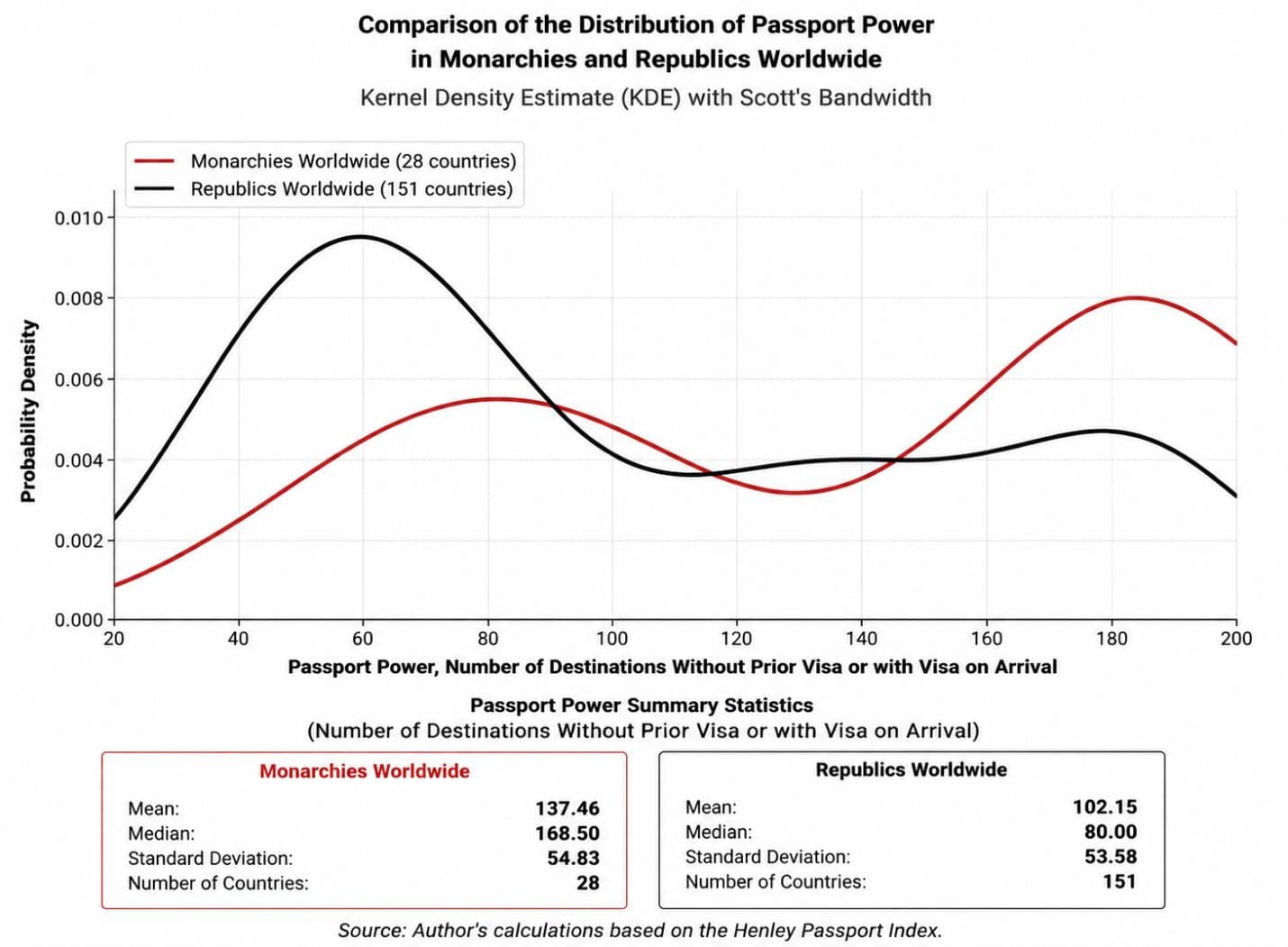
The kernel density estimate shows that the distribution of passport power among monarchies worldwide, based on 2024 data, is generally shifted toward higher values, with a substantial proportion of monarchies among the countries whose passports provide visa-free or visa-on-arrival access to a large number of destinations worldwide. In contrast, although republics span a very wide range of values, their distribution is more concentrated at the lower and middle levels of the index. This pattern is also consistent with the descriptive statistics: the mean and median passport power scores for monarchies are 137.46 and 168.50, respectively, compared with 102.15 and 80.00 for republics. Overall, the available data indicate that monarchies, on average, have more powerful passports than republics.
Comparison of Passport Power between Constitutional and Non-Constitutional Monarchies Worldwide
Descriptive Statistics
Type of Monarchy |
Number of Countries |
Mean |
Median |
Standard Deviation |
Constitutional Monarchies |
15 |
155.93 |
190.00 |
40.55 |
Non-Constitutional Monarchies |
13 |
116.15 |
99.00 |
45.05 |
The mean passport power is 155.93 in constitutional monarchies and 116.15 in non-constitutional monarchies. Thus, citizens of constitutional monarchies have access, on average, to 39.78 more destinations without obtaining a visa in advance or with a visa on arrival.
The median shows the same pattern. The median passport power is 190 among constitutional monarchies and 99 among non-constitutional monarchies. In other words, the median country among constitutional monarchies provides access to 91 more destinations than the median country among non-constitutional monarchies.
Test of the Difference in Means
Welch’s t-test was used to examine the difference between the group means.
Statistical Measure |
Value |
Mean Difference (Constitutional minus Non-Constitutional) |
39.78 |
Welch’s t |
2.049 |
Approximate Degrees of Freedom |
25.97 |
Two-tailed p-value |
0.0507 |
95% Confidence Interval |
−0.14 to 79.70 |
Effect Size (Hedges’ g) |
0.74 |
Welch’s test shows that the difference in mean passport power between the two groups is very close to the threshold of statistical significance (p ≈ 0.051) and falls just short of the conventional 5% level. Nevertheless, the Hedges’ g effect size (g = 0.74) indicates that the observed difference is moderate to large in practical terms.
Mann–Whitney Test
To compare the rankings of the two groups and reduce dependence on the assumption of normally distributed data, the non-parametric Mann–Whitney test was also conducted.
Statistical Measure |
Value |
U Statistic |
146.5 |
Two-tailed p-value |
0.0252 |
Rank-Biserial Correlation |
0.50 |
The Mann–Whitney test indicates that the distributions of passport power in the two groups differ significantly (p = 0.0252). The rank-biserial correlation of approximately 0.50 also indicates a moderate-to-large effect in favor of constitutional monarchies.
Conclusion
In the within-monarchy comparison, constitutional monarchies perform better in passport power than non-constitutional monarchies. The mean, median, and Mann–Whitney test all favor constitutional monarchies. Welch’s test also indicates a substantial difference, although it falls just short of the conventional threshold for statistical significance.
This finding suggests that, even among monarchies themselves, political structure may be associated with differences in international standing and the degree of trust extended to a country’s citizens. As with the other within-group analyses, however, this finding should be regarded as supplementary evidence rather than a substitute for the primary comparison between monarchies and republics.
Comparison of Passport Power between Commonwealth Realms and Republics Worldwide
Descriptive Statistics
Type of Government |
Number of Countries |
Mean |
Median |
Standard Deviation |
Commonwealth Realms |
14 |
144.79 |
150.50 |
34.35 |
Republics Worldwide |
151 |
102.15 |
80.00 |
53.58 |
The mean passport power is 144.79 among Commonwealth realms and 102.15 among republics worldwide. Thus, citizens of Commonwealth realms have access, on average, to approximately 42.64 more destinations without obtaining a visa in advance or with a visa on arrival.
The median confirms the same pattern. The median passport power is 150.50 among Commonwealth realms and 80.00 among republics. In other words, the median Commonwealth realm provides access to approximately 70.50 more destinations than the median republic.
The standard deviation is also lower among Commonwealth realms than among republics, indicating that passport power among Commonwealth realms is not only higher on average but also less dispersed.
Test of the Difference in Means
Welch’s t-test was used to assess the statistical significance of the difference between the means.
Statistical Measure |
Value |
Mean Difference (Commonwealth minus Republic) |
42.64 |
Welch’s t |
4.195 |
Approximate Degrees of Freedom |
19.44 |
Two-tailed p-value |
0.00047 |
95% Confidence Interval |
21.40 to 63.88 |
Effect Size (Hedges’ g) |
0.81 |
Welch’s test shows that the difference in mean passport power between Commonwealth realms and republics worldwide is highly statistically significant (p < 0.001). The 95% confidence interval lies entirely above zero, further confirming that the direction of the difference favors the Commonwealth realms.
Hedges’ g is 0.81, indicating a large effect. The observed difference is therefore not only statistically significant but also substantial in practical terms.
Mann–Whitney Test
To ensure that the result does not depend solely on a comparison of means or on the assumptions of the parametric test, the non-parametric Mann–Whitney test was also conducted.
Statistical Measure |
Value |
U Statistic |
1564 |
Two-tailed p-value |
0.0031 |
Rank-Biserial Correlation |
0.48 |
The Mann–Whitney test also shows a statistically significant difference between the two groups (p = 0.0031). The rank-biserial correlation of 0.48 indicates a moderate-to-large effect in favor of the Commonwealth realms.
Conclusion
In 2024, Commonwealth realms had higher passport power than republics worldwide in terms of both the mean and the median. Both Welch’s test and the Mann–Whitney test confirm this difference with strong statistical evidence, and the effect sizes are also substantial.
Citizens of Commonwealth realms therefore enjoyed, on average, greater freedom of international travel than citizens of republics worldwide. If passport power is regarded as a composite indicator of a country’s international standing, the trust other governments place in its citizens, and the overall quality of governance, the result of this comparison is also consistent with the prediction of the “New or Modern Monarchy” hypothesis.
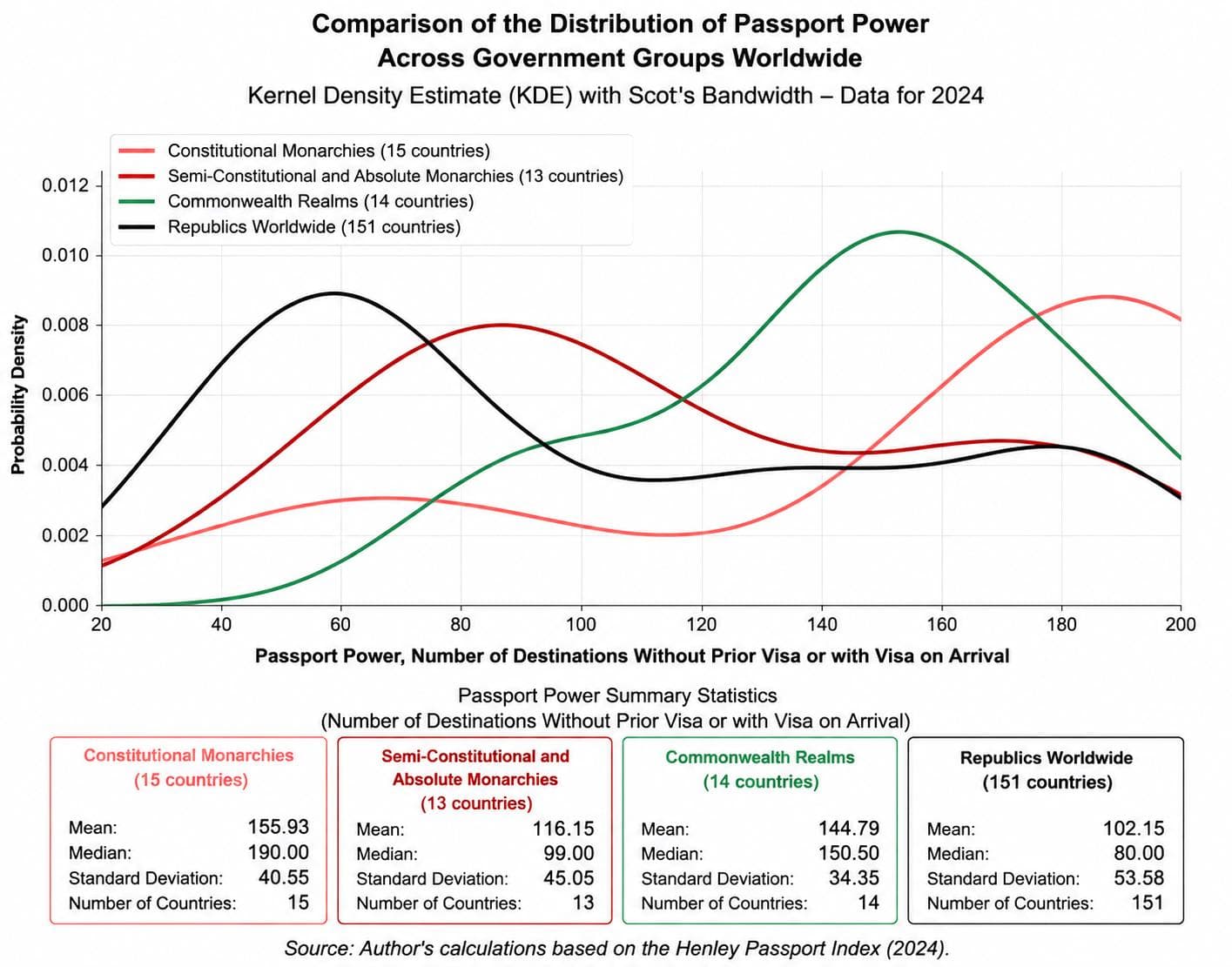
The kernel density estimate shows substantial differences in the distribution of passport power across the four government groups worldwide. Constitutional monarchies exhibit the highest level of performance, with most of them among the countries whose citizens enjoy visa-free or visa-on-arrival access to the largest number of destinations worldwide. Commonwealth realms follow closely behind constitutional monarchies, with a relatively concentrated distribution at the higher levels of the index. In contrast, although semi-constitutional and absolute monarchies have a higher mean than republics, their distribution is more dispersed, with a substantial proportion falling within the middle range of the index. Republics worldwide have the lowest mean among the four groups, and their distribution is more heavily concentrated at lower values. Overall, the 2024 data indicate that, as monarchical systems move toward the constitutional model, the passport power of their citizens tends, on average, to increase.