

Monarchy & Republic in the Laboratory of History by N. Fakhr - HTML preview
Download the book in PDF, ePub for a complete version.
Comparison of the International Property Rights Index between Monarchies and Republics across Continents and the Middle East
Comparison of the International Property Rights Index between Monarchies and Republics in Asia
Descriptive Statistics
Type of Government |
Number of Countries |
Mean |
Median |
Standard Deviation |
Asian monarchies |
11 |
5.90 |
5.84 |
0.73 |
Asian republics |
20 |
4.75 |
4.67 |
1.22 |
The mean International Property Rights Index score is 5.90 for Asian monarchies and 4.75 for Asian republics. Thus, Asian monarchies score, on average, 1.15 points higher than the republics of the continent.
The medians point in the same direction. The median is 5.84 for monarchies and 4.67 for republics, meaning that the median country among Asian monarchies scores approximately 1.16 points higher than the median country among Asian republics.
The standard deviation is also substantially lower among monarchies (0.73) than among republics (1.22), indicating that Asian monarchies not only achieve higher scores but also exhibit more consistent performance.
Test of the Difference in Means
To assess the statistical significance of the difference in means, Welch’s t-test was used.
Statistical Measure |
Value |
Mean difference (monarchies minus republics) |
1.15 |
Welch’s t statistic |
3.26 |
Approximate degrees of freedom |
28.69 |
Two-tailed p-value |
0.0028 |
95% confidence interval |
0.43 to 1.87 |
Hedges’ g |
1.03 |
Welch’s test shows that the difference in mean Property Rights Index scores between monarchies and republics in Asia is statistically significant (p < 0.01). The 95% confidence interval lies entirely above zero, supporting the higher average score of the monarchies.
Hedges’ g is 1.03, indicating a large effect. Thus, the observed difference is not only statistically significant but also substantial in magnitude.
Mann–Whitney Test
To ensure that the result does not depend on the assumptions of the parametric test, the non-parametric Mann–Whitney U test was also conducted.
Statistical Measure |
Value |
U statistic |
182 |
Two-tailed p-value |
0.0032 |
Rank-biserial correlation |
0.65 |
The Mann–Whitney test also indicates a statistically significant difference between the two groups (p < 0.01). The rank-biserial correlation of 0.65 indicates a large effect, with Asian monarchies generally receiving higher scores on this index.
Conclusion
In 2024, Asian monarchies performed substantially better on the International Property Rights Index than Asian republics. Both the mean and median scores were considerably higher among monarchies, and both Welch’s t-test and the Mann–Whitney test confirmed the difference with strong statistical evidence. The large effect sizes further indicate that the difference is substantial in magnitude as well as statistically significant.
Overall, the Asian data indicate that monarchies in the region provide stronger protection for citizens’ property rights than Asian republics, and this finding is consistent with the predictions of the “New or Modern Monarchy” hypothesis.
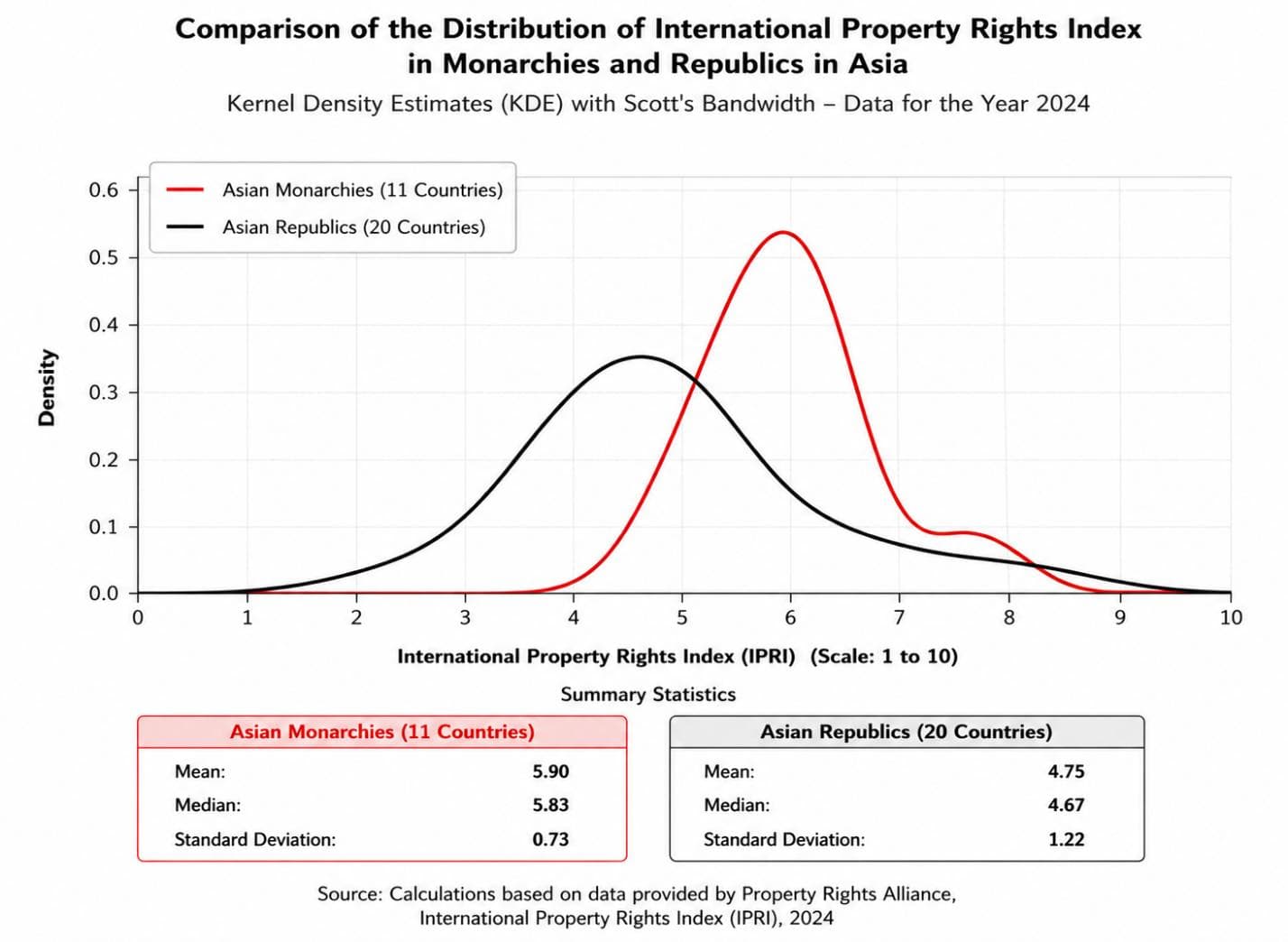
The kernel density estimate shows that the distribution of Asian monarchies on the International Property Rights Index is noticeably shifted toward higher scores, with the greatest concentration occurring at relatively high levels of the index. In contrast, Asian republics are concentrated mainly at lower scores and display greater dispersion, indicating more heterogeneous performance in the protection of property rights. The separation between the two curves suggests that, on average, Asian monarchies perform more favorably than the republics of the continent.
Comparison of the International Property Rights Index in European Monarchies and Republics
Descriptive Statistics
Form of Government |
Number of Countries |
Mean |
Median |
Standard Deviation |
European Monarchies |
8 |
7.48 |
7.70 |
0.47 |
European Republics |
30 |
5.82 |
5.89 |
1.19 |
The mean International Property Rights Index score is 7.48 for European monarchies and 5.82 for European republics. Thus, European monarchies score, on average, 1.66 points higher than European republics.
The median confirms the same pattern. The median score is 7.70 for monarchies and 5.89 for republics, meaning that the median country among European monarchies scores approximately 1.82 points higher than the median country among European republics.
The standard deviation is also substantially lower among European monarchies (0.47) than among European republics (1.19), indicating that European monarchies not only achieve higher scores but also exhibit greater consistency in their performance.
Test of Difference in Means
To assess the statistical significance of the difference in means, Welch’s t-test was used.
Statistical Measure |
Value |
Mean difference (Monarchies − Republics) |
1.66 |
Welch’s t statistic |
6.07 |
Approximate degrees of freedom |
30.22 |
Two-tailed p-value |
0.0000011 |
95% confidence interval |
1.10 to 2.22 |
Hedges’ g |
1.49 |
Welch’s test indicates that the difference in mean property-rights scores between European monarchies and republics is highly statistically significant (p < 0.001). The 95% confidence interval also lies entirely above zero, confirming that the difference favors the monarchies.
Hedges’ g is 1.49, indicating a very large effect. Thus, the observed difference is not only statistically significant but also substantial in practical terms.
Mann–Whitney Test
To ensure that the result does not depend on the assumptions of the parametric test, the nonparametric Mann–Whitney U test was also conducted.
Statistical Measure |
Value |
U statistic |
218 |
Two-tailed p-value |
0.00013 |
Rank-biserial correlation |
0.82 |
The Mann–Whitney test likewise indicates a highly statistically significant difference between the two groups (p < 0.001). The rank-biserial correlation of 0.82 represents a very large effect, indicating a pronounced advantage for European monarchies on this index.
Conclusion
In 2024, European monarchies performed substantially better than European republics on the International Property Rights Index. Both the mean and median scores were considerably higher among monarchies, and both Welch’s t-test and the Mann–Whitney test confirmed the difference with very strong statistical evidence. The very large effect sizes further indicate that the difference is substantial not only statistically but also in practical terms.
Moreover, the lower dispersion of scores among European monarchies indicates that these countries have not only achieved a higher level of property-rights protection but have also done so with greater consistency. This finding is also consistent with the prediction of the “New or Modern Monarchy” hypothesis.
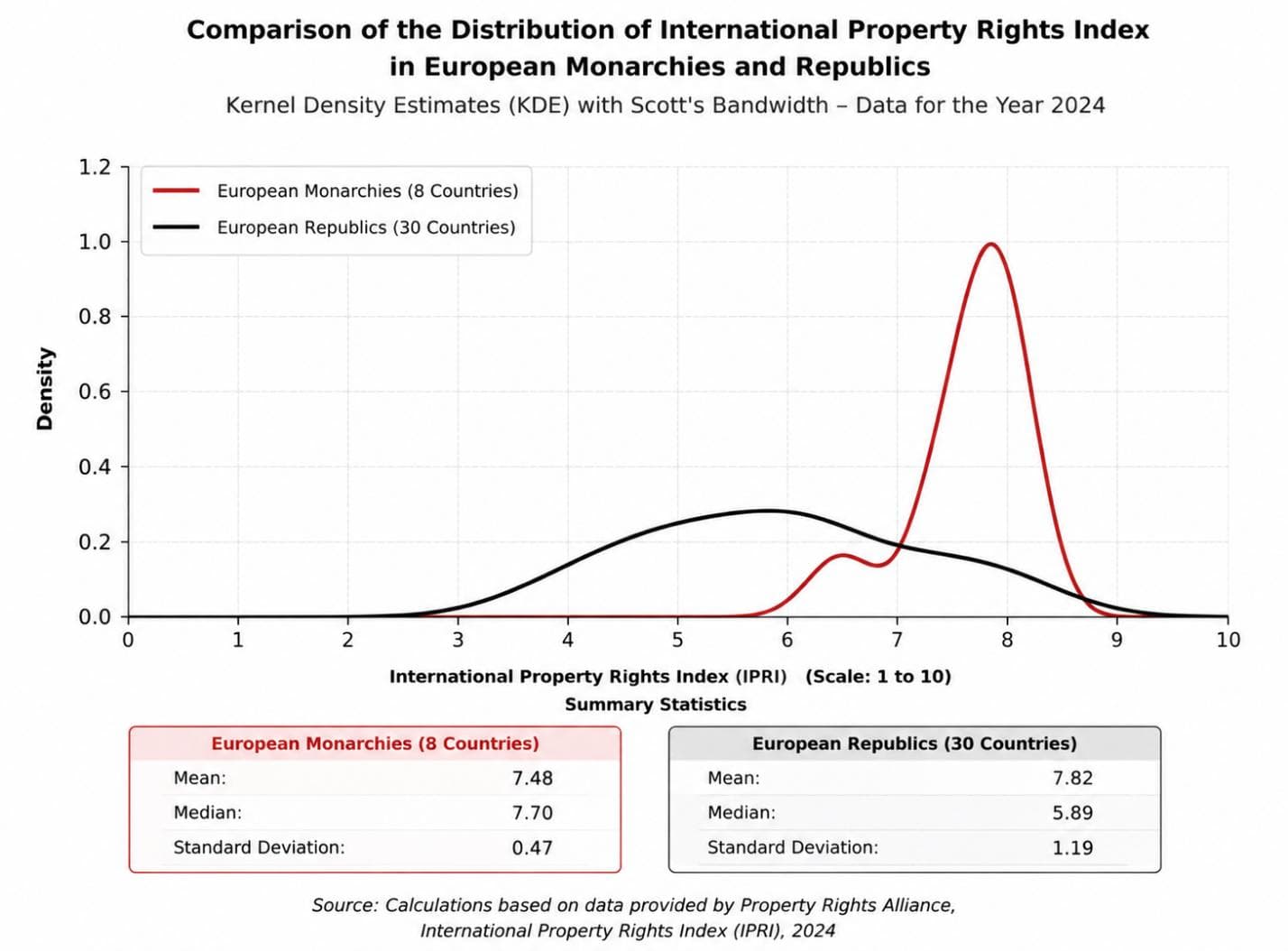
The distribution of European monarchies on the International Property Rights Index is clearly shifted toward higher scores, with the greatest concentration at the very high end of the index. In contrast, although European republics generally perform well, their scores are more widely dispersed, with some countries falling in the middle range of the index. The separation between the two curves indicates that, on average, European monarchies perform more favorably than the republics of the continent in protecting property rights.
Comparison of the International Property Rights Index in European Monarchies and European Republics That Have Never Been Communist
Descriptive Statistics
Form of Government |
Number of Countries |
Mean |
Median |
Standard Deviation |
European Monarchies |
8 |
7.48 |
7.70 |
0.47 |
Never-Communist European Republics |
12 |
6.82 |
7.05 |
0.91 |
The mean International Property Rights Index score is 7.48 for European monarchies and 6.82 for never-communist European republics. Thus, European monarchies score, on average, 0.66 points higher than this group of republics.
The median confirms the same pattern. The median score is 7.70 for monarchies and 7.05 for never-communist republics, meaning that the median country among European monarchies scores approximately 0.65 points higher than the median country among never-communist republics.
The standard deviation among monarchies (0.47) is approximately half that of the never-communist republics (0.91), indicating that European monarchies not only achieve higher scores but also exhibit greater consistency in their performance.
Test of Difference in Means
To assess the statistical significance of the difference in means, Welch’s t-test was used.
Statistical Measure |
Value |
Mean difference (Monarchies − Republics) |
0.66 |
Welch’s t statistic |
2.12 |
Approximate degrees of freedom |
17.21 |
Two-tailed p-value |
0.049 |
95% confidence interval |
0.003 to 1.316 |
Hedges’ g |
0.82 |
Welch’s test indicates that the difference in mean property-rights scores between European monarchies and never-communist European republics is statistically significant at the 5% level (p = 0.049). The 95% confidence interval also lies entirely above zero, although its lower bound is very close to zero. Thus, while statistically significant, this result is less robust than those of the preceding comparisons.
Hedges’ g is 0.82, indicating a large effect. The observed difference is therefore also substantial in practical terms.
Mann–Whitney Test
To ensure that the result does not depend on the assumptions of the parametric test, the nonparametric Mann–Whitney U test was also conducted.
Statistical Measure |
Value |
U statistic |
75 |
Two-tailed p-value |
0.0387 |
Rank-biserial correlation |
0.56 |
The Mann–Whitney test also indicates a statistically significant difference between the two groups (p = 0.039). The rank-biserial correlation of 0.56 indicates a large effect, favoring European monarchies on this index.
Conclusion
Even after excluding republics with a history of communist rule, European monarchies continue to perform better on the International Property Rights Index than European republics that have never been communist. Both the mean and median scores are higher among monarchies, and both Welch’s t-test and the Mann–Whitney test confirm that the difference is statistically significant at the 5% level.
This finding is noteworthy because the never-communist European republics include some of the world’s longest-established democratic systems and would therefore be expected to provide strong protection for property rights. Nevertheless, the 2024 data show that European monarchies, on average, still provide stronger protection for their citizens’ property rights. As in other sections of this book, however, this finding represents an observational relationship and does not, by itself, establish a causal relationship between form of government and the degree of property-rights protection.
Comparison in Africa, the Americas, and Oceania
For this index, data were available for only a very limited number of monarchies and Commonwealth realms in Africa, the Americas, and Oceania. Consequently, comparisons with the republics of these continents would have insufficient analytical value and reliability because of the very small sample sizes. Such comparisons are therefore omitted from this section.
Comparison of the International Property Rights Index in Middle Eastern Monarchies and Republics
Descriptive Statistics
Form of Government |
Number of Countries |
Mean |
Median |
Standard Deviation |
Middle Eastern Monarchies |
7 |
5.82 |
5.84 |
0.42 |
Middle Eastern Republics |
7 |
4.34 |
4.26 |
1.38 |
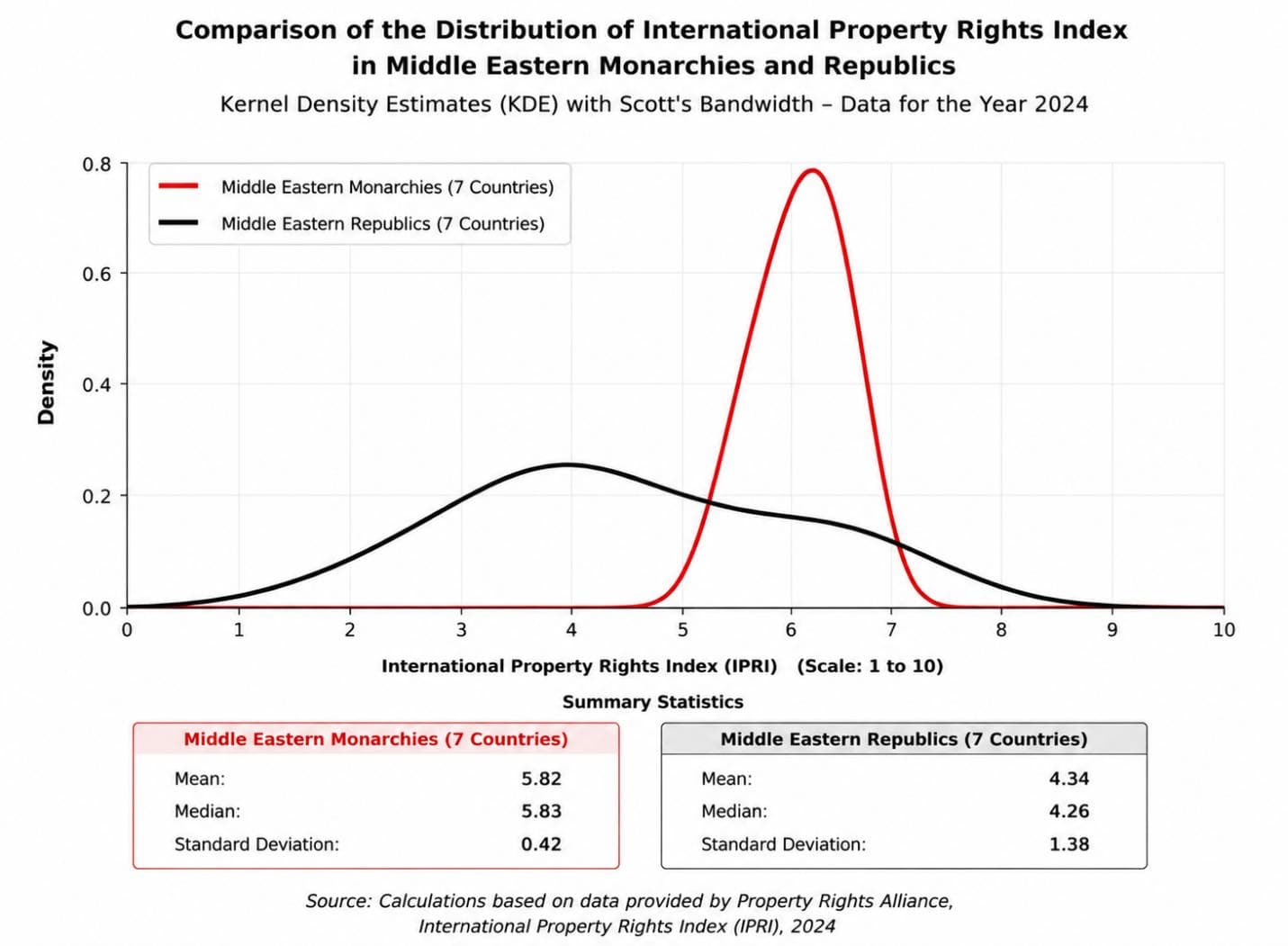
The mean International Property Rights Index score is 5.82 for Middle Eastern monarchies and 4.34 for Middle Eastern republics. Thus, the region’s monarchies score, on average, 1.48 points higher than its republics.
The median confirms the same pattern. The median score is 5.84 for monarchies and 4.26 for republics, meaning that the median country among Middle Eastern monarchies scores approximately 1.58 points higher than the median country among the region’s republics.
The standard deviation is also substantially lower among monarchies (0.42) than among republics (1.38). This indicates that the region’s monarchies not only achieve higher scores but also exhibit greater consistency in their performance.
Test of Difference in Means
To assess the statistical significance of the difference in means, Welch’s t-test was used.
Statistical Measure |
Value |
Mean difference (Monarchies − Republics) |
1.48 |
Welch’s t statistic |
2.71 |
Approximate degrees of freedom |
7.11 |
Two-tailed p-value |
0.0297 |
95% confidence interval |
0.19 to 2.76 |
Hedges’ g |
1.36 |
Welch’s test indicates that the difference in mean property-rights scores between Middle Eastern monarchies and republics is statistically significant (p = 0.0297). The 95% confidence interval also lies entirely above zero, supporting the higher scores observed among monarchies.
Hedges’ g is 1.36, indicating a very large effect. Thus, the observed difference is not only statistically significant but also substantial in practical terms.
Mann–Whitney Test
To ensure that the result does not depend on the assumptions of the parametric test, the nonparametric Mann–Whitney U test was also conducted.
Statistical Measure |
Value |
U statistic |
39 |
Two-tailed p-value |
0.0728 |
Rank-biserial correlation |
0.59 |
Unlike Welch’s test, the Mann–Whitney test does not indicate a statistically significant difference at the 5% level (p = 0.0728), although the p-value is relatively close to the conventional significance threshold. The rank-biserial correlation of 0.59 nevertheless indicates a large effect favoring monarchies.
Conclusion
In 2024, Middle Eastern monarchies performed better on average than the region’s republics on the International Property Rights Index. Both the mean and median scores are higher among monarchies. Welch’s test indicates a statistically significant difference, whereas the Mann–Whitney test does not confirm significance at the 5% level, likely reflecting the small sample size and some overlap in the groups’ ranks; nevertheless, the effect size in the latter test is also large.
Overall, the Middle Eastern data are consistent with the prediction of the “New or Modern Monarchy” hypothesis, indicating that the region’s monarchies, on average, provide stronger protection for their citizens’ property rights. Given the small number of countries and the differing results of the two statistical tests, however, this finding should be interpreted more cautiously than some of the global and European comparisons.
Status of the “New or Modern Monarchy” Hypothesis After the Eleventh Indicator
With the addition of the International Property Rights Index, the status of the “New or Modern Monarchy” hypothesis at this stage is as follows:
Test |
Indicator |
Result |
✓ |
GDP per capita |
Consistent with the hypothesis |
✓ |
Purchasing power per capita |
Consistent with the hypothesis |
◐ |
Gini coefficient |
Mixed evidence; difference favors the hypothesis |
✓ |
Political Stability and Absence of Violence |
Consistent with the hypothesis |
✓ |
Regulatory Quality |
Consistent with the hypothesis |
✓ |
Rule of Law |
Consistent with the hypothesis |
✓ |
Government Effectiveness |
Consistent with the hypothesis |
✓ |
Inflation |
Consistent with the hypothesis |
✓ |
Control of Corruption |
Consistent with the hypothesis |
✓ |
Corruption Perceptions |
Consistent with the hypothesis |
✓ |
Property Rights |
Consistent with the hypothesis |
At this stage, the “New or Modern Monarchy” hypothesis has been tested against eleven independent indicators covering a range of different domains. These indicators are not confined to a single dimension of governance; rather, they encompass various aspects of welfare, security, order, justice, and liberty, and their data have been drawn from a variety of international sources and institutions.
For the International Property Rights Index as well, monarchies achieved higher average scores in the global, Asian, European, and Middle Eastern comparisons. Even when European monarchies were compared with European republics that had never experienced communist rule, the difference remained in favor of the monarchies.
Thus, none of the eleven indicators examined so far has produced a result running counter to the prediction of the hypothesis: ten indicators have provided clear evidence in its direction, while for the Gini coefficient, despite the mixed evidence, the direction of the difference favored the hypothesis. As emphasized throughout this book, however, these findings do not establish a causal relationship between regime type and the quality of governance. A more precise conclusion is that the empirical pattern emerging from the eleven indicators examined so far has not been inconsistent with the predictions of the “New or Modern Monarchy” hypothesis and, in most cases, has provided clear statistical evidence in its direction.