

Monarchy & Republic in the Laboratory of History by N. Fakhr - HTML preview
Download the book in PDF, ePub for a complete version.
International Property Rights
As noted at the beginning of this chapter, liberty can be examined from several different perspectives. One of its most fundamental dimensions is the right to property, because property rights largely determine the extent to which individuals are free to make decisions about the fruits of their labor, their possessions, and their assets.
Full ownership of an asset means that, within the law, its owner is free to decide whether to use it or not, retain it, sell it, rent it out, give it away, leave it as an inheritance, or otherwise dispose of it. The broader these rights are, the greater the individual’s freedom of action over that property.
For this reason, the owner of a house has far greater freedom in deciding what to do with it than the tenant of the same house, because the owner possesses a broader set of rights over that asset.
Throughout history, governments have been among the most important actors in defining the boundaries of property rights. In many societies, governments could determine who had the right to own land, who could hunt, fish, trade, or inherit, and even under what circumstances private property could be confiscated. Property rights have therefore long been one of the principal areas of tension between citizens and governments.
The more freely a government can interfere with private ownership without clear rules or constraints, the less control citizens have over their property, and the more their range of choices is reduced. Conversely, the more strongly a government protects property rights, the greater the freedom citizens have to make decisions about the fruits of their labor and their possessions.
Because this book also tests the “New or Modern Monarchy” hypothesis, we would expect, if the hypothesis is correct, modern monarchies to provide stronger protection for their citizens’ property rights. According to this hypothesis, just as caring parents seek to give their children greater independence and autonomy, a king or queen would be expected to recognize broader rights for citizens, allowing them greater freedom to choose how they live and to develop their abilities.
To test this prediction, we use the International Property Rights Index (IPRI). Published by the Property Rights Alliance, this index evaluates the extent to which countries protect both physical and intellectual property rights. The higher a country’s score, the stronger the protection of property rights and the greater the freedom citizens have over their assets and achievements. Economic research has also found that stronger property-rights protection is generally associated with greater investment security, easier trade, and a higher capacity for economic growth.
The data used in this section are from 2024 and cover 123 countries (Appendix RDS-K01).
Global Comparison of the International Property Rights Index in Monarchies and Republics
This section compares the performance of monarchies and republics worldwide on the International Property Rights Index (IPRI). The data are from 2024. On this index, a higher score indicates stronger protection of property rights and therefore greater freedom for citizens to control and make use of their property and assets.
Descriptive Statistics
Type of Government |
Number of Countries |
Mean |
Median |
Standard Deviation |
Monarchies Worldwide |
20 |
6.50 |
6.27 |
1.03 |
Republics Worldwide |
99 |
4.83 |
4.63 |
1.28 |
The mean International Property Rights Index score is 6.50 for monarchies and 4.83 for republics. Thus, monarchies score, on average, 1.67 points higher than republics.
The median confirms the same pattern. The median is 6.27 for monarchies and 4.63 for republics, meaning that the median monarchy scores 1.64 points higher than the median republic. This indicates that the observed advantage of monarchies is not limited to a few exceptional countries but is also visible in the broader distribution of the data.
The standard deviation is also lower among monarchies (1.03) than among republics (1.28). Thus, monarchies not only have higher levels of property-rights protection but also exhibit somewhat more consistent performance.
Test of the Difference in Means
To assess the statistical significance of the difference in means, Welch’s t-test was used.
Statistical Measure |
Value |
Mean difference (Monarchies minus Republics) |
1.67 |
Welch’s t-statistic |
6.304 |
Approximate degrees of freedom |
32.09 |
Two-tailed p-value |
0.00000045 |
95% confidence interval |
1.13 to 2.20 |
Hedges’ g |
1.33 |
Welch’s test shows that the difference in mean property-rights scores between monarchies and republics worldwide is highly statistically significant (p < 0.001). The 95% confidence interval also lies entirely above zero, supporting the observed higher mean among monarchies.
Hedges’ g is 1.33, indicating a very large effect. Thus, the observed difference is not only statistically significant but also substantial in practical terms.
Mann–Whitney U Test
To ensure that the conclusion does not depend solely on the assumptions of the parametric test, the nonparametric Mann–Whitney U test was also conducted.
Statistical Measure |
Value |
U statistic |
1686.5 |
Two-tailed p-value |
0.00000076 |
Rank-biserial correlation |
0.704 |
The Mann–Whitney test likewise confirms a difference between the two groups with very strong statistical evidence (p < 0.001). The rank-biserial correlation of 0.704 indicates a very large effect, showing that International Property Rights Index scores are generally substantially higher among monarchies than among republics.
Conclusion
In 2024, the world’s monarchies performed substantially better than the world’s republics on the International Property Rights Index. Both the mean and median scores were considerably higher among monarchies, and both Welch’s t-test and the Mann–Whitney U test confirmed the difference with very strong statistical evidence. The very large effect sizes in both tests further indicate that the observed difference is substantial not only statistically but also in practical terms.
Overall, the data examined in this study show that monarchies provide stronger protection for their citizens’ property rights than republics do. Since property rights are among the most fundamental dimensions of liberty, this finding is also consistent with the predictions of the “New or Modern Monarchy” hypothesis. As in the other chapters of this book, however, this result represents an observational association and does not, by itself, establish a causal relationship between the form of government and the degree of property-rights protection.
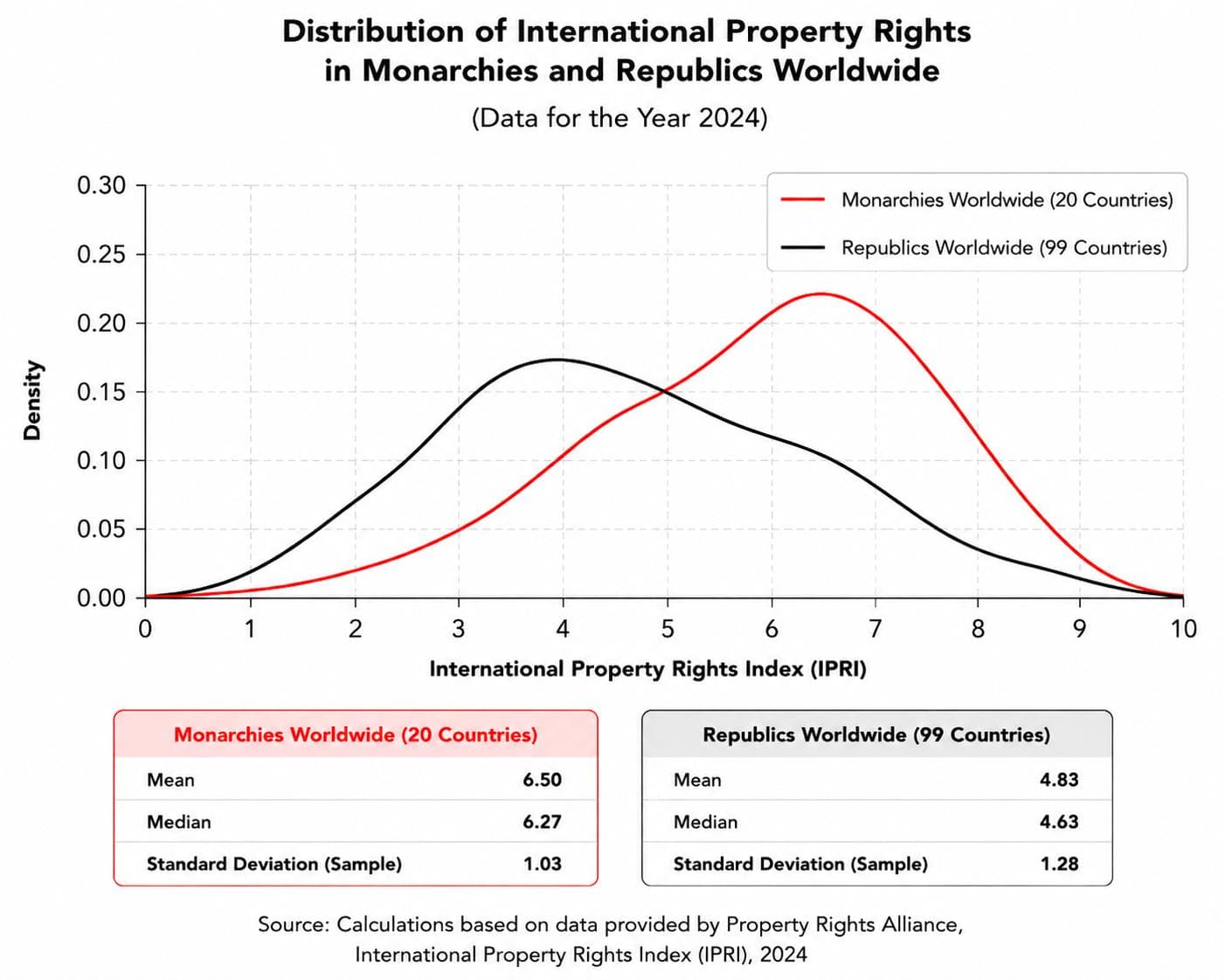
The kernel density estimate (KDE) plot shows that the distribution of monarchies worldwide on the International Property Rights Index is noticeably shifted toward higher scores, with the greatest concentration occurring in the relatively high range of the index. By contrast, the distribution of republics is concentrated primarily at lower scores and is also more dispersed, indicating greater heterogeneity in their performance in protecting property rights. The separation between the two curves indicates that, on average, monarchies perform more favorably on the Property Rights Index.
Comparison of the International Property Rights Index between Constitutional and Non-Constitutional Monarchies Worldwide
Descriptive Statistics
Type of Monarchy |
Number of Countries |
Mean |
Median |
Standard Deviation |
Constitutional monarchies |
12 |
6.99 |
7.52 |
1.03 |
Semi-constitutional and absolute monarchies |
8 |
5.76 |
5.78 |
0.43 |
The mean International Property Rights Index score is 6.99 for constitutional monarchies and 5.76 for semi-constitutional and absolute monarchies. Thus, constitutional monarchies score, on average, 1.23 points higher than the second group.
The medians point in the same direction. The median is 7.52 for constitutional monarchies and 5.78 for semi-constitutional and absolute monarchies. In other words, the median country among constitutional monarchies scores approximately 1.74 points higher than the median country in the second group.
The standard deviation among constitutional monarchies (1.03) is also more than twice that of the second group (0.43), indicating that although constitutional monarchies have a higher average score, their performance is also more dispersed.
Test of the Difference in Means
To assess the statistical significance of the difference in means, Welch’s t-test was used.
Statistical Measure |
Value |
Mean difference (constitutional minus semi-constitutional and absolute) |
1.23 |
Welch’s t statistic |
3.69 |
Approximate degrees of freedom |
15.90 |
Two-tailed p-value |
0.0020 |
95% confidence interval |
0.52 to 1.94 |
Hedges’ g |
1.39 |
Welch’s test shows that the difference in mean Property Rights Index scores between the two types of monarchy is statistically significant (p = 0.002). The 95% confidence interval also lies entirely above zero, supporting the higher average score of constitutional monarchies.
Hedges’ g is 1.39, indicating a very large effect. Thus, the observed difference is not only statistically significant but also substantial in magnitude.
Mann–Whitney Test
To ensure that the result does not depend on the assumptions of the parametric test, the non-parametric Mann–Whitney U test was also conducted.
Statistical Measure |
Value |
U statistic |
81 |
Two-tailed p-value |
0.0096 |
Rank-biserial correlation |
0.69 |
The Mann–Whitney test also indicates a statistically significant difference between the two groups (p < 0.01). The rank-biserial correlation of approximately 0.69 indicates a large effect, with constitutional monarchies generally receiving higher scores on this index.
Conclusion
In 2024, constitutional monarchies performed better on the International Property Rights Index than semi-constitutional and absolute monarchies. Both the mean and median scores were noticeably higher among constitutional monarchies, and both Welch’s t-test and the Mann–Whitney test confirmed that the difference was statistically significant. Moreover, the large effect sizes indicate that the difference is substantial in magnitude as well as statistically significant.
This result suggests that, even among monarchies themselves, constitutional systems provide stronger protection for citizens’ property rights. This is consistent with the theoretical expectation that more constrained government power and broader recognition of citizens’ rights should be associated with stronger property-rights protection in constitutional monarchies.
Comparison of the International Property Rights Index between Commonwealth Realms and Republics Worldwide
It should be noted that, of the 16 Commonwealth realms, only 4 countries had data available in the 2024 edition of this index. This comparison is therefore based on those four countries.
Descriptive Statistics
Type of Government |
Number of Countries |
Mean |
Median |
Standard Deviation |
Commonwealth realms |
4 |
7.03 |
7.55 |
1.16 |
Republics worldwide |
99 |
4.83 |
4.63 |
1.28 |
The mean International Property Rights Index score is 7.03 for the Commonwealth realms and 4.83 for republics worldwide. Thus, the Commonwealth realms score, on average, 2.19 points higher than the republics.
The medians point in the same direction. The median score is 7.55 for the Commonwealth realms and 4.63 for the republics, meaning that the median country among the Commonwealth realms scores approximately 2.92 points higher than the median republic.
The standard deviations of the two groups are also relatively similar. Thus, the observed difference primarily reflects a difference in the level of performance rather than merely a difference in the dispersion of scores.
Test of the Difference in Means
To assess the statistical significance of the difference in means, Welch’s t-test was used.
Statistical Measure |
Value |
Mean difference (Commonwealth realms minus republics) |
2.19 |
Welch’s t statistic |
3.68 |
Approximate degrees of freedom |
3.30 |
Two-tailed p-value |
0.0296 |
95% confidence interval |
0.39 to 4.00 |
Hedges’ g |
1.70 |
Welch’s test indicates that the difference in mean Property Rights Index scores between the Commonwealth realms and republics worldwide is statistically significant (p = 0.0296). The 95% confidence interval lies entirely above zero, supporting the higher average score of the Commonwealth realms.
Hedges’ g is 1.70, indicating a very large effect. However, this result is based on only four Commonwealth realms. Therefore, although the observed difference is substantial, the very small sample size of this group should be kept in mind when interpreting the result.
Mann–Whitney Test
To ensure that the result does not depend on the assumptions of the parametric test, the non-parametric Mann–Whitney U test was also conducted.
Statistical Measure |
Value |
U statistic |
358 |
Two-tailed p-value |
0.0065 |
Rank-biserial correlation |
0.81 |
The Mann–Whitney test likewise indicates a statistically significant difference between the two groups (p < 0.01). The rank-biserial correlation of approximately 0.81 indicates a very large effect, with the Commonwealth realms generally receiving higher scores on this index.
Conclusion
In 2024, the four Commonwealth realms for which International Property Rights Index data were available performed better, on average, than republics worldwide. Both their mean and median scores were substantially higher, and both Welch’s t-test and the Mann–Whitney test indicated statistically significant differences between the groups.
However, because this comparison is based on only four Commonwealth realms, the results should be interpreted with greater caution than the other comparisons in this book. Despite this limitation, the available evidence is consistent with the predictions of the “New or Modern Monarchy” hypothesis, indicating that this group of countries performs more favorably than republics worldwide in the protection of property rights.
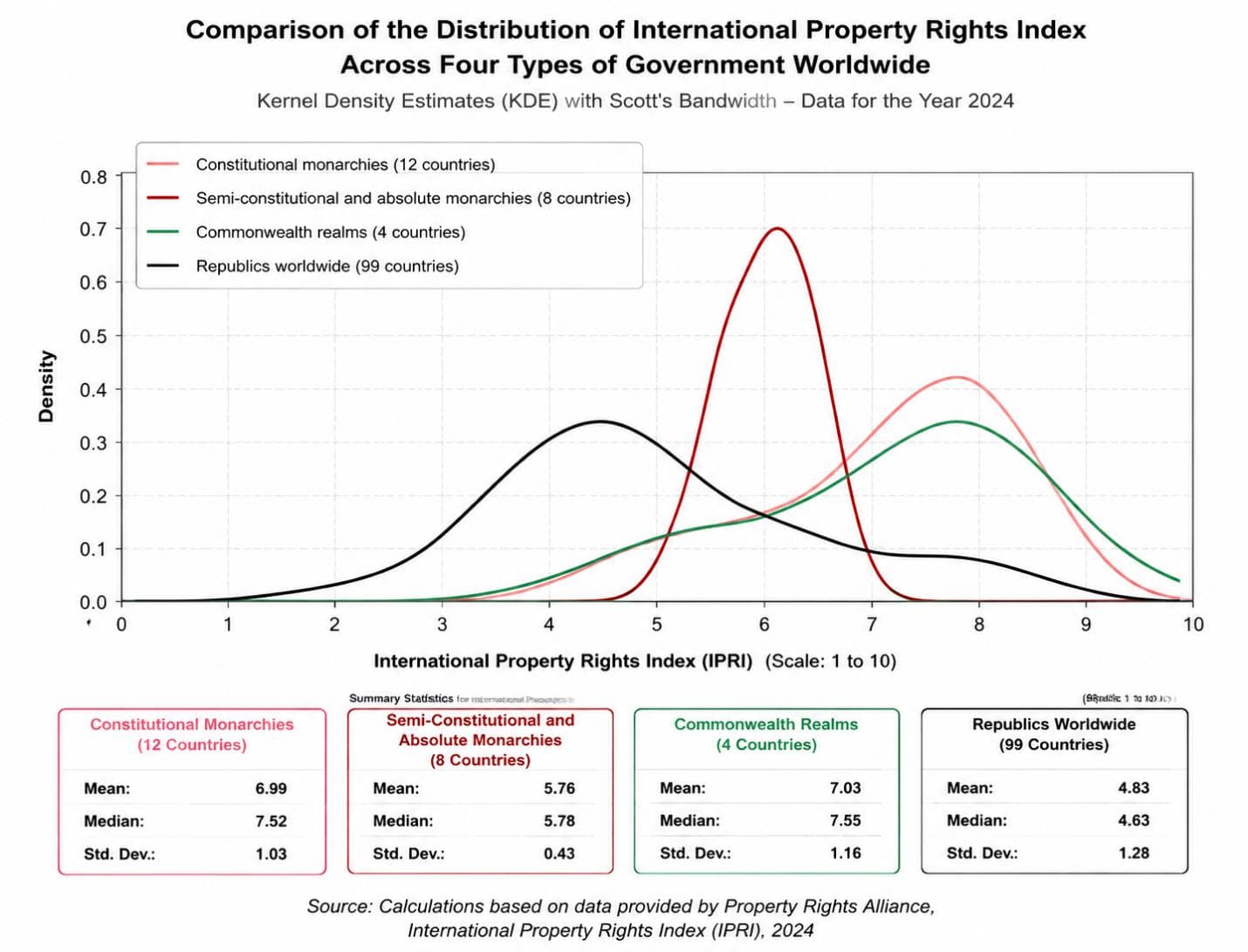
The kernel density estimate (KDE) plot shows that the Commonwealth realms and constitutional monarchies are concentrated primarily at the higher end of the International Property Rights Index, with their greatest density occurring among relatively high scores. Semi-constitutional and absolute monarchies also perform better overall than republics, although their distribution is centered at lower levels than that of constitutional monarchies. By contrast, the distribution of republics worldwide is noticeably shifted toward lower scores and is also more dispersed. Overall, this pattern suggests that, at the global level, monarchical systems—particularly constitutional monarchies and Commonwealth realms—tend to perform more favorably in the protection of property rights.