

I’ll Be Back by Henning Jon Grini - HTML preview
Download the book in PDF, ePub, Kindle for a complete version.
Resolution 1325) have elevated women’s involvement in peacekeeping and
conflict prevention. The evidence is clear that when women are involved, peace
agreements last longer and communities recover fastercfr.org. Women are also
leading humanitarian efforts in conflict zones, from Syria to South Sudan,
working to rebuild and heal war-torn societies. As the world faces complex
security challenges, women leaders – whether heads of government or
grassroots activists – are bringing more collaborative and compassionate
approaches to conflict resolution and international diplomacy. This bodes for a
future in which peace processes and security policies are more inclusive and
effective.
• Social Movements and Advocacy: Many of the most potent social and
political movements of our time have women at the forefront. Women are
leading the charge on issues like climate change, education, and human
rights. For instance, young female activists such as Greta Thunberg have
galvanized global climate action with their moral clarity and tenacity. In the
realm of girls’ education, figures like Malala Yousafzai have become
international symbols, influencing global commitments to ensure every girl
goes to school. The #MeToo movement against sexual harassment and assault,
which started in the United States with activist Tarana Burke and gained
worldwide momentum in 2017, is another example – it has led to concrete
changes in laws and workplace norms across countries. From Poland to
Argentina, women’s rights activists are organizing mass movements to fight
femicide, expand reproductive rights, and demand equal treatment. These
movements are reshaping cultural attitudes and forcing institutions to
respond. As a result, future societies are likely to be more aware of gender
justice thanks to today’s women advocates.
• Science, Technology, and Innovation: Women are also increasingly
contributing to shaping the future through science and technology. Although
underrepresented in STEM fields, women have made landmark innovations –
from Dr. Özlem Türeci (co-founder of BioNTech, key to developing the Pfizer
COVID-19 vaccine) to Katie Bouman (who helped produce the first image of a
black hole). Worldwide, initiatives are underway to involve more girls in STEM,
recognizing that the next generation of discoveries needs women’s minds. The
rise of women in tech leadership – e.g., CEOs of major tech companies and
unicorn startups – means the digital economy’s future will have female
architects. This is crucial as technology (AI, biotech, renewable energy) will
define the next decades. When women help design tech, products and
research are more likely to serve all of society (for example, considering
79
women’s health needs in medical research, or mitigating biases in AI). Thus,
women in labs, universities, and tech firms are shaping the future as much as
those in parliaments.
• Global Economy and Labor: Women’s growing role in the workforce and
entrepreneurship is another transformative force. In many countries, increasing
female labor participation is expanding the economy and changing workplace
cultures. Women-run businesses are on the rise globally, and many are
focused on social entrepreneurship – solving local problems from clean water
to financial inclusion. As more women attain higher education and control
economic assets, we can expect shifts in global economic priorities. Already,
research shows women investors and leaders often prioritize sustainability and
ethical business practices, influencing companies to be more socially
responsible. Furthermore, women as consumers drive trends and demand
corporate accountability. The “she-conomy” is an emerging power shaping
markets and innovation focus (for example, growth in sectors like
telemedicine, childcare tech, etc., that cater to needs long overlooked). In
short, women are not just joining the global economy but transforming it to
be more responsive and inclusive.
Overall, women are essential stakeholders in all facets of the world’s future. Higher gender equality is directly linked to greater global security and prosperity – countries with more empowered women are less likely to fall into conflict and more
likely to prospercfr.org. As we move further into the 21st century, the imprint of women in leadership, activism, and innovation will only deepen. We are likely to see more female heads of state, more women CEOs, more female Nobel laureates – inspiring others and normalizing women’s presence at the helm. The collective impact of women shaping the future is a world that could be more collaborative, equitable, and sustainable.
7. Strategies to Strengthen and Empower Women
Globally (with a Focus on the U.S.)
Empowering women worldwide requires concerted action across education, economics, politics, and cultural norms. The following strategies are being suggested and implemented to strengthen women’s roles – with special emphasis on policies relevant to the United States:
• Expand Girls’ Education and Skills Training: Education is the foundation of
empowerment. Globally, initiatives to ensure girls complete primary and
secondary school (and have equal access to higher education) are crucial.
Educated women marry later, have healthier families, and earn more, creating
positive ripple effects. Programs like scholarships for girls, school meal
80
incentives, and campaigns against child marriage all help keep girls in school.
In the U.S., enforcing Title IX (which prohibits gender discrimination in
education) and encouraging girls in STEM through programs like Girls Who
Code or science camps are ways to build the pipeline of future women leaders.
Supporting female literacy and vocational training in developing countries
through U.S. foreign aid and NGOs is another lever – for example, USAID’s
initiatives have focused on girls’ education in countries from Afghanistan to
Zambia.
• Enact and Enforce Legal Equality and Protection: Strengthening the legal
rights of women is fundamental. This includes enacting laws that guarantee
equal pay for equal work, prohibit gender-based discrimination and
harassment, and protect women’s rights to own property and inherit. Many
nations have adopted constitutional or statutory guarantees of gender equality
– the U.S. has laws like the Equal Pay Act and Civil Rights Act; there is also
ongoing advocacy for finally ratifying the Equal Rights Amendment (ERA) to
the Constitution. Robust enforcement is as important as the laws themselves.
Policies to combat gender-based violence are key as well. Globally, the
adoption of laws against domestic violence, marital rape, and sexual
harassment (backed by effective policing and judicial action) can empower
women to live free from fear. The U.S. reauthorization of the Violence Against
Women Act (VAWA) and efforts to address sexual assault in the military are
examples of strengthening protections. Ensuring women’s reproductive rights
and access to healthcare is another critical legal area – as seen in current U.S.
debates post-Roe v. Wade, which have significant bearing on women’s
autonomy and equality.
• Increase Women’s Political Participation (Quotas and Training): To
empower women in leadership, many experts advocate measures to boost
their numbers in politics. One proven approach is adopting gender quotas –
requirements that a certain percentage of election candidates or legislative
seats go to women. Around the world, over 130 countries have some form of
gender quota, and it has had a “massive impact” on the number of women in
politics, often doubling or tripling female representationhir.harvard.edu. Countries
like Rwanda (with a 60% female parliament) illustrate the effect of quotas.
While the United States does not have formal quotas, parties and
organizations are working to recruit and train more women candidates.
Initiatives like Emily’s List (which funds pro-choice women candidates) and
bipartisan programs for campaign training have helped increase the share of
women in U.S. Congress to about 28% (a record high). Further strategies
include mentorship programs pairing young women with female politicians,
public financing incentives (e.g. extra campaign funds for parties that run more
women), and addressing barriers like childcare for candidates. By creating a
supportive pipeline, the goal is to achieve greater gender balance in political
offices. Greater representation not only empowers the women who hold office
81
but also ensures women’s interests are better represented in policy – studies
show that when women are at the table, issues like health care, education, and
childcare get more attentionweforum.org.
• Economic Empowerment and Workplace Equity: Empowering women
economically is essential for global progress. This involves policies to help
women enter, remain, and thrive in the workforce. Key strategies include
providing affordable childcare and paid family leave (so that having children
doesn’t derail women’s careers), ensuring fair wages and labor rights, and
improving access to capital for women entrepreneurs. The United States is
notably one of the few developed countries without a national paid maternity
leave – addressing this gap (through legislation like the proposed FAMILY Act)
would greatly support working women. The current administration has also
focused on boosting the minimum wage and tipped wage (which
disproportionately affect women in service jobs) and supporting caregiving
infrastructure as part of economic plans. Globally, microfinance programs have
famously empowered millions of women to start small businesses (e.g.,
Grameen Bank in Bangladesh). Larger-scale efforts, such as the U.S. Gender
Equity and Equality Action Fund established in 2021, direct foreign aid to
women’s economic security programs worldwidebidenwhitehouse.archives.gov. Mentoring
and networking programs (like Goldman Sachs’ 10,000 Women initiative or
local businesswomen’s associations) also strengthen women’s economic roles.
Ensuring workplace equity also means promoting women to leadership roles in
companies – some countries have mandated women on corporate boards
(e.g., France and California with 40% and 30% quotas respectively, though
enforcement varies). A diverse leadership leads to better business outcomes
and breaks stereotypes that top jobs are “for men.”
• Leadership Development and Role Models: Empowering women globally
also requires cultivating leadership skills and highlighting role models. This can
start young – for instance, schools and universities can encourage girls to take
on leadership positions, debate, and public speaking. Civil society and
governments are supporting programs to train the next generation of women
leaders (such as leadership academies, fellowship programs, and peer
networks). In the U.S., organizations like Emerge America train women to run
for public office, and Lean In circles (inspired by Sheryl Sandberg’s initiative)
provide support for professional women aiming for management roles.
Internationally, exchange programs and scholarships (like the Fulbright
program or the U.S. State Department’s TechWomen) empower women from
around the world with education and global networks. Just as important
is celebrating female role models in all fields – from heads of state to
scientists and athletes. Seeing women succeed in various arenas combats
stereotypes and motivates younger women and girls to aspire high. Media
campaigns and public recognition (e.g., awards, profiles) of women achievers
82
are simple but effective tools to shift cultural perceptions about women’s
capabilities.
• Community and Cultural Change Initiatives: Lasting empowerment will also
come from changing mindsets and social norms at the community level. Thus,
strategies include engaging men and boys as allies in gender equality (through
education campaigns about respectful relationships and shared household
responsibilities), working with religious and traditional leaders to reinterpret
cultural norms that have limited women, and using media to portray women in
empowering roles. For example, some development programs work with entire
villages to abandon female genital mutilation or child marriage, emphasizing
community dialogue led by respected local women. In the United States,
movements like #HeForShe encourage men in workplaces and universities to
champion gender equity. Additionally, promoting women’s rights in areas like
reproductive health (access to contraception, etc.) allows women to make life
choices that enable them to pursue education and careers, which in turn
strengthens their agency. Changing culture is a slower, diffuse process, but it
underpins all the other reforms – laws and policies are most effective when
society broadly supports the idea of women as equals.
• Institutionalizing Gender-Focused Policy: Governments can empower
women by making gender equality a sustained priority across all agencies. The
U.S. recently created a White House Gender Policy Council to coordinate
federal efforts on gender issues and ensure accountability on the National
Gender Strategybrookings.edu. This kind of institutional mechanism helps integrate a
“gender lens” in policy-making – for instance, analyzing how a budget or a
new law might impact women differently and adjusting accordingly. Other
countries have similar bodies (ministries or departments of women’s affairs,
gender equality task forces, etc.). Internationally, continuing to fund and
support UN Women and other multilateral initiatives keeps women’s
empowerment on the global agenda. Donor countries like the U.S. are
increasing aid targeting women and girls – for example, in 2023 President
Biden announced the largest-ever U.S. budget allocation for global gender
equality and women’s economic empowerment programs donortracker.org. These
investments finance everything from girls’ education in Africa to women’s
political participation training in Asia. By institutionalizing support and
funding, governments signal that empowering women is not a one-time
project but a permanent commitment.
In applying these strategies, the United States has a dual role: advancing gender equality domestically and supporting it worldwide through diplomacy and development. Domestically, there have been positive steps such as appointing a diverse cabinet (with a record number of women), strengthening workplace harassment protections, and pushing for family-friendly policies. The Biden-Harris administration’s National Strategy on Gender Equity and Equality (2021) outlines a
83
comprehensive plan touching on economic security, health, gender-based violence,
and equity for women of color and LGBTQ+ peoplebrookings.edubrookings.edu. For example, the administration launched a U.S. Strategy on Global Women’s Economic Security in 2023 to guide foreign assistance in empowering women entrepreneurs and workers
abroad brookings.edu. These are promising frameworks, but implementation will be key – and advocates note that progress must accelerate to meet persistent gaps.
Ultimately, empowering women is a multifaceted endeavor requiring legal, economic, educational, and social change. The payoff, however, is immense. When women are empowered, families prosper, communities are healthier, economies grow faster,
and peace is more enduringcfr.orgweforum.org. As the world has come to recognize these truths, the momentum behind women’s empowerment has never been stronger. By continuing to implement and expand the strategies above – and by ensuring men join as partners in the effort – we move closer to a future where women everywhere can fully exercise their rights, talents, and leadership for the betterment of all.
84
US Political Polarization and
Immigrant Scapegoating: Causes
and Solutions
Historical Roots of Polarization
U.S. political parties only began to sort into sharply contrasting camps in the mid-20th century. For most of the 19th and early 20th centuries, major issues (slavery, Populism, labor vs. capital) divided the nation, and many periods saw broad
bipartisan consensus (for example, on foreign policy after WWII)brookings.edu. That changed with the 1960s civil-rights realignment: as Democrats embraced civil rights, they “lost their old Southern base” and consolidated support in liberal northern states, while the GOP shed its moderate Northeastern wing and became “anchored in
the South and West,” growing more conservativebrookings.edu. In other words, longstanding regional/ideological coalitions unraveled, leading each party’s base to become more homogeneous. By the 2000s this sorting was complete – as one study notes, congressional Democrats and Republicans now have “almost no ideological
overlap”brookings.edu. In short, the legacy of the civil rights era and subsequent realignments has left today’s parties sharply divided along race, region, and values.
Contemporary Drivers of Polarization
In recent decades, several new factors have entrenched these divides. Media and technology play a major role: the explosion of cable TV, talk radio, and especially social media allows people to “seek each other out” online and be exposed almost
entirely to ideologically congenial newsbrookings.edubrookings.edu. Surveys show that Americans increasingly choose news sources by political preference (for example, conservative
viewers favor Fox News while liberals favor NPR and the New York Times) brookings.edu. News outlets also often exaggerate conflict because “acrimony and strident rhetoric
make good copy,” which reinforces the sense of a bitter divide brookings.edu. Social-media algorithms and echo chambers further amplify extreme viewpoints and personal grievances, making ordinary citizens more partisan over time.
Economic and cultural shifts have reinforced polarization. Economic inequality has grown since the 1980s, generating anxieties among those who feel “left behind.” Globalization and automation hollowed out manufacturing and blue-collar jobs,
85
fueling resentment in rural and small-town America. Many of these voters have been drawn into politics by populist messages blaming immigrants and global elites for their economic pain. Meanwhile, cultural issues – religion, gun rights, abortion, and attitudes toward race and identity – have become sharp fault lines, with secular/liberal Americans on one side and religious/conservative Americans on the other. Religion, in particular, now correlates more strongly with party: frequent churchgoers tend to be Republican, while secular voters tend to be Democratic
Electoral structures and party strategies have also magnified polarization. Gerrymandering: After the 2010 census, many state legislatures aggressively redrew district maps in their own favor. As Brookings scholars note, in earlier decades dozens of seats might swing between parties each election, but in the 2000s the number of competitive U.S. House districts plummeted (by 2004 only about
6% of seats were truly in play)brookings.edu. Modern mapping technology makes it easy to create extremely safe “one-party” districts. In such districts, the real contests are primary elections among hard-liners, so candidates cater to the partisan base rather
than the centerbrookings.edu. Primaries: Direct primaries (especially closed ones) have grown more important and tend to be dominated by activists. With turnout often below 20%, candidates who win primaries must appeal to small, ideologically intense
factions, pushing them away from the median voterbrookings.edu. On the Republican side, the number of congressional primaries has risen steeply, empowering the most
conservative activistsbrookings.edu. These forces combine: partisan maps plus hard-line primaries produce congressional delegations with few moderates, locking in ideological extremes.
• Cues from Leaders: Tight election margins (e.g. electoral disputes in 2000 and
2016) have incentivized each side to fight fiercely. When elections hinge on a
few swing votes, both parties often turn to aggressive tactics (legal challenges,
disinformation, dramatic pledges) to eke out every possible edge brookings.edu
brookings.edu. Political norms have eroded: tactics like holding up judicial
appointments or refusing bipartisan cooperation – once rare – are now
common, heightening mutual distrustbrookings.edu.
• Technology and Mobilization: Campaigns and interest groups use big data
and social media to micro-target voters with tailored, polarizing messages. As
Brookings observes, the “revolution in communications” allows ideologues to
organize and proselytize online with unprecedented efficiencybrookings.edu.
Smartphones and social apps have increased exposure to political content
(often negative or sensational) and lowered the barriers to viral conspiracy
theories.
86
Table 1: Comparative Reforms to Mitigate Polarization. Below are sample strategies (some used abroad) for reducing partisan fragmentation.
Reform/Strategy Description Example
Iowa, Arizona, Utah – bipartisan
Nonpartisan Independent commissions draw electoral maps, panels; Canada, UK use neutral
Redistricting reducing “safe seats.” commissionsbrookings.edu.
Open or top-two primaries (and ranked-choice California (top-two), Alaska/NWS
Open/Ranked voting) encourage candidates to appeal to (ranked-choice), Australia (instant Primaries broader electorate rather than base. runoff).
Many democracies cap donations;
Campaign Finance Limiting “dark money” and foreign influence e.g., France limits individual Reform can reduce extreme negative ads. contributions.
Ireland’s citizens’ assemblies on
Civic Education & Curriculum on civics/media literacy and sensitive issues (abortion, climate) Dialogue programs for cross-partisan dialogue. fostered consensus.
Fact-checking and transparency rules (e.g. EU’s Digital Services Act forces content
Media disclosure for online ads) to combat moderation; UK’s Ofcom imposes Accountability disinformation. impartiality rules.
Approaches to Reducing Polarization
Addressing polarization requires both institutional reforms and civic initiatives. No single fix will suffice, but scholars and policymakers suggest multiple strategies:
• Electoral and Institutional Reform: Reducing gerrymanders is often cited as
a key step. Several states (e.g. Iowa, Arizona, Utah, Washington) have
created independent redistricting commissions to draw fair mapsbrookings.edu.
Early results show more competitive elections and fewer guaranteed safe seats.
(By contrast, most countries do not redraw districts every ten years in the
hyper-partisan way the U.S. does; foreign models like proportional
representation or commission-based maps could be studied and emulated
brookings.edu.) Similarly, moving to open primaries or ranked-choice voting can
force candidates to appeal beyond the base. States like Alaska and California
have experimented with these systems, and Australia’s instant-runoff voting
for parliament tends to produce more moderate coalition governments.
Reforming campaign finance (e.g. public financing, donation limits) could also
reduce candidates’ reliance on extreme donors.
• Media and Technology: Acknowledging the role of social media, many
experts urge greater regulation of online platforms. (For example, a Brookings
report recommends empowering regulators to enforce a “code of conduct” for
87
social media to curb misinformation and incendiary content.)
Encouraging media literacy education in schools can help citizens recognize
bias and fact-check partisan claims. Fact-checking organizations and bipartisan
journalism (with clear labeling of opinion vs. news) can counteract echo
chambers. Congress and the FTC have explored rules for political ad
transparency online. More controversially, some propose requiring algorithms
to expose users to cross-cutting viewpoints, or taxing political micro-targeting.
• Civic Engagement and Dialogue: Strengthening civic institutions can bridge
divides. Programs that bring together citizens from different backgrounds to
deliberate on common issues (so-called “citizen assemblies” or local
“polarization reduction” groups) have had success abroad. For example, in
Ireland a series of citizens’ assemblies allowed ordinary people to recommend
reforms on abortion and climate policy, leading to broad consensus and major
reforms. In the U.S., nonprofits like Braver Angels organize workshops where
Democrats and Republicans find personal common ground. Expanding
nonpartisan civic education and service (e.g. national service programs, inter-
state exchange programs) could foster mutual understanding across red-blue
lines. Institutionalizing dialogue (for instance, bipartisan commissions on major
issues, or “Republican-Democrat summit” traditions) might also temper the
zero-sum mindset.
• Economic and Social Policies: Since some polarization stems from real social
divisions, policies that ease inequality and strengthen the middle class may
reduce resentments. This includes support for healthcare, education, and
worker retraining programs that benefit people of all political stripes.
Addressing the roots of anxiety – such as urban-rural income gaps or regional
job declines – could undercut populist appeals. Finally, actively promoting
inclusive national narratives (e.g. patriotism that acknowledges diversity) can
shift attitudes toward compromise.
Table 2: International Examples of Polarization-Reduction (success varies by context)
Country/Region Strategy Note/Result
Multi-party coalitions & Grand coalitions (major parties governing together)
Germany consensus norms diffuse extremes. Strong federalism and party discipline.
Mixed-member proportional Adopted MMP in 1990s, leading to broad coalitions and
New Zealand system (MMP) less winner-take-all politics.
Preferential voting (ranked Requires major parties to court second preferences;
Australia ballots) reduces incentive for extreme appeals.
Mandatory civic education and High social trust and trust in media; lower income
Nordic Countries robust social safety nets inequality correlates with higher cross-ideological trust.
88
Country/Region Strategy Note/Result
Taiwan/South Truth and Reconciliation After authoritarian periods, commissions helped heal Korea Commissions polarized historical grievances (though success is mixed).
Immigrant Scapegoating by Trump (2016–2025)
Donald Trump’s rhetoric and policies have notably demonized immigrants. From his 2015 campaign onward he portrayed immigrants as the source of America’s problems, and he doubled down on this narrative both as president (2017–2021) and as the 2024 Republican nominee.
• Presidency (2016–2020): Trump frequently labeled undocumented
immigrants as criminals and threats. At campaign rallies and policy speeches
he blamed them for violent crime, drug trafficking, and economic ills. For
example, a mid-2017 rally in Ohio saw him describe illegal-immigrant gang
members as “animals” who “slice and dice” victims and “bring ... drugs,
violence [and] bloodshed” to American townshrw.org. Human Rights Watch
condemned this as “dangerous scapegoating,” noting that Trump’s words
painted immigrants as outsiders “responsible for violent crime and deep
societal problems”hrw.org. The administration’s policies reflected this worldview: it
enacted a travel ban on nationals from several countries, instituted “zero
tolerance” family-separation at the southern border, and expanded aggressive
ICE deportations. In practice, ICE enforcement under Trump “made little
distinction between people with no criminal records and dangerous gang
members,” as the agency itself admittedhrw.org. Tens of thousands of mostly
nonviolent migrants – including asylum seekers and visa overstayers – were
detained or deported. These measures and narratives were politically
calculated. They energized his base by tapping into fears about crime and
terrorism, and they diverted attention from other issues. Racially tinged
language (“invasion,” “drug lords,” etc.) also played as dog whistles to
nationalist and anti-immigrant sentiments.
• 2024 Campaign: As Trump ran again, he continued these themes. In a
September 2024 rally in Savannah, he spent much of an “economic
development” speech attacking immigrants. The Guardian reported that he
repeatedly “blame[d] immigrants for everything from fentanyl overdoses to
crime and taking Americans’ jobs”theguardian.com. He told the crowd that
undocumented immigrants were “responsible for myriad ills” in the country
theguardian.com . Such claims – often fact-checked as false – were aimed at exciting
supporters. Trump’s 2024 platform similarly emphasized a massive border wall
and deportations: he has promised to “close the border” entirely and to carry
out the “largest deportation effort in U.S. history”reuters.com.
89
• 2025 Developments: Even before a potential second term, Trump escalated
the rhetoric. On January 19, 2025 – the eve of his scheduled inauguration – he
addressed thousands at a “Make America Great Again” rally in Washington. He
vowed that “by the time the sun sets tomorrow, the invasion of our country
will have come to a halt”reuters.com. He repeated his pledge to remove “millions” of
undocumented immigrants from the U.S.reuters.com. Reuters noted his promise of
a sweeping crackdown and the largest-ever mass deportation. This shows that
even after four years out of office, the strategy of framing immigrants as an
existential threat remains central to his message.
These tactics rely on simple, fear-based appeals. Immigrants – especially Latin American and Muslim newcomers – are painted as outsiders undermining American security, culture, or economy. Statements like “they’re taking your jobs” or calling migrants “vermin” are meant to stir anger. By contrast, more nuanced factors (e.g. corporate interests hiring cheaper labor, or domestic crime) are downplayed or ignored. The political motivation is clear: scapegoating a vulnerable group unites a core constituency, distracts from complex policy failures, and creates an enemy image that can justify harsh measures.
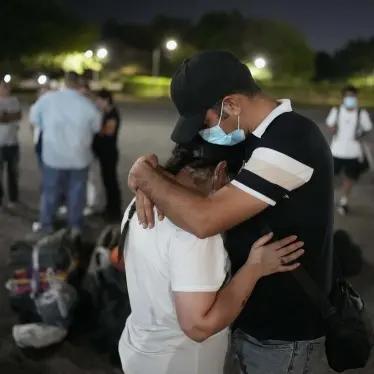
*Image: Migrants from Central America embrace after crossing into the United States (U.S.– Panama border, 2024). This illustrates that many asylum-seekers are families fleeing danger, not criminals. (Source: Human Rights Watch)
90
Approaches to Countering Immigrant Scapegoating
Combating anti-immigrant sentiment involves reshaping narratives and policies. Broadly, solutions focus on education, inclusion, and fair policy enforcement:
• Fact-based Public Messaging: Governments and media can highlight the
positive contributions of immigrants. For example, official reports and think-
tank analyses show that immigrants often pay more in taxes than they
consume in public services over the long term, and that they create jobs by
starting businesses. Public awareness campaigns (akin to past efforts on HIV or
trade facts) can debunk myths. Media outlets and educators should emphasize
stories of immigrant families, veterans, and entrepreneurs to humanize
immigrants. (For instance, in some Latin American countries migrating to the
U.S., children reuniting at the border reinforce that many migrants are family-
oriented refugees, not the “invasion” portrayed in rhetoric.)
• Inclusive Integration Policies: When newcomers are well integrated,
scapegoating tends to diminish. This means investing in language and civics
classes, education, and job training for immigrants – a practice used in
countries like Germany and Canada. Germany’s Integrationskurse (integration
courses) include German language and cultural orientation to help migrants
assimilate, which many experts cite as a model. Canada’s official
multiculturalism policy, which provides settlement services and encourages
expression of cultural identity within a Canadian framework, is often pointed to
as helping maintain social cohesion (public opinion on immigration remains
more positive there than in many European countries). Making legal
immigration more accessible and providing clear pathways to citizenship (for
example, for high-skilled workers or long-term residents) can also reduce
underground flows and remove the sense of permanent “otherness.”
• Community Engagement and Enforcement: Policies should build trust
between immigrant communities and authorities. For example, “sanctuary city”
policies protect immigrant cooperation with police by keeping local law
enforcement separate from federal immigration enforcement; law enforcement
officials argue this increases crime reporting and safety. Tough border
enforcement can be paired with due process for asylum-seekers so that the
public sees a balance of security and compassion, reducing fear. It is also
important to strictly enforce laws against hate crimes and hate speech: many
European democracies criminalize inflammatory scapegoating (Germany bans
Nazi-like language, for instance). Denouncing high-profile scapegoaters legally
can set a norm that immigrant-bashing is unacceptable.
• Grassroots and Cultural Efforts: Civic groups and religious organizations
often bridge divides. Dialogues between native-born and immigrant
communities – in churches, mosques, or civic halls – can dispel rumors and
build empathy. Schools can teach the history of immigration and its role in
91
America’s development. Media diversity helps too: having immigrant voices in
newsrooms and on public broadcasts provides alternative viewpoints. Policing
the internet to remove clearly false rumors (e.g. that 98% of immigrants
commit violent crime, etc.) can slow hateful viral narratives.
Table 3: International Examples of Combating Xenophobia
Country/Strategy Description Example
Integration courses + strict hate Provides free language classes; Strafgesetzbuch §130
Germany speech laws penalizes incitement.
Official multiculturalism + skills Emphasizes immigrant contributions; high public
Canada immigration (points system) support.
Local integration programs + social Municipal “welcome programs” for refugees; broad
Sweden/Norway trust policies social welfare lessens competition fears.
Bilingual/bicultural education + Immigrants take civics/language tests; success is
Malaysia/Singapore compulsory integration exams debated but formalized.
Government emphasizes overseas Filipino workers’
Philippines Global diaspora narrative remittances, countering stigma.
Overall, reducing polarization and countering scapegoating both require restoring accurate, empathetic political discourse. In polarization’s case, that means institutional checks (like fair districts and open primaries) and a culture of moderation. In the immigration debate, it means replacing fear-based myths with facts and human stories, and enacting fair policies that treat immigrants with dignity. Both challenges benefit from civic engagement and leadership that rewards unity over division.
92
Democracy Index: Norway vs.
United States – A Comparative
Analysis
Note from the editor:
This overview shows data from 2023. Norway tops the list at number 1, while the United States is down to 29th place. After Trump came back to power in the United States in 2025, the country has quickly fallen further down the list.
Overview of the Democracy Index and Rankings
The Economist Intelligence Unit (EIU) publishes an annual Democracy Index that scores countries (0–10) across five categories – electoral process and pluralism, functioning of government, political participation, political culture, and civil
libertieseconomist.com. Based on these scores, nations are classified as “full democracies” (scores 8.01–10), “flawed democracies” (6.01–8.00), “hybrid
regimes”, or “authoritarian regimes”worldpopulationreview.com. In the most recent index (2023), Norway ranks #1 with an overall score of 9.81 (the highest in the world),
making it the top-rated full democracyindvstrvs.orgworldpopulationreview.com. By contrast, the United States scores 7.85 (ranked 29th globally), classifying it as a flawed
democracyworldpopulationreview.com. The sections below explain why Norway tops the index and compare its performance to that of the United States, highlighting key differences in each category.
Norway – Why It Ranks #1 in Democracy
Norway has been the world’s highest-ranked democracy for years, owing to
exceptionally strong performance in all five index categoriesindvstrvs.org. It consistently scores near the maximum in each aspect of democratic governance. Key factors contributing to Norway’s top ranking include:
• Electoral Process and Pluralism: Norway’s elections are free, fair, and
inclusive, with a high degree of pluralism. It employs proportional
representation, ensuring that multiple parties are represented in the Storting
(parliament). There are no significant barriers to voting or political
candidacy, and electoral integrity is well protected. As a result, Norway earned
a indvstrvs.orgworldpopulationreview.com perfect 10.00/10 in this category. (By
93
comparison, Freedom House also notes that Norwegian elections are fully
free and power regularly alternates between parties in governmentfreedomhouse.org.)
• Functioning of Government: The Norwegian government
operates efficiently and transparently, with high public trust in institutions
and low levels of corruption. Consensus-based politics and coalition
governance are common, leading to effective policy-making and
implementation. Norway scored about 9.64/10 on government functioning
d1qqtien6gys07.cloudfront.net, one of the highest scores globally. This reflects a well-
functioning system with strong checks and balances, accountability, and public
confidence in governance.
• Political Participation: Citizen participation in Norway’s democracy is robust
and widespread. Voter turnout is typically high (around 75–80% in recent
national electionsfreedomhouse.org), and there is broad engagement in civic and
political life. Both men and women, and various social groups, are actively
involved in politics, whether through voting, party membership, or public
debate. Norway received a perfect 10.00/10 for political participationindvstrvs.org
worldpopulationreview.com, indicating that political engagement is near-universal and
accessible.
• Political Culture: Norway exhibits a strong democratic political culture,
meaning that public attitudes overwhelmingly support democracy and
reject authoritarian alternatives. There is high societal trust and acceptance of
core democratic values such as tolerance, pluralism, and respect for the rule of
law. Surveys find minimal appetite in Norway for non-democratic governance
(e.g. military rule or strongman leaders). Accordingly, Norway
scores 10.00/10 on political cultureindvstrvs.orgworldpopulationreview.com – a reflection of
Norwegians’ deep commitment to democratic norms and institutions.
• Civil Liberties: Norwegians enjoy extensive civil liberties and protections for
fundamental rights. Freedoms of expression, association, religion, and
assembly are well-respected. The press is free and independent, and civil
society organizations operate without undue restrictions. Law enforcement
generally respects due process and individual rights. Norway
scored d1qqtien6gys07.cloudfront.net 9.41/10 in civil liberties, among the highest in the
world. (For context, Freedom House rates Norway as “Free”, highlighting that
civil liberties are respected and independent media and NGOs hold the
government to accountfreedomhouse.org.) The slightly non-perfect score in this
category may reflect minor issues (for example, Norway has laws against hate
speech that balance free expression with protecting minorities), but overall civil
freedoms in Norway are exemplary.
In sum, Norway’s democracy is exceptional across the board. It is a “full
democracy” worldpopulationreview.com with an overall score of 9.81 out of 10. This indicates that Norway has almost no democratic deficits: its elections are fully free and fair, its governance is effective, citizen participation and political trust are very high, and
94
individual liberties are strongly protected. These strengths explain why Norway
remains the top-ranked country in the Democracy Indexindvstrvs.org.
Comparison: Norway vs. the United States
Despite both being long-established democracies, Norway and the United States diverge significantly in their Democracy Index scores and rankings. The United States is rated lower in every category, reflecting certain democratic challenges not present in Norway. The table below summarizes the latest Democracy Index (2023) scores for key metrics in Norway and the U.S. side by side:
Democratic Indicator Norway (Score) United States (Score)
Overall Score 9.81 (Rank 1)worldpopulationreview.com 7.85 (Rank 29)worldpopulationreview.com
Regime Classification Full Democracyworldpopulationreview.com Flawed Democracyworldpopulationreview.com
Electoral Process & Pluralism 10.00worldpopulationreview.com 9.17worldpopulationreview.com
Functioning of Government 9.64d1qqtien6gys07.cloudfront.net 6.43worldpopulationreview.com
Political Participation 10.00worldpopulationreview.com 8.89worldpopulationreview.com
Political Culture 10.00worldpopulationreview.com 6.25worldpopulationreview.com
Civil Liberties 9.41d1qqtien6gys07.cloudfront.net 8.53worldpopulationreview.com
Table: Democracy Index 2023 scores for Norway and the United States across key
categories. Sources: EIU Democracy Index 2023d1qqtien6gys07.cloudfront.networldpopulationreview.com.
As shown above, Norway outperforms the United States on every metric. Both countries hold regular elections and uphold core democratic institutions, but the magnitude of differences in scores highlights how much more consolidated Norway’s democracy is compared to the U.S. Below are the main differences in democratic development between the two countries, corresponding to each category:
• Electoral Process and Pluralism: Free and fair elections are a hallmark in both
nations, but Norway’s electoral system ensures broader representation.
Norway uses nationwide proportional representation, resulting in multiparty
inclusion and few wasted votes, which contributes to its 10/10 score. The
United States, with a 9.17/10 in this category, still has a strong electoral
process but faces issues that Norway largely avoids. For example, the U.S.
95
presidential elections are influenced by the Electoral College (which can
diverge from the popular vote) and partisan gerrymandering in legislative
districts, which can skew representation. Additionally, voting rights in the U.S.
have some friction (e.g. varying ID laws, fewer viable parties), whereas
Norway’s system makes voting straightforward and highly accessible. These
factors give Norway a slight edge in electoral integrity and pluralism
worldpopulationreview.comworldpopulationreview.com.
• Functioning of Government: This is one of the biggest gaps between the two
countries. Norway’s government functions with a high degree of efficiency,
consensus, and public confidence (score 9.64), while the U.S. score is much
lower ( worldpopulationreview.com 6.43 ). In Norway, coalition governments and cross-party
cooperation are common, and there is strong accountability with relatively
low corruption. In contrast, the U.S. has struggled with political gridlock and
polarization – for instance, frequent deadlocks between the executive and
legislature, government shutdowns, and partisan conflicts that hinder policy-
making. Public trust in the U.S. federal government is comparatively low, and
concerns about lobbyist influence and transparency persistaxios.com. According
to the EIU, issues like dysfunctional governance, lack of accountability, and
partisan division undermine the functioning of government in the U.S.axios.com,
explaining why the U.S. falls into the “flawed” category. Norway’s ability to
implement decisions effectively and maintain public trust stands in stark
contrast to these challenges.
• Political Participation: Both countries have an engaged citizenry, but Norway
achieves a perfect 10 while the U.S. scores 8.89worldpopulationreview.com. Norway’s
higher mark reflects slightly higher and more universal voter
participation and civic engagement. Voting in Norway is easy and turnout is
consistently high (around 78% in recent elections) with minimal barriers to
participation. The United States has also seen improved political participation
in recent years – notably, the 2020 U.S. election had the highest turnout in
over a century (about 66% of eligible voters) and overall U.S. participation
levels are among the highest in the world freedomhouse.orgindvstrvs.org. In fact, the EIU
noted North America’s political engagement (driven by the U.S.) remains at
a indvstrvs.org world-leading level of 8.89. However, the U.S. still lags Norway due
to factors like lower turnout in midterm elections, socio-economic disparities
in voting rates, and obstacles such as voter registration hurdles. Norway’s
culture of participation is more uniformly strong, whereas in the U.S.
participation, while vigorous, is not as universal.
• Political Culture: This category reveals a stark difference: Norway scores 10.0,
versus worldpopulationreview.com 6.25 for the U.S.. Political culture measures the
population’s support for democracy and the degree of polarization or
extremism in society. Norway’s perfect score indicates an almost universal
commitment to democratic values and acceptance of the democratic process.
The United States, on the other hand, has experienced eroding consensus on
96
democratic norms. Public trust in institutions and elections has declined in
the U.S., and surveys show a segment of Americans express openness to
undemocratic alternatives or conspiracy theories (for example, questioning
election legitimacy)axios.com. The violent contestation of the 2020 election
outcome (the Capitol riot of January 6, 2021) and ongoing polarization are
symptomatic of a political culture under strain. The EIU notes that low social
cohesion, deep partisan polarization, and growing cynicism in the U.S.
have hurt its political culture scoreaxios.com. In Norway, by contrast, there is broad
social trust and acceptance of political outcomes, so such challenges are
minimal or absent. This difference in political culture is a major factor
distinguishing a “full” democracy like Norway from a “flawed” democracy like
the U.S.
• Civil Liberties: Both Norway and the United States uphold a wide range of
civil liberties, but Norway’s safeguards are slightly stronger in practice. Norway
scores 9.41 in this category, ahead of the U.S.’s 8.53d1qqtien6gys07.cloudfront.net
worldpopulationreview.com. In Norway, freedoms of speech, religion, association, and the
press are not only legally protected but also highly respected in society. The
media environment in Norway is less polarized and generally free of the
intense partisan pressure seen in the U.S. The United States also
constitutionally guarantees core liberties and has a vibrant free press, but
certain issues lower its score: for example, higher levels of gun violence and
incarceration, debates over mass surveillance and privacy (e.g. post-9/11
security measures), and recent attempts at book bans or restrictions at the
state level can signal stresses on civil liberties. Additionally, during crises like
the COVID-19 pandemic, the U.S. saw contentious disputes over balancing
public health and individual rights. Norway managed such issues with high
trust and compliance, maintaining a strong civil liberty record. Overall, while
both countries remain free societies, Norway’s civil liberties are marginally
more comprehensive, contributing to its superior score.
Conclusion
In summary, Norway stands as the world’s strongest democracy in the EIU index due to its exemplary performance across all democratic dimensions – from flawless elections and highly effective governance to an engaged public, a deeply rooted democratic culture, and extensive freedoms. The United States, although a longtime democracy with solid institutions, falls short in several areas (notably in government functioning and political culture) and is thus rated a “flawed democracy.” Norway’s experience highlights the value of broad political consensus, social trust, and inclusive institutions in sustaining a full democracy. The United States, by comparison, faces ongoing challenges such as partisan polarization, lower institutional trust, and policy gridlock that have hindered its democratic development
97
in recent yearsaxios.com. Nevertheless, the U.S. continues to have strengths like competitive elections and active civic participation, which could help it improve its democratic health if reforms address its shortcomings.
By examining the Democracy Index’s detailed scores, we clearly see that Norway outpaces the United States on every core metric of democracy – a gap that underlines the importance of not just having democratic institutions on paper, but ensuring they function well and enjoy public legitimacy. Norway’s top ranking reflects a democracy that is truly comprehensive and resilient, setting a benchmark for other nations, while the U.S. ranking reveals areas where even an
established democracy must continually strive to strengthen its foundations indvstrvs.org
98
Comparison of the Nordic Model vs
the United States
Note from the editor:
In my opinion Happiness and Quality of Life (which is the last point in this chapter) is the most important indicator for a society. It has been said that the measure of a good society is how well it takes care of the "weakest" in a society. Here, the Nordic countries score high, and this may be an important reason why the Nordics are repeatedly
measured among the happiest countries in the world. Here is a short video that explains a little about why the countries in the North (with a focus on Finland) score so high.
Economic Performance
The Nordic economies (Sweden, Norway, Denmark, and Finland) are small but wealthy, with GDP per capita levels comparable to high-income countries like the U.S. In 2023, Norway’s GDP per capita was about $88,000 – one of the highest in the
world – while Sweden’s was around $55,000 and Finland’s about $53,000worldometers.info
worldometers.info. Denmark also ranks among the top economies with roughly $68,000 per
capita incomeworldometers.info. For comparison, the United States had a GDP per capita of
approximately worldometers.info $80,700 in 2023, falling between Norway’s exceptional level and the other Nordics. In other words, Norway (boosted by oil wealth) slightly outpaces the U.S. in output per person, while Sweden, Finland, and Denmark are somewhat lower, though still very affluent by global standards
Unemployment rates in the Nordic region tend to be low, akin to U.S. levels, except
in a couple of cases. Norway’s unemployment was only statista.com ~3.6% in 2023 –
virtually identical to the bls.gov 3.6% unemployment rate of the United States that year.
Denmark also managed low joblessness around statista.com 5.1% in 2023. Finland and
Sweden, however, saw higher unemployment at statista.comstatista.com 7 – 8% in 2023 (Sweden’s
was about 7.6% on averagestatista.com). Even so, these rates are not far above the broader European average, and Sweden’s spike owes partly to more immigrants and youth in the labor force. The U.S. labor market has been very tight recently, hitting
multi-decade low unemployment around 3.5–3.7%bls.gov, so by that measure America slightly led the Nordics except Norway. All Nordic countries have “flexicurity”-style labor policies that promote flexibility for employers to hire and fire, but with strong social safety nets to support workers (see Social Welfare section).
99
In terms of productivity, both the Nordics and the U.S. are highly productive economies. Norway in particular stands out with one of the world’s highest
outputs qery.no per hour worked , thanks in part to its capital-intensive oil sector. Indeed, OECD comparisons show Norway and Ireland at the top of labor productivity rankings (Norway’s GDP per hour was about 50% above the OECD
average in 2022)qery.no. The United States also has very high productivity – roughly $77–$80 in output per hour in recent estimates – placing it near the top of
OECD countries qery.no. Sweden, Denmark, and Finland have slightly lower productivity levels than the U.S. or Norway, but still above the OECD average (e.g. Sweden’s productivity is roughly on par with Germany’s) and have narrow productivity gaps across industries. Overall, all the Nordic economies are “advanced economies” with strong GDP per capita and productivity, fully in the same league as the U.S.
on these metricsoecdstatistics.blogoecdstatistics.blog.
Income and Wealth Inequality
A hallmark of the Nordic model is its low income inequality compared to most countries. After taxes and transfers, the Gini coefficient (where 0 = perfect equality, 1 = max inequality) in Nordic countries lies in the 0.25–0.30 range. For example,
Denmark’s Gini is about 0.28 and Finland’s 0.27 in recent yearscia.gov. Sweden and
Norway are only slightly higher (~0.28–0.30)cia.govcia.gov. In contrast, the United States has a much higher income inequality, with a Gini around 0.41 in 2022 (one of the
highest among developed nations)cia.gov. This means the U.S. income distribution is far more unequal – roughly the U.S. Gini is 10–15 points higher than in Sweden or
Denmark, indicating significantly greater income gapscia.govcia.gov. The difference reflects the redistributive policies of the Nordics: they use taxes and social benefits to compress after-tax income differences. By one estimate, the ratio of richest 10% to poorest 10% incomes is about 5:1 in the Nordics vs. 18:1 in the U.S. (OECD data). Consequently, poverty rates in Nordic countries are among the lowest in the OECD, while the U.S. has one of the highest relative poverty rates. In summary, Nordic societies are far more equal in income – a direct outcome of the Nordic model’s
emphasis on egalitarianism nber.org.