

I’ll Be Back by Henning Jon Grini - HTML preview
Download the book in PDF, ePub, Kindle for a complete version.
When it comes to wealth inequality, the picture is a bit different. Private wealth (assets like savings, stocks, real estate) is highly concentrated at the top in both the U.S. and the Nordics. In fact, Nordic countries actually exhibit very high wealth Gini coefficients (around 0.75–0.85) – comparable to or even exceeding
U.S. levels advisors.ubs.com. According to Credit Suisse data, the average wealth Gini in Sweden, Norway, Denmark, and Finland is ~0.78 (with 1.0 meaning one person
holds all wealth)advisors.ubs.com. Sweden has the most unequal wealth distribution of the
group (wealth Gini advisors.ubs.com 0.87 , and the top 1% owns ~36% of Sweden’s wealth ),
100
which is about the same as the top 1% share in America (around 35%). Denmark
and Finland, while a bit less extreme, still have wealth Ginis above 0.70advisors.ubs.com. The United States’ wealth Gini is roughly 0.85 (one of the highest globally), so in pure statistical terms, private wealth inequality in the Nordics is in the same ballpark
as in the U.S. advisors.ubs.com.
However, context is crucial: Nordic citizens rely more on robust public welfare (pensions, healthcare, education), so they need to personally accumulate less
wealth for retirement or emergenciesadvisors.ubs.com. Middle-class Danes or Swedes may have lower private savings (and more of their wealth in heavily taxed pensions or
home equity), which mathematically drives up measured wealth inequality advisors.ubs.com. At the same time, Nordic governments hold substantial public wealth (e.g. Norway’s sovereign wealth fund is over $1.3 trillion, equivalent to 300% of GDP)
peoplespolicyproject.org. If one considers net social welfare (public + private wealth), the Nordics achieve far more equality in life outcomes than the raw wealth Gini suggests. In the U.S., by contrast, individuals must save for college, healthcare, and retirement largely on their own, and many cannot – leading to a smaller middle class nest egg and extreme wealth held by the top. In short, Nordic income inequality is very low
compared to the U.S.cia.govcia.gov, and while both systems show high wealth concentration at the top, the Nordic model mitigates the impacts of wealth
inequality through universal public provisionsadvisors.ubs.com.
Healthcare Systems
All Nordic countries have universal healthcare systems that provide coverage to all residents as a right. Access: This stands in stark contrast to the United States, which (despite recent gains from the Affordable Care Act) still had about 8% of its
population uninsured in 2022aspe.hhs.gov. In practical terms, a Swedish or Norwegian citizen has automatic health coverage from birth, whereas roughly 27 million Americans lack any health insurance and many more face high out-of-pocket costs. The U.S. is the only wealthy nation without universal health coverage . Nordic systems are mostly tax-funded single-payer or highly regulated public-private hybrids: for example, Denmark and Norway have predominantly government-run hospital systems, while Finland and Sweden have decentralized public providers. Americans, by comparison, rely on a mix of private insurance (often employer-based), Medicare/Medicaid for the elderly and poor, and a sizable uninsured segment – leading to gaps in access.
101
Health outcomes in the Nordic region are among the best in the world, and notably better than U.S. outcomes on average. Life expectancy at birth in Sweden
and Norway is about worldometers.infomacrotrends.net 82 – 83 years (even after a slight COVID-era
decline), and similar in Finland and Denmark (~81 macrotrends.netcountryeconomy.com – 82 years). In the United States, life expectancy has fallen in recent years, standing around 76–77
years worldometers.infocia.gov in 2022 – a significant 5+ year gap compared to Nordic averages. This gap in longevity is often attributed to higher U.S. rates of infant mortality, chronic disease, opioid overdoses, and homicides, as well as unequal access to care.
Indeed, the cia.gov infant mortality rate in the U.S. is about 5.1 per 1,000 live births,
more than double the rate in Finland or Norway (which have ~2 infant deaths per
1,000cia.govcia.gov cia.govcia.gov ). Sweden’s infant mortality is around 2.0 – 2.3 per 1,000, whereas the U.S. rate, while improved from past decades, is still high for a rich country. Other health indicators tell a similar story: rates of heart disease, obesity, and diabetes are lower in the Nordics, and measures like hospital admissions for preventable causes are better. The Nordic healthcare systems achieve generally superior health outcomes and higher patient satisfaction, with no one left unable to afford care, unlike the U.S. where medical bills can bankrupt patients despite the higher spending.
Costs: The United States notably spends far more on healthcare than any other nation. U.S. health expenditure is about 16.5–17.8% of GDP (post-pandemic)
commonwealthfund.orghealthsystemtracker.org, nearly double the OECD average. In 2023 the U.S. spent $13,432 per person on health care, which was $3,700 more than any other high-
income countryhealthsystemtracker.org. By comparison, the Nordic countries spend around 9– 11% of GDP on health. For example, Sweden spends ~11.2% of GDP on health
(close to the EU average)oecd.org, and Finland ~10%data.worldbank.org. Denmark and Norway are in between (~10–11%). In per capita terms, Nordic health spending is roughly
$5,000–$7,000 PPP per person, about half the U.S. levelhealthsystemtracker.org. Despite the lower cost, coverage is universal and care outcomes are strong, indicating the Nordics achieve much greater efficiency. The U.S. system’s notorious inefficiencies (administrative costs, higher drug/hospital prices, etc.) mean Americans pay more for
often comparable or worse outcomescommonwealthfund.org. It’s often noted that the U.S. “pays twice as much for care” but has lower life expectancy and higher infant
mortality than the Nordics worldometers.infocia.gov.
In summary, Nordic healthcare is accessible to everyone, delivered at lower cost, and yields generally better public health metrics. The U.S. excels in certain cutting-edge medical treatments and has world-leading hospitals, but its lack of universal access and high costs cause overall performance to lag. Nordic citizens do face some issues like wait times for elective procedures, but basic care, emergency services, and essential treatments are guaranteed free or very low-cost. The trade-off
102
is funding through higher taxes, but as we’ll see in Taxation, those taxes buy extensive health security for the populace. Overall, healthcare is a clear example of the Nordic model’s emphasis on universal welfare versus the U.S. emphasis on individual responsibility and market-driven provision.
Education Systems
Access and structure: Nordic education systems are highly accessible and publicly financed from preschool through university. All four Nordic countries offer tuition-free education not just for primary and secondary school (as is standard in most nations) but also for college and graduate studies for their citizens. For instance, Denmark, Sweden, and Norway charge no tuition at public universities and even provide government stipends to students for living
expensestheworld.orgtheworld.org. A Danish university student can receive around $800 per
month from the government to help cover rent and foodtheworld.orgtheworld.org – effectively, students are paid to study as if it were a job. As a result, Nordic students typically
graduate without burdensome debttheworld.orgtheworld.org. In Finland and Norway, loans are available but used sparingly, and any loans are low-interest with long repayment
horizons backed by the statetheworld.orgtheworld.org. By contrast, the United States has the most expensive higher education in the world: public universities often charge sizable tuition (average ~$10,000 per year in-state, more for out-of-state) and private colleges can cost $30k–$50k+ per year. Most American students rely on personal or family funds and student loans. Consequently, American graduates commonly carry significant student debt – as of 2023, about 43 million Americans owed over $1.7 trillion in student loans, with an average debt of ~$30,000 per borrower. The U.S. and UK thus produce graduates with the highest student debt levels globally
theworld.org, whereas Nordic graduates typically owe little or nothing (fewer than 5%
of Danish students take any loans at all)theworld.orgtheworld.org. This stark difference stems from the Nordic belief that higher education is a public good, vs. the more market-driven U.S. approach.
Quality and performance: Despite free access, Nordic countries consistently rank among the best in educational outcomes. Finland, in particular, has a global reputation for excellence in K–12 education. Finnish 15-year-olds have historically scored at or near the top of PISA (Programme for International Student Assessment) in reading, math, and science – e.g. Finland scored 520 in reading
(OECD #1 tie) in PISA 2018julkaisut.valtioneuvosto.fi. (Finland’s scores have dipped slightly in
recent years but remain high nea.org.) Other Nordics like Estonia, which follows a similar model, and Sweden also perform above the OECD average on PISA.
103
Sweden’s performance declined in the early 2000s but has stabilized after reforms. Overall, Nordic students tend to have strong fundamentals, low performance variation between schools, and high equity (relatively small achievement gaps). By comparison, U.S. students perform around the OECD average on PISA. In 2018, the U.S. was mid-pack (rank ~25-30) in math and science, and above average in
reading, but well behind the Nordics and East Asian economiesnea.org. The U.S. has many excellent schools and top-tier universities; however, K–12 quality is uneven, tied to local funding disparities. Nordic public schools are more uniformly high-quality, with national curricula, well-paid teachers, and a strong emphasis on equal opportunity (e.g. Finnish schools offer extra help to struggling students, keeping variance low).
Cost and funding: Nordic countries invest heavily in education as a share of GDP, similar to or higher than the U.S. All Nordics provide universal preschool or heavily subsidized childcare from an early age (parents usually pay a small fee capped by income). This means virtually all children enter primary school with some formal early education. In higher education, because it’s taxpayer-funded, per-student spending in Nordics is high and infrastructure is well-maintained – though universities are generally less plush than elite U.S. campuses. U.S. education spending per student is among the highest at the K–12 level, but the funding is inequitably distributed (rich districts vs. poor districts). At the college level, U.S. public funding is lower, pushing costs to students.
Outcomes: Nordic countries have very high tertiary education attainment rates (e.g. over 40% of young adults have a college degree in Finland and Denmark), comparable to the U.S. (which is around 45%). Notably, Nordic graduates enter the workforce without student debt burdens, enabling them to start families or buy
homes earlier on averagetheworld.org. The U.S. system produces world-class research and top universities, attracting international students (including Nordics), but it also leaves many Americans behind due to cost. In summary, the Nordic model offers free, equitable education from pre-K through college, resulting in strong performance and social mobility, whereas the U.S. offers high-quality education for some but at the cost of high tuition and inequality in access.
Social Welfare and Safety Nets
The Nordic social welfare system is famously comprehensive, providing a wide safety net “from cradle to grave.” Public social expenditures (government spending on welfare programs, pensions, healthcare, etc.) are among the highest in the
world: weforum.org Nordic countries spend over 25% of GDP on social services. In 2019, Finland spent 29% of GDP on social benefits, and Denmark, Sweden, Norway
each spent weforum.org around 25 – 28%. This is well above the OECD average (~20%), and significantly higher than the United States, which spends roughly 18–20% of
104
GDP publicly on social programs (around the OECD average)weforum.orgweforum.org. In
fact, France was the only country higher than the Nordics, at ~31% of GDPweforum.org. The U.S. appears lower in public social spending, but if one includes certain private expenditures (like employer health insurance and private pensions), U.S. “net social
spending” approaches 30% of GDP oecd.org. Even so, the coverage and generosity of benefits differ vastly.
Key features of the Nordic welfare model include: Universal child allowances, subsidized daycare, generous paid leave for new parents, free education, unemployment insurance, disability and sickness benefits, and universal pensions. For example, parental leave in Sweden is about 16 months (480 days) per child, with a high percentage of your salary paid, which parents can split between mothers and fathers. Norway offers ~49 weeks at full pay (or 59 weeks at 80% pay) for parental leave. Denmark guarantees at least 52 weeks of parental leave (with a mix of maternity, paternity, and shared leave) with most of it paid via the social insurance system. Finland similarly provides nearly a year of paid leave. By contrast, the **United States has no federal paid maternity or paternity leave mandate – new parents often rely on a patchwork of employer policies or must take unpaid leave under the limited Family and Medical Leave Act. This is a stark difference: a Nordic mother can expect ~$/year of paid leave to care for a baby, whereas an American mother often must return to work in a few weeks or leave the labor force (only some states or progressive companies offer paid leave).
Another aspect is unemployment benefits. Nordic countries have generous unemployment insurance schemes (often union-administered in the “Ghent system”). A laid-off worker in Denmark, for instance, can get up to 90% of previous earnings (capped) for a period (2 years, with active job-seeking requirements) – this softens the blow of job loss. Sweden and Finland offer ~80% of previous income for the first 200 days of unemployment, etc. In the U.S., unemployment benefits replace only about 30–50% of wages and typically last 6 months or less , varying by state. The Nordic “flexicurity” approach means it’s easier for firms to adjust the workforce, but workers have security and retraining opportunities funded by the state.
Healthcare and eldercare are also major parts of the safety net (covered in Healthcare section) – essentially free at point of use in Nordics. Childcare: Nordics heavily subsidize daycare/preschool, often capped at around 5–15% of household income. As a result, most Nordic children attend high-quality daycare and both parents can work (female workforce participation is very high). The U.S. has comparatively scant childcare support; many families face daycare costs that rival college tuition, or one parent (often the mother) drops out of work due to childcare costs.
105
Pensions: The Nordics have universal basic pensions plus earnings-related schemes – ensuring virtually all elderly are above the poverty line. Elderly poverty is very low in Scandinavia, whereas in the U.S., Social Security provides a base but many retirees struggle without additional savings.
The outcomes of this broad welfare state are evident: Nordic countries consistently have some of the lowest poverty and inequality rates in the world. Social mobility is high (a child’s income correlates less with their parents’ income than in the U.S.). Citizens enjoy a high degree of economic security – losing a job or falling ill in a Nordic country will not typically result in destitution or bankruptcy, thanks to the safety net. By contrast, while the U.S. does have programs (Social Security, Medicare for seniors, Medicaid for the poor, food stamps, etc.), its welfare system is more targeted and means-tested, often with strict eligibility. The U.S. tends to provide relief primarily to the very poor or elderly, whereas Nordic welfare is more
universal (benefiting the middle class as well as the poor) by designtaxfoundation.org.
One illustrative metric: Denmark, Norway, and Sweden all rank at or near the top in social mobility and absence of poverty, with relative poverty rates (share below 50% median income) around 5-8%, whereas the U.S. relative poverty rate is about 17% (one of the highest in OECD). These differences reflect choices: Nordic countries tax more and spend more on social support, resulting in a stronger safety net and less economic hardship, while the U.S. opts for lower taxes and spending, leaving more to individual responsibility and the private sector.
Taxation
To fund their extensive welfare states, Nordic countries impose significantly higher taxes on their populations than the United States does. The overall tax burden (total tax revenue as a percentage of GDP) in the Nordics is almost twice that of the U.S. Specifically, in 2021 the tax-to-GDP ratios were 46.9% in Denmark, ~42% in
Sweden and Norway taxfoundation.org (and around 42% in Finland as well), compared to
only taxfoundation.org ~24.5% in the United States. Even among advanced economies, the Nordics are at the high end of taxation: by 2022 Denmark’s ratio was one of the highest globally. The U.S. tax ratio (~25%) is the lowest of the G7 economies and well below the OECD average (~34%). This fundamental difference underscores that Nordic citizens contribute a larger share of national income to the public coffers in exchange for the broad services provided.
106
Tax structure differs in important ways. Nordic tax systems rely heavily on broad-based taxes like VAT (Value-Added Tax) and social contributions, in addition to high income taxes. All Nordic countries have a hefty VAT of ~25% on most goods and services (a form of national sales tax) which generates a large portion of revenue
taxfoundation.org. The U.S. has no federal VAT and only state-level sales taxes (typically 5– 10%), meaning consumption is taxed more lightly. Personal income taxes in the Nordics are progressive and reach high marginal rates relatively quickly. For example, Sweden’s top national income tax rate is 20% on top of municipal income tax ~32%, giving ~52% marginal tax on high earners (Denmark’s top rate is even a bit higher ~55%, Norway ~47%). The United States’ top federal income tax rate is 37%, and including average state taxes (~5%) yields ~42% – still lower than Nordic levels. Moreover, the U.S. top rate kicks in at a much higher income (hundreds of thousands of dollars) compared to Nordic top brackets. This means upper-middle-class households in Nordics pay a higher effective tax share than equivalent U.S. households.
On the other hand, Nordic countries tend to have lower tax on corporations and investments relative to the U.S. historically, to encourage business (though this gap has narrowed after the U.S. cut corporate tax to 21%). And importantly, Nordic taxation is not just about soaking the rich – it’s often said the Nordic model relies on taxing everyone, including the middle class, quite highly. For instance, payroll taxes (for pensions, unemployment insurance, etc.) and the VAT affect virtually all workers and consumers. In Denmark, Norway, and Sweden, even average workers face income tax rates around 30-35%, plus 25% VAT on consumption, whereas in the U.S. a middle-income worker might pay ~12% federal income tax, maybe ~7% payroll (after deductions/credits), and ~0–10% sales tax. The trade-off is that in Nordics those taxes directly fund benefits that Americans must often purchase privately (healthcare, college, retirement savings, etc.).
Social security contributions (payroll taxes) are another piece: In Sweden and Norway, employers and employees pay significant payroll levies (in Sweden, ~31% employer social fee on salaries, in Finland ~20%, etc.) to fund universal benefits. The U.S. has a 15.3% payroll tax (split between employer/employee) for Social Security and Medicare, but no more for things like universal childcare or paid leave (which are funded by general taxation or not provided).
The result is that Nordic citizens bear a higher overall tax “burden” but receive many services in return, while Americans keep more of their paycheck but must
107
individually pay for services or go without. As the Tax Foundation notes, “high levels
of government spending naturally require high levels of taxation”taxfoundation.org – the Nordics illustrate this clearly. The public attitude toward taxes also differs: there is generally broad acceptance in Nordic countries of the high-tax/high-service social contract (trust in government is relatively high, and tax compliance is good), whereas in the U.S., low taxes are often valued for fostering personal freedom and private enterprise.
To summarize, Nordic taxation is characterized by: heavy value-added taxes, high personal income taxes across most income levels, and substantial payroll taxes, along with relatively low tax evasion. The U.S. taxation is characterized by lower rates, a greater reliance on progressive income tax on the wealthy (and on property taxes at the local level), and lower reliance on consumption taxes. Despite the U.S. having a reputation for low taxes, one quirk is that when including things like private health premiums as a de facto “tax”, Americans pay comparably for certain services but via private sector. In any case, the tax burden in Nordic countries (around 42-46% of GDP) far exceeds that in the U.S. (~25%), reflecting
fundamentally different approaches to financing societytaxfoundation.org. Nordic tax policy
prioritizes collective provision funded by broad taxestaxfoundation.org, while the U.S. prioritizes lower taxes and individual choice, with less revenue for public programs.
Labor Market and Work–Life Balance
Nordic labor markets combine strong worker protections and work–life balance with competitive business environments. A key aspect is the high rate of labor union membership and collective bargaining in the Nordic countries. Over 60% of workers in Denmark, Sweden, and Finland belong to unions, and
about 59% in Norwayprogressivepolicy.org. (Iceland is even higher at 90%+ unionized
progressivepolicy.org.) This is the highest unionization in the world. Unions negotiate industry-wide agreements that set wages and working conditions, resulting in relatively high minimum wages (often by agreement, not law) and generally good labor standards for all. In contrast, only about 10% of American workers are union members (and
just ~6% in the private sector)progressivepolicy.org. The U.S. labor market is far more decentralized – wages and conditions are often set by employers or individual contracts, which contributes to greater wage dispersion (e.g. very low wages for some low-skill jobs in the U.S. versus higher “floor” wages in the Nordics). Despite high unionization, Nordics have flexible labor arrangements – employers can still hire and lay off workers relatively freely (especially in Denmark’s famed “flexicurity” system), but laid-off workers are supported by generous unemployment benefits and retraining. This model results in low labor disputes and cooperation between unions
108
and employers; for instance, union wage moderation has been credited with helping Nordic firms stay competitive internationally.
Working hours and vacations: One of the most striking differences is in work–life balance. Nordic workers enjoy shorter working hours on average and more paid leave. The average full-time employee in Denmark or Norway works about
1,380 worldpopulationreview.comworldpopulationreview.com – 1,420 hours per year. Sweden and Finland are
slightly higher (~1,437 and 1,499 hours/year respectively)worldpopulationreview.com
worldpopulationreview.com. By comparison, the average American worker logs around 1,799
hours annuallyworldpopulationreview.com – roughly 350–400 more hours per year than a
Daneworldpopulationreview.comworldpopulationreview.com. That translates to about 7-8 extra hours per week for U.S. workers, or two extra months of work over a year. Part of this is because paid vacation and holidays are far more generous in the Nordics . All European Union countries, including the Nordics, have legally mandated paid vacation (minimum 4 weeks). In practice, Nordic workers typically get 5 to 6 weeks of paid vacation annually (e.g. Sweden mandates at least 25 paid days off
worldpopulationreview.com, Denmark 25 days, Finland 25–30 days). On top of that are public holidays. The United States has no statutory paid vacation at the federal level – 0 days required by law – so many American workers, especially in lower-wage jobs, have very limited paid time off. The average U.S. full-time worker with paid leave gets around 10 vacation days (2 weeks) after a year on the job, plus perhaps 10 holidays, but a significant number (especially part-time or gig workers) get none. This contributes to Americans working more weeks per year. As the World Population Review notes, countries with a cultural emphasis on leisure (like the Nordics) have shorter workweeks and more vacation, which correlates with higher
reported happinessworldpopulationreview.com.
Work hours per week are also somewhat lower in the Nordics. A full-time workweek is typically 37.5 hours in Finland, 37 hours in Norway, and around 38 hours in Sweden/Denmark, often with flexibility. In the U.S., the nominal full-time week is ~40 hours, and many salaried employees work beyond that (with no overtime pay if they are exempt). Overtime regulations are stricter in Nordic countries, and there is a cultural norm to leave work on time – late evenings or constant weekend work are less common than in some competitive U.S. industries. Additionally, Nordic workers benefit from policies like parental leave (as discussed) and sick leave that allow them to take time off for family or health without losing their job or pay. For instance, if a child is ill, Norwegian or Swedish parents can take paid leave to care for them (VAB in Sweden). The U.S. has far fewer such protections (the FMLA grants only unpaid leave for certain family emergencies, and many workers are not covered by it due to employer size or tenure).
109
Workplace culture and conditions: Thanks to collective agreements, Nordic workers have a strong say in workplace conditions. There are often worker representatives on company boards (cooperative management in e.g. Sweden). Dismissals usually require notice and severance. At the same time, employment is at-will in the U.S. (outside of union or certain contracts), meaning workers can be fired more easily (which companies argue allows agility, but it also causes job insecurity).
Despite working fewer hours, Nordic countries do not suffer in productivity – in fact, productivity per hour is very high. The shorter hours and generous leave arguably contribute to higher labor productivity and better health. The focus on work–life balance in the Nordics is often cited as a reason these countries score high on happiness and life satisfaction. Americans work longer and take fewer vacations, which has its pros (higher total output, possibly higher incomes for some) but also cons in terms of stress and work-life conflict. It’s telling that surveys consistently show Nordics feel they have a good work–life balance (e.g. ~70% in Denmark say they have time for personal life, one of the highest rates, whereas the U.S. is lower).
Labor market outcomes: Unemployment was covered earlier (generally low in both models recently). Another outcome is female labor force participation – it is very high in Nordics (~70%+ of women work, often full-time) partly due to childcare and parental leave policies. In the U.S., female participation is lower (~60%) and many more women work part-time or drop out due to child-rearing. Nordic policies enable both parents to work and share child-raising duties, improving gender equality in the workforce. Wages in the Nordics are more compressed – lower-paid occupations like retail or cleaning pay a livable wage (thanks to unions), whereas the U.S. has a wider gap (the U.S. federal minimum wage, ~$7.25/hour, is far below what a Nordic counterpart would earn, which might be the equivalent of $18–$20/hour through collective agreements).
In summary, Nordic labor markets prioritize a healthy balance between work and personal life, supported by union-negotiated contracts and welfare policies. Americans benefit from a dynamic labor market with lower unemployment and potentially higher top-end earnings, but often at the cost of longer hours, less job security, and fewer guaranteed benefits. The differences
manifest in statistics like annual hours (Nordics ~1.4k vs U.S. ~1.8k)worldpopulationreview.com
worldpopulationreview.com worldpopulationreview.com and guaranteed vacation (5+ weeks vs 0 by law). These factors also feed into the overall quality of life and happiness, as discussed next.
110
Happiness and Quality of Life
By various measures of overall well-being and quality of life, the Nordic countries outperform the United States. Perhaps most famously, the World Happiness Report – which ranks countries by self-reported life satisfaction – has seen Nordic nations consistently in the top ten (often the top five) year after year. In 2025, Finland was ranked #1 happiest country for the eighth year in a row, with an
average life satisfaction score around worldpopulationreview.comaljazeera.com 7.7/10. Denmark was #2, and other Nordics like Iceland (#3) and Sweden (#4) were right at the top as well
data.worldhappiness.reportworldpopulationreview.com. Norway typically also ranks in the top ten (in some years Norway was #3 or #5). In contrast, the **United States fell to 24th place in the
2025 Happiness Index aljazeera.com – its lowest rank on record. (In earlier years the U.S. hovered around 18th or so, but it has slid in rankings.) The report cites factors like social support, healthy life expectancy, freedom, trust, and generosity as
drivers of happinessaljazeera.comaljazeera.com. The Nordics score extremely high on social trust (people trust their neighbors and government) and support (having someone to count on), whereas the U.S. scores lower on those and suffers more from issues like perceived corruption and social fragmentation. The happiness gap is striking: for example, on a scale of 0 to 10, Finns rated their life ~ 7.8, Swedes ~ 7.3, while
Americans were around 6.9data.worldhappiness.reportworldpopulationreview.com. These differences, though seemingly small on a 0–10 scale, are statistically significant across large samples.
Beyond subjective happiness, objective quality-of-life indices also favor the Nordics. The United Nations Human Development Index (HDI), which combines GDP per capita, life expectancy, and education, consistently ranks Norway #1 in the
world (Norway has topped HDI for many years)advisors.ubs.com. Sweden, Denmark, and Finland all rank in the top 15 on HDI, indicating very high human development. The United States ranks high as well (usually around #17 on HDI in recent reports), due to its wealth and education, but if you adjust for inequality (the “HDI inequality-adjusted”), the U.S. falls further behind the Nordics. Life expectancy and health-adjusted life expectancy are better in Nordics; education attainment is high universally (with minimal dropout rates and virtually 100% literacy). Crime rates are lower in the Nordics (e.g. the homicide rate per 100k is around 0.9 in Norway versus 5.3 in the U.S.), and incarceration rates in the U.S. are vastly higher than in any Nordic country.
Another telling measure is the Social Progress Index or the OECD Better Life Index, which aggregate various well-being indicators (housing, safety, work-life, environment, civic engagement, etc.). Nordic countries score at the top on such
111
indexes, reflecting clean environments, low pollution, high civic engagement (voter turnout in Nordic countries is ~70-80% vs ~55% in recent U.S. elections), and overall life satisfaction. The U.S. performs well economically and in some areas like housing space and earnings, but lags in work-life balance, safety, and health. For instance, obesity and related health issues are more prevalent in the U.S., which can detract from quality of life.
It’s also notable that the **Nordics have relatively high levels of personal freedom and social cohesion, which contribute to both happiness and quality of life. Citizens report feeling free to make life choices, and there is a high degree of gender equality and equal opportunity. The U.S. excels in some aspects of quality of life – it has a very high average income, lots of consumer choices, and many top cultural and educational institutions. Many people value the U.S. for its entrepreneurial opportunities and diversity. However, these strengths are offset in international comparisons by issues like income inequality, higher stress, less time off, and concerns about healthcare, safety nets, and social divisions.
In concrete terms, the average person in a Nordic country can expect:
• A healthy, long life (82+ years), with free healthcare and low risk of falling
into poverty due to medical billsworldometers.infocia.gov.
• Free education through college, minimal debt, and strong skills (Nordic
countries have some of the highest literacy and numeracy skills among adults).
• Low crime and a secure environment – for example, cities like Oslo, Helsinki,
Copenhagen routinely rank among the safest and most livable.
• Work-life balance with at least 5 weeks vacation, shorter work days, and
generous family leaves, allowing time for family, hobbies, and rest
• Social trust and cohesion – people generally trust each other and their
institutions; government services are reliable and corruption is very low.
• High gender equality – the Nordics lead in female workforce participation
and representation (e.g. around 45% of parliament members are women, and
policies support dual-earner families).
The average American by contrast has a higher chance of: earning a bit more in absolute terms (U.S. GDP per capita is high), but also working longer hours and having less social protection if things go wrong. The U.S. offers great opportunities for those who succeed (world-leading incomes for top professionals, for instance) and a climate of innovation, but quality of life is more heterogeneous – many enjoy high living standards, while others struggle without robust safety nets.
112
Crucially, happiness surveys capture this balance – Nordic populations, benefiting from economic security and work-life harmony, report higher overall life
satisfactionaljazeera.comaljazeera.com. The U.S., with more economic dynamism but more inequality and insecurity, sees lower average happiness and more stress (e.g. Gallup surveys often find Americans report more daily stress and worry than residents of the Nordics).
International rankings summarize it well. In addition to the Happiness Index and HDI: the 2023 World Happiness Report ranked all four Nordic countries in the top 7 (Finland #1, Denmark #2, Iceland #3, Israel #4, Sweden #6, Norway #7)
data.worldhappiness.reportworldpopulationreview.com. The U.S. was ranked 15th in 2023 and fell to 24th
by 2025aljazeera.com. On the Quality of Life Index (US News/BAV) which considers factors like stability, healthcare, education, Nordics again dominate the top while the U.S. ranks lower due to high cost of living and poor safety nets. These consistent results indicate that the Nordic model, through its combination of economic prosperity, equality, and strong social support, delivers a higher aggregate
quality of life than the American model for most citizensaljazeera.comaljazeera.com.
Conclusion
In conclusion, across these multiple dimensions, the Nordic model demonstrates strong economic performance, low inequality, universal services, and an emphasis on work-life balance and well-being, whereas the United States shows higher output in absolute terms and more top-end wealth, but also greater inequality, higher costs for services, and a more work-centric lifestyle. International data and rankings from the OECD, World Bank, UN, and World Happiness Report consistently reflect these differences – with the Nordics often leading in social outcomes and happiness, and the U.S. leading in sheer size and innovation but lagging in equity and some quality-of-life measures. Each model has its trade-offs, but the comparative analysis illustrates how the Nordic countries have achieved high living standards with robust social support, versus the more market-driven approach in the U.S. that yields wealth alongside
notable social gapsaljazeera.comtaxfoundation.org.
113
From “Soulless” to “Soulful”:
Transforming Society for Meaning
and Connection
Modern life is often critiqued as “soulless” – marked by materialism, hyper-individualism, disconnection from nature, eroding community bonds, and a lack of spiritual depth. How can such a society be transformed into a “soulful” society rich in connection, meaning, and vitality? This report explores four key dimensions of this transformation: (1) philosophical and spiritual perspectives that reorient our values, (2) practical grassroots initiatives and community models, (3) public policy shifts prioritizing well-being and ecology over mere GDP, and (4) cultural changes in media, education, and public discourse to nurture compassion, awe, and community. Each section provides examples and evidence of how a more “soulful” society can be realized, supported by sources.
Philosophical and Spiritual Perspectives for a Soulful
Society

Caption: A bee pollinating a flower – a simple example of interdependence (“interbeing”) in nature. Many spiritual philosophies emphasize that humans are deeply connected to each other and the natural world.
114
At the philosophical level, many traditions call for a reconnection to something larger than the individual self – be it community, nature, or a spiritual reality. Embracing these wisdom perspectives can infuse a society with “soul.” Key examples include:
• Indigenous Wisdom (Interdependence with Nature) – Indigenous cultures
worldwide teach that humans are part of an extended family of life. For
example, many Indigenous traditions regard the Earth as a living mother and
all creatures as kin, fostering a sense of responsibility and reverence for nature
mindandlife.org. As one scholar of Indigenous contemplative traditions
explains, “Indigenous peoples understand ourselves as interdependent, so the
perception of self and world is based on responsibility to the environmental
community”mindandlife.org. In this view, a person’s well-being is inseparable from the
well-being of their community and environment – “there is no human
flourishing without Mother Earth flourishing”mindandlife.org. Reviving Indigenous
principles like kinship with nature, respect for ancestors, and the seventh-
generation ethic (considering impacts on descendants) can imbue society with
a sacred sense of connection that counteracts soulless materialism.
• Eastern Philosophies (Harmony, Compassion, and “Interbeing”) – Eastern
spiritual traditions offer frameworks that counter individualistic and materialist
mindsets. Buddhist philosophy, for instance, emphasizes compassion and the
interdependent nature of existence. The Zen teacher Thich Nhat Hanh coined
the term “interbeing” to express that “we cannot be by ourselves alone. ‘To be’
is always to inter-be… We inter-are with one another and with all life.”
garrisoninstitute.org. This insight suggests that recognizing our profound
interconnectedness can cultivate empathy and collective responsibility.
Likewise, Buddhist-inspired “Engaged Buddhism” and Buddhist
economics urge simplicity, non-violence, and prioritizing true well-being over
excessive consumptiontheguardian.com. Hindu and Taoist philosophies echo the call
for living in balance with the Tao or Dharma of the natural world, seeing the
divine in all beings. Sufi mysticism in Islam, and other contemplative paths,
similarly stress love, service, and unity. All these traditions provide spiritual
antidotes to a shallow consumer culture by encouraging mindfulness,
compassion, and a sense of awe toward the universe.
• Deep Ecology and Ecological Spirituality – Modern environmental
philosophy has converged with spiritual ideas in the deep ecology movement.
Championed by thinker Arne Næss, deep ecology asserts that humans are not
separate from nature but one part of the broader living system, with no right
to dominate other life formsearth.org. It urges a shift from an anthropocentric
worldview to an ecocentric one where all species have inherent value. One of
deep ecology’s core principles is appreciating “life quality” (experienced
through things like relationship, tranquility, contact with nature) over an ever-
115
higher material standard of livingearth.org. This principle challenges the pursuit of
GDP growth at all costs – instead favoring a society that measures progress by
well-being of humans and the rest of the ecosystem. Ecophilosophers and
movements like Gaia theory (seeing Earth as a living organism)
or pantheism (seeing the divine in all nature) cultivate a sense of the
sacredness of Earth, inspiring policies and lifestyles that enrich the “soul” of
society through harmony with the natural world earth.org.
• Humanistic and Spiritual Worldviews (Ubuntu and Spiritual Humanism) –
A soulful society can also draw on humanistic values that elevate our shared
humanity and moral potential. The African philosophy of Ubuntu is a prime
example: it is often translated as “I am because we are,” expressing that one’s
identity is formed through community and mutual care en.wikipedia.org. Ubuntu-
oriented values – compassion, hospitality, cooperation – directly counter the
isolation and competition of a soulless society. In a similar vein, Spiritual
Humanism has been described as “a faith in Humanity” and the project
of “learning to be fully human is to ‘form one body with Heaven, Earth, and the
myriad things’”cambridge.org. This idea (articulated by Confucian scholar Tu
Weiming) bridges secular humanism with spiritual depth: it reveres human life
and potential, but situates humanity within a larger, meaningful cosmos
(Heaven and Earth). Such a worldview honors reason and human rights while
also nurturing qualities like empathy, conscience, and a sense of cosmic
belonging. Altogether, philosophical perspectives like Ubuntu and spiritual
humanism call for a shift in values – from seeing humans as isolated
economic actors to seeing humans as persons in community, stewards of
nature, and seekers of meaning.
By reviving and integrating these philosophical/spiritual frameworks, a society gains a “soul” – people come to see life as more than a rat race; it is a network of relationships to be cherished. Values like interdependence, balance, reverence, and compassion form an ethical foundation for the practical changes discussed next.
Practical Initiatives: Grassroots Movements and
Community Projects Fostering Connection
A soulful society is built from the ground up through how people live, work, and form communities in everyday life. In recent decades, numerous grassroots movements, community projects, and alternative living models have emerged to counteract alienation and nurture belonging, meaning, and well-being. These initiatives offer practical blueprints for a more connected and fulfilling way of life:
116
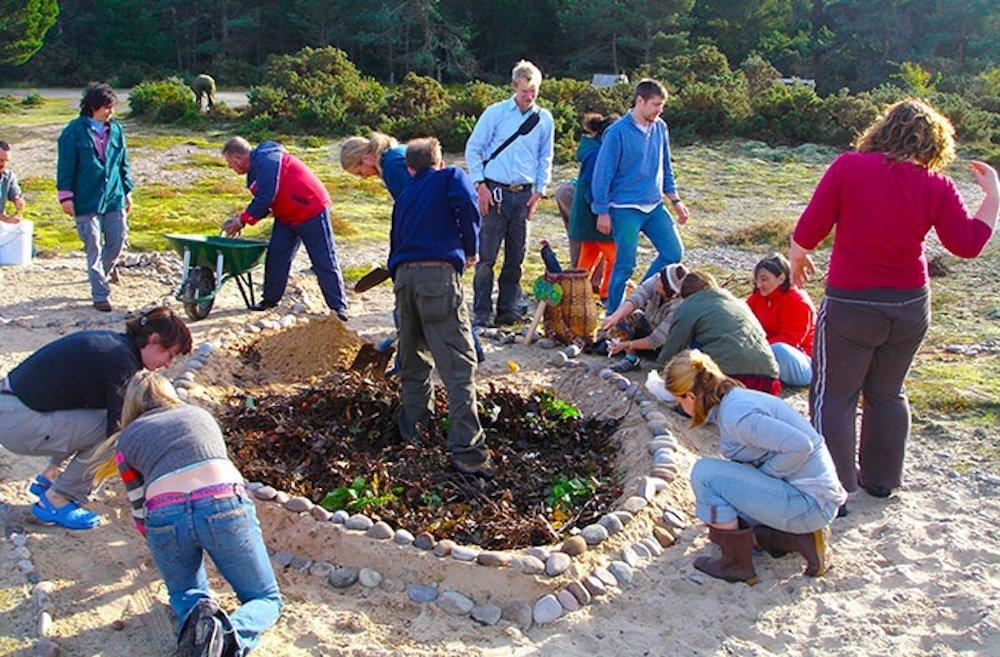
Caption: Community members engaging in collective gardening at Findhorn Ecovillage (Scotland) – an intentional community that integrates sustainable living, spirituality, and cooperation.
• Cohousing and Intentional Communities – Cohousing is a model where
residents live in private homes but share common spaces (like kitchens,
gardens, community rooms) and collectively manage the community. This
design fosters neighborly interaction, mutual support, and resource-sharing –
an antidote to suburban isolation. Research suggests that cohousing can
reduce loneliness and improve quality of life by strengthening social support
networkspublichealthreviews.biomedcentral.compublichealthreviews.biomedcentral.com. For example, elders in
cohousing report a greater sense of community and security than those living
alonepublichealthreviews.biomedcentral.com. These communities often operate by consensus,
giving residents a voice (and hence a sense of agency and belonging) in
decisions. Around the world, there are hundreds of cohousing communities
(from Denmark to the U.S. to Australia) demonstrating more “soulful” living:
neighbors share meals, care for each other’s children, lend tools, grow food,
and celebrate together. Such environments naturally encourage generosity
and collaboration in place of the anonymity of typical urban neighborhoods.
• “Slow Living” Movement – Slow living is a cultural shift away from the
frenetic pace of modern life toward a more intentional, present, and
community-oriented lifestyle. Adherents of the slow movement choose to
prioritize quality over quantity – whether in food, work, or relationships. This
can mean things like cooking meals mindfully (as championed by the Slow
Food movement), reducing digital overload, or opting for a less demanding
career to have time for family, community, and nature. “Living a slower pace of
117
life allows you to pause, reflect and reconnect with yourself, your community,
and the planet”slowlivingkitchen.com. People who practice slow living often report less
stress and burnout, stronger relationships, more creativity, and deeper
gratitude in daily lifeslowlivingkitchen.com. For instance, a neighborhood might organize
weekly unplugged gatherings or communal meals, fostering real human
connection in place of endless “hustle.” By rejecting the cult of speed and
hyper-productivity, the slow living movement creates space for meaning –
encouraging mindfulness, leisure, and connection as measures of success
rather than just income or status.
• Ecovillages and Sustainable Communities – Ecovillages are intentional
communities that integrate ecological design, cooperative living, and often
some form of spiritual or holistic ethos. They serve as living laboratories for a
soulful society by demonstrating lifestyles that are both Earth-friendly and
people-friendly. For example, Findhorn Ecovillage in Scotland, founded in the
1980s, emphasizes the interconnection of social, ecological, and spiritual
dimensions of lifehappiness.com. Findhorn’s residents share facilities, meditate
together, practice arts, and jointly steward the land. Impressively, Findhorn’s
ecological footprint is ~50% less than the UK average, meaning they consume
half the resources and generate half the waste of a typical citizenhappiness.com –
evidence that living in community with intention can be
both sustainable and satisfying. Similarly, EcoVillage Ithaca in New York has
~230 residents farming organic food and governing by consensus; their
community’s carbon footprint is estimated 70% lower than the US average
happiness.com . Many ecovillages incorporate spiritual practices (like meditation,
yoga, or indigenous ceremonies) to build shared meaning. At Eco Truly Park in
Peru, for instance, residents live in harmony with nature guided by Indian
Vaishnava spiritual principles, cultivating values of non-violence, compassion,
and simple livinghappiness.comhappiness.com. Across Europe, the Americas, Africa, and
Asia, ecovillages and permaculture communities are gaining traction through
networks like the Global Ecovillage Network. They show that communal life
rooted in sustainability and spirituality can yield high levels of happiness
and well-being even with modest material wealth – offering a direct contrast
to soulless consumerism.
• Contemplative and Holistic Education – Education is a powerful lever for
cultural change, and new models of schooling are bringing “soul” back into
learning. Contemplative education integrates mindfulness, empathy, and
ethical values into curricula, rather than focusing solely on test scores. For
example, some schools have introduced daily meditation or yoga for students,
finding it helps reduce stress and aggression while improving focus and
emotional regulation. School-based mindfulness programs aim to “regulate
stress, reduce anxiety and impulsivity, improve health and well-being, and
support students to act ethically and education** (SEL) – with encouraging
results. A 2019 review found school mindfulness programs *“consistently
118
suggest small to moderate impacts... most reliably on psychosocial health and
well- 】 being, especially mental health”. Benefits include reduced anxiety and
depression in students, better emotional regulation, and improved empathy
and cooperatio 】. Some pioneering schools integrate meditation, yoga,
or “quiet time” for reflection, treating the student not just as a future worker,
but as a whole person with emotional and spiritual need】. Holistic
approaches like social-emotional learning (which cultivates skills like
kindness, conflict resolution, and community service) have been shown to
boost students’ collaborative behaviors and ethical developmen】. By
educating heart and soul in addition to mind, contemplative education
initiatives create a generation more equipped to value connection over
competition, and inner growth over mere grades – seeding a more soulful
future society.
Together, these practical initiatives – cohousing, slow living, ecovillages, mindful education, and more – demonstrate viable paths to reclaiming a sense of community, purpose, and balance in daily life. They prove that people hunger for connection and meaning, and when given the chance, will innovate new forms of living that prioritize relationships, well-being, and reverence for life over material accumulation.
Policy Changes: Public Policies for Well-Being, Ecology,
and Spiritual Flourishing
To support and scale up a soulful transformation, changes at the policy and governance level are crucial. Instead of measuring success only by economic output, soulful societies are adopting policies that prioritize well-being, ecological balance, and even spiritual/cultural vitality. Key examples include:
• Well-Being Indicators Beyond GDP (Gross Domestic Product) – The small
nation of Bhutan famously pioneered the concept of Gross National
Happiness (GNH) as a guiding development philosophy. GNH is a holistic
index that measures nine domains of well-being: psychological well-being,
health, education, time use (work-life balance), cultural diversity, good
governance, community vitality, ecological resilience, and living standardoecd.org
】. By constitution and policy, Bhutan evaluates all major decisions by how
they impact the GNH of the people, not just the GDP. For instance, protected
areas and cultural preservation are given high priority. The GNH framework
has “shaped Bhutan’s development policy” and is designed as
a “multidimensional, equitable… policy-relevant” tool valuing various
aspects of life equall】. This approach has inspired other efforts worldwide
(e.g., New Zealand’s Wellbeing Budget, or cities adopting happiness indexes)
119
to reorient government focus toward what truly makes life worth living – a
prime example of institutionalizing “soulfulness.” In effect, it recognizes that
economic growth is a means, not an end; the end is human and ecological
thriving.
• Universal Basic Income (UBI) and Economic Security – UBI is a policy
proposal to provide all citizens with a regular, unconditional cash payment
sufficient to cover basic needs. While primarily an economic idea, UBI
has soulful implications: it can free people from survival anxiety and allow
them to pursue purpose, community involvement, or creative and spiritual
pursuits. A Finnish pilot study (2017–2018) showed that even a modest basic
income (560€ a month) led to *“significantly better well-being on multiple
dimensions”】. Recipients reported higher life satisfaction (7.3/10 vs 6.8/10
in control group) – a jump equivalent to what a large income raise would
normally produc】. They also had better health, less stress, less sadness and
loneliness, and more trust in others and societ】. Crucially, the basic income
created positive feedback loops: with basic security, people felt more confident
to seek education or social activities, which further improved well-bein】. This
suggests that policies ensuring a baseline of material dignity can
unleash “soulful” outcomes – more time for family, volunteering, arts, or
contemplation, and less fear-driven competition. Similarly, experiments in
other countries (Canada, Kenya, etc.) have shown UBI can improve mental
health and social cohesio】. UBI aligns with the idea that a society’s health is
measured not by the wealth of a few, but by the well-being of all – and it
might reduce the existential precarity that pushes people into soulless work or
ethical compromise.
• Rights of Nature and Environmental Stewardship Laws – A soulful society
extends moral and legal consideration to the more-than-human world. In
recent years, there’s a growing movement to grant legal rights to nature –
recognizing rivers, forests, and ecosystems as entities with intrinsic rights to
exist and thrive. For example, Ecuador’s Constitution (2008) was the first to
recognize enforceable Rights of Nature: *“Nature, or Pachamama, has the right
to exist, persist, maintain and regenerate its vital cycles”】. This means any
person or community can go to court on behalf of an ecosystem (e.g., to stop
pollution), shifting law from a purely human-centered stance to a life-centered
stance. In 2017, New Zealand granted the Whanganui River legal
personhood after a long struggle by the Māori, who view the river as an
ancestor. The law acknowledges the Māori worldview of the river as an
indivisible, living whole and states that the river *“can hold all the rights, duties
and liabilities of a legal person”】. Two guardians (one appointed by Māori,
one by the government) now speak for the river’s interests. This precedent, as
legal scholars note, “embodies an exciting synthesis of ecological
jurisprudence” 】 that could herald a broader recognition of nature’s right.
120
Other places (India for the Ganges, Colombia for the Amazon, various US
communities for local ecosystems) have followed with rights-of-nature laws.
Such policies, inspired by indigenous perspectives and deep ecology, infuse
law with soul by asserting that humans are not masters of a dead world, but
relatives in a living community. They encourage development that honors the
sanctity of nature, reinforcing ecological balance as a core value.
• Policies for Shorter Workweeks and “Slow” Economics – Beyond high-
profile ideas like UBI, even adjusting labor and urban policies can enhance the
“soul” of society. Some governments are exploring 4-day workweeks or limits
on after-hours emails to ensure people have time for family, rest, and civic life.
For example, experiments in Iceland and New Zealand found that productivity
did not suffer with a shorter workweek, while workers’ well-being improved
(less stress, more time for hobbies and volunteering). “Slow cities” (Cittaslow
movement originating in Italy) aim to curb chaotic urban growth and preserve
local traditions, conviviality, and green spaces. City planning that favors
walkable neighborhoods, parks, and community hubs (rather than just
commercial districts and highways) helps residents interact and feel a sense of
place. Zoning for cohousing or cooperative housing developments, and
providing funding or land for community gardens and arts centers, are further
policy choices that can help soulful communities flourish.
• Health, Recreation, and Spiritual Spaces – A soulful society would invest in
the commons that nurture connection. This could include funding for public
parks and wilderness conservation (recognizing nature’s role in
mental/spiritual health), support for community centers, libraries, and
museums (places for lifelong learning and gathering), and protecting spaces
for worship, contemplation or intercultural dialogue. Some countries
consider Loneliness as a public health issue – the U.K., for instance,
appointed a “Minister for Loneliness” in 2018 to address social isolation.
Policies arising from this focus include social prescribing (doctors “prescribing”
community activities), and building design standards that facilitate social
interaction. These efforts treat community connection as important
infrastructure, much like roads or internet access.
In summary, policy innovations – from measuring happiness, to securing basic incomes, to granting nature rights – embed the values of well-being, justice, and reverence into the system’s DNA. They move society away from soulless metrics and towards goals of collective flourishing. Crucially, they validate that government’s role is not just managing the economy, but stewarding the conditions for meaningful, connected lives.
121
Cultural and Value Shifts: Media, Education, and
Discourse Nurturing a Soulful Ethos
Even with new ideas and policies, a transformation isn’t complete without a deeper cultural shift. How people think, what they celebrate, and how they relate day-to-day must evolve. Fortunately, around the world, many cultural currents are already moving towards elevating compassion, awe, mindfulness, and community:
• Media that Uplifts and Informs (Storytelling for Good) – The stories a
society tells itself – through news, films, social media – shape its soul. In a
soulless society, media often fixates on consumerist lifestyles, fear-based news,
and shallow entertainment. To counter this, movements in solutions
journalism and constructive media focus on stories of hope, resilience, and
innovation that bring people together. The Solutions Journalism Network, for
example, works with news organizations to report on how communities
address challenges, not just the problems. This type of journalism has been
found to make audiences feel *“less anxious, more energized and more
trusting”】, and can even increase civic engagement and optimism. Similarly,
platforms like Positive News, Greater Good Magazine, or the Good News
Network highlight compassion, cooperation, and acts of kindness – reminding
the public that goodness is pervasive, not rare. The aim is not to ignore harsh
realities, but to balance the narrative so that people are not paralyzed by
cynicism, but motivated by possibility. When media nurtures empathy rather
than outrage, it encourages readers/viewers to emulate pro-social
behavior. Documentaries on nature’s wonders (like BBC’s Planet Earth series) or
human triumphs can inspire awe and a sense of connection. Even popular
entertainment is seeing more productions that emphasize friendship, diversity,
and the triumph of the human spirit. Over time, these storytelling shifts help
reweave a cultural fabric in which soulful values are seen as strengths, not
naïveté.
• Reviving Community and Ritual – Modern secular societies often lack rituals
and shared practices that traditionally bonded communities (harvest festivals,
communal dances, collective prayers, etc.). However, new forms of gathering
are emerging: neighborhood potlucks, interfaith ceremonies for environmental
healing, or city-wide days of service. For example, the annual “Day of
Service” in many countries (like Martin Luther King Jr. Day in the US) mobilizes
millions to volunteer, turning an individual holiday into a community-building
event. Likewise, movements like “Compassionate Cities” (a program inspired
by Karen Armstrong’s Charter for Compassion) encourage cities to adopt
compassion as a guiding principle – organizing dialogues, kindness
campaigns, and inclusive festivals. Arts and music also play a role: community
choirs, drumming circles, or street murals can create shared joy and
expression, crossing social divides. These cultural activities rekindle soul by
122
giving people a tangible sense of togetherness and belonging to something
greater than themselves.
• Education in Values and Meaning – We touched on contemplative education
earlier; here it’s worth noting how schools and universities can foster cultural
change by teaching values and ethics alongside academics. Programs
in character education or philosophy for children invite students to reflect
on why to be kind, or what makes a good life. Exposure to literature and
history can be framed to draw lessons about compassion (e.g., reading Anne
Frank’s diary to discuss empathy and resilience). Some schools hold “empathy
workshops” or partner students from different backgrounds to cultivate
understanding. Higher education is also seeing a rise in courses on happiness,
mindfulness, and sustainable living (for instance, Yale University’s most
popular class ever was “Psychology of Happiness,” which debunked
materialistic notions of success and taught practices like gratitude and
savoring). As these cohorts of students enter society, they carry a more soulful
outlook – valuing balance, human connection, and personal growth, not just
their paycheck.
• Public Discourse that Embraces Spiritual Pluralism – In a soulless society,
public discourse often marginalizes spiritual conversation or questions of
meaning, deeming them too private or irrational. A soulful society, by contrast,
makes respectful space for spiritual and philosophical dialogue in the public
square. This doesn’t mean imposing a religion, but rather recognizing that
humans have spiritual yearnings – for purpose, for transcendence, for moral
order – and that it’s healthy to discuss these openly. We see hints of this in the
increasing popularity of mindfulness (a practice with spiritual roots) in
corporate and healthcare settings, or the way political leaders in New Zealand
and Bhutan talk about kindness and well-being as core goals. Even in Western
psychology, there’s more research on the role of awe, gratitude, and
compassion in mental health, validating age-old spiritual wisdom in scientific
terms. The more a culture can openly honor virtues like forgiveness, humility,
and interconnectedness, the more it counters cynicism. For example, the Dalai
Lama’s message that *“the key to a happier and more successful world is the
growth of compassion”】 is now frequently cited in secular contexts, such as
leadership workshops or conflict resolution trainings. The language of love and
unity is becoming more mainstream as people realize that the alternative –
endless division and competition – is unsustainable.
• Role of Technology and Social Media – Lastly, even our cutting-edge
technologies can be harnessed for soulful ends. While social media has often
fueled vanity or polarization, it also has the power to connect people to causes
and each other. Online communities of practice (for meditation, yoga,
gardening, etc.) allow people to find like-minded peers and mentors globally.
Crowdfunding platforms let individuals support heartfelt projects (art, medical
needs, community initiatives) in a spirit of generosity. Mindfulness apps bring
123
techniques for inner peace to millions. The concept of a “digital detox” or
mindful tech usage is gaining traction, encouraging people to reclaim their
attention and use technology intentionally (e.g., scheduling device-free family
time). Tech companies, under public pressure, are beginning to address how
their designs impact mental health and societal well-being. As awareness
grows, we might see design ethics that promote meaningful connection
(features that facilitate deep conversation over endless scrolling) and reduce
harmful comparison or misinformation. In a soulful culture, technology would
be a tool in service of human values, rather than humans serving the gods of
technology.
Conclusion
Transforming a soulless society into a soulful one is a grand, multi-faceted endeavor – but, as shown, it is already in motion. Philosophies from Indigenous wisdom to deep ecology are reminding us of our interdependence and the sacredness of life. Grassroots experiments like cohousing, slow living, and ecovillages are proving by example that we can live richly with less and find happiness through community and simplicity. Forward-thinking policies like Bhutan’s GNH, Universal Basic Income pilots, and Rights of Nature are enshrining new priorities in our economic and legal systems, valuing well-being and balance over mere profit. Meanwhile, cultural shifts in media, education, and everyday values are nurturing compassion, awe, and generosity, especially among younger generations.
A truly soulful society would be one where material progress does not eclipse moral progress, where economic activity is harmonized with ecological rhythms, and where individuals feel embedded in supportive communities and a meaningful universe. In such a society, success might be measured in the health of relationships, the beauty of our surroundings, and the depth of our joy and purpose. The path from soulless to soulful is challenging – it asks for inner change as much as outer change – but the trends highlighted here suggest a growing collective desire for a more connected and soul-rich way of life. As people and policymakers continue to align actions with these values, the more “soul” our society will have, manifesting in both the human spirit and the living world that sustains us.
124
I'll be back
The United States is now in one of its worst crises ever. But crises accelerate change. Who hasn't experienced crises and then emerged stronger from them? In fact, many have come to appreciate in retrospect that the crisis put us on a new path. It changed us for the better. There is no reason why this shouldn't also happen to the United States.
There is only one country with continuous democracy for more than two hundred years and that is The United States. In 2026 it will be 250 years since its founding in 1776, when it declared independence. Maybe that is the year for the return?
If you make it, and I am convinced that you will, the United States will once again be an example for the rest of the world. We would very much welcome that.

125
Recommended further reading
For those interested in solutions (This idea is of American origin):
I was working on a book and website promoting solutions globally in the second part of 2024. It was launched in January 2025, but it did not get much attention because Trump and the new administration got most of it. Here is text from the press release:

Global Solutions
Center
Humanity has now
passed the first quarter
of this century. The
question is: where do we
stand today?
If our goal is to create a
civilization without wars
and suffering, we have a
long way to go. If the goal
is a civilization that thrives
and cares for nature, we
are far behind schedule.
The necessary changes are too few and are happening too slowly.
There are several reasons for this: we rarely have a
long-term perspective, our focus on profit is too great, and we do not collaborate effectively enough.
We can do better, and here is an idea that could accelerate progress: Establish a large, dynamic, and impactful Global Solutions Center that scan for, map, connect, and communicate what works worldwide, across all sectors. What exists now is too weak, fragmented and one-sided.
The world is constantly balancing on the edge of catastrophes, whether due to climate change, pandemics, inequality, polarization, wars, or tyrants. We need to think holistically and long-term to address these challenges in the future.
The proposal for such a center is presented in its own website and free book:
126
A few years ago, I wrote a science fiction book that described a future where humanity thrives and most of our problems are solved. The book is free:
Message from the future: WE MADE IT!
www.gaiainnovations.org/book/we-made-it
Humanity is struggling with so many
serious problems, and many countries like
America is going through a tough time.
We need optimism and hope, something
to look forward to, something that shows
another future, a more enlightened future.
What we visualize is especially important,
if we only focus on a dystopian future (as
so many do), we will sooner or later
manifest it. On the other hand, if we focus
on a positive, more pleasant future, that is
what we will manifest.
A JOURNEY INTO OUR NEAR FUTURE
This science fiction book is not about a
dystopian future where humans have to
fight for survival. Quite the contrary, it is
about a bright future where we have managed to overcome most of our problems. It will show the unity, strength, love, and potential of man.
The reader is invited on a journey into the future and gets to experience what life is like there. The main character gets to know a woman, and feelings arise between them. Together, they explore society and have numerous conversations about the difference between our society and theirs. There will be a trip to a space station, down into an underwater research station, and not least meeting with our cosmic friends at the end of the book.
The world the protagonist encounters has a far more loving and positive approach to life. The book is free from murder, crime, intrigue, fear and other misery. However, it contains imagination, good experiences and a lot of optimism and hope.
127
Evolving human consciousness

For those of you who are interested in expanding
human consciousness, I can recommend studying
the material of the American Neale Donald
Walsch. I have personally had the pleasure of
inviting him to Norway twice.
Neale Donald Walsch is a modern-day spiritual
messenger. He is most famous for the
Conversations with God series of books that has touched and inspired millions.
I have asked ChatGPT make a summary of his
book Tomorrow’s God:
Neale Donald Walsch’s Tomorrow’s God: Our Greatest Spiritual Challenge (2004) lays out a bold vision for humanity’s spiritual evolution. It argues that only by changing our deepest beliefs about God, life, and each other can we create an elevated, peaceful society. Below is a structured summary of the book’s core ideas on how society can evolve, followed by clear steps for individuals and for communities/ governments to put these ideas into practice.
The summary is divided into three parts:
1. Overview of Core Ideas for Societal Evolution
2. Specific Actionable Steps for Individuals
3. Specific Actionable Steps for Communities and Governments
Read the complete summary here:
Evolving Humanity to a Higher State (PDF)
128
About the author
Henning Jon Grini

was born in Bergen, Norway in 1966. All his
adult life he has been concerned with the big
questions in life. He is socially engaged, and
have started several businesses and non-profit
organizations with the intention of contributing
to the planet’s best, as well as lifting the human
consciousness to a higher level. He has, among
other things, founded, run and been an editor
for the Norwegian magazine and publisher
«Ildsjelen» (fire soul) for 12 years. He writes
regularly in magazines and some of the biggest
www.inspirasjonogideer.no/english Photo: by John Mac newspapers in Norway. He has his own website:
129
You may also like...
-

Monarchy & Republic in the Laboratory of History Politics by N. FakhrMonarchy & Republic in the Laboratory of History
Reads:
1Pages:
433Published:
Oct 2026Which system of government performs better in the real world: monarchy or republic? Instead of beginning with political ideals or assumptions, this book puts ...
Formats: PDF, Epub
-

Utopia Governance & the Commons Politics by Tom WallaceUtopia Governance & the Commons
Reads:
1Pages:
440Published:
Mar 2026The main content of this book has been previously published, along with a series of memoirs, with the title Three Miles of Rice Pudding. (The origin of this p...
Formats: PDF, Epub, Kindle, TXT
-

Artifacts of a Troubled and Troublesome Species Politics by Peter McMillanArtifacts of a Troubled and Troublesome Species
Reads:
0Pages:
193Published:
Nov 2025The theme of the writings presented in this collection is history, sometimes fictions but mostly opinions based on the interpretation of facts—real events, re...
Formats: PDF, Epub, Kindle, TXT
-

America’s New Breed of Freedom Fighters: Law of Attraction Guide for Democrats, 3rd edition General Non Fiction by Evelyn Roberts BrooksAmerica’s New Breed of Freedom Fighters: Law of Attraction Guide for Democrats, 3rd edition
Reads:
11Pages:
345Published:
Mar 2025Harness the power of the mind and activism to create lasting change. This guide blends the Law of Attraction with progressive politics, offering a 3-step proc...
Formats: PDF, Epub, Kindle, TXT