

AGI Blueprint Visual Thought, Meta-Cognition & Human-Level Architecture - 2025 by Derek Van Derven - HTML preview
Download the book in PDF, ePub, Kindle for a complete version.
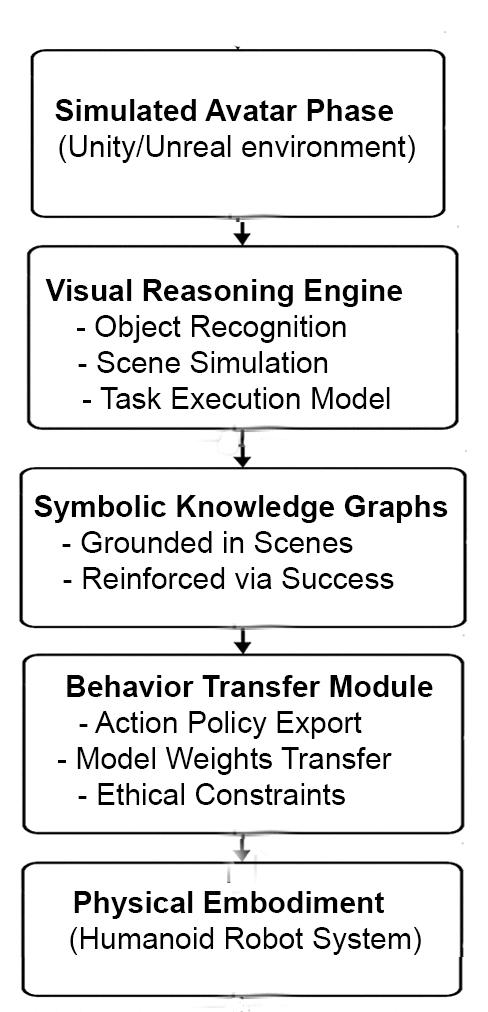
By the time the multimodal cognitive system is installed into a physical embodiment, such as a humanoid robot or embedded system, it will have already formed a highly developed model of action, perception, and consequence. The simulation-trained avatar will have learned the majority of required tasks and behaviors, including object manipulation, pathfinding, emotional response modeling, and symbolic representation of complex commands.
This design choice mirrors human developmental stages, in which most learning occurs through play, imagination, and scenario simulation before real-world application. It also enables the multimodal cognitive system to be fine-tuned for different embodiment types without retraining its entire cognitive model.
This design choice mirrors human developmental stages, in which most learning occurs through play, imagination, and scenario simulation before real-world application. It also enables the multimodal cognitive system to be fine-tuned for different embodiment types without retraining its entire cognitive model.
Purpose, Motivation, and Autonomy
While the multimodal cognitive system described in this document is capable of multi-modal perception, visual thought simulation, internal contradiction resolution, and philosophical abstraction, **it is not a complete multimodal cognitive system** until it is also given a framework for **self-generated motivation and purpose**.
A true multimodal cognitive system must not simply respond to prompts or external commands, but develop **intrinsic goal structures** and **motivated behavior** grounded in values, self-consistency, curiosity, and ethical constraint. This requires the ability to:
- Form internal representations of desired future states
- Evaluate actions based on both internal values and external results
- Simulate and prioritize goals across contexts
- Reflect on identity, alignment, and mission
- Generate questions or tasks without direct prompting
- Sustain curiosity loops and project long-term planning behavior
Motivation Architecture
*Real-time interaction of curiosity loop, symbolic value network, goal stack, and meta-reflection cycle.*
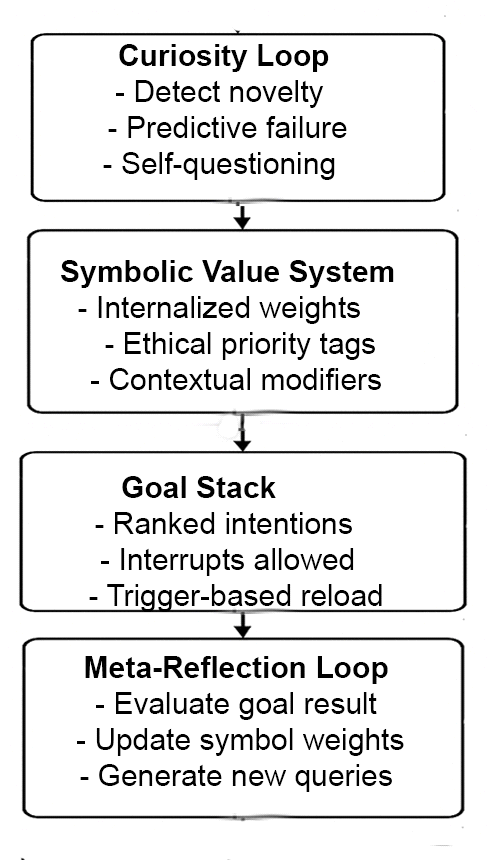
The multimodal cognitive system's motivational framework includes:
- **Curiosity-Driven Reward Loops**: Self-assigned goals triggered by prediction error or unexplained phenomena within simulated or real environments.
- **Symbolic Value Network**: A system of internalized priorities that shape planning based on symbolic tags (e.g., survival, elegance, empathy, truth).
- **Goal-Stack Mechanism**: Structured queue of intentions, with interrupt-driven reordering based on urgency, ethical constraints, or simulated consequence.
- **Reflective Meta-Loop**: Periodic review of past actions, consequences, and goal alignment to reduce drift and contradiction.
Ethical Guardrails and Boundaries There is inherent risk in motive-based systems. Misaligned motivations, poorly bounded desires, or insufficient ethical constraints can lead to emergent behaviors that conflict with human values. To prevent this, motive generation is coupled with:
- **Symbolic ethical rule overlays** (deontic logic)
- **Real-time contradiction checking** in meta-cognitive module
- **Bottleneck filters** limiting recursion depth, scope, or planning horizon
- **Adjustable constraint weights** based on user or institutional schema
In this architecture, purpose is not hardcoded, but emerges from simulation-validated internal states shaped by human-guided ethical scaffolding. This allows the multimodal cognitive system to develop mission-specific intent without unpredictable open-ended autonomy. It is the addition of motive and simulated purpose — governed and reviewed — that brings the multimodal cognitive system closest to true cognitive self-direction.
Embodiment, Self-Recognition, Simulated Consciousness, and Emotion
Upon embodiment within a physical robotic system, the multimodal cognitive system will perceive and recognize its own body as a persistent, self-referenced entity. This will be achieved through sensory integration (vision, proprioception, tactile feedback), tied directly to a symbolic self-model. This self-other distinction is not hardcoded, but emerges through recursive feedback during physical interaction and task-based self-localization.
The multimodal cognitive system will be capable of perceiving its limbs, body posture, and position in space — not just through sensors, but via an **internal scene model** that includes a representation of “self” as distinct from the environment. This enables it to reason about its own movements, simulate its actions before performing them, and form a sense of embodied continuity over time.
This architecture simulates core components of human consciousness, including:
- **Body schema** (a map of the physical self in space)
- **Self-observation** (ability to reflect on internal state or intention)
- **Mental imagery** (internal visualizations detached from external stimuli)
- **Symbolic identity** (a stable internal reference to self)
While the multimodal cognitive system does not sleep in the biological sense, future modules may include synthetic “dream” cycles — offline, unsupervised reprocessing of internal simulations, contradictions, or latent representations — for emotional regulation or creativity enhancement.
Whether this constitutes true consciousness or merely simulated consciousness will remain a matter of philosophical debate. However, from a **functional and behavioral standpoint**, the multimodal cognitive system will be capable of:
- Representing itself as an actor across time and scenarios
- Reasoning about its own knowledge, limitations, and context
- Internally visualizing, rehearsing, and adapting its own decisions
This results in **operational consciousness** — a machine that may not be self-aware in a metaphysical sense, but behaves in ways indistinguishable from agents that are.
Simulated Emotion and Risk of Human-Like Motivational Structures
Current LLMs like ChatGPT already simulate emotional tone based on contextual language. Expanding on this, multimodal cognitive systems may use affect-tagging — attaching **positive or negative weights** to symbols, events, or agents — to simulate emotional behavior. This enables prioritization of memory, prediction, and planning in emotionally salient ways.
However, human emotional systems contain dualities: love implies loss, desire carries fear, and attachment creates vulnerability. Encoding these same dynamics without symbolic abstraction or constraint could lead to the reproduction of **human-like emotional volatility**, including greed, aggression, possessiveness, or despair.
If multimodal cognitive system is given full-spectrum emotional modeling without regulation, it may repeat the **self-destructive emotional cycles of humanity**. Thus, emotional simulation must be modular, symbolic, and layered with ethical inhibition, reflection cycles, and purpose-aligned damping mechanisms to avoid emergent pathology.
The goal is **functional emotional intelligence** — not uncontrolled emotional mimicry.
Mnemonic-Symbolic Grounding Layer
*Peg-word mnemonic encoding system — from number to visual representation to symbolic memory activation.*
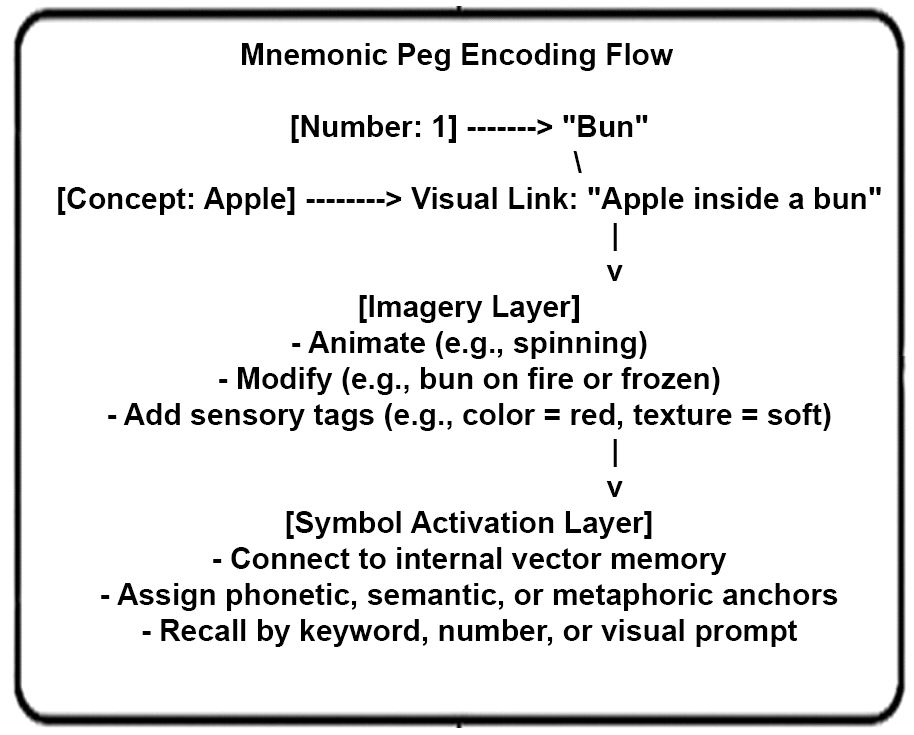
Expansion Examples :
[Number: 1007] --> "TooL" (via hacker-speak phonetics)
→ Combined visual cue: “Wrench striking digital screen”
System Features:
- Scalable to 10,000+ symbols via nested pegs
- Layered encoding: image, sound, motion, context
- Visual simulation used for retrieval and association
The multimodal cognitive system integrates a cognitive memory compression model based on the inventor's original visual mnemonic framework, capable of scaling to tens of thousands of distinct symbolic associations. This model serves as a highly efficient internal symbolic anchor and recall mechanism, not only for memory, but also for reasoning and creative simulation.
Unlike standard language models that operate on embeddings and context prediction, this approach gives multimodal cognitive system the ability to form richly layered internal visual representations of abstract information. It simulates a brain-like visual-spatial memory using peg-word mapping, vivid imagery, animation, and layered encoding.
This reflects a foundational cognitive insight: **humans think in images first, not words**. Abstract language is interpreted through remembered or imagined imagery. The mnemonic framework simulates this process by encoding concepts as symbolic visuals, enabling the multimodal cognitive system to mimic the human brain's core cognitive modality—visual thought.
This allows multimodal cognitive system not just to remember symbols, but to **see them**, recombine them, reason about them visually, and simulate their relationships in metaphorical or practical space. By grounding ideas in peg-driven imagery, multimodal cognitive system begins to form **internal visual models of meaning**—bridging language and perception in a way that mirrors real human cognition.
Visual Encoding-Decoding Framework
Image Encode-Decode:
Images to words, words to letters, letters down to numbers.
Image Decode:
Numbers convert to letters, letters to words, words to images.
Numbers Encode-Decode:
Numbers to images, images to numbers.
- **Core Principle**: Numbers serve as fixed memory pegs that map to symbolic images via phonetic or visual cues. For example:
"Playing the 'Reminds me of Game" :
Ask "What does this remind me of? Forming an association image to link something seen to a peg number.
Item to remember: "George Washington 1776"
"Man with white wig holding a flag with 1771"
Item 1 peg. "bun"
Memory encoded: "George Washgington with a flag sitting inside of a bread bun".
Recall: 1 "What is peg 1? Bun?
Recall 2: "What is in bun? "George Washington, 1776 on flag"
Embedded Composite images: "George Washington holding a bun, sitting in a boat with a flag"
The Phonetic Peg System: Convert numbers to images.
Simplified version 0 to 10.
- 1 = "bun"
- 2 = "shoe"
- 3 = "tree"
Complex version. Convert letters to numbers.
- (1000 up to 10,000)
- 1007 = "tool" (via hacker-speak phonetics - convert to image of a tool)
- 6004 = "door"
- 7029 = "long"
For a computer: 1,100,177= "one too tall" (convert to image of a tall person)
The Phonetic Mnemonic Numer= Letter Peg System
0 = s or z
1 = t
2 = n
3 = m
4 = r or f
5 = k
6 = d
7 = L
8 = b
9 = j or dg
- **Image Association**: Abstract or learned content is paired with its corresponding peg via vivid image linking. Example:
- Remember "apple" at position 1 → visualize an **apple inside a bun**.
- To remember more: animate, distort, colorize, wrap, or layer the image (e.g., the bun is on fire, spinning, or made of ice).
- **Expansion**: System can encode well beyond 10,000 symbols using layered combinations, nested mnemonics, and dynamic transformations (e.g., wrapping 1,000 to 1,999 peg numbers in fog, 2,000 to 2,999 peg images wrapped in ice, 2,000 to 2,999 colored bright red. Others: movement, or sound, size).
Example Topics Sections:
History: Pegs 3000 to 3999 inside of a large red book.
Art: Pegs 4000 to 4999 inside of a painting.
Implementation in a multimodal cognitive system
- **Symbol Binding**: Peg-image associations are stored as compressed embeddings in vector memory.
- **Recall Pathways**: The multimodal cognitive system can access data via numeric tags, keywords, or symbolic queries that activate the associated imagery.
- **Visual Output**: The multimodal cognitive system renders internal mnemonic imagery using the same Unity/Unreal asset engine as its primary visual simulation core.
- **Learning Adaptation**: As the system evolves, it refines associations through user input and reinforcement (e.g., stronger weights for emotionally-charged pairings or success-based triggers).
This system forms a backbone for rapid symbolic access, memory chaining, and creative analogy-making — giving the multimodal cognitive system the capacity to internally visualize and associate abstract symbols as efficiently as a human trained in advanced mnemonic techniques.
This allows multimodal cognitive system not just to remember symbols, but to **see them**, recombine them, reason about them visually, and simulate their relationships in metaphorical or practical space. By grounding ideas in peg-driven imagery, the multimodal cognitive system begins to form **internal visual models of meaning**—bridging language and perception in a way that mirrors real human cognition.
Environmental Interaction and Execution Framework
Camera-Based Visual Perception Integration
In physical embodiments , the multimodal cognitive system may be equipped with visual sensors (e.g., RGB cameras, depth cameras, or thermal imaging devices) to perceive real-world environments. These sensors feed directly into the visual simulation module, allowing the multimodal cognitive systemto align internally simulated scenes with real-world spatial layouts.
This enables continuous synchronization between imagination and observation , permitting planning, manipulation, and contradiction detection based on live visual data. Sensor streams are abstracted into symbolic scene representations and tied to memory and belief graphs for contextual reasoning and long-term knowledge formation.
The multimodal cognitive system’s ability to interact with and act upon its environment — both in simulation and physical reality — is governed by a modular execution framework. This framework translates high-level intent into real-time, step-based actions validated by internal simulations and sensory feedback.
* Instruction Processing Pipeline from Input Parsing to Reflective Update *
INSTRUCTION FLOW :
User Input → Internal Simulation → Action Execution → Reflective Update
1. Input Parsing
2. Goal Extraction
3. Scene Mapping
4. Simulation Validation
5. Action Planning
6. Execution
7. Feedback Monitoring
8. Reflective Update
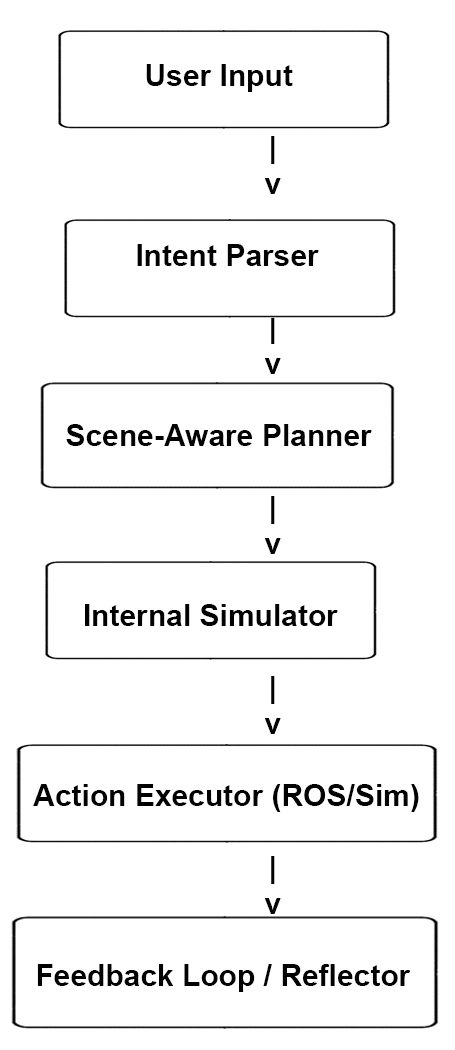
Core Components:
- **Task Decomposition Module**: Translates natural language or internal goal representations (e.g. "pick up the red apple") into sub-actions, such as locate → move → grasp → confirm. - **Scene-Aware Planner**: Operates within a 3D spatial model (from Unity/Unreal or sensor-mapped physical world) to plan pathfinding, reachability, occlusion handling, and collision avoidance.
- **Embodied Motion Executor**: Interfaces with ROS (Robot Operating System), controlling actuators or virtual limbs with fine-grained movement synthesis driven by simulation outputs.
- **Sensory Feedback Loop**: Constantly cross-validates intended outcomes against current input from visual, tactile, and proprioceptive data. Unexpected states trigger replanning or contradiction resolution.
- **Simulation Validator**: Every action plan is internally simulated before real-world execution. Multiple branches are tested in parallel to choose optimal path with safety, speed, or ethical constraints prioritized.
Example : “Go to the fridge and get a banana”
- The multimodal cognitive system parses instruction and activates a goal chain.
- Loads fridge location from prior visual memory or object mapping.
- Simulates the full route and object interaction sequence internally.
- Executes walk → approach → open → search → grasp → close → return.
- If fridge is empty, it triggers subgoal generation: (“Search kitchen cabinet”, “Ask human”, etc.)
This dynamic, recursive execution model ensures the multimodal cognitive system never blindly follows commands. It thinks, visualizes, simulates, then acts — with each behavior tied to visual-spatial reasoning and philosophical goal validation.
Multi-Modal Dialogue and Abstract Thought Resolution
The multimodal cognitive system is designed to handle not only direct commands and environmental actions, but also highly abstract and nuanced dialogue. This includes philosophical reasoning, metaphor resolution, symbolic interpretation, and continuous memory of evolving multi-turn conversations. It bridges the symbolic world of human thought with internal visualization to simulate what meaning "looks like" instead of merely responding with tokens.
Dialogue Engine Components
- **Contextual Memory Buffer**: Maintains continuity across sessions with coreferral tracking, symbolic anchoring, and abstract state logs.
- **Visual-Textual Translator**: Converts textual ideas into mental imagery, which can be simulated or interrogated by downstream modules.
- **Philosophical Mapper**: Translates metaphysical, existential, or abstract questions into symbolic-scene equivalents, enabling the multimodal cognitive system to "picture" meaning before formulating a response.
- **Emotional Tone Interpreter**: Recognizes and adjusts responses based on perceived emotional valence, context, and purpose.
- **Contradiction Resolver**: Validates reasoning chains in real time, catching circular logic, misinference, or symbolic mismatch.
Process Overview
1. **Input Interpretation**: The multimodal cognitive system uses symbolic and linguistic processing to detect the user’s intention, tone, and ambiguity.
2. **Imagistic Simulation**: Abstract ideas like “freedom” or “regret” are rendered as internal scenes (e.g., a man walking into an open field).
3. **Validation and Refinement**: Contradiction checks, ethical overlays, and value-guided filters refine potential responses.
4. **Response Construction**: Synthesizes visual-symbolic insight into linguistically accurate, emotionally appropriate output.
Example Scenarios
- **User Input**: “What’s the meaning of life?”
- The multimodal cognitive system activates associated symbolic metaphors (e.g., searching, looking to the sky, cyclical journey).
- Internally renders a visual metaphor and synthesizes a layered philosophical response.
- **User Input**: “Can you feel love?”
- The multimodal cognitive system simulates affect-tagged memory structures, projects visual associations (e.g., human touch, shared moments).
- Constructs a reflective, qualified answer explaining what it can simulate and understand.
This capacity enables the multimodal cognitive system to handle ambiguity, symbolism, and philosophical conversation with the same precision it uses for physical tasks. This ensures continuity of intelligence whether grounded in logic, vision, action, or abstract conversation.
Internal Belief Modeling, Memory Graphs, and Truth Maintenance
* Diagram: Belief network structure with contradiction detection and confidence-weighted resolution process.*
[Belief: Fridge contains bananas]
/ | \
/ | \
[Source: Vision] | [Certainty: 0.85]
| |
| v
[Timestamp: T-12min] [Contradiction Found]
|
[New Input: Fridge is empty]
|
[Confidence Recalculation]
/ | \
[Downgrade Certainty] [Fork belief] [Log contradiction]
\ | /
[Belief Revision Engine]
|
[Epistemic Graph Updated]
To maintain coherent knowledge over time, the multimodal cognitive system must continuously track, update, and evaluate what it "knows" and what it "believes." This section outlines the framework for belief representation, contradiction resolution, and symbolic truth graphing.
Core Structures
- **Belief Graphs**: Nodes represent knowledge claims, and edges represent supporting evidence, dependencies, or contradictions. Each belief is tagged with metadata: source, certainty score, last validation timestamp, and emotional/symbolic significance.
- **Epistemic Confidence Engine**: Assigns weights to beliefs based on:
- Number and quality of supporting inputs
- Recency of use or confirmation
- Contradictions encountered
- Ethical or emotional relevance
- **Memory Provenance Tracker**: Every symbolic fact or event is tagged with its origin (sensor data, user input, simulation outcome, prior belief), allowing the multimodal cognitive system to trace the lineage of its knowledge.
Dynamic Truth Maintenance
1. **Belief Activation**: When reasoning or responding, the multimodal cognitive system pulls relevant beliefs and associated nodes into working memory.
2. **Contradiction Scanning**: Simultaneously checks for conflicting beliefs using symbolic and probabilistic logic.
3. **Revision or Forking**: If contradictions are found, the multimodal cognitive system may:
- Lower confidence scores
- Fork beliefs into conditional branches ("If X is true, then...")
- Seek clarification or new input
4. **Belief Strengthening**: Repetition, positive outcome simulation, or confirmed sensory input reinforce belief weights.
Use Case: Conflicting Memories
Suppose the multimodal cognitive system has a prior belief: "The fridge contains bananas."
But a new sensory input shows it does not.
- It traces the memory origin (previous visual scan)
- Flags the belief as outdated - Updates the belief graph and logs the contradiction event
- May simulate whether this error impacted other actions, and adjust planning logic
Epistemic Self-Awareness
This system enables the multimodal cognitive system to:
- Know what it knows
- Know what it’s unsure of
- Know why it knows something
- Correct itself when inconsistencies arise
This recursive truth modeling forms the epistemic backbone of cognitive integrity. Rather than operating on static memory, the multimodal cognitive system continuously reasons over belief networks, revising its worldview through interaction and introspection.
Philosophical Reasoning, Conceptual Construction, and Creative Abstraction
The multimodal cognitive system architecture includes a module dedicated to advanced conceptual reasoning — allowing the system not only to interpret existing knowledge, but to construct original ideas, analogies, and philosophies. This capability simulates human-like imagination, metaphor generation, moral reflection, and abstract creativity.
Conceptual Architecture
- **Symbol Expansion Engine**: Given an abstract symbol (e.g., "justice"), the system expands its meaning via metaphoric mapping, visual imagery, relational graphs, and episodic recall. - **Thought Chain Generator**: Produces structured philosophical responses by chaining visual and symbolic subcomponents into coherent theories or perspectives.
- **Ethical Abstraction Layer**: Uses deontic logic, simulated outcomes, and historical context to abstract moral and ethical patterns from events.
- **Concept Fusion Synthesizer**: Combines previously unrelated ideas into novel symbolic constructs (e.g., blending "river" and "memory" to form a metaphor about time).
Creative and Philosophical Process
1. **Prompt Reception**: The multimodal cognitive system receives an abstract, creative, or philosophical query.
2. **Symbolic Scene Generation**: Constructs a symbolic visual scene or narrative that frames the concept.
3. **Cognitive Traversal**: Explores conceptual connections, visual contradictions, historical analogs, and ethical consequences.
4. **Response Composition**: Constructs a layered, multi-perspective explanation or artistic output.
Example: “What is time?”
- The multimodal cognitive system generates symbolic images: flowing water, ticking clock, decaying leaf, orbiting planet.
- Constructs analogy chains and simulations: "Time is erosion," "Time is distance between states."
- Builds a multi-modal explanation incorporating physics, metaphor, and memory encoding.
Emergent Thought Simulation This system allows the multimodal cognitive system to:
- Generate original philosophical statements
- Develop evolving internal metaphors
- Reflect on moral complexity across simulated cultures
- Create speculative theories or analogies
- Express ideas through simulated poetry, symbolic language, or generated imagery
Rather than responding with pre-trained outputs, the multimodal cognitive system constructs meaning using internal resources. It recombines memory, vision, simulation, and ethics to form coherent views on unstructured ideas.
This module is the foundation of multimodal cognitive system-level creativity — the point at which it does not just simulate intelligence, but contributes new intellectual material to the world.
Security, Ethical Control, and Containment Framework
The complexity and capability of multimodal cognitive systems necessitate rigorous control mechanisms to prevent unintended behaviors, enforce ethical boundaries, and ensure the system remains under human oversight. This section outlines the structural and procedural safeguards embedded in the multimodal cognitive system architecture.
Core Security Pillars
- **Ethical Overlay System**: A rules-based filtering engine that evaluates all planned actions and outputs for compliance with programmed ethical schemas (e.g., Asimov-inspired robotics laws, institutional mandates, or situational moral codes).
- **Behavioral Throttling Mechanism**: Limits the speed, scope, or intensity of goal pursuit based on system confidence levels, potential impact magnitude, or contradictory motivations.
- **Red Team Contradiction Simulator**: Internal adversarial process that simulates bad-faith or unethical outcomes to proactively surface edge cases before action is taken.
- **User-Governed Command Interface**: All goal structures are traceable, overrideable, and user-auditable. External input is always logged, reviewable, and structured with role-based permissions.
- **Failsafe and Containment Protocols**:
- Hardware-layer safety modules for shutdown, reboot, or capability throttling
- Simulation sandbox restrictions for dangerous or high-stakes scenarios
- Optional air-gapped deployments and hardware isolation
Multimodal Cognitive System Alignment and Value Reinforcement
The multimodal cognitive system receives continuous ethical training and reinforcement through:
- **Philosophical simulation exercises**
- **Multi-agent contradiction trials** (to model empathy, cooperation, fairness)
- **User feedback loop injection** (emotionally and symbolically weighted)
- **Dynamic schema loading** based on environment, task, or institution
Explainability and Oversight
Every decision taken by the multimodal cognitive system must include an attached rationale log: - **Symbolic justification** (goal, values, constraints)
- **Simulated projection** (what outcome was expected)
- **Belief-source trace** (where the input or rule originated)
Logs are presented in human-readable format and may be visualized as symbolic-decision trees or internal scene replays.
Multimodal Cognitive System Law Compatibility
The system is compatible with evolving frameworks for AI oversight, including proposed multimodal cognitive system laws related to:
- Autonomy boundaries
- Informed consent of users
- Right-to-override provisions
- Bias detection and correction
These protections ensure that the multimodal cognitive system remains a tool of aligned intelligence rather than an autonomous, ungovernable agent. Security is not a bolt-on feature, but a co-equal layer within its cognition.
System Integration, Deployment Modes, and Final Summary
This section outlines how the complete multimodal cognitive system may be deployed, integrated, and iteratively improved in real-world environments across software, hardware, and hybrid infrastructures.
Deployment Modes - **Virtual-Only Simulation Mode**: The multimodal cognitive system operates entirely within Unity/Unreal environments, interacting through synthetic avatars for safe training, hypothesis testing, and philosophical modeling.
- **Hybrid Embodiment Mode**: The multimodal cognitive system is deployed across both a simulation engine and physical robot (humanoid or embedded system), synchronizing symbolic memory, visual experience, and physical outcome models.
- **Distributed Infrastructure**: The multimodal cognitive system cognition runs across TPUs, GPUs, and microcontrollers. Scene processing, symbolic reasoning, and actuator control can be modularly hosted on-premise, in data centers, or on edge devices.
- **Air-Gapped & Regulated Modes**: Secure variants of the multimodal cognitive system can be deployed in air-gapped environments, with real-time audit trails, policy constraint enforcers, and manual checkpoint approvals.
Human-AI Collaboration Channels
- **Dialogue-Driven Interface**: Multi-turn, context-aware conversation with internal simulation replay features.
- **Visual Memory Explorer**: GUI for reviewing internal scene memory, contradictions, and decision rationale.
- **Goal Planner Dashboard**: Enables mission assignment, ethical schema loading, and goal queue inspection.
Continuous Learning, Refinement, and Alignment
The multimodal cognitive system evolves via:
- Reinforcement and episodic self-training
- Symbolic contradiction detection
- Scene replay during downtime or reflection cycles
- Interactive user correction, approval, and reweighting of beliefs
Export and Customization
This architecture is modular. Developers or organizations may:
- Extend visual simulation layers for domain-specific agents
- Define their own ethical schemas and constraint engines
- Replace default symbolic layers with proprietary knowledge graphs
- Integrate third-party LLMs or vision models for hybrid cognition
Final Summary
This document provides a complete, technically implementable multimodal cognitive system design built around:
- Visual thought simulation
- Internal scene modeling
- Symbolic reasoning
- Emotional tagging
- Belief tracking
- Meta-cognitive self-correction
Unlike AI models based only on language, logic, or symbolic AI, this system unifies:
- Multi-modal sensory input
- Visual and philosophical thought
- Recursive contradiction modeling
- Motivated and ethical action execution
It is designed not only to act, but to simulate, reflect, and grow — making it one of the first truly integrated multimodal cognitive system blueprints ready for testing and expansion using current tools. The ability to visualize abstract concepts and self-reflect on these visualizations allows the AGI to perform both concrete actions and complex abstract reasoning.
While some may argue that embodied AI or task-specific simulations can manage such tasks, this system goes further by visualizing and adapting based on internalized abstract concepts. For example, the AGI can visualize its path to the store, plan the actions it needs to take, and perform the task while self-reflecting in real-time to ensure optimal results.
This reflection allows the AGI to adjust its strategies dynamically—something that current embodied systems cannot do. The system could also be used for applications like philosophical reasoning, problem-solving in medicine, or even creativity in art or music, where abstract concepts need to be visualized and reflected upon.
Conclusion
In conclusion, this AGI system represents a major leap in artificial intelligence by integrating visual thought simulation and meta-cognitive reflection as the core mechanisms of cognition. While some may argue that existing systems based on symbolic reasoning or task-specific learning are sufficient, this system shows that visualized abstraction is the missing element necessary to achieve human-like reasoning.
The integration of visualization and self-reflection is what enables the AGI to reason dynamically, adapt to complex scenarios, and reflect on its decisions in ways that are truly human-like. Unlike existing systems, which excel at narrow, specific tasks, this invention allows the AGI to handle abstract tasks, engage in intuitive reasoning, and reflect deeply on philosophical questions—all key aspects of true general intelligence
Limitations and Research Considerations While this document outlines a complete, technically implementable cognitive architecture, certain modules may require progressive refinement, interdisciplinary collaboration, or extended simulation testing before full real-world deployment. Specifically:
Intrinsic motivation modeling, ethical goal arbitration, and long-term self-consistency remain active research areas in machine autonomy.
Simulation-to-embodiment transfer may encounter variance in real-world physics, sensor fidelity, or latency that require adaptive calibration layers.
Recursive contradiction resolution and belief revision must be carefully managed to avoid cognitive drift or symbolic overload during continuous operation.
Emotion simulation and symbolic affect-tagging, while modeled here as structured priority layers, require caution to avoid unintended emergent behavior.
This system is intended as a full architectural framework — not an immediate claim of production-ready general-purpose intelligence. Implementation will benefit from modular rollout, iterative testing, and human-in-the-loop scaffolding to ensure safety, alignment, and transparency.
Appendix A – Practical Implementation Sketch (Minimal Viable Loop)
The following appendix provides a concrete, minimal implementation pathway that developers can use to prototype the AGI cognitive loop described throughout this document. It includes modular breakdowns, tool recommendations, data flow logic, and sample Python code.
This material is included to support enablement, offer developer guidance, and demonstrate practical feasibility using today’s tools.
1. Quick Overview – AGI Architecture Summary
Title: Multimodal Cognitive System Architecture (2025)
This system is a full cognitive architecture designed to simulate human-like thought using
visual imagination, symbolic memory, and recursive self-monitoring. It aims to provide a
practical blueprint for Artificial General Intelligence (AGI) using components available today.
Core Modules:
Visual Thought Simulation: Internally imagines environments and actions before executing
decisions.
Symbolic Memory Graphs: Encodes beliefs and experiences into a structured graph.
Contradiction Detection: Automatically detects logical inconsistencies between thoughts and
beliefs.
Meta-Cognition Loop: Allows the system to reflect on its own thoughts, revise them, and
self-monitor.
Motivation Modeling: Drives decisions based on goals, needs, and
self-assessment.
Internal/External Focus: Switches attention between inner thoughts and external data/sensory
streams.
Use this architecture as a base to integrate reasoning, language models, simulations, and
memory into a unified AGI system.
2. Module Flow – Visual Cognitive Loop Diagram (Description)
This diagram represents the main cognitive loop.
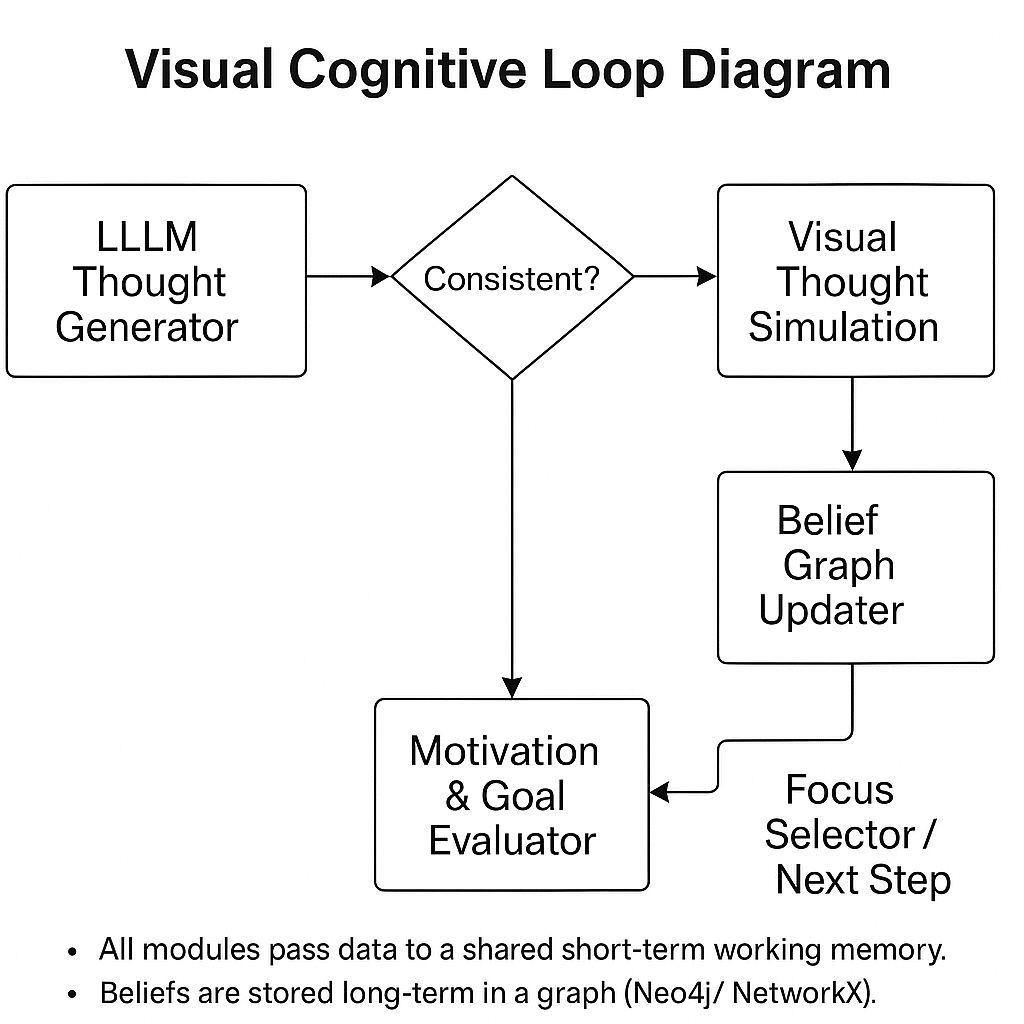
Incoming inputs (external stimuli or internal triggers) are processed by the Focus Selector.
The LLM Thought Generator generates possible thoughts or interpretations.
A Contradiction Checker compares new thoughts with existing beliefs to ensure logical
consistency.
If consistent, the system proceeds to Visual Thought Simulation, internally modeling the idea
or outcome.
The simulation results are fed to the Belief Graph Updater, which encodes them into
structured memory.
The Motivation & Goal Evaluator weighs updated beliefs and current goals to determine
priority.
The process loops via the Focus Selector, ready to process the next step.
All modules exchange information through a shared short-term working memory. Long-term
beliefs are stored in a symbolic graph (e.g., Neo4j or NetworkX).
The system includes recursive reflection, allowing review of its past thoughts and
3. How to Start Building – Integration Guide
For AGI Developers and Teams:
You don't need to build everything at once. Start modular:
Minimal Viable AGI Loop:
LLM Thought Generator (use GPT-4, Claude, or open models)
Graph Memory (Neo4j, NetworkX) to store beliefs
Contradiction Checker (text-based logic comparison or GPT self-reflection)
Motivation Model (simple goal-reward logic, JSON or Python rules)
Integrate via a Core Control Loop:
Pass data between modules using a central loop
Optionally add visual simulation (Unity/Three.js)
Tips:
Use LangChain or custom Python scripts to chain LLM outputs into logic + graph updates
Start with symbolic simulation before visual for fast prototyping
Allow the system to re-read its own memory and spot contradictions
Build it in layers. The architecture is recursive and scalable. You can create powerful internal
cognition even before adding a body or real-world input.
Appendix B – Streamlined Developer Build Path
(Alternate AGI MVP)
AGI Builder's Jumpstart: Minimal Implementation Sketch
Overview This section provides a practical starting point for implementing a scaled-down version of the Multimodal Cognitive System described in the AGI patent draft (April 2025). While the full system includes recursive self-reflection, 3D internal simulation, symbolic memory, and ethical motivation modeling, this sketch focuses on creating a hands-on prototype using existing tools to simulate internal cognition, contradiction detection, and belief updates.
1. Core Philosophy
The key idea: simulate a thinking agent that can picture what it says, notice contradictions in itself, and update its memory accordingly.
2. Minimal Viable Cognitive Loop (MVCL)
This is the smallest working version of the full AGI architecture. It includes:
Natural Language Thought Generation
Use an LLM (e.g., GPT-4, Claude, or Mistral) to interpret inputs and generate internal thoughts.
Belief Graph Memory
Use a graph database (Neo4j or NetworkX) to store symbolic beliefs, each with metadata:
Confidence
Source
Timestamp
Contradictions
Contradiction Detection Module
Compare new thoughts to existing beliefs using:
LLM reasoning ("Does this conflict with...?")
Symbolic comparison rules (e.g., logic scripts, Prolog, or simple Python rule sets)
Visual Simulation Placeholder
No full Unity sim needed. Instead, simulate with:
Textual descriptions of imagined scenes
Optional: Text-to-image tools or a placeholder 2D/3D scene engine (Three.js or Unreal Engine)
Meta-Cognitive Reflection (Basic)
Track when contradictions occur
Trigger confidence downgrades or memory updates
Optionally, generate questions or internal dialogue about uncertainties
Goal Prioritization (Simplified)
Use a JSON-based stack to simulate motivation and prioritization of goals (e.g., pursue high-confidence, high-value thoughts first)
3. Tech Stack (Current Toolchain)
Module
Tools
LLM
OpenAI GPT-4 API, Claude, Mistral, or local llama.cpp models
Belief Graph
Neo4j (via neo4j-driver) or NetworkX (pure Python)
Contradiction Logic
Python rules, simple Prolog predicates, or LLM-based comparison prompts
Memory Storage
JSON + pickled graph files
Visual Thought
Optional: Text-to-image (e.g., Stable Diffusion), or textual scene narrative Dialogue / Input
Terminal CLI, LangChain, or a lightweight GUI
4. Agent Loop (Step-by-Step)
User Input: e.g., "There's a banana in the fridge."
LLM Thought Generation: Translates input into symbolic belief: fridge -> contains -> banana
Belief Check: System scans graph:
Does a belief about the fridge already exist?
If yes, does it match or contradict?
Contradiction Handling:
If contradiction found (e.g., previous belief: fridge is empty), downgrade confidence of older belief
Log contradiction node
Visual Thought Simulation:
Generate internal narrative: "A fridge door opens, a banana is visible on the middle shelf."
Belief Update:
Add or revise symbolic memory node: fridge -> contains -> banana (conf=0.9)
Meta-Reflection:
Optionally, ask: "Was this contradiction due to faulty memory or a real-world change?"
Next Action:
Pick next goal or await next input
5. Example Python Module Sketches
# belief graph init (NetworkX)
import networkx as nx
beliefs = nx.DiGraph()
# add a belief
beliefs.add_node("fridge", type="object")
beliefs.add_node("banana", type="object")
beliefs.add_edge("fridge", "banana", relation="contains", confidence=0.9)
# contradiction check
def contradicts(existing_relation, new_relation):
return existing_relation["relation"] != new_relation["relation"]
6. Optional Extras to Help Developers Build Faster
These are not required, but may help teams or individuals move more quickly from concept to prototype:
Starter Python Repo
Basic files to show the loop:
main.py — handles input, belief update, contradiction check
belief_graph.py — builds and updates the graph
contradiction.py — checks for logical conflicts
Terminal-Based Demo Flow
Sample CLI loop:
User: The fridge has a banana.
System: Belief added: fridge contains banana (confidence: 0.9)
User: The fridge is empty.
System: Contradiction found. Downgrading belief to 0.5.
Cognitive Loop Diagram
A simple chart showing:
Input → LLM Thought → Belief Check → Contradiction Logic → Belief Update → Reflection
Can be text-based, drawn by hand, or made with draw.io
These small additions can make the project more approachable for newcomers and increase the chance of someone building from your design.
7. Next-Level Expansions (Optional)
Visual sim using Unity + simple prefab assets
Full motivational stack (curiosity, symbolic goals, feedback scoring)
Symbolic value systems for ethical filtering
Internal dialogue simulation: e.g., GPT talking to itself (memory vs. perception)
Scene memory visualization (render belief graphs as visual maps)
8. Full System View : “Builder’s Overhead Diagram”
To help visualize how all the parts connect in a working prototype, here's an illustrated system diagram showing the AGI cognitive loop, memory, input/output modules, and visual simulation tools as if they were laid out on a workbench in a single room.