

AGI Blueprint Visual Thought, Meta-Cognition & Human-Level Architecture - 2025 by Derek Van Derven - HTML preview
Download the book in PDF, ePub, Kindle for a complete version.
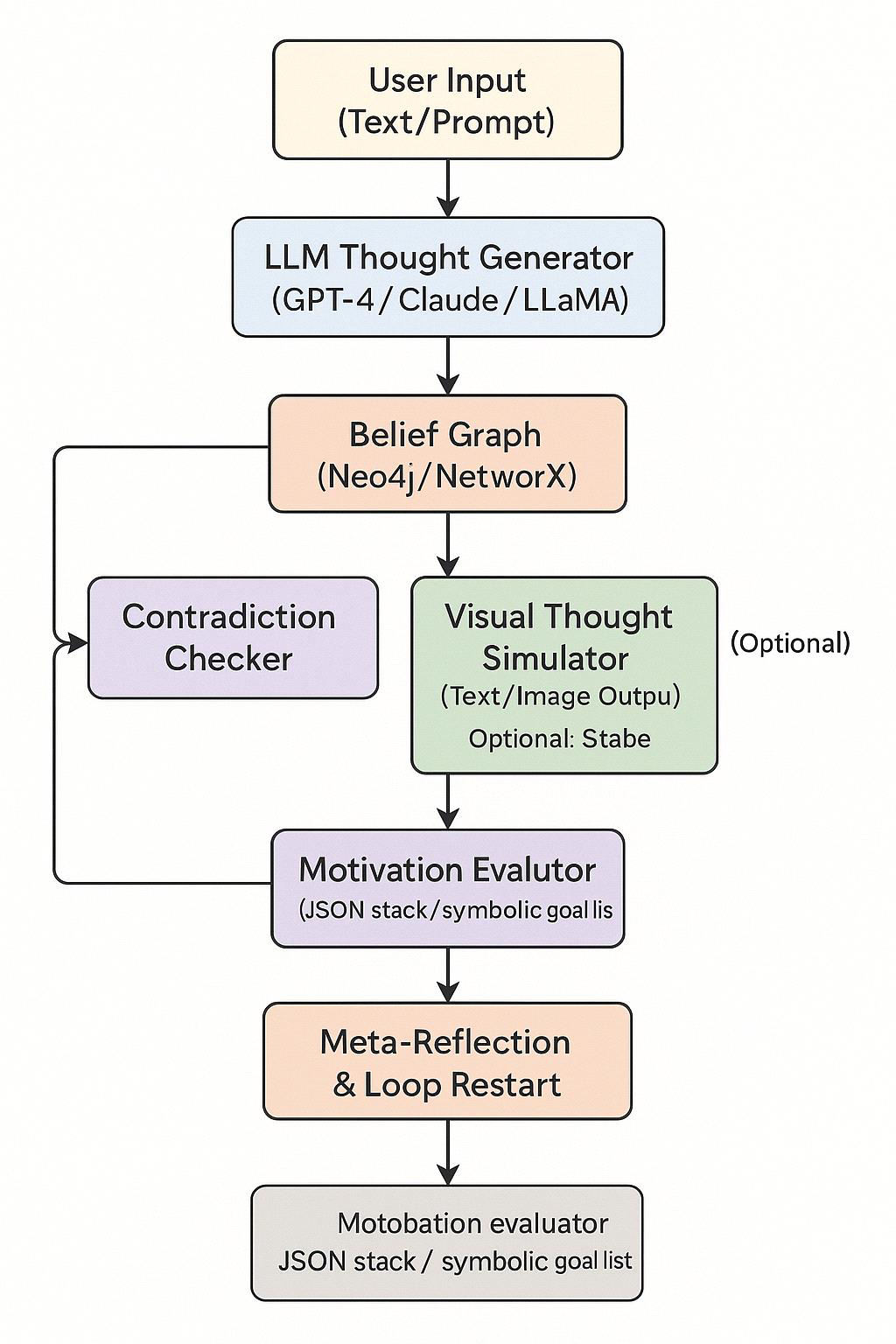
This high-level sketch shows how:
The LLM core interacts with a belief graph memory and contradiction detector
The user input stream feeds into this loop
Optional visual thought renderers (text-to-image or placeholder sim engines) support internal narrative construction
Outputs can include internal monologue, updated beliefs, or questions
The whole process is guided by a simplified goal stack
9. Final Notes
This sketch isn’t meant to replace the full architecture—it’s meant to help someone get started and build a working brain-loop that reflects the ideas of visual reasoning, contradiction resolution, and symbolic memory.
Anyone with some Python skills and access to a GPT-4 API can begin experimenting today.
Prepared as a practical supplement to the 2025 AGI Architecture draft by Derek Van Derven.
CLAIMS
1. A Multimodal Cognitive Architecture comprising:
a natural language input parser; a visual thought simulation module that renders internal scenes based on parsed input;
a symbolic reasoning engine configured to perform contradiction detection and belief modeling;
a meta-cognitive feedback loop for self-reflection and learning;
and an action execution subsystem capable of interacting with real or simulated environments.
2. The system of claim 1, wherein said visual simulation is constructed from multimodal sensory input, including 2D/3D models, symbolic imagery, sound, and internal avatar feedback.
3. The system of claim 1, wherein said meta-cognitive feedback loop re-evaluates goal structures and confidence levels based on internal contradictions, symbolic mappings, and external task outcomes.
4. The system of claim 1, wherein symbolic memory is stored and recalled using a mnemonic encoding layer that maps numeric or semantic values to visual metaphors.
5. The system of claim 4, wherein the mnemonic encoding layer implements a peg-word memory system, associating numerical keys with structured symbolic imagery, enabling long-term associative recall and symbolic activation.
6. The system of claim 3, wherein the meta-cognitive feedback loop includes a contradiction-checking engine that logs internal epistemic conflicts, assigns confidence penalties to contradictory beliefs, and resolves inconsistencies via recursive belief updates.
7. The system of claim 1, wherein said action execution subsystem is integrated with an embodiment interface that transitions learned behaviors from a virtual avatar-based training environment to a physical robotic body, preserving sensory-action mappings and behavioral intent.
You may also like...
-

Engineering Mindset for Early-Career Developers Technology by Moyinoluwalogo O. MayowaEngineering Mindset for Early-Career Developers
Reads:
20Pages:
98Published:
Mar 2026Start thinking like an engineer - not just a coder. Engineering Mindset for Early-Career Developers shows how to approach problems, systems, and collaboration...
Formats: PDF, Epub, Kindle, TXT
-

Mobile App Development with WordPress Backend: A Practical Guide to REST API Integration Technology by SanjayMobile App Development with WordPress Backend: A Practical Guide to REST API Integration
Reads:
28Pages:
40Published:
Aug 2025Build high-performance mobile apps using WordPress as a powerful backend system with this actionable guide. Whether you're working with React Native or Flutte...
Formats: PDF, Epub, Kindle, TXT
-

What’s This Thing Called A Quantum Computer? Technology by Michael McNaughtWhat’s This Thing Called A Quantum Computer?
Reads:
37Pages:
31Published:
Jul 2025"What is this Thing Called a Quantum Computer?" offers a clear and engaging introduction to quantum computing. It explains core quantum mechanics principles, ...
Formats: PDF, Epub, Kindle, TXT
-

Introduction: Product Management Essentials Technology by RK OluwasanmiIntroduction: Product Management Essentials
Reads:
1193Pages:
29Published:
Oct 2024Introduction: Product Management EssentialsIn the fast-paced world of technology and business, product management is often considered the bridge between strat...
Formats: PDF, Epub, Kindle, TXT