

O.K. Corral by Edward Drobinski - HTML preview
Download the book in PDF, ePub, Kindle for a complete version.
Behan was born in Westport, Missouri, in what is now Kansas City, the third of nine children. His parents, who had wed on March 16th, 1837
in Jackson County, Missouri, were Peter Behan, a carpenter from County Kildare, Ireland, and Sarah Ann Harris, a native of Madison County, Kentucky. John Harris Behan was named for his mother's 510
family and his maternal grandfather, although the 1900 Federal census reports an 1845 date of birth for him.
Behan moved west to San Francisco, working as a miner and a freighter. During the American Civil War, Behan was a 19 year old civilian employee of Carleton's Column of Union Volunteers in California. He fought in the Battle of Apache Pass on July 14th–15th, 1862 and in 1863 settled in Tucson, where he found work delivering freight to military installations. In 1864, he served as a clerk to the First Arizona Legislative Assembly in Prescott, the territorial seat. This brought 19 year old Behan into contact with some of the most influential men in the state.
In 1865, he moved to Prescott, the new capital of the Arizona Territory, where he speculated in real estate and prospected for minerals. While prospecting along the Verde River February 28th, 1866, five other men and he were attacked by Indians. Behan helped fight them off and gained a reputation as a brave man. He also operated a saw mill.
511
Yavapai County Sheriff John P. Bourke married German immigrant and widow Harriet Zaff in 1860. She had four children from her two prior marriages; Benjamin, Catherine, Victoria, and Louisa. Bourke hired Behan as an under-sheriff in 1866, and fourteen year old Victoria caught Behan's eye. After two years Behan resigned to run for Yavapai County Recorder, which he won in 1868 at age 23. It was one of the most important jobs in the county as he was responsible for maintaining accurate records that were the basis for all taxes collected.
In March 1869, Behan married Bourke's step-daughter Victoria Zaff in San Francisco, Bourke's home town. Victoria was already pregnant.
The couple quickly returned to Prescott, Arizona Territory. Only three months later, on June 15th, 1869, Victoria had her first child, Henrietta. Victoria and Johnny later had a son, Albert Price Behan, born in Prescott on July 7th, 1871.
Behan succeeded his father-in-law in office as the Yavapai County sheriff from January 1871 to December 1873. He took a chance at a more important position and in 1873 successfully ran for office as 512
Yavapai County's representative to the Seventh Arizona Legislative Assembly.
The Territorial Legislature met in Tucson or Prescott for a six to eight week legislative session, and Behan attended his first session in January 1874 in Tucson. On September 28th, 1874, Behan was nominated as sheriff at the Democratic convention in Yavapai County.
“The Prescott Miner” reported on October 6th, 1874 that; "J.H. Behan left on an 'electioneering' tour toward Black Canyon, Wickenburg and other places," north and east of present day Phoenix. Behan was gone for 35 days campaigning for the sheriff's office.
Some accounts state that Sadie Marcus ran away from her parents'
home in San Francisco in 1874 and traveled to Prescott, Arizona. Her friend Dora Hurst and she, with other passengers on a stage coach, had been forced to hole up in a ranch house near Cave Creek by Apache Indians, who had escaped the Cave Creek reservation. Indian fighter Al Sieber was tracking the Apaches. Sadie said the famous Indian scout led them to safety. According to Sadie, she first met
"John Harris" here, whom she described as; "Young and darkly 513
handsome, with merry black eyes and an engaging smile." She said;
"My heart was stirred by his attentions as the heart of any girl would have been under such romantic circumstances. The affair was at least a diversion in my homesickness, though I cannot say I was in love with him."
Behan returned to Prescott on November 11th, 1874 but lost the election. He apparently spent considerable time away from home, either at saloons along Prescott's Whisky Row or at nearby brothels.
His affairs were finally too much for Victoria. On May 22nd, 1875, Behan's fortunes took a turn for the worse when Victoria filed for divorce. While being divorced alone wasn't completely unusual, Victoria took the extra step of asserting in her divorce petition that Behan "has within two years last past at diverse times and places openly and notoriously visited houses of ill fame and prostitution at said town of Prescott."
Witness Charles Goodman testified; "I saw the defendant [Behan] at a house of ill fame, at which resided one Sada Mansfield, commonly called Sadie, a woman of prostitution and ill fame, and the said 514
defendant did at the time and at the house spoken of, stay all night with and sleep with the said Sada Mansfield, and I know of the defendant having committed similar acts at the same place and at various times than at the particular time referred to." The divorce action also cited Behan's threats of violence and unrelenting verbal abuse. Victoria told the court, Behan approached her in a "threatening and menacing manner calling me names such as whore and other epithets of like character and by falsely charging me with having had criminal intercourse with other men, threatened to turn me out of the house, quarreling with, and abusing me, swearing and threatening to inflict upon me personal violence."
Behan claimed their daughter Henrietta was not his, and Victoria's request for support for Henrietta was stricken from the divorce petition. He didn't contest any of her other allegations and was ordered to pay $16.16 a month in child support for Albert alone.
Henrietta died on March 6th, 1877 at age seven of scarlatina.
515
Behan did not restrict his extramarital liaisons to paid arrangements.
Throughout his life, he had sexual relationships with numerous women, including the wives of friends and business partners.
In April 1876, Behan became the census marshal for Yavapai County, and spent several weeks covering the district and completing his census chores. In the fall of 1876, he ran for Yavapai County sheriff and lost by 78 votes. In January 1877, he was selected as sergeant at arms for the Ninth Legislative Assembly while it met in Tucson. He then moved to the northwest Arizona Territory, where he served as the Mohave County Recorder in 1877, and then deputy sheriff of Mohave County in Gillet in 1879. In October 1879 the “Weekly Journal Miner”
reported that Behan was planning on opening a business in Tip Top, a then fast growing silver mining town in central Arizona, and in November 1879, Behan opened a saloon there.
He was elected to represent Mohave County at the Tenth Arizona Legislative Assembly, which met beginning January 6th, 1879, in Prescott. In the middle of 1879, he relocated to Prescott, where he opened a business providing services to local mines and exercised his 516
skills as a lawman by joining several posses. While in Prescott, he got into a skirmish with some Chinese laundry men, and outnumbered, was clubbed and beaten by the businessmen.
On June 2nd, 1880, Behan was counted in the 1880 census in Tip Top, Arizona as a saloon keeper. His was initially the only one of six saloons without a prostitute. But 19 year old Sadie Mansfield, whose occupation was given as "Courtesan," the same person that his former wife Victoria had named in their divorce five years earlier, was also living in Tip Top.
On June 1st or 2nd, 1880, William V. Carroll, the census enumerator for the 9th ward in San Francisco, visited the Marcus home. He lived about two blocks from the family. He recorded Josephine as a member of the Marcus household, information that may have been offered by her parents. Sadie Mansfield and Sadie Marcus also were both 19
years old, born in New York, and their parents were from Prussia.
According to Josephine, at some point she felt ill and returned to her parents' home in San Francisco. She said Behan followed her and persuaded her parents to approve their engagement. Some modern 517
researchers question the likelihood that her father, a Reform Jew, would approve her union with Behan, an unemployed office seeker, fourteen years older than his daughter, a Gentile, and a divorced father. Sadie later said Behan told her parents that he couldn't leave his livery stable business for a wedding in San Francisco and Sadie said her parents approved their engagement.
In August 1880, Behan sought the nomination as County Recorder in Yavapai County once more, but was defeated. On September 15th,
“The Tombstone Epitaph” noted his arrival with his eight year old son Albert in Tombstone. Albert, who had a hearing impairment, had been living with his mother, grandmother and his uncle John Bourke Jr. in Prescott in 1880.
Depending on which version of events is correct, Sadie said she first arrived in Tombstone as part of the Pauline Markham troupe on December 1st, 1879, for a one week engagement. The Pauline Markham troupe put on more than a dozen performances of H.M.S.
Pinafore from December 24th, 1879 through February 20th, 1880.
Sadie, possibly using the stage name May Bell, may have played 518
Cousin Hebe. The city of Prescott, Arizona, fell in love with the troupe, and they stayed for nearly six months.
Sadie reported later in life that Behan pestered her in San Francisco with letters from Tombstone, bragging about the growing town and promising to marry her. She said she thought Behan's marriage proposal was a good excuse to leave home again. She wrote; "Life was dull for me in San Francisco. In spite of my bad experience of a few years ago the call to adventure still stirred my blood." Josephine arrived in Tombstone in mid-October. When Behan avoided setting a wedding date, she was ready to end the relationship, but Behan persuaded her to stay. They lived together as husband and wife, and Josephine signed her name as Josephine Behan for a period of time, but no marriage record has been found. Sadie later said she lived with a lawyer and his wife during this time period. Considering that Josephine said she first arrived in Arizona with the Markham troupe on December 1st, 1879, and she joined Behan in Tombstone in October 1880, her reference to "my bad experience of a few years ago" means she must have actually been in Arizona for some time before 1879.
519
Based on the information Sadie provided the Earp cousins with, when correlated with other sources, Josephine may have left San Francisco for Prescott as early as October 1874, when she was 13 or 14 years old. Author Roger Ray thoroughly researched Josephine's story about joining the theater company and found many inconsistencies. The Markham troupe was documented as leaving San Francisco on board the Southern Pacific Railroad, not a ship nor a stagecoach, for Casa Grande, Arizona in October 1879, the end of the line. Sadie Marcus's name was never included among those on the Markham troupe's rolls in 1879.
“The Yuma Arizona Sentinel” reported on October 25th, 1879;
"Tuesday arrived a Pinafore Company for Tucson, composed of Misses Pauline Markham, Mary Bell, Belle Howard, and Mrs. Pring, and Messrs.
Borabeck and McMahon." From Yuma, the troupe took a stagecoach to Tucson, not Prescott. The train trip was not interrupted by Indians.
Ray states that Josephine didn't have a friend named Dora Hirsch. Her real name was Leah Hirschberg, whose mother was actually a music teacher. This family lived only a few blocks from where Josephine lived with her family. But Leah never left San Francisco with 520
Josephine. She instead enjoyed some brief success as a juvenile actress on the San Francisco stage during the 1870s.
Bat Masterson, a friend of Wyatt Earp's who was in Tombstone from February to April 1881, described Sadie to Stuart Lake as "an incredible beauty" and as the "belle of the honkytonks, the prettiest dame in three hundred or so of her kind." Honkytonk bars in that era often had a reputation as place for prostitution and his choice of language, "three hundred or so of her kind", likely referred to Josephine's work as a prostitute.
When Behan first arrived in Tombstone in September 1880, he also got a job as bar manager in the Grand Hotel, a favorite of the outlaw Cowboys, and a good place to make political connections. He also bought part interest in the Dexter Livery Stable with John Dunbar, where local businessmen could rent horses.
Wyatt Earp had been appointed undersheriff for the eastern section of Pima County by Pima County Sheriff Charles Shibell on July 29, 1880.
The Cowboys, mostly Southerners, supported the Democratic ticket and Shibell. Elections were held on November 2nd, and it was 521
expected that Democrat Shibell would be defeated by Republican Bob Paul, who Wyatt had supported during the campaign.
Shibell won the election by a 46 vote margin. Opponent Bob Paul filed suit on November 19th alleging ballot box stuffing in the San Simon Cienega precinct, since the precinct delivered a 103 to 1 vote for Shibell in a precinct estimated to contain only 15 eligible voters.
James Johnson later testified for Bud Paul in the election hearing and said that the ballots had been left in the care of Democrat Phin Clanton. Meanwhile, a week after the election on November 9th, 1880, Earp resigned. The position of undersheriff was now open, and Shibell immediately selected Democrat Johnny Behan to serve as Tombstone area undersheriff.
In February 1881, the San Simon results were thrown out by the election commissioners, but Shibell filed an appeal. Shibell was finally removed from office in April and replaced by Bob Paul. But the election was now moot. On February 1st, 1881, during the vote counting investigation, the eastern area of Pima County containing Tombstone had been split off to form the new Cochise County.
522
Behan's partner in the Dexter Livery, John Dunbar, through his family in their home town in Bangor, Maine, was "close family friends" of the powerful Senator James G. Blaine, one of the most powerful Republican congressmen of his time. The Dunbars used their influence to help Behan get appointed sheriff of the new Cochise County, in February 1881. Behan had already served two terms in the Territorial Legislature and was more politically connected than Earp. When the state created Cochise County, Governor John C. Frémont appointed, and the territorial legislature approved, Behan as sheriff on February 10, 1881.
In a back room deal with Wyatt Earp, he promised Wyatt Earp a position as Cochise County undersheriff, if Earp, the only other previous undersheriff for Tombstone, would not oppose Behan's appointment. Behan took office in the new position in April, with his offices in the county seat, Tombstone, but reneged on the deal with Earp, appointing prominent Democrat Harry Woods instead.
Later that year, Behan gave a contrived explanation of his actions during the hearings after the gunfight at the O.K. Corral. He said he 523
broke his promise to appoint Earp because of an incident shortly before his appointment. Searching for a stolen horse belonging to him, Wyatt learned in late 1880 that the horse was in nearby Charleston.
Wyatt spotted Billy Clanton attempting to leave town with the horse and, hand on his gun, persuaded Billy to release it. Behan was in Charleston to serve a subpoena on Ike Clanton. Billy carried the subpoena from Behan to Ike using Wyatt's horse. Ike was hopping mad when Behan finally found him, for Earp had told Clanton that Behan
"had taken a posse of nine men down there to arrest him." Behan took offense at Wyatt's tactics and changed his mind about appointing Wyatt. Holliday reported in an interview in 1882 that "from that time a coolness grew up between the two men."
As Cochise County sheriff, one of Behan's duties was collecting prostitution, gambling, liquor, and theater fees, taxes for which he received 10% of all proceeds. He developed a reputation for graft and was seen as the head of the "Ten Percent Ring." Rumors of graft and corruption followed him during his tenure as sheriff. On January 31st, 1882, Behan was arrested for collecting bills totaling $300 twice, arraigned in front of Justice Stilwell, and discharged due to a 524
technicality. In 1882, after Southern Pacific Railroad completed laying tracks and building facilities across the northern portion of Cochise County, he assessed them $8,000,000, which they appealed. The Board of Supervisors reduced the assessment to $1,000,000, substantially reducing Behan's take by $25,000.
In 1881 Behan's ex-wife Victoria sent Albert to live with his father in Tombstone. Behan was already living with Sadie in 1880, and Albert grew close to her. This relationship lasted for much of the rest of their lives.
Wyatt Earp testified later saying that he had promised not to publicly campaign to the governor against the appointment, not election, of Behan, in return for an appointment by Behan as Behan's own undersheriff. But after being appointed, Behan appointed another man, Southern Democrat Harry Woods, to the position that Wyatt thought would go to him.
At the preliminary hearing against the Earps after the gunfight at the O.K. Corral, Behan explained that he appointed Woods rather than Earp due to an incident involving a stolen horse of Virgil Earp's, which 525
was recovered by Wyatt from Billy Clanton. This happened sometime after Behan had been appointed undersheriff in November 1880, and his move to Cochise County sheriff the next spring. At the time, Wyatt was not a law officer, but had used the threat of Behan riding out to the Clantons' ranch as a bluff to get Clanton to turn over the horse. As it happened, Behan was riding to the ranch to serve a subpoena related to the ballot box stuffing incident, not to recover the horse, and the incident embarrassed the Cowboys and also Behan, who for a time had been made to look like he was supporting Earp against the Cowboys.
Sometime during early 1881, Sadie arrived home to find Behan in bed with the wife of a friend of theirs, and she kicked Behan out of the home they had built with her father's money. One version of the story is that Sadie had taken Albert, who had a hearing impairment, to San Francisco for treatment. Upon their return, they arrived late in the evening and a day earlier than expected. They found Behan in bed with another woman. Behan was embarrassed by the public breakup. Most Tombstone residents thought that Marcus and Behan were legally 526
married. Her breakup with Behan was publicized by “The Tombstone Epitaph.”
Tombstone diarist George W. Parsons never mentioned seeing Wyatt and Sadie together and neither did John Clum in his memoirs.
Earp had been in a common-law marriage with Mattie Blaylock since about 1873 and she was listed as his wife in the 1880 census. It is not known when Earp and Blaylock ended their relationship, except that after the gunfight at the O.K. Corral, she went to Colton, California, where the rest of the Earp family lived. She waited for Earp to come get her there and when he didn't, she resumed a life of prostitution in Pinal, Arizona, where on July 3rd, 1888, she took a lethal dose of laudanum together with alcohol. Her death was officially ruled as
"suicide by opium poisoning."
The records show evidence that Cochise County Marshall Behan was sympathetic to the interests of and a friend to Ike Clanton, "Curly Bill"
Brocius, as well as Johnny Ringo, and a group of cattle rustlers and ranchers, loosely known as "Cowboys." Some of the Cowboys were also active as rustlers in the US side of the border after the Mexicans 527
lowered tariffs and stepped up military patrols after 1882. Frank Stilwell was an assistant Deputy under Behan for several months until shortly before he was a suspect in the Bisbee stage holdup. Behan employed several of the outlaws as sheriff's deputies during their pursuit of Deputy US Marshal Wyatt Earp's posse after he was alleged to have killed Frank Stilwell in Tucson.
528
O.K. Corral
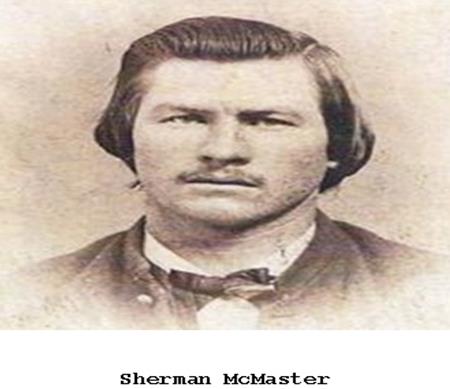
8B– Sherman McMaster
Sherman W. McMaster was born in 1853 in Rock Island, Illinois, the son of Sylvester W. McMaster. Not much is known of his life before heading out west, but he moved to Texas and became a Texas Ranger.
He met "Curly Bill" Brocius, who was a prisoner under McMaster's Ranger division. In 1878 Curly Bill escaped from prison, allegedly helped by McMaster. Soon after, along with Brocius, Johnny Barnes, and Pony Diehl, McMaster moved to Arkansas.
529
McMaster worked for the Texas Rangers in 1878, the same year that he first met Brocius. By most accounts he was a good lawman, and was respected for his talents with a gun. In July 1880 he was suspected of stealing US Army mules and two horses from a camp near Tombstone. He was also a suspect in a stagecoach robbery near Globe, Arizona.
On February 24th, 1881, two men robbed the stage traveling between Globe and Florence. When they found that the Wells, Fargo and Co.
strongbox was empty, they stole the US mail. Pony Diehl, A/K/A Charles Ray, and McMaster were suspects. In Tombstone, City Marshal Virgil Earp knew that McMaster was wanted for the robbery, but according to “The Tombstone Epitaph” Virgil had received instructions from Pima County Sheriff Bob Paul to wait to arrest McMaster until Diehl was in custody.
On September 10th, 1881, Tombstone City Marshal Virgil Earp attempted to arrest McMaster, who resisted. McMaster fired several shots at Virgil before escaping.
530
9 - The Bad Blood Prelude
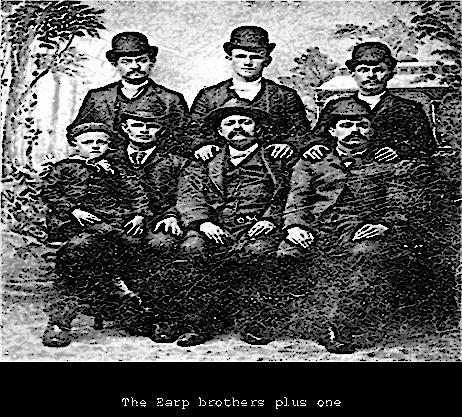
The interpersonal conflicts and feuds leading to the gunfight at the O.K.Corral were complex. Each side had strong family ties. The brothers James, Virgil, Wyatt, Morgan, and Warren Earp were a tight knit family, working together as either lawmen, pimps, gamblers, and saloon owners in several frontier towns, among other occupations, and had moved together from one town to another. Virgil served in the Union Army during the American Civil War and in 1877 became a police officer in Prescott, Arizona Territory. He followed that with a job as a night watchman before he became a constable. Wyatt had held two jobs as a police officer in the cattle drive towns of Wichita and Dodge City, Kansas.
531
O.K. Corral
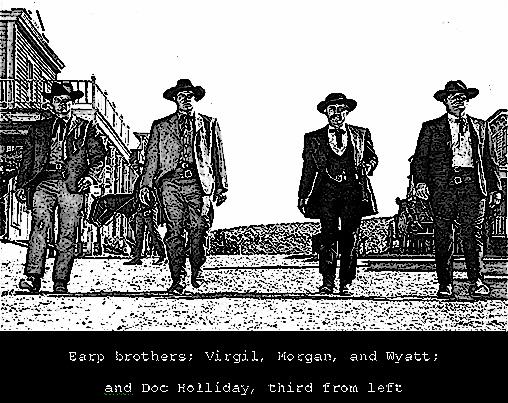
James, Virgil, and Wyatt Earp, together with their wives, arrived in Tombstone on December 1st, 1879, during the early period of rapid growth associated with mining, when there were only a few hundred residents. Virgil was appointed Deputy US Marshal shortly before he arrived in town. In the summer of 1880, Morgan and Warren Earp also moved to Tombstone. Wyatt arrived hoping he could leave "lawing"
behind with his best friend, Doc Holliday, with him. He bought a stagecoach, only to find the business was already very competitive.
The Earps invested together in several mining claims and water rights, 532
O.K. Corral
while Doc Holliday did well at Faro. The Earps were Republicans and Northerners who had never worked as cowmen or ranchers. Holliday had no political agenda, but also was no cowman or rancher. His gun decided any “political” babble which surfaced.
The Earps quickly came into conflict with Frank and Tom McLaury, Billy and Ike Clanton, Johnny Ringo, and William "Curly Bill" Brocius, 533
among others, as did Holiday for another reason; that the Cowboys sought to implicate him in a stagecoach robbery wherein two were killed. They were part of a large, loose association of cattle smugglers and horse thieves known as the Cowboys; outlaws who had been implicated in various crimes. Ike Clanton was prone to drinking heavily and threatened the lives of the Earp brothers for interfering in his business numerous times.
The Cowboys openly blamed Holliday for the March 15th, 1881
stagecoach robbery near Contention City. The coach was carrying $26,000 in silver bullion and two people were killed. Doc recognized an enemy and packed quietly. Doc told Dave Wallace that; “I didn’t appreciate the publicity. I had not yet done anything to invite their wrath, and I wasn’t prone to tolerating it. When they sent their ‘ace,’
Johnny Ringo around to scare Wyatt and me, I told him; ‘I’m your huckleberry.’”
Tombstone resident George Parson wrote in his diary; "A Cowboy is a rustler at times, and a rustler is a synonym for desperado/bandit, outlaw, and horse thief." “The San Francisco Examiner” wrote in an 534
editorial; "Cowboys are the most reckless class of outlaws in that wild country, infinitely worse than the ordinary robber." During the 1880s in Cochise County, it was an insult to call a legitimate cattleman a
"Cowboy." The Cowboys teamed up for various crimes and came to each other's aid. Virgil thought that some of the Cowboys had met at Charleston and taken "an oath over blood drawn from the arm of Johnny Ringo, the leader, that they would kill us."
Among the lawmen involved in the O.K. Corral shooting, only Virgil had any real experience in combat. Virgil had been constable in Prescott and was the deputy United States Marshal in Tombstone. He was appointed Deputy US Marshal for eastern Pima County by US Marshal Crawley Dake, on November 27th, 1879, before the rest of the Earps and Doc Holliday arrived in Tombstone around December 1st. He was appointed as Tombstone's acting town marshal on September 30th, 1880, after popular Tombstone town marshal Fred White was shot and killed by Brocius. Wyatt had been a deputy city marshal in Kansas, as well as deputy sheriff in Tombstone.
535
O.K. Corral
Only six weeks later, Virgil ran for the office on November 12th, 1880, but lost to Ben Sippy. However, on June 6th, 1881, Sippy asked for a two week leave of absence. The city soon discovered $3,000 in financial improprieties in Sippy's records. A few days later Virgil was appointed as town marshal in his place. At the time of the gunfight, Virgil was both Deputy US Marshal and town marshal. The city suspended him as town marshal after Ike Clanton filed charges.
536
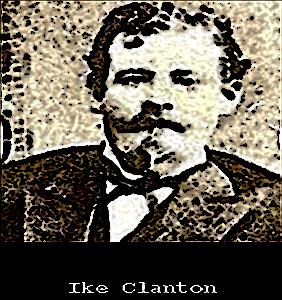
O.K. Corral
After Wyatt first arrived in Tombstone, his business efforts yielded little profit, and he took a job as a stagecoach shotgun messenger for Wells Fargo, guarding shipments of silver bullion. On July 28th, 1880, Wyatt was appointed Pima County Deputy Sheriff. He held this position for only three months, until after the election of November 9th, 1880, when he resigned. When Virgil was later maimed by an assassination attempt, Wyatt was appointed Deputy US Marshal in his place. He held that position until he left Cochise County in April 1882.
537
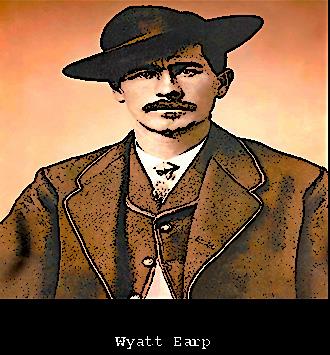
O.K. Corral
Wyatt was an imposing, handsome man; blond, six feet tall, weighing 165 to 170 pounds, broad shouldered, long armed, and muscular. He had been a boxer and was reputed to be an expert with a pistol.
According to author Leo Silva, Earp showed no fear of any man. Wyatt had been an assistant marshal when he and policeman James Masterson, along with a few other citizens, fired their pistols at several cowboys who were fleeing town after shooting up a theater. A member of the group, George Hoyt, was shot in the arm and died of his wound a month later. Wyatt always claimed to have been the one 538
to shoot Hoyt, although it could have been anyone among the lawmen.
Wyatt had developed a reputation as a no-nonsense, hard-nosed lawman, but prior to the gunfight he was known to have been involved in only one other shooting, in Dodge City, Kansas, during the summer of 1878. But, rumors abounded.
The 1931 book “Wyatt Earp: Frontier Marshal” was a best selling biography by Stuart N. Lake. It established Wyatt Earp's role as a fearless lawman in the American Old West and the legend of the
"Gunfight at the O.K. Corral" in the public consciousness. But Lake and many others in the popular media exaggerated Wyatt's role as the central figure in the gunfight. That position clearly belongs either to older brother Virgil Earp or Doc Holliday. It was only discovered much later that “Wyatt Earp: Frontier Marshal,” based on eight interviews with Earp, was largely fictional. The book and later Hollywood portrayals embellished Wyatt's reputation and magnified his mystique as a western lawman. It should be noted here that Wyatt’s achievements were not minor. In fact they were quite substantial; merely overstated which is far from unusual for anyone discussed in the media.
539
Morgan Earp had been a police officer in Montana, but had no known experience with gun fighting prior to their arrival in Tombstone. While Wyatt became Pima County Deputy Sheriff on July 27th, 1880, Morgan Earp took over his job as shotgun messenger for Wells Fargo. Morgan also occasionally assisted Virgil and at the time of the gunfight was wearing a deputy city marshal's badge and drawing pay.
Doc Holliday had a reputation as a gunman and had reportedly been in nine shootouts up until then, though Doc was never one to self-advertise his doings. Rather than looking toward show business, he looked to stay out of trouble. Although it has only been modern day
“expert” verified that he killed three men, his legend preceded him at the time. One well-documented episode occurred on July 19th, 1879, when Holliday and his business partner, former deputy marshal John Joshua Webb, were seated in their saloon in Las Vegas, New Mexico.
Former US Army scout Mike Gordon got into a loud argument with one of the saloon girls whom he wanted to take with him. Gordon stormed from the saloon and began firing his revolver into the building. Before Gordon could get off his second shot, Holliday killed him. Holliday was 540
tried for the murder but acquitted, mostly based on the testimony of Webb.
Holliday had saved Wyatt Earp's life at one time and had become a close friend. He had been living in Prescott, Arizona Territory and making a living as a gambler since late 1879. There, he first met future Tombstone sheriff Johnny Behan, a sometime gambler and saloon owner. In late September 1880, Holliday followed the Earps to Tombstone.
The ranch owned by Newman Haynes Clanton near Charleston, Arizona was believed to be the local center for the Cowboys' illegal activities.
Tom and Frank McLaury worked with the rustlers buying and selling stolen cattle.
Many of the rural ranchers and Cowboys resented the growing influence of the city residents over county politics and law enforcement. The ranchers largely maintained control of the country outside Tombstone, due in large part to the sympathetic support of Cochise County Sheriff Johnny Behan, who favored the Cowboys and rural ranchers, and who also grew to intensely dislike the Earps.
541
Behan tended to ignore the Earps' complaints about the McLaurys' and Clantons' horse thieving and cattle rustling. The Earps were known to bend the law in their favor when it affected their gambling and saloon interests, which earned them further enmity with the Cowboy faction.
To reduce crime in Tombstone, on April 19th, 1881, the city council passed ordinance 9, requiring anyone carrying a bowie knife, dirk, pistol or rifle to deposit their weapons at a livery or saloon soon after entering town.
The ordince read as follows; “To Provide against Carrying of Deadly Weapons.
Section 1: It is hereby declared unlawful to carry in the hand or upon the person or otherwise any deadly weapon within the limits of said city of Tombstone, without first obtaining a permit in writing.
Section 2: This prohibition does not extend to persons immediately leaving or entering the city, who, with good faith, and within reasonable time are proceeding to deposit, or take from the place of deposit such deadly weapon.
542
Section 3: All fire-arms of every description, and bowie knives and dirks, are included within the prohibition of this ordinance.
Tombstone City Ordinance Number 9 Effective April 19th, 1881.”
The ordinance was the legal basis for City Marshal Virgil Earp's decision to confront the Cowboys on the day of the shootout.
Guadalupe Canyon Massacre
In the borderlands south of Tombstone there was only one passable route between Arizona and Mexico, a passage known as Guadalupe Canyon. In August 1881, 15 Mexicans carrying gold, coins and bullion to make their purchases were ambushed and killed in Skeleton Canyon. The next month Mexican Commandant Felipe Neri dispatched troops to the border, where they killed five Cowboys, including Newman Haynes "Old Man" Clanton, in Guadalupe Canyon. The Earps knew that the McLaurys and Clantons were reputed to be mixed up in the robbery and murder in Skeleton Canyon. Wyatt Earp said in his testimony after the shootout; "I naturally kept my eyes open and did not intend that any of the gang should get the drop on me if I could help it."
543
On July 27th, 1880, Pima County Sheriff Charles A. Shibell, whose offices were in the county seat of Tucson, appointed Wyatt Earp as deputy sheriff. On October 28th, 1880, Tombstone Marshal Fred White attempted to disarm some late night revelers who were shooting their pistols in the air. When he attempted to disarm Curly Bill Brocius, the gun discharged, striking White in the abdomen. Wyatt saw the shooting and pistol whipped Brocius, knocking him unconscious, and arrested him. Wyatt later told his biographer John Flood that he thought Brocius was still armed at the time, and didn't see Brocius'
pistol on the ground.
Brocius waived the preliminary hearing so he and his case could be immediately transferred to Tucson. Wyatt and a deputy took Brocius in a wagon the next day to Tucson to stand trial, possibly saving him from being lynched. Wyatt testified that he thought the shooting was accidental. It was also demonstrated that Brocius's pistol could be fired from half cock. Fred White left a statement before he died two days later that the shooting was not intentional. Based on the evidence presented, Brocius was not charged with White's death.
544
The Tombstone council convened and appointed Virgil Earp as
"temporary assistant city marshal" to replace White for a salary of $100 per month until an election could be held on November 12th. For the next few weeks, Virgil represented federal and local law enforcement and Wyatt represented Pima County.
In the November 2nd, 1880, election for Pima County sheriff, Democrat Shibell ran against Republican Bob Paul, who was expected to win.
Votes arrived as late as November 7th, and Shibell was unexpectedly re-elected. He immediately appointed Johnny Behan as the new deputy sheriff for eastern Pima County, a job that Wyatt wanted. A controversy ensued when Paul uncovered ballot stuffing by Cowboys and he sued to overturn the election. While San Simeon precinct, east of Tombstone, only had 10 registered voters, Shibell won that precinct with 103 votes to 1. In that precinct lived Ike Clanton. Johnny Ringo was the precinct officer for the election.
Paul finally became sheriff in April 1881, but it was too late to re-appoint Wyatt Earp as deputy sheriff because on February 1st, 1881, the eastern portion of Pima County containing Tombstone had been 545
split off into the new Cochise County, which would need its own sheriff, based in the county's largest city, Tombstone. This position was filled by a political appointment from the governor, and Wyatt and Behan both wanted the job. The Cochise County sheriff's position was worth more than $40,000 a year because the office holder was also county assessor and tax collector, and the board of supervisors allowed him to keep ten percent of the amounts paid and collected.
Behan used his existing position and his superior political connections to successfully lobby for the position. He also promised Wyatt a position as his undersheriff if he was appointed over Wyatt. Wyatt withdrew from the political contest and the governor and legislature appointed Behan to the job of Cochise County sheriff on February 10th, 1881. Behan reneged on his deal with Earp and appointed Harry Woods as undersheriff instead. Behan said he broke his promise to appoint Earp because Wyatt Earp used Behan's name to threaten Ike Clanton when Wyatt recovered his stolen horse from Clanton.
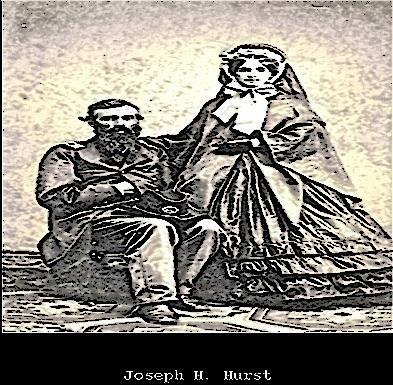
Tensions between the Earp family and both the Clanton and McLaury clans increased through 1881. On July 25th, 1880, Captain Joseph H.
546
O.K. Corral
Hurst, of Company A, 12th US Infantry, and Commanding Officer of Fort Bennett, a Civil War hero, asked Deputy US Marshal Virgil Earp to help him track Cowboys who had stolen six US Army mules from Camp Rucker. This was a federal matter because the animals were US
property. Hurst brought four soldiers, and Virgil invited Wyatt and Morgan Earp, as well as Wells Fargo agent Marshall Williams. The posse found the mules on the McLaury's Ranch on Babacomari Creek, northwest of Tombstone, as well as the branding iron used to change the "US" brand to "D8."
547
To avoid bloodshed, Cowboy Frank Patterson promised Hurst they would return the mules and Hurst persuaded the posse to withdraw.
Hurst went to nearby Charleston, but the Cowboys showed up two days later without the mules, laughing at Hurst and the Earps for having had backed off so easily and stupidly. In response, Hurst had printed and distributed a handbill in which he named Frank McLaury as specifically assisting with hiding the mules. He re-printed this in “The Tombstone Epitaph” on July 30th, 1880. Virgil later said that Tom McLaury had asked him if he had posted the handbills. When Virgil said he had not, McLaury said if Virgil had printed the handbills it was Frank's intention to kill Virgil. He warned Virgil; "If you ever again follow us as close as you did, then you will have to fight anyway." This incident was the first run-in between the Clantons and McLaurys and the Earps.
A Kinnear Express stagecoach was operating from Tombstone to Bisbee in the 1880s. This thorough brace stagecoach used thick leather straps to support the body of the carriage and serve as shock absorbing springs. But, on the evening of March 15th, 1881, a Kinnear
& Company stagecoach carrying $26,000 in silver bullion was en route 548
from Tombstone to Benson, Arizona, the nearest freight terminal. Bob Paul, who had run for Pima County Sheriff and was contesting the election he lost due to ballot stuffing, was temporarily working once again as the Wells Fargo shotgun messenger. He had taken the reins and driver's seat in Contention City because the usual driver, a well-known and popular man named Eli "Bud" Philpot, was ill. Philpot was riding shotgun.
Near Drew's Station, just outside Contention City, a man stepped into the road and commanded them to "Hold!" Three Cowboys attempted to rob the stage. Paul, in the driver's seat, fired his shotgun and emptied his revolver at the robbers, wounding a Cowboy later identified as Bill Leonard in the groin. Philpot, riding shotgun, and passenger Peter Roerig, riding in the rear dickey seat, were both shot and killed. The horses spooked and Paul wasn't able to bring the stage under control for almost one mile, leaving the robbers with nothing. Paul, who normally rode shotgun, later said he thought the first shot killing Philpot had been meant for him.
549
Deputy US Marshal Virgil Earp, along with temporary federal deputies Wyatt and Morgan Earp, Wells Fargo agent Marshall Williams, former Kansas Sheriff Bat Masterson, who was dealing Faro at the Oriental Saloon, and County Sheriff Behan set out to find the robbers. Wells Fargo issued a wanted poster offering a $3,600 reward for the three robbers, $1,200 each, dead or alive. Robbery of a mail carrying stagecoach was both a federal crime and territorial crime, and the posse consisted of both county and federal authorities and deputies.
The posse trailed the robbers to a nearby ranch where they found a drifter named Luther King. He would not tell who his confederates were until the posse lied and told him that Doc Holliday's girlfriend had been shot. Fearful of Holliday's reputation, he confessed to holding the reins of the robbers' horses, and identified Bill Leonard, Harry "The Kid" Head, and Jim Crane as the robbers. They were all known Cowboys and rustlers. Behan and Williams escorted King back to Tombstone.
Remarkably to those not politically astute, King walked in the front door of the jail and a few minutes later walked out the back. King had arranged with Undersheriff Harry Woods, publisher of the “Tombstone 550
Nugget,” to sell the horse he had been riding to John Dunbar, Sheriff Behan's partner in the Dexter Livery Stable. On March 19th, King conveniently escaped while Dunbar and Woods were making out the bill of sale. Woods claimed that someone had deliberately unlocked a secured back door to the jail. The Earps and the townspeople were furious at King's easy escape. Williams was later dismissed from Wells Fargo, leaving behind a number of debts, when it was determined he had been stealing from the company for years.
The Earps pursued the other two men for 17 days, at one point riding for 60 hours without food and 36 hours without water, during which Bob Paul's horse died, and Wyatt and Morgan's horses became so weak that the two men walked 18 miles back to Tombstone to obtain new horses. After pursuing the Cowboys for over 400 miles they could not obtain more fresh horses and were forced to give up the chase.
They returned to Tombstone on April 1st. Behan submitted a bill for $796.84 to the county for posse expenses, but he refused to reimburse the Earps for any of their costs. Virgil was incensed. They were later reimbursed by Wells, Fargo and Co., but the incident caused further 551
friction between county and federal law enforcement, and between Behan and the Earps.
After he was passed over by Johnny Behan for the position of undersheriff, Wyatt thought he might beat him in the next Cochise County election in late 1882. He thought catching the murderers of Bud Philpot and Peter Roerig would help him win the sheriff's office.
Wyatt later said that on June 2nd, 1881, he offered the Wells, Fargo and Co. reward money and more to Ike Clanton if he would provide information leading to the capture or death of the stage robbers.
According to Wyatt, Ike was initially interested, but the plan was foiled when the threemost likely suspects, Leonard, Head and Crane, were killed in supposedly unrelated incidents.
Ike began to fear that word of his possible cooperation had leaked, threatening to compromise his standing among the Cowboys.
Undercover Wells Fargo Company agent M. Williams suspected a deal, and said something to Ike, who was fearful that other Cowboys might learn of his double cross. Ike now began to threaten Wyatt and Doc Holliday, who had learned of the deal, for apparently revealing Ike's 552
willingness to help arrest his friends, which Ike characterized as fake news.
The fallout over the Cowboys' attempts to implicate Holliday and the Earps in the robbery, along with Behan's involvement in King's escape, exacerbated the increasingly bad feelings between the Earp brothers, Holliday, and the Cowboy factions.
Wyatt Earp and Cochise County sheriff Johnny Behan were interested in the same sheriff's position and also might have shared an interest in the same woman; Josephine Marcus, known as Sadie. Citizens of Tombstone believed that Behan and Sadie were married, but Behan was a known womanizer and had sex with prostitutes and other women. In early 1881, Sadie ended the relationship after she came home and found Behan in bed with the wife of a friend and kicked him out, although she used the Behan surname through the end of that summer. She rented her home sometime before April 1881 to Dr.
George Goodfellow.
Wyatt Earp lived with Mattie Blaylock, who was listed as his wife in the 1880 census. She had a growing addiction to the opiate laudanum, 553
which was readily available at the time. Earp remained with Blaylock until he left Tombstone in April 1882. There are no contemporary Tombstone records that indicate a relationship between Sadie and Earp, but Earp certainly knew her, because both Behan and Earp had offices above the Crystal Palace Saloon.
Sadie, traveling as either Mrs. J. C. Earp or Mrs. Wyatt Earp, left for Los Angeles on March 25th, 1882, and then returned to her family in San Francisco. In July 1882, Wyatt left Colorado and went to San Francisco, where he sought out Sadie and his brother Virgil, who was seeking treatment for his arm. In February or March 1883, Sadie and Earp left San Francisco for Gunnison, where Earp ran a Faro bank until he received a request in April for assistance from Luke Short in Dodge City. Sadie was his common-law wife for the next 46 years.
Tensions between the Earps and the McLaurys further increased when another passenger stage on the “Sandy Bob Line” in the Tombstone area, bound for Bisbee, was held up on September 8th, 1881. The masked bandits robbed all of the passengers of their valuables since the stage was not carrying a strongbox. During the robbery, the driver 554
heard one of the robbers describe the money as "sugar," a phrase known to be used almost exclusively by Frank Stilwell, a Cowboy.
Stilwell had, until the prior month, been a deputy for Sheriff Behan but had been fired for "accounting irregularities."
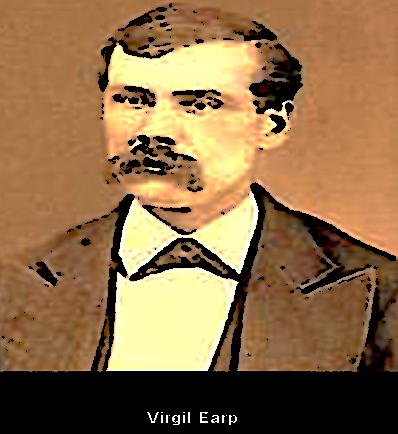
Wyatt and Virgil Earp rode with a sheriff's posse and tracked the Bisbee stage robbers. Virgil had been appointed Tombstone's town marshal, equivalent to the chief of police, on June 6th, 1881, after Ben Sippy abandoned the job. However, Virgil at the same time continued to hold his position of deputy US marshal, and it was in this federal capacity that he continued to chase robbers of stage coaches outside Tombstone city limits.
555
O.K. Corral
At the scene of the holdup, Wyatt discovered an unusual boot print left by someone wearing a custom repaired boot heel. The Earps checked a shoe repair shop in Bisbee known to provide widened boot heels and were able to link the boot print to Stilwell.
Frank Stilwell had just arrived in Bisbee with his livery stable partner, Pete Spence, when the two were arrested by Deputy US Marshal Virgil Earp for the holdup. Both were friends of Ike Clanton and the 556
McLaurys. At the preliminary hearing, Stilwell and Spence were able to provide several witnesses who supported their alibis. Judge Spicer dropped the charges for insufficient evidence just as he had done for Doc Holliday earlier in the year.
Released on bail, Spence and Stilwell were re-arrested October 13th by Marshal Virgil Earp for the Bisbee robbery on a new federal charge of interfering with a mail carrier. The newspapers, however, reported that they had been arrested for a different stage robbery that occurred on October 8th near Contention City.
Ike and other Cowboys believed the new arrest was further evidence that the Earps were illegally persecuting the Cowboys. They told the Earps that they could expect retaliation. While Virgil and Wyatt were in Tucson for the federal hearing on the charges against Spence and Stilwell, Frank McLaury confronted Morgan Earp. He told him that the McLaurys would kill the Earps if they tried to arrest Spence, Stilwell, or the McLaurys again. “The Tombstone Epitaph” reported "that since the arrest of Spence and Stilwell, veiled threats are being made that the friends of the accused will 'get the Earps.'"
557
Milt Joyce, a county supervisor and owner of the Oriental Saloon, had a contentious relationship with Doc Holliday. This culminated in October 1880, when Holliday had trouble with a gambler named Johnny Tyler in Milt Joyce's Oriental Saloon. Tyler had been hired by a competing gambling establishment to drive customers from Joyce's saloon. Holliday challenged Tyler to a fight, but Tyler ran. Seemingly contrary to his business interests, Joyce did not like Holliday or the Earps and he continued to argue with Holliday. Joyce ordered Holliday removed from the saloon but would not return Holliday's revolver. But Holliday left and returned carrying a double action revolver. Milt brandished a pistol and threatened Holliday, but Holliday shot Joyce in the palm, disarming him, and then shot Joyce's business partner William Parker in the big toe. Joyce then hit Holliday over the head with his revolver. Holliday was arrested and pleaded guilty to assault and battery.
Holliday and his on-again, off-again mistress Big Nose Kate Horony had many fights. After a particularly nasty, drunken argument, Holliday kicked her out. County Sheriff John Behan and Milt Joyce saw an opportunity and exploited the situation. They plied Big Nose Kate with 558
more booze and suggested to her a way to get even with Holliday. She signed an affidavit implicating Holliday in the attempted stagecoach robbery and murders. Holliday was a good friend of Bill Leonard, a former watchmaker from New York, one of three men implicated in the robbery. Judge Wells Spicer issued an arrest warrant for Holliday. The Earps found witnesses who could attest to Holliday's location at the time of the murders and Kate sobered up, revealing that Behan and Joyce had influenced her to sign a document she didn't understand.
With the Cowboy plot revealed, Spicer freed Holliday. The district attorney threw out the charges, labeling them "ridiculous." Doc gave Kate some money and put her on a stage out of town.
Wyatt Earp testified after the O.K. Corrral gunfight that five or six weeks prior he had met Ike Clanton outside the Alhambra Hotel. Ike told Wyatt that Doc Holliday had told him he knew of Ike's meetings with Wyatt and about Ike providing information on Head, Leonard, and Crane, as well as their attempted robbery of the stage. Ike now accused Earp of telling Holliday about these conversations. Earp testified that he told Ike he had not told Holliday anything. Wyatt Earp 559
offered to prove this when Holliday and the Clantons next returned to town.
A month later, the weekend before the shootout, Morgan Earp was concerned about possible trouble with the Cowboys. He asked Doc Holliday to come back to Tombstone from a fiesta celebration in Tucson where Holliday had been gambling. Upon his return, Wyatt Earp asked Holliday about Ike's accusation.
Holliday told Wyatt that he was merely turning around the accusations that the Cowboys had been falsely making against him. It was pure chance that Wyatt had discussed the matter with Ike Clanton. Wyatt believed his old pal and the two got to laughing over the false impressions so easily made, but yet so difficult to refute, each seeing their gun as the best, and perhaps only, instrument of truth.
560
10- The Shootout at the O.K. Corral
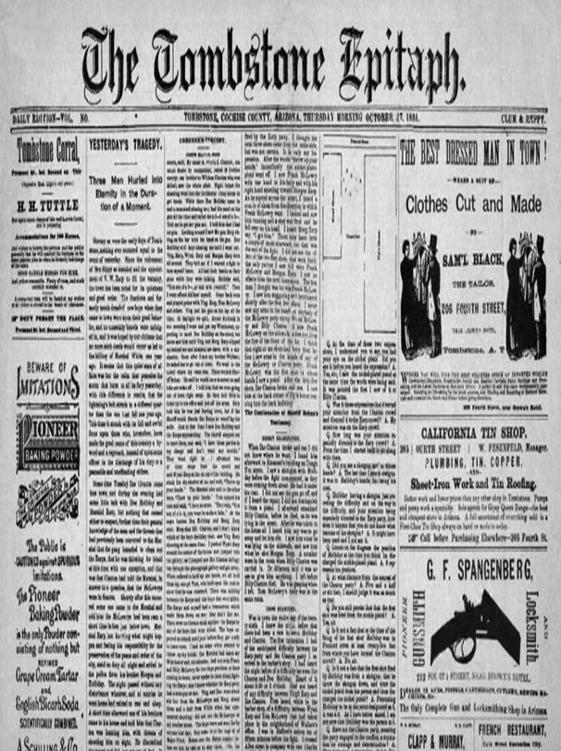
The gunfight at Tombstone’s O.K.Corral was the result of the long simmering feud, with Cowboys Billy Claiborne, brothers Ike and Billy Clanton, and brothers Tom and Frank McLaury on one side; and Town Marshal Virgil Earp, Special Policemen and Earp's two younger brothers Morgan and Wyatt Earp, and temporary policeman Doc Holliday on the other side. Wyatt Earp is often erroneously regarded as the central figure in the shootout, although his brother Virgil was Tombstone town marshal and Deputy US Marshal that day and had far more experience as a sheriff, constable, marshal, and soldier in combat, while Doc Holliday’s involvement seemed most integral.
561
O.K. Corral
562
O.K. Corral
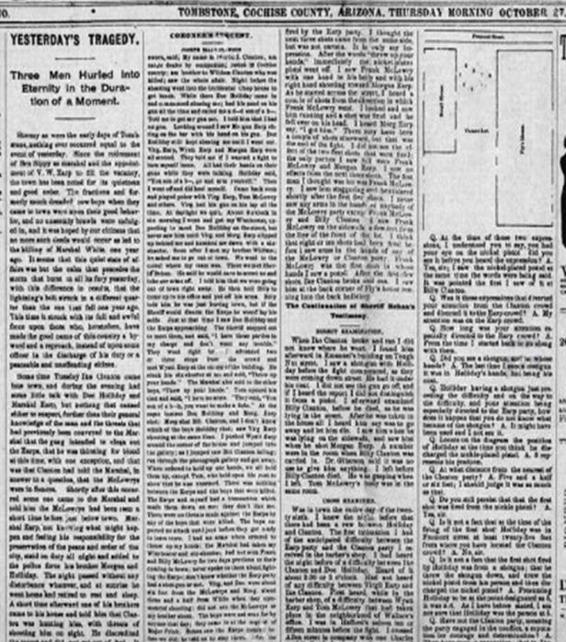
On October 26th, 1881, the Earp brothers et al faced off against the Clanton-McLaury gang in the legendary shootout at the O.K. Corral in Tombstone, Arizona.
563
O.K. Corral
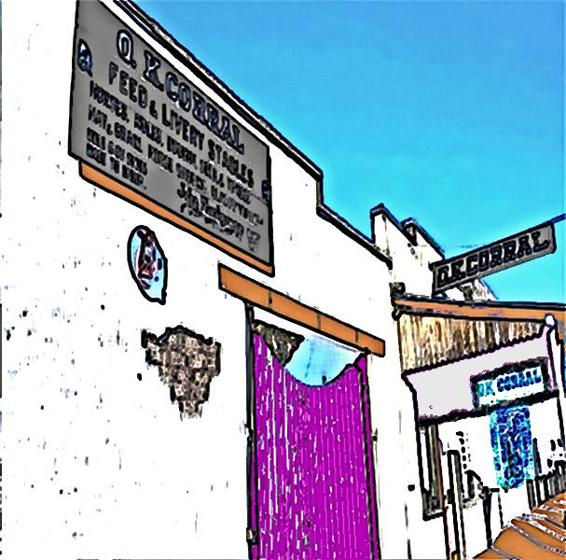
After silver was discovered nearby in 1877, Tombstone quickly grew into one of the richest mining towns in the Southwest. Wyatt Earp, a former Kansas police officer working as a bank security guard, and his brothers, Morgan and Virgil, the town marshal, represented “law and order” in Tombstone, though they also had reputations as being power hungry and ruthless, despite any evidence of that being scant and based on hearsay. The Clantons and McLaurys were cowboys who 564
lived on a ranch outside of town and sidelined as cattle rustlers, thieves and murderers. In October 1881, the struggle between these two groups for control of Tombstone and Cochise County came to a temporary pause in a blaze of gunfire at the O.K. Corral.
On the morning of October 25th, Ike Clanton and Tom McLaury came into Tombstone for supplies. Over the next twenty-four hours, the two men had several violent run ins with the Earps and their friend Doc Holliday. Around 1:30 PM on October 26th, Ike’s brother Billy rode into town to join them, along with Frank McLaury and Billy Claiborne. The first person they met in the local saloon was Doc Holliday, who was delighted to inform them that their brothers had both been pistol whipped and disarmed by the Earps. Doc likely wasn’t much surprised when Frank and Billy immediately left the saloon, vowing revenge. In fact he might have been hoping for a fight, to settle matters once and for all, after the Cowboy contingent kept promoting that he had pulled off a stagecoach robbery leaving two dead.
565
O.K. Corral
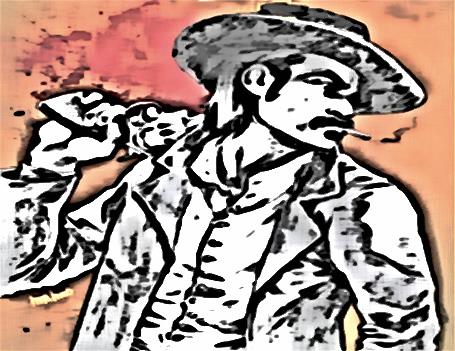
Doc was a little over medium height, thin, with a rather handsome sun tanned face and prematurely graying hair. His expression when he smiled was very close to the ruddy, complacent and hard appearance of any number of American politicians, but his tough good guy aura never quite dissipated as did theirs. There was a certain intelligence in his face, like the intelligence of those currently running for some federal office.
566
O.K. Corral
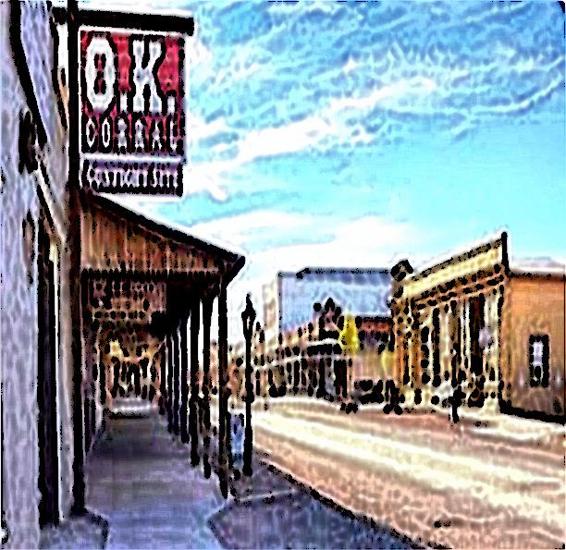
Around 3 PM, the Earp and Holliday contingent spotted the five members of the Clanton-McLaury gang in a vacant lot behind the O.K.
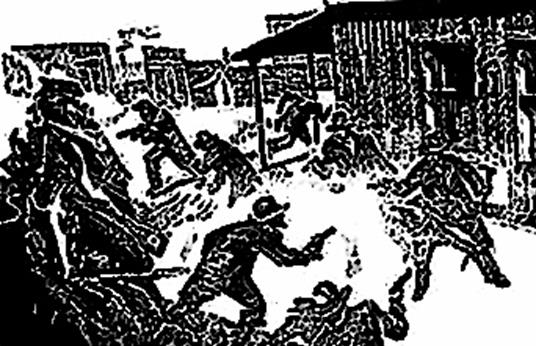
Corral, at the end of Fremont Street. The famous gunfight that ensued lasted all of 30 seconds, and around 30 shots were fired. Though it’s still debated who fired the first shot, most reports say that the 567
shootout began when Virgil Earp pulled out his revolver and shot Billy Clanton point blank in the chest, while Doc Holliday fired a shotgun blast at Tom McLaury’s chest. Though Wyatt Earp wounded Frank McLaury with a shot in the stomach, Frank managed to get off a few shots before collapsing, as did Billy Clanton. When the dust cleared, Billy Clanton and the McLaury brothers were dead, and Virgil and Morgan Earp and Doc Holliday were wounded. Ike Clanton and Claiborne had run for the hills and were not further pursued.
568
O.K. Corral
Sheriff John Behan of Cochise County, who claimed to have witnessed the shootout, charged the Earps and Holliday with murder. The famous shootout has been immortalized in many movies, including “Frontier Marshal” (1939), “Shootout at the O.K. Corral” (1946), “Gunfight at the O.K. Corral” (1957), “Tombstone” (1993) and “Wyatt Earp” (1994).
569
Virgil Earp was both deputy US Marshal and Tombstone, Arizona City Marshal when he led his younger brothers Wyatt and Morgan, and Doc Holliday, in a confrontation with outlaw Cowboys at the gunfight at the O.K. Corral on October 26th, 1881. They killed brothers Tom and Frank McLaury and Billy Clanton. All three Earp brothers had been the target of repeated death threats made by the Cowboys who were upset by the Earps' interference in their illegal activities, and Doc Holliday had been subjected to criminal accusations, though none of the Cowboys dared to threaten him with any kind of violence. Whatever their faults, few called the Cowboys stupid.
3:00PM on an unseasonably cold and windy Wednesday, October 26th, 1881, in Tombstone, Arizona Territory, United States was the scene of what is generally regarded as the most famous shootout in the history of the American Old West.
The participants present in Tombstone were Lawmen Wyatt, Morgan, and Virgil Earp, and Doc Holliday versus Cowboys Ike and Billy Clanton and Tom and Frank McLaury, with Billy Claiborne. Other members of 570
O.K. Corral
the loose groups were not there, most notably the Cowboys’ leader Johnny Ringo.
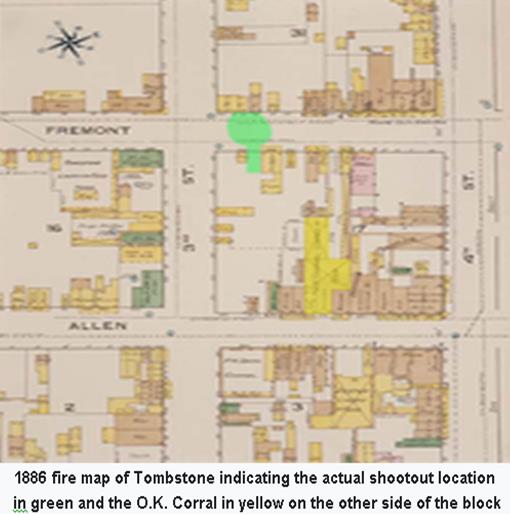
Despite its name, the gunfight did not take place within or next to the O.K. Corral, which fronted Allen Street and had a rear entrance lined with horse stalls on Fremont Street. The shootout actually took place in a narrow lot on the side of C. S. Fly's photography studio on Fremont Street, six doors west of the O.K. Corral's rear entrance. Some members of the two opposing parties were initially only about six feet apart. About thirty shots were fired in thirty seconds.
571
On the morning of Tuesday, October 25th, 1881, the day before the gunfight, Ike Clanton and Tom McLaury drove 10 miles in a spring wagon from Chandler's Milk Ranch at the foot of the Dragoon Mountains to Tombstone. They were in town to sell a large number of beef stock, most of them owned by the McLaurys. Fred Dodge, an undercover detective for Wells Fargo, heard from J.B. Ayers, another undercover Wells Fargo man in Contention, that Frank MacLaury, Billy Clanton, and Billy Claiborne were in town and planning to join Ike and Tom in Tombstone Wednesday afternoon. Dodge, who had been sick, got up and went looking for city marshal Virgil Earp. He found Tombstone Deputy City Marshal Morgan Earp at the Alhambra Saloon instead and told him the news.
Near midnight, Holliday saw Clanton in the Alhambra Saloon and confronted Ike, accusing him of lying about their previous conversations. They got into a heated argument. Wyatt Earp, who was not wearing a badge, encouraged his brother Morgan to intervene.
Morgan took Holliday out onto the street and Ike, who had been drinking steadily, followed them. City Marshal Virgil Earp arrived a few minutes later and threatened to arrest both Holliday and Clanton if 572
they did not stop arguing. Wyatt Earp walked over to the Oriental Saloon and Ike followed him. They talked again, and drunken Ike made the mistake of threatening to confront Holliday in the morning. Ike told Earp that the fighting talk had been going on for a long time and that he intended to put an end to it. Ike told Earp; "I will be ready for you in the morning." Wyatt told Ike to go home "because there was no money in it," a reference to his professionally induced lack of passion induced by no bounty being on Ike’s head. Ike sat down near Wyatt, his revolver in plain sight, and told Earp; "You must not think I won't be after you all in the morning." Virgil Earp went to the Occidental Saloon across the street.
After Holliday's confrontation with Ike Clanton, Wyatt Earp took Holliday back to his room at Camillus Sidney "Buck" Fly's Lodging House to sleep off his drinking, then went home and to bed.
Tombstone Marshal Virgil Earp played poker with Ike Clanton, Tom McLaury, Cochise County Sheriff Johnny Behan and a fifth unnamed man in a back room of the Occidental Saloon until morning.
573
O.K. Corral
At about dawn on October 26th, the card game broke up and Behan and Virgil Earp went home to bed. Ike Clanton testified later he saw Virgil take his six shooter out of his lap and stick it in his pants when the game ended. Not having rented a room, Tom McLaury and Ike Clanton had no place to go. Shortly after 8:00 AM barkeeper E. F. Boyle spoke to Ike Clanton in front of the telegraph office. Clanton had been drinking all night and Boyle encouraged him to get some sleep, but Ike insisted he would not go to bed. Boyle later testified he noticed Ike was armed and covered his gun for him.
574
Boyle later said that Ike told him; "’As soon as the Earps and Doc Holliday show themselves on the street, the ball will open; that they will have to fight' ... I went down to Wyatt Earp's house and told him that Ike Clanton had threatened that when Wyatt, his brothers, and Doc Holliday showed themselves on the street that the ball would open." Ike said in his testimony afterward that he remembered neither meeting Boyle nor making any such statements that day. Deputy Marshal Andy Bronk also heard the talk around town. He woke Virgil, who listened, and went back to sleep. He figured that Ike's continuous, unfulfilled threats were not worth losing sleep over.
Later in the morning, Ike picked up his rifle and revolver from the West End Corral, where he had deposited his weapons and stabled his wagon and team after entering town. By noon that day, Ike was still drinking and once again armed, in violation of the city ordinance against carrying firearms in the city. He told anyone who would listen he was looking for Holliday or an Earp. At Fly's boarding house where Holliday and his common-law wife Mary Katharine Horony were sleeping, proprietor Mary Fly heard Clanton's threats and banged on Holliday's door. Fly told Horony; "Ike Clanton was here looking for 575
Holliday, and he had a rifle with him." Horony woke Holliday and relayed the threat, who replied; "If God will let me live to get my clothes on, he will see me."
At about 1:00 PM, Marshal Virgil and his Deputy Morgan Earp found Ike on Fourth Street, still armed, and Virgil pistol whipped him from behind. Disarming him, the Earps took Ike to appear before Justice of the Peace A.O. Wallace for violating the ordinance. Wyatt waited with Clanton while Virgil went to find Justice Wallace so a court hearing could be held.
While Wyatt waited for Virgil to return with Justice Wallace, witnesses overheard Wyatt tell Clanton; "You cattle thieving son of a bitch, and you know that I know you are a cattle thieving son of a bitch, you've threatened my life enough, and you've got to fight!." Ike Clanton was heard to reply; "Fight is my racket, and all I want is four feet of ground!"
Ike reported in his testimony afterward that Wyatt Earp cursed him. He said Wyatt, Virgil and Morgan offered him his rifle and to fight him right there in the courthouse, which Ike declined. Ike also denied ever 576
threatening the Earps. Justice Wallace fined Ike $25 plus court costs.
Ike paid the fine and Virgil told Ike he could pick up his confiscated rifle and revolver at the Grand Hotel, which was favored by Cowboys when in town. Ike testified that he picked up the weapons from William Soule, the jailer, a couple of days later.
Outside the court house where Ike was being fined, Tombstone Deputy Marshal Wyatt Earp almost walked into twenty-eight year old Tom McLaury as the two men were brought up short nose to nose. Tom, who had arrived in town the day before, was required by the well-known city ordinance to deposit his pistol when he first arrived in town. When Wyatt demanded; "Are you heeled or not?", McLaury said he was not armed. Wyatt testified that he saw a revolver in plain sight on the right hip of Tom's pants. As an unpaid deputy marshal for Virgil, Wyatt habitually carried a pistol in his waistband, as was the custom of that time. Witnesses reported that Wyatt drew his revolver from his coat pocket and pistol whipped Tom McLaury with it twice, leaving him prostrate and bleeding on the street. Saloon keeper Andrew Mehan testified at the Spicer hearing afterward that he saw McLaury deposit a revolver at the Capital Saloon sometime between 1:00 and 577
2:00 PM, after the confrontation with Wyatt, which Mehan also witnessed.
Wyatt said in his deposition afterward that he had been temporarily acting as city marshal for Virgil the week before while Virgil was in Tucson for the Pete Spence and Frank Stilwell trial. Wyatt said that he still considered himself a deputy city marshal, which Virgil later confirmed. Since Wyatt was an off duty officer, he could not legally search or arrest Tom for carrying a revolver within the city limits, a misdemeanor offense. Only Virgil or one of his city police deputies, including Morgan Earp and possibly Warren Earp, could search him and take any required action. Wyatt, who was portrayed as a non-drinker, testified at the Spicer hearing that he went to Haffords and bought a cigar and went outside to watch the Cowboys. At the time of the gunfight, which was about two hours later, Wyatt could not know if Tom was still armed.
It was early afternoon by the time Ike and Tom had seen doctors for their head wounds. The day was chilly, with the overnight snow still on the ground in some places. Both Tom and Ike had spent the night 578
O.K. Corral
gambling, drinking heavily, and without sleep. Now they were both out of doors, both wounded from head beatings, and at least Ike was still drunk.
At around 1:30–2:00 PM, after Tom had been pistol whipped by Wyatt, Ike's 19 year old younger brother Billy Clanton and Tom's older brother Frank McLaury arrived in town. They had heard from their neighbor, Ed
"Old Man" Frink, that Ike had been stirring up trouble in town overnight, and they had ridden into town on horseback to back up their brothers.
579
They arrived from Antelope Springs, 13 miles east of Tombstone, where they had been rounding up stock and had breakfasted with Ike and Tom the day before. Both Frank and Billy were armed with a revolver and a rifle, as was the custom for riders in the country outside Tombstone. Apache warriors had engaged the US Army near Tombstone just three weeks before the O.K. Corral gunfight, so the need for weapons outside of town was well established and accepted.
Billy and Frank stopped first at the Grand Hotel on Allen Street, and were greeted by Doc Holliday. They learned immediately after of their brothers' beatings by the Earps within the previous two hours. The incidents had generated a lot of talk in town. Angrily, Frank said he would not drink, and he and Billy left the saloon immediately to seek Tom. By law, both Frank and Billy should have left their firearms at the Grand Hotel. Instead, they remained fully armed.
Wyatt said that he saw Billy Clanton and Frank McLaury in Spangenberger's gun and hardware store on 4th Street filling their gun belts with cartridges. Ike testified afterward that Tom was not there and that he had tried to buy a new revolver but the owner saw Ike's 580
bandaged head and refused to sell him one. Ike apparently had not heard Virgil tell him that his confiscated weapons were at the Grand Hotel around the corner from Spangenberger's shop.
When Virgil Earp learned that Wyatt was talking to the Cowboys at Spangenberg's gun shop, he went there himself. Virgil testified afterward that he thought he saw all four men, Ike Clanton, Billy Clanton, Frank McLaury, and Tom McLaury, buying cartridges. Virgil went around the corner on Allen Street to the Wells Fargo office, where he picked up a 10 gauge or 12 gauge, short, double barreled shotgun. It was an unusually cold and windy day in Tombstone, and Virgil was wearing a long overcoat. To avoid alarming Tombstone's public, Virgil hid the shotgun under his overcoat when he returned to Hafford's Saloon.
From Spangenberg's, the Cowboys moved to the O.K. Corral where witnesses overheard them threatening to kill the Earps. For unknown reasons the Cowboys then walked out the back of the O.K. Corral and then west, stopping in a narrow, empty lot next to C. S. Fly's boarding house.
581
Virgil initially avoided a confrontation with the newly arrived Frank McLaury and Billy Clanton, who had not yet deposited their weapons at a hotel or stable as the law required. The statute was not specific about how far a recently arrived visitor might "with good faith, and within reasonable time" travel into town while carrying a firearm. This permitted a traveler to keep his firearms if he was proceeding directly to a livery, hotel or saloon. The three main Tombstone corrals were all west of 4th Street between Allen and Fremont, a block or two from where Wyatt saw the Cowboys buying cartridges.
Miner Ruben F. Coleman later told “The Tombstone Epitaph;” “I was in the O.K. Corral at 2:30 PM when I saw the two Clantons and the two McLaurys in an earnest conversation across the street at Dunbar's corral. I went up the street and notified Sheriff Behan and told them it was my opinion that they meant trouble, and it was his duty, as sheriff, to go and disarm them. I told him they had gone to the West End Corral. I then went and saw Marshal Virgil Earp and notified him to the same effect.”
582
Cochise County Sheriff Johnny Behan, a friend of the Cowboys, later testified that he woke up about 1:30 PM after the late night card game, and went to get a shave at a barbershop. That's where he first learned that the Cowboys were armed. Behan stated he quickly finished his shave and went to locate the Cowboys. At about 2:30 PM he found Frank McLaury holding a horse and talking to someone on 4th Street near the corner of Fremont. When he saw Ike Clanton and Tom McLaury near C. S. Fly's photography studio, he walked there with Frank. He told the Cowboys that they must give up their arms. Ike Clanton said he was not armed, and Tom McLaury pulled his coat open to show he was not carrying a weapon.
The Cowboys were located in a narrow 15–20 feet lot between the Harwood house and Fly's 12 room boarding house and photography studio at 312 Fremont Street, where Doc Holliday roomed.
Behan later said he attempted to persuade Frank McLaury to give up his weapons, but Frank insisted that he would give up his guns only after City Marshal Virgil Earp and his brothers were first disarmed.
583
The Cowboys were about a block and a half from the West End Corral at 2nd Street and Fremont, where Ike and Tom's wagon and team were stabled. Virgil Earp later testified that he thought Ike and Tom were stabled at the O.K. Corral on Allen between 3rd and 4th, from which he thought they would be departing if they were leaving town.
While Ike Clanton later said he was planning to leave town, Frank McLaury reported that he had decided to remain behind to take care of some business. Will McLaury, Tom and Frank's brother and a judge in Fort Worth, Texas, claimed in a letter he wrote during the preliminary hearing after the shootout that Tom and Frank were still armed because they were planning to conduct business before leaving town to visit him in Texas. He wrote that Billy Clanton, who had arrived on horseback with Frank, intended to go with the McLaurys to Fort Worth.
Will McLaury came to Tombstone after the gun fight and joined the prosecution team in an attempt to convict the Earps and Holliday for his brothers' “murder.” Paul Johnson told a different story, that the McLaurys were about to leave for Iowa to attend the wedding of their sister, Sarah Caroline, in Iowa. Tom and Frank were especially close 584
to Sarah, one of their 14 siblings and half-siblings. Caroline married James Reed in Richland, Iowa at the end of November that year.
Citizens reported to Virgil on the Cowboys' movements and their threats told him that Ike and Tom had left their livery stable and entered town while armed, in violation of the city ordinance. Virgil Earp was told by several citizens that the McLaurys and the Clantons had gathered on Fremont Street. Virgil decided he had to disarm the Cowboys. His decision to take action may have been influenced by the Cowboy's repeated threats to the Earps, their proximity to Holliday's room in Fly's boarding house, and their location on the route the Earps usually took to their homes two blocks further west on Fremont Street.
585
O.K. Corral
Several members of the citizen's vigilance committee offered to support him with arms, but Virgil refused. He had, during the prior month, appointed Morgan as a Special Policeman. He had also appointed Wyatt as a Special Policeman while Virgil had been in Prescott on business. He had also called on Doc Holliday that morning for help with disarming the Clantons and McLaurys. Cordial, erudite, and polite to a Southern gentlemanly fault, Doc could also blow the head off someone he deemed improper in a fraction of a second; 586
apparently an acquired taste he found increasingly delightful over time. Wyatt spoke of his brothers Virgil and Morgan as the "marshals"
while he acted as "deputy."
Virgil Earp picked up the shotgun he had retrieved from the Wells Fargo office earlier. He gave the shotgun to Doc Holliday who hid it under his overcoat. He took Holliday's walking stick in return.
As usual, the Earps carried their revolvers in their coat pockets or in their waistbands. Wyatt Earp was carrying a .44 caliber American 1869
Smith & Wesson revolver. Virgil was known to favor the Smith & Wesson New Model No. 3, in .44 Russian, but it is not known if that was what he was armed with that day. Holliday was carrying a nickel plated pistol in a holster, but this was concealed by his long coat, as was the shotgun. The Earps and Holliday walked west, down the south side of Fremont Street past the rear entrance to the O.K. Corral, but out of visual range of the Cowboys' last reported location. Near the corner of Fourth St. and Fremont St., the Earps ran into Sheriff Behan.
He had left the Cowboys and came toward the Earps, though he looked nervously backward several times. Virgil testified afterward that 587
Behan told them; "For God's sake, don't go down there or they will murder you!" Wyatt said Behan told him and Morgan; "I have disarmed them." Behan testified afterward that he'd only said he'd gone down to the Cowboys "for the purpose of disarming them," not that he'd actually disarmed them. One eyewitness, laundryman Peter H. Fallehy, testified afterward that Virgil Earp told Behan; "Those men have made their threats and I will not arrest them but I will kill them on sight."
When Behan said he had disarmed them, Virgil attempted to avoid a fight. "I had a walking stick in my left hand and my right hand was on my six shooter in my waist pants, and when he said he had disarmed them, I shoved it clean around to my left hip and changed my walking stick to my right hand." Wyatt said; "I took my pistol, which I had in my hand, under my coat, and put it in my overcoat pocket." The Earps walked further down Fremont street and came into full view of the Cowboys in the lot.
Wyatt testified he saw "Frank McLaury, Tom McLaury, and Billy Clanton standing in a row against the east side of the building on the opposite side of the vacant space west of Fly's photograph gallery. Ike 588
Clanton and Billy Claiborne and a man I don't know (Wes Fuller) were standing in the vacant space about halfway between the photograph gallery and the next building west." Addie Bourland corroborated Wyatt's testimony, stating that she saw "five men opposite my house, leaning against a small house west of Fly's Gallery and one man was holding a horse, standing a little out from the house."
589
O.K. Corral
Martha J. King was in Bauer's butcher shop located on Fremont Street.
She testified that when the Earp party passed by her location, one of the Earps on the outside of the group looked across and said to Doc Holliday nearest the store, "... let them have it!" to which Holliday replied, "All right."
590
When the Earps approached the lot, the four law men initially faced six Cowboys; Frank McLaury, Tom McLaury, Billy Clanton, Billy Claiborne, Wes Fuller, and Ike Clanton. When the Cowboys saw the officers, they stepped away from the Harwood house.
In testimony given by witnesses afterward, they disagreed about the precise location of the men before, during and after the gunfight. The coroner's inquest and the Spicer hearing produced a sketch showing the Cowboys standing, from left to right facing Fremont Street, with Billy Clanton and then Frank McLaury near the Harwood house and Tom McLaury and Ike Clanton roughly in the middle of the lot.
Opposite them and initially only about 6 to 10 feet away, Virgil Earp was on the left end of the Earp party, standing a few feet inside the vacant lot and nearest Ike Clanton. Behind him a few feet near the corner of C. S. Fly's boarding house was Wyatt. Morgan Earp was standing on Fremont Street to Wyatt's right, and Doc Holliday anchored the end of their line in Fremont Street, a few feet to Morgan's right.
591
Wyatt Earp drew a sketch in 1924 and another with John Flood on September 15th, 1926, that depicted Billy Clanton near the middle of the lot, close to the Harwood house. Tom and Frank McLaury stood deeper in the lot. Frank was in the center between the two buildings, holding the reins of his horse. Tom was closer to C. S. Fly's boarding house. According to Wyatt's sketches, Morgan was on the right of the lawmen, close to the Harwood house, opposite Billy Clanton near the Harwood house and close to Fremont Street. Virgil was deeper in the lot, opposite Frank and Ike Clanton. Wyatt was to Virgil's left, opposite Tom. Doc Holliday hung back a step or two on Fremont Street. Neither of Wyatt's sketches included Ike Clanton or Billy Claiborne, who ran from the fight.
Virgil Earp was not expecting a fight. Once Behan said that he'd disarmed the Cowboys, Virgil moved Doc's cane to his right hand and shifted the pistol in his waistband from the right side to his left.
Holliday still concealed the short shotgun under his long jacket. Wyatt too was not expecting a fight and put his pistol in his overcoat pocket.
592
Billy Clanton and Frank McLaury wore revolvers in holsters on their belts and stood alongside their saddled horses with rifles in their scabbards, probably in violation of the city ordinance prohibiting carrying weapons in town.
When Virgil saw the Cowboys, he testified, he immediately commanded the Cowboys to "Throw up your hands, I want your guns!"
Wyatt said Virgil told the Cowboys; "Throw up your hands; I have come to disarm you!" Virgil and Wyatt both testified they saw Frank McLaury and Billy Clanton draw and cock their single action six shot revolvers.
Virgil yelled; "Hold! I don't mean that!" or "Hold on, I don't want that!"
593
O.K. Corral
Jeff Morey, who served as the historical consultant on the film
“Tombstone,” compared testimony by partisan and neutral witnesses and came to the conclusion that the Earps described the situation accurately.
Who started shooting first is not certain. Accounts by both participants and eyewitnesses are contradictory. The smoke from the black 594
powder used in the weapons added to the confusion of the gunfight in the narrow space. Those loyal to one side or the other told conflicting stories, and independent eyewitnesses who did not know the participants by sight were unable to say for certain who shot first. The six or seven men with guns fired about 30 shots in around 30 seconds.
Virgil Earp reported afterward; "Two shots went off right together. Billy Clanton's was one of them." Wyatt testified; "Billy Clanton leveled his pistol at me, but I did not aim at him. I knew that Frank McLaury had the reputation of being a good shot and a dangerous man, and I aimed at Frank McLaury." He said he shot Frank McLaury after both he and Billy Clanton went for their revolvers. "The first two shots were fired by Billy Clanton and myself, he shooting at me, and I shooting at Frank McLaury." Morey agreed that Billy Clanton and Wyatt Earp fired first.
Clanton missed, but Earp shot Frank McLaury in the stomach.
All witnesses generally agreed that the first two shots were almost indistinguishable from each other. General firing immediately broke out. Virgil and Wyatt thought Tom was armed. When the shooting started, the horse that Tom McLaury held jumped to one side. Wyatt 595
said he also saw Tom throw his hand to his right hip. Virgil said Tom followed the horse's movement, hiding behind it, and fired once or twice over the horse's back.
According to one witness, Holliday drew a "large bronze pistol,"
interpreted by some as Virgil's coach gun, from under his long coat, stepped around Tom McLaury's horse, and shot him with the double barreled shotgun in the chest at close range.
Witness C. H. "Ham" Light saw Tom running or stumbling westward on Fremont Street towards Third Street, away from the gunfight, while Frank and Billy were still standing and shooting. Light testified that Tom fell at the foot of a telegraph pole on the corner of Fremont and 3rd Street and lay there, without moving, through the duration of the fight. Fallehy also saw Tom stagger across the street until he fell on his back. After shooting Tom, Holliday tossed the empty shotgun aside, pulled out his nickel plated revolver, and continued to fire at Frank McLaury and Billy Clanton.
Ike Clanton had been publicly threatening to kill the Earps for several months, including very loud threats on the day before. Wyatt told the 596
court afterward that Clanton had bragged that he would kill the Earps and Doc Holliday at his first opportunity. However, when the gunfight broke out, Clanton ran forward and grabbed Wyatt, exclaiming that he was unarmed and did not want a fight. To this protest Wyatt said he responded; "Go to fighting or get away!" Clanton ran through the front door of Fly's boarding house and escaped, unwounded. Other accounts say that Ike drew a hidden pistol and fired at the Earps before disappearing. Like Ike, Billy Claiborne was unarmed. He and Cowboy Wes Fuller, who had been at the rear of the lot, also ran from the fight as soon as the shooting began.
According to “The Tombstone Epitaph,” "Wyatt Earp stood up and fired in rapid succession, as cool as a cucumber, and was not hit." Morgan Earp fired almost immediately, as Billy Clanton drew his gun right handed. Morgan's shot hit Billy in the right wrist, disabling his hand.
Forced to shift the revolver to his left hand, Clanton continued shooting until he emptied the gun. Virgil and Wyatt were now firing.
Morgan Earp tripped and fell over a newly buried waterline and fired from the ground. Wyatt shot Frank McLaury in the abdomen, and Frank took his horse by its reins and struggled across Fremont Street. He 597
tried and failed to grab his rifle from the scabbard but lost control of the horse. Frank crossed Fremont Street firing his revolver instead.
Frank and Holliday exchanged shots as Frank moved across Fremont Street, and Frank hit Holliday in his pistol pocket, grazing him. Holliday followed him, exclaiming; "That son of a bitch has shot me and I am going to kill him." Morgan Earp picked himself up and also fired at Frank. Frank fell to the sidewalk on the east side of Fremont Street.
A number of witnesses observed a man leading a horse into the street and firing near it, and Wyatt in his testimony thought this was Tom McLaury. Claiborne said only one man had a horse in the fight, and that this man was Frank, holding his own horse by the reins, then losing it and its cover, in the middle of the street. Wes Fuller also identified Frank as the man in the street leading the horse.
Though wounded, Billy Clanton and Frank McLaury kept shooting. One of them, perhaps Billy, shot Morgan Earp across the back in a wound that struck both shoulder blades and a vertebra. Morgan went down for a minute before picking himself up. Either Frank or Billy shot Virgil 598
Earp in the calf. Virgil thought it was Billy. Virgil, though hit, fired his next shot at Billy Clanton.
Frank, now entirely across Fremont street and still walking at a good pace according to Claiborne's testimony, fired twice more before he was shot in the head under his right ear. Both Morgan and Holliday apparently thought they had fired the shot that killed Frank, but since neither of them testified at the hearing, this information is only from second hand accounts. Dos was the superior shot. A passerby testified to having stopped to help Frank, and saw Frank try to speak, but he died where he fell, before he could be moved.
Billy Clanton was shot in the wrist, chest and abdomen, and after a minute or two slumped to a sitting position near his original position at the corner of the Harwood house in the lot between the house and Fly's Lodging House. Claiborne said Clanton was supported by a window initially after he was shot, and fired some shots after sitting, with the pistol supported on his leg. After he ran out of ammunition, he called for more cartridges, but C. S. Fly took his pistol at about the time the general shooting ended.
599
A few moments later, Tom McLaury was carried from the corner of Fremont and Third into the Harwood house on that corner, where he died without speaking. Passersby carried Billy Clanton to the Harwood house, where Tom had been taken. Billy was in considerable pain and asked for a doctor and some morphine. He told those near him; "They have murdered me. I have been murdered. Chase the crowd away and from the door and give me air." Billy gasped for air, and someone else heard him say; "Go away and let me die." Ike Clanton, who had repeatedly threatened the Earps with death, was still running. William Cuddy testified that Ike passed him on Allen Street and Johnny Behan saw him a few minutes later on Toughnut Street.
Before “The Tombstone Nugget” burned down in 1882, that paper always sided with the Clantons and the McLaurys, pro-Cowboy, while
“The Tombstone Epitaph” was pro-Earps, Holliday, and local law enforcement.
Here is how the “The Tombstone Nugget” covered the gunfight near the OK Corral. It invites a comparison as to how “The Tombstone Epitaph” covered it. If you read both, you will be surprised that they 600