

O.K. Corral by Edward Drobinski - HTML preview
Download the book in PDF, ePub, Kindle for a complete version.
Cody founded the “Buffalo Bill Combination” in 1874, in which he performed for part of the year while scouting on the prairies the rest of the year. The troupe toured for ten years. Cody's part typically included a reenactment of an 1876 incident at Warbonnet Creek, where he claimed to have scalped a Cheyenne warrior.
In 1883, in the area of North Platte, Nebraska, Cody founded “Buffalo Bill's Wild West,” a circus like attraction that toured annually. Contrary to the popular misconception, the word show was not a part of the title. With his show, Cody traveled throughout the United States and Europe and made many contacts. He stayed, for instance, in Garden City, Kansas, in the presidential suite of the former Windsor Hotel. He was befriended by the mayor and state representative, a frontier scout, rancher, and hunter named Charles "Buffalo" Jones. In 1886, Cody and Nate Salsbury, his theatrical manager, entered into partnership with Evelyn Booth (1860–1901), a big game hunter and scion of the aristocratic Booth family. It was at this time “Buffalo Bill's Cowboy Band” was organized. The band was directed by William Sweeney, a cornet player who served as leader of the cowboy band from 1883 until 1913. Sweeney handled all of the musical 423
arrangements and wrote a majority of the music performed by the cowboy band.
In 1893, Cody changed the title to “Buffalo Bill's Wild West and Congress of Rough Riders of the World.” The show began with a parade on horseback, with participants from horse culture groups that included the US and another military, cowboys, American Indians, and performers from all over the world in their best attire. Turks, gauchos, Arabs, Mongols and Georgians displayed their distinctive horses and colorful costumes. Visitors would see main events, feats of skill, staged races, and sideshows. Many historical western figures participated in the show. For example, Sitting Bull appeared with a band of 20 of his braves.
In his shows, the Indians were usually depicted attacking stagecoaches and wagon trains and were driven off by cowboys and soldiers. Many family members traveled with the men. Cody encouraged the wives and children of his Native American performers, as part of the show, to set up camp just as they would in their 424
homelands. He wanted the paying public to see the human side of the
"fierce warriors."
Cody's headline performers were well known in their own right. Annie Oakley and her husband, Frank Butler, were sharpshooters, together with the likes of Gabriel Dumont and Lillian Smith. Performers reenacted the riding of the Pony Express, Indian attacks on wagon trains, and stagecoach robberies. The show was said to end with a reenactment of Custer's Last Stand, in which Cody portrayed General Custer, but this is more legend than fact. The finale was typically a portrayal of an Indian attack on a settler's cabin. Cody would ride in with an entourage of cowboys to defend a settler and his family. This finale was featured predominantly as early as 1886 but was not performed after 1907. It was used in 23 of 33 tours. Another celebrity appearing on the show was Calamity Jane, as a story teller as of 1893.
The show influenced many 20th century portrayals of the West in cinema and literature.
425
With his profits, Cody purchased a 4,000 acre ranch near North Platte, Nebraska, in 1886. The Scout's Rest Ranch included an eighteen room mansion and a large barn for winter storage of the show's livestock.
Cody was known as a conservationist who spoke out against hide hunting and advocated the establishment of a hunting season.
Cody was active in the concordant bodies of the fraternal organization of Freemasonry having been initiated in Platte Valley Lodge No. 32, in North Platte, Nebraska, on March 5th, 1870. He received his second and third degrees on April 2nd 1870, and January 10th, 1871, respectively. He became a Knight Templar in 1889 and received his 32nd degree in the Scottish Rite of Freemasonry in 1894.
In 1887, invited by the British businessman, John Robinson Whitley, Cody took the show to Great Britain in celebration of the Jubilee year of Queen Victoria, who attended a performance. It played in London and then in Birmingham and Salford, near Manchester, where it stayed for five months.
In 1889, the show toured Europe, and in 1890 Cody met Pope Leo XIII.
On March 8th, 1890, a competition took place. Buffalo Bill had met 426
some Italian butteri, a less well known sort of Italian equivalent of cowboys, and said his men were more skilled at roping calves and performing other similar actions. A group of Buffalo Bill's men challenged nine butteri, led by Augusto Imperiali, at Prati di Castello neighborhood in Rome. The butteri easily won the competition.
Augusto Imperiali became a local hero after the event. A street and a monument were dedicated to him in his hometown, Cisterna di Latina, and he was featured as the hero in a series of comic strips in the 1920s and 1930s.
Cody set up an independent exhibition near the Chicago World's Fair of 1893, which greatly contributed to his popularity in the United States.
It vexed the promoters of the fair, who had rejected his request to participate.
In 1894, Edison Studios invited Buffalo Bill and his show to be filmed in an early silent film; “Buffalo Bill.”
On October 29th, 1901, outside Lexington, North Carolina, a freight train crashed into one unit of the train carrying Buffalo Bill's show from Charlotte, North Carolina, to Danville, Virginia. The freight train's 427
engineer had thought that the entire show train had passed, not realizing it was three units, and returned to the tracks. 110 horses were killed in the crash or had to be killed later, including his mounts Old Pap and Old Eagle. No people were killed, but Annie Oakley's injuries were so severe that she was told she would never walk again.
She did recover and continued performing later. The incident put the show out of business for a while, and this disruption may have led to its eventual demise. According to one source, three young Indians were killed in the train accident and many others injured.
In 1908, Pawnee Bill and Buffalo Bill joined forces and created the
“Two Bills Show.” That show was foreclosed on when it was playing in Denver, Colorado.
The Buffalo Bill and Pawnee Bill Film Company, based in New York City, produced a three reel motion picture in 1912 titled “The Life of Buffalo Bill.” Cody himself appears in scenes that bookend the short film, a series of adventures presented in flashback as Buffalo Bill's dreams. The film had two other directors before it was successfully 428
completed by John B. O'Brien. The film is in the collection of the Library of Congress.
“Buffalo Bill's Wild West” toured Europe eight times, the first four tours between 1887 and 1892, and the last four from 1902 to 1906. The Wild West first went to London in 1887 as part of the American Exhibition, which coincided with the Golden Jubilee of Queen Victoria. The Prince of Wales, later King Edward VII, requested a private preview of the Wild West performance. He was impressed enough to arrange a command performance for Queen Victoria. The Queen enjoyed the show and meeting the performers, setting the stage for another command performance on June 20th, 1887, for her Jubilee guests.
Royalty from all over Europe attended, including the future Kaiser Wilhelm II and the future King George V. These royal encounters provided “Buffalo Bill's Wild West” an endorsement and publicity that ensured its success. Also, at this time, Buffalo Bill was presented with written accolades from several of America's high ranking generals including William T. Sherman, Philip H. Sheridan and William H. Emory testifying to his service, bravery, and character. Among the presentations was a document signed by Governor John M. Thayer of 429
Nebraska appointing Cody as aide-de-camp on the Governor's staff with the rank of colonel dated March 8th, 1887. The rank had little official authority but the English press quickly capitalized on the new title of "Colonel Cody." “Buffalo Bill's Wild West” closed its successful London run in October 1887 after more than 300 performances, with more than 2.5 million tickets sold. The tour made stops in Birmingham and Manchester before returning to the United States in May 1888 for a short summer tour.
“Buffalo Bill's Wild West” returned to Europe in May 1889 as part of the Exposition Universelle in Paris, an event that commemorated the 100th anniversary of the Storming of the Bastille and featured the debut of the Eiffel Tower. On this tour, his portrait was painted by Europe's leading female painter Rosa Bonheur. The tour moved to the south of France and Barcelona, Spain, then on to Italy. While in Rome, a Wild West delegation was received by Pope Leo XIII. Buffalo Bill was disappointed that the condition of the Colosseum did not allow it to be a venue; however, at Verona, the Wild West did perform in the ancient Roman amphitheater. The tour finished with stops in Austria-Hungary and Germany.
430
In 1891 the show toured cities in Belgium and the Netherlands before returning to Great Britain to close the season. Cody depended on several staffs to manage arrangements for touring with the large and complex show. In 1891 Major Arizona John Burke was the general manager for the “Buffalo Bill Wild West Company;” William Laugan, supply agent; George C. Crager, Sioux interpreter, considered leader of relations with the Indians; and John Shangren, a native interpreter. In 1891, Buffalo Bill performed in Karlsruhe, Germany, in the Südstadt Quarter. The inhabitants of Südstadt are nicknamed Indianer, German for "American Indians," to this day, and the most accepted theory says that this is due to Buffalo Bill's show. In October Cody brought the show to Dennistoun, Glasgow, where it ran from November 16th until February 27th, 1892 in the East End Exhibition Building, and George C.
Crager sold “The Ghost Shirt” to the Kelvingrove Museum.
The show's 1892 tour was confined to Great Britain. It featured another command performance for Queen Victoria. The tour finished with a six month run in London before leaving Europe for nearly a decade.
431
“Buffalo Bill's Wild West” returned to Europe in December 1902 with a fourteen week run in London, capped by a visit from King Edward VII and the future King George V. The Wild West traveled throughout Great Britain in a tour in 1902 and 1903 and a tour in 1904, performing in nearly every city large enough to support it. The 1905 tour began in April with a two month run in Paris, after which the show traveled around France, performing mostly one night stands, concluding in December. The final tour, in 1906, began in France on March 4th and quickly moved to Italy for two months. The show then traveled east, performing in Austria, the Balkans, Hungary, Romania and Ukraine, before returning west to tour in Poland, Bohemia, later Czech Republic, Germany, and Belgium.
The show was enormously successful in Europe, making Cody an international celebrity and an American icon. Mark Twain commented;
"It is often said on the other side of the water that none of the exhibitions which we send to England are purely and distinctly American. If you will take the Wild West show over there you can remove that reproach." The Wild West brought an exotic foreign world 432
to life for its European audiences, allowing a last glimpse at the fading American frontier.
Several members of the Wild West show died of accidents or disease during these tours in Europe. Surrounded by the Enemy (1865–1887), of the Oglala Lakota band, died of a lung infection. His remains were buried at Brompton Cemetery in London. Red Penny, the one year old son of Little Chief and Good Robe, had died four months earlier and was buried in the same cemetery. Paul Eagle Star (1864–1891), of the Brulé Lakota band, died in Sheffield, of tetanus and complications from injuries caused when his horse fell on him, breaking his leg. He was buried in Brompton Cemetery. His remains were exhumed in March 1999 and transported to the Rosebud Indian Reservation, in South Dakota, by his grandchildren Moses and Lucy Eagle Star II. The remains were reburied in the Lakota cemetery in Rosebud two months later. Long Wolf (1833–1892), of the Oglala Lakota band, died of pneumonia and was buried in Brompton Cemetery. His remains were exhumed and transported to South Dakota's Pine Ridge Indian Reservation in September 1997 by his descendants, including his great-grandson, John Black Feather. The remains were reburied at 433
Saint Ann's Cemetery, in Denby. White Star Ghost Dog (1890–1892), of the Oglala Lakota band, died after a horse riding accident and was buried in Brompton Cemetery. Her remains were exhumed and transported to the Pine Ridge Indian Reservation, in South Dakota, in September 1997, with those of Long Wolf, and were reburied at Saint Ann's Cemetery, in Denby.
In 1895, Cody was instrumental in the founding of the town of Cody, the seat of Park County, in northwestern Wyoming. Today the Old Trail Town museum is at the center of the community and commemorates the traditions of Western life. Cody first passed through the region in the 1870s. He was so impressed by the development possibilities from irrigation, rich soil, grand scenery, hunting, and proximity to Yellowstone Park that he returned in the mid-1890s to start a town.
Streets in the town were named after his associates; Beck, Alger, Rumsey, Bleistein, and Salsbury. The town was incorporated in 1901.
In November 1902, Cody opened the Irma Hotel, named after his daughter. He envisioned a growing number of tourists coming to Cody on the recently opened Burlington rail line. He expected that they 434
would proceed up Cody Road, along the north fork of the Shoshone River, to visit Yellowstone Park. To accommodate travelers, Cody completed the construction of the Wapiti Inn and Pahaska Tepee in 1905 along Cody Road with the assistance of the artist and rancher Abraham Archibald Anderson.
Cody established the TE Ranch, located on the south fork of the Shoshone River about thirty-five miles from Cody. When he acquired the TE property, he stocked it with cattle sent from Nebraska and South Dakota. The new herd carried the TE brand. The late 1890s were relatively prosperous years for the Wild West show, and he bought more land to add to the ranch. He eventually held about eight thousand acres of private land for grazing operations and ran about a thousand head of cattle. He operated a dude ranch, pack horse camping trips, and big game hunting business at and from the TE
Ranch. In his spacious ranch house, he entertained notable guests from Europe and America.
Cody founded the local newspaper, “The Cody Enterprise,” in 1899
with Colonel John Peake.
435
Cody published his autobiography, “The Life and Adventures of Buffalo Bill” in 1879. Another autobiography, “The Great West That Was:
‘Buffalo Bill's’ Life Story,” was serialized in “Hearst's International Magazine” from August 1916 to July 1917 and ghostwritten by James J. Montague. It contained several errors, in part because it was completed after Cody's death in January 1917.
Bill's Daughter, Irma Cody, died in Cody in 1918. She is buried at Riverside Cemetery in Cody, Wyoming.
Larry McMurtry, along with historians such as R. L. Wilson, asserted that at the turn of the 20th century, Cody was the most recognizable celebrity on Earth. While Cody's show brought an appreciation for the Western and American Indian cultures, he saw the American West change dramatically during his life. Bison herds, which had once numbered in the millions, were threatened with extinction. Railroads crossed the plains, barbed wire, and other types of fences divided the land for farmers and ranchers, and the once threatening Indian tribes were confined to reservations. Wyoming's coal, oil and natural gas were beginning to be exploited toward the end of his life.
436
The Shoshone River was dammed for hydroelectric power and irrigation. In 1897 and 1899 Cody and his associates acquired from the State of Wyoming the right to take water from the Shoshone River to irrigate about 169,000 acres of land in the Big Horn Basin. They began developing a canal to carry water diverted from the river, but their plans did not include a water storage reservoir. Cody and his associates were unable to raise sufficient capital to complete their plan. Early in 1903, they joined with the Wyoming Board of Land Commissioners in urging the federal government to step in and help with irrigation in the valley.
The Shoshone Project became one of the first federal water development projects undertaken by the newly formed Reclamation Service, later known as the Bureau of Reclamation. After Reclamation took over the project in 1903, investigating engineers recommended constructing a dam on the Shoshone River in the canyon west of Cody.
Construction of the Shoshone Dam started in 1905, a year after the Shoshone Project was authorized. When it was completed in 1910, it was the tallest dam in the world. Almost three decades after its 437
construction, the name of the dam and reservoir was changed to Buffalo Bill Dam by an act of Congress.
Cody married Louisa Frederici on March 6th, 1866, just a few days after his twentieth birthday. The couple met when Cody had traveled to St. Louis under his command during the Civil War. Cody's autobiography barely mentioned the courtship to Frederici but declared; "I now adored her above any other young lady I had ever seen." Cody suggested in letters and his autobiography that Frederici had pestered him into marriage, but he was aware that it was "very smart to be engaged." This rhetoric became pushed more and more in his explanations for marriage as the relationship between him and his wife began to decline.
Frederici stayed home with their four children in North Platte, while he stayed outside the home, hunting, scouting, and building up his acting career in the Wild West show. As Cody began to travel more frequently and to places farther from home, problems over infidelity, real or imagined, began to arise. These concerns grew so great that in 1893, Frederici showed up at his hotel room in Chicago unannounced and 438
was led to "Mr. and Mrs. Cody's suite." Cody mentions in his autobiography that he was "embarrassed by the throng of beautiful ladies" who surrounded him both in the cast and the audiences, and this trend continued as he became involved with more and more actresses who were not afraid to show their attraction to him in front of an audience.
Cody filed for divorce in 1904, after 38 years of marriage. His decision was made after years of jealous arguments, bad blood between his wife and his sisters, and friction between the children and their father.
By 1891, Cody had instructed his brother-in-law to handle Frederici's affairs and property, saying; "I often feel sorry for her. She is a strange woman but I don't mind her. Remember she is my wife and let it go at that. If she gets cranky, just laugh at it, she can't help it." Cody hoped to keep the divorce quiet, to not disrupt his show or his stage persona, but Frederici had other ideas.
Filing for divorce was scandalous in the early 20th century when marital unions were seen as binding for life. This furthered Cody's determination to get Frederici to agree to a "quiet legal separation," to 439
avoid "war and publicity." The court records and depositions that were kept with the court case threatened to ruin Cody's respectability and credibility. His private life had not been open to the public before, and the application for divorce brought unwanted attention to the matter.
Not only did townspeople feel the need to take sides in the divorce, but headlines rang out with information about Cody's alleged infidelities or Frederici's excesses.
Cody's two main allegations against his wife were that she attempted to poison him on multiple occasions, later proven false, and that she made living in North Platte "unbearable and intolerable" for Cody and his guests. The press picked up on the story immediately, creating a battle between Cody and Frederici's teams of lawyers, both of which seemed to be the better authority on Nebraska divorce law. Divorce laws varied from state to state in the early 1900s. Desertion was the main grounds for divorce, but in some jurisdictions, such as Kansas, divorce could be granted if a spouse was "intolerable." The Victorian ideal of marriage did not allow for divorce in any case, but the move westward forced a change in the expectations of husbands and wives and the ability to remain married. In Lewis and Clark County, Montana, 440
1867 records show that there were more divorces in that year than marriages. Part of the appeal of the frontier was that "a man cannot keep his wife here."
After Cody's announcement that he was suing for divorce, Frederici began to fight back. She claimed that she had never attempted to poison him and that she wished to remain married. The trial then moved to court in February 1905. One of the witnesses who spoke to a newspaper was Mrs. John Boyer, a housekeeper in the Cody home who was married to a man who worked for the Wild West show. She claimed that Frederici acted inhospitably towards Cody's guests and that, when Cody was not at the ranch, she would "feed the men too much and talk violently about Cody and his alleged sweethearts, and that she was seen putting something into his coffee." Other witnesses mentioned Cody's comment that to handle his wife he had to "get drunk and stay drunk." The battle in court continued, with testimony from three witnesses, Mary Hoover, George Hoover, and M. E. Vroman.
After the witnesses had testified, Cody changed his mind about the divorce.
441
Cody's change of mind was not due to any improvement in his relationship with Frederici but rather was due to the death of their daughter, Arta Louise, in 1904 from "organic trouble." With this weighing heavily on him, Cody sent a telegram to Frederici hoping to put aside "personal differences" for the funeral. Frederici was furious and refused any temporary reconciliation. Cody decided to continue pursuing the divorce, adding to his complaint that Frederici would not sign mortgages and that she had subjected him to "extreme cruelty" in blaming him for the death of Arta. When the trial proceeded a year later, in 1905, both their tempers were still hot. The final ruling was that "incompatibility was not grounds for divorce," so that the couple was to stay legally married. The judge and the public sided with Frederici, the judge deciding that her husband's alleged affairs and his sisters' meddling in his marriage had caused his unhappiness, not his wife. Cody returned to Paris to continue with the Wild West show and attempted to maintain a hospitable, but distant, relationship with his wife. The two reconciled in 1910, after which Frederici often traveled with her husband until he died in 1917.
442
In late 1916, Cody traveled to Glenwood Springs, Colorado to recuperate from a bronchial infection. Realizing that his health was not improving, Cody boarded a train to Denver to return to his family, making a stop at the Leadville station on January 6th, 1917. As the train pulled in, he told his nurse about his old friend Texas Jack, buried across town. Not well enough to leave the train due to his declining health, Cody was unable to walk across town to Evergreen Cemetery and the grave he had generously erected for his friend. As the train pulled out of the station, Cody waved goodbye for the last time to the people of Leadville and to his old pard Texas Jack. Four days later, Buffalo Bill was dead.
Cody died on January 10th, 1917. He was baptized in the Catholic Church the day before his death by Father Christopher Walsh of the Denver Cathedral. He received a full Masonic funeral. Upon the news of Cody's death, tributes were made by King George V, Kaiser Wilhelm II, and President Woodrow Wilson. His funeral service was held at the Elks Lodge Hall in Denver. The governor of Wyoming, John B. Kendrick, a friend of Cody, led the funeral procession to the cemetery.
443
At the time of his death, Cody's once great fortune had dwindled to less than $100,000. He left his burial arrangements with his wife. She said that he had always said he wanted to be buried on Lookout Mountain, which was corroborated by their daughter Irma, Cody's sisters, and family friends. But other family members joined the people of Cody in saying that he should be buried in the town he founded.
On June 3rd, 1917, Cody was buried on Lookout Mountain, in Golden, Colorado, west of Denver, on the edge of the Rocky Mountains, overlooking the Great Plains. His burial site was selected by his sister Mary Decker. In 1948 the Cody chapter of the American Legion offered a $10,000 reward to anyone who could steal Cody's body and deliver it to Cody, Wyoming. In response, the Denver chapter of the American Legion mounted a guard over the grave. There are still rumors about the true burial place of Buffalo Bill Cody, although Lookout Mountain has a gravesite behind a fence and under concrete. Cody, Wyoming also claims that a great body swap was carried out before he was buried in Colorado and instead he is laid to rest on top of Cedar Mountain in Cody.
444
On June 9th, 1917, his show was sold to Archer Banker of Salina, Kansas, for $105,000.
Some Oglala Lakota people carry on family show business traditions from ancestors who were Carlisle Indian School alumni and worked for Buffalo Bill and other Wild West shows. Several national projects celebrate Buffalo Bill, Wild Westers, and Wild Westing. Wild Westers still perform in movies, powwows, pageants, and rodeos. Cody is depicted in an uncountable number of entertainment and educational vehicles. His well-deserved legend is vast and immortal.
445
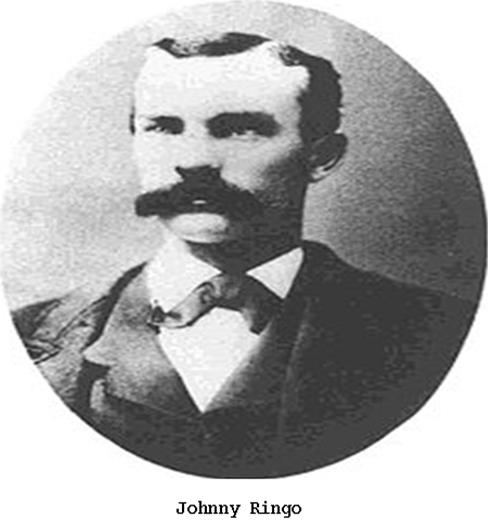
7- The Chiefly Tombstone Cowboys Before the Shootout 7A– Johnny Ringo
John Peters Ringo, May 3rd, 1850 – July 13th, 1882, known as Johnny Ringo, was an American Old West outlaw and premier gunman generally said to be loosely associated with the Cochise County Cowboys in frontier boomtown Tombstone, Arizona Territory, though some say that he was actually their leader. He took part in the Mason County War in Texas during which he committed his first murder. He was arrested and charged with murder. He was affiliated with Cochise County Sheriff Johnny Behan, Ike Clanton, and Frank Stilwell most clearly during 1881–1882. He got into a confrontation in Tombstone with Doc Holliday and was suspected by Wyatt Earp of having taken part in the attempted murder of Virgil Earp and the ambush of Morgan Earp. Ringo was found dead with a bullet wound to his temple which was ruled a suicide. As the intelligent man gave no indications of being suicidal, modern writers have advanced various theories attributing his death to Wyatt Earp, Doc Holliday, Frank Leslie, and Michael O'Rourke. Dos Holliday told Wallace; "I'm afraid the strain was 446
O.K. Corral
more than he could bear," adding a mumble which sounded like; "when he learned that he wasn’t the fastest gun. I like to think that I helped my old pal out.”
Johnny Ringo, son of Martin and Mary Peters Ringo, had distant Dutch ancestry and was born in what would later become the small town of Greens Fork, Clay Township, Wayne County, Indiana. His family moved 447
to Liberty, Missouri in 1856. He was a tangentially related cousin to the Younger brothers through his aunt Augusta Peters Inskip, who married Coleman P. Younger, uncle of the outlaws.
In 1858, his family moved from Liberty to Gallatin, where they rented property from the father of John W. Sheets, who became the first
"official" victim of the James–Younger Gang when they robbed the Daviess County Savings & Loan Association in 1869.
On July 30th, 1864, when Johnny was 14, his family was in Wyoming en route to California. His father, Martin Ringo, was killed when he stepped off their wagon holding a shotgun, which accidentally discharged. The buckshot entered the right side of his face and exited the top of his head. The family buried Martin on a hillside alongside the trail.
Ringo left his mother, brother, and sisters in San Jose, California, in 1869 and moved to Mason County, Texas. He befriended an ex-Texas Ranger Scott Cooley who was the adopted son of rancher Tim Williamson.
448
Trouble started when two American rustlers, Elijah and Pete Backus, were dragged from the Mason jail and lynched by a predominantly German mob. Full blown war began on May 13th, 1875, when Tim Williamson was arrested by a hostile posse and murdered by a German farmer named Peter "Bad Man" Bader. Cooley and his friends, including Johnny Ringo, conducted a terror campaign against their rivals.
Officials called it the "Mason County War," while locally it was called the "Hoodoo War." Cooley retaliated by killing local German ex-deputy sheriff John Worley, then taking his scalp and tossing his body down a well on August 10th, 1875.
Cooley already had a reputation as a dangerous man and was respected as a Texas Ranger. He killed several others during the
"war." After Cooley supporter Moses Baird was killed, Ringo murdered James Cheyney on September 25th, 1875, with a friend named Bill Williams. They rode up to Cheyney's house. Cheyney, who had led Baird into the ambush, greeted them unarmed, invited them in, and began washing his face on the porch. Both Ringo and Williams shot and killed him. The two then rode to the house of Dave Doole and 449
called him outside, but he came out with a gun and they fled back into town.
Some time later, Scott Cooley and Johnny Ringo mistook Charley Bader for his brother Pete and killed him. Both men were jailed in Burnet, Texas by Sheriff A. J. Strickland, but Ringo and Cooley soon broke out of jail with help of their friends and they parted company to evade the law.
The Mason County War ended in about November 1876 after about a dozen individuals had been killed. Scott Cooley was thought to be dead and Johnny Ringo and his friend George Gladden were in jail. One of Ringo's alleged cellmates was the notorious killer John Wesley Hardin. While Gladden was sentenced to 99 years, Ringo appears to have been acquitted. Two years later, Ringo was a constable in Loyal Valley, Texas. Soon after this, he traveled to Arizona.
Ringo first appeared in Cochise County, Arizona Territory in 1879 with Joseph Graves Olney, alias "Joe Hill", a friend from the Mason County War. In December 1879, a drunk Ringo shot unarmed Louis Hancock in a Safford, Arizona saloon when Hancock refused a complimentary 450
drink of whiskey, stating that he preferred beer. Hancock survived his wound. Soon after arriving in Tombstone, Arizona, he met editor Sam Purdy of “The Tombstone Epitaph,” who later wrote of their talk; "He said that he was as certain of being killed as he was of living then. He said that he might run along for a couple years more, and may not last two days." In Tombstone, Ringo developed a reputation as having a bad temper. He may have participated in robberies and killings with the Cochise County Cowboys, a loosely associated group of outlaws.
He was occasionally erroneously referred to as "Ringgold" by local newspapers. He described himself as a "speculator" in the 1882
Cochise County Great Register.
451
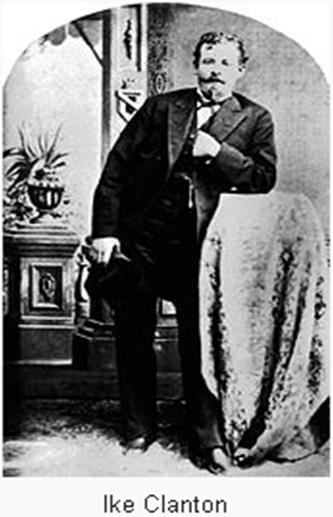
7B– Ike Clanton
Joseph Isaac Clanton, 1847 – June 1st, 1887, was a member of a loose association of outlaws known as The Cowboys who clashed with lawmen Wyatt, Virgil and Morgan Earp as well as Doc Holliday. On October 26th, 1881, Clanton was present at the gunfight at the O.K.
Corral in the boomtown of Tombstone, Arizona Territory, but was supposedly unarmed and ran from the shootout.
452
O.K. Corral
Born in Callaway County, Missouri, Joseph Isaac "Ike" Clanton was one of seven children of Newman Haynes Clanton, (1816–1881) and his wife Mariah Sexton (Kelso) Clanton. His father worked at times as a day laborer, a gold miner, a farmer, and by the late 1870s, a cattleman in Arizona Territory.
453
Clanton's mother died in 1866. Ike stayed with the family when they moved to Tombstone, Arizona Territory, around 1877, before Tombstone became a town or even a mining center. At that time, Newman “Old Man” Clanton was living with his sons Phin, Ike, and Billy. By 1878 Ike was running a small "lunch counter" at the Tombstone Mill site. By 1881, however, he was working on his father's ranch at Lewis Springs, about 12 miles west of Tombstone and 5 miles from Charleston.
The Clantons and their ranch hands and associates were known as the
"Cowboys," and they had a reputation for reckless behavior. They were accused of cattle rustling from across the US–Mexican border, as well as other acts of banditry and murder.
Clanton's notoriety is based largely on his conflict with Wyatt Earp and Wyatt's friend Doc Holliday. The Earps and the Clantons had political, personal, and legal differences and the animosity between them grew throughout 1881. The Cowboys supported incumbent Sheriff Charles Shibell while the Earps supported his opponent Bob Paul in the November 1880 election. Clanton repeatedly boasted in public, drank 454
heavily, and had a quick temper. He was well known for talking too much.
In November 1879, shortly after arriving in Tombstone, Earp had a horse stolen. More than a year later, probably sometime in December 1880, Earp was told the horse was being used near Charleston, and Wyatt and Holliday were forced to ride to the Clanton's ranch near Charleston to await ownership papers in order to legally recover it.
According to Wyatt's testimony later, 18 year old Billy Clanton asked him insolently if he had any more horses to "lose," but he gave the horse up without first being shown the ownership papers, demonstrating to Wyatt that Billy Clanton knew to whom the horse belonged. Sheriff Johnny Behan later testified that the incident had angered Ike Clanton. It also angered Earp.
After he was passed over by Johnny Behan for the position of undersheriff, Earp thought he might beat him in the next Cochise County election. He thought catching the March 15th, 1881 robbers of the Benson Stage, in which the driver and a passenger were killed, would help him win the sheriff's office. Earp later said that on June 455
2nd, 1881 he offered the Wells, Fargo and Co. reward money and more to Clanton if he would provide information leading to the capture or death of the stage robbers. Clanton openly said that it was done by Doc Holliday, Earp’s best friend, which he refused to believe.
According to Earp later, the plan was foiled when the three suspects, Leonard, Head and Crane, were conveniently killed in “unrelated”
incidents.
In the summer of 1881, Clanton got into an argument with gambler
"Denny" McCann. On the morning of June 9th, 1881, they were drinking in an Allen Street saloon when Clanton insulted McCann. McCann slapped Clanton, who left and fetched his pistol. McCann did the same and the two met on the street in front of the Wells Fargo office. They had already drawn their weapons when Tombstone Marshal Virgil Earp stepped between them, preventing a shooting.
The Clanton ranch grew into a successful enterprise. During his testimony after the shootout at the O.K. Corral, Clanton claimed to have raised and purchased about 700 head of cattle during the past year, and the Clanton ranch was one of the most profitable cattle 456
ranches in that part of the country. However, the Clantons never registered a brand in either Cochise County or Pima County which was required to legally raise cattle. The Clantons were reputed to be among a group of outlaw Cowboys who crossed the border into Mexico where they stole cattle and re-sold them to the hungry miners in Cochise County. Curly Bill Brocius, Tom and Frank McLaury bought and sold stolen cattle to “Old Man” Clanton, among others. The Mexican government at the time placed high tariffs on goods transported across the border, making smuggling a profitable enterprise.
The outlaw Cowboys in Cochise County were not organized well, and their acts of violence, rustling or robbery were usually committed by independent groups of Cowboys. Newman Haynes Clanton, also known as "Old Man” Clanton, Ike's father, ran a ranch near the Mexican border that served as a waystation for much of the smuggling carried out by the outlaws.
On August 12th, 1881, Old Man Clanton and six other men were herding stolen cattle sold to him by William Brocius through Guadalupe Canyon near the Mexican border. Around dawn, they were ambushed 457
by Mexicans dispatched by Commandant Felipe Neri in what became known as the Guadalupe Canyon Massacre. “Old Man” Clanton and five other men were killed in the ambush.
458
7C– Billy Clanton
William Harrison Clanton, 1862 – October 26th, 1881, was an outlaw Cowboy in Cochise County, Arizona Territory. He, along with his father Newman Clanton and brother Ike Clanton, worked a ranch near the boomtown of Tombstone, Arizona Territory and stole livestock from Mexico and later US ranchers.
He was a member of group of loosely organized outlaws who had ongoing conflicts with lawmen Wyatt, Virgil and Morgan Earp, and Doc Holliday. The Clantons repeatedly threatened the Earps and Holliday because they interfered with the Cowboys' illegal activities. They blamed Doc Holliday for a stagecoach robbery he claimed not to have done.
Clanton was born in Hamilton County, Texas, one of seven children of Newman Haynes Clanton and his wife Mariah Sexton (Kelso) Clanton; John Wesley, Joseph Issac, Phineas Fay, Alonzo Peter, Mary Elise and Ester Ann. His father worked at times as a day laborer, a gold miner, a farmer, and by the late 1870s, a cattleman in Arizona Territory.
459
In 1851 Newman Clanton moved his family to Adams County, Illinois.
The family moved to California after the end of the Civil War. Clanton's mother died in 1866.
Clanton moved with his family in 1873 to Pima County, Arizona Territory and then to Charleston. His father started the "Clanton Ranch" in 1877. In the same year prospector Ed Schieffelin discovered silver in the hills east of the San Pedro River on a plateau known as Goose Flats, less than 15 miles from the Clanton ranch. The boom town of Tombstone grew within two years from less than 100 to more than 7,000 residents.
Billy Clanton and his brother Ike often went into Tombstone on weekends, and he did business in Tombstone associated with the ranch, alongside the two McLaury brothers. By most accounts, Ike was not well liked in and around Tombstone because he was a drunk and a braggart.
A few days after Wyatt Earp's arrival in Tombstone in December 1879, one of his prized horses was stolen. He heard several times that the Clantons had his horse. Almost a year later he got a tip that it had 460
been seen at the Clanton's ranch near Charleston. Earp rode to their ranch and saw the horse being ridden down the street and placed in a corral. He stabled his horse at another corral and telegraphed James Earp in Tombstone to send up ownership papers for the horse to Charleston. Warren Earp brought the papers out that night. Earp testified in a later court hearing; "While I was waiting for the papers, Billy Clanton found out that I was in town and went and tried to take the horse out of the corral. I told him that he could not take him out, that it was my horse. After the papers came, he gave the horse up without the papers being served, and asked me if I had any more horses to lose."
In July 1879, several rustlers attacked a rancho in northern Sonora, Mexico, killing several of the inhabitants. Hunting the murderers, Mexican Rurales led by Commandant Francisco Neri illegally crossed the border into Arizona and were ambushed. Johnny Ringo later said that Old Man Clanton and his sons Ike and Billy were among the murderers.
461
On August 13th, 1881, Billy's father was killed in an ambush Guadalupe Canyon by Mexican Rurales. The Clanton sons continued operating the ranch. On October 25th, 1881, Ike, Billy, and the McLaury brothers headed to Tombstone after working to gather scattered cattle, lost during an earlier Apache raid. The events that transpired over that night and the next day have various versions, and are enumerated later.
462
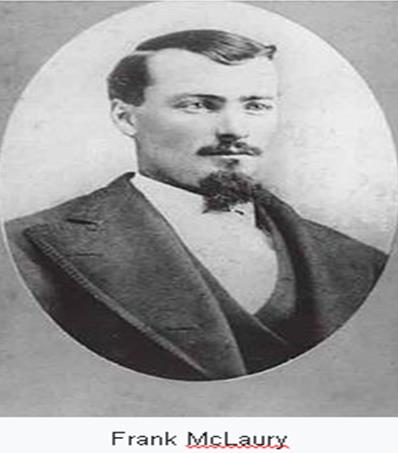
7D– Frank McLaury
Frank McLaury, born Robert Findley McLaury on March 3rd, 1849, and dying October 26th, 1881, was an American outlaw. He and his brother Tom owned a ranch outside Tombstone, Arizona, Arizona Territory during the 1880s, and had ongoing conflicts with lawmen Wyatt, Virgil, and Morgan Earp, as well as Doc Holliday. The McLaury brothers repeatedly threatened the Earps because they interfered with the Cowboys' illegal activities. On October 26th, 1881, Tom, Frank, and Billy Clanton were involved in the gunfight at the O.K. Corral.
463
O.K. Corral
Frank, born Robert Findley McLaury and known as "Rob" when younger, was born in Kortright, New York. He was one of eleven children born to Margaret Rowland and Robert Houston McLaury, a descendant of Matthew McClaughry of Ireland and his son Thomas McClaughry of Kortright, New York. The McLaury family worked a farm in Merideth, Delaware County, New York. The father Robert moved the 464
family to a new farm near Belle Plaine in Benton County, Iowa, in 1855, where Robert also practiced law.
His mother Margaret died when an epidemic of typhoid swept through their community on October 11th, 1859 when Frank was 9. Franks'
father Robert was 65 years old in August 1875. By that time he had lived as a widower for over 15 years. He was the father of 11 children, six of them sons. But by 1875, two of his sons had already died. His father remarried widow and neighbor Jane Arbuthnot on September 13th, 1860. Eight of his siblings including Frank were still living at home, as were eight of Jane's children.
Frank's older brother Edwin McLaury joined the 14th Iowa Volunteers, which saw action at the battle of Fort Donelson and Pittsburgh Landing (Shiloh). Edwin was captured and imprisoned at Macon, Georgia, and after he was paroled he came home but died in October 1862 from the effects of starvation and disease. Another brother, Will, was still serving in the Union Army and could not attend Edwin’s funeral.
465
After the war, the McLaury family moved 50 miles north to Buchanan County, Iowa, to farm land in an unincorporated portion outside Hazelton Township known as Buffalo. Tom and Frank helped their father work the 800 acre farm. By 1859, only Frank, known as "Rob"
within the family because his name, like his father's, was Robert, Christiana, known as "Anna", Tom, and Sarah Caroline, the youngest of the clan, who they called Carrie, were living on their father's farm.
In 1872, the elder McLaury, aged 65, remarried 35 year old widow Ann Lavina (Miller) Leigh. She was two years younger than Frank and had five children from her previous marriage ranging in age from 2 to 13
years old. Only Frank, Tom and Carrie remained at home. By 1875, the youngest daughter of Robert and Margaret, Anna, married and moved away, and by this time two of her brothers had died. Frank had 13
siblings and half-siblings.
Frank and his brother Tom left Iowa in 1878 for Fort Worth, Texas.
Their older brother Will had completed college and moved with his family to Fort Worth where he opened a law practice. Around the time he was in Fort Worth, Robert Findley stopped using his given name and 466
began going by Frank, a derivative of his middle name, Findley. Will later became a judge in Fort Worth, and both Frank and his younger brother Tom McLaury studied pre-law.
In 1878, Frank and Tom may have joined a cattle drive working for either John Slaughter or John Chisum and they moved to Hereford, Arizona, where they got a job working for “Old Man” Clanton. The Clanton family owned one of the largest cattle operations in Arizona.
When “Old Man” Clanton sold his ranch to purchase another holding along the San Pedro River in southern Arizona, Ike Clanton remained behind. The McLaury brothers and Ike became fast friends.
By 1879 the two brothers were experiencing some success in their cattle business, and they purchased land and built a house at Soldiers Hole along the Babocomari creek, a tributary of the San Pedro River.
Another account says they never held title to the land, but that it was owned by Frank Patterson. Nearby Tombstone, Arizona, was just beginning to see its population explode due to the silver rush. Frank briefly assisted local constable Melvin Jones in apprehending soldiers who had stolen government horse harnesses. The soldiers attempted 467
to bribe the two men but McLaury and Jones both insisted they submit to arrest.
Sometime after their arrival in the San Pedro River valley they met
"Curly Bill" Brocius. On October 27th, 1880, the two brothers were with Brocius when he accidentally shot and killed Tombstone Marshal Fred White. The two men were briefly detained. Before he died, White stated that the shooting was accidental and Brocius was released.
The McLaury brothers were suspected of stealing cattle from Sonora, Mexico and re-selling them to “Old Man” Clanton and local butchers.
On July 25th, 1880, Captain Joseph H. Hurst requested the assistance of Deputy US Marshal Virgil Earp, who brought Wyatt and Morgan Earp, as well as Wells Fargo agent Marshall Williams, to track the thieves of six US Army mules stolen from Camp Rucker. This was a federal matter because the animals were US property. Acting on a tip, they found the animals on the McLaury's Ranch on the Babacomari River and the branding iron used to change the "US" brand to "D8."
To avoid bloodshed, Cowboy Frank Patterson promised to return the mules and Hurst pressed the posse to withdraw. The Cowboys showed 468
up two days later without the mules and laughed at Captain Hurst and the Earps. Hurst responded by printing and distributing a handbill describing the theft and promising a reward for the "trial and conviction" of the thieves. It said; "It is known that the stolen animals were secreted at or in the vicinity of the McLaury Brothers ranch, and it is also believed that they were branded on the left shoulder over the Government brand." Hurst specifically charged Frank McLaury with assisting in hiding the mules. It was reprinted in “The Tombstone Epitaph” on July 30th, 1880. Frank McLaury angrily printed a response in the Cowboy friendly “Tombstone Nugget,” calling Hurst "unmanly,"
"a coward, a vagabond, a rascal, and a malicious liar," accusing Hurst of stealing the mules himself. Virgil reported that Frank accosted him and warned him; "If you ever again follow us as close as you did, then you will have to fight anyway."
In November 1879, shortly after arriving in Tombstone, a prize horse of Wyatt Earp's was stolen. More than a year later, he learned the horse had been seen in Charleston and was in the possession of Ike Clanton and his brother Billy. Earp and Doc Holliday rode to the Clanton ranch near Charleston to recover the horse. On the way, they overtook 469
Sheriff Johnny Behan, who was riding in a wagon. Behan was also heading to the ranch to serve an election hearing subpoena on Ike Clanton. According to Wyatt's testimony later, 18 year old Billy Clanton asked him insolently if he had any more horses to "lose," but he gave the horse up without first being shown the ownership papers, demonstrating to Wyatt that Billy knew to whom the horse belonged.
In later years, Doc said to Wallace the diarist that; “Billy drew on us, but before he was able to get a hold of his gun, I had both of mine pointed at his face. He suddenly hecame genial and graciously reasonable over the messy affair.”
Early in 1881, shortly after Cochise County was created, Tom and Frank moved their ranching operations to the Sulphur Springs Valley.
They dug a well and built a substantial adobe ranch house, a barn, corrals, and irrigation ditches for farming. They owned eight horses, two mules, and 140 cattle. They began planning a visit to their sister Sarah Caroline McLaury in Iowa, who was set to be married on November 30th.
470
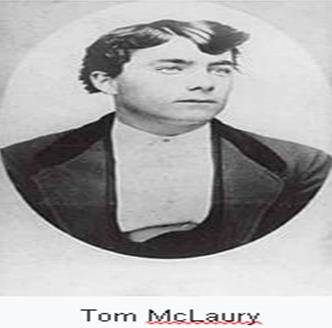
7E– Tom McLaury
Tom McLaury, June 30th, 1853 – October 26th, 1881, was an American outlaw. He and his brother Frank owned a ranch outside Tombstone, Arizona, Arizona Territory during the 1880s. He was a member of a group of outlaws Cowboys and cattle rustlers that had ongoing conflicts with lawmen Wyatt, Virgil, and Morgan Earp, and Doc Holliday. The McLaury brothers repeatedly threatened the Earps because they interfered with the Cowboys' illegal activities. On October 26th, 1881, Tom and Frank were both participants in the gunfight at the O.K. Corral in Tombstone, Arizona Territory. The Tombstone shootout was his first, last, and only gunfight.
Born Thomas McLaury in Meredith, New York, he was two years old when his family moved to Belle Plaine, Iowa. Both he and his older brother Frank McLaury studied pre-law, and their oldest brother William McLaury eventually became a judge in Fort Worth, Texas. Tom was 5'3" tall and his brother Frank was 5'4" tall.
In 1878 he and Frank moved to Hereford, Arizona, where they first met Ike Clanton and became associated with the Clanton family. At the 471
time, the Clanton family owned one of the largest cattle operations in the Arizona Territory, although their success was based at least in part on stealing cattle from Mexico Rancheros and later US ranches.
By 1879 the two brothers cattle business was growing and they purchased land and built a house at Soldiers Holes. Their ranching operation was near the silver mining boomtown of Tombstone, Arizona Territory, as its population soared due to the silver rush. They became associated with "Curly Bill" Brocius. On October 27th, 1880, the two brothers were briefly detained when Brocius accidentally shot and killed Tombstone Town Marshal Fred White.
472
O.K. Corral
Tom McLaury was involved in several outlaw activities that brought him into conflict with the Earps.
On July 25th, 1880, US Army Captain Joseph H. Hurst asked Deputy US
Marshal Virgil Earp to assist him in tracking Cowboys who had stolen six US Army mules from Camp Rucker. Virgil requested the assistance of his brothers Wyatt and Morgan, along with Wells Fargo agent Marshall Williams, and they found the mules at the McLaurys' ranch.
473
McLaury was a Cowboy, which in that time and region was generally regarded as an outlaw. Legitimate cowmen were referred to as cattle herders or ranchers. They found the branding iron used to change the
"US" brand to "D.8." Stealing the mules was a federal offense because the animals were US property.
Cowboy Frank Patterson "made some kind of a compromise" with Captain Hurst and persuaded the posse to withdraw with the understanding that the mules would be returned. The Cowboys showed up two days later without the mules and laughed at Captain Hurst and the Earps. In response, Captain Hurst printed a handbill describing the theft, and specifically charged McLaury with assisting in hiding the mules. He also reproduced the flyer in “The Tombstone Epitaph,” on July 30, 1880. McLaury angrily printed a response in the Cowboy friendly “Tombstone Nugget,” calling Hurst "unmanly," "a coward, a vagabond, a rascal, and a malicious liar," and accused Hurst of stealing the mules himself. Captain. Hurst later cautioned Wyatt, Virgil, and Morgan that the Cowboys had threatened their lives. Virgil reported that Frank accosted him and warned him; "If you ever again follow us as close as you did, then you will have to fight anyway." A 474
month later Earp ran into Frank and Tom McLaury in Charleston, and they told him if he ever followed them as he had done before, they would kill him.
Tensions between the Earps and both the Clantons and McLaurys increased through 1881. On March 15th, 1881 at 10:00 PM, three Cowboys attempted to rob a Kinnear and Company stagecoach carrying US$26,000 in silver bullion near Benson, during which popular driver Eli "Budd" Philpot and passenger Peter Roerig were killed.
Tensions further increased between the Earps and the McLaurys when a passenger stage on the Sandy Bob line headed for Bisbee was robbed in the Tombstone area on September 8th. The masked robbers shook down the passengers and robbed the strongbox. They were recognized by their voices and language. They were identified as Pete Spence, an alias for Elliot Larkin Ferguson, and Frank Stilwell, a business partner of Spence who had shortly before been fired as a deputy of Sheriff Behan's for county tax "accounting irregularities.”
Spence and Stilwell, friends of the McLaury brothers, were arrested by sheriff's deputies Breakenridge and Nagel for the stage robbery, and 475
later by Deputy US Marshal Virgil Earp on the federal offense of mail robbery.
Released on bail, Spence and Stilwell were re-arrested by Virgil for the Bisbee robbery a month later, October 13th, on the new federal charge of interfering with a mail carrier. The newspapers, however, reported that they had been arrested for a different stage robbery that occurred October 8th near Contention City. Occurring less than two weeks before the O.K. Corral shootout, this final incident may have been misunderstood by the McLaurys. While Wyatt and Virgil were still out of town for the Spence and Stilwell hearing, Frank McLaury confronted Morgan Earp, telling him that the McLaurys would kill the Earps if they tried to arrest Spence, Stilwell, or the McLaurys again.
476
7F– Billy Claiborne
Billy Claiborne, ? – November 14, 1882, was an American outlaw cowboy, drover, miner, and gunfighter in the American Old West. He killed James Hickey in a confrontation in a saloon, but it was ruled self-defense. He was present at the beginning of the gunfight at the O.K. Corral, but was unarmed and ran from the shootout. Only a year later, while drunk, he confronted gunfighter "Buckskin" Frank Leslie and was killed.
As a young man, William Claiborne worked as a cowhand and remuda rider for John Slaughter and helped him drive cattle from Texas to the Arizona Territory in 1879. In Tombstone, he worked on the amalgamator at mines in Charleston, and as a slag cart driver at the Neptune Mining Company smelter in Hereford, Arizona.
477
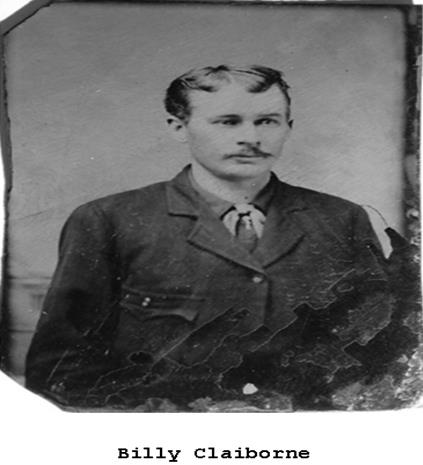
O.K. Corral
On October 1st, 1881, Claiborne got into an argument with James Hickey in the Queen's Saloon in Charleston. Hickey had been drinking for three days. Harry Queen, the saloon owner and eyewitness reported on the event; “I was present when James Hickey was killed.
Hickey was standing close to the table where a game of cards was being played in my saloon. He turned to walk out at the same time this young fellow they called The Kid was coming into the saloon. When he 478
saw Hickey he turned to walk out. Hickey said at that time he would like to see any prick eating son of a bitch stand in front of them. The Kid turned around and said don't follow me, you have been following me long enough and I won't stand it any longer. If you follow me any longer I will kill you. The Kid drew his pistol, raised it, and fired.
Hickey turned partly around after the report of the pistol and fell on his face and left side. After The Kid told Hickey not to follow him any longer Hickey continued to advance. Claiborne shot Hickey in the cheek below his left eye, killing him instantly.”
Over a month later, on November 26th, the trial was convened, but only four jurors showed up. The next court day, three jurors did not show up. When all of the jurors finally showed up, they asked the judge if they could convict on second degree murder. When the judge said no, they said they could not agree on a verdict and the judge declared a mistrial. A second trial was set for May 11th, 1882, but most of the defense attorneys did not appear. A new trial date was set on May 15th but not enough jurors could be found. Hickey was not well-liked and when a jury was finally convened, Billy was found not guilty and set free.
479
In 1881, after William "Billy the Kid" Bonney was killed, Claiborne demanded that others call him "Billy the Kid." He reportedly killed one to three men who refused. Claiborne was a heavy drinker and hothead.
He became friends with Ike and Billy Clanton, and with Tom and Frank McLaury.
480
7G – Frank Stilwell
Frank C. Stilwell, 1856 – March 20, 1882, was an outlaw Cowboy who killed at least two men in Cochise County, Ariona during 1877–82. Both killings were considered to have been self-defense. For four months he was a deputy sheriff in Tombstone, Arizona Territory for Cochise County Sheriff Johnny Behan. Stilwell owned interests in several mines and various businesses, including a saloon, a wholesale liquor business, a stage line, and at his death livery stables in Charleston and Bisbee. He was also a partner in a Bisbee area saloon with ex-Texas Ranger Pete Spence.
481
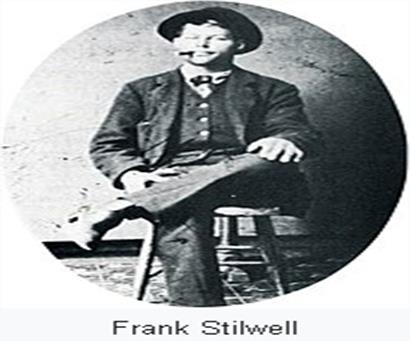
O.K. Corral
Frank was the son of William "Henry" Stilwell and Charlotte B. "Sarah"
Winfrey. Frank was born in Iowa in 1856, as estimated from his self-reported age of 24 in the 1880 census.
His family moved shortly afterward near Palmyra, Kansas Territory, on the Santa Fe Trail. In 1863 William and Charlotte divorced and William left with the three boys, Jack, Millard and Frank. Charlotte took the girls Elizabeth and Mary. Frank's father was a Private in the Union Army with Company B, 18th Missouri Volunteer Infantry, under General 482
William Tecumseh Sherman and took part in Sherman's March to the Sea.
His older brother Simpson "Comanche Jack" Stilwell was an Indian fighter, scout, Deputy US Marshal, police judge, and US Commissioner.
Frank and his brother Simpson traveled from Anadarko, Indian Territory to Prescott, Arizona Territory in 1877. While in Prescott, Frank worked at nearby Miller's Ranch. On October 18th, 1877, newly hired cook Jesus Bega brought Frank tea instead of coffee, and after an argument Frank shot Bega through the lung, killing him. Frank was later acquitted on the grounds of self-defense. When Frank's brother Simpson left Arizona for Fort Davis, Texas Frank remained in Arizona.
He worked as a teamster for C. H. "Ham" Light.
Frank later staked a claim and worked a mine in Mohave County and on November 9th, 1879, got into an argument over claim jumping with Colonel John Van Houten. Van Houten was brutally beaten in the face with a rock and died. Frank Stilwell and James Cassidy were charged with his murder but escaped a grand jury indictment for lack of evidence.
483
In the 1880 census he listed himself as 24 years old, and living in Charleston, occupation "keeping livery," and reported that he had been born in Texas.
Stilwell was hired as an assistant deputy sheriff by Cochise County Sheriff Johnny Behan in April, 1881. Four months later, in August, Behan fired him for "accounting irregularities."
On September 8th, 1881, a passenger stage on the “Sandy Bob Line” in the Tombstone area bound for Bisbee, Arizona was robbed. The masked bandits robbed all of the passengers of their valuables and the strongbox of about $2,500. During the robbery, the driver heard one of the robbers describe the money as "sugar," a phrase known to be used almost uniquely by Frank. Wyatt and Virgil Earp rode with the sheriff's posse attempting to track the robbers. At the scene of the holdup, Wells, Fargo and Co. undercover agent Fred Dodge discovered an unusual boot print left by someone wearing a custom repaired boot heel. The Earps checked a shoe repair shop in Bisbee known to provide widened boot heels and were able to link the boot print to Frank Stilwell.
484
When Stilwell arrived in Bisbee with his livery stable partner, Pete Spence, Tombstone Marshal Virgil Earp, Special Police Officer Wyatt Earp, and Cochise County Deputy Sheriff Billy Breakenridge arrested them for the robbery. Stilwell and Spence were arraigned before Judge Wells Spicer and posted $7,000 bond, paid by C.H. "Ham" Light. At the preliminary hearing, Stilwell and Spence were able to provide several witnesses who supported their alibis. The distinctive boot print and the use of the word "sugar" to describe money was not enough to convict Stilwell, and Judge Spicer dropped the charges for insufficient evidence just as he had done for Doc Holliday earlier in the year.
On October 13th, two weeks after Frank was acquitted on the state charges, Virgil in his role as Deputy US Marshal filed new federal charges against Stilwell and Spence for the federal crime of interfering with a mail carrier. Virgil took Stilwell and Spence to Tucson for arraignment where they were held at the territorial jail. While Virgil was in Tucson, he deputized Wyatt to act in his place as assistant city marshal in Tombstone.
485
The Cowboys thought the new arrest was in regard to a separate stage robbery that had occurred five days before October 8th near Contention City, and saw the new arrest as evidence that Stilwell and Spence were being unfairly harassed and targeted by the Earps for any stage robbery. They let the Earps know they could expect retaliation.
While Wyatt and Virgil were in Tucson for the federal hearing on the charges against Stilwell and Spence, Cowboy Frank McLaury confronted Morgan Earp, Spence and Stilwell being friends of McLaury and his brother Tom. He told Morgan that the McLaurys would kill the Earps if they tried to arrest Spence, Stilwell, or the McLaurys again.
“The Tombstone Epitaph” reported "that since the arrest of Spence and Stilwell, veiled threats are being made that the friends of the accused will 'get the Earps.'" The newspapers misreported that Stilwell and Spence had been arrested for the different recent October 8th stage robbery near Contention City, probably helping to lead to the mistaken conviction that Stilwell and Spence were being persecuted by the law.
486
7H - Charles A. Shibell
Charles A. Shibell, August 14th, 1841 – October 21st, 1908, was a teamster, miner, hotel owner, customs inspector, recorder, and Pima County, Arizona County Sheriff and a contemporary of Wyatt Earp and his brothers, as well as Doc Holliday. Shibell promised a job as Deputy Sheriff to Virgil Earp, but when Earp announced his support for Bob Paul as the next sheriff, Shibell appointed Earp's antagonist Johnny Behan to the position instead.
487
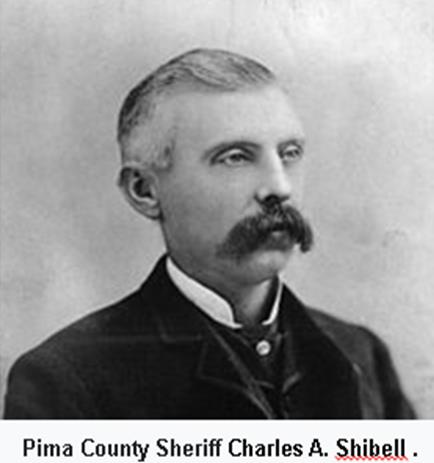
O.K. Corral
Charles Alexander Shibell was born to George and Mary Agnes (Byrne) Shibbell in St. Louis, Missouri where he attended public school. He attended Iowa College, later renamed Grinnell College. In 1860, he left Iowa for Sacramento, California, where he got a job as a clerk in a general store. He later moved to the Southwest where he married Mercedes Sais Quiroz in 1868. Mercedes had been kidnapped as a 488
child with Larcena Pennington Page in March 1860 by Apache Indians.
She was later traded for Apache prisoners. Mercedes and Charles Shibell had four children; Mamie A., Lillie M., Charles B. and Mercedes A., before his wife died in 1876 at age 26. In 1877, Shibell married Nellie Norton and they had two children, Lionel J. and Orpha.
In 1862, just as the Civil War was beginning, he joined Colonel James H. Carleton's California Column. He worked as a civilian teamster and was with the Union forces when they re-captured Tucson, Arizona, from Confederate forces on May 20th, 1862. He followed the force to the Rio Grande and remained there until January 1st, 1863, when he returned to Tucson. He worked for the federal government transporting supplies 300 miles from the headquarters at Tucson to Ft.
Yuma. In 1864, the troops were ordered to the Rio Grande where they would be mustered out, and Shibell remained in Tucson.
In June 1864, he went to work at the Cerro Colorado Mine as a silver miner about 75 miles southwest of Tucson. In May 1865, he moved to the Sonoita River about 30 miles south of Tubac, Arizona, participating in the cowboy business before operating his own cattle ranch. His 489
ranch was repeatedly attacked by Apache Indians and he lost cattle on several occasions to the Indians, until two or three of his men were killed. Unable to withstand the Apache's attacks, he left the area in 1867 and returned to Tucson. He became a Customs Inspector for the next two years. He may have been a participant in the Camp Grant Massacre on April 30th, 1871, during which 144 Aravaipas and Pinal Indians were killed and mutilated, almost all of them women and children.
He then opened a stagecoach stop named Desert Station on the road 26 miles northwest of Tucson which he maintained through 1872. He also resumed the teamster business that year between Tucson and Yuma.
In 1874, Shibell, a lifelong Democrat, developed an interest in politics.
In January 1875, he was appointed a Pima County Deputy Sheriff by Tucson Mayor William S. Oury and held the office for two years.
He ran for Sheriff in 1876 and held that office for four years, until 1881.
He was responsible for enforcing the law for 3,000 citizens spread out 490
over 12,000,000 acres on the extremely remote border with Mexico, a wide open area on the edge of the American frontier.
On August 19th, 1878, Shibell and a citizen posse tracked Arizona and New Mexico Territory road agent William Whitney Brazelton, who was suspected of repeated stagecoach robberies in the Tucson area, to a meeting place where he expected to receive supplies from a confederate named David Nemitz. Nemitz warned that Brazelton
"would not be taken alive unless by artful strategy." Shibell gave orders to shoot on sight if needed, and Brazelton was killed during the confrontation in a mesquite bosque along the Santa Cruz River approximately three miles south of Tucson. Shortly thereafter, Brazelton's body was photographed by pioneer Tucson photographer Henry Buehman and copies of these were available for sale to the general public, which was not the least bit unusual at the time.
Additionally, John J. Valentine Sr., of Wells, Fargo and Co. would, as a direct response to Brazelton's criminal actions in Pima County, send special agent and future sheriff of said county, Bob Paul, to investigate on their behalf." Shibell was reelected Sheriff in 1878.
491
On July 27th, 1880, Shibell allowed the appointment of Wyatt Earp Deputy Sheriff; Virgil already the Sheriff, in Pima County, when Tombstone, Arizona was still part of Pima County, making the Earps the primary law enforcement officers for most of eastern Pima County.
Shibell ran for reelection as Pima County Sheriff in the November 2nd, 1880, election against Republican Bob Paul. The region was strongly Republican and Paul was expected to win. Whoever won would likely appoint someone from the same political party. Republican Wyatt expected he would continue in the job.
Shibell was supported in his reelection bid by a loosely organized federation of outlaw Cowboys, mostly Southerners, who strongly opposed Wyatt Earp and the Republicans generally. A cowboy in that time and region was generally regarded as an outlaw. Legitimate cowmen were referred to as cattle herders or ranchers.
The election of November 2nd, resulted in Shibell winning by a 58 vote margin.
On November 19th, Bob Paul filed suit and accused Shibell of ballot stuffing in the San Simon precinct, since the precinct delivered a 103
492
to 1 vote for Shibell in a precinct that contained only about 10 eligible voters; some would say not unlike minority controlled, big city election counts of the twenty-first century. The trial was transferred to Tucson's district court and began on January 17th. On January 20th, 1881, the “Arizona Star” reported; "There has been some big cheating somewhere, and by some persons. It was clear that there had been reckless counting at Tombstone, fraud at San Simon and a careless election board at Tres Alamos." A recount was held and this time Paul had 402 votes and Shibell had 354. Sixty-two were kept from a closer examination.
James Johnson later testified for Bud Paul in the election hearing and said that the ballots had been left in the care of Democrat Phin Clanton. Meanwhile, a week after the election on November 9th, 1880, Earp resigned. The position of undersheriff was now open, and Shibell immediately selected Democrat Johnny Behan to serve as Tombstone area undersheriff.
493
In February 1881, the San Simon results were thrown out by the election commissioners, but Shibell filed an appeal. He was finally removed from office in April and replaced by Bob Paul.
494
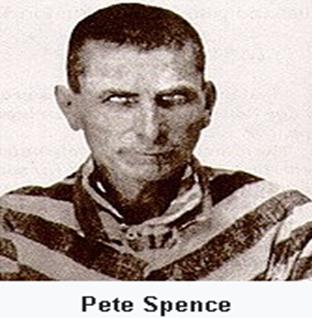
O.K. Corral
7I – Pete Spence
Pete Spence, born Elliot Larkin Ferguson, 1852–1914, was a small time criminal known for his association with outlaw Cowboys Frank and Tom McLaury, and Ike and Billy Clanton, of Tombstone, Arizona Territory. Spence was first suspected of robbery in 1878 in Goliad County, Texas. He was suspected of stealing mules and later a suspect in a stagecoach robbery outside Bisbee, Arizona. While a deputy sheriff, he pistol whipped and killed a man for which he served eighteen months of a five year term before the governor pardoned him.
495
In the 1880 Tombstone census he gave his age as 28, born in Texas, and listed his occupation as stock raiser. He was also reported as having been born in Louisiana in 1850. Little is known about his youth, but he enlisted in the Texas Rangers under Captain Wallace in 1874.
A man who called himself Ferguson was wanted for robbery in Goliad County, Texas in 1878 and left the area for the Arizona Territory near Bisbee and Tombstone where he began using the name of Peter M.
Spencer. He was one of a number of outlaws from Texas who sought sanctuary on the American frontier and the Wild West. Locally known as a Cowboy, Tombstone resident George Parson wrote in his diary; "A Cowboy is a rustler at times, and a rustler is a synonym for desperado, bandit, outlaw, and horse thief."
In Tombstone, Arizona Territory, Spence lived immediately across the street from the Earps in a house which still stands. For a time he ran Vogan's Saloon. In October, 1880 Spence was charged with grand larceny on a charge of possessing stolen Mexican mules, but was not convicted. Spence was a business partner of Frank Stilwell in the 496
Franklin Mine and other mining ventures, and also in a Bisbee saloon.
On August 12th, 1881, he married Marietta Duarte.
On September 8th, 1881, a passenger stage on the Sandy Bob line in the Tombstone, Arizona area bound for Bisbee was held up by two or three masked men. They robbed all of the passengers of their valuables since the stage was not carrying a strongbox. During their robbery the driver heard one of the robbers describe the money as
"sugar," a phrase known to be used by Frank Stilwell. Stilwell had until the prior month been a deputy for Sheriff Johnny Behan but had been fired for "accounting irregularities."
Deputy US Marshal Virgil Earp assisted by his brother Wyatt and Sheriff's posse led by Behan attempted to track the Bisbee stage robbers. At the scene of the holdup, Wyatt discovered an unusual boot print left by someone wearing a custom repaired boot heel. The Earps checked a shoe repair shop in Bisbee known to provide widened boot heels, and were able to link the boot print to Frank Stilwell. Stilwell had just arrived in Bisbee with Spence, his livery stable partner, and Virgil and Wyatt arrested both of them at the stable, for the stage 497
robbery, on September 10th. Cowboy friends provided Stilwell and Spence with an alibi, saying they were elsewhere during the robbery, and the state robbery charges were dropped.
Spence and Stilwell were re-arrested on October 13th by Virgil Earp for the Bisbee robbery on a new federal charge of interfering with a mail carrier. The Cowboys saw the Earp's filing of federal charges as further evidence they were being unfairly harassed and targeted by the Earps. They let the Earps know that they could expect retaliation.
Local newspapers erroneously reported that Spence and Stilwell had been arrested for a different stage robbery that occurred on October 8th near Contention City. Stilwell was in jail in Tucson on these federal charges on the day of the gunfight on October 26th, 1881, but Spence had been released several days before.
498
O.K. Corral
7J – Curly Bill Brocius
.
William Brocius, ca. 1845 – March 24th, 1882, better known as Curly Bill Brocius, was an American gunman, rustler and an outlaw Cowboy in the Cochise County area of the Arizona Territory during the late 1870s and early 1880s. Some say he was the Cowboy leader, but more 499
think it was Johnny Ringo. His name is likely an alias or nickname, and some evidence links him to another outlaw named William "Curly Bill"
Bresnaham, who was convicted of an 1878 attempted robbery and murder in El Paso, Texas.
Brocius had a number of conflicts with the lawmen of the Earp family, and he was named as one of the individuals who participated in the attack on Morgan Earp. Deputy US Marshal Wyatt Earp and a group of deputies including his brother Warren Earp and Doc Holliday pursued those they believed responsible for the attack.
Brocius arrived in Arizona Territory from either Texas or Missouri about 1878, and went briefly to the San Carlos Reservation with a herd of cattle, before arriving in the Arizona Territory.
Brocius was an outlaw Cowboy and a rustler, and was for a time also a tax collector for Cochise County Sheriff Johnny Behan, making other rustlers pay taxes on their stolen cattle. The money went into the sheriff's coffers and added to his salary.
Brocius was known for a mean sense of humor when drunk. He was reported to have perpetrated "practical jokes."
500
An unauthenticated photo of Brocius is displayed in the Bird Cage Theater Museum in Tombstone. Two other unauthenticated photos of Brocius have been provided by descendants. Several writers who knew Brocius reported that he was well built with curly black hair and a freckled complexion.
In a drunken revelry, some of Curly Bill's friends were firing pistols into the air on October 28th, 1880, in a dark vacant lot in Tombstone between Toughnut and Allen Streets, near where the Birdcage Theater now stands. Tombstone's Town Marshal Fred White attempted to disarm Brocius and grabbed his weapon by the barrel. The gun discharged, striking White in the groin. Wyatt Earp had borrowed Fred Dodge's pistol and he pistol whipped Brocius. At the preliminary hearing for Brocius afterward, Wyatt testified that he had heard White say; "I am an officer; give me your pistol." When he got close, he saw Brocius remove his pistol from his holster and White grab it by the barrel. He said he put his arms around Brocius from behind to see if he had any other weapons, and White "gave a quick jerk and the pistol went off." White fell to the ground, wounded. When the pistol discharged, Wyatt buffaloed Brocius and arrested him. Brocius 501
complained; "What have I done? I have not done anything to be arrested for."
White was carried to a doctor and they initially thought he would recover, and the next day, he gave a statement that exonerated Curly Bill of murder, but that night, White's condition worsened. Brocius later claimed that his gun discharged accidentally and reportedly immediately regretted shooting White. He testified at his trial that he did not consider himself to have committed a crime. Brocius waived his right to a preliminary hearing, apparently because he feared a lynching, as White was very popular as town marshal. Brocius was anxious to be moved out of town. Pima County Deputy Sheriff Earp and George Collins immediately took Brocius to Tucson for trial.
White died two days after Curly Bill shot him. Before dying, White testified that he thought the pistol had accidentally discharged and that he did not believe that Curly Bill shot him on purpose. Wyatt Earp supported this testimony, ironically, given his later vendetta against Brocius and the rest of the Cowboy gang, as was a demonstration that Brocius's pistol could be fired from half cock, and the fact that it had 502
been found to contain six rounds, with only one of them fired. After spending most of November and December 1880 in jail awaiting trial, Brocius was acquitted with a verdict of accidental death.
Wyatt told his biographer John H. Flood, Jr., many years later that he thought that Brocius was still armed at the time and did not notice that Brocius' pistol lay on the ground in the dark, until Brocius was already down. Despite being responsible for the deaths of several other men during his life, Brocius had apparently personally liked White and maintained that his death had been an accident.
Brocius was described by author Billy Breakenridge in his book,
“Helldorado: Bringing the Law to the Mesquite,” as being a deadly pistol shot of the Cowboys, second only to Johnny Ringo, "able to hit running jackrabbits, shoot out candle flames without breaking the candles or lantern holders, and shoot quarters from between the fingers of volunteers." When drunk, Brocius was also known for a mean sense of humor and for such "practical jokes" as using gunfire to make a preacher "dance" during a sermon or forcing Mexicans at a community dance to take off their clothes and dance naked. Wells 503
Fargo agent Fred Dodge reported both incidents in his memoirs, and both were alluded to in local newspapers.
On March 8th, 1881, Brocius and his friend Johnny Ringo rode to Maxey, near Camp Thomas, Arizona. Cowboy Dick Lloyd got drunk while playing poker in O'Neil and Franklin's saloon. After shooting and wounding one man, Lloyd rode his horse into the saloon where Brocius was drinking. Brocius and several other men resented the interruption, and about a dozen of them, including Brocius, shot and killed Lloyd.
Owner O'Neil took the blame and was acquitted.
On May 25th, 1881, Brocius was drinking heavily in Galeyville with his friend of several months and Lincoln County War veteran Jim Wallace and eight or nine other Cowboys. Wallace insulted Brocius' friend and ally, Tombstone Deputy Marshal Billy Breakenridge. Breakenridge ignored him, but Brocius took offense and insisted that Wallace accompany him and apologize to Breakenridge. Brocius threatened to kill him. Wallace complied, but Brocius afterward heaped abuse on Wallace, announcing; "You damned Lincoln County son of a bitch, I'll kill you anyhow." Wallace left the saloon and Curly Bill followed him.
504
Feeling threatened, Wallace shot Curly Bill, wounding him in the cheek and neck.
Deputy Breakenridge arrested Wallace, but the court ruled he acted in self-defense. Curly Bill may have first met Pony Diehl around this time, as well. Diehl was implicated in several Cowboy criminal activities later on.
In July 1881, Bill Leonard and Harry Head attempted to rob William and Isaac Haslett's general store in Hachita, New Mexico. The Haslett brothers killed Leonard and Head during the holdup. Some modern researchers state that Brocius and friend Johnny Ringo rode to New Mexico to avenge their friends' deaths and killed both Haslett brothers. However, no witnesses to this crime were found nor to any sort of Curly Bill involvement in the Hasletts' death.
Four months after Brocius was shot, on October 6th, 1881, George Parsons rode through the McLaury brothers' ranch in Sulphur Springs Valley as part of an Indian scouting party, and noted that Brocius had not yet fully recovered from his wound, but was well enough to ride.
505
For this reason, many historians doubt that Brocius took part in killing William and Isaac Haslett.
In July, some reports say that Brocius ambushed a Mexican trail herd in what became known as the Skeleton Canyon Massacre. Six vaqueros were killed and the remainder captured, then possibly tortured and murdered. Curly Bill reportedly sold the stolen Mexican beef to Newman Haynes Clanton the next month. When “Old Man”
Clanton was herding the beef on the trail to Tombstone, he and four others were ambushed in the Guadalupe Canyon Massacre and murdered by Mexicans. No reports were verified of Curly Bill's involvement in these episodes, nor was he charged with any crimes related to these events.
Brocius was still recovering from being shot in the face by Wallace only six weeks earlier. Some modern researchers doubt that he was well enough to take part in these events.
506
7K - Phineas Clanton
Phineas Fay Clanton, December 1843 – January 5th, 1906, was the son of Newman Haynes “Old Man” Clanton and the brother of Billy and Ike Clanton. He was witness to and possibly played a part in a number of illegal activities during his life. He moved frequently in his early life from Missouri to California and to Arizona.
Their father was implicated in the ambush and murder of a number of Mexican smugglers in July 1881. The following month he was killed by Mexican Rurales. Phin's brother Ike Clanton had an ongoing series of conflicts with Deputy US Marshal Virgil Earp and was accused of cattle rustling among other things. Phin and his brothers developed bitter and angry feelings for the Earps.
507
8 – The Unclearly Aligned Before the Shootout
While many Wild West people were seemingly on both sides of the fence at times, most were on one side of the other the majority of the time. However, there are exceptions and extremes.
One might also refer to them as politicians, in every sense of the word, including the thoughts that no one should pay any attention to a thing they say, and that they are on their own side only.
508
8A– Johnny Behan
John Harris Behan, October 24th, 1844 – June 7th, 1912, was an American law enforcement officer and politician who served as Sheriff of Cochise County in the Arizona Territory during the gunfight at the O.K. Corral and was ironically known for his opposition to the Earps.
Behan was sheriff of Yavapai County from 1871 to 1873. He was married and had two children, but his wife divorced him, accusing him of consorting with prostitutes. He was elected to the Seventh Arizona Legislative Assembly, representing Yavapai County. In 1881, Wyatt Earp served for about five months as undersheriff of the eastern half of Pima County. When Wyatt resigned, Behan was appointed to fill his place, which included the mining boomtown Tombstone. When Cochise County was formed in February 1881, Behan was appointed as its first sheriff. Tombstone became the new county seat and the location of Behan's office. Sadie Marcus was his mistress, possibly as early as 1875 in Tip Top, Arizona, and certainly from 1880 until she found him in bed with another woman and kicked him out in mid-1881.
509
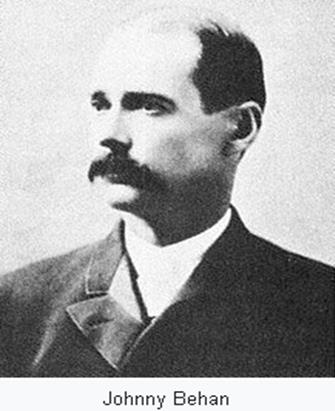
O.K. Corral
After the gunfight at the O.K. Corral, Behan testified at length against the Earps and Doc Holliday, despite having promised to deputize them.