

O.K. Corral by Edward Drobinski - HTML preview
Download the book in PDF, ePub, Kindle for a complete version.
After the passage of the Kansas–Nebraska Act in 1854, Clay County became the scene of great turmoil as the question of whether slavery would be expanded into the neighboring Kansas Territory bred tension and hostility. Many people from Missouri migrated to Kansas to try to influence its future. Much of the dramatic buildup to the Civil War centered on the violence that erupted on the Kansas–Missouri border between pro-slavery and anti-slavery militias.
After a series of campaigns and battles between conventional armies in 1861, guerrilla warfare gripped Missouri, waged between secessionist "bushwhackers" and Union forces which largely consisted of local militias known as "jayhawkers." A bitter conflict ensued, resulting in an escalating cycle of atrocities committed by both sides. Confederate guerrillas murdered civilian Unionists, executed prisoners, and scalped the dead. The Union presence enforced martial law with raids on homes, arrests of civilians, summary executions, and banishment of Confederate sympathizers from the state.
336
The James–Samuel family sided with the Confederates at the outbreak of war. Frank James joined a local company recruited for the secessionist Drew Lobbs Army, and fought at the Battle of Wilson's Creek in August 1861. He fell ill and returned home soon afterward. In 1863, he was identified as a member of a guerrilla squad that operated in Clay County. In May of that year, a Union militia company raided the James–Samuel farm looking for Frank's group. They tortured Reuben Samuel by briefly hanging him from a tree. According to legend, they lashed young Jesse.
Frank James eluded capture and was believed to have joined the guerrilla organization led by William C. Quantrill known as Quantrill's Raiders. It is thought that he took part in the notorious massacre of some two hundred men and boys in Lawrence, Kansas, a center of abolitionists. Frank followed Quantrill to Sherman, Texas, over the winter of 1863–1864. In the spring he returned in a squad commanded by Fletch Taylor. After they arrived in Clay County, 16 year old Jesse James joined his brother in Taylor's group.
337
Taylor was severely wounded in the summer of 1864, losing his right arm to a shotgun blast. The James brothers then joined the bushwhacker group led by William "Bloody Bill" Anderson. Jesse suffered a serious wound to the chest that summer. The Clay County provost marshal reported that both Frank and Jesse James took part in the Centralia Massacre in September, in which guerrillas stopped a train carrying unarmed Union soldiers returning home from duty and killed or wounded some 22 of them. The guerrillas scalped and dismembered some of the dead. The guerrillas also ambushed and defeated a pursuing regiment of Major A. V. E. Johnson's Union troops, killing all who tried to surrender, who numbered more than 100. Frank later identified Jesse as a member of the band who had fatally shot Major Johnson.
As a result of the James brothers' activities, Union military authorities forced their family to leave Clay County. Though ordered to move South beyond Union lines, they moved north across the nearby state border into Nebraska Territory.
338
After "Bloody Bill" Anderson was killed in an ambush in October, the James brothers separated. Frank followed Quantrill into Kentucky, while Jesse went to Texas under the command of Archie Clement, one of Anderson's lieutenants. He is known to have returned to Missouri in the spring. At the age of 17, Jesse suffered the second of two life threatening chest wounds when he was shot while trying to surrender after they ran into a Union cavalry patrol near Lexington, Missouri.
At the end of the Civil War, Missouri remained deeply divided. The conflict split the population into three bitterly opposed factions; anti-slavery Unionists identified with the Republican Party; segregationist conservative Unionists identified with the Democratic Party, and pro-slavery, ex-Confederate secessionists, many of whom were also surreptitiously allied with the Democrats, especially in the southern part of the state.
The Republican dominated Reconstruction legislature passed a new state constitution that freed Missouri's slaves. It temporarily excluded former Confederates from voting, serving on juries, becoming corporate officers, or preaching from church pulpits. The atmosphere 339
was volatile, with widespread clashes between individuals and between armed gangs of veterans from both sides of the war.
Jesse recovered from his chest wound at his uncle's boarding house in Harlem, Missouri; north across the Missouri River from the City of Kansas's River Quay. He was tended to by his first cousin, Zerelda
"Zee" Mimms, named after Jesse's mother. Jesse and his cousin began a nine year courtship that culminated in their marriage.
Meanwhile, his former commander Archie Clement kept his bushwhacker gang together and began to harass Republican authorities.
These men were the likely culprits in the first daylight armed bank robbery in the United States during peacetime, the robbery of the Clay County Savings Association in the town of Liberty, Missouri, on February 13th, 1866. The bank was owned by Republican former militia officers who had recently conducted the first Republican Party rally in Clay County's history. During the gang's escape from the town, an innocent bystander, 17 year old George C. "Jolly" Wymore, a student at William Jewell College, was shot dead on the street.
340
As by now one may have come to expect, it remains unclear whether Jesse and Frank took part in the Clay County robbery. After the James brothers successfully conducted other robberies and became legendary, some observers retroactively credited them with being the leaders of the robbery. Others have argued that Jesse was at the time still bedridden with his wound and could not have participated. No evidence has been found that connects either brother to the crime or that conclusively rules them out. On June 13th, 1866, in Jackson County, Missouri, the gang freed two jailed members of Quantrill's gang, killing the jailer in the effort. Historians believe that the James brothers were involved in this crime.
Local violence continued to increase in the state. Governor Thomas Clement Fletcher had recently ordered a company of militia into Johnson County to suppress guerrilla activity. Archie Clement continued his career of crime and harassment of the Republican government, to the extent of occupying the town of Lexington, Missouri, on Election Day in 1866. Shortly afterward, the state militia shot Clement dead. James wrote about this death with bitterness a decade later.
341
The survivors of Clement's gang continued to conduct bank robberies during the next two years, though their numbers dwindled through arrests, gunfights, and lynchings. While they later justified robbing the Unionist banks, most of their targets were small, local banks based on local capital. On May 23rd, 1867, for example, they robbed a bank in Richmond, Missouri, in which they killed the mayor and two others. It remains uncertain whether either of the James brothers took part, although an eyewitness who knew the brothers told a newspaper seven years later "positively and emphatically that he recognized Jesse and Frank James among the robbers." In 1868, Frank and Jesse James allegedly joined Cole Younger in robbing a bank in Russellville, Kentucky.
Jesse James did not become well known until December 7th, 1869, when he, and most likely Frank, robbed the Daviess County Savings Association in Gallatin, Missouri. The robbery netted little money.
Jesse is believed to have shot and killed the cashier, Captain John Sheets, mistakenly believing him to be Samuel P. Cox, the militia officer who had killed "Bloody Bill" Anderson during the Civil War.
342
James claimed he was taking revenge, and the daring escape he and Frank made through the middle of a posse shortly afterward attracted newspaper coverage for the first time. An 1882 history of Daviess County said; "The history of Daviess County has no blacker crime in its pages than the murder of John W. Sheets."
The only known civil case involving Frank and Jesse James was filed in the Common Pleas Court of Daviess County in 1870. In the case, Daniel Smoote asked for $223.50 from Frank and Jesse James to replace a horse, saddle, and bridle stolen as they fled the robbery of the Daviess County Savings Bank. The brothers denied the charges, saying they were not in Daviess County on December 7th, the day the robbery occurred. Frank and Jesse failed to appear in court, and Smoote won his case against them. It is unlikely that he ever collected the money due.
The 1869 robbery marked the emergence of Jesse James as the most famous survivor of the former Confederate bushwhackers. It was the first time he was publicly labeled an "outlaw." Missouri Governor Thomas T. Crittenden set a reward for his capture. This was the 343
beginning of an alliance between James and John Newman Edwards, editor and founder of the “Kansas City Times.” Edwards, a former Confederate cavalryman, was campaigning to return former secessionists to power in Missouri. Six months after the Gallatin robbery, Edwards published the first of many letters from Jesse James to the public asserting his innocence. Over time, the letters gradually became more political in tone and James denounced the Republicans and expressed his pride in his Confederate loyalties. Together with Edwards's admiring editorials, the letters helped James become a symbol of Confederate defiance of federal Reconstruction policy.
James's initiative in creating his rising public profile is debated by historians and biographers. The high tensions in politics accompanied his outlaw career and enhanced his notoriety.
Meanwhile, the James brothers joined with Cole Younger and his brothers John, Jim, and Bob, as well as Clell Miller and other former Confederates, to form what came to be known as the James–Younger Gang. With Jesse James as the most public face of the gang, though with operational leadership likely shared among the group, the gang carried out a string of robberies from Iowa to Texas, and from Kansas 344
to West Virginia. They robbed banks, stagecoaches, and a fair in Kansas City, often carrying out their crimes in front of crowds, and even hamming it up for the bystanders.
On July 21st, 1873, they turned to train robbery, derailing a Rock Island Line train west of Adair, Iowa, and stealing approximately $3,000. For this, they wore Ku Klux Klan masks. By this time, the Klan had been suppressed in the South by President Grant's use of the Enforcement Acts. Former rebels attacked the railroads as symbols of threatening centralization.
The gang's later train robberies had a lighter touch. The gang held up passengers only twice, choosing in all other incidents to take only the contents of the express safe in the baggage car. John Newman Edwards made sure to highlight such techniques when creating an image of James as a kind of Robin Hood. Public sentiment toward the gang's crimes was overwhelmingly positive.
Jesse and his cousin Zee married on April 24th, 1874. They had two children who survived to adulthood; Jesse Edward James and Mary Susan James. Twins Gould and Montgomery James died in infancy.
345
Jesse Jr. became a lawyer who practiced in Kansas City, Missouri, and Los Angeles, California.
In 1874, the Adams Express Company turned to the Pinkerton National Detective Agency to stop the James–Younger Gang. The Chicago based agency worked primarily against urban professional criminals, as well as providing industrial security, such as strike breaking.
Because the gang received support by many former Confederate soldiers in Missouri, they eluded the Pinkertons. Joseph Whicher, an agent dispatched to infiltrate Zerelda Samuel's farm, was soon found killed. Two other agents, Captain Louis J. Lull and John Boyle, were sent after the Youngers. Lull was killed by two of the Youngers in a roadside gunfight on March 17th, 1874. Before he died, Lull fatally shot John Younger. A deputy sheriff named Edwin Daniels also died in the skirmish.
Allan Pinkerton, the agency's founder and leader, took on the case as a personal vendetta. He began to work with former Unionists who lived near the James family farm. On the night of January 25th, 1875, he staged a raid on the homestead. Detectives threw an incendiary 346
device into the house. It exploded, killing James's young half-brother Archie and blew off one of Zerelda Samuel's arms. Afterward, Pinkerton denied that the raid's intent was arson. But biographer Ted Yeatman found a letter by Pinkerton in the Library of Congress in which Pinkerton declared his intention to "burn the house down."
Many residents were outraged by the raid on the family home. The Missouri state legislature narrowly defeated a bill that praised the James and Younger brothers and offered them amnesty. Allowed to vote and hold office again, former Confederates in the legislature voted to limit the size of rewards the governor could offer for fugitives.
This extended a measure of protection over the James–Younger gang by minimizing the incentive for attempting to capture them. The governor had offered rewards higher than the new limit only on Frank and Jesse James.
Across a creek and up a hill from the James house was the home of Daniel Askew, who is thought to have been killed by James or his gang on April 12th, 1875. They may have suspected Askew of cooperating with the Pinkertons in the January 1875 arson of the James house.
347
On September 7th, 1876, the opening day of hunting season in Minnesota, the James–Younger gang attempted a raid on the First National Bank of Northfield, Minnesota. The robbery quickly went wrong, however, and after the robbery only Frank and Jesse James remained alive and free.
Cole and Bob Younger later said they selected the bank because they believed it was associated with the Republican politician Adelbert Ames, the governor of Mississippi during Reconstruction, and Union general Benjamin Butler, Ames's father-in-law and the Union commander of occupied New Orleans. Ames was a stockholder in the bank, but Butler had no known direct connection to it.
The gang attempted to rob the bank in Northfield at about 2 PM. To carry out the robbery, the gang divided into two groups. Three men entered the bank, two guarded the door outside, and three remained near a bridge across an adjacent square. The robbers inside the bank were thwarted when acting cashier Joseph Lee Heywood refused to open the safe, falsely claiming that it was secured by a time lock even as they held a Bowie knife to his throat and cracked his skull with a 348
pistol butt. Assistant cashier Alonzo Enos Bunker was wounded in the shoulder as he fled through the back door of the bank. Meanwhile, the citizens of Northfield grew suspicious of the men guarding the door and raised the alarm. The five bandits outside fired into the air to clear the streets, driving the townspeople to take cover and fire back from protected positions. They shot two bandits dead and wounded the rest in the barrage. Inside, the outlaws turned to flee. As they left, one shot the unarmed cashier Heywood in the head. Historians have speculated about the identity of the shooter but have not reached consensus.
The gang barely escaped Northfield, leaving two dead companions behind. They killed Heywood and Nicholas Gustafson, a Swedish immigrant from the Millersburg community west of Northfield. A substantial manhunt ensued. It is believed that the gang burned fourteen Rice County mills shortly after the robbery. The James brothers eventually split from the others and escaped to Missouri. The militia soon discovered the Youngers and one other bandit, Charlie Pitts. Pitts died in a gunfight and the Youngers were taken prisoner.
Except for Frank and Jesse James, the James–Younger Gang was destroyed.
349
Later in 1876, Jesse and Frank James surfaced in the Nashville, Tennessee, area, where they went by the names of Thomas Howard and B. J. Woodson, respectively. Frank seemed to settle down, but Jesse remained restless. He recruited a new gang in 1879 and returned to crime, holding up a train at Glendale, Missouri on October 8th, 1879. The robbery was the first in a spree of crimes, including the holdup of the federal paymaster of a canal project in Killen, Alabama, and two more train robberies. But the new gang was not made up of battle hardened guerrillas. They soon turned against each other or were captured. James grew suspicious of other members. He scared away one man and some believe that he killed another gang member.
In 1879, the James gang robbed two stores in far western Mississippi, at Washington in Adams County and Fayette in Jefferson County. The gang left with $2,000 cash from the second robbery and took shelter in abandoned cabins on the Kemp Plantation south of St. Joseph, Louisiana. A law enforcement posse attacked and killed two of the outlaws but failed to capture the entire gang. Among the deputies was Jefferson B. Snyder, later a long serving district attorney in northeastern Louisiana.
350
By 1881, with local Tennessee authorities growing suspicious, the brothers returned to Missouri, where they felt safer. James moved his family to St. Joseph, Missouri, in November 1881, not far from where he had been born and reared. Frank, however, decided to move to safer territory and headed east to settle in Virginia. They intended to give up crime. The James gang had been reduced to the two of them.
With his gang nearly annihilated, James trusted only the Ford brothers, Charley and Robert. Although Charley had been out on raids with James brothers, Bob Ford was an eager new recruit were the gang to start up again. For protection, James asked the Ford brothers to move in with him and his family. James had often stayed with their sister Martha Bolton and, according to rumor, he was "smitten" with her. By that time, Bob Ford had conducted secret negotiations with Missouri Governor Thomas T. Crittenden, planning to bring in the famous outlaw. Crittenden had made capture of the James brothers his top priority. In his inaugural address he declared that no political motives could be allowed to keep them from justice. Barred by law from offering a large reward, he had turned to the railroad and express corporations to put up a whopping $5,000 bounty for the delivery of 351
each of them and an additional $5,000 for the conviction of either of them.
On April 3rd, 1882, after eating breakfast, the Fords and Jameses went into the living room before traveling to Platte City for a robbery. From the newspaper, James had just learned that gang member Dick Liddil had confessed to participating in Wood Hite's murder. He was suspicious that the Fords had not told him about it. Robert Ford later said he believed that James had realized they were there to betray him. Instead of confronting them, James walked across the living room and laid his revolvers on a sofa. He turned around and noticed a dusty picture above the mantle, and stood on a chair to clean it. Robert Ford, who has been forever first remembered as “The dirty little coward who shot Mr. Howard, and put poor Jesse in his grave,” drew his weapon and shot the unarmed Jesse James in the back of the head. James's two previous bullet wounds and partially missing middle finger served to positively identify the body.
The death of Jesse James became a national sensation. The Fords made no attempt to hide their role. Robert Ford wired the governor to 352
claim his reward. Crowds pressed into the little house in St. Joseph to see the dead bandit. The Ford brothers surrendered to the authorities and were dismayed to be charged with first degree murder. In the course of a single day, the Ford brothers were indicted, pleaded guilty, were sentenced to death by hanging, and were granted a full pardon by Governor Crittenden. The governor's quick pardon suggested he knew the brothers intended to kill James rather than capture him. The implication that the chief executive of Missouri conspired to kill a private citizen startled the public and added to James's notoriety.
After receiving a small portion of the reward, the Fords fled Missouri.
Sheriff James Timberlake and Marshal Henry H. Craig, who were law enforcement officials active in the plan, were awarded the majority of the bounty. Later, the Ford brothers starred in a touring stage show in which they reenacted the shooting. Public opinion was divided between those against the Fords for murdering Jesse and those of the opinion that it had been time for the outlaw to be stopped. Suffering from tuberculosis, then incurable, and a morphine addiction, Charley Ford committed suicide on May 6th, 1884, in Richmond, Missouri. Bob Ford operated a tent saloon in Creede, Colorado. On June 8th, 1892, 353
Edward O'Kelley went to Creede, loaded a double barrel shotgun, entered Ford's saloon and said; "Hello, Bob." before shooting Ford in the throat, killing him instantly. O'Kelley was sentenced to life in prison, but his sentence was subsequently commuted because of a 7,000 signature petition in favor of his release, as well as a medical condition. The Governor of Colorado pardoned him on October 3rd, 1902.
James's original grave was on his family property, but he was later moved to a cemetery in Kearney. The original footstone is still there, although the family has replaced the headstone. James's mother Zerelda Samuel wrote the following epitaph for him; "In Loving Memory of my Beloved Son, Murdered by a Traitor and Coward Whose Name is not Worthy to Appear Here." James's widow Zerelda Mimms James died alone and in poverty.
Rumors of Jesse James's survival proliferated almost as soon as the newspapers announced his death. Some said that Robert Ford killed someone other than James in an elaborate plot to allow him to escape justice. These tales have received little credence, then or since. None 354
of James's biographers accepted them as plausible. The body buried in Kearney, Missouri, marked "Jesse James" was exhumed in 1995 and subjected to mitochondrial DNA typing. The report, prepared by Anne C. Stone, Ph.D., James E. Starrs, L.L.M., and Mark Stoneking, Ph.D., confirmed that the mtDNA recovered from the remains was consistent with the mtDNA of one of James's relatives in the female line.
J. Frank Dalton claimed to be Jesse James. Dalton was allegedly 101
years old at the time of his first public appearance, in May 1948.
Dalton died August 15th, 1951, in Granbury, Texas. Oran Baker, Hood County sheriff, conducted a visual postmortem exam and found he had thirty-two bullet wounds and a rope burn around his neck. He was buried in Granbury Cemetery, where the headstone bears the name of
"Jesse Woodson James." His story did not hold up to questioning from James's surviving relatives.
James's turn to crime at the end of the Reconstruction era helped cement his place in American life and memory as a simple but remarkably effective bandit. After 1873, he was covered by the national media as part of social banditry. During his lifetime, James 355
was celebrated chiefly by former Confederates, to whom he appealed directly in his letters to the press. Displaced by Reconstruction, the antebellum political leadership mythologized the James Gang's exploits. Frank Triplett wrote about James as a "progressive neo-aristocrat" with "purity of race." Some historians credit James's myth as contributing to the rise of former Confederates to dominance in Missouri politics. In the 1880s, both US Senators from the state, former Confederate military commander Francis Cockrell, and former Confederate Congressman George Graham Vest, were identified with the Confederate cause.
In the 1880s, after James's death, the James Gang became the subject of dime novels that represented the bandits as pre-industrial models of resistance. During the Populist and Progressive eras, James became an icon as America's Robin Hood, standing up against corporations in defense of the small farmer, robbing from the rich and giving to the poor.
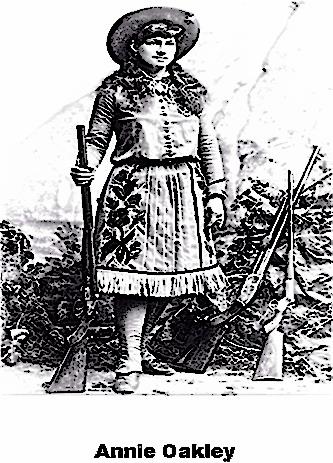
Annie Oakley – 1860 to 1926
356
O.K. Corral
Born as Phoebe Ann Oakley, Annie grew up hunting to feed her siblings. She made her first shot at 8, catching a squirrel in the head.
At 15, she met her husband by beating him in a marksmanship contest.
They often performed together, with her shooting cigars out of his mouth or splicing sideways cards with bullets. One of her nicknames was Watanya Cicilla.
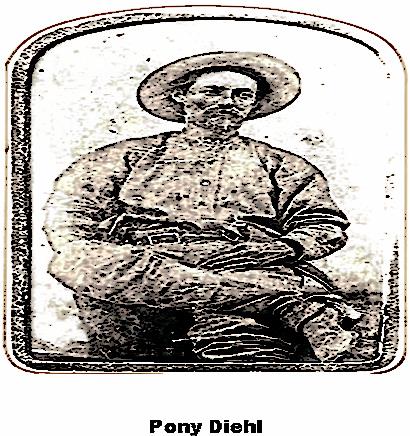
Pony Diehl – 1848 to 1888
357
O.K. Corral
If that name sounds Anglo-Saxon, it’s because it is. Charles Ray A/K/A Pony Diehl was born to German-Americans in Illinois. He was part of the Kinney and Evans gangs. The law saw him as a robber and rustler and he was arrested several times, serving time and escaping. There’s no official record of him after 1887, but he’s assumed to have died during an 1888 gunfight.
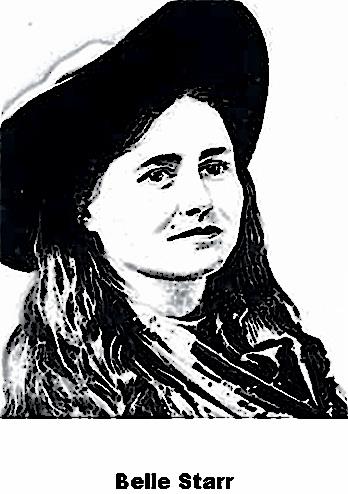
Belle Starr – 1848 to 1889
Women in the west could only become cowboys if their fathers, brothers, or husbands were involved. They were more likely to work in 358
O.K. Corral
brothels or as performative cowgirls at touring shows. But Myra Maybelle Shirley Reed Starr made herself a name as the Bandit Queen.
As part of the Younger Gang, she stole horses and was killed in a shootout that’s still unsolved.
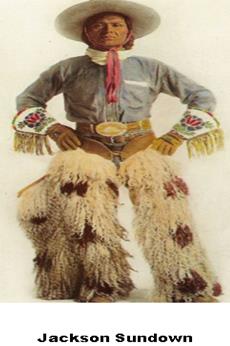
Jackson Sundown – 1863 to 1923
We often pit Cowboys against Indians, but the Old West had its share of Native American cowboys as well. Jackson, whose given name was Blanket of the Sun or Earth After Sunset, Waaya-Tonah-Toesits-Kahn, was a top rodeo pro. He was part of the Nez Perce community, under 359
O.K. Corral
Chief Joseph. They were known for their skills in horse wrangling and horse breeding.
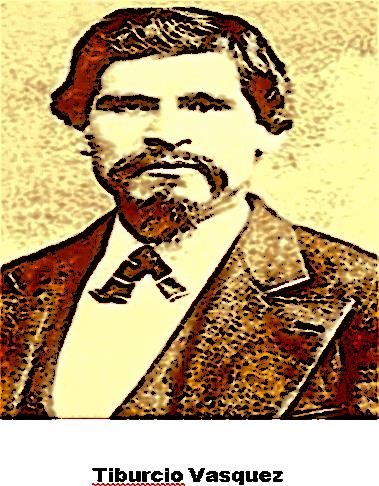
Tiburcio Vasquez – 1835 to 1875
Mexican cowboys were often known as vaqueros and were generally considered outlaws. Tiburcio is one of the most famous ones. He was born in California and was a key player in the Belcher-Roach feud.
Tiburcio, who was popular with the ladies, considered himself a Mexican-American activist and a forerunner of “modern” critical thought, blamed his crimes on discrimination and self-preservation.
360
O.K. Corral
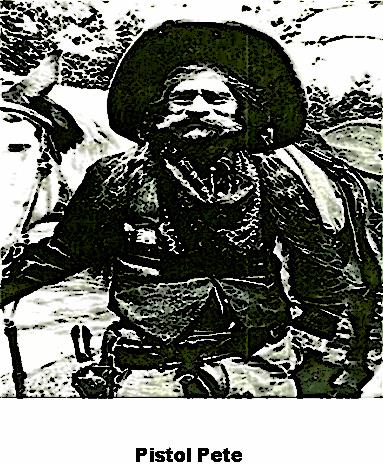
Pistol Pete – 1860 to 1958
This surprisingly popular nickname is shared by NBA stars and Disney characters. But the original Pistol Pete was Frank Eaton, who was a sheriff, a cowboy, and a military scout. He picked up the gun at age 8
when Regulators killed his abolitionist dad. Many of his legends were self-started, and he wrote at least two western themed books.
361
O.K. Corral
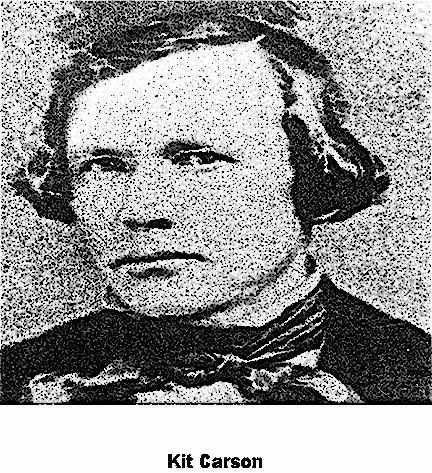
Kit Carson – 1809 to 1869
While many cowboys ended up as criminals, many stayed on the right side of the law. Christopher Carson was one of them. He went by Kit and worked as a trapper, guide, soldier, and Indian agent. He had two Native American wives but later led expeditions against native tribes.
He first became a cowboy by running away from home to join a Santa Fe caravan.
362
O.K. Corral
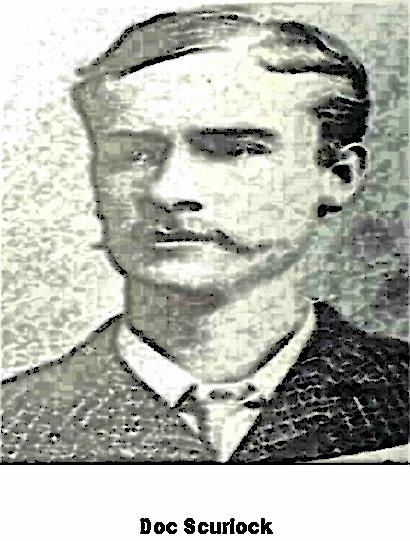
Doc Scurlock – 1849 to 1929
Some famous cowboys, like Doc, skillfully straddled the law. Born as Josiah Gordon Scurlock, he was first hired as a line rider, providing security from cattle rustlers. He later founded the Regulators, a vigilante posse that once broke Jesus Largo out of jail so they could 363
O.K. Corral
hang him. Doc served as a Deputy Sheriff and studied medicine, hence the nickname.
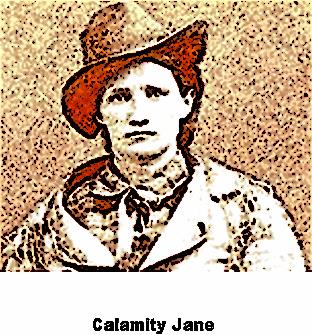
Calamity Jane – 1852 to 1903
Martha Jane Canary was known for several things. She was an expert shot, a daredevil, a masterful storyteller, a heavy drinker, and a compassionate caregiver who often wore men’s clothes. A lot of the stories about her are contested because she dictated them herself and 364
O.K. Corral
distributed pamphlets. Towards the end of her life, she bought a ranch and ran an inn.
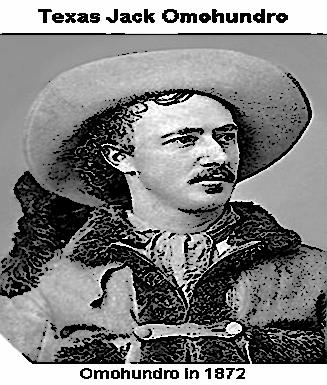
Texas Jack Omohundro – 1846 to 1880
While some cowboys transitioned into railroad jobs and postal work, others got work making westerns in Hollywood. John Omohundro was among the latter. He started out as a confederate soldier and civilian scout, earning the nickname “Boy Scout of the Confederacy.” He worked in cattle drives, fishing, and hunting trips before joining
“Buffalo Bill’s Wild West Show.”
365
O.K. Corral
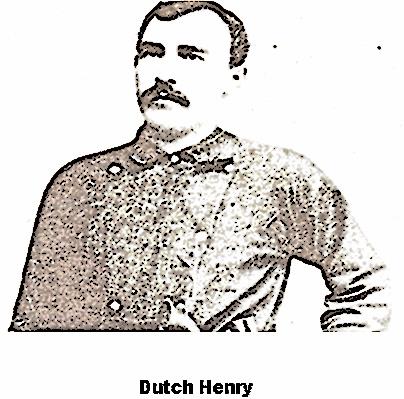
Dutch Henry – 1849 to 1921
When we discuss famous cowboys, we often focus on the line riders that protected cattle from rustlers. But those horse thieves were cowboys too, and Dutch Henry was among the most prolific. Officially named Henry Bourne, his parents were German immigrants. Dutch Henry’s first heist was 20 government mules, working his way up to over 300 stolen ponies.
366
O.K. Corral
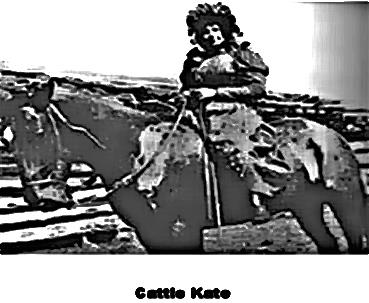
Cattle Kate – 1861 to 1889
Ellen Liddy Watson was known as Ella to her friends and Cattle Kate to her detractors. She was a homesteader and skilled with horses. Ella was born in Ontario, Canada, but migrated to the US with her first husband. She divorced him for being abusive and moved on. Jealous neighbors accused her of cattle rustling, lynching her and her second
“secret” husband.
367
O.K. Corral
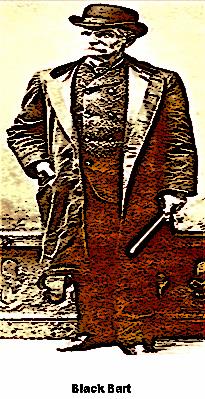
Black Bart – 1829 to 1888
Charles E. Boles, also known as Black Bart, was an American outlaw noted for the poetic messages he left behind after two of his robberies. Often called Charley by his friends, he was also known as Charles, or C.E. Bolton. Considered a gentleman bandit with a reputation for style and sophistication, he was one of the most notorious stagecoach robbers to operate in and around Northern California and southern Oregon during the 1870s and 1880s.
368
O.K. Corral
Frank James – 1843 to 1915
Alexander Franklin James, January 10th, 1843 – February 18th, 1915, was a Confederate soldier and guerrilla in the post-Civil War period.
Heroic to some, he was considered by some others to be an outlaw.
The older brother of outlaw Jesse James, Frank was also part of the James–Younger Gang.
James was born in Kearney, Missouri, to Baptist minister Reverend Robert Sallee James and his wife Zerelda (Cole) James. The couple 369
came from Kentucky. He was of English, Welsh and Scottish descent.
Frank was the oldest of three children. His father died in 1851 and his mother remarried Benjamin Simms in 1852. After his death, she married a third time to Dr. Reuben Samuel in 1855, when Frank was 13
years old. As a child, James showed interest in his late father's sizable library, especially the works of William Shakespeare. Census records show that James attended school regularly, and he reportedly wanted to become a teacher.
The American Civil War began in 1861, when James was eighteen years old. The secessionists in Missouri, including Governor Claiborne Fox Jackson, attempted to drive the Union army out of the state, but were eventually defeated. The James family was from the heavily Confederate western portion of the state. On September 13th, 1861, the Missouri State Guard, including private Frank James, besieged Lexington, Missouri. James fell ill and was left behind when the Confederate forces retreated. He surrendered to the Union troops, was paroled, and was allowed to return home. On his arrival, however, he was arrested by the local pro-Union militia and was forced to sign an oath of allegiance to the Union.
370
After the withdrawal of regular Confederate troops in the fall of 1861, a bitter guerrilla conflict soon began between bands of pro-Confederate irregulars, commonly known as bushwhackers, and the Union home guards. By early 1863, Frank, ignoring his parole and oath of allegiance, had joined the guerrilla band of Fernando Scott, a former saddler. He soon switched to the more active command led by William Clarke Quantrill.
Union militiamen searching for Fernando Scott raided the Samuel farm and hanged Dr. Reuben Samuel, Frank's stepfather, though not fatally, torturing him to reveal the location of the guerrillas. Shortly afterward, Frank took part with Quantrill's company in the August 21st, 1863
Lawrence Massacre where approximately 200 mostly unarmed civilians were killed.
Frank James was paroled for something undisclosed July 27th, 1865 in Nelson County, Kentucky. There is a report that after his parole, Frank was involved in a gunfight in Brandenburg, Kentucky with four soldiers that resulted in two soldiers killed, one wounded, and Frank wounded in the hip. However, there is an alternative account that claims in the 371
autumn of 1865, Frank, who was in Kentucky going to Missouri, was suspected of stealing horses in Ohio and that Frank shot two members of a posse and escaped.
During his years as a bandit, James was involved in at least four robberies between 1868 and 1876 that resulted in the deaths of bank employees or citizens. The most famous incident was the disastrous Northfield, Minnesota, raid on September 7th, 1876, that ended with the death or capture of most of the James-Younger gang.
Five months after the killing of his brother Jesse in 1882, Frank James boarded a train to Jefferson City, Missouri, where he had an appointment with the governor in the state capitol. Placing his holster in Governor Crittenden's hands, he explained; “I have been hunted for twenty-one years, have literally lived in the saddle, have never known a day of perfect peace. It was one long, anxious, inexorable, eternal vigil.” He then ended his statement by saying; “Governor, I haven't let another man touch my gun since 1861.” Accounts say that James surrendered with the understanding that he would not be extradited to Northfield, Minnesota.
372
He was tried for only two of the robberies/murders; one in Gallatin, Missouri, for the July 15th, 1881, robbery of the Rock Island Line train at Winston, Missouri, in which the train engineer and a passenger were killed, and the other in Huntsville, Alabama, for the March 11th, 1881, robbery of a United States Army Corps of Engineers payroll at Muscle Shoals, Alabama. Among others, former Confederate General Joseph Orville Shelby testified on James's behalf in the Missouri trial. He was acquitted in both Missouri and Alabama. Missouri accepted legal jurisdiction over him for other charges, but they never came to trial.
He was never extradited to Minnesota for his connection with the Northfield Raid.
His New York Times obituary summarized his arrest and acquittal; “In 1882 Frank James surrendered in Jefferson City, Missouri. After his surrender James was taken to Independence, Missouri, where he was held in jail three weeks, and later to Gallatin, where he remained in jail a year awaiting trial. Finally James was acquitted and went to Oklahoma to live with his mother. He never was in the penitentiary and never was convicted of any of the charges against him.”
373
In the last thirty years of his life, James worked a variety of jobs, including as a shoe salesman in Nevada, Missouri and then as a burlesque theater ticket taker in St. Louis. One of the theater's spins to attract patrons was their use of the phrase "Come get your ticket punched by the legendary Frank James." He also served as an AT&T
telegraph operator in St. Joseph, Missouri. James took up the lecture circuit, while residing in Sherman, Texas. In 1902, former Missourian Sam Hildreth, a leading thoroughbred horse trainer and owner, hired James as the betting commissioner at the Fair Grounds Race Track, in New Orleans. He returned to the North Texas area where he was a shoe salesman at Sanger Brothers in Dallas. “The Tacoma Times”
reported in July, 1914, that he was picking berries at a local ranch in Washington state, and planned to buy a farm nearby. He was also part of a Chicago investment group which purchased the Fletcher Terrell's
“Buckskin Bill's Wild West Show,” third in size after the Buffalo Bill and Pawnee Bill shows.
In his final years, James returned to the James Farm, giving tours for the sum of 25 cents. He died there at age 72 on February 18th, 1915.
He left behind his wife Annie Ralston James and one son. He is 374
interred in Hill Park Cemetery, in the western portion of Independence, Missouri.
Newman Haynes Clanton – 1816 to 1881
Newman Haynes Clanton, also known as "Old Man" Clanton, was a cattle rancher and father of four sons, one of whom was killed during the gunfight at the O.K. Corral. Two of his sons were involved in multiple conflicts in Cochise County, Arizona Territory including stagecoach robbery and cattle rustling. His son Ike Clanton was identified by one witness as a participant in the murder of Morgan Earp. Billy Clanton and Ike were both present at the gunfight at the O.K. Corral in which Billy was killed. "Old Man" Clanton was reportedly involved with stealing cattle from Mexican ranchers and re-selling them in the United States. Records indicate he participated in the Skeleton Canyon Massacre of Mexican smugglers. In retaliation, Mexican Rurales are reported to have ambushed and killed him and a crew of Cowboys.
“Indian Charlie” Cruz - ? to 1882
375
Florentino "Indian Charlie" Cruz was a Mexican outlaw of the Wild West and a member of the Cochise County Cowboys gang.
Florentino Cruz was born in Mexico, and he was a half-blooded Native American. He became a cattle rustler, stage robber, and outlaw with the Cochise County Cowboys gang, and he served as Curly Bill Brocius'
translator during the gang's raids into Mexico. Nicknamed "Indian Charlie," he took part in the ambushes of Virgil Earp and Morgan Earp, wounding the first and killing the second. During Wyatt Earp's
"Vendetta Ride," they tracked down Cruz as he was chopping wood, and he was shot between 10 and 12 times.
Buckskin Frank Leslie – 1842 to after 1920
Buckskin Franklyn Leslie was a US Army scout, gambler, bartender, rancher, miner, gunfighter, and con-man. He was known for his fringed buckskin jacket. He became famous in Tombstone, Arizona, for killing two men in self-defense. He married the widow of one of his victims eight days after killing her husband. Following their divorce, Leslie later shot and killed a woman he lived with at his ranch while drunk and in a fit of jealousy. He was sentenced to life in prison, but only 376
served six years before he was pardoned. He was last listed in the US
Federal Census on January 27th, 1920 in Sausalito, California. No public records of him have been found after this date and it is not known when he died.
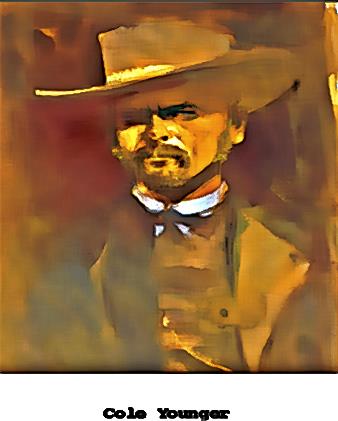
Cole Younger – 1844 to 1916
Thomas Coleman Younger was an American Confederate guerrilla during the American Civil War and later an outlaw leader with the James–Younger Gang. He was the elder brother of Jim, John and Bob Younger, who were also members of the gang.
Younger was born on the Younger family farm in Jackson County, Missouri. He was a son of Henry Washington Younger, a prosperous farmer from Greenwood, Missouri and Bersheba Leighton Fristoe, daughter of a prominent Jackson County farmer. Cole was the seventh of fourteen children.
377
O.K. Corral
During the American Civil War, savage guerrilla warfare wracked the state of Missouri. Younger's father was a Union supporter, but he was shot dead by a Union soldier from Kansas. After that, Cole Younger sought revenge as a pro-Confederate guerrilla or "bushwhacker" under William Clarke Quantrill. By 1862, the Confederate Army had been forced to withdraw from the state, and most of the fighting involved pro-Union and pro-Confederate partisans rather than regular armies.
However, the bushwhackers held a special hatred for the "red leg"
Union troops from Kansas who frequently entered Missouri and earned a reputation for ruthlessness. Younger rode with Quantrill in a 378
retaliatory raid on Lawrence, Kansas on August 21st, 1863, during which about 200 citizens were killed and the town looted and burned.
Younger later claimed to have eventually left the bushwhackers and enlisted in the Confederate Army. He claimed he was sent to California on a recruiting mission, and returned after the war's end to find Missouri ruled by a militant faction of Unionist Radicals. In the last days of the war, the Radicals had pushed through a new state constitution that barred all Confederate sympathizers from voting, serving on juries, holding public office, preaching the gospel, or carrying out other public roles. The constitution freed all slaves in Missouri in advance of the ratification of the 13th Amendment to the US Constitution. It enacted a number of reforms, and the restrictions on former Confederates created disunity.
Most of the former bushwhackers returned to peaceful lives. Many left Missouri for friendlier places, particularly Kentucky, where they had relatives. Most of their former leaders, including Quantrill and William
"Bloody Bill" Anderson, had been killed during the war. But a small core of Anderson's men, led by the ruthless Archie Clement, remained 379
together. State authorities believed that Clement planned and led the first daylight peacetime armed bank robbery in US history when he held up the Clay County Savings Association on February 13th, 1866.
The bank was run by the leading citizens of Clay County, who had just held a public meeting for their association. The governor posted a reward for Clement, but he and his band of outlaws conducted further robberies that year. On Election Day of 1866, Clement led his men to polling places in Lexington, Missouri, where they intimidated citizens and secured the election of a slate of candidates. A state militia unit entered the town shortly thereafter and killed Clement when he resisted arrest.
It is uncertain when the Younger brothers joined the Clement gang.
The first mention of their involvement came in 1868, when authorities identified Cole as a member of a gang that robbed Nimrod Long and Co., a bank in Russellville, Kentucky. Former guerrillas John Jarrett, Younger's brother-in-law, Arthur McCoy, and George and Oliver Shepard were also implicated. Oliver Shepard was killed resisting arrest and George was imprisoned. Once the more senior members of 380
the gang had been killed, captured, or quit, its core thereafter consisted of the Younger brothers and Frank and Jesse James.
Witnesses repeatedly gave identifications that matched Cole Younger in robberies carried out over the next few years, as the outlaws robbed banks and stagecoaches in Missouri and Kentucky. On July 21st, 1873, they turned to train robbery, derailing a locomotive and looting the express car on the Rock Island Railroad in Adair, Iowa. Younger and his brothers were also suspects in robberies in Missouri, Kentucky, Kansas, and West Virginia.
Following the robbery of the Iron Mountain Railroad at Gad's Hill, Missouri in 1874, the Pinkerton National Detective Agency began to pursue the James–Younger Gang. Two agents, Louis J. Lull and John Boyle, engaged John and Jim Younger in a gunfight on a Missouri road on March 17th, 1874. Lull and John Younger were killed and Boyle and Jim Younger fled the scene. Another Pinkerton agent who pursued the James brothers, W. J. Whicher, was abducted and later found dead alongside a rural road in Jackson County, Missouri.
381
Some Younger families changed their last names to Jungers to avoid a family association with the gangsters. The James and Younger brothers survived capture longer than most Western outlaws because of their strong support among former Confederates. Jesse James became the public face of the James–Younger Gang, appealing to the public in letters to the press.
On September 7th, 1876, the James–Younger Gang attempted to rob a bank in Northfield, Minnesota. Cole Younger and his brother Bob both later said that they selected the bank because of its connection to two former Union generals and radical politicians, Benjamin Butler, a Democrat, and Adelbert Ames, a Republican. Three of the outlaws entered the bank, as the remaining five, led by Cole Younger, remained on the street to provide cover. The crime soon went awry, however, when the townspeople sent up the alarm and ran for their guns.
Younger and his brothers began to fire in the air to clear the streets, but the townspeople, shooting from behind cover, through windows and around the corners of buildings, opened a deadly fusillade, killing gang members Clell Miller and William Chadwell and badly wounding 382
Bob Younger through the elbow. Herb Potter rode off in a hail of bullets.
The outlaws killed two townspeople, including the acting cashier of the bank, and fled empty handed. As hundreds of Minnesotans formed posses to pursue the fleeing gang, the outlaws separated. The James brothers made it back to Missouri, but the three Youngers; Cole, Bob, and Jim; did not. They and another gang member, Charlie Pitts, waged a gun battle with a local posse in a wooded ravine along the Watonwan River west of Madelia, Minnesota. Pitts was killed, and Cole, Jim, and Bob Younger were badly wounded and captured. Cole, asked about the robbery, responded; "We tried a desperate game and lost. But we are rough men used to rough ways, and we will abide by the consequences."
Cole, Jim and Bob pleaded guilty to their crimes to avoid being hanged. They were sentenced to life in prison at the Minnesota Territorial Prison at Stillwater on November 18th, 1876. Frank and Jesse James fled to Nashville, Tennessee, where they lived peacefully for the next three years. In 1879, Jesse returned to a life of crime, 383
which ended with his death on April 3rd, 1882, in Saint Joseph, Missouri. Frank James surrendered to Missouri Governor Thomas T.
Crittenden on October 4th, 1882. Eventually Frank James was acquitted, and lived quietly and peacefully thereafter.
Bob Younger died in Stillwater prison on September 16th, 1889, of tuberculosis. Cole and Jim were paroled on July 10th, 1901, with the help of the prison warden. Jim committed suicide in a hotel room in St.
Paul, Minnesota, on October 19th, 1902. Cole wrote a memoir that portrayed himself as a Confederate avenger more than an outlaw, admitting to only one crime, that at Northfield. He lectured and toured the south with Frank James in a Wild West show, “The Cole Younger and Frank James Wild West Company,” in 1903. On August 21st, 1912, Cole declared that he had become a Christian and repented of his criminal past. He was baptized at Lee’s Summit Christian Church on August 16th, 1913.
Frank James died February 18th, 1915. A year later, Cole Younger died, on March 21st, 1916, in his hometown of Lee's Summit, Missouri, and is buried in the Lee's Summit Historical Cemetery.
384
Harry “The Kid” Head - ? to 1881
Harry Head, known as Harry the Kid, was a cattle rustler and stagecoach robber. One of his better known robberies occurred outside Contention City, a boomtown in the Arizona Territory.
On March 15th, 1881, Head and three of his known Cowboy companions, Bill Leonard, Jim Crane, and Luther King, were set to rob a Wells Fargo stagecoach. The monetary gain, however, wasn't the only motive for robbing the stagecoach. Killing Bob Paul was reportedly a secondary objective. Paul had been sent out with the stagecoach to prevent robberies from occurring, riding shotgun. Two well-known local families during the time, the Clantons and the Earps, are rumored to have had an interest in trying to kill Paul.
The coach was carrying 26,000 dollars and eight passengers. Twelve miles from the stagecoach's final destination, Paul changed seats with the driver of the stagecoach, which temporarily brought the stagecoach to a halt. Shortly after the change of seats the stagecoach came to a part of the road that had a very steep grade. This was where Head and the others laid in ambush. In order to conceal their 385
identities, the stagecoach robbers wore wigs and false beards. Crane fired at the guard’s seat, which was where Paul should have been sitting, but the driver, Budd Philpot, was killed instead. Philpot fell forward into the horses pulling the stagecoach, causing them to charge forward. By this time Paul had drawn his weapon and had started to return fire, and he wounded Leonard. During the gunfight, a passenger named Pete Roerig was killed. Paul gained control of the stagecoach and brought the rest of the passengers to safety.
There was Cowboy talk that Doc Holliday was involved in the stagecoach robbery. He was at the time living in the nearby city of Tombstone and was known to visit the local hacienda where the suspects reportedly had camped a week before the attack. Holliday claimed that he had a sufficient alibi and that he was in no way involved in the robbery. But in July a warrant was sworn out for his arrest. Holliday was taken into custody and questioned but was later released on bond. Four days later his case was dismissed for insufficient evidence.
386
After the ambush on the Wells Fargo stagecoach, Paul and Wyatt Earp, started an investigation. They put a price on the heads of those that were involved in the ambush and set it at 2,000 dollars dead or alive.
Paul should have notified the local sheriff immediately after the incident occurred, however the sheriff at the time, Johnny Behan, was known to be a "friend of the Cowboy element." As the manhunt for the perpetrators of the Drew Station Stagecoach robbery continued, it was soon discovered that Head and several of his companions had managed to flee across the Mexican border.
The investigation initially resulted in the arrest of Luther King, who was held under suspicion of being one of the robbers. King went peaceably even though he had a Winchester, two six shooters, and twenty boxes of cartridges with him. He did, however, quickly escape from jail. Before escaping, King stated he had only been there to hold the horses, but had also revealed that his accomplices were Harry
"the Kid" Head, Billy Leonard, and Jim Crane.
Head and Leonard were able to elude capture for several months. After three months, however, they attempted a robbery at a store in Eureka, 387
New Mexico. The owners of the store, Bill and Ike Haslett, fought back and killed the two outlaws. Afterward, Crane, along with Curly Bill Brocius, Frank Stilwell, Pony Diehl, Pete Spence, and at least five other men, went to Eureka and hunted down the Haslett brother store owners.
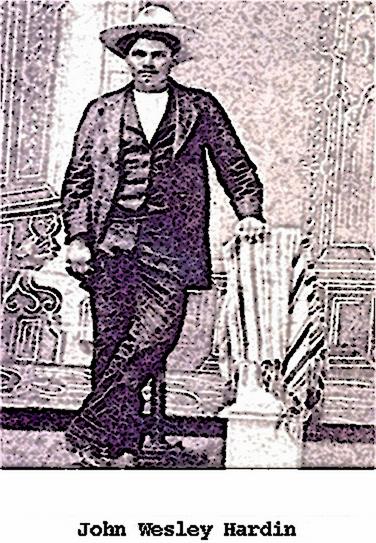
John Wesley Hardin – 1853 to 1895
John Wesley Hardin, May 26th, 1853 – August 19th, 1895, was an American Old West outlaw, gunfighter, and controversial folk icon.
Hardin often got into trouble with the law from an early age. He killed his first man at the age of 15, claiming he did so in self-defense.
388
O.K. Corral
Pursued by lawmen for most of his life, in 1877 at the age of 23, he was sentenced to 24 years in prison for murder. At the time of sentencing, Hardin claimed to have killed 42 men, while contemporary newspaper accounts attributed 27 deaths to him. While in prison, Hardin studied law and wrote an autobiography. He was well known 389
for exaggerating or fabricating stories about his life and claimed credit for many killings that cannot be corroborated.
Within a year of his 1894 release from prison, Hardin was killed by John Selman in an El Paso saloon.
Hardin was born near Bonham, Texas, to James "Gip" Hardin, a Methodist preacher and circuit rider, and Mary Elizabeth Dixson. He was named after John Wesley, the founder of the Methodist denomination of the Christian church.
In his autobiography, Hardin described his mother as "blond, highly cultured, while charity predominated in her disposition." Hardin's father traveled over much of central Texas on his preaching circuit until he settled his family in Sumpter, Trinity County, Texas, in 1859.
There, Hardin's father established and taught at the school that John Hardin and his siblings attended. Hardin was the second surviving son of ten children. The Hardins were Southerners and politically prominent. His great grandfather was North Carolina provincial Congressman Colonel Joseph Hardin the father of Congressman Martin D. Hardin of Kentucky and father of Congressman John J. Hardin; 390
relatives included Congressman Benjamin Hardin and Colonel John Hardin of Virginia.
In 1862, at age nine, Hardin tried to run away from home and join the Confederate army.
In 1867 while attending his father's school, Hardin was taunted by another student, Charles Sloter. Sloter accused Hardin of being the author of graffiti on the schoolhouse wall that insulted a girl in his class. Hardin denied writing the poetry, claiming in turn that Sloter was the author. Sloter charged at Hardin with a knife, but Hardin stabbed him with his own knife, almost killing him. Hardin was nearly expelled over the incident.
In November 1868, when he was 15, Hardin challenged his uncle Holshousen's former slave, Major "Maje" Holshousen, to a wrestling match, which Hardin won. According to Hardin, the following day, Maje
"ambushed" him as he rode past shouting at him and waving a stick.
Hardin drew his revolver and shot Maje five times. Hardin wrote in his autobiography that he rode to get help for the wounded man, but Maje died three days later. Hardin further wrote that his father did not 391
believe he would receive a fair hearing in the Union occupied state, where more than a third of the state police were former slaves, so he ordered him into hiding. Hardin claimed that the authorities eventually discovered his location, and three Union soldiers were sent to arrest him, at which time he "chose to confront his pursuers" despite having been warned of their approach by an older brother, Joseph. Hardin said; “I waylaid them, as I had no mercy on men whom I knew only wanted to get my body to torture and kill. It was war to the knife for me, and I brought it on by opening the fight with a double barreled shotgun and ended it with a cap and ball six shooter. Thus it was by the fall of 1868 I had killed four men and was myself wounded in the arm.” Hardin and confederate supportive locals hid the victims in the creek bed about one hundred yards from the ambush.
Hardin knew that he would be arrested if he returned home. As a fugitive, he initially traveled with outlaw Frank Polk in the Pisgah area of Navarro County, Texas. Polk had killed a man named Tom Brady, and a detachment of soldiers sent from Corsicana, Texas, were pursuing the duo. Hardin escaped, but the soldiers apprehended Polk and jailed him temporarily. Hardin also briefly taught school in Pisgah.
392
While there, he claimed he shot a man's eye out to win a bottle of whiskey in a bet. Hardin also claimed that he and his cousin, "Simp"
Dixon, encountered a group of soldiers and each killed a man.
Allegedly, Hardin killed a black man in Leon County, Texas. On January 5th, 1870, Hardin was playing cards with Benjamin Bradley in Towash, Hill County, Texas. Hardin was winning almost every hand, which angered Bradley, who threatened to cut out Hardin's liver if he won again. Bradley drew a knife and a six shooter. Hardin said he was unarmed and excused himself but claimed that later that night, Bradley came looking for him. Bradley allegedly fired a shot at Hardin and missed. Hardin drew both his pistols and returned fire, one shot striking Bradley in the head and the other in his chest. Dozens of people saw this fight, and from them there is a good record of how Hardin had used his guns. His holsters were sewn into his vest so that the butts of his pistols pointed inward across his chest. He crossed his arms to draw. Hardin claimed this was the fastest way to draw, and he practiced every day. A man called "Judge Moore," who held Hardin's stakes of money and a pistol, refused to give them up without 393
Bradley's consent and later "vanished." Hardin eventually admitted killing two men in Hill County.
After killing Bradley, Hardin claimed that when a posse of fifteen men came after him, he captured two of them and took a shotgun, two six shooters, a rifle, and two derringers from his captives. He then ordered the two men to join the other members of the posse at Jim Page's and wait for him to come along, stating; "I reckon they are waiting for me yet."
Later that month, on January 20th in Horn Hill, Limestone County, Texas, Hardin claimed he killed a man in a gunfight after an argument at the circus. Less than a week after this incident, in nearby Kosse, Texas, Hardin was accompanying a prostitute home when they were accosted by her pimp, who demanded money. Hardin threw money on the ground and shot the would be thief when he bent over to pick it up.
In January 1871, Hardin was arrested for the murder of Waco, Texas, city marshal Laban John Hoffman; however, he denied committing this crime. Following his arrest, he was held temporarily in a log jail in the town of Marshall, awaiting transfer to Waco for trial. While locked up, 394
he bought a revolver from another prisoner. Two Texas state policemen, Captain Edward T. Stakes and an officer named Jim Smalley, were assigned to escort Hardin to Waco for trial. According to Hardin, they tied him on a horse with no saddle for the trip. While making camp along the way, Hardin escaped when Stakes went to procure fodder for the horses. He claims he was left alone with Smalley, who began to taunt and beat the then 17 year old prisoner with the butt of a pistol. Hardin says he feigned crying and huddled against his pony's flank. Hidden by the animal, he pulled out the gun, fatally shot Smalley, and used his horse to escape. Hardin then claimed that while on the run he was "arrested" by three men named Smith, Jones, and Davis. But in Bell County, Texas, he killed all three with their own guns, after they became drunk and careless, and escaped again.
A Texas historical marker notes that in the 1870s, Hardin hid out in the vicinity of Pilgrim, Texas. After the Bell County shootings, Hardin found refuge with his cousins, the Clements, who were then living in Gonzales, in south Texas. They suggested he could make money by driving cattle to Kansas as a cowboy. Thinking he could get out of 395
Texas long enough for his pursuers to lose interest, Hardin worked with his cousins, rustling cattle for Jake Johnson and Columbus Carol.
Hardin wrote that he was made trail boss for the herd. In February 1871, while the herd was being collected for the drive to Kansas, a freed black man, Bob King, attempted to cut a beef cow out of the herd. When he refused to obey Hardin's demand to stop, Hardin hit him over the head with his pistol. That same month, Hardin may have wounded three Mexicans in an argument over a three card monte card game, pistol whipping one man over the head, shooting one man in the arm, and shooting the third man in the lung.
In the summer of 1871, while driving cattle on the Chisholm Trail to Abilene, Kansas, Hardin is reputed to have fought Mexican vaqueros and cattle rustlers. Towards the end of the drive, a Mexican herd crowded in behind Hardin's and there was some trouble keeping the two herds apart. Hardin exchanged words with the man in charge of the other herd; both men were on horseback. The Mexican fired his gun at Hardin, putting a hole through Hardin's hat. Hardin found that his own weapon, a worn out cap and ball pistol with a loose cylinder, would not fire. He dismounted and managed to discharge the gun by 396
steadying the cylinder with one hand and pulling the trigger with the other. He hit the Mexican in the thigh. A truce was declared, and both parties went their separate ways. However, Hardin borrowed a pistol from a friend and went looking for the Mexican, this time fatally shooting him through the head. A firefight between the rival camps ensued. Hardin claimed six vaqueros died in the exchanges, five of them reportedly shot by him. Hardin also claimed to have killed two Indians in separate gunfights on the same cattle drive. The first instance was when an Indian tried to shoot an arrow at him on the South Canadian River. Hardin shot him and then had the body buried to avoid retribution from the man's tribe. The second incident, at Bluff Creek, Kansas, occurred when Indians wanted to collect a "tax" on the cattle. Hardin hit an Indian over the head who he claimed had stolen a silver bridle from him. He then forced a war party to flee after he shot a second Indian who had killed a beef cow.
After arriving in Abilene, Hardin claimed that he and a companion named Pain got into an argument in a restaurant with an anti-Texan, which left Pain wounded in one arm and the stranger shot in the mouth by Hardin's bullet. Hardin fled Abilene to the Cottonwood Trail.
397
On July 4th, 1871, a Texas trail boss named William Cohron was killed on the Cottonwood Trail, forty miles south of Abilene, by an unnamed Mexican, who "fled south" and was subsequently killed by two cowboys in a Sumner County, Kansas restaurant on July 20th. Hardin admitted to being involved in the shooting of the Mexican.
The Bull's Head Tavern, in Abilene, Kansas, had been established as a partnership between ex-lawman Ben Thompson and gambler Phil Coe.
The two entrepreneurs had painted a picture of a bull with a large erect penis on the side of their establishment as an advertisement.
Citizens complained to town marshal "Wild Bill" Hickok. When Thompson and Coe refused his request to remove the bull, Hickok altered it himself. Infuriated, Thompson tried to incite his new acquaintance, Hardin, by exclaiming to him; "He's a damn Yankee.
Picks on rebels, especially Texans, to kill." Hardin, then under the assumed name "Wesley Clemmons," but better known to the townspeople by the alias "Little Arkansas," seemed to have had respect for Hickok, and replied; "If Bill needs killing why don't you kill him yourself?" Later that night, Hardin was confronted by Hickok, who told him that he was wearing guns in violation of town ordinance and 398
ordered him to hand over his guns, which he did but in a quite surprising way. Hardin reached down, picked his revolvers up from the holsters, and handed the guns to Wild Bill butts forward, then swiftly rolled them over in his hands and suddenly Wild Bill was staring right into their muzzles. However, both men did back down. Hickok had no admitted knowledge that Hardin was a wanted man, and he advised Hardin to avoid problems while in Abilene.
Hardin met up with Hickok again while on a cattle drive in August 1871. This time, Hickok allowed Hardin to carry his pistols into town; something he had never allowed others to do. For his part, Hardin, still using his alias, was fascinated by Wild Bill and reveled in being seen on intimate terms with such a celebrated gunfighter. Hardin alleged that when his cousin, Mannen Clements, was jailed for the killing of two cowhands, Joe and Dolph Shadden, in July 1871, Hickok, at Hardin's request, arranged for his escape.
Soon afterwards, on August 6th, 1871, Hardin, his cousin Gip Clements, and a rancher friend named Charles Couger put up for the night at the American House Hotel after an evening of gambling.
399
Clements and Hardin shared one room, with Couger in the adjacent room. All three had been drinking heavily. Sometime during the evening, Hardin was awakened by loud snoring coming from Couger's room. He first shouted several times for the man to "rollover" and then, irritated by the lack of response, drunkenly fired several bullets through the shared wall, in an apparent effort to awaken him. Couger was hit in the heart by one of the bullets as he lay in bed and was killed instantly. Although Hardin may not have intended to kill Couger, he had violated an ordinance prohibiting firing a gun within the city limits. Half-dressed and still drunk, he and Clements exited through a second story window onto the roof of the hotel. He saw Hickok arrive with four policemen. "Now, I believed," Hardin wrote, "that if Wild Bill found me in a defenseless condition he would take no explanation, but would kill me to add to his reputation."
A newspaper reported; "A man was killed in his bed at a hotel in Abilene, Monday night, by a desperado called 'Arkansas.' The murderer escaped. This was his sixth murder. Monday night," as reported by the newspaper, would have been August 7th, 1871, not August 6th. Hardin leapt from the roof into the street and hid in a haystack for the rest of 400
the night. He then stole a horse and rode to a cow camp thirty-five miles outside town. Hardin claimed he ambushed lawman Tom Carson and two other deputies there. According to Hardin, he did not kill them but forced them to remove all their clothing and walk back to Abilene.
The next day, Hardin left for Texas, never to return to Abilene.
The incident earned Hardin a reputation as a man "so mean, he once shot a man for snoring." Years later, Hardin made a casual reference to the episode; "They tell lots of lies about me," he complained. "They say I killed six or seven men for snoring. Well, it ain't true. I only killed one man for snoring.” Later, in his contradictory 1896 autobiography, Hardin completely omitted the "snoring man" from the story, and he related not only a wrong date, July 7th instead of August 6th, but claimed the shooting was a case of self-defense, saying that the man he killed had first tried to stab him with a dirk and was a burglar who tried to make off with his pants.
In September 1871, Hardin was involved in a gunfight with two Texas Special Policemen, two black freed men, privates Green Paramore and John Lackey, during which Paramore was killed and Lackey wounded.
401
In September 1871, a black posse from Austin, Texas, came after him for killing Paramore but said that they returned "sadder and wiser"
after he ambushed and killed three of them.
In May 1872, about forty-five miles outside Corpus Christi, Texas, after he was followed by two Mexicans, he shot one off his horse while the other "quit the fight."
On June 19th, 1872, Hardin was involved in a gunfight in Willis, Texas.
On July 26th, 1872, Hardin wounded Texas state policeman Sonny Speights in the arm with a derringer pistol, in Hemphill, Texas.
In early 1872, Hardin was in south central Texas, in the area around Gonzales County. It was about this time that Hardin married Jane Bowen and started to keep regular company with her brother, cattle rustler Robert Bowen. While in the area, he also renewed his acquaintance with some of his cousins who were allied with a local family, the Taylors, who had been feuding with the rival Sutton faction for several years.
402
On August 7th, 1872, Hardin was wounded by a shotgun blast in a gambling dispute at the Gates Saloon in Trinity, Texas. He was shot by Phil Sublett, who had lost money to him in a poker game. Two buckshot pellets penetrated Hardin's kidney and for a time it looked as if he would die.
While recuperating from his wounds, Hardin decided he wanted to settle down. After surrendering to Sheriff Reagan, brother of John Henninger Reagan, of Cherokee County, Texas, he was wounded in the right knee by an accidental gunshot from a nervous deputy. Hardin made a sick bed surrender to authorities, handing over his guns to Sheriff Reagan and asking to be tried for his past crimes in order "to clear the slate." However, when Hardin learned of how many murders Reagan was going to charge him with, he changed his mind. A relative smuggled a hacksaw to Hardin, who escaped after cutting through the bars of a prison window. In November 1872, Hardin escaped from the Gonzales County, Texas, jail despite a guard of six men. A $100 reward was offered for his arrest.
403
On May 15th, 1873, Jim Cox and Jake Christman were killed by the Taylor faction at Tumlinson Creek. Hardin, having by then recovered from the injuries sustained in Sublett's attack, admitted that there were reports that he had led the fights in which these men were killed but would neither confirm nor deny his involvement saying; " ... as I have never pleaded to that case, I will at this time have little to say."
Hardin's main notoriety in the Sutton–Taylor feud came from his part in the killing of two lawmen known to be Sutton family allies. On July 18th, 1873 in Cuero, Texas, Hardin killed DeWitt County Deputy Sheriff J.B. Morgan, who served under County Sheriff Jack Helm, a former captain in the Texas State Police and leader of the Sutton force at that time. Later that day, Hardin killed Helm in the town square of Albuquerque, Texas. On the run again in June 1873, Hardin assisted in the escape of his brother in law, Joshua Bowen, from the Gonzales County, Texas, jail where he was imprisoned on an 1872 murder charge. Allegedly, Hardin was also involved in this killing of Thomas Holderman.
404
On March 11th, 1874, the Sutton–Taylor feud intensified when Jim and Bill Taylor gunned down Billy Sutton and Gabriel Slaughter as they waited on a steamboat platform in Indianola, Texas. Tired of the feuding, the two were planning to leave the area for good. Hardin admitted that he and his brother Joseph had been involved, along with both Taylors in the killings.
After a brief visit to Florida, where he claimed to have been involved in three incidents against blacks, including a lynching, Hardin met with his wife, Jane, and their young daughter, with whom he had relocated under the assumed name "Swain." Hardin then met up with his "gang"
on May 26th, 1874, in a Comanche, Texas saloon to celebrate his 21st birthday. Hardin spotted Brown County Deputy Sheriff Charles Webb entering the premises. He asked Webb if he had come to arrest him.
When Webb replied he had not, Hardin invited him into the hotel for a drink. As Webb followed him inside, Hardin claimed Webb drew his gun. One of Hardin's men yelled out a warning, and in the ensuing gunfight, Webb was shot dead. It was reported at the time that Webb was shot as he was pulling out an arrest warrant for one of Hardin's 405
group. Two of Hardin's accomplices in the shooting were cousin Bud Dixon and Jim Taylor.
The death of the popular Webb resulted in the quick formation of a lynch mob. Hardin's parents and wife were taken into protective custody, while his brother Joe and two cousins, brothers Bud and Tom Dixon, were arrested on outstanding warrants. A group of local men broke into the jail in July 1874 and hanged Joe and the two Dixon boys. After this, Hardin and Jim Taylor parted ways for good. Hardin would claim that he twice drove away men connected to the feud who had come after him, killing a man in each encounter. On November 18th, 1875, the leader of the Suttons, ex-Cuero, Texas, town marshal Reuben Brown was shot and killed by five men in Cuero along with a black named Tom Freeman, with another black being wounded. In his autobiography, Hardin made only two references to Brown; that "Rube"
Brown had arrested William Taylor before sending him to Galveston, Texas, for trial, and that Brown had been among the leaders of a Sutton "posse" that had been out to "get" him in Gonzales County, Texas. It is not known if Hardin was directly or indirectly involved in 406
the killing of Reuben Brown, as he makes no further mention of the incident in his life story.
On January 20th, 1875, the Texas Legislature authorized Governor Richard B. Hubbard to offer a $4,000 reward for Hardin's arrest. An undercover Texas Ranger named Jack Duncan intercepted a letter sent to Hardin's father in law by Hardin's brother in law, Joshua Robert
"Brown" Bowen. The letter mentioned that Hardin was hiding out on the Alabama-Florida border using the name "James W. Swain." In his autobiography, Hardin admitted that he had "adopted" this alias from Brenham, Texas, Town Marshal Henry Swain, who had married a cousin of Hardin's named Molly Parks.
In March 1876, Hardin wounded a man, in Florida, who had tried to mediate a quarrel between him and another man. In November 1876, in Mobile, Alabama, Hardin was arrested briefly for having marked cards.
In mid-1877, two former slaves of his father's, "Jake" Menzel and Robert Borup tried to capture Hardin in Gainesville, Florida. Hardin killed one and blinded the other.
407
On August 24th, 1877, Rangers and local authorities confronted Hardin on a train in Pensacola, Florida. He attempted to draw a .44 Colt cap and ball pistol but it got caught up in his suspenders. The officers knocked Hardin unconscious. They arrested two of his companions, and Ranger John B. Armstrong killed a third, a man named Mann, who had a pistol in his hand. Hardin claimed that he was captured while smoking his pipe and that Duncan found Hardin's pistol under his shirt only after his arrest.
Hardin was tried for Webb's killing, and on June 5th, 1878, was sentenced to serve twenty-five years in Huntsville Prison. In 1879, Hardin and fifty other convicts were stopped within hours of successfully tunneling into the prison armory. Hardin made several attempts to escape. On February 14th, 1892, during his prison term, he was convicted of another manslaughter charge for the earlier shooting of J.B. Morgan and given a two year sentence to be served concurrently with his unexpired twenty-five year sentence.
Hardin eventually adapted to prison life. While there, he read theological books, becoming the superintendent of the prison Sunday 408
School, and studied law. He was plagued by recurring poor health, especially when the wound he had received from Sublett became reinfected in 1883, causing him to be bedridden for almost two years. In 1892, Hardin was described as 5 feet 9 inches tall and 160 pounds, with a fair complexion, hazel eyes, dark hair, and wound scars on his right knee, left thigh, right side, hip, elbow, shoulder, and back. On November 6th, 1892, during Hardin's stay in prison, his first wife, Jane, died.
While in prison, he wrote an autobiography. He was well known for wildly exaggerating, or completely making up, stories about his life.
He claimed credit for many murders that cannot be corroborated nor refuted. Hardin wrote that he was first exposed to violence in 1861
when he saw a man named Turner Evans stabbed by John Ruff. Evans died of his injuries and Ruff was jailed. Hardin wrote; "Readers you see what drink and passion will do. If you wish to be successful in life, be temperate and control your passions. If you don't, ruin and death is the result."
409
On February 17th, 1894, Hardin was released from prison, having served seventeen years of his twenty-five-year sentence. He was forty years old when he returned to Gonzales, Texas. Later that year, on March 16th, Hardin was pardoned, and, on July 21st, he passed the state's bar examination, obtaining his license to practice law.
According to a newspaper article in 1900, shortly after being released from prison, Hardin committed negligent homicide when he made a $5
bet that he could "at the first shot" knock a Mexican man off the soapbox on which the man was "sunning" himself, winning the bet and leaving the man dead from the fall and not the gunshot.
On January 9th, 1895, Hardin married a 15 year old girl named Callie Lewis. The marriage ended quickly, although it was never legally dissolved. Afterward, Hardin moved to El Paso, Texas.
An El Paso lawman, John Selman Jr., arrested Hardin's acquaintance and part time prostitute, the "widow" M'Rose, or Mroz, for "brandishing a gun in public." Hardin confronted Selman and the two men argued.
Some accounts state that Hardin pistol whipped the younger man.
Selman's fifty-six year old father, Constable John Selman Sr., himself a 410
notorious gunman and former outlaw, approached Hardin on the afternoon of August 19th, 1895, and the two men exchanged heated words.
That night, Hardin went to the Acme Saloon where he began playing dice. His last words were; "Four Sixes to Beat." Shortly before midnight, Selman Sr. entered the saloon, walked up to Hardin from behind, and shot him in the head, killing him instantly. As Hardin lay on the floor, Selman fired three more shots into him. Hardin was buried the following day in Concordia Cemetery, in El Paso.
Selman Sr. was arrested for murder and stood trial. He claimed self-defense, stating that he witnessed Hardin attempting to draw his pistol upon seeing him enter the saloon, and a hung jury resulted in his being released on bond, pending a retrial. However, before the retrial could be organized Selman was killed in a shootout with US Marshal George Scarborough on April 6th, 1896, during an argument following a card game.
A century later, on August 27, 1995, there was a confrontation between two groups at the site of Hardin's grave. One group, 411
representing several of Hardin's great grandchildren, sought to relocate his body to Nixon, Texas, to be interred next to the grave of his first wife, Jane. The other group, consisting of locals from El Paso, sought to prevent the move. At the cemetery, the group representing Hardin's descendants presented a disinterment permit for the body, while the El Pasoans presented a court order prohibiting its removal.
Both sides accused the other parties of seeking the tourist revenue generated by the location of the body. A subsequent lawsuit ruled in favor of keeping the body in El Paso.
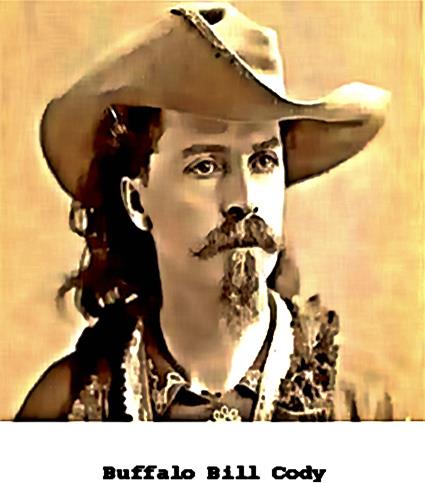
Buffalo Bill Cody – 1846 to 1917
William Frederick Cody, February 26th, 1846 – January 10th, 1917, known as "Buffalo Bill," was an American soldier, bison hunter, and showman. He was born in Le Claire, Iowa Territory, now the US state of Iowa, but he lived for several years in his father's hometown in modern day Mississauga, Ontario, Canada, before the family returned to the Midwest and settled in the Kansas Territory.
Buffalo Bill started working at the age of eleven, after his father's death, and became a rider for the Pony Express at age 15. During the 412
O.K. Corral
American Civil War, he served the Union from 1863 to the end of the war in 1865. Later he served as a civilian scout for the US Army during the Indian Wars, receiving the Medal of Honor in 1872.
One of the most famous and well known figures of the American Old West, Buffalo Bill's legend began to spread when he was only 23.
Shortly thereafter he started performing in shows that displayed cowboy themes and episodes from the frontier and Indian Wars. He founded “Buffalo Bill's Wild West” in 1883, taking his large company on 413
tours in the United States and, beginning in 1887, in Great Britain and continental Europe.
Cody was born on a farm just outside Le Claire, Iowa. His father, Isaac Cody, was born on September 5th, 1811, in Toronto Township, Upper Canada, now part of Mississauga, Ontario, directly west of Toronto.
Mary Ann Bonsell Laycock, Bill's mother, was born about 1817 in Trenton, New Jersey. She moved to Cincinnati to teach school, and there she met and married Isaac. She was a descendant of Josiah Bunting, a Quaker who had settled in Pennsylvania. There is no evidence to indicate Buffalo Bill was raised as a Quaker. In 1847 the couple moved to Ontario, having their son baptized in 1847, as William Cody, at the Dixie Union Chapel in Peel County, present day Peel Region, of which Mississauga is a part, not far from the farm of his father's family. The chapel was built with Cody money, and the land was donated by Philip Cody of Toronto Township. They lived in Ontario for several years.
In 1853, Isaac Cody sold his land in rural Scott County, Iowa, for $2000
and the family moved to Fort Leavenworth, Kansas Territory. In the 414
years before the Civil War, Kansas was overtaken by political and physical conflict over the slavery question. Isaac Cody was against slavery. He was invited to speak at Rively's store, a local trading post where pro-slavery men often held meetings. His anti-slavery speech so angered the crowd that they threatened to kill him if he did not step down. A man jumped up and stabbed him twice with a Bowie knife.
Rively, the store's owner, rushed Cody to get treatment, but he never fully recovered from his injuries.
In Kansas, the family was frequently persecuted by pro-slavery supporters. Cody's father spent time away from home for his safety.
His enemies learned of a planned visit to his family and plotted to kill him on the way. Bill, despite his youth and being ill at the time, rode thirty miles to warn his father. Isaac Cody went to Cleveland, Ohio, to organize a group of thirty families to bring back to Kansas, to add to the anti-slavery population. During his return trip, he caught a respiratory infection which, compounded by the lingering effects of his stabbing and complications from kidney disease, led to his death in April 1857.
415
After his death, the family suffered financially. At age 11, Bill took a job with a freight carrier as a "boy extra.” On horseback he would ride up and down the length of a wagon train and deliver messages between the drivers and workmen. Next, he joined Johnston's Army as an unofficial member of the scouts assigned to guide the United States Army to Utah, to put down a rumored rebellion by the Mormon population of Salt Lake City.
According to Cody's account in “Buffalo Bill's Own Story,” the Utah War was where he began his career as an "Indian fighter." “Presently the moon rose, dead ahead of me; and painted boldly across its face was the figure of an Indian. He wore this war bonnet of the Sioux, and at his shoulder was a rifle pointed at someone in the river bottom 30
feet below. In another second he would drop one of my friends. I raised my old muzzle loader and fired. The figure collapsed, tumbled down the bank and landed with a splash in the water. ‘What is it?’ called McCarthy, as he hurried back. ‘It's over there in the water.’ ‘Hi!’ he cried. ‘Little Billy's killed an Indian all by himself!’ So began my career as an Indian fighter.”
416
At the age of 14, in 1860, Cody was caught up in the "gold fever," with news of gold at Fort Colville and the Holcomb Valley Gold Rush in California. On his way to the goldfields, however, he met an agent for the Pony Express. He signed with them, and after building several stations and corrals, Cody was given a job as a rider. He worked at this until he was called home to his sick mother's bedside.
Cody claimed to have had many jobs, including trapper, bullwhacker,
"Fifty-Niner" in Colorado, Pony Express rider in 1860, wagon master, stagecoach driver, and a hotel manager, but historians have had difficulty documenting them. He may have fabricated some for publicity. Namely, it is argued that in contrast to Cody's claims, he never rode for the Pony Express, but as a boy, he did work for its parent company, the transport firm of Russell, Majors, and Waddell. In contrast to the adventurous rides, hundreds of miles long, that he recounted in the press, his real job was to carry messages on horseback from the firm's office in Leavenworth to the telegraph station three miles away.
417
After his mother recovered, Cody wanted to enlist as a soldier in the Union Army during the American Civil War but was refused because of his young age. He began working with a freight caravan that delivered supplies to Fort Laramie in present day Wyoming. In 1863, at age 17, he enlisted as a teamster with the rank of private in Company H, 7th Kansas Cavalry, and served until discharged in 1865.
The next year, Cody married Louisa Frederici. They had four children.
Two died young, while the family was living in Rochester, New York.
They and a third child are buried in Mount Hope Cemetery, in Rochester.
In 1866, he reunited with his old friend Wild Bill Hickok in Junction City, Kansas, then serving as a scout. Cody enlisted as a scout himself at Fort Ellsworth and scouted between there and Fort Fletcher, later renamed and moved to Fort Hays. He was attached as a scout, variously, to Captain George Augustus Armes and was at the Battle of the Saline River, and Lieutenant Colonel George Armstrong Custer as a guide and impromptu horse racer to Fort Larned. It was during this 418
service at Fort Elsworth that he met William Rose, with whom he would found the short lived settlement of Rome.
In 1867, with the construction of the Kansas Pacific Railway completing through Hays City and Rome, Cody was granted a leave of absence to hunt buffalo to supply railroad construction workers with meat. This endeavor continued into 1868, which saw his hunting contest with William Comstock.
Cody returned to Army service in 1868. From his post in Fort Larned, he performed an exceptional feat of riding as a lone dispatch courier from Fort Larned to Fort Zarah, escaping brief capture, Fort Zarah to Fort Hays, Fort Hays to Fort Dodge, Fort Dodge to Fort Larned, and, finally, Fort Larned to Fort Hays, a total of 350 miles in 58 hours through hostile territory, covering the last 35 miles on foot. In response, General Philip Sheridan assigned him Chief of Scouts for the 5th Cavalry Regiment.
He was also Chief of Scouts for the Third Cavalry in later campaigns of the Plains Wars.
419
In January 1872, Cody was a scout for the highly publicized hunting expedition of the Grand Duke Alexei Alexandrovich of Russia.
In 1872, Cody was awarded the Medal of Honor for service as a civilian scout to the 3rd Cavalry Regiment, for "gallantry in action" at Loupe Forke, Platte River, Nebraska. In 1917, after Congress revised the standards for the award, the US Army removed from the rolls 911
medals previously awarded to civilians or for actions that would not warrant a Medal of Honor under the new higher standards. Cody's medal was among those revoked. In 1977, Congress began reviewing numerous cases; and it reinstated the medals for Cody and four other civilian scouts on June 12th, 1989.
Cody received the nickname "Buffalo Bill" after the American Civil War, when he had a contract to supply Kansas Pacific Railroad workers with buffalo (American bison) meat. Cody is purported to have killed 4,282 buffalo in eighteen months in 1867 and 1868. Cody and another hunter, Bill Comstock, competed in an eight hour buffalo shooting match over the exclusive right to use the name, which Cody won by killing 68 animals to Comstock's 48. Comstock, part Cheyenne 420
and a noted hunter, scout, and interpreter, used a fast shooting Henry repeating rifle, while Cody competed with a larger caliber Springfield Model 1866, which he called Lucretia Borgia, after the notorious Italian noblewoman, the subject of a popular contemporary Gaetano Donizetti opera “Lucrezia Borgia,” based on Victor Hugo's play of the same name. Cody explained that while his formidable opponent, Comstock, chased after his buffalo, engaging from the rear of the herd and leaving a trail of killed buffalo "scattered over a distance of three miles," he, likening his strategy to a billiards player "nursing" his billiard balls during "a big run," first rode his horse to the front of the herd to target the leaders, forcing the followers to one side, eventually causing them to circle and create an easy target, and dropping them close together.
In 1869, the 23 year old Cody met Ned Buntline, who later published a story based on Cody's adventures, largely invented by the writer, in
“Street and Smith's New York Weekly” and then published a highly successful novel, “Buffalo Bill, King of the Bordermen,” which was first serialized on the front page of the “Chicago Tribune,” beginning that December 15th. Many other sequels followed by Buntline, Prentiss 421
Ingraham and others from the 1870s through the early part of the twentieth century. Cody later became world famous for “Buffalo Bill's Wild West,” a touring show which traveled around the United States, Great Britain, and Continental Europe. Audiences were enthusiastic about seeing a piece of the American West. Emilio Salgari, a noted Italian writer of adventure stories, met Buffalo Bill when he came to Italy and saw his show. Salgari later featured Cody as a hero in some of his novels.
In December 1872, Cody traveled to Chicago to make his stage debut with his friend Texas Jack Omohundro in “The Scouts of the Prairie,”
one of the original Wild West shows produced by Ned Buntline. The effort was panned by critics. One critic compared Cody's acting to a
"diffident schoolboy," but the handsome performer was a hit with the sold out crowds.
In 1873, Cody invited "Wild Bill" Hickok to join the group in a new play called “Scouts of the Plains.” Hickok did not enjoy acting and often hid behind scenery. In one show, he shot at the spotlight when it focused on him. Therefore, he was released from the group after a few months.
422