

O.K. Corral by Edward Drobinski - HTML preview
Download the book in PDF, ePub, Kindle for a complete version.
stagecoach, but he found two established stage lines already running.
He later said that he made most of his money in Tombstone as a professional gambler. The three Earps and Robert J. Winders filed a location notice on December 6th, 1879, for the First North Extension of the Mountain Maid Mine. They also bought an interest in the Vizina mine and some water rights.
Jim worked as a barkeep, but none of their other business interests proved fruitful. Wyatt was hired in April or May 1880 by Wells Fargo agent Fred J. Dodge as a shotgun messenger on stagecoaches when they transported Wells Fargo strongboxes.
247
In late July 1880, younger brother Morgan arrived, leaving his wife Lou in Temescal, California, near San Bernardino. Warren Earp moved to Tombstone. Doc Holliday arrived from Prescott in September flush with $40,000 in gambling winnings in his pocket.
On July 25th, 1880, Army Captain Joseph H. Hurst asked Deputy US
Marshal Virgil Earp to assist him in tracking outlaw Cowboys who had stolen six Army mules from Fort Rucker, Arizona. Virgil requested the assistance of his brothers Wyatt and Morgan, along with Wells Fargo agent Marshall Williams, and they found the mules at the McLaurys'
ranch. McLaury was a Cowboy, a term which was generally used in that region to refer to a loose association of outlaws, some of whom also were landowners and ranchers. Legitimate cowmen were referred to as cattle herders or ranchers. They found a branding iron which the Cowboys had used to change the "US" brand into "D.8." Stealing the mules was a federal offense because the animals were government property.
Cowboy Frank Patterson made an agreement with Captain Hurst, and Hurst persuaded the posse to withdraw with the understanding that 248
the mules would be returned. The Cowboys showed up two days later without the mules and laughed at Hurst and the Earps. In response, Hurst printed a handbill describing the theft, and he charged McLaury with hiding the mules. He also reproduced the handbill in “The Tombstone Epitaph” on July 30th, 1880. McLaury angrily printed a response in the Cowboy-friendly “Tombstone Nugget,” calling Hurst
"unmanly", "a coward, a vagabond, a rascal, and a malicious liar," and accusing him of stealing the mules himself. Hurst later cautioned the Earp brothers that the Cowboys had threatened their lives. Virgil reported that McLaury accosted him and said; "If you ever again follow us as close as you did, then you will have to fight anyway." A month later, Earp ran into Frank and Tom McLaury in Charleston, and they told him that they would kill him if he ever followed them as he had done before.
County Sheriff Charles A. Shibell appointed Virgil Earp as deputy sheriff for the eastern part of Pima County, Arizona, on July 28th, 1880, which included Tombstone. The sheriff's position was worth more than $40,000 per year, because he was also county assessor and tax collector, and the board of supervisors allowed him to keep 10% of the 249
amounts paid. Wyatt, appointed a deputy by his brother, then passed his Wells Fargo job as shotgun messenger to his brother Morgan. Wyatt did his job well, and his name was mentioned nearly every week from August through November in “The Tombstone Epitaph” or the
“Tombstone Nugget” newspapers.
On October 28th, 1880, Tombstone town marshal Fred White attempted to break up a group of five late night, drunken revelers shooting at the moon on Allen Street. Deputy Sheriff Earp was in Owens Saloon a block away, though unarmed. Morgan and Fred Dodge were in a cabin nearby. Wyatt heard the shooting and ran to the scene.
He borrowed a pistol from Fred Dodge and went to assist White. As he approached White, he saw White attempt to disarm Curly Bill Brocius and the gun discharged, striking White in the groin. Throughout the shooting Earp was standing by a chimney that was struck repeatedly by gunfire. He buffaloed Brocius, knocking him to the ground, then he grabbed Brocius by the collar and told him to get up. Brocius asked,
"What have I done?" Fred Dodge recalled in a letter he wrote to Stuart Lake in 1928 what he had witnessed; “Wyatt's coolness and nerve never showed to better advantage than they did that night. When Morg 250
and I reached him, Wyatt was squatted on his heels beside Curly Bill and Fred White. Curly Bill's friends were pot shooting at him in the dark. The shooting was lively and slugs were hitting the chimney and cabin. In all of that racket, Wyatt's voice was even and quiet as usual.”
Earp altered his story later on, telling John H. Flood Jr. that he did not see Brocius's pistol on the ground in the dark until afterward. The pistol contained one expended cartridge and five live rounds.
Brocius waived a preliminary hearing so that his case could be transferred to Tucson District Court, and Virgil and Wyatt escorted him to Tucson to stand trial, possibly saving him from a lynching. White, age 31, unexpectedly died of his wound two days after his shooting.
On December 27th, 1880, Earp testified that White's shooting was accidental. Brocius expressed regret, saying that he had not intended to shoot White. Gunsmith Jacob Gruber testified that Brocius's single action revolver was defective, allowing it to be discharged at half cock. A statement was introduced which White had made, stating that the shooting was accidental. The judge ruled that the shooting was accidental and released Brocius. Brocius, however, remained intensely 251
angry about how Earp had pistol whipped him, and he became an enemy to the Earps.
On November 2nd, 1880, the Democratic incumbent Charles Shibell ran for re-election as county sheriff against Republican challenger Robert H. Paul. Initially, Shibell was declared the winner by a margin of 58
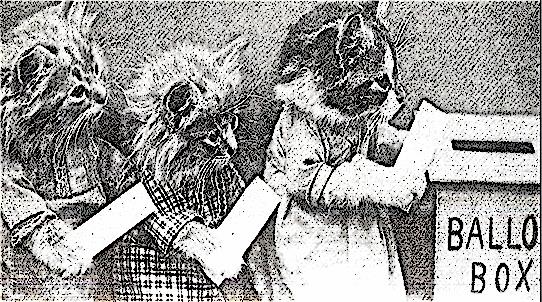
votes under suspicious circumstances. James C. Hancock reported that Cowboys Curly Bill Brocius and Johnny Ringo had served as election officials in San Simon Precinct, although biographer David Johnson places Ringo in New Mexico with Ike Clanton on November 1st, the day before the election. Curly Bill had been arrested and jailed in Tucson on October 28th for shooting Marshal White, and he was still there on election day. The home of John Magill was used as the polling place. The precinct only contained about 10 - 50 eligible voters, but the Cowboys gathered non-voters such as the children and Chinese and had them cast ballots. They then gave names to all the dogs, cats, donkeys, and poultry and cast ballots in their names for Democrat Shibell. Precinct 27 in the San Simon Valley in northern Cochise County, turned out 104 votes, 103 of them for Shibell. The election board met on November 14th and declared Shibell the winner.
252
O.K. Corral
Paul filed a lawsuit on November 19th contesting the election results, alleging that Shibell's Cowboy supporters Ike Clanton, Curly Bill Brocius, and Frank McLaury had conspired in ballot stuffing. In late January 1881, Chief Justice of Arizona C. G. W. French ruled in Paul's favor, but Shibell appealed. A recount found that Paul had 402 votes and Shibell had 354. In April 1881 the election commission found that a mysterious "Henry Johnson" was responsible for certifying the ballots. This turned out to be the same James K. Johnson who had been shooting up Allen Street the night when Marshal White was killed. Moreover, he had testified at Curly Bill's preliminary hearing after he shot Fred White. Johnson later testified in the election hearing 253
and said that the ballots had been left in the care of Ike Clanton's brother Phineas. None of the witnesses during the election hearing reported on ballots being cast by dogs.
Paul was declared the winner of the Pima County sheriff election.
However, the election was a moot point by then, as Paul could not replace Behan with Earp because Cochise County was created out of the eastern portion of Pima County on January 1st, 1881.
Earp served as deputy sheriff for eastern Pima County for only three months. The region was strongly Republican and Bob Paul had been expected to defeat Shibell. Earp was a Republican and believed that he would continue in the job. Given how fast eastern Pima County was growing, many expected that it would be split off into its own county soon with Tombstone as its seat, and Earp hoped to win the job as the new county's sheriff and continue receiving the 10% of all tax money collected. Southern Pacific was the major landholder, so tax collection was a relatively easy process. In 1882, the Cochise County sheriff earned $24,010.52 in fees.
254
Earp resigned from the sheriff's office on November 9th, 1880, and Shibell immediately appointed Johnny Behan as the new deputy sheriff for eastern Pima County. Behan had considerably more political experience than Earp, as he had served as Yavapai County sheriff from 1871 to 1873. He had been elected to the Arizona Territorial Legislature twice, representing Yavapai Country in the 7th Territorial Legislature in 1873 and Mohave County in the 10th in 1879. Behan moved to the northwest Arizona Territory, where he served as the Mohave County recorder in 1877 and then deputy sheriff of Mohave County at Gillet in 1879.
Earp and Behan applied for the new position of Cochise County sheriff, which paid the office holder 10% of the fees and taxes collected, as did the Pima County sheriff job. Earp thought that he had a good chance to win because he was the former undersheriff in the region and a Republican, like Arizona Territorial Governor John C. Fremont.
However, Behan had greater political experience and influence in Prescott.
255
Earp later testified at the O.K. Corral hearing that he and Behan had made a deal. He said that Behan and he agreed that, if Earp withdrew his application, Behan would appoint him as undersheriff. Behan received the appointment in February 1881, but he did not keep his end of the bargain and instead chose Harry Woods as undersheriff, who was a prominent Democrat. Behan testified at first that he had not made any deal with Earp, although he later admitted that he had lied. He said that he broke his promise to Earp because of an incident which occurred shortly before his appointment when Earp learned that Ike and Billy Clanton had one of his prize horses which had been stolen more than a year before. Earp and Holliday rode to the Clanton ranch near Charleston to recover the horse and overtook Behan along the way, who was riding in a wagon. Behan also was heading to the ranch to serve an electioneering subpoena on Ike Clanton. Accounts differ as to what happened next, but Earp testified that Billy Clanton gave up the horse when Earp arrived at the ranch, even before being presented with ownership papers. According to Behan's testimony, however, Earp had told the Clantons that Behan was on his way to arrest them for horse theft. The incident embarrassed the Clantons 256
and Behan, and Behan later testified that he did not want to work with Earp and chose Woods instead.
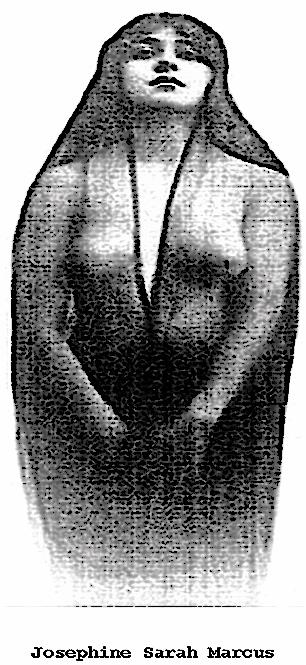
Later in life, Josephine Sarah Marcus aggressively protected hers and Wyatt's history while in Tombstone. Marcus was deliberately vague about this period, causing modern researchers to question what she was hiding. She said that she first visited Tombstone as part of the Pauline Markham Theater Troupe on December 1st, 1879, for a one week engagement. But modern researchers have not found any record that she was ever part of the theater company. The many contradictions in her story have led to considerable speculation about her past.
257
O.K. Corral
Researchers have identified two women with similar names in the same region of the Arizona Territory whose lives bear many striking parallels. Sadie Mansfield and Sadie Marcus both made a stagecoach journey from San Francisco to Prescott, Arizona Territory; both traveled with a black woman named Julia; both were sexual partners with Behan; both were nineteen years old, born in New York City, and had parents from Prussia. The only difference noted in the 1880
258
census is in their occupations. The Sadie who lived in San Francisco is listed as "At home," while the Sadie in Tip Top is recorded as a
"Courtesan." Josephine said that her parents hid her activities, and they may have been covering for her when the census taker was a neighbor who knew the family.
Behan owned a saloon in Tip Top, Arizona, where he maintained a prostitute named Sadie Mansfield, and he moved to Tombstone in September 1880. "Sadie" was a popular nickname for "Sarah", and prostitutes commonly changed their first names. Sadie Mansfield, the Tip Top prostitute, may have returned to San Francisco and then rejoined Behan in Tombstone in September 1880 as Sadie Marcus, where they continued their relationship.
In early 1881, Sadie found Behan in bed with the wife of a friend and kicked him out, although she still used the Behan surname through mid-year. Wyatt was in a relationship with Mattie Blaylock, a former prostitute. Earp named a mining claim he filed on February 16th, 1880
"Mattie Blaylock." Modern researchers have found Blaylock listed as Earp's wife in the June 1880 census. She suffered from severe 259
headaches and became addicted to laudanum, a commonly used opiate and painkiller, and later committed suicide. When Marcus learned that Stuart Lake had discovered the existence of Blaylock, she successfully demanded that he omit her from his book “I Married Wyatt Earp.”
After Marcus arrived in Tombstone with Behan, Earp apparently developed an interest in her, although there are no records in Tombstone of a relationship between them. Tombstone diarist George W. Parsons never mentioned seeing Wyatt and Sadie together and neither did John Clum in his memoirs. But Earp and Marcus certainly knew each other, as both Behan and Earp had offices above the Crystal Palace Saloon.
In April 1882, shortly after he left Tombstone, there is evidence that Earp had developed feelings for Marcus. The Earp posse, by that time on their vendetta ride, arrived in Albuquerque, New Mexico, intending to stay for two weeks. Wyatt and Holliday had been fast friends since Holliday saved Earp's life in Dodge City three years prior. Wyatt was staying with prominent businessman Henry N. Jaffa, who was also 260
president of the local board of trade. Like Marcus, Jaffa was Jewish.
During their stay in Albuquerque, Earp and Holliday ate at the Retreat Restaurant owned by "Fat Charlie." Former New Mexico Territory Governor Miguel Otero wrote in 1940 that; "Holliday said something about Earp becoming 'a damn Jew-boy.' Earp became angry and left.
Henry Jaffa told me later that Earp's woman was a Jewess. Earp did mezuzah when entering the house." “The Albuquerque Evening Review” reported that Doc Holliday "became intoxicated and indiscreet in his remarks, which offended Wyatt and cause the party to break up; Holliday going with Tipton." Holliday told Wallace that; “The best humor is always borderline. I had no idea that after all these years Wyatt would be super-sensitive about this Jew stuff. I still think it’s funny to picture him with a yarmulke on his head.”
Since the world was still a century away from ”political correctness,”
Earp's anger at Holliday's ethnic demarcation may indicate that his feelings for Marcus were more serious at the time than is commonly known. The information in the Otero letter is compelling because at that time in the 1940s, the possibility of a prior relationship between Wyatt Earp and Josephine Marcus while in Tombstone was unknown.
261
Otero could know these things only if he had a relationship with someone who had personal knowledge of the people involved.
Marcus went to great lengths to sanitize her own and Wyatt's history.
For example, as mentioned, she worked hard to keep her name and the name of Wyatt's second wife Mattie out of Stuart Lake's 1931 book,
“Wyatt Earp: Frontier Marshal,” and Marcus threatened litigation to keep it that way. Marcus also told Earp's biographers and others that Earp never drank, did not own gambling saloons, and that he never provided prostitutes to customers, although strong evidence to the contrary exists.
Back to the Tombstone story, losing the undersheriff position left Earp without a job in Tombstone. However, he and his brothers were beginning to make some money on their mining claims in the Tombstone area. In January 1881, Oriental Saloon owner Milt Joyce gave Earp a 25 percent interest in the Faro concession at the Oriental Saloon in exchange for his services as a manager and enforcer.
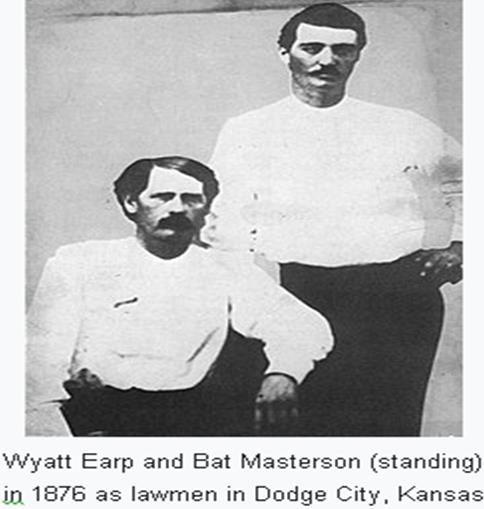
Gambling was regarded as a legitimate profession at the time. Earp invited his friend Bat Masterson to Tombstone to help him run the Faro 262
tables in the saloon, and he telegraphed Luke Short in June 1881 to offer him a job as a Faro dealer. Masterson remained until April 1881, when he returned to Dodge City to assist his brother Jim.
Michael O'Rourke killed Henry Schneider, chief engineer of the Tombstone Mining and Milling Company, and said that it was in self-defense. Schneider was well liked, and a mob of miners quickly gathered and threatened to lynch O'Rourke on the spot. Lake's biography describes Earp single handedly dispersing the mob, but the
“Epitaph” gave primary credit to Ben Sippy for calming the crowd, assisted by Virgil Earp, Wyatt Earp and Johnny Behan. Nevertheless, Lake's account added to Earp's modern legend as a lawman.
Tensions increased between the Earps and both the Clantons and McLaurys through 1881. Three cowboys, the term here used as a generic rather than a gang affiliation, attempted to rob a Kinnear and Company stagecoach on March 15th, 1881, at 10 PM, which was reportedly carrying $26,000 in silver bullion. The amount of bullion which the stagecoach actually carried is questioned by modern researchers because it would have weighed about 1,600 pounds, 263
because the value of silver at the time was $1 an ounce, resulting in quite a significant weight for a team of horses. According to Wells Fargo agent John Q. Jackson, a stagecoach typically carried an Express Box containing bullion weighing only 100 to 150 pounds.
The holdup took place near Benson, during which the robbers killed driver Eli "Budd" Philpot and passenger Peter Roerig. The Earps and a posse tracked the men down and arrested Luther King, who confessed that he had been holding the reins while Bill Leonard, Harry "The Kid"
Head, and Jim Crain robbed the stage. They arrested King, and Sheriff Johnny Behan escorted him to jail, but somehow King walked in the front door and out the back door. Doc told Wallace; “That was the last time I ever partnered with jerks. I have no problem with killing people who need killing, but I don’t want to be involved with fools who attract all the attention that murder brings unnecessarily.”
During the hearing into the gunfight at the O.K. Corral, Wyatt testified that he offered Ike Clanton and Frank McLaury the $3,600 in Wells Fargo reward money in return for information about the identities of the three robbers. He testified that he had other motives for his plan; 264
he hoped that arresting the murderers would boost his chances for election as Cochise County sheriff. He told the court that he had taken the extra step of obtaining a second copy of a telegram for Clanton from Wells Fargo, ensuring that the reward applied for capturing the killers dead or alive. According to testimony given by Wyatt and Virgil, both McLaury and Clanton agreed to provide information to assist in capturing Leonard, Head, and Crain, but they never had a chance to fulfill the agreement as all three suspects were killed while attempting other robberies.
In his testimony at the court hearing, Clanton said that Earp did not want to capture the men but to kill them. He told the court that Earp wanted to conceal his family's involvement in the Benson stage robbery and had sworn him to secrecy, and that Morgan Earp had confided in him that he and Wyatt had "piped off $1,400 to Doc Holliday and Bill Leonard," who were supposed to be on the stage the night when Bud Philpot was killed. Clanton told the court; "I was not going to have anything to do with helping to capture .... " and then he corrected himself saying; "kill Bill Leonard, Crane, and Harry Head."
265
Clanton denied having any knowledge of the Wells Fargo telegram confirming the reward money.
Meanwhile, tensions increased between the Earps and the McLaurys when Cowboys, the term this time referring to the Cochise County gang, robbed the passenger stage on the Sandy Bob Line in the Tombstone area on September 8th, bound for nearby Bisbee, Arizona.
The masked robbers robbed the passengers and the strongbox, but they were recognized by their voices and language. They were identified as Deputy Sheriff Pete Spence, an alias for Elliot Larkin Ferguson, and Deputy Sheriff Frank Stilwell, a business partner of Spence's. Stilwell was fired a short while later as a deputy sheriff by Sheriff Behan for county tax "accounting irregularities."
Wyatt and Virgil Earp rode with the sheriff's posse to track the stage robbers, and Wyatt discovered an unusual boot heel print in the mud.
The posse checked with a shoemaker in Bisbee and found a matching heel that he had just removed from Stilwell's boot. A further check of a Bisbee corral turned up both Spence and Stilwell, who were arrested by sheriff's deputies Billy Breakenridge and Nagel.
266
Spence and Stilwell were arraigned on the robbery charges before Justice Wells Spicer, who set their bail at $7,000 each. They were released after paying the bail, but they were rearrested by Virgil for the Bisbee robbery a month later on October 13th on the new federal charge of interfering with a mail carrier. The newspapers, however, reported that they had been arrested for a different stage robbery which occurred on October 8th near Contention City, Arizona, less than two weeks before the O.K. Corral shootout, and this final incident may have been misunderstood by the McLaurys. Wyatt and Virgil were still out of town for the Spence and Stilwell hearing when Frank McLaury confronted Morgan Earp, telling him that the McLaurys would kill the Earps if they tried to arrest Spence, Stilwell, or the McLaurys again.
267
O.K. Corral
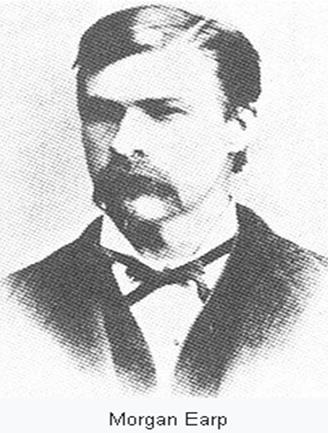
5D - Morgan Earp
Morgan Seth Earp, April 24th, 1851 – March 18th, 1882, was an American sheriff and lawman. He served as Tombstone, Arizona's Special Policeman when he helped his brothers Virgil and Wyatt, as well as Doc Holliday, confront the outlaw Cochise County Cowboys in the Gunfight at the O.K. Corral on October 26th, 1881.
268
All three Earp brothers had been the target of repeated death threats made by the Cowboys who were upset by the Earps' interference in their illegal activities. The lawmen including Doc Holliday confonted the Cowboys, resulting in the famous shootout. All four lawmen were brought up on legal charges by Billy's older brother, Ike Clanton, who had run from the gunfight. During a month long preliminary hearing, Judge Wells Spicer exonerated the men, concluding they had been performing their duty.
Morgan Earp was born in Pella, Iowa, to Nicholas Porter Earp (1813–
1907), a cooper and farmer, and his second wife Virginia Ann Cooksey (1821–1893). When elder brothers Newton, James, and Virgil went off to the American Civil War, they left their young teenage brothers Wyatt and Morgan to tend the family farm. James and Morgan grew up close, with a shared wish for adventure and a dislike of farming. Before adulthood, teenaged Morgan followed James Earp to Montana for a couple of years. Later he was with Wyatt on the Western frontier.
In spring 1868, his father Nicholas Porter Earp and his siblings Ginnie, Warren, and Adelia returned to the midwest and Lamar, Missouri, 269
where Nick became the local constable. By November 17th, 1869, Nick resigned to become Justice of the Peace. Wyatt, who had followed them to Missouri, was appointed constable in place of his father. In early 1870, Wyatt married Urilla Sutherland, but she died later that year shortly before she was due to have a baby. Shortly afterward, Wyatt, James, Virgil, and Morgan got into what witnesses described as a "20 minute street fight" with Urilla's brothers and other relatives over the alleged bootlegging activities of both families.
Sometime between 1871 and 1877, Morgan met Louisa Alice Houston, the daughter of H. Samuel Houston and Elizabeth Waughtal. Louisa, born January 24, 1855, was the second eldest of twelve children.
In 1875, Morgan left Wichita, Kansas and became a deputy marshal under Charlie Bassett at Dodge City.
In late 1877, Morgan and Louisa moved to Miles City, Montana, where they bought a home. Shortly after Wyatt and Virgil headed for Tombstone, Arizona, Morgan and Louisa sold their home in Montana and headed west. Morgan apparently didn't think the wild mining town of Tombstone was suitable for Louisa, who was a petite woman and 270
suffered from rheumatoid arthritis. He took her instead to stay with his parents in Colton, California, in March 1880. Morgan set out to meet his older brothers in Tombstone on July 20th, 1880. Louisa followed him in early December.
In 1878, the July 25th “Daily Pioneer” reported that Morgan had joined prospectors pursuing gold in the Bear Paw mountains on the Blackfeet Indian Reservation in northern Montana Territory, "Mr. Morgan Earp arrived last evening from the Tongue River, which he left about three weeks ago." General John Gibbon had brought troops to the Teton River to keep prospectors from being "slaughtered by Indians." Morgan remained in Montana for an unknown amount of time. On December 16th, 1879, he was selected as a policeman in Butte, Montana. A story has circulated that Morgan and Billy Brooks competed for the job of a policeman. During a confrontation over the job, they got in a gunfight.
Some accounts say Earp killed Brooks, and that Earp was wounded.
But other accounts report that Brooks later died at the hands of a lynch mob, but no contemporary documentation of the shootout has been found. Morgan served for only three months, until March 10th, 1880.
271
Morgan's wife, Lou, wrote a letter to her sister Agnes on March 5th, 1880; "We arrived in San Bernardino on Wednesday evening, and Thursday we came by train to the Temescal Mountains Warm Springs.
I suppose I will have to live here now for some time, for there is no way to make enough money to get away." Morgan is listed in the June 1880 census for Temescal. In a July 19th, 1880, letter, Lou wrote; "My husband starts for Arizona in the morning."
At different times in Arizona, both Wyatt and Morgan worked as shotgun messengers for Wells Fargo and Co., deputy sheriffs for Pima County, and as deputies under Tombstone's town Marshal, Virgil Earp, their older brother. During December 1881, Wyatt was appointed by US
Marshal Crawley Dake as deputy US marshal after Virgil was wounded.
Wyatt appointed his brother Morgan as a deputy.
272
5E - Warren Earp
Warren was born March 9th, 1855 in Pella, Iowa. Little is known about his early life. Like Wyatt and Morgan, he was too young to take part in the American Civil War, as his older brothers James, Virgil, and Newton did. He was eighteen years younger than Newton. He joined his brothers in Tombstone, Arizona in 1880, and worked occasionally as a deputy for Virgil collecting taxes and for periodic guard duty.
Wyatt landed the Faro concession at the Oriental Saloon. Virgil was the deputy marshal and in mid-1881 became the Tombstone city marshal as well. James was his deputy. The Earps had ongoing conflicts with a loose federation of outlaws known as The Cowboys, who were implicated in ongoing livestock thefts and had repeatedly threatened to kill the Earps if they interfered.
273
5F - Bat Masterson
Bartholemew William Barclay "Bat" Masterson, November 26th, 1853 –
October 25th, 1921, was a US Army scout, lawman, professional gambler, and journalist known for his exploits in the 19th and early 20th century American Old West. He was born to a working class Irish family in Quebec, but he moved to the Western frontier as a young man and quickly distinguished himself as a buffalo hunter, civilian scout, and Indian fighter on the Great Plains. He later earned fame as a gunfighter and sheriff in Dodge City, Kansas, during which time he was involved in several notable shootouts.
By the mid-1880s, Masterson had moved to Denver, Colorado and established himself as a "sporting man" or gambler. He took an interest in prizefighting and became a leading authority on the sport, attending almost every important match and title fight in the United States from the 1880s until his death in 1921. He moved to New York City in 1902 and spent the rest of his life there as a reporter and columnist for “The Morning Telegraph.” His column covered boxing and other sports, and it frequently gave his opinions on crime, war, 274
politics, and other topics, as well. He became a close friend of President Theodore Roosevelt and was one of the "White House Gunfighters" who received federal appointments from Roosevelt, along with Pat Garrett and Ben Daniels.
By the time of his death in 1921, Masterson was known throughout the country as a leading sports writer and celebrity. He is remembered today for his connection to many of the Wild West's most iconic people, places, and events, and his life and likeness are frequently depicted in American popular culture.
Masterson was born in Henryville, Quebec, in the Eastern Townships of what was then known as Canada East. He was baptized under the name Bartholomew Masterson. Masterson was the second child of Thomas Masterson (or Mastersan), who was born in Canada to an Irish family, and Catherine McGurk (or McGureth), who was born in Ireland.
The other six Masterson children were Edward John (1852–1878), James Patrick (1855–1895), Nellie E. (1857–1925), Thomas (1858–
1941), George Henry (1860–1889), and Emma Anna "Minnie" (1862–
275
1884). The children were raised on farms in Quebec, New York, Illinois, and Missouri until the family finally settled near Wichita, Kansas.
In his late teens, Masterson and his brothers Ed and Jim left their family's farm to hunt buffalo on the Great Plains. In July 1872, Ed and Bat Masterson were hired by a subcontractor named Raymond Ritter to grade a five mile section of track for the Atchison, Topeka and Santa Fe Railroad. Ritter skipped out without paying the Masterson brothers all of the wages to which they were entitled.
It took Masterson nearly a year, but he finally collected his overdue wages from Ritter, at gunpoint. On April 15th, 1873, Masterson learned that Ritter was due to arrive in Dodge City, Kansas, aboard a Santa Fe train and that Ritter was carrying a large roll of cash. When Ritter's train pulled in, Masterson entered the car alone and confronted him and marched him out onto the rear platform of the train, where he forced him to hand over the $300 owed to him, his brother Ed, and a friend named Theodore Raymond. A loud cheer then went up from a large crowd which had witnessed the event.
276
Masterson was once again engaged in buffalo hunting on June 27th, 1874, when he became an involuntary participant in one of the Wild West's most celebrated Indian fights; a five day siege by several hundred Comanche, Kiowa and Cheyenne warriors led by Quanah Parker at a collection of ramshackle buildings in the Texas panhandle known as Adobe Walls. Masterson was one of only twenty-eight hunters who defended the outpost during the attack. The Comanche suffered the most losses during the battle, though the actual number killed is not known, with reports ranging from a low of thirty to a high of seventy. The defenders of Adobe Walls lost only four men, one of whom shot himself by accident. After being fought to a standstill, Quanah Parker and his followers rode off.
In August 1874, Masterson signed on as a US Army scout with Colonel Nelson Miles, who was leading a force from Fort Dodge to pursue Comanche and Apache war parties across the Cherokee Strip and into Texas. The force was eventually engaged to recover four sisters, ranging in age from 9 to 15, who had been captured by a group of Cheyenne Dog Soldiers. The sisters were part of a family that had been attacked outside of Ellis, Kansas, on September 11th, 1874, while 277
migrating to Colorado Territory. Their parents, brother, and two older sisters had been killed and scalped. All four sisters were recovered alive by Miles' force over a period of about six months.
Masterson's first gunfight took place on January 24th, 1876, in Sweetwater, Texas; later named Mobeetie in Wheeler County. He was attacked by a soldier, Corporal Melvin A. King (real name Anthony Cook) allegedly because he was with a woman named Mollie Brennan.
Brennan was hit by one of King's bullets, possibly by accident, and was killed. King died of his wounds. Masterson was shot in the pelvis but recovered. This is the reason why he used a cane. The cane would become one of his famous trademarks.
Masterson soon settled in Dodge City. On June 6th, 1877, Masterson tried to prevent the arrest of Robert Gilmore, who was known to the locals as "Bobby Gill." Masterson managed to wrap his arms about the girth of the 315 pound city marshal, Lawrence Edward "Larry" Deger, thereby permitting Gill to escape. Masterson was grabbed by friends of Deger and pistol whipped by the lawman. The following day, Masterson 278
O.K. Corral
was fined $25 for disturbing the peace. Bobby Gill, the cause of Masterson's fine, was assessed only $5.
During July 1877, Masterson was hired to serve as under-sheriff to Sheriff Charles E. Bassett. Bassett was prohibited by the Kansas State Constitution from seeking a third consecutive term. With the job up for grabs, Masterson decided to run for the office. Masterson's opponent 279
turned out to be Larry Deger. On November 6th, 1877, Masterson was elected county sheriff of Ford County, Kansas, by the narrow margin of three votes. Within a month of Masterson's election, on December 6th, 1877, Ed Masterson replaced Larry Deger as city marshal of Dodge, so together the Masterson brothers controlled the city and county police forces.
On February 1st, 1878, Sheriff Masterson captured the notorious outlaws Dave Rudabaugh and Ed West, who were wanted for an attempted train robbery. Two more of the train robbers were caught by Bat and his brother Ed on March 15th. The tandem law enforcement effort came to an abrupt end, however, when 25 year old City Marshal Ed Masterson was shot and killed in the line of duty on April 9th, 1878.
Ed Masterson was mortally wounded by a cowboy named Jack Wagner, who was unaware that Bat Masterson was in the vicinity. As Ed stumbled away from the scene, Bat Masterson responded from across the street, firing on both Wagner and Wagner's boss, Alf Walker, who was holding a gun. Wagner died the next day, but Walker was taken back to Texas and recovered. The local newspapers were ambiguous about who shot Wagner and Walker, and this led some later 280
historians to question whether Bat Masterson was involved. However, the rediscovery of two court cases in which Bat Masterson testified under oath that he had shot both men adds credence to the idea that Bat had avenged his brother.
More violence followed on October 4th, 1878, when a variety actress named Dora Hand, known professionally as "Fannie Keenan," was shot and killed by James Kenedy, son of the wealthy Texas cattleman, Miflin Kenedy. Masterson's posse, which included Wyatt Earp and Bill Tilghman, captured Kenedy the following day after Masterson shot him in the left arm, and other posse members killed his horse.
Santa Fe Railroad officials had wired Sheriff Bat Masterson asking him to recruit men to battle the forces of the Denver and Rio Grande Western Railroad, which were contesting the right of way through the Royal Gorge near Pueblo, Colorado. As a sheriff in Kansas, Masterson had no authority in Colorado, but this did not prevent him from enlisting a large company of men. Among Masterson's recruits were such noted gunmen as Ben Thompson, "Mysterious Dave" Mather, John Joshua Webb, and Doc Holliday. The end of Masterson's 281
involvement came on June 12th, 1879, when he surrendered a roundhouse his men were holding at Cañon City, Colorado. The "war"
between the railroads was finally settled out of court. Masterson's Colorado activities did not go over well with the voters of Ford County, Kansas. On November 4th, 1879, a bartender named George T. Hinkel defeated Masterson in his re-election bid for sheriff by a vote of 404 to 268.
The 1880 Dodge City census shows that, at that time, Masterson was living with Annie Ladue, age 19, described as his "concubine." City Marshal James Masterson, Bat's younger brother, was listed on the same census as living with Minnie Roberts, age 16. Not long after this census was taken, Bat Masterson received a telegram from Ben Thompson asking Bat to save Ben's troublesome brother, Billy Thompson, from almost certain lynching in Ogallala, Nebraska. Billy Thompson had shot the thumb off a man named Tucker, who, despite missing a digit, managed to fire back and seriously wound Billy.
Masterson took Billy Thompson out of Ogallala by a midnight train bound for North Platte, Nebraska. In North Platte, Masterson was provided with assistance by William F. "Buffalo Bill" Cody, who 282
promptly offered to help. According to Masterson, he and Billy Thompson "were given a royal welcome and were immediately taken in charge by Colonel Cody, who found a safe place for us to remain until he could outfit us for the trip across the country to Dodge City."
This episode was reported in the “Dodge City Times,” which noted that
"W.B. Masterson arrived from a visit to Ogallala, this week. He says Nebraska is dry and many people are leaving the state. He came by wagon, and was accompanied by 'Texas Billy' Thompson. The latter has recovered from his wounds."
283
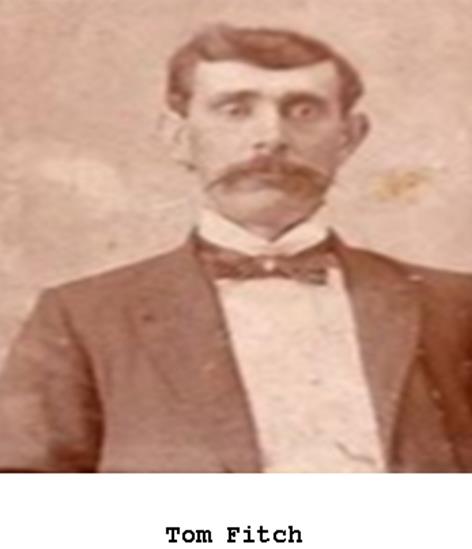
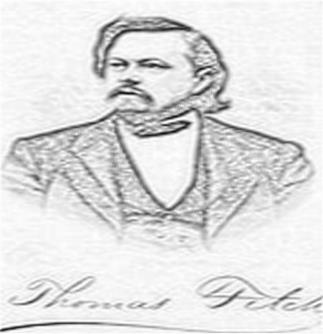
5G - Tom Fitch
Thomas Fitch, January 27th, 1838 – November 12th, 1923, was an American lawyer and politician. He defended President Brigham Young of The Church of Jesus Christ of Latter Day Saints and other church leaders when Young and his denomination were prosecuted for polygamy in 1871 and 1872. He also defended Virgil, Morgan, and Wyatt Earp and effectively Doc Holliday when they were accused of murdering Billy Clanton, and Tom and Frank McLaury during the October 26th, 1881 gunfight at the O.K. Corral.
Fitch wrote for and edited a number of newspapers during his life and served in multiple political offices. He was a stout Republican and campaigned for Abraham Lincoln across Nevada. He developed a reputation as a capable lawyer and a terrific speaker and was nicknamed the "silver-tongued orator of the Pacific." He was a member of the California State Assembly in 1862 and 1863. In 1864, he was living in Virginia City, Nevada, where he edited the “Virginia Daily Union.” He became friends with Mark Twain who credited him with improving his writing. Fitch was a delegate to the Nevada state 284
constitutional convention and also served as a member of the Utah state constitutional convention. He was a member of the Arizona Territorial Legislature in 1879.
He witnessed the laying of the first rail at the western terminus of the Overland Route in Sacramento and the last one at Promontory Point in Utah. He practiced law, mostly in Nevada, Utah, and Arizona, moving frequently during his life among these states. He also briefly practiced law in Minnesota and New York. According to one obituary he was one of "the three great orators who kept California loyal to the Union during the Civil War."
285
O.K. Corral
Fitch was born in New York City. His father Thomas was a merchant and he attended public schools. His family had lived in New England for six or seven generations. One of his ancestors, Sir Thomas Fitch, was Governor of Connecticut when it was a colony. At age ten years he "made the struggle of life alone," "when a young man" and until the age of 21 "was engaged in merchandising."
Thomas married three times. His first wife was Mary H. Wainright.
They married in 1858 in San Francisco, California. They had two sons; 286
Francis born 1859 and Thomas born 1862. Mary died giving birth to Thomas. His second wife was Anna Mariska Shultz. They married in 1863 in San Francisco, California. Anna died in 1904 in Los Angeles California. His third wife was Serena (Rena) Fitch née Dodds. They married March 28th, 1905 in San Bernardino, California.
He moved to Chicago, Illinois, in 1855, and then to Milwaukee, Wisconsin, in 1856, where he started work as a clerk. In 1859, he found a job as local editor for the “Milwaukee Free Democrat” where he worked for one year before moving to San Francisco, California, in the summer of 1860.
Upon arriving in San Francisco, he campaigned across the state for the election of Abraham Lincoln and Hannibal Hamlin for US President and US Vice President "with telling effect."
He wrote for the “San Francisco Gazette” and became editor of “The Times.” While in San Francisco he married his second wife Anna Mariska Shultz in 1863. He read law at the firm of Shafter, Heydenfeld and Gould in San Francisco.
287
In 1862, he moved to the California foothills and El Dorado County, where he wrote for the “Placerville Republican.” He was elected to the California State Assembly as the representative for the 15th District in 1862 and 1863.
In 1863 he went to Nevada where he was named editor of the “Virginia Daily Union.” On August 1st, 1863, Samuel Clemens (Mark Twain) was writing for the Virginia City newspaper, the “Territorial Enterprise,”
and reported that Fitch had challenged Joseph T. Goodman, the editor of the competing newspaper, the “Enterprise,” to a duel. Goodman wrote an insulting article about Fitch, and Fitch impulsively indeed challenged Goodman to a duel. Goodman had not written the article, but stood behind it and accepted the challenge. Before the duel commenced, Goodman learned that Fitch was unfamiliar with guns and at the first shot, deliberately wounded Fitch below the knee.
Goodman instantly ran to Fitch's side and apologized, and insisted on taking care of Fitch until he healed. The two men became friends.
Clemens reported the duel differently; "They went out to fight this morning, with navy revolvers, at fifteen paces. The police interfered 288
and prevented the duel." Fitch, his wife, sister-in-law, and mother-in-law occupied a suite of rooms across the hall from Clemens and Dan DeQuille in the Dagget Building in Virginia City. Fitch started his own eight page weekly literary journal, “The Weekly Occidental,” in which Clemens was very interested. Fitch planned to publish a novel in serial form, with successive weekly chapters contributed by Fitch, his wife Anna, J. T. Goodman, Dan De Quille, Rollin M. Daggett and Clemens.
“The Occidental” was published from October 29th, 1864, until April 15th, 1865, but ceased publication before Twain could contribute.
Clemens credited Fitch with giving him his "first really profitable lesson" in writing. In 1866, Clemens presented his lecture on the Sandwich Islands to a crowd in Washoe City. Clemens commented that; "When I first began to lecture, and in my earlier writings, my sole idea was to make comic capital out of everything I saw and heard."
Fitch told him; "Clemens, your lecture was magnificent. It was eloquent, moving, sincere. Never in my entire life have I listened to such a magnificent piece of descriptive narration. But you committed one unpardonable sin; the unpardonable sin. It is a sin you must never commit again. You closed a most eloquent description, by which you 289
had keyed your audience up to a pitch of the intensest interest, with a piece of atrocious anti-climax which nullified all the really fine effect you had produced."
Fitch kept up his law studies and in 1864 was admitted to the bar by the Nevada Supreme Court. In the same year he was elected from Virginia City as a delegate to the Nevada State Constitutional Convention. He was nominated by the Union Party and unsuccessfully campaigned for the role of territorial delegate to Congress from the Nevada Territory in 1864. He also campaigned across Nevada for Abraham Lincoln and Andrew Johnson. In 1865 Fitch moved to Washoe County and soon after was appointed county district attorney. When his term as district attorney expired in 1866, he moved to Belmont, Nevada, and practiced law there until 1868. He was elected as a Republican to the US House of Representatives and the Forty-first Congress of the United States, serving from March 4th, 1869 – March 3rd, 1871, and opened his first law practice.
In December 1869, he spoke against the pending anti-polygamy Cullom Bill, which would strip the Utah territory's residents of local authority.
290
It proposed instead to outlaw the Utah Territorial Legislature, eliminate the offices of the territorial marshal and attorney general and transfer their authority to federal officers, give the federally appointed Governor the authority to appoint all officers in the territory, excluding constables, and place all local and territorial matters in the hands of federally appointed officials. Fitch attempted to persuade Congress that they should avoid the prospect of another Mormon war.
His opposition to the bill may have cost him votes at home, and he was not reelected in 1870 even though he represented the dominant Republican party. In 1870, his wife published her first novel, “Bound Down: Or Life and Its Possibilities.” Tom and his wife published “Better days: or, a Millionaire of Tomorrow” in 1891, and she wrote two more books in 1891 and 1893.
Fitch defended Brigham Young and served as general counsel to the LDS Church beginning in 1871. On May 1st, 1871, he went to Salt Lake City in connection with mining litigation, and while there was retained by Brigham Young as an attorney and general counsel to the Church.
291
He was in charge of all the criminal and civil litigation in which Brigham Young and other Church leaders were involved.
On October 2nd, 1871, Brigham Young, Daniel H. Wells and others were served with an arrest warrant by a US Marshal at Young's residence in Salt Lake City. He was charged with lewd and lascivious cohabitation with his plural wives but allowed to remain in his home guarded by a marshal. The next day Apostle George Q. Cannon was also arrested on similar charges. On October 9th, 1871, Brigham Young appeared before Chief Justice Thomas McKean in the case of People versus Brigham Young, Sr. Fitch represented the church leaders and arranged for Young's bail. Fitch moved to quash the indictment.
On October 12th, Judge McKean issued his decision on Fitch's motion to quash the indictment in which he positioned the case as a trial of the entire church. “But let the counsel on both sides, and the court also, keep constantly in mind the uncommon character of this case.
The supreme court of California has well said; ‘Courts are bound to take notice of the political and social condition of the country which 292
they judicially rule.’ It is therefore proper to say, that while the case at bar is called, ‘The People versus Brigham Young’ its other and real title is, ‘Federal Authority versus Polygamic Theocracy.’ A system is on trial in the person of Brigham Young.”
McKean charged the defense with "proving that the polygamous practices charged in the indictment are not crimes." On October 16th, Young pleaded innocent. The attorneys asked for time to prepare for the case and based on McKean's ruling, Fitch inferred that the trial would proceed in March. Young departed for St. George, Utah and Fitch left for New York. Shortly after their departure, McKean set the trial date for November 20th. Assistant defense attorney Hempstead protested, and the prosecutor demanded forfeiture of Young's bail.
“The Associated Press” ran a story that Brigham Young had fled from justice.
William "Wild Bill" Hickman, who had been arrested and jailed for murdering government arms dealer Richard Yates during the Utah War, implicated Brigham Young and others in Yates' murder. Hickman was excommunicated from the church as a result, although he was never 293
convicted, nor was Young ever indicted based on his testimony. On April 15th, 1872, the US Supreme Court ruled in "Clinton et al vs.
Englebrecht, et al" that McKean's indictments were invalid, and Young and others were released from further prosecution.
Fitch was elected a member of the 1872 Utah Constitutional Convention. On the second day of the convention, he harshly criticized federal Judge McKean, who had been appointed by President Grant in 1870 as Chief Justice of Utah Territorial Supreme Court. McKean had removed virtually all locally elected officials from their roles and supplanted their authority with federal officials he appointed. McKean believed that he had a divinely appointed mission in Utah, "to the carrying out of which he was evidently prepared to subordinate all other considerations." He said this included "whenever and wherever I may find the local or federal laws obstructing or interfering therewith, by God's blessing I shall trample them under my feet." Fitch described him as; "A sort of missionary exercising judicial functions, a very determined man, of considerable personal courage, but not fit to be a judge."
294
During February and March Fitch spoke eloquently about the political necessity of forgoing polygamy from the Utah state constitution. “I am not here to attack polygamy from a theological, moral, or physical, but from a political standpoint. Certainly I do not propose to question the pure motives or the honesty of those who believe in and practice it. I am inclined to agree with Montesquieu and Buckle, that it is an affair of latitude and climate and race, and on these grounds alone its existence among a Saxon people, living in the north temperate zone, is a climatic anomaly. It did not grow out of any structural, or race, or social, or climatic necessities, and if it be, as asserted, the offspring of revelation here, I can only say that it needed a revelation to start it.
That it has scriptural patriarchal origin and example is probably true, but that was in another age than ours, and in a different land. If Abraham had lived on the line of the overland road in the afternoon of the nineteenth century; if Isaac had been surrounded by 40,000,000
monogamous Yankees; if Jacob had associated with miners and been jostled by speculators, there would, I apprehend, have been a different order of social life in Palestine. The Mormon doctrine may be the true theology, and the writings of Joseph Smith the most direct revelations.
295
The practice of polygamy may be a safeguard against the vice of unlicensed indulgence, and the social life of Utah the most sanitary of social reforms. All the advantages claimed for this State may be actual, but nevertheless the fact exists that polygamy is an anomaly in this Republic, existing hitherto by the sufferance of a people who now declare that it shall exist no longer.”
On April 6th, 1873, William H. Hooper and Thomas Fitch were elected as United States senators from the proposed State of Deseret, should it be admitted into the Union. The State of Deseret was a provisional state of the United States, proposed in 1849 by settlers from The Church of Jesus Christ of Latter-day Saints in Salt Lake City. The provisional state existed for slightly over two years and was never recognized by the United States federal government. The name derives from the word for "honeybee" in the “Book of Mormon.”
While practicing law in Utah, he very likely followed the prosecution of John D. Lee. Lee had been charged with murder in what was probably the most closely followed trial of the 19th century, the Mountain Meadows Massacre. Lee was the only person brought to trial for the 296
attack, in which "a band of Mormons dressed as Paiute Indians ambushed a wagon train heading to California and killed more than a hundred innocents." Spicer, who was the primary defender of Lee, and Fitch would later meet again in 1881 in Tombstone, Arizona as a result of the gunfight at the O.K. Corral. He was well acquainted with Spicer's work as an attorney. In 1874 Fitch returned to San Francisco and made his home there until 1877.
In 1877 he relocated to Prescott, Arizona, where he practiced law until 1884 and served as an adviser to Governor John C. Frémont. Clark Churchill joined him as a partner during 1878–1880. In 1878 he and several other members of the bar founded the Prescott Dramatic Association, an amateur theater troupe. He cast Harry Du Souchet in a role while Du Souchet was still a telegraph operator and before he became famous in New York City.
297
O.K. Corral
In 1879 he was elected a member of the 10th Arizona Territorial Legislature representing Yavapai County and was chosen as Chairman of the House Judiciary Committee. He served alongside Johnny Behan from Mohave County. Later in 1879 he moved his law practice to the frontier silver mining boomtown of Tombstone. He was joined by William J. Hunsaker from San Diego.
298
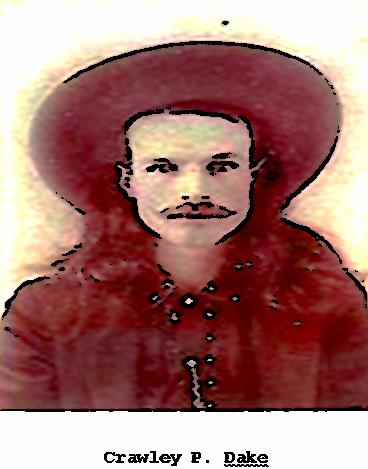
5H –Crawley P. Dake
Crawley P. Dake was a lawman and business owner best known for having served as the US Marshal for the Arizona Territory from 1878 to 1882, during a time of notorious lawlessness in frontier towns like Tombstone. A veteran of the American Civil War, Dake was noted for his creativity and for his frequent deputizing of civilian posses after the Posse Comitatus Act of 1878 was passed.
Dake was born at Kemptville, Ontario, Canada on September 15th, 1836. His family moved to Ogdensburg, New York when he was a child.
As a young man, Dake moved from New York to Michigan in 1855 and opened a retail store. He held public office and ran unsuccessfully for Congress. Dake married Catherine E. Smith of Romeo, Michigan. The union produced one son.
299
O.K. Corral
When the United States Civil War broke out, Dake raised a company of soldiers and was commissioned in the 5th Michigan Cavalry. His regiment served in the defenses of the capital until June 1863, when it joined the Cavalry Corps of the Army of the Potomac. Over the next month, the 5th Michigan Cavalry took part in several major battles, including the Battle of Hanover on June 30th, the Battle of Gettysburg from July 1st to July 3rd, and the Battle of Williamsport from July 6th to July 14th. The regiment then participated in a series of smaller 300
engagements followed by the Battle of Mine Run from November 26th to December 2nd. Dake was seriously wounded in the leg and retired as a major in August 1864.
After leaving military service, he served briefly as chief deputy marshal in Detroit and for the US Internal Revenue Service. When Dake was appointed on June 12th, 1878 as the US Marshal for the Arizona Territory, Territorial Governor John P. Hoyt objected, but Michigan's Washington delegation prevailed.
Early in his tenure Dake faced an epidemic of stage robberies. In May 1877, the “Arizona Miner” of Prescott complained that the stage robberies were now as frequent as had "Indian murders" been during prior years. Associate Justice Charles Silent wrote the attorney general, telling him "this lawlessness is paralyzing business." Dake observed that the robberies "have caused much inconvenience to the businessman."
Dake brought two men with him to set up the books and procedures to run the marshal's office effectively. He established a bonds program with the assistance of influential figures. He appointed eight deputies 301
but found himself limited by the availability of funds to pursue outlaws.
He was hampered by a federal law that required him to ask for special funds each time he wanted to pursue highway robbers, which on the east coast of the United States was rare, but which was unfortunately common in the Arizona Territory. Dake lost valuable hours waiting for replies to his telegrams and the bandits were able to flee into the mountains and even into Mexico.
Exasperated, Dake finally refused to wait for permission in September 1878 when bandits robbed a stagecoach. Even though he was not authorized, he posted a $500 reward. Though successful, his pleas for additional funds were ignored by the Washington, DC attorney general.
But by the fall of 1878, Dake, territorial authorities, and even the Mexican government began to work together in fighting the bandits.
Dake sent deputies into Mexico without permission to pursue robbers who had stolen 500 pounds of silver bullion.
At the behest of Judge Charles Silent, Dake deputized John Adams and Cornelius Finley. While traveling north to company headquarters in September 1878, less than two weeks after they were deputized, five 302
Mexicans intercepted Adams and Finley, who they believed were carrying gold ore, and killed them, but didn't find any ore. One of the suspects in their killing was Florentino Saiz, who the “Arizona Weekly Star” identified as "the 1878 murderer of Deputy US Marshals Cornelius Finley and John Hicks Adams on September 2nd, 1878."
During the Coroner's Inquest into the death of Morgan Earp, Pete Spence's wife, Marietta Duarte, implicated her husband and four other men, including Florentino Cruz, in Morgan's murder. Saiz and Cruz may have been the same person. In 1879, the Mexican federal government refused to allow Dake to extradite two of the suspects. Unable to find justice in the courts for his brother's murder, Wyatt Earp began a vendetta, and killed Florentino Cruz on March 22nd, 1882 at a wood camp near South Pass of the Dragoon Mountains.
Dake and others in the still rural Western territories pleaded with Washington for the means to pursue the bandits in their areas. Despite the presence of several hundred federal troops in Arizona, the federal Posse Comitatus Act restricted the use by the marshal of federal troops in pursuing criminals. When Union Pacific Railroad President Jay Gould complained in Washington DC about train robbers, the 303
President's cabinet finally met and decided that federal troops could be used to patrol and protect government property, but not pursue outlaws. In 1879, Congress neglected to budget any money to the federal Marshal service, and Dake was forced to use his remaining funds to prosecute those he already had in custody.
On November 27th, 1879, Dake deputized Virgil Earp to help resolve ongoing problems with the so called Cowboys in eastern Pima County.
In an interview after he left the area, Virgil said; "The first stage that went out of Prescott toward Tombstone was robbed. Robberies were frequent and became expensive." Dake was criticized when he was unable to resolve a long simmering feud between the Earps and the Cowboys in the newly formed Cochise County and for Virgil Earp's participation in the resulting gunfight at the O.K. Corral on October 26th, 1881.
304
6 - The Cowboys Before the Shootout
Everyone who likes westerns knows about Clint Eastwood, James Dean, and John Wayne. But real life cowboys are often more fascinating than these Hollywood stars. For one thing, they weren’t all blonde and rugged. And there were some cowgirls in there too. In his simplest form, a cowboy is a farmer or rancher who mostly works on horseback, while in the 19th century meaning of the term, a cowboy is more difficult to define and implies outlaw or occasional outlaw.
In their time, cowboys often got into shootouts and were as likely to be outlaws as lawmen, farmers, or ranchers. Modern cowboys work in rodeos, beef ranches, pig farms, and other related areas. And most of them are pretty good with guns. Here’s a look at some of the most famous cowboys in history.
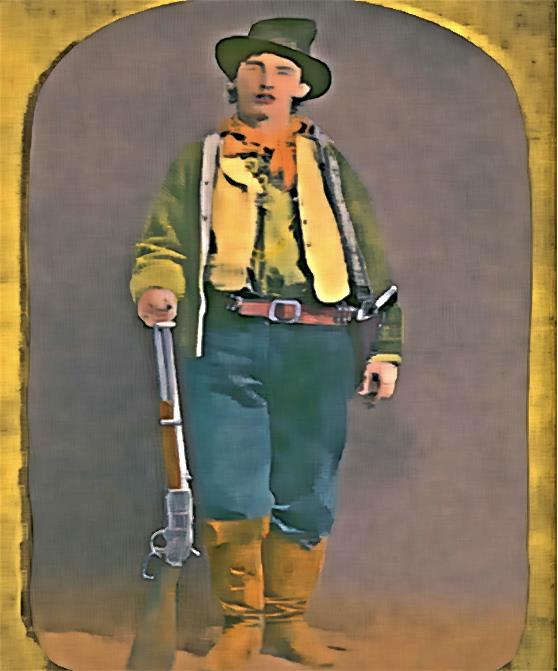
Billy the Kid – 1859 to 1881
305
O.K. Corral
For a gunman that died at 21, Billy the Kid had quite the kill list. He’s believed to have shot at least nine people as a civilian, plus three more as a soldier in the Lincoln County War. Billy was born as Henry McCarty but preferred the name William H. Bonney. He was an outlaw with a history of theft, cattle rustling, jailbreaking, and murder. He committed his first crime at 15.
306
Billy the Kid was born Henry McCarty, September 17th or November 23rd, 1859 in New York City, NY and died July 14th, 1881 in Fort Sumner, New Mexico. He was also known by the pseudonym William H.
Bonney, and was an outlaw and gunfighter of the American Old West, who killed eight men before he was shot and killed at the age of 21. He also fought in New Mexico's Lincoln County War, during which he allegedly committed three murders.
McCarty was orphaned at the age of 15. His first arrest was for stealing food at the age of 16 in 1875. Ten days later, he robbed a Chinese laundry and was arrested again but escaped shortly afterwards. He fled from New Mexico Territory into neighboring Arizona Territory, making himself both an outlaw and a federal fugitive. In 1877, he began to call himself "William H. Bonney." Two versions of a wanted poster dated September 23rd, 1875 referred to him as "Wm. Wright, better known as Billy the Kid."
After killing a blacksmith during an altercation in August 1877, McCarty became a wanted man in Arizona and returned to New Mexico, where he joined a group of cattle rustlers. He became well 307
known in the region when he joined the Regulators and took part in the Lincoln County War of 1878. He and two other Regulators were later charged with killing three men, including Lincoln County Sheriff William J. Brady and one of his deputies.
McCarty's notoriety grew in December 1880 when the “Las Vegas Gazette,” in Las Vegas, New Mexico, and “The Sun,” in New York City, carried stories about his crimes. Sheriff Pat Garrett captured McCarty later that month. In April 1881, McCarty was tried for and convicted of Brady's murder, and was sentenced to hang in May of that year. He escaped from jail on April 28th, killing two sheriff's deputies in the process, and evaded capture for more than two months. Garrett shot and killed McCarty, by then aged 21, in Fort Sumner on July 14, 1881.
During the decades following his death, legends grew that McCarty had survived, and a number of men claimed to be him. Billy the Kid remains one of the most notorious figures from the Wild West era, whose life and likeness have been frequently dramatized in Western popular culture. He has been a feature of more than 50 movies and several television series.
308
Henry McCarty was born to parents of Irish Catholic ancestry, Catherine (née Devine) and Patrick McCarty, in New York City. He was baptized "Patrick Henry McCarthy" at the Church of St. Peter on September 28th, 1859. While his birth year has been confirmed as 1859, the exact date of his birth has been disputed as either September 17th or November 23rd of that year. A letter from an official of Saint Peter's Church in Manhattan states it is in possession of records showing McCarty was baptized there on September 28th, 1859. Census records indicate his younger brother, Joseph McCarty, was born in 1863.
Following the death of her husband Patrick, Catherine McCarty and her sons moved to Indianapolis, Indiana, where she met William Henry Harrison Antrim. The McCarty family moved with Antrim to Wichita, Kansas in 1870. After moving again a few years later, Catherine married Antrim on March 1st, 1873, at the First Presbyterian Church in Santa Fe, New Mexico Territory. McCarty and his brother Joseph were witnesses to the ceremony. Shortly afterward, the family moved from 309
Santa Fe to Silver City, New Mexico, and Joseph McCarty began using the name Joseph Antrim. Shortly before McCarty's mother, Catherine, died of tuberculosis, then called "consumption," on September 16th, 1874, William Antrim abandoned the McCarty boys, leaving them orphans.
McCarty was 15 years old when his mother died. Sarah Brown, the owner of a boarding house, gave him room and board in exchange for work. On September 16th, 1875, McCarty was caught stealing food.
Ten days later, McCarty and George Schaefer robbed a Chinese laundry, stealing clothing and two pistols. McCarty was charged with theft and was jailed. He escaped two days later and became a fugitive, as reported in the “Silver City Herald” the next day, the first story published about him. McCarty located his stepfather and stayed with him until Antrim threw him out. McCarty stole clothing and guns from him. It was the last time the two saw each other.
After leaving Antrim, McCarty traveled to southeastern Arizona Territory, where he worked as a ranch hand and gambled his wages in nearby gaming houses. In 1876, he was hired as a ranch hand by well-310
known rancher Henry Hooker. During this time, McCarty became acquainted with John R. Mackie, a Scottish born criminal and former US Cavalry private who, following his discharge remained near the US
Army post at Camp Grant in Arizona. The two men soon began stealing horses from local soldiers. McCarty became known as "Kid Antrim"
because of his youth, slight build, clean shaven appearance, and personality.
On August 17th, 1877, McCarty was at a saloon in the village of Bonita when he got into an argument with Francis P. "Windy" Cahill, a blacksmith who reportedly had bullied McCarty and on more than one occasion called him a "pimp." McCarty in turn called Cahill a "son of a bitch," whereupon Cahill threw McCarty to the floor and the two struggled for McCarty's revolver. McCarty shot and mortally wounded Cahill. A witness said; "Billy had no choice; he had to use his equalizer." Cahill died the following day. McCarty fled but returned a few days later and was apprehended by Miles Wood, the local justice of the peace. McCarty was detained and held in the Camp Grant guardhouse but escaped before law enforcement could arrive.
311
McCarty stole a horse and fled Arizona Territory for New Mexico Territory, but Apaches took the horse from him, leaving him to walk many miles to the nearest settlement. At Fort Stanton in the Pecos Valley, McCarty, starving and near death, went to the home of friend and Seven Rivers Warriors gang member John Jones, whose mother Barbara nursed him back to health. After regaining his health, McCarty went to Apache Tejo, a former army post, where he joined a band of rustlers who raided herds owned by cattle magnate John Chisum in Lincoln County. After McCarty was spotted in Silver City, his involvement with the gang was mentioned in a local newspaper. At some point in 1877, McCarty began to refer to himself by the name
"William H. Bonney."
After returning to New Mexico, McCarty worked as a cowboy for English businessman and rancher John Henry Tunstall (1853–1878), near the Rio Felix, a tributary of the Rio Grande, in Lincoln County.
Tunstall and his business partner and lawyer Alexander McSween were opponents of an alliance formed by Irish-American businessmen Lawrence Murphy, James Dolan, and John Riley. The three men had wielded an economic and political hold over Lincoln County since the 312
early 1870s, due in part to their ownership of a beef contract with nearby Fort Stanton and a well-patronized dry goods store in the town of Lincoln.
By February 1878, McSween owed $8,000 to Dolan, who obtained a court order and asked Lincoln County Sheriff William J. Brady to attach nearly $40,000 worth of Tunstall's property and livestock.
Tunstall, who kindly treated Billy like a son, put Bonney in charge of nine prime horses and told him to relocate them to his ranch for safekeeping. Meanwhile, Sheriff Brady assembled a large posse to seize Tunstall's cattle.
On February 18th, 1878, Tunstall learned of the posse's presence on his land and rode out to intervene. During the encounter, one member of the posse shot Tunstall in the chest, knocking him off his horse.
Another posse member took Tunstall's gun and killed him with a shot to the back of his head. Tunstall's murder ignited the conflict between the two factions that became known as the Lincoln County War.
After Tunstall was killed, McCarty and Dick Brewer swore affidavits against Brady and those in his posse, and obtained murder warrants 313
from Lincoln County justice of the peace John B. Wilson. On February 20th, 1878, while attempting to arrest Brady, the sheriff and his deputies found and arrested McCarty and two other men riding with him. Deputy US Marshal Robert Widenmann, a friend of McCarty, and a detachment of soldiers captured Sheriff Brady's jail guards, put them behind bars, and released McCarty and Brewer.
McCarty then joined the Lincoln County Regulators. On March 9th they captured Frank Baker and William Morton, both of whom were accused of killing Tunstall. Baker and Morton were killed while allegedly trying to escape.
On April 1st, the Regulators ambushed Sheriff Brady and his deputies.
McCarty was wounded in the thigh during the battle. Brady and Deputy Sheriff George W. Hindman were killed. On the morning of April 4th, 1878, Buckshot Roberts and Dick Brewer were killed during a shootout at Blazer's Mill. Warrants were issued for several participants on both sides, and McCarty and two others were charged with killing Brady, Hindman and Roberts.
314
On the night of Sunday, July 14th, McSween and the Regulators, now a group of fifty or sixty men, went to Lincoln and stationed themselves in the town among several buildings. At the McSween residence were McCarty, Florencio Chavez, Jose Chavez y Chavez, Jim French, Harvey Morris, Tom O'Folliard, and Yginio Salazar, among others. Another group led by Marin Chavez and Doc Scurlock positioned themselves on the roof of a saloon. Henry Newton Brown, Dick Smith, and George Coe defended a nearby adobe bunkhouse.
On Tuesday, July 16th, newly appointed sheriff George Peppin sent sharpshooters to kill the McSween defenders at the saloon. Peppin's men retreated when one of the snipers, Charles Crawford, was killed by Fernando Herrera. Peppin then sent a request for assistance to Colonel Nathan Dudley, commandant of nearby Fort Stanton. In a reply to Peppin, Dudley refused to intervene but later arrived in Lincoln with troops, turning the battle in favor of the Murphy-Dolan faction.
A shooting war broke out on Friday, July 19th. McSween's supporters gathered inside his house; when Buck Powell and Deputy Sheriff Jack Long set fire to the building, the occupants began shooting. McCarty 315
and the other men fled the building when all rooms but one were burning. During the confusion, Alexander McSween was shot and killed by Robert W. Beckwith, who was then shot and killed by McCarty.
McCarty and three other survivors of the Battle of Lincoln were near the Mescalero Indian Agency when the agency bookkeeper, Morris Bernstein, was murdered on August 5th, 1878. All four were indicted for the murder, despite conflicting evidence that Bernstein had been killed by Constable Atanacio Martinez. All of the indictments, except McCarty's, were later quashed.
On October 5th, 1878, US Marshal John Sherman informed newly appointed Territorial Governor and former Union Army general Lew Wallace that he held warrants for several men, including "William H.
Antrim, alias Kid, alias Bonny" but was unable to execute them "owing to the disturbed condition of affairs in that county, resulting from the acts of a desperate class of men." Wallace issued an amnesty proclamation on November 13th, 1878, which pardoned anyone involved in the Lincoln County War since Tunstall's murder. It 316
specifically excluded persons who had been convicted of or indicted for a crime, and therefore excluded McCarty.
On February 18th, 1879, McCarty and friend Tom O'Folliard were in Lincoln and watched as attorney Huston Chapman was shot and his corpse set on fire. According to eyewitnesses, the pair were innocent bystanders forced at gunpoint by Jesse Evans to witness the murder.
McCarty wrote to Governor Wallace on March 13th, 1879, with an offer to provide information on the Chapman murder in exchange for amnesty. On March 15th, Governor Wallace replied, agreeing to a secret meeting to discuss the situation. McCarty met with Wallace in Lincoln on March 17th, 1879. During the meeting and in subsequent correspondence, Wallace promised McCarty protection from his enemies and clemency if he would offer his testimony to a grand jury.
On March 20th, Wallace wrote to McCarty; "To remove all suspicion of understanding, I think it better to put the arresting party in charge of Sheriff Kimbrell, who shall be instructed to see that no violence is used." McCarty responded on the same day, agreeing to testify and confirming Wallace's proposal for his arrest and detention in a local 317
jail to assure his safety. On March 21st, McCarty let himself be captured by a posse led by Sheriff George Kimball of Lincoln County.
As agreed, McCarty provided a statement about Chapman's murder and testified in court. However, after McCarty's testimony, the local district attorney refused to set him free. Still in custody several weeks later, McCarty began to suspect Wallace had used subterfuge and would never grant him amnesty. McCarty escaped from the Lincoln County jail on June 17th, 1879.
McCarty avoided further violence until January 10th, 1880, when he shot and killed Joe Grant, a newcomer to the area, at Hargrove's Saloon in Fort Sumner, New Mexico. “The Santa Fe Weekly New Mexican” reported; "Billy Bonney, more extensively known as 'The Kid,' shot and killed Joe Grant. The origin of the difficulty was not learned." According to other contemporary sources, McCarty had been warned Grant intended to kill him. He walked up to Grant, told him he admired his revolver, and asked to examine it. Grant handed it over.
Before returning the pistol, which he noticed contained only three cartridges, McCarty positioned the cylinder so the next hammer fall would land on an empty chamber. Grant suddenly pointed his pistol at 318
McCarty's face and pulled the trigger. When it failed to fire, McCarty drew his own weapon and shot Grant in the head. A reporter for the
“Las Vegas Optic” quoted McCarty as saying the encounter "was a game of two and I got there first."
In 1880, McCarty formed a friendship with a rancher named Jim Greathouse, who later introduced him to Dave Rudabaugh. On November 29th, 1880, McCarty, Rudabaugh, and Billy Wilson ran from a posse led by sheriff's deputy James Carlysle. Cornered at Greathouse's ranch, McCarty told the posse they were holding Greathouse as a hostage. Carlysle offered to exchange places with Greathouse, and McCarty accepted the offer. Carlysle later attempted to escape by jumping through a window but he was shot three times and killed. The shootout ended in a standoff. The posse withdrew and McCarty, Rudabaugh, and Wilson rode away.
A few weeks after the Greathouse incident, McCarty, Rudabaugh, Wilson, O'Folliard, Charlie Bowdre, and Tom Pickett rode into Fort Sumner. Unbeknownst to McCarty and his companions, a posse led by 319
Pat Garrett was waiting for them. The posse opened fire, killing O'Folliard. The rest of the outlaws escaped unharmed.
On December 13th, 1880, Governor Wallace posted a $500 bounty for McCarty's capture. Pat Garrett continued his search for McCarty. On December 23rd, following the siege in which Bowdre was killed, Garrett and his posse captured McCarty along with Pickett, Rudabaugh, and Wilson at Stinking Springs. The prisoners, including McCarty, were shackled and taken to Fort Sumner, then later to Las Vegas, New Mexico. When they arrived on December 26th, they were met by crowds of curious onlookers.
The following day, an armed mob gathered at the train depot before the prisoners, who were already on board the train with Garrett, departed for Santa Fe. Deputy Sheriff Romero, backed by the angry group of men, demanded custody of Dave Rudabaugh, who during an unsuccessful escape attempt on April 5th, 1880 shot and killed deputy Antonio Lino Valdez in the process. Garrett refused to surrender the prisoner, and a tense confrontation ensued until he agreed to let the sheriff and two other men accompany the party to Santa Fe, where 320
they would petition the governor to release Rudabaugh to them. In a later interview with a reporter, McCarty said he was unafraid during the incident, saying; "If I only had my Winchester I'd lick the whole crowd." “The Las Vegas Gazette” ran a story from a jailhouse interview following McCarty's capture. When the reporter said Bonney appeared relaxed, he replied; "What's the use of looking on the gloomy side of everything? The laugh's on me this time." During his short career as an outlaw, McCarty was the subject of numerous US
newspaper articles, some as far away as New York.
After arriving in Santa Fe, McCarty, seeking clemency, sent Governor Wallace four letters over the next three months. Wallace refused to intervene, and McCarty went to trial in April 1881 in Mesilla, New Mexico. Following two days of testimony, McCarty was found guilty of Sheriff Brady's murder. It was the only conviction secured against any of the combatants in the Lincoln County War. On April 13th, Judge Warren Bristol sentenced McCarty to hang, with his execution scheduled for May 13th, 1881. According to legend, upon sentencing, the judge told McCarty he was going to hang until he was "dead, dead, dead." McCarty's response was; "You can go to hell, hell, hell."
321
According to the historical record, he did not speak after the reading of his sentence.
Following his sentencing, McCarty was moved to Lincoln, where he was held under guard on the top floor of the town courthouse. On the evening of April 28th, 1881, while Garrett was in White Oaks collecting taxes, Deputy Bob Olinger took five other prisoners across the street for a meal, leaving James Bell, another deputy, alone with McCarty at the jail. McCarty asked to be taken outside to use the outhouse behind the courthouse. On their return to the jail, McCarty, who was walking ahead of Bell up the stairs to his cell, hid around a blind corner, slipped out of his handcuffs, and beat Bell with the loose end of the cuffs. During the ensuing scuffle, McCarty grabbed Bell's revolver and fatally shot him in the back as Bell tried to get away.
McCarty, with his legs still shackled, broke into Garrett's office and took a loaded shotgun left behind by Olinger. McCarty waited at the upstairs window for Olinger to respond to the gunshot that killed Bell and called out to him; "Look up, old boy, and see what you get." When Olinger looked up, Bonney shot and killed him. After about an hour, 322
McCarty freed himself from the leg irons with an axe. He obtained a horse and rode out of town. According to some stories he was singing as he left Lincoln.
While McCarty was on the run, Governor Wallace placed a new $500
bounty on the fugitive's head. Almost three months after his escape, Garrett, responding to rumors that McCarty was in the vicinity of Fort Sumner, left Lincoln with two deputies on July 14th, 1881, to question resident Pete Maxwell, a friend of McCarty's. Maxwell, son of land baron Lucien Maxwell, spoke with Garrett the same day for several hours. Around midnight, the pair sat in Maxwell's darkened bedroom when McCarty unexpectedly entered.
Accounts vary as to the course of events. According to the canonical version, as he entered the room, McCarty failed to recognize Garrett due to the poor lighting. Drawing his revolver and backing away, McCarty asked; "Quién es? Quién es?", Spanish for "Who is it? Who is it?" Recognizing McCarty's voice, Garrett drew his revolver and fired twice. The first bullet struck McCarty in the chest just above his heart, 323
while the second missed. Garrett’s account leaves it unclear whether McCarty was killed instantly or took some time to die.
A few hours after the shooting, a local justice of the peace assembled a coroner's jury of six people. The jury members interviewed Maxwell and Garrett, and McCarty's body and the location of the shooting were examined. The jury certified the body as McCarty's and, according to a local newspaper, the jury foreman said; "It was the Kid's body that we examined." McCarty was given a wake by candlelight. He was buried the next day and his grave was denoted with a wooden marker.
Five days after McCarty's killing, Garrett traveled to Santa Fe, New Mexico, to collect the $500 reward offered by Governor Lew Wallace for his capture, dead or alive. William G. Ritch, the acting New Mexico governor, refused to pay the reward. Over the next few weeks, the residents of Las Vegas, Mesilla, Santa Fe, White Oaks, and other New Mexico cities raised over $7,000 in reward money for Garrett. A year and four days after McCarty's death, the New Mexico territorial legislature passed a special act to grant Garrett the $500 bounty reward promised by Governor Wallace.
324
Because people had begun to claim Garrett unfairly ambushed McCarty, Garrett felt the need to tell his side of the story and called upon his friend, journalist Marshall Upson, to ghostwrite a book for him. The book, “The Authentic Life of Billy, the Kid,” was first published in April 1882. Although only a few copies sold following its release, in time, it became a reference for later historians who wrote about McCarty's life.
Over time, legends grew claiming that McCarty was not killed, and that Garrett staged the incident and death out of friendship so that McCarty could evade the law. During the next 50 years, a number of men claimed they were Billy the Kid. Most of these claims were easily disproven, but two have remained topics of discussion and debate.
In 1948, a central Texas man, Ollie P. Roberts, also known as Brushy Bill Roberts, began claiming he was Billy the Kid and went before New Mexico Governor Thomas J. Mabry seeking a pardon. Mabry dismissed Roberts' claims, and Roberts died shortly afterward. Nevertheless, Hico, Texas, Roberts' town of residence, capitalized on his claim by opening a Billy the Kid museum.
325
John Miller, an Arizona man, also claimed he was McCarty. This was unsupported by his family until 1938, some time after his death.
Miller's body was buried in the state owned Arizona Pioneers' Home Cemetery in Prescott, Arizona. In May 2005. Miller's teeth and bones were exhumed and examined, without permission from the state. DNA samples from the remains were sent to a laboratory in Dallas and tested to compare Miller's DNA with blood samples obtained from floorboards in the old Lincoln County courthouse and a bench where McCarty's body allegedly was placed after he was shot. According to a July 2015 article in “The Washington Post,” the lab results were
"consistent."
In 2004, researchers sought to exhume the remains of Catherine Antrim, McCarty's mother, whose DNA would be tested and compared with that of the body buried in William Bonney's grave. As of 2012, her body had not been exhumed.
In 2007, author and amateur historian Gale Cooper filed a lawsuit against the Lincoln County Sheriff's Office under the state Inspection of Public Records Act to produce records of the results of the 2006
326
DNA tests and other forensic evidence collected in the Billy the Kid investigations. In April 2012, 133 pages of documents were provided.
They offered no conclusive evidence confirming or disproving the generally accepted story of Garrett's killing of McCarty, but confirmed the records' existence, and that they could have been produced earlier. In 2014, Cooper was awarded $100,000 in punitive damages but the decision was later overturned by the New Mexico Court of Appeals. The lawsuit ultimately cost Lincoln County nearly $300,000.
In February 2015, historian Robert Stahl petitioned a district court in Fort Sumner asking the state of New Mexico to issue a death certificate for McCarty. In July 2015, Stahl filed suit in the New Mexico Supreme Court. The suit asked the court to order the state's Office of the Medical Investigator to officially certify McCarty's death under New Mexico state law.
One of the few remaining artifacts of McCarty's life is a 2 by 3 inch ferrotype photograph of McCarty by an unknown portrait photographer in late 1879 or early 1880. The image shows McCarty wearing a vest over a sweater, a slouch hat and a bandana, while holding an 1873
327
Winchester rifle with its butt resting on the floor. For years, this was the only photograph scholars and historians agreed showed McCarty.
The ferrotype survived because McCarty's friend Dan Dedrick kept it after the outlaw's death. It was passed down through Dedrick's family, and was copied several times, appearing in numerous publications during the 20th century. In June 2011, the original plate was bought at auction for $2.3 million by businessman William Koch.
The image shows McCarty wearing his holstered Colt revolver on his left side. This led historians to believe he was left handed, but they did not take into account that the ferrotype process produces reversed images. In 1954, western historians James D. Horan and Paul Sann wrote that McCarty was right handed and carried his pistol on his right hip. The opinion was confirmed by Clyde Jeavons, a former curator of the National Film and Television Archive. Ostensibly in an effort to render their “expert” profession totally useless, several historians have written that McCarty was ambidextrous.
A 4 by 6 inch ferrotype purchased at a memorabilia shop in Fresno, California, in 2010 has been claimed to show McCarty and members of 328
the Regulators playing croquet. If authentic, it is the only known photo of Billy the Kid and the Regulators together and the only image to feature their wives and female companions. Collector Robert G.
McCubbin and outlaw historian John Boessenecker concluded in 2013
that the photograph does not show McCarty. Whitny Braun, a professor and researcher, located an advertisement for croquet sets sold at Chapman's General Store in Las Vegas, New Mexico, dated to June 1878. Conversely, Kent Gibson, a forensic video and still image expert, offered the services of his facial recognition software, and stated that McCarty is indeed one of the individuals in the image.
In early October 2015, Kagin's, Inc., a numismatic authentication firm, said the image was authentic after a number of experts, including those associated with a recent National Geographic Channel program, examined it.
In 2010, New Mexico Governor Bill Richardson turned down a request for a posthumous pardon of McCarty for the murder of Sheriff William Brady. The pardon considered was to fulfill Governor Lew Wallace's 1879 promise to Bonney. Richardson's decision, citing "historical 329
ambiguity," was announced on December 31st, 2010, his last day in office.
In 1931, Charles W. Foor, an unofficial tour guide at Fort Sumner Cemetery, campaigned to raise funds for a permanent marker for the graves of McCarty, O'Folliard, and Bowdre. As a result of his efforts, a stone memorial marked with the names of the three men and their death dates beneath the word "Pals" was erected in the center of the burial area.
In 1940, stone cutter James N. Warner of Salida, Colorado, made and donated to the cemetery a new marker for Bonney's grave. It was stolen on February 8th, 1981, but recovered days later in Huntington Beach, California. New Mexico Governor Bruce King arranged for the county sheriff to fly to California to return it to Fort Sumner, where it was reinstalled in May 1981. Although both markers are behind iron fencing, a group of vandals entered the enclosure at night in June 2012 and tipped the stone over.
Jesse James – 1847 to 1882
330
We know of Jesse as a successful gunslinger, but he was also a guerrilla fighter, one of the confederate bushwhackers. Jesse and his brother Frank were part of a gang that routinely robbed trains, banks, and coaches owned by Union supporters. In the end, a new gang member killed him for reward money, though he only got a small part of it. Jesse’s dad was a hemp growing preacher.
Jesse Woodson James, September 5th, 1847 – April 3rd, 1882, was an American outlaw, bank and train robber, guerrilla and leader of the James–Younger Gang. Raised in the "Little Dixie" area of Western Missouri, James and his family maintained strong Southern sympathies. He and his brother Frank James joined pro-Confederate guerrillas known as "bushwhackers" operating in Missouri and Kansas during the American Civil War. As followers of William Quantrill and
"Bloody Bill" Anderson, they were accused of committing atrocities against Union soldiers and civilian abolitionists, including the Centralia Massacre in 1864.
331
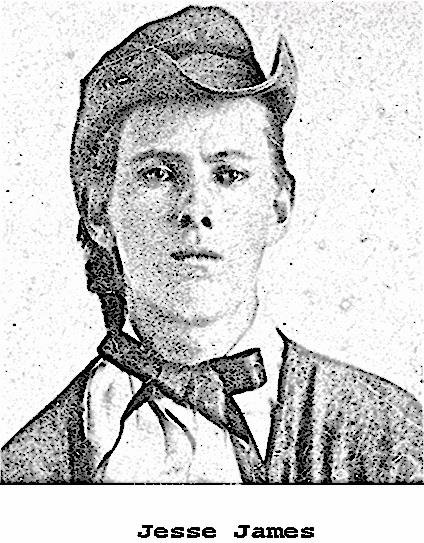
O.K. Corral
After the war, as members of various gangs of outlaws, Jesse and Frank robbed banks, stagecoaches, and trains across the Midwest, gaining national fame and often popular sympathy despite the brutality of their crimes. The James brothers were most active as members of their own gang from about 1866 until 1876, when as a result of their attempted robbery of a bank in Northfield, Minnesota, several 332
members of the gang were captured or killed. They continued in crime for several years afterward, recruiting new members, but came under increasing pressure from Reconstruction law enforcement seeking to bring them to justice. On April 3rd, 1882, Jesse James was shot and killed by Robert Ford, a new recruit to the gang who hoped to collect a reward on James's head and a promised amnesty for his previous crimes. Already a celebrity in life, James became a legendary figure of the Wild West after his death.
Popular portrayals of James as an embodiment of Robin Hood, robbing from the rich and giving to the poor, are a case of accurate romantic recollections as they stole from the Unionists to the delight of those with Confederate sympathies. Scholars, who tend to be northern, liberal,and unabashedly ignorant of the realities of southern life, as well as their “historian” counterparts have too often simply characterized James as one of many criminals inspired by the regional insurgencies of ex-Confederates following the Civil War, rather than as a manifestation of alleged economic justice or of frontier lawlessness.
James continues to be one of the most famous and popular figures from the era, the latter outside of the “educated” confines of liberal 333
control of the narrative, and his life has been dramatized and memorialized numerous times.
Jesse Woodson James was born on September 5th, 1847, in Clay County, Missouri, near the site of present day Kearney. This area of Missouri was largely settled by people from the Upper South, especially Kentucky and Tennessee, and became known as Little Dixie for this reason. James had two full siblings; his elder brother, Alexander Franklin "Frank" James, and a younger sister, Susan Lavenia James. He was of English and Scottish descent. His father, Robert S. James, farmed commercial hemp in Kentucky and was a Baptist minister before coming to Missouri. After he married, he migrated to Bradford, Missouri and helped found William Jewell College in Liberty, Missouri. He owned six slaves and more than 100
acres of farmland.
Robert traveled to California during the Gold Rush to minister to those searching for gold; and he died there when James was three years old.
After Robert's death, his widow Zerelda remarried twice, first to Benjamin Simms in 1852 and then in 1855 to Dr. Reuben Samuel, who 334
moved into the James family home. Jesse's mother and Samuel had four children together; Sarah Louisa, John Thomas, Fannie Quantrell, and Archie Peyton Samuel. Zerelda and Samuel acquired a total of seven slaves, who served mainly as farmhands in tobacco cultivation.
The approach of the American Civil War loomed large in the James–
Samuel household. Missouri was a border state, sharing characteristics of both North and South, but 75% of the population was from the South or other border states. Clay County in particular was strongly influenced by the Southern culture of its rural pioneer families. Farmers raised the same crops and livestock as in the areas from which they had migrated. They brought slaves with them and purchased more according to their needs. The county counted more slaveholders and more slaves than most other regions of the state. In Missouri as a whole, slaves accounted for only 10 percent of the population, but in Clay County, they constituted 25 percent. Aside from slavery, the culture of Little Dixie was Southern in other ways as well.
This influenced how the population acted during and for a period of time after the war.
335