

O.K. Corral by Edward Drobinski - HTML preview
Download the book in PDF, ePub, Kindle for a complete version.
Crockett fell in love with John Canady's niece Amy Summer, who was engaged to Canady's son Robert. While serving as part of the wedding party, Crockett met Margaret Elder. He persuaded her to marry him, and a marriage contract was drawn up on October 21st, 1805.
Margaret had also become engaged to another young man at the same time and married him instead.
He met Polly Finley and her mother Jean at a harvest festival.
Although friendly towards him in the beginning, Jean Finley eventually felt Crockett was not the man for her daughter. Crockett declared his intentions to marry Polly, regardless of whether the ceremony was allowed to take place in her parents' home or had to be performed elsewhere. He arranged for a justice of the peace and took out a marriage license on August 12th, 1806. On August 16th, he rode to Polly's house with family and friends, determined to ride off with Polly to be married elsewhere. Polly's father pleaded with Crockett to have the wedding in the Finley home. Crockett agreed only after Jean apologized for her past treatment of him.
165
The newlyweds settled on land near Polly's parents, and their first child, John Wesley Crockett, who became a United States Congressman, was born July 10th, 1807. Their second child, William Finley Crockett, was born November 25th, 1808. In October 1811, the family relocated to Lincoln County. Their third child Margaret Finley (Polly) Crockett was born on November 25th, 1812. The Crocketts then moved to Franklin County in 1813. He named the new home on Beans Creek "Kentuck." His wife died in March 1815, and Crockett asked his brother John and his sister-in-law to move in with him to help care for the children. That same year, he married the widow Elizabeth Patton, who had a daughter, Margaret Ann, and a son, George. David and Elizabeth's son, Robert Patton, was born September 16th, 1816.
Daughter Rebecca Elvira was born December 25th, 1818. Daughter Matilda was born August 2nd, 1821.
Andrew Jackson was appointed major general of the Tennessee militia in 1802. The Fort Mims massacre occurred near Mobile, Mississippi Territory on August 30th, 1813 and became a rallying cry for the Creek War. On September 20th, Crockett left his family and enlisted as a scout for an initial term of 90 days with Francis Jones's Company of 166
O.K. Corral
Mounted Rifleman, part of the Second Regiment of Volunteer Mounted Riflemen. They served under Colonel John Coffee in the war, marching south into present day Alabama and taking an active part in the fighting. Crockett often hunted wild game for the soldiers, and felt better suited to that role than killing Creek warriors. He served until December 24th, 1813.
167
The War of 1812 was being waged concurrently with the Creek War.
After the Treaty of Fort Jackson in August 1814, Andrew Jackson, now with the US Army, wanted the British forces ousted from Spanish Florida and asked for support from the Tennessee militia. Crockett re-enlisted as third sergeant for a six month term with the Tennessee Mounted Gunmen under Captain John Cowan on September 28th, 1814. Crockett's unit saw little of the main action because they were days behind the rest of the troops and were focused mostly on foraging for food. Crockett returned home in December. He was still on a military reserve status until March 1815, so he hired a young man to fulfill the remainder of his service.
In 1817, Crockett moved the family to new acreage in Lawrence County, where he first entered public office as a commissioner helping to configure the new county's boundaries. On November 25th, the state legislature appointed him county justice of the peace. On March 27th, 1818, he was elected lieutenant colonel of the Fifty-seventh Regiment of Tennessee Militia, defeating candidate Daniel Matthews for the position. By 1819, Crockett was operating multiple businesses in the area and felt his public responsibilities were beginning to 168
consume so much of his time and energy that he had little left for either family or business. He resigned from the office of justice of the peace and from his position with the regiment.
In 1821, he resigned as commissioner and successfully ran for a seat in the Tennessee General Assembly, representing Lawrence and Hickman counties. It was this election where Crockett honed his anecdotal oratory skills. He was appointed to the Committee of Propositions and Grievances on September 17th, 1821, and served through the first session that ended November 17th, as well as the special session called by the governor in the summer of 1822, ending on August 24th. He favored legislation to ease the tax burden on the poor. Crockett spent his entire legislative career fighting for the rights of impoverished settlers who he felt dangled on the precipice of losing title to their land due to the state's complicated system of grants. He supported 1821 gubernatorial candidate William Carroll, over Andrew Jackson's endorsed candidate Edward Ward.
Less than two weeks after Crockett's 1821 election to the General Assembly, a flood of the Tennessee River destroyed Crockett's 169
businesses. In November, Elizabeth's father Robert Patton deeded 800
acres of his Carroll County property to Crockett. Crockett sold off most of the acreage to help settle his debts, and moved his family to the remaining acreage on the Obion River, which remained in Carroll County until 1825 when the boundaries were reconfigured and put it in Gibson County. In 1823, he ran against Andrew Jackson's nephew-in-law William Edward Butler and won a seat in the General Assembly representing the counties of Carroll, Humphreys, Perry, Henderson and Madison. He served in the first session, which ran from September through the end of November 1823, and in the second session that ran September through the end of November 1824, championing the rights of the impoverished farmers. During Andrew Jackson's election to the United States Senate in 1823, Crockett backed his opponent John Williams.
On October 25th, 1824, Crockett notified his constituents of his intention to run in the 1825 election for a seat in the US House of Representatives. He lost that election to incumbent Adam Rankin Alexander. A chance meeting in 1826 gained him the encouragement of Memphis mayor Marcus Brutus Winchester to try again to win a seat 170
in Congress. The Jackson Gazette published a letter from Crockett on September 15th, 1826 announcing his intention of again challenging Rankin, and stating his opposition to the policies of President John Quincy Adams and Secretary of State Henry Clay and to Rankin's position on the cotton tariff. Militia veteran William Arnold also entered the race, and Crockett easily defeated both political opponents for the 1827–29 term. He arrived in Washington, D.C. and took up residence at Mrs. Ball's Boarding House, where a number of other legislators lived when Congress was in session. Jackson was elected as president in 1828. Crockett continued his legislative focus on settlers getting a fair deal for land titles, offering H.R. 27 amendment to a bill sponsored by James K. Polk.
“I believed it was a wicked, unjust measure .... I voted against this Indian bill, and my conscience yet tells me that I gave a good honest vote, and one that I believe will not make me ashamed in the day of judgement.” - David Crockett,
Crockett was re-elected for the 1829–31 session, once again defeating Adam Rankin Alexander. He introduced H.R. 185 amendment to the 171
land bill on January 29th, 1830, but it was defeated on May 3rd. On February 25th, 1830, he introduced a resolution to abolish the United States Military Academy at West Point, New York because he felt that it was public money going to benefit the sons of wealthy men. He spoke out against Congress giving $100,000 to the widow of Stephen Decatur, citing that Congress was not empowered to do that. He opposed Jackson's 1830 Indian Removal Act and was the only member of the Tennessee delegation to vote against it. Cherokee chief John Ross sent him a letter on January 13th, 1831 expressing his thanks for Crockett's vote. His vote was not popular with his own district, and he was defeated in the 1831 election by William Fitzgerald.
Crockett ran against Fitzgerald again in the 1833 election and was returned to Congress, serving until 1835. On January 2nd, 1834, he introduced the land title resolution H.R. 126, but it never made it as far as being debated on the House floor. He was defeated for re-election in the August 1835 election by Adam Huntsman. During his last term in Congress, he collaborated with Kentucky Congressman Thomas Chilton to write his autobiography, which was published by E. L. Carey and A. Hart in 1834 as “A Narrative of the Life of David Crockett,”
172
Written by Himself, and he went east to promote the book. In 1836, newspapers published the now famous quotation attributed to Crockett upon his return to his home state: “I told the people of my district that I would serve them as faithfully as I had done; but if not, they might go to hell, and I would go to Texas.”
By December 1834, Crockett was writing to friends about moving to Texas if Jackson's chosen successor Martin Van Buren was elected president. The next year, he discussed with his friend Benjamin McCulloch raising a company of volunteers to take to Texas in the expectation that a revolution was imminent. His departure to Texas was delayed by a court appearance in the last week of October as co-executor of his deceased father-in-law's estate; he finally left his home near Rutherford in West Tennessee with three other men on November 1st, 1835, to explore Texas. His youngest child Matilda later wrote that she distinctly remembered the last time that she saw her father:
“He was dressed in his hunting suit, wearing a coonskin cap, and carried a fine rifle presented to him by friends in Philadelphia. ... He seemed very confident the morning he went away that he would soon have us all to join him in Texas.”
173
Crockett traveled with 30 well-armed men to Jackson, Tennessee, where he gave a speech from the steps of the Madison County courthouse, and they arrived in Little Rock, Arkansas on November 12th, 1835. The local newspapers reported that hundreds of people swarmed into town to get a look at Crockett, and a group of leading citizens put on a dinner in his honor that night at the Jeffries Hotel.
Crockett spoke "mainly to the subject of Texan independence," as well as Washington politics.
Crockett arrived in Nacogdoches, Texas in early January 1836. On January 14th, he and 65 other men signed an oath before Judge John Forbes to the Provisional Government of Texas for six months: "I have taken the oath of government and have enrolled my name as a volunteer and will set out for the Rio Grande in a few days with the volunteers from the United States." Each man was promised about 4,600 acres of land as payment. On February 6th, he and five other men rode into San Antonio de Bexar and camped just outside the town.
174
Crockett arrived at the Alamo Mission in San Antonio on February 8th.
A Mexican army arrived on February 23rd led by General Antonio López de Santa Anna, surprising the men garrisoned in the Alamo, and the Mexican soldiers immediately initiated a siege. Santa Anna ordered his artillery to keep up a near constant bombardment. The guns were moved closer to the Alamo each day, increasing their effectiveness.
On February 25th, 200–300 Mexican soldiers crossed the San Antonio River and took cover in abandoned shacks approximately 90 to 100
yards from the Alamo walls. The soldiers intended to use the huts as cover to establish another artillery position, although many Texans assumed that they actually were launching an assault on the fort.
Several men volunteered to burn the huts. To provide cover, the Alamo cannons fired grapeshot at the Mexican soldiers, and Crockett and his men fired rifles, while other defenders reloaded extra weapons for them to use in maintaining a steady fire. The battle was over within 90
minutes, and the Mexican soldiers retreated. There were limited stores of powder and shot inside the Alamo, and Alamo commander William Barret Travis ordered the artillery to stop returning fire on February 175
26th so as to conserve precious ammunition. Crockett and his men were encouraged to keep shooting, as they were unusually effective.
As the siege progressed, Travis sent many messages asking for reinforcements. Several messengers were sent to James Fannin who commanded the group of Texan soldiers at Presidio La Bahia in Goliad, Texas. Fannin decided that it was too risky to reinforce the Alamo, although historian Thomas Ricks Lindley concludes that up to 50 of Fannin's men left his command to go to Bexar. These men would have reached Cibolo Creek on the afternoon of March 3rd, 35 miles from the Alamo, where they joined another group of men who also planned to join the garrison.
There was a skirmish between Mexican and Texan troops that same night outside the Alamo. Historian Walter Lord speculates that the Texans were creating a diversion to allow their courier John Smith to evade Mexican pickets. However, Alamo survivor Susannah Dickinson said in 1876 that Travis sent out three men shortly after dark on March 3rd, probably a response to the arrival of Mexican reinforcements. The three men, including Crockett, were sent to find Fannin. Lindley states 176
that Crockett and one of the other men found the force of Texans waiting along Cibolo Creek just before midnight; they had advanced to within 20 miles of the Alamo. Just before daylight on March 4th, part of the Texan force managed to break through the Mexican lines and enter the Alamo. A second group was driven across the prairie by Mexican cavalry.
The siege ended on March 6th when the Mexican army attacked just before dawn while the defenders were sleeping. The daily artillery bombardment had been suspended, perhaps a ploy to encourage the natural human reaction to a cessation of constant strain. But the garrison awakened and the final fight began. Most of the noncombatants gathered in the church sacristy for safety. According to Dickinson, Crockett paused briefly in the chapel to say a prayer before running to his post. The Mexican soldiers climbed up the north outer walls of the Alamo complex, and most of the Texans fell back to the barracks and the chapel, as previously planned. Crockett and his men, however, were too far from the barracks to take shelter and were the last remaining group to be in the open. They defended the low wall in front of the church, using their rifles as clubs and relying on knives, 177
as the action was too furious to allow reloading. After a volley and a charge with bayonets, Mexican soldiers pushed the few remaining defenders back toward the church.
The Battle of the Alamo lasted almost 90 minutes, and all of the defenders were killed. Santa Anna ordered his men to take their bodies to a nearby stand of trees, where they were stacked together and wood piled on top. That evening, they lit a fire and burned their bodies to ashes. The ashes were left undisturbed until February 1837, when Juan Seguin and his cavalry returned to Bexar to examine the remains. A local carpenter created a simple coffin, and ashes from the funeral pyres were placed inside. The names of Travis, Crockett, and Bowie were inscribed on the lid. The coffin is thought to have been buried in a peach tree grove, but the spot was not marked and can no longer be identified.
All that is certain about the fate of David Crockett is that he died at the Alamo on the morning of March 6th, 1836 at age 49. Accounts from survivors of the battle differ on the manner of Crockett's death, with stories ranging from Crockett putting up a heroic last stand to the 178
account that he surrendered along with several other men and was executed. To further confusion, historians have been able to back up opposing theories with "voluminous evidence.”
The popular mythology of Crockett's death in American culture is one of a heroic last stand, a tale that is backed up by some historical evidence. For example, a cook for one of Santa Anna's officers, maintained that Crockett's body was found in the barracks surrounded by "no less than sixteen Mexican corpses," with Crockett's knife buried in one of them. There is, however, historical evidence countering the popular myth, with stories of a Crockett surrender and execution circulating as far back as just a few weeks after the battle.
The counter myth picked up historical steam, when, in 1955, Jesús Sánchez Garza discovered the memoirs of José Enrique de la Peña, a Mexican officer present at the Battle of the Alamo, and self-published it as “La Rebelión de Texas – Manuscrito Inédito de 1836 por un Oficial de Santa Anna.” Texas A&M University Press published the English translation in 1975 “With Santa Anna in Texas: A Personal Narrative of the Revolution.” The English publication caused a scandal within the 179
United States, as it asserted that Crockett did not die in battle. The translator of the English publication, Carmen Perry, the former librarian of the Daughters of the Republic of Texas, was harassed with anonymous letters and intimidating phone calls by Crockett loyalists who considered the mere suggestion that Crockett had not died fighting blasphemous.
Some have questioned the validity of the text. The author and retired firefighter, William Groneman III, posited that the journals were made up of several different types of paper from several different paper manufacturers, all cut down to fit. Long time John Wayne enthusiast Joseph Musso also questioned the validity of de la Peña's diary, basing his suspicions on the timing of the diary's release, and the fact that historical interest in the topic rose around the same time as the Walt Disney mini-series Davy Crockett was released in 1955. Some questions were answered when finally, in 2001, archivist David Gracy published a detailed analysis of the manuscript, including lab results.
He found, among other things, that the paper and ink were of a type used by the Mexican army in the 1830s, and the handwriting matched 180
that on other documents in the Mexican military archives that were written or signed by de la Peña.
As for those who have questioned de la Peña's ability to identify any of the Alamo defenders by name, historians believe that de la Peña likely witnessed or was told about executions of the Alamo survivors. And while some claim neither he nor his comrades would have known who those men were, others conclude that the "weight of evidence" is in favor of the surrender-execution hypothesis. To further controversy, equal evidence is available for the "heroic last stand" story, with several survivors and first hand witnesses to the battle claiming Crockett fought to the death. Given Davy’s history, the latter seems more consistent with his behavior.
One of Crockett's sayings, which were published in almanacs between 1835 and 1856 along with those of Daniel Boone and Kit Carson, was:
"Always be sure you are right, then go ahead."
While serving in the United States House of Representatives, Crockett became a Freemason. He entrusted his masonic apron to a friend in 181
Tennessee before leaving for Texas, and it was inherited by the friend's descendant in Kentucky.
In 1967, the US Postal Service issued a 5 cent stamp commemorating Davy Crockett.
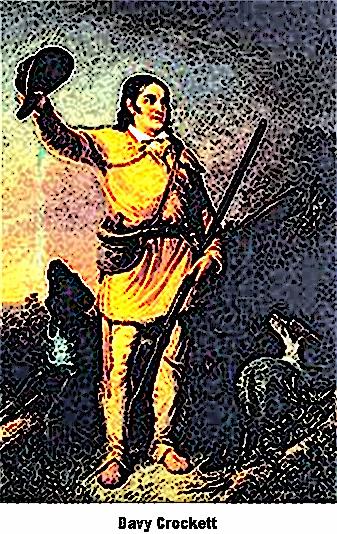
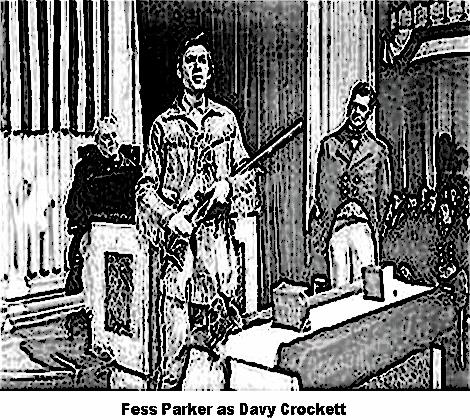
Walt Disney adapted Crockett's stories into a television miniseries titled “Davy Crockett,” which aired in 1954 and 1955 on Walt Disney's Disneyland. The series popularized the image of Crockett, portrayed by Fess Parker, wearing a coonskin cap, and originated the song "The Ballad of Davy Crockett." The first three parts of the series were edited into a feature length movie for theaters.
182
O.K. Corral
Crockett's stories were adapted by French animation studio Studios Animage into a 1994 animated series titled “Davy Crockett.”
A 2009 episode of MythBusters tested whether Crockett could split a bullet in half on the blade of an ax 40 yards away, and concluded that it would indeed be possible to do so.
In films, Crockett has been played by:
Charles K. French, Davy Crockett – “In Hearts United” (1909), silent.
Hobart Bosworth, “Davy Crockett” (1910), silent.
183
Dustin Farnum, “Davy Crockett” (1916), silent.
Cullen Landis, “Davy Crockett at the Fall of the Alamo,” 1926, silent.
Jack Perrin, “The Painted Stallion,” 1937.
Lane Chandler, “Heroes of the Alamo,” 1937.
Robert Barrat, “Man of Conquest,” 1939.
Trevor Bardette, “The Man from the Alamo,” 1953.
Arthur Hunnicutt, “The Last Command,” 1955.
Fess Parker, “Davy Crockett, King of the Wild Frontier,” 1955, and
“Davy Crockett and the River Pirates,” 1956, both on Walt Disney's Disneyland.
James Griffith, “The First Texan,” 1956.
John Wayne, “The Alamo,” 1960.
Brian Keith, “The Alamo: 13 Days to Glory,” 1987.
Merrill Connally, “Alamo: The Price of Freedom,” 1988.
Johnny Cash, “Davy Crockett: Rainbow in the Thunder,” 1988.
184
Tim Dunigan, “Davy Crockett: Rainbow in the Thunder,” “Davy Crockett: A Natural Man,” “Davy Crockett: Guardian Spirit,” and “Davy Crockett: Letter to Polly,” 1988–1989.
David Zucker, “The Naked Gun 2½: The Smell of Fear,” 1991.
John Schneider, “James A. Michener's Texas,” 1994.
Scott Wickware, “Dear America: A Line in the Sand,” 2000.
Justin Howard, “The Anarchist Cookbook,” 2002.
Billy Bob Thornton, “The Alamo,” 2004.
Theatre:
“Davy Crockett,” (1872), popular touring play of its time, by Frank Murdoch.
“Davy Crockett,” unfinished musical play, January to April 1938, Kurt Weill.
Prose fiction:
Crockett appears in at least two short alternate history works:
"Chickasaw Slave" by Judith Moffett in Mike Resnick's anthology 185
“Alternate Presidents” (1992), where Crockett is the seventh President of the United States, and "Empire" by William Sanders in Harry Turtledove's anthology “Alternate Generals II” (2002) where Crockett fights for Emperor Napoleon I of Louisiana in a conflict analogous to the War of 1812. Crockett is also a character in Gore Vidal's novel
“Burr” as a congressman from Tennessee.
Comics:
Columbia Features syndicated a comic strip, “Davy Crockett, Frontiersman,” from June 20th, 1955 until 1959.
186
5 - The Chiefly Tombstone Lawmen Before the Shootout 5A- Doc Holliday
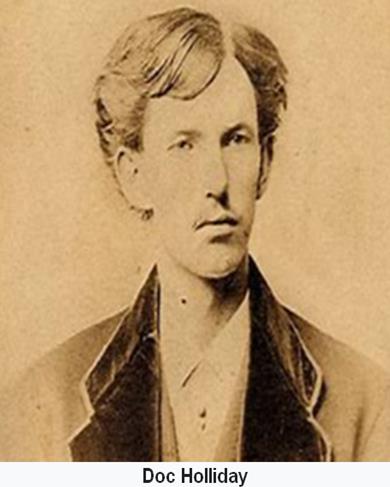
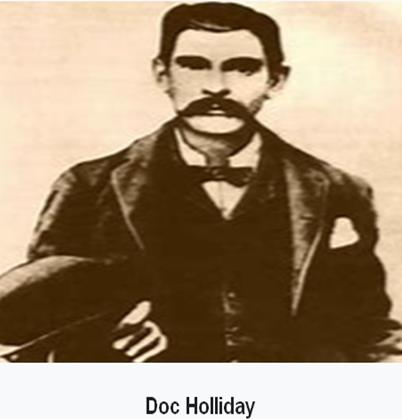
John Henry Holliday was born August 14th, 1851 in Griffin, Georgia. He was much better known as Doc Holliday, an American gambler, gunfighter, and dentist. A close friend and associate of lawman Wyatt Earp, Holliday is best known for his role in the events leading up to, including, and following the gunfight at the O.K. Corral, though it is abundantly clear that his hand was in many events for which he got no credit, that substantially enabled by his own wishes and an ability to dodge bullets. He developed a popular reputation in the Wild West as having killed more than twenty men, maybe as many as thirty, in various altercations, though he has been only contemporary “expert”
credited with only two or three, which is largely dis-similar to what pundits living at the time said.
Unlike most publicity seeking gunfighters, Doc Holliday never flashed his weapons or announced his intention to kill someone. His handguns were always concealed, and when he used shotguns they would be hidden under a long coat. This allowed him, when business needed 187
being done, to do it without possible interference from that which might protect the soon to be deed, as well as avoiding criminal charges by law enforcement, though at times, as in Tombstone at the O.K Corral, he was part of that same law enforcement. Doc seemed to have little or no fear of death, and a disposition which didn’t tolerate much nonsense. The lack of jitters concerning a gunfight isadistinct advantage, and no doubt aided Doc’s reutation for being the quickest and most accurate draw.
Holliday's colorful life and character have been depicted in many books and portrayed by well-known actors in numerous movies and television series.
At age 21, Holliday earned a degree in dentistry from the Pennsylvania College of Dental Surgery. He set up practice in his hometown of Griffin, Georgia, but he was soon diagnosed with tuberculosis, the same disease that had claimed his mother when he was 15, having acquired it while tending to her needs while she was still in the contagious phase of the illness. Hoping the climate in the American Southwest and Colorado would ease his symptoms, he moved to that 188
O.K. Corral
region and became a gambler, a reputable profession in Arizona in that day. Having received an early death sentence, what additional mental trepidation could a loudmouth jerk waving a gun instill?
Over the next few years, he reportedly had several gun confrontations.
He saved Wyatt Earp, a famous lawman and gambler, while in Texas.
Afterwards they became friends. In 1879, he joined Earp in Las Vegas, 189
New Mexico, and then rode with him to Prescott, Arizona, and then Tombstone. In Tombstone, local members of the outlaw Cochise County Cowboys repeatedly threatened him and spread rumors that he had robbed a stagecoach, which Doc did not appreciate. On October 26th, 1881, Holliday was deputized by Tombstone city marshal Virgil Earp. The “lawmen,” which included other Earps, became involved in the famous O.K. Corral shootout.
It is always accurate to remember that Doc Holliday had already been given an imminent death sentence by tuberculosis. If the distanced observer finds Doc’s actions too oblivious to the fear of death, that reader may not be fully cognizant of a mentality which views the risks of gunplay as being something only marginally quicker than the processes of a diseased “nature.” Indeed, to one so damned, the quick death by gun may be preferable to a protracted and painful death right around the corner.
Following the Tombstone shootout trouble with the Cowboys, and unable to obtain justice in the courts, Doc’s good friend Wyatt Earp took matters into his own hands. As the recently appointed deputy US
190
marshal, Earp formally deputized Holliday, among others. A bit later, as a federal posse, they pursued the outlaw Cowboys they believed were responsible. The local Tombstone sheriff Behan issued a warrant for the arrest of five members of the federal posse, including Holliday. The federal posse rode to the New Mexico Territory, while Doc returned to the good air of Colorado. Wyatt Earp learned of an extradition request for Holliday and arranged for Colorado Governor Frederick Walker Pitkin to deny Holliday's extradition.
Holliday was born in Griffin, Georgia, to Henry Burroughs Holliday and Alice Jane (McKey) Holliday. He was of English and Scottish ancestry.
His father served in the Mexican-American War and the American Civil War as a major in the 27th Georgia Infantry. When the Mexican-American War ended, Henry brought home an adopted son named Francisco. Holliday was baptized at the First Presbyterian Church of Griffin in 1852. In 1864, his family moved to Valdosta, Georgia, where his father would be elected mayor and his mother would die of tuberculosis on September 16th, 1866. The same disease killed his adopted brother. Three months after his wife's death, his father married Rachel Martin.
191
Holliday attended the Valdosta Institute, where he received a classical education in rhetoric, grammar, mathematics, history and languages; principally Latin, but some French and ancient Greek.
In 1870, nineteen year old Holliday left home for Philadelphia. On March 1st, 1872, at age 20, he received his Doctor of Dental Surgery degree from the Pennsylvania College of Dental Surgery. Holliday graduated five months before his 21st birthday, so the school held his degree until he turned 21, the minimum age required to practice dentistry.
Holliday moved to St. Louis, Missouri, so he could work as an assistant for his classmate, A. Jameson Fuches, Jr. Less than four months later, at the end of July, he relocated to Atlanta, where he joined a dental practice. He lived with his uncle and his family so he could begin to build up his dental practice. A few weeks before Holliday's birthday, dentist Arthur C. Ford advertised in the Atlanta papers that Holliday would substitute for him while Ford was attending “dental meetings.”
There are stories that Holliday’s shootings began with an incident on the Withlacoochee River, Georgia, in 1873. According to these stories, 192
when Holliday was 22, he went with some friends to a swimming hole on his uncles' land, where they discovered it was occupied by a group of negro Union soldiers who were in the area as part of the Union's occupying forces in the South.
They rode in on the trespassing negros who were swimming in a part of the Withlacoochee River that "Doc" and his friends had cleared to be used as their personal swimming hole. The presence of the negros in their swimming hole enraged "Doc," and he drew his pistol, shooting over their heads to either scare them off or otherwise get them moving. He initially shot over their heads. Holliday then leveled a double barreled shotgun at them, and when they exited the swimming hole, killed two of them. Some family members thought it best that Holliday leave the state. In later years Doc said; “When counting men shot, you only count the White ones.”
193
O.K. Corral
Shortly after beginning his dental practice, Holliday was impacted by his tuberculosis. He was given only a few months to live, but was told that a drier and warmer climate might slow the deterioration of his health. After Dr. Ford's return in September, Holliday left for Dallas, Texas, the last big city before the uncivilized western frontier.
When he arrived in Dallas, Holliday partnered with a friend of his father's, Dr. John A. Seegar. They won awards for their dental work at 194
the Annual Fair of the North Texas Agricultural, Mechanical and Blood Stock Association at the Dallas County Fair. They received all three awards; "Best set of teeth in gold," "Best in vulcanized rubber," and
"Best set of artificial teeth and dental ware." Their office was located along Elm Street, between Market and Austin Streets. They dissolved the practice on March 2nd, 1874. Afterward, Holliday opened his own practice over the Dallas County Bank at the corner of Main and Lamar Streets.
With coughing spells at inopportune times from his tuberculosis, his dental practice slowly declined. Meanwhile, Holliday found he had some skill at gambling and he soon relied on it as his principal income source. On May 12th, 1874, Holliday and twelve others were indicted in Dallas for illegal gambling. He was arrested in Dallas in January 1875 after trading gunfire with a saloon keeper, Charles Austin, but no one was injured and he was found not guilty. He moved his offices to Denison, Texas, but after being fined for gambling in Dallas, he left the state and according to Wallace’ Holliday diary, Austin “suddenly got a lot more reasonable with me, by amiably disappearing.”
195
O.K. Corral
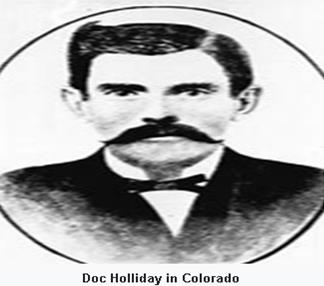
Holliday headed to Denver, following the stage routes and gambling at towns and army outposts along the way. During the summer of 1875, he settled in Denver under the alias "Tom Mackey" and found work as a Faro dealer for John A. Babb's Theatre Comique at 357 Blake Street.
He got in an argument with Bud Ryan, a well-known and tough gambler. They drew knives and fought and Holliday left Ryan seriously wounded.
196
O.K. Corral
Holliday left when he learned about gold being discovered in Wyoming.
On February 5th, 1876, he arrived in Cheyenne. He found work as a Faro dealer for Babb's partner, Thomas Miller, who owned the Bella Union Saloon. In the fall of 1876, Miller moved the Bella Union to Deadwood, site of the gold rush in the Dakota Territory, and Holliday went with him.
197
In 1877, Holliday returned to Cheyenne, then Denver, and eventually to Kansas, where he visited an aunt. When he left Kansas, he went to Breckenridge, Texas, where he gambled. On July 4th, 1877, after a disagreement with gambler Henry Kahn, Holliday beat him repeatedly with his walking stick. Both men were arrested and fined, but Kahn was not finished. Later that same day, he shot and seriously wounded the unarmed Holliday. On July 7th, the “Dallas Weekly Herald”
incorrectly reported that Holliday had been killed. His cousin, George Henry Holliday, moved west to help him recover.
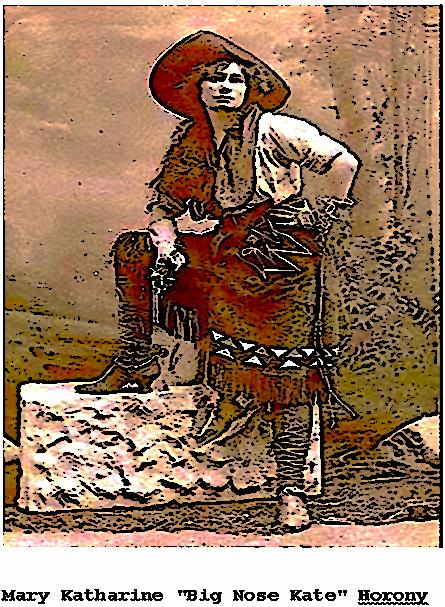
Once healed, Holliday relocated back to his Fort Griffin, Texas hometown, after having “set the accounts straight with Kahn, who didn’t have time to make a plea deal.” While dealing cards at John Shanssey's saloon, he met Mary Katharine "Big Nose Kate" Horony, a dance hall woman and occasional prostitute. One may have guessed that her nose was a prominent feature. "Tough, stubborn and fearless,"
she was educated, but chose to work as a prostitute because she liked her independence. She is the only woman with whom Holliday is known to have had a long term relationship.
198
O.K. Corral
In October 1877, outlaws led by "Dirty" Dave Rudabaugh robbed a Santa Fe Railroad construction camp in Kansas. Rudabaugh fled south into Texas. Wyatt Earp, was given a temporary commission as deputy US marshal. Earp left Dodge City, following Rudabaugh over 400 miles to Fort Griffin, a frontier town on the Clear Fork of the Brazos River.
Earp went to the Bee Hive Saloon, the largest in town and owned by 199
John Shanssey, whom Earp had met in Wyoming when he was 21.
Shanssey told Earp that Rudabaugh had passed through town earlier in the week, but he did not know where he was headed. Shanssey suggested Earp ask gambler Doc Holliday, who had played cards with Rudabaugh. Holliday told Earp that he thought Rudabaugh was headed back to Kansas. Earp sent a telegram to Ford County Sheriff Bat Masterson that Rudabaugh might be headed back in his direction.
After about a month in Fort Griffin, Earp returned to Fort Clark and in early 1878, he went to Dodge City, where he became the assistant city marshal, serving under Charlie Bassett. During the summer of 1878, Holliday and Horony also arrived in Dodge City, where they stayed at Deacon Cox's boarding house as Dr. and Mrs. John H. Holliday.
Holliday sought to practice dentistry again, and ran an advertisement in the local paper; “John H. Holliday, Dentist, very respectfully offers his professional services to the citizens of Dodge City and surrounding county during the Summer. Office at Room No. 24 Dodge House. Where satisfaction is not given, money will be refunded.”
200
According to accounts of the following event, reported by Glenn Boyer in “I Married Wyatt Earp,” Earp had run two cowboys, Tobe Driscall and Ed Morrison, out of Wichita earlier in 1878. During the summer, the two cowboys accompanied by another two dozen men rode into Dodge and shot up the town while galloping down Front Street. They entered the Long Branch Saloon, vandalized the room and harassed the customers.
Hearing the commotion, Earp burst through the front door and before he could react, a large number of cowboys were pointing their guns at him. In another version, he was still outnumbered, though there were only three to five cowboys. In both stories, Holliday was playing cards in the back of the room and upon seeing the commotion, drew his weapon and put his pistol at Morrison's head, forcing him and his men to disarm, rescuing Earp from a bad situation. No account of any such confrontation was reported by any of the Dodge City newspapers at the time. Whatever actually happened, Wyatt Earp credited Holliday with saving his life that day, and the two men became best of friends for life.
201
O.K. Corral
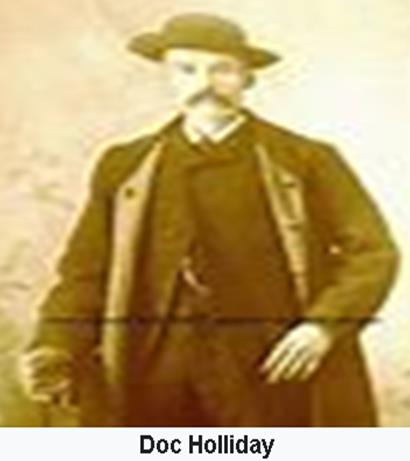
Holliday was still practicing dentistry from his room in Fort Griffin, Texas, and in Dodge City, Kansas. In an 1878 Dodge newspaper advertisement, he promised money back for less than complete customer satisfaction. However, this was the last known time that he worked as a dentist. He gained the nickname "Doc" during this period.
202
Holliday reportedly engaged in a gunfight with a bartender named Charles White. Miguel Otero, who would later become governor of the New Mexico Territory, said he was present when Holliday walked into the saloon with a cocked revolver in his hand and challenged White to settle an outstanding argument. White was serving customers at the time and took cover behind the bar, then started shooting at Holliday with his revolver. During the fight, Holliday shot White in the scalp. But there are no contemporaneous newspaper reports of the incident. Doc told Wallace that “White’s scalp was clean off, like an Injun with a hatchet would do.”
Bat Masterson reportedly said that Holliday was in Jacksboro, Texas, and got into a gunfight with an unnamed soldier whom Holliday shot and killed. Historian Gary L. Roberts found a record for a Private Robert Smith who had been shot and killed by an "unknown assailant"
March 3rd, 1876, but Holliday was never charged with the death. Doc said; “Bat saw me. Smith never will.”
Without trying Holliday developed a reputation for his skill with a gun, as well as with the cards. A few days before Christmas in 1878, 203
Holliday and Horony arrived in Las Vegas, New Mexico. The twenty-two hot springs near the town were favored by individuals with tuberculosis for their alleged healing properties. Doc opened a dental practice and continued gambling as well, but the winter was unseasonably cold and business was slow. The New Mexico Territorial Legislature passed a bill banning gambling within the territory with surprising ease. On March 8th, 1879, Holliday was indicted for
"keeping a gaming table" and was fined $25. The ban on gambling combined with extreme low temperatures persuaded him to return to Dodge City for a few months.
In September 1879, Wyatt Earp resigned as assistant marshal in Dodge City. Accompanied by his common-law wife Mattie Blaylock, his brother Jim, and Jim's wife Bessie, they left for Arizona Territory.
Holliday and Horony returned to Las Vegas where they met again with the Earps. The group arrived in Prescott in November.
In Dodge City, Holliday joined a team being formed by Deputy US
Marshal Bat Masterson. Masterson had been asked to prevent an outbreak of guerrilla warfare between the Atchison, Topeka and Santa 204
Fe Railway and the Denver and Rio Grande Western Railroad (D&RGW), which were vying to be the first to claim a right of way across the Royal Gorge, one of the few natural routes through the Rockies that crossed the Continental Divide. Both were striving to be the first to provide rail access to the boom town of Leadville, Colorado. Royal Gorge was a bottleneck along the Arkansas River, too narrow for both railroads to pass through, and with no other reasonable access to the South Park area. Doc remained there for about two and a half months.
The federal intervention prompted the so called "Treaty of Boston" to end the fighting. The D&RGW completed its line and leased it for use by the Santa Fe. Holliday took home a share of a $10,000 bribe paid by the D&RGW to Masterson to give up their possession of the Santa Fe roundhouse, and returned to Las Vegas where Horony had remained.
The Santa Fe Railroad built tracks to Las Vegas, New Mexico, but bypassed the city by about a mile. A new town was built up near the tracks and prostitution and gambling flourished there. On July 19th, 1879, Holliday and John Joshua Webb, former lawman and gunman, were seated in a saloon. Former US Army scout Mike Gordon tried to persuade one of the saloon girls, a former girlfriend, to leave town with 205
him. She refused and Gordon left the building "shouting obscenities,"
followed by Holliday. Gordon fired a shot at Holliday and subsequently
"Gordon died" the day after. The next day, Holliday paid $372.50 to a carpenter to build a clapboard building to house the Doc Holliday Saloon with John Webb as his partner. While in town, he was fined twice for keeping a gambling device, and again for carrying a deadly weapon.
It appeared Holliday and Horony were settling into life in Las Vegas when Wyatt Earp arrived on October 18th, 1879. He told Holliday he was headed for the silver boom going on in Tombstone, Arizona Territory. Holliday and Horony joined Wyatt and his wife Mattie, as well as Jim Earp and his wife and stepdaughter, and they left the next day for Prescott, Arizona Territory. They arrived within a few weeks and went straight to the home of Constable Virgil Earp and his wife Allie.
Holliday and Horony checked into a hotel and when Wyatt, Virgil, and James Earp with their wives left for Tombstone, Holliday remained in Prescott, where he thought the gambling opportunities were better.
Holliday finally joined the Earps in Tombstone in September 1880.
Some accounts report that the Earps sent for Holliday for assistance 206
with dealing with the outlaw Cowboys. Holliday quickly became embroiled in the local politics and violence that led up to the gunfight at the O.K. Corral in October 1881, again making at most minimal effort to do so.
Holliday and Horony had many fights. After a particularly nasty, drunken argument, Holliday kicked her out. County Sheriff Johnny Behan and Milt Joyce, both members of the Ten Percent Ring, saw an opportunity and exploited the situation. They plied Horony with more liquor and suggested to her a way to get even with Holliday. She signed an affidavit implicating Holliday in an attempted robbery and murder of two men aboard a Kinnear and Company stage coach on March 15th, 1881, carrying US$26,000 in silver bullion.
Bob Paul, who had run for Pima County sheriff and was contesting the election he lost due to ballot stuffing, was working as the Wells Fargo shotgun messenger. He had taken the reins and driver's seat in Contention City because the usual driver, a well-known and popular man named Eli "Budd" Philpot, was ill. Paul was riding in Philpot's 207
place as shotgun when three cowboys stopped the stage between Tombstone and Benson, Arizona and tried to rob it.
Paul fired his shotgun and emptied his revolver at the robbers, wounding a cowboy, later identified as Bill Leonard, in the groin.
Philpot and passenger Peter Roerig, riding in the rear dickey seat, were both shot and killed. Holliday was a good friend of Leonard, a former watchmaker from New York. Based on the affidavit sworn by Horony, Judge Wells Spicer issued an arrest warrant for Holliday.
Rumors flew that Holliday had taken part in the shooting and murders.
Later that day Holliday returned, drunk, to Milt Joyce’s saloon. He insulted Joyce and demanded his firearm back. Joyce refused and threw him out, but Holliday came back carrying a revolver and started firing. Joyce pulled out a pistol and Holliday shot the revolver out of Joyce's hand, putting a bullet through his palm. When Joyce's bartender, Parker, tried to grab his gun, Holliday wounded him in the toe. Joyce picked up his pistol and pistol whipped Holliday, knocking him out. Holliday shot and wounded both men and was subsequently 208
convicted of assault. Doc said; “The altercation was over when Joyce and Parker took up business in more gentle climes.”
The Earps found witnesses who could attest to Holliday's location elsewhere at the time of the stagecoach murders, and a sober Horony confessed that Behan and Joyce had influenced her to sign a document she did not understand. With the cowboy plot revealed, Judge Spicer freed Holliday. The district attorney dismissed the charges, labeling them "ridiculous." Holliday gave Horony some money and put her on a stage out of town.
The card game of Faro has been and will continue to be mentioned many times herein. It was the most popular gambling game of the early Wild West, replaced later by simpler poker. While Faro has also been characterized as simple, most gambling games are, and it might suffice to point out that Faro is more reliant on logic and memory, while it also allows for a virtually unlimited number of players.
How to Play Faro
1 - Setup
209
2 - Gameplay
3 - Special Bets
If you're looking to play a classic Old West gambling game, Faro is a perfect addition for any casino night or party. In Faro, players place bets on which cards they think will get drawn from the deck and can win big if they predict them correctly.
1 - Setup
1 - 1
Give each player betting chips and a penny. Any number of people can play Faro, but just use different color poker chips for each player so you can tell your bets apart. Hand everyone a penny as well that they can use to make alternative bets later on too.
1 - 2
Lay out all of the cards of one suit face up on the table. Traditionally, you would put spades out on the table, but you can use any suit you want. Set the Ace, 2, 3, 4, 5, and 6 in one row and King, Queen, Jack, 210
10, 9, and 8 in a row directly below the first. Set the 7 card on the end of the rows next to the 6 and 8.
You’ll place your chips on the cards when you want to make a bet.
If you’re playing at a casino, the card ranks will be printed on the table.
1 - 3
Shuffle a full deck of cards. Use a standard 52 card deck with all four suits and choose someone to be the dealer, also known as the banker.
Mix the cards up really well and be careful not to let any of the other players see the order of the cards.
If you want a more secure way to prevent people from peeking at the cards, load the deck into a dealing shoe. A shoe is a container you can draw the cards from while still keeping the deck hidden.
1 - 4
Discard the top card of the deck face up in the middle of the table. The first card of the deck is called the “soda” and doesn’t count toward 211
any bets in the game. Take the soda card off of the deck and set it to the side for everyone to see.
Variation: Keep the soda card face down and hidden from other players. That way, they won’t be able to count cards and their bets will be a small degree more of a gamble.
2 - Gameplay
2 - 1
Place a betting chip on which card rank you think will be drawn second. Start with the player to the left of the dealer. Make a guess at which card you think the banker will draw from the deck during the round. When you make your decision, take one of the chips from your stack and place it on top of the card rank in the middle of the table.
You only need to bet on the rank of the card. The suit doesn’t matter for your bet.
Multiple players can bet on the same card rank.
2 - 2
212
Flip over the top 2 cards of the deck for the losing and winning rank.
After all the bets have been placed, have the dealer reveal the top card of the deck to determine the losing rank. Then, they’ll flip the next card from the deck to determine the winning rank for the current round.
2 - 3
Win your bet if you chose the winning rank. If you placed a chip on the rank that won the round, you win at 1 to 1 odds, meaning you get an amount equal to the bet you made plus your original bet back. Take any chips you won back into your own personal stack.
If you placed your bet on the losing rank, then you lose them to the banker.
If the winning and losing cards are the same rank, then you win back half of your bet.
If no one wins the bet, all of the bets stay on the table and you continue playing.
2 - 4
213
Set the winning and losing cards face up in the middle of the table.
Place the losing card next to the soda card you discarded at the start of the game. Place the winning card on top of the soda card, but keep its rank visible so all of the players can see what’s already been drawn.
As the game goes on, you’ll see what cards have already been drawn, so you can make a better guess on which cards will come out of the deck next.
2 - 5
Change, remove, or add to your bets for the next round. After the first round, leave any bets that didn’t win or lose on the cards in the middle of the table. Go clockwise around the table choosing if you want to add another chip to a bet you already made, put a chip on a second card rank, move your chips to a different rank, or remove an old bet back to your personal stack of chips.
You can place a bet on multiple ranks on the same turn.
There’s no limit to how many chips you can have on a card rank.
214
2 - 6
Play rounds until the deck runs out. Keep taking turns betting and revealing two cards at a time, a loser and a winner, to go through the deck. Players can choose to stop playing or come back in whenever they want as long as there are still cards left in the deck. Once you reveal the last cards, you can end the game or reshuffle all of the cards to start again.
3 - Special Bets
3 - 1
Put your chip in between 2 or 4 cards to bet on multiple ranks. Instead of choosing only 1 card rank, set your chip in the spaces between the cards. If you place the chip in the middle of the 2 rows so it touches the corners of 4 cards, then you place your bet on all of them. If any of the cards are the winning rank, you still win at 1 to 1 odds, but you lose if any of the cards are the loser.
215
If you placed bets on multiple cards and one is the winner and another is the loser, then it’s considered a “wash” and your chips stay on the ranks.
3 - 2
Place a penny on your betting chip to bet on the loser. Instead of choosing which card you think will win, set your penny on one of your bets if you think the rank will lose the round. If the losing card matches the rank you bet on, you win your bet at 1 to 1 odds.
You can bet on the losing rank and the winning rank in the same turn.
3 - 3
Make a bet that the winning card is higher than the losing one. Rather than betting on the exact rank of the cards, you may have better odds of betting on the high card. Set your chip next to the dealer and say,
"High Card." If the winning card has a higher rank than the losing card, you win at 1 to 1 odds.
Faro boards at casinos will have an area marked “High Card” for you to place your bets.
216
3 - 4
Call a “dead bet” if someone else bets on a rank that’s been drawn four times. If four copies of the card have already been revealed, then there aren’t any more in the deck. Keep your eye on the cards that have already been drawn and what players have bet on. Anyone that notices a bet on a rank that can’t be drawn anymore can say “dead bet,” and immediately earn the value of the bet.
Keep an eye on your own chips as well so you don’t lose any of your bets.
3 - 5
Bet on the order of the final three cards for increased odds and payout.
At the end of the game, there will be three cards left in the deck.
Rather than betting on the winner and loser, look at the cards that have already been revealed and guess which card will come out first, second, and third. If you guess the order exactly, then you win your bet at 5 to 1 odds.
217
For example, if you bet 1 chip on the order and got it right, you would win 5 chips and your original bet back. You can easily see how certain bets are unwise when the remaining deck is unknown, but become more attractive when more cards are known.
218
5B - Virgil Earp
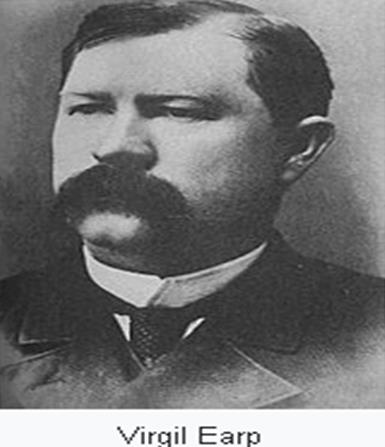
Virgil Earp was born in Hartford, Kentucky, July 18th, 1843, the second son of Nicholas Earp and Virginia Ann Cooksey. In February 1860, while living in Pella, Iowa, sixteen year old Virgil eloped with seventeen year old Dutch immigrant Magdalena C. "Ellen" Rysdam, born October 25th, 1842 in Utrecht, Netherlands, and living until May 3rd, 1910 in Cornelius, Oregon. One report states that they saw each other only occasionally and kept their marriage secret until Ellen was about to deliver their first child. When her parents Gerrit Rysdam and Magdalena Catrina Van Velzen learned of the marriage, they were furious, as they preferred that she marry a man who was also Dutch.
Virgil's father thought he was too young to marry. Both parents wanted to get the marriage annulled. One source reports that Rysdam was successful, but another says her father failed because Virgil and Ellen refused to reveal where they had been married. They also claimed they had used false names, which would have made the marriage invalid in any case.
219
O.K. Corral
Virgil and Ellen remained together for a year in spite of his and her parents' disapproval. On July 26th, 1861, Virgil enlisted at age eighteen in the Union Army. Ellen had a daughter named Nellie Jane, born January 7th, 1862 or in July 1862. Virgil was mustered in to the Illinois Volunteer Infantry for three years on September 21st, 1862.
220
Virgil was assigned to the 83rd Illinois Infantry on August 21st, 1863.
The 83rd was primarily on garrison duty in Tennessee. Virgil was court martialed for a minor offense and docked two week’s pay as punishment.
In the summer of 1863 while Virgil was on active duty, Ellen's father told her that Virgil had been killed in Tennessee. In early 1864, Ellen married a Dutch man named John Van Rossum, and in May of that year they joined a large group who relocated from Pella, Iowa, to the Oregon Territory.
When Virgil was discharged from the military on June 26th, 1865, he returned to Iowa but could not find his wife and daughter. He hired on at a local farm and helped operate a grocery store, before leaving for California to join the rest of the Earp family. In 1868, Nicholas Earp took the family east again, eventually settling in Lamar, Missouri. On August 28th, 1870, Virgil married Rosella Dragoo, born in France in 1853, in Lamar. His father as justice of the peace married them, but there are no further records of Rosella.
221
Virgil later met Alvira "Allie" Sullivan from Florence, Nebraska in 1874.
She was a waitress at the Planter's House Hotel in Council Bluffs, Iowa. They never married but remained together the rest of his life.
During the remainder of his life, Virgil worked at a variety of jobs, including peace officer, farmer, did rail construction in Wyoming, stagecoach driver, sawmill sawyer in Prescott, Arizona Territory, mailman, and later in life, prospector. The Earp brothers were close and often moved together, seeking a better life in booming towns.
Virgil spent time in Dodge City, Kansas in 1877 with his younger brother Wyatt, and though there is no record of Virgil ever holding any law enforcement position there, Allie claimed he briefly worked as a deputy town marshal with Wyatt.
From Dodge City, Virgil and Allie moved to Prescott on the 4th of July 1877, the capital of the Arizona Territory. Virgil first delivered mail in Miller Valley, then later owned a saw mill at the base of Thumb Butte, just west of Prescott.
On October 16th, 1877, US Marshal Wiley Standifer, Yavapai County Sheriff Edward Franklin Bowers, Prescott Constable Frank Murray, 222
Virgil Earp, and Colonel William Henry McCall attempted to arrest John Tallos and accused murderer George Wilson. While the others rode on horseback or carriages, Virgil ran on foot after the posse that pursued the two men to the edge of town, where a gun fight broke out. Virgil spotted one of the two men under a tree, reloading his pistol. Using a Winchester rifle from a distance, Virgil shot him through the head, killing him.
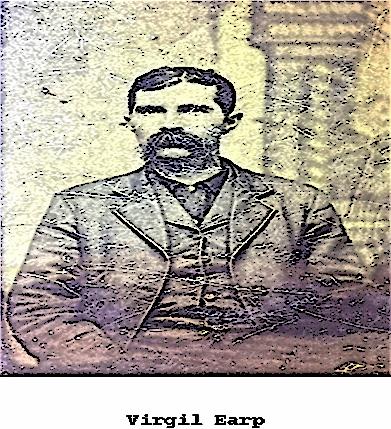
Virgil was shortly afterward offered a job as a driver for Patterson, Caldwell and Levally, a local freight company, during which he met John J. Gosper, Secretary of the Arizona Territory. Gosper was acting Governor in the place of Governor John C. Frémont, who was frequently absent. When Crawley Dake was appointed US Marshal, he and Virgil became friends. In 1878, Virgil was appointed as Prescott's night watchman, which paid $75 a month.
223
O.K. Corral
In November 1878, he was elected as constable for Prescott, for which he received fees for serving summonses, subpoenas, writs and warrants. While constable, Virgil wrote his brother Wyatt about the opportunities in the silver mining boomtown of Tombstone. In September 1879, Wyatt resigned as assistant marshal in Dodge City.
Accompanied by his common-law wife Mattie Blaylock, his brother Jim 224
and his wife Bessie, they left for Las Vegas in the New Mexico Territory. There they were reconnected with Doc Holliday and his common-law wife Kate Horony, who had been running a gambling business until the territorial legislature banned gambling. Virgil and his wife met the others in Prescott.
Knowing Virgil was moving to Tombstone, and knowing of his peace officer background, US Marshal Crawley Dake appointed Virgil as Deputy US Marshal for the Tombstone District of Pima County, on November 27th, 1879. He was instructed by Dake to help resolve ongoing problems with outlaw Cowboys. But the job didn't pay much.
He was mostly on call helping county and city officials.
In an interview after he left Tombstone, Virgil said that; "The first stage that went out of Prescott toward Tombstone was robbed.
Robberies were frequent and became expensive." Virgil and his brothers Wyatt and Jim and their wives arrived together in Tombstone on December 1st, 1879.
On October 30th, 1880, after town marshal Fred White was shot and killed by outlaw and gunman "Curly Bill" Brocius, Virgil was appointed 225
acting town marshal of Tombstone. Virgil now held both the more powerful local town marshal position and the prestigious federal law enforcement position. As town marshal, Virgil earned a regular salary of $100 a month plus a percentage of the city taxes he collected.
But Virgil did not hold the job for long. The city held a special election on November 13th, and Tombstone city policemen James Flynn and Ben Sippy competed for the job. But then Flynn dropped out of the race and Sippy beat Virgil for the office, 311 votes to Earp's 259. On January 4th, 1881, the city held its first regular election, and Virgil lost to Sippy once again.
However, Sippy was known to be in financial trouble. He requested a two week leave of absence on June 6th, 1881, and never returned. The city council once again appointed Virgil as temporary city marshal. On June 22nd, the center section of Tombstone was devastated by a fire.
Virgil kept looting under control and chased off lot jumpers who tried to take over property. On June 28th, it was learned that Sippy had left about $3,000 in bad debts and financial improprieties while in his 226
office. Virgil was appointed by Tombstone Mayor John Clum as the permanent city marshal and paid $150 per month.
To reduce crime in Tombstone, the City Council enacted an ordinance in April 1881 that prohibited anyone from carrying a deadly weapon in town. Everyone was required to deposit their weapons at a livery or saloon soon after entering town. A long simmering feud between the Earps and some of the Cowboys played a big role in a gunfight that broke out when Virgil decided to enforce the ordinance on Wednesday, October 26, 1881.
Virgil was told by several concerned citizens that several Cowboys, who had been threatening the Earps for several months, were in town and armed in violation of the ordinance. Assisted by his deputy Morgan Earp and temporary deputies Wyatt Earp and John "Doc" Holliday, Virgil went to disarm Frank and Tom McLaury, Ike and Billy Clanton, and Billy Claiborne. That confrontation turned into the shootout now known as the gunfight at the O.K. Corral.
The gunfight and later media portrayals made Wyatt Earp a legend. He is often depicted as the central lawman, but he was only Virgil's 227
temporary assistant. Wyatt had acted as city marshal the week prior when Virgil was out of town. Virgil was the city marshal and deputy US
marshal. Although Wyatt had previously served in Wichita, Kansas, and Dodge City as a lawman, Virgil had three years of Civil War service, which had given him more combat and shooting experience. He had also served as a lawman off and on since the war.
Before the gunfight at the O.K. Corral, Virgil and Wyatt had been in only one shootout each, and Morgan had never been in any gun battles. Billy Claiborne had been in one gunfight prior to the shootout and was the only member of the Cowboy faction that had prior gun fighting experience, not counting the Skeleton Canyon massacre, in which the McLaurys and Clantons took part. Doc Holliday, despite his reputation, had no documented “stand up” gunfights to his credit, but he did have several drunken potshots and brawls in saloons, not counting tales of fights with unnamed men some claimed he had shot.
Doc said; “I planted a few weeds.” Both Tom and Ike had spent the night gambling, drinking heavily, and were without sleep. Now they were both out of doors, both wounded from having been pistol whipped by the Earps earlier that morning, and at least Ike was still drunk.
228
Virgil initially avoided a confrontation with Frank McLaury and Billy Clanton, who had arrived in town early that afternoon and had not yet deposited their weapons at a hotel or stable soon after their arrival, as required by ordinance #9. Virgil had been offered armed assistance from the town Vigilance committee and the town militia, but he declined the help. Around 1:00 PM, a miner named Ruben F. Coleman told Virgil that the Cowboys had left the Dunbar and Dexter Stable for the O.K. Corral and were still armed, and Virgil decided he had to disarm them.
Virgil testified after the shootout that he thought he saw all four men, Ike Clanton, Billy Clanton, Frank McLaury, and Tom McLaury, buying cartridges at Spangenberg's gun shop beforehand. He went by the Wells Fargo office around the corner on Allen Street and picked up a 10 or 12 gauge short, double barreled shotgun. It was an unusually cold and windy day in Tombstone, and Virgil was wearing a long overcoat. To avoid alarming Tombstone's public, Virgil and Doc Holliday hid their shotguns under their overcoats when they returned to Hafford's Saloon.
229
Virgil, his brothers Wyatt and Morgan, and Doc Holliday confronted the Cowboys in a narrow lot on Fremont Street. Virgil was not expecting a fight. He later testified that when he saw the Cowboys, he immediately commanded them to "Throw up your hands, I want your guns!" But general shooting broke out almost immediately. Witnesses were conflicted about who fired first.
230
5C - Wyatt Earp
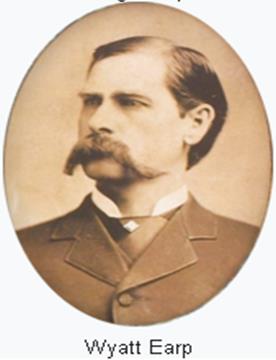
Wyatt Berry Stapp Earp, March 19, 1848 – January 13, 1929, was an American lawman and gambler in the American West, including Dodge City, Deadwood, and Tombstone. Earp took part in the famous gunfight at the O.K. Corral. Despite being far from a slouch, he is often erroneously regarded as the central figure in the shootout, although his brother Virgil was the Tombstone City and Deputy US Marshal that day and had far more experience in combat as a sheriff, constable, marshal, and soldier, and that Doc Holliday likely did the bulk of the well placed shooting.
In 1874, Earp arrived in the boomtown of Wichita, Kansas, where his reputed wife opened a brothel. He was appointed to the Wichita police force and developed a solid reputation as a lawman but was fined and
"not rehired as a police officer" after getting into a physical altercation with a political opponent of his boss. Earp immediately left Wichita, following his brother James to Dodge City, Kansas, where he became an assistant city marshal. In late 1878, he went to Texas to 231
track down an outlaw and met John "Doc" Holliday, whom Earp credited with saving his life.
Throughout his life, Earp moved between boomtowns. He left Dodge in 1879 and moved with brothers James and Virgil to Tombstone, where a silver boom was underway. The Earps clashed with a group of outlaws known as the "Cowboys". Wyatt, Virgil, and younger brother Morgan, and Doc Holliday held various law enforcement positions that put them in conflict with Tom McLaury, Frank McLaury, Ike Clanton, and Billy Clanton, who threatened to kill the Earps and Holliday on several occasions.
Wyatt Berry Stapp Earp was born on March 19th, 1848, the fourth child of Nicholas Porter Earp and his second wife, Virginia Ann Cooksey. He was named after his father's commanding officer in the Mexican–
American War, Captain Wyatt Berry Stapp, of the 2nd Company Illinois Mounted Volunteers. Some evidence supports Wyatt Earp's birthplace as 406 S. 3rd St. in Monmouth, Illinois, though the street address is disputed by a professor and a historian. Nonetheless, the Wyatt Earp Birthplace, Inc., 1986, was placed on the National Register of Historic 232
O.K. Corral
Places in 1999. The Illinois Historic Preservation Agency visited the home at 406 South 3rd Street and submitted the nomination. Wyatt had seven full siblings; James, Virgil, Martha, Morgan, Warren, Virginia, and Adelia, and an elder half-brother, Newton, from his father's first marriage.
In March 1849 or in early 1850, Nicholas Earp joined about 100 other people in a plan to relocate to San Bernardino County, California, 233
where he intended to buy farmland. Just 150 miles west of Monmouth on the journey, their daughter Martha became ill. The family stopped and Nicholas bought a new 160 acre farm 7 miles northeast of Pella, Iowa. Martha died there on May 26th, 1856.
Nicholas and Virginia Earp's last child, Adelia, was born in June 1861
in Pella. Newton, James, and Virgil joined the Union Army on November 11th, 1861. Their father was busy recruiting and drilling for local companies, so Wyatt and his two younger brothers, Morgan and Warren, were left in charge of tending 80 acres of corn. Wyatt was only 13 years old, too young to enlist, but he tried on several occasions to run away and join the army. Each time, his father found him and brought him home. James was severely wounded in Fredericktown, Missouri, and returned home in the summer of 1863. Newton and Virgil fought several battles in Missouri, Mississippi, and Tennessee, and later followed the family to California.
On May 12th, 1864, Nicholas Earp organized a wagon train and headed to San Bernardino, California, arriving on December 17th. By late summer 1865, Virgil found work as a driver for Phineas Banning's 234
stage coach line in California's Imperial Valley, and 16 year old Wyatt assisted. In spring 1866, Wyatt became a teamster transporting cargo for Chris Taylor. From 1866-68, he drove cargo over 720 miles on a wagon road from Wilmington through San Bernardino, then Las Vegas, Nevada, to Salt Lake City, Utah Territory.
In spring 1868, Earp was hired to transport supplies needed to build the Union Pacific Railroad. He learned gambling and boxing while working on the rail head in the Wyoming Territory. He developed a good reputation officiating boxing matches and refereed a fight between John Shanssey and Prof. Mike Donovan on July 4th, 1869, in Cheyenne, Wyoming, in front of 3,000 spectators.
In spring of 1868, the Earps moved east again to Lamar, Missouri, where Wyatt's father Nicholas became the local constable. Wyatt rejoined the family the next year. Nicholas resigned as constable on November 17th, 1869, to become the Justice of the Peace. Wyatt was appointed constable in his place.
Wyatt Earp and his brother Virgil visited their family in Monmouth, Illinois. Afterward, Virgil went to Missouri and Wyatt went to 235
Beardstown, Illinois, 70 miles south where he spent the summer of 1869. Beardstown was undergoing a boom thanks to a rail line being laid through town.
During mid 1869 in Beardstown, Illinois, a railroad brakeman named Tom Piner mocked Wyatt, calling him "the California boy," a euphemism for coward, implying that Wyatt had gone to California to avoid serving in the Civil War. Although Wyatt had attempted to join the army, he'd been stopped by his father, and he took offense at Piner's remarks. They fought and Wyatt tossed Piner outside. Piner drew his gun, and Wyatt armed himself. The two men exchanged shots, leaving Piner wounded in the hip.
In late 1869, Earp courted 20 year old Urilla Sutherland, daughter of William and Permelia Sutherland who operated the Exchange Hotel in Lamar. They were married by Earp's father on January 10th, 1870.
Wyatt bought a lot on the outskirts of town for $50 where he built a house in August 1870. Urilla was about to deliver their first child when she suddenly died from typhoid fever. In November, Earp sold the lot and house for $75. He ran against his elder half-brother Newton for the 236
office of constable and won by 137 votes to Newton's 108, but their father lost the election for Justice of the Peace in a very close four way race.
Earp went through a downward spiral after Urilla's death, and he had a series of legal problems. On March 14th, 1871, Barton County, Missouri, filed a lawsuit against him and his sureties. He was in charge of collecting license fees for Lamar which funded local schools, and he was accused of failing to turn them in. On March 31st, James Cromwell filed a lawsuit against him alleging that he had falsified court documents concerning the amount of money that Earp had collected from Cromwell to satisfy a judgment. The court seized Cromwell's mowing machine and sold it for $38 to make up the difference between what Earp turned in and what Cromwell owed.
Cromwell's suit claimed that Earp owed him $75, the estimated value of the machine.
Earp, Edward Kennedy, and John Shown were charged with stealing two horses on March 28th, 1871, from William Keys while in the Indian country, "each of the value of $100." On April 6th, Deputy US Marshal 237
J. G. Owens arrested Earp for the horse theft, and Commissioner James Churchill arraigned him on April 14th and set bail at $500. On May 15th, an indictment was issued against Earp, Kennedy, and Shown. John Shown's wife Anna claimed that Earp and Kennedy got her husband drunk and then threatened his life to persuade him to help. On June 5th, Kennedy was acquitted while the case remained against Earp and Shown. Earp did not wait for the trial but climbed out through the roof of his jail and headed for Peoria, Illinois.
Earp was listed in the Peoria city directory during 1872 as a resident in the home of Jane Haspel at Washington Street near the corner of Hamilton, although Stuart N. Lake took notes of a conversation with Earp years later in which Earp claimed that he'd been hunting buffalo during the winter of 1871–72. Peoria police raided Haspel's home on February 24th, 1872 and arrested four women, Wyatt and Morgan Earp, and George Randall. The men were charged with "keeping and being found in a house of ill fame," and later fined $20 and court costs. Both Earps were arrested for the same crime again on May 11th. "Wyatt Earp and his brother Morgan Earp were each fined $44.55 and as they had not the money and would not work, they languish in the cold and 238
silent calaboose.” The size of the fines may indicate that the judge considered them to be pimps and not merely customers. In Root’s Peoria City Directory for 1872-73, Wyatt Earp was living at the same address as Jane Haspel. The city directory was published on March 1st, 1872, indicating that Wyatt was residing in the Haspel home and brothel, not merely patronizing it, at the time of his arrest.
On their sister Adelia's eleventh birthday, June 16th, 1872, the two men visited her in the family home in Lamar, Missouri. “The Peoria Daily National Democrat” reported that Earp had been arrested once more on September 10th, 1872, and this time he was on a floating brothel named the Beardstown Gunboat owned by John T. Walton. A prostitute named Sally Heckell was arrested with him, and she called herself his wife. She was likely the 16 year old daughter of Jane Haspel.
Some of the women were said to be good looking, but all appeared to be terribly depraved. John Walton, the skipper of the boat and Wyatt Earp, the Peoria Bummer, were each fined $43.15. Sarah Earp, alias Sally Heckell, called herself the wife of Wyatt Earp.
239
By calling Earp the "Peoria Bummer," the newspaper was putting him in a class of "contemptible loafers who impose on hard working citizens," a "beggar," and worse than tramps. They were men of poor character who were chronic lawbreakers, and Peoria constables probably considered him to be a pimp. Earp wrote Lake many years later that he "arrived in Wichita direct from my buffalo hunt in '74," so he may have hunted buffalo between 1873 and 1874, although there's no evidence that he ever did so.
In early 1874, Earp and Sally moved to the growing cow town of Wichita where his brother James ran a brothel. Local arrest records show that Sally and James's wife Nellie "Bessie" Ketchum operated a brothel there from early 1874 to the middle of 1876. Wyatt may have been a pimp, but he was more likely an enforcer or a bouncer for the brothel. When the Kansas state census was completed in June 1875, Sally was no longer living with Wyatt, James, and Bessie.
Wichita was a railroad terminal and a destination for cattle drives from Texas. The town would fill with drunken, armed cowboys celebrating the end of their long journey when the cattle drives arrived, and 240
lawmen were kept busy. When the cattle drives ended and the cowboys left, Earp searched for something else to do. “The Wichita City Eagle” reported on October 29th, 1874, that he had helped an off duty police officer find thieves who had stolen a man's wagon. Earp officially joined the Wichita marshal's office on April 21st, 1875, after the election of Mike Meagher as city marshal, making $100 per month.
He also dealt Faro at the Long Branch Saloon. In late 1875, the
“Wichita Beacon” published this story; “On last Wednesday (December 8th), policeman Earp found a stranger lying near the bridge in a drunken stupor. He took him to the 'cooler' and on searching him found in the neighborhood of $500 on his person. He was taken next morning, before his honor, the police judge, paid his fine for his fun like a little man and went on his way rejoicing. He may congratulate himself that his lines, while he was drunk, were cast in such a pleasant place as Wichita as there are but a few other places where that $500 bank roll would have been heard from. The integrity of our police force has never been seriously questioned.”
Earp's stint as Wichita deputy came to a sudden end on April 2nd, 1876, when former marshal Bill Smith accused him of using his office 241
to help hire his brothers as lawmen. Earp beat Smith in a fist fight and was fined $30. The local newspaper reported; "It is but justice to Earp to say he has made an excellent officer." Meagher won the election, but the city council voted against rehiring Earp. His brother James opened a brothel in Dodge City, and Earp left Wichita to join him.
After 1875, Dodge City, Kansas, became a major terminal for cattle drives from Texas along the Chisholm Trail. Earp was appointed assistant marshal in Dodge City under Marshal Lawrence Deger around May 1876. At some point he met prostitute Mattie Blaylock, who became his common-law wife until 1881. Earp spent the winter of 1876–77 in the gold rush boomtown of Deadwood in the Dakota Territory. He and Morgan left Dodge for Deadwood on September 9th, 1876, with a team of horses, but they arrived there to find that all the land was already tied up in mining claims, so Morgan decided to return to Dodge. Instead of gambling, Wyatt made a deal to buy all the wood that a local individual had cut and put his horses to work that winter hauling firewood into camp. He made about $5,000 in profit but was unable to file any mining claims, so he returned to Dodge City in the spring.
242
He rejoined the Dodge City police in spring 1877 at the request of Mayor James H. Kelley. The Dodge City newspaper reported in July 1878 that he'd been fined $1 for slapping a muscular prostitute named Frankie Bell, who "heaped epithets upon the unoffending head of Mr.
Earp to such an extent as to provide a slap from the ex-officer,"
according to the account. Bell spent the night in jail and was fined $20, while Earp's fine was the legal minimum.
In October 1877, outlaw Dave Rudabaugh robbed a Santa Fe Railroad construction camp and fled south. Earp was given a temporary commission as deputy US Marshal and left Dodge City, following Rudabaugh over 400 miles through Fort Clark, Texas, where the newspaper reported his presence on January 22nd, 1878, and on to Fort Griffin, Texas.
He arrived at the frontier town on the Clear Fork of the Brazos River and went to the Bee Hive Saloon, the largest in town and owned by John Shanssey, whom Earp had known since he was 21. Shanssey told Earp that Rudabaugh had passed through town earlier in the week, but didn't know where he was headed. Shanssey suggested that Earp ask 243
gambler Doc Holliday, who played cards with Rudabaugh. Doc told Earp that Rudabaugh was headed back into Kansas.
By May 11th, 1878, the Dodge newspapers reported that Earp had returned. “The Dodge City Times” noted on May 14th that he'd been appointed Assistant Marshal for $75 per month, serving under Charlie Bassett. Doc Holliday also showed up in Dodge City with his common-law wife Big Nose Kate during mid-1878. Ed Morrison and another two dozen cowboys rode into Dodge in that time and shot up the town, galloping down Front Street. They entered the Long Branch Saloon, vandalized and harassed the customers. Hearing the commotion, Earp burst through the front door to find numerous guns pointing at him.
Another version of the story has it that only 3-5 cowboys were there. In both versions, Holliday was playing cards in the back and he put his pistol at Morrison's head, forcing him and his men to disarm. Earp credited Holliday with saving his life that day, and the two were friends ever since. While in Dodge City, Earp became acquainted with brothers James and Bat Masterson and gambler Luke Short.
244
George Hoyt and other drunken cowboys shot their guns wildly at about 3 AM on July 26th, 1878, including three shots into Dodge City's Comique Theater, causing comedian Eddie Foy, Sr. to throw himself to the stage floor in the middle of his act. Fortunately, no one was injured. Assistant Marshal Earp and policeman Bat Masterson responded, along with several citizens, and opened fire with their pistols at the fleeing horsemen. The riders crossed the Arkansas River bridge south of town but Hoyt fell from his horse, wounded in the arm or leg. Earp later told biographer Stuart Lake that he saw Hoyt through his gun sights, illuminated against the morning horizon, and he fired a fatal shot which killed him that day; but the “Dodge City Times”
reported that Hoyt developed gangrene and died on August 21st after his leg was amputated.
Dodge City had been a frontier cowtown for several years, but by 1879
it had begun to settle down. Virgil Earp was the town constable in Prescott, Arizona Territory, and he wrote to Wyatt about the opportunities in the silver mining boomtown of Tombstone. He later wrote; "In 1879, Dodge was beginning to lose much of the snap which 245
had given it a charm to men of reckless blood, and I decided to move to Tombstone, which was just building up a reputation."
Earp resigned from the Dodge City police force on September 9th, 1879, and traveled to Las Vegas in New Mexico Territory with his common-law wife Mattie, his brother Jim, and Jim's wife Bessie. There they reunited with Holliday and Big Nose Kate, and the six of them went on to Prescott. Virgil was appointed deputy US marshal for the Tombstone mining district on November 27th, 1879, three days before they left for Tombstone, by US Marshal for the Arizona Territory Crawley P. Dake. Virgil was to operate out of Tombstone, some 280
miles from Prescott, and his territory included the entire southeast area of the Arizona Territory. Wyatt, Virgil, and James Earp traveled to Tombstone. Tombstone had been founded on March 5th, 1879 with about 100 people living in tents and a few shacks. The Earps arrived with their wives on December 1st, 1879, while Doc Holliday remained in Prescott where the gambling afforded better opportunities.
Tombstone had already grown to about 1,000 residents. Wyatt brought horses and a buckboard wagon which he planned to convert into a 246
O.K. Corral