

O.K. Corral by Edward Drobinski - HTML preview
Download the book in PDF, ePub, Kindle for a complete version.
O.K. CORRAL
By
Edward Drobinski
Copyright © 2022 by Edward Drobinski
All rights reserved
1 - Intro and the Wallace Diary of Doc Holliday ..................................... 1
2 - The West at That Time ..................................................................... 35
4 - The Lawmen Before the Shootout ................................................... 87
5 - The Chiefly Tombstone Lawmen Before the Shootout ................. 187
6 - The Cowboys Before the Shootout ................................................ 305
7- The Chiefly Tombstone Cowboys Before the Shootout ................ 446
8 – The Unclearly Aligned Before the Shootout .................................. 508
8B– Sherman McMaster ........................................................................ 529
9 - The Bad Blood Prelude ................................................................... 531
10- The Shootout at the O.K. Corral .................................................... 561
11– The Trial, Lawsuit, and Investigation ........................................... 644
12 – Subsequent Retribution ................................................................. 656
13 - The Lawmen After the Shootout .................................................. 710
14 - The Chiefly Tombstone Lawmen After the Shootout .................. 760
14A- Doc Holliday Revisited .................................................................. 760
14B- Virgil Earp Revisited ..................................................................... 844
14C- Wyatt Earp Revisited .................................................................... 858
14D- Morgan Earp Revisited .................................................................. 898
14E- Warren Earp Revisited .................................................................. 909
14F- Bat Masterson Revisited ............................................................... 914
14G- Tom Fitch Revisited ...................................................................... 931
14H- Crawley P. Dake Revisited ........................................................... 942
15 - The Cowboys After the Shootout ................................................ 944
16 - The Chiefly Tombstone Cowboys After the Shootout .............. 1113
16A– Johnny Ringo Revisited.............................................................. 1113
16B– Ike Clanton Revisited ................................................................. 1122
16C– Billy Clanton Revisited ............................................................... 1137
16D– Frank McLaury Revisited ........................................................... 1141
16E– Tom McLaury Revisited .............................................................. 1143
16F– Billy Claiborne Revisited ............................................................ 1149
16G– Frank Stilwell Revisited ............................................................. 1157
16H- Charles A. Shibell Revisited ....................................................... 1166
16I- Pete Spence Revisited ................................................................ 1169
16J- Curly Bill Brocius Revisited ........................................................ 1172
16K- Phineas Clanton Revisited ......................................................... 1180
17– The Unclearly Aligned After the Shootout ................................. 1182
17A– Johnny Behan Revisited............................................................. 1182
17B- Sherman McMaster Revisited .................................................... 1194
18- Subsequent Tombstone .............................................................. 1196
O.K. Corral
1 - Intro and the Wallace Diary of Doc Holliday
The gunfight at the OK Corral, the Wild West’s most famous gun battle, lasted just thirty seconds with approximately thirty shots being fired.
Yet, that thirty seconds has resulted in numerous and uncountable following accounts, editing, mythological posturing, entertainment oriented productions, and deflating “studies” provided by modern historical “experts” who were invariably not there and thereby had not lived in the culture of the Wild West, yet would have you defer to their
“learned” editorials, the volume of which can fill the cyber space allocated to a moderately popular, twenty-first century purveyor of chat, truth, and misinformation. If that is what you seek you are in the wrong place.
1
While other accounts are referred to in an attempt to convey the full story, that of Doc Holliday is most prevalent herein. He just happened to be there and didn’t seem to have been “confused” by the “benefits”
of favorable publicity. The fast and deadly accurate man had a girl and a gun.
The gunfight occurred on October 26th, 1881, killing Tom McLaury, Frank McLaury and Billy Clanton. Virgil Earp, Morgan Earp, and Doc Holliday were wounded. Wyatt Earp was not injured in the shootout.
After the fight the bodies of the dead outlaws were displayed in a window at a local undertakers with the sign; “Murdered in the Streets of Tombstone.” Contrary to what has been depicted in movies about the gunfight at the OK Corral, the Cowboys did have some popular support, and the Earps and Holliday were not universally liked. Several hundred people joined the funeral procession for the dead Cowboys, and as many as 2,000 people watched from the streets.
The gunfight may have been the popular highpoint of the conflict between the Cowboys and the Earps, but the events attendant to this story lasted many more months.
2
Despite many months of Cowboy threats, Ike Clanton was able to file murder charges against the Earps following the gun battle. Virgil and Morgan could not leave home due to the injuries they sustained in the gunfight, so Wyatt Earp and Doc Holliday were the only two to be arrested and they spent 16 days in jail during the hearing.
The hearing ended on November 30th with Justice Spicer concluding that the Earps and Holliday had not broken the law in the events leading up to, or during, the fight.
In December 1881 Ike Clanton again filed murder charges against the Earps, this time in nearby Contention City. Fearing an ambush, a large posse escorted the Earps to the court appearance. The charges were quickly dropped.
On December 14th, 1881 Justice Spicer received anonymous death threats and was ordered to leave town. Tombstone mayor John Clum, who had been a supporter of the Earps, was the target of a murder attempt.
On December 28th, 1881 Virgil Earp was ambushed and hit in the left arm with a shotgun blast. The wound was serious, and Virgil would 3
have to carry the arm in a sling for the rest of his life. The following day, Wyatt Earp was appointed as Deputy US Marshal for eastern Pima County.
On January 25th, 1882 Wyatt led a posse which included his pal, Doc Holliday, to Charleston to search for Virgil’s assailants. Upon returning to Tombstone, they found that several Cowboys had turned themselves in, but for lesser charges, apparently in an attempt to escape the posse’s wrath. The charges against the outlaws were dropped due to lack of evidence.
On Februrary 9th, 1882 relentless Ike Clanton once again filed charges against the Earps in Contention City. The Earps travelled to Contention City under heavy guard for fear of a Cowboy ambush. The judge refused to indict the Earps without new evidence.
Virgil Earp was no longer drawing a salary and for increased security the brothers and their wives had been living at the Cosmopolitan Hotel since the gunfight. Hard up for cash, Wyatt took out a mortgage on his house and ultimately lost the house when he defaulted on the loan.
4
On March 18th, 1882, while playing a late round of billiards, shots were fired through the billiard hall window, and Morgan Earp was struck in the spine by the gunfire. Morgan died from his wounds less than an hour later. Cowboy Pete Spence, who was suspected in Morgan’s murder, turned himself into Sheriff Behan presumably so he could be protected in Behan’s jail. Charges against Spence were dropped due to lack of evidence. Doc Holliday would later say that he considered Behan responsible for the assassination of Morgan Earp.
On March 21st, 1882 Wyatt received information that Frank Stilwell, Ike Clanton, and two other cowboys were watching the passenger trains in Tucson intending to kill Virgil Earp, who was leaving Tombstone for the family home in California. Wyatt formed a posse with Warren Earp, Doc Holliday, “Turkey Creek” Jack Johnson, and Sherman McMaster to accompany Virgil and Allie, Virgil’s wife, to the rail head in Benson. They boarded the train to Tucson along with Virgil and his wife, armed with pistols, rifles and shotguns.
Upon their arrival in Tucson, the Earp posse spotted Stilwell and other Cowboys. “Almost the first men we met on the platform there were 5
Stilwell and his friends, armed to the teeth,” Virgil later told the “San Francisco Examiner.” “Upon seeing the posse, the Cowboys initially withdrew. Returning later to finish the job, the Cowboys were met with gunfire from the Earp posse, and Frank Stilwell was killed.”
The Tucson sheriff issued arrest warrants for Wyatt and Warren Earp, Holliday, McMaster, and Johnson for the death of Frank Stilwell.
Following the events in Tuscon, Wyatt concluded that they will get no justice from the courts, and that it was time to take the law into their own hands. It turned out that Wyatt was not going to be going it alone though, as some Federal assistance became available when attitudes started to sour about the lawlessness of the Tombstone area.
With funds available to hire more men, Wyatt and Warren Earp, Doc Holliday, Johnson and McMaster were now joined by “Texas Jack”
Vermillion, Dan Tipton, Charlie Smith, Fred Dodge, Johnny Green, and Louis Cooley to form a federal posse under Wyatt’s authority as the Deputy US Marshal.
On March 22nd, 1882 County sheriff Behan formed his own posse consisting of many deputized cowboys, including Johnny Ringo, 6
Phineas Clanton, Johnny Barnes and about 18 more men. The posse rode out to arrest Wyatt and his men for the murder of Frank Stilwell.
That morning, Earp’s posse located and killed wanted Cowboy “Indian Charlie” Cruz.
On March 24th, 1882 the Earp Posse unknowingly rode into a Cowboy camp at Iron Springs. The Earp posse had six men at this encounter, to the Cowboy’s nine. Both parties were surprised, and gunfire started almost immediately. Curly Bill Brocius shot at Wyatt but missed. Wyatt returned the fire and hit Bill in the chest with a shotgun blast, killing him instantly. During the Earp Vendetta Ride, Earp borrowed a short, 22 inch, 10 gauge, double barrel percussion shotgun from Fred Dodge, which he had used to kill Brocius. Some Cowboy confederates disputed Brocius' death, and Dodge interviewed three participants afterward, confirming that Earp had killed Brocius.
In the ensuing chaos, members of Earp’s posse were pinned down by Cowboy gunfire. Wyatt, still standing in the middle of the fight, without cover, shot Johnny Barnes in the chest and Milt Hicks in the arm.
Wyatt was then able to get back on his horse and retreat. Incredibly, 7
he was shot seven times through his clothes, but none of the shots injured him.
On March 25th, 1882 Sheriff Behan again rode out with a 25 man posse in pursuit of Earp’s posse. He pursued the Earps for ten days, but never found them.
The true story Wyatt Earp’s vendetta ride is arguably as spectacular or more so than movies like “Tombstone” have portrayed. It is said that after killing “Indian Charlie” Cruz, and Curly Bill Brocius, it seems that Wyatt may have considered his brothers’ avenged, or maybe he was well aware of how lucky they had all been over the last few days.
However, things were obviously not yet over, as Cowboy leader Johnny Ringo was still around, and he had stupidly incurred the wrath and disdain of Doc Holliday
Whatever the reason, the Earp Posse left Arizona and hid out in New Mexico for several weeks. Near the end of April, the posse split up, and Wyatt and Doc left the lawless territory behind permanently.
.......... Or so they are said to have thought.
8
O.K. Corral
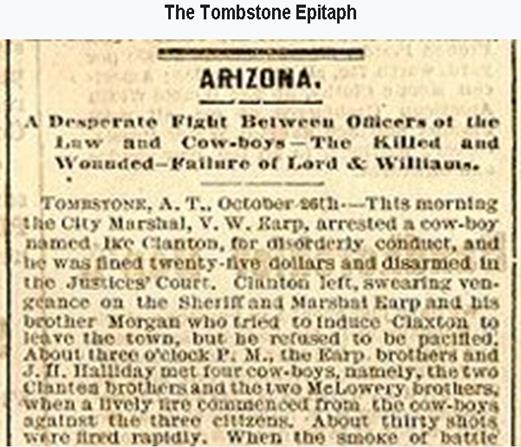
On October 26th, 1881 in Tombstone, Arizona Territory, US, the most famous western gun fight happened. Movies, books, and newspaper articles about it proliferate, and they disagree or merely gloss over the cause, often ignore the aftermath, and indeed quibble over the fight itself. One simple telling example of the fundamentally differing accounts is that the local Tombstone newspapers of the time told different stories. “The Tombstone Epitaph” was loyal to the business owners, the Earps, and Doc Holliday; and thereby found them to be merely protecting the people of Tombstone and their laws.
9
The “Tombstone Nugget” favored rural interests and the Cowboys and consequently found the lawmen to have overstepped their bounds. In that time and region, the term cowboy generally meant an outlaw.
Legitimate cowmen were instead referred to as cattle herders or ranchers. The details printed at the time by the two “primary” sources didn’t even agree concerning arms carried and who shot first. It may be difficult to believe for the twenty-first century world which ignores history, but fake news was not invented or perfected after the post-truth, twenty-first century creation of the internet’s social media. The battle which ensued and has popularly come to be known as “The Gunfight at the O.K. Corral” or “The Shootout at the O.K. Corral,” was given those names of the event many years later.
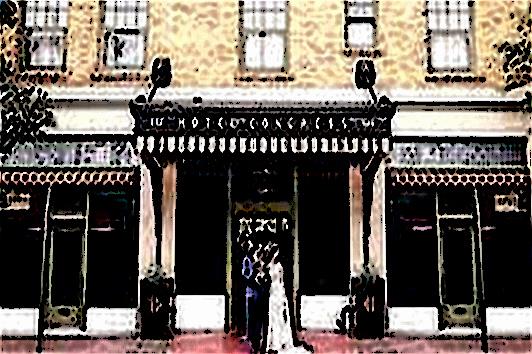
This rendition of the O.K. Corral story is the result of having chanced upon a diary kept by a departed freelance newspaperman, while he was staying at “Hotel Congress,” a hotel in old town Tucson at 311
East Congress Street, built in 1919.
10
O.K. Corral
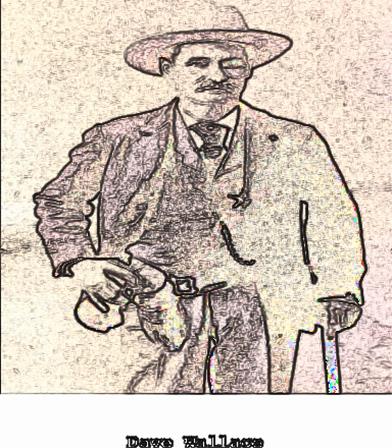
Dave Wallace’ old diary was just sitting there on the lobby table of the old hotel at the center of some sofas and chairs. That it seemingly got little attention from others, as discerned by its condition being much less dog eared than Stuart Lake’s “Wyatt Earp: Frontier Marshal,”
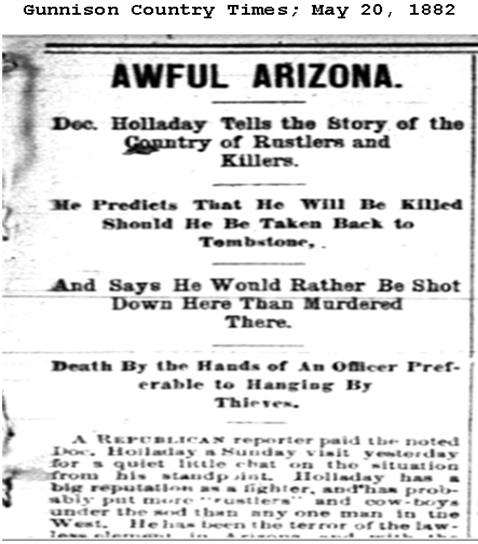
resulted in it somewhat contradictorily, though not really, drawing mine. According to the diary, Wallace interviewed Doc Holliday extensively in 1882, while Holliday was jailed in Gunnison, Colorado.
According to Wallace, the usually discreet and personal evidence averse Holliday was quite loquacious, apparently wanting to finally set the record straight about who did what, much of that previously 11
O.K. Corral
conveniently left elsewhere, where it was greedily latched onto by people with ambitions in the entertainment field.
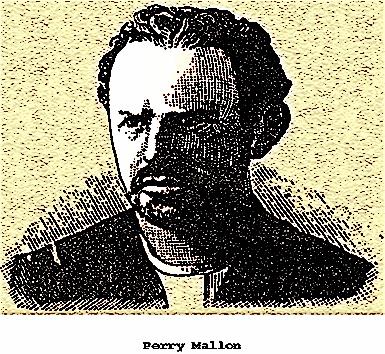
Doc was actually arrested in Denver by a swindler and bounty hunter named Perry Mallon, who thought he had ingratiated himself to Doc by making up the story that some bad guys were coming to town to kill 12
him, while thanking him for having saved his life years prior.
Mistakenly thinking that he had gotten Doc’s guard down, Mallon got the drop on him anyway and had him jailed.
Therefore you might say that this book is Holliday-centric by way of Wallace by way of Mallon. However if that is your thought, also realize concurrently that all communications arise from one or more particular points of view, none necessarily bearing any semblance of reality. Supplementing that Holliday-Wallace-Mallon piece of work with selected facts available which stand well to reason, this compilation is arguably the most reasonably biased Holliday-centric account of what happened in Tombstone on October 26th, 1881 you will find. It seems uncanny how this 141 year old story parallels what goes on in
“sophisticated” 2022; especially with regard to politically aligned nineteenth century newspapers reporting different stories and “facts,”
the participants telling different stories, the overt and clandestine government affiliation of some of the parties, the ”witnesses” seeming to have “seen” different movies, the government’s inability or unwillingness to resolve the “issues” brought up, and they being left to the courts if willing and common sense to try to settle. The only thing 13
the shootout lacks for modern man is a series of films taken by working security cameras doctored by some IT film app.
Perry Mallon approached Doc Holliday for the first time during the second week of May 1882 at the sophisticated Theatre Comique in Pueblo, Colorado. The small, bearded man informed the well-known, thirty year old gunfighter and gambler that the brother of the slain Frank Stilwell was looking for Doc and wanted to kill him. Holliday had no known obvious reason to doubt this information, other than regarding it as just another obsequious attempt of a nobody to gain favor with someone significant or as a ploy for someone to get close to a person with a bounty on their head. Two months earlier at the Tucson rail yard in Arizona Territory, Doc had been part of the Wyatt Earp posse that killed Stilwell, the suspected cowardly assassin of Morgan Earp in Tombstone. Warrants and reward money had been issued for the arrest of the posse members. Not being one to shy away from danger, and testing him, Holliday asked the stranger to point out Stilwell’s brother. When Mallon refused, Doc knew he was playing some kind of game.
14
The story of the Earp posse’s troubles in Arizona Territory had been reported in Utah Territory and throughout the Southwest. Holliday would later suggest that Mallon had obtained his knowledge of the Earp saga and concocted his stories from newspaper reports of the day; and that this was evident to Doc from their first conversation.
Mallon falsely claimed that Holliday had once saved his life in Santa Fe, New Mexico Territory, and said all he wanted was to return the favor. Mallon then made a bold but puzzling statement; “If you give me away, I will kill you.” Holliday ignored the curious threat and nothing happened. The stranger moved on, and the brother of the late Stilwell never appeared. But if Doc Holliday thought he had seen the last of Perry Mallon, he was sadly mistaken.
Mallon was twenty-seven when he met Doc Holliday. As is common with today’s mass murderers and political assassins, at the risk of providing too much notoriety of a person unimportant other than his brief appearance in the existence of someone good, significant, or both; in this case a parasitic worm in the bowels of Doc Holliday’s life, Mallon was born in Akron, Ohio. He was the son of an Irishman who deserted his family. Perry had a troubled youth and spent more than 15
two years in the Ohio Reform School for Boys, for violent and abusive behavior. When he surfaced in Ogden, Utah Territory, in 1879, he carried with him a history of fraudulent activity and recent abuse of women; nothing requiring any bravery. A railroad employee, he was married to an unfortunate young woman named Rozina. In 1880, like his father before him, Mallon deserted his wife and their newborn child. He then plied confidence scams along the Union Pacific and Central Pacific railroad lines. Mallon usually targeted the vulnerable; women, children and the elderly, often claiming less than a few hundred dollars and thereby staying one step ahead of the law. There can be little doubt that Perry Mallon was small time in every sense of the term. How he obtained the nerve to mess with Doc Holliday is a mystery. Maybe he was only familiar with one of the watered down versions of Doc’s tale.
16
O.K. Corral
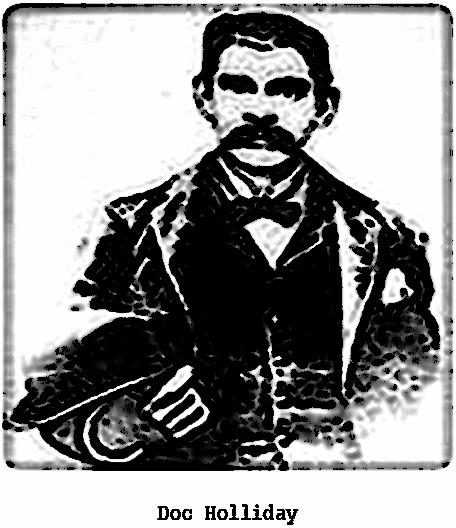
John Henry “Doc” Holliday cast a much longer shadow, boasting a reputation as a fearless man who could skillfully handle cards and firearms, if not liquor or his consumptive cough. The onetime dentist from Georgia had entered the big time western spotlight on October 26th, 1881, when at the request of Wyatt, sided with Wyatt, Virgil and Morgan Earp against the loose Cowboy faction, as represented by the Clantons and McLaurys in the well-publicized Tombstone gunfight near the O.K. Corral. After further revenge killings, the Holliday-Earp posse members, facing murder charges, left Arizona Territory in early April, 1882 and rode east to Silver City, New Mexico Territory, where they sold their horses. Next they took a stage to Deming and then a train 17
north to Albuquerque, where they planned to rest for a few days before heading to Colorado, their chosen safe haven.
After an apparent disagreement with Wyatt in Albuquerque, Holliday, along with fellow posse member Dan Tipton, separated from the group and went ahead to join the sporting crowd in Trinidad, Colorado. Early in May 1882, Holliday left Tipton and traveled by train to Pueblo. As luck would have it, Perry Mallon happened to alight from a train in Pueblo soon after. This seemingly innocuous coincidence would ultimately lead to incidents that endangered Holliday’s life and again propelled his name into the spotlight.
A couple of days after their peculiar conversation at the Comique, Holliday and Mallon met again at a Pueblo saloon. This time Holliday decided to make a few inquiries about Mallon. A bartender told Doc that Mallon had represented himself as a rancher who had sold his land and was looking for new opportunities. Yet Mallon had borrowed $10 from the bartender and failed to repay it. Holliday quickly pegged the “rancher” as a crank and a liar. He said Mallon had tried to boost 18
his reputation by revealing a scar and claiming it was a bullet wound.
Doc thought it was only a “mark of disease” and laughed in his face.
“The Pueblo Daily Chieftain” later reported that men visiting from Akron, Ohio, had recognized Mallon, and that the latter had obtained money from locals under false pretenses. To acquaintances Mallon maintained he was traveling on business, while to strangers he identified himself as a detective. The newspaper confirmed Mallon’s last known address as Ogden, Utah and described the crafty con man as “a small man with reddish face and beard, with small ferrety eyes and not an inviting cast of features.” “The Denver Tribune” provided further clues when it reported that Mallon appeared to be a discharged railroad brakeman who was missing the little finger on his left hand.
Whatever the truth, Doc had determined Mallon was of no account and could not be trusted. He decided to leave Pueblo, and the shifty Mallon, behind to travel north and try his luck in Denver. Unbeknown to Doc, Mallon saw an opportunity to make quick money through the reward placed on Doc’s head, and shadowed the former dentist to Mile High City.
19
By mid-May 1882, Holliday and two other gamblers had taken a train to Denver to attend the horse races. On May 15th, while strolling near the corner of 16th and Lawrence streets, Holliday was forced to surrender when Perry Mallon appeared out of the darkness and leveled two revolvers at him. Mallon claimed to be a lawman from California, and with the aid of a not particularly alert local deputy sheriff named Charles Linton, he escorted Holliday to the sheriff’s office. Mallon convinced Linton that Doc was wanted in Arizona Territory for murder and that a reward was offered for his arrest. While at the sheriff’s office, Mallon kept two six shooters aimed at Holliday. Fearing for his safety, the gambler protested to Linton, as Mallon appeared nervous.
Thick Linton assured Holliday no harm would come to him and summoned a cab to transport the prisoner to the county jail, but Holliday wasn’t so sure.
Mallon claimed Doc was also wanted in Utah Territory for the murder of Harry White, said to be the con man’s partner. According to Mallon, White had been killed at a saloon in St. George, Utah Territory, where Holliday had been dealing Faro. Mallon told a tale that Doc had wounded him six times, and with a flair for the dramatic, he held up his 20
left hand during the interview and credited Holliday’s six shooter for his missing little finger. Mallon enjoyed the instant notoriety his arrest of Holliday had aroused. He granted interviews to the more gullible newspapers and told increasingly bizarre stories about his seven year pursuit of the gambler.
“The Denver Tribune” was never entirely convinced by Mallon’s version of events and reported that he “acted like a suspicious man and did not handle a pistol with the grace of the trained desperado hunter that he purported himself to be.” Holliday later also remarked that Mallon was no gunman, as he “had a silver mounted revolver such as a cowboy would disdain to carry.” A Denver reporter added; “The manner in which he handled his pistol showed that he was afraid it would go off every moment, and that he was more frightened than Holliday was evident.”
Despite the questionable nature of Mallon’s stories, Denver tabloids continued to publish his claims. As has become more obvious to history challenged dolts in the 21st century, embellished stories were more interesting to a large segment of the population. Further, if 21
repeated sufficiently often, the embellished stories become the prevailing popular “truth,” and the old un-embellished stories the
“conspiracy theory,” punishable by monetary fines, imprisonment, or both for “encouraging vigilantism” and/or being “subversive.”
The embellishers painted Doc as a desperado and his captor as a gallant avenger who deserved the $500 reward offered by Arizona Territory officials for Holliday’s arrest. “The Tribune” seemed the lone voice of reason, sarcastically questioning Mallon’s stories and professed identity. Undeterred, Mallon continued to claim he was a deputized officer; seemingly easy to verify or refute, but no one did. On May 22nd, 1882, he thought he had sighted Wyatt Earp in Denver. “The Tribune” reported; “There was a man in the city named Greenleaf yesterday, who looks very much like Wyatt Earp and who came near being arrested by Mallon on account of the resemblance.”
According to reliable reports, Wyatt and his youngest brother, Warren, were living on the outskirts of Gunnison, Colorado, at the time. They had set up a camp there with fellow posse riders Dan Tipton and Texas Jack Vermillion and probably provided assistance to Holliday by 22
way of their friendship with Bat Masterson. Masterson was the marshal of Trinidad and happened to be in Denver for the races at the time of Holliday’s arrest. He would play an important role in coming events.
Perry Mallon clearly fed off all the sudden attention paid him by the Denver newspapers, going so far as to claim he had personally been authorized to arrest Holliday by Cochise County Sheriff Johnny Behan.
His lust for fame, however, was his undoing. As reporters from the
“Tribune” interviewed Holliday, Mallon’s stories began to unravel. Doc confirmed he had never been in Utah Territory, had met Mallon for the first time in Pueblo, and had actually been living in Denver at the time of Mallon’s fictitious murder accusations.
As some of the Denver newspapers continued to publish Mallon’s fiction, pressure mounted for Holliday to be extradited back to Arizona Territory to face the Stilwell murder charges. Pima County Sheriff Bob Paul arrived from the territory to escort Holliday back to Tucson, but he lacked the necessary paperwork, forcing him to wait in Denver for the appropriate requisition documents to arrive. To combat the order, 23
Doc and Wyatt’s friends, including Masterson, spoke in his defense and hatched a plan to delay extradition proceedings. Holliday was saddled with a bogus fraud charge in Pueblo, and a writ of habeas corpus was issued to release him from custody in Denver to face the trumped up charges in Pueblo. As the plan unfolded, the spotlight once again turned on Mallon. Paul, the Arizona Territory officer, stated he had never heard of the man, and the “Tribune” finally subjected the habitual liar to further scrutiny.
24
O.K. Corral
Mallon went on the offensive. On May 23rd, 1882, he wrote a pompous letter to the “Rocky Mountain News” defending his actions. As befitted the work of a con man, the letter was full of irony, lies and indignant self-righteousness. He criticized the “Tribune’s” attack on his integrity, assuring its readers he was “here on business, for business, that I mean business, which ‘Doc’s’ friends, who may have misled reporters 25
or the public, will soon find out. Respectfully, Perry Mallon.” The nature of his real “business” would soon become apparent to everyone.
In the meantime, the widespread coverage of Mallon’s exploits proved a double edged sword. While the fame brought him the trust and attention of gullible backslappers, it also advertised the con man’s whereabouts. Blacksmith Hiram W. Rublee, an elderly investor who in 1880 had been conned out of $100 by Mallon in Omaha, read about Mallon’s adventures in Denver and stepped forward to accuse him of fraud and reclaim the lost money. Rublee provided “Tribune” reporters the details of his dealings with Mallon in Omaha, and they championed his cause. Subsequent articles left readers in no doubt as to the character of the dubious Mallon.
Rublee eventually confronted Mallon in Sheriff Linton’s Denver office and, with the assistance of a witness, pressed him to repay the $100.
Mallon began to tremble and asked to speak with Rublee outside in an alley. Rublee declined the offer. “The Tribune” later reported the con man had been forced to repay the full amount. Mallon had now been 26
exposed as a fraud, but in the grand tradition of all good con men, he had one more trick up his sleeve.
In his capture of Doc Holliday, Mallon had been motivated by a $500
reward and the notoriety it would bring. But his plan for making a quick buck had been spoiled when legal proceedings bogged down. As it became clear there would be no reward and that Holliday would in fact go free, Mallon needed to hatch a new plan. The sudden appearance of Rublee, his old nemesis from Omaha, convinced the con man it was time to leave Denver. To do so, he would need cash, and the best way for him to acquire it would be to work over one more sucker.
Mallon chose Julius Schweigardt, a naive former part owner and clerk of Denver’s Great West Hotel, where both men had lodged. According to the “Denver Republican,” Mallon presented several letters of introduction from Schweigardt’s friends and associates in California, suggesting Schweigardt may in fact have been one of Mallon’s original targets in Denver. Schweigardt had just sold his share of the Great West Hotel and was impressed by accounts of Holliday’s arrest. Mallon 27
used that impression to great advantage, telling tales of huge rewards he had been paid for the capture of other criminals. Mallon also borrowed money from Schweigardt when his own cash ran low, and the young hotel clerk was happy to oblige. Mallon even borrowed a $20
overcoat from Schweigardt and a revolver from another guest on the strength of his sudden notoriety.
Once Mallon had captivated Schweigardt with his amazing exploits, the con man cast his bait. He told the clerk of a murderer living in Kansas City under a false name. A reward of $1,500 was to be paid for the outlaw’s capture, and Mallon offered Schweigardt a share of the bounty if he would finance their trip and bribe a woman whom Mallon claimed knew the exact whereabouts of the wanted man. Schweigardt foolishly agreed, and the two men left Denver by train on May 27th, 1882, bound for Kansas City. Once there, Mallon said he would go alone to Wyandotte to scout out the wanted man. He never returned.
The local depot watchman said he saw the con man board the westbound Atchison and Santa Fe train that Sunday night. Three days later, Schweigardt returned to Denver and went to the police. Mallon had fleeced the gullible clerk of $310.
28
Back home Schweigardt discovered that Mallon had “borrowed” a further $130 from fellow Great West Hotel resident Charles Morgan.
Both men would later learn that Mallon had also conned the former mayor of Alamosa, to the tune of $50 and a pistol. Morgan thought Mallon had fled to New Mexico Territory and was so incensed about his own losses that he took a train to Albuquerque on June 1st, 1882, to hunt for the con man. His search would be in vain. All this was cold comfort to Schweigardt, but a subsequent report in the June 6th, 1882,
“Pueblo Daily Chieftain” would have pleased him. The paper stated that Mallon had been arrested in Pittsburgh, Pennsylvania, and would be held until a governor’s requisition arrived from Colorado. There is no evidence to confirm either the arrest or subsequent requisition.
Regardless, Denverites were probably well satisfied to have seen the last of Perry Mallon. Doc Holliday certainly was.
Holliday dodged extradition to Arizona Territory. Colorado Governor Frederick Pitkin decided to decline the requisition, and Holliday was transported to Pueblo to face the bogus fraud charges. He made bail on June 1st, 1882, and promptly traveled to Gunnison to reunite with Wyatt and Warren Earp, Dan Tipton and Texas Jack Vermillion. Always 29
the Southern gentleman, he told a Gunnison reporter on June 18th, 1882, he would not seek revenge on Mallon. Doc explained; “No, that is not my way of doing. I shall let him alone if he does me.” Holliday did, however, add that his friends were not feeling so magnanimous. He held a letter from the house of Comfort and Harlan in Denver that stated it would spend $1,000 if necessary to send Mallon to the penitentiary.
The opportunity never arose. Although the Kansas City depot watchman reported that Mallon had boarded a westbound train, the slippery con man had actually headed in the opposite direction. Like a true flim flam man, Mallon kept moving, did not look back, and wasted no time in setting up another confidence game in his home state of Ohio. A scam there proved unsuccessful, and Mallon was arrested in Toledo in late July 1882 for being a “suspicious person.” After a three month stint in the county jail, he was released and promptly disappeared. Holliday remained in Colorado, settled in Leadville for a time and later died in Glenwood Springs in 1887.
30
Perry Mallon’s arrest of Holliday had provided fodder for the Denver press in May and June 1882. Other newspapers soon picked up Mallon’s wild stories, rife with bogus claims and dime novel descriptions of murder and revenge. These actions helped spread Holliday’s name and reputation nationwide. While Mallon is all but forgotten, his fleeting moment of fame had inadvertently, and almost single handedly, added several chapters to the enduring legend of Doc Holliday.
If not for Mallon’s bungled nonsense there would never have been a Wallace diary. It was during Doc’s stay at the Gunnison jail, that he was unusually talky, perhaps in an effort to keep someone else present while Mallon was holding guns on him. Wallace recorded what he was told, much of it admissions of murders Doc had not been charged with or had been cleared of, though Wallace was more proficient in using memory than short hand.
31
O.K. Corral
Writer’s Note. – It is the primary intent of this book to relate the story of the shootout at the O.K. Corral from various points of view, deferring to what Doc Holliday told Dave Wallace, as the only true witnesses were the participants, despite obviously bogus claims from others, each side with a different story. Having said that, the writer also finds the O.K. Corral story to be emblematic of the broader American Wild West era, if not contemporary America, further if not an early precursor of its demise along with the concurrent move into show business. Much of that overlapping context is contained herein.
32
The overlaps abound uncontrollably for the purpose of maximizing inputs to no disadvantage. For the convenience of the reader not prone to the detail required by paying some degree of credence to every version of the story, it is not necessary to read the entirety of this book to read the bare bones story of the shootout at the O.K. Corral.
Readers wanting only that may read only Chapters 3 – Tombstone, 9 –
The Bad Blood Prelude, 10 – The Shootout at the O.K. Corral, 11 – The Trial, Lawsuit, and Investigation, and 12 – Subsequent Retribution, which like here, in some versions have been shaded in black. In addition, when there is both a short and long version of a biography, in some versions the short version, like here, is shaded in dark red. Now, for the book which contains an overview, and a context of the Wild West’s start, decline, and eventual death.
The inevitable and inescapable bias here is admittedly toward Doc Holliday’s accounts. Not only are they consistent, but Doc was the only one with little or nothing to lose. He never went into show business, was somewhat averse rather than braggy about being hounded for killing bums, and was generally content to pragmatically and quietly allow his friends with stage and book ambitions to take all 33
the credit. As Doc said; “I'm not travelling about the country in search of notoriety, and I think your newspaper fellows have already had a fair hack at me.”
34
O.K. Corral
2 - The West at That Time
The O.K. Corral shootout has come to exemplify a period of the Old West when the frontier was virtually an open range for outlaws, largely unopposed by law enforcement officers who were spread thin over vast territories. Small towns grew in boom areas providing their transient residents with whatever they wanted. In addition to boarding rooms and food; gambling, alcohol, prostitution, and gunplay was always on the menu. It was not well known to the American public until 1931, when Stuart Lake published the initially well received biography; “Wyatt Earp: Frontier Marshal” two years after Earp's death.
The book was the basis for the 1939 film “Frontier Marshall,” with 35
O.K. Corral
Randolph Scott and Cesar Romero, the 1946 film “My Darling Clementine,” directed by John Ford, and the 1957 film “Gunfight at the O.K. Corral,” after which the shootout became known by that name.
Since then, the conflict has been portrayed with varying degrees of accuracy in numerous western films and books, and has become an archetype for much of the popular imagery associated with the Old West.
According to the broadest of “learned” accounts, the Wild West was a period of American history that lasted from roughly 1865 to 1924; the 36
end of the Civil War to six years after the end of World War One. The first date is easily debatable though it more or less indirectly suggests the necessities imposed due to the demise of the White southern heroes and the second is ridiculously absurd, lasting into the transfer to a city based lawlessness of the Democrat, government supportive mob and the payoffs of the Roaring Twenties. The period, which took place on the frontier of the American West, was marked by lawlessness in America's unincorporated territories, cattle drives, westward expansion and settlement, the proliferation of immoral businesses such as bordellos and saloons, the rise of outlaw gangs, and conflicts with Native Americans. Despite the negative description just quoted from no source in particular, the Wild West has been popularly immortalized by the "cowboy" image, which represented rugged individualism and survival, and came to become a cultural icon of America, providing the fodder for the American culture’s most popular movies, TV shows, and children’s toys. At one time every little boy had a coonskin cap, a cowboy hat, a bow and arrow, an Indian head dress, holsters, bandanas, spurs, rifles and hand guns galore, some replete with exploding caps to get and keep your attention. It 37
O.K. Corral
wasn’t until a century later that the “educated” liberals found something wrong with the popular re-creations.
The era was brought to an end by intense crackdowns on outlaw behavior by lawmen and bounty hunters, by the incorporation of the Western territories into the union, by technological modernizations, such as railroads and air conditioning which encouraged further settlement of the West, and the growth of Western cities and the concurrent decline of the rural West.
The Wild West period followed the westward expansion promoted by
"Manifest Destiny," which saw the United States acquire vast amounts 38
O.K. Corral
of territory in the Mexican-American War, the Gadsden Purchase, and through several Indian wars. These newly conquered lands were organized into "territories," American lands that were not yet granted statehood due to their low populations and their lack of infrastructure.
In 1862, the US government passed the first of the "Homestead Acts,"
which opened up millions of acres of land in the West to settlement.
Any adult who had never taken up arms against the US government could apply, including women, immigrants, and after 1866 freed 39
negroes. These laws effectively gave free land to whoever did not secede from and oppose imperial Lincoln, those who were willing to farm it, and also gave them the rights to gold if they mined it. After the California gold rush, many immigrants and settlers arrived in the West with the objective of mining and keeping their gold. Promises of prosperity led to waves of immigration to the sparsely populated West.
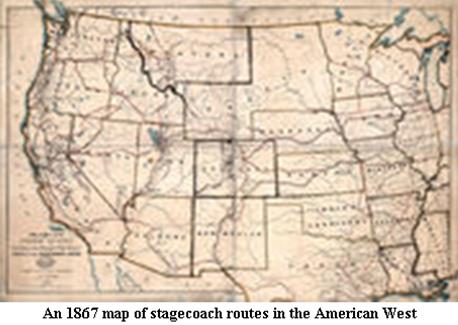
The new territories lacked a strong political infrastructure, however, and the West initially became a completely lawless region in which settlers would have to brave Native American conflicts, outlaw shootouts, train and bank robberies, hazardous stagecoach journeys,
“lawmen” who were outlaws, and the stifling desert heat. Following the American Civil War's end in 1865, many former Confederate
"bushwhackers" found themselves unemployed, and several of them, including Jesse James, became outlaws. Many southerners would become outlaws, while many northerners would become lawmen, continuing the divisions created by Lincoln’s unnecessary Civil War.
40
O.K. Corral
Lawful cowboys were animal herders who tended cattle on ranches, typically on horseback. They were nicknamed "cowboys" because of their herding of livestock, including cows, sheep, goats, chickens, and other animals.
In 1867, the first cattle drive from Texas up the Chisholm Trail arrived at the rail yards of Abilene, Kansas, beginning a series of drives. The Chisholm Trail was a trail used in the post-Civil War era to drive cattle overland from ranches in Texas to Kansas railheads. It should be noted that the trail was not named, and mis-spelled, for famous, wealthy, cattle baron John Chisum. In fact the trail was established by 41
Black Beaver, a Lenape guide and rancher, and his friend Jesse Chisholm, a Cherokee merchant. They collected and drove numerous cattle along the trail to Kansas, where they could be shipped east to achieve higher prices. The southern terminus was Red River Station, a trading post near the Red River along the northern border of Texas.
The northern terminus was a trading post near Kansas City, Kansas.
Chisholm owned both of these posts. In the years of the cattle drives, cowboys would drive large herds from ranches across Texas to the Red River Station and then north to Kansas City.
These drives saw horse mounted cowboys move herds of cattle long distances to market, and, from 1866 to 1895, 10,000,000 cattle were herded from Texas to railheads in Kansas for shipments to stockyards in Chicago and points east, where they would be slaughtered and turned into meat. Due to the major role that cattle drives had in the Wild West, the cowboy tending to a herd of cattle became the worldwide iconic image of the Wild West.
42
O.K. Corral
Ranching also played a major role in the American West, with cowboys living on ranches with their herds of livestock, as well as with their families. At ranches, animals were bred and nourished before cattle drives took place, and the settler families were able to sustain themselves from selling their livestock, as well as by growing or slaughtering their own food. In 1874, Joseph Gilden invented barbed wire, revolutionizing ranching, as animals could now be prevented from escaping by barbs.
During the 1870s and 1880s, the image of the cowboy was politicized by the Democratic Party, which saw the West as a land untouched by 43
O.K. Corral
the hated Republicans, and viewed cowboys as hard working, hard playing, honorable, self-protecting, and independent men who asked nothing of the government. Democratic newspapers romanticized the poverty, danger, and debilitating hours of the cowboy lifestyle, contrasting the rugged individualism of the cowboys with the behemoth “social” government catering to "lazy ex-slaves" the Republicans conspired to establish in an effort to buy the votes of the ignorant misinformed.
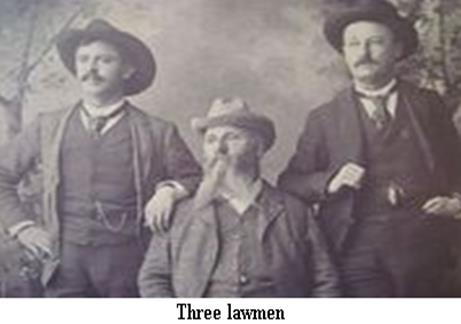
Lawmen, most with shady backgrounds, became the guardians of the law in the Wild West, including Sheriffs and Marshals. They were 44
O.K. Corral
responsible for enforcing the law in the frontier towns and settlements, and they often formed posses of townspeople to assist them in protecting and defending the law and innocent townspeople.
Lawmen typically wore golden stars to identify them as sheriffs or Marshals, and they were rarely shot by outlaws, as killing a lawman essentially meant a death sentence. By the early 1900s, lawmen had virtually eliminated the outlaws in shootouts or by capturing and hanging many of them.
The Wild West occurred in the lands west of the Mississippi River, including the territories acquired by the United States in the 1848
45
Treaty of Guadalupe Hidalgo following the war with Mexico. Hotspots of outlaw activity included Dodge City in Kansas, Santa Fe in New Mexico, Deadwood in South Dakota, and Tombstone in Arizona. The unsettled lands west of the Mississippi lacked law and order for decades. The Great Plains states saw fierce fighting between the White settlers and the Native American tribes, while the border territories along the Mexican boundary were the sites of raids by Mexican banditos or local tribes such as the Apache, Navajo, and Comanche. The Wild West shrunk in size as the US government incorporated many of its territories as states, and, with Arizona's incorporation in 1912, all of the Western territories had become states with ample law enforcement.
46
O.K. Corral
47
O.K. Corral
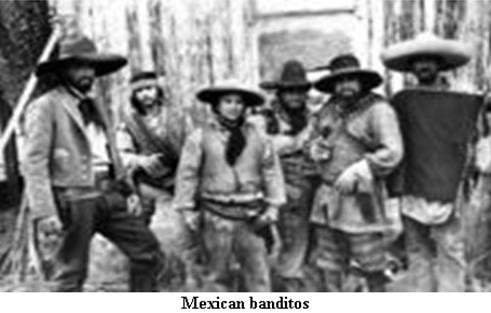
The Mexican frontier was just as dangerous as the American frontier, and it could be argued that, during the Mexican Revolution of 1910-48
1920, it was even more so. The lack of a defended border allowed for easy travel between the two countries, with horse riders being able to cross the Rio Grande over wooden bridges or over railroad bridges without hindrance. Mexican outlaws, known as banditos, would occasionally raid across the border and engage in robberies and shootouts. In Mexico, it was common for banditos to engage in highway robbery, to steal payroll wagons, or to create gang hideouts full of outlaws. During the Mexican Revolution, civil warfare between the Mexican Army and revolutionary Rebeldes further destabilized the Mexican border states, leading to even more violence. This allowed for banditos such as Pancho Villa and Javier Escuella to attack the American border, and for American outlaws to interfere with the revolution in Mexico. Lawlessness in Mexico would continue for years due to the lack of an effective law enforcement agency and poor economic conditions, but the end of the revolution and the improvement of policing helped to tame the US side of the border region.
49
O.K. Corral
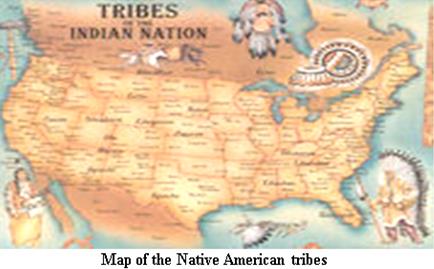
Native Americans, as the original inhabitants of the continent, played a major role in the period. The Native Americans were initially peaceful towards the settlers, as they sought to avoid conflict and continue tending to their open lands. However, the subsequent increase in the number of settlers led to Whites outnumbering the natives, and the US government, through several unfair treaties, forced the natives to give up their lands and move west. Eventually, this led to conflict between the settlers and the Indians, as the natives fought back against encroaching settlers. There were numerous wars, including the Comanche Wars, Colorado War, Red Cloud's War, Great Sioux War, Nez Perce War, and Apache War, all of which would 50
O.K. Corral
ultimately result in the Native American tribes being relocated onto reservations, many of them in the Indian Territory in what is now Oklahoma.
51
O.K. Corral
52
The Wild West was famous for being an age of outlaws, who often operated from bases in the wilderness and opposed, attacked, or disrupted the fragile institutions of new settlements. The majority of outlaws preyed on banks, trains, and stagecoaches, which they would rob and distribute the money among themselves. Some ex-Confederates became outlaws after the end of the Civil War, seeing little other choice due to lifetime lasting Union punishments. Others merely took advantage of the wilderness and the lawlessness of the frontier to enrich themselves at the expense of others, and others migrated to the frontier to escape prosecution for crimes elsewhere.
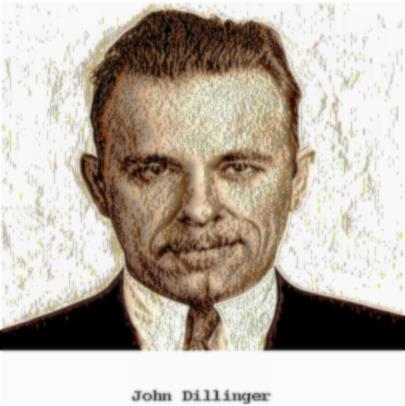
Famous outlaws included Billy the Kid, Belle Starr, Bill Doolin, Black Bart, the Dalton Brothers, Jesse James, Frank James, William "Curly Bill" Brocius, Butch Cassidy and the Sundance Kid; almost all of whom were either killed in shootouts or hanged for their crimes. By 1899, the age of outlaws was almost at an end, as almost all of them had been killed, arrested, pardoned, or became lawmen. The incorporation of America's western territories led to the establishment of better police forces, and outlaws, who were already uncommon figures, practically vanished until the Great Depression era of the 1930’s, manifesting as 53
O.K. Corral
John Dillinger, Baby Face Nelson, Pretty Boy Floyd, Clyde Barrow, Bonnie Parker, Al Capone, Ma Barker, and others.
54
O.K. Corral
A major feature of the Wild West was the influx of settlers, also known as "pioneers," into the newly acquired territories. Initially, many of these settlers came from the East Coast of the United States, and they were descended from the original British settlers. However, they were followed by waves of Scots, Irish and German immigrants, among other groups. The arrival of immigrants helped with the development of thriving outposts into new towns, and civilization spread rapidly into the wild frontier as more and more settlers arrived.
55
Native American tribes in the region included the Sioux, Pawnee, Cheyenne, Crow, Sauk, Apache, Navajo, Comanche, Nez Perce, Shoshone, Paiute, Blackfoot, and Kiowa, among others. These tribes mostly fought on horseback with either bows or rifles, having acquired both horses and rifles through trade with the Europeans. The natives were often defeated by the technologically superior Americans, but they were victorious in Red Cloud's War in 1867 and at the Battle of Little Bighorn in 1876. The Americans often perpetrated atrocities against the Indians, including the Sand Creek massacre, but they often portrayed the Indians as savages and as uncivilized. The Shawnee chief Cheeseekau famously said; "When a White army battles Indians and wins, it is called a great victory, but if they lose it is called a massacre."
The bringing of American settlers to the West also brought with it American politics. During the 1870s, the rural farmers, ranchers, and cowboys were Democrats who deeply resisted the influx of Republican merchants, miners, and businessmen moving west. Republican ethics were set on civilizing the West and providing law and order to the West, while Democrats saw them as government lackeys serving the 56
interests of corporate America and ex-slaves at their expense.
Additionally, political affiliation was influenced by the migrants' states of origin. Northerners and Union Army veterans tended to vote Republican, while Southerners and former Confederates overwhelmingly voted Democratic.
The political system had shifted by the late 19th century, as the Republican Party benefited from the support of the old immigrant groups; English, Scots-Irish, Protestant Germans, etc., who settled on frontier farms, while the newer Irish, Catholic German, Polish, etc., urban immigrants became the base of the Democratic Party in the West. The Republicans came to represent the railroad industry and the White Anglo-Saxon Protestant race, while the Democrats represented anti-elitist and immigrant interests. Most Mexicans in the American Southwest were Republicans into the early 20th century, but their manipulation by Republican political machines and the threat of disenfranchisement led to a significant number of Hispanics, including Octaviano Ambrosio Larrazolo, defecting to the Democrats. Over the years, the voter bases shifted, with German Lutherans becoming alienated by the GOP's support for temperance and assimilation, and 57
the Democrats, who supported minimalist government and traditional values, appealed more to immigrants.
The rise of the Populist Party in the 1890s introduced a social liberal element to the Democratic Party, which increasingly shifted to the political left, while the western Republicans shifted to the right due to their support for the railroad business, religious moralism, and the gold standard. The Populists won the support of impoverished farmers, while finding little support in cities and towns. The Populists attacked Gilded Age corporate interests, international finance, occasionally employing anti-Jewish rhetoric, and Republican promoted modernization. After the 1896 election, most Populists joined the Democratic Party.
58
O.K. Corral
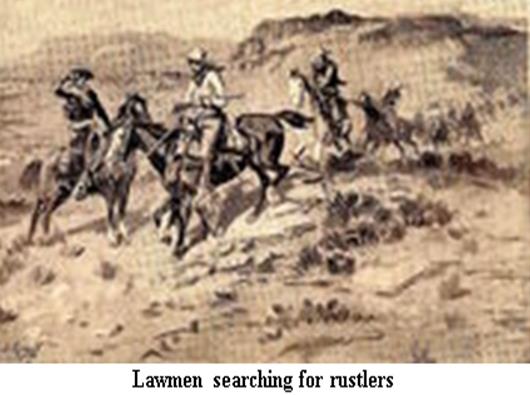
Cattle rustling was a major issue in the Wild West, in which criminals would steal cattle. During the 1840s, the Apache, Comanche, and Navajo Indians took advantage of Mexico's weakness by undertaking large scale raids hundreds of miles deep into the country to steal livestock for their own use and to supply an expanding market in America. These raids left thousands dead, and the lives of many northern Mexicans were ruined. Northern Mexico's demoralized population offered little opposition to the Americans during their invasion in 1846. During the American Civil War, the Mexican government was accused of supporting the habit of Mexicans rustling 59
O.K. Corral
American cattle, and American rustlers did the same in Mexico.
Rustling was held to be a serious crime, and vigilantes often hanged captured rustlers. With the advent of barbed wire and ranches and the decline of the open range system, rustling became less common, as livestock were now guarded in ranches.
60
3 - Tombstone
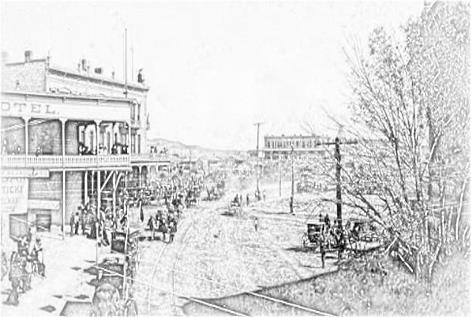
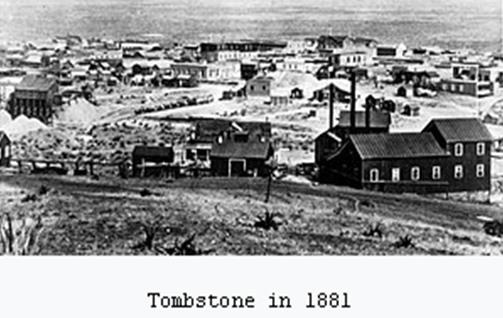
Tombstone, located in Arizona Territory about thirty miles from the Mexican border, was founded in March 1879 after silver was discovered in the area. Like many mining boomtowns on the American frontier, Tombstone grew rapidly. At its founding, it had a population of just 100, and only two years later, in late 1881, the population was more than 7,000 adult White males, which excluded Chinese, Mexicans, women, and children, making it the largest boomtown in the American Southwest. Silver mining and its attendant wealth attracted many professionals and merchants, who brought their wives and families. With them came churches and ministers. By 1881 the town boasted fancy restaurants, a bowling alley, four churches, an ice house, a school, an opera house, two banks, three newspapers, and an ice cream parlor, along with 110 saloons, fourteen gambling halls, and numerous brothels, all situated among a number of dirty, hardscrabble mines.
61
O.K. Corral
Horse rustlers and bandits from the countryside often came to town, and shootings were frequent. In the 1880s, theft of cattle and the smuggling of alcohol and tobacco across the border were common.
The Mexican government assessed heavy export taxes on these items, and smugglers earned a handsome profit by stealing them in Mexico and selling them in Tombstone.
62
O.K. Corral
63
O.K. Corral
James, Virgil, and Wyatt Earp arrived in Tombstone on December 1st, 1879, when the town was mostly composed of tents as living quarters, a few saloons and other buildings, and the mines. Virgil had been hired as Deputy US Marshal for eastern Pima County, with his office in Tombstone, only a few days before his arrival. In June 1881 he was also appointed as Tombstone's town marshal, the rough equivalent of a police chief.
64
Though not universally liked by the townspeople, the Earp brothers tended to protect the interests of the town's business owners and residents. Even so, Wyatt helped protect outlaw "Curly Bill" Brocius from being lynched after he accidentally killed Tombstone town marshal Fred White. In contrast, Cochise County Sheriff Johnny Behan was generally sympathetic to the interests of the rural ranchers and members of the loosely organized outlaw group called the Cochise County Cowboys, or simply the Cowboys, to which Brocius belonged.
In that time and region, the term cowboy generally meant an outlaw.
Legitimate cowmen, insofar as such things existed, were instead referred to as cattle herders or ranchers.
65
O.K. Corral
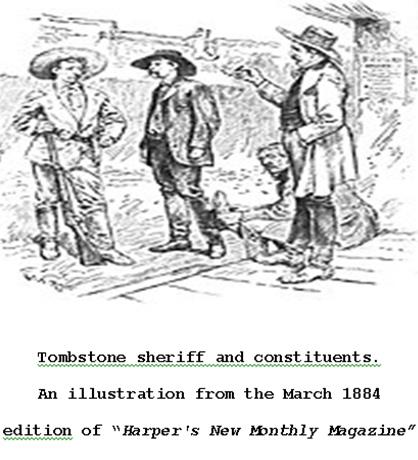
Many of the sources describing the events leading up to the gunfight, and details of the gunfight itself, conflict with each other. Newspapers of the day were not above taking sides, and news reporting often editorialized on issues, rather than being bothered with strictly factual news, to reflect the publisher's interests. John Clum, publisher of “The Tombstone Epitaph,” had helped organize a "Committee of Safety," a vigilance committee, in Tombstone in late September 1881. He was elected as Tombstone's first mayor under the new city charter that year. Clum and his newspaper tended to side with the interests of local business owners and supported Deputy US Marshal Virgil Earp.
66
Harry Woods, the publisher of the other major newspaper, the daily
“Tombstone Nugget,” was an undersheriff to Behan. He and his newspaper tended to side with Behan, the Cowboys, some of whom were part time ranchers and landowners, and the rural interests of the ranchers.
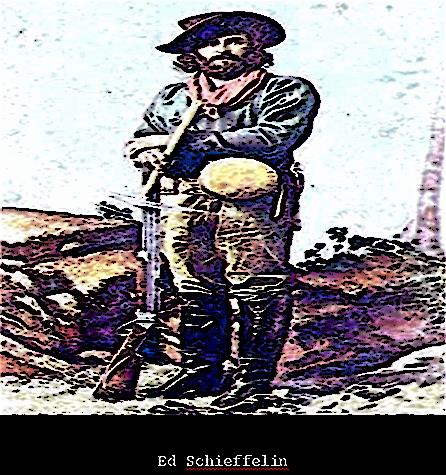
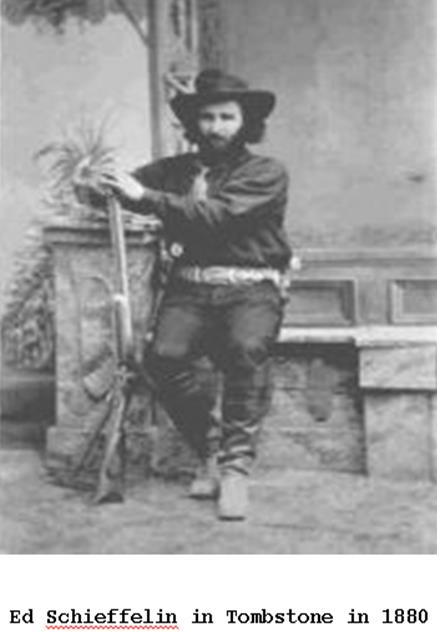
Tombstone is also a historic city in Cochise County, Arizona, United States, founded in 1877 by prospector Ed Schieffelin in what was then Pima County, Arizona Territory.
67
O.K. Corral
It became one of the last boomtowns in the American frontier. The town grew significantly into the mid-1880s as the local mines produced $40 to $85 million in silver bullion per annum, the largest productive silver district in Arizona. Its population grew from 100 to around 14,000 in less than seven years. The town was established on Goose Flats, a mesa above the Goodenough Mine. Within two years of its founding, although far distant from any other metropolitan area, 68
Tombstone had a bowling alley, four churches, an ice house, a school, two banks, three newspapers, and an ice cream parlor, alongside 110
saloons, 14 gambling halls, and numerous dance halls and brothels. All of these businesses were situated among and atop many silver mines.
The gentlemen and ladies of Tombstone attended operas presented by visiting acting troupes at the Schieffelin Hall opera house, while the miners and cowboys saw shows at the Bird Cage Theatre and brothel.
Under the surface were tensions that grew into deadly conflict. The mining capitalists and the townspeople were largely Republicans from the Northern states. Many of the ranchers; some of whom, like the Clantons, were also rustlers or other criminal varieties; were Confederate sympathizers and Democrats. The booming city was only 30 miles from the US–Mexico border and was an open market for cattle stolen from ranches in Sonora, Mexico, by a loosely organized band of outlaws known as The Cowboys. The Earp brothers; Wyatt, Virgil and Morgan, as well as Doc Holliday, arrived in December 1879 and mid-1880. The Earps had ongoing conflicts with Cowboys Ike and Billy Clanton, Frank and Tom McLaury, and Billy Claiborne. The Cowboys repeatedly threatened the Earps over many months until the conflict 69
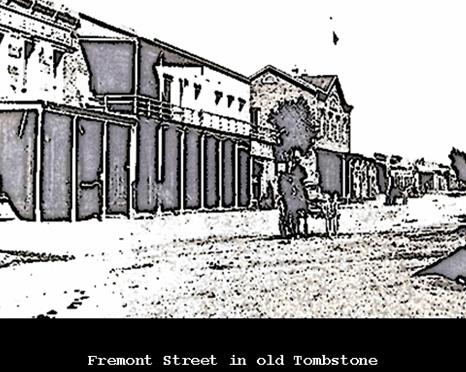
escalated into a shootout on October 26th, 1881. The historic gunfight is often portrayed as occurring at the O.K. Corral, though it actually occurred a short distance away in an empty lot on Fremont Street.
In the mid-1880s, the silver mines penetrated the water table and the mining companies made significant investments in specialized pumps.
A fire in 1886 destroyed the Grand Central hoist and the pumping plant, and it was deemed unprofitable to rebuild the costly pumps. The city nearly became a ghost town, saved only because it was the Cochise County seat until 1929. The city's population dwindled to a low of 646 in 1910, but grew to 1,380 by 2010. Tombstone has frequently been noted on lists of unusual place names.
70
O.K. Corral
71
O.K. Corral
Ed Schieffelin was briefly a scout for the US Army headquartered at Camp Huachuca. Schieffelin frequently searched the wilderness looking for valuable ore samples. At the Santa Rita mines in nearby Santa Cruz Valley, three superintendents had been killed by Native Americans. When friend and fellow Army Scout Al Sieber learned what 72
Schieffelin was up to, he is quoted as telling him; "The only rock you will find out there will be your own tombstone," or, according to another version of the story; "Better take your coffin with you, Ed. You will only find your tombstone there, and nothing else."
In 1877, Schieffelin used Brunckow's cabin as a base of operations to survey the country. After many months, while working the hills east of the San Pedro River, he found pieces of silver ore in a dry wash on a high plateau called Goose Flats. It took him several more months to find the source. When he located the vein, he estimated it to be fifty feet long and twelve inches wide. Schieffelin took on a partner named William Griffith who financed the filing of the claim in return for a later claim for himself. Griffith filed Schieffelin's first claim, which was named Tombstone, on September 3rd, 1877.
When the first claims were filed, the initial settlement of tents and wooden shacks was located at Watervale, near the Lucky Cuss mine, with a population of about 100. The Goodenough Mine strike occurred shortly after. Former Territorial Governor Anson P. K. Safford offered financial backing for a share of the mining claims, and Schieffelin, his 73
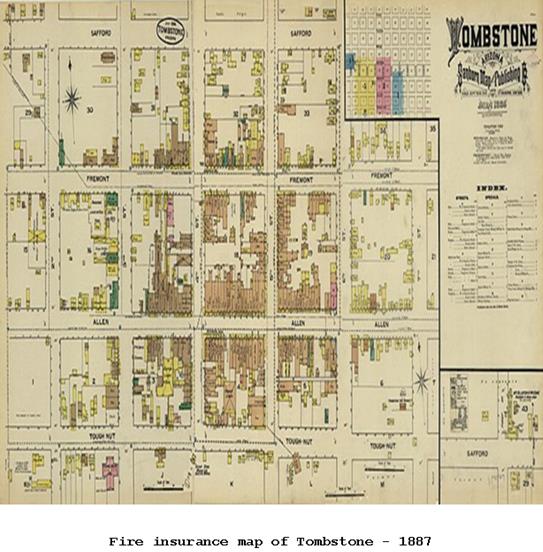
brother Al, and their partner Richard Gird formed the Tombstone Mining and Milling Company and built a stamp mill near the San Pedro River, about eight miles away. As the mill was being built, US Deputy Mineral Surveyor Solon M. Allis finished surveying the new town's site in March 1879. The tents and shacks near the Lucky Cuss were moved to the new town site on Goose Flats, a mesa above the Goodenough Mine at 4,539 feet above sea level and large enough to hold a growing town. Lots were immediately sold on Allen Street for $5 each. The town soon had some 40 cabins and about 100 residents. At the town's founding in March 1879, it took its name from Schieffelin's initial mining claim. By fall 1879, a few thousand hardy souls were living in a canvas and matchstick camp perched amidst the richest silver strike in the Arizona Territory.
When Cochise County was formed from the eastern portion of Pima County on February 1st, 1881, Tombstone became the new county seat. Telegraph service to the town was established that same month.
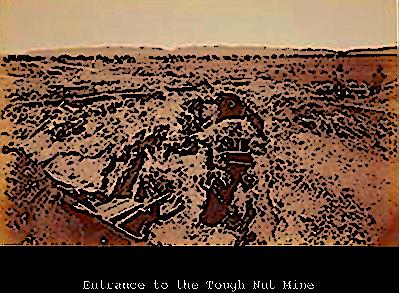
In early March 1880, the Schieffelins' Tombstone Mining and Milling Company which owned the original Goodenough Mine and the nearby Tough Nut Mine, among others, was sold to investors from 74
Philadelphia. Two months later, it was reported that the Tough Nut Mine was working a vein of silver ore 90 feet across that assayed at $170 per ton, with some ore assaying at $22,000 a ton; quite the disparity and a source of income for crooked, federally appointed assayers.
On September 9th, 1880, the richly appointed Grand Hotel was opened, adorned with fine oil paintings, thick Brussels carpets, toilet stands, elegant chandeliers, silk covered furniture, walnut furniture, and a kitchen with hot and cold running water. At the height of the silver mining boom, when the population was about 10,000, the city was host to Kelly's Wine House, featuring 26 varieties of wine imported from Europe, a beer imported from Colorado named "Coors," cigars, a bowling alley, and many other amenities common to large cities.
75
O.K. Corral
76
O.K. Corral
Under the surface were other tensions aggravating the simmering distrust. Most of the Cowboys were Confederate sympathizers and Democrats from Southern states, especially Texas. The mine and business owners, miners, townspeople and city lawmen including the Earps were largely Republicans from the Northern states. There was 77
also the fundamental conflict over resources and land, with traditional, Southern style "small government" agrarianism of the rural Cowboys contrasted to Northern style “big government” development.
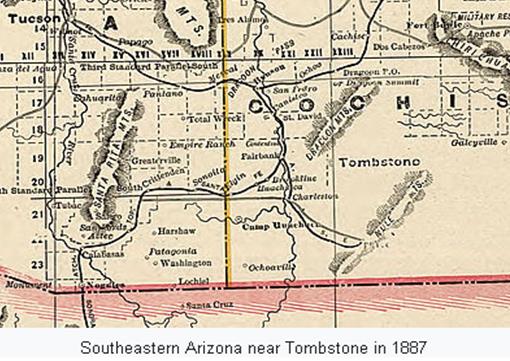
In the early 1880s, smuggling and theft of cattle, alcohol, and tobacco across the US/Mexico border about 30 miles from Tombstone was common. The Mexican government taxed these items heavily and smugglers earned a handsome profit by sneaking these products across the border. The illegal cross border smuggling contributed to the lawlessness of the region. Many of these crimes were carried out by outlaw elements labeled "Cow-boys," a loosely organized band of friends and acquaintances who teamed up for various crimes and came to each other's aid. “The San Francisco Examiner” wrote in an editorial; "Cowboys are the most reckless class of outlaws in that wild country, infinitely worse than the ordinary robber." At that time during the 1880s in Cochise County it was an insult to call a legitimate cattleman a "Cowboy." Legitimate cowmen were referred to as cattle herders or ranchers. The Cowboys were nonetheless welcome in town because of their free spending habits, but shootings were common.
78
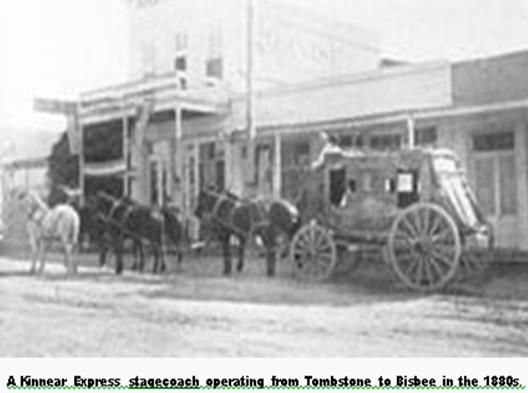
On the evening of March 15th, 1881, three Cochise County Cowboys attempted to rob a Kinnear and Company stagecoach carrying $26,000
in silver bullion, en route from Tombstone to Benson, Arizona, the nearest railroad freight terminal. Near Drew's Station, just outside Contention City, the popular and well-known driver Eli "Budd" Philpot, and a passenger named Peter Roerig riding in the rear dickey seat, were both shot and killed. Deputy US Marshal Virgil Earp, with his temporary deputies and brothers Wyatt Earp and Morgan Earp, pursued the Cowboys suspected of the murders.
John Slaughter was elected Cochise County Sheriff in 1886 and served two terms. He hired Burt Alvord, who as a 15 year old boy said he had witnessed the shootout between the Earps, Doc Holliday and the Cowboys. Alford served very effectively for three years until he began to drink heavily and associate with outlaws, as had Earp era County Sheriff Johnny Behan, a close friend and constant protector of the law breaking Clanton family and their friends.
79
Of the number of pioneer Boot Hill cemeteries in the Old West, so named because most of those buried in them had "died with their boots on," Boot Hill in Tombstone is one of the best known.
While Tombstone boomed because of the silver mining, founder Ed Schieffelin was more interested in prospecting than owning a mine. Ed was one-third partners with his brother Al Schieffelin and Richard Gird.
There were several hundred mining claims near Tombstone, although the most productive were immediately south of town. These included the Goodenough, Toughnut, Contention, Grand Central, Lucky Cuss, Emerald, and Silver Thread. Due to the lack of readily available water near town, mills were built along the San Pedro River about nine miles away, leading to the establishment of several small mill towns, including Charleston, Contention City, and Fairbank.
Schieffelin left Tombstone to find more ore and when he returned four months later, Gird had lined up buyers for their interest in the Contention claim, which they sold for $10,000. It would later yield millions in silver. They sold a half interest in the Lucky Cuss, and the other half turned into a steady stream of money. Al and Ed Schieffelin 80
O.K. Corral
later sold their two-thirds interest in the Tough Nut for $1 million, and sometime later Gird sold his one-third interest for the same amount.
There are widely varying estimates of the value of gold and silver mined during the course of Tombstone's history. The Tombstone mines produced 32 million troy ounces of silver, more than any other mining district in Arizona. In 1883, writer Patrick Hamilton estimated that during the first four years of activity the mines produced about US$25,000,000. Other estimates include US$40 to US$85 million.
Renewed mining was planned for the area.
One of the byproducts of the vast riches being produced, lawsuits became very prevalent. Between 1880 and 1885 the courts were 81
clogged with many cases, often about land claims and properties. As a result, lawyers began to settle in Tombstone and became even wealthier than the miners and those who financed the mining. In addition, because many of the lawsuits required expert analysis of the underground, many geologists and engineers found employment in Tombstone and settled there. In the end, a thorough mapping of the area was completed by “experts” which resulted in maps documenting Tombstone's mining claims better than any other mining district of the West.
Mining was an easy task at Tombstone in the early days, ore being rich and close to the surface. One man could pull out ore equal to what three men produced elsewhere. Some residents of Tombstone became quite wealthy and spent considerable money during its boom years.
Tombstone's first newspaper, the “Tombstone Nugget,” was established in the fall of 1879. “The Tombstone Epitaph” was founded on May 1st, 1880. As the fastest growing boomtown in the American Southwest, the silver industry and attendant wealth attracted many professionals and merchants who brought their wives and families.
With them came churches and ministers. They brought a Victorian 82
sensibility and became the town's elite. Many citizens of Tombstone dressed well, and up to date fashion could be seen in this growing mining town. Visitors expressed their amazement at the quality and diversity of products that were readily available in the area. The men who worked the mines were largely European immigrants. The Chinese did the town's laundry and provided other services. The Cowboys ran the countryside and stole cattle from haciendas across the international border in Sonora, Mexico.
When the railroad was not built into Tombstone as had been planned, the increasingly sophisticated city of Tombstone remained relatively isolated, deep in a federal territory that was largely an unpopulated desert and wilderness. Tombstone and its surrounding countryside also became known as one of the deadliest regions in the West. Water was hauled in until the Huachuca Water Company, funded in part by investors like Dr. George E. Goodfellow, built a 23 mile long pipeline from the Huachuca Mountains in 1881. No sooner was a pipeline completed than Tombstone's silver mines struck water.
83
By mid-1881 there were fancy restaurants, Vogan's Bowling Alley, four churches — Catholic, Episcopal, Presbyterian, and Methodist, an ice house, a school, the Schieffelin Hall opera house, two banks, three newspapers, and an ice cream parlor, alongside 110 saloons, 14
gambling halls, several Chinese restaurants, a French restaurant, two Italian restaurants, numerous Mexican restaurants, several upscale
"Continental" establishments, and many "home cooking" hot spots including Nellie Cashman's famous Rush House and numerous brothels all situated among and on top of a number of dirty, hardscrabble mines. The Arizona Telephone Company began installing poles and lines for the city's first telephone service on March 15th, 1881.
Investors from the northeastern United States bought many of the leading mining operations. The mining itself was carried out by immigrants from Europe, chiefly Cornwall, Ireland, and Germany.
Chinese and Mexican labor provided services including laundry, construction, restaurants and hotels, but immigrant labor provoked backlash. An "Anti-Chinese League" was formed in the 1880s to boycott Chinese businesses and workers.
84
The mines and stamping mills ran three shifts. Miners were paid union wages of $4 per day working six 10 hour shifts per week. The approximately 6,000 men working in Tombstone generated more than $168,000 a week in income. The mostly young, single, male population spent their hard earned cash on Allen Street, the major commercial center, open 24 hours a day.
The respectable folks saw traveling theater shows at Schieffelin Hall, opened on June 8th, 1881. On December 25th, 1881, the Bird Cage Theatre opened on Allen Street, offering the miners and Cowboys their kind of bawdy entertainment. One of the prime entertainments at the Bird Cage theatre was Cornish wrestling competitions, with the results being regularly published in the UK.
In 1882, “The New York Times” reported that; "The Bird Cage Theatre is the wildest, wickedest night spot between Basin Street and the Barbary Coast." The Bird Cage remained open 24 hours a day, 7 days a week, 365 days a year until it closed its doors in 1889. Respectable women stayed on the north side of Allen Street. The prostitutes worked the saloons on the south side and in the southeast quarter of 85
O.K. Corral
the town, as far as possible from the proper residential section north of Fremont Street.
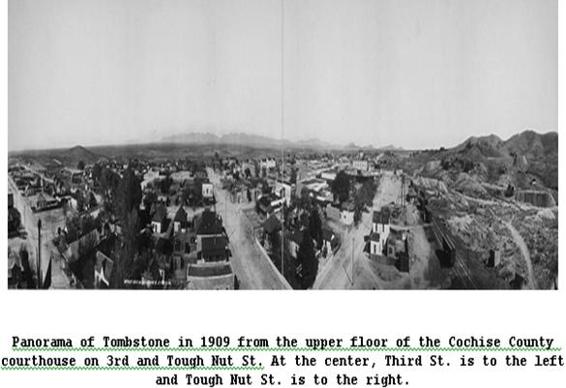
By late 1881 Tombstone had more than 7,000 citizens, excluding all Chinese, Mexicans, women and children residents. At the height of the town's boom, the official population reached about 10,000, with several thousand more uncounted. In 1882, the Cochise County Courthouse was built at a cost of around $45,000.
86
4 - The Lawmen Before the Shootout
The wild and lawless period in the West lasted for about 70 years, with the first shooting incident by a person who could be considered a professional gunman taking place in Texas in 1854.
The gunfighter era was an outgrowth of the Civil War. With many men without opportunities for jobs, their homes and lands in ruins, family members killed or missing, and few skills, with the exception of gun handling, they headed westward in search of new lives. And then, the question became what to do once they got there. Some hunted for gold; some, who had the means, started businesses, others became cowboys, and those with sharp gun handling skills became gunfighters; either lawmen or cowboys, or both.
Living in the American West was not easy at that time. There were no laws, no courts, and little or no government, and because of this, it easily lured numerous criminals, some of who were escaping punishment for other crimes, some who wanted to take advantage of its having no laws, and probably a few who wanted to start over.
87
Some settlements were quickly known for violence and for attracting the seedier elements of society, such as Las Vegas, New Mexico; El Paso, Texas; the mining camps of across the West; and the cow towns of Kansas. In these places, saloons, dance houses, and brothels, easily outnumbered legitimate other businesses, and in many cases, the towns were under the control of less than decent citizens.
However, honest people were also moving to the west and over time, they determined to rid their towns and areas of the lawlessness. This often led them to employ men who were known to be expert in the use of firearms. In other cases, before the establishment of “official”
organizational law, communities turned to vigilantism.
There was a fine line in the Old West as to the skills and nerve required to be a gunfighter, a lawman, or an outlaw, and, those lines often became tangled with some men playing each role at different times in their lives. Just a few of these men who were sufficiently common not to attract the attention of later history included Tom Horn, Burton Alford, J.J. Webb, and Henry Newton Brown.
88
Unlike the old movies, where the outlaw was always a grizzled, mean, and murdering road agent and the lawman was a calm, steely eyed, honest man, the reality was that the two types were often very much the same. This was not always the case; however, some were known to have been good men, such as Bat Masterson, Heck Thomas, and Bill Tilghman. But, even a young Bill Tilghman was once charged with stealing when he was animmature man and so was Wyatt Earp. What the lawmen and the outlaws had in common, besides their gun handling skills, was their willingness to risk their lives to enforce the law or to commit a crime.
There were various types of lawmen in the Old West. He might have been a US Marshal, appointed by the Attorney General; a Sheriff elected to office by the county residents, a Marshal appointed by the City Council, or a deputy, constable, ranger, or peace officer hired by a superior officer or authority. Many lawmen received no pay other than a percentage of any money that those they arrested might be fined, or the collection of bounties on the heads of wanted men. This often led them to have second jobs or sometimes, to use their badges in establishing protection rackets or other crimes. Of those who did 89
make a salary, it was often very low, encouraging off-the-books activities, and their duties often included tasks that many felt were beneath them, such as keeping the streets clean, and other city duties; or in the case of US Marshals, being responsible for taking the national census and distributing Presidential proclamations. Often their work would consist of weeks of boring tasks, punctuated by moments of high drama and sometimes deadly confrontation.
For these reasons and more, very few of even the most famous lawmen actually spent very many years wearing a badge, including Wild Bill Hickok, who only served a few short years in various roles, and Wyatt Earp, who worked in a few Kansas cow towns, before being temporarily deputized by his brother Virgil in time for the O.K. Corral gunfight.
John Clum - 1851 to 1932
John Philip Clum was an Indian agent for the San Carlos Apache Indian Reservation in the Arizona Territory. He implemented a limited form of self-government on the reservation that was so successful that other reservations were closed and their residents moved to San Carlos.
90
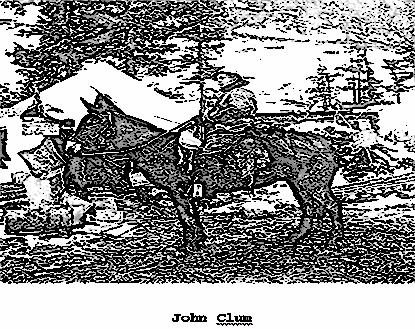
O.K. Corral
Clum later became the first mayor of Tombstone, Arizona Territory, after its incorporation in 1881. He also founded still operating “The Tombstone Epitaph” on May 1st, 1880. He later served in various postal service positions across the United States.
Billy Breakenridge – 1846 to 1931
William Milton Breakenridge was an American lawman, teamster, railroader, soldier and author. Breakenridge was born in Watertown, Wisconsin, to George D. and Elisa Ann Breakenridge. United States 91
Census records from 1850 and 1860 indicate that he had an older brother, an older sister, and a younger sister.
After leaving Wisconsin at the age of 16, Breakenridge joined the United States Army, eventually serving under Colonel John Chivington with the Colorado Territorial Militia during the Sand Creek Massacre, also known as the Chivington massacre. Following his stint with the army, he moved on to Arizona, eventually ending up in Phoenix where he became a Maricopa County deputy sheriff.
After staying in Phoenix for about a year, Breakenridge went south to Cochise County and the growing mining town of Tombstone. He served as a deputy sheriff under Cochise County Sheriff Behan during the 1880s including at the time of the gunfight at the O.K. Corral. Most Old West historians consider Breakenridge, like his boss Behan, to have been a friend to the local outlaw cowboys.
92
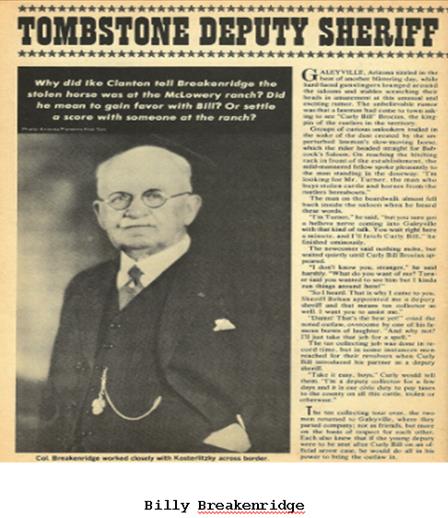
O.K. Corral
After leaving Tombstone shortly after the gunfight at the OK Corral, Breakenridge later served as a deputy US marshal, a surveyor, and as a claims agent for the Southern Pacific Railroad.
93
In 1927, according to historian David Leighton, Wyatt Earp returned to Tucson, likely for the last time, and met with Breakenridge at the Old Pueblo Club. While the purpose of the meeting remains unknown, it might have been to informally obtain information from Earp, for Breakenridge's future book.
In 1928, he became a published author with the release of his memoirs of life in Tombstone and the old west, “Helldorado: Bringing the Law to the Mesquite.” Critics of the book, including Wyatt Earp and his wife Josie, claimed that much of what Breakenridge wrote was biased and more fiction than factual. Although Breakenridge met with Earp in Los Angeles to interview him, the picture he painted of Earp was less than flattering.
Portrayed as a thief, pimp, crooked gambler, and murderer, Earp loudly protested the book's contents until his death in 1929, and his wife continued in the same vein afterward. Nonetheless, the book was a success and generated so much interest that Tombstone's citizens joined together in 1929 to create an annual October celebration, 94
Helldorado Days, commemorating the gunfight at the OK Corral. The celebration continues today.
Breakenridge died before dawn from cardiac failure on January 31st, 1931, aged 84, in Tucson, Arizona. His death certificate stated that he had previously undergone surgery for cardiac problems. He is buried in Evergreen Cemetery in Tucson.
John Horton Slaughter – 1841 to 1922
John Horton Slaughter, also known as Texas John Slaughter, was an American lawman, cowboy, poker player and rancher in the Southwestern United States during the late 19th and early 20th centuries. After serving in the Confederate States Army during the American Civil War, Slaughter earned a reputation fighting hostile Indians and Mexican and American outlaws in the Arizona and New Mexico territories.
95
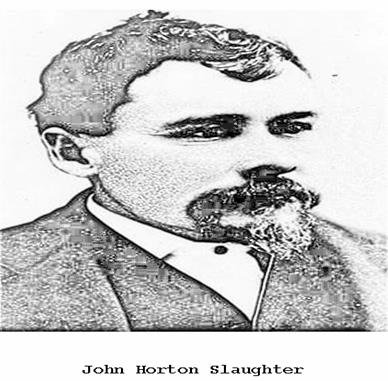
O.K. Corral
In the latter half of his life, he lived at the San Bernardino Ranch, which is today a well preserved National Historic Landmark in Cochise County in far southeastern Arizona. In 1964, he was inducted into the Hall of Great Westerners of the National Cowboy and Western Heritage Museum.
Pat Garrett – 1850 to 1908
Patrick Floyd Jarvis Garrett was born in Chambers County, Alabama.
He was the second of five children born to John Lumpkin Garrett and 96
wife Elizabeth Ann Jarvis. Garrett's four siblings were Margaret, Elizabeth, John, and Alfred. Garrett was of English ancestry, his ancestors migrated to America from the English counties of Hertfordshire, Northamptonshire, Bedfordshire, Lincolnshire and Buckinghamshire. When Pat was three years old his father purchased the John Greer plantation in Claiborne Parish, Louisiana. The Civil War, however, destroyed the Garrett family's finances. Their mother died on March 25th, 1867, at the age of 37. Then the following year, on February 5th, 1868, his father died at age 45. The children were left with a plantation that was more than $30,000 in debt. The children were taken in by relatives. The 18 year old Garrett headed west from Louisiana on January 25th, 1869.
97
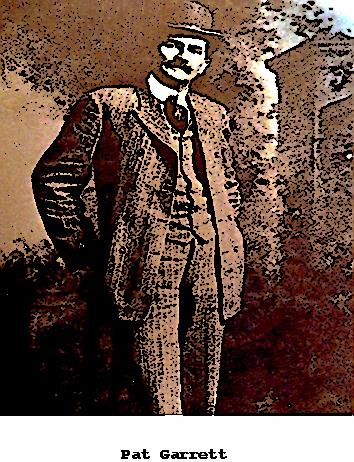
O.K. Corral
Garrett's whereabouts over the next seven years are obscure. By 1876
he was in Texas hunting buffalo. During this period Garrett killed his first man, another buffalo hunter named Joe Briscoe. Garrett surrendered to the authorities at Fort Griffin, Texas, but they declined to prosecute. When the buffalo hunting declined, Garrett left Texas and rode to the New Mexico Territory. When Garrett arrived at Fort Sumner, New Mexico, he found work as a cowboy for Pedro Menard
"Pete" Maxwell.
98
Garrett's first wife was Juanita Martinez, who died 15 days after their marriage. On January 14th, 1880, Garrett married Apolinaria Gutierrez.
Between 1881 and 1905 Apolinaria Garrett gave birth to eight children; Ida, Dudley, Elizabeth, Annie, Patrick, Pauline, Oscar, and Jarvis.
Billy the Kid, born Henry McCarty, and also known as William H.
Bonney, was wanted for murder in the aftermath of the Lincoln County War. On November 2nd, 1880, Garrett was elected sheriff of Lincoln County, New Mexico, having defeated the incumbent, Sheriff George Kimball, by a vote of 320 to 179. Although Garrett's term would not begin until January 1st, 1881, Sheriff Kimball appointed him a deputy sheriff for the remainder of Kimball's term. Garrett also obtained a deputy US Marshal's commission, which allowed him to pursue the Kid across county lines. Garrett and his posse stormed the Dedrick ranch at Bosque Grande on November 30th, 1880. They expected to find the Kid there, but only succeeded in capturing John Joshua Webb, who had been charged with murder, along with an accused horse thief named George Davis. Garrett turned Webb and Davis over to the sheriff of San Miguel County a few days later, and moved on to the settlement 99
of Puerto de Luna. There a local tough named Mariano Leiva picked a fight with Garrett and was shot in the shoulder.
On December 19th, 1880, Billy the Kid, Charlie Bowdre, Tom Pickett, Billy Wilson and Tom O'Folliard rode into Fort Sumner. Lying in wait were deputy Garrett and his posse. Mistaking O'Folliard for the Kid, Garrett's men opened fire and killed O'Folliard. Billy and the others escaped unharmed. Three days later, Garrett's posse cornered Billy and his companions at a spot called Stinking Springs. They killed one man and captured the others. On April 15th, 1881, Billy the Kid was sentenced to hang by Judge Warren Bristol, but escaped thirteen days later, killing two deputies.
On July 14th, 1881, Garrett visited Fort Sumner to question a friend of the Kid's about his whereabouts and learned he was staying with a mutual friend, Pedro Menard "Pete" Maxwell. Around midnight, Garrett went to Maxwell's house. The Kid was asleep in another part of the house, but woke up in the middle of the night and entered Maxwell's bedroom, where Garrett was standing in the shadows. The Kid did not recognize the man standing in the dark. He asked him, repeatedly; 100
"Quién es?",translated to English; "Who is it?", and Garrett replied by shooting at him twice. The first shot hit the Kid in the chest just above the heart, while the second missed. Garrett’s account leaves it unclear whether Billy was killed instantly or took some time to die.
He coauthored “The Authentic Life of Billy the Kid” with Ash Upson, and for decades his book was deemed authoritative.
Following Billy the Kid's death, writers quickly went to work producing books and articles that made a folk hero out of Billy the Kid, while making Garrett seem like an assassin. Although filled with many errors of fact, “The Authentic Life” served afterward as the main source for most books written about the Kid until the 1960s. A commercial failure when originally released, an original copy of the Pat Garrett - Ash Upson book became a rare commodity. In 1969 the original 1882
edition of the Garrett - Upson book was described by Ramon F. Adams as being "exceedingly rare." Twentieth century editions of Garrett's
“Authentic Life of Billy, the Kid,” with alterations to the original title, appeared in 1927, 1946, and 1964.
101
Garrett did not seek re-election as sheriff of Lincoln County in 1882.
He moved to Texas, where he ran unsuccessfully for a seat in the state senate. Garrett became a captain with the Texas Rangers for less than a month, then returned to Roswell, New Mexico.
Garrett discovered a large reservoir of artesian water in the Roswell region and went into partnership with two men to organize the "Pecos Valley Irrigation and Investment Company" on July 18th, 1885. Garrett kept his irrigation schemes alive for several years, and on January 15th, 1887, he purchased a one-third interest in the "Texas Irrigation Ditch Company," but the partners got rid of him. On August 15th, 1887, he formed a partnership with William L. Holloman in the "Holloman and Garrett Ditch Company." All of Garrett's forays into the irrigation field, however, resulted in failure. By 1892, Garrett had moved his large family to Uvalde, Texas, where he became close friends with John Nance Garner, 1868–1967, a future vice president of the United States.
Garrett might have lived out the remainder of his life in Uvalde, had it not been for a headline making event back in New Mexico.
102
On January 31st, 1896, Colonel Albert Jennings Fountain and his eight year old son Henry disappeared at the edge of the White Sands area of southern New Mexico. Neither of the Fountains was ever seen again.
The mystery was never officially solved, even with the efforts of Apache scouts, the Pinkertons, and an all-out push by the Republican Party. In April 1896, Garrett was appointed sheriff of Doña Ana County, and two years later had gathered sufficient evidence to make arrests, asking a judge in Las Cruces for warrants to arrest Oliver M. Lee, William McNew, Bill Carr and James Gililland. Within hours, he had arrested McNew and Carr.
During the early morning hours of July 12th, 1898 Garrett and his posse confronted Oliver M. Lee and James Gililland at a spot called
"Wildy Well" near Orogrande, New Mexico. Garrett had hoped to capture the fugitives while they were sleeping, but Lee and Gililland expected trouble and took their bedrolls up to the roof of the bunkhouse to avoid being taken by surprise. One of Garrett's deputies named Kearney heard footsteps on the roof, scaled a ladder, and was mortally wounded by the fugitives. A stray shot nicked Garrett. Due to his concern for his dying deputy, Garrett arranged a truce with the 103
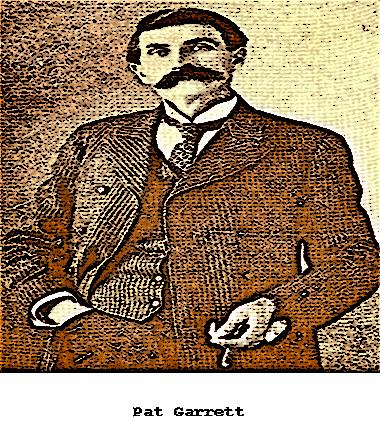
O.K. Corral
fugitives and withdrew while Kearney was lifted into a wagon.
Kearney, however, died on the road to Las Cruces, and Lee and Gililland remained at large for another eight months, before they finally surrendered to Sheriff George Curry. They were found not guilty in the Fountain killings, and the indictments for killing the deputy were also dismissed.
104
Garrett killed his last offender in 1899; a fugitive named Norman Newman, who was wanted for murder in Greer County, Oklahoma.
Newman was hiding out at the San Augustin Ranch in New Mexico.
Sheriff George Blalock of Greer County went to New Mexico and asked Garrett for his assistance. The lawmen and Jose Espalin, one of Garrett's deputies, rode to the ranch, and on October 7th, 1899, Newman was killed in a gunfight.
On December 16th, 1901, President Theodore Roosevelt nominated Garrett to the post of collector of customs in El Paso. He also became one of President Roosevelt's three "White House Gunfighters," Bat Masterson and Ben Daniels being the others. Despite public outcry over his appointment, Garrett was confirmed by the US Senate on January 2nd, 1902. Garrett's tenure as El Paso's collector of customs was stormy from the start. On May 8th, 1903, he got into a public fistfight with an employee named George Gaither. The following morning, both Garrett and Gaither paid five dollar fines for disturbing the peace. Continued complaints about Garrett's alleged incompetence were sent to Washington. Through it all, President Roosevelt stood by Garrett. As a show of his support, Roosevelt invited 105
Garrett to attend a Rough Riders reunion being held in San Antonio during April 1905. Since Garrett had not been a member of that regiment, Roosevelt's invitation was taken as a snub at those critics who wanted Garrett replaced from his post. Garrett brought a guest of his own to the event named Tom Powers. Garrett introduced Powers to the president as "a prominent Texas cattleman." Garrett and Powers posed for two photographs with Roosevelt, first standing with him in a group and later seated with Roosevelt at dinner. Garrett's enemies obtained copies of the photos and sent them to Roosevelt, informing the president that instead of being the "cattleman" that Garrett claimed, Powers was, in fact, the owner of a "notorious dive" in El Paso called the Coney Island Saloon. That was the final straw for Roosevelt, who replaced Garrett with a new collector of customs on January 2nd, 1906.
Following his dismissal, Garrett returned with his family to New Mexico. Garrett was in deep financial difficulty. His ranch had been heavily mortgaged, and when he was unable to make payments, the county auctioned off all of Garrett's personal possessions to satisfy judgments against him. The total from the auction came to $650.
106
President Roosevelt had appointed Pat's friend George Curry as the territorial governor of New Mexico. Garrett met with Curry, who promised him the position of superintendent of the territorial prison at Santa Fe, once he was inaugurated. Since Curry's inauguration was still months away, the destitute Garrett left his family in New Mexico and returned to El Paso, where he found employment with the real estate firm of H.M. Maple and Company. During this period Garrett moved in with a woman known as "Mrs. Brown," who was described as an El Paso prostitute. When Governor-elect Curry learned of his involvement with Brown, the promised appointment of prison superintendent was withdrawn.
Dudley Poe Garrett, Pat's son, had signed a five year lease for his Bear Canyon Ranch with Jesse Wayne Brazel. Garrett and his son objected when Brazel began bringing in large herds of goats, which were anathema to cattlemen like Garrett. Garrett tried to break the lease when he learned that the money for Brazel's operation had been put up by his neighbor, W. W. "Bill" Cox. He was further angered when he learned that Archie Prentice "Print" Rhode was Brazel's partner in the huge goat herd. When Brazel refused, the matter went to court. At this 107
point James B. Miller met with Garrett to try to solve the problem.
Miller met with Brazel, who agreed to cancel his lease with Garrett, provided a buyer could be found for his herd of 1,200 goats. Carl Adamson, who was related to Miller by marriage, agreed to buy the 1,200 goats. Just when the matter seemed resolved, Brazel claimed that he had "miscounted" his goat herd, claiming there were actually 1,800, rather than his previous estimate of 1,200. Adamson refused to buy that many goats, but agreed to meet with Garrett and Brazel to see if they could reach some sort of agreement.
Garrett and Carl Adamson rode together, heading from Las Cruces, New Mexico in Adamson's wagon. Brazel appeared on horseback along the way. Garrett was shot and killed, but exactly by whom remains the subject of controversy. Brazel and Adamson left the body by the side of the road and returned to Las Cruces, where Brazel surrendered to Deputy Sheriff Felipe Lucero. More than thirty years later, Lucero claimed that Brazel exclaimed; "Lock me up. I've just killed Pat Garrett!" Brazel then pointed to Adamson and said; "He saw the whole thing and knows that I shot in self-defense." Lucero incarcerated Brazel, summoned a coroner's jury, and rode to Garrett's death site.
108
Brazel's trial for Garrett's murder concluded on May 4th, 1909. Brazel was represented at his trial by attorney and future Secretary of the Interior Albert Bacon Fall. The only eyewitness to Garrett's murder, Adamson, never appeared at the trial, which lasted only one day and ended with an acquittal.
The coroner's report on Garrett's death states that Brazel shot Garrett.
Brazel reportedly confessed, but was acquitted at trial. Four other suspects have been proposed: Adamson, Cox, Rhode, and Miller. In a book published in 1970, Glenn Shirley gave his reasons for naming Miller as the killer of Pat Garrett. Leon C. Metz in his 1974 biography of Garrett related the claim of W.T. Moyers that "his investigations led him to believe that W. W. Cox himself ambushed and killed Garrett,"
but also wrote that "the Garrett family believes that Carl Adamson pulled the trigger." In his 2010 book on Billy the Kid and Pat Garrett, Mark Lee Gardner suggests that Archie Prentice "Print" Rhode killed Garrett.
The site of Garrett's death is now commemorated by a historical marker south of US Route 70, between Las Cruces, New Mexico and 109
the San Augustin Pass. The historical marker is located about 1.2
miles from where Garrett was murdered. In 1940 his son, Jarvis Garrett, marked the spot with a monument consisting of concrete laid around a stone with a cross carved in it. The cross is believed to be the work of Garrett's mother. Scratched in the concrete is "P. Garrett"
and the date of his killing. The marker is located in the desert. In 2020, the city of Las Cruces revealed plans for a development that would destroy the site. An organization called “Friends of Pat Garrett” was formed to ensure that the city preserves the site and marker.
At six feet five inches, Garrett's body was too tall for any finished coffins available, so a special one had to be shipped in from El Paso.
His funeral service was held March 5th, 1908, and he was laid to rest next to his daughter, Ida, who had died in 1896 at the age of fifteen.
Garrett's grave and the graves of his descendants are in the Masonic Cemetery, Las Cruces.
George McKelvey - ? to ?
George McKelvey was a lawman in Charleston, Cochise County, Arizona during the 1880s. He is known for arresting Johnny-Behind-the-110
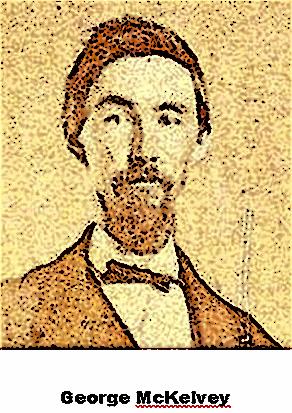
O.K. Corral
Deuce, Michael O'Rourke, on January 14th, 1881 after he killed Tombstone Mill and Mining Company’s chief engineer Phillip Schneider in apparent self-defense. Schneider was well-liked, and residents of Charleston formed an angry mob and threatened to lynch O'Rourke.
McKelvey put O'Rourke on a buckboard wagon and hurried towards Tombstone, 10 miles away, pursued by the angry citizens. Charleston authorities telegraphed Tombstone Marshal Ben Sippy to let him know that McKelvey was on his way with a prisoner. In an episode that later became famous, McKelvey encountered either Virgil or Wyatt Earp on 111
his way into Tombstone. Various versions of the story differ, but Virgil or Wyatt reportedly put O'Rourke on the back of his horse and escorted him to Vogan’s Saloon. Wyatt, aided by Virgil, and Marshal Ben Sippy, stood down the crowd in a nervy display that soon fed his reputation as a fearless lawman.
After the mob was calmed down, McKelvey joined a 15 man posse, including Cochise County Deputy Sheriff Johnny Behan and Marshal Ben Sippy, who guarded O'Rourke during the 10 miles ride to Tucson.
Fred J. Dodge – 1854 to 1938
Frederick J. Dodge, August 29th, 1854 — December 16th, 1938, was an undercover Wells Fargo detective, a constable in Tombstone, Arizona, and a Texas cattleman. He was born in Spring Valley in northern Butte County, California and was raised in Sacramento.
112
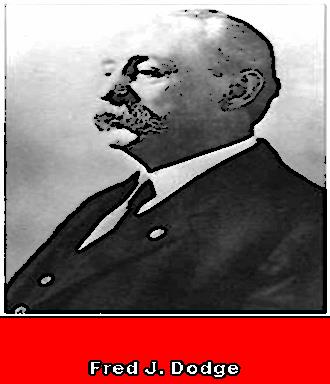
O.K. Corral
As a young man, Dodge learned to drive two, four, and six horse hitches, and "fast freight handling fruit into the mining camps." He kept a store and managed a railroad eatery for his parents, but he was
"lonesome for the mountains and the excitement of the mining camps," he later wrote. Dodge moved around, including trips to Pioche, Nevada, and Bodie, California, and met notable individuals in the mining camps, including Dave Neagle, Pat Holland, and Nellie Cashman.
He worked as undercover agent for Wells Fargo in California, Nevada and Arizona. In December 1879, he was working in Tombstone, Arizona 113
and recommended that Wyatt Earp be hired as a guard and messenger for the stage line. The two quickly became good friends and Dodge supported Wyatt and his brothers in their troubles in Tombstone that led up to the gunfight at the O.K. Corral and its aftermath. He was a personal friend of Wyatt and Virgil Earp and remained friends with them the rest of their lives. He was also a friend of lawman Heck Thomas. He was personally involved in the investigations that led to the demise of the Doolin and Dalton Gangs.
During the Earp Vendetta Ride, Earp borrowed a short, 22 inch, 10
gauge, double barrel percussion shotgun from Fred Dodge. Dodge used the shotgun throughout his 40 year career and the gun was also registered to US Marshal Heck Thomas. It passed through several owners. It was sold at auction in February, 2020, for $375,000.
He kept a daily diary of his life, a total of 27 diaries, which he used as the basis for the book on the "Life and Times of Wyatt Earp." A book about the unvarnished recollections of Fred Dodge titled "Undercover for Wells Fargo" was edited by Carolyn Lake, who discovered Dodge's journals among Stuart N. Lake's papers.
114
His diaries describe dozens of his cases, including stage robberies, train holdups, long pursuits across the badlands, even a lawsuit against Wells Fargo for "delay to a corpse."
Fred Dodge and Morgan Earp looked alike, and when he first arrived on the stagecoach in Tombstone in 1879, Wyatt and Virgil promptly introduced themselves to the stranger who looked so much like their brother. Dodge posed as a gambler and none of the Earps initially knew he was a Wells Fargo agent. Dodge later teamed up with Heck Thomas to hunt down outlaws in Kansas and Oklahoma, and was personally involved in the investigations that led to the end of the Doolin and Dalton Gangs.
Ben Sippy - ? to ?
Ben Sippy was City Marshal of Tombstone, Arizona Territory, from November 12th, 1880, to June 6th, 1881. He beat out Deputy US
Marshal Virgil Earp for the office but left under a cloud of financial impropriety.
Before arriving in Arizona, Sippy had been indicted for theft in Parker County, Texas. He fled the state without facing the charges. On 115
O.K. Corral
November 12th, 1880, Sippy beat Virgil Earp by 311 to Earp's 259 votes in an election only two weeks after Earp was appointed to fill the office after Fred White was “accidentally” killed by Cowboy Curly Bill Brocius. On January 4th, 1881, Sippy stood for election as the permanent City Marshal and beat challenger Howard Lee.
On February 28th, 1881, at the Oriental Hotel, gamblers Luke Short and Charlie Storms had a verbal altercation which was temporarily defused by Bat Masterson, who was an acquaintance of Storms as 116
well. Storms later returned to the scene and yanked Short off the sidewalk as he and Masterson left the gambling hall. Storms pulled his cut off Colt .45 pistol, but Short was quicker. Short shot Storms twice before he hit the ground; the first shot fired was so close that it set fire to Storms' shirt. Short was alleged to have then turned to Bat Masterson and stated; "You sure pick some of the damnedest friends, Bat." Sippy arrested Short, but the shooting was determined to have been made in self-defense.
The city council reprimanded him for being absent without leave. In May, they criticized him for "action in regard to releasing certain prisoners." He also helped defuse a lot jumping confrontation in December 1880. Sippy was praised for his handling of the mob intent on lynching Johnny Behind-the-Deuce, on January 14th, 1881, helping to convince them to disperse.
But by June 1881 Sippy was in trouble. On June 6th, 1881, he asked the city for a two week leave of absence and Virgil Earp was appointed as acting city marshal. Angry creditors came forward, complaining Sippy owed them money. On June 22nd, during Sippy's 117
absence, Tombstone was hit by a large fire. Earp ably managed the disarray and kept lot jumpers at bay. Less than a week later, the City of Tombstone discovered $3,000 in financial improprieties in Sippy's records. Earp was appointed as Chief of Police.
Fred White – 1849 to 1880
Frederick G. White, ca. 1849 – October 30th, 1880, was an American lawman and the first town marshal of the mining boomtown of Tombstone, Arizona Territory. White was elected to the position on January 6th, 1880. At the time, Tombstone was still an emerging frontier town with fewer than 1,000 residents, and did not become an official city, with over 1,000 residents, until a year later. Before that time, White died in office following a notorious “accidental” shooting, and was succeeded by Virgil Earp.
118
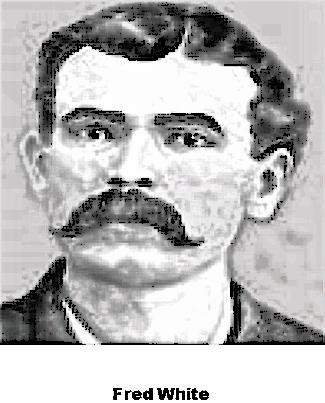
O.K. Corral
Bob Paul – 1830 to 1901
Robert Havlin "Bob" Paul was a law enforcement officer in the American Southwest for more than 30 years. He was sheriff of Pima County, Arizona Territory from April 1881 to 1886 and a friend of Deputy US Marshall Virgil Earp and his brother Wyatt Earp. At 6 feet 6
inches and 240 pounds, he was described by some as "larger than life." Others described him as "powerful, fearless and very lucky."
They were right, as Bob managed to stay out of trouble in an environment which seemed to invite it.
119
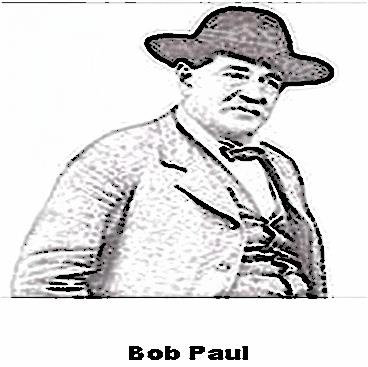
O.K. Corral
Wild Bill Hickok – 1837 to 1876
James Butler Hickok, May 27th, 1837 – August 2nd, 1876, better known as "Wild Bill" Hickok, was a folk hero of the American Old West known for his life on the frontier as a soldier, scout, lawman, gambler, showman, and actor, and for his involvement in many famous gunfights. He earned a great deal of notoriety in his own time, much of it bolstered by the many outlandish and often fabricated tales he told about himself. Some contemporaneous reports of his exploits are known to be fictitious, but they remain the basis of much of his fame and reputation.
120
Hickok was born and raised on a farm in northern Illinois at a time when lawlessness and vigilante activity were rampant because of the influence of the "Banditti of the Prairie." Drawn to this ruffian lifestyle, he headed west at age 18 as a fugitive from justice, working as a stagecoach driver and later as a lawman in the frontier territories of Kansas and Nebraska. He fought and spied for the Union Army during the American Civil War and gained publicity after the war as a scout, marksman, actor, and professional gambler. He was involved in several notable shootouts during the course of his life.
121
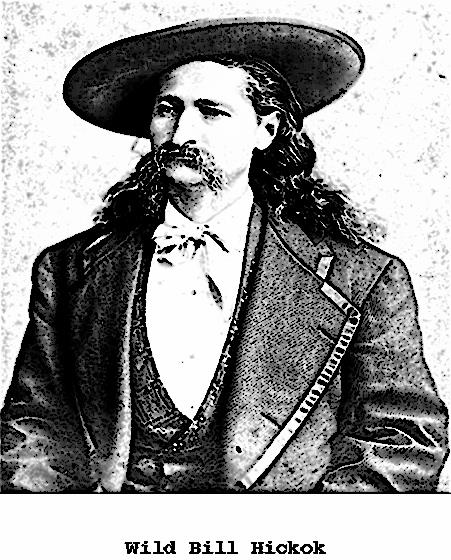
O.K. Corral
In 1876, Hickok was shot and killed while playing poker in a saloon in Deadwood, Dakota Territory, present day South Dakota, by Jack McCall, an unsuccessful gambler. The hand of cards which he supposedly held at the time of his death has become known as the dead man's hand; two pair; black aces and eights.
122
Hickok remains a popular figure of frontier history. Many historic sites and monuments commemorate his life, and he has been depicted numerous times in literature, film, and television. He is chiefly portrayed as a protagonist, although historical accounts of his actions are often controversial, and much of his career is known to have been exaggerated both by himself and by contemporary mythmakers. While Hickok claimed to have killed numerous named and unnamed gunmen in his lifetime, his career as a gunfighter only lasted from 1861 to 1871. According to Joseph G. Rosa, Hickok's biographer and the foremost authority on Wild Bill, Hickok killed only six or seven men in gunfights.
James Butler Hickok was born in Homer, Illinois, present day Troy Grove, Illinois, to William Alonzo Hickok, a farmer, and his wife, Polly Butler. Hickok was of English ancestry. James was the fourth of six children. His father was said to have used the family house, now demolished, as a station on the Underground Railroad. William Hickok died in 1852, when James was 15.
123
Hickok was a good shot from a young age, and was recognized locally as an outstanding marksman with a pistol. Photographs of Hickok appear to depict dark hair, but all contemporaneous descriptions affirm that it was red.
In 1855, at age 18, James Hickok fled Illinois following a fight with Charles Hudson, during which both fell into a canal; each thought, mistakenly, that he had killed the other. Hickok moved to Leavenworth in the Kansas Territory, where he joined Jim Lane's Free State Army, also known as the Jayhawkers, an anti-slavery vigilante group active in the new territory during the Bleeding Kansas era. While a Jayhawker, he met 12 year old William Cody, later known as "Buffalo Bill," who, despite his youth, served as a scout just two years later for the US Army during the Utah War.
Hickok used his late father's name, William Hickok, from 1858, and the name William Haycock during the American Civil War. Most newspapers referred to him as William Haycock until 1869. He was arrested while using the name Haycock in 1865. He afterward resumed using his given name, James Hickok. Military records after 1865 list 124
him as Hickok, but note that he was also known as Haycock. In an 1867 article about his shootout with Davis Tutt, his surname was misspelled as Hitchcock.
While in Nebraska, Hickok was derisively referred to by one man as
"Duck Bill" for his long nose and protruding lips. He was also known before 1861 among Jayhawkers as "Shanghai Bill" because of his height and slim build. He grew a moustache following the McCanles incident, and in 1861 began calling himself "Wild Bill.”
In 1857, Hickok claimed a 160 acre tract in Johnson County, Kansas, near present day Lenexa. On March 22nd, 1858, he was elected one of the first four constables of Monticello Township. In 1859, he joined the Russell, Majors and Waddell freight company, the parent company of the Pony Express.
In 1860, Hickok was badly injured, possibly by a bear, while driving a freight team from Independence, Missouri to Santa Fe, New Mexico.
According to Hickok's account, he found the road blocked by a cinnamon bear and its two cubs. Dismounting, he approached the bear and fired a shot into its head, but the bullet ricocheted off its skull, 125
infuriating it. The bear attacked, crushing Hickok with its body. Hickok managed to fire another shot, wounding the bear's paw. The bear then grabbed his arm in its mouth, but Hickok was able to grab his knife and slash its throat, killing it.
Hickok was severely injured, with a crushed chest, shoulder, and arm.
He was bedridden for four months before being sent to Rock Creek Station in the Nebraska Territory to work as a stable hand while he further recovered. There, the freight company had built a stagecoach stop along the Oregon Trail near Fairbury, Nebraska, on land purchased from David McCanles.
On July 12th, 1861, David McCanles went to the Rock Creek Station office to demand an overdue property payment from Horace Wellman, the station manager. McCanles reportedly threatened Wellman, and either Wellman or Hickok, who was hiding behind a curtain, killed McCanles. Hickok, Wellman, and another employee, J.W. Brink, were tried for killing McCanles, but were found to have acted in self-defense. McCanles may have been the first man Hickok killed. Hickok subsequently visited McCanles' widow, apologized for the killing, and 126
offered her $35 in restitution, all the money he had with him at the time.
After the Civil War broke out in April 1861, Hickok became a teamster for the Union Army in Sedalia, Missouri. By the end of 1861, he was a wagon master, but in September 1862, he was discharged for unknown reasons. He then joined General James Henry Lane's Kansas Brigade, and while serving with the brigade, saw his friend Buffalo Bill Cody, who was serving as a scout.
In late 1863, Hickok worked for the provost marshal of southwest Missouri as a member of the Springfield detective police. His work included identifying and counting the number of troops in uniform who were drinking while on duty, verifying hotel liquor licenses, and tracking down individuals who owed money to the cash strapped Union Army.
Buffalo Bill claimed that he encountered Hickok disguised as a Confederate officer in Missouri in 1864. Hickok had not been paid for some time, and was hired as a scout by General John B. Sanborn by early 1865. In June, Hickok mustered out and went to Springfield, 127
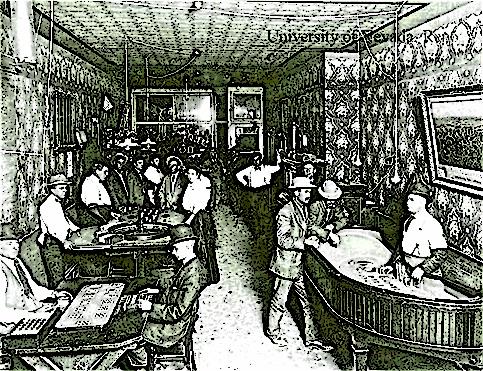
O.K. Corral
where he gambled. The 1883 History of Greene County, Missouri described him as "by nature a ruffian ... a drunken, swaggering fellow, who delighted when 'on a spree' to frighten nervous men and timid women."
While in Springfield, Hickok and a local gambler named Davis Tutt had several disagreements over unpaid gambling debts and their common affection for the same women. Hickok lost a gold watch to Tutt in a poker game. The watch had great sentimental value to Hickok, so he asked Tutt not to wear it in public. They initially agreed not to fight over the watch, but when Hickok saw Tutt wearing it, he warned him to stay away. On July 21st, 1865, the two men faced off in Springfield's 128
town square, standing sideways before drawing and firing their weapons. Their quick draw duel was recorded as the first of its kind.
Tutt's shot missed, but Hickok's struck Tutt through the heart from about 75 yards away. Tutt called out; "Boys, I'm killed," before he collapsed and died.
Two days later, Hickok was arrested for murder. The charge was later reduced to manslaughter. He was released on $2,000 bail and stood trial on August 3rd, 1865. At the end of the trial, Judge Sempronius H.
Boyd told the jury they could not find Hickok acted in self-defense if he could have reasonably avoided the fight. However, if they felt the threat of danger was real and imminent, he instructed they could apply the unwritten law of the "fair fight" and acquit. The jury voted to clear Hickok, resulting in public backlash and criticism of the verdict.
Several weeks later, an interview Hickok gave to Colonel George Ward Nichols, a journalist who subsequently became known as the creator of the Hickok legend, was published in “Harper's New Monthly Magazine.” Under the name "Wild Bill Hitchcock", the article recounted the "hundreds" of men whom Hickok had personally killed 129
and other exaggerated exploits. The article was controversial wherever Hickok was known, and several frontier newspapers wrote rebuttals.
In September 1865, Hickok came in second in the election for city marshal of Springfield. Leaving Springfield, he was recommended for the position of deputy federal marshal at Fort Riley, Kansas. This was during the Indian Wars, in which Hickok sometimes served as a scout for General George A. Custer's 7th Cavalry.
In 1865, Hickok recruited six Native Americans and three cowboys to accompany him to Niagara Falls, where he commenced his show business career by putting on an outdoor demonstration called “The Daring Buffalo Chasers of the Plains.” Since the event was outdoors, he could not compel people to pay, and the venture was a financial failure. The show featured six buffalo, a bear, and a monkey, and one show ended in disaster when a buffalo refused to act, prompting Hickok to fire a bullet into the sky. This angered the buffalo and panicked audience members, causing the animals to break free of their wire fencing and chase audience members, some of whom were 130
trampled. The incident helped contribute to the overall failure of the show.
Henry M. Stanley, of the “Weekly Missouri Democrat,” reported Hickok to be "an inveterate hater of Indian People," perhaps to enhance his reputation as a scout and American fighter, but separating fact from fiction is difficult considering his recruitment of Indians to cross the nation to appear in his own Wild West show. Witnesses confirm that while working as a scout at Fort Harker, Kansas, on May 11th, 1867, Hickok was attacked by a large group of Indians, who fled after he shot and killed two. In July, Hickok told a newspaper reporter that he had led several soldiers in pursuit of Indians who had killed four men near the fort on July 2nd. He reported returning with five prisoners after killing ten. Witnesses confirm that the story was true to the extent the party had set out to find whoever had killed the four men, but the group returned to the fort "without nary a dead Indian, never even seeing a live one."
In December 1867, newspapers reported that Hickok had come to stay in Hays City, Kansas. He became a deputy US marshal, and on March 131
28th, 1868, he picked up eleven Union Army deserters who had been charged with stealing government property. Hickok was assigned to bring the men to Topeka for trial, and he requested a military escort from Fort Hays. He was assigned Buffalo Bill Cody, a sergeant, and five privates. They arrived in Topeka on April 2nd. Hickok remained in Hays through August 1868, when he brought 200 Cheyenne Indians to Hays to be viewed by "excursionists."
On September 1st, 1868, Hickok was in Lincoln County, Kansas, where he was hired as a scout by the 10th Cavalry Regiment, a segregated African-American unit. On September 4th, Hickok was wounded in the foot while rescuing several cattlemen in the Bijou Creek basin who had been surrounded by Indians. The 10th Regiment arrived at Fort Lyon in Colorado in October and remained there for the rest of 1868.
In July 1869, Hickok returned to Hays and was elected city marshal of Hays and sheriff of Ellis County, Kansas, in a special election held on August 23rd, 1869. Three sheriffs had quit during the previous eighteen months. Hickok may have been acting sheriff before he was elected. A newspaper reported that he arrested offenders on August 132
18th, and the commander of Fort Hays wrote a letter to the assistant adjutant general on August 21st in which he praised Hickok for his work in apprehending deserters.
The regular county election was held on November 2nd, 1869. Hickok ran as an Independent; but lost to his deputy, Peter Lanihan, who ran as a Democrat. Hickok and Lanihan, however, remained sheriff and deputy, respectively. Hickok accused a J.V. Macintosh of irregularities and misconduct during the election. On December 9th, Hickok and Lanihan both served legal papers on Macintosh, and local newspapers acknowledged that Hickok had guardianship of Hays City.
In September 1869, his first month as sheriff, Hickok killed two men.
The first was Bill Mulvey, who was rampaging through town, drunk, shooting out mirrors and whisky bottles behind bars. Citizens warned Mulvey to behave, because Hickok was sheriff. Mulvey angrily declared that he had come to town to kill Hickok. When he saw Hickok, he leveled his cocked rifle at him. Hickok waved his hand past Mulvey at some onlookers and yelled; "Don't shoot him in the back; he is drunk." Mulvey wheeled his horse around to face those who might 133
shoot him from behind, and before he realized he had been fooled, Hickok shot him through the temple.
The second man killed by Hickok was Samuel Strawhun, a cowboy, who was causing a disturbance in a saloon at 1:00 AM on September 27th, when Hickok and Lanihan went to the scene. Strawhun "made remarks against Hickok," and Hickok killed him with a shot through the head. Hickok said he had "tried to restore order.” At the coroner's inquest into Strawhun's death, despite "very contradictory" evidence from witnesses, the jury found the shooting justifiable.
On July 17th, 1870, Hickok was attacked by two troopers from the 7th US Cavalry, Jeremiah Lonergan and John Kyle in a saloon. Lonergan pinned Hickok to the ground, and Kyle put his gun to Hickok's ear.
When Kyle's weapon misfired, Hickok shot Lonergan, wounding him in the knee, and shot Kyle twice, killing him. Hickok lost his re-election bid to his deputy.
John Wesley Hardin, a well-known gunfighter, was known to have killed at least twenty-seven men. In his autobiography, Hardin made the claim that while surrendering his guns to the lawman due to a 134
local ordinance, he had once disarmed Town Marshal "Wild Bill"
Hickok with the use of the "road agent's spin."
On April 15th, 1871, Hickok became marshal of Abilene, Kansas. He replaced Tom "Bear River" Smith, who had been killed while serving an arrest warrant on November 2nd, 1870. Outlaw John Wesley Hardin arrived in Abilene at the end of a cattle drive in early 1871. In his 1895
autobiography, published after his death, Hardin claimed to have been befriended by Hickok, the newly elected town marshal, after he had disarmed the marshal. In any case, Hardin appeared to have thought highly of Hickok.
Hickok later said he did not know that "Wesley Clemmons" was Hardin's alias, and that he was a wanted outlaw. He told Clemmons (Hardin) to stay out of trouble in Abilene and asked him to hand over his guns, and Hardin complied. Hardin alleged that when his cousin, Mannen Clements, was jailed for the killing of two cowhands, Joe and Dolph Shadden, in July 1871, Hickok, at Hardin's request, arranged for his escape.
135
In August 1871, Hickok sought to arrest Hardin for killing Charles Couger in an Abilene hotel "for snoring too loud." Hardin left Kansas before Hickok could arrest him. A newspaper reported; "A man was killed in his bed at a hotel in Abilene, Monday night, by a desperado called 'Arkansas.' The murderer escaped. This was his sixth murder."
Hickok and Phil Coe, a saloon owner and acquaintance of Hardin's, had a dispute that resulted in a shootout. The Bull's Head Saloon in Abilene had been established by gambler Ben Thompson and Coe, his partner, businessman, and fellow gambler. The two entrepreneurs had painted a picture of a bull with a large erect penis on the side of their establishment as an advertisement. Citizens of the town complained to Hickok, who requested that Thompson and Coe remove the image.
They refused, so Hickok altered it himself. Infuriated, Thompson tried to incite John Wesley Hardin to kill Hickok by exclaiming to Hardin that; "He's a damn Yankee. Picks on rebels, especially Texans, to kill."
Hardin was in town under his assumed name Wesley Clemmons, but was better known to the townspeople by the alias "Little Arkansas."
He seemed to have respect for Hickok's abilities and replied; "If Bill needs killing, why don't you kill him yourself?" Hoping to intimidate 136
Hickok, Coe allegedly stated that he could "kill a crow on the wing."
Hickok's retort is one of the West's most famous sayings; "Did the crow have a pistol? Was he shooting back? I will be."
On October 5th, 1871, Hickok was standing off a crowd during a street brawl when Coe fired two shots. Hickok ordered him to be arrested for firing a pistol within the city limits. Coe claimed that he was shooting at a stray dog, and then suddenly turned his gun on Hickok, who fired first and killed Coe. In another account of the Coe shootout, Theophilus Little, the mayor of Abilene and owner of the town's lumber yard, recorded his time in Abilene by writing in a notebook, which was ultimately given to the Abilene Historical Society. Writing in 1911, he detailed his admiration for Hickok and included a paragraph on the shooting that differs considerably from the reported account; "’Phil’
Coe was from Texas, ran the ‘Bull's Head,’ a saloon and gambling den, sold whiskey and men's souls. As vile a character as I ever met. For some cause Wild Bill incurred Coe's hatred and he vowed to secure the death of the marshal. Not having the courage to do it himself, he one day filled about two hundred cowboys with whiskey intending to get them into trouble with Wild Bill, hoping that they would get to shooting 137
and in the melee shoot the marshal. But Coe ‘reckoned without his host.’ Wild Bill had learned of the scheme and cornered Coe, had his two pistols drawn on Coe. Just as he pulled the trigger, one of the policemen rushed around the corner between Coe and the pistols and both balls entered his body, killing him instantly. In an instant, he pulled the triggers again sending two bullets into Coe's abdomen, and whirling with his two guns drawn on the drunken crowd of cowboys, Hickok said; ‘And now do any of you fellows want the rest of these bullets?’ Not a word was uttered. Coe lived a day or two.”
After shooting Coe, Hickok caught a glimpse of someone running toward him and quickly fired two more shots in reaction, accidentally shooting and killing Abilene Special Deputy Marshal Mike Williams, who was coming to his aid. This was the last time Hickok was ever involved in a gunfight; the accidental death of Deputy Williams was an event that haunted Hickok for the remainder of his life.
Hickok was relieved of his duties as marshal less than two months after the accidental shooting, this incident being only one of a series of questionable shootings and claims of misconduct during his career.
138
In 1873, Buffalo Bill Cody and Texas Jack Omohundro invited Hickok to join their troupe after their earlier success. Hickok did not enjoy acting, and often hid behind scenery. In one show, he shot the spotlight when it focused on him. He was released from the group after a few months.
In 1876, Hickok was diagnosed by a doctor in Kansas City, Missouri, with glaucoma and ophthalmia. Although he was just 39, his marksmanship and health were apparently in decline, and he had been arrested several times for vagrancy, despite earning a good income from gambling and displays of showmanship only a few years earlier.
From 1871 until his death in 1876, Hickok had vision problems. A former cavalryman, J. W. "Doc" Howard, who had known Hickok, stated that Hickok had left Buffalo Bill's Wild West Exhibition "because the lights affected his eyes, so he had to give it up."
Charles Snyder, the Lucien Howe Librarian of Ophthalmology at Harvard Medical School, said "Granular conjunctivitis, ophtalmia, trachoma, call it what you will, was common on the Western Frontier.
Jesse James suffered from it."
139
On March 5th, 1876, Hickok married Agnes Thatcher Lake, a 50 year old circus proprietor in Cheyenne, Wyoming Territory. Hickok left his new bride a few months later, joining Charlie Utter's wagon train to seek his fortune in the gold fields of South Dakota.
Shortly before Hickok's death, he wrote a letter to his new wife, which read in part; "Agnes darling, if such should be we never meet again, while firing my last shot, I will gently breathe the name of my wife Agnes and with wishes even for my enemies I will make the plunge and try to swim to the other shore."
Martha Jane Cannary, known popularly as Calamity Jane, claimed in her autobiography that she was married to Hickok and had divorced him so he could be free to marry Agnes Lake, but no records have been found that support her account. The two possibly met for the first time after Jane was released from the guardhouse in Fort Laramie and joined the wagon train in which Hickok was traveling. The wagon train arrived in Deadwood in July 1876. Jane confirmed this account in an 1896 newspaper interview, although she claimed she had been hospitalized with illness rather than in the guardhouse.
140
On August 1st, 1876, Hickok was playing poker at Nuttal and Mann's Saloon No. 10 in Deadwood, Dakota Territory. When a seat opened up at the table, a drunk man named Jack McCall sat down to play. McCall lost heavily. Hickok encouraged McCall to quit the game until he could cover his losses and offered to give him money for breakfast. Although McCall accepted the money, he was apparently insulted.
The next day, Hickok was playing poker again. He usually sat with his back to a wall so he could see the entrance, but the only seat available when he joined the game was a chair facing away from the door. He twice asked another man at the table, Charles Rich, to change seats with him, but Rich refused. McCall then entered the saloon, walked up behind Hickok, drew his Colt Model 1873 single action Army .45 caliber revolver, and shouted, "Damn you! Take that!"
before shooting Hickok in the back of the head at point blank range.
Hickok died instantly. The bullet emerged through his right cheek and struck another player, riverboat Captain William Massie, in the left wrist. Hickok told his friend Charlie Utter and others who were 141
traveling with them that he thought he would be killed while in Deadwood.
Hickok was playing either five card stud or five card draw when he was shot. He was holding two pair; black aces and black eights as his
"up cards," which has since become widely known as the "dead man's hand." The identity of the fifth card, his "hole card" is the subject of debate.
McCall's motive for killing Hickok is like most of the old Wild West stories, the subject of speculation, this one largely concerning McCall's anger at Hickok's having given him money for breakfast the day before, after McCall had lost heavily.
McCall was summoned before an informal "miners' jury," an ad hoc local group of miners and businessmen. He claimed he was avenging Hickok's earlier slaying of his brother, which may have been true; a man named Lew McCall had indeed been killed by an unknown lawman in Abilene, Kansas, but whether or not the two McCall men were related is unknown. McCall was acquitted of the murder, which prompted editorializing in the “Black Hills Pioneer;” "Should it ever be 142
our misfortune to kill a man ... we would simply ask that our trial may take place in some of the mining camps of these hills." Calamity Jane is reputed to have led a mob that threatened McCall with lynching, but at the time of Hickok's death, Jane was actually being held by military authorities.
After bragging about killing Hickok, McCall was rearrested. The second trial was not considered double jeopardy because of the irregular jury in the first trial and because Deadwood was at the time in unorganized Indian country. The new trial was held in Yankton, the capital of the Dakota Territory. Hickok's brother, Lorenzo Butler, traveled from Illinois to attend the retrial. McCall was found guilty and sentenced to death.
Leander Richardson, a reporter, interviewed McCall shortly before his execution, and wrote an article about him for the April 1877 issue of
“Scribner's Monthly.” Lorenzo Butler Hickok spoke with McCall after the trial, and said McCall showed no remorse. Richardson wrote; “As I write the closing lines of this brief sketch, word reaches me that the slayer of Wild Bill has been rearrested by the United State authorities, 143
and after trial has been sentenced to death for willful murder. He is now at Yankton, D.T. awaiting execution. At the second trial it was suggested that McCall was hired to do his work by gamblers who feared the time when better citizens should appoint Bill the champion of law and order, a post which he formerly sustained in Kansas border life, with credit to his manhood and his courage.”
Jack McCall was hanged on March 1st, 1877, and buried in a Roman Catholic cemetery. The cemetery was moved in 1881, and when McCall's body was exhumed, the noose was found still around his neck.
Charlie Utter, Hickok's friend and companion, claimed Hickok's body and placed a notice in the local newspaper, the “Black Hills Pioneer,”
which read; “Died in Deadwood, Black Hills, August 2nd, 1876, from the effects of a pistol shot, J. B. Hickock (Wild Bill) formerly of Cheyenne, Wyoming. Funeral services will be held at Charlie Utter's Camp, on Thursday afternoon, August 3rd, 1876, at 3 o'clock PM. All are respectfully invited to attend.”
144
Almost the entire town attended the funeral, and Utter had Hickok buried with a wooden grave marker reading; “Wild Bill, J. B. Hickock killed by the assassin Jack McCall in Deadwood, Black Hills, August 2nd, 1876. Pard, we will meet again in the happy hunting ground to part no more. Good bye, Colorado Charlie, C. H. Utter.”
Hickok is known to have fatally shot six men and is suspected of having killed a seventh - McCanles. Despite his reputation, Hickok was buried in the Ingelside Cemetery, Deadwood's original graveyard. This cemetery filled quickly, and in 1879, on the third anniversary of Hickok's original burial, Utter paid to move Hickok's remains to the new Mount Moriah Cemetery. Utter supervised the move and noted that, while perfectly preserved, Hickok had been imperfectly embalmed. As a result, calcium carbonate from the surrounding soil had replaced the flesh, leading to petrifaction. One of the workers, Joseph McLintock, wrote a detailed description of the reinterment.
McLintock used a cane to tap the body, face, and head, finding no soft tissue anywhere. He noted that the sound was similar to tapping a brick wall and believed the remains weighed more than 400 pounds.
William Austin, the cemetery caretaker, estimated 500 pounds. This 145
made it difficult for the men to carry the remains to the new site. The original wooden grave marker was moved to the new site, but by 1891, it had been destroyed by souvenir hunters whittling pieces from it, and it was replaced with a statue. This, in turn, was destroyed by souvenir hunters and replaced in 1902 by a life sized sandstone sculpture of Hickok. This, too, was badly defaced, and was then enclosed in a cage for protection. The enclosure was cut open by souvenir hunters in the 1950s, and the statue was removed.
Hickok is currently interred in a 10 foot square plot at the Mount Moriah Cemetery, surrounded by a cast iron fence, with a US flag flying nearby. As of 2020, the flag is no longer flown. A monument has been built there.
Calamity Jane was reported to have been buried next to Hickok according to her dying wish. Four of the men on the self-appointed committee who planned Calamity's funeral; Albert Malter, Frank Ankeney, Jim Carson, and Anson Higby; later stated that, since Hickok had "absolutely no use" for Jane in this life, they decided to play a posthumous joke on him by laying her to rest by his side.
146
Hickok's favorite guns were a pair of Colt 1851 Navy Model .36 caliber, cap and ball revolvers. They had ivory grips and nickel plating, and were ornately engraved with "J.B. Hickok–1869" on the back strap. He wore his revolvers butt forward in a belt or sash when wearing city clothes or buckskins, respectively, and seldom used holsters. He drew the pistols using a "reverse", "twist", or cavalry draw, as would a cavalryman.
At the time of his death, Hickok was wearing a Smith and Wesson Model No. 2 Army revolver, a five shot, single action, .32 caliber weapon, innovative as one of the first metallic cartridge firearms and favored by many Union officers during the Civil War. Bonhams auction company offered this pistol at auction on November 18th, 2013, in San Francisco, California, describing it as Hickok's Smith and Wesson No.
2, serial number 29963, a .32 rimfire with a six inch barrel, blued finish, and varnished rosewood grips. The gun did not sell because the highest bid of $220,000 was less than the reserve set by the gun's owners.
147
Hickok has remained one of the most popular and iconic figures of the American Old West, and is still frequently depicted in popular culture, including literature, film, and television.
Paramount Pictures' Western silent film “Wild Bill Hickok,” released on November 18th, 1923, was directed by Clifford Smith and starred William S. Hart as Hickok. A print of the film is maintained in the Museum of Modern Art film archive.
The movie “The Plainsman” (1936), starring Gary Cooper as Hickok, featured the alleged romance between Calamity Jane and him as its main plot line. It is a loose adaptation of Hickok's life, ending with his famous aces and eights card hand. A later film (1953) and subsequent stage musical, both titled “Calamity Jane,” also portrayed a romance between Calamity Jane and Hickok. In the film version, Howard Keel co-starred as Hickok to Doris Day's Calamity Jane.
“Prairie Schooners” was a 1940 American Western film directed by Sam Nelson, which stars Wild Bill Elliott as Hickok.
In 1954 an episode of “Gunsmoke” on CBS radio featured John Danher as Hickok. Hickok was sent from Abilene to arrest Matt Dillon (William 148
Conrad) for the murder of a man he had thrown out of Dodge earlier that month. In the episode Dillon and Hickok are old friends.
“The Adventures of Wild Bill Hickok” was a 1950s TV series starring Guy Madison and Andy Devine.
“The White Buffalo” (1977), starring Charles Bronson as Hickok, tells a tale of Hickok's hunt for a murderous white buffalo that followed him in his nightmares.
A highly fictional film account of Hickok's later years and death, titled
“Wild Bill” (1995), starred Jeff Bridges as Hickok and David Arquette as Jack McCall, and was written and directed by Walter Hill.
A semi-fictionalized version of Hickok's time as marshal of Abilene Kansas, titled “Hickok” (2017), stars Luke Hemsworth as Hickok, Trace Adkins as the Bull's Head Saloon keeper Phil Coe, Kris Kristofferson as Abilene mayor George Knox, and Kaiwi Lyman-Mersereau as John Wesley Hardin. It was written by Michael Lanahan and directed by Timothy Woodward Jr.
149
In the early 1990s ABC television series “Young Riders,” a fictional account of Pony Express riders, Hickok is portrayed by Josh Brolin.
In the HBO show “Deadwood” (TV series) (2004-2006), Wild Bill is played by Keith Carradine.
Hickok is a playable character in the 2018 board game “Deadwood 1876” by Façade Games.
Hickok's birthplace is now the Wild Bill Hickok Memorial and is a listed historic site under the supervision of the Illinois Historic Preservation Agency. The town of Deadwood, South Dakota, re-enacts Hickok's murder and McCall's capture every summer evening. In 1979, Hickok was inducted into the Poker Hall of Fame.
Tom Tate Tobin – 1823 to 1904
Tom Tate Tobin was a frontiersman, trapper, mountain man, guide, and scout in the early American West, exploring and scouting in New Mexico and Colorado.
Tobin was born at St. Louis, Missouri on March 15th, 1823, and when he was just 14 years old, he traveled west with his half-brother, 150
O.K. Corral
Charles Autobees to Taos, New Mexico in 1837. There, he worked as a trapper, as well as sometimes working at a store at Arroyo Hondo.
Later, he worked as a trapper and scout at Bent’s Fort, Colorado.
In 1846, he married Pascuala Bernal and the two settled at Arroyo Hondo, near Taos, New Mexico. In the Taos Pueblo Revolt in January 1847, he narrowly escaped being killed. Through the years, he continued to work as a guide and scout, making the acquaintance of 151
other frontiersmen, such as Kit Carson, Uncle Dick Wootton, Ceran St.
Vrain, Charles Bent, John C. Fremont, Wild Bill Hickok, William F. Cody, and the Shoup brothers. By 1853, his talents as a mountain man were so highly regarded, that he guided the Beale expedition from the Gunnison River to California.
Some ten years later, in September, 1863, he was sent along with a detachment of soldiers to track down and eliminate the notorious outlaws, Felipe and Julian Espinosa.
In the spring of 1863, residents and travelers through Colorado Territory feared for their lives as account after account of vicious murders were reported, and lone riders disappeared, only for their bodies to be later found in a remote gulley or hidden in the brush of the mountainsides. The murders were a mystery. No one knew who was responsible, as the perpetrators left no clues. Numerous look-outs were posted throughout the regions of the killings, but they had no idea who to look for; Indians, a gang, or a lone vagabond desperado. It was only after some time that it was determined that the “Bloody Espinosas” were terrorizing Colorado.
152
O.K. Corral
The first victim was found in May 1863, his corpse mutilated, and the heart hacked out of his chest. During that summer, 25 more people were attacked and killed similarly. When a wagon was attacked along a road to Fairplay, Colorado and the driver was lucky enough to get away the murderers were finally recognized.
They were Felipe and Jose Espinosa, who led a gang made up of their cousins, who soon took on the nickname of the “Bloody Espinosas.”
The Espinosas, who came from Vera Cruz, Mexico, had witnessed the killing of six family members when the US Navy shelled their town during the Mexican-American War.
153
O.K. Corral
Living near the village of San Rafael, Colorado, the Espinosas were not only embittered by the earlier killing of their family members but also because they claimed their land grant in Conejos County wasn’t being honored, and numerous White settlers were squatting upon their property. The Espinosa brothers had earlier been suspected of horse stealing, but now they were wanted for murder.
According to local legend, Felipe Espinosa claimed to have had a vision from the Virgin Mary telling him to kill 100 Anglos for every member of his family lost during the Mexican-American War. However, there are several differing accounts of why they were killed. Martin 154
Edward Martinez, a direct descendant of the Espinosa’s, who researched the history extensively, says it came down to the atrocities committed by American soldiers against his family, coupled with the nation’s “Manifest Destiny,” which he says was used to justify continental expansion, with American’s believing it was their “God-given right to expand and conquer a people who were not capable of self-government.” Martinez says that the Espinozas were on a mission of revenge after American soldiers raped Felipe’s wife and daughters, with his wife dying four days later, in the fall of 1861. Things got worse after a similar incident at his brother’s home, in which Jose Espinosa wound up killing a soldier who had raped his sister. According to Martinez, more soldiers came to the ranch and killed everyone there as revenge for the soldiers’ death. It was after this, according to Martinez, that past years’ turmoils with pioneers laying claims to their land, along with mistreatment by American soldiers, pushed several family members to avenge the deaths and rapes. As they searched for the soldiers guilty of the atrocities, they ran into more Mexican families who had endured the same and had been pushed from their homes. Martinez says the Espinosas would then kill those who had 155
taken over the ranches and give the land back to the Mexican families they had been taken from.
Hotly pursued by lawmen, Espinosa sent a letter to Governor John Evans, threatening to kill 600 “Gringos,” including the governor, if he and the other gang members were not granted amnesty and some 5,000 acres in Conejos County, Colorado. The Governor soon called upon the US Cavalry to help track down the murderers.
Somewhere along the line, Felipe’s brother, Jose, was killed, but his place was taken by a cousin named Julian Espinosa, and their deadly vendetta continued as more and more men were killed. By their own admission, the Espinosas killed some 32 people.
Following the ambush and murder of a man and his wife on La Veta Pass, Colonel Sam Tappen, commanding officer at Fort Garland, called upon well-known frontiersman and scout Tom Tobin, to use his tracking skills to find the murderers and bring them in dead or alive.
Accompanied by a detachment of fifteen soldiers, Tobin, who also just happened to be a cousin of the Espinosa’s, set out to find the outlaws.
A few days later, Tobin left the camp alone, accompanied only by a 156
Mexican boy. According to Tobin, within just a few days, he had tracked the outlaws, and when a gunfight erupted, he shot both Felipe and his cousin, Julian. However, through his research, Martin Edward Martinez says that Tobin was a trusted family member and that he tricked the Espinosa’s by coming to their camp alone, pretending he was friendly. Martinez says that Tobin drank with them until they passed out and then cut their throats. History agrees though, that he then returned to Fort Garland, with their heads in a sack. Although he anticipated receiving the $2,500 reward on their heads, he only received $1,500.
In an interview with “Denver Westword” in July 2013, Charles F. Price, author of the book “Season of Terror: The Espinosas in Central Colorado, March-October 1863,“ contends that the Espinosas rage against Anglos and the US began after the Mexican War and during a time when the Hispanic population of Colorado and New Mexico were facing concerns over new laws and possible taxes they would have to deal with under the US federal government. Price says the Espinosas were part of a tax revolt, which led to them killing an American soldier, and it was that incident that started the bloody rampage.
157
Price also indicates that the soldier was part of a detachment sent to arrest them and that, under orders, their house was burned.
But Martinez and his family’s account put most of the blame on American greed, corruption, and the atrocities of the time. In his thesis, Edward Martinez says; “The story of the Espinosas unveils the hardship and the terror that they faced when the soldiers, frontiersmen, pioneers, and settlers came after the Mexican and American war. This is the case not only for the Espinosas but also for the Mexican families that lived in a conquered land. Mexicans had to adjust their life, culture, and ways in order to fit into the ‘new’ world. It was a new way of life for the Mexican families. If the Espinosas were bandits, guerilla fighters, and killers, let the truth be known. If the Espinosas were fighting for justice, let it be known. The Espinosas could even have been heroes.”
In a differing version pf the story, Tobin tracked the Espinosas to a camp and shot them. He cut off their heads and carried them in a sack back to Ft. Garland as proof of his success. When asked by Tappan 158
how his trip had gone, Tobin reportedly replied; "So-so," then rolled the heads out of the sack and across the floor.
The government had posted a reward for several thousand dollars, dead or alive, for the Espinosas, but Tobin never collected the full amount. He got $1,500, and the governor of Colorado gave him a coat like Kit Carson's and the Army gave him a Henry rifle.
In November 1868, Tobin was appointed by General Penrose as a chief scout on an Indian hunting campaign where he worked along with two other scouts, including his half-brother, Charles Autobees and “Wild Bill” Hickok. In the meantime, his daughter, Pascualita, had grown up and married William “Billy” Carson, Kit’s son, in 1878. Later, when Tobin found out that Billy was abusing his wife, he went after his sonin-law to avenge a beating, but instead, was shot by Billy Carson.
Though Tobin survived, he never fully recovered from his wound.
However, he did outlive Billy by many years. Tobin died on May 16th, 1904 and was buried at Fort Garland, Colorado.
Davy Crockett 1786 to 1836
159
O.K. Corral
Davy Crockett, August 17th, 1786 – March 6th, 1836, was a folk hero, frontiersman, soldier, and politician. He is often referred to in popular culture as the "King of the Wild Frontier." He represented Tennessee in the US House of Representatives and served in the Texas Revolution.
Crockett grew up in East Tennessee, where he gained a reputation for hunting and storytelling. He was made a colonel in the militia of 160
Lawrence County, Tennessee and was elected to the Tennessee state legislature in 1821. In 1827, he was elected to the US Congress where he vehemently opposed many of the policies of President Andrew Jackson, especially the Indian Removal Act. Crockett's opposition to Jackson's policies led to his defeat in the 1831 elections. He was reelected in 1833, then narrowly lost in 1835, prompting his angry departure to Texas, then the Mexican state of Tejas, shortly thereafter. In early 1836, he took part in the Texas Revolution and died at the Battle of the Alamo, either in battle or executed after being captured by the Mexican Army.
Crockett became famous during his lifetime for larger than life exploits popularized by stage plays and almanacs. After his death, he continued to be credited with acts of mythical proportion. These led in the 20th century to television and film portrayals, and he became one of the best known American folk heroes.
The Crocketts were of mostly French-Huguenot ancestry, although the family had settled in Ireland before migrating to the Americas. The earliest known paternal ancestor was Gabriel Gustave de 161
Crocketagne, whose son Antoine de Saussure Peronette de Crocketagne was given a commission in the Household Troops under French King Louis XIV. Antoine married Louise de Saix and immigrated to Ireland with her, changing the family name to Crockett. Their son Joseph Louis was born in Ireland and married Sarah Stewart. Joseph and Sarah emigrated to New York, where their son William David was born in 1709. He married Elizabeth Boulay. William and Elizabeth's son David was born in Pennsylvania and married Elizabeth Hedge. They were the parents of William, David Jr., Robert, Alexander, James, Joseph, and John, the father of David Crockett who died at the Alamo.
John was born c. 1753 in Frederick County, Virginia. The family moved to Tryon County, North Carolina c. 1768. In 1776, the family moved to northeast Tennessee, in the area now known as Hawkins County. John was one of the Overmountain Men who fought in the Battle of Kings Mountain during the American Revolutionary War. He was away as a militia volunteer in 1777 when David and Elizabeth were killed at their home near today's Rogersville by Creeks and Chickamauga Cherokees led by war chief Dragging Canoe. John's brother Joseph was wounded 162
in the skirmish. His brother James was taken prisoner and held for seventeen years.
John married Rebecca Hawkins in 1780. Their son David was born August 17th, 1786, and they named him after John's father. David was born in what is now Greene County, Tennessee; at the time part of North Carolina; close to the Nolichucky River and near the community of Limestone. John continually struggled to make ends meet, and the Crocketts moved to a tract of land on Lick Creek in 1792. John sold that tract of land in 1794 and moved the family to Cove Creek, where he built a gristmill with partner Thomas Galbraith. A flood destroyed the gristmill and the Crockett homestead. The Crocketts then moved to Mossy Creek in Jefferson County, Tennessee, but John forfeited his property in bankruptcy in 1795. The family next moved on to property owned by a Quaker named John Canady. At Morristown in the Southwest Territory, John built a tavern on a stage coach route.
When David was 12 years old, his father indentured him to Jacob Siler to help with the Crockett family indebtedness. He helped tend Siler's cattle as a cowboy on a 400 mile trip to near Natural Bridge in 163
Virginia. He was well treated and paid for his services but, after several weeks in Virginia, he decided to return home to Tennessee.
The next year, John enrolled his sons in school, but David played hookey after an altercation with a fellow student. Upon learning of this, John attempted to whip him but was outrun by his son. David then joined a cattle drive to Front Royal, Virginia for Jesse Cheek.
Upon completion of that trip, he joined teamster Adam Myers on a trip to Gerrardstown, West Virginia. In between trips with Myers, he worked for farmer John Gray. After leaving Myers, he journeyed to Christiansburg, Virginia, where he apprenticed for the next four years with hatter Elijah Griffith.
In 1802, David journeyed by foot back to his father's tavern in Tennessee. His father was in debt to Abraham Wilson for $36, so David was hired out to Wilson to pay off the debt. Later, he worked off a $40
debt to John Canady. Once the debts were paid, John Crockett told his son that he was free to leave. David returned to Canady's employment, where he stayed for four years.
164