

The Career Switch Playbook into Product Management by Nkeonye Akumah - HTML preview
Download the book in PDF, ePub, Kindle for a complete version.
Chapter 7: Mastering Product
Interviews
Breaking into a product role is not only about having skills. It is about presenting
those skills clearly, confidently, and in a structured way. हुओ
Product interviews test how you think, not just what you know. Interviewers want to understand how you approach ambiguity, how you prioritize, and how you make decisions with limited information.
This chapter will guide you through resume structure, common interview types, answer frameworks, preparation methods, and offer negotiation.
Resume Structure for Product Roles
Your resume is your first product. It represents your thinking, clarity, and ability to communicate value.
Recruiters often scan resumes in less than 30 seconds. Your document must be clean, focused, and results-driven.
1. Keep It Clear and Simple
Avoid long paragraphs. Use short bullet points.
Each bullet should answer:
• What problem did you work on?
• What action did you take?
• What was the measurable result?
For example:
Weak:
“Worked on improving app features.”
Strong:
“Redesigned onboarding flow, reducing user drop-off by 18% in 6 weeks.”
Numbers matter. Impact matters.
2. Structure of a Strong Product Resume
Header
• Name
• Contact information
• Portfolio link (if available)
Professional Summary (Optional but useful)
2–3 lines highlighting:
• Your experience level
• Key strengths
• Type of product role you seek
Experience Section
For each role:
• Company name
• Your title
• Time period
• 3–5 impact-focused bullet points
Projects Section
If you lack formal experience, showcase:
• Case studies
• Freelance work
• Startup contributions
• Personal product builds
Skills Section
Group skills under categories:
• Product: Roadmapping, user research, prioritization
• Analytical: SQL basics, A/B testing, metrics tracking
• Tools: Notion, Figma, Jira, Google Analytics
Keep it relevant. Avoid listing every tool you have ever touched.
Common Interview Types
Product interviews are structured to test different dimensions of your thinking.
Understanding the format reduces anxiety and improves performance.
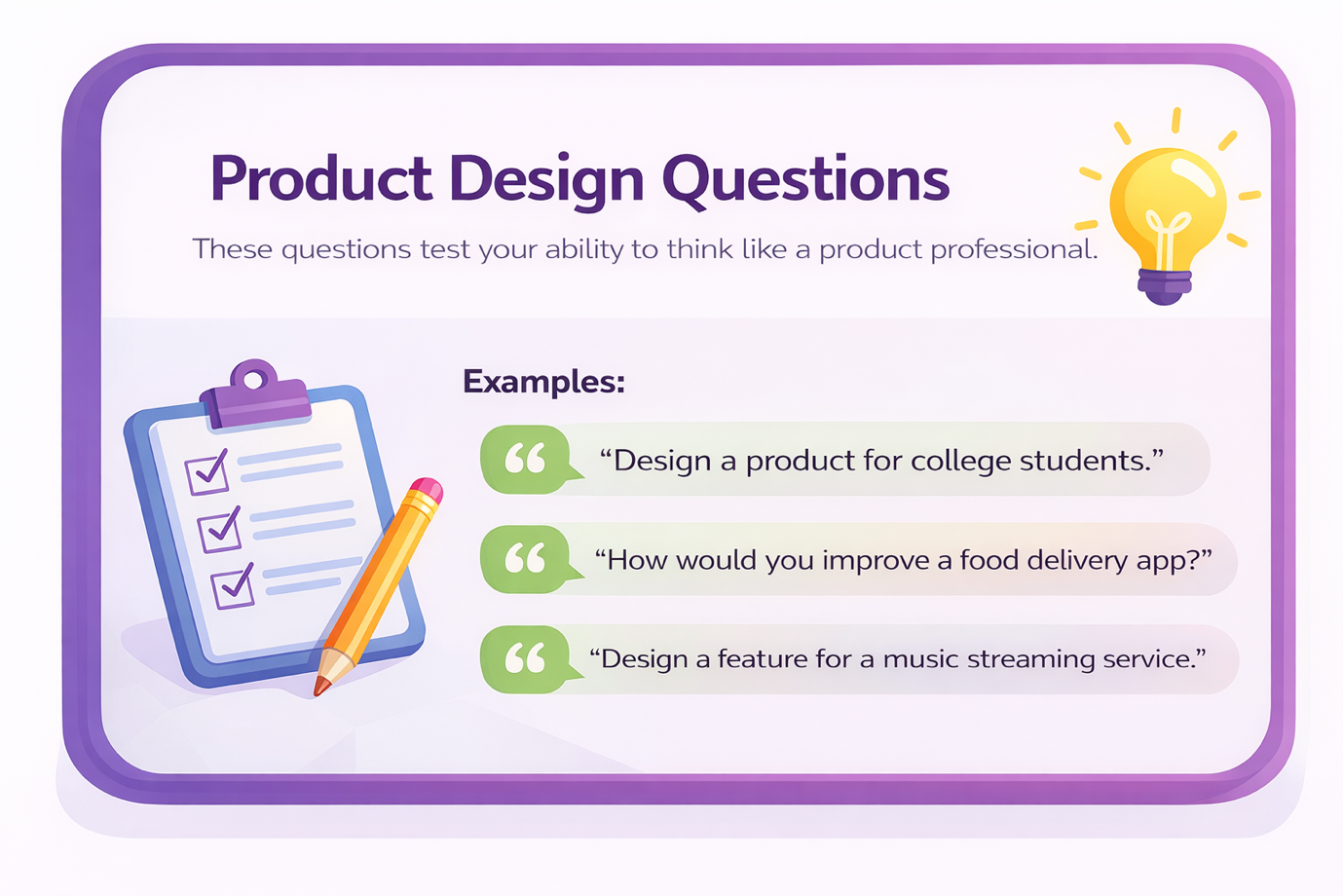
Product Design Questions
These questions test your ability to think like a product professional.
Examples:
• “Design a product for college students.”
• “How would you improve a food delivery app?”
• “Design a feature for a music streaming service.”
What interviewers assess:
• User understanding
• Problem clarity
• Prioritization logic
• Structured thinking
• Trade-off awareness
They are not looking for perfect ideas. They are looking for clear reasoning.
Estimation Questions
These questions test logical thinking and comfort with numbers.
Examples:
• “How many food delivery orders happen daily in your city?”
• “Estimate the number of electric cars in your country.”
You are not expected to know the exact answer.
Interviewers want to see:
• Logical assumptions
• Step-by-step breakdown
• Calm reasoning under pressure
The process matters more than the final number.
Behavioral Questions
These questions explore how you work with others.
Examples:
• “Tell me about a time you handled conflict.”
• “Describe a failure and what you learned.”
• “How do you handle tight deadlines?”
Interviewers evaluate:
• Ownership
• Communication
• Emotional intelligence
• Accountability
• Growth mindset
Stories must be structured and honest.
Framework for Answering Product
Questions
Structure is your strongest advantage.
When you structure answers clearly, you appear confident and thoughtful.
Here are simple frameworks you can use.
1. Framework for Product Design Quesions
Use this step-by-step structure:
Step 1: Clarify the Goal
Ask questions:
• Who is the target user?
• What is the business objective?
• Are there constraints?
Never jump straight into solutions.
Step 2: Define the User
Segment users clearly:
• Primary user
• Secondary user (if relevant)
Choose one segment and focus deeply.
Step 3: Identify Pain Points
List 3–5 problems users face.
Select one high-impact problem to solve.
Explain why you chose it.
Step 4: Propose Solutions
Generate multiple ideas first.
Then prioritize one.
Explain trade-offs:
• Why this?
• Why not the others?
Step 5: Define Success Metrics
What does success look like?
Examples:
• Retention rate
• Conversion rate
• Daily active users
• Time spent in app
Metrics show business thinking.
Step 6: Risks and Trade-Offs
Discuss:
• Possible unintended consequences
• Technical constraints
• Cost concerns
This demonstrates maturity.
2. Framework for Estimation Questions
Use this structure:
1. Clarify geography and scope
2. Break the population into logical groups
3. Make reasonable assumptions
4. Calculate step by step
5. Sanity-check the final number
Speak clearly as you calculate. Do not rush.
Confidence grows from clarity.
3. Framework for Behavioral Questions
Use the STAR method:
• Situation – Context
• Limitation or Task – Your responsibility
• Action – What you did
• Result – Outcome with measurable impact
Keep stories concise. Focus on your role, not the team’s.
Avoid blaming others when discussing failure. Show learning and accountability.
Mock Interview Preparation
Preparation builds fluency.
Product interviews reward structured thinking under pressure. This skill improves with repetition.
1. Practice Out Loud
Silent thinking is not enough.
Practice:
• Speaking clearly
• Structuring thoughts verbally
• Managing time
Record yourself if possible.
Notice:
• Filler words
• Rambling
• Missing structure
Improve gradually.
2. Time Management
In product design interviews:
• 3–5 minutes: Clarify and structure
• 15–20 minutes: Deep discussion
• Final minutes: Metrics and trade-offs
Practice pacing.
Running out of time before defining success metrics weakens your answer.
3. Peer Mock Interviews
Practice with:
• Friends
• Product communities
• Online platforms
• Alumni networks
Give and receive feedback.
Ask:
• Was my structure clear?
• Did I prioritize logically?
• Did I explain trade-offs?
Feedback accelerates growth.
4. Study Real Products
Analyze popular apps:
• What is their target user?
• What problem do they solve?
• What metrics matter to them?
• What would you improve?
This strengthens product intuition.
Negotiating Your Offer
Many candidates focus only on getting the offer.
Strong professionals also know how to evaluate and negotiate it.
Negotiation is not confrontation. It is professional discussion.
1. Understand the Full Package
Look beyond base salary:
• Bonus structure
• Equity or stock options
• Learning budget
• Health benefits
• Remote flexibility
• Growth opportunities
Sometimes a lower salary with better learning exposure is more valuable early in your career.
2. Research Market Ranges
Know typical salary ranges for:
• Associate Product Manager
• Product Manager
• Entry-level product roles
This gives you confidence when discussing compensation.
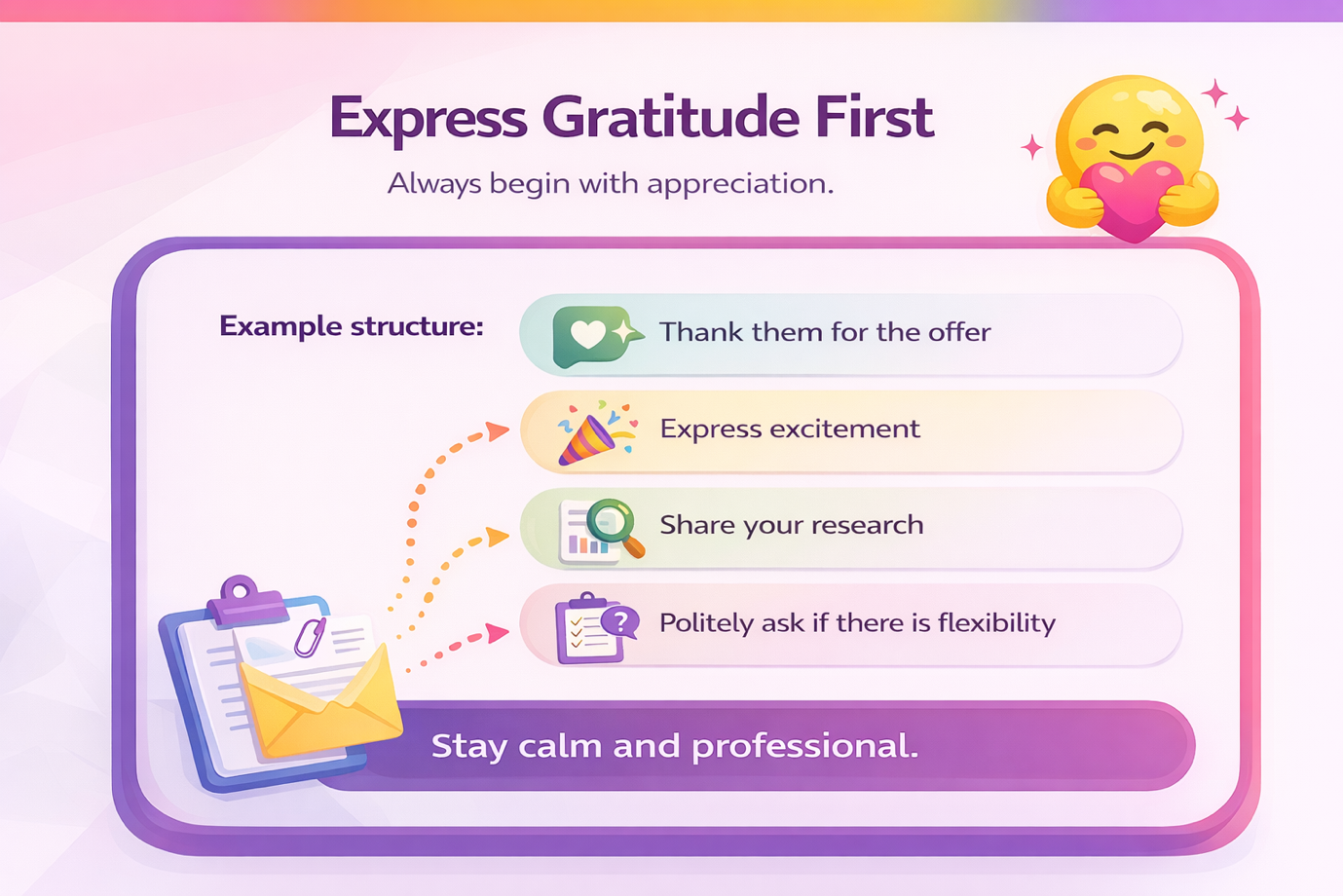
3. Express Gratitude First
Always begin with appreciation.
Example structure:
• Thank them for the offer
• Express excitement
• Share your research
• Politely ask if there is flexibility
Stay calm and professional.
4. Be Ready with Justification
Support your request with:
• Skills you bring
• Impact examples
• Relevant experience
• Market data
Avoid emotional arguments.
Use logic.
5. Know Your Minimum
Before negotiating, decide:
• What is your acceptable minimum?
• What factors matter most to you?
Clarity prevents regret later.
Final Thoughts
Product interviews are not memory tests.
They test:
• Clarity of thought
• Structured reasoning
• Empathy for users
• Business awareness
• Communication skills
Preparation transforms anxiety into confidence.
Remember:
Your resume opens the door.
Your thinking keeps it open.
Your communication secures the offer.
Master the process, and interviews become conversations about how you think— not exams to fear.