Sons in the Shadow: Surviving the Family Business as an SOB (Son of the Boss) by Roy H. Park Jr. - HTML preview
Download the book in PDF, ePub, Kindle for a complete version.
EPILOGUE
They say that no one ever really finishes a book, that a book is not finished, it’s abandoned. Thomas Wolfe wrote, “The reason a writer writes a book is to forget a book and the reason a reader reads a book is to remember it.” I wrote this book to remember it.
My father will not be forgotten. Not by me. The chapter of his life is finished, but the events in my life are ongoing. There is more to tell. As another of my fortune cookies read in 2006, “Life to you is a dashing and bold adventure,” as it was for my father before me.
I have now told about the role my father played in my life and in the life of others, and the role I played in his. To paraphrase the words of Georgia O’Keefe in the first chapter of this book, I hope that what he did with where he has been has been of some interest.
As the years roll by and memories return, times grows short. You know how short when your friends start leaving you behind. I didn’t write the eulogy for my father, but I did for the first person I met when I transferred to UNC-Chapel Hill. Eulogy for a Friend is Appendix H if you want to read it.
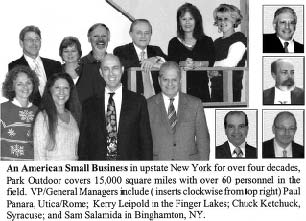
I do know if my father were running his business today, he would not be a happy camper. The newspaper and broadcasting station categories that were the basis of his media empire are hurting big time because of the shrinking advertising budgets and business closings caused by the economy and competition from the internet. It is ironic that the smallest part of his former empire is maintaining a consistent level of performance. Outdoor advertising is a powerful ad format which tends to hold up better during recessions because of its low cost and demographic reach. Outdoor offers instant impact with a quiet, pervasive, continuous presence that is the opposite of the intrusive, loud and often irritating narration and music that repeatedly air on broadcast commercials.
As a pioneer business entrepreneur who took responsible risks and worked hard all his life, Roy H. Park believed in capitalism, and would not be happy with the direction in which the country is going. As Nicholas Longworth, Speaker of the House at the onset of the Great Depression wrote: “The capitalistic system is the oldest system in the world, and any system that has weathered the gales and chances of thousands of years must have something in it that is sound and true. We believe in the right of a man to himself, to his own property, to his own destiny, and we believe the government exists as the umpire in the game, not to come down and take the bat, but to see that other fellows play the game according to the principles of fairness and justice.”
I also think my father, born on a farm as the grandson of a Baptist preacher, after working hard all his life, might also agree with Dr. Adrian Rogers, former three-term president of the Southern Baptist Convention, who said: “You cannot legislate the poor into freedom by legislating the wealthy out of freedom. What one person receives without working for, another person must work for without receiving. The government cannot give to anybody anything that the government does not first take from somebody else. When half of the people get the idea that they do not have to work because the other half is going to take care of them, and when the other half gets the idea that it does no good to work because somebody else is going to get what they work for, that, my dear friend, is about the end of any nation. You cannot multiply wealth by dividing it.”
This recession is equal to the one that followed 9/11, shortly after I began writing this book. I am doubtful that the decline in the stock market, which closed at 14,164 on October 9, 2007, before it took a massive slide to 6,547 on March 9, 2009, will be reversed to any great extent by the direction the government is taking. A columnist for Pravda, as reported in the New York Post on May 28, 2009, mocked the United States writing: “It must be said that, like breaking of a great dam, the American descent into Marxism is happening with breathtaking speed, against the backdrop of a passive, hapless sheeple, excuse me dear reader, I mean people.” He continued stating that “spending and money-printing has been record-setting, not just in America’s short history but in the world. If this keeps up for more than another year….America at best will resemble the Weimar Republic and at worst Zimbabwe.”
Warren Buffet wrote in Berkshire Hathaway’s Annual Letter to shareholders on February 26, 2011, “Human potential is far from exhausted, and the American system for unleashing that potential— a system that has worked wonders for over two centuries despite frequent interruptions for recessions and even a Civil war—remains alive and effective.” But I worry about the future of corporations in America, and even more for small businesses whose owners employ the large majority of Americans. As a small business owner myself, I know that all we can do is to continue to work hard and try our best to survive for the time being.
In the meantime if you’ve read this far, Johnnie and I want to say, and we mean this without irony, “Thanks a Million.”