

Sons in the Shadow: Surviving the Family Business as an SOB (Son of the Boss) by Roy H. Park Jr. - HTML preview
Download the book in PDF, ePub, Kindle for a complete version.
CHAPTER 31: A NEW BEGINNING
TRIAD—a group of three persons; three related things that form a group; three people considered as a unit; a union of three.
There are also a couple of other definitions of Triad, one having to do with music, “a chord of notes,” and the other, a secret Chinese organization involved in illegal activities such as selling drugs. But I can assure you that our new family foundation is not heavily into music and definitely not into drugs, except for the kind that cure human ailments and illnesses as a result of scientific research on plants and the resulting discoveries.
We settled on “Triad” because it means a union of three. The three of us wanted to protect and honor my father’s heritage by calling ourselves the “Roy H. Park Foundation,” but in the last face-to-face meeting we had with the other five Park trustees, my mother was opposed to this. She said I could name it the “Roy H. Park, Jr. Foundation,” but it wasn’t my hard-earned money that funded it, so the Park Foundation will eventually be run by family and outside trustees who do not carry his name or never knew the founder.
As reported in the Cornell Chronicle, the foundation’s new name “ ‘ reflects the desire of the Triad directors to honor the legacy of my father,’ explained Roy H. Park, Jr., president and chairman of Triad. Serving as directors and officers of the Triad Foundation are Park, Jr. and his children, Roy H. Park, III, and Elizabeth Park Fowler. The unit of three inspired the name Triad as well as the foundation’s logo, a pyramid transected into three parts by the letter T.”
“We chose ‘Carolina Blue’ for our logo, since six members of the family attended The University of North Carolina at Chapel Hill. This blue is the color of the sky and the oceans covering over 70 percent of our planet. The logo also represents the three of us living in three key states equally spaced along the East Coast, where my father conducted most of his business.

The Cornell Chronicle continued: “As part of the change, the fellowships themselves have been renamed the Roy H. Park Leadership Fellowships, for the founder of the Park Foundation, the late Roy Hampton Park. An entrepreneur, Park launched the Duncan Hines food group in the 1950s and also was the founder and chair of Park Communications, a media company that included newspapers, radio stations and outdoor advertising.
“Park Sr., who died in 1993, used Cornell expertise and laboratories to research Americans eating habits and perfect his company’s food products. He served on the advisory councils of the College of Agriculture and Life Sciences and the Johnson School and helped create the Lewis H. Durland Memorial Lecture series at the school.
“Park Jr. is a 1963 graduate of the Johnson School and is a member of its advisory council and a Cornell trustee. He is president and CEO of Park Outdoor Advertising of New York, Inc., headquartered in Ithaca.”59 There are very few conservative foundations left in America. James Piereson, executive director of the John M. Olin Foundation, pointed out in a Wall Street Journal opinion article in July 2004 that organized philanthropy, like the academic world, remains firmly in the grip of orthodox liberalism. Liberal ideas have effective control over key institutions, thanks to support from large liberal philanthropies. “Death, retirements, along with changing circumstances, have brought changes in leadership and focus to many of these institutions,” he wrote. He said, as a consequence, the Olin Foundation will be closing its doors at the wishes of its late founder, who feared that what happens to many large foundations could happen to his—that it might eventually be captured by people hostile to views he held when he was alive and in control. As Steve Forbes, editor-in-chief of Forbes said in its July 24, 2006 issue, most foundations “are dominated by proactivist-governmental types vibrating with barely concealed hostility to entrepreneurial capitalism.”
Adam Meyerson, president of the Philanthropy Roundtable, stated in a June 13, 2000 memo, “Our members are deeply disturbed that so many of America’s large philanthropic foundations violate the most cherished values of the business leaders who endowed them.” And as reported in the July 1, 2006 issue of the Economist, philanthropists…“like the notions that their foundations will live on after them, carrying their name down from generation unto generation. But, after the founder has died, foundations tend to become sclerotic and directionless—the fiefs of administrators who have lost sight of the original aims.”
Our Triad mission statement was more specific but not much changed from that of the Park Foundation, and we intend to honor it. It simply reads: The Triad Foundation was established to honor the legacy of the late Roy H. Park, founder, chairman, and chief executive officer of Park Communications, Inc.
The Foundation makes grants primarily for graduate fellowships, educational programs serving children and youth, marine and tropical ecology, scientific research and human services.
In higher education, grant making is focused on specific academic institutions with which Roy H. Park was affiliated during his lifetime. The Fellowship programs established at these institutions reflect his desire to encourage American citizens to take advantage of the opportunities offered by their country.
Support for other educational and charitable programs is generally restricted to the East Coast where Roy H. Park had lifetime interests, or to areas where Foundation directors reside.
As said earlier, these areas, which coincide with my own stomping grounds, are along the Atlantic Coast. Although other members of my family have traveled to the west and overseas, I’m basically a home boy and territorial in nature. My life and travels mostly kept me near water, surrounded by the sea or along shorelines from Cape Cod to Key West. Memorable and current ports of call range from Coral Gables on one side of Florida to Tampa and Gasparilla Island on the other, from Bermuda to Sea Island, GA, Charleston, SC, and Charlotte to Pine Knoll Shores, NC, and from Manhattan Island’s Carlyle Hotel to our home far above Cayuga’s waters.
Four members of the family live in Ithaca, and Triad, through the astute professional management of its assets, has created enough growth beyond that needed to cover our three initial commitments to be of help to the Ithaca community and to much broader goals.
The history of the Park Foundation before the Park Communications funding, and before the division, included substantial donations to religious organizations. Recently, my mother sent me a note saying she discovered “more than we thought we knew about him.” Her note said, “One of his goals was that his offspring would live lives to help others—to make this world a better place because they had lived,” and attached were several quotes he had pasted to the back of a framed picture on his desk.
They included a quote by Emerson reading, “All that I have seen teaches me to trust the Creator for all that I have not seen,” and by Pasteur saying, “The more I study nature, the more I stand amazed at the work of the Creator.” These confirm my father was a religious man, aside from the years he spent as an elder and president of the trustees of the First Presbyterian Church. He always held to his conservative principles and, as I said, my family will not be the ones who trample on his grave. Our foundation is doing fine, and a sample of the grants we have made that continue his legacy are listed in Appendix J, Triad Grants: Continuing the Roy H. Park Legacy.
With my father’s emphasis on higher education our Roy H. Park Fellows now number over 750 around the globe as pointed out in my May 7, 2011 farewell address to our graduating Cornell Park MBAs (Appendix K). I said without the ability in a free enterprise society for hard work to allow you to accumulate wealth, Fellowships like these that send you back into the world pretty much debt free, could not exist. They were reminded, as Winston Churchill said, “We make a living by what we get...we make a life by what we give.”
Since 2003, Triad has made over 550 grants ranging from a couple of thousand dollars to well over $2.5 million a year. Making money is not easy, but philanthropists know that giving it away intelligently is much harder.
As a penguin in the movie Happy Feet said, “Let me tell something to you.” Managing a family foundation is no easy matter, even with our small, but highly dedicated professional staff. Without program directors, Triad family members serve in that capacity, putting in hours that range from 30 to 55 percent of a normal nine-to-five work week to keep up with a hundred or more grants that are active at any given time. It’s intensive, exhaustive, time-consuming and difficult to make grants that are meaningful and are effective and measurable against their intended goal.
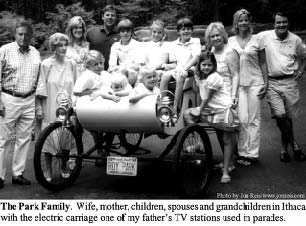
Though it is sad to leave behind a foundation carrying his name and going in a number of directions in which he had no interest and probably would not have supported during his lifetime, Triad has moved on to honor and support the traditions his life represented. His life was worth it, and the legacy of his story is not yet finished.
It’s interesting how people try to redefine the legacy of a person who’s gone. Adeliberate remaking to fit their own images and justify their own pursuits, which may be quite the opposite of what the deceased believed in. My father’s legacy included education, to which he made commitments all his life. It took him off the farm and sparked the entrepreneurship that led to his success. He was not into environmentalism, though he may have enjoyed those fleeting moments he took from work to acknowledge the natural world. When he bought land, he bought it to make a profit, to build on, sell or rent. He bought orange groves to harvest oranges and timberland to cut and sell the timber. He did not buy land to take it off the tax roles. He paid taxes on the land he bought and taxes, again, on the income he made from that land.
Nor did my father look kindly on public broadcasting stations that competed with his commercial properties. He bought stations and newspapers to sell advertising and never used his ownership for political purposes. He allowed his managers to take whatever positions, political or otherwise, that the advertisers, subscribers and viewers in each area believed in. He never forced his beliefs on others.
Throughout his life, Roy Hampton Park was committed to democracy and free enterprise, religious liberty and freedom of thought, community responsibility and broad access to education and employment. The true legacy of my father was that of a God-fearing, persevering business entrepreneur who pulled himself by his own bootstraps, took reasonable risks and worked hard all his life.
If the soul of a person who has given it meaning is granted the chance to hang around and watch over this world for a while, I hope one option may be the one offered by this beautiful Hopi prayer: When you awaken in the morning hush, I am the swift uplifting rush of quiet birds in circled flight.
I am the soft stars that shine at night. Do not stand at my grave and cry. I am not there. I did not die.
As Sean Connery said in the movie The League of Extraordinary Gentlemen, “Old tigers, sensing theend, areattheir mostfierce. And they go down fighting.” That goes for my father and the son who once upon a time was able to survive in his shadow long enough to find the light.