

Huey Long by Edward Drobinski - HTML preview
Download the book in PDF, ePub, Kindle for a complete version.
1936 Presidential Ambitions
Huey Long
Page 73
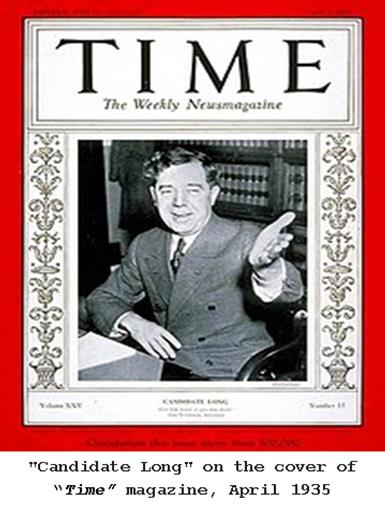
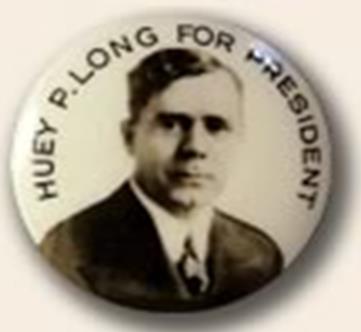
Popular support for Long's Share Our Wealth program raised the possibility of a 1936 presidential bid against incumbent Franklin D. Roosevelt. When questioned by the press, Long gave conflicting answers on his plans for 1936. Long's son Russell believed his father would have run on a third party ticket.
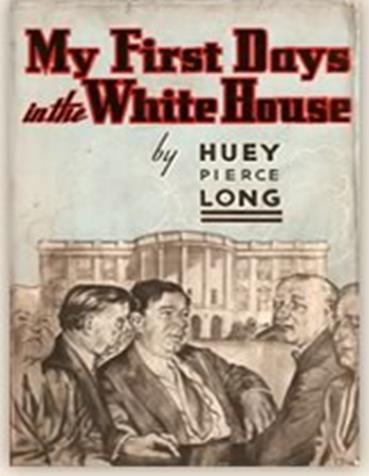
Huey’s interest in the White House is evidenced by Long's writing of a speculative book, “My First Days in the White
Huey Long
Page 74
House,” which laid out his plans for the Presidency after the 1936 election.
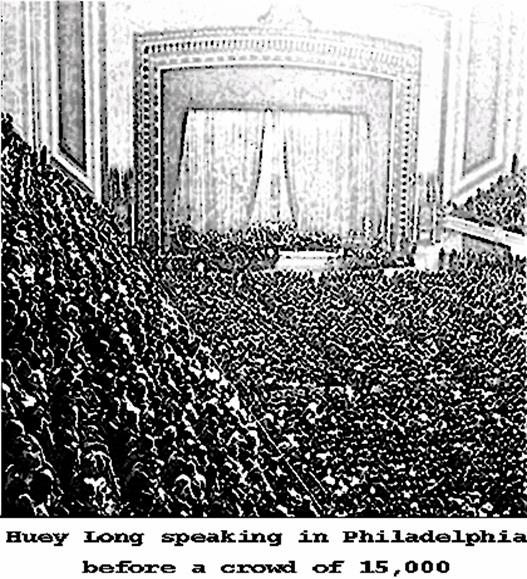
In spring 1935, Long undertook a national speaking tour and attended regular radio appearances, attracting large crowds and increasing his stature. At a well-attended Long rally in Philadelphia, a former mayor told the press, "There are 250,000
Long votes" in this city.
Huey Long
Page 75
Regarding Roosevelt, Long boasted to the “New York Times” Arthur Krock; "He's scared of me. I can out promise him, and he knows it."
Roosevelt Goes on the Warpath
Huey Long was well poised to run for president in the 1936
election against Franklin Delano Roosevelt. He had risen to national prominence with his “Share Our Wealth” program, which swept the nation as the Great Depression worsened. Meanwhile,
Huey Long
Page 76
FDR adopted some of Huey’s ideas in order to “steal Long’s thunder,” while simultaneously moving to discredit him.
By 1935, Huey’s Share Our Wealth Society had over 7.5 million members in 27,000 clubs across the country. Long's Senate office was flooded with about ten thousand letters daily, prompting him to hire 48 typists-stenographers, who worked around the clock to respond to the fan mail. As the nation’s third most photographed man, after FDR and celebrity aviator Charles Lindberg, Long was recognized from coast to coast simply as “Huey.” One national poll found Huey to be the most attractive man in America, ahead of Tarzan.
Page 77
To Roosevelt, however, Huey was “one of the two most dangerous men in America.” The other was General Douglas MacArthur.
Roosevelt sought to undercut Huey’s clout by putting Huey’s enemies in charge of federal spending and patronage in Louisiana. He ordered unproductive investigations by the Internal Revenue Service and the FBI into Huey’s finances and other dealings. Huey was also the subject of the first nationwide political poll, used by the Roosevelt campaign to assess how great a threat a Long candidacy would be to the President’s re-election. According to Democratic National Committee Chairman James Farley, Huey was polling up to 6
million popular votes and his appeal was nationwide. In a memo to Roosevelt, Farley expressed his concern that Long could split the vote, allowing the Republican nominee to win. Diplomat Edward M. House warned Roosevelt; "Many people believe that he can do to your administration what Theodore Roosevelt did to the Taft Administration in '12." Many, including Hair, Roosevelt, and Williams speculated that Long expected to lose in 1936, allowing the Republicans to take the White House. They believed the Republicans would worsen the Great Depression, deepening Long's appeal. According to Roosevelt; "That would bring the country to such a state by 1940 that Long thinks he would be made dictator."
Page 78
FDR also moved to deflate Long’s appeal by playing right into the Kingfish hand and incorporating some of Huey’s ideas as part of the Second New Deal, a more liberal version of his Great Depression reforms. For example, the Social Security system reflected Huey’s proposal for old-age pensions, the Works Progress Administration mirrored public works programs begun by Long in Louisiana, and the National Youth Administration reflected his student financial aid proposal. Other initiatives championed by Long and implemented by FDR included the National Labor Relations Board rights of unions to organize, minimum wage and 40 hour work week, the Public Utility Holding Company Act’s regulation of public utilities, the Farm Security Administration’s assistance to farmers, and the poorly named Wealth Tax Act, which taxed income on a graduated basis and established minimal inheritance taxes.
To prepare the nation for his upcoming presidential bid, Huey wrote “My First Days in the White House,” the reflections of a President Long after his first 100 days in office. Written in 1935, the book was published in 1936 after Huey’s assassination.
They’ve got a set of Republican waiters on one side and a set of Democratic waiters on the other side, but no matter which set of waiters brings you the dish, the legislative grub is all prepared in the same Wall Street kitchen.”
Page 79
— Huey Long
In 1932, Huey had exercised his political muscle to elect the widow of his friend, Arkansas Sen. Thad Caraway, to the US
Senate. Hattie Caraway was appointed to serve out the remainder of her husband’s term but was the underdog in the upcoming election. She faced six opponents, including a candidate supported by Senate Majority Leader Joseph Robinson, with whom Huey had frequently clashed.
Huey sympathized with Caraway and engineered an eight day barnstorm of Arkansas. He and Caraway covered 2,100 miles and made 39 appearances together, drawing an estimated 200,000 Huey Long admirers to the Hattie Caraway bandwagon. One stunned political observer described Huey's whirlwind tour as "a circus hitched to a tornado".
With Huey’s endorsement, Caraway swept to an easy victory, becoming the first woman elected to the US Senate. Ironically, Huey’s widow, Rose, would be the second woman elected to the Senate in 1936 after Huey’s assassination.
Increased Tensions in Louisiana
When he so chose, Huey had a knack for being able to pull anyone’s chain to an uncomfortable position. By 1935, Long's consolidation of power led to talk of armed opposition from his
Page 80
enemies in Louisiana. Opponents increasingly invoked the memory of the Battle of Liberty Place, 1874, in which the White League staged an uprising against Louisiana's Reconstruction era government. In January 1935, an anti-Long paramilitary organization called the Square Deal Association was formed. Its members included former governors John M. Parker and Ruffin Pleasant and New Orleans Mayor T. Semmes Walmsley. Standard Oil threatened to leave the state when Long passed the five cent per barrel oil tax for which he had been impeached in 1929.
Concerned Standard Oil employees formed a Square Deal association in Baton Rouge, organizing themselves in militia companies and demanding "direct action."
Huey Long
Page 81
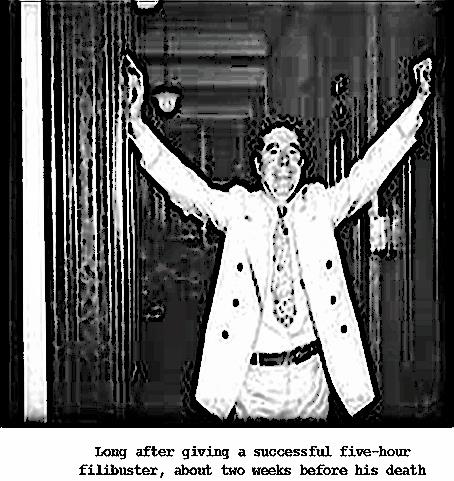
On January 25, 1935, these Square Dealers, now armed, seized the East Baton Rouge Parish courthouse. Long had Governor Allen execute emergency measures in Baton Rouge. He called in the National Guard, declared martial law, banned public gatherings of two or more persons, and forbade the publication of criticism of state officials. The Square Dealers left the courthouse, but there was a brief armed skirmish at the Baton Rouge Airport.
Tear gas and live ammunition were fired; one person was wounded, but there were no fatalities. At a legal hearing, an alleged spy
Page 82
within the Square Dealers testified they were conspiring to assassinate Long, but unlike the January Sixers of 2020, they were never prosecuted, perhaps the result of being on the government deep state entrenched and imbedded side of the issue.
In summer 1935, Long called two special legislative sessions in Louisiana. Bills were passed in rapid fire succession without being read or discussed. The new laws further centralized Long's control over the state by creating new Long appointed state agencies; a state bond and tax board holding sole authority to approve loans to local governments, a new state printing board which could withhold "official printer" status from uncooperative newspapers, a new board of election supervisors which would appoint all poll watchers, and a State Board of Censors. They stripped away the remaining powers of the Mayor of New Orleans. Long boasted he had "taken over every board and commission in New Orleans except the Community Chest and the Red Cross." A September 7 special session passed 42 bills. The most extreme, likely aimed at Roosevelt and his federal agents, authorized Louisiana to fine and imprison anyone who infringed on the powers reserved to the state in the Tenth Amendment to the United States Constitution. It expresses the principle of federalism, also known as states' rights, stating that the federal government has only those powers explicitly delegated to
Page 83
it by the Constitution, and that all other powers not forbidden to the states by the Constitution are reserved to each state.
Page 84
5 – Political Views
The political views of Huey P. Long have presented historians and biographers with some difficulty. While most say that Louisiana Governor and Senator Huey Long was a populist, little else can be agreed on. Huey Long's opponents, both during his life and after, often drew connections between him and his ideology with far left as well as far right political movements, comparing it to everything from European fascism, Stalinism, liberalism, socialism, communism, and later McCarthyism. When asked about his own philosophy, Long simply replied; "Oh, hell, say that I’m sui generis and let it go at that." Writer Robert Penn Warren described him as a "remarkable set of contradictions." In the US senate where he was known for his fiery and quick witted oratory, those in power did not want to directly verbally engage the “Kingfish.”
Throughout his tenure in office as Governor and then Senator of Louisiana, Long was repeatedly labelled by his corrupt critics as an authoritarian and political usurper, akin to the carpetbaggers of Louisiana's past that had no respect for the rule of law. Ostensibly a true Democrat patented operation, Long's machine in Louisiana was also accused of mass voter fraud via the usage of dummy candidates and having corrupt election vote counters in various state elections including the 1932 US
Page 85
Senate and Gubernatorial elections and elections for amendments to the Louisiana state constitution. A federal investigation into the election of John Overton to the US senate in 1932 grew to encompass other parts of Long's regime in Louisiana including his electoral funding processes and his use of public patronage to cement his power in the state. Responding to the attacks of voter fraud by his opponents, Long made no specific admissions but pointed out that the tactics he used were not new and had been used by his opponents in the past. Additionally, Long argued his use of dummy candidates had had no direct impact on the results of Overton's election. Further, Democrats running dummies for office is a tradition. Towards the end of the campaign of Huey's own election to the US senate in 1930, a man named Sam Irby who had offered claims of mass graft and fraud in Louisiana's highway commission, which was controlled by Long, mysteriously disappeared. Along with Irby's disappearance came Jimmie Terrell, the former husband of Long's secretary Alice Lee Grosjean, who Long feared would potentially expose a supposed affair he had with Grosjean. According to historian T. Harry Williams, Long organized a meeting among his allies to figure out how to keep the two from talking in order to minimize any damage that may be done on his machine and his chances of winning the senatorial primary. Long would send six policemen that would carry away the drunken Irby and Terrell to an
Page 86
isolated camping location on Grand Isle, giving him time to take advantage of the situation, using it to attack his enemies. On a radio broadcast, Long brought Irby to address the large audience declaring that he had not been kidnapped by Huey and was safe and sound. Irby continued his message saying that he was instead trying to entrap Long's enemies, and had been attempted to be bought off by the Ransdell Camp. This maneuvering by Long prevented the scandal from seriously damaging him in any way and led to his easy win in the September 9 primary.
Long's power in the state of Louisiana ranged from holding the Governorship, the state legislature, the state's two US Senate seats, and various other political positions in the state. An anti-Long leader once said at the height of Long's power; "If you were for him, you could have anything you wanted. If you were against him, God help you unless you were an extraordinary man." Long was able to intimidate his opponents in the state by passing far reaching laws that would add increased power to Long's regime. Examples of these laws stretched from allowing the Governor to call out the state militia upon his own discretion, without there being any threat of rebellion or insurrection. Long aggressively pursued laws that would put increased state jobs under his control, as he viewed them as central to the functioning of his machine. Legislation created a
Page 87
civil service board that would be headed by the state's top officials, those being the governor, Lieutenant Governor, and Secretary of State. The civil service board would be able to investigate the competence of police and fire chiefs and fire them if found to be incapable of their job. Upon an official’s removal, a municipality would have to submit a successor to the removed official in question which would then have to be approved by the commission. The directed target for much of the power grabs Long took during the end of his reign were primarily targeted at the city of New Orleans, a city that was the headquarters of his traditional opponents the old regulars.
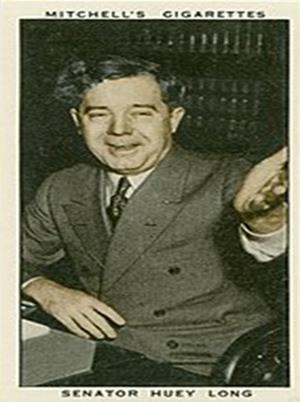
Long was reportedly gripped by the idea that he was the reincarnated ego of Napoleon Bonaparte. The analogy is not without merit as Napoleon was a French political leader and military commander who rose to prominence during the French Revolution and led successful campaigns during the Revolutionary Wars. He was the de facto leader of the French Republic as First Consul from 1799 to 1804, then Emperor of the French from 1804
until 1814 and again in 1815. Napoleon's political and cultural legacy endures to this day, as a highly celebrated and controversial leader. He initiated many liberal reforms that have persisted in society, and is considered one of the greatest
Huey Long
Page 88
military commanders in history. His campaigns are still studied at military academies worldwide.
During his lifetime, Long's political philosophy, particularly his Share Our Wealth program, was strongly criticized by an increasing number of more conservative politicians. They said that they feared that such a scheme was decidedly communist, though no doubt they were concerned with their decline in political power and its attendant diminishment of their abilities to continue receiving donations from the monopoly businesses and their owners. The former Louisiana governor Ruffin G. Pleasant, for instance, decried Long as "the 'ultra socialist’ whose views outreached ‘Marx, Lenin, and Trotsky.'"
Page 89
Similarly, in 1935, the “New York American” accused Long's Share the Wealth program of being "molded in the criminal brains of the leader of the Paris Commune and sanctified in the brains of an oriental fanatic, Nicolai Lenin." He was jokingly labelled the "Karl Marx of the Hillbillies." Deflecting such attacks, Long occasionally painted Roosevelt as a communist, once suggesting that Roosevelt "hold the Democratic convention and Communist convention together and save money."
Despite claims from right wing opponents, Long's program diverged significantly from Marxist communism. In particular, the Share Our Wealth program preserved the concepts of private property and the profit motive, while seeking to avoid any need for violent revolution. Indeed, Long himself said that his plan would strengthen the capitalist system by removing its greatest excesses, thereby removing any desire by the American people to do away with it. When asked whether his plan was communist, Long replied; "Communism? Hell no! ... This plan is the only defense this country's got against communism." Long also called his program "the only stop gap to Communism!" When pressed by a leftist magazine who pointed out that the magnates Long railed against would be saved under his plan, he conceded; "That would be one of the unfortunate effects of my program." He concluded
Page 90
to the reporter; "I'd cut their nails and file their teeth and let them live."
Although conservatives labeled Long as a communist, legitimate American communists sought to distance themselves from Long and his Share Our Wealth program. They believed his policies preserved the capitalist enterprise, which Long admitted to. The communists also believed that Long's Share our Wealth Societies diverted interest away from their own party. Some of Long's fiercest critics were prominent American communists, such as Sender Garlin and Alexander Bittelman. They argued that Long's populist rhetoric and antics belied a decidedly anti-labor philosophy. Garlin, for instance, noted that while Long constructed thousands of miles of roads and numerous bridges, the state paid its workers only 30 cents an hour, 10 cents less than what the National Recovery Administration called for during the Great Depression.
Conservatism and Nationalism
Despite being accused of being a political extremist from the left, Long saw his own positions as strengthening the traditions of America. In a film discussing his Share our Wealth societies, Long argued that he was upholding the promise of the Declaration of Independence to life, liberty, and the pursuit of happiness.
Page 91
Long's conservative streak was apparent during his crackdown on gambling and prostitution in the red light district in New Orleans after his breaking with Colonel Robert "Bow-Wow" Ewing who was a Long boss in the city. Ewing had ties to the gambling and prostitution industries in New Orleans and Long, coupled with his disdain for both of the industries, ordered state militia under Adjutant General of the national guard Raymond H.
Fleming to "cut out the wide open gambling" in the city. In a great irony, the conservatives, who deplored such acts as gambling and prostitution, attacked Long for issuing the raids.
Their outrage was mostly targeted against the forceful way in which the raids had been executed with female patrons having been "held and searched for money," and guardsman having "burst into establishments with guns drawn forcing patrons to hold up their hands and back against a wall.”
Long was a strident isolationist and political nationalist who opposed American intervention abroad and was a strong supporter of tariffs, with Long labelling himself a "tariff Democrat."
Along with supporting tariffs, he advocated that the American government disassociate from European efforts to settle war debts and to grant independence to the Philippines. Long argued that Standard Oil had backed rebellions across Latin America to install puppet governments that would be beholden to the
Page 92
company's interests. In 1934, Long claimed that Standard Oil was backing the Bolivian government to make war with Paraguay over the oil rich northern Grand Chaco region after the latter had refused to grant favorable leasing terms to the company.
Education
Long's contributions to education formed a key part of his populist ideology and modernizing the state of Louisiana. Long's investments into the Louisiana State University, transformed the school from a third rate and backwater state university into one of the most prestigious in the country by 1935.
Along with his investments into the state university, Long addressed the problem of widespread illiteracy in rural Louisiana. Together with Superintendent of State Education, T.H.
Harris, Long diverted tax money to fund night schools that would teach illiterate Whites, with the classes meeting three times a week. The effect of the program was immediate when in the 1930
state census the illiterate population of Whites dropped from ten to seven percent.
Fascism
With the rise of fascism in 1930s Europe, many noted parallels to Long. US General Hugh Johnson described Long as "the Hitler of one of our sovereign states." American fascist Lawrence
Page 93
Dennis described Long as "the nearest approach to a national fascist leader" in the United States. Journalist Raymond Gram Swing claimed that Long wished to "Hitlerize America." In an effort to distance Long from communism, many socialists, such as Norman Thomas, also sought to smear Long as a fascist. Communist writer Sender Garlin labelled him the "personification of the fascist menace in the United States," and noted that his swinging arm gestures were similar to those of Hitler. Alex Bittelman, a member of the Communist Party from New York wrote;
"Long says he wants to do away with concentration of wealth without doing away with capitalism. This is humbug. This is fascist demagogy." The communist newspaper “Daily Worker” ran headlines such as "Huey Long - Louisiana's 'Hitler' Is Sole Lawmaker." Even Long's brother Julius claimed that he was
"trying to be a Hitler, though he never stated whether or not he approved of Hitler.
Although often denounced as a fascist by some of his contemporaries, a number of modern historians have disagreed with these assessments. Long was not known to be anti-Semitic, nor any more anti-Communist than most politicians at the time.
When asked about common comparisons between him and Adolf Hitler, Long replied; "Don't compare with that so and so.
Anybody that lets his public policies be mixed up with religious
Page 94
prejudice is a plain God damned fool," and later commented; "I don't know much about Hitler. Except that last thing, about the Jews. There has never been a country that put its heel down on the Jews that ever lived afterwards." Several of Long's political and personal friends were Jews, such as Abraham Shushan and Seymour Weiss. Additionally, Long didn't espouse any anti-democratic ideology and had no conception of a corporate state. Arthur Schlesinger, Jr. noted that "Long's political fantasies had no tensions, no conflicts, except of the most banal kind, no heroism or sacrifice, no compelling myths of class or race or nation."
“Life Magazine” said; "The late Huey P. Long, who knew all the tricks of the dissembling demagogue, was once asked; ‘Do you think we will ever have Fascism in America?’ Said the Kingfish;
‘Sure, only we’ll call it anti-Fascism.’" Several other similar quotes have been credited to Long. George Sokolsky remembered having asked Long if he was a fascist. “Fine,” Long told him in a conversation that took place less than a year before he was killed. “I’m Mussolini and Hitler rolled into one. Mussolini force fed dissidents castor oil; I’ll give them Tabasco, and then they’ll like Louisiana.” Then he laughed.
Currently Obligatory Commentary on Race
Page 95
Long historian T. Harry Williams wrote that Long was "the first Southern mass leader to leave aside race baiting and appeals to the Southern tradition and the Southern past and address himself to the social and economic problems of the present." Unlike many other southern demagogues, Long resisted associating himself with the Ku Klux Klan. When KKK Imperial Wizard Hiram Evans announced plans to campaign against Long in 1934, Long declared
"that Imperial bastard will never set foot in Louisiana,"
threatening that Evans would leave the state with "his toes turned up." Many historians also argue that Long's building projects and social reforms helped all of the lower classes in Louisiana.
Long had never faced a serious election that hinged on questions of race or racism. This was largely because after the Louisiana Constitution of 1898 was ratified, race was an irrelevant political issue and negro Louisianians were segregated, ghettoized, and ignored. Long never had to address the subject of race in politics. In a 1935 interview, Long explained; "A lot of guys would have been politically murdered for what I've been able to do quietly for the niggers. But do you think I could get away with niggers voting? No siree!" Long also declined to support federal anti-lynching legislation; "Can't do the dead nigra no good."
Page 96
Nevertheless, many of Long's efforts did benefit the negro community. Long's programs, instituted when he was Governor and Senator, allowed a number of black Louisianans to receive an education, file for tax exemptions, and also vote without having to worry about poll taxes. Indeed, they participated in the economic growth initiated by Huey. The bottom line is that a number of negro ministers organized Share Our Wealth club chapters. Burton Wheeler, one of the few men Long was close with in the Senate, wrote in his memoirs that "Long had far less racial prejudice in him than any other Southerner in the Senate."
Page 97
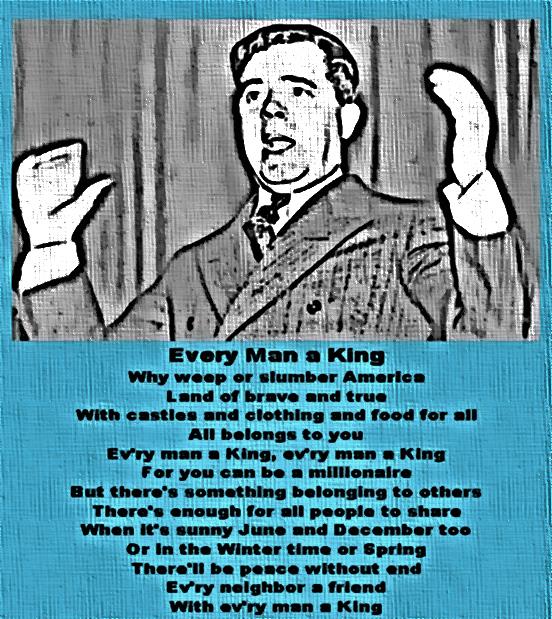
6 – Share Our Wealth – the Program The “Share Our Wealth” movement more or less began in February 1934, during the Great Depression, prompted and popularized by Huey Long, then Governor of and later United States Senator from Louisiana. Long first proposed the plan in a national radio address, which is now referred to as the "Share Our Wealth Speech." To stimulate the economy, the Share Our Wealth program called for massive federal spending, a wealth tax, and wealth redistribution. These proposals drew wide support, with millions joining local Share Our Wealth clubs. Roosevelt adopted many of these proposals in the Second New Deal, while skipping the main ingredient, the wealth tax.
Huey Long
Page 98
Page 99
Huey Long and “Every Man a King” by Huey Long and Carazo Castro; property of the author, the latter under both the “fair use” and “transformative” doctrines.
Long believed that the underlying cause of the Great Depression, which he called "Mr. Roosevelt's depression," was the growing disparity between the rich and everyone else. For most of his political career, he focused his speeches and efforts on the
"little man," referring to the rural, working, White poor. The Share Our Wealth program was intended to become the capstone project for Long's populist agenda.
In March 1933, Long offered a series of bills collectively known as "the Long plan" for the redistribution of wealth. The first bill proposed a new progressive tax code designed to cap personal fortunes at $100 million, about $2 billion in 2022
dollars. This is not very restrictive, except to those terminally greedy and the politicians they use their money to buy. Fortunes above $1 million, $20 million in 2022, would be taxed at 1 percent; fortunes above $2 million, $40 million in 2022, would be taxed at 2 percent, and so forth, up to a 100
percent tax on fortunes greater than $100 million. The second bill would have limited annual income to $1 million, $20 million in 2022, and the third bill would have capped individual inheritances at $5 million, $99 million in 2022.
Page 100
In February 1934, Long introduced his "Share Our Wealth" plan over a nationwide radio broadcast.
His plan was to minimize wealth inequality, which he saw as the root cause of the Great Depression, via Federal tax and spend policy.
An individual's right to wealth would be restricted to: a maximum inheritance of $5 million, $100 million in 2022; a maximum annual income of $1 million, $20 million in 2022; and an individual's private wealth/fortune to $99 million, $2
billion in 2022.
The taxes raised would guarantee every family what Long called a
"Household Estate" of $5,000, a Basic Household Grant worth $100,000 in 2022, and a minimum annual income of $2,000–3,000, a Universal Basic Income to each household of $40,000 - $60,000
per year in 2022 dollars, or one-third of the average family homestead value and income.
free higher education, including degree level study at a college, and vocational internships/training required to enter professional organizations;
Page 101
a mandatory 30 hour, four day, working week and a minimum of four weeks paid vacation per year;
a pension of $30/month, $360 a year, $600 and $7,200 in 2022
dollars, paid to every person from the age of 65; for direct Federal assistance to farmers; public works projects, including a $10 billion, $200 billion 2022 equivalence, land reclamation project to end the Dust Bowl; specific to the WWI veterans, benefits would increase, and World War I veteran's adjusted Compensation certificates, due in 1945
would be issued immediately;
free medical services for all citizens, and what he called a
"war on disease" led by the Mayo brothers.
Long intended his reforms to bring an end to the Great Depression.
Long's plans for the Share Our Wealth program attracted much criticism from main stream economists at the time, who called it communism. In 1934, Long held a public debate with Norman Thomas, the leader of the Socialist Party of America, who didn’t like Share Our Wealth whatsoever, on the merits of Share Our Wealth versus socialism.
Page 102
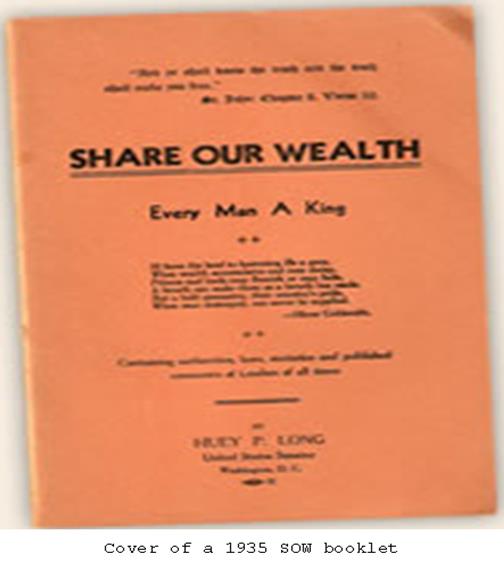
With the Senate unwilling to support his proposals, in February 1934 Long formed a national political organization, the Share Our Wealth Society. A network of local clubs led by national organizer Reverend Gerald L. K. Smith, the Share Our Wealth Society was intended to operate outside of and in opposition to the Democratic Party and the Roosevelt administration. By 1935, the society had over 7.5 million members in 27,000 clubs across the country. Share Our Wealth booklets were freely sent to members.
Huey Long
Page 103
Long's Senate office received an average of 60,000 letters a week, resulting in Long hiring 48 stenographers to type responses. Of the two trucks that delivered mail to the Senate, one was devoted solely to mail for Long. Long's newspaper, now renamed “American Progress,” averaged a circulation reaching over 1.5 million. Long's radical programs were very attractive
Page 104
to union members. Teamsters President Daniel J. Tobin expressed his growing concerns to Roosevelt. Long also drew international attention. Writer H. G. Wells traveled across the Atlantic just to interview Long. Wells noted that Long was "like a Winston Churchill who has never been at Harrow. He abounds in promises."
Any presidential ambitions which Long might have had were cut short when he was shot by an assassin in Baton Rouge, Louisiana on September 8, 1935. He died two days later. Control of the Share Our Wealth Society fell to Gerald L. K. Smith, who was widely viewed as a political demagogue. Smith brought the Share Our Wealth Society into a brief coalition with the followers of radio priest Charles Coughlin and old age pension advocate Francis Townsend in support of the short lived Union Party, a third party effort which ran William Lemke of North Dakota for President in 1936, but under his leadership alone, the Share Our Wealth movement quickly fell apart.
Some historians believe that pressure from Long and his organization contributed to Roosevelt's "turn to the left" in the Second New Deal - 1935, which consisted of the Social Security Act, the Works Progress Administration, the National Labor Relations Board, Aid to Dependent Children, and the misleadingly named Wealth Tax Act of 1935, A/K/A The Revenue Act of 1935, which progressively taxed income rather than wealth.
Page 105
Each tenet of the Second New Deal seemed to foil while also complementing one of Long's corresponding proposals. For example, Roosevelt's National Youth Administration provided part-time employment to the country's youth, counteracting the appeal for Long's free college proposal. Roosevelt reportedly admitted in private to trying to "steal Long's thunder."
Huey Long
Page 106
Huey Long
Page 107
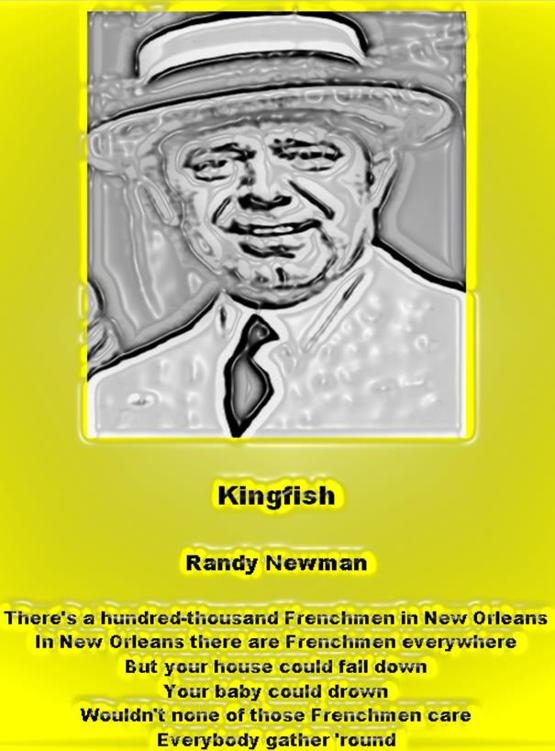
Huey Long and “Kingfish” by Randy Newman; property of the author, the latter under both the “fair use” and “transformative” doctrines.
Huey Long
Page 108
7 - Every Man a King – the Book
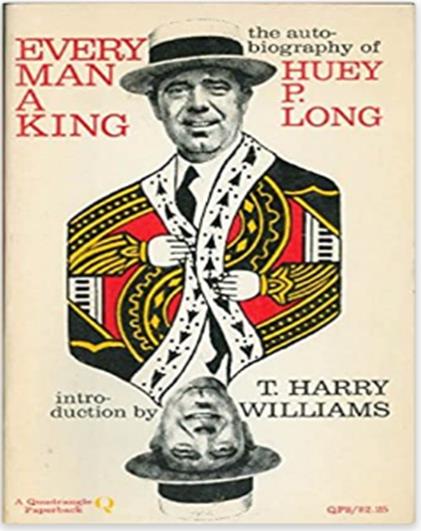
“Every Man A King: The Autobiography of Huey P. Long” was first published in 1933 by the National Book Company, and has since been reissued numerous times.
In 1933, at the ripe old age of 39, Huey Long published his autobiography. This might seem, at the least, premature. But it
Page 109
turned out to be a provident move as Huey Long was dead two years later, felled by an assassin's bullet.
Huey Long was a man in a hurry. He passed the Louisiana bar exam and became a lawyer after taking only two law school classes and spending a year reading every law book he could find. He became Governor of Louisiana in 1928. In four short years as Governor he paved roads, built bridges, provided free textbooks to poor children, reformed the hospitals, broke the power of the old political bosses, and took on the near monopolistic power of the big oil companies. Within a year of taking office he was impeached by the Louisiana House, although the charges were dismissed by the State Senate. In 1930 Long was elected to the US Senate. But since he was busy with his agenda as Governor, he never bothered to show up in Washington to take the oath of office until 1932. Huey Long was a man in a hurry.
Excerpts From Huey Long's Autobiography: Offending the Senate From Day One:
Huey Long's brief career in the United States Senate was contentious and disagreeable to his fellow Senators. Of his fellow Democratic Senator, Pat Harrison of Mississippi, he would say on the Senate floor; "The Senator from Mississippi has another way of standing by his friends. Catch your friend in
Page 110
trouble, stab him in the back and drink his blood." A few months after arriving in Congress he made a permanent enemy of Senate Majority Leader Joe Robinson, a Democrat from Arkansa, by reading into the Congressional Record a long list of corporate clients of Robinson's Arkansas law firm and then intoning with mock sincerity; "I want now to disclaim that I have the slightest motive of saying, or that in my heart I believe, that such a man could to the slightest degree be influenced in any vote which he casts in this body by the fact that this association might mean hundreds of thousands and millions of dollars to him in the way of lucrative fees." This sort of behavior would make him a pariah to his colleagues. Senator Harry Byrd of West Virginia would ask that his desk be moved from next to Long's "even if I have sit on the Republican side."
As you might imagine, Huey Long was not a successful in getting his bills passed. In the following excerpt, Long recounts his first moments on the Senate floor, when he offended the senior Senator from his home state by refusing to be introduced by him.
"I arrived in Washington January 25, 1932. Soon thereafter I met our Democratic leader, Senator Robinson of Arkansas. He escorted me to the lounging room immediately adjacent to the Senate, where I sat awaiting the time when I would enter the Senate and be administered the oath of office. My old friend, Senator
Page 111
Broussard, whom I had not seen for eighteen months, walked up to me while I sat there. ‘Huey,’ he said, ‘There is a rule here that a Senator from one State should escort a new Senator from that State when he takes the oath.’ ‘Edwin, I will be glad to have you do that,’ I said, ‘but I don't want you to misunderstand me. When I reached here this morning I read in the newspapers remarks attributed to you, saying that you had not decided whether you would or would not introduce me. I was asked concerning your remarks, and I made the statement that that was a matter you were not going to decide. Now, I just want you to know that.’
The Senator was angry.
‘I won't introduce you unless you ask me to,’ he said.
‘Don't hold your breath until I do, Edwin,’ I replied.
Senator Robinson returned, and I told him of the conversation.
‘Well, would you have any objection to his introducing you, just dropping matters?’ he asked.
‘No, not particularly,’ I said.
He left to talk to Senator Broussard; but on returning he said:
‘All right; I'll introduce you.’”
Page 112
Long’s Early Support of FDR
Huey Long was a nominal Democrat, but many in the Democratic party thought the old saying applied; "with friends like these, who needs enemies." President Roosevelt considered Huey Long a demagogue and privately said of him that he was "one of the two most dangerous men in America." Probably the nicest thing Huey Long had to say about President Roosevelt was to compare him to President Hoover, in his best piney woods barnyard analogy; "The only difference between Hoover and Roosevelt is that Hoover is a hoot owl and Roosevelt is a scrootch owl. A hoot owl bangs into the roost and knocks the hen clean off, and catches her while she's falling. But a scrootch owl slips into the roost and talks softly to her. And she just falls in love with him, and the first thing you know, there ain't no hen." For his part, Roosevelt tried to establish a political relationship with Huey Long, no doubt considering it politically beneficial though socially notso, even inviting Huey to dine with the Roosevelt family at the estate in Hyde Park. The resulting scene was like something out of a B-movie comedy of manners. Roosevelt displayed no irritation at Huey's outrageous costume, a loud suit, clashing shirt, and pink tie, or at his effort to dominate the conversation during lunch, lecturing the candidate like a schoolboy. Roosevelt's mother, however, was not so tactful. "Who
Page 113
is that awful man?" she said in a loud whisper. Everyone pretended not to hear, but Long almost certainly took note. "By God, I feel sorry for him," Huey later remarked of Roosevelt.
"He's got more sonofabitches in his family than I got in mine."
Despite all of this, Huey Long was initially a supporter of FDR, as indicated in these excerpts.
"When I reached Washington on January 25, 1932, newspapermen generally inquired what I thought of the approaching presidential election. My reply was that I thought most any Democrat could win; that I thought some one like my friend Senator Joseph T. Robinson or my friend Senator Pat Harrison would be the best choice. I spoke kindly of Garner as a prospective candidate, as well as of Al Smith, but I expressed contrary predictions on the then Governor of New York, Franklin D. Roosevelt.
I had been in the Senate but a few days, when the famous sales tax fight developed; much of our Democratic leadership in Congress was either favorable to this policy which was being advocated for Mr. Hoover, or, at least, was not unsympathetic to it.
I regarded the sales tax as a disaster. It was diametrically opposed to what I considered the only course which the nation
Page 114
must take to relieve itself from the distress which then and now afflicts it. I was soon looking away from my early inclinations, and eventually toward Governor Roosevelt, who all the time, day by day, made commitments exactly consistent with my belief and understanding of correct government.
Progressive members of the United States Senate, particularly Senators Norris and Wheeler, played a material part in my inclination for the then Governor of New York and present President of the United States. They were the boldest, most courageous men I had ever met."
"On my way from New Orleans to Washington one night I met Clark Howell of the Atlanta Constitution on the train. I gave him to understand that I was inclined to Roosevelt. Soon thereafter I received a letter from Governor Roosevelt telling me that Mr.
Howell had informed him of what I had said. He paid me a few compliments and closed by saying:
'You and I are alike for the rights in behalf of the common man of this country.'
I was more than ready to join him."
"But I saw to it that my views were known to Mr. Roosevelt, then Governor of New York and now President of the United States.
Page 115
Early in his candidacy in a speech delivered in Atlanta, Mr.
Roosevelt said:
'The millions who are in want will not stand by silently forever while the things to satisfy their needs are within easy reach.
Many of those whose primary solicitude is confined to the welfare of what they call capital have failed to read the lessons of the last few years and have been moved less by calm analysis of the needs of the nation as a whole than by a blind determination to preserve their own special stakes in the economic disorder.
We may build more factories, but the fact remains that we have enough now to supply all our domestic needs and more, if they are used. No; our basic trouble was not an insufficiency of capital; it was an insufficient distribution of buying power coupled with an over-sufficient speculation in production.'
Soon thereafter on the basis of such declarations, I became convinced that the best chance for a solution of America's difficulties was through the election of Franklin D. Roosevelt as President."
"The Democratic National Convention assembled in its first formal session in the Chicago Coliseum on the 27th day of June, 1932. The first controversy was the dispute between contesting
Page 116
delegations. Contests were heard alphabetically, beginning with Louisiana. This was the original test of strength of the Roosevelt forces in that convention.
We knew an effort would be made on the first contest, regardless of what it might be, to break through our lineup; furthermore, in the seating of delegates, the Roosevelt forces did not dare to sacrifice a vote, for the selection of a permanent Chairman bade fair to be a nip and tuck contest due to the early commitments certain of our forces had made.
The opposition to the seating of our delegation was most ably presented by two distinguished anti-Roosevelt Democrats from Illinois and Iowa. Our floor leader, Arthur Mullen, and myself replied for the Roosevelt forces.
The final vote stood 638 3/4 to 514 1/4 and our delegation was seated.
It was the initial victory for the Roosevelt forces at the National Convention in Chicago."
His Political Agenda as a Senator
Huey Long says he came to the US Senate for only one purpose; to push his "Share The Wealth" philosophy. And push it he did. See the excerpts from the section on his radio and Senate speeches.
Page 117
This excerpt from his autobiography makes the case for the crisis that Long sought to address with his plan.
"I had come to the United States Senate with only one project in mind, which was that by every means of action and persuasion I might do something to spread the wealth of the land among all of the people.
I foresaw the depression in 1929. I had predicted all of the consequences many years before they occurred.
The wealth of the land was being tied up in the hands of a very few men. The people were not buying because they had nothing with which to buy. The big business interests were not selling, because there was nobody they could sell to.
One per cent of the people could not eat any more than any other one per cent; they could not wear much more than any other one per cent; they could not live in any more houses than any other one per cent. So, in 1929, when the fortune holders of America grew powerful enough that one per cent of the people owned nearly everything, ninety-nine per cent of the people owned practically nothing, not even enough to pay their debts, a collapse was at hand.
God Almighty had warned against this condition. Thomas Jefferson, Andrew Jackson, Daniel Webster, Theodore Roosevelt,
Page 118
William Jennings Bryan and every religious teacher known to this earth had declaimed against it. So it was no new matter, as it was termed, when I propounded the line of thought with the first crash of 1929, that the eventful day had arrived when accumulation at the top by the few had produced a stagnation by which the vast multitude of the people were impoverished at the bottom.
There is no rule so sure as that one that the same mill that grinds out fortunes above a certain size at the top, grinds out paupers at the bottom. The same machine makes them both; and how are they made? There is so much in the world, just so much land, so many houses, so much to eat and so much to wear. There is enough; yea, there is more than the entire human race can consume, if all are reasonable.
All the people in America cannot eat up the food that is produced in America; all the people in America cannot wear out the clothes that can be made in America; nor can all of the people in America occupy the houses that stand in this country, if all are allowed to share in homes afforded by the nation. But when one man must have more houses to live in than ninety-nine other people; when one man decides he must own more foodstuff than any other ninety-nine people own; when one man decides he must have more goods to wear for himself and family than any
Page 119
other ninety-nine people, then the condition results that instead of one hundred people sharing the things that are on earth for one hundred people, that one man, through his gluttonous greed, takes over ninety-nine parts for himself and leaves one part for the ninety-nine.
Now what can this one man do with what is intended for ninety-nine? He cannot eat the food that is intended for ninety-nine people; he cannot wear the clothes that are intended for ninety-nine people; he cannot live in ninety-nine houses at the same time; but like the dog in the manger, he can put himself on the load of hay and he can say;
'This food and these clothes and these houses are mine, and while I cannot use them, my greed can only be satisfied by keeping anybody else from having them.'
Wherefore and whence developed the strife in the land of too much, beginning in the year 1929."
From the Back Cover
Huey Long (1893-1935) was one of the most extraordinary American politicians, simultaneously cursed as a dictator and applauded as a benefactor of the masses. A product of the poor north Louisiana hills, he was elected governor of Louisiana in 1928,
Page 120
and proceeded to subjugate the powerful state political hierarchy after narrowly defeating an impeachment attempt.
The only Southern popular leader who truly delivered on his promises, he increased the miles of paved roads and number of bridges in Louisiana tenfold and established free night schools and state hospitals, meeting the huge costs by taxing corporations and issuing bonds. Soon Long had become the absolute ruler of the state, in the process lifting Louisiana from near feudalism into the modern world almost overnight, and inspiring poor Whites of the South to a vision of a better life.
As Louisiana Senator and one of Roosevelt's most vociferous critics, "The Kingfish," as he called himself, gained a nationwide following, forcing Roosevelt to turn his New Deal significantly to the left. But before he could progress farther, he was assassinated in Baton Rouge in 1935. Long's ultimate ambition, of course, was the Presidency, and it was doubtless with this goal in mind that he wrote this spirited and fascinating account of his life, an autobiography every bit as daring and controversial as was The Kingfish himself.
Review:
This fascinating piece of work written by Huey P. Long during the height of his reign was intended to promote his “legend and
Page 121
legacy,” toward the goal of becoming President of the United States in 1936. However, it is best understood from the perspective of modern times.
Huey P. Long has forever been portrayed as the personification of all that is evil in American Politics. American school children outside the State of Louisiana have been taught that Long, if left unchecked, would have destroyed American Democracy as we know it and replaced it with the most corrupt Dictatorship imaginable.
Indeed, History has given Long a “bad rap.” “Every Man a King”
is Huey Long's side of the story. Calling himself the “friend of the working man,” Long's brief but turbulent rise through American politics is unmatched by anyone in the 20th century. He was the Establishment's worst nightmare - a true Populist who really “re-distributed the wealth.” He took on the task of taxing the rich oil companies and other business interests in Louisiana and used the money to build roads, schools, and hospitals. His accomplishments are indisputable, and the moneyed interests absolutely hated him. His own abrasive and sometimes buffoon-like personality only fueled the fire for his enemies.
But make no mistake about it, Long was a brilliant man and an extremely savvy politician who posed a serious threat to the status quo.
Page 122
Long has been dead nearly 70 years, yet his detractors still vehemently accuse him of “robbing the people blind” during his reign. I say “let history be the judge.” As late as the 1980's, most of the existing paved roads, schools, and hospitals in Louisiana were built during the Long administration.
After his election to the US Senate, Long became a national figure and a serious contender for the 1936 Presidential nomination. His constituents were America's poor and working class, and his “socialist” ideas hit a chord with many Americans during those depression era times. There's no question that most of Roosevelt's “New Deal” program was a successful attempt to
“steal Huey Long's thunder.”
Forget everything you've ever been taught about Huey Long and buy this book. There are two sides to every story, but history has only told us one side of the enigma that was Huey Long. This book will tell the other side. Read it and let history and your conscience decide whether Long was a sinner or a savior.
Page 123
8 – As Popular as the Beatles and Sinatra In “Every Man a King;” Huey Long, Louisiana’s Populist Governor Long used anti-establishment rhetoric and economic empowerment to win the nation’s hearts. Dems of the twentieth and twenty-first centuries should take note that in extremely effective in doing that Huey Long did not feel that in order to accomplish his economic goals it was necessary to place negros in a preferential position over working White people. Consequently, his following was White and working, at all economic and collar levels except the top .1% and their purchased politico flunkies.
Frank Sinatra and the Beatles also seemed to do reasonably okay without resorting to racial deference. Note that Huey wanted a wealth tax, but only on people with net worths in excess of $200
million in today’s money.
In election year 2020, division and polarization are rife. But if there’s one fact the American people can agree on, it’s this; Joe Biden is certainly not an exciting candidate, and despite claims to the contrary, he is not the least bit averse to taxing and nickel-and-diming fees on people at every economic level including the low income habitues. His inflation is in effect a regressive sales tax.
Page 124
Huey would have made some good and pointed joke, better than perhaps calling him Joe Bribin (pronounced bry-bin), and extrapolating on Bribin’s absurd claims of being part of whatever group he is doddering in front of, ostensibly forgetting that his background is English-Irish-French. On more than one occasion Briben laughably claimed that he had negro parents and he was in the same South African jail and shared a cell with Nelson Mandela. Huey would have had a field day.
A mere 24% of those who intend to vote for Biden say they are excited to do so, the same 24% reportedly also excited when encountering grifting panhandlers, compared to 53% of Trump voters who claim no thrill in the proximity of bums. Will this end in his defeat? Biden that is. Maybe, maybe not. But Democrats should be deeply concerned their next leader can neither command respect or offer an inspiring vision of the future. So what kind of candidate could excite the country?
Look no further than Depression era Democratic Governor Huey Long, a larger than life Louisianan who captured 96% of the vote and revolutionized his state. That is no typo; Huey Long got 96%
of the vote. His detractors would like you to not notice or take into account that they are unable to get 10% of that. His distinctly populist policies and rhetoric, as well as his character and conviction could teach them a lot, if only
Page 125
enabling them to come up with methodologies which increase their share of the UniParty monopoly distributions. Understand that it is relatively quite difficult to get contributions from people who are struggling with a marginalized and decreasing amount of purchasing power.
Huey Long was certainly a character: a loudmouth who didn’t pull his punches, and a charmer nicknamed “Kingfish”.
Huey Long: Kingfish
Huey Long entered public service as an elected member of the Louisiana Railroad Commission and immediately set himself apart as a grassroots reformer. He spoke directly with voters about how transportation monopolies hurt small farmers and sued a telephone monopoly for unfairly raising prices. Long’s victory against them in the US Supreme Court defined him as a champion of the little guy.
When running for Governor in 1928, Long interrupted a Southern political tradition of race baiting and Confederate nostalgia.
Instead, he focused the public’s attention on the severe underdevelopment and inequality rural residents of Louisiana faced, and especially the role monopolistic robber barons played.
Page 126
Governor Huey Long, a Democrat from the great state of Louisiana, speaks on the issue of wealth inequality, an anti-elite message;
“Corrupted by wealth and power, your government is like a restaurant with only one dish. They’ve got a set of Republican waiters on one side and a set of Democratic waiters on the other side. But no matter which set of waiters brings you the dish, the legislative grub is all prepared in the same Wall Street kitchen.”
-Huey Long
That’s it in a nutshell. Isn’t it?
Americans now could definitely relate to our 1930s predecessors.
They too, were most often forced to vote for the lesser of two evils; both Democrats and Republicans serving the same corporate interests.
Huey Long capitalized on this sentiment and used it to distinguish himself. His virulent attacks on both parties earned voters’ trust and electrified audiences. These intra-party criticisms spoke to a sense of frustration in a system that was constructed to primarily preserve the status quo.
Page 127
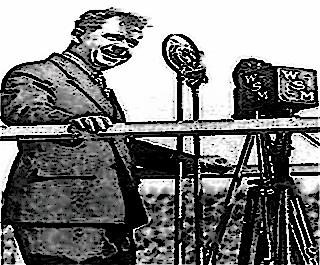
Watching Long speak, one may initially identify similarities with Democratic primary candidate Bernie Sanders’ imitative arm flailing and language. He frequently mentions statistics like
“4% of the American people own 85% of the wealth” and “70% of Americans can’t pay the debts they owe.” Much like Sanders decries the exorbitant wealth of Jeff Bezos, Long had blasted billionaires Rockefeller and Mellon for theirs.
However, there are several differences beside decrepitude that make Long a superior candidate. Socialism, Sanders’ mantra, has never been viewed as a legitimate or desirable political term in the United States; and for good reason, as it has never, never produced the standard of life capitalism does without trying.
Young voters may understand that by “democratic socialism”
Sanders really means a European style welfare capitalism, but older generations hear failed philosophy. It is admittedly extremely easy for opponents to use this word to depict Sanders as an anti-American communist who wants to destroy America’s entrepreneurial spirit, which only time knows if this would be; and it is egregiously irrelevant to guess as Sanders is now just too damn old.
Long was more progressive than FDR and his “Share the Wealth”
program was certainly to the left of the New Deal, but he distanced himself from socialism. Instead, he framed his
Huey Long
Page 128
redistributive policies as the antidote to socialism. If no one acted to raise the standard of living, Long suggested, the lower classes would revolt and impose a communist state. This messaging was a lot more palatable in its common sense for the average American.
Long simplified his economic message. The elites were using their monopoly on money and power to hurt American families.
Certainly, this was a notion most Americans could agree with then and now.
Huey Long revolutionized public education in Louisiana by providing free textbooks to children.
Page 129
Every Man a King: Long’s Populist Policies
“I’m for the poor man — all poor men, they all gotta have a chance. They gotta have a home, a job, and a decent education for their children. ‘Every man a king’ — that’s my slogan.”
-Huey Long
Long’s policies were populist rather than communist in that they economically advanced the interests of working people. Across the board, Long wanted to tax monopolies and use government spending to improve Depression majority society.
Infrastructure was a major priority. Poorly maintained dirt and gravel roads inhibited travel, and Louisiana only had 300 miles of paved roads at this point. Long employed 22,000 previously unemployed men to surface 5,000 miles of modern highways. He also constructed numerous bridges and dams to connect the wetlands.
Reforming education was paramount. Long had not been able to access public education as a rural youth, and had few books around. Illiteracy was high, and 25% of children couldn’t afford textbooks. Using revenue from taxing oil monopolies, Long made free textbooks available to all public school students. This immediately increased attendance by 20%. Long, a huge football fan, also tripled the size of Louisiana State University, built
Page 130
a new stadium, and subsidized tuition so more students could attend.
Long launched construction on 31 free health and immunization clinics for Louisianan's, dropping mortality rates by 30
percent. It was important to him that the rural poor had access to affordable healthcare.
But most central to Long’s platform was his “Share Our Wealth”
program, with the slogan “Every Man a King.” Under this program, large fortunes would be capped at $2 billion, adjusted for inflation. The proceeds of this tax would go towards funding vocational schools, free healthcare and education, and an early form of universal basic income.
Huey Long launched a campaign to promote his program, and 27,000
“Share Our Wealth clubs” formed by 1935. Nationwide, Long’s idea had 7.5 million loyal supporters. White supremacists criticized Huey for allowing blacks into the club, but he insisted they be allowed to join.
Although “Share Our Wealth” wasn’t implemented, historians suggest Huey’s ideas pushed FDR’s New Deal to the left significantly. These programs were intended to solve many of the same issues we face today and were widely embraced by working class people across demographics, regardless of collar color.
Page 131
What Democrats Can Learn From Huey Long Comparing Joe Biden to Governor Huey Long is an unintended insult to Long and is a night and day difference. The two candidates clearly have very different philosophical and electoral approaches. While the election has yet to occur, Biden’s razor thin margin is cause for concern and evidence his strategy is flawed; especially considering how controversial his opponent will be, or the mainstream purchased media will say him to be.
Huey Long embodies the programmatic, class based approach that New Deal Democrats widely used. He had a clearly displayed set of policies geared toward improving the material conditions of disaffected workers. Long’s messaging identified the elite as a united part of the problem and encouraged voters to be skeptical of leadership in both parties, which won him valuable bipartisan framing as an outsider. It’s no surprise he earned 96% of the gubernatorial vote in Louisiana.
Biden, on the other hand, embraces the Clinton playbook developed since the 1990s. His policies firmly embrace the neoliberal status quo, adopting few components of fairly popular progressive ideas. But noticeably, Biden chooses not to focus on an agenda at all. Rather, he messages the election as a moral
Page 132
dilemma – “We just need to get a good guy in the White House,”
ostensibly thinking himself that, unaware of the opinion of the populace. The DNC almost entirely lacks a policy program or a vision voters could look forward to. And instead of blaming both parties for the COVID-19 and economic crises, as they are rightly jointly responsible, Biden squarely focuses animosity on Republicans, fooling no one but himself and press secretary.
Democrats would do better to keep a few things in mind.
Americans want an ambitious plan. They intensely dislike the two party system and trust neither side to deliver prosperity. And they could easily be united by a third party platform that appeals to common economic interests in a time of common need.
A change in strategy would be wise. In less than 100 years, the Democratic Party has gone from “Every Man a King” to “Anyone but Trump.” How inspiring.
Page 133
9 – Hear What the People Say
The following short stories describe the personal impact of Huey Long's programs.
“My grandfather was a member of the Share the Wealth chapter in Wisconsin. He told me that he wept bitter tears when Huey Long was shot. His birthday was on the day Huey Long died, and he never celebrated his birthday again.”
“I am the granddaughter of poor north Louisiana farmers. My dad was able to get a high school education and go on to college because of the free public education made possible by Governor Long.
My grandparents lived in a shack and made a meager living on 25
acres, most of which they had to sell by 1940 to survive. The paved roads Governor Long implemented allowed my grandparents to get their crops to market. My grandmother had a faded photo on her dresser when she died. It was one of Governor Long dedicating a hospital.
I am a CPA, MBA in Accounting from Rice University. I know that I would not have had any of this if Governor Long had not provided programs that helped my grandparents and my dad improve their lives. I try to visit his grave every few years to pay my respects. My respect and admiration for him has only grown over
Page 134
the years. I would not be where I am today without his tremendously compassionate programs.”
“My grandfather's voice still resonates in my mind as I hear him and see him lecturing me on what this world is coming to. There were politicians he absolutely could not stand locally and federally. Mostly, I remember the stories of Huey Long. Governor Long was going to see that families of all socio-economic backgrounds were going to have the equal opportunities. Governor Long was the people's man.
The story I remember the most was hearing of Governor Long's death and the thousands of people who attended the services from all over Louisiana. Two of those attending were my grandmother and my great-grandmother. My grandfather saved all of Huey Long's published speeches, which I found in my grandmother's hope chest.
The one artifact that I regret we no longer have in our possession is buried with my grandfather. In 1982, after cancer stole Poppa from our family, he was presented at the Joseph Laughlin Funeral Home on Magazine Street in New Orleans —
fastened to his jacket was his 'Every Man a King' lapel pin.”
“I think it is relatively unknown to many how severe poverty was in the early 1920s in Louisiana and the lack of basic services
Page 135
that were available to all of its citizens, e.g. schools, roads, bridges, hospitals, health care. Enter Huey P. Long.
Gov. and Sen. Long was responsible for so many great things that happened to Louisiana when he was in office. It is remarkable he accomplished so much. He was a genius. Say what you will about his motives, clothes, speaking manner, roots, whatever, this man changed it all in favor of the Louisiana citizen.
In my opinion, the criticism he received in the waning years of his life and career was over the top and generated by the wealthy and powerful that feared him. He was not a socialist, nor a fascist as some portray him to be. What he accomplished was within the bounds of a state and federal democracy. When his opponents could not defeat him at the polls or on the floor of the state capitol or the Senate, they verbally maligned him and finally killed him.
What would he have been and where would he have gone on a state and national level we will never know. One thing we do know is that Louisiana is a much better, more educated, healthier state than it could have ever been without the KINGFISH. When you watch the DVD biography of Huey P. Long by Ken Burns, keep in mind who the people are who are criticizing Mr. Long and examine their motives, from those residing in Louisiana to FDR. Watch
Page 136
this DVD, think for yourself, look around you, study Louisiana history, and decide for yourself. Louisiana folks should always revere the great Huey P. Long.”
“My dad was an orphan from Tallulah by the age of 9 or 10. He later became a star football player at Tallulah High. In 1933, Huey Long got wind of my dad's football prowess and summoned him to his penthouse at the Roosevelt Hotel. Until that trip from Tallulah to New Orleans, my dad had never even seen a paved road.
My dad and another good football player, Cy Wickson, were both introduced to Huey — still wearing his pajamas midmorning. Huey commented, ‘Ain't no more good football players goin' to Tulane, they're all goin' to LSU,’ and then he turned to someone else in the room and had my dad and Wickson dropped off in Baton Rouge.
My dad ended up a 3 year starter from 1935-37 and captained the team his senior year. Without Huey, my dad would have never graduated from college or enjoyed the success of separate careers as a football coach and general contractor.”
“I first became familiar with Huey Long by reading T. Harry Williams’ biography. When I enrolled at Harvard College in 1975, I found a shelf, deep in the bowels of Widener Library, that
Page 137
held a dozen books by and about Governor Long. I enjoyed them all.
He was, quite simply, someone who fought to improve the lives of ordinary people. He delivered roads, bridges, textbooks and higher education to people who never would have gotten them any other way. He was utterly fearless. He won over and over again.
And he did it all with such style. Huey Long demonstrated a lesson that needs to be remembered today: that populism is popular.”
“My late dad worked for the Recorder of Mortgages for the city of New Orleans during Huey Long's time. In those days, the city administration was at odds with Governor Long. Accordingly, all city employees, well at least those in the Recorder of Mortgages, were charged with going to the homes of New Orleans'
residents and "canvassing" for their candidate and against Huey Long.
My dad often remarked how useless and frustrating that was. Many residents would not invite them into their homes once they were identified as promoting the opponent of Huey Long. And those who would invite them in always seemed to have a picture of Huey Long on their mantlepiece. My dad said it was an exercise in futility.
Page 138
Huey Long was so admired — actually worshipped — by the people here that my dad said he would leave his "canvassing" for the day depressed. I met a gentleman years ago who was such a believer in Huey that he told me he used to pray to Huey Long …
and, most importantly, Huey answered his prayers.”
“My husband was named after Huey Long. His mother raised five children as a single woman. Her husband went off one day to hunt for a job and never came back. She worked at odd jobs and gave her children an education while living in Natchitoches, Louisiana. My husband is proud of his name and tells everyone who he is named after.
I grew up in Winnfield. My dad would have gone around the world for Huey P. Long. He was always there when Huey or his staff were handing out bacon or some kind of meat on the Court House lawn.”
“Huey Long died long before I was born, but his name and legacy were an everyday part of my life. My grandfather was a friend of Huey Long and a supporter of every Long to run for office. He told me as long as I can remember, ‘Always vote for the Long.’
At my grandmother's funeral, Russell Long came and presented a book on the life of Huey P Long to my grandfather. He wrote the following inscription in the front cover ‘To Eddie Manuel, my
Page 139
father's good friend.’ I asked my grandfather what that was all about, and he told me that he and Huey were good friends, and that at one point in his life, he actually drove Huey around in an ‘open car’ campaigning and running for governor of Louisiana.
You just never know.”
“It is true that Huey completely changed the political landscape that had existed for many years. The change was for the better but the ‘establishment’ certainly did not appreciate being ousted and they were the ones that still had enormous influence with the newspapers and other media. Was Huey ‘colorful?’
Probably, but he was also light years ahead of his time in his political thinking.”
“I was born in my grandmother's shotgun house, which sat on the old Hu Long place in Winnfield, LA. My grandmother was very pro-Long. She had raised two children by herself during the Depression, and she stood firm on her belief that Huey Long had saved many a poor person's life with his various programs.
On occasion, especially when Earl pulled some stunt or one of the other Long politicians may have done something she did not agree with, she'd get mad and say something about the Longs. But under no circumstances would she allow anyone else to say anything negative about Huey or Earl Long.
Page 140
My grandmother always said that much of the negative media news on Huey came from ‘carpetbaggers’ who came south to profit off the poor folks. And in time, I came to realize that much of what was written about Huey was from people who were not Southern and were from families of wealth.
No doubt Huey did many things that were not quite up to today's so called ethical standards, but I firmly believe that many of the big name news editors of that time period were influenced by the landed gentry who Huey had displaced when he was elected to the Railroad Commission, and later as Governor.”
“Governor Long solved many of the ills that confronted our state during the Depression – and turned the politicians who had controlled access to the wealth and power on their collective ears. My great “Uncle” was a friend of Governor/Senator Long. I remember our family speaking of the times of change and challenge.”
“I was born in 1933, about the time Huey P. Long was campaigning for the Senate. My parents were poor farmers in Tangipohoa Parish on a small piece of land that my father inherited that had been part of a land grant that my ancestors received from the Spanish Government, before the Louisiana Purchase. My family were strong supporters of Gov. Huey Long.
Page 141
In the later 1940s, 1950s, and early 1960s I frequently traveled US 190 and US 71 between Baton Rouge and Alexandria. Most of the time there was an older gentleman sitting in a chair under an oak tree along the highway distributing a poem he had written proclaiming the greatness of Huey P. Long. If anyone would take the time to listen he would recite the poem. My memory is clouded after many years but I think he was a black man. His race has no bearing on the issue or the fact that is clear in my memory, he was very pleased with Gov.-Sen. Long.”
“I came from a fairly well to do family because of Huey Long's Administration. I am a Black retired US Postman. I think of the wonders he has contributed to making our jobs so easy and not as complex as described in the old days. What a great job well done in promoting Louisiana as he has. Our love and generous appreciation extends in the surpass. Thanks for a job truly well done. We miss you Gov. Long. YOU are not dead in our hearts, you are only just away. May God bless your spirit that hangs proudly in the skies of the old state we both call home — Louisiana.”
“I am an African American senior born in 1933. I clearly remember many stories about Huey P. Long shared among older black people most of which were complimentary and held him in high regard. This attitude confused me for many years because from his political rhetoric I somehow thought he was anti-black.
Page 142
Later I learned of the good work he had done for education of black people and also made numerous opportunities for employment of professionally trained blacks. My maternal aunt was employed as a ‘Jeans Supervisor’ for black schools, the equivalent of a superintendant of education, in Bossier Parish. It is my understanding that the Jeans Supervisor program was started under the leadership of Huey P. Long.”
“I was born very poor with a brother and five sisters. My mother and father struggled to send us to school because of the high cost of school books. There finally came a time when they could no longer afford to buy books for 7 children. We children were told that we could no longer attend school.
That very same year, Governor Long persuaded the Louisiana Legislature to fund school books for all children attending public schools. Not only did that mean that my brother and sisters and I could finish our education but also thousands of other children could as well. My family never forgot Huey Long and became long time political supporters of the Long family.”
“When you talk about politics in rural Louisiana, Huey Long’s name always comes up. He was a master communicator with the people in rural Louisiana.
Page 143
When he visited the Washington Parish areas and delivered his famous stump speeches, I am told he would look out into the crowd of people and pick out some of the children who might be in attendance. He would then say to their parents, ‘Take them down to the local clothing store and buy them a new set of clothes.’ He would add, ‘Tell the merchant to charge them to Old Huey.’
Some of the people who remember those meetings have told me that the clothes purchased and given to them by Huey Long was the first store bought clothing they ever owned, since almost all children’s clothes were hand made from old flour sacks.
Huey Long's acts of kindness made him very popular. He had a special place in his heart for children, the poor, and others who were less fortunate than many of that day. He improved our great state in ways we enjoy even today.”
“Thank God and Huey Long.”
“I often have been disappointed with the way Huey has been portrayed by ill-informed people. Huey's legacy, so misunderstood by glib commenters and historians with axes to grind, is alive in Louisiana in the form of roads, hospitals and healthy, educated children.
Page 144
Huey Long, though certainly no saint, did more to help real, working people in Louisiana than anyone before or since, and his proposed Share Our Wealth program did as much to goose Franklin Roosevelt to real reforms as did people like Sen. Robert Wagner and Roosevelt's wife, Eleanor.
I believe Louisiana, and the nation, owe Huey a very large debt.
For my very small, inconsequential part, I recently released a song, "Thank God and Huey Long," about Huey and what he meant to the working people of the state.”
“I am a songwriter from London and I have long been a big admirer of Huey Long, to the extent that I incorporated some of his speeches into one of my songs. No politician today manages to speak with such clarity, purpose and passion.
Huey's policies are perhaps even more appropriate now than when he was alive, with wealth inequality continuing to be a problem in so many countries across the world today.
It was therefore a great honor to finally make it to Baton Rouge to see his statue, appreciate and examine his legacy, as well as sadly see where he was tragically assassinated.
I believe that his works will continue to inspire, and I hope that one day a new Huey Long will rise and continue to fulfill his legacy and bring about a fairer distribution of wealth.”
Page 145
“I became acquainted with Huey Long through my National History Day project. The theme for 2010 was 'Innovation in History: Impact and Change,' and I created an individual performance about Long's 'Share Our Wealth' program, a true innovation in history.
Not only was Long innovative in his proposals to redistribute the wealth through social welfare programs, but also in the ways that he spoke directly to the masses. He spoke on issues they cared about in language they could understand. Long's speeches went straight to the heart of the bitter suffering of the Great Depression. People felt Huey Long was their friend, despite never meeting him.
I also read criticism of Long and decided to portray three characters in my performance: Huey Long, critic Walter Lippmann, and a common man. In history, the common man is most often the forgotten one, thus I ended my performance in the common man's voice so that it would not be forgotten. He cries, ‘Rest in peace Kingfish, your legacy lives on in all of us.’”
“I am an American songwriter living near London. I recently awoke at 3 a.m. with the idea 'share the wealth.' I thought
'what a good idea' and got up to write it down. When further inspiration failed to materialize during the days that followed,
Page 146
I performed a search for it online and subsequently made a close acquaintance with Huey Long.
After reading about what happened during his life, I remember being totally in awe of Huey Long and spending a day or two just reflecting on the things he'd achieved and feeling very impressed and ever so slightly proud to be American.
A larger than life character — to say the least — and veritable hero for the progress of the state of Louisiana. So much to write about! Indeed, had I written all that occurred to me, the result would have been a very, very long song about the extraordinary Huey Long.”
“As a child growing up in New Orleans, Louisiana, I was always fascinated with history. Living in a state steeped in the history of oppressing my ancestors, I was moved when our Louisiana History class studied Huey P. Long.
Huey Long’s belief and work to embrace ‘all men’ is a timeless message that all Americans and humans can learn from. His basic premise that every man is a king and every man deserves at least a homestead was a message of justice. Imagine if we put into action just this basic belief. Just think, the homeless problem could be eradicated.
Page 147
All of us are made in the Image of God. All deserve basic human comforts. This man was feared by those who wanted to continue oppression and practice injustice. He was probably killed because his message if put into action would establish a colorblind America truly practicing ‘justice for all.’
Huey Long was a man before his time and a man whose message is timeless. It is not too late for us to hear this call for justice to roll down like waters.”
“I'm sad to say that I was never able to see the likes of such a great man as Huey Long, but I have my own story to tell nonetheless. I am 19 years old, and I live in Alabama.
Huey was a great man who looked out for the well-being of this great Nation, and I believe this country could have done many great things if he would have been given a chance to be our president. I would do anything in my power to go back and meet him.
I get so sad in my heart when I think about his death. His final words, ‘God do not let me die, I have so much to do’ are just so touching to me. Here was a man who had such love for the people of America, and just when he was about to take it to the top, he was shot.
Page 148
His legacy will not die as long as I am alive. I hope to one day meet him in the sky and tell him how much he means to me. LONG
LIVE THE KINGFISH!”
“My mother was born and raised in Oak Ridge, LA. I was so inspired by reading the life and times of Mr. Huey Long! His message is one that we can use today. President Obama could use a page or two from Mr. Long's political platform of Share the Wealth as we are certainly in need of it.
We are in the dawn of a new era for change yet we are still fighting backward and foolish political policies by those who only want to appease the wealthy. Our President has been trying to break through to those that don't want change.
There is still a great divide between those that have and those that don't have. In addition our civil rights are being challenged and threatened by politicians whose interests have nothing to do with justice for the poor and middle class.
I salute Mr. Long's life and legacy for his dedication as a voice for the voiceless. Thank you so much for providing a web page so that those such as myself, an African American woman whose descendants were share croppers but whose children eventually received an education in part due to the efforts of
Page 149
Mr. Long, directly or indirectly. We are to learn from our history so that we don't repeat it.
It gives me great joy to read about a man that fought for true justice and equality. As Martin Luther King Jr., he was a drum major, a soldier fighting for justice providing light during a dark, traumatic, and trying time in American history.
Mr. Long's light is still shining! We will continue to fight for justice and equality until all people are kings and queens in their own right.”
Page 150
10– A Few of Huey Long’s Speeches
Huey Long's Senate speeches became legendary, as he packed the public galleries. According to one Washington tourist guide, top stops were "White House, Monument, Capitol — and The Kingfish."
Strangely, while one can easily access virtually everything Dubya said on the internet, the only source for the vast majority of Huey Long speeches is the Congressional record, which is quite difficult to use. Some sites do not go as far back as Huey Long, and those that do only provide PDF versions and only if you correctly input quite precise information like page number, which you likely can’t know unless you already have a copy. In addition, the government site does not have every session yet in its records. A cynical person might conclude that they are still shadow blocking Huey.
Following are selected speeches by Huey Long, many of which were also delivered on the radio and mailed to Share Our Wealth club members in their publication.
Senate Speeches:
The Doom of America's Dream - April 4, 1932
Wall Street's Outer Guard - April 29, 1932
The Missing Stars - May 12, 1932
People's Right to Fulfillment - December 6, 1932
Page 151
The Abyss Yawns for All - January 25, 1933
Louisiana's Defense - February 21, 1933
War Cry for World Democracy; To-day's Cry for American Dictatorship - March 13, 1933
How America Can Be Adjusted - March 17, 1933, also a radio address (published March 23, 1933)
St. Lawrence Waterway Treaty and Injustice to the Mississippi Valley - April 21, 1933
Limitation of Fortunes – Spreading Wealth Among the Masses - May 12, 1933
Our Constant Rulers - May 26, 1933
J. P. Morgan & Co.'s Magazine Attack on Huey P. Long - June 10, 1933
Victory Over the Helpless - June 15, 1933
The Oil Industry - March 1, 1934
Redistribution of Wealth - January 9, 1935 radio address (published January 14, 1935)
Our Plundering Government - February 10, 1935 radio address Share Our Wealth - May 15, 1935
Louisiana's Rights - July 19, 1935
The Need of Truth and Sincerity in Mr. Roosevelt's Promises -
July 19, 1935 radio address (published July 22, 1935) The Last Supper - July 23, 1935
The Plan of Robbery, Murder, Blackmail, or Theft - August 9, 1935
Huey Long on the Radio:
Page 152
Huey Long was the first politician, soon followed by President Franklin D. Roosevelt, to use national radio broadcasts to promote his ideas to a larger audience.
After offering bills in the Senate, he purchased radio time with the National Broadcasting Company to explain his proposals to the American public, bypassing the usual filters and criticism of the conservative newspapers.
Huey developed a following of an estimated 25 million loyal listeners, who started 27,000 Share Our Wealth clubs across the nation.
Following, please find a few examples of his dynamically popular speeches.
Page 153
The Share Our Wealth Speech – Radio 2/23/34
In a national radio speech on February 23, 1934, Huey Long unveiled his “Share Our Wealth” plan, a program designed to provide a decent standard of living to all Americans by spreading the nation’s wealth among the people. The speech is referred to both as the “Share Our Wealth” speech and the “Every Man a King” speech. Whatever name is chosen, it is probably viewed by posterity as his most significant oration.
Long initially proposed capping personal fortunes at $50 million each, roughly $600 million in today's dollars, through a restructured, progressive federal tax code on wealth and incomes, at the approximate upper 1% level or less, and sharing the resulting revenue with the public through government benefits and public works. In subsequent speeches and writings, he revised his graduated tax levy on wealth over $1 million to cap fortunes at $5 - $8 million, or $60 - $96 million today.
The full text of this speech, as printed in Long's official Share Our Wealth pamphlet, appears below.
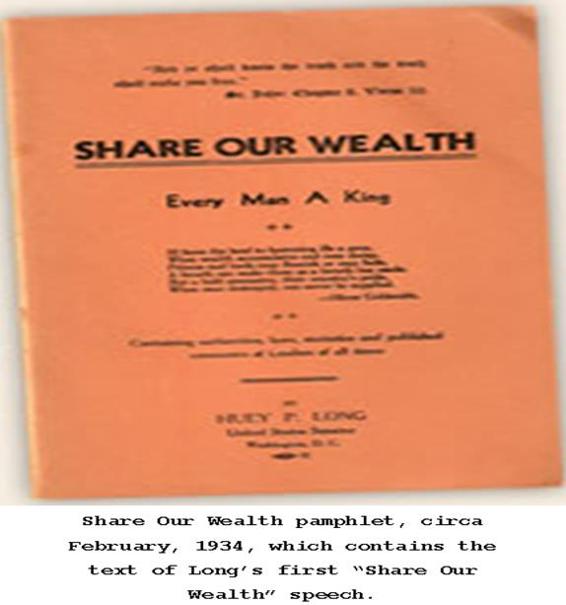
Huey Long
Page 154
“EVERY MAN A KING”
Share Our Wealth Radio Speech by Senator Huey P. Long, of Louisiana, February 23, 1934
Page 155
Is that a right of life when the young children of this country are being reared into a sphere which is more owned by 12 men than it is by 120,000,000 people?
Ladies and Gentlemen:
I have only 30 minutes in which to speak to you this evening, and I, therefore, will not be able to discuss in detail so much as I can write when I have all of the time and space that is allowed me for the subjects, but I will undertake to sketch them very briefly without manuscript or preparation, so that you can understand them so well as I can tell them to you tonight.
I contend, my friends, that we have no difficult problem to solve in America, and that is the view of nearly everyone with whom I have discussed the matter here in Washington and elsewhere throughout the United States that we have no very difficult problem to solve.
It is not the difficulty of the problem which we have; it is the fact that the rich people of this country, and by rich people I mean the super-rich, will not allow us to solve the problems, or rather the one little problem that is afflicting this country, because in order to cure all of our woes it is necessary to scale down the big fortunes, that we may scatter the wealth to be shared by all of the people.
Page 156
We have a marvelous love for this government of ours; in fact, it is almost a religion, and it is well that it should be, because we have a splendid form of government and we have a splendid set of laws. We have everything here that we need, except that we have neglected the fundamentals upon which the American government was principally predicated.
How many of you remember the first thing that the Declaration of Independence said? It said: "We hold these truths to be self-evident, that there are certain inalienable rights for the people, and among them are life, liberty, and the pursuit of happiness;" and it said further, "We hold the view that all men are created equal."
Now, what did they mean by that? Did they mean, my friends, to say that all men are created equal and that that meant that any one man was born to inherit $10,000,000,000 and that another child was to be born to inherit nothing?
Did that mean, my friends, that someone would come into this world without having had an opportunity, of course, to have hit one lick of work, should be born with more than it and all of its children and children's children could ever dispose of, but that another one would have to be born into a life of starvation?
Page 157
That was not the meaning of the Declaration of Independence when it said that all men are created equal or "That we hold that all men are created equal."
Nor was it the meaning of the Declaration of Independence when it said that they held that there were certain rights that were inalienable; the right of life, liberty, and the pursuit of happiness.
Is that right of life, my friends, when the young children of this country are being reared into a sphere which is more owned by 12 men than it by 120,000,000 people?
Is that, my friends, giving them a fair shake of the dice or anything like the inalienable right of life, liberty, and the pursuit of happiness, or anything resembling the fact that all people are created equal; when we have today in America thousands and hundreds of thousands and millions of children on the verge of starvation in a land that is overflowing with too much to eat and too much to wear?
I do not think you will contend that, and I do not think for a moment that they will contend it.
Now let us see if we cannot return this Government to the Declaration of Independence and see if we are going to do anything regarding it. Why should we hesitate or why should we
Page 158
quibble or why should we quarrel with one another to find out what the difficulty is, when we know that the Lord told us what the difficulty is, and Moses wrote it out so a blind man could see it, then Jesus told us all about it, and it was later written in the Book of James, where everyone could read it?
I refer to the Scriptures, now, my friends, and give you what it says not for the purpose of convincing you of the wisdom of myself, not for the purpose, ladies and gentlemen, of convincing you of the fact that I am quoting the Scriptures means that I am to be more believed than someone else; but I quote you the Scripture, or rather refer you to the Scripture, because whatever you see there you may rely upon will never be disproved so long as you or your children or anyone may live; and you may further depend upon the fact that not one historical fact that the Bible has ever contained has ever yet been disproved by any scientific discovery or by reason of anything that has been disclosed to man through his own individual mind or through the wisdom of the Lord which the Lord has allowed him to have.
But the Scripture says, ladies and gentlemen, that no country can survive, or for a country to survive it is necessary that we keep the wealth scattered among the people, that nothing should keep the wealth scattered among the people, that nothing should be held permanently by any one person, and that 50 years seems
Page 159
to be the year of jubilee in which all property would be scattered about and returned to the sources from which it originally came, and every seventh year debt should be remitted.
Those two things the Almighty said to be necessary; I should say He knew to be necessary, or else He would not have so prescribed that the property would be kept among the general run of the people, and that everyone would continue to share in it; so that no one man would get half of it and hand it down to a son, who takes half of what was left, and that son hand it down to another one, who would take half of what was left, until, like a snowball going downhill, all of the snow was off of the ground except what the snowball had.
I believe that was the judgment and the view and the law of the Lord, that we would have to distribute wealth ever so often, in order that there could not be people starving to death in a land of plenty, as there is in America today.
We have in America today more wealth, more goods, more food, more clothing, more houses than we have ever had. We have everything in abundance here.
We have the farm problem, my friends, because we have too much cotton, because we have too much wheat, and have too much corn, and too much potatoes.
Page 160
We have a home loan problem, because we have too many houses, and yet nobody can buy them and live in them.
We have trouble, my friends, in the country, because we have too much money owing, the greatest indebtedness that has ever been given to civilization, where it has been shown that we are incapable of distributing the actual things that are here, because the people have not money enough to supply themselves with them, and because the greed of a few men is such that they think it is necessary that they own everything, and their pleasure consists in the starvation of the masses, and in their possessing things they cannot use, and their children cannot use, but who bask in the splendor of sunlight and wealth, casting darkness and despair and impressing it on everyone else.
"So, therefore," said the Lord in effect, "if you see these things that now have occurred and exist in this and other countries, there must be a constant scattering of wealth in any country if this country is to survive."
"Then," said the Lord, in effect, "every seventh year there shall be a remission of debts; there will be no debts after 7
years." That was the law.
Now, let us take America today. We have in America today, ladies and gentlemen, $272,000,000,000 of debt. Two hundred and
Page 161
seventy-two thousand millions of dollars of debts are owed by the various people of this country today. Why, my friends, that cannot be paid. It is not possible for that kind of debt to be paid.
The entire currency of the United States is only $6,000,000,000.
That is all of the money that we have got in America today. All the actual money you have got in all of your banks, all that you have got in the Government Treasury, is $6,000,000,000; and if you took all that money and paid it out today you would still owe $266,000,000,000; and if you took all that money and paid again you would still owe $260,000,000,000; and if you took it, my friends, 20 times and paid it you would still owe $150,000,000,000.
You would have to have 45 times the entire money supply of the United States today to pay the debts of the people of America and then they would just have to start out from scratch, without a dime to go on with.
So, my friends, it is impossible to pay all of these debts, and you might as well find out that it cannot be done. The United States Supreme Court has definitely found out that it could not be done, because, in a Minnesota case, it held that when a State
Page 162
has postponed the evil day of collecting a debt it was a valid and constitutional exercise of legislative power.
Now, ladies and gentlemen, if I may proceed to give you some other words that I think you can understand; I am not going to belabor you by quoting tonight; I am going to tell you what the wise men of all ages and all times, down even to the present day, have all said that you must keep the wealth of the country scattered, and you must limit the amount that any one man can own. You cannot let any man own §300,000,000,000 or $400,000,000,000. If you do, one man can own all of the wealth that the United States has in it.
Now, my friends, if you were off on an island where there were 100 lunches, you could not let one man eat up the hundred lunches, or take the hundred lunches and not let anybody else eat any of them. If you did, there would not be anything else for the balance of the people to consume.
So, we have in America today, my friends, a condition by which about 10 men dominate the means of activity in at least 85
percent of the activities that you own. They either own directly everything or they have got some kind of mortgage on it, with a very small percentage to be excepted. They own the banks, they own the steel mills, they own the railroads, they own the bonds,
Page 163
they own the mortgages, they own the stores, and they have chained the country from one end to the other until there is not any kind of business that a small, independent man could go into today and make a living, and there is not any kind of business that an independent man can go into and make any money to buy an automobile with; and they have finally and gradually and steadily eliminated everybody from the fields in which there is a living to be made, and still they have got little enough sense to think they ought to be able to get more business out of it anyway.
If you reduce a man to the point where he is starving to death and bleeding and dying, how do you expect that man to get hold of any money to spend with you? It is not possible.
Then, ladies and gentlemen, how do you expect people to live, when the wherewith cannot be had by the people?
In the beginning I quoted from the Scriptures. I hope you will understand that I am not quoting Scripture to you to convince you of my goodness personally, because that is a thing between me and my Maker; that is something as to how I stand with my Maker and as to how you stand with your Maker. That is not concerned with this issue, except and unless there are those of you who would be so good as to pray for the souls of some of us.
Page 164
But the Lord gave His law, and in the Book of James they said so, that the rich should weep and howl for the miseries that had come upon them; and, therefore, it was written that when the rich hold goods they could not use and could not consume, you will inflict punishment on them, and nothing but days of woe ahead of them.
Then we have heard of the great Greek philosopher, Socrates, and the greater Greek philosopher, Plato, and we have read the dialogue between Plato and Socrates, in which one said that great riches brought on great poverty, and would be destructive of a country. Read what they said. Read what Plato said; that you must not let any one man be too poor, and you must not let any one man be too rich; that the same mill that grinds out the extra rich is the mill that will grind out the extra poor, because, in order that the extra rich can become so affluent, they must necessarily take more of what ordinarily would belong to the average man.
It is a very simple process of mathematics that you do not have to study, and that no one is going to discuss with you.
So that was the view of Socrates and Plato. That was the view of the English statesmen. That was the view of American statesmen.
That was the view of American statesmen like Daniel Webster,
Page 165
Thomas Jefferson, Abraham Lincoln, William Jennings Bryan, and Theodore Roosevelt, and even as late as Herbert Hoover and Franklin D. Roosevelt.
Both of these men, Mr. Hoover and Mr. Roosevelt, came out and said there had to be a decentralization of wealth, but neither one of them did anything about it. But, nevertheless, they recognized the principle. The fact that neither one of them ever did anything about it is their own problem that I am not undertaking to criticize; but had Mr. Hoover carried out what he says ought to be done, he would be retiring from the President's office, very probably, eight years from now, instead of one year ago; and had Mr. Roosevelt proceeded along the lines that he stated were necessary for the decentralization of wealth, he would have gone, my friends, a long way already, and within a few months he would have probably reached a solution of all of the problems that afflict this country today.
But I wish to warn you now that nothing that has been done up to this date has taken one dime away from these big fortune holders; they own just as much as they did, and probably a little bit more. They hold just as many of the debts of the common people as they ever held, and probably a little bit more; and unless we, my friends, are going to give the people of this country a fair shake of the dice, by which they will all get
Page 166
something out of the funds of this land, there is not a chance on the top side of this God's eternal earth by which we can rescue this country and rescue the people of this country.
It is necessary to save the government of the country, but it is much more necessary to save the people of America. We love this country. We love this Government. It is a religion, I say. It is a kind of religion people have read of when women, in the name of religion, would take their infant babes and throw them into the burning flame, where they would be instantly devoured by the all-consuming fire, in days gone by; and there probably are some people of the world even today, who, in the name of religion, throw their own babes to destruction; but in the name of our good government, people today are seeing their own children hungry, tired, half naked, lifting their tear dimmed eyes into the sad faces of their fathers and mothers, who cannot give them food and clothing they both need, and which is necessary to sustain them, and that goes on day after day, and night after night, when day gets into darkness and blackness, knowing those children would arise in the morning without being fed, and probably go to bed at night without being fed.
Yet in the name of our Government, and all alone, those people undertake and strive as hard as they can to keep a good government alive, and how long they can stand that no one knows.
Page 167
If I were in their place tonight, the place where millions are, I hope that I would have what I might say, I cannot give you the word to express the kind of fortitude they have; that is the word; I hope that I might have the fortitude to praise and honor my Government that had allowed me here in this land, where there is too much to eat and too much to wear, to starve in order that a handful of men can have so much more than they can ever eat or they can ever wear.
Now, we have organized a society, and we call it "Share Our Wealth Society," a society with the motto "Every Man a King."
Every man a king, so there would be no such thing as a man or woman who did not have the necessities of life, who would not be dependent upon the whims and caprices and ipsi dixit of the financial barons for a living. What do we propose by this society? We propose to limit the wealth of big men in the country. There is an average of $15,000 in wealth to every family in America. That is right here today.
We do not propose to divide it up equally. We do not propose a division of wealth, but we propose to limit poverty that we will allow to be inflicted upon any man's family. We will not say we are going to try to guarantee any equality, or $15,000 to a family. No; but we do say that one third of the average is low
Page 168
enough for any one family to hold, that there should be a guarantee of a family wealth of around $5,000; enough for a home, an automobile, a radio, and the ordinary conveniences, and the opportunity to educate their children; a fair share of the income of this land thereafter to that family so there will be no such thing as merely the select to have those things, and so there will be no such thing as a family living in poverty and distress.
We have to limit fortunes. Our present plan is that we will allow no one man to own more that $50,000,000. We think that with that limit we will be able to carry out the balance of the program. It may be necessary that we limit it to less than $50,000,000. It may be necessary, in working out of the plans that no man's fortune would be more than $10,000,000 or $15,000,000. But be that as it may, it will still be more than any one man, or any one man and his children and their children, will be able to spend in their lifetimes; and it is not necessary or reasonable to have wealth piled up beyond that point where we cannot prevent poverty among the masses.
Another thing we propose is old age pension of $30 a month for everyone that is 60 years old. Now, we do not give this pension to a man making $1,000 a year, and we do not give it to him if he has $10,000 in property, but outside of that we do.
Page 169
We will limit hours of work. There is not any necessity of having overproduction. I think all you have got to do, ladies and gentlemen, is just limit the hours of work to such an extent as people will work only so long as it is necessary to produce enough for all of the people to have what they need. Why, ladies and gentlemen, let us say that all of these labor-saving devices reduce hours down to where you do not have to work but 4 hours a day; that is enough for these people, and then praise be the name of the Lord, if it gets that good. Let it be good and not a curse, and then we will have 5 hours a day and 5 days a week-, or even less than that, and we might give a man a whole month off during a year, or give him 2 months; and we might do what other countries have seen fit to do, and what I did in Louisiana, by having schools by which adults could go back and learn the things that have been discovered since they went to school.
We will not have any trouble taking care of the agricultural situation. All you have to do is balance your production with your consumption. You simply have to abandon a particular crop that you have too much of, and all you have to do is store the surplus for the next year, and the Government will take it over.
When you have good crops in the area in which the crops that have been planted are sufficient for another year, put in your
Page 170
public works in the particular year when you do not need to raise any more, and by that means you get everybody employed.
When the Government has enough of any particular crop to take care of all of the people, that will be all that is necessary; and in order to do all of this, our taxation is going to be to take the billion-dollar fortunes and strip them down to frying size, not to exceed $50,000,000, and if it is necessary to come to $10,000,000, we will come to $10,000,000. We have worked the proposition out to guarantee a limit upon property (and no man will own less than one-third the average), and guarantee a reduction of fortunes and a reduction of hours to spread wealth throughout this country. We would care for the old people above 60 and take them away from this thriving industry and give them a chance to enjoy the necessities and live in ease, and thereby lift from the market the labor which would probably create a surplus of commodities. Those are the things we propose to do.
Every Man a King. Every man to eat when there is something to eat; all to wear something when there is something to wear. That makes us all a sovereign.
You cannot solve these things through these various and sundry alphabetical codes. You can have the N. R. A. and P. W. A. and C. W. A. and the U. U. G. and G. I. N. and any other kind of dad-gummed lettered code. You can wait until doomsday and see 25
Page 171
more alphabets, but that is not going to solve this proposition.
Why hide? Why quibble? You know what the trouble is. The man that says he does not know what the trouble is is just hiding his face to keep from seeing the sunlight.
God told you what the trouble was. The philosophers told you what the trouble was; and when you have a country where one man owns more than 100,000 people, or a million people, and when you have a country where there are four men, as in America, that have got more control over things than all the 120,000,000
people together, you know what the trouble is.
We had these great incomes in this country; but the farmer, who plowed from sunup to sundown, who labored here from sunup to sundown for 6 days a week, wound up at the end of the time with practically nothing.
And we ought to take care of the veterans of the wars in this program. That is a small matter. Suppose it does cost a billion dollars a year—that means that the money will be scattered throughout this country. We ought to pay them a bonus. We can do it. We ought to take care of every single one of the sick and disabled veterans. I do not care whether a man got sick on the battlefield or did not; every man that wore the uniform of this country is entitled to be taken care of, and there is money
Page 172
enough to do it; and we need to spread the wealth of the country, which you did not do in what you call the N. R. A.
(Note: Roosevelt’s “National Recovery Act of 1933,” sometimes called “The New Deal I,” was found to be unconstitutional by the US Supreme Court in 1935.)
If the N. R. A. has done any good, I can put it all in my eye without having it hurt. All I can see that the N. R. A. has done is to put the little man out of business; the little merchant in his store, the little Italian that is running a fruit stand, or the Greek shoe-shining stand, who has to take hold of a code of 275 pages and study it with a spirit level and compass and looking-glass; he has to hire a Philadelphia lawyer to tell him what is in the code; and by the time he learns what the code is, he is in jail or out of business; and they have got a chain code system that has already put him out of business. The N. R. A. is not worth anything, and I said so when they put it through.
Now, my friends, we have got to hit the root with the ax.
Centralized power in the hands of a few, with centralized credit in the hands of a few, is the trouble.
Get together in your community tonight or tomorrow and organize one of our Share Our Wealth Societies. If you do not understand
Page 173
it, write me and let me send you the platform; let me give you the proof of it.
This is Huey P. Long talking, United States Senator, Washington, D. C. Write me and let me send you the data on this proposition.
Enroll with us. Let us make known to the people what we are going to do. I will send you a button, if I have got enough of them left. We have got a little button that some of our friends designed, with our message around the rim of the button, and in the center "Every Man a King." Many thousands of them are meeting through the United States, and every day we are getting hundreds and hundreds of letters. Share Our Wealth Societies are now being organized, and people have it within their power to relieve themselves from this terrible situation.
Look at what the Mayo brothers announced this week, these greatest scientists of all the world today, who are entitled to have more money than all the Morgans and the Rockefellers, or anyone else, and yet the Mayos turn back their big fortunes to be used for treating the sick, and said they did not want to lay up fortunes in this earth, but wanted to turn them back where they would do some good; but the other big capitalists are not willing to do that, are not willing to do what these men, 10
times more worthy, have already done, and it is going to take a law to require them to do it.
Page 174
Organize your Share Our Wealth Society and get your people to meet with you, and make known your wishes to your Senators and Representatives in Congress.
Now, my friends, I am going to stop. I thank you for this opportunity to talk to you. I am having to talk under the auspices and by the grace and permission of the National Broadcasting System tonight, and they are letting me talk free.
If I had the money, and I wish I had the money, I would like to talk to you more often on this line, but I have not got it, and I cannot expect these people to give it to me free except on some rare instance. But, my friends, I hope to have the opportunity to talk with you, and I am writing to you, and I hope that you will get up and help in the work, because the resolutions and bills are before Congress, and we hope to have your help in getting together and organizing your Share Our Wealth Societies.
Now, that I have but a minute left, I want to say that I suppose my family is listening in on the radio in New Orleans, and I will say to my wife and three children that I am entirely well and hope to be home before many more days, and I hope they have listened to my speech tonight, and I wish them and all of their neighbors and friends everything good that may be had.
Page 175
I thank you, my friends, for your kind attention, and I hope you will enroll with us, take care of your own work in the work of this Government, and share or help in our Share Our Wealth Societies.
I thank you.
Now, my friends, we have got to hit the root with the ax.
Centralized power in the hands of a few, with centralized credit in the hands of a few, is the trouble.”
— Huey Long
Page 176
The Doom of America’s Dream – Congress 4/4/32
Seventy-second Congress
First Session
The Doom of America’s Dream Speech
Of Hon. Huey P. Long of Louisiana
In the Senate of the United States
Monday, April 4, 1932
Mr. Long - Mr. President, the Senator from Michigan (Mr.
Couzens) takes a little exception to the statement made by the Senator from Arkansas (Mr. Robinson), on this side of the Chamber, relative to the reduction of salaries of Federal employees. In the discussion which has been going on here in this Chamber there is really a little bit too much harmony; in fact, this is about 95 per cent the most harmonious discussion to which I have ever listened. It seems that the Senator from Arkansas (Mr. Robinson) and the Senator speaking for the administration (Mr. Van Denberg) are in accord that taxes should be saved the American taxpayer through whatever eliminations can be made at this time. I see this morning, in one of the daily papers published here in Washington, that it is reported that a bipartisan drive is on among the leaders of the Senate. It says:
Page 177
What worries Senate leaders is a fear that the so-called tariff taxes adopted by the House, such as levies on oil and coal, will lead to a bitter fight that will delay the bill. An effort, therefore, will be made to eliminate these taxes and substitute other levies to make up the loss. As I said here on the floor of the Senate less than a month ago, when the balancing of the budget reaches the point where there is going to be a tax on the Standard Oil Co., then it is going to become necessary to find other levies. And if you do not find other levies, then the demand is going to come here in the Senate to reduce salaries and wages of the employees of the federal government, “The Rich Men’s Club.” I do not speak alone for the men drawing $1,200 a year nor for the men drawing $1,500 a year. I speak for the men drawing $10,000 a year, sitting in the Senate and in the House of Representatives. I say that there is not a man here who can stand the campaign expenses connected with election to the United States Senate and live six years on what he gets in the United States Senate; and to reduce the salaries of Congressmen and Senators today is not tending in any direction whatever except to make this body a rich men's club. We know that there was a coalition over in the House on this tax bill, and on the raising of revenue for the government. The newspapers tell us that there is a coalition in the Senate. I want to know if there is a coalition in the Senate on this tax bill. If so, whom it is
Page 178
between, where it was made up, where they met, who blessed the conference, and who was at the anointing, if there has been a coalition, conference, agreement or tentative agreement or effort to agree on this tax bill. They tell us it was so in the House, and the leaders said it was so. The publications of the United States condemned every man in the House who did not fall in line behind one or the other of the party leaders. Bloated fortunes. Of course, there is need of money for the government.
What are we to get? That is not the main need of this country, Mr. President. The reason why the Government needs money, the reason why industry needs money, comes from an infernal condition of concentration of wealth; and never has any of these bipartisan conferences in either one of the houses of congress recommended anything being done along the line of the redistribution of wealth here in the United States to avoid the alarming condition that we are in now. Oh, no; something must be done to balance the budget. But Mr. Hoover comes in when the time gets about ripe, and you can read his messages between the lines, and you do not have to eat a whole beef to tell when it is tainted. He comes in about the time when there arises the spirit in either one of these Houses to put these taxes where they ought to be put, and changes the estimates of the requirements of the budget to suit the peculiar conditions and circumstances arising at that time. If the House looks like it
Page 179
is going be become rebellious in raising the funds, they report that there is a mistake of $500,000,000 in the budget. Then the matter subsides, and the House becomes docile. Then they demand that other remedies be taken to balance the Budget. Mr.
President and Members of the Senate, there never was a more determined fight than is being waged today, silently, under cover, behind the silken veil, and out in front, to keep this tax bill from going into the field of surtaxes and inheritance taxes, that would give the common man of this country a chance, and to give the wealth of this country an opportunity to be distributed among the people of the United States. What is the tax bill going to contain when it comes out? We have waited a long time to get some help. If it has already been agreed upon, let us know now from the party leaders, as they gave it out in the House. Let us know in the Senate. Why wait? Is there going to be any relief for the masses of this country in this tax bill? Let us know what is going to come. On this home by horror haunted, tell me truly, I implore: Is there, is there balm in Gilead? Tell me, tell me, I implore. What is to be the balm from the tax bill? What is to be the balm?
America’s crisis. Why, if this Congress adjourns and does not provide a law for the effective starting of a redistribution of wealth in the United States you need not be worried about the
Page 180
amount of deficit that there is going to be in the National Treasury? If we adjourn here with this tax bill before us, with a bill passed as a result of it or with this bill passed, without providing a means for the redistribution of wealth in the United States today, and allow this snowball to go downhill for two or three more years as it is now, and allow this panic to be exploited as it is now being exploited to concentrate every business enterprise in this country, you do not need to worry about the federal government nor the budget of the federal government. You will have a problem before you that is a great deal bigger than any problem of the Budget of the Federal Government.
I have letters which I have received today, which I intended to read to the Senate. One man, a peaceable citizen, has undertaken to make a living as long as he could, and finally went into a business prohibited by law because it was the only thing out of which he could make a living for his wife and children. He is now in the federal penitentiary. Another letter is from a widow with a 19 year old son that she is undertaking to send to college, living in a college town; and he cannot continue his work in the university because she cannot find the funds even to buy the books. Yet we are sitting here talking about balancing the budget.
Page 181
The unblessed coalition. Who is thinking about those people? Who is thinking about this condition? Who is doing anything about it? Where is this bipartisan conference? I want to find it and write it a letter. Has it been blessed as the House conference was blessed? Have Rockefeller and Morgan and Baruch sent in their ill-fated recommendations and demands that were so effective in other administrations? Have they been sent in now?
Is that what we are going to see done in this tax bill that is corning out here? We are told that there never was a ruling class that abdicated. A great deal of speculation is made over who is the leader and who are the party leaders of this nation, who are the leaders of congress. I have been here long enough to say that if I had any legislation in the United States Congress today, I would a whole lot rather know that it had the sanction and approval of Morgan and Rockefeller and Baruch than to know that it had the sanction and approval of every party leader in both houses of congress. They are here to fight the tax on the importation of oil. They are here to fight the tax on stock exchanges. We have a cotton exchange and a stock exchange in the city of New Orleans, just as they have a stock exchange and a cotton exchange in the city of New York, and I am not afraid to tell you that there is not a more nefarious enterprise that ever operated on the face of the globe than the stock exchanges and cotton exchange in the city of New York and in the city of New
Page 182
Orleans. They have lived for years out of the miseries and the slim profits that might have meant some convenience and comfort to the people of this country, and there is no tax on the living face of the globe that can be more justly and properly assessed than a tax on the stock exchange and a tax on the cotton exchange. I am not politically afraid for them to know that I have expressed exactly those sentiments on the floor of the Senate. It does not make any difference to me whether they like it or not. Now, these men are fighting the inheritance tax and the surtax. The newspapers tell us that this is a great effort to soak the rich. Soak the rich, the "soak the rich campaign."
It is no campaign to soak the rich, Mr. President. It is a campaign to save the rich. It is a campaign the success of which they will wish for when it is too late, if it fails, more than anyone else on earth will wish for it; a campaign for surtaxes to insure redistribution of wealth and of income, a campaign for inheritance taxes to insure redistribution of wealth and of income. Is Wall Street alone to have the coalition? Since we had a coalition of the Republican and Democratic leaders in the House and in the Senate that the House members rebelled against, is it not possible that there can be some coalition of the members of the United States Senate in the interest of the people of this country to raise these surtaxes and these inheritance taxes and to save these other forms of taxation that
Page 183
mean a prosperous America? Could there not be some anointed move from the Senate that would mean the protection of the people of this country? Evidently we do not realize that there is a crisis. Apparently we do not. We do not have to go very far to find it out. Mr. Herbert Hoover, in his speech in Indianapolis the other day, said that we were now in the midst of the greatest crisis in the history of the world. If Mr. Hoover can be believed, neither disunion, rebellion, war, nor pestilence compares with the condition that faces the American people today. Mr. Hoover may not ever say this again. I do not think he will say it again. I think he had a rather unguarded moment, and probably his speech was not censored as it is going to be censored in the future. As campaign days draw closer, the artist who can make words mean and not mean will no doubt interpolate these messages in such a way that they will offend but few, and benefit probably fewer. But President Hoover went on to say that a different means of taxation had to be found for this country; that we had to find a means of taxation that would take the taxes off the small man. That is what Mr. Hoover said. I am going to read in a moment just exactly what he did say; that we had to formulate a tax policy that would take the taxes off the farmers and home owners of this country; and in the same speech, which evidently was not censored as most of them probably will be hereafter and probably have been heretofore, he went on and
Page 184
said that the remedy was by the distribution of wealth. But now every power of the administration which can be brought from the White House is exerted against anything being done which means the distribution of wealth among the people of this country.
The light of America’s dream is fading. The great and grand dream of America that all men are created free and equal, endowed with the inalienable right of life and liberty and the pursuit of happiness, this great dream of America, this great light, and this great hope, have almost gone out of sight in this day and time, and everybody knows it; and there is a mere candle flicker here and yonder to take the place of what the great dream of America was supposed to be.
Another slave owner. The people of this country have fought and have struggled, trying, by one process and the other, to bring about the change that would save the American country to the ideal and purposes of America. They are met with the Democratic Party at one mi1e and the Republican Party at another time, and both of them at another time, and nothing can be squeezed through these party organizations that goes far enough to bring the American people to a condition where they have such a thing as a livable country. We swapped the tyrant 3,000 miles away for a handful of financial slave owning overlords who make the tyrant of Great Britain seem mild. Much talk is indulged in to
Page 185
the effect that the great fortunes of the United States are sacred, that they have been built up by the honest and individual initiative, that the funds were honorably acquired by men of genius, far-visioned in thought. The fact that those fortunes have been acquired and that those who have built them for the financial masters have become impoverished is a sufficient proof that they have not been regularly and honorably acquired in this country. Even if they had been that would not alter the case. I find that the Morgan and Rockefeller groups alone held, together, 341 directorships in 112 banks, railroad, insurance, and other corporations, and one of this group of them made an after dinner speech in which he said that a newspaper report had asserted that 12 men in the United States controlled the business of the Nation, and in the same speech to this group he said, "And I am one of the 12 and you the balance, and this statement is correct." Twelve men! If we only had that passing remark, which, by the way, was deleted from the newspaper report which finally went out, although we have plenty of authority that the statement was made; if we did not have other figures to show it, we probably might not pay so much attention to that passing remark. You want to enforce the law, you want to balance the budget? I tell you that if in any country I live in, despite every physical and intellectual effort I could put forth, I should see my children starving and my wife starving, its laws
Page 186
against robbing and against stealing and against bootlegging would not amount to any more to me than they would to any other man, when it came to a matter of facing the time of starvation.
Whoever tries to guard the existence of these fortunes becomes a statesman of high repute. He is welcome in the party counsels.
Whoever undertakes to provide for the distribution of these fortunes is welcome in no counsel. “They pass laws under which people may be put in jail for utterances made in war times and other times, but you cannot stifle or keep from growing as poverty and starvation and hunger increase in this country, the spirit of the American people, if there is going to be any spirit in America at all.”
Let all enjoy our wealth if the country is to be saved. Unless we provide for the redistribution of wealth in this country, the country is doomed; there is going to be no country left here very long. That may sound a little bit extravagant, but I tell you that we are not going to have this good little America here long if we do not take care to redistribute the wealth of this country. Here is a report of the Federal Trade Commission published in 1926. On page 58 I find this: “The foregoing table shows that about 1 per cent of the estimated number of decedents owned about 59 per cent of the estimated wealth, and that more than 90 per cent was owned by about 13 per cent of th1s number.”
Page 187
That is the very conservative and highly subsidized Federal Trade Commission, which said that 1 per cent of the decedents owned 59 per cent of the wealth. It had been previously estimated, as I read the other day from the report of the Industrial Relations Committee, just 10 years before that time, that 2 per cent of the people owned 60 per cent of the wealth, and in 10 years the cycle grew, so that from one government reported the estimate that 2 percent of the people owned 60 per cent of the wealth, in 10 years had become 1 per cent of the people owning 59 per cent of the wealth of this country. That is how that condition grew. I have here an editorial which appeared in “The Saturday Evening Post” at the time this first report was published. This editorial appeared on September 23, 1916, in
“The Saturday Evening Post” under the heading, Are We Rich or Poor? I read from the editorial, which is just a column: The man who studies wealth In the United States from statistics only will get nowhere with the subjects because all the statistics afford only an inconclusive suggestion along one statistical line. This is “The Saturday Evening Post” in 1916 before its owner began to come to Washington in a $3,000,000 yacht. Says this editorial: Along one statistical line you can figure out a nation bustling with wealth; along another a bloated plutocracy comprising 1 per cent of the population lording it over a starving horde with only a thin margin of barely well to do in
Page 188
between. That is from “The Saturday Evening Post” of September 23, 1916. I saw an article in the “World's Work” for last month, which gives the details of the Mellon fortune, and totals it up at seven billion nine hundred and ninety million four hundred and twenty-five thousand. That is enough without getting to the hundreds-seven billion nine hundred and ninety million. That is the Mellon fortune, with a footnote to the effect that it did not include two billion one hundred and sixty-six million his brother has. The Mellon fortune $10,000,000,000, and everybody knows that the Mellon fortune does not compare with the Rockefeller fortune. Thirty-two fortunes of the Mellon size would take every dime of property America has in it today.
Thirty-two men! No wonder 12 men were in absolute control of the United States.
Who owns America? I have here the statistics showing the concentration of American industries. Iron ore: 50 to 75 percent owned by the United States Steel Corporation. Steel: 40 per cent of the mill capacity owned by the United States Steel Corporation. Nickel: 90 percent owned by the International Nickel Co. Aluminum: 100 percent owned by the Aluminum Trust.
Telephone: 80 per cent owned by the American Telephone and Telegraph Co. It is more than that, as they would state if they understood the subsidizing contract which that company requires
Page 189
every little independent telephone company to sign in order to get long distance connections. If that were stated, it would be found that the telephone industry in the United States is 100
percent in the hands of the American Telephone and Telegraph Co.
Telegraph: 75 percent in the Western Union. Parlor car: Pullman Co., 100 percent monopoly. Agricultural machinery: The International Harvester Co. has 50 percent. Shoe machinery: The United States Shoe Machinery Co. has a monopoly. Sewing machines: The Singer Sewing Machine Co. controls that field.
Radio: The Radio Corporation, 100 per cent. Sugar: The American Sugar Refining Co., 100 percent. Anthracite coal: Eight companies, 80 per cent of the United States tonnage. Sulphur: Two companies own the world's deposits. Oil: To show how conservative this report is, it states that 33 per cent of the oil is controlled by five companies, when, as a matter of fact, they own 105 percent, 1f you can get that much out of the total quantity of oil produced. That which they do not own they have absolute dominion over and manipulate the oil tariffs and the import fees of the foreign group in such a manner that no independent man can stay in the oil business in this country today in competition with the Standard Oil Co. Meat packing: Two companies, 50 percent. Electrical equipment: Two companies, 50
percent. Railroad rolling stock: Two companies, monopoly.
Chemicals: Three companies, monopoly. Matches: Two companies,
Page 190
monopoly. Rubber: Four companies, monopoly. Moving pictures: Three companies, monopoly. Aviation: Three companies, monopoly.
Electric power: Four groups, monopoly. Insurance: Ten companies, 66 per cent of the insurance in force. Banking: 1 per cent of the banks control 99 per cent of the banking resources of the United States. That is the concentration that has occurred in this country. The statistics further show that only 2 per cent of the people ever pay income taxes. Mr. Mellon points out that that is a grave condition; that the law has been miraculously at fault in failing to collect an income tax against a larger percentage of the people. It is not the law that is at fault.
That is not the trouble at all. It is the infernal fact that 98
percent of the people of the United States have nothing, rather than it being the fault of the fact that only 2 per cent of them pay any income tax. Mr. Mellon wants to broaden the tax, so he said in his statement. He has gone to Europe by this time, at least we hope so. Mr. Mellon said that he wants the law broad ended so as to cover more than 2 per cent. That means that he wants to go into the pockets of the little man living from hand to mouth on the bank of some creek or in some little cabin with 40 acres and a mule. That means that he wants to reach down lower into the lower strata and take from the starvation wages of that class of people so that he might relieve the upper crust from paying the burdens of government. I have here the address
Page 191
by President Hoover delivered at Indianapolis. Here is what he said: Above all schemes of public works which have no reproductive value would result in sheer waste. Public works would result in sheer waste. The remedy to economic depression ls not waste but the creation and distribution of wealth. "The creation and distribution of wealth." He said further that in this creation and distribution truces have got to be lifted from the small man.
Therefore, Mr. President, there is necessity that something must be done in this crisis for the benefit of the people of the country, as well as for the benefit of balancing the budget.
Over 2,000,000 earn less than 504 plutocrats. I have the statistics here. Here is how the income is being distributed. In 1929 there were 504 super millionaires at the top of the heap who had an aggregate net income of $1,185,000,000. That is 504
people. These 504 persons could have purchased with their net income the entire wheat and cotton crops of 1930. In other words, there were 504 men who made more money in that year than all the wheat farmers and all the cotton farmers in this great land of democracy. Out of the two chief crops, 1,300,000 wheat farmers and 1,032,000 cotton farmers; 2,300,000 farmers raising wheat and cotton made less than those 504 men. From the official statistics we find that $538,664,187 was the net income of the
Page 192
85 largest income tax payers in 1929. The 421,000 workers in the clothing industry received in wages $475,000,000. Those 85 men could have paid the entire wages of the clothing industry of the nation and have had $100,000,000 left. Yes; there has got to be relief from this condition. Mr. Gompers was termed a socialist when he said: “Hundreds of thousands of our fellow men, through the ever increasing extensions and improvements in modern methods of production, are rendered superfluous. We must find employment for our wretched brothers and sisters by reducing hours of labor or we will be overwhelmed and destroyed.” That was his statement, but the statement that the country faced any such thing as destruction was heralded as a preposterous statement, but Mr. Hoover came back and clarified the matter. He did not disturb Mr. Gompers's ashes because they are underneath the earth all alone. Mr. Hoover came back and went Mr. Gompers one better. He said this is "the greatest crisis the world has ever known." I have here a newspaper article in the nature of an interview with the Senator from Michigan [Mr. Couzens] and want to read a line from that. This was published in the “St. Louis Post Dispatch” of May 27, 1931: “Senator James Couzens (Michigan) does not believe the depression in this country is due to world depression. And I do not either. Nor does he believe that our recovery depends upon world recovery. Nor do I.
He believes, and emphatically says, that American capitalists
Page 193
caused the American depression mainly by taking an exorbitant share of the earnings of American Industry, and that recovery can be accomplished only by securing the livelihoods and increasing the purchasing power of American workers.”
All agreed. "No swollen fortunes.” I have here an article appearing in the “Saturday Evening Post” on the question of the distribution of wealth of this country. Whenever fear comes around, as it did in 1919, there was a fear that Bolshevism was going to overrun this country like it threatened to overrun Europe. Then we get such expressions as this. We cannot get them at any other time. Here was the “Saturday Evening Post,” the great conservative journal, saying this: “We want prosperity in America, but not swollen fortunes.” That is the “Saturday Evening Post” saying that we do not want "swollen fortunes in America.” Then it went on to say: “We want big rewards for men who do big constructive things, and jail sentences for the big fellows who steal the fruits of their work and the savings of small investors.” They wanted to put Rockefeller and Morgan in jail, according to this editorial; but today the cry is, "Soak the rich," and the man who undertakes to levy a penny on the concentrated bloated fortunes in the hands of a few of them is considered an outlaw. There have been altogether too many mavericks loose on the range, sucking cows on which they have no
Page 194
claim. There would be no real railroad mess, no necessity for trying to pare down wages in basic industries. The same thing prevailed then that prevails now, the same condition practically, and the “Saturday Evening Post” said: “There would be no real railroad mess, no necessity for trying to pare down wages in basic Industries, if there had been no banker control and no flagrant watering of the stocks of these corporations.”
That was the “Saturday Evening Post” in 1919. It said; "We want prosperity, but no swollen fortunes," and that the men who have made most of those swollen fortunes by impoverishing the labor of the country ought to be put in jail. We are not trying to put them in jail. We are trying to save them from committing physical suicide in this country and pulling the temple down with everybody else in it. But we have a coalition! We have a coalition of the Democratic Party leaders and the Republican Party leaders. Yes; we have a coalition. Who are the annointed of this coalition of Democratic and Republican leaders that is going to eliminate everything that means protection of the common men in this country? Where is this coalition? Where does it meet? With whom does it meet? Has it ever for once come out before the American people with anything except the statement that they have to hold the House in order? Will they come out with the same declaration that they have got to hold the Senate in order, not trying to do anything particularly, but only
Page 195
holding everything in order? The House is described as "being in rebellion" when it rebels against its leaders. Is there going to be one coalition? Is that going to be the extent? Are there not men enough in the Senate of the United States who will see to it that there is a coalition for the people of the United States?
Is there not some way there can be a coalition that takes into consideration the man with the house full of starving children, or has there got to be only one coalition to protect the banker control, which it was said, as I have pointed out, ought to have been in the penitentiary 20 years ago? What is to be the coalition? The pastor of Mr. John D. Rockefeller's church had something to say about it. I do not suppose he will ever say it again. They probably did net get to look over this speech of his in advance. If they had done so, it would possibly have been different. There would have been a different interpretation of it advanced. They would have had more interpolations in it. Here is what Mr. Rockefeller's pastor said on December 28, 1930:
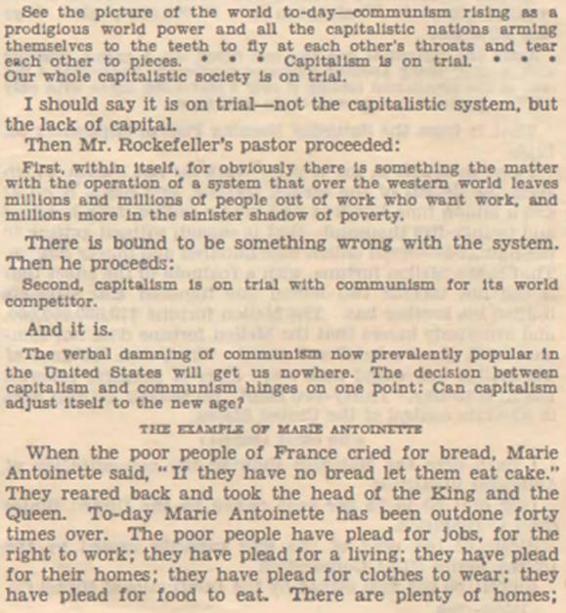
Huey Long
Page 196
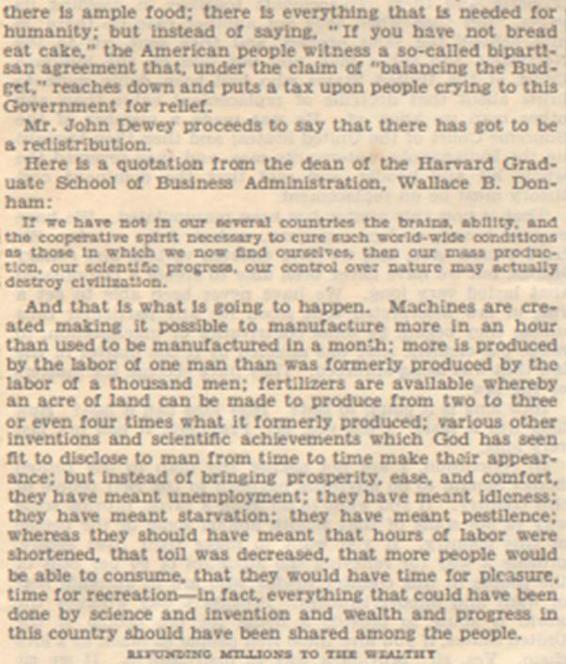
Huey Long
Page 197
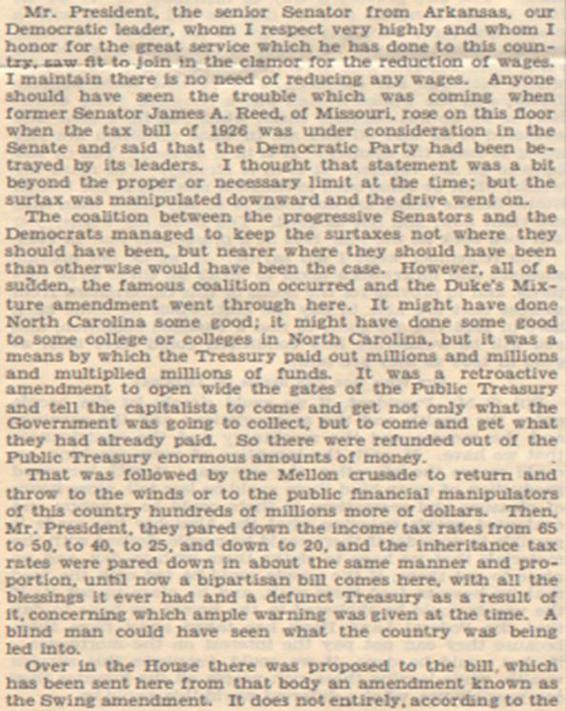
Huey Long
Page 198
Huey Long
Page 199
Huey Long
Page 200
Huey Long
Page 201
Huey Long
Page 202
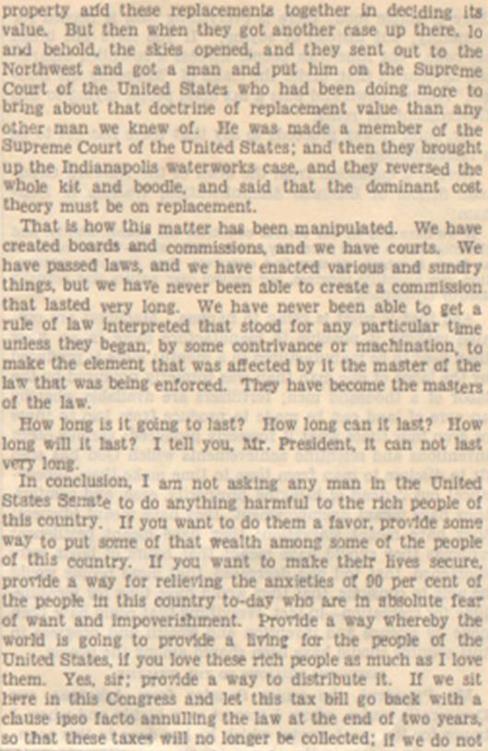
Huey Long
Page 203
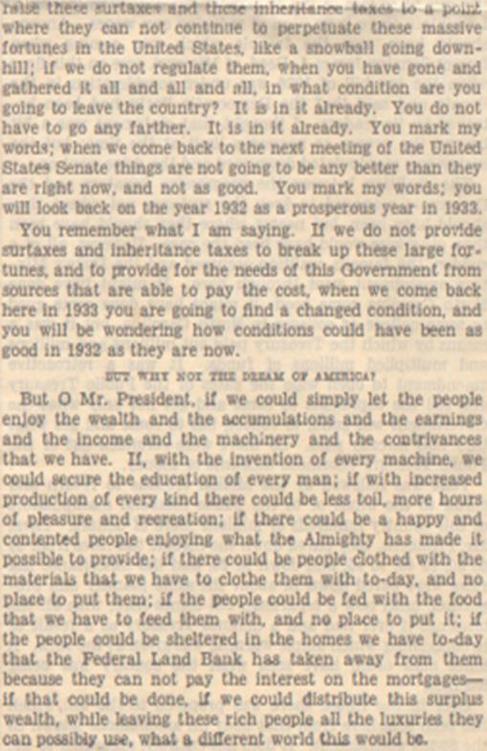
Huey Long
Page 204
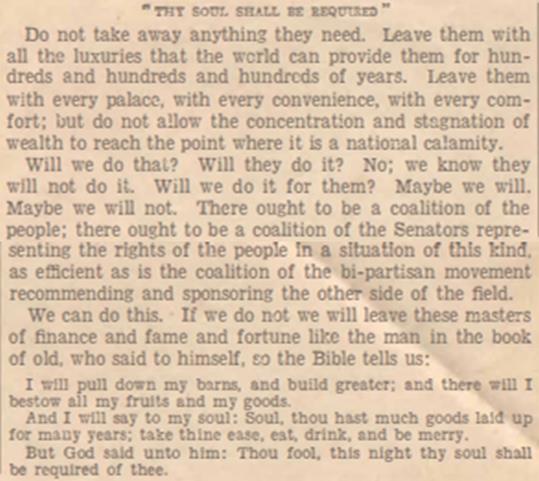
Huey Long
Page 205
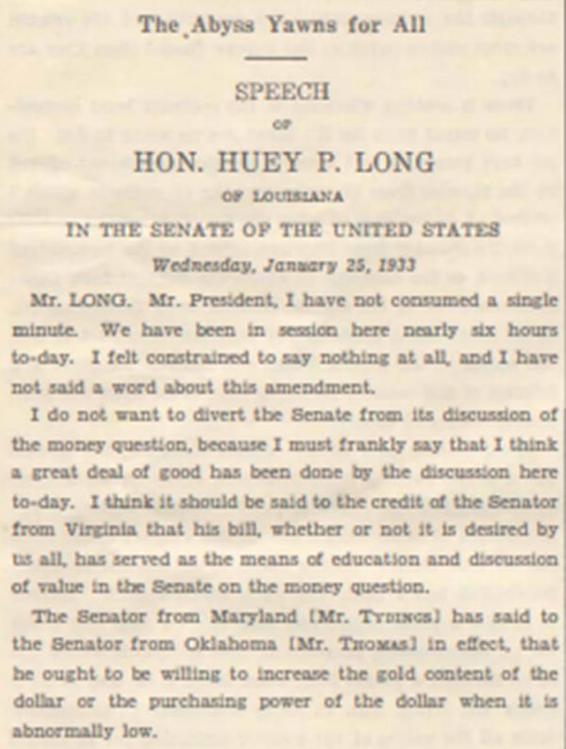
Huey Long
Page 206
The Abyss Yawns for All – Congress 1/25/33
Huey Long
Page 207
Huey Long
Page 208
Huey Long
Page 209
Huey Long
Page 210
Huey Long
Page 211
Huey Long
Page 212
Huey Long
Page 213
Huey Long
Page 214
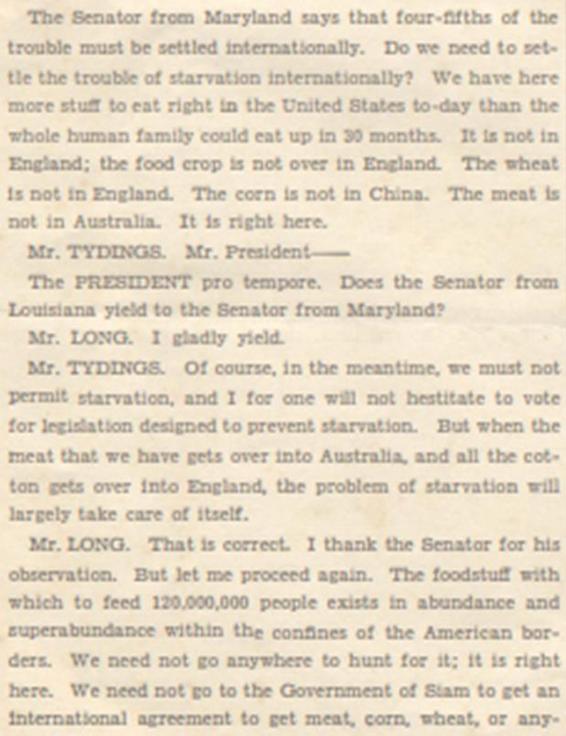
Huey Long
Page 215
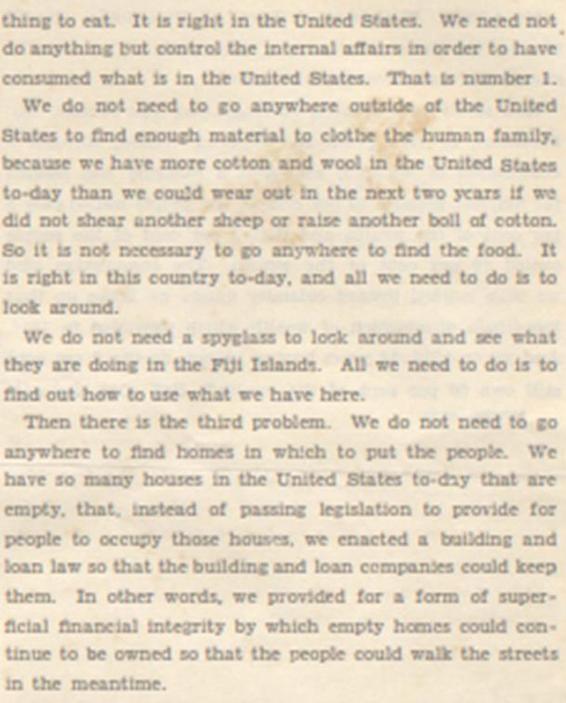
Huey Long
Page 216
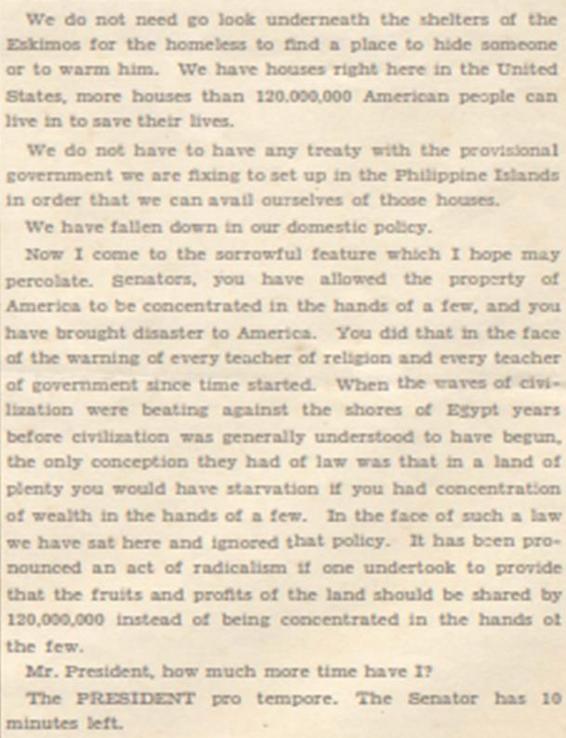
Huey Long
Page 217
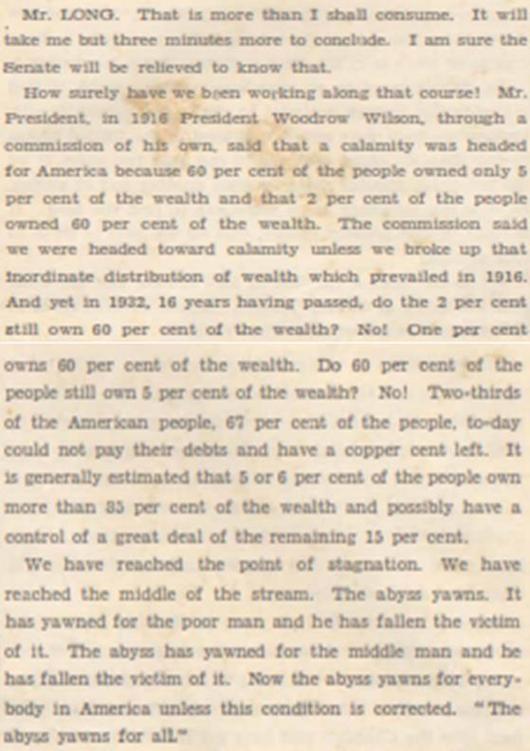
Huey Long
Page 218
Page 219
War Cry for World Democracy – Congress 3/13/33
Seventy-third Congress, First Session War Cry for World Democracy
Speech of Hon. Huey P. Long
Of Louisiana
In the Senate of the United States