

Huey Long by Edward Drobinski - HTML preview
Download the book in PDF, ePub, Kindle for a complete version.
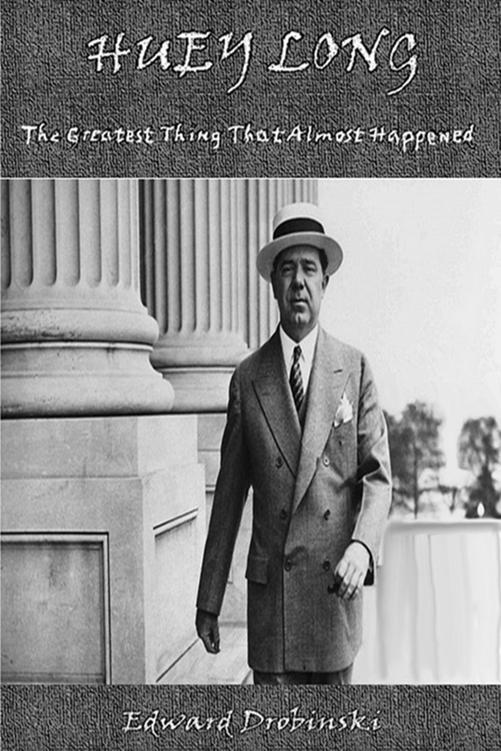
HUEY LONG
By Edward Drobinski
Copyright © 2023 by Edward Drobinski
All rights reserved
Table of Contents
1 - The Great Depression in Louisiana ......................... 1
2 – The Early Years .......................................... 25
3 – Elected Governor of Louisiana ............................ 39
4 – Huey Goes Nationwide ..................................... 60
5 – Political Views .......................................... 84
6 – Share Our Wealth – the Program ........................... 97
7 - Every Man a King – the Book ............................. 108
8 – As Popular as the Beatles and Sinatra ................... 123
9 – Hear What the People Say ................................ 133
10– A Few of Huey Long’s Speeches ........................... 150
The Share Our Wealth Speech – Radio 2/23/34 ................. 153
The Doom of America’s Dream – Congress 4/4/32 ............... 176
The Abyss Yawns for All – Congress 1/25/33 .................. 206
War Cry for World Democracy – Congress 3/13/33 .............. 219
The Last Supper – Congress 7/23/35 .......................... 232
11- Assassination ........................................... 237
12– Differing Assassination Theories ........................ 241
13- Huey’s Take on his Assassination ........................ 264
14- Quotes .................................................. 299
15- The Final Wrapup ........................................ 308
Page 1
1 - The Great Depression in Louisiana The Great Depression started earlier in Louisiana and the US
south than it did the “educated” northern cities which were riding the crest of the Woodrow Wilson Federal Reserve’s “easy money” policies. Increasing mechanization was making more and more people economically useless, and the growing disparity in wealth between plain working folks and the city slickers getting rich on that easy borrowed money put in the stock market was exploding.
In Louisiana the 1927 flood proved to be a pre-cursor, bringing the issue and the one-sided economy to the fore, but was un-noticed outside of the affected areas at the time. The Great Depression would soon become nationwide; predicted by no politician, except man-of-the-people Huey Long, who shouted it from the rooftops.
In 1927, twenty-five percent of the entire state of Louisiana was under floodwaters, and another twenty-five percent was threatened.
Huey Long
Page 2
During the Great Depression farm prices in Louisiana reached unheard of lows and deepened rural poverty.
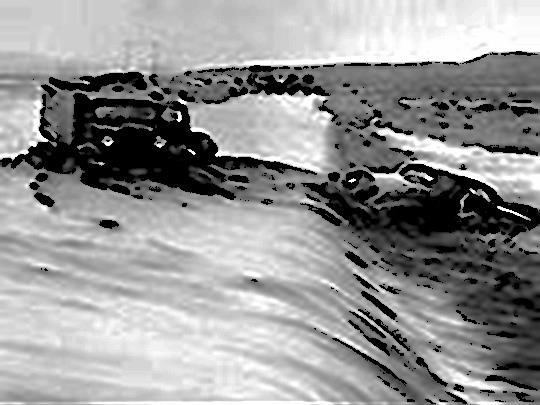
The Great Mississippi Flood of 1927 was the most destructive river flood in the history of the United States, with 27,000
square miles inundated in depths of up to 30 feet over the
Huey Long
Page 3
course of several months in early 1927. The cost of the damage has been estimated to be between $246 million and $1 billion, $4.2-$17.3 billion in 2023 dollars.
About 500 people died and over 630,000 people were directly affected. 94% of those affected lived in Arkansas, Mississippi, and Louisiana, especially in the Mississippi Delta region. 127
people died in Arkansas, making it one of the deadliest disasters ever recorded in the state. More than 200,000 people were displaced from their homes along the Lower Mississippi River and had to live for lengthy periods in relief camps. As a result of this disruption, many of them joined the great migration from the South to the industrial cities of the North and the Midwest. Even after the waters had subsided, the migrants preferred to stay where they had moved, rather than return to rural southern agricultural labor.
Page 4
To prevent future floods, the federal government built the world's longest system of levees and floodways. Then Secretary of Commerce Herbert Hoover's handling of the crisis gave him a positive nationwide reputation, helping pave to way to his election as US President in 1928. Political turmoil from the disaster at the state level aided the election of enormously popular vocal critic of the wealth disparity, Huey Long as Governor in Louisiana.
As early as the late nineteenth century, the United States was well aware of flooding potential along the Mississippi, which drained 40% of the nation's area. The Mississippi River Commission was established by the federal government in 1879, with the directive to deepen the river channel, improve navigation, prevent major flooding, and increase river based commerce. This commission recommended raising extensive levees along its channels to contain the flow, dismissing the advice of experts such as James Eads, who had directed the Saint Louis Bridge project in the 1860s. These “expert” critics predicted that compressing a swollen river between walls would increase its destructive potential. That’s kind of like saying that putting water in a glass makes it more dangerous to drink.
Nonetheless, the “experts” had a diminishing effect on the
Page 5
recommendations of the commission, and after the disaster they disappeared or became unavailable for comment.
Flooding began due to heavy rainfall in summer 1926 across the river's central basin. By September, the Mississippi's tributaries in Kansas and Iowa were swollen to capacity. On Christmas Day of 1926, the Cumberland River at Nashville, Tennessee, exceeded 56.2 feet, the second highest recorded level of all time, second only to a destructive flood in 1793 had produced the record level – 58.5 feet.
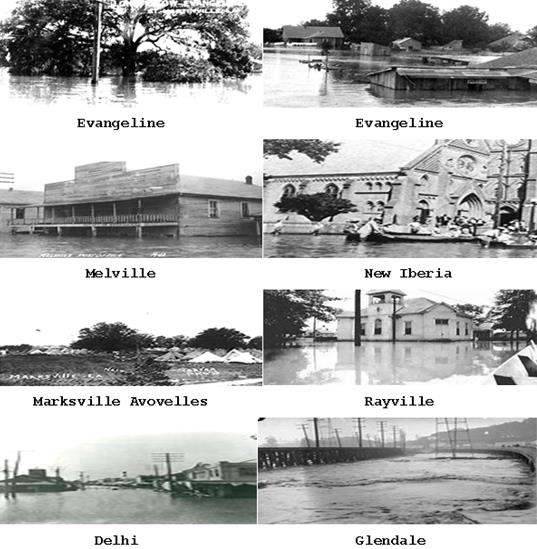
Flooding peaked in the Lower Mississippi River near Mound Landing, Mississippi, and Arkansas City, Arkansas, and broke levees along the river in at least 145 places. The water flooded more than 27,000 square miles of land, and left more than 700,000 people homeless. Approximately 500 people died as a result of flooding. Monetary damages due to flooding reached approximately $1 billion, which was one-third of the federal budget in 1927. If the event were to have occurred in 2007, the damages would total around $930 billion to $1 trillion, measured in 2007 US dollars.
Huey Long
Page 6
Page 7
The flood eventually affected Missouri, Illinois, Kansas, Tennessee, Kentucky, Arkansas, Louisiana, Mississippi, Oklahoma, and Texas. Arkansas was hard hit, but less so than Louisiana, with 14% of its territory covered by floodwaters extending from the Mississippi and Arkansas deltas. By May 1927, the Mississippi River below Memphis, Tennessee, reached a width of 80 miles. Without trees, grasses, deep roots, and wetlands, the denuded soil of the watershed could not do its ancient work of absorbing floodwater after seasons of intense snow and rain.
In an unrelated flood a few years later, on Good Friday, April 15, 1934, 15 inches of rain fell in New Orleans in 18 hours.
This far exceeded the abilities of the city's rainwater pumping system, and up to 4 feet of water flooded some parts of the city. This local rain related flood was not connected to the Mississippi River flooding.
Being the hub of Louisiana business and politics at the time, a group of influential bankers in New Orleans met to discuss how to guarantee the safety of the city, as they had already learned of the massive scale of flooding upriver. On April 29 they arranged to set off about 30 tons of dynamite on the levee at Caernarvon, Louisiana, releasing 250,000 cubic feet of water.
This was intended to prevent New Orleans from suffering serious damage, and it resulted in flooding much of the less densely
Page 8
populated St. Bernard Parish and all of Plaquemines Parish's east bank. As it turned out, the destruction of the Caernarvon levee was unnecessary, as several major levee breaks well upstream of New Orleans, including one the day after the demolitions, released major amounts of flood waters, reducing the water that reached the city. The New Orleans businessmen did not compensate the losses to and of people in the downriver parishes.
In what they must have thought would be viewed as a legitimate address to the disaster, the US Congress passed the Mississippi Flood Control Act, which put greater stress on construction in the Mississippi Delta levee camps despite warnings about harsh living conditions and mistreatment within the camps.
Huey Long
Page 9
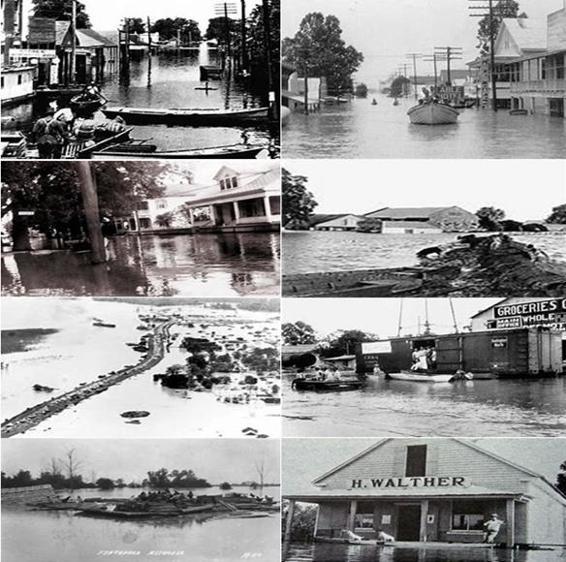
By August 1927, the flood subsided. Hundreds of thousands of people had been made homeless and displaced; properties, livestock, and crops were destroyed. In terms of population affected, in territory flooded, in property loss and crop destruction, the flood's figures were "staggering." Great loss
Page 10
of life was averted by relief efforts, largely by the American Red Cross through the efforts of local workers.
Historians estimate that of the 637,000 people forced to relocate by the flooding, 94% lived in three states: Arkansas, Mississippi and Louisiana. In one location, over 13,000 evacuees near Greenville, Mississippi, were gathered from area farms, and evacuated to the crest of the unbroken Greenville Levee. But many were stranded there for days without food or clean water.
Following the Great Flood of 1927, multiple states needed money to rebuild their roads and bridges. Louisiana received $1,067,336 from the federal government for rebuilding, but it also had to institute a state gasoline tax to create a $30,000,000 fund to pay for new hard surfaced highways.
The US Army Corps of Engineers was charged with taming the Mississippi River. Under the Flood Control Act of 1928, the world's longest system of levees was built. Floodways that diverted excessive flow from the Mississippi River were constructed. While the levees prevented some flooding, scientists have found that they changed the flow of the Mississippi River, with the unintended consequence of increasing flooding in succeeding decades. Channeling of waters has reduced the absorption of seasonal rains by the floodplains, increasing
Page 11
the speed of the current and preventing the deposit of new soils along the way. The levees did not prevent recurrences of significant flooding, especially a major flood in 1937. To better study and plan for future situations, Lt. Eugene Raybold proposed laying out a physical hydraulic model to simulate the basin's response to various rainfall scenarios. Land was procured at the southeast edge of Clinton, Mississippi, and a 200 acre hydraulic model was constructed, matching to the river's flow from Baton Rouge to Omaha, modeling the confluence points of its major tributaries across 16 states. The work was completed during 1942, with some labor provided by POWs from Camp Clinton. The Corps used this model to accurately study river flows and mitigation strategies, but by 1970 it fell out of use. In the 1970s it was transferred to the city government of Jackson, and the Buddy Butts Park was created around it. It is presently little known, recognized, or used by the heavily black area, despite its proven accuracy.
Herbert Hoover enhanced his reputation by his achievements in directing flood relief operations as Secretary of Commerce under President Calvin Coolidge. The next year Hoover easily won the Republican 1928 nomination for President, and the general election that year. In upstate Louisiana, anger among yeomen farmers directed at the New Orleans elite for its damage of
Page 12
downriver parishes aided Huey Long's election to the governorship in 1928. Hoover was much lauded initially for his masterful handling of the refugee camps known as "tent cities."
These densely populated camps required basic necessities which were difficult to attain, such as water and sanitation facilities. Hoover used a combination of bureaucratic resources and grassroots forces to give the tent cities the opportunity to become self-sufficient. This method presented difficulties, as rural leaders were unprepared to manage the chaotic circumstances found in large camps. This led Hoover eventually to place the relief camps under federal government supervision.
Several reports on the terrible situation in the refugee camps were kept out of the media at Hoover's request, with the pledge of further reforms after the presidential election in 1928. His failure to deliver followed other disappointments by the Republican Party.
During the 1920s Europe and much of the rest of the world suffered economic troubles following World War I. Yet during this time the United States seemed immune to the chaos of the outside world thanks to the growth of new technologies and the rapid rise of consumerism. By the end of the decade, though, the American economy was in deep trouble. Protectionist trade policies and unchecked speculation, i.e. high risk, potential
Page 13
high reward investment made on borrowed funds, the declining value of wages, and overproduction in agriculture and industry combined to bring the Great Depression to the United States.
Capitalism, the great producer of wealth has an illogical, stained, soft underbelly which first came to notice during the Great Depression. While businesses seek to maximize profits, one common method of doing that is to pay proportionately less wages. The collectively lessened purchasing power of the workers, which concurrently lines the pockets of the monopoly owners, causes the workers to buy less products of the business monopolies, eradicating the owner’s profits. That’s it in a nutshell; simple, though acknowledged by none, excepting Huey Long. Long was not anti-business, not by a long shot. However, he recognized that their well-being was tied to the well-being of the worker-consumer. To this day, hearing the political nonsense attendant to the “learned” discussions of capitalism versus communism, one would think that Huey said it simply in ancient Sumerian; now a defunct language. In fact he said it in Louisianan, a language the “credentialed” have not yet found on their Rosetta Stones.
These structural problems surfaced throughout the 1920s. Most notably, real estate busts in California and Florida during the mid-1920s were devastating. For most people, though, these
Page 14
problems seemed to have hit all at once with the stock market crash in October 1929. By the end of the month, the stock market had lost an estimated 40 percent of its total prior value. The economy started to pick up in early 1930, giving President Herbert Hoover and the investing class a brief sense of hope before the market quickly resumed its disastrous slide, reaching a low in the summer of 1932, just before the presidential election that fall.
The stock market collapse on Wall Street highlighted the country's slow economic breakdown, and the effects of the depression soon became visible in the wider economy. More than thirteen hundred banks failed in 1930 alone. More than twenty-six thousand businesses failed in 1930, followed by even more in 1931 and 1932. Foreign trade fell by 70 percent, while private investment in manufacturing dropped by 80 percent. In 1933 the US gross national product; the total value of goods and services produced at the time, was down more than half from its 1929
peak, and industrial output had fallen to 1913 levels. In short, within three years, all the gains of the World War I years and the 1920s were completely erased.
Despite not having much participation in the boom years, Louisiana was greatly affected by the struggling economy, especially as farm prices declined to unheard of lows. Louisiana
Page 15
was a mostly agricultural state. Cotton, for example, dropped to less than five cents a pound, sugar to less than four. The value of the state's other leading products; timber, oil, and rice, experienced a similar decline. Many rural people already lived in deep poverty. The devastating 1927 Mississippi River flood and the drought of 1930-31 had displaced thousands of farm laborers and their families across the state. The sinking price for farm products put them in an even more unstable place where even basic subsistence, like the ability to feed and shelter themselves was in doubt.
Lucille Watson, a relief fieldworker in Tensas Parish, described a situation typical in 1933. One sharecropper family she interviewed lived in a cabin where the walls were "one big crack" that had been pasted over with old catalogue pages and newspaper to keep the "wind and the rain from blowing into the house as much." She also found another migrant family with a mother who was "depressed and miserable over their present condition" and children who "looked more or less sick and puny."
Watson also came across families with only a few bushels of sweet potatoes to last the winter season. Hard times were common in the state's rural areas. Even wealthier planters and large landowners faced difficult times as farm income declined by two-thirds between 1929 and 1932. Many couldn't pay their taxes or
Page 16
keep up with their mortgages, and eventually lost everything to a sheriff's sale or to foreclosure.
Yet agricultural problems weren't the only cause of suffering in Louisiana during the depression. The oil and gas industry experienced a slowdown in production that led to cutbacks and layoffs. Still, the oil business acted as a stabilizing force for the state's economy throughout the 1930s, especially after some semblance of a recovery had begun by 1934-35. Baton Rouge, home of the Standard Oil refinery and associated plants, continued to expand during the decade. Shreveport and Monroe grew as well, as both were located amid vast oil and gas fields.
New Orleans, however, experienced some of the most severe effects of the depression in the state, similar to other large cities in the country. As the largest city in the South in 1930, and one of the country's biggest ports, New Orleans faced the depression almost immediately. The decline in foreign trade emptied New Orleans's warehouses and docks, leaving dockworkers jobless. By early 1930 one census counted at least ten thousand unemployed workers in the city with approximately 100,000
workers. To meet the need for public relief, the city formed a welfare committee in early 1931 and raised more than half a million dollars from private donations. This money ran out in 1932, and city leaders proposed a $750,000 loan. However this
Page 17
wasn't enough money to deal with the number of unemployed workers and their families.
Huey Long
Page 18
Page 19
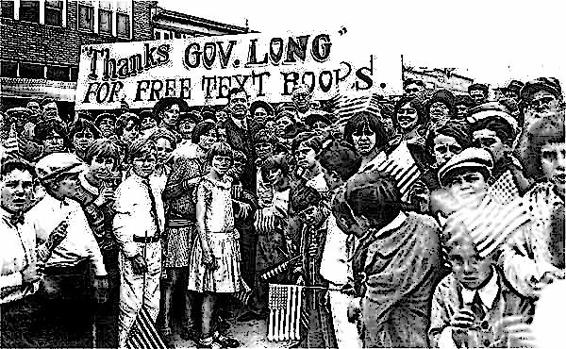
Still, Louisiana appears to have suffered less than other parts of the country. Governor, and later US Senator, Huey Long had made a commitment to infrastructure development when he took office in 1928. His willingness to spend millions of dollars on massive construction projects lessened the impact of the national economic crisis. These projects were similar to the objectives of the Roosevelt, federal New Deal programs developed a few years later. Without the help of economic advisors or political scientists, Long instinctively pressed for increased spending in all areas of state government to promote economic growth. He built roads, bridges, and public facilities quickly and improved public education through the distribution of free textbooks, teacher pay raises, and adult literacy programs. Long spent more between 1928 and 1932 than the previous three state administrations combined.
Huey Long
Page 20
Strangely Huey Long never endorsed direct government aid to unemployed workers or their families, such as small cash payments or even distribution of surplus food and clothes. His early construction program poured money into public works projects that provided employment opportunities for many laborers around the state. Local sources of public charity also provided much of the support for people facing hardship. In fact, churches, social clubs, benevolent societies, and other private sources funded 98 percent of all welfare expenditures in the state that year. And by the time these sources began to run out, even Herbert Hoover's Republican administration had seen the need for a national relief program.
Page 21
Beginning with Hoover's federal loans to states in the summer of 1932, relief became more regular. As a result of these funds, Governor O. K. Allen's administration paid out $6.5 million between October 1932 and May 1933. Once Franklin D. Roosevelt took office as President in March 1933, this system was reorganized under the control of the Federal Emergency Relief Agency. Although federal dollars were often mishandled at the local level, they still had a big impact on relief. Later, after Long's death in 1935, an even greater amount of money poured into Louisiana for projects that eventually employed thousands of blue and white collar workers.
As a result of the federal relief and recovery programs known as the New Deal, the desperation of the early years of the depression eased slightly. Although poverty and underemployment continued to affect many of the state's working class families until World War II, the problems of the early 1930s had improved, thanks to the example and push of Huey Long. In fact, many Louisianans remember the second half of the decade as a golden era, a time of common purpose and feverish activity that saw major architectural projects undertaken and an explosion of artistic activity. The restoration of the French Market in New Orleans and the building of the Louisiana State Exhibit Museum in Shreveport occurred during this time. State colleges
Page 22
especially enjoyed well-funded building programs. Louisiana State University's Tiger Stadium is only the most well-known of the many New Deal buildings constructed on campuses around Louisiana in the 1930s. New parish courthouses, hospitals, and even airports were all built in this era. A Louisiana and New Orleans guidebook was also produced under Lyle Saxon's direction, and murals celebrating Louisiana life and history were created. However, the deep anxiety and fear that filled Louisiana newspapers and personal letters during the depression remind us that this was indeed one of America's most difficult times.
Huey Long
Page 23
Huey Long
Page 24
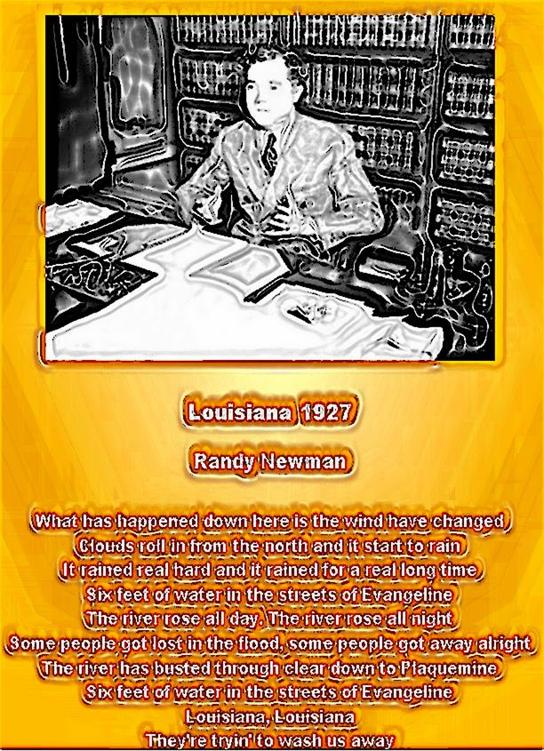
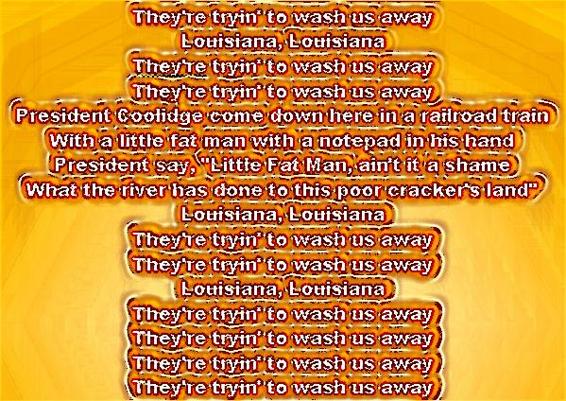
Huey Long and “Louisiana 1927” by Randy Newman; property of the author, the latter under both the
“fair use” and “transformative” doctrines.
Page 25
2 – The Early Years
First let it be known that the people of Louisiana love Huey so much that ever since him, every White resident of the state will forever vote for anyone with the name Long. None of his political enemies/critics can make anything near as grand a claim. Throughout Roosevelt’s Presidency, Louisiana school children believed that Huey was alive and living in the White House. Their benevolent God did not die. If he had, nothing good would have happened.
From an early age, it was evident that Huey Long was a true original. A bright, inquisitive, and feisty child, he would grow to become the most famous and audacious public figure ever produced by the state of Louisiana; perhaps anywhere.
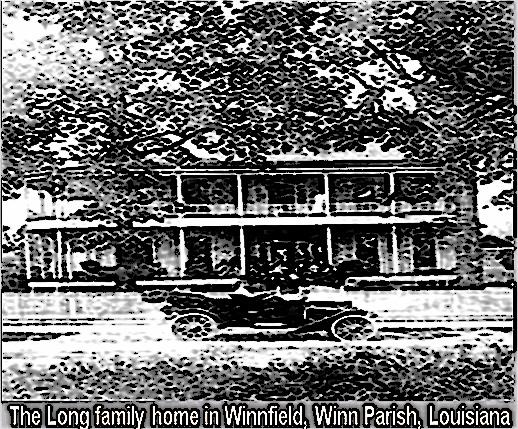
Huey Pierce Long, Jr. was born on August 30, 1893, in Winnfield, a small rural community in the piney woods of north central Louisiana. He was the seventh of nine surviving children born to Caledonia Tison Long and Huey Pierce Long, Sr., a livestock farmer.
At age 8, Huey was deeply affected when he witnessed a neighbor lose his farm at a sheriff’s auction, a sale organized to pay the debt a farmer owed to a store.
Page 26
Standing on the steps of the courthouse before the sale, the farmer begged the crowd not to bid on his home, promising to pay the store if given enough time to harvest another crop. No one in the crowd offered a bid.
Just as the sheriff was ready to declare “no sale,” the creditor made a bid and won the farm, rendering the farmer and his family homeless.
“The poor farmer was out,” Huey remembered. “I was horrified. I could not understand. It seemed criminal.”
The Longs were fairly well off by the standards of Winn Parish, one of the poorest parishes in a very poor state. Most frontier families lived in abject poverty, surviving on what they cultivated, with little opportunity for leisure, education, or cultural growth. Neighbors relied on one another for survival.
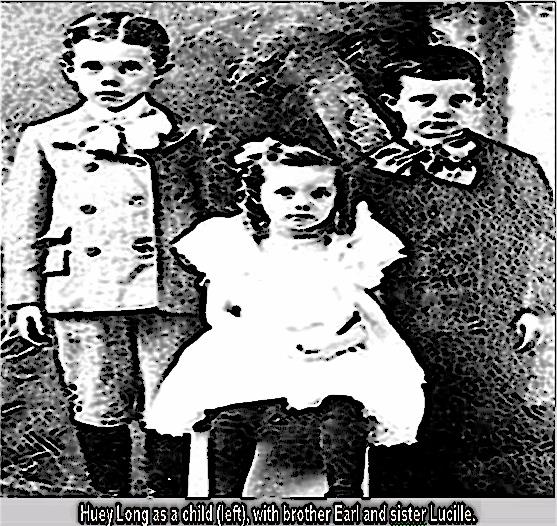
Little Huey was forever resisting the boundaries established to restrain him. He learned to walk at eight months and was soon discovered playing among the livestock, much to the frustration of his parents and siblings, who were always chasing after him.
His father built a cover for their water well out of fear that Huey would jump in.
Huey Long
Page 27
Small for his age, Huey was not like the other boys in his community, who amused themselves with outdoor activities like hunting and fishing. He disliked farm work and loved to read books, which were scarce in his community. He was intensely curious and determined to understand how things worked. When a train rolled into Winnfield, it was common for little Huey to crawl underneath it to get a closer look, delaying its departure until somebody pulled him out.
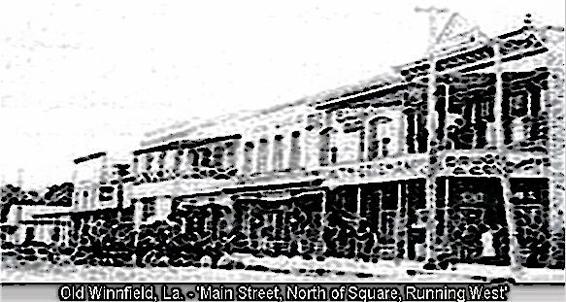
Huey Long
Page 28
When it came to work, he preferred anything to the monotony of farm work. His jobs were many and varied, from delivering baked goods to setting newspaper type, but sales work was his favorite.
Winnfield was a stronghold of populism, a political philosophy first popularized in the US of the nineteenth century, which championed the needs of the common man over the interests of corporations and the wealthy elite. Huey grew up listening to the old timers complain about the corrupt and indifferent political establishment that ran the state and how things should be different. As a youngster, Huey had no inhibitions about chiming in and offering his own opinions.
Page 29
Remembered as “a pesterance” by one observer, Huey freely interrupted checkers games to tell grown men how to play their next move. His parents rarely scolded him for his audacity and encouraged individual expression and competition among their children.
Huey’s parents were better educated than most, and they stressed the importance of education to all of their children.
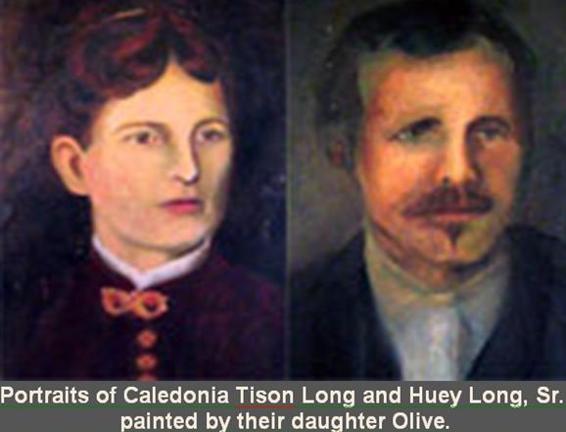
Huey’s mother Caledonia (Callie) was universally remembered as a remarkably tolerant and compassionate woman, often sending her children to the homes of less fortunate neighbors with gifts of food and clothing. Caledonia Long imbued her children with a strong sense of righteousness and fairness. In addition to her values, Caledonia appears to have passed her brilliant intellect and photographic memory to Huey. The Longs were a deeply religious family, with Bible study a daily event as an integral part of their home life. Sunday school, church, and Wednesday night prayer meetings were mandatory, and they never missed a gospel revival.
Described by her children as a “rock ribbed Baptist,” Caledonia Long insisted that all of her children know the Bible backwards and forwards. She devised a game that she played with the children after supper, where each child was called upon to read
Huey Long
Page 30
a page from the Bible aloud and then recite it from memory.
Gifted with a photographic memory, Caledonia was usually the winner.
“Young Huey would jump in a well just to see what it was like.”
— attributed to Huey’s father, Huey Long, Sr.
A Remarkable Family
Huey Long
Page 31
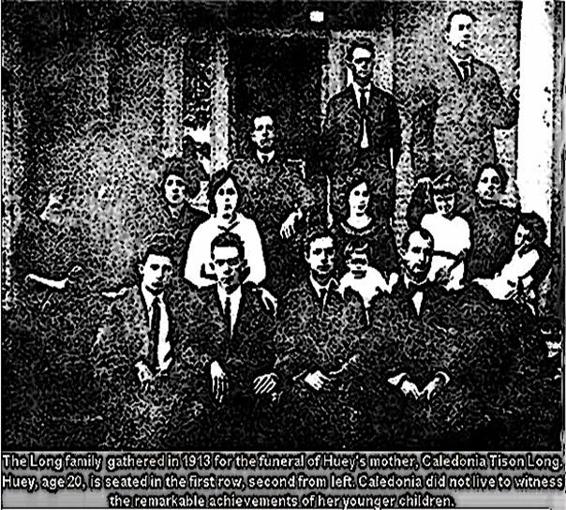
Huey's parents, “Hu” and Caledonia Long, were determined to teach their children enough “to be somebody.” Of their four sons and five daughters, two became Louisiana governors, one also a US Senator, one a US congressman, one a district attorney, and five school teachers, including a university professor.
Huey’ great grandfather, James Long, was an itinerant Methodist minister from Baltimore, Maryland. In 1841, a preaching assignment took him to Mississippi. His son, Huey’s grandfather, John Murphy Long, was an early settler of Winn Parish,
Page 32
Louisiana. For 25 cents an acre, John Long homesteaded 640 acres of woods and carved out a farm for his large family of 14
children. Later, his son Huey Sr. purchased 320 acres near the new parish seat of Winnfield as a home for his young family.
Later known as “Old Hu,” Huey, Sr., prospered as a livestock farmer and a self-styled entrepreneur. He raised cattle and hogs for market and always had an eye for income opportunities, such as contracting to deliver mail and selling off home lots as the town grew.
At 13, Huey was baptized in a fish pond and became a member of the First Baptist Church. He was so moved by the experience that he briefly considered becoming a preacher and donated three weeks pay, nine dollars, to the church from his job driving a bakery wagon. Thereafter, he tithed 10 percent.
Huey Long was born to farmers in the poorest part of Louisiana where illiteracy and poverty were rampant, though not personally, perhaps producing a sense of noblesse oblige.
Despite the humble circumstances surrounding him, he educated himself and became a successful lawyer. Long never forgot where he came from and when he entered politics he aspired to eliminate Louisiana’s despair.
Page 33
His hometown of Winnfield was in one of the poorest parishes in the state, but the Longs, farmers with livestock, were relatively well off. Long was known for his avid reading, photographic memory and an audacious personality with no inhibitions about offering his opinion.
During high school, Long won a scholarship to Louisiana State University in a debate competition. Long claimed that he became a traveling salesman instead when he realized he couldn’t afford the required books, but it’s believed he didn’t attend because he never graduated high school.
His older brother George paid for Huey’s attendance at Oklahoma Baptist University to become a preacher, but Long never registered. George then gave his brother money to switch to the University of Oklahoma Law School, but Huey lost that gambling.
After hustling for a job, Long attended for a semester, but by his own admission, learned more about gambling than the law. He left to become a traveling salesman again.
According to unearthed “official” records, at the end of 1912, Long was arrested in Shreveport for creating a disturbance in a brothel. Long later claimed he was falsely arrested for the shooting of two men.
Huey Long
Page 34
He was in Shreveport to propose to Rose McConnell. Long had met Rose in 1910 at a baking contest he had organized to promote a shortening called Cottolene while he was still in sales. Serving as the judge, he gave the top two prizes to Rose and her mother.
They were married in April 1913.
His mother, Caledonia Palestine Long (Tison), born October 18, 1860 in Winnfield, died that same year of 1913 on October 26 at the age of 52.
Page 35
In 1914 Long received special permission to take the Louisiana bar exam, passing it without the formal school training at the age of 21.
By 1915, Long had established a private legal practice in Winnfield. He represented poor plaintiffs, usually in workers'
compensation cases. Long avoided fighting in World War I by obtaining a draft deferment on the grounds that he was married and had a dependent child. He successfully defended from prosecution under the Espionage Act of 1917 the state senator who had loaned him the money to complete his legal studies, and later claimed he did not serve because, "I was not mad at anybody over there." In 1918, Long invested $1,050, equivalent to $18,066 in 2020, in a well that struck oil. The Standard Oil Company refused to accept any of the oil in its pipelines, costing Long his entire investment. This episode probably served as the catalyst for Long's lifelong hatred of Standard Oil. It certainly alerted him to the unfair methodologies with which the monopoly did business.
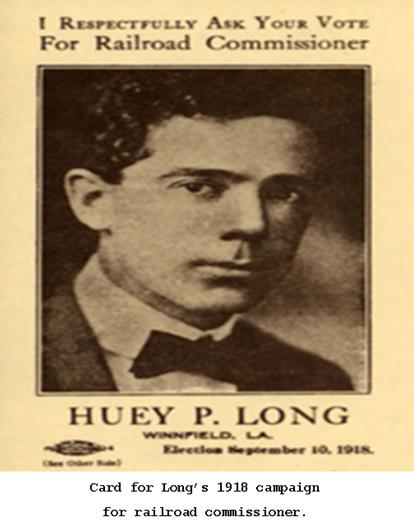
That same year, Long entered the race to serve on the three seat Louisiana Railroad Commission. According to historian William Ivy Hair, Long's political message “... would be repeated until the end of his days. He was a young warrior of and for the plain people, battling the evil giants of Wall Street and their
Page 36
corporations. Too much of America's wealth was concentrated in too few hands, and this unfairness was perpetuated by an educational system so stacked against the poor that, according to his statistics, only fourteen out of every thousand children obtained a college education. The way to begin rectifying these wrongs was to turn out of office the corrupt local flunkies of big business ... and elect instead true men of the people, such as himself.”
In the Democratic primary, Long polled second behind incumbent Burk Bridges. Since no candidate garnered a majority of the votes, a run-off election was held, for which Long campaigned tirelessly across northern Louisiana. The race was close. Long defeated Burk by just 636 votes. Although the returns revealed wide support for Long in rural areas, he performed poorly in urban areas.
After Long won the seat on the Louisiana Railroad Commission, he used his position to fight monopolies and utility rates, winning favor with working people.
On the Commission, Long forced utilities to lower rates, ordered railroads to extend service to small towns, and demanded that Standard Oil cease the importation of Mexican crude oil and use more oil from Louisiana wells.
Huey Long
Page 37
In the gubernatorial election of 1920, Long campaigned heavily for John M. Parker. Today, he is often credited with helping Parker win northern parishes. After Parker was elected, the two became bitter rivals. Their break was largely caused by Long's demand and Parker's refusal to declare the state's oil pipelines public utilities. Long was infuriated when Parker allowed oil companies, led by Standard Oil's legal team, to assist in writing severance tax laws. Long denounced Parker as corporate
Page 38
"chattel." The feud climaxed in 1921, when Parker tried unsuccessfully to have Long ousted from the commission.
By 1922, Long had become Chairman of the commission, now called the "Public Service Commission." That year, Long prosecuted the Cumberland Telephone and Telegraph Company for unfair rate increases; and he successfully argued the case on appeal before the United States Supreme Court, which resulted in cash refunds to thousands of overcharged customers. After the decision, Chief Justice and former President William Howard Taft praised Long as
"the most brilliant lawyer who ever practiced" before the court.
Long rankled the moneyed conservative establishment and confrontations with them sometimes erupted into violence.
Huey Long
Page 39
3 – Elected Governor of Louisiana
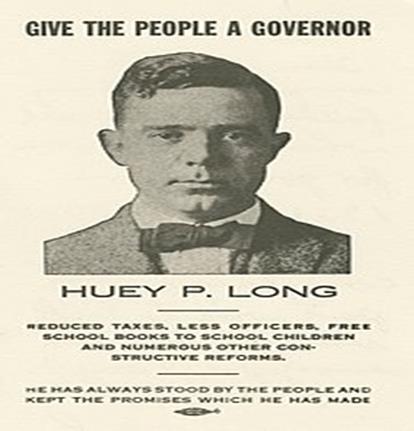
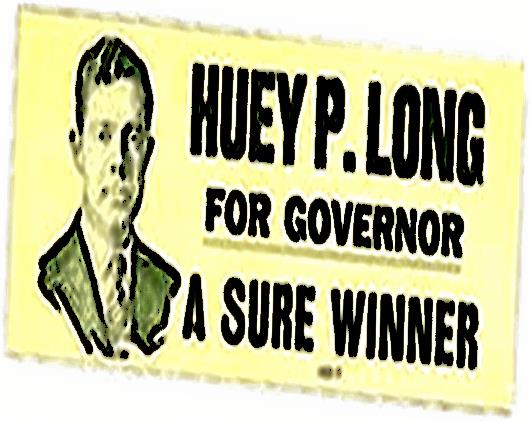
Card distributed for Long's 1924 gubernatorial campaign On August 30, 1923, at the age of 30, Long announced his candidacy as a Democrat for the governorship of Louisiana. Long campaigned throughout the state, personally distributing circulars and posters. He denounced Governor Parker as a corporate stooge, vilified Standard Oil as controlling the corrupt New Orleans political machine, and assailed local political bosses. Although true, his statements did not endear him to Louisiana’s Democrat political machine. Long lost by 7,000 votes, placing third, which he blamed on torrential downpours preventing rural voters from getting to the polls.
Page 40
Some confusion exists as to Long’s politics being anti-corporate, while his personal finances supposedly told a different story, with multiple lucrative investments in independent oil companies. His battles against Standard Oil were often on behalf of companies that he benefited from financially.
The “confusion” seems a purposeful misunderstanding promoted by his enemies as Huey was not anti-corporate at all; just anti-monopoly. In addition, the gains from his small personal investments were not used for self-aggrandizement, but rather to bankroll the poor worker’s political message of “Share Our Wealth,” which was already taking form.
He had tirelessly campaigned in rural areas disenfranchised by the state's political establishment, the "Old Regulars." Since the 1877 end of Republican controlled Reconstruction government, the Democrats had controlled most of the state through hush-hush alliances with local officials. With negligible support for Republicans, Louisiana was essentially a one party state under the Democratic Old Regulars. Holding mock elections in which they invoked the lost cause of the Confederacy, the Old Regulars presided over a corrupt government that largely benefited the planter class. Consequently, Louisiana was one of the least developed states. It had just 300 miles of paved roads and the lowest literacy rate in the nation.
Page 41
Despite an enthusiastic campaign, Long came third in the primary and was eliminated. Although polls projected only a few thousand votes, he attracted almost 72,000, around 31% of the electorate, and carried 28 parishes; more than either opponent. Limited to sectional appeal, he performed best in the poor rural north.
The Ku Klux Klan's prominence in Louisiana was the campaign's primary issue. While the two other candidates either strongly opposed or supported the Klan, Long remained neutral, alienating both sides. He also failed to attract Catholic voters, which limited his chances in the south of the state. In majority Catholic New Orleans, he polled just 12,000 votes, 17%. Long blamed heavy rain on election day for suppressing voter turnout among his base in the north, where voters could not reach the polls over dirt roads that had turned to mud. It would turn out to be the only election Long ever lost.
1928 Louisiana gubernatorial election Long spent the intervening four years building his reputation and political organization, particularly in the heavily Catholic urban south. Despite disagreeing with their politics, Long campaigned for Catholic US Senators in 1924 and 1926. Government mismanagement during the Great Mississippi Flood of 1927 gained Long the support of Cajuns, whose land had been affected. He
Page 42
formally launched his second campaign for governor in 1927, using the slogan, "Every man a king, but no one wears a crown,"
which he supplemented and expanded upon.
“And it is here, under this oak, where Evangeline waited in vain for her lover, Gabriel, who never came. This oak is an immortal spot, made so by Longfellow's poem, but Evangeline is not the only one who has waited here in disappointment. Where are the schools that you have waited for your children to have, that have never come? Where are the roads and the highways that you sent your money to build, that are no nearer now than ever before? Where are the institutions to care for the sick and disabled? Evangeline wept bitter tears in her disappointment, but it lasted only through one lifetime. Your tears in this country, around this oak, have lasted for generations. Give me the chance to dry the eyes of those who still weep here.”
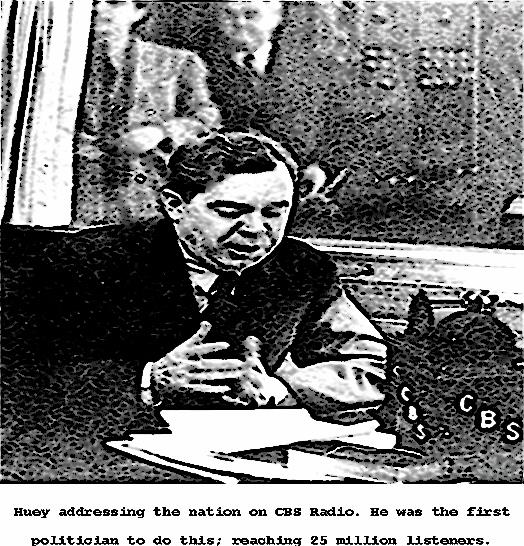
— An example of Long's 1928 campaign’s imaginative oratory Long developed campaign techniques novel in the time, including the use of sound trucks and radio commercials.
Huey Long
Page 43
His stance on race was also unorthodox at the time. According to academic and author, T. Harry Williams, Long was "the first Southern mass leader to leave aside race baiting and appeals to the Southern tradition and the Southern past and address himself to the social and economic problems of the present."
The campaign sometimes descended into brutality. When the 60
year old incumbent governor called Long a liar during a chance
Huey Long
Page 44
encounter in the lobby of the Roosevelt Hotel, Long punched him in the face.
Huey’s revolutionary campaign and victory toppled the corrupt political establishment that had ruled since the French.
Louisiana and its politics would never be the same.
Louisiana was run by the New Orleans based political establishment, called the “Old Regulars,” who exercised total control of state government through the legislature and a
Page 45
network of local sheriffs and “courthouse rings.” These “machine politicians” enjoyed a mutually beneficial relationship with the wealthy planter class and large corporations and utilities, who were given free reign to profit off the state in return for their support.
Life was hard in 1920s Louisiana, with little hope of advancement for a poor majority isolated by geography. In a state covering nearly 52,000 square miles, of which 16 percent is dominated by waterways, there existed only 300 miles of paved roads and three major bridges.
Sixty percent of the state’s two million citizens lived in rural conditions with only the bare necessities. Education was a luxury few could afford. Most White farmers had not completed the fourth grade, and nearly 240,000, roughly 25% of adults could not read at all.
Louisiana was widely regarded as the most backward state in the nation. Public education was virtually non-existent among the masses. Most families could not afford to purchase the textbooks required for their children to attend school. Dirt roads and abundant water hazards made travel and commerce difficult. The poll tax hindered the lower classes from voting, and the poor
Page 46
paid disproportionately high property taxes for state services they never received.
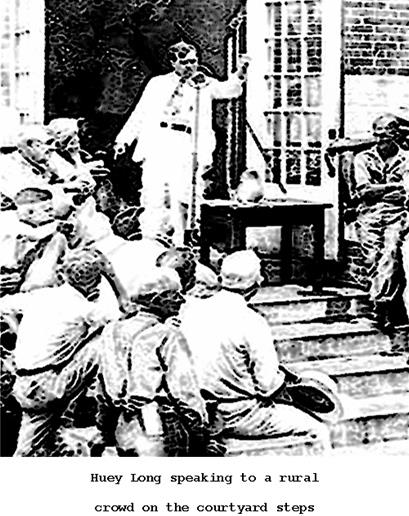
A brilliant orator, Long made hundreds of campaign speeches among rural voters, expressing a vision for a new Louisiana in which government would be responsive to the needs of its people.
Indeed, it would be God’s way, not Standard Oil’s. He promised Louisiana’s needy citizens good roads, bridges, free hospital care, free education, and lower property taxes.
Rural audiences loved Huey’s sense of humor and the memorable nicknames he invented to poke fun at his opponents which stuck.
Favorites included “Turkey Head” Walmsley, “Whistle Britches”
Rightor, “Shinola” Phelps, and “Feather Duster” Ransdell.
Long won the election by the largest margin in the state’s history, and his closest opponent refused to face him in a run-off. His support transcended the traditional Protestant-Catholic divide of Louisiana politics and replaced it with a new division between the “pro-Long” average citizens and the “anti-Longs”
from the wealthy establishment that were to be ousted from power. At Huey’s inauguration, more than 15,000 supporters flocked to the capital to see one of their own take the oath as governor.
Revolutionary Campaign Methods
Huey Long
Page 47
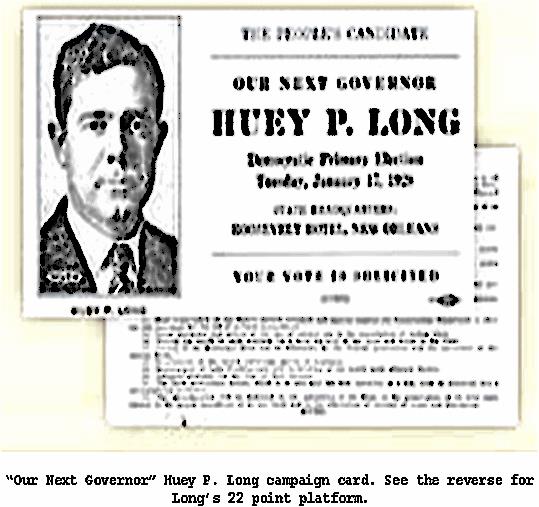
Huey’s revolutionary campaign methods transformed Louisiana politics. In his 1928 campaign for governor, he covered 15,000
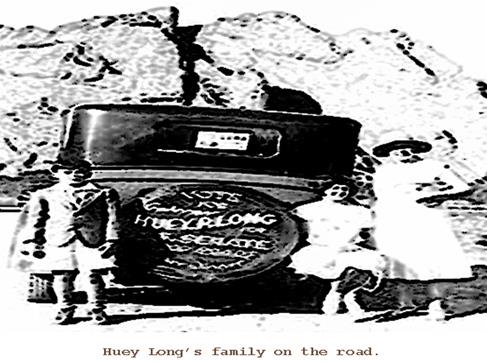
miles on Louisiana's dirt roads and made 600 speeches. Poor voters felt privileged that a candidate would take the trouble to court them. At his own expense, he printed and distributed thousands of circulars; flyers that laid out in detail his reform agenda. Huey frequently resorted to standing on the top of his car to personally nail campaign posters high on telephone polls, where they could not be easily torn down by his opponents.
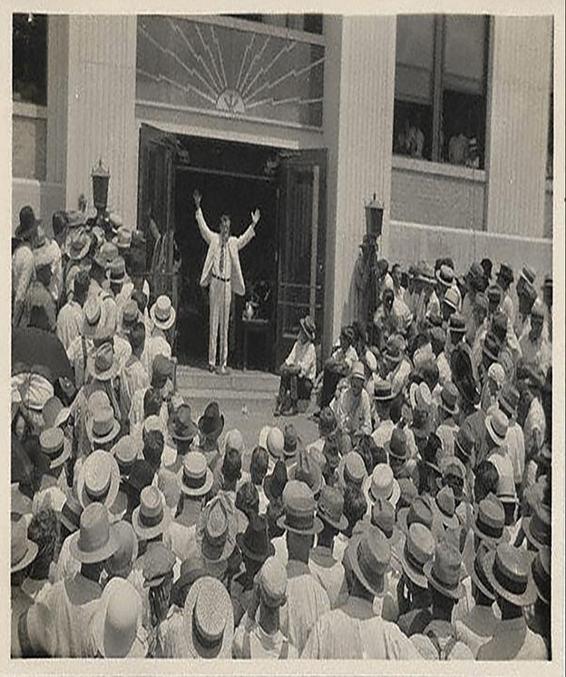
Huey attracted huge crowds with his fiery speeches, and his appearances became the talk of the state. A man of boundless
Page 48
energy, he pursued an exhaustive speaking schedule, often making five or more campaign stops a day. He captivated his audiences with his intellect and humor and could speak for hours without notes.
Having learned the value of showmanship during his salesman days, Huey dressed in his trademark white linen suits and presented himself as a country boy who never forgot his roots.
He entertained crowds with a warm up band, and then lobbed barbs at his “rascal” opponents to the delight of his fans.
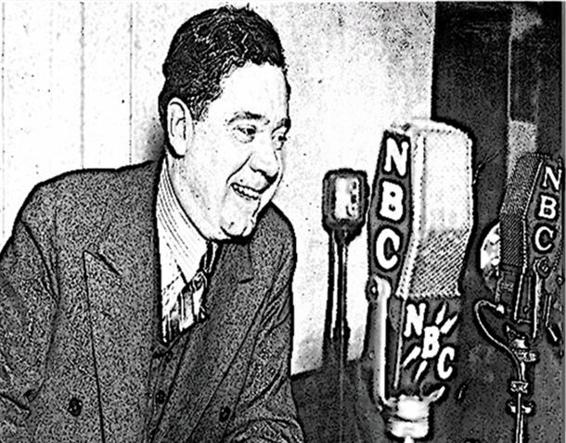
In later campaigns, Huey used sound trucks to amplify his voice to the far reaches of the huge crowds he attracted, and he used radio speeches to reach a state wide audience. When the state’s newspapers uniformly aligned against him and his reforms, Huey blanketed the state with his own position papers to explain his programs to the people. As governor, Huey labeled the press “the lyin’ newspapers” and started his own newspaper, “The Louisiana Progress,” to get his message out.
Huey Long
Page 49
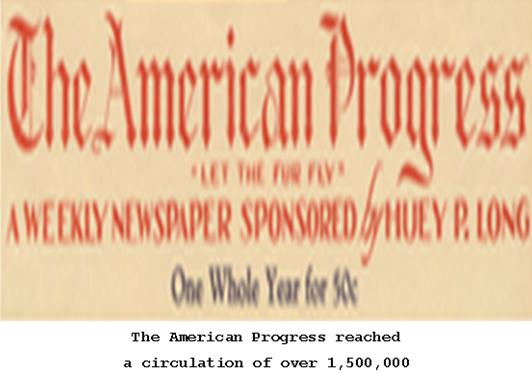
Just a bit later, Huey reached nationwide audiences through radio broadcasts and a newspaper called “The American Progress,”
which had a circulation of 1,500,000.
Huey Long
Page 50
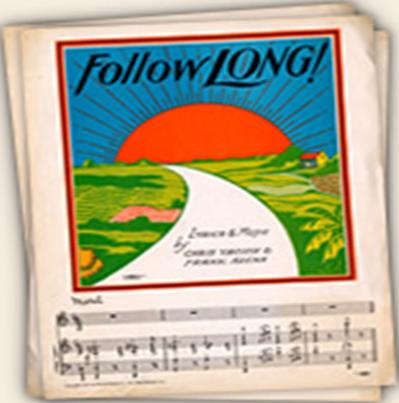
Always the music lover, Huey wrote a catchy campaign song,
“Every Man a King”, that summarized his share the wealth philosophy: “Every man a king, for you can be a millionaire —
but there's something belonging to others — there's enough for all people to share.”
Huey Long
Page 51
Huey Long
Page 52
“Louisiana was stirring. The trappers and fishermen of the bayous, the Cajun farmers of the south and the redneck farmers of the hill parishes, the sharecroppers and tenants everywhere, and the laborers in the towns and the small businessmen in the villages. Now suddenly a champion had appeared to them, one who promised to lead them to a better life.” — T. Harry Williams,
“Huey Long”
Having won by huge numbers in 1928 at the age of thirty-five and, now embracing the nickname “the Kingfish,” Huey immediately made good on his promises by the maneuvering out of government
Page 53
agencies the cronies of the conservative political establishment and installing his own allies.
Democratic Governor Long began his agenda of centralizing power around the executive office; a move that brought accusations of a dictatorship, pressuring the legislature to pass laws allowing him to seize control of multiple state agencies.
He later signed a bill that allowed all police to make arrests without a warrant, along with others that centralized investigative power in the Governor. In that same vein, one of his earliest acts when he became Governor was to sign a bill expanding train segregation to buses, and he gave speeches warning of “Negro domination,” though some of his populist policies did benefit non-Whites economically. Long’s favorite way to discredit opponents was to claim they were of negro descent.
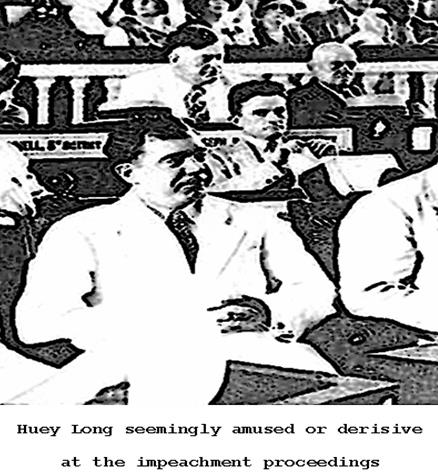
Long pursued increased spending in education, infrastructure and energy, and placed a tax burden on the rich, most notably large corporations like Standard Oil. Threatened with impeachment, Long charged legislators with taking bribes. In 1929, Standard Oil’s legislative allies led an unsuccessful attempt to remove Huey Long from the governorship on a variety of charges, ranging from serious to comical. He was impeached (charged) in the
Huey Long
Page 54
House. Impeachment was attempted, which Long escaped, the vote not even close in Louisiana’s Senate. He avoided conviction in the Senate through some maneuvering as well as the requirement of a larger majority in his favor.
In order to finance his building and social programs, Huey had called a special session of the legislature to enact a 5 cent per barrel tax on the production of refined oil. The bill was met with a storm of opposition from the state’s big oil interests, and opponents in the legislature, prompting the
Page 55
impeachment attempt on Huey on charges ranging from misuse of state funds to using “abusive language,” the latter ostensibly a reference to Huey’s use of the word “negro.”
“We condemn as being vicious, dangerous and utterly without merit, any and all systems of taxation that seek to impose tax burdens upon industries in Louisiana” was the lead resolution for an anti-Long mass meeting on impeachment.
“You can impeach for whatever you want to impeach for; for any act not consistent with the duty of the office. It is not like a criminal or civil court.” — impeachment leader Cecil Morgan.
Under a “gentleman’s agreement” with former Governor John Parker, Louisiana’s two cent severance tax law had been written by the legal department of Standard Oil and rubber stamped by the Legislature. Standard Oil financed the impeachment rallies against Huey Long, where the company’s band provided the entertainment.
“Pro-Long” rallies attracted larger crowds, to the chagrin of the newspapers, which were uniformly aligned with the “anti-Long” corporate interests. In one case, a newspaper ran photos of both rallies, but reversed the captions to create the impression that the impeachment movement had more support.
Page 56
Huey responded with a statewide campaign to make his case that Standard Oil and his political opponents were conspiring to retake state government using the trumped-up charges against him. He asserted that legislators had been offered as much as $25,000 for their votes to remove him from office; or enough money "to burn a wet mule."
Of the original 19 charges, eight items were passed in the House. When the trial moved to the Senate, Huey produced a document signed by over one third of the senators, stating they would vote against impeachment because the trial was illegal.
With the two-thirds majority required to convict now impossible, Huey’s opponents halted the proceedings.
The “Constipational” League
Huey’s opponents formed a society in New Orleans called the Louisiana Constitutional League, which was dedicated to digging up dirt on the governor and restoring the office to the planter class. Huey called the group the “Constipational League.”
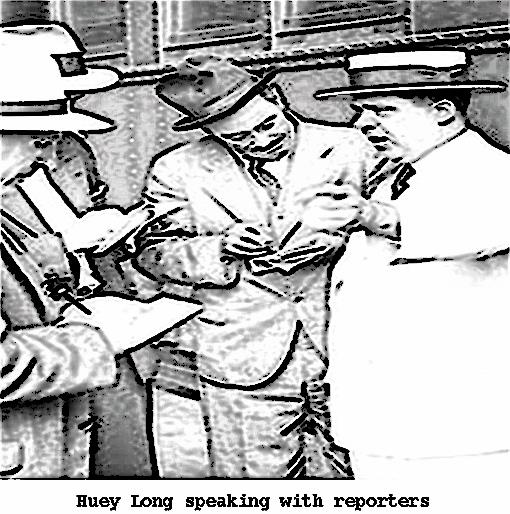
After the impeachment, Huey became determined to fight fire with fire when dealing with his enemies. “I used to try to get things done by saying please,” he later told reporters. “Now I dynamite them out of my path.”
Page 57
With the state’s major newspapers financed by his opposition, in 1930 Huey founded his own newspaper, “The Louisiana Progress,”
which he used to make the case for his programs and publicize his achievements. After impeachment, Huey received mountains of death threats. His New Orleans home was the target of a drive-by shooting and several arson attempts. Fearing for his life and the safety of his family, he began surrounding himself with armed bodyguards, the number continually growing as the increased rate of threats presented themselves.
“I was elected Railroad Commissioner of Louisiana in 1918, and they tried to impeach me in 1920. When they failed to impeach me in 1920, they indicted me in 1921.”
The death threats continued to follow him, and Long increasingly procured the services of bodyguards out of fear of assassination.
Huey Long
Page 58
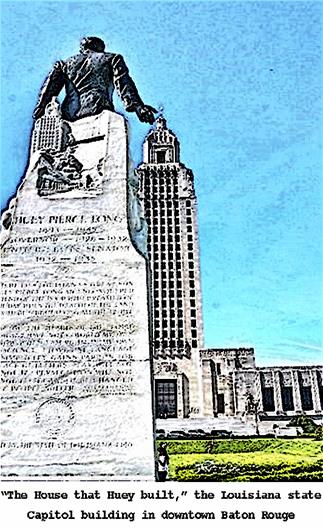
If you’re traveling into Baton Rouge on Highway 190 East, the route most commonly taken by people from central and northern Louisiana prior to the construction of Interstate 10, “The House That Huey Built” comes into view several miles before you reach the Mississippi River, appearing to stand alone, in the same way the Emerald City materialized in front of Dorothy.
It is the nation’s tallest state Capitol, and as its nickname suggests, it was conceived and built by Huey P. Long, the
Page 59
Kingfish, the Louisiana governor who never really left the mansion when he was elected to the US Senate, a politician who had been so feared than even Franklin D. Roosevelt considered him to be one of the two most dangerous men in America.
“It’s also the nation’s tallest tombstone,” current Louisiana Commissioner of Administration Jay Dardenne once observed of the state Capitol building. The body of Huey P. Long is buried on the Capitol grounds. Atop his grave, there’s a statue of Long overlooking his building.
Page 60
4 – Huey Goes Nationwide
Huey Long was always moving fast. As a young man, he had passed the Louisiana bar exam and became a lawyer after “being burdened” with only two law school classes at Tulane and spending a year reading every law book he could find. By 1915, Long had established a private legal practice in Winnfield. He represented poor plaintiffs, usually in workers' compensation cases. In 1918 Long won a seat on the Louisiana Railroad Commission and used his position to fight monopolies like Rockefeller’s Standard Oil and utility rates, winning favor with working people.
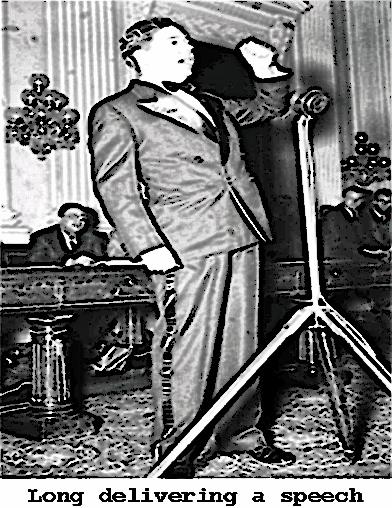
He became Governor of Louisiana in 1928. In four short years as Governor he paved roads, built bridges, provided free textbooks to poor children, reformed the hospitals, broke the power of the old political bosses, and took on the monopolistic power of the big oil companies, especially Rockefeller’s Standard Oil. Within a year of taking office he was impeached by the Louisiana House, although the charges were dropped in anticipation of being dismissed by the State Senate. In 1930 Long ran for and was elected to the US Senate. But since he was busy with his agenda as Louisiana Governor, he never bothered to show up in Washington to take the oath of office until 1932.
Huey Long
Page 61
When Long arrived in the US Senate, America was in the throes of the Great Depression. With this backdrop, Long made characteristically fiery speeches that denounced wealth inequality, the cornerstone of his program and beliefs. He criticized the leaders of both parties for failing to address the crisis adequately, notably attacking conservative Senate
Page 62
Democratic Leader Joseph Robinson of Arkansas for his apparent closeness with President Herbert Hoover and big business.
In the 1932 presidential election, Long was a vocal supporter of New York Governor Franklin D. Roosevelt. At that year's Democratic National Convention, Long kept the delegations of several wavering Southern states in the Roosevelt camp. Due to this, Long expected to be featured prominently in Roosevelt's campaign but was disappointed with a peripheral speaking tour limited to four Midwestern states.
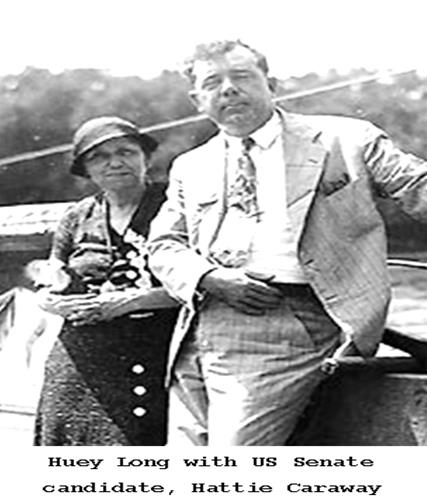
Not discouraged after being snubbed, Long found other venues for his populist message. He endorsed Senator Hattie Caraway of Arkansas, a widow and the underdog candidate in a crowded field and conducted a whirlwind, seven day tour of that state. During the campaign, Long gave 39 speeches, traveled 2,100 miles, and spoke to over 200,000 people. In an upset win, Caraway became the first woman elected to a full term in the Senate.
Huey Long
Page 63
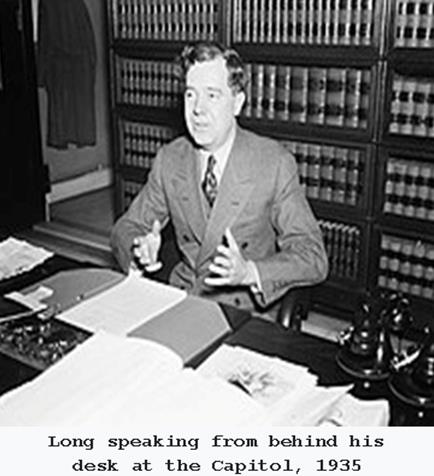
Returning to Washington, Long gave theatrical speeches which drew wide attention. Public viewing areas were crowded as never before with onlookers, among them a young future US President named Lyndon B. Johnson, who later said he was "simply entranced" by Long. Long obstructed bills for weeks, launching hour long filibusters and having the clerk read superfluous documents. Long's antics, one editorial claimed, had made the Senate "impotent." Others used the phrase; “less toxic.” In May 1932, “The Washington Post” called for his resignation. Long's behavior and radical rhetoric did little to endear him to his
Page 64
fellow senators. None of his proposed bills, resolutions, or motions were explicitly passed during his three years in the Senate, though it is undeniable that Huey’s huge and growing popularity necessitated the inclusion of some of his ideas in the passed bills of others, where it would never have been without him.
Roosevelt’s First New Deal
During the first 100 days of Roosevelt's Presidency in spring 1933, Long's attitude toward Roosevelt and his “New Deal” became less than tepid, and at times out and out dismissive. Now, fully aware that Roosevelt had no intention of radically redistributing the country's wealth, Long became one of the few national politicians to oppose Roosevelt's “New Deal” policies from the left. He considered them inadequate in the face of the escalating economic crisis at the depth of the Depression, but still supported some of Roosevelt's programs in the Senate, explaining simply; "Whenever this administration has gone to the left I have voted with it, and whenever it has gone to the right I have voted against it."
Long opposed the core of Roosevelt’s first program, the National Recovery Act, claiming it favored industrialists. In an attempt to prevent its passage, Long held a lone filibuster, speaking
Page 65
for 15 hours and 30 minutes, the second longest filibuster at the time. He also criticized Social Security, calling it inadequate and expressing his concerns that states would administer it in an arbitrary way. In 1933, he was a leader of a three week Senate filibuster against the Glass banking bill, which he later supported as the Glass–Steagall Act after provisions extended government deposit insurance to state banks as well as national banks.
Roosevelt considered Long a radical demagogue and stated that Long, along with General Douglas MacArthur, "was one of the two most dangerous men in America," his short list quite the unintended complement. For MacArthur’s part, the onset of the Great Depression prompted Congress to make cuts in the Army's personnel and budget. Some 53 bases were closed, but MacArthur managed to prevent attempts to reduce the number of regular officers from 12,000 to 10,000. MacArthur's main programs included the development of new mobilization plans. He grouped the nine corps areas together under four armies, which were charged with responsibility for training and frontier defense.
He also negotiated the MacArthur-Pratt agreement with the Chief of Naval Operations, Admiral William V. Pratt. This was the first of a series of inter-service agreements over the following decades that defined the responsibilities of the different
Page 66
services with respect to aviation. This agreement placed coastal air defense under the Army. In March 1935, MacArthur activated a centralized air command, General Headquarters Air Force, under Major General Frank M. Andrews. One of MacArthur's most controversial acts came in 1932, when the "Bonus Army" of veterans converged on Washington. The “Bonus Army” was a group of 43,000 demonstrators, 17,000 veterans of US involvement in World War I, their families, and affiliated groups, who gathered in Washington, D.C., in mid-1932 to demand early cash redemption of their service bonus certificates. MacArthur sent tents and camp equipment to the demonstrators, along with mobile kitchens, until an outburst in Congress caused the kitchens to be withdrawn. MacArthur was concerned that the demonstration had been taken over by communists and pacifists but the General Staff's intelligence division reported that only three of the march's 26 key leaders were communists. MacArthur went over contingency plans for civil disorder in the capital. Mechanized equipment was brought to Fort Myer, where anti-riot training was conducted. On July 28, 1932, in a clash with the District police, two veterans were shot, and later died. President Herbert Hoover ordered MacArthur to "surround the affected area and clear it without delay." MacArthur brought up troops and tanks and, against the advice of Major Dwight D. Eisenhower, decided to accompany the troops, although he was not in charge
Page 67
of the operation. The troops advanced with bayonets and sabers drawn under a shower of bricks and rocks, but no shots were fired. In less than four hours, they cleared the “Bonus Army's”
campground using tear gas. The gas canisters started a number of fires, causing the only death during the riots. While not as violent as other anti-riot operations, it was nevertheless a public relations disaster. However, the defeat of the "Bonus Army," while unpopular with the American people at large, did make MacArthur into the hero of the more right-wing elements in the Republican Party who said that they believed that the general had saved America from a communist revolution in 1932.
In June 1933, in an effort to undermine Long's political dominance, Roosevelt cut him out of consultations on the distribution of federal funds and patronage in Louisiana and placed Long's opponents in charge of federal programs in the state. Roosevelt supported a Senate inquiry into the election of Long ally John H. Overton to the Senate in 1932. The Long machine was accused of election fraud and voter intimidation, but the inquiry came up empty, and Overton was seated. To discredit Long and damage his support base, Roosevelt had Long's finances investigated by the Internal Revenue Service in 1934.
Although they failed to link Long to any illegality, some of his lieutenants were charged with income tax evasion. Roosevelt's
Page 68
son, Elliott, would later note that in this instance, his father
"may have been the originator of the concept of employing the IRS as a weapon of political retribution.”
Chaco War and foreign policy
On May 30, 1934, Long took to the Senate floor to debate the abrogation of the Platt amendment. But instead of debating the amendment, Long declared his support for Paraguay against Bolivia in the Chaco War. He maintained that US President Rutherford B. Hayes had awarded the oil rich Chaco region to Paraguay in 1878. He attested that Rockefeller’s Standard Oil had corrupted the Bolivian government and organized the war and that Wall Street orchestrated American foreign policy in Latin America. For his speech, Long received praise in Paraguay. After capturing a Bolivian fort in July 1934, they renamed it Fort Long. Long's allegations were widely publicized in Latin American newspapers. This drew the concern of the State Department, who believed that Long was damaging the reputation of the United States. Throughout the summer of 1934, they waged a sustained public relations campaign against Long throughout Latin America. This speech and others established Long as one of the most ardent isolationists in the Senate. He further argued that American involvement in the Spanish–American War and the First World War had been deadly mistakes conducted on behalf of
Huey Long
Page 69
Wall Street. Consequently, Long demanded the immediate independence of the Philippines, which the United States had occupied since 1898. He also opposed American entry into the World Court.
Share Our Wealth
In March 1933, Long revealed a series of bills collectively known as "the Long plan" to redistribute wealth. Together, they would cap fortunes at $100 million, limit annual income to $1
million, and cap individual inheritances at $5 million.
Page 70
In a nationwide February 1934 radio broadcast, Long introduced his Share Our Wealth plan. The legislation would use the wealth from the Long plan to guarantee every family a basic household grant of $5,000 and a minimum annual income of one-third of the average family homestead value and income. Long supplemented his plan with proposals for free college and vocational training, veterans' benefits, federal assistance to farmers, public works projects, greater federal economic regulation, a $30 monthly elderly pension, a month's vacation for every worker, a thirty hour workweek, a $10 billion land reclamation project to end the Dust Bowl, and free medical service and a "war on disease" led by the Mayo brothers. These reforms, Long claimed, would end the Great Depression. The plans were widely criticized and labeled impossible by the UniParty politicians and their paid
“economists.”
With the Senate unwilling to support his proposals, in February 1934 Long formed the Share Our Wealth Society, a national network of local clubs that operated in opposition to the Democratic Party and Roosevelt. By 1935, the society had over 7.5 million members in 27,000 clubs. Long's Senate office received an average of 60,000 letters a week, resulting in Long hiring 48 stenographers to type responses. Of the two trucks that delivered mail to the Senate, one was devoted solely to
Page 71
mail for Long. Long's newspaper, now renamed “American Progress,” averaged a circulation reaching over 1.5 million.
Long drew international attention. English writer H. G. Wells interviewed Long, noting he was "like a Winston Churchill who has never been at Harrow. He abounds in promises."
Some historians believe that pressure from Share Our Wealth contributed to Roosevelt's "turn to the left" in his Second New Deal of 1935, which consisted of the Social Security Act, the Works Progress Administration, the National Labor Relations Board, Aid to Dependent Children, and the Wealth Tax Act of 1935. Roosevelt reportedly admitted in private to trying to
"steal Long's thunder."
Continued Control Over Louisiana
Long continued to maintain effective control of Louisiana while he was a Senator, blurring the supposed and porous boundary between federal and state politics. Long chose his childhood friend, Oscar K. Allen, to succeed the Kingfish in the January 1932 election. With the support of Long's voter base, Allen won easily, permitting Long to resign as governor and take his seat in the US Senate in January 1932. Allen, widely viewed as a puppet, dutifully enacted Long's policies. When Long visited Louisiana, Allen would relinquish his office to the Senator,
Page 72
working instead at his receptionist's desk. Though he had no constitutional authority, Long continued to draft and press bills through the Louisiana State Legislature. One of the laws passed was what Long called "a tax on lying," a 2 percent tax on newspaper advertising revenue.
In 1934, Long and James A. Noe, an independent oilman and member of the Louisiana State Senate from Ouachita Parish, formed the controversial Win or Lose Oil Company. The firm was established to obtain leases on state owned lands so that its directors might collect bonuses and sublease the mineral rights to the major oil companies. Although ruled legal, these activities were done in secret, and the stockholders were unknown to the public.
Long made a profit on the bonuses and the resale of those state leases and used the funds primarily for political purposes.