

Crazy Horse by Edward Drobinski - HTML preview
Download the book in PDF, ePub, Kindle for a complete version.
1876 Sun Dance Ceremony
Among the Plains Tribes, the long standing ceremonial tradition known as the Sun Dance was the most important religious event of the year. It is a time for prayer and personal sacrifice for the community, as well as for making personal vows and resolutions.
Towards the end of spring in 1876, the Lakota and the Cheyenne held a Sun Dance that was also attended by some "agency Native Americans" who had slipped away from their reservations. During the Sun Dance around June 5, 1876, on Rosebud Creek in Montana, Sitting Bull, the spiritual leader of the Hunkpapa Lakota, reportedly had a vision of "soldiers falling into his camp like grasshoppers from the sky." At the same time US military officials were conducting a summer campaign to force the Lakota and the Cheyenne back to their reservations, using infantry and cavalry, part of a so called "three-pronged approach."
Col. John Gibbon's column of six companies (A, B, E, H, I, and K) of the 7th Infantry and four companies (F, G, H, and L) of the 2nd Cavalry marched east from Fort Ellis in western Montana
Page 204
on March 30 to patrol the Yellowstone River. Brig. Gen. George Crook's column of ten companies (A, B, C, D, E, F, G, I, L, and M) of the 3rd Cavalry, five companies (A, B, D, E, and I) of the 2nd Cavalry, two companies (D and F) of the 4th Infantry, and three companies (C, G, and H) of the 9th Infantry moved north from Fort Fetterman in the Wyoming Territory on May 29, marching toward the Powder River area. Brig. Gen. Alfred Terry's column, including twelve companies (A, B, C, D, E, F, G, H, I, K, L, and M) of the 7th Cavalry under Lt. Col. George Armstrong Custer's immediate command, Companies C and G of the 17th Infantry, and the Gatling gun detachment of the 20th Infantry departed westward from Fort Abraham Lincoln in the Dakota Territory on May 17. They were accompanied by teamsters and packers with 150
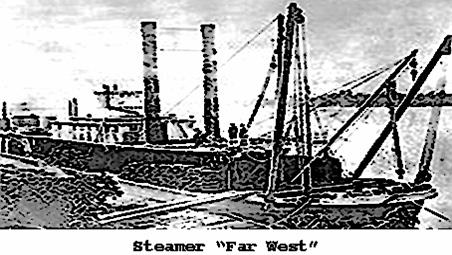
wagons and a large contingent of pack mules that reinforced Custer. Companies C, D, and I of the 6th Infantry moved along the Yellowstone River from Fort Buford on the Missouri River to set up a supply depot and joined Terry on May 29 at the mouth of the Powder River. They were later joined there by the steamboat Far West, which was loaded with 200 tons of supplies from Fort Abraham Lincoln.
Crazy Horse
Page 205
7th Cavalry organization
The 7th Cavalry had been created just after the American Civil War. Many men were veterans of the war, including most of the leading officers. A significant portion of the regiment had previously served four and a half years at Fort Riley, Kansas, during which time it fought one major engagement and numerous skirmishes, experiencing casualties of 36 killed and 27 wounded.
Six other troopers had died of drowning and 51 in cholera epidemics. In November 1868, while stationed in Kansas, the 7th Cavalry under Custer had routed Black Kettle's Southern Cheyenne camp on the Washita River in the Battle of Washita River, an attack which was even at the time labeled a "massacre of innocent Native Americans" by the Native American Bureau.
Page 206
However, Custer may have mistaken his ability to defeat outnumbered non-combatants as a sign of his military “prowess.”
By the time of the Battle of the Little Bighorn, half of the 7th Cavalry's companies had just returned from 18 months of constabulary duty in the Deep South, having been recalled to Fort Abraham Lincoln, Dakota Territory to reassemble the regiment for the campaign. About 20% of the troopers had been enlisted in the prior seven months. 139 of an enlisted roll of 718, were only marginally trained and had no combat or frontier experience. About 60% of these recruits were listed as
“American;” the rest were European immigrants, mostly Irish and German, just as many of the veteran troopers had been before their enlistments. Archaeological evidence suggests that many of these troopers were malnourished and in poor physical condition, despite being the best equipped and supplied regiment in the Army.
Of the 45 officers and 718 troopers then assigned to the 7th Cavalry, including a second lieutenant detached from the 20th Infantry and serving in Company L, 14 officers, including the regimental commander, and 152 troopers did not accompany the 7th during the campaign. The regimental commander, Colonel Samuel D.
Sturgis, was on detached duty as the Superintendent of Mounted Recruiting Service and commander of the Cavalry Depot in St.
Page 207
Louis, Missouri, which left Lieutenant Colonel Custer in command of the regiment. However, having said that, it is also fair to point out that the ratio of troops detached for other duty, approximately 22%, was not unusual for an expedition of this size, and part of the officer shortage was chronic, due to the Army's rigid seniority system. Three of the regiment's 12
captains were permanently detached, and two had never served a day with the 7th since their appointment in July 1866. Three second lieutenant vacancies in E, H, and L Companies were also unfilled.
Crazy Horse
Page 208
Battle of the Rosebud
The Army's coordination and planning began to go awry on June 17, 1876, when Crook's column retreated after the Battle of the Rosebud, just 30 miles to the southeast of the eventual Little Bighorn battlefield. Surprised and according to some accounts astonished by the unusually large numbers of Native Americans, Crook held the field at the end of the battle but felt compelled by his losses to pull back, regroup, and wait for reinforcements. Unaware of Crook's battle, Gibbon and Terry
Page 209
proceeded, joining forces in early June near the mouth of Rosebud Creek. They reviewed Terry's plan calling for Custer's regiment to proceed south along the Rosebud while Terry and Gibbon's united forces would move in a westerly direction toward the Bighorn and Little Bighorn Rivers. As this was the likely location of Native encampments, all army elements had been instructed to converge there around June 26 or 27 in an attempt to engulf the Native Americans. On June 22, Terry ordered the 7th Cavalry, composed of 31 officers and 566 enlisted men under Custer, to begin a reconnaissance in force and pursuit along the Rosebud, with the prerogative to "depart" from orders if Custer saw "sufficient reason." Custer had been offered the use of Gatling guns but declined, believing they would slow his rate of march.
Little Bighorn
While the Terry-Gibbon column was marching toward the mouth of the Little Bighorn, on the evening of June 24, Custer's Native American scouts arrived at an overlook known as the Crow's Nest, 14 miles east of the Little Bighorn River. At sunrise on June 25, Custer's scouts reported they could see a massive pony herd and signs of the Native American village roughly 15 miles in the distance. After a night's march, the tired officer who was sent with the scouts could see neither, and when Custer joined them,
Page 210
he was also unable to make the sighting. Custer's scouts also spotted the regimental cooking fires that could be seen from 10
miles away, disclosing the regiment's position.
Custer contemplated a surprise attack against the encampment the following morning of June 26, but he then received a report informing him several hostiles had discovered the trail left by his troops. Assuming his presence had been exposed, Custer decided to attack the village without further delay. On the morning of June 25, Custer divided his 12 companies into three battalions in anticipation of the forthcoming engagement. Three companies were placed under the command of Major Marcus Reno, A, G, and M, and three were placed under the command of Captain Frederick Benteen, H, D, and K. Five companies, C, E, F, I, and L, remained under Custer's immediate command. The 12th, Company B under Captain Thomas McDougall, had been assigned to escort the slower pack train carrying provisions and additional ammunition.
Unknown to Custer, the group of Native Americans seen on his trail was actually leaving the encampment and did not alert the rest of the village. Custer's scouts warned him about the size of the village, with Mitch Bouyer reportedly saying; "General, I have been with these Native Americans for 30 years, and this is the largest village I have ever heard of." Custer's “overriding”
Page 211
concern was that the Native American group would break up and scatter, ostensibly preferring to engage a larger consolidated number of Native Americans. The command began its approach to the village at noon and prepared to attack in full daylight.
With an impending sense of doom, the Crow scout Half Yellow Face prophetically warned Custer, speaking through the interpreter Mitch Bouyer; "You and I are going home today by a road we do not know."
US Military Assumptions Prior to the Battle As the Army moved into the field on its expedition, it was said by some Custer-complimentary sources, that they were operating with incorrect assumptions as to the number of Native Americans it would encounter, though this directly contradicts what Half Yellow Face had said to Custer. These assumptions were based on inaccurate information provided by the Native American Agents that no more than 800 "hostiles" were in the area. The Native American Agents based their estimate on the number of Lakota that Sitting Bull, Crazy Horse, and other leaders had reportedly led off the reservation in protest of US government policies. It was in fact a correct estimate until several weeks before the battle when the "reservation Native Americans" joined Sitting Bull's ranks for the summer buffalo hunt. The agents did not
Page 212
consider the many thousands of these "reservation Native Americans" who had unofficially left the reservation to join their "un-cooperative non-reservation cousins led by Sitting Bull and Crazy Horse.” Thus, Custer unknowingly faced thousands of Native Americans, including the 800 non-reservation
"hostiles." All Army plans were based on the incorrect numbers.
Although Custer was criticized after the battle for not having accepted reinforcements and for dividing his forces, it appears that he had accepted the same official government estimates of hostiles in the area which Terry and Gibbon had also accepted.
Historian James Donovan notes, however, that when Custer later asked interpreter Fred Gerard for his opinion on the size of the opposition, he estimated the force at 1,100 warriors, and did not allow that to change his over-reaching plans.
Additionally, Custer was foolishly more concerned with preventing the escape of the Lakota and Cheyenne than with fighting them. From his observation, as reported by John Martin, Custer assumed the warriors had been sleeping in on the morning of the battle, to which virtually every Native account attested later, giving Custer a false estimate of what he was up against.
When he and his scouts first looked down on the village from the Crow's Nest across the Little Bighorn River, they could see only the herd of ponies. Later, looking from a hill two and one half
Page 213
miles away after parting with Reno's command, Custer could observe only women preparing for the day, and young boys taking thousands of horses out to graze south of the village, apparently never wondering why there were so many horses.
Custer's Crow scouts told him it was the largest Native village they had ever seen. When the scouts began changing back into their Native dress right before the battle, Custer released them from his command. While the village was enormous, Custer still concluded that there were far fewer warriors to defend the village.
Finally, Custer may have assumed when he encountered the Native Americans that his subordinate Benteen, who was with the pack train, would provide support. Rifle volleys were a standard way of telling supporting units to come to another unit's aid. In a subsequent official 1879 Army investigation requested by Major Reno, the Reno Board of Inquiry, Benteen and Reno's men testified that they heard distinct rifle volleys as late as 4:30
PM during the battle.
Custer had initially wanted to take a day to scout the village before attacking. However, when men who went back looking for supplies accidentally dropped by the pack train, they discovered that their track had already been discovered by Native Americans. Reports from his scouts also revealed fresh pony
Page 214
tracks from ridges overlooking his formation. It became apparent that the warriors in the village were either aware or would soon be aware of his approach. Fearing that the village would break up into small bands that he would have to chase, Custer began to prepare for an immediate attack, favoring laziness over pragmatism.
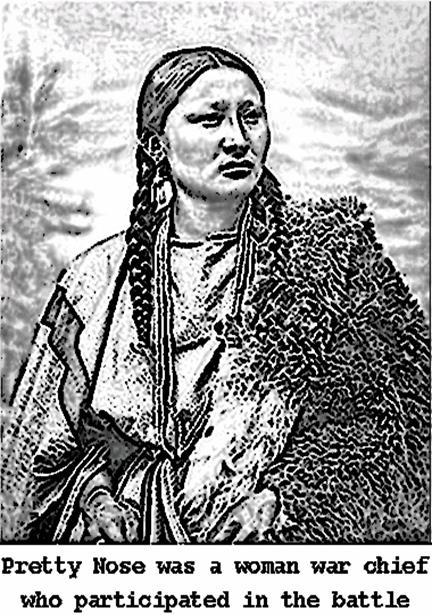
Role of Native American Non-combatants in Custer's Strategy Custer's field strategy was designed to engage non-combatants at the encampments on the Little Bighorn, to capture women, children, and the elderly or disabled to serve as hostages to convince the warriors to surrender and comply with federal orders to relocate. Custer's battalions were poised to "ride into the camp and secure non-combatant hostages, and "force the warriors to surrender." Author Evan S. Connell observed that if Custer could occupy the village before widespread resistance developed, the Sioux and Cheyenne warriors "would be obliged to surrender, because if they started to fight, they would be endangering their families." However, not all Lakota women were defenseless.
Crazy Horse
Page 215
In Custer's book “My Life on the Plains,” published two years before the Battle of the Little Bighorn, he asserted; “Native Americans contemplating a battle, either offensive or defensive, are always anxious to have their women and children removed from all danger. For this reason I decided to locate our military camp as close as convenient to Chief Black Kettle's Cheyenne
Page 216
village, knowing that the close proximity of their women and children, and their necessary exposure in case of conflict, would operate as a powerful argument in favor of peace, when the question of peace or war came to be discussed.”
On Custer's decision to advance up the bluffs and descend on the village from the east, Lt. Edward Godfrey of Company K surmised;
“Custer expected to find the squaws and children fleeing to the bluffs on the north, for in no other way do I account for his wide detour. He must have counted upon Reno's success, and fully expected the ‘scatteration’ of the non-combatants with the pony herds. The probable attack upon the families and capture of the herds were in that event counted upon to strike consternation in the hearts of the warriors and were elements for success upon which General Custer fully counted.”
The Sioux and Cheyenne fighters were acutely aware of the danger posed by the military engagement of non-combatants and that
"even a semblance of an attack on the women and children" would draw the warriors back to the village, according to historian John S. Gray. Such was their concern that an apparent reconnaissance by Capt. Yates' E and F Companies at the mouth of Medicine Tail Coulee, Minneconjou Ford, caused hundreds of warriors to disengage from the Reno valley fight and return to deal with the threat to the village.
Page 217
Some authors and historians, based on archaeological evidence and reviews of Native testimony, speculate that Custer attempted to cross the river at a point further north they refer to as Ford D. According to Richard A. Fox, James Donovan, and others, Custer proceeded with a wing of his battalion, Yates' E and F
companies, north and opposite the Cheyenne circle at that crossing, which provided "access to the women and children fugitives." Yates's force "posed an immediate threat to fugitive Native American families." Gathering at the north end of the huge encampment, he then persisted in his efforts to "seize women and children" even as hundreds of warriors were massing around Keogh's wing on the bluffs. Yates' wing, descending to the Little Bighorn River at Ford D, encountered "light resistance," undetected by the Native American forces ascending the bluffs east of the village. Custer was almost within
"striking distance of the refugees" before abandoning the ford and returning to Custer Ridge.
The Lone Teepee, or Tipi, was a landmark along the 7th Cavalry's march. It was where the Native American encampment had been a week earlier, during the Battle of the Rosebud on June 17, 1876.
The Native Americans had left a single teepee standing. Some reports mention a second that had been partially dismantled, and in it was the body of a Sans Arc warrior, Old She Bear, who had
Page 218
been wounded in the battle. He had died a couple of days after the Rosebud battle, and it was the custom of the Native Americans to move camp when a warrior died and leave the body with its possessions. The Lone Teepee was an important location during the Battle of the Little Bighorn for several reasons, including that it is where Custer gave Reno his final orders to attack the village ahead. It is also where some Native Americans who had been following the command were seen and Custer assumed he had been discovered.
Many of the survivors' accounts use the Lone Teepee as a point of reference for event times or distances.
Knowing this location helps establish the pattern of the Native Americans' movements to the encampment on the river where the soldiers found them.
The first group to attack was Major Reno's second detachment, Companies A, G and M, after receiving orders from Custer written out by Lt. William W. Cooke, as Custer's Crow scouts reported Sioux tribe members were alerting the village. Ordered to charge, Reno began that phase of the battle. The orders, made without accurate knowledge of the village's size, location, or the warriors' propensity to stand and fight, had been to pursue the Native Americans and "bring them to battle." Reno's force
Page 219
crossed the Little Bighorn at the mouth of what is today Reno Creek around 3:00 PM on June 25. They immediately realized that the Lakota and Northern Cheyenne were present "in force and not running away."
Reno advanced rapidly across the open field towards the northwest, his movements masked by the thick belt of trees that ran along the southern banks of the Little Bighorn River. The same trees on his front right shielded his movements across the wide field over which his men rapidly rode, first with two approximately forty man companies abreast and eventually with all three charging abreast. The trees also obscured Reno's view of the Native American village until his force had passed that bend on his right front and was suddenly within arrow shot of the village. The tepees in that area were occupied by the Hunkpapa Sioux. Neither Custer nor Reno had much idea of the length, depth and size of the encampment they were attacking, as the village was hidden by the trees. When Reno came into the open in front of the south end of the village, he sent his Arikara/Ree and Crow Native American scouts forward on his exposed left flank. Realizing the full extent of the village's width, Reno quickly suspected what he would later call "a trap"
and stopped a few hundred yards short of the encampment.
Page 220
He ordered his troopers to dismount and deploy in a skirmish line, according to standard army doctrine. In this formation, every fourth trooper held the horses for the troopers in firing position, with 5 to 10 yards separating each trooper, officers to their rear and troopers with horses behind the officers. This formation reduced Reno's firepower by 25 percent. As Reno's men fired into the village and killed, by some accounts, several wives and children of the Sioux leader, Chief Gall, Phizi in Lakota, the mounted warriors began streaming out to meet the attack. With Reno's men anchored on their right by the protection of the tree line and bend in the river, the Native Americans rode against the center and exposed left end of Reno's line. After about 20 minutes of long distance firing, Reno had taken only one casualty, but the odds against him had risen Reno estimated five to one, and Custer had not reinforced him.
Trooper Billy Jackson reported that by then, the Native Americans had begun massing in the open area shielded by a small hill to the left of Reno's line and to the right of the Native American village. From this position the Native Americans mounted an attack of more than 500 warriors against the left and rear of Reno's line, turning Reno's exposed left flank. This forced a hasty withdrawal into the timber along the bend in the river. Here the Native Americans pinned Reno and his men down
Crazy Horse
Page 221
and tried to set fire to the brush to try to drive the soldiers out of their position.
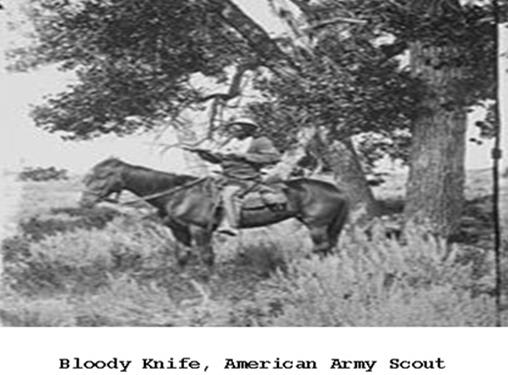
Reno's Arikara scout, Bloody Knife, was shot in the head, splattering brains and blood onto Reno's face.
The shaken Reno ordered his men to dismount and mount again. He then said; "All those who wish to make their escape follow me."
Abandoning the wounded thereby dooming them to their deaths, he led a disorderly rout for a mile next to the river. He made no attempt to engage the Native Americans to prevent them from picking off men in the rear. The retreat was immediately disrupted by Cheyenne attacks at close quarters. A steep bank, some 8 feet high, awaited the mounted men as they crossed the river. Some horses fell back onto others below them. Native
Page 222
Americans fired both on the soldiers from a distance, and within close quarters, pulled them off their horses and clubbed their heads. Later, Reno reported that three officers and 29 troopers had been killed during the retreat and subsequent fording of the river. Another officer and 13–18 men were missing. Most of these missing men were left behind in the timber, although many eventually rejoined the detachment.
Atop the bluffs, known today as Reno Hill, Reno's depleted and shaken troops were joined about a half hour later by Captain Benteen's column, Companies D, H and K, arriving from the south.
This force had been returning from a lateral scouting mission when it had been summoned by Custer's messenger, Italian bugler John Martin with the handwritten message; "Benteen. Come on, Big Village. Be quick. Bring packs. P.S. Bring Packs." This message made no sense to Benteen, as his men would be needed more in a fight than the packs carried by herd animals. Though both men inferred that Custer was engaged in battle, Reno refused to move until the packs arrived so his men could resupply. The detachments were later reinforced by McDougall's Company B and the pack train. The 14 officers and 340 troopers on the bluffs organized an all-around defense and dug rifle pits using whatever implements they had among them, including knives. This practice had become standard during the last year of the
Page 223
American Civil War, with both Union and Confederate troops utilizing knives, eating utensils, mess plates and pans to dig effective battlefield fortifications.
Despite hearing heavy gunfire from the north, including distinct volleys at 4:20 PM, Benteen concentrated on reinforcing Reno's badly wounded and hard pressed detachment rather than continuing on toward Custer's position. Benteen's apparent reluctance to reach Custer prompted later criticism that he had failed to follow orders. Around 5:00 PM, Capt. Thomas Weir and Company D
moved out to contact Custer. They advanced a mile, to what is today Weir Ridge or Weir Point. Weir could see that the Native American camps comprised some 1,800 lodges. Behind them he saw through the dust and smoke hills that were oddly red in color; later learning that this was a massive assemblage of Native American ponies. By this time, roughly 5:25 PM, Custer's battle may have concluded. From a distance, Weir witnessed many Native Americans on horseback and on foot shooting at items on the ground; perhaps killing wounded soldiers and firing at dead bodies on the "Last Stand Hill" at the northern end of the Custer battlefield. Some historians have suggested that what Weir witnessed was a fight on what is now called Calhoun Hill, some minutes earlier. The destruction of Keogh's battalion may have begun with the collapse of half of L, I and C Company
Page 224
following the combined assaults led by Crazy Horse, White Bull, Hump, Chief Gall and others. Other Native accounts contradict this understanding, however, and the time element remains a subject of debate. The other entrenched companies eventually left Reno Hill and followed Weir by assigned battalions; first Benteen, then Reno, and finally the pack train. The men on Weir Ridge were attacked by Natives, increasingly coming from the apparently concluded Custer engagement, forcing all seven companies to return to the bluff before the pack train had moved even a quarter mile. The companies remained pinned down on the bluff, fending off the Native Americans for three hours until night fell. The soldiers dug crude trenches as the Native Americans performed their war dance.
Benteen was hit in the heel of his boot by a Native American bullet. At one point, he led a counterattack to push back Native Americans who had continued to crawl through the grass closer to the soldier's positions.
The precise details of Custer's fight and his movements before and during the battle are largely conjectural since none of the men who went forward with Custer's battalion, the five companies under his immediate command, survived the battle. Later accounts from surviving Native Americans are useful but are sometimes conflicting and unclear.
Page 225
While the gunfire heard on the bluffs by Reno and Benteen's men during the afternoon of June 25 was probably from Custer's fight, the soldiers on Reno Hill were unaware of what had happened to Custer until General Terry's arrival two days later on June 27. They were reportedly stunned by the news. When the army examined the Custer battle site, soldiers could not determine fully what had transpired. Custer's force of roughly 210 men had been engaged by the Lakota and Northern Cheyenne about 3.5 miles to the north of Reno and Benteen's defensive position. Evidence of organized resistance included an apparent skirmish line on Calhoun Hill and apparent breastworks made of dead horses on Custer Hill. By the time troops came to recover the bodies, the Lakota and Cheyenne had already removed most of their own dead from the field. The troops found most of Custer's dead men stripped of their clothing, ritually mutilated, and in a state of decomposition, making identification of many impossible. The soldiers identified the 7th Cavalry's dead as well as they could and hastily buried them where they fell.
Custer's body was found with two gunshot wounds, one to his left chest and the other to his left temple. Either wound would have been fatal, though he appeared to have bled from only the chest wound. Some scholars believe his head wound may have been delivered postmortem. Some Lakota oral histories assert that
Page 226
Custer, having sustained a wound, committed suicide to avoid capture and subsequent torture. This would be inconsistent with his known right handedness, but that does not rule out assisted suicide. Other Native accounts note several soldiers committing suicide near the end of the battle. Custer's body was found near the top of Custer Hill, which also came to be known as "Last Stand Hill." There the United States erected a tall memorial obelisk inscribed with the names of the 7th Cavalry's casualties.
Several days after the battle, Curley, Custer's Crow scout who had left Custer near Medicine Tail Coulee, a drainage which led to the river, recounted the battle, reporting that Custer had attacked the village after attempting to cross the river. He was driven back, retreating toward the hill where his body was found. As the scenario seemed compatible with Custer's aggressive style of warfare and with evidence found on the ground, it became the basis of many popular accounts of the battle.
According to Pretty Shield, the wife of Goes-Ahead, another Crow scout for the 7th Cavalry, Custer was killed while crossing the river; "and he died there, died in the water of the Little Bighorn, with Two Bodies, and the blue soldier carrying his flag." In this account, Custer was allegedly killed by a Lakota
Page 227
called Big Nose. However, in Chief Gall's version of events, as recounted to Lt. Edward Settle Godfrey, Custer did not attempt to ford the river and the nearest that he came to the river or village was his final position on the ridge. Chief Gall's statements were corroborated by other Native Americans, notably the wife of Spotted Horn Bull. Given that no bodies of men or horses were found anywhere near the ford, Godfrey himself concluded "that Custer did not go to the ford with any body of men."
Cheyenne oral tradition credits White Buffalo Calf Woman with striking the blow that knocked Custer off his horse before he died.
“Hurrah boys, we've got them! We'll finish them up and then go home to our station.” — Reported words of Lieutenant Colonel Custer at the battle's outset.
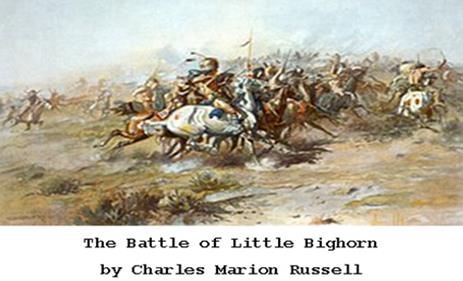
Having isolated Reno's force and driven them away from their encampment, the bulk of the Native warriors were free to pursue Custer. The route taken by Custer to his "Last Stand" remains a subject of debate. One possibility is that after ordering Reno to charge, Custer continued down Reno Creek to within about a half mile of the Little Bighorn, but then turned north and climbed up the bluffs, reaching the same spot to which Reno
Page 228
would soon retreat. From this point on the other side of the river, he could see Reno charging the village. Riding north along the bluffs, Custer could have descended into Medicine Tail Coulee. Some historians believe that part of Custer's force descended the coulee, going west to the river and attempted unsuccessfully to cross into the village. According to some accounts, a small contingent of Native American sharpshooters effectively opposed this crossing.
White Cow Bull claimed to have shot a leader wearing a buckskin jacket off his horse in the river. While no other Native American account supports this claim, if White Bull did shoot a buckskin clad leader off his horse, some historians have argued that Custer may have been seriously wounded by him. Some Native American accounts claim that besides wounding one of the leaders of this advance, a soldier carrying a company guidon was also hit. Troopers had to dismount to help the wounded men back onto their horses. The fact that either of the non-mutilation wounds to Custer's body, a bullet wound below the heart and a shot to the left temple, would have been instantly fatal casts doubt on his being wounded and then remounting.
Reports of an attempted fording of the river at Medicine Tail Coulee might explain Custer's purpose for Reno's attack, that is, a coordinated "hammer and anvil" maneuver, with Reno's
Page 229
holding the Native Americans at bay at the southern end of the camp, while Custer drove them against Reno's line from the north. Other historians have noted that if Custer did attempt to cross the river near Medicine Tail Coulee, he may have believed it was the north end of the Native American camp, only to discover that it was the middle. Some Native American accounts, however, place the Northern Cheyenne encampment and the north end of the overall village to the left, and south, of the opposite side of the crossing. The precise location of the north end of the village remains in seemingly eternal dispute, however.
In 1908, Edward Curtis, the famed ethnologist and photographer of the Native Americans, made a detailed personal study of the battle, interviewing many of those who had fought or taken part in it. First, he went over the ground covered by the troops with the three Crow scouts White Man Runs Him, Goes Ahead, and Hairy Moccasin, and then again with Two Moons and a party of Cheyenne warriors. He also visited the Lakota country and interviewed Red Hawk, "whose recollection of the fight seemed to be particularly clear." Then, he went over the battlefield once more with the three Crow scouts, but also accompanied by General Charles Woodruff "as I particularly desired that the testimony of these men might be considered by an experienced army officer."
Page 230
Finally, Curtis visited the country of the Arikara and interviewed the scouts of that tribe who had been with Custer's command. He found 44 and based on all the information he gathered, Curtis concluded that Custer had indeed ridden down the Medicine Tail Coulee and then towards the river where he probably planned to ford it. However, "the Native Americans had now discovered him and were gathered closely on the opposite side." They were soon joined by a large force of Sioux who, no longer engaging Reno, rushed down the valley. This was the beginning of their attack on Custer who was forced to turn and head for the hill where he would make his famous "last stand."
Thus, wrote Curtis; "Custer made no attack, the whole movement being a retreat."
Other Views of Custer's Actions at Minneconjou Ford Other historians claim that Custer never approached the river, but rather continued north across the coulee and up the other side, where he gradually came under attack. According to this theory, by the time Custer realized he was badly outnumbered, it was too late to retreat to the south where Reno and Benteen could have provided assistance. Two men from the 7th Cavalry, the young Crow scout Ashishishe, known in English as Curley, and the trooper Peter Thompson, claimed to have seen Custer engage the Native Americans. The accuracy of their recollections
Page 231
remains suspect; as accounts by battle participants and assessments by historians almost universally discredit Thompson's claim.
Archaeological evidence and reassessment of Native American testimony have led to a new interpretation of the battle. In the 1920s, battlefield investigators discovered hundreds of 45-70
shell cases along the ridge line known today as Nye-Cartwright Ridge, between South Medicine Tail Coulee and the next drainage at North Medicine Tail, also known as Deep Coulee. Some historians believe Custer divided his detachment into two, or possibly three battalions, retaining personal command of one while presumably delegating Captain George W. Yates to command the second.
Evidence from the 1920s supports the theory that at least one of the companies made a feint attack southwest from Nye-Cartwright Ridge straight down the center of the "V" formed by the intersection at the crossing of Medicine Tail Coulee on the right and Calhoun Coulee on the left. The intent may have been to relieve pressure on Reno's detachment, according to the Crow scout Curley, possibly viewed by both Mitch Bouyer and Custer, by withdrawing the skirmish line into the timber near the Little Bighorn River. Had the US troops come straight down Medicine Tail Coulee, their approach to the Minneconjou Crossing and the
Page 232
northern area of the village would have been masked by the high ridges running on the northwest side of the Little Bighorn River.
That they might have come southwest, from the center of Nye-Cartwright Ridge, seems to be supported by Northern Cheyenne accounts of seeing the approach of the distinctly white colored horses of Company E, known oddly as the Grey Horse Company. Its approach was seen by Native Americans at that end of the village. Behind them, a second company, further up on the heights, would have provided long range cover fire. Warriors could have been drawn to the feint attack, forcing the battalion back towards the heights, up the north fork drainage, away from the troops providing cover fire above. The covering company would have moved towards a reunion, delivering heavy volley fire and leaving the trail of expended cartridges discovered 50 years later.
Custer’s Last Stand
In the end, the hilltop to which Custer had moved was probably too small to accommodate all of the survivors and wounded. Fire from the southeast made it impossible for Custer's men to secure a defensive position all around Last Stand Hill where the soldiers put up their most dogged defense. According to Lakota
Page 233
accounts, far more of their casualties occurred in the attack on Last Stand Hill than anywhere else. The extent of the soldiers'
resistance indicated they had more than a few doubts about their prospects for survival. According to Cheyenne and Sioux testimony, the command structure rapidly broke down, although smaller "last stands" were apparently made by several groups.
Custer's remaining companies, E, F, and half of C, were soon killed.
By almost all accounts, the Lakota annihilated Custer's force within an hour of engagement. David Humphreys Miller, who between 1935 and 1955 interviewed the last Lakota survivors of the battle, wrote that the Custer fight lasted less than one half hour. Other Native accounts said the fighting lasted only
"as long as it takes a hungry man to eat a meal." The Lakota asserted that Crazy Horse personally led one of the large groups of warriors who overwhelmed the cavalrymen in a surprise charge from the northeast, causing a breakdown in the command structure and panic among the troops. Many of these men threw down their weapons while Cheyenne and Sioux warriors rode them down,
"counting coup" with lances, coup sticks, and quirts. Some Native accounts recalled this segment of the fight as a "buffalo run."
Page 234
Captain Frederick Benteen, battalion leader of Companies D, H
and K, on the 18th day of the Reno Court of Inquiry gave his observations on the Custer battlefield on June 27, 1876; “I went over the battlefield carefully with a view to determine how the battle was fought. I arrived at the conclusion then, as I have now, that it was a rout, a panic, until the last man was killed.
There was no line formed on the battlefield. You can take a handful of corn and scatter it over the floor, and make just such lines, but there were none. The only approach to a line was where 5 or 6 dead horses were found at equal distances, like skirmishers, part of Lt. Calhoun's Company L. Ahead of those 5
or 6 dead horses there were 5 or 6 men at about the same distances, showing that the horses were killed and the riders jumped off and were all heading to get where General Custer was.
That was the only approach to a line on the field. There were more than 20 troopers killed there to the right. There were 4 or 5 at one place, all within a space of 20 to 30 yards. That was the condition all over the field and in the gorge. I think, in all probability, that the men turned their horses loose without any orders to do so. Many orders might have been given, but few obeyed. I think that they were panic stricken. It was a rout, as I said before.”
Page 235
A Brulé Sioux warrior stated; "In fact, Hollow Horn Bear believed that the troops were in good order at the start of the fight, and kept their organization even while moving from point to point." Red Horse, an Oglala Sioux warrior, commented; "Here at Last Stand Hill the soldiers made a desperate fight." One Hunkpapa Sioux warrior, Moving Robe, noted that; "It was a hotly contested battle," while another, Iron Hawk, stated; "The Native Americans pressed and crowded right in around Custer Hill. But the soldiers weren't ready to die. We stood there a long time."
In a letter from February 21, 1910, Private William Taylor, Company M, 7th Cavalry, wrote; "Reno proved incompetent and Benteen showed his indifference. I will not use the uglier words that have often been in my mind. Both failed Custer and he had to fight it out alone."
Recent archaeological work at the battlefield indicates that officers on Custer Hill restored some tactical control. E
Company rushed off Custer Hill toward the Little Bighorn River but failed to reach it, which resulted in the destruction of that company. This left about 50-60 men, mostly from F Company and the staff, on Last Stand Hill. The remainder of the battle took on the nature of a running fight. Modern archaeology and historical Native American accounts indicate that Custer's force may have been divided into three groups, with the Native
Page 236
Americans attempting to prevent them from effectively reuniting.
Native American accounts describe warriors, including women, running up from the village to wave blankets in order to scare off the soldiers' horses. One 7th Cavalry trooper claimed to have found several stone mallets consisting of a round cobble weighing 8–10 pounds with a rawhide handle, which he believed had been used by the Native American women to finish off the wounded. Fighting dismounted, the soldiers' skirmish lines were overwhelmed. Army doctrine would have called for one man in four to be a horseholder behind the skirmish lines and, in extreme cases, one man in eight. Later, the troops would have bunched together in defensive positions and in which case would have been alleged to have shot their remaining horses as cover. As individual troopers were wounded or killed, initial defensive positions would have been abandoned as untenable.
Under threat of attack, the first US soldiers on the battlefield three days later hurriedly buried the troopers in shallow graves, more or less where they had fallen. A couple of years after the battle, markers were placed where men were believed to have fallen, so the placement of troops has been roughly construed. The troops evidently died in several groups, including on Custer Hill, around Captain Myles Keogh, and strung out towards the Little Bighorn River.
Page 237
According to Native American accounts, about forty men on Custer Hill made a desperate stand around Custer, delivering volley fire. The great majority of the Native American casualties were probably suffered during this closing segment of the battle, as the soldiers and Native Americans on Calhoun Ridge were more widely separated and traded fire at greater distances for most of their portion of the battle than did the soldiers and Native Americans on Custer Hill.
Apparently in an attempt to debunk and erase more or less accepted history, modern documentaries suggest that there may not have been a "Last Stand," as traditionally portrayed in popular culture. Instead, archaeologists suggest that in the end, Custer's troops were not surrounded but rather overwhelmed by a single charge. This scenario corresponds to several Native American accounts stating Crazy Horse's charge swarmed the resistance, with the surviving soldiers fleeing in panic, while he continued his heroic charge which slew thirty-one of them.
Many of these troopers may have ended up in a deep ravine 300 to 400 yards away from what is known today as Custer Hill. At least 28 bodies, the most common number associated with burial witness testimony, including that of scout Mitch Bouyer, were discovered in or near that gulch, their deaths possibly the battle's final actions.
Page 238
Although the marker for Mitch Bouyer was found accurate through archaeological and forensic testing of remains, it is some 65
yards away from Deep Ravine. Historian Douglas Scott theorized that the "Deep Gulch" or "Deep Ravine" might have included not only the steep sided portion of the coulee, but the entire drainage including its tributaries, in which case the bodies of Bouyer and others were found where eyewitnesses had said they were seen.
Other archaeological explorations done in Deep Ravine found no human remains associated with the battle. Over the years since the battle, skeletal remains that were reportedly recovered from the mouth of the Deep Ravine by various sources have been repatriated to the Little Bighorn National Monument. According to Scott, it is likely that in the 108 years between the battle and Scott's excavation efforts in the ravine, geological processes caused many of the remains to become unrecoverable.
For example, near the town of Garryowen, portions of the skeleton of a trooper killed in the Reno Retreat were recovered from an eroding bank of the Little Bighorn, while the rest of the remains had apparently been washed away by the changing course of the river.
Whatever the precise detail, after the Custer force was soundly defeated, the Lakota and Northern Cheyenne regrouped to attack
Page 239
Reno and Benteen. The fight continued until dark, approximately 9:00 PM, and for much of the next day, with the outcome in doubt. Reno credited Benteen's luck with repulsing a severe attack on the portion of the perimeter held by Companies H and M. On June 27, the column under General Terry approached from the north, and the Natives drew off in the opposite direction.
The Crow scout White Man Runs Him was the first to tell General Terry's officers that Custer's force had "been wiped out." Reno and Benteen's wounded troops were given what treatment was available at that time. Five later died of their wounds. One of the regiment's three surgeons had been with Custer's column, while another, Dr. DeWolf, had been killed during Reno's retreat. The only remaining doctor was Assistant Surgeon Henry R. Porter.
The first to hear the news of the Custer defeat were those aboard the steamboat Far West, which had brought supplies for the expedition. Curley, one of Custer's scouts, rode up to the steamboat and tearfully conveyed the information to Grant Marsh, the boat's captain, and army officers. Marsh converted the Far West into a floating field hospital to carry the 52 wounded from the battle to Fort Lincoln. Traveling night and day, with a full head of steam, Marsh brought the steamer downriver to Bismarck, Dakota Territory, making the 710 mile run in the record time of
Page 240
54 hours and bringing the first news of the military defeat which came to be popularly known as the "Custer Massacre." The editor of the Bismarck paper kept the telegraph operator busy for hours transmitting information to the “New York Herald,” for which he corresponded; though the “Herald” heldon to the information, apparently deeming it to be something the public would be better off not hearing. The news of the defeat arrived in the East as the US was observing its centennial. The Army began to investigate, although its effectiveness was hampered by a concern for survivors, and the reputation of the officers.
Custer's wife, Elizabeth Bacon Custer, in particular, guarded and promoted the ideal of him as the gallant hero, attacking any who cast an ill light on his reputation.
The Battle of the Little Bighorn had far reaching consequences for the Natives. It was the beginning of the end of the "Native American Wars" and has even been referred to as "the Native Americans' last stand" in the area. Within 48 hours of the battle, the large encampment on the Little Bighorn broke up into smaller groups because there was not enough game and grass to sustain a large congregation of people and horses.
Oglala Sioux Black Elk recounted the exodus this way; "We fled all night, following the Greasy Grass. My two younger brothers and I rode in a pony drag, and my mother put some young pups in
Page 241
with us. They were always trying to crawl out and I was always putting them back in, so I didn't sleep much."
The scattered Sioux and Cheyenne feasted and celebrated during July with no threat from soldiers. After their celebrations, many of the Natives returned to the reservation. Soon the number of warriors amounted to only about 600. Both Crook and Terry remained immobile for seven weeks after the battle, awaiting reinforcements and unwilling to venture out against the Sioux and Cheyenne until they had at least 2,000 men. Crook and Terry finally took the field against the Native forces in August.
General Nelson A. Miles took command of the effort in October 1876. In May 1877, Sitting Bull escaped to Canada. Within days, Crazy Horse surrendered at Fort Robinson, Nebraska. The long lasting Great Sioux War had ended with a whimper on May 7.
Crow warrior Two Leggings joined the US army for a short time after the defeat of Custer. Two Belly had given him and nearly 30 other Crows a lecture and explained how the Sioux, the Lakota branch in particular, had taken the hunting grounds of the Crow.
Two Belly said; “We should help the soldiers drive them back to their own country."
Ownership of the Black Hills, which had been a focal point of the 1876 conflict, was determined by an ultimatum issued by the
Page 242
Manypenny Commission, according to which the Sioux were required to cede the land this same federal government had ceded to them under the “Fort Laramie Treaty of 1868,” to the United States if they wanted the federal government to continue supplying rations to the reservations, after having decimated the buffalo population for nothing but waste. Threatened with forced starvation, the Natives ceded Paha Sapa to the United States, but the Sioux, strongly reflecting Crazy Horse’s stance, never signed onto or accepted the legitimacy of the transaction. They lobbied Congress to create a forum to decide their claim and subsequently litigated for 40 years. The United States Supreme Court in the 1980 decision regarding United States vs. Sioux Nation of Native Americans acknowledged that the United States had taken the Black Hills without just compensation. The Sioux refused the money subsequently offered and continue to insist on their right to occupy the land.
Putting the non-alignment of the Native American tribes in clear perspective, when the Crows got news from the battlefield, they went into grief. Crow woman Pretty Shield told how they were
"crying for son-of-the-morning-star, Custer, and his blue soldiers," With the defeat of Custer, it was still a real threat that the Lakotas would take over the eastern part of the Crow reservation and keep up the invasion. In the end, the army won
Crazy Horse
Page 243
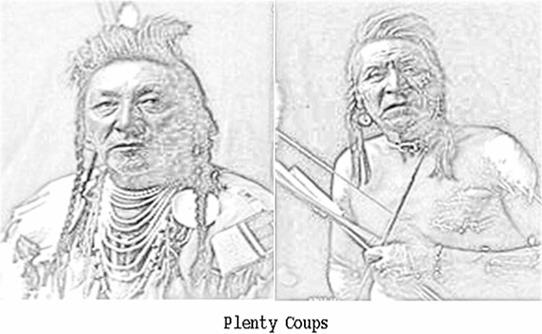
the Sioux war. Crow chief Plenty Coups recalled with amazement how his tribe now finally could sleep without fear for Lakota attacks; "This was the first time I had ever known such a condition." So much for Native American unity.
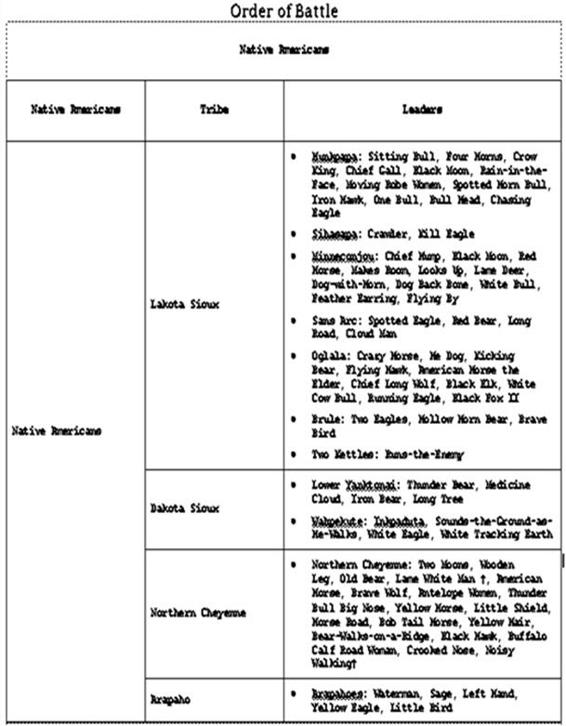
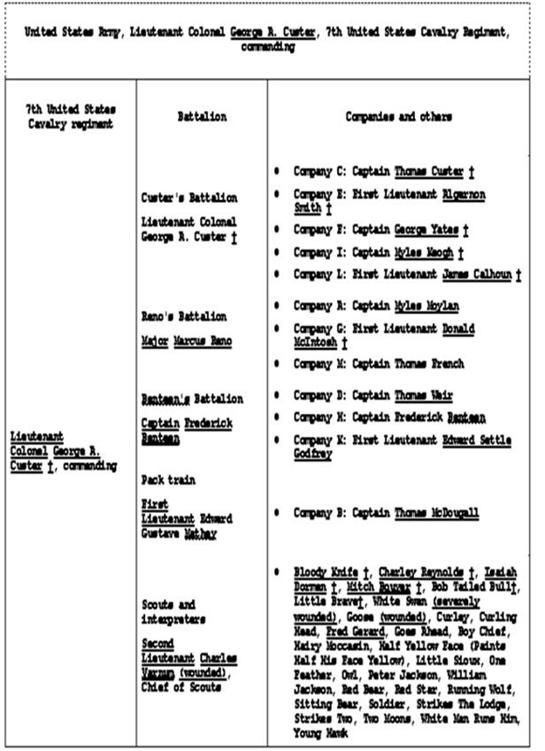
Another blurry ”tale of the tape“ immediately follows.
Crazy Horse
Page 244
Crazy Horse
Page 245
Page 246
Casualties
Native American Warriors
Estimates of Native American casualties have differed widely, from as few as 36 dead, taken from Native American listings of the dead by name, to as many as 300 as counted by US Army officials, who no doubt didn’t want to make it sound as badly as they had actually been beaten. Lakota chief Red Horse told Col.
W. H. Wood in 1877 that the Native Americans suffered 136 dead and 160 wounded during the battle. In 1881, Red Horse told Dr.
C. E. McChesney the same numbers but in a series of drawings done by Red Horse to illustrate the battle, he drew only sixty figures representing Lakota and Cheyenne casualties. Of those sixty figures, only thirty are portrayed with a conventional Plains Native American method of indicating death. In the last 140 years, historians have been able to identify multiple Native American names pertaining to the same individual, which has greatly reduced previously inflated numbers. You will recall that Native Americans regularly changed their names a few times over the course of a lifetime. Today a list of positively known casualties exists that lists 99 names, attributed and consolidated to 31 identified warriors.
Page 247
Native American Non-combatants
Six unnamed Native American women and four unnamed children are known to have been killed at the beginning of the battle during Reno's charge. Among them were two wives and three children of the Hunkpapa Leader Pizi, also known as Chief Gall.
7th Cavalry
The 7th Cavalry suffered 52 percent casualties. 16 officers and 242 troopers were killed or died of wounds. Every soldier of the five companies with Custer was killed, except for some Crow scouts and several troopers that had left that column before the battle or as the battle was starting. Among the dead were Custer's brothers Boston and Thomas, his brother-in-law James Calhoun, and his nephew Henry Reed.
In 1878, the army awarded 24 Medals of Honor to participants in the fight on the bluffs for bravery, most for risking their lives to carry water from the river up the hill to the wounded.
Few on the non-Native American side questioned the conduct of the enlisted men, but many questioned the tactics, strategy and conduct of the officers. Native American accounts spoke of soldiers' panic driven flight and suicide by those unwilling to fall captive to the Native Americans. While such stories were gathered by Thomas Bailey Marquis in a book in the 1930s, it was
Page 248
not published until 1976 because of the unpopularity of such assertions. Although soldiers may have said that they believed captives would be tortured, Native Americans usually killed men outright and took as captive for adoption only young women and children. Native American accounts also noted the bravery of soldiers who fought to the death.
Civilians Killed, Armed and Embedded Within the Army Boston Custer: brother of George and Thomas, forager for the 7th Cavalry.
Mark Kellogg: reporter.
Henry Armstrong Reed: Custer's nephew, herder for the 7th Cavalry.
Reconstitution of the 7th Cavalry
Beginning in July, the 7th Cavalry was assigned new officers and recruiting efforts began to fill the depleted ranks. The regiment, reorganized into eight companies, remained in the field as part of the Terry Expedition, based on the Yellowstone River at the mouth of the Bighorn and reinforced by Gibbon's column. On August 8, 1876, after Terry was further reinforced with the 5th Infantry, the expedition moved up Rosebud Creek in pursuit of the Lakota. It met with Crook's command, similarly
Page 249
reinforced, and the combined force, almost 4,000 strong, followed the Lakota trail northeast toward the Little Missouri River. Persistent rain and lack of supplies forced the column to dissolve and return to its varying starting points. The 7th Cavalry returned to Fort Abraham Lincoln to reconstitute. The regimental commander, Colonel Samuel D. Sturgis, returned from his detached duty in St. Louis, Missouri. Sturgis led the 7th Cavalry in the campaign against the Nez Perce in 1877.
Expansion of the US Army
The US Congress authorized appropriations to expand the Army by 2,500 men to meet the emergency after the defeat of the 7th Cavalry. For a session, the Democratic Party controlled House of Representatives abandoned its campaign to reduce the size of the Army. Word of Custer's fate reached the 44th United States Congress as a conference committee was attempting to reconcile opposing appropriations bills approved by the House and the Republican Senate. They approved a measure to increase the size of cavalry companies to 100 enlisted men on July 24. The committee temporarily lifted the ceiling on the size of the Army by 2,500 on August 15.
"Sell or Starve"
Page 250
As a result of the defeat in June 1876, Congress responded by attaching what the Sioux call the "sell or starve" rider to the Native American Appropriations Act of 1876, which cut off all rations for the Sioux until they terminated hostilities and ceded the Black Hills to the United States. The Agreement of 1877 officially took away Sioux land and permanently established Native American reservations.
Reno's Conduct
The Battle of the Little Bighorn was the subject of an 1879 US
Army Court of Inquiry in Chicago, held at Reno's request, during which his conduct was “scrutinized.” Some testimony by non-Army officers suggested that he was drunk and a coward. The court found Reno's conduct to be without fault. After the battle, Thomas Rosser, James O'Kelly, and others continued to question the conduct of Reno due to his hastily ordered retreat.
Defenders of Reno at the trial noted that, while the retreat was disorganized, Reno did not withdraw from his position until it became apparent that he was outnumbered and outflanked by the Native Americans. Contemporary accounts also point to the fact that Reno's scout, Bloody Knife, was shot in the head, spraying him with blood, possibly increasing Reno’s panic and distress, as if such events were unusual in war, and not a reflection upon the purveyor’s competence.
Page 251
Custer's errors
General Terry and others claimed that Custer made strategic errors from the start of the campaign. For instance, he refused to use a battery of Gatling guns and turned down General Terry's offer of an additional battalion of the 2nd Cavalry. Custer believed that the Gatling guns would impede his march up the Rosebud and hamper his mobility. His rapid march en route to the Little Bighorn averaged nearly 30 miles a day, so his assessment appears to have been accurate. Custer planned "to live and travel like Native Americans; in this manner the command will be able to go wherever the Native Americans can," he wrote in his
“Herald” dispatch.
By contrast, each Gatling gun had to be hauled by four horses, and soldiers often had to drag the heavy guns by hand over obstacles. Each of the heavy, hand cranked weapons could fire up to 350 rounds a minute, an impressive rate, but they were known to jam frequently. During the Black Hills Expedition two years earlier, a Gatling gun had turned over, rolled down a mountain, and shattered to pieces. Lieutenant William Low, commander of the artillery detachment, was said to have almost wept when he learned he had been excluded from the strike force.
Page 252
Custer arrogantly and foolishly believed and said that the 7th Cavalry could handle any Native American force and that the addition of the four companies of the 2nd would not alter the outcome. When offered the 2nd Cavalry, he reportedly replied that the 7th "could handle anything." There is evidence that Custer suspected that he would be outnumbered by the Native Americans, although he did not know by how much. By dividing his forces, Custer could have caused the defeat of the entire column, had it not been for Benteen's and Reno's linking up to make a desperate yet successful stand on the bluff above the southern end of the camp.
The historian James Donovan believed that Custer's dividing his force into four smaller detachments, including the pack train, can be attributed to his inadequate reconnaissance. He also ignored the warnings of his Crow scouts and Charley Reynolds. By the time the battle began, Custer had already divided his forces into three battalions of differing sizes, of which he kept the largest. His men were widely scattered and unable to support each other. Wanting to prevent any escape by the combined tribes to the south, where they could disperse into different groups, Custer believed that an immediate attack on the south end of the camp was the best course of action.
Admiration for Custer
Page 253
Criticism of Custer was not universal. While investigating the battlefield, Lieutenant General Nelson A. Miles wrote in 1877;
"The more I study the moves here on the Little Bighorn, the more I have admiration for Custer." Facing major budget cutbacks, the US Army wanted to avoid bad press and found ways to exculpate Custer. They blamed the defeat on the Native Americans' alleged possession of numerous repeating rifles and the overwhelming numerical superiority of the warriors.
The widowed Elizabeth Bacon Custer, who never remarried, wrote three popular books in which she fiercely protected her husband's reputation. She lived until 1933, hindering much serious research until most of the evidence was long gone. In addition, Captain Frederick Whittaker's 1876 book idealizing Custer was hugely successful. Custer, as a heroic officer fighting valiantly against savage forces was an image popularized in Wild West extravaganzas hosted by showman
"Buffalo Bill" Cody, Pawnee Bill, and others. It was not until over half a century later that historians took another look at the battle and Custer's decisions that led to his death and loss of half his command and found much to criticize.
Gatling Gun Controversy
Page 254
General Alfred Terry's Dakota column included a single battery of artillery, comprising two 3 inch Ordnance rifles and two Gatling guns. According to historian Evan S. Connell, the precise number of Gatlings has not been established; either two or three. Custer's decision to reject Terry's offer of the rapid fire Gatlings has raised questions among historians as to why he refused them and what advantage their availability might have conferred on his forces at the Battle of the Little Bighorn.
One factor concerned Major Marcus Reno's recent 8 day reconnaissance-in-force of the Powder Tongue - Rosebud Rivers, June 10 to 18. This deployment had demonstrated that artillery pieces mounted on gun carriages and hauled by horses no longer fit for cavalry mounts, so called condemned horses, were cumbersome over mixed terrain and vulnerable to breakdowns.
Custer, valuing the mobility of the 7th Cavalry and recognizing Terry's acknowledgment of the regiment as "the primary strike force" preferred to remain unencumbered by the Gatling guns.
Custer insisted that the artillery was superfluous to his success, in that the 7th Cavalry alone was sufficient to cope with any force they should encounter, informing Terry; "The 7th can handle anything it meets." In addition to these practical concerns, a strained relationship with Major James Brisbin induced Custer's polite refusal to integrate Brisbin's Second
Page 255
Cavalry unit and the Gatling guns into his strike force, as it would disrupt any hierarchical arrangements that Custer presided over.
Historians have acknowledged the firepower inherent in the Gatling gun. They were capable of firing 350 45-70 caliber rounds per minute. Jamming caused by black powder residue could lower that rate, raising questions as to their reliability under combat conditions. However the question may be asked that if Gatling guns were not for combat conditions, what were they for?
Researchers have further questioned the effectiveness of the guns under the tactics that Custer was likely to face with the Lakota and Cheyenne warriors. The Gatlings, mounted high on carriages, required the battery crew to stand upright during its operation, making them easy targets for Lakota and Cheyenne sharpshooters.
Historian Robert M. Utley, in a section entitled "Would Gatling Guns Have Saved Custer?" presents two judgments from Custer's contemporaries. General Henry J. Hunt, expert in the tactical use of artillery in Civil War, stated that Gatlings "would probably have saved the command," whereas General Nelson A.
Miles, participant in the Great Sioux War declared "Gatlings were useless for Native American fighting." Nineteenth century
Page 256
“expert” opinions were as consistent and as helpful as they are in the twenty-first. Is the reader surprised?
Weapons
Lakota and Cheyenne
The Lakota and Cheyenne warriors that opposed Custer's forces possessed a wide array of weaponry, from war clubs and lances to the most advanced firearms of the day. The typical firearms carried by the Lakota and Cheyenne combatants were muzzleloaders, more often a cap lock smoothbore, the so called Native American trade musket or Leman guns distributed to Native Americans by the US government at treaty conventions. Less common were surplus rifled muskets of American Civil War vintage such as the Pattern 1853 Enfield and Springfield Model 1861.
Metal cartridge weapons were prized by Native combatants, such as the Henry and the Spencer lever action rifles, as well as Sharps breechloaders. The Lakota and Cheyenne warriors also utilized bows and arrows. Effective up to 30 yards, the arrows could readily maim or disable an opponent.
Sitting Bull's forces had no assured means to supply themselves with firearms and ammunition. Nonetheless, they could usually procure these through post traders, licensed or unlicensed, and from gunrunners who operated in the Dakota Territory; "A horse
Page 257
or a mule for a repeater ... buffalo hides for ammunition."
Custer's highly regarded guide, "Lonesome" Charley Reynolds, informed his superior in early 1876 that Sitting Bull's forces were amassing weapons, including numerous Winchester repeating rifles and abundant ammunition.
Of the guns owned by Lakota and Cheyenne fighters at the Little Bighorn, approximately 200 were repeating rifles, corresponding to about 1 of 10 of the encampment's two thousand able bodied fighters who participated in the battle.
7th Cavalry
The troops under Custer's command carried two regulation firearms authorized and issued by the US Army in early 1876; the breech loading, single shot Springfield Model 1873 carbine, and the 1873 Colt single action revolver. The regulation Model 1860
saber or "long knives" were not carried by troopers upon Custer's order. Except for a number of officers and scouts who opted for personally owned and more expensive rifles and handguns, the 7th Cavalry was uniformly armed.
Ammunition allotments provided 100 carbine rounds per trooper, carried on a cartridge belt and in saddlebags on their mounts.
An additional 50 carbine rounds per man were reserved on the
Page 258
pack train that accompanied the regiment to the battlefield.
Each trooper had 24 rounds for his Colt handgun.
The opposing forces, though not equally matched in the number and type of arms, were comparably outfitted, and neither side held an overwhelming advantage in weaponry.
Lever Action Repeaters vs. Single Shot Breechloaders Two hundred or more Lakota and Cheyenne combatants are known to have been armed with Henry, Winchester, or similar lever action repeating rifles at the battle. Virtually every trooper in the 7th Cavalry fought with the single shot, breech loading Springfield carbine and the Colt revolver.
Historians have asked whether the repeating rifles conferred a distinct advantage to Sitting Bull's villagers that contributed to their victory over Custer's carbine armed soldiers.
Historian Michael L. Lawson offers a scenario based on archaeological collections at the "Henryville" site, which yielded plentiful Henry rifle cartridge casings from approximately twenty individual guns. Lawson speculates that though less powerful than the Springfield carbines, the Henry repeaters provided a barrage of fire at a critical point, driving Lieutenant James Calhoun's L Company from Calhoun Hill
Page 259
and Finley Ridge, forcing it to flee in disarray back to Captain Myles Keogh's I Company and leading to the disintegration of that wing of Custer's Battalion.
After exhaustive testing, including comparisons to domestic and foreign single shot and repeating rifles, the Army Ordnance Board, whose members included officers Marcus Reno and Alfred Terry, authorized the Springfield as the official firearm for the United States Army.
The Springfield, manufactured in a 45-70 long rifle version for the infantry and a 45-55 light carbine version for the cavalry, was judged a solid firearm that met the long term and geo-strategic requirements of the United States fighting forces.
Historian Mark Gallear claims that US government experts rejected the lever action repeater designs, deeming them ineffective in a clash with fully equipped European armies, or in case of an outbreak of another domestic civil conflict.
Gallear's analysis dismisses the allegation that rapid depletion of ammunition in lever action models influenced the decision in favor of the single shot Springfield. The Native American Wars are portrayed by Gallear as a minor theatre of conflict whose contingencies were unlikely to govern the selection of standard weaponry for an emerging industrialized nation. This “rationale”
Page 260
would seem more palatable if the government “experts” of the time were not also lobbyists and owners of the manufacturers of single shot weapons.
The Springfield carbine is praised for its "superior range and stopping power" by historian James Donovan, and author Charles M. Robinson reports that the rifle could be "loaded and fired much more rapidly than its muzzle loading predecessors, and had twice the range of repeating rifles such as the Winchester, Henry and Spencer."
Gallear points out that lever action rifles, after a burst of rapid discharge, still required a reloading interlude that lowered their overall rate of fire. Springfield breechloaders
"in the long run, had a higher rate of fire, which was sustainable throughout a battle." Specific numerical calculations are “conveniently” not disclosed.
The breechloader design patent for the Springfield's Erskine S.
Allin trapdoor system was owned by the US government and the firearm could be easily adapted for production with existing machinery at the Springfield Armory in Massachusetts. At time when funding for the post-war Army had been slashed, the prospect for economical production influenced the Ordnance Board member selection of the Springfield option.
Page 261
Malfunction of the Springfield Carbine Extractor Mechanism Whether the reported malfunction of the Model 1873 Springfield carbine issued to the 7th Cavalry contributed to their defeat has been debated for years. That the weapon experienced jamming of the extractor is not contested, but its contribution to Custer's defeat is considered negligible. This conclusion is supported by evidence from archaeological studies performed at the battlefield, where the recovery of Springfield cartridge casings, bearing tell-tale scratch marks indicating manual extraction, were rare. The flaw in the ejector mechanism was known to the Army Ordnance Board at the time of the selection of the Model 1873 rifle and carbine, and was not considered a significant shortcoming in the overall worthiness of the shoulder arm. With the ejector failure in US Army tests as low as 1:300, the Springfield carbine was vastly more reliable than the muzzle loading Springfields used in the Civil War.
Gallear addresses the post-battle testimony concerning the copper 45-55 cartridges supplied to the troops in which an officer is said to have cleared the chambers of spent cartridges for a number of Springfield carbines. This testimony of widespread fusing of the casings offered to the Chief of Ordnance at the Reno Court of Inquiry in 1879 conflicts with the archaeological evidence collected at the battlefield. Field data
Page 262
showed that possible extractor failures occurred at a rate of approximately 1:30 firings at the Custer Battlefield and at a rate of 1:37 at the Reno-Benteen Battlefield.
Historian Thom Hatch observes that the Model 1873 Springfield, despite the known ejector flaw, remained the standard issue shoulder arm for US troops until the early 1890s.
Survivor Claims
Soldiers under Custer's direct command were annihilated on the first day of the battle, except for three Crow scouts and several troopers, including John Martin, who had left that column before the battle. One surviving Crow scout, Curly, was the only survivor to leave after the battle had begun; though rumors of other survivors persisted for years.
Over 120 men and women would come forward over the course of the next 70 years claiming they were "the lone survivor" of Custer's Last Stand. The phenomenon became so widespread that one historian remarked; "Had Custer had all of those who claimed to be 'the lone survivor' of his two battalions he would have had at least a brigade behind him when he crossed the Wolf Mountains and rode to the attack."
Page 263
The historian Earl Alonzo Brininstool suggested he had collected at least seventy "lone survivor" stories. Michael Nunnally, an amateur Custer historian, wrote a booklet describing thirty such accounts. W. A. Graham claimed that even Libby Custer received dozens of letters from men, in shocking detail, about their sole survivor experience. At least 125 alleged "single survivor"
tales have been confirmed in the historical record as of July 2012.
Frank Finkel, from Dayton, Washington, had such a convincing story that historian Charles Kuhlman believed the alleged survivor, going so far as to write a lengthy defense of Finkel's participation in the battle. Douglas Ellison, mayor of Medora, North Dakota, and an amateur historian, also wrote a book in support of the veracity of Finkel's claim, but most scholars reject it, despite this revisionist genre’s burgeoning popularity.
Some of these survivors held a form of celebrity status in the United States, among them Raymond Hatfield "Arizona Bill"
Gardner and Frank Tarbeaux. A few even published autobiographies that detailed their deeds at the Little Bighorn.
Contributing to the expansion, a modern historian, Albert Winkler, has asserted that there is some evidence to support the
Page 264
case of Private Gustave Korn being a genuine survivor of the battle. "While nearly all of the accounts of men who claimed to be survivors from Custer's column at the Battle of the Little Bighorn are fictitious, Gustave Korn's story is supported by contemporary records." Several contemporary accounts note that Korn's horse bolted in the early stages of the battle, whilst he was serving with Custer's “I” company, and that he ended up joining Reno's companies making their stand on Reno Hill.
Almost as soon as men came forward implying or directly pronouncing their unique role in the battle, there were others who were equally opposed to any such claims. Theodore Goldin, a battle participant who later became a “controversial” historian on the event, controversial ostensibly because he was limited to having only experienced and seen what happened at the event in question, wrote in regard to Charles Hayward's claim to have been with Custer and taken prisoner; “The Native Americans always insisted that they took no prisoners. If they did, a thing I firmly believe, they were tortured and killed the night of the 25th. As an evidence of this I recall the three charred and burned heads we picked up in the village near the scene of the big war dance, when we visited the village with Capt.
Benteen and Lieut. Wallace on the morning of the 27th. I'm sorely afraid that we will have to class Hayward's story, like
Page 265
that of so many others, as pure, unadulterated BS. As a clerk at headquarters I had occasion to look over the morning reports of at least the six troops at Lincoln almost daily, and never saw his name there, or among the list of scouts employed from time to time. I am hoping that someday all of these damned fakers will die and it will be safe for actual participants in the battle to admit and insist that they were there, without being branded and looked upon as a lot of damned liars. Actually, there have been times when I have been tempted to deny that I ever heard of the 7th Cavalry, much less participated with it in that engagement. My Medal of Honor and its inscription have served me as proof positive that I was at least in the vicinity at the time in question, otherwise I should be tempted to deny all knowledge of the event.”
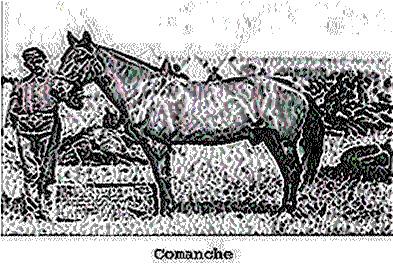
The only documented and verified survivor of Custer's command, having been actually involved in Custer's part of the battle, was Captain Keogh's horse, Comanche. The wounded horse was discovered on the battlefield by General Terry's troops.
Crazy Horse
Page 266
Although other cavalry mounts survived, they had been taken by the Native Americans. Comanche eventually was returned to the fort and became the regimental mascot. Several other badly wounded horses were found and killed at the scene. Writer Evan S. Connell noted in “Son of the Morning Star;” “Comanche was reputed to be the only survivor of the Little Bighorn, but quite a few Seventh Cavalry mounts survived, probably more than one hundred, and there was even a yellow bulldog. Comanche lived on another fifteen years. When he died, he was stuffed and to this day remains in a glass case at the University of Kansas. So, protected from moths and souvenir hunters by his humidity controlled glass case, Comanche stands patiently, enduring
Page 267
generation after generation of undergraduate jokes. The other horses are gone, and the mysterious yellow bulldog is gone, which means that in a sense the legend is true. Comanche alone survived.”
Battlefield Preservation
The site of the battle was first preserved as a United States national cemetery in 1879 to protect the graves of the 7th Cavalry troopers. In 1946, it was re-designated as the Custer Battlefield National Monument, reflecting its association with Custer. In 1967, Major Marcus Reno was re-interred in the cemetery with honors, including an eleven gun salute. Beginning in the early 1970s, there was concern within the National Park Service over the name Custer Battlefield National Monument failing to adequately reflect the larger history of the battle between two cultures. Hearings on the name change were held in Billings on June 10, 1991, and during the following months Congress renamed the site the Little Bighorn Battlefield National Monument.
United States memorialization of the battlefield began in 1879
with a temporary monument to the US dead. In 1881, the current marble obelisk was erected in their honor. In 1890, marble
Page 268
blocks were added to mark the places where the US cavalry soldiers fell.
Nearly 100 years later, ideas about the meaning of the battle have become more inclusive. The United States government acknowledged that Native American sacrifices also deserved recognition at the site. The 1991 bill changing the name of the national monument also authorized a Native American Memorial to be built near Last Stand Hill in honor of Lakota and Cheyenne warriors. On Memorial Day 1999, in consultation with tribal representatives, the US added two red granite markers to the battlefield to note where Native American warriors fell. As of December 2006, a total of ten warrior markers have been added, three at the Reno–Benteen Defense Site and seven on the Little Bighorn Battlefield.
The Native American Memorial, themed "Peace Through Unity" is an open circular structure that stands 75 yards from the 7th Cavalry obelisk. Its walls have the names of some Native Americans who died at the site, as well as Native accounts of the battle. The open circle of the structure is symbolic, as for many tribes, the circle is sacred. The "spirit gate" window facing the Cavalry monument is symbolic as well, welcoming the dead cavalrymen into the memorial.
Page 269
In Popular Culture
John Mulvany's 1881 painting “Custer's Last Rally” was the first of the large images of this battle. It was 11 by 20 feet and toured the country for over 17 years.
In 1896, Anheuser-Busch commissioned from Otto Becker a lithographed, modified version of Cassilly Adams' painting
“Custer's Last Fight,” which was distributed as a print to saloons all over America.
Edgar Samuel Paxson completed his painting “Custer's Last Stand”
in 1899. In 1963 Harold McCracken, the noted historian and Western art authority, deemed Paxson's painting "the best pictoral representation of the battle" and "from a purely artistic standpoint one of the best if not the finest pictures which have been created to immortalize that dramatic event."
In 1926, “General Custer at the Little Bighorn” opened in movie theaters in the US, featuring Roy Stewart with John Beck as Custer.
The episode “The 7th” is made up of phantoms from the fifth season of the American television anthology series “The Twilight Zone,” which depicts modern American soldiers finding themselves near the battlefield and ultimately involved in the real battle.
Page 270
The 1964 novel, “Little Big Man” by American author Thomas Berger and 1970 film of the same name includes an account of the battle and portrays a manic and somewhat psychotic Custer, played by Richard Mulligan, realizing to his horror that he and his command are "being wiped out."
The 1994 video game “Live a Live” features this story in its Western chapter. The chapter villain O. Dio was actually the horse that was the sole survivor of the battle. Possession by vengeful spirits of the slain Union soldiers turned the horse into an evil man, as told by the town sheriff after defeating O.
Dio.
A fictionalized version of the battle is depicted in the 2006
video game “Age of Empires III: The War Chiefs.”
In 2007, the BBC presented a one hour drama documentary titled
“Custer's Last Stand.”
The May 2011 episode of the BBC Radio 4 program “In Our Time”
featured Melvyn Bragg and guests discussing the context, conditions, and consequences of the battle.
In 2017, historian Daniele Bolelli covered the battle and the events leading to it in a three part series on the "History on Fire" podcast.
Page 271
Page 272
12- Red Horse Drawings of Little Bighorn The Amazing Little Bighorn Drawings of Red Horse It's been a century and a half since the Battle of the Little Bighorn. Today, that day remains one of the most hotly contested events in our history by scholars and armchair historians. But, new discoveries bring new light. Following, you may visit that day through the eyes of a Lakota warrior who was there.
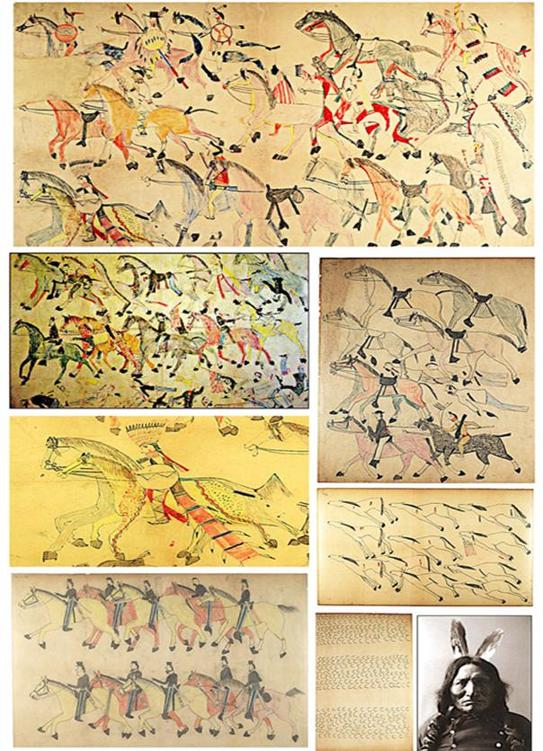
Crazy Horse
Page 273
Page 274
Many moons ago, George Armstrong Custer rode into battle against Native Americans and never rode out again. We don’t have photography of the 1876 Little Bighorn Battle, famously called
“Custer’s Last Stand.” But we do have eye witness accounts in spectacular drawings by Native Americans who fought there. These drawings, called “ledgers,” provide amazing clues to the many mysteries military scholars and frontier lovers have argued over exactly what happened for nearly a century and a half.
Among the most comprehensive and illustrative of these drawings is the work of Chief Red Horse, a Minneconjou Lakota Sioux warrior and chief. He lived from 1822-1907, and drew a collection of 42 ledgers in 1881 at the Cheyenne River Reservation, just south of Standing Rock Native American Reservation in north central South Dakota.
It turns out Red Horse was not only a great warrior, adept at handling a bow and a rifle. He was a darn good artist, too, adept with pen and ink and colored pencils. After the battle, he began drawing his memories of the battle, full of minute details and tantalizing clues to what might have really happened at the event the Sioux called the Battle of Greasy Grass.
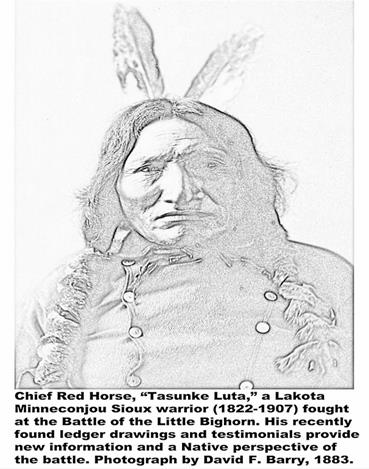
Crazy Horse
Page 275
But, the age old adage; “To the victor go the spoils” did not apply to the Lakota, Northern Cheyenne and Arapahoe who won the Battle of the Little Bighorn. Nor were they able to write or draw their accounts of their victory for mass consumption. The Native American versions of the battle did not come out until much later, trickling out in bits of quiet truth telling; in Red Horse’s case, 135 years later. They were overpowered largely by the blaring narratives of the US military and the main stream
Page 276
press, who sought to mythologize the vaunted golden haired general and his 7th Cavalry and painted glorious battle scenes of Custer at the center of the battle, killing dozens of Native warriors until his courageous end. Because the battle took place almost exactly midpoint in the year of the nation’s Centennial 1876 one hundredth anniversary, the defeat was especially shocking. It was supposed to be a year of celebration of American greatness and military power.
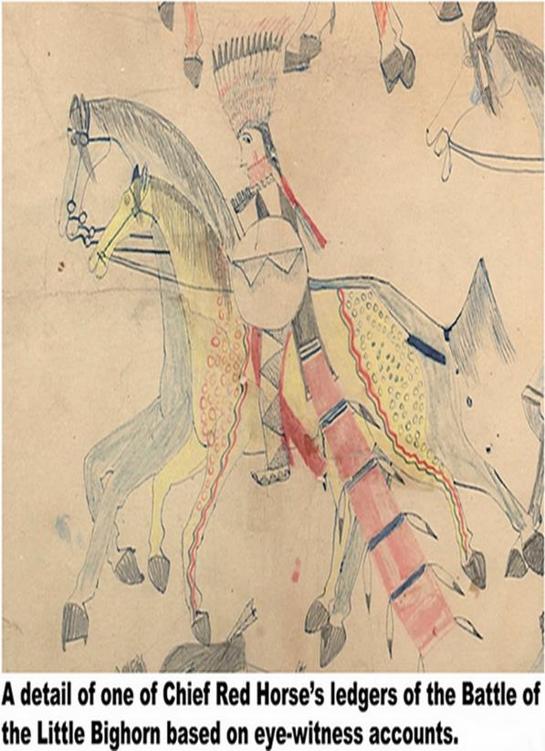
Crazy Horse
Page 277
Several years after the battle, Red Horse and other Native warriors who had fought at the Little Bighorn created illustrations with ink and graphite colored pencils on blank ledger paper that provided spectacular wordless but nevertheless powerful details of the carnage. In 1881, Dr. Charles E.
McChesney commissioned the works for the Smithsonian Bureau of
Page 278
Ethnology. He conducted a study of Native sign language and
“Picture Writing of the American Native Americans.”
Drawing colored pictures on animal hides, plant materials and stone had long been a popular art form among most Native American tribes. But the reservation era supplanted animal hides with ledger paper as a new medium for Native American artists.
The Bureau collected 42 drawings from Red Horse himself, as well as other art depictions from other warriors, of their eyewitness accounts of the battle. In addition, the Smithsonian recorded written accounts of their sign language and spoken testimonials that were translated into English.
But the pictorial and written accounts were collected, it seems, for artistic and academic purposes and not historic review. They were not shared with the public but sequestered away into large drawers in the Smithsonian Institution’s National Anthropological Archives and remained quietly moldering for 135
years.
Due in part to the digging of student research assistant, Stanford University senior Sarah Sadlier, and her professor, Scott D. Sagan, the ledgers from 1881 were rediscovered in the drawers, as well as the written testimonials. The ledgers began
Page 279
to be displayed at various art museums and art and history scholars pounced on the new and tantalizing information.
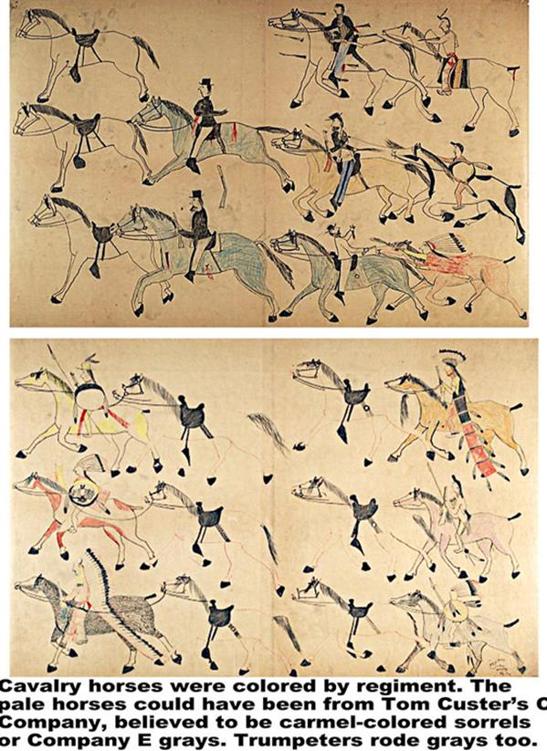
Crazy Horse
Page 280
Page 281
Red Horse’s 42 drawings provide dramatic and detailed portrayals of the Battle of the Little Bighorn. They diverge from the ledgers of later Native works that often assumed the standard White narrative about the battle. According to Sarah Sadlier, the Stanford student research assistant; “The ledger art produced about the Battle of the Little Bighorn was often Custer centric. Many Native artists didn’t want to draw what they saw because they feared retribution. There are no ledger art drawings I’ve seen that are so violent and true to the face of battle as Red Horse’s art.”
A popular portrayal of Custer following the military debacle at the Little Bighorn was one of nearly operatic glory; America’s greatest Native American fighter with tawny flowing locks wielding saber and gun, mounted in full regalia on his fiery charger, killing dozens of Native warriors at his feet before he finally fell in gallant splendor. On a minor accuracy note, Custer had in fact cut his famous hair before the battle. In fact, the most popular writer at the time, Walt Whitman, lionized Custer in a celebratory poem of Custer’s fall that was published in newspapers across the country; “Now ending well in death the splendid fever of thy deeds, I bring no dirge for it or thee, I bring a glad triumphal sonnet.”
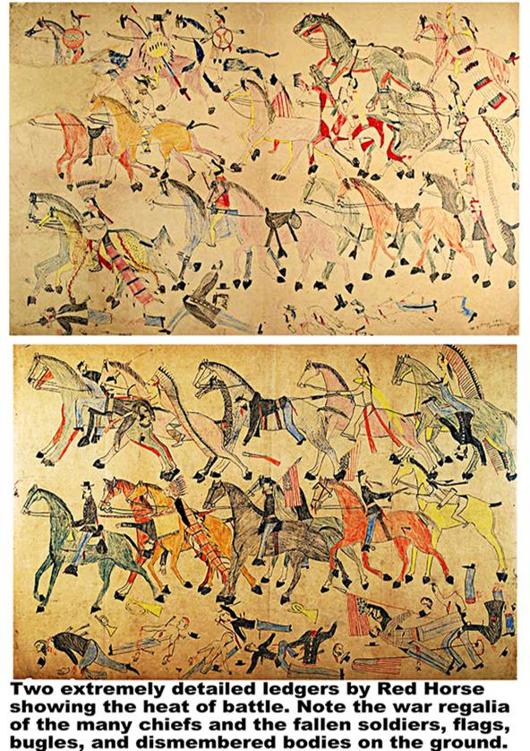
Crazy Horse
Page 282
Page 283
The vainglorious narrative of Custer in picturesque and triumphant stances upon the battlefield were not only continued, but popularly highlighted beginning in 1888 in Buffalo Bill Cody’s “Wild West Shows” which featured Native Americans and actors dressed as cavalry soldiers on horseback, reenacting
“Custer’s Last Stand.” That same story line continued well into the 20th century in film. Among the most dramatic Hollywood versions was Errol Flynn playing the dashing Custer in the 1941
hit, “They Died With Their Boots On.”
Such heroic portrayals are far from what most probably happened, although the facts will no doubt remain forever shrouded in emotion charged mythology of the hero and legend of the great American West. Debates about nearly every aspect of the Little Bighorn and Custer’s demise are hotly contested yet today, including if his body was mutilated or not, who killed him, how many if any Native Americans he killed, how he died and even if he killed himself rather than be taken prisoner and tortured.
There seems to be some consensus that Custer was shot two times, once in the left temple and once in the left chest near his heart. There is also consensus that he was later found naked on the battlefield. But from there, theories diverge wildly.
Page 284
The “official” version was that Custer was found sitting up placidly on the battlefield between the corpses of his men, shot twice, but not mutilated at all and not scalped. Many scholars have questioned this claim when so many soldiers, including Custer’s own brother, were mutilated beyond recognition. Tom Custer had to be identified through his tattoo. Other accounts and private letters of soldiers recounted that his left thigh had been slashed to the bone; some tribes practiced this mutilation to impede an enemy from mounting a horse in the afterlife, a finger had been severed, and an arrow shaft had been shoved into his penis. There were also many Native American claims that Cheyenne women had ran awls into his ears after he was dead, to improve his hearing in the afterlife because he had not heeded warnings of their chiefs on earth. There were even soldiers’ accounts that Custer had shot himself. It is most likely the “truth” will never be known.
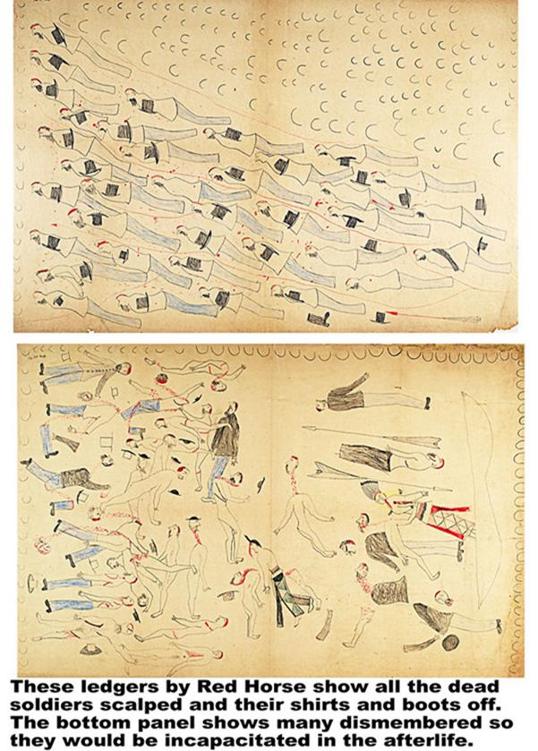
Crazy Horse
Page 285
Page 286
“The portrayal of Custer has been one of gallantry, charging in a heroic last stand,” Sadlier continues. “What people need to understand is the impact of his devastating tactics against women and children, completely against the rules of war. I think it’s very important people be aware of that. This is one little crack in the facade that’s been created around Lt. Col. Custer.”
When Red Horse’s drawings are presented chronologically, according to the unfolding events of the battle, they present a rare, retroactive eye witness narrative that often contradicts the White narrative long depicted as the truth about the Battle of the Little Bighorn.
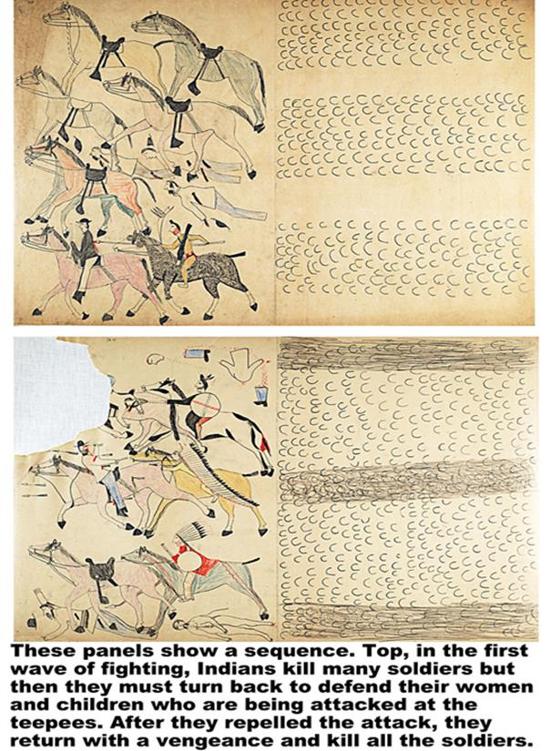
Crazy Horse
Page 287
Page 288
The chronology of the drawings presents first uniformed cavalry soldiers advancing on horseback from right to left. Then three rows of tipis, then Native combatants and a stampede of horse tracks. The bloody carnage that follows includes scene after scene of chaotic and horrific violence. Both horses and men fall to the ground, some catapulted in twisting frenzy.
The final drawings, the victorious Native warriors riding their horses bareback, carry what were once cavalry rifles and lead ammunition, galloping with riderless cavalry horses, identified by their saddles and generally darker horses, bays and chestnuts, from right to left across the page.
“What’s particularly fascinating about Red Horse’s drawings is they’re so honest in the brutal depictions of warfare,” says Sadlier. “In many ways Red Horse’s work is the most trustworthy sort of visual depiction we have of the Battle of Little Bighorn, a Little Bighorn that’s not Custer centric, one that nativizes from a participant who is a very respected person among the Lakota.” Red Horse’s depictions show the heroism of his fellow warriors, the brutal morass of war, and Native fighters in hand to hand combat against invaders of their land and killers of their people.
Page 289
What is also notable in Red Horse’s drawings is the complete absence of Lieutenant Colonel Custer. On that day, Custer was riding his sorrel thoroughbred, Vic, short for “victory,” that had a blaze and three white stockings. Nowhere in Red Horse’s drawing does such a horse appear, although his drawings are excruciatingly detailed, especially regarding the coloring of the horses and the different styles of facial hair of cavalry soldiers.
In one drawing, a White man in civilian clothes lies dead beside an upside down American flag. Red Horse differentiates garb and decoration. He also does not shrink from showing the gory aspect of battle; fallen men slashed, scalped, dismembered, and mutilated. He devotes an entire page to fallen horses.
Make no mistake, Custer was brave, at least up until the moment he saw all the Native American warriors. Either that or he was an arrogant fool. And, his own writings indicate he was a far more complicated man than depicted in his one dimensional warmongering, popular persona. But, as the British writer, John Le Carre, once wrote; “The sacrifice of a brave man cannot be justified by the pursuit of an unjust war.” Red Horse’s drawings show the flip side of the war against Native Americans and focus on the bravery and valor of Native warriors defending their land, their people and their way of life.
Page 290
Page 291
13– Crazy Horse’s Story of the Battle Crazy Horse's Story of the Battle
An Oglala Sioux's Account of the Battle of the Little Bighorn The most striking thing about the following Chicago newspaper account of Crazy Horse's surrender in 1877 is how absent Crazy Horse is from it.
Although it contains the closest thing we have to Crazy Horse's version of what happened at the Battle of the Little Bighorn, Crazy Horse never actually spoke with the “Chicago Times”
reporter who wrote the story. Instead, he communicated through a spokesman, Sioux war chief Horned Horse.
Imagine it. Crazy Horse, known as Tasunka Witko, "His Horse Is Crazy" to the Sioux, rode into Fort Robinson, Nebraska, on May 6, 1877 at the head of a procession of people and ponies that stretched on for miles, but somehow he managed to escape capture by the American press.
It's as if he was never there, at his own surrender, but that was typical of the press coverage of Crazy Horse, which might well have been consistent with his wishes, if not for the same reasons of Crazy Horse. In fact, Crazy Horse is the only great
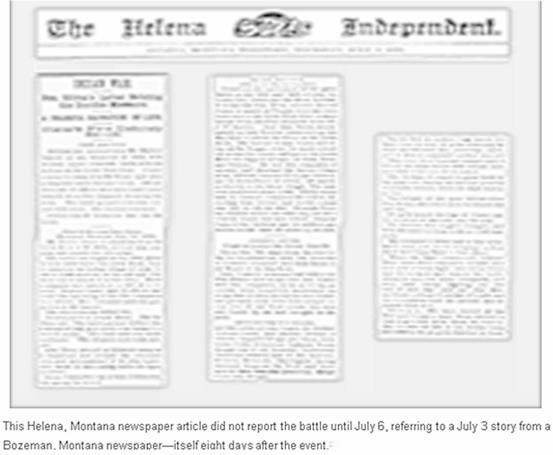
Crazy Horse
Page 292
figure in American history who never allowed his soul to be captured, as the Sioux conceived it, meaning he never allowed his image to be captured in life, either by photograph or artist's hand.
Newspaper reporting of the Little Bighorn Battle was similarly null and void. Perhaps, fearing that their customers did not want to be made aware of US Army defeats and Native American victories at Little Bighorn, they withheld reporting until a small paper wrote something of it, and even after waiting printed a diluted, if not absolutely false version, which also not once mentioned Crazy Horse.
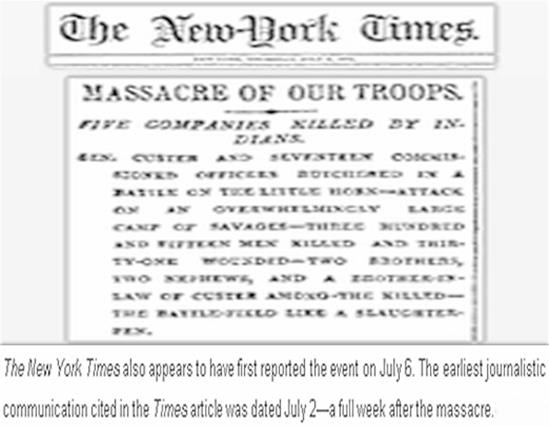
Crazy Horse
Page 293
The only evocative eye witness claimed description of Crazy Horse that appeared in the American media during his lifetime was an anonymous “New York Sun” reporter's 1877 observation that
"his eyes are exceedingly restless and impress the beholder fully as much as does his general demeanor."
On the battlefield, Crazy Horse's personal bravery was as legendary as his personal style was eccentric.
Phil Sheridan was one of the many who noted that Crazy Horse always led the initial charge and he wanted to be WAY out in front of his men; "He always leads and he never allows his men to close up on him. He is always 30 or 40 yards ahead of them."
Page 294
Crazy Horse’s visions had told him that he would not die in battle, and perhaps accordingly he showed no fear in them. His visions were prophetic.
As an anonymous Crow warrior put it; "We know Crazy Horse because whenever we have a fight, he is closer to us than to you."
At the Little Bighorn, Arapaho warrior Waterman said Crazy Horse was the bravest man he ever saw, and the Sioux warrior Little Soldier said; "The greatest fighter in the whole battle was Crazy Horse."
But personal bravery was really not the point for Crazy Horse.
Unlike many Sioux and Cheyenne warriors, who lived for the Homeric ecstasy of individualistic heroism on the battlefield, Crazy Horse was not there for ego, fame, applause, or for show.
He was there to seize control of the battle and kill the enemies of the Sioux and Cheyenne.
Called "the Napoleon among the Sioux" by Frank Grouard, Crazy Horse was the tactical genius of the Plains Native American Wars. He "liked to have his battles all planned out in his head," as Sioux war chief He Dog recalled, but actually he was most dangerous in fluid, rapidly evolving battlefield situations that put a premium on the commander's ability to innovate in the
Page 295
moment, and in this sense Crazy Horse resembled Confederate General Bedford Forrest, the most modern of the great 19th century American generals.
At the Battle of the Little Bighorn, it has been said more than once that Crazy Horse personally inflicted somewhere around 10
percent of the total American fatalities.
Crazy Horse was chosen commander-in-chief beginning with the Battle of the Platte River Bridge in 1865 and the Fetterman Massacre two years later, where Crazy Horse led the decoys for Red Cloud in a battle where all the American soldiers were killed. Crazy Horse developed tactics designed to isolate portions of the American force, which then could be destroyed piecemeal, like Royall on the Rosebud and Custer on the Little Bighorn.
Analytical and disciplined, Crazy Horse recognized early on that the Americans' greatest strength on the battlefield was their command structure and corps discipline. And so, while he devised tactics to break down that corps discipline, he also worked to instill it in his own men.
Crazy Horse could make a whole battle turn on the flash of a mirror in his hand as General George Crook learned at the Battle
Page 296
of the Rosebud, or the scream of his eagle bone war whistle as General Nelson Miles learned at the Battle of Wolf Mountain.
At the Little Bighorn, Crazy Horse led his Native American troops in charges that shattered the defenses of first Reno and then Custer.
Iron Hawk and Standing Bear described how Crazy Horse's first flanking charge of the battle "broke Reno's left wing" in the timber and sent his men fleeing for their lives, and Flying Hawk described how Crazy Horse personally rode among the American soldiers and "killed a lot of them with his war club." Then after he disengaged from Reno, Crazy Horse led his combined Sioux and Cheyenne force to flank Custer's retreating men.
Flying Hawk described how Crazy Horse "shot American soldiers as fast as he could load his gun" while he studied the situation.
He Dog said Crazy Horse led a charge which split Custer's right flank on the ridge above the river. In the deadly melee that followed, Red Feather described how Crazy Horse rode between the two split portions blowing on his wild, unearthly Eagle Horn.
Crazy Horse drew withering fire but escaped untouched.
And finally, near the end, Ohiyesa said Crazy Horse, Ice Bear and Little Horse led the final charge that annihilated the last Seventh Cavalry survivors on Last Stand Hill, and Flying Hawk
Page 297
remembered how Crazy Horse personally rode after, caught and killed an American soldier who tried to escape on horseback.
Altogether, the next day Horn Chips said Crazy Horse personally killed 31 Americans, devastating as a member of the joint Sioux and Cheyenne army, just as he was on the Rosebud nine days before, and according to Short Bull, Crazy Horse led the Native Americans' stately withdrawal from the Little Bighorn witnessed by Medal of Honor winner Charles Windolf.
The Battle of the Little Bighorn is often viewed as the apogee of Crazy Horse's military career, but actually it may have been the Battle of the Rosebud eight days prior that was probably his greatest leadership moment in the American wars of imperial conquest.
At the Little Bighorn, there was no Native American commander in chief. The Native Americans had not planned to fight. They simply reacted to Custer's unprovoked attack. So Crazy Horse was one of many more or less equal corps commanders that day, including Gall, Crow King, Red Horse, Rain In The Face, He Dog, Hump, Big Road, Spotted Elk, Lame White Man, Two Moon, and many other notables. His greatest accomplishment may well have been what he did as one of many warriors.
Page 298
On the Rosebud, however, Crazy Horse was commander-in-chief of the combined Sioux / Cheyenne force and planned the first strike. He and his men rode all night to catch General George Crook in the Valley of the Rosebud, and everyone who saw the Native Americans initial charge that day; 1,500 fiercely painted warriors coming at full gallop and full cry at the "best cavalry soldiers on earth," never forgot it for the rest of their lives.
It was a true "holy shit" moment because Crazy Horse caught Crook's main force off their horses at rest. Some had even loosened their saddle girths.
Crook survived Crazy Horse's opening charge on June 17, 1876
thanks to the fierce valor of his Crow and Shoshoni scouts, but Crazy Horse's deft use of the fleet and supremely mobile Sioux and Cheyenne cavalry, controlled by mirror flash from higher ground, ultimately secured a grand strategic victory for the free Sioux and Cheyenne, eliminating Crook's army from the subsequent action on the Little Bighorn, and setting up everything that was to come with Custer.
Just as Crazy Horse never allowed the Americans to capture his soul and not many can say that, even to this day, he was never defeated on the battlefield by the Americans.
Page 299
After fighting General Nelson Miles to a draw in his last battle at Wolf Mountain in January 1877, Crazy Horse decided that following Sitting Bull to Canada would only inflict more hardship on his people. So he surrendered, riding into Fort Robinson, Nebraska, with nearly 1,000 followers on May 6, 1877.
Crazy Horse's surrender was the raison for the story below, which originally ran in the May 7, 1877 “Chicago Times.” Barely four months later, the US Army aided by turncoat, jealous Lakotas-in-name-only, murdered Crazy Horse while he was in
"protective custody," part of a drumbeat of atrocities and war crimes committed by invading American soldiers against and also in conjunction with Native Americans that foreshadowed the atrocities and war crimes committed by invading American soldiers against Native populations in Afghanistan and Iraq and Pakistan and Syria a century and a half later.
In fact, this is a major theme in American history. This is how America was made, and how America made and continues to make mujahidin bent on fighting America to the death; for Crazy Horse was a holy warrior much more than any Islamic jihadist, possessing the combined dream power of all the elements, as the Sioux understood them, and his prophetic visions had shown them to him.
Page 300
"When he rode into battle," Kingsley M. Bray wrote in “Crazy Horse: A Lakota Life,” "Crazy Horse was not simply a naked warrior with a curious paint design; his being crackled with the awesome destructive powers of the total cosmos."
Chicago Times, May 7, 1877
CRAZY HORSE SPEAKS
THE CUSTER MASSACRE
AN NATIVE AMERICAN’S DESCRIPTION OF THE BATTLE
WITH CUSTER ON THE BIGHORN
AND ITS TRAGIC ENDING
Telegram to Chicago Times from Camp Robinson, Nebraska Your correspondent has obtained some very valuable information in regard to the Custer Massacre from Crazy Horse, through Horned Horse as his spokesman, which is authentic, and confirmed by other principal chiefs. I interviewed these chiefs this afternoon, Lieut. Clark arranging for the meeting, and William Hunter acting as interpreter, a man perfectly reliable and thoroughly conversant with the Native American language. This is the Native American version and the first published.
Page 301
The attack was made on the village by a strong force at 11
o'clock in the morning, at the upper end of the village. This was the force commanded by Maj. Reno, and very shortly afterward the lower end of the village was attacked by another strong force, that commanded by Custer.
The village was divided into seven different bands of Native Americans, each commanded by a separate chief and extended in nearly a straight line. The bands were in the order mentioned below, commencing from the lower end where Custer made the attack. First, the Uncpapas, under Sitting Bull; second, the Ogalallas, under Crazy Horse; third, the Minneconjous, under Fast Bull; fourth, the Sans Arcs, under Red Bear; fifth, the Cheyennes, under Ice Bear, their two principal chiefs being absent; sixth, the Santees and Yanktonias, under Red Point, of the Santees; seventh, the Blackfeet, under Scabby Head. The village consisted of eighteen hundred lodges, and at least four hundred wickayups, a lodge made of small poles and willows for temporary shelter. Each of the wickayups contained four young bucks, and the estimate made by Crazy Horse is that each lodge had from three to four warriors. Estimating at three made a fighting force of seven thousand Native Americans. This is the lowest estimate that can be made, for there were a good many Native Americans without shelter, hangers on, who fought when
Page 302
called upon, and the real number was much above seven thousand.
The attack was a surprise and totally unlooked for. When Custer made his charge the women, papooses, children, and in fact all that were not fighters made a stampede in a northerly direction.
Custer, seeing so numerous a body, mistook them for the main body of Native Americans retreating and abandoning their village, and immediately gave pursuit. The warriors in the village, seeing this, divided their forces into two parts, one intercepting Custer between their non-combatants and him, and the other getting in his rear. Outnumbering him as they did, they had him at their mercy, and the dreadful massacre ensued.
Horned Horse says the smoke and dust was so great that foe could not be distinguished from friend. The horses were wild with fright and uncontrollable. The Native Americans were knocking each other from their steeds, and it is an absolute fact that the young bucks in their excitement and fury killed each other, several dead Native Americans being found killed by arrows.
Horned Horse represented this hell of fire and smoke and death by intertwining his fingers and saying; "Just like this, Native Americans and white men." These chiefs say they suffered a loss of fifty-eight killed, and over sixty wounded. From their way of expressing it, I should judge that about 60 per cent of their wounded died.
Page 303
While this butchery was going on Reno was fighting in the upper part of the village, but did not get in so as to get surrounded, and managed to escape. They say had he got in as far, he would have suffered the same fate as Custer, but he retreated to the bluffs, and was held there until the Native Americans fighting Custer, comprising over half the village, could join the northern portion in besieging him. These Native Americans claim that but for the timely arrival of Gen. Terry they would have certainly got Reno. They would have surrounded and stormed him out or would have besieged and eventually captured him.
From what I know of Crazy Horse I should say that he no doubt is capable of conducting a siege. In both the Rosebud fight and the Custer massacre the Native Americans claim he rode unarmed in the thickest of the fight invoking the blessing of the great spirit in him; that if he was right he might be victorious and if wrong that he might be killed.
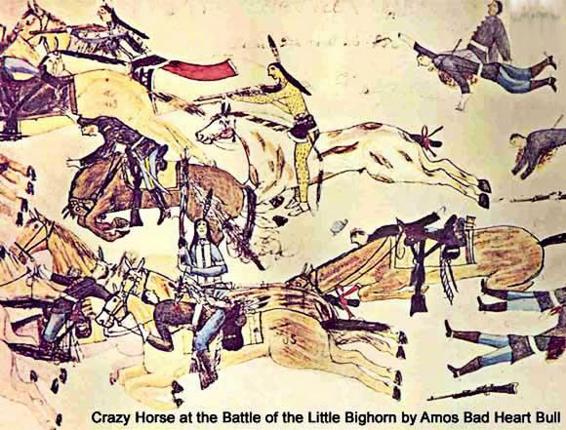
Crazy Horse
Page 304
He was right, victorious, masterful, and brave; only to be later done in through the partnership of sell-out Lakotas and the US
Army.
Page 305
14- Crazy Horse Quotes
Crazy Horse Quotes
“Hokahey! Today is a good day to die.” – said to inspire his warriors prior to battle.
“We preferred our own way of living. We were no expense to the government. All we wanted was peace and to be left alone.”
“Treat the earth well. It was not given to you by your parents; it was loaned to you by your children. We do not inherit the earth from our ancestors, we borrow it from our children.”
“I see a time of Seven Generations when all the colors of mankind will gather under the Sacred Tree of Life and the whole earth will become One Circle again.”
“Upon suffering beyond suffering: the Red Nation shall rise again and it shall be a blessing for a sick world. A world filled with broken promises, selfishness and separations. A world longing for light again. I see a time of Seven Generations when all the colors of mankind will gather under the Sacred Tree of Life and the whole earth will become one circle again.”
Page 306
“I salute the light within your eyes where the whole universe dwells. For when you are at that center within you and I am at that place within me, we shall be one.”
“One does not sell the earth upon which the people walk.”
“My lands are where my dead lie buried.”
“At my death paint my body with red paint and plunge it into fresh water to be restored back to life, otherwise my bones will be turned into stone and my joints into flint in my grave, but my spirit will rise.”
“My friend, why should you wish to shorten my life by taking from me my shadow?” – said to US Army photographer Dr. Valentine T. McGillycuddy.
“Another White man's trick! Let me go! Let me die fighting!!!!”
“My friend, I do not blame you for this. Had I listened to you this trouble would not have happened to me. I was not hostile to the White men. Sometimes my young men would attack the Native Americans who were their enemies and took their ponies. They did it in return. We had buffalo for food, and their hides for clothing and for our tepees. We preferred hunting to a life of idleness on the reservation, where we were driven against our will. At times we did not get enough to eat and we were not
Page 307
allowed to leave the reservation to hunt. We preferred our own way of living. We were no expense to the government. All we wanted was peace and to be left alone. Soldiers were sent out in the winter, they destroyed our villages. The "Long Hair"
[Custer] came in the same way. They say we massacred him, but he would have done the same thing to us had we not defended ourselves and fought to the last. Our first impulse was to escape with our squaws and papooses, but we were so hemmed in that we had to fight. After that I went up on the Tongue River with a few of my people and lived in peace. But the government would not let me alone. Finally, I came back to the Red Cloud Agency. Yet, I was not allowed to remain quiet. I was tired of fighting. I went to the Spotted Tail Agency and asked that chief and his agent to let me live there in peace. I came here with the agent [Lee] to talk with the Big White Chief but was not given a chance. They tried to confine me. I tried to escape, and a soldier ran his bayonet into me. I have spoken.”
“A very great vision is needed, and the man who has it must follow it as the eagle seeks the deepest blue of the sky.”
“We preferred hunting to a life of idleness on the reservations.
At times we did not get enough to eat, and we were not allowed to leave the reservation to hunt.”
Page 308
“We did not ask you White men to come here. The Great Spirit gave us this country as a home. You had yours. We did not interfere with you. We do not want your civilization!”
“If you wait to know all the details before making a decision, you invite time to pass you by.”
“Ah, my father, I am hurt bad. Tell the people it is no use to depend on me any more.” – Said to his father and likely the last thing he said, though there is another account which claims that the last thing he said was; “Father, I want to see you.”
Page 309
15– Suggestive Errata Relegated
A way of life was showing strong signs of coming to an end. Not only were the usurping aliens pushing their way in, but much worse, the supposed American “leaders” were joining with the belligerent, violent, thieving, lying aliens in return for chump jobs paid in US silver backed dollars. Unification of the disparate Native tribes was a distant memory of only the elders.
All Americans, Native or not, were warned not to speak of it, especially if they knew anything.
No, it was not the White world of 2023. It sounds like it though. Doesn’t it? On a simplistic level 2023 dollars are fiat; backed by nothing. That is a world wherein Populist Huey Long was long gone and Jean Luc-Godard was just recently taken off the board. Nonetheless, it was the Lakota world of 1877. Uniting Tecumseh was long gone and Crazy Horse was betrayed by his
“tribesmen,” to never again return in the flesh. Unification of the disparate Native American tribes was a distant memory of only the elders. All Americans, Native or not, were warned not to speak of it, especially if they knew anything.
So, please inform me as to what is new under the sun. Perhaps it is that unlike the beleaguered White Christians of today, spiritual Crazy Horse paid no heed to the spurious US Army
Page 310
claims of a need for burgeoning “diversity” of thieves on his people’s land, not their thieving own, backed up by “treaties”
signed by Lakotas-in-name-only, and ignored by the US Army whenever convenient to do so. Happening simultaneously with all of that, it would seem that Crazy Horse did not see the attacks on his Lakota people as isolated, un-related incidents, but rather as a planned, consistent, guerrilla war against his people, which could only be effectively dealt with in the same manner in which it was presented. His military engagement was effective as long as Native Americans were united; at least as far as committing to engage a common enemy.
Crazy Horse is the premier inspirational figure for all invaded peoples, as rather than complain and “negotiate,” he rose up against the lying, thieving oppressors to prevent the uninvited invaders from encroaching on Native American territory and threatening his people’s way of life; at least until he was sold out by jealous, little, cowardly people from his own village, whom the oppressors had purchased cheaply through jobs of guards, scouts, and police for the invaders. Though that sounds like an intentional derisive description of today’s FBI, DOJ, and Democrat Party, it just happens to be an accurate description one can apply elsewhere if they so see and choose.
Maybe, it’s just another example of how things never change. A
Page 311
likely unintentional result of his selfless devotion to his people, Crazy Horse never spent a day in the shackles of the invaders. Though Crazy Horse participated in and led many successful battles, he is most well-known for his 1876 victory at the Battle of Little Bighorn. It was here that he fulfilled his prophetic youthful vision wherein the combined forces of the Lakota, Northern Cheyenne, and Arapaho tribes defeated the United States Army in what is still most often known as
“Custer's Last Stand” to the Whites, while the victorious Native Americans, who have every precedent right to name it call it
“The Battle of the Greasy Grass.”
Hokahey! Hokahey! Today is a good day to die. Crazy Horse, Tasunke Witko, is now with the Thunder Beings.
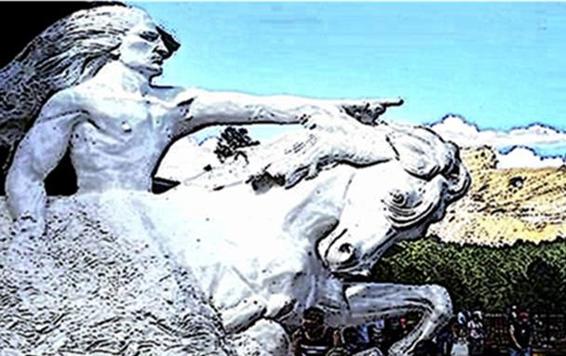
Crazy Horse
Page 312
Page 313
You may also like...
-
Mordecai Brown Biography by Edward DrobinskiMordecai Brown
Reads:
9Pages:
199Published:
Feb 2026Mordecai Brown was perhaps the best baseball pitcher of all time. He was certainly the most overlooked. He was the most integral and overworked part of the 19...
Formats: PDF, Epub, Kindle, TXT
-
Damn Yankees Biography by Edward DrobinskiDamn Yankees
Reads:
24Pages:
402Published:
Jun 2025What baseball team won the most consecutive pennants and World Series championships? Please tell me why they are excluded from the “expert’s” all-time-greates...
Formats: PDF, Epub, Kindle, TXT
-
Vanished: The Disappearance of Jack O'Sullivan Biography by Dylan HunterVanished: The Disappearance of Jack O'Sullivan
Reads:
28Pages:
20Published:
Mar 2025On March 1, 2024, Jack O’Sullivan vanished without a trace. A bright law student with a promising future, his disappearance in Bristol sent shockwaves through...
Formats: PDF, Epub, Kindle, TXT
-
Huey Long Biography by Edward DrobinskiHuey Long
Reads:
51Pages:
333Published:
Feb 2025A brilliant, young Louisianan matures during the Great Depression, and is compelled to champion the people of Louisiana first, and then the entire US. The sub...
Formats: PDF, Epub, Kindle, TXT