

Crazy Horse by Edward Drobinski - HTML preview
Download the book in PDF, ePub, Kindle for a complete version.
10 non-combatants killed
55 wounded, 6 of whom later died of wounds Little Bighorn Battlefield
Crazy Horse
Page 198
Great Sioux War of 1876
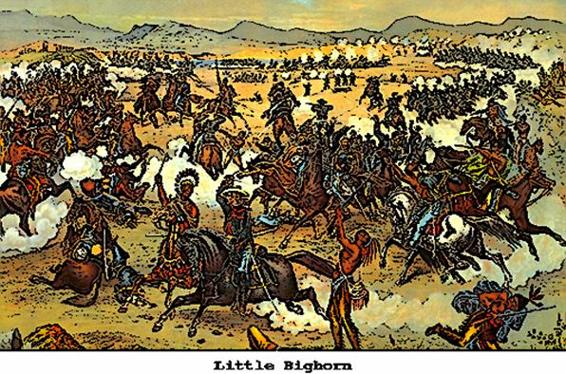
The Battle of the Little Bighorn, known to the Lakota and other Plains Native Americans as the Battle of the Greasy Grass, and also commonly referred to as Custer's Last Stand among other things, was an armed engagement between combined forces of the Lakota Sioux, Northern Cheyenne, and Arapaho tribes and the 7th Cavalry Regiment of the United States Army supplemented by turncoat Native Americans. The battle, which resulted in the defeat of US forces, was the most significant action of the Great Sioux War of 1876. It took place on June 25–26, 1876,
Page 199
along the Little Bighorn River in the Crow Native American Reservation in southeastern Montana Territory.
Most battles in the Great Sioux War, including the Battle of the Little Bighorn, were on lands those Native Americans had taken from other tribes since 1851. The Lakotas were there without consent from the local Crow tribe, which had a treaty with the US Army on the area. Already in 1873, Crow chief Blackfoot had called for US military actions against their enemy Native American Lakota intruders. The steady Lakota invasion, a reaction to encroachment in the Black Hills, into treaty areas belonging to the smaller tribes ensured the United States a firm Native American alliance with the Arikaras and the Crows during the Lakota Wars.
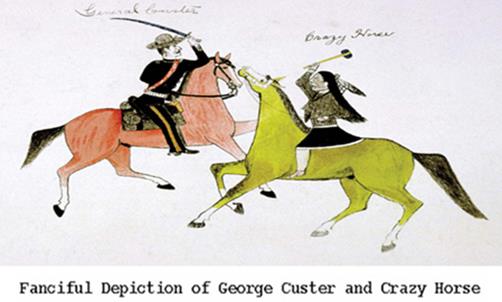
The fight was an overwhelming victory for the Lakota, Northern Cheyenne, and Arapaho, who were led by several major war leaders, including Crazy Horse and Chief Gall, and had been inspired by the visions of Sitting Bull - Tȟatȟáŋka Íyotake. The US 7th Cavalry, a force of 700 men, suffered a major defeat while commanded by Lieutenant Colonel George Armstrong Custer, a brevetted major general during the American Civil War, brevetted being the act of giving a commissioned officer a higher rank title as a reward for gallantry or meritorious conduct, but which may not confer the authority inherent thereto, a form of
Page 200
military bullshit. Most historians disagree, but Custer demonstrated a few aspects of being delusional, stupid, and arrogant. He seemed to genuinely say and think that his troops of fighting men were the best, invincible, and able to overcome any opponent.
Five of the 7th Cavalry's twelve companies were wiped out and Custer was killed, as were two of his brothers, a nephew, and a brother-in-law. The total US casualty count included 268 dead and 55 severely wounded, six of those dying later from their wounds, including four Crow Native American scouts and at least two Arikara Native American scouts.
Public response to the Great Sioux War varied in the immediate aftermath of the battle. Libbie Custer, Custer's widow, soon worked to burnish her husband's memory, and during the following decades Custer and his troops came to be considered heroic figures in American history. The battle and Custer's actions in particular, have been studied extensively by historians. Little Bighorn Battlefield National Monument honors those who fought on both sides.
Crazy Horse
Page 201
Battlefield and Surrounding Areas
In 1805, fur trader François Antoine Larocque reported joining a Crow camp in the Yellowstone area. On the way he noted that the Crow hunted buffalo on the "Small Horn River." St. Louis based fur trader Manuel Lisa built Fort Raymond in 1807 for trade with the Crow. It was located near the confluence of the Yellowstone and Bighorn rivers, about 40 miles north of the future battlefield. The area is first noted in the 1851 Treaty of Fort Laramie.
In the latter half of the 19th century, tensions increased between the Native inhabitants of the Great Plains of the US and
Page 202
encroaching settlers. This resulted in a series of conflicts known as the Sioux Wars, which in its broadest estimation took place from 1854 to 1890, with numerous lulls. While some of the indigenous people eventually agreed to relocate to ever shrinking reservations, a relatively small number of them resisted, sometimes fiercely. The number wishing to fight consistently fell among the Native American population with the elapsing of time. Excepting Crazy Horse and Sitting Bull, all Native American leaders had effectively capitulated to the US
Army by 1877, signing away their lands.
On May 7, 1868, the valley of the Little Bighorn became a tract in the eastern part of the new Crow Native American Reservation in the center of the old Crow country. There were numerous skirmishes between the Sioux and Crow tribes, so when the Sioux were in the valley in 1876 without the consent of the Crow tribe, the Crow supported the US Army to expel the Sioux. The Crows enlisted as Army scouts and Crow warriors fought in the nearby Battle of the Rosebud.
The geography of the battlefield is very complex, consisting of dissected uplands, rugged bluffs, the Little Bighorn River, and adjacent plains, all areas close to one another. Vegetation varies widely from one area to the next.
Page 203
The battlefield is known as "Greasy Grass" to the Lakota Sioux, Dakota Sioux, Cheyenne, and most other Plains Native Americans.
However, in contemporary accounts by alleged participants, it was referred to as the "Valley of Chieftains."