

Crazy Horse by Edward Drobinski - HTML preview
Download the book in PDF, ePub, Kindle for a complete version.
5 - Lakota Religious System
As you are seeing, Crazy Horse always seemed to follow what his own mind-heart showed him, thereby putting little, if any, credence in the doctrinaire dictates of “authorities.” Still, having said that, it is pertinent to discuss some Lakota beliefs, as for the most part they more or less conform with the majority of what Crazy Horse instinctively held as gospel.
The conceptual notion of a religious system is more applicable to Western ideology and Christian missionaries' efforts to understand a spiritual philosophy different from their own than it is to the beliefs of the Lakota. For the Lakota, religion is not compartmentalized into a separate category. More appropriately, Lakota traditions can be characterized as a system of spirituality that is fully integrated into a rhythm of life that includes all aspects and patterns of the universe. At the center of this rhythm is Wakan Tanka or Tunkashila, sometimes translated as Grandfather and often as Great Spirit or Great Mystery, but better left untranslated. Cannupa Wakan, the sacred pipe, and the subsequent smoke carries messages from humans to Wakan Tanka. The system is based on respect and emphasizes that the virtues or values of bravery, fortitude, wisdom, and generosity be followed and perpetuated.
Page 103
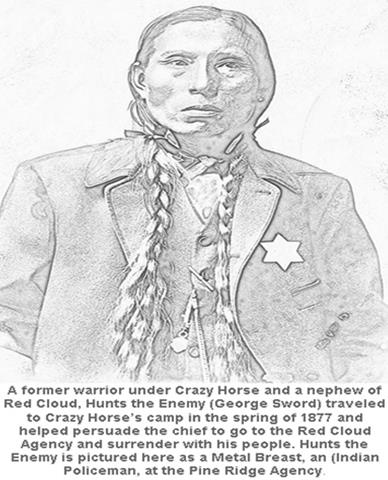
James R. Walker, a physician at Pine Ridge, South Dakota, between 1896 and 1914, was one of the most influential non-Native American revisers of Lakota spirituality. Ella Deloria expressed her skepticism in the 1930s about his work, and, more recently, his interpretations have been considered specious by William K. Powers. It has been hypothesized that George Sword, an Oglala Lakota, gave Walker an explanation of the Lakota system in Christian theological terms to make it understandable to him, and Walker misinterpreted and further changed some of Sword's descriptions based on his own Christian notions and ideology.
Some of Walker's work accurately reflects Lakota belief and information from Sword. His work describes a number of Lakota spirits who inhabited the earth prior to humans. Takuskanskan -
That Which Moves Moves; Wi - Sun, who is married to Hanwi -
Moon, with whom he has one daughter, Woȟpe - Falling Star; Old Man and Old Woman, whose daughter Ite - Double Face, is married to Tate - Wind, with whom she has four sons, Tate Topa - The Four Winds. An important spirit is Iktomi the trickster. Iktomi conspired with Old Man and Old Woman to increase their daughter's status by arranging an affair between the Sun and Ite. The discovery of the affair by the Sun's wife led to punishments by Takuskanskan, who gave the Moon her own domain,
Page 104
and in the process separated her from the Sun. Old Man, Old Woman, and Ite were sent to earth, but Ite is separated from Tate, who, along with the Four Winds and a fifth wind established space as the universe known today. The daughter of the Sun and the Moon, Woȟpe, fell to earth and later resides with South Wind.
The Emergence
Alone on the newly formed earth, Ite prevailed upon Iktomi to find her people, Pte Oyate - the Buffalo People or Nation. In the form of a wolf, Iktomi travelled beneath the earth and discovered a village of humans. Iktomi told them about the wonders of the earth and convinced one man, Tokahe - the first, to accompany him to the surface. Tokahe does so and upon reaching the surface through the emergence place, located in Wind Cave in the Black Hills of South Dakota, marveled at the green grass and blue sky. Iktomi and Ite introduced Tokahe to buffalo and showed him tipis, clothing, and hunting utensils.
Tokahe returned to the village and appealed to six other men, and their families to travel with him to the earth's surface.
When they arrived, they discovered that Iktomi had deceived them. The weather had turned bad, and they found themselves starving. Unable to return to their home, but armed with a new knowledge about the world, they survived with the help of their
Page 105
relative the buffalo. The skull of this animal is a significant symbol that represents Lakol Wicoh'an - the traditional way of life.
The Seven Sacred Rites
According to contemporary Lakota oral historical accounts and discussions with elders, the following is a description of the Seven Sacred Rites of the Lakota and of how these rites came to the people. Many years ago, during a period of starvation, there appeared to the Lakota a beautiful woman who was met by two hunters. One hunter lusted for her, and was covered by a mist and reduced to bone. The other hunter, who possessed a good and pure heart, was instructed to return to camp and tell the chief and people that she, Ptehincalaskawin, White Buffalo Calf Woman, will appear to them the next day for she has something of importance to tell them. He obeyed, and a great council tipi was constructed. Ptehincalaskawin presented to the people a bundle containing the sacred pipe and told them that in time of need they should smoke and pray with the pipe for help. The smoke from the pipe would carry their prayers upward.
She then instructed them in the great Wicoh'an Wakan Sakowin, Seven Sacred Rites, the basis of Lakota spirituality, which have been recorded by Joseph Brown in the words of Nicholas Black Elk
Page 106
in “The Sacred Pipe: Black Elk's Account of the Seven Sacred Rites of the Oglala Sioux.” Ptehincalaskawin pledged to watch over the people and to return someday. Upon leaving, she walked a short way off and lay down in the grass. When she stood again she had turned into a white buffalo calf, and walked over the hill, out of sight. The Sacred Buffalo Calf Pipe remains among the people today.
First Rite
The first of the Seven Sacred Rites, though they are not chronological, is Inikagapi or Inipi - to renew life. A sweat lodge is held in a dome shaped structure made of saplings and covered with hide or tarps that symbolizes the shape of the universe and/or the womb of a pregnant woman. Heated stones are placed in a central hole in the lodge and water is poured over them by an itancan - leader to create steam. The purpose of the ceremony is to pray for health and well-being, spiritually and physically. The lodge utilizes all the Powers of the universe: earth, and the things which grow from the earth, water, fire, and air.
Second Rite
The second rite is Hanbleceyapi - crying for a vision. The vision quest is undertaken by an individual with the help and
Page 107
guidance of a holy man. A person elects to go on a vision quest to pray, communicate with the spirits, and attempt to gain knowledge, strength, and understanding. The person pledges to stay on an isolated hill for one to four days with a blanket and a pipe, but without food or water. Upon returning, the vision may be discussed with the wicasa wakan - holy man. Often the meaning of the vision is not readily apparent and the individual may be told to wait for knowledge and understanding.
Third Rite
The third rite is Wanagi Wicagluha - keeping of the spirit.
Spirit keeping is a rite performed by a mourner for one year to grieve for a lost loved one. When a person dies the spirit can linger around the family and community. According to Black Elk;
"This rite purifies the souls of our dead, and our love for one another is increased." A special place is set up for the spirit, who is fed every day. Members of the family and community can come and visit, eat, and sit with the spirit and family. After one year the spirit is ceremonially released and the mourning period is formally ended. It is usual among the Lakota for the mourning family to refrain from attending or participating in secular activities, gatherings, or events during this formal grieving period.
Page 108
Fourth Rite
The fourth rite is Wiwanyang Wacipi - Sun Dance. The Sun Dance is often considered the most important rite, and it is held during the summer when the moon is full. In times past a number of Plains bands of the Lakota would gather at a prearranged location for the annual meeting of the Oceti Sakowin. This was the occasion prior to Greasy Grass. It was during this annual gathering that the Sun Dance ceremony was held. During the ceremony, dancers pledge to make offerings of their flesh so that much strength would be given to the nation and to fulfill personal vows. The choice to participate is solely that of each individual. It is usually the result of receiving a sacred dream or is undertaken to seek assistance in healing a sick loved one.
The sacred tree that is placed at the center of the dance area symbolizes Wakan Tanka, the center of the universe.
Fifth Rite
The fifth rite is Hunkapi - making relatives. It establishes a relationship on earth, which is a reflection of that real relationship with Wakan Tanka. It was usually performed to unite a younger person with a family, and it can be a way of solidifying relationships with other individuals as well as
Page 109
Wakan Tanka. This ceremony represents the formal adoption of people as relatives.
Sixth Rite
The sixth rite is Isnati Awicalowanpi - puberty ceremony. The ceremony takes place after a girl's first menses, and prayers are said to ensure the girl will grow up to have all the virtues of a Lakota woman and understand the meaning of her new role, and to formally announce her eligibility as a potential wife and mother.
Seventh Rite
The seventh rite is Tapa Wankayeyapi - throwing the ball, a game which represents the course of a man's life. A young girl stands at the center and throws a ball upward and to the four corners as people vie to catch it. The person to catch the ball is considered more fortunate than the others, for the ball is symbolically equated with knowledge.
Crazy Horse
Page 110
Essential Beliefs
For the Lakota, the nature of the universe is a whole, and above, below, and around are all part of that whole. Life is seen as a series of recurrent travels, and each person has a purpose to fulfill, one that will support and benefit the community.
People live through four generations; childhood, adolescence, maturity, and old age. When a person dies, one of his four souls travels southward, along the Wanagi Tacanku - spirit path, identified with the Milky Way, where it meets with an old woman
Page 111
who examines its earthly virtues, directing the soul either to the spirit world, where there is an unending supply of buffalo and where people rejoin their kin, or back to earth where they are reborn and given another chance to live in harmony. Because of this the birth of children is an especially joyful event since they are closest to the spirit world and considered sacred. Twins are particularly auspicious and considered intellectually mature at birth. Many rites help develop the proper behavior of children through observation and listening.
The sacred is the domain of the wicasa wakan - holy men, who conduct all spiritual ceremonies. The most important symbol is the sacred pipe, whose smoke represents prayers offered to Wakan Tanka. In addition to its general interpretation as something like "great spirit," this single name refers to important beings and powers, half of which existed prior to the creation of the earth, and half as a result of it. Wakan Tanka, in the sacred language of the medicine men, underscores the belief that all sacred things come in fours. The root wakan - sacred is a dynamic concept indicating the potentiality of anything to transform from the secular to sacred. Iktomi the trickster named all things, taught culture to humans, and remains on the earth to continually deceive them. The trickster is smart and works to fool humans for his own benefit. His is the power to deceive.
Page 112
Iktomi stories frequently are told with humor and serve as lessons for young children as well as adults since Iktomi often plays the fool. But he is capable of bringing real danger and destruction, as well.
Contemporary Religion
All of the Seven Sacred Rites are still performed, with the exception of Tapa Wan-kayeyapi. In addition, a vital religious practice known as Yuwipi became popular in the twentieth century. It encompasses a number of cultural concepts related to traditional life and problems confronting contemporary Lakota peoples. This rite is performed in a darkened room under the supervision of a Yuwipi man or wicasa wakan. The object is to cure a person and at the same time to pray for the general welfare of all Native American people and for long life for the kinship group. Some Yuwipi men possess an exceptional ability that allows them to locate lost items or people.
Page 113
6 – Females Three
Black Buffalo Woman was Crazy Horse’s first love. They met in 1857, but she married a man named No Water while Crazy Horse was out on a raid.
Crazy Horse continued to pay her attention and in 1868 or 1870, depending on the source, “eloped” with her while No Water was on a hunting party.
In the fall of 1870, Crazy Horse invited Black Buffalo Woman to accompany him on a buffalo hunt in the Slim Buttes area of present day northwestern South Dakota. At the time, she was the wife of No Water, who had a reputation for drinking too much. It was Lakota custom to allow a woman to divorce her husband at any time. She did so by moving in with relatives or with another man, or by placing the husband's belongings outside their lodge.
Although some compensation might be required to smooth over hurt feelings, the rejected husband was expected to accept his wife's decision. No Water was away from camp when Crazy Horse and Black Buffalo Woman left for the buffalo hunt.
No Water tracked down Crazy Horse and Black Buffalo Woman in the Slim Buttes area. When he found them in a teepee, he called
Page 114
Crazy Horse's name from outside. When Crazy Horse answered, No Water stuck a pistol into the teepee and aimed for Crazy Horse.
Touch the Clouds, Crazy Horse's first cousin and son of Lone Horn, was sitting in the teepee nearest the entry. He knocked the pistol upward as No Water fired, deflecting the bullet to Crazy Horse's upper jaw. No Water left, with Crazy Horse's relatives in hot pursuit. No Water ran his horse until it died and continued on foot until he reached the safety of his own village.
Several elders convinced Crazy Horse and No Water that no more blood should be shed. As compensation for the shooting, No Water gave Crazy Horse three horses. Because Crazy Horse was more or less with a married woman, despite previously stated Lakota customs, he was stripped of his title of Shirt Wearer.
Black Buffalo Woman’s fourth child, a girl, was a light-skinned baby suspected of being the result of her night with Crazy Horse. It seems that nothing is known of her. Perhaps this unknown has been Lakota fashioned to protect Crazy Horse’s blood line.
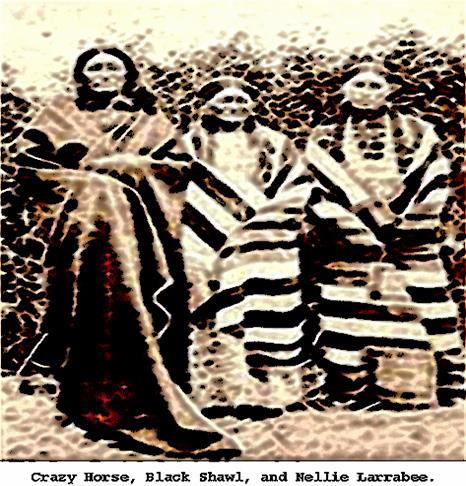
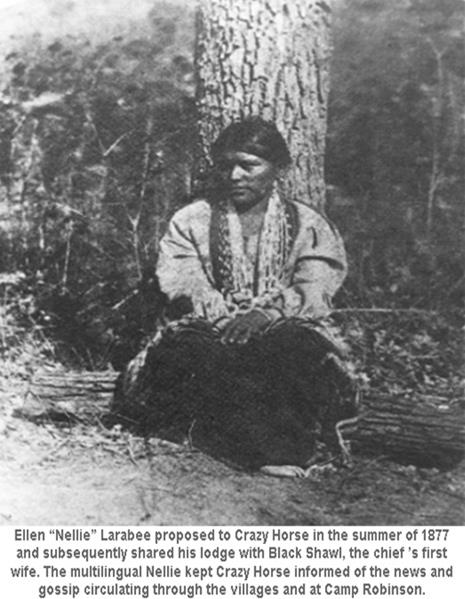
Crazy Horse eventually married Black Shawl, who prematurely died of tuberculosis, and later a half Cheyenne, half French woman named Nellie Larrabee.
Page 115
Crazy Horse married Black Shawl, a member of the Oglala Lakota and relative of Spotted Tail. The elders sent her to heal Crazy Horse after his altercation with No Water. Crazy Horse and Black Shawl Woman were married in 1871, more or less. Black Shawl gave birth to Crazy Horse's only child, a daughter named They Are Afraid Of Her, who died in 1873, though some sources say that it was at the age of four. Black Shawl outlived Crazy Horse. She died in 1927 during the influenza outbreaks of the 1920s.
At the time of the No Water debacle, Chief Red Cloud also arranged to send a young woman, Nellie Larrabee, to live in Crazy Horse's lodge. Interpreter William Garnett described Larrabee as "a half blood, not of the best frontier variety, an invidious and evil woman," citing minimal supposition and no facts. This might be attributed to the popularity of anti-White sentiments. Larrabee, also referred to as Chi-Chi and Brown Eyes Woman, was the daughter of a French trader and a Cheyenne woman.
Garnett's first-hand account of Crazy Horse's surrender alludes to Larrabee as the "half-blood woman" who caused Crazy Horse to fall into a "domestic trap which insensibly led him by gradual steps to his destruction," whatever that means.
Crazy Horse
Page 116
Page 117
7 – Attempted Imprisonment and Death After Little Bighorn Crazy Horse traveled to Big Butte to get rid of invading White miners in the holy Sioux Black Hills, while the Sioux faced continued hostilities from General Crook during a harsh winter that decimated the tribe.
Sensing the tribe’s struggle for survival, Colonel Nelson A.
Miles tried to strike a deal with Crazy Horse, promising to help the Sioux and treat them fairly.
When Crazy Horse sent emissaries to discuss the deal, soldiers shot and killed several and Crazy Horse fled. Miles repeatedly attacked Crazy Horse’s encampment until continued harsh winter weather prevented action.
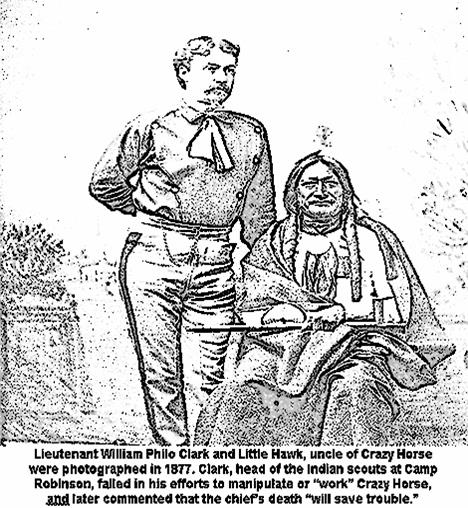
Incapacitated by the winter, Crazy Horse reluctantly negotiated with Lieutenant Philo Clark, who offered the starving Sioux their own reservation in exchange for their surrender, and Crazy Horse took the deal, no doubt under duress.
During negotiations, Crazy Horse found trouble with both the Army and his fellow tribesmen. Clark tried to convince him to go to Washington, but Crazy Horse refused, furthering the Army's belief that Crazy Horse was too unreliable for negotiation,
Page 118
though it did not prevent them from striking a “truce” deal with him.
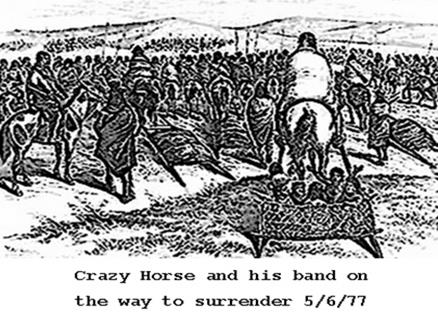
Crazy Horse and other northern Oglala leaders arrived at the Red Cloud Agency, located near Fort Robinson, Nebraska, on May 5, 1877. Together with He Dog, Little Big Man, Iron Crow and others, they met in a solemn ceremony with First Lieutenant William P. Clark as the first step in their formal surrender.
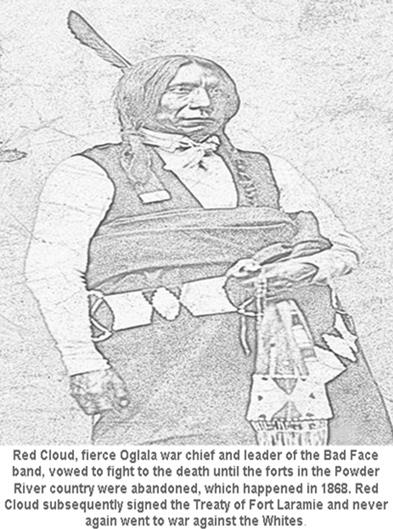
For the next four months, Crazy Horse resided in his village near the Red Cloud Agency. The attention that Crazy Horse received from the Army drew the jealousy of Red Cloud and Spotted Tail, two Lakota who had long before come to the agencies and adopted the White ways and money. Rumors of Crazy Horse's desire to slip away and return to the old Lakota ways of life started to spread at the Red Cloud and Spotted Tail Agencies. In August 1877 officers at Camp Robinson received word that the Nez Perce of Chief Joseph had broken out of their reservation in Idaho and were fleeing north through Montana toward Canada. When asked by Lieutenant Clark to join the Army against the Nez Perce, Crazy Horse and the Miniconjou leader Touch the Clouds objected, saying that they had promised to remain at peace when they surrendered. But his words were apparently purposely misinterpreted by a half Tahitian scout, Frank Grouard during the summer of 1876. Grouard reported that
Crazy Horse
Page 119
Crazy Horse had said that he would "go north and fight until not a White man is left." When he was challenged over his interpretation, Grouard left the council. Another interpreter, William Garnett, was brought in but quickly noted the growing tension.
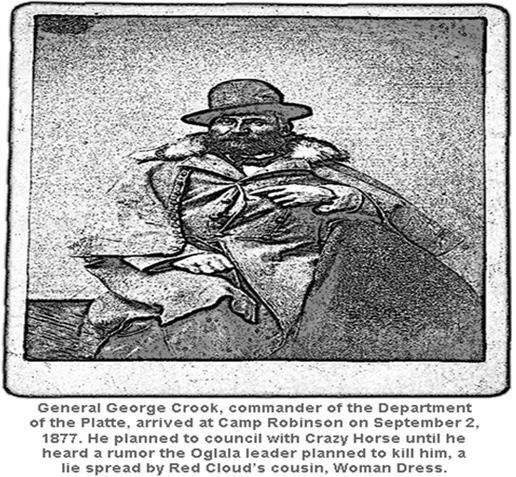
With the growing trouble at the Red Cloud Agency, General George Crook was ordered to stop at Fort Robinson. A council of the Oglala leadership was called, then canceled, when Crook was incorrectly informed by other Oglala leaders that Crazy Horse had said the previous evening that he intended to kill the general during the proceedings.
Page 120
Crook ordered Crazy Horse's arrest and then departed; leaving the post commander at Fort Robinson, Lieutenant Colonel Luther P. Bradley, to carry out his order. Additional troops were brought in from Fort Laramie. On the morning of September 4, 1877, two columns moved against Crazy Horse's village, only to find that it had scattered during the night. Crazy Horse had fled to the nearby Spotted Tail Agency with his wife, who had become ill with tuberculosis. After meeting with military officials at Camp Sheridan, the adjacent military post, Crazy Horse agreed to return to Fort Robinson with Lieutenant Jesse M.
Lee, the Native American agent at Spotted Tail.
On the morning of September 5, 1877, Crazy Horse and Lieutenant Lee, accompanied by Touch the Clouds as well as a number of Native American scouts, departed for Fort Robinson. Arriving that evening outside the adjutant's office, Lieutenant Lee was informed that he was to turn Crazy Horse over to the Officer of the Day. Lee protested and hurried to Bradley's quarters to debate the issue, but without success.
Some of the Sioux already at Fort Robinson were agitating with others following a rumor that Crazy Horse had found favor with White people, who planned to install him as leader of all the Sioux.
Page 121
Some Sioux warriors signed on with the Army to fight the Nez Perce warriors. Disgusted, Crazy Horse threatened to leave negotiations and was soon after arrested.
Returning to camp the next day, Crazy Horse requested to talk to military leaders, but was led to a cell instead.
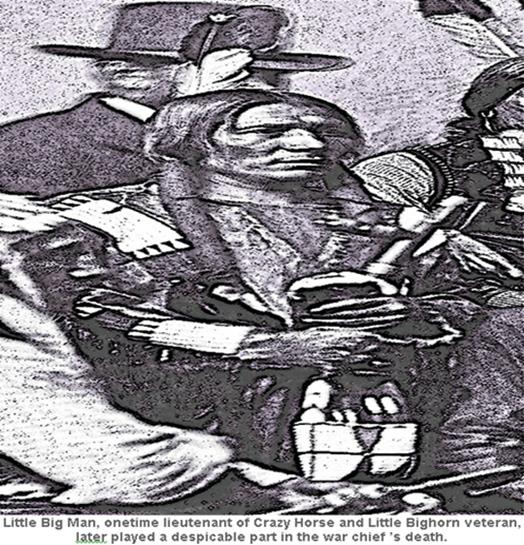
Realizing the betrayal, Crazy Horse struggled. An old friend, Little Big Man, worked for the Army as a policeman and attempted to restrain Crazy Horse, who pulled a concealed knife on him.
Trying to prevent Crazy Horse from stabbing Little Big Man, a soldier shoved a bayonet into Crazy Horse’s abdomen, piercing his kidneys. Crazy Horse collapsed and was moved to an office, where he refused a cot. Only his father was allowed to visit.
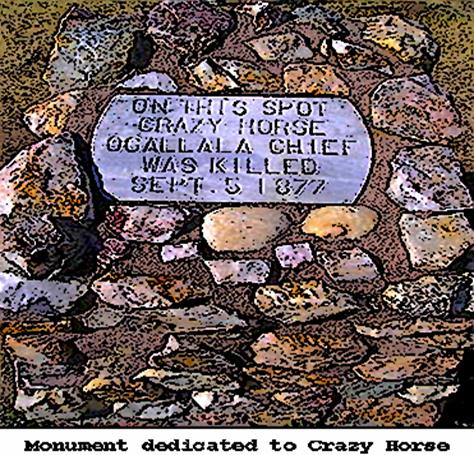
Crazy Horse died at some point later on the night of September 6, 1877, at the age of 36, lying on the bare floor in Fort Robinson, Nebraska. His body was taken away by Sioux and buried at an unknown location near a creek called Wounded Knee.
Backing up a step or two, Bradley had received orders that Crazy Horse was to be arrested and taken under the cover of darkness to Division Headquarters. Lee turned the Oglala war chief over to Captain James Kennington, in charge of the post guard, who accompanied Crazy Horse to the post guardhouse. Once inside,
Page 122
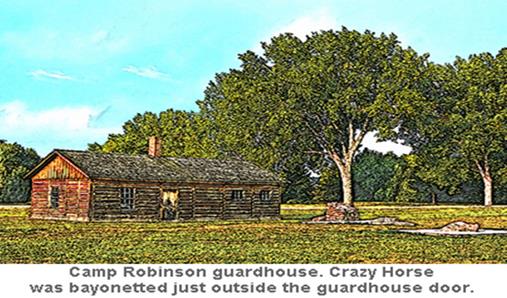
Crazy Horse struggled with him and the Lakota-in-name-only guard Little Big Man and attempted to escape. Just outside the door, Crazy Horse was stabbed with a bayonet by one of the members of the guard. He was taken to the adjutant's office, where he was tended by the assistant post surgeon at the post, Valentine McGillycuddy, and died late that night.
Crazy Horse, even when dying, refused to lie on the White man's cot. He insisted on being placed on the floor. Armed soldiers stood by until he died. And when he breathed his last, Touch the Clouds, Crazy Horse's seven foot tall Miniconjou friend, pointed to the blanket that covered the chief's body and said, "This is the lodge of Crazy Horse."
The following morning, Crazy Horse's body was turned over to his elderly parents, who took it to Camp Sheridan and placed it on a burial scaffold. The following month, when the Spotted Tail Agency was moved to the Missouri River, Crazy Horse's parents moved the remains to an undisclosed location. There are at least four possible locations as noted on a state highway memorial near Wounded Knee, South Dakota. His final resting place remains unknown.
Controversy over his death
Page 123
On a minor note, McGillycuddy, who treated Crazy Horse after he was stabbed, wrote that Crazy Horse "died about midnight."
According to military records, he died before midnight, making it September 5, 1877.
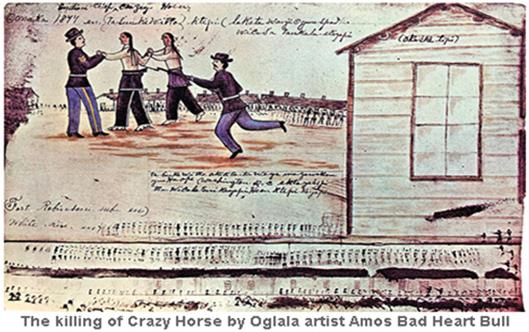
John Gregory Bourke's memoir of his service in the Native American wars, “On the Border with Crook,” describes a different account of Crazy Horse's death. He based his account on an interview with Crazy Horse's former underling, and contemporary rival, Little Big Man, who was present at Crazy Horse's arrest and fatal wounding. The interview took place over a year after Crazy Horse's death. Little Big Man said that, as Crazy Horse was being escorted to the guardhouse, he suddenly pulled two knives from under his blanket and held one in each hand. One knife was reportedly fashioned from an army bayonet. Little Big Man, standing behind him, seized Crazy Horse by both elbows, pulling his arms up behind him. As Crazy Horse struggled, Little Big Man lost his grip on one elbow, and Crazy Horse drove his own knife deep into his own lower back. The US Army guard stabbed Crazy Horse with his bayonet in the back, who then fell and surrendered to the guards.
When Bourke asked about the popular account of the guard bayoneting Crazy Horse first, Little Big Man said that the guard had thrust with his bayonet, but that Crazy Horse's struggles
Page 124
resulted in the guard's thrust missing entirely and lodging his bayonet into the frame of the guardhouse door. Little Big Man said that in the hours immediately following Crazy Horse's wounding, the camp commander had suggested the story of the guard being responsible to hide Little Big Man's role in the death of Crazy Horse and avoid any inter-clan reprisals.
The identity of the soldier responsible for the bayoneting of Crazy Horse is debated. Only one eyewitness account actually identifies the soldier as Private William Gentles. Historian Walter M. Camp circulated copies of this account to individuals who had been present who questioned the identity of the soldier and provided two additional names. To this day, the identification remains questioned.
Just who killed the Lakota fighting man remains in dispute, and is not limited to the efforts of the US Army.
The scenario is much too familiar to 2023 observers with some ability to read between the official lines. In the long lasting, official version, Crazy Horse, greatest war chief of the Lakota Nation, harasser of George Crook and destroyer of George Custer, struggled to avoid being shut in the guardhouse at Camp Robinson, Nebraska, not expecting to be there for having reluctantly and without much choice accepting the word of some
Page 125
White Army men. He was bayoneted by a soldier upon brandishing weapons. Books and movies have depicted this Crazy Horse demise, but there is a lot of room for debate and a very good chance it didn’t happen that way.
The circumstances of Crazy Horse’s arrest, while complicated, are not in serious doubt. He surrendered his weapons to the United States on May 6, 1877, so his people wouldn’t starve to death. Then, in August, the US Army asked Crazy Horse to take up arms again and help subdue Chief Joseph’s Nez Perces, who had broken out of custody to avoid being deported from their homeland. Sarcastically, and probably with an escape of his own in mind, Crazy Horse told his captors that he would fight until not a Nez Perce was left. Frank Grouard, an interpreter who disliked Crazy Horse, twisted the Lakota chief’s words to suggest he would fight until not a White man was left.
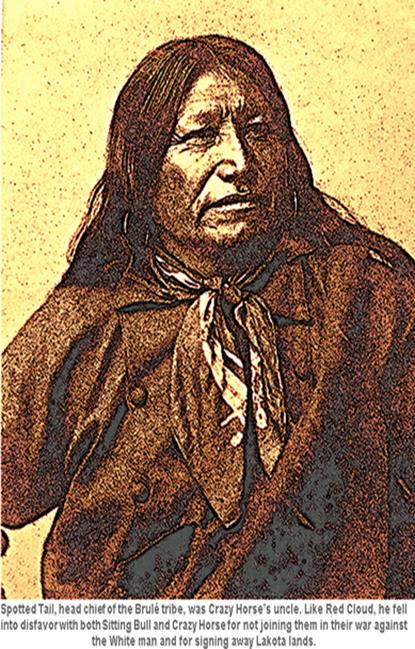
Faced with this menacing but almost certainly false translation, General Crook condoned the arrest of Crazy Horse and left the post, possibly to avoid what might happen next. The commander of Camp Robinson, Lt. Col. Luther P. Bradley, dispatched Captain Daniel Burke to negotiate with the Native American agent for the Brulé Sioux - Sicangu Lakota, Jesse Lee, a former Army lieutenant who knew Crazy Horse as a friend and had invited him to sit down dinners with his family. Crazy Horse was a nephew of
Page 126
Chief Spotted Tail, and Burke promised both Spotted Tail and the agent that Crazy Horse would be well treated if he left all weapons and came in for a peaceful talk. The idea that the government already had plans to ship Crazy Horse to the Dry Tortugas off the Florida coast, last stop on earth for many warriors, is controversial. But the Army had no intention of releasing Crazy Horse after his “threat against Americans.”
Accounts vary as to whether he was to be shipped to Omaha, Cheyenne, or the Tortugas.
Handling arrangements at Camp Robinson on September 5, 1877, was Lieutenant William Philo Clark, known as “White Hat” to the Lakotas, a Native American sign language expert and Crook’s right hand man in Native American matters. Lee had sent notice that Crazy Horse was coming into camp with a handful of other now peaceful Native Americans and had been told to arrive unarmed and to expect good treatment, although the warrior himself had been plagued with foreboding. In fact, when the party arrived at the camp, Clark told Lee that Crazy Horse would be handed over to the officer of the day, a euphemism for detention.
When Crazy Horse, surrounded by soldiers and Native American agency police, saw the guardhouse and realized what was happening, a struggle broke out, during which the chief was
Page 127
mortally wounded. Crazy Horse died about midnight. The Army gave his body to his grieving parents, who buried him in an unknown location, possibly near Wounded Knee Creek.
The anecdotal details of that last fight, however, remain controversial. The most frequently repeated account has Crazy Horse struggling with Little Big Man, a former Lakota warrior and close friend who had since “sold out” to the ceska maza -
“metal breasts.” While Crazy Horse and Little Big Man wrestled, a middle aged soldier, 14th Infantry Private William Gentles, rushed up and rammed his bayonet into Crazy Horse’s side, piercing both kidneys.
Little Big Man shared yet a different story. At an 1881 Sun Dance, he told Captain John Bourke that Crazy Horse had pulled a concealed knife. Slashed in the struggle, Little Big Man then deflected Crazy Horse’s knife into the chief’s own side, fatally wounding him. Little Big Man insisted that the guard’s bayonet had missed Crazy Horse completely, leaving a gouge in the guardhouse door still visible in 1881. Bourke leaned toward Little Big Man’s account, believing he had been motivated by a desire to share in the death of the greatest warrior of his time. Or perhaps Little Big Man was cleansing his soul before the Sun Dance, a time of intense purification among the Lakotas,
Page 128
when sweat baths and fasting achieve wakan, a state of harmony, the worst possible time to indulge in lies or empty boasts.
Suggestions that Crazy Horse may have stabbed himself deliberately seem unlikely. Among Lakota warriors, death in combat was preferable, while suicide was a sort of “woman thing.” But if there is such a thing as a “suicide gene,” it’s worth noting that Crazy Horse’s birth mother, Rattling Blanket Woman, had reportedly hanged herself. It is thought she perceived the two younger wives and fifteen year old prospective wife her husband brought home as a studied insult after she had failed to conceive another child. Crazy Horse was actually raised by his maternal aunt, the “mother” mentioned in most accounts, to avoid dismaying those who object to Lakota polygamy. Confusion among outsiders is common, as Lakota wives called one another “sisters,” even when unrelated by blood, and children called all the father’s wives “mother.”
William Garnett, a scout and the half-blood son of a Lakota woman and a Confederate general killed at Gettysburg, was present at the arrest and also claimed to have seen a knife in Crazy Horse’s hand. He said the guard had merely tried to prod the chief with the bayonet, but that Crazy Horse fell against it, inflicting the lethal wound. Unfortunately, the middle of Garnett’s written account has disappeared.
Page 129
Dr. Valentine McGillycuddy, the agency physician, was also present, but his account; “I saw he was done for,” leaves some doubt that he saw the stabbing. McGillycuddy examined what he described as a bayonet wound, administered opiates by hypodermic to ease the agony and sat down with Crazy Horse’s father, Waglula, or “Worm,” mother, technically stepmother, and Lakota Chief Touch the Clouds for the death vigil.
Captain Bourke, who took down Little Big Man’s account, throws the story another curve. “Little Big Man himself assured me that he had unintentionally killed Crazy Horse with the latter’s own weapon, which was shaped at the end like a bayonet (stiletto) and made the very same kind of a wound,” the officer wrote in his “On the Border With Crook.” “He described how he jumped on Crazy Horse’s back and seized his arms at the elbow, and showed how he himself had received two wounds in the left wrist; after that, in the struggle, the stiletto of the captive was inclined in such a manner that when he still struggled, he cut himself in the abdomen instead of harming the one who held him.”
The idea that Crazy Horse slashed Little Big Man with a knife fashioned after a bayonet makes no sense. Army bayonets of the era had triangular blades and made triangular punctures. They couldn’t be used to slash, as only the tip was sharp. Native
Page 130
Americans commonly carried flat bladed butcher knives that made slashing incisions for eating, scalping and self-defense.
The question arises; was Gentles, a 47 year old Irish born private who had soldiered for 20 years and never made corporal, the actual killer of Crazy Horse? Or did Little Big Man fashion a special assassination knife from a bayonet in case an expendable bungler like Gentles couldn’t get the job done?
Gentles reportedly died a year later of asthma, an odd cause of death in the clean, dry air of the West, but perhaps a good excuse for the designated killer of a celebrity to disappear.
The manner of Crazy Horse’s death, while controversial, confirms at the very least that he preferred death as a fighting man to a humiliating end in prison. He refused to outlive his honor and pride as a man. For this reason, as well as for his courage, tactical brilliance and generosity, he remains the most esteemed of the Lakota fighting men. Still, nobody really knows who killed him, and that too is part of the legend of Crazy Horse.
Whichever version one wishes to adhere to has their rational proponents, with further versions likely to come. Whatever, it can be unequivocally forever said that Crazy Horse was killed by an alliance of the US Army and Lakotas-in-name-only. What has yet to be physically disputed is that Crazy Horse remained armed
Page 131
to the very end, despite the US government attempts to disarm him. It is indeed unfortunate that he was outnumbered and betrayed, thereby unable to take a few of the conspiring predators with him.
“Hokahey! Today is a good day to die.”
Crazy Horse
Page 132
8 - Tribal Politics with Lakotas- In-Name-Only – the Real Killers
The US Army gathered all its forces and attacked the Lakota people after Custer’s defeat, and this was not a good sign for the Native American coalition. The Natives were severely outnumbered and Sitting Bull decided to dodge the fight and instead, led his tribesmen across the border to Canada. However, Crazy Horse refused to run away and gathered the remaining of his fighters to tackle the US army.
Crazy Horse
Page 133
It was a long and tiring fight and Crazy Horse’s men were falling short of food supplies. They were tired of fighting without any victory in sight. They were tired of fighting with other bands of Native Americans who were now on the side of the US Army. As a result, his own warriors started abandoning him, and once he knew it was all over, Crazy Horse decided to surrender.
Lakota leaders like Spotted Tail, Red Cloud, American Horse, and others feared Crazy Horse because he was a threat to their
Page 134
status at the agencies. These chiefs believed they had a good thing going with the US Army, and the last thing they wanted was a defiant Crazy Horse shaking up agency politics. Feeding their anxiety was a rumor that said the Great Father in the Sky or the US Army, whichever they now put their highest of faith in, intended to make Crazy Horse chief over all the Lakotas.
All this fear put Crazy Horse in extreme danger and he knew that all too well. His visions had assured him of not dying in battle, but they did not assure him of not dying in “peace.”
Logic’s disheartening pronouncements strongly suggested that one day he would die somewhere. Many Whites and Lakotas would sleep much more soundly if Crazy Horse no longer lived. When an early report of White Hat’s failed attempt to corral Crazy Horse’s band claimed the war chief had been killed, one of the officer’s wives wrote that it was “considered good news.”
Jesse Lee, a former Army lieutenant who knew Crazy Horse as a friend, and Captain Burke, then currently active with the US
Army, assured Crazy Horse they meant him no harm and that he was safe at the Spotted Tail Agency. Lee was willing to consider a transfer of Crazy Horse’s band, but it was something that would have to be worked out with the authorities at the Red Cloud Agency and Camp Robinson. In the meantime, Crazy Horse would be under the protection of his friend Touch the Clouds during the
Page 135
night. Lee instructed Crazy Horse to report at Sheridan the following morning, when Lee would accompany the war chief back to Red Cloud to see what could be arranged. No troops would be part of the escort, Lee promised.
Crazy Horse arrived at the post the next day as requested but informed Agent Lee he’d changed his mind about going to Red Cloud. He said he “feared some trouble would happen.” The war chief asked Lee to make the trip without him and settle the matter about the transfer. Lee made it clear, however, that that wouldn’t do. The agent stressed to Crazy Horse that no one intended to harm him and that he would have to return peaceably to Red Cloud as planned. Thoroughly unconvinced, Crazy Horse wanted additional assurances. Accordingly, Lee promised a meeting with the Soldier Chief, Colonel Bradley, in which he would explain everything they’d discussed at Camp Sheridan.
Crazy Horse would then have a chance to give his side of the events that led to his flight. If Crazy Horse was truthful, Lee would tell Bradley that he, Captain Burke, and Spotted Tail were agreeable to the transfer of Crazy Horse’s band to the Spotted Tail Agency. Lee and Crazy Horse also agreed that both would travel to Red Cloud unarmed.
Crazy Horse
Page 136
Now that Crazy Horse was going to make the forty-three mile journey, he decided he wanted a saddle. He’d ridden bareback from his village to Spotted Tail. Crazy Horse started back to Touch the Clouds’s camp to get one. Lee planned to meet him there with the “ambulance,” which was essentially a covered wagon that is medically equipped and used to transport patients to treatment facilities. Two Sheridan Native American scouts were ordered to follow Crazy Horse to the camp. Even though Lee and Captain Burke told Crazy Horse several times not to worry about being harmed, they weren’t about to take a chance of the war chief escaping. If Crazy Horse tried to flee, the scouts
Page 137
were instructed to shoot his mount. If that didn’t work, they were to shoot Crazy Horse.
When the mule drawn ambulance arrived at Touch the Clouds’ camp, perhaps taking a hint, Crazy Horse seemed in no hurry to leave.
Eager to get going, though, was Lee, who sent the interpreter Bordeaux after the chief. But just as the interpreter found Crazy Horse, Touch the Clouds invited the war chief to his lodge for a breakfast of bread, meat, and coffee. The two friends took their time eating, seemingly trying to put off the inevitable for as long as possible. Finally, having finished their leisurely meal, Crazy Horse said he was ready to go.
As promised, no troops appeared to escort the party, but a number of warriors and headmen came along, some friends of Crazy Horse whom he requested and others there to make sure the Oglala leader didn’t try to get away. Seated in the ambulance with Lee were Bordeaux, Touch the Clouds, and three other chiefs. Crazy Horse, a bright red trade blanket draped around his upper body, rode horseback.
When the surrendering procession was about fifteen miles out, it became obvious Crazy Horse wasn’t going to get away even if he had wanted to. Small groups of scouts from Spotted Tail began to come up on their back trail. By the halfway point to Red Cloud,
Page 138
some forty scouts had joined the party. This sudden increase of strength had all been planned. Crazy Horse tested the escort just once by suddenly spurring his pony ahead and galloping over a rise a hundred yards away and out of sight. The scouts gave chase and brought the chief back to the ambulance. Crazy Horse said he’d only gone ahead to find water for his horse. Lee instructed him to ride behind the ambulance for the remainder of the trip. Crazy Horse now grew very serious and uneasy, more uncertain than ever as to what awaited him. This prompted Lee to reassure Crazy Horse and his friends that he would do exactly as promised, and Crazy Horse would be allowed to state his case to the Soldier Chief and request a transfer.
When within fifteen miles of Red Cloud, Lee sent a runner ahead with a message to Lieutenant Clark asking if he should bring Crazy Horse to the agency or to Camp Robinson. Lee also mentioned his promise to Crazy Horse of an audience with Colonel Bradley and asked that this be arranged. After going another eleven miles, a rider delivered Clark’s written response; “Take Crazy Horse directly to the adjutant’s office at the Robinson post.” Clark said not a word about the requested meeting with the colonel, and as the adjutant’s office was next to the post guardhouse, Lee had to have figured that was where Crazy Horse was going to end up. Lee still hoped for a brief talk with
Page 139
Bradley, however, as he had given Crazy Horse his word, ostensibly not realizing that Crazy Horse already did not trust it; whether that was due to Crazy Horse’s conclusion of Lee being duplicitous, incompetent, or both is buried with Crazy Horse, though given the circumstances, one might easily make a good guess of “both,” the two attributes often sharing the same space.
The procession passed the Red Cloud Agency at a good clip.
Groups of Native Americans stood silently near their lodges to catch a glimpse of Crazy Horse as he passed. They’d been warned not to approach the party; as it could be confused as a rescue attempt. The Native American scouts were already on edge, leery of a possible ambush from Crazy Horse’s people. A mile and a half more and the column pulled into Robinson. The time was approximately 6:00 PM. In a little more than an hour, sunset would bring a close to this crisp, clear day.
Alerted to the war chief’s approach, a crowd of several hundred had gathered at the post; Crazy Horse’s people, agency Lakotas, Cheyennes, Arapahos, and Bluecoats. Crazy Horse rode in front of the ambulance as it crossed the parade ground. Among those waiting to see the war chief was He Dog, who rode up on the left side of Crazy Horse and shook hands. He Dog leaned close to his
Page 140
friend. “Look out,” he whispered; “Watch your step. You are going into a dangerous place.”
The ambulance stopped in front of the adjutant’s office, on the south side of the parade ground. Here several artillery pieces were arranged in a line, not unlike in Crazy Horse’s dream. As Lee stepped down from the vehicle, the post adjutant met him and said Crazy Horse was to be turned over to the officer of the day. This meant the guardhouse for the chief. “No, not yet!” Lee blurted out. He requested that Crazy Horse be allowed to speak to Colonel Bradley first. Only the colonel could decide that, the adjutant replied, so Lee had Crazy Horse dismount and go into the adjutant’s office to wait. Crazy Horse was joined by his friends Touch the Clouds, High Bear, and other Lakotas who had made the journey from Spotted Tail.
Lee rapidly walked the 175 yards across the parade ground to Bradley’s quarters, passing through throngs of Lakotas on horseback and on foot, all wondering what was transpiring with Crazy Horse. But to Lee’s utter dismay, Bradley refused to see the chief. General Crook, who’d departed Robinson the morning previous, had telegraphed orders to send Crazy Horse under guard to Omaha. From there, the chief was destined for exile at Fort Marion, Florida, the US War Department’s prison of choice for
Page 141
Native Americans who dared resist the loss of their lands and freedom.
Lee tried to delicately reason with his superior, explaining that the only way he’d been able to convince the Oglala leader to come was by promising he could have a hearing before the Soldier Chief. But Bradley was unsympathetic and firmly told Lee it was too late for any talk. Orders were orders. Turn Crazy Horse over to the officer of the day, he said, and tell the chief “not a hair of his head should be harmed.” Desirous of somehow finding a way to honor his pledge to Crazy Horse, Lieutenant Lee asked the colonel if it would be possible to meet with the chief in the morning. Bradley gave Lee a glance that signaled their talk was over.
This was a disconcerting turn of events for Lee; as it was now painfully obvious that he’d betrayed Crazy Horse’s trust.
Nevertheless, he full well understood that a broken promise to a Native American, one his fellow officers considered a troublemaker and a murderer, definitely wasn’t worth risking his career over. Lee walked back to the adjutant’s office and told Bordeaux to bring out a few of Crazy Horse’s friends. Through the interpreter, Lee told them he’d done all he could for Crazy Horse and that Colonel Bradley would take care of him for the night. Then Lee, who wished to avoid any uncomfortable questions
Crazy Horse
Page 142
from Crazy Horse, told Bordeaux to go in and tell the Oglala leader that night was coming, and thus it was too late to talk to the Soldier Chief. Instead, he was to go with the officer of the day, Captain James Kennington, who would get him settled and keep him from any harm.
Page 143
Devoid of other options, Crazy Horse did his best to appear satisfied with Bordeaux’s words and walked out with Kennington, followed by the Lakotas who’d been waiting with him. Suddenly appearing near the door was Little Big Man, who roughly took Crazy Horse by the left arm. “So you are the brave man,” he sneered. “Come on, you coward.” Crazy Horse was both astonished and taken aback. Little Big Man had seized this moment when Crazy Horse was at his most vulnerable to demonstrate how big a friend he was to the White man. Two soldiers of the guard followed close behind the war chief. Several Native American scouts watched with weapons at the ready. A distance of sixty feet separated the adjutant’s office from the guardhouse. Like many structures at the post, both buildings were constructed of pine logs. The guardhouse, one story high, contained two rooms, and from the outside, there was little to suggest its purpose.
Its main door opened into the guardroom; to the right was the prison room, and it currently held a number of inmates, the chains of their leg irons clinking and rattling on the wood floor every time the men moved.
Crazy Horse stepped through the door of the guardhouse with Kennington and Little Big Man, followed by a cluster of allies, among whom were Touch the Clouds and Horn Chips, Crazy Horse’s friend and holy man. Though Crazy Horse undoubtedly knew that it
Page 144
wasn’t anything good, a betrayal of some sort, neither he nor his friends realized exactly what kind of garbage they were walking into until Touch the Clouds heard the sound of the chains and saw the door to the prison room with its barred window. In a startled voice, Touch the Clouds said the place was a jail. Crazy Horse instantly sprang back, careening into bodies of guards and Native Americans. Even though the war chief had promised Lee he would not come armed, in attempting to deal with the readily apparent fraudulence, he wisely wore a revolver and a knife beneath his blanket. In a blur of movement, he yanked his knife from its sheath. Seeing a knife on Little Big Man’s belt, he seized that, too, and began slashing wildly in all directions while moving toward the outside doorway.
Crazy Horse
Page 145
Kennington drew his saber. Little Big Man grabbed one of Crazy Horse’s arms. “Let me go! Let me go! Let me go!” the chief shouted. Stunned onlookers in the parade ground saw flashes of polished steel and also saw and heard Little Big Man dragging behind him. Several Native American scouts raised their revolvers, causing Kennington to yell; “Don’t shoot! Don’t shoot!”
Crazy Horse brought the sharp blade of his knife down on Little Big Man’s hand, cutting deeply into his thumb and forefinger Little Big Man howled in pain and jerked his hand back, blood
Page 146
spurting from the wound. Native American scouts and guards grappled with the chief, who violently pulled in all directions, trying to break free. Kennington hovered near the frenzied mass of bodies looking for an opportunity to deal a blow with his saber. Changing his tone from that of the moment’s prior “Don’t shoot,” he now yelled; “Kill the son of a bitch! Kill the son of a bitch!”
A middle aged soldier, forty-seven year old, 14th Infantry Private William Gentles, had been posted as a sentry next to the door. He intently watched the scuffle, and already had his Springfield rifle lowered, an eighteen inch bayonet blade affixed to the gun’s muzzle. He swiftly guided the sharp point of the bayonet between those struggling with the chief and made a sudden jab, pushing the triangular steel blade deep into Crazy Horse’s abdomen, just above the hip. Crazy Horse stiffened for an instant and gasped as the sentry withdrew the blade. “Let me go, you’ve got me hurt now,” he cried. The sentry thrust again but missed the squirming chief and struck the doorframe, the rigid bayonet sinking deep into the pine wood. The soldier jerked the Springfield back to make another stab, accidentally slamming the butt of the gun into Horn Chips, dislocating the holy man’s shoulder.
Crazy Horse
Page 147
Nauseated from pain, Crazy Horse stopped fighting and sank to the ground. A Native American scout grabbed the grip of the war chief’s revolver and jerked it out of its scabbard; though Crazy Horse had never tried to use it. The scout held the gun
Page 148
triumphantly in the air. As the Native American scouts and guards stepped back from the war chief, Crazy Horse was seen to be writhing on the ground in a fetal position, moaning loudly.
Crazy Horse’s father, Worm, had watched in horror as his son fought with Little Big Man and the soldiers. He now jumped off his pony and ran toward Captain Kennington, a cocked revolver in one hand and a bow and arrows in the other. The Native American scouts knocked the old man down and disarmed him. Doctor McGillycuddy also witnessed the melee, and he pushed his way through to Crazy Horse’s side. The war chief was frothing at the mouth, and his pulse in both arms was weak and intermittent.
The doctor searched for the wound and found it on Crazy Horse’s right side, where blood trickled from a small puncture on the upper edge of the war chief’s hip. The entry wound didn’t look bad, but the doctor assumed the bayonet’s long blade had traversed the entire width of Crazy Horse’s body, slicing through vital organs and causing internal bleeding. The Oglala leader had but a short time to live.
Crazy Horse
Page 149
Meanwhile, Crazy Horse’s friends and followers in the crowd began shouting angrily and brandishing their weapons. The Native American scouts fled across the parade ground to the front of Colonel Bradley’s quarters. Kennington ordered his guards to take Crazy Horse back inside the guardhouse, but when they attempted to pick up the wounded chief, the crowd became more threatening, chambering rounds and cocking hammers. At this
Page 150
point, the interpreters Bordeaux, Billy Garnett, and Frank Grouard decided to make themselves scarce. Kennington and McGillycuddy became increasingly anxious and uncertain as what to do, neither one being able to speak or understand Lakota. All it would take was one gun going off to commence an all-out firefight.
After several tense moments, a mixed blood Lakota offered to translate and informed the crowd that McGillycuddy wanted to move Crazy Horse inside the guardhouse so he could be treated.
“Don’t take him in the guardhouse,” someone shouted, “He is a chief.”
“What shall I do with him?” said McGillycuddy.
Several in the crowd motioned to the adjutant’s office. “Take him there,” they said.
Crazy Horse
Page 151
.
Crazy Horse was carefully removed to the adjutant’s office and insisted upon being placed on a pallet of blankets on the floor, rather than anything more comfortable and White. McGillycuddy made a more thorough examination of Crazy Horse’s wound, which confirmed his dismal earlier assessment. The doctor-photographer gave the war chief a hypodermic injection of morphine to ease his pain and bandaged the swollen puncture on his side. Touch the Clouds and Crazy Horse’s father were allowed to stay with
Page 152
the chief. Others in the room included post surgeon Charles E.
Munn, Captain Kennington, and officer of the guard Lieutenant Henry R. Lemly. Louis Bordeaux had gotten over his fright and was there for the next few hours as interpreter.
As darkness settled on Camp Robinson, the crowd of Native Americans gradually melted away. Most didn’t know exactly how Crazy Horse had been hurt, whether it was from a knife, a bayonet, or a gun. And they didn’t know the culprit, either. The bayonet thrust had been so quick that very few saw it, and the soldier who skewered the war chief was immediately relieved by a new sentry. Some strongly suspected Little Big Man stabbed Crazy Horse to gain favor with the Long Knives. Years later, Little Big Man would claim that it was indeed him.
Another theory was that Crazy Horse stabbed himself. This fantastical theory involved Little Big Man, too, for he claimed afterward that when Crazy Horse cut his hand, the blade glanced off and entered the war chief’s body. The Crazy Horse-killed-himself scenario was especially liked by White Hat, as it cast no blame on Lakotas-in-name-only or any member of their patronizing US Army. He telegraphed General Crook that he was
“trying to persuade all the Native Americans” that was indeed what happened.
Crazy Horse
Page 153
Under the warm glow of kerosene lamps, Crazy Horse slipped in and out of consciousness. McGillycuddy shot morphine into the war chief’s veins as needed. Lucid moments were far apart and brief. During one of these, Crazy Horse supposedly told Bordeaux the soldiers shouldn’t have stabbed him. “I had no desire to do injury to any of them,” he said. “The only man to whom I wished to do harm was Little Big Man, for his insolent treatment of me, but he got away. I don’t know why they stabbed me.”
Worm sat on the floor next to his son. Crazy Horse looked up at him and said; “Father, it is no use to depend upon me; I am going to die.” Worm and Touch the Clouds began to sob uncontrollably.
Page 154
Late in the evening, about 11:00 PM, “Big Bat” Pourier relieved Bordeaux as interpreter so Bordeaux could get some rest. Crazy Horse’s face had become very pale, and his body was growing cold. The war chief, as if speaking from a dream, began a sort of chant; “Father, I want to see you.” He repeated this several times. It was the last that Crazy Horse’s voice was heard in this world. He died at approximately 11:40 PM. Touch the Clouds pulled Crazy Horse’s blanket over his face and pointed to his body. “There lies his lodge,” he said. The Miniconjou then motioned toward the heavens and said, “The chief has gone above.”
Crazy Horse, Tasunke Witko, was now with the Thunder Beings.
Crazy Horse
Page 155
Crazy Horse
Page 156
Crazy Horse
Page 157
Crazy Horse
Page 158
As an overview of the betrayal and killing of Crazy Horse, the varying accounts and theories are outweighed by the bottom line of that it can be most accurately said that the powers that be said whatever they deemed palatable at the time and did whatever
Page 159
the fuck they pleased when push came to shove. Their efficient understanding is only unexplained in its inherent assumption that the besieged believe what they say. However the besieged, in this instance, Crazy Horse and his true people, had their own understandings, especially him, though it was ultimately irrelevant in the face of absolute, corrupt power, which he had come to understand all too well for all of his life. Fighting is fighting. It is seemingly inevitable and can be quite noble.
However, Machiavellian subterfuge is a crooked manifestation of the devil.
Page 160
9 – The Lakota Last Stand
On the afternoon of September 9, 1876, 600 to 800 Lakota warriors led by Oglala leader Crazy Horse rode to the crests of some hills overlooking a broad depression near the Slim Buttes range of western Dakota Territory. What they saw below must have turned their stomachs. The village of Minneconjou Lakota leader American Horse lay in ruin. Most of the forty lodges had been demolished, with dead ponies and personal belongings scattered about. Soldiers were everywhere, far more than Crazy Horse had expected to see. They were not shooting their guns now. There was no need to. No Native Americans were in sight.
Crazy Horse and his warriors had been called from their village some ten miles away. The bluecoats had attacked and must be driven off. But Crazy Horse had been told there were no more than 150 soldiers, fewer than the number killed earlier that summer along the Greasy Grass in Montana Territory. Crazy Horse had been there, too, and before that on the Rosebud battlefield.
He knew how to fight soldiers. Before him now, though, were more than 1,000 bluecoats. Captain Anson Mills and 150 cavalrymen had made the initial attack on American Horse’s village that morning, but they had since been reinforced by many more of
Crazy Horse
Page 161
Brigadier General George Crook’s troops. Most of the Native Americans from the village had fled to the south, and some women and children were captured. American Horse himself had surrendered after he was mortally wounded. Crook’s men had found a number of relics from the Greasy Grass fight, better known as the Battle of the Little Bighorn, including a swallow tailed guidon of the 7th Cavalry.
Crazy Horse had been misinformed. The situation was that there had been some untrustworthy Cheyennes there. Lakota-in-name only chiefs were through fighting; having preferred to have taken cash paying guard and scout jobs for the US Army. Sitting Bull was soon to be on his way to Canada, posing not much of a threat to US expansion. It doesn’t take a military genius to see that
Page 162
this left Crazy Horse as the only force present which supported the Lakota way of life; and support it he did.
Showing no pragmatic hesitation, from their positions atop the hills, Crazy Horse’s warriors opened fire on the troops. Crook immediately had his men form a defensive line around the horses and mules, while other soldiers went ahead and set the Native American village ablaze. The general then ordered some of his troops into skirmish lines to advance toward the warriors. Four companies of infantry led the way, with dismounted troopers from three cavalry regiments following. As the troops came within range, the Native Americans rained gunfire down on them, but the troops answered with a furious volume of fire and kept on coming. After 45 minutes of steady fighting, the US troops drove most of the warriors from their positions on the hills. But some of the Lakotas held their ground, and at one point they charged Lt. Col. William Royall’s 3rd Cavalry, on the perimeter of Crook’s line. It took a well-aimed fusillade to drive them away.
The battle cost the lives of two cavalrymen and one of Crook’s scouts, Charles “Buffalo Chips” White, but the outnumbered Native Americans, who had an estimated ten killed, could not defeat the soldiers. That night, Crook’s men ate well while camping near the smoldering ruin that had once been American Horse’s village. When the bluecoats pulled out on September 10
Page 163
and headed toward the Black Hills, Crazy Horse had his warriors keep up a running fight. On September 15, Crook finally reached a supply column in the Black Hills and was no doubt glad to have Crazy Horse out of his hair.
The September 9 Battle of Slim Buttes, fought near present day Reva, S.D., marked the first time since the late June fight at the Little Bighorn that Crazy Horse had fought soldiers in large numbers. During those couple of months in between, avoiding a fight with the bluecoats had not been difficult. After learning of Lt. Col. George Custer’s shocking defeat, Generals Crook and Alfred Terry had been unwilling to take on the Lakotas until reinforcements had arrived. Meanwhile, the Lakotas had kept on the move, traveling mostly east and burning the grass behind them to deny forage to the horses of any soldiers who might follow.
Crazy Horse had too few warriors to attack the soldiers in force, but he did all he could to resist the White intruders in Paha Sapa, the sacred Black Hills. Alone or with a few friends, he attacked miners and others, and then brought the spoils home to his people. One time he returned to his village with mules loaded with goods, and another time he brought sacks of raisins that the Native American children happily gobbled up. What he could not obtain enough of, though, was ammunition.
Page 164
After the Battle of Slim Buttes, Crazy Horse and his people went west to the Tongue River. They settled in for the winter near Hanging Woman Creek. “It snowed much; game was hard to find, and it was a hungry time for us,” recalled Oglala holy man Black Elk, who was Crazy Horse’s cousin through marriage and just a teenager in 1876. “Ponies died, and we ate them. They died because the snow froze hard and they could not find enough grass that was left in the valleys and there was not enough cottonwood to feed them all. There had been thousands of us together that summer, but there were not two thousand now.”
Meanwhile, General Crook, having retreated to Fort Laramie on the Bozeman Trail, outfitted for a winter campaign against Crazy Horse. He had 2,200 soldiers and more than 400 Native American scouts, including 60 Lakota Sioux from the agencies. His cavalry was commanded by Colonel Ranald Mackenzie and his infantry by Lt. Col. Richard Dodge. The soldiers left Fort Laramie on November 5, 1876, and followed the Bozeman Trail to Fort Fetterman and then to Fort Reno. There, Crook learned that some Native Americans had gone to warn Crazy Horse of his approach.
At that point, the general changed his plan, sending Mackenzie and the cavalry to attack the already surrendered Northern Cheyenne villages of Dull Knife and Wild Hog, some 37 miles away on the Red Fork of the Powder River.
Page 165
Mackenzie hit the village at dawn on November 25 and destroyed it. Although the village had been warned of Mackenzie’s approach, the attack was a surprise of disbelief. Some forty Cheyenne men, women and children were killed. The rest escaped, but only with the clothes on their backs. For two weeks they trudged northward through the snow and subfreezing temperatures to reach their only source of help, the village of Crazy Horse.
Several people, mostly children, died along the way. Crazy Horse took in the surviving refugees, feeding, clothing and sheltering them as best he could. But Crazy Horse’s own people could not keep up such support for long; as they themselves were suffering. Some of the Northern Cheyennes left the village to surrender to the US Army at Camp Robinson.
Mackenzie’s attack on Dull Knife’s village and the lack of game that winter convinced many of the Lakota leaders on the Tongue River to pursue peace. Crazy Horse, whose following at the time consisted of about 250 lodges, struggled with that concept and, according to Black Elk, began to act even more strange than usual. “He hardly ever stayed in camp,” Black Elk said. “People would find him out alone in the cold, and they would ask him to come home with them. He would not come, but sometimes he would tell the people what to do. People wondered if he ate anything at all. Once my father found him out alone like that, and he
Page 166
said to my father; Ùncle, you have noticed the way I act. But do not worry; there are caves and holes for me to live in and out here the spirits may help me. I am making plans for the good of my people.’”
Crazy Horse knew not only of Crook but also of Colonel Nelson A.
Miles, who had established a cantonment at the mouth of the Tongue River, and would soon build Fort Keogh nearby. Miles, a veteran of the Red River War in Texas, had effectively campaigned against Sitting Bull and the Hunkpapa Lakotas in October and November. By mid-December, Crazy Horse had come to agree with those Lakota leaders who said it was in their best interests to talk peace with Miles. A delegation of 25 Lakotas and Northern Cheyennes made the trip. As they drew close to Cantonment Tongue River, five of them went ahead, carrying two White flags of truce. To reach Miles’ headquarters, the peacemakers had to pass through a camp of Crow scouts. The Crows greeted the Lakotas, shaking their hands, but then, without warning, one of the Crows pulled a pistol and shot the Minneconjou Gets Fat With Beef. The Crows surrounded the others and killed them too.
The murders did not sit well with Miles, who ordered the remaining Crows disarmed and their horses seized. He sent the Lakotas the guns and the horses and a letter of apology,
Page 167
assuring them that the White men had nothing to do with the killings. Crazy Horse did not buy it. Clearly, the White’s word still could not be trusted, and he wanted revenge. Most of the other Native American leaders said that they agreed with him.
They held a council and decided to send a decoy party to draw the soldiers away from the post and into an ambush by the main body of warriors. A similar Lakota tactic at Fort Phil Kearney in 1866 had enabled Crazy Horse and friends to annihilate Captain William Fetterman’s force in the Fetterman Fight, also known as among other things the Fetterman Massacre.
The decoy party struck the post on December 26, 1876, stealing nearly 250 head of cattle and driving them south. Miles immediately sent Companies C and F, 22nd Infantry, and Company D, 5th Infantry, all under the command of Captain Charles Dickey, in pursuit. The next day, Lieutenant Mason Carter’s Company K, 5th Infantry, followed. On December 28, Miles himself set out with three companies, A, C and E, of the 5th Infantry, eight scouts, a 12 pounder Napoleon cannon and a 3 inch rifled Rodman gun. In all, Miles had 436 men in the field. The decoy party allowed Miles to follow it southwest through the Tongue River valley, engaging in small scale skirmishes with his rear guard on January 1 and 3, 1877. The deep snow and freezing temperatures made conditions difficult for everyone, but the
Page 168
soldiers were better prepared. They wore buffalo coats over layers of clothing, as well as fur caps, rubber overshoes and warm mittens. “Bear Coat” Miles, relentlessly eager to find Crazy Horse’s village, was likely unknowingly playing right into the hands of the Lakotas. The decoy party was leading him to a spot near Prairie Dog Creek, where the ambush was supposed to take place.
On January 7, Miles’ scouts, led by Luther “Yellowstone” Kelly, captured nine Northern Cheyenne women and children who were trying to reach Crazy Horse’s village. Miles now knew that Crazy Horse was close. But a Northern Cheyenne warrior, Big Horse, had seen the soldiers seize the others, and he immediately went off to warn Crazy Horse that the troops were coming. Instead of waiting for Miles’ attack, the Oglala leader would go on the offensive. Half of the warriors would strike from south of the soldiers’ camp, and the other half, under Crazy Horse, would attack from the west. Things did not work out as planned because the element of surprise was lost when the decoy party, fearing the nine captives might be killed by the soldiers, impatiently sprang the ambush early. Instead of waiting for the main war party to arrive, 40 or 50 warriors attacked Yellowstone Kelly’s scouting party. The gunfire brought a company of Miles’ foot soldiers and mounted infantry to the scene. By the time these
Page 169
bluecoats arrived, more than 100 Native Americans were in the fight. Small arms fire was exchanged for more than an hour before the soldiers opened up with an artillery piece that forced the warriors to retreat into the rocky hills to the south.
Miles’ camp was in a fairly good defensive position in a grove of trees on the south bank of the Tongue River. The camp was east of the Wolf Mountains, some 115 miles south of Tongue River Cantonment. To the northwest and southeast of camp rose rugged hills, and about a half mile to the south was a high, cone shaped butte that came to be called Battle Butte.
Crazy Horse and some 400 warriors arrived on the scene early on the morning of January 8, unaware of the decoy party’s attack the night before and still expecting to spring a surprise ambush. In the falling snow, they maneuvered their way to the hills northwest of the camp. At about 7 AM, Native Americans showed themselves on the northwest heights. Some of them yelled that the soldiers would “eat no more fat meats.” With piercing war cries, Lakota and Northern Cheyenne warriors charged on foot down the hills toward a company strong line of infantry under Lieutenant Carter, whom Miles had ordered to the north side of the Tongue River. The attackers were driven back by rifle fire and a few well-placed rounds of artillery. The Native Americans
Page 170
regrouped and charged again and again, but each time they were repulsed. Despite the intensity of fire, nobody was killed on either side.
While the gunfire continued in the valley west of Miles’ camp, Crazy Horse led some of his men across the river to the bluffs southeast of the camp. They provided cover for warriors under Northern Cheyenne leader Medicine Bear, who crossed the river southwest of the camp and headed to the hills south of Battle Butte. Another group of Northern Cheyennes, under medicine man Big Crow, and warriors from the decoy party came up from the south and took positions on three ridges between Crazy Horse and Medicine Bear. Seeing this threat, Miles ordered Company A, 5th Infantry, under Captain James Casey, to advance through the deep snow toward the ridges. Before long, the company took fire from Medicine Bear’s warriors, but nobody was hit. Casey proceeded to capture the first, and lowest, of the ridges. When he tried to move to the higher ridges, Native American resistance stiffened and his attack stalled.
Miles then sent Company D, under Lieutenant Robert McDonald, to help out. After crossing the valley in Company A’s tracks, McDonald’s men managed to climb up the second ridge and push the Native Americans back. Meanwhile, Big Crow tried to inspire his warriors by dancing along the summit of the third ridge, daring
Page 171
anyone to shoot him. His dancing and taunting went on for some time as bullets whizzed past him from 100 soldiers in the valley below. Finally, two soldiers from Company D, firing from the second ridge, dropped the daring Big Crow. His death discouraged some of the Northern Cheyennes, but other kinsmen fought on, as did the Lakotas.
Blowing on an eagle bone whistle, Crazy Horse led a charge of some 300 warriors on foot from the third hill toward the commands of Casey and McDonald. They closed to within 50 yards of the soldiers, but the firing by both sides, perhaps because of the falling snow, poor visibility and intense cold, was inaccurate. Fearing the other two companies would be overrun, Miles sent a third company, Company C under Captain Edmund Butler, into the fight. Butler and his men charged up the hill at Crazy Horse, who fell back at first but then took up a strong defensive position behind rocks and fallen trees near the top of the third ridge.
Miles needed more help, so he called in the field artillery, and the shells fired from the valley forced Crazy Horse and his men to abandon their positions. They did not flee in panic, however.
As they fell back, they continued to fire at the soldiers, who pursued them for nearly a mile, until the snow fell too heavily to continue. The blizzard also covered the retreat of the
Page 172
warriors who had remained to fight from the hills northwest of the Tongue River. The five hour Battle of Wolf Mountains, also known as the Battle Butte Fight, was over. Amazingly enough, the soldiers had suffered only a few casualties, one dead and eight wounded. One of the wounded would die the next day. The Native Americans’ losses were apparently also light, three killed, including the daring Big Crow, though Miles reported seeing pools of blood on the snow where the Native Americans had fought. Crazy Horse still had enough healthy bodies to fight on, but he had used up most of his ammunition, which could not be replaced. He led his people back up the Tongue and then over to the Little Powder.
On January 9, Miles began his march back to his post at the mouth of the Tongue River. Although the battle had been a draw, the colonel had demonstrated to the non-agency Lakotas and Cheyennes that they had reversed what had happened at Little Bighorn, and that now the US Army soldiers could find them and fight them any time, anywhere. Talk of surrender resurfaced among the Native Americans. It didn’t help that Hunkpapa leader Sitting Bull showed up in camp and announced that he was taking his people to safety across the Canadian border.
Crazy Horse declined to join him. He knew it was even colder in Canada and that game was hard to come by. But further resistance
Page 173
did seem futile to many of Crazy Horse’s followers. Colonel Miles and General Crook sent messengers to Crazy Horse’s camp with food and tobacco and promises of fair treatment. Each commander wanted to get credit for the great Oglala warrior’s surrender.
In early February 1877, Crook persuaded Spotted Tail, an uncle of Crazy Horse’s and the designated by Crook, chief of all agency Lakotas, to march for peace. He was to go to Crazy Horse with 250 Brules and a pack train of gifts and promise him his own agency in the Powder River country if he would surrender to Crook. Spotted Tail left his agency near Camp Sheridan in western Nebraska on February 13 and eventually found Crazy Horse’s camp on the Powder River. Crazy Horse was out on a solo hunt, but Spotted Tail told those present that unless they surrendered, Crook would attack them with the help of not only Crow and Shoshone scouts but also other Lakotas and Cheyennes.
Negotiations began without Crazy Horse participating. The elusive Oglala did send word through his father, Worm, that he would soon bring his camp of Oglalas and Northern Cheyennes, about 400 lodges, to the Red Cloud Agency. Red Cloud had once been chief of all the agency Lakotas, but Crook had stripped him of the title and given it to Spotted Tail. On April 5 at Camp Sheridan, Spotted Tail reported the news of Crazy Horse’s
Page 174
imminent surrender, and the general naturally was delighted.
Still smarting from his failure to defeat Crazy Horse at the Rosebud and jealous of Colonel Miles, Crook agreed when Red Cloud volunteered to go out and hurry the Oglala leader along.
Red Cloud was allowed to take cattle and other provisions so that Crazy Horse and his followers would not have to stop to hunt on their way to the agency in western Nebraska.
Red Cloud found Crazy Horse on the trail to the Red Cloud Agency on April 27. “All is well, have no fear,” Red Cloud told him.
“Come on in.” Without hesitation, Crazy Horse laid out his blanket for Red Cloud to sit on and gave the older man his shirt as a symbol of surrender to him. Turning himself in, though, must have been agonizingly difficult for Crazy Horse, who had always lived as a free man in the traditional Lakota manner.
Now, he would have to take handouts and obey the White man. But he was determined to do what was best for his people.
On May 6, 1877, Crazy Horse and 889 other Oglalas appeared outside Camp Robinson, near the Red Cloud Agency. They were the last major group of Lakota holdouts on American soil to surrender. The Great Sioux War was finally over, and Crazy Horse told his escort, Lieutenant William Philo Clark of the 2nd Infantry; “Friend, I shake with this hand, because my heart is on this side. I want this peace to last forever.” As a token of
Page 175
surrender, Crazy Horse’s longtime friend He Dog gave Clark his war bonnet and shirt. Crazy Horse gave nothing, saying; “I have given all I have to Red Cloud.”
Crazy Horse carried a Winchester rifle across his saddle as he rode to the fort. He wore a single hawk’s feather in his hair.
His braids, wrapped in fur, fell across his buckskin shirt. He Dog and another old friend, Little Big Man, rode on either side of him. The procession stretched for two miles. Crazy Horse’s loyal followers and the agency Native Americans alike began singing and cheering for Crazy Horse. “By God,” said an Army officer who witnessed the event, “this is a triumphal march, not a surrender.” The reception was a clear sign that Crazy Horse was a hero, even among many agency Native Americans who had not spent time with him in years.
Lieutenant Clark informed Crazy Horse that he could be chief of all the Lakotas if he visited President Rutherford B. Hayes in Washington, DC. But Crazy Horse wasn’t interested, even after Clark made him a noncommissioned officer in the US Native American Scouts on May 15. Crazy Horse did say he wanted the agency that had been promised him. He wanted it to be at a grassy spot on Beaver Creek where he had camped many times, in what is now northeast Wyoming. Clark and Crazy Horse soon came to an impasse. Crazy Horse wouldn’t be going to Washington, but
Page 176
he wouldn’t be getting his own agency or become the big chief, either. Crazy Horse was also worried that the US government would relocate all the Lakotas along the Missouri River. Just as Crazy Horse was suspicious of the Army and government, Clark and many others were suspicious of the popular new prisoner. Clark later described the Oglala as “remarkably brave, generous and reticent, a pillar of strength for good or evil.”
Crazy Horse was apparently not suspicious of scout-interpreter Frank Grouard, but he should have been. Grouard had lived with the Lakotas for a time, and Crazy Horse regarded him as a friend. Back in March 1876, however, Grouard had guided Colonel Joseph Reynolds when Reynolds attacked a Cheyenne village that Grouard believed was Crazy Horse’s camp. Grouard greeted Crazy Horse at Camp Robinson like a long lost buddy, but he no doubt feared that the Oglala would learn the truth. As interpreter Louis Bordeaux later noted, Grouard had reason for wanting to get rid of Crazy Horse.
Not all the Lakota leaders supported Crazy Horse, either. Red Cloud and Spotted Tail, whose agencies were about 40 miles apart, were jealous of the young hero. They and their cohorts began spreading rumors that Crazy Horse intended to break out and renew his fight against the Whites. Eventually, Crazy Horse softened his stance on the Washington trip. In July, he decided
Page 177
he would go. At a council on July 27, Lieutenant Clark read a message from Crook that said 18 of the best and strongest Lakotas, including Crazy Horse, would make the trip to the nation’s capital. The general also promised that the Lakotas could go on a buffalo hunt. Crazy Horse was all for it, but Red Cloud was not, fearing that such a hunt would add to Crazy Horse’s stature. At the close of the council, Young Man Afraid of His Horses suggested that the customary council feast be held at Crazy Horse’s camp. Red Cloud and his followers promptly left the council in protest, and that night warned Native American agents Benjamin Shopp and James Irwin that Crazy Horse could not be trusted. To Crazy Horse’s chagrin, the promised sale of ammunition to the Lakotas was halted on August 4, and the next day the buffalo hunt was postponed. Furthermore, Red Cloud had his friends tell Crazy Horse that the trip to Washington was a ruse, and that if he went along he would be shipped off to prison in the Dry Tortugas, off the coast of Florida, where the worst Native Americans were put. Crazy Horse listened to the talk and, over the objections of He Dog, told the Army authorities he would not be going to Washington after all.
When Chief Joseph and other Nez Perces left their reservation in Idaho Territory and fled into Montana Territory in August 1877, Crook wanted to use Lakota warriors to subdue them. Crazy Horse
Page 178
refused, even though Clark offered him a horse, a uniform and a new repeating rifle. “I came here in peace,” Crazy Horse told the lieutenant. “No matter if my own relatives pointed a gun at my head and ordered me to change that word, I would not change it.”
Clark persisted. On August 30, Crazy Horse said, with exasperation, that despite his promise to the Great Spirit to fight no more, he would go north with the soldiers and fight, his sentence not specifying against who. Interpreter Grouard, seizing the moment, translated it as “go north and fight until not a White man is left.” Bordeaux caught the willful misinterpretation, and the Minneconjou leader Touch the Clouds later accused Grouard of lying. But many White authorities at Camp Robinson and elsewhere seemed to want to believe Grouard’s lie. Crook was fast losing faith in Crazy Horse, but he didn’t want to make a mistake on the matter. On September 2, he left the Red Cloud Agency for a council on White Clay Creek with Crazy Horse and other Lakota leaders. He planned to discuss the fight with the Nez Perces. On the trail to the council, Crook’s party was met by Woman’s Dress, a nephew of Red Cloud, who told Crook that Crazy Horse intended to kill him at the council.
Crook took the rumor seriously and turned back, sending orders for the agency chiefs to report to him at Camp Robinson.
Page 179
On September 3, the US Army friendly Lakota leaders all came, including Red Cloud, Spotted Tail and No Water, who had once shot Crazy Horse in a dispute over Black Buffalo Woman. Crook told them that he wanted Crazy Horse arrested. Red Cloud and the others said that Crazy Horse was a desperate man and would fight if anyone tried to arrest him. It would be better, they said, to kill him. Crook said he could not condone murder, but he wanted Crazy Horse arrested and would provide cavalry to assist their warriors. After the Lakota leaders left, Crook gave orders to Colonel Luther Bradley, commander of Camp Robinson, to arrest Crazy Horse and put him on a train to Omaha. From there he would be taken to Fort Jefferson in the Dry Tortugas.
The next morning, September 4, the chiefs rode out of Camp Robinson with 400 agency warriors and eight companies of the 3rd Cavalry to arrest Crazy Horse. When they reached his camp, about six miles away, they found he had fled, along with his wife Black Shawl, who was suffering from tuberculosis, to the Spotted Tail Agency in the hopes of finding a more peaceful existence.
At the Spotted Tail Agency, he was met by Touch the Clouds and other friendly warriors. They escorted him to Camp Sheridan, where he intended to tell the authorities about his move.
Spotted Tail appeared with a crowd of his warriors and told Crazy Horse that he must listen to and obey him. Crazy Horse,
Page 180
Spotted Tail and Touch the Clouds then all went to the office of Captain Daniel Burke, commander of Camp Sheridan. According to Lieutenant Jesse M. Lee, acting Native American agent at the Spotted Tail Agency, Crazy Horse looked like a frightened animal as he explained that he never intended to go north and kill Whites or to murder Crook. He had come to the Spotted Tail Agency, he said, because of all the bad talk at the Red Cloud Agency. He asked Lee to go to Camp Robinson with him to help explain the situation. Burke and Lee promised Crazy Horse that the Army did not wish to harm him and would listen to his side of the story.
On the morning of September 5, Crazy Horse took the trail toward Camp Robinson, along with Lee, Bordeaux, Touch the Clouds and other Native Americans, some of whom were friends of Crazy Horse and some of whom Lee found trustworthy. After traveling about 15
miles, the party was joined by a group of Spotted Tail’s warriors. At that point Crazy Horse, according to Lee’s account, realized that he was, in practicality, a prisoner. Still, he retained his spirit. Later on he raced his horse ahead over a hill, where he met a Lakota family. When Spotted Tail’s warriors caught up with him, Crazy Horse told them he had gone ahead to water his horse. Lee, though, thought the family had given him a
Page 181
knife. Crazy Horse was ordered to ride at the rear of Lee’s ambulance the rest of the way.
When the party reached Camp Robinson at dusk, thousands of Lakotas were waiting to see Crazy Horse. Not all were friendly, but they parted to allow him to pass through. He Dog rode up, shook his hand and said; “Look out. Watch your step. You are going into a dangerous place.” Little Big Man, now an Native American policeman, came up to Crazy Horse as he dismounted and stayed close to him as his old friend walked across the parade ground. When a warrior shouted that he was a coward, Crazy Horse lunged at him, but Little Big Man held Crazy Horse back.
Lee immediately went to the office of Colonel Bradley but had little luck smoothing things over. Bradley told him that his orders could not be changed. He was shipping Crazy Horse off to prison in the morning and there was no point discussing the matter. Before leaving, Lee asked if Bradley was willing to listen to Crazy Horse in the morning. Bradley hesitated, and then replied; “Tell him to go with the officer of the day, and not a hair on his head should be harmed.” Informed of what Bradley had said, Crazy Horse apparently seemed to believe that he would be allowed to meet with the commander in the morning; though he may have been displaying wishful thinking in the absence of other options. The Oglala warrior expressed his joy
Page 182
and shook the hand of the officer of the day, Captain James Kennington.
Kennington, with two soldiers and Little Big Man, then took Crazy Horse to the nearby guardhouse. It was Little Big Man who stepped up and led Crazy Horse inside. Perhaps this turn of events was a complete surprise to Crazy Horse, and he suddenly realized he was going to be locked up. Or perhaps he knew where he was going, but the sight of the cells and the men inside wearing balls and chains set something off inside him. In any case, he moved fast, wrenching his arm free of Little Big Man, pulling a knife and springing for the door. Little Big Man reacted quickly, too, grabbing Crazy Horse’s arms. “Let me go, let me go. You won’t allow me to hurt anyone!” Crazy Horse said as he dragged Little Big Man outside. Crazy Horse freed a hand just enough to slash Little Big Man’s wrist. At that point, Kennington yelled; “Stab the son of a bitch! Stab the son of a bitch!” or something similar. Guardhouse sentry William Gentles followed orders. He lunged with his bayonet, stabbing Crazy Horse in the back, near the left kidney. “He has killed me now,”
Crazy Horse announced as he fell to the ground. The wounded Little Big Man and some soldiers tried to grab his arms again, but he told them, “Let me go, my friends. You have got me hurt enough.”
Page 183
Crazy Horse had an odd way of using the word “friend” over the years. Guesses indicate that it was sometimes used truthfully as well as it other times being used a method to disarm his enemy, or that it was pure, denigrating sarcasm.
Kennington wanted to carry the mortally wounded Crazy Horse to the guardhouse, but Touch the Clouds said; “He was a great chief and cannot be put in a prison.” Other Native Americans on the scene agreed. Camp doctor Valentine T. McGillycuddy went to Bradley and convinced him that there would be more killing if Kennington went ahead and put Crazy Horse in a cell. Instead, Touch the Clouds carried his friend into the adjutant’s office.
There, Crazy Horse refused to be put on a bed, saying he wanted to lie on the floor, closer to the earth.
Touch the Clouds was still there at just before midnight when Crazy Horse died. Also on hand was Crazy Horse’s father, Worm; Captain Kennington; Lieutenant Henry R. Lemley, officer of the guard; interpreter John Provost; and McGillycuddy. What Crazy Horse’s last words were is not certain. At some point he reportedly told Worm; “Ah, my father, I am hurt bad. Tell the people it is no use to depend on me any more.”
In the morning, Crazy Horse’s parents took his body, wrapped in a red blanket, on a travois to the Spotted Tail Agency. About
Page 184
half a mile from Camp Sheridan, they placed the body on a small scaffold. Eventually a coffin was built and placed on the scaffold, and a crude fence was constructed to keep the cattle out. His parents mourned there for days. Worm supposedly finally buried his son somewhere in the Pine Ridge country of Dakota territory, though he disclosed this information to no one. A cousin of Crazy Horse named Chips said in 1910 that the location was near the head of the creek called Wounded Knee, but that he himself had reburied the remains several times after that, the last time in 1883. Crazy Horse’s final resting place is not known.
What is known, wherever he is, there has never been another.
Page 185
10– Legacy and Memorials
Even the most basic outline of his life shows how great Crazy Horse was, because he remained himself from the moment of his birth to the moment he died; because though he may have surrendered when virtually all of his “allied” Native American warriors wanted to he was never defeated in battle; because, although he was killed, even the Army admitted he was never truly captured and had to make use of paid off Lakotas-in-name-only to do it. His dislike of the oncoming civilization was prophetic. Unlike many people all over the world, when he met White men he was not diminished by the encounter.
There are few resistance figures in American history as noble as Crazy Horse. His ferocity of spirit remains a guiding light for all who seek lives of defiance.
Crazy Horse is remembered for his courage, leadership and his tenacity of spirit in the face of near impossible odds.
His legacy is celebrated in the Crazy Horse Memorial, an uncompleted monumental sculpture located in the Black Hills, not far from Mount Rushmore. Started in 1948 by sculptor Korczak Ziółkowski, who also worked on Mount Rushmore, the Crazy Horse Memorial will be the largest sculpture in the world if ever completed.
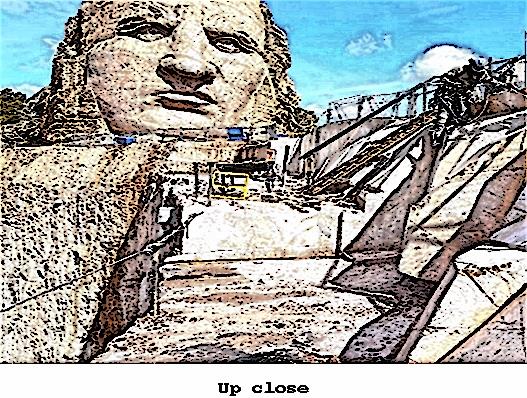
Crazy Horse
Page 186
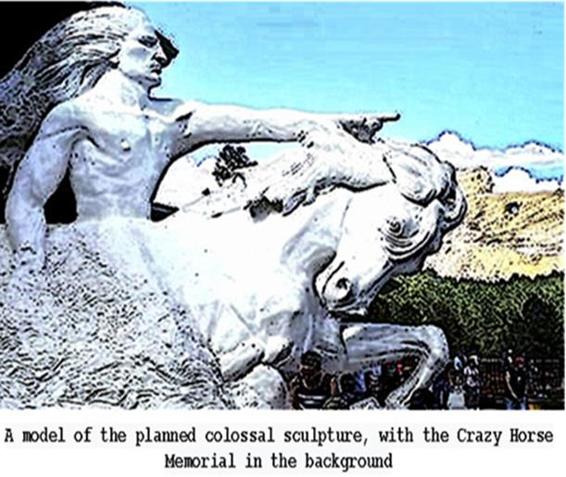
Crazy Horse
Page 187
Operated by the nonprofit Crazy Horse Memorial Foundation, the sculpture grounds are open to the public and reportedly receive more than one million visitors each year.
The incomplete Crazy Horse Memorial in the Black Hills of South Dakota is near the town of Berne. Like the nearby Mount Rushmore National Memorial, it is a monument carved out of a mountainside. The sculpture was begun by Polish-American sculptor Korczak Ziółkowski, who had worked under Gutzon Borglum on Mount Rushmore, in 1948. Plans call for the completed monument to be 641 feet wide and 563 feet high.
Crazy Horse
Page 188
Ziółkowski was inspired to create the Crazy Horse Memorial after receiving a letter from Native Lakota chief Henry Standing Bear, who asked if Ziółkowski would be interested in creating a monument for the Native North Americans to show that the Native American nations also have their heroes. The Native Americans consider Thunderhead Mountain, where the monument is being carved, to be sacred ground. Thunderhead Mountain is situated between Custer and Hill City. Upon completion, the head of Crazy Horse will be the world’s largest sculpture of the human head, measuring approximately 87 feet tall, more than 27 feet taller than the 60 foot faces of the US Presidents depicted on Mount Rushmore, and the Crazy Horse Memorial as a whole will be the largest sculpture in the world.
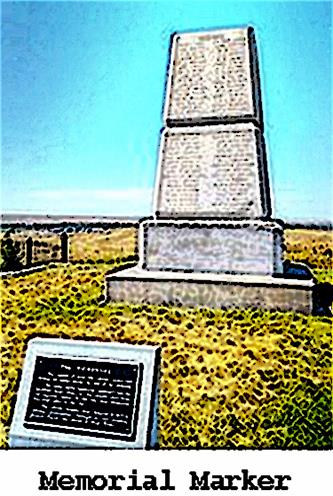
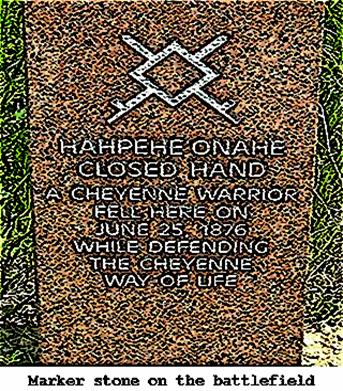
Crazy Horse
Page 189
Page 190
The memorial is funded entirely by private donations, with no assistance from the US government, federal or otherwise. There is no target completion date at this time. However, in 1998, the face of Crazy Horse was completed and dedicated. The Crazy Horse Memorial Foundation regularly takes the lead in cultural, social and educational events, including the Volksmarch, the occasion on which the public is allowed into the actual monument grounds.
The foundation generates most of its funds from visitor fees, with visitors numbering more than one million annually.
The monument has been the subject of controversy, joining 2023’s myriad of main stream media fed “controversies” which the general public doesn’t give three wet farts about. In Ziółkowski's vision, the sculpted likeness of Crazy Horse is dedicated to the spirit of Crazy Horse and all Native Americans.
It is well known that Crazy Horse did not want to be photographed during his lifetime and is reportedly buried in an undisclosed location. While Lakota chief Henry Standing Bear believed in the sincerity of the motives, many Native Americans, as anonymously quoted by that main stream media machine, still oppose the intended meaning of the memorial, while being vague and contradictory in what their understanding of “meaning” might be. Some suspect this is just another manifestation of their cowardly approach to anything revolutionary, and not priorly
Page 191
sanctioned by their federal government benefactors and influencers. Opponents of the monument have likened it to pollution and desecration of the landscape and environment of the Black Hills, and of the ideals of Crazy Horse himself, as if they had any idea of the true feelings they rhetorically impose on environmentalism and Crazy Horse, himself. It’s really kind of amusing to sit back and see-hear the purchased flunkies pontificate about what their betters think.
Aside from the monumental sculpture, Crazy Horse has also been honored by having two highways named after him, both called the Crazy Horse Memorial Highway. In South Dakota, the designation has been applied to a portion of US 16/US 385 between Custer and Hill City, which passes by the Crazy Horse Memorial. In November 2010, Nebraska Governor Dave Heineman approved designating US 20
from Hay Springs to Fort Robinson in honor of Crazy Horse, capping a year-long effort by citizens of Chadron. The designation may extend east another 100 miles through Cherry County to Valentine.
Crazy Horse School in Wanblee, South Dakota is named after him.
In the film “Chief Crazy Horse” (1955), directed by George Sherman, Crazy Horse is played by Victor Mature.
Page 192
In 1982, the American government issued postage stamps in his name, under the “Great Americans” series.
In the film “Crazy Horse” (1995), Crazy Horse is played by Native American actor Michael Greyeyes.
Crazy Horse was killed at Fort Robinson in 1877, which place is marked solely by a rough carved stone set in the remaining foundation of the guardhouse where he was killed. The marker was dedicated in 1934, but it only recognized the death of Crazy Horse. In 2015, Doug Bissonette, spokesman for the Crazy Horse family in Pine Ridge, and Marvin Goings, Lakota, are working with Fort Robinson park officials and the Nebraska State Historical Society to design a new memorial that will also include the names of the 899 others who surrendered with him.
Currently planned is a 60 foot diameter circle with large granite stones at the four directions, a stone in the center, and a smaller stone for offerings. It is a traditional Lakota design, and there will be grass and a walking path around it, probably of concrete. It is long past due. Monique Ziolkowski, family representative and part of the management team of the Crazy Horse Memorial in South Dakota, will donate the massive stones for the new memorial. Four plaques, one in each quadrant of the circle, will contain the names of those who surrendered with Crazy Horse. Still in discussion is the material that will
Page 193
be used to display the names of those listed in the surrender ledger, many of whom are not known by their real names. The plan states that the location of the new memorial “will be laid out in front of the old memorial at the old parade grounds of the US
Army. Crazy Horse first surrendered there, and he was killed there, and we want to make a tribute to all those who surrendered with him. That was the last time they were together.
After that they scattered all over the place,” Bissonette said.
Crazy Horse’s band was the last hold out in the Indian wars.
With Sitting Bull in Canada, Crazy Horse was the Army’s last obstacle to ending the Indian Wars to their complete satisfaction. During the harsh winter of 1877, General Nelson A.
Miles attacked the Hunkpatila Oyate in the Battle of Wolf Mountain. The starving Lakota, their horses lame, courageously fought against all odds on foot in three feet of snow, with only bows and arrows, against the Army. As of 2023, this planned memorial is no more complete than the one in the Black Hills.
The novel “In the Footsteps of Crazy Horse” (2015) by Joseph Marshall III tells the story of a young Lakota boy who learns about Crazy Horse from his grandfather.
An Excelsior class Starfleet starship named after Crazy Horse appears in two episodes of “Star Trek: The Next Generation.”
Page 194
Crazy Horse's life was the subject of a four part series of the podcast “History on Fire” by historian Daniele Bolelli.
Page 195
11– Little Bighorn
If Crazy Horse cared about what people thought about him, he’d probably hope that they remembered him for this. However, he doesn’t. Just for your information, Little Bighorn was the fulfillment of his youthful vision. Try getting into the spirit of these things. Crazy Horse led as many as 1,000 warriors to flank Custer’s forces and help seal the general’s disastrous defeat and death.
Battle of the Little Bighorn
Part of the Great Sioux War of 1876
Date: June 25–26, 1876
Location: Near Little Bighorn River, Crow Native American Reservation, Bighorn County, Montana, US
Result: Lakota, Northern Cheyenne, and Arapaho victory Participants
Lakota
Dakota
Northern Cheyenne
Arapaho
Page 196
United States
Crow scouts
Arikara scouts
Commanders and Leaders
Crazy Horse
Sitting Bull
Chief Gall
Lame White Man
Two Moon
George A. Custer
Marcus Reno
Frederick Benteen
Myles Keogh
James Calhoun
Units Involved
Page 197
Nations of the plains and the 7th Cavalry Regiment Strength
1,100–2,500 Native American warriors vs. 700 US cavalrymen and Native American scouts
Casualties and Losses
31 done in by Crazy Horse himself and up to 300 killed overall Up to 160 wounded