

Baseball Trailblazers by Edward Drobinski - HTML preview
Download the book in PDF, ePub, Kindle for a complete version.
.333.
Following the A's 1930 World Series victory, Collins retired as a player and immediately stepped into a full time position as a coach with the A's. After two seasons as a coach, Collins was hired as vice president and general manager of the Boston Red Sox. The new owner, Tom Yawkey, was a close friend and had bought the Red Sox at Collins' suggestion. He took over a team that had bottomed out from a long decline dating from their sale of Babe Ruth. The 1932 Red Sox finished 43-111, the worst record in franchise history.
Collins remained GM through the 1947 season, retiring at age 60
after a period of declining health, thus ending 41 years in baseball. During his 15 years as general manager, Collins helped turn a dreadful team into a contender once again. After two years rebuilding the awful team he'd inherited, Collins managed winning seasons in seven of his final 12 years as general manager. His 1946 team won the Red Sox' first pennant since 1918.
He struggled with major heart problems for several years at the end of his life. He was admitted to a hospital in Boston on
Baseball Trailblazers Page 425
March 10, 1951, and died there due to the heart condition on March 25 at age 63.
Baseball Trailblazers
Page 426
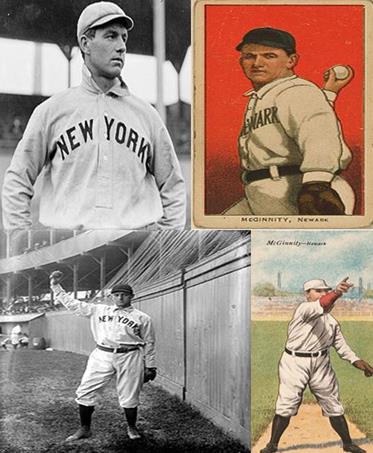
Joe McGinnity

Baseball Trailblazers
Page 427
Joseph Jerome McGinnity, March 20, 1871 - November 14, 1929, was a right handed pitcher in major league baseball in the late 19th and early 20th century. McGinnity played for ten years, pitching for the National League's Baltimore Orioles and Brooklyn Superbas, before jumping to the American League to play for the Baltimore Orioles. He returned to the NL with the New York Giants. McGinnity continued to pitch in the minor leagues, eventually retiring from baseball for good at the age of 54.
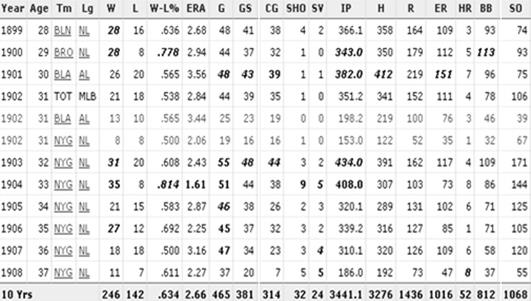
In major league baseball, he won 246 games with a 2.66 earned run average. He had seven 20 win seasons and two 30 win seasons.
Baseball Trailblazers Page 428
Including his time in the minor leagues, McGinnity won close to 500 games as a professional ballplayer. He led the major leagues in wins five times and ERA once. With the Giants, he won the 1905 World Series. His teams also won NL pennants in 1900 and 1904.
McGinnity was nicknamed "Iron Man" because he worked in an iron foundry during the baseball off seasons. His nickname came to convey his longevity and durability, as he routinely pitched in both games of doubleheaders. He set modern NL records for complete games and innings pitched in a single season, which still stand.
McGinnity's father, Peter, was born in Dublin, Ireland. Peter worked in coal mines and on the farm owned by John and Rebecca Denning, and they accepted him, allowing him to move in with them in their Henry County farm. John and Rebecca moved to Oregon, leaving the homestead in the hands of Peter and their daughter, Hannah. The two married in August 1865, three months before the birth of their first son, William. Their second son, Peter, was born in 1869, and Joe was born in 1871. The McGinnitys had four more children.
Joe received little formal schooling. His family moved frequently during his childhood. The McGinnitys moved to
Baseball Trailblazers Page 429
Gallatin County in 1878. Two days after the birth of their seventh child, Peter died in an accident. At the age of eight, Joe and his older brothers went to work in the mines to support their family. In 1880, the family moved to Springfield, Illinois, where Joe and his brothers worked for the Springfield Coal Company. They moved to Decatur, Illinois less than six months later, continuing to mine coal, while their mother cleaned houses.
While living in Decatur, McGinnity began playing baseball with other coal miners in his leisure time. The owner of the Decatur Coal Company founded the Decatur Baseball Association in 1886.
An outfielder, McGinnity substituted for his team's pitcher in an 1888 game, which he won. He continued to pitch from that point on. He pitched for semi-professional teams based in Decatur in 1888 and 1889. His family headed west, stopping in the Native American Territory on their way to Montana, where Hannah's sister struck gold in their coal mine. McGinnity and his brothers worked in a coal mine in Krebs. There, he met his future wife, Mary Redpath, the oldest daughter of a fellow coal miner. McGinnity also played baseball for the local team. He increased baseball's popularity in the area, and was later referred to as "the father of Oklahoma baseball" by a sportswriter for The Oklahoman, as he organized, managed, and
Baseball Trailblazers Page 430
pitched for teams in Krebs. One of these teams began traveling to other towns along the Missouri-Kansas-Texas Railroad to play against their local teams. He also pitched for teams in neighboring towns.
“I have never seen a pitcher with more confidence in himself than McGinnity had. He was so cocksure of his fielding ability that he would take any sort of chance, throwing to any base under any circumstance, and this fielding ability lifted him out of many tight spots.” - Hughie Jennings
John McCloskey, the manager of the minor league baseball Montgomery Colts of the Class B Southern League, heard about McGinnity's pitching. McCloskey signed McGinnity, who made his professional debut with the Colts in 1893. McCloskey habitually baited umpires during games, a trait which McGinnity learned.
The league folded as a result of financial troubles related to the Panic of 1893. Jimmie Manning, manager of the Southern League franchise in Savannah, Georgia, became manager of the Kansas City Blues of the Class A Western League for the 1894
season, and signed McGinnity to pitch for the Blues. Combined for Montgomery and Kansas City, McGinnity had a 21-29 win-loss record, while walking more batters than he could strikeout, and allowing more than a hit per inning pitched. According to a Western League umpire, catcher Tim Donahue tipped McGinnity's
Baseball Trailblazers Page 431
pitches to opposing batters due to a personal feud. As McGinnity continued to struggle for Kansas City, he requested his release in June.
McGinnity moved to Springfield, Illinois, where he worked as a coal miner, bartender, and operated a saloon. McGinnity also pitched locally for semi-professional teams in Springfield and Decatur, receiving a salary between $1 and $3 for each game.
During this time, McGinnity developed a sidearm pitch he nicknamed "Old Sal," described as a "slow curve," which became a feature of his later success. He also improved his fielding, as opponents attempted to bunt "Old Sal."
While pitching for a semi-professional team, McGinnity defeated the National League's Baltimore Orioles in an exhibition game after he had already defeated a team from Chatham, Illinois earlier in the day. Pat Wright, who managed Springfield's semiprofessional team, was named manager of the Peoria Distillers of the Class B Western Association, and he signed McGinnity to Peoria for the 1898 season, marking his return to professional baseball. Armed with "Old Sal," McGinnity compiled a 9-4 record for Peoria, allowing only 118 hits and 60 walks while striking out 74 batters in 142 innings. He pitched a complete 21 inning game, believed to be the second longest professional baseball
Baseball Trailblazers Page 432
game to date. With low attendance and the distraction of the Spanish-American War, the Western Association folded in August.
Former Brooklyn Grooms player George Pinkney, who lived in Peoria during his retirement, saw McGinnity pitch, and contacted Brooklyn owner Charles Ebbets to recommend he sign McGinnity. He signed McGinnity in the spring of 1899 for $150 a month. The syndicate that owned Brooklyn also owned the Baltimore Orioles.
With the ownership consolidation, Orioles player-manager Ned Hanlon, who received an ownership stake in the clubs, moved from Baltimore to Brooklyn and assigned many of his best players to Brooklyn, including Joe Kelley, Dan McGann, Hughie Jennings and Willie Keeler. Hanlon assigned McGinnity to the Orioles for the 1899 season after seeing his unorthodox pitching delivery and slow pitching speed. With the Orioles, McGinnity played with John McGraw, who succeeded Hanlon as player-manager, and Wilbert Robinson, who caught McGinnity. McGraw and Robinson had refused to relocate to Brooklyn due to their investment in a Baltimore restaurant. The two imparted their aggressive style of play to McGinnity. In his first year in the NL, McGinnity had a 28-16
record. His 28 wins led the NL, while he ranked second with 48
games, third with a 2.68 earned run average, and fourth with 366
innings pitched.
Baseball Trailblazers Page 433
After the 1899 season, the NL voted to contract four teams, which included the Orioles. Hanlon assigned McGinnity to Brooklyn, now known as the "Superbas." McGinnity posted a 28-8
record for Brooklyn in the 1900 season. His 28 wins and 343
innings pitched led the league, as the Dodgers won the NL
pennant. McGinnity also pitched two complete games in the Chronicle-Telegraph Cup, as the Superbas defeated the Pittsburgh Pirates. Rather than draw straws to decide who would keep the trophy, the team voted to award it to McGinnity.
With the formation of the American League as a competitor to the NL, and rumors that the AL's Detroit Tigers were interested in McGinnity, Brooklyn offered McGinnity a $5,000 contract to stay with Brooklyn. McGinnity considered retiring from baseball, but ultimately jumped to the AL, signing with the Baltimore Orioles of the AL before the 1901 season. He received a salary of $2,800, choosing less money in an upstart league for the chance to be reunited with McGraw, who was player-manager and part-owner of the Orioles.
Fighting continued to erupt in games McGraw managed. During a brawl that erupted in a game against the Detroit Tigers on August 21, 1901, McGinnity spat on umpire Tom Connolly.
McGinnity was arrested for the incident and permanently suspended by AL president Ban Johnson, who wanted there to be no
Baseball Trailblazers Page 434
fighting in AL games. Johnson later cut the suspension down to 12 days after McGinnity apologized. McGinnity compiled a 26-20
record for the 1901 Orioles, and his 48 games, 39 complete games, and 382 innings pitched led the AL.
"It was difficult for a batter to get McGinnity's measure.
Sometimes his fingers would almost scrape the ground as he hurled the ball. He knew all the tricks for putting a batter on the spot.” - Connie Mack
McGinnity began the 1902 season with the Orioles. However, the franchise began to fall into significant debt. Joe Kelley, star player for the Orioles and son-in-law of part owner John Mahon, reported that the team owed as much as $12,000. Unable to afford that debt, Mahon purchased shares of the team from Kelley and player-manager John McGraw. With this, Mahon became the majority shareholder. On July 17, 1902, Mahon sold his interest in the Orioles to Andrew Freedman, principal owner of the Giants, and John T. Brush, principal owner of the Cincinnati Reds, also of the NL. That day, Freedman and Brush released McGinnity, McGraw, Kelley, Roger Bresnahan, Jack Cronin, Cy Seymour, and Dan McGann from their Oriole contracts. Brush then signed Kelley and Seymour to the Reds, while Freedman signed McGinnity, Bresnahan, Cronin, and McGann, joining McGraw, his new player-manager, on the Giants. McGinnity attempted to contact Johnson that night,
Baseball Trailblazers Page 435
offering to stay with the Orioles if he could receive Johnson's personal assurance that he was welcome to stay. McGinnity did not hear back from Johnson, who had left his phone off the hook that night to avoid being contacted, and joined his teammates with the Giants.
With the Giants for the 1903 season, McGinnity won 31 games. He also set major league baseball records with 48 games started and 434 innings pitched, which remain NL records today. In 1903, McGinnity started both games of a doubleheader on numerous occasions. He performed this feat three times in a single month, winning all six games. On the final instance, “The New York Times” reported "he seemed fresh enough to tackle the visitors for a third contest if that were necessary." He pitched over 100
innings in the month of August. Wins by McGinnity and fellow pitcher Christy Mathewson accounted for 73% of the Giants'
winning games in 1903, setting a record for a pitching tandem.
After the season, McGinnity and some of his teammates threatened to quit the Giants, accusing Brush, now the Giants owner, of going back on a promise to pay the team a monetary bonus for having finished among the top three teams in the NL, as well as a share of the gate receipts from exhibition games, for which they were paid $56.35, though Brush allegedly had made over $200,000. McGinnity claimed that he would pitch in the
Baseball Trailblazers Page 436
California League, as he had received a salary offer for "$1,000
more than he got in New York." Jack Warner eventually joined McGinnity in publicly threatening to quit.
McGinnity set a record during the 1904 season, recording his tenth win in 21 team games on May 21, the fewest team games for a pitcher to reach the mark. In 1904, McGinnity had a 35-8
record, leading the NL in games - 51, innings pitched - 408, shutouts - 9, saves - 5, and his career best 1.61 ERA. With the Giants competing for the pennant, McGinnity again won both games in a doubleheader three times in a matter of weeks. Aided by McGinnity, the Giants again won the NL pennant. However, they did not compete in the 1904 World Series as Brush and McGraw refused to face the AL champion Boston Pilgrims, following their altercations with Johnson. After the 1904 season, McGinnity attempted to hold out from the Giants when Brush refused to allow McGinnity to play winter baseball with a team in the Southern United States.
McGinnity won 21 games in the 1905 season, as the Giants won the NL pennant. This year, the Giants participated in the 1905 World Series, against the AL champion Philadelphia Athletics.
McGinnity started Games Two and Four of the five game series against the Athletics, winning one and losing one, while Mathewson pitched and won the other three. All five games,
Baseball Trailblazers Page 437
including the game McGinnity lost to Chief Bender, were shutouts. In 1906, McGinnity again led the NL in wins, with 27.
This came in spite of a suspension McGinnity served for fighting with Pirates catcher Heinie Peitz, which NL president Harry Pulliam described as "attempting to make the ball park a slaughterhouse." The Mayor of Pittsburgh, who attended the game, insisted that McGinnity be arrested.
In the 1907 season, McGinnity finished with an 18-18 record with a 3.16 ERA, allowing more than a hit per inning for the first time since the 1901 season. He missed the beginning of the 1908
season with a severe fever. In June 1908, Brush put McGinnity on waivers, hoping another owner would relieve him of McGinnity's $5,000 salary. He tried to waive McGinnity again in August, but both times McGinnity went unclaimed. Despite this, McGinnity reverted to his old form. From August 22 through the end of the season, McGinnity had an 11-7 record, five shutouts, a 2.27 ERA, and an NL leading five saves. The Giants released McGinnity on February 27, 1909, when McGinnity decided to pay for his own release.
McGinnity purchased the Newark Indians of the Class A Eastern League for $50,000 in 1909 from Frank J. Farrell. The press reported that McGinnity would operate the team as a farm team of the Giants, though he denied these reports. When McGinnity could
Baseball Trailblazers Page 438
not retain manager Harry Wolverton, he stepped in as player-manager for the Indians. That season, he had a 29-16 record. His 422 innings pitched and 11 shutouts set EL single season records. He also won both games of doubleheaders on August 27, 1909, and July 23, 1912.
McGinnity played for and managed the Indians through 1912. The Indians finished second in the EL in 1909 and 1910. McGinnity sold his interests in the Indians to Ebbets and Ed McKeever and purchased the Tacoma Tigers of the Class B Northwestern League for $8,500, spending another $50,000 on the franchise in renovating the stadium. He served as player-manager of the Tigers at the start of the 1913 season, but stepped down, hiring Russ Hall to serve as manager in June. McGinnity sold stock in the team in 1915 in order to afford operating expenses. He also briefly played for the Venice Tigers of the Class A Pacific Coast League in 1914.
McGinnity sold the Tigers and purchased the Butte Miners of the Northwestern League in 1916, serving as player-manager and bringing with him several players from Tacoma. In June 1917, he sold his stock in the team and secured his release. He played for the Great Falls Electrics of the Northwestern League for the remainder of the 1917 season. He later became the manager of the A. E. Staley factory baseball team.
Baseball Trailblazers Page 439
McGinnity served as player-manager of the Danville Veterans of the Class B Illinois-Indiana-Iowa League in the 1922 season and Dubuque Climbers of the Class D Mississippi Valley League during the 1923 season. With Dubuque, McGinnity won 15 games at age 52.
One of those wins was a shutout, pitched in a record one hour and seven minutes. Two years later, he returned to play for Dubuque and the Springfield Senators of the Illinois-Indiana-Iowa League during the 1925 season. He pitched in his final professional game on July 28, 1925, after participating in an old timers game earlier in the day.
McGinnity joined the coaching staff of former teammate Wilbert Robinson, along with Kelley, for the Brooklyn Dodgers during the 1926 season. McGinnity and Kelley were not retained after the season.
McGinnity acquired his nickname, "Iron Man" before his doubleheader pitching became widely discussed. A reporter asked McGinnity, while he was still a minor league pitcher, what he did in between seasons. "I'm an iron man," he answered. "I work in a foundry." McGinnity's wife's family operated an iron foundry in McAlester, Oklahoma, where McGinnity worked in the off seasons.
Baseball Trailblazers Page 440
Because of his nickname and connection to the foundry, John McGraw named McGinnity the starter for the Giants' March 23, 1904 exhibition game against the Southern Association's Birmingham Iron Men which was scheduled to raise funds for the Vulcan statue then being cast for the Louisiana Purchase Exposition that summer in St. Louis, Missouri. At his own request, McGinnity was allowed to visit the downtown foundry and personally pour some of the iron into the moulds for the statue.
McGinnity finished his major league baseball career with 246
career wins, seven 20 win seasons, and two 30 win seasons. He had nearly 500 professional wins including his years in the minor leagues. He revolutionized the fielding of the pitching position, by attempting to make force outs at any base, instead of only throwing the ball to first base.
While working with Williams College's baseball team in 1929, McGinnity became ill. He had surgery to remove tumors from his bladder, and was said to be in critical condition. After the surgery, he was quoted as saying; "It's the ninth inning, and I guess they're going to get me out." He died November 14, 1929 in Brooklyn, New York, at the home of his daughter.
Baseball Trailblazers
Page 441
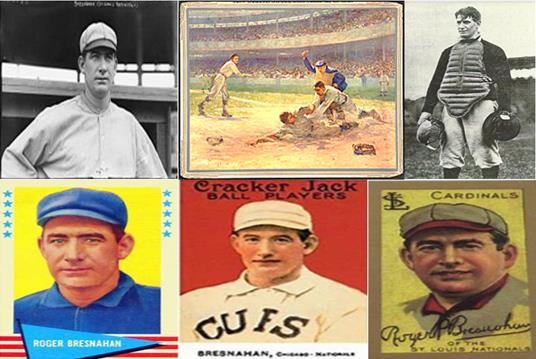
Roger Bresnahan
Baseball Trailblazers
Page 442
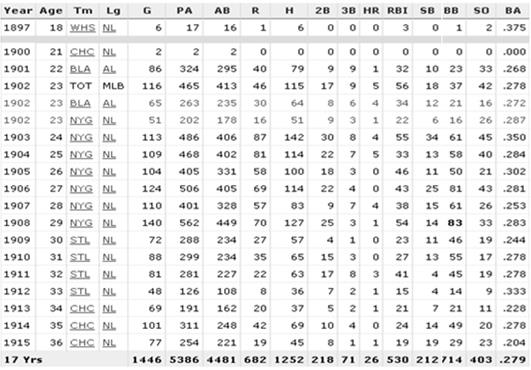
Roger Philip Bresnahan, June 11, 1879 - December 4, 1944, nicknamed "The Duke of Tralee," was a player and manager in major league baseball. Bresnahan began his major league baseball career as a pitcher. He also served as an outfielder, before becoming a regular catcher. For his major league career, Bresnahan had a .279 batting average in 4,480 at bats and a 328-432 managerial win-loss record. Bresnahan popularized the use of protective equipment in baseball by introducing shin guards, to
Baseball Trailblazers Page 443
be worn by catchers, in 1907. He also developed the first batting helmet.
Bresnahan was born in Toledo, Ohio. He was the seventh child of Michael and Mary Bresnahan, who had immigrated to the United States from Tralee, Ireland. Bresnahan used to claim that he was also from Tralee, and early in his life, he earned the nickname
"The Duke of Tralee."
Bresnahan began playing baseball in grade school, becoming one of the best known sandlot baseball players. He continued to play baseball at Toledo's Central High School.
At 16, Bresnahan signed with a semi-professional team from Manistee, Michigan. After he graduated high school, Bresnahan signed with Lima of the Ohio State League, where he played primarily as a pitcher, but also as a catcher in 1895 and 1896.
On August 10, 1897, the Washington Senators of the National League purchased Bresnahan from Lima. He began his major league career as a pitcher, throwing a six hit shutout against the St.
Louis Browns on August 27, 1897. He had six hits in 16 at bats, a .375 batting average, and had a 4-0 win-loss record for the 1897 Senators. However, the Senators released Bresnahan after the season over a salary dispute, when he attempted to hold out for more money.
Baseball Trailblazers Page 444
Bresnahan played for the Toledo Mud Hens of the Interstate League and the Minneapolis Millers of the Western League in 1898, and the Millers and Buffalo Bisons of the Western League in 1899. Bresnahan appeared in two games at catcher for the Chicago Orphans of the NL in 1900, which served as a tryout.
With the formation of the American League as a competitor to the NL, Bresnahan, among others, jumped to the AL. John McGraw, manager of the Baltimore Orioles of the AL saw Bresnahan pitch for Chicago, and decided to sign him for the Orioles before the 1901 season. For the Orioles, Bresnahan filled in at catcher behind Wilbert Robinson, and also appeared in the outfield. A faster baserunner than the average catcher, Bresnahan had two inside the park home runs on May 30, 1902.
With the Orioles reportedly in significant debt, part-owner John Mahon purchased shares of the team from star players Joe Kelley and John McGraw, who had resigned from the team and signed with the New York Giants of the NL, becoming the majority shareholder. On July 17, 1902, he sold his interest in the Orioles to Andrew Freedman, principal owner of the Giants, and John T. Brush, principal owner of the Cincinnati Reds, also of the NL. That day, Freedman and Brush released Bresnahan, Kelley, Joe McGinnity, Jack Cronin, Cy Seymour, and Dan McGann from their contracts. Brush then signed Kelley and Seymour to the
Baseball Trailblazers Page 445
Reds, while Freedman signed McGinnity, Bresnahan, Cronin, Gilbert, and McGann, joining McGraw, his new player-manager, on the Giants.
With Frank Bowerman and Jack Warner established as the Giants'
catchers, McGraw played Bresnahan as the center fielder. In 1903, Bresnahan batted .350, trailing Honus Wagner's .355
average atop the NL. Bresnahan batted .284 in the 1904 season, playing 96 games in the outfield, ten games at first base, four games at shortstop, and one game apiece at second base and third base, as the Giants were champions of the NL.
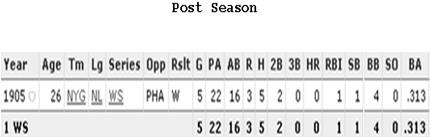
Bresnahan shifted to catcher full time in 1905, as Bowerman became less effective and Warner left the Giants. Christy Mathewson preferred pitching to Bresnahan. Bresnahan caught all five games in the 1905 World Series, including three shutouts by Mathewson, and one shutout thrown by Joe McGinnity. He led the Giants with a .313 batting average in the fall classic.
“Bresnahan had a memory almost as good as Mathewson or McGinnity. He never had to be told twice. Once we had discovered a weak spot in the opposition and had discussed a plan for attacking it I could depend absolutely on Bresnahan to carry it out. He did not forget. His whole mind was concentrated on
Baseball Trailblazers Page 446
winning that particular game and it was rarely that he overlooked anything.” - John McGraw
On Opening Day in 1907, Bresnahan began to experiment with protective gear. Most catchers did not wear any protective equipment at that time. Bresnahan practiced in shin guards that are worn in cricket during spring training, and debuted them on April 11, 1907. Fans, used to seeing catchers play without protective equipment, threw snowballs on the field, and without police at the game, umpire Bill Klem called off the game, with the Giants forfeiting to the Philadelphia Phillies. The press also criticized the use of shin guards. However, other catchers began to adopt Bresnahan's idea. Though Pittsburgh Pirates manager Fred Clarke protested Bresnahan's gear to the league, the protest was denied and the equipment was approved. Bresnahan caught a career high 138 games in 1908, batting .283 and leading the NL in walks.
Bresnahan also developed the first batting helmet. He was hit in the head with a pitch by Andy Coakley of the Cincinnati Reds on June 18, 1907. Bresnahan was unconscious, and a Catholic priest read him his last rites. Bresnahan was hospitalized for ten days, during which time he developed schematics for a plastic batting helmet, though this piece of equipment did not become
Baseball Trailblazers Page 447
commonplace until the 1940s. Bresnahan was also the first catcher to wear a padded facemask while catching.
The Giants obtained younger and faster players in 1909. McGraw had Chief Meyers ready to succeed Bresnahan at catcher. Stanley Robison of the St. Louis Cardinals became interested in hiring Bresnahan to be a player-manager. As McGraw did not want to block Bresnahan from the opportunity, the Giants traded Bresnahan to the Cardinals for Red Murray, Bugs Raymond and Admiral Schlei after the 1908 season. Bresnahan led the Cardinals, who won only 49 games in 1908, to 54 wins in 1909 and 63 wins in 1910. Attendance increased from 205,000 fans in 1908
to 299,000 fans in 1909, and 355,000 fans in 1910.
Grateful for the improvement at the box office, Robison signed Bresnahan to a five year contract to manage the team for a salary of $10,000 per season, plus ten percent of the club's profits. Robison died in March 1911, and ownership of the team transferred to Helene Hathaway Britton, his niece.
On July 11, 1911, with the Cardinals only three games out of first place, the team was involved in a train wreck while riding the Federal Express from Philadelphia to Boston. Fourteen passengers were killed after the train derailed and plunged down an 18 foot embankment outside Bridgeport, Connecticut. None of
Baseball Trailblazers Page 448
the Cardinals were seriously injured, due to a fortuitous pre-trip change in the location of their Pullman car, requested by Bresnahan. The Cardinals helped remove bodies and rescue the injured.
Bresnahan and Britton feuded publicly in 1912, as the Cardinals fell to sixth place in the NL. The Cardinals fired Bresnahan after the 1912 season due to various arguments Bresnahan had with Britton, including over Bresnahan's desire to sell Miller Huggins to another franchise. Britton cited decreased profits as a sign that Bresnahan was uninterested in the job. Huggins succeeded Bresnahan as Cardinals' manager, as she preferred Huggins' "gentlemanly" manner, as opposed to Bresnahan's rougher personality. Brenahan hired an attorney to obtain the remainder of his salary. He eventually settled the lawsuit against Britton for $20,000.
Following his termination by the Cardinals, the NL declared Bresnahan a free agent. He signed a three year contract with the Cubs, receiving $10,000 per season with a $25,000 signing bonus.
He served as player-manager for the Cubs in 1915, but was released when his batting average slipped. As the rival Federal League collapsed and the Cubs merged with the Chicago Whales of the Federal League, the Cubs decided to replace Bresnahan with Whales manager Joe Tinker.
Baseball Trailblazers Page 449
The Cubs paid Bresnahan for the remaining two years on his contract and aided Bresnahan in purchasing the Toledo Mud Hens, then in the American Association, in 1916. The club had moved to Cleveland to block the Federal League from placing a team there, but returned to Toledo under Bresnahan's control. Bresnahan played for the team until 1918, when he announced his retirement. He played for a semi-professional team in 1919, and appeared in five games for the Mud Hens in 1921. Bresnahan worked to add lights to Toledo's stadium, so that they could play night games.
Bresnahan sold the Mud Hens before the 1924 season. McGraw then hired Bresnahan as a coach for the Giants, a position he held from 1925 through 1928. He coached for the Detroit Tigers in 1930 and 1931.
During the off seasons, Bresnahan returned to Toledo. He worked as a hotel detective at the Boody House, which he later purchased. Bresnahan lost much of his money in the stock market crash of 1929. He worked as a manual laborer, as a guard at the Toledo Workhouse, and as a salesman for Toledo's Buckeye Brewing Company. Bresnahan ran for sheriff of Lucas County as a member of the Democratic Party in 1932. He lost, and endorsed the victorious candidate in his reelection bid two years later.
Bresnahan ran for county commissioner in 1944, winning the
Baseball Trailblazers Page 450
Democratic Party nomination, but losing in the general election by a few hundred votes out of 140,000 cast.
Bresnahan died of a heart attack at his home in Toledo on December 4, 1944 at the age of 65. He was survived by his wife, Gertrude, and his daughter, Marian.
Baseball Trailblazers
Page 451
Al Simmons
Baseball Trailblazers
Page 452
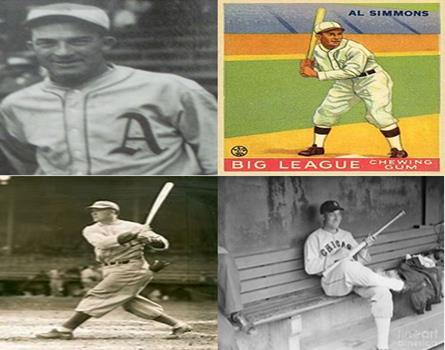
Aloysius Harry Simmons, May 22, 1902 – May 26, 1956, born Alois Szymanski, was a professional baseball player. Nicknamed
"Bucketfoot Al," he played for two decades in major league baseball as an outfielder and had his best years with Connie Mack's Philadelphia Athletics during the late 1920s and early
Baseball Trailblazers Page 453
1930s, winning two World Series with Philadelphia. Simmons also played for the Chicago White Sox, Detroit Tigers, Washington Senators, Boston Braves, Cincinnati Reds and Boston Red Sox.
After his playing career ended, Simmons served as a coach for the Athletics and Cleveland Indians. A career .334 hitter, Simmons was inducted into the Baseball Hall of Fame in 1953.
Simmons was born in Milwaukee and grew up as a fan of the Philadelphia Athletics. In the fourth grade, he received a spanking from his father for insisting that he wanted to play professional baseball. When he persisted in asserting his desire to be a baseball player, his father replied that he had better become a good player. Simmons was known by his birth last name, Szymanski, until he was playing for a local minor league team and he was tired of hearing people mispronounce it. He saw an advertisement for a company named “Simmons Hardware” and decided to take on the last name of Simmons.
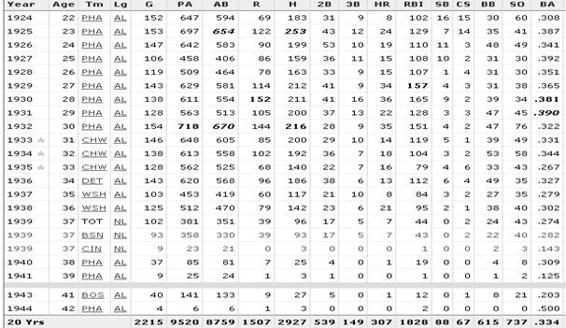
In 1925, his second season with Philadelphia, Simmons led the AL
with 253 hits and 392 total bases, while posting a .387 batting average, 24 home runs and 129 runs batted in. He scored 122
runs, hit 43 doubles, and finished with a .599 slugging percentage. His 85 multi-hit games constitute a single season record. In the following three seasons, he hit .341, .392 and
Baseball Trailblazers Page 454
.351 and drove in 110, 108 and 107 runs in those respective years.
Simmons led the A's to the AL pennant in 1929 as Philadelphia went 104–46, finishing 18 games ahead of the New York Yankees.
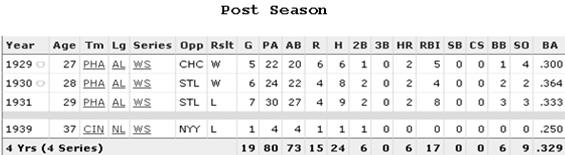
The A's went on to defeat the Chicago Cubs in five games to win the World Series. That season he hit .365 with 34 home runs and led the AL with 157 RBI. He also scored 114 runs, had 212 hits with 41 doubles and a .642 slugging percentage. In his first World Series Simmons batted .300 with 2 home runs, 5 RBIs, and scored 6 runs.
Simmons' best year as a player was in 1930, when he won his first of successive batting titles, hitting .381 with 36 home runs, 211 hits, 41 doubles and 16 triples. He had a slugging percentage of .708, drove in 165 runs and scored 152 runs in 138
games. The A's won the AL pennant again, going 102–52, and defeated the St. Louis Cardinals to win back to back World Series titles. In that World Series, Simmons batted .364 with 2
home runs, 4 RBI with a .727 slugging percentage.
In 1931, the A's won their third straight AL pennant, by 13.5
games over the Yankees, going 107–45. Simmons won his second batting title, hitting .390 with 22 home runs, 128 RBI, 100 runs scored, 200 hits, 37 doubles, 13 triples and a .641 slugging
Baseball Trailblazers Page 455
percentage while playing in only 128 games. The A's were upset in their quest for a third consecutive World Series title, losing the World Series in seven games to the Cardinals. Simmons hit .333 with 2 home runs and 8 RBI in the series.
In a final season with Philadelphia, 1932, Simmons led the AL
with 216 hits. He batted .322, with 35 home runs, 151 RBIs and 144 runs scored. Simmons finished his Philadelphia Athletics tenure with a .356 batting average, 209 home runs, 1,179 RBI and 969 runs scored in 1,290 games. He drove in 100+ runs in all nine seasons and scored 100 or more runs in five seasons. In three World Series appearances for the A's, Simmons hit .333
with 6 home runs, 17 RBI and 15 runs scored in 18 games.
In late September 1932 the Athletics sold Simmons, Mule Haas and Jimmy Dykes to the Chicago White Sox for cash. The amount of the purchase was not disclosed at the time the sale was reported, though it was said to be the largest cash purchase ever made by the White Sox and possibly the largest purchase in AL history.
Newspaper reports speculated that Athletics owner Connie Mack might be breaking apart the Athletics team that had been so successful between 1929 and 1931.
During his first season in Chicago, Simmons batted .331 with 14
home runs, 119 RBI and 200 hits. In 1934 he batted .344 with 18
Baseball Trailblazers Page 456
home runs, 104 RBI, 102 runs scored and 192 hits in 138 games.
After a disappointing final season with the White Sox which saw Simmons bat just. 267 with 16 home runs and 79 RBI in 128 games, he rebounded by hitting .327 with 13 home runs, 112 RBI, and 96
runs scored in 1936 for the Detroit Tigers.
In 1937 he struggled again, this time with the Washington Senators, batting just .279 with 8 home runs and 84 RBIs in 103
games. He rebounded with a stellar season in 1938, batting .302
with 21 home runs and 95 RBI in just 125 games. His 21 home runs that year gave Simmons the distinction of being the first player to hit 20 home runs in a year for the Senators.
Simmons was purchased from the Senators by the Boston Bees in 1939. The purchase price was not immediately revealed, though Simmons was reported as not getting along with Senators owner Clark Griffith. Simmons played in the major leagues until 1944.
Simmons was one of the best hitters in major league baseball history. He had a career batting average of .334. He hit .340 or better in eight different seasons, with four seasons of better than .380. He recorded a .300 batting average and 100 or more RBI in his first 11 major league seasons.
Simmons accumulated 1,500 hits in 1,040 games and 2,000 hits in 1,393 games, numbers that remain the fewest games needed to
Baseball Trailblazers Page 457
attain both marks in major league history. He compiled 200 hits or better in a season six times, with five of those being consecutive - 1929–33, and had 199 and 192 hits in 1926 and 1934. He compiled more hits than any right handed batter in AL
history until surpassed by Al Kaline in many more at bats.
Simmons recorded 8 five hit games and 52 four hit games in the majors.
Simmons hit 307 career home runs, finishing in the top six in AL
in home runs for seven consecutive seasons - 1925–32. In 19
World Series games, he hit .329 with 6 home runs, 17 RBI, 15
runs scored and a .658 slugging percentage. He was also a fine outfielder in his era, recording a career .982 fielding percentage. Simmons was nicknamed "Bucketfoot Al" because he strode toward third base when hitting.
After his playing days ended, Simmons served as a coach for Mack's Athletics - 1945–49, and the Cleveland Indians - 1950. In early April 1951, Simmons announced he was dealing with an undisclosed illness and would be stepping down as a coach of the Indians. While Cleveland manager Al López encouraged Simmons to think about his decision, Simmons said he could no longer help the team.
Baseball Trailblazers Page 458
Simmons died on May 26, 1956. He had collapsed on a sidewalk near the Milwaukee Athletic Club, where he lived, and was thought to have suffered a heart attack. He was pronounced dead at a hospital a short time later.
Baseball Trailblazers
Page 459
Chief Bender
Baseball Trailblazers
Page 460
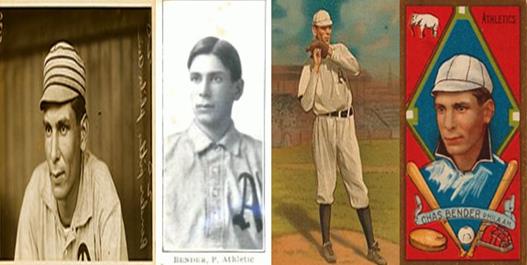
Charles Albert "Chief" Bender, May 5, 1884 - May 22, 1954, was a pitcher in major league baseball during the 1900s and 1910s.
Bender was born in Crow Wing County, Minnesota, as a member of the Ojibwe tribe. His father was German and his mother was part Chippewa. As a child, he was named Mandowescence, which might be translated into English as "Little Spirit Animal." His family had 160 acres on the White Earth Indian Reservation near Bemidji, Minnesota. His father taught him to farm on the reservation. He graduated from Carlisle Indian Industrial School and attended Dickinson College.
Bender debuted in the major leagues in 1903. He is one of only a few pitchers in the 20th century to throw 200 or more innings at the age of 19. His walks per nine innings rate were 2.17; only a few pitchers since 1893 have had a rate below 2.2 at the age of
Baseball Trailblazers Page 461
20 or younger. That year, he also won a game against Cy Young and met his future wife Marie.
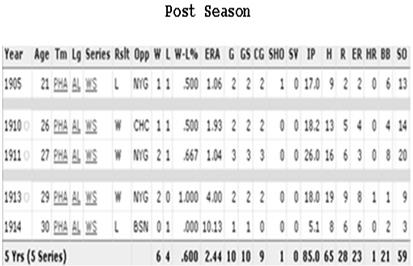
In 1905, Bender earned an 18-11 win-loss record with a 2.83 ERA, helping the A's win the AL pennant; but they lost the World Series in five games to the New York Giants. Bender went 1-1, with a 1.06 ERA in the series, pitching a 4 hit, 3-0 complete game shutout in Game 2, striking out 9, and again went the distance in Game 5, giving up just two earned runs in eight innings and losing 2-0 to Christy Mathewson.
After solid seasons in 1906 - 15-10, 2.53 ERA, 1907 - 16-8, 2.05
ERA, 1908 - 8-9, 1.75 ERA, and 1909 - 18-8, 1.66 ERA, he led the Athletics to the AL pennant in 1910, as Philadelphia went 102-48, 14 games ahead of the second place New York Yankees. Bender led the AL in winning percentage, at .821, going 23-5 with a 1.58 ERA. He went 1-1 with a 1.93 ERA in the World Series as the A's beat the Chicago Cubs, who had gone 104-50 in the regular season, in five games. Bender pitched a complete game three hitter in the opener, striking out 8 and giving up only one unearned run. He lost Game 4 of the series in another complete game effort, 4-3 in 10 innings. Bender pitched all 9.2 innings for the Athletics, striking out 6.
Baseball Trailblazers Page 462
In 1911, he led the AL in winning percentage again at .773, going 17-5 with a 2.16 ERA as the A's won their second consecutive AL pennant, going 101-50 and finishing 13 games ahead of the Detroit Tigers. In a rematch of the 1905 World Series, the Athletics got their revenge, defeating the New York Giants and becoming the first American League team to win back to back World Series. After losing the opener 2-1 to Christy Mathewson, though pitching a complete game, giving up just 5
hits and 2 runs, 1 earned, and striking out 11, he returned in Game 4, beating the Giants 4-2 in a complete game 7 hitter, and closed out the Series in game 6 with a 13-2 A's victory. Bender again went the distance, his 3rd complete game of the series, a 4 hit performance which he gave up no earned runs. He went 2-1, with 1.04 ERA and 3 complete games in the series.
In 1912 Bender was 13-8 with a 2.74 ERA. He did not start for nearly 40 games late in the year and was suspended by the A's in September for alcohol abuse. His next contract had a clause saying he had to abstain from drinking to earn his full salary.
In 1913, he went 21-10 with a 2.21 ERA, helping the A's win their third AL pennant in four years. They would also make it three World Series titles in four years by defeating the Giants in five games. Bender went 2-0 in the series with complete game victories in Games 1 and 4.
Baseball Trailblazers Page 463
He led the AL in winning percentage at .850 for the third time in 1914, going 17-3 with a 2.26 ERA, and the A's would win their fourth AL pennant in five years. But the Philadelphia Athletics would be swept by the underdog Boston Braves, with Bender losing Game One 7-1, giving up 6 earned runs in 5+ innings. It was the only World Series game he failed to finish, after completing his previous nine starts in the Fall Classic.
When the Baltimore Terrapins of the upstart Federal League offered Bender a significant increase in salary, Athletics manager Connie Mack knew he could not hope to match it and released him. Bender went 4-16 for the Terrapins and later regretted leaving Philadelphia. After two years with the Phillies, he left baseball in 1918 to work in the shipyards during World War I.
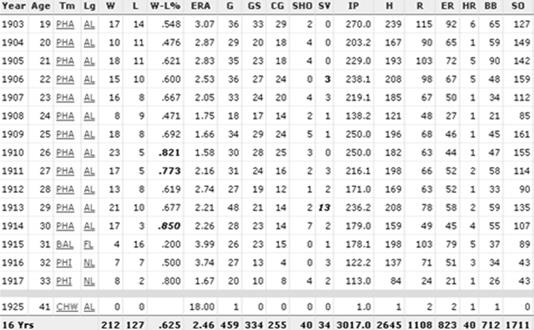
Over his career, his win-loss record was 212-127, for a .625
winning percentage, a category in which he led the American League in three seasons, and a career 2.46 ERA. His talent was even more noticeable in the high pressure environment of the World Series. In five trips to the championship series, he managed six wins and a 2.44 ERA, completing 9 of the 10 games he started, putting him second in World Series history behind Christy Mathewson. In the 1911 Series, he pitched three complete
Baseball Trailblazers Page 464
games to tie Christy Mathewson's record. He also threw a no hitter on May 12, 1910, beating the Cleveland Indians 4-0.
Bender was a very adept hitting pitcher in his major league career, posting a .212 batting average, 243 for 1,147, with 102
runs, 6 home runs and 116 RBI. He had 10 or more RBI in a season four times, with a career high 16 in 1910.
In 1919, Bender pitched in the minor leagues for the Richmond Colts of the Virginia League. He earned a 29-2 record that year.
He spent the next three seasons as a player-manager. The first two seasons were with the New Haven Weissmen/Indians, and the third was with the Class AA Reading Aces. For the 1920 New Haven team, Bender recorded 25 wins as a pitcher. His record declined to 13-7 in 1921 and 8-13 in 1922.
In 1923 and 1924, Bender did not manage, but did pitch for the minor league Baltimore Orioles and the New Haven Profs, respectively. He went 6-3 with a 5.03 ERA for Baltimore, then went 6-4 with a 3.07 ERA for New Haven.
He came back to the majors as a coach for the Chicago White Sox during 1925 and 1926, and even made a cameo appearance on the mound in 1925. Between 1924 and 1928, Bender managed the baseball team at the United States Naval Academy. He recorded a 42-34-2 record for the Naval Academy. In 1931, he coached for
Baseball Trailblazers Page 465
the Giants and the next year managed the Yankee affiliate in the Central League. He then returned to the Athletics where he worked the rest of his life as a scout, minor league manager, and coach.
Off the baseball field, Bender was one of several prominent baseball players who enjoyed trap shooting, bowling and golf. He felt that shooting in the off season helped to train his eye and increase his self-control. He worked in sporting goods at Wanamaker's in Philadelphia during his early playing days. He opened his own store, “Bender Sporting Goods,” in 1914.
Late in his life, Bender's friend John Burns gave him a plot of land in Haddon Heights, New Jersey. Bender planted a garden on the land and worked with it almost every day, even though he lived in Philadelphia. He grew a number of fruits and vegetables, especially corn, and either ate, sold or gave away what he grew. After the 1950 season, Bender took his last position in the major leagues, replacing Mickey Cochrane as the pitching coach for the Athletics. Bender's coaching helped pitcher Bobby Shantz to the American League Most Valuable Player Award in 1952. Bender was struggling with health problems, including arthritis and a cancer he did not disclose, during his tenure with Philadelphia.
Baseball Trailblazers Page 466
In his last days, Bender remained close friends with Athletics coach Bing Miller, who used to bring Bender a container of ice cream almost every day. Bender was hospitalized in Philadelphia in mid-April 1954. He died there on May 22, 1954, of prostate cancer. He had also been suffering from cardiac problems. While he had been hospitalized, Bender sent Marie to Shibe Park for each home game so that she could report back to him on his team's pitching.
Baseball Trailblazers
Page 467
Mel Ott
Baseball Trailblazers
Page 468
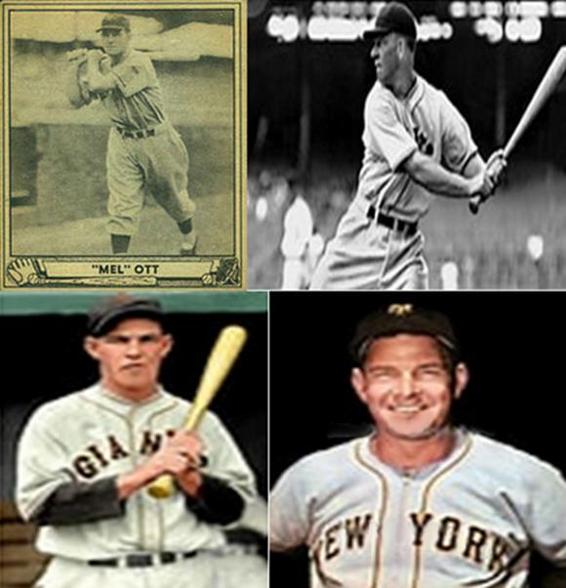
Melvin Thomas Ott, March 2, 1909 - November 21, 1958, nicknamed
"Master Melvin," was a professional baseball right fielder, who played in major league baseball for the New York Giants from 1926 through 1947.
Baseball Trailblazers Page 469
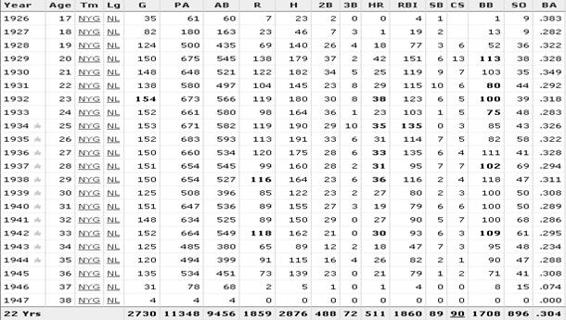
He batted left handed and threw right handed. Though unusually slight in stature for a power hitter, at 5 feet 9 inches, and 170 pounds, Ott led the National League in home runs a then record six times. He was an All-Star for 11 consecutive seasons, and was the first National League player to surpass 500 career home runs.
Ott was born in Gretna, Louisiana, a suburb of New Orleans.
Despite his average height, he quickly established himself as a gifted athlete, especially in baseball. During high school, he played on a semi-pro team three or four days a week. He already showed considerable power at a young age and was getting paid for it. His team had a tradition of passing the hat whenever a player hit a home run that figured in a victory, meaning Ott was taking home money for playing baseball as early as 14.
Despite his power, Ott's hometown minor league team, the New Orleans Pelicans, refused to sign him because of concerns about his size. He then found a job at a lumber company in Patterson, near Morgan City, where he became a sensation on the company baseball team. Company owner Henry Williams was particularly impressed with Ott. While visiting New York, he suggested that Giants manager John McGraw give him a tryout. Ott was skeptical at first, so Williams bought Ott a train ticket to New York.
Baseball Trailblazers Page 470
Ott arrived in New York in early September. He quickly impressed observers with his hitting, especially McGraw, who predicted that he would be "one of the greatest left hand hitters the National League has ever seen." He formally signed Ott to a contract in January 1926.
Ott had originally been a catcher, but McGraw concluded that Ott was too small to be a major league catcher and converted him into an outfielder. After two years as a part time player, he became the regular right fielder in 1929 at the age of 19. He didn't disappoint, powering 41 home runs and collecting 151
RBIs; both records for players who were 20 years old or younger at the start of the season.
Ott was a six time NL home run leader, in 1932, 1934, 1936-1938, and 1942. From 1928 through 1945, he led the New York Giants in home runs. This 18 season consecutive dominance is a record. No other player has ever led his team in more consecutive years in a single Triple Crown category. He was both the youngest player to hit 100 home runs and the first National Leaguer to hit 500
home runs. He passed Rogers Hornsby to become the all-time NL
home run leader in 1937 and held that title until 1966.
Ott was noted for reaching base via the base on balls. He drew five walks in a game three times. He set the National League
Baseball Trailblazers Page 471
record for most walks in a doubleheader, with six, on October 5, 1929, and did it again on April 30, 1944. He tied the record by drawing a walk in seven consecutive plate appearances from June 16-18, 1943. He also led the NL in walks six times; in 1929, 1931-1933, 1937, and 1942. He twice scored six runs in a game, on August 4, 1934 and on April 30, 1944. He is the youngest major leaguer to ever hit for the cycle. Ott was the first NL
player to post eight consecutive 100 RBI seasons.
He used a batting style that was then considered unorthodox, lifting his forward-right foot prior to impact. When McGraw first saw Ott's style, he called it "the most natural swing I've seen in years.” This style helped him hit for power.
In 1943, all of his 18 home runs came at home. Only two other players ever had a greater number of all home field home runs.
Of Ott's 511 career home runs, 323 of them, or 63%, came at home. Because of this, his home run record historically has been downplayed, suggesting that a 257 foot foul line at the Polo Grounds resulted in higher numbers at home. Sportswriters often jokingly referred to him as the master of the "Chinese home run"
as such short homers were called at the time. Ott would often respond by noting that if it was so easy to inflate his homer totals by hitting over that fence, all other hitters in the league would be doing it too.
Baseball Trailblazers Page 472
As a balance, the Polo Grounds had the deepest power alleys in baseball. Also, he hit more career home runs in foreign stadiums than any other National League hitter at the time of his retirement. In some of his better seasons, he hit more homers on the road than in the Polo Grounds.
Ott was also a skilled fielder. He was a master at playing balls that bounced off the fences at the Polo Grounds, allowing him to garner 26 assists in 1929, his first full season as a full time player. He would never even approach that figure again, as baserunners quickly realized it was far too risky to run on balls hit in Ott's direction.
During the prime of Ott's career, the 11 seasons from 1931-1941, American League batters averaged 21% more home runs; peaking at 41% more home runs than their National League counterparts. Babe Ruth and Jimmie Foxx, contemporaries, and both American League players, were the only batters to surpass Ott's record during this time.
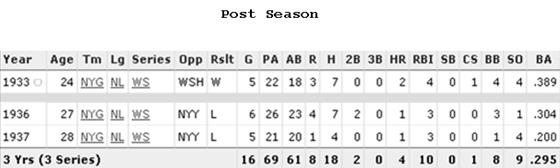
Ott played in the World Series in 1933, 1936, and 1937, winning in 1933. He hit two home runs during that 1933 series. In Game 1, he had four hits, including a two run home run in the first inning. In Game 5, he drove in the series winning run with two outs in the top of the 10th, driving a pitch into the center
Baseball Trailblazers Page 473
field bleachers. In the 1936 World Series, Ott had seven hits and one home run. In 1937, he had 4 hits and 1 home run. Playing in 16 World Series games, Ott batted .295, 18 for 61, with eight runs, four home runs and ten RBI.
In his 22 season career, Ott batted .304 with 511 home runs, 1,860 RBIs, 1,859 runs, 2,876 hits, 488 doubles, 72 triples, 89
stolen bases, 1,708 BB, a .414 on base percentage and a .533
slugging average. Defensively, he recorded a .974 fielding percentage. He hit better than .300 10 times in his major league career. At the time of his retirement, he had hit 200 more home runs than the next highest National Leaguer.
After longtime teammate Bill Terry retired as manager in 1941, he named Ott as player-manager. Ott continued as a regular player for another five years, and remained productive at the plate for much of that time. In 1942, he led the league in home runs, runs scored, and walks. He finished second in home runs and third in slugging percentage in 1944. In 1945, he hit .308
and finished tied for fourth in home runs.
On the second day of the 1946 season, a day after hitting what would be his final career home run, he injured his knee while diving for a fly ball. The injury effectively ended his career.
He only appeared in 29 more games for the rest of 1946, and
Baseball Trailblazers Page 474
retired after making only four cameo appearances in 1947. He stayed on as manager until Leo Durocher replaced him midway through the 1948 season.
The Giants' best finish during Ott's tenure was third place in 1942, one of only three times he finished with a winning record.
However, his 1943 and 1944 teams were decimated by World War II, which saw a number of established players drafted into the military.
It was in reference to Ott's supposedly easy going managing style that then Dodgers manager Durocher made the oft quoted and somewhat out of context comment; "Nice guys finish last!" Ott was the first manager to be ejected from both games of a doubleheader, when the Giants lost both games to the Pittsburgh Pirates on June 9, 1946.
Ott spent the remaining two and a half years of his contract helping his former teammate Carl Hubbell run the Giants' farm system. In 1951, Ott succeeded Chuck Dressen as manager of the Oakland Oaks of the Pacific Coast League, leading the club to an 80-88 finish. In 1952, the Oaks finished 104-76 under Ott, good for second place in the PCL.
Ott spent the 1953 and 1954 seasons out of baseball for the first time since coming to New York in 1925. In 1955, he joined
Baseball Trailblazers Page 475
the Mutual radio network to recreate baseball games. From 1956
to 1958, Ott teamed with Van Patrick to broadcast the games of the Detroit Tigers on radio and television.
Ott was injured in an auto accident in Bay Saint Louis, Mississippi, in November 1958. He was transferred to a hospital in New Orleans, where he died a week later at the age of 49.
Baseball Trailblazers
Page 476
Tris Speaker
Baseball Trailblazers
Page 477
Tristram Edgar Speaker, April 4, 1888 - December 8, 1958, nicknamed "The Gray Eagle," was a professional baseball player.
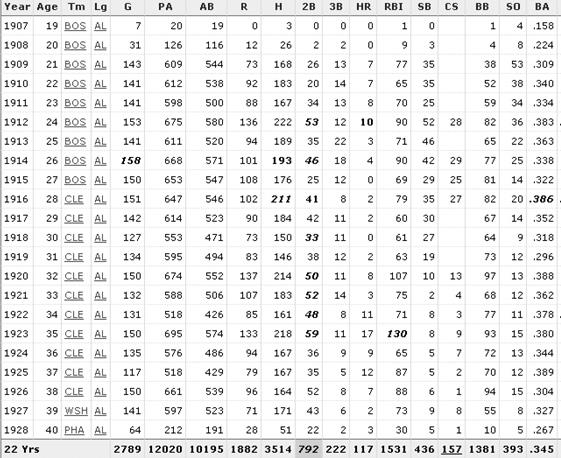
Considered one of the greatest offensive and defensive center fielders in the history of major league baseball, he compiled a career batting average of .345, sixth all-time. His 792 career doubles represents a major league career record. His 3,514 hits are fifth in the all-time hits list. Defensively, Speaker holds career records for assists, double plays, and unassisted double plays by an outfielder. His fielding glove was known as the place "where triples go to die."
Speaker was born in Hubbard, Texas, to Archie and Nancy Poer Speaker. As a youth, Speaker broke his arm after he fell from a horse, and the injury forced him to become left handed. In 1905, Speaker played a year of college baseball for Fort Worth Polytechnic Institute. Newspaper reports have held that Speaker suffered a football injury and nearly had his arm amputated
Baseball Trailblazers Page 478
around this time. He worked on a ranch before beginning his professional baseball career.
Speaker's abilities drew the interest of Doak Roberts, owner of the Cleburne Railroaders of the Texas League, in 1906. After losing several games as a pitcher, Speaker converted to outfielder to replace a Cleburne player who had been struck in the head with a pitch. He batted .318 for the Railroaders.
Speaker's mother opposed his participation in the major leagues.
Though she relented, for several years Mrs. Speaker questioned why her son had not stayed home and entered the cattle or oil businesses.
He performed well for the Texas League's Houston Buffaloes in 1907, but his mother stated that she would never allow him to go to the Boston Americans. Roberts sold the youngster to the Americans for $750 or $800. Speaker played in seven games for the Americans in 1907, with three hits in 19 at bats for a .158
average. In 1908, Boston Americans owner John I. Taylor changed the team's name to the Boston Red Sox after the bright socks in the team's uniform. That year, the club traded Speaker to the Little Rock Travelers of the Southern League in exchange for use of their facilities for spring training. Speaker batted .350 for the Travelers and his contract was repurchased by the Red Sox.
He logged a .224 batting average in 116 at bats.
Baseball Trailblazers Page 479
Speaker became the regular starting center fielder for Boston in 1909 and light hitting Denny Sullivan was sold to the Cleveland Naps. Speaker hit .309 in 143 games as the team finished third in the pennant race. Defensively, Speaker was involved in 12
double plays, leading the league's outfielders, and had a .973
fielding percentage, third among outfielders. In 1910 the Red Sox signed left fielder Duffy Lewis. Speaker, Lewis and Harry Hooper formed Boston's "Million-Dollar Outfield," one of the finest outfield trios in baseball history. Speaker was the star of the Million Dollar Outfield. He ran fast enough that he could stand very close to second base, effectively giving the team a fifth infielder, but he still caught the balls hit to center field. In 1910 and 1911, Boston finished fourth in the American League standings.
Speaker's best season came in 1912. He played every game and led the American League in doubles – 53, and home runs - 10. He set career highs with 222 hits, 136 runs, 580 at bats, and 52 stolen bases. He batted .383 and his .567 slugging percentage was the highest of his dead ball days. Speaker set a major league single season record with three hitting streaks of 20 or more games; 30, 23, and 22. He also became the first major leaguer to hit 50
doubles and steal 50 bases in the same season. In August, Speaker's mother unsuccessfully attempted to convince him to
Baseball Trailblazers Page 480
quit baseball and come home. In Fenway Park's first game, Speaker drove in the winning run in the 11th inning, giving Boston the 7-6 win.
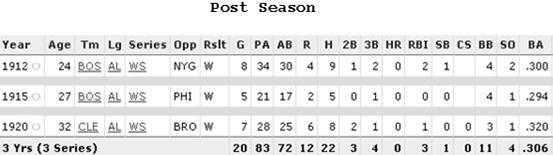
The 1912 Red Sox won the AL pennant, finishing 14 games ahead of the Washington Senators and 15 games ahead of the Philadelphia Athletics. In the 1912 World Series, Speaker led the Red Sox to their second World Series title by defeating John McGraw's New York Giants. After the second game was called on account of darkness and ended in a tie, the series went to eight games. The Red Sox won the final game after Fred Snodgrass dropped an easy fly ball and later failed to go after a Speaker pop foul. After the pop foul, Speaker tied the game with a single. The Red Sox won the game in the bottom of the tenth inning. He finished the series with a .300 batting average, nine hits and four runs scored. Speaker was named the AL Most Valuable Player for 1912.
Though he did not lead the league in any offensive categories in 1913, Speaker finished fourth in AL MVP voting.
Speaker batted .338 and tied his career high of 12 double plays as an outfielder in 1914. He hit .322 in 1915. The Red Sox beat the Philadelphia Phillies in the 1915 World Series. The Red Sox were led by pitcher Babe Ruth, who was playing in his first full season and won 18 games. Speaker got five hits, including a
Baseball Trailblazers Page 481
triple, in 17 at bats during the series. He scored twice but did not drive in any runs.
After 1915, Red Sox president Joseph Lannin wanted Speaker to take a pay cut from about $15,000 to about $9,000 because of the drop in his batting average. Speaker refused and offered $12,000. On April 8, 1916, Lannin traded Speaker to the Cleveland Indians. In exchange, Boston received Sad Sam Jones, Fred Thomas and $50,000. The angry Speaker held out until he received $10,000 of the cash that Boston collected.
For many years, this was considered the worst trade in Red Sox history, and was thought to be far more damaging to the Red Sox than the sale of Babe Ruth more than four years later. In his book about the Red Sox-Yankees rivalry, “Emperors and Idiots,”
Mike Vaccaro recalled that for some time, "Red Sox fans shook their heads in fury" when recalling the trade. Vaccaro recalled that no one knew in the winter of 1919-20 that Ruth would blossom into a superstar. In contrast, Speaker had established himself as "indisputably the best player in the American League"
by 1916.
With an annual salary of $40,000, Speaker was the highest paid player in baseball. Speaker hit over .350 in nine of his eleven years with Cleveland. In 1916, he led the league in hits,
Baseball Trailblazers Page 482
doubles, batting average, slugging percentage and on base percentage. Ty Cobb had won the previous nine consecutive AL
batting titles, and Speaker outhit him with a .386 batting average compared to Cobb's .371.
The center field fence at Cleveland's Dunn Field was 460 feet from home plate until it was shortened to 420 feet in 1920. Even so, Speaker played so shallow in the outfield that he was able to execute six career unassisted double plays at second base, catching low line drives on the run and then beating baserunners to the bag. At least once he was credited as the pivot man in a routine double play. He was often shallow enough to catch pickoff throws at second base. At one point, Speaker's signature move was to come in behind second base on a bunt and make a tag play on a baserunner who had passed the bag.
While in Cleveland, Speaker participated in diverse activities off the baseball field. Speaker enrolled in an aviator training program in 1918. Though World War I ended less than two months after he enrolled, Speaker completed his training and served in the naval reserves for several years. He also owned a ranch in Texas and competed in roping events during the baseball off season.
Baseball Trailblazers Page 483
From the day that Speaker arrived in Cleveland, he was effectively assistant manager to Lee Fohl, who rarely made an important move without consulting him. George Uhle recalled an incident from 1919 during his rookie year with the Indians.
Speaker often signaled to Fohl when he thought that a pitcher should be brought in from the bullpen. One day, Fohl misread Speaker's signal and brought in a different pitcher than Speaker had intended. To avoid the appearance of overruling his manager, Speaker let the change stand. Pitcher Fritz Coumbe lost the game, Fohl resigned that night and Speaker became manager. Uhle said that Speaker felt bad for contributing to Fohl's departure.
Speaker guided the 1920 Indians to their first World Series win.
In a crucial late season game against the second place White Sox, Speaker caught a hard line drive hit to deep right center field by Shoeless Joe Jackson, ending the game. On a dead run, Speaker leaped with both feet off the ground, snaring the ball before crashing into a concrete wall. As he lay unconscious from the impact, Speaker still held the baseball. In the 1920 World Series against Brooklyn, Speaker hit an RBI triple in the deciding game, which the Indians won 3-0. Cleveland's 1920
season was also significant due to the death of Ray Chapman on August 17, who died after being hit in the head by a pitch from Carl Mays. Chapman had been asked about retirement before the
Baseball Trailblazers Page 484
season, and he said that he wanted to help Speaker earn Cleveland's first World Series victory before thinking of retirement.
During that championship season, Speaker is credited with introducing the platoon system, which attempted to match right handed batters against left handed pitchers and vice versa.
Sportswriter John B. Sheridan was among the critics of the system, saying; "The specialist in baseball is no good and won't go very far. The whole effect of the system will be to make the players affected half men. It is farewell, a long farewell to all that player's chance of greatness. It destroys young ball players by destroying their most precious quality; confidence in their ability to hit any pitcher, left or right, alive, dead, or waiting to be born." “Baseball Magazine” was supportive, pointing out that Speaker had results that backed up his system.
The 1921 Indians remained in a tight pennant race all year, finishing 4 games behind the Yankees. The Indians did not seriously contend for the pennant from 1922 through 1925.
Speaker led the league in doubles eight times, including every year between 1920 and 1923. He led the league's outfielders in fielding percentage in 1921 and 1922. On May 17, 1925, Speaker became the fifth member of the 3,000 hit club when he hit a single off pitcher Tom Zachary of the Washington Senators. Only
Baseball Trailblazers Page 485
Napoleon Lajoie had previously accomplished the feat as a member of the Indians.
AL President Ban Johnson asked Speaker and Detroit manager Cobb to resign their posts after a scandal broke in 1926. Pitcher Dutch Leonard claimed that Speaker and Cobb fixed at least one game between Cleveland and Detroit. In a newspaper column published shortly before the hearings were to begin, Billy Evans characterized the accusations as "purely a matter of personal revenge" for Leonard. The pitcher was said to be upset with Cobb and Speaker after a trade ended with Leonard in the minor leagues. When Leonard refused to appear at the January 5, 1927, hearings to discuss his accusations, Commissioner Landis cleared both Speaker and Cobb of any wrongdoing. Both were reinstated to their original teams, but each team declared its manager free to sign elsewhere. Speaker did not return to big league managing and he finished his major league managerial career with a 617-520 record.
At the time of his 1926 resignation, news reports described Speaker as permanently retiring from baseball to pursue business ventures. However, Speaker signed to play with the Washington Senators for 1927. Cobb joined the Philadelphia Athletics.
Speaker joined Cobb in Philadelphia for the 1928 season. He played part time and finished with a .267 average. Prior to that
Baseball Trailblazers Page 486
season, Speaker had not hit for a batting average below .300
since 1908.
Speaker's major league playing career ended after 1928. He retired with 792 doubles, an all-time career record.
Defensively, Speaker holds the all-time career records for assists as an outfielder and double plays as an outfielder. He remains the last batter to hit 200 triples in a career.
In 1929 Speaker replaced Walter Johnson as the manager of the Newark Bears of the International League. In two seasons with Newark, he also appeared as a player in 59 games. When Speaker resigned during his second season, the Bears were in seventh place after a sixth place finish in 1929. In January 1933 he became a part owner and manager of the Kansas City Blues. By May, Speaker had been replaced as manager but remained secretary of the club. By 1936, he had sold his share of the team. In 1937, Speaker was voted into the Baseball Hall of Fame during its second year of balloting. He was honored at the hall's first induction ceremony in 1939.
After his playing and managing days, Speaker was an entrepreneur and salesman. By 1937, Speaker had opened a wholesale liquor business and worked as a state sales representative for a steel company. He chaired Cleveland's boxing commission between 1936
Baseball Trailblazers Page 487
and 1943. Newspaper coverage credited Speaker with several key reforms to boxing in Cleveland, including the recruitment of new officials and protections against fight fixing. Under Speaker, fight payouts went directly to boxers rather than managers.
Speaker sorted out a scheduling conflict for a 1940 boxing match in Cleveland involving former middleweight champion Teddy Yarosz. Yarosz defeated Jimmy Reeves in ten rounds and the fight attracted over 8,300 spectators.
In 1937, Speaker sustained a 16 foot fall while working on a flower box near a second story window at his home. Upon admission to the hospital, he underwent facial surgery. He was described as having "better than an even chance to live" and was suffering from a skull fracture, a broken arm and possible internal injuries. He ultimately recovered.
In 1939, Speaker was president of the National Professional Indoor Baseball League. The league had teams in New York, Brooklyn, Philadelphia, Boston, Cleveland, Chicago, Cincinnati and St. Louis. The league shut down operations due to poor attendance only two months after its formation. Speaker was one of the founders of Cleveland's Society for Crippled Children and he helped to promote the society's rehabilitation center, Camp Cheerful. Speaker served as vice president of the society, ran fundraising campaigns and received a distinguished service award
Baseball Trailblazers Page 488
from the organization. He became seriously ill with pneumonia in 1942. Speaker ultimately recovered, after being "touch-and-go for several days."
In 1947, Speaker returned to baseball as "ambassador of good will" for Bill Veeck and the Cleveland Indians. He remained in advisory, coaching or scouting roles for the Indians until his death in 1958. Speaker died of a heart attack on December 8, 1958, at the age of 70, at Lake Whitney, Texas. He collapsed as he and a friend were pulling their boat into the dock after a fishing trip. It was his second heart attack in four years.
After Speaker's death, Cobb said; "Terribly depressed. I never let him know how much I admired him when we were playing against each other. It was only after we finally became teammates and then retired that I could tell Tris Speaker of the underlying respect I had for him." Lajoie said; "He was one of the greatest fellows I ever knew, both as a baseball player and as a gentleman." Former Boston teammate Duffy Lewis said; "He was a team player. As great a hitter as he was, he wasn't looking out for his own average. Speaker was the bell cow of our outfield.
Harry Hooper and I would watch him and know how to play the hitters."
Baseball Trailblazers
Page 489
Tim Keefe
Baseball Trailblazers
Page 490
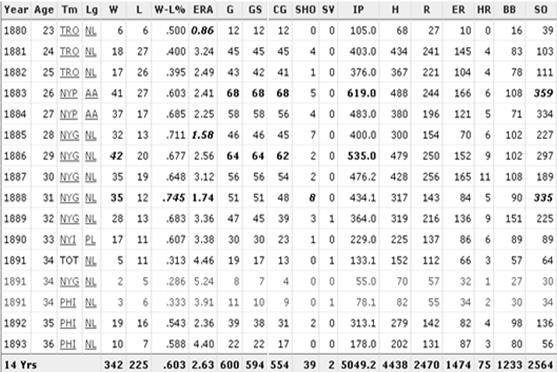
Timothy John Keefe, January 1, 1857 - April 23, 1933, nicknamed
"Smiling Tim" and "Sir Timothy," was a major league baseball pitcher. He stood 5 feet 10 inches tall and weighed 185 pounds.
He was one of the most dominating pitchers of the 19th century and posted impressive statistics in one category or another for almost every season he pitched. He was the second major league pitcher to record 300 wins. He was elected to the Baseball Hall of Fame in 1964.
Baseball Trailblazers Page 491
Keefe was born in Cambridge, Massachusetts. His father, Patrick, was an Irish immigrant. When Tim Keefe was a child, Patrick served in the Union Army during the American Civil War. Patrick was a prisoner of war for several years. All four of Patrick's brothers were killed in the war. Tim had been named after two of them. Tim's brother became a major and fought in the Spanish-American War.
After the war, Patrick had high expectations for his son, and the two frequently fought over Tim's pursuit of baseball. With the help of local former pitcher Tommy Bond, Keefe persisted and became known as a standout local pitcher by 1876. Keefe's early professional career included minor league stints in Lewiston, Clinton, New Bedford, Utica, and Albany.
Keefe entered the major leagues in 1880 with the Troy Trojans.
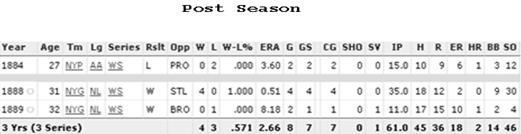
He immediately established himself as a talented pitcher, posting an astounding 0.86 ERA in 105 innings pitched, a record that still stands. Despite the sterling ERA, he managed but a 6-6 record, pitching in 12 games, all complete.
In 1883, after the Trojans folded, Keefe rose to stardom with the New York Metropolitans of the American Association under manager "Gentleman" Jim Mutrie and had one of the most dominating seasons in baseball's early history. On July 4 of
Baseball Trailblazers Page 492
that year, Keefe pitched both ends of a doubleheader against Columbus, winning the first game with a one hitter; the second a two hit gem. He went 41-27 over 619 innings pitched with a 2.41
ERA and 361 strikeouts. His 1884 campaign was almost as dominant, winning 37 games, losing 17, and striking out 334.
In 1885, John B. Day, who owned the Metropolitans and the New York Giants of the National League, moved Keefe and Mutrie to the Giants. Here, Keefe joined future Hall of Famers Buck Ewing, Monte Ward, Roger Connor, Mickey Welch, and "Orator" Jim O'Rourke to form an outstanding team that finished with a fine 85-27 record. Keefe went 32-13 with a 1.58 ERA and 227
strikeouts. In 1887, Keefe sat out several weeks of the season after he struck a batter in the head with a pitch. He was said to have suffered a nervous breakdown.
He had arguably his greatest season in 1888, when he led the league with a 35-12 record, a 1.74 ERA and 335 strikeouts, winning the Pitcher’s Triple Crown. He won 19 consecutive games that season, a record that stood for 24 years. The Giants played the St. Louis Browns of the American Association in a postseason series for the Dauvray Cup, and Keefe added four more wins to his tally. Keefe even designed the famous all-black "funeral"
uniforms the Giants wore that season.
Baseball Trailblazers Page 493
Keefe was very well paid for his career, yet he was a leading member of the Brotherhood of Professional Base Ball Players, an early players' union that fought for the welfare of players. He assisted his brother-in-law Monte Ward to form the Players'
League for the 1890 season. As a co-organizer of the Players'
League, he recognized that he might be financially vulnerable if the league failed to make money. Keefe transferred ownership of his real estate assets to his mother so that they would remain safe from any legal rulings.
Shortly before the Players' League was founded, Keefe had started a sporting goods business in New York with W. H.
Becannon, a former employee of baseball owner and sporting goods entrepreneur Albert Spalding. The Players' League folded after one season.
In the 1891 preseason, Keefe refused a salary offer of $3,000
from New York. He had earned $4,500 in the previous season.
Keefe said; "I want to play in New York, but I never will for a $3,000 salary. To tell you the truth, however, I do not think I am wanted in the New York team, and this cutting method is being pursued to keep me out." Keefe ultimately signed with the team for a $3,500 salary.
Baseball Trailblazers Page 494
During the 1891 season, Keefe was released by New York. He was drawing a high salary and was not meeting the expectations of the team's leadership. After his release, Keefe said; "I hate to leave New York, am very fond of it, and would do all in my power for New York. But what am I to do? I have been systematically done by the New York Baseball Club. They would not let me play, and when I did get a chance, I worked under a disadvantage. I feel that I am just as good a player as I ever was."
Keefe moved to the Philadelphia Phillies after his release from the Giants. He retired after the 1893 season with 342 wins, 10th all time, a 2.62 ERA, and 2,562 strikeouts, a major league record at the time of his retirement. He was also the first pitcher to achieve three 300 plus strikeout seasons, done during his dominating prime in the 1880s in which he won the most games of the decade with 291. Keefe was nicknamed "Sir Timothy"
because of his gentlemanly behavior on and off the field. He never drank or smoked.
Late in his playing career, Keefe began to coach college baseball and he continued in this capacity after his retirement as a player. Beginning in the spring of 1893, Keefe began to work as a pitching coach for Harvard. Keefe also worked as an umpire for a total of 243 major league games; his most active year was 1895, when he umpired 129 games. He was also involved
Baseball Trailblazers Page 495
in real estate. He died in his hometown of Cambridge, Massachusetts, at the age of 76.
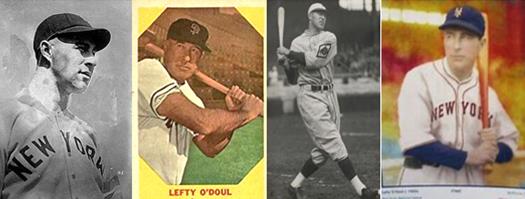
Baseball Trailblazers
Page 496
Lefty O’Doul
Baseball Trailblazers Page 497
Francis Joseph "Lefty" O'Doul, March 4, 1897 - December 7, 1969, was a major league baseball player who went on to become an extraordinarily successful manager in the minor leagues. He was also a vital figure in the establishment of professional baseball in Japan.
Born in San Francisco, California, in the Bayview neighborhood, O'Doul began his professional career as a left handed pitcher with the minor league San Francisco Seals of the Triple A Pacific Coast League. He had some major league success with the New York Yankees and Boston Red Sox from 1919 to 1923 as a reliever. He pitched in one notable game on July 7, 1923, that would go down in the record books. Relieving for starter Curt Fullerton, O'Doul gave up 16 runs over 3 innings of relief, with 14 of those runs coming in the 6th inning alone. Following the season, O'Doul developed a sore arm, which forced him to give up pitching.
After the 1923 season, the New York Giants returned O'Doul to the Pacific Coast League, where he was converted to a power hitting outfielder. In 1927, he became the second of only four Pacific Coast League hitters to have hit 30 home runs and stolen 30 bases in a season.
Baseball Trailblazers Page 498
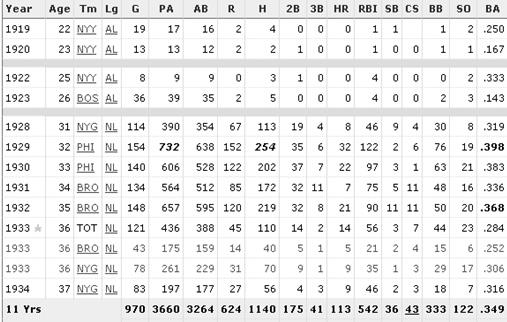
O'Doul returned to the majors in 1928, where he batted .319 as a platoon player. In 1929, he was traded to the Philadelphia Phillies and, teaming up with Chuck Klein, had one of the best offensive years in baseball history, leading the league in batting at .398 with 254 hits, 32 home runs, 122 runs batted in, and 152 runs scored. His hit total broke the previous National League record.
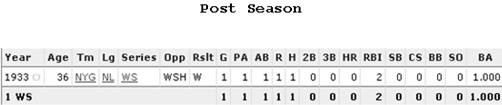
After batting .383 with 22 homers during the 1930 season, O'Doul was traded to the Brooklyn Robins. In 1932, he batted .368 for Brooklyn to win another league batting title. After a slow start in 1933, when he batted just .252 through 43 games, O'Doul was again traded, this time back to the Giants. He rallied to hit
.306 the rest of the way that season, but played just one more year before ending his career in 1934.
In an 11 year major league career, he played in 970 games, 34 as a relief pitcher and the rest as an outfielder, posting a .349
batting average, 1140 for 3264, with 624 runs scored, 175
doubles, 41 triples, 113 home runs, and 542 runs batted in. His on base percentage was .413 and his slugging percentage was
.532. In seven seasons between 1928 and 1934, when he became a regular outfielder, he hit .353. O'Doul hit over .300 six times, missing only in 1933 when he hit .284 playing with the Dodgers and Giants. He had 200 plus hit seasons in 1929, 1930 and 1932.
Baseball Trailblazers Page 499
He had 6 five hit games between 1929 and 1933, recording two each in 1929 and 1930 with the Phillies and one each in 1931 and 1933 with the Dodgers.
O'Doul then returned to the Pacific Coast League as manager of the San Francisco Seals from 1935 to 1951, later managing several other teams in the circuit and becoming the most successful manager in PCL history. One of his outstanding accomplishments while managing the Seals was developing the young Joe DiMaggio, who went on to a Hall of Fame career with the New York Yankees. O'Doul refused to take credit for DiMaggio's success, saying, "I was just smart enough to leave him alone."
O'Doul was instrumental in spreading baseball's popularity in Japan, serving as the sport's goodwill ambassador before and after World War II. The Tokyo Giants, sometimes considered
"Japan's Baseball Team," were named by him in 1935 in honor of his longtime association with the New York Giants; the logo and uniform of the Giants in Japan strongly resembling their North American counterparts.
O'Doul's fame and popularity live on in his hometown of San Francisco and are enhanced by the fact that his former team now thrives as the San Francisco Giants. The popular hofbrau-style
Baseball Trailblazers Page 500
restaurant and bar he founded in 1958 operated for years after his death, December 7, 1969 at age 72 in San Francisco, California, as “Lefty O'Doul's Restaurant and Cocktail Lounge”
on Geary Street. It still served his original recipe for Bloody Mary, when it closed in 2017 over a landlord dispute. In November 2018, the restaurant reopened in a new location at Fisherman's Wharf.
Baseball Trailblazers
Page 501
Time Out – Errors and Gloves
Baseball Trailblazers Page 502
The entire concept of “error” was actually invented by Henry Chadwick in the 1850’s, who also invented the box score, batting average and ERA concepts still used. Henry was a baseball writer, though never a player. He later lamented the “negative”
use of the term, as the player who is capable of getting to the most balls makes the most errors. An unreached ball cannot be misplayed.
An error is defined as an act, in the judgment of the official scorer, of a fielder misplaying a ball in a manner that allows a batter or baserunner to advance one or more bases or allows an at bat to continue after the batter should have been put out.
Excepting unusual circumstances the batter is charged with an at bat, and a pitcher’s ERA is calculated as if the play was properly made. Had Chadwick not come up with this “error”
concept, early batting averages and ERA’s would have been much higher; though with the use of larger gloves, it probably wouldn’t matter much today.
Though it might intuitively seem that errors should not have a huge effect on batting statistics, fielding averages should be briefly mentioned and discussed, as they suggest otherwise.
Consider this. Overall fielding averages from .935 in 1900 to
.983 in 2000. This is too large a change to ignore the dynamics behind it. Even through increased size and steroids, players
Baseball Trailblazers Page 503
didn’t consistently become more adept in catching ground balls, making accurate throws and securely capturing fly balls. What happened was simply that the gloves got consistently larger and more capable. In fact you would find it strange if you witnessed a 1900 major league game and saw that many of the fielders wore no glove at all, while others wore something akin to your current day winter gloves. Imagine yourself trying to field a Pujols two hopper barehanded. Ole at best and a very unhappy pitcher and manager is the likely result. If you touch and
“misplay” it, you’ll be charged with an error. If you miss it entirely, it’s a “hit.”
Here are some examples of 19th century baseball gloves. It’s hard to believe that some of them were even called gloves. It wasn’t until 1916 that all fielders wore one, and it wasn’t until the 1950’s that gloves standardly reached the sizes we are accustomed to in 2021.
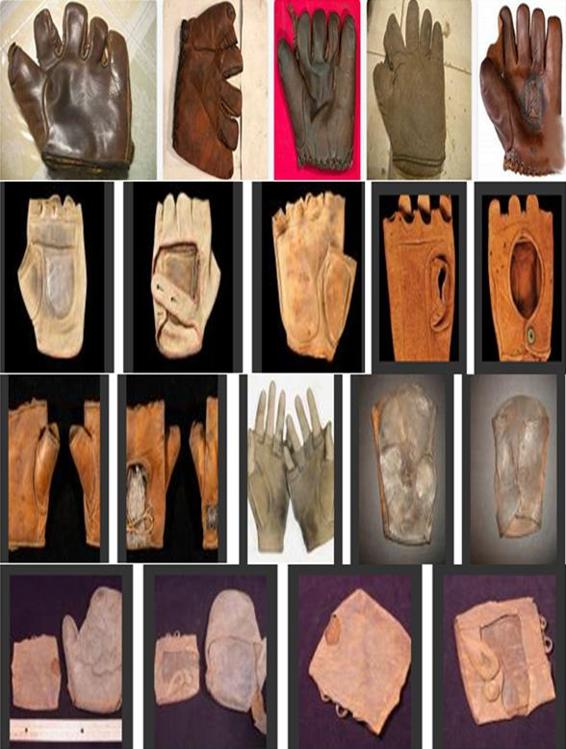
Baseball Trailblazers
Page 504
Baseball Trailblazers Page 505
Much of the statistical nuance lies in the definition itself; more specifically the phrases “misplaying” and “in the judgment of the official scorer,” and how the game is actually played.
Back when the ball was dead and the “Inside Game” was played by all the smart cookies, it was the object of the hitter to get on base, no matter the means, including getting on by an “error.”
If the opposing team had an infielder who was shaky, either through drunkenness or the congenital inability to field a ball cleanly, also due to his refusal to wear a glove or the wearing of a tiny one, often a batter would try to hit it his general direction. Therefore the most significant number to the players was “on base percentage” (OBP). The term, as used today, is very misleading, as what OBP actually measures is a player’s ability to get on base not counting the times he got on base due to an error.
The definition matters less in post 1920 power baseball than it does prior to that as the strategy of hitting the ball toward a weak fielder became virtually nil with the advent of the long ball game and larger fielder’s gloves. OBP is sometimes referred to as on base average (OBA), as the statistic is rarely presented as a true percentage. It is defined as a measure of how often a batter reaches base for any reason other than a fielding error, dropped, uncaught third strike, fielder's
Baseball Trailblazers Page 506
obstruction, fielder’s choice or catcher's interference.
Cather’s interference is actually scored as a catcher’s error.
So, the main point is that it includes walks but not errors, and there is no statistic kept for pre-1920 players which reflects their primary objective; getting on base.
In actuality, though the home run hitters who often get walked 100 times a year would seem to have an advantage, the highest OBP’s have been logged by a fairly even mixture of long ball hitters and players from the “deadball error” era. At the end of this chapter is a list of the highest lifetime and single season OBP’s on record.
In practice “misplaying” a ball entails one physical fact and one judgement. The physical “fact” centers around the fielder’s ability to get to the ball, as a ball not gotten to cannot be misplayed. Therefore if the fielder has a range of two feet, a ball hit three feet away from him is a clear hit. One modern era second baseman, who will remain un-named consistently led the league in positional fielding average for precisely this reason.
On the other side of the coin you have Brooks Robinson.
Nicknamed "The Human Vacuum Cleaner" or "Mr. Hoover," he is considered one of the greatest defensive third basemen in major league history. He could actually throw out hitters at first from deep third when the ball cut the bag and wound up in foul
Baseball Trailblazers Page 507
territory. He won 16 consecutive Gold Glove Awards during his career, and was elected to the Baseball Hall of Fame in 1983, not as a result of his hitting prowess. During this time he did not once lead the league in fielding average.
“So, what’s the point?” you reasonably inquire. I sigh and answer “It seems like there should be a valid measure of OBP
which includes getting on base by ‘error,’ and that it should be given some credence. The game has not changed enough to disregard a batter’s OBP. That’s the point.” The long answer is that if one were to merely accept the compiled statistics in the futile yet perennial process of comparing and contrasting players from differing eras, this is another area in which there are inherent deficiencies in the currently accepted, simple, and inadequate approach. It would seem eminently reasonable to think that a sharply hit two hopper would be “misplayed” if not handled by a large gloved fielder, but not considered reasonably playable by one who is bare handed or less to this quasi-point, short of range. The result is a reasonable explanation for the high batting averages recorded in “dead-ball” era, its own topic, which existed alongside low ERA’s, and a less than reasonably expected deficiencies in runs scored. It makes some sense.
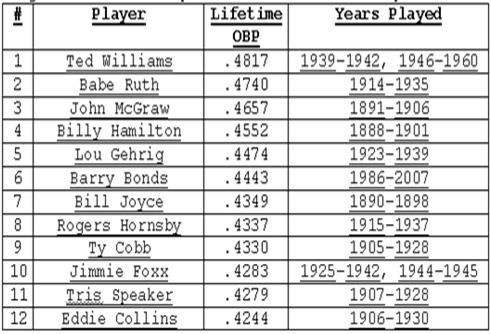
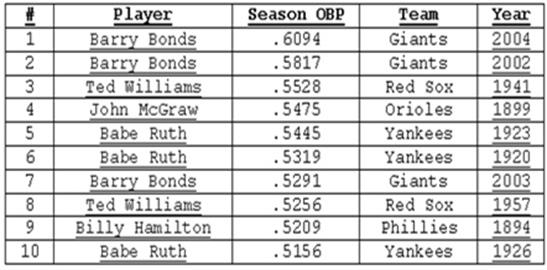
Baseball Trailblazers
Page 508
Here are those lifetime and single season on base percentage leaders. I suspect there are a few surprises.
Baseball Trailblazers Page 509
You might note that six of the ten seasonal highs were recorded by the great Babe Ruth in the twenties and steroid “enhanced”
Barry Bonds in 2002-3-4. Whether or not it is “fair” to count them in the same frame as the prior, the performance of modernity’s artificially enhanced operators is up to you; but it is also eminently “fair” to say that what they are doing is the equivalent of shortening the fences forty feet. You might also note that Ty Cobb, generally now considered the best hitter of his time, was exceeded by three others in the “Deadball” era, and barely exceeded another who played at virtually the exact same time.
I suspect that if you asked any of the players in the “dead ball era” if they were playing with a dead ball they wouldn’t know what you were talking about. The ball became officially dead only in retrospect.
I was amazed at the relative run production during the “Dead ball” era which is said to have ended around 1920. That the ball was indeed dead in some manner, shape, or form, is the overwhelming expert opinion; though there is a minority case; a small one anyway. Just re-consider the average runs per game (RPG) recorded in the 1910’s and 1920’s. Yes, they are lower than most decades, but not as much as one might have expected.
Especially on the high end, the 5.21 RPG of the 1910’s is second
Baseball Trailblazers Page 510
only to the 5.55 of the 1930’s. Average runs scored in the 1890’s is higher than any other decade.
What happened? Nobody was hitting home runs; yet more runs were scored in this “dead ball” decade than in any other, and by a handsome margin. The low pitcher’s ERA’s of the time have more to do with the “errors” recorded, than the actual run production. It is not unusual to see that early pitchers gave up as many unearned runs as they did earned ones. Things do not happen in a vacuum.
In addition the later hitting slowdown did not commence in the 1970’s. It started in the 1960’s when Mantle, Mays, Aaron, Frank Robinson and Killebrew were still in their good years and aging Ted Williams and Musial were still around. There is another apparently inescapable conclusion which surprised me. Run production has some degree of a relationship with home runs; but it is a weak one, as it has as much or more to do with gloves.
The believers in simple answers have what they consider an open and shut case for something based on the fact that so few home runs were hit before the magical date of 1920. Succinctly worded attestations to that would provide a compelling bumper sticker.
However, a minority opinion suggests that the only change made was in how often an umpire threw a ball out of the game. Coupled
Baseball Trailblazers Page 511
with the humanly demonstrated desire to be social, players comported themselves toward the “scientific” game of chop-chop, as it preceded them; and no doubt entered their minds as the most significant of the bases upon which they would be evaluated prior to and during pro play.
Then along came the Babe. Initially, he was a pitcher with serious Hall of Fame credentials as that. As a pitcher he wasn’t expected to hit much, so he took the swing which he preferred; wailing and totally unscientific. When, in later years, he was asked where he came up with the swing, he said; “I copied it off Shoeless Joe Jackson.”
All of a sudden towering shots were leaving the parks.
............... Hmnnnn. Either, this “dead ball” had suddenly developed a propensity for lengthy voyages, thereby newly adopting the moniker of Lazarus, or it was just waiting for some innovator to give it a little bit of giddyup.
Factually, the ball got its cork center in 1910; and in the
“magic” year of 1920, it is said that the umpires started to throw beat up balls out of the game. However, playing part time, the Babe hit 29 beat up balls out of the park in 1919, establishing a new record.
Baseball Trailblazers Page 512
In his book, “My Thirty Years in Baseball,” John McGraw said "I do not like the lively ball. I think the game far more interesting when the art of making scores lies in scientific work on the bases.” His use of the word “lively” seems to clearly indicate that some type of change had been made; though it is possible that the word relates to the results rather than the source of them. It certainly seems more efficient, if not interesting to McGraw, to hit a home run if one could, rather than hit a single, steal second, and try to score on another batted ball. Having said that, it is also recognized that John McGraw was truly one of baseball’s greats, more than most people know today. He excelled at playing and managing, and is sometimes called “the best player to become a great manager.” Ty Cobb was usually not specific about the matter other than his few evaluations of Ruth. But, what he is quoted as saying, post retirement, implied agreement with McGraw; in that he did not like the style of baseball being played. No specific comments regarding the deadness of the ball are known from the time it allegedly existed.
The infrequency of rule changes after 1890 allows comparisons to be drawn between players and teams of different eras. No matter how implausible these comparisons may be in the closest of calls, it provides baseball fans with an endless supply of
Baseball Trailblazers Page 513
debates. These long term comparisons have much less significance in sports in which the rules have either been “recently” changed or have been altered to further enable a marquee name.
The relative constant nature of the rules in the modern era allows a contemporary fan to somewhat follow an account of a game played long ago. As a result, baseball has more of a
"history" than any other American sport.
What would be interesting to see will never happen. Try to imagine a contemporary baseball team playing with tiny or no gloves against an archaic baseball team which hit no home runs.
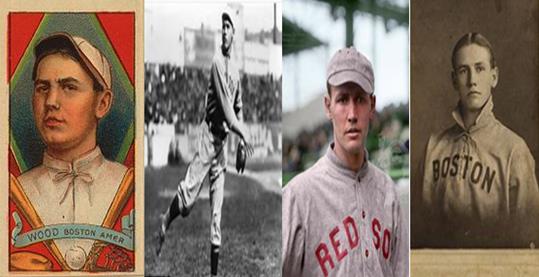
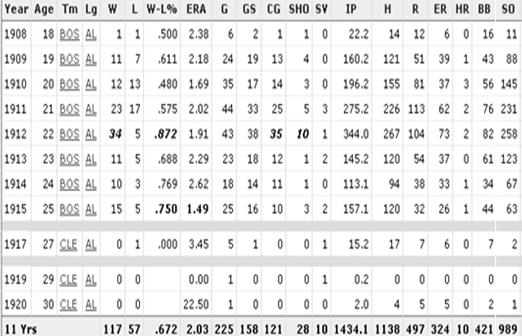
Baseball Trailblazers
Page 514
Smoky Joe Wood

Baseball Trailblazers
Page 515
Howard Ellsworth "Smoky Joe" Wood, October 25, 1889 - July 27, 1985, was a professional baseball player for 14 years. He played for the Boston Red Sox from 1908 to 1915, where he was primarily a pitcher, and for the Cleveland Indians from 1917 to 1922, where he was primarily an outfielder. Wood is one of only 13
pitchers to win 30 or more games in one season, going 34-5 in 1912, since 1900.
"Smoky Joe" played his first amateur baseball for the local miners teams in Ouray, Colorado. Wood made his playing debut with the mostly female "Bloomer Girls." There were many such teams across the country, which barnstormed in exhibition games against teams of men. Bloomer Girl rosters featured at least one male player.
Red Sox star Ted Williams, as a guest on the Bill Stern's The Colgate Sports Newsreel radio program in 1950, told the story that Wood was posing as a girl on a girls' team when the Red Sox signed him. The story ended; "The pitcher I'm talking about was
Baseball Trailblazers Page 516
the immortal Smoky Joe Wood. A pitcher who can never be forgotten even though he did get his start posing as a girl."
After joining the Red Sox in 1908 at the age of 18, Wood had his breakthrough season in 1911 in which he won 23 games, compiled an earned run average of 2.02, threw a no hitter against the St.
Louis Browns and struck out 15 batters in a single game. Wood once struck out 23 batters in an exhibition game. He earned the nickname "Smoky Joe" because of his blazing fastball. Wood recounted; "I threw so hard I thought my arm would fly right off my body."
His peers concurred. A story that gained common parlance was that legendary fastballer and pitching contemporary Walter Johnson once said; "Can I throw harder than Joe Wood? Listen, my friend, there's no man alive can throw harder than Smoky Joe Wood!" Reminded of Johnson's supposed assessment 60 years later, Wood said; "Oh, I don't think there was ever anybody faster than Walter." Johnson, whether being his usual self-effacing or literal, did say Wood could throw as hard as he could for two or three innings, but his delivery put much strain on his arm.
Wood's best season came in 1912, in which he won 34 games while losing only 5, had an ERA of 1.91 and struck out 258. Since 1900, pitchers have won 30 or more games only 21 times, with
Baseball Trailblazers Page 517
Wood's 34 wins being the sixth highest total. He also tied Walter Johnson's record for consecutive victories with 16.
On September 6, 1912, Wood faced off against Johnson in a pitching duel at Fenway Park. At the time, Wood had a 13 game winning streak and Johnson had recently had his own American League record 16 game winning streak snapped. The papers of the time hyped the matchup like a heavyweight prize fight, and a standing room only crowd of 29,000 packed the park that day.
Johnson and Wood dueled to a scoreless tie through five innings, when with two outs in the sixth, Boston's Tris Speaker doubled to left on a 1-2 count and Duffy Lewis knocked him in with a double down the right field line. Meanwhile, Wood gave up only two hits and no runs and the Red Sox prevailed, 1-0.
Equally compelling in drama, Wood's Red Sox faced John McGraw's New York Giants in the historic 1912 World Series. After slugging it out in seven close games, the teams met for the deciding game eight at Fenway with future Hall of Famer Christy Mathewson starting for the Giants. After Boston tied the score 1-1 in the bottom of the seventh, Wood came in to pitch. He matched Mathewson in the eighth and ninth, and the game went into extra innings. In the top of the tenth, Fred Merkle got to Wood knocking in a run with a single. But in the bottom of the tenth, Clyde Engle, pinch hitting for Wood, hit an easy fly ball
Baseball Trailblazers Page 518
to Fred Snodgrass in center field, and Snodgrass dropped the ball. Given new life, the "Snodgrass Muff" cost the Giants as Speaker and Larry Gardner each knocked in a run to overcome the one run deficit. Wood and the Red Sox won the game 3-2 and the series 4-3-1. For Wood, the game was his third win in the series against one loss. He also struck out 11 batters in one game, becoming the first pitcher to record double digit strikeouts in a World Series game.
The following year, Wood slipped on wet grass while fielding a bunt in a game against the Detroit Tigers. He fell and broke his thumb, and pitched in pain for the following three seasons.
Although he maintained a winning record and a low ERA, his appearances were limited, as he could no longer recover quickly from pitching a game. Wood sat out the 1916 season and most of the 1917 season, and for all intents and purposes ended his pitching career.
Late in the 1917 season, Wood was sold to the Cleveland Indians, where he rejoined former teammate Tris Speaker. Always proficient with the bat, Wood embarked on a second career as an outfielder. His former Boston teammate Babe Ruth, would make a similar position change a season later in 1919.
Baseball Trailblazers Page 519
Early in the 1918 season, Wood was struggling to establish himself as a regular player. But in a 19 inning game on May 24
against the Yankees at the Polo Grounds, Wood hit two home runs, including the eventual game winner in the 19th, and in Wood's words; "the worst was finally over."
Establishing himself as a solid if not stellar player, Wood finished in the top 10 in the American League in runs batted in in two seasons, and in 1918 he also finished in the top ten in home runs, doubles, batting average and total bases. Wood pitched seven more times, all but one game in relief, winning none and losing one. He also appeared in four games in the 1920
World Series.
Wood finished his major league career after the 1922 season with a pitching record of 117-57 and an ERA of 2.03. His lifetime batting average was .283. In his final season with the Indians, he had his highest hit total for a season with 150, and also set a personal mark for RBIs with 92.
Wood went on to become head baseball coach at Yale University, where he compiled a career managing record of 283-228-1 over 20
seasons. While at Yale, he coached his son Joe, who pitched briefly for the 1944 Red Sox.
Baseball Trailblazers Page 520
Decades later, in 1981, Wood was present at a historic pitcher's duel between Yale and St. John's University, featuring future major leaguers and teammates Ron Darling and Frank Viola.
Darling threw 11 no hit innings for Yale, matched by Viola's 11
shutout innings for St. John's. Wood, sitting in the stands, recalled Ty Cobb and said; "A lot of fellows in my time shortened up on the bat when they had to. That's what the St.
John's boys should try against this good pitcher." Darling lost the no hitter and the game in the 12th, and Wood called it the best baseball game he had ever seen.
In 1984, Wood received a standing ovation on Old Timers Day at Fenway Park in Boston, some 72 years after his memorable season.
Aged 94, he said he was happy that Boston remembered him as
"Smoky."
Wood died in West Haven, Connecticut on July 27, 1985.
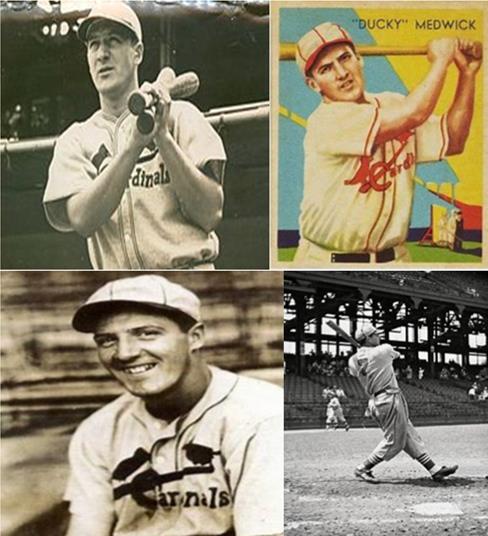
Baseball Trailblazers
Page 521
Ducky Medwick
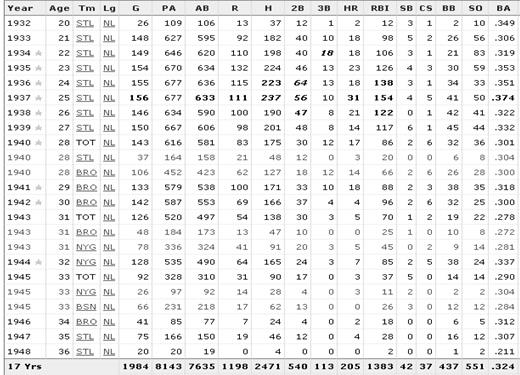
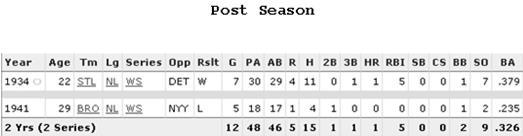
Baseball Trailblazers
Page 522
Joseph Michael Medwick, November 24, 1911 - March 21, 1975, nicknamed "Ducky" and "Muscles," was a major league baseball left fielder with the St. Louis Cardinals during the "Gashouse Gang" era of the 1930s. He also played with the Brooklyn Dodgers, New York Giants, and Boston Braves.
Baseball Trailblazers Page 523
Medwick was born and raised in Carteret, New Jersey, the son of Hungarian immigrants. He excelled in baseball, basketball, football, and track at Carteret High School. Famed football coach Knute Rockne made arrangements for Medwick to play football at University of Notre Dame, but he chose professional baseball instead.
Medwick entered professional baseball in 1930 with the Scottdale Scotties of the Middle Atlantic League. In 75 games he had a
.419 batting average and 22 home runs. He spent most of the next two seasons with the Houston Buffaloes of the Texas League. He played 161 games for Houston in 1931, hitting .305 with 19 home runs. He played in 139 games for the team the next year, hitting
.354 with 26 home runs before being called up to the major leagues.
He made his major league baseball debut with the Cardinals in 1932. By 1934, he hit .319 with 18 home runs and 106 runs batted in. Though Medwick swung at any pitch near the strike zone, he was difficult to strike out. He became known as one of baseball's rising stars, but was competitive to the point of combativeness, and regarded by some as self-centered.
Medwick's hard charging style of play got him pulled out of the seventh game of the 1934 World Series by Commissioner Kenesaw
Baseball Trailblazers Page 524
Mountain Landis after a hard slide into third baseman Marv Owen on a triple which caused Detroit Tigers fans to pelt Medwick with fruits and vegetables. Landis also ordered Owen benched.
Medwick remains the only known player to be thrown out of a game for his own personal safety. When asked about the incident after the game, Medwick replied; "I knew why they threw them. What I don't understand is why they brought them to the ballpark in the first place."
Medwick won the National League Triple Crown and the NL Most Valuable Player in 1937, remaining the last NL player to win a Triple Crown.
Medwick's 64 doubles in 1936 remains the National League record.
He also held the National League record with seven consecutive seasons with 40 or more doubles until Stan Musial topped it with nine. In 1940, the Cardinals traded Medwick and Curt Davis to the Dodgers for $125,000 and four lesser known players. While still a solid hitter, Medwick never excelled defensively, where the Cardinals felt he was losing some of the skills he displayed in his 1937 Triple Crown season. Team president Branch Rickey and owner Sam Breadon also thought the trade would be best because they thought that Medwick was becoming increasingly discontented with being a Cardinal, having spent all season haggling with the pair over his contract.
Baseball Trailblazers Page 525
Six days after the trade, Medwick was nearly killed by what some at the time regarded as a beanball thrown by former Cardinals teammate Bob Bowman. A mob of Dodgers led by their manager, Leo Durocher, charged the mound and had to be restrained from going after Bowman by the other Cardinals and the umpires. Uniformed members of the New York City Police Department sat with Bowman in the dugout to protect him from the crowd, and on request from Dodger president Larry MacPhail, nearly one hundred were present by the end of the game.
William O'Dwyer, Brooklyn's district attorney, started an investigation to determine whether the hit by pitch was deliberate. Bowman blamed the incident on sign stealing by Dodgers coach Chuck Dressen. He said that Dressen would whistle each time he saw the sign for a curveball. Hearing the whistle, Medwick stepped toward what he thought was a curveball, but Bowman had decided to throw a high, inside fastball to confuse them. When Medwick strode forward, the ball hit him in the temple and rendered him unconscious. Medwick did not blame Bowman for the beaning, telling one of O'Dwyer's aides; "No direct threat had been made to me by Bowman. I saw the ball leave from his hand, but that was the last I saw of it."
NL president Ford Frick conducted his own investigation.
Durocher and the Dodgers told him they still thought the hit by
Baseball Trailblazers Page 526
pitch was deliberate. Bowman countered that "I never meant to hurt Joe." On June 20, O'Dwyer's office dismissed the case for lack of evidence. The next day, Frick reached the same verdict.
Contemporary baseball writers wonder if the beaning affected Medwick's playing. Though still among the best, it is clear that his numbers declined in what is traditionally a hitter’s prime years. In 1941, Medwick helped Brooklyn win their first pennant since 1920. He was traded to the New York Giants in 1943. During a USO tour by a number of players in 1944, Medwick was among several individuals given an audience by Pope Pius XII.
Late in his career, Medwick said that golf was helping him to stay in good physical condition; 36 holes per day allowed him to walk more than 10 miles "without heavy strain."
In 1946, he was signed as a free agent by the St. Louis Browns, but coming out of spring training was unable to stick with the team and was seemingly out of baseball at just 34. He eventually returned to St. Louis to finish his career with the Cardinals in 1947 and 1948.
He stayed in the game, at the minor league level. In 1949 he was player-coach of the Miami Beach Flamingos, a Class B team in the Florida International League. He had 375 at bats in 106 games, with 121 hits for a .323 batting average. He continued playing
Baseball Trailblazers Page 527
through 1952 with Class B Raleigh and Tampa, but his numbers declined substantially.
In 1,984 games played over 17 seasons Medwick compiled a .324
batting average, 2471 for 7635, with 1198 runs, 540 doubles, 113
triples, 205 home runs, 1383 RBI, 437 bases on balls, a .362 on base percentage and a .505 slugging percentage. He recorded a career .980 fielding percentage. In 12 World Series games, he hit .326, 15 for 46, with five runs, five RBI, and one home run.
In 1966, Medwick was hired as a hitting instructor in the Cardinals minor league system, a role he held until 1975. During spring training that year, on March 21, he died of a heart attack in St. Petersburg, Florida. He was buried at St. Lucas Cemetery in Sunset Hills, Missouri, a suburb of St. Louis.
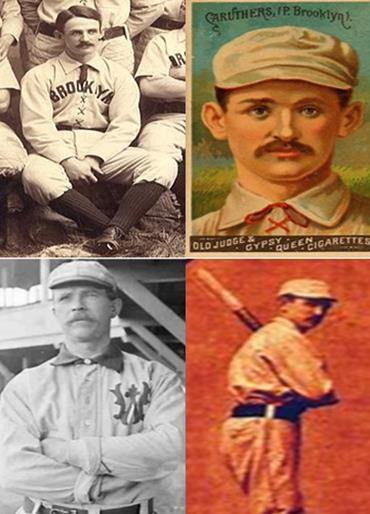
Baseball Trailblazers
Page 528
Bob Caruthers
Robert Lee Caruthers, January 5, 1864 – August 5, 1911, nicknamed "Parisian Bob," was a right handed pitcher and right fielder in major league baseball who played primarily for the St. Louis Browns and Brooklyn Bridegrooms. The star pitcher on five league champions in a ten year career, he was the top pitcher in the American Association, leading that league in wins
Baseball Trailblazers Page 529
and shutouts twice each, winning percentage three times, and earned run average once. His 175 wins in the Association were the second most of any pitcher, and his league ERA of 2.62 was the lowest of any pitcher with at least 2,000 innings in the league. He was also the only pitcher to have 40 win seasons for two different Association teams. His career winning percentage was the highest of any pitcher prior to 1950 with at least 250
decisions. Some sources recognize him as having compiled the highest winning percentage of any pitcher with at least 200
decisions.
Born in Memphis, Tennessee, Caruthers debuted with a four hitter for the Browns in late 1884. Caruthers, who stood 5'7" and weighed 138 pounds led the team to its first pennant the following year. He led the league in wins - 40, ERA - 2.07, shutouts – 6, and winning percentage - .755, in 1885, and was 30–14 for the 1886 champions after a lengthy contract dispute which he conducted from Paris, earning him his nickname. In 1886, he also played right field when not pitching, batting .334
to place him among the league's top five hitters, and leading the league in on base percentage. In 1887, despite battling malaria, he again led the league in winning percentage with a 29–9 record as the Browns won their third consecutive title. He also batted .357 with 73 runs batted in, while finishing second
Baseball Trailblazers Page 530
in the league in slugging percentage for the second consecutive year.
After the team's 1887 postseason loss, during which the team was criticized for its recreational activities, his contract was sold to Brooklyn by team owner Chris von der Ahe, who largely blamed Caruthers for the failure.
Caruthers posted a record of 29–15 in 1888, though his batting average dropped to .230. In 1889 he again led the league in wins
- 40, shutouts -7, and winning percentage - .784, as the team captured its first title. But he rarely played in the field when not pitching. Brooklyn changed leagues following the 1889
season, joining the National League. Caruthers' 175 wins during six Association seasons would stand as the second best total in the league's ten year existence, behind Tony Mullane's 203 wins in seven seasons. Caruthers' league ERA of 2.62 was the best of any pitcher with at least 2,000 innings.
In 1890, Caruthers posted a record of 23–11 as Brooklyn won the NL title in their first season in the league. He also saw considerable playing time in left field and batted .265. In 1891
his record slipped to 18–14, and he played only occasionally in right field though he hit .281.
Baseball Trailblazers Page 531
In 1892 Caruthers returned to the Browns, who had joined the NL
that season in a league merger. It marked his last season as a pitcher as he earned only two victories, though he played regularly in right field, hitting .277 with 69 RBI.
During his career Caruthers threw 298 career complete games among his 310 starts, including 24 shutouts, and had a career ERA of 2.83 in 2,828 innings pitched. He also batted .282
lifetime with 29 home runs and 359 RBI. He was the only 19th century pitcher to lead the league in winning percentage three times.
Caruthers is often considered one of the most deserving candidates for the Baseball Hall of Fame not yet inducted. His 218 wins versus 99 losses, make his winning percentage .688, third all-time.
On August 5, 1911, Caruthers died after a month long illness in Peoria, Illinois, where he had lived for three years. He was 47
years old. Caruthers was under a minor league baseball umpiring contract with the Illinois–Indiana–Iowa League at the time of his death.
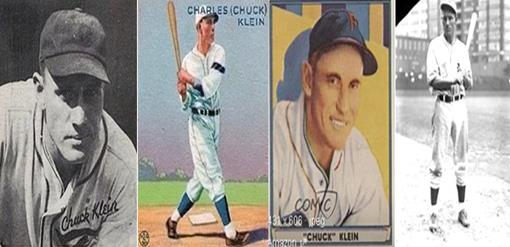
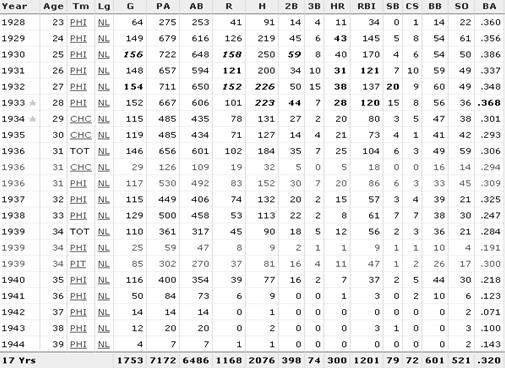
Baseball Trailblazers
Page 532
Chuck Klein
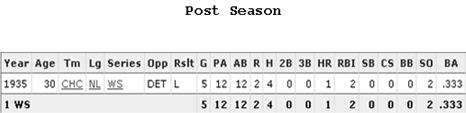
Baseball Trailblazers
Page 533
Charles Herbert Klein, October 7, 1904 - March 28, 1958, nicknamed the "Hoosier Hammer," was a professional baseball outfielder. Born in Indianapolis, Indiana, he was the son of immigrant farmers Frank and Margaret Klein. After finishing high school at Southport High School, he began working at a steel mill instead of attending college due to his poor grades at school. As a result, Klein's talents were not noticed by the major league clubs until his early 20s. He was picked up by a semi-pro team and played for them for a few years earning $200 a week. The St. Louis Cardinals noticed his talent and signed him to a minor league contract. Within a year, he worked his way up to the Cardinals' farm team in Fort Wayne, which played in the Class B Central League, roughly equivalent to today's Double A.
After hitting 26 homers in 88 games in 1928, Klein was slated to be called up to St. Louis midway through the season. However, Baseball Commissioner Kenesaw Mountain Landis discovered that the Cardinals owned a team in Dayton, Ohio, that also played in the Central League with Fort Wayne. Landis ordered the Cardinals
Baseball Trailblazers Page 534
to sell off the Fort Wayne team and give up the rights to its players. The Phillies purchased Klein's contract for a sum of $5,000 and in the process outbid the New York Yankees for Klein's services. Klein joined the Phillies in July.
Klein hit .356 in 1929, his first full season, and won the NL
home run title. On the last day of the season, the Phillies played a doubleheader against the New York Giants. The Giants'
star slugger, Mel Ott, was tied with Klein for the lead with 42
home runs. In the first game, Klein homered to put him one ahead of Ott, who was held to a single. In the second game, the Phillies' pitchers walked Ott five straight times, including once with the bases loaded.
In 1930, Klein enjoyed one of the best offensive years in baseball history, batting .386 with 250 hits and 158 runs scored, all career highs. He also set career bests and still standing Phillies records with 59 doubles, 170 runs batted in, a
.687 slugging percentage, and 445 total bases. No player has had as many total bases in a season since. His 107 extra base hits that year are a National League record. Along with his batting prowess, Klein was also a good defensive right fielder, and is tenth on the all-time list for assists for a right fielder. 1930
marked the second straight season where Klein had collected at least 200 hits. Along with his hitting records he set the single
Baseball Trailblazers Page 535
season mark for assists by a right fielder with 44. On July 1, 1931, in a game against the Chicago Cubs, Klein hit for the cycle, going 4-for-5 with five RBI. At the end of the season, he led the National League in runs scored with 121 and RBI with 121. He also led the league in home runs for the second time in his career with 31, and amassed at least 200 hits for the third season in a row.
After the 1932 season, Klein was awarded the National League MVP
award. During the season, he led the league in home runs for the third time, as well as hits and runs scored. He also became the first player in the live ball era to lead the league in both home runs and stolen bases. No player since has led the league in both categories in the same year. He finished the season with 226 hits, marking the fourth year in a row that he exceeded the 200 hit mark. On May 26, 1933, the Phillies lost a 14 inning game to the St. Louis Cardinals, and during this game Klein hit for the cycle for the second time in his career. On July 6 of 1933, he became the first Phillies player ever to bat in an All-Star Game after receiving a majority of the fan's votes. At the end of the season, he became the fourth NL player since 1901 to win the Triple Crown with a batting average of .368, 28 home runs, and 120 RBIs. At the end of the season, due in part to Carl Hubbell's brilliant pitching season, and the Giants winning
Baseball Trailblazers Page 536
the 1933 World Series, Klein finished second in MVP voting behind Hubbell.
On November 21, 1933 Klein was traded to the Cubs for $65,000
and three other players. Klein hit 20 and 21 HRs in his two full seasons with the Cubs; 1934 and 1935; and batted .301 and .293
in those seasons respectively. The Phillies reacquired him on May 21, 1936. On July 10, 1936, in the spacious Forbes Field, against the 42-34 Pirates, Klein became the first NL player to hit four home runs in a game in the 20th century.
Klein went to the Pirates during the 1939 season, but was back in Philadelphia in 1940 for what proved to be his last year as a regular player. From 1941 onward, he never played in more than 50 games in a season, and was often used as a pinch hitter. In his last eight seasons, from 1937 to 1944, he averaged 69 games played, batted .253 and hit 43 home runs. He retired midway through the 1944 season.
After retiring, he owned and operated a bar in Kensington, Philadelphia until 1947. He endured some difficult financial times, largely due to a drinking problem. Eventually, a stroke damaged his nervous system and left one leg paralyzed. By 1947, Klein was living with his brother, and his wife in Indianapolis, Indiana. He died there in 1958.
Baseball Trailblazers Page 537
In his 17 year career, Klein batted .320, with 1,201 RBI, 1,168
runs, 2,076 hits, 398 doubles, 74 triples, 300 home runs, a .379
on base percentage, and a .543 slugging percentage. Klein recorded five five hit games, 36 four hit games in his career, and 28 multi-home run games. Klein and Lou Gehrig are the only players in history that have recorded 400 or more total bases in three separate seasons.
Klein led the National League in home runs four times, and won the NL Most Valuable Player Award in 1932. In 1933 he became one of six, at the time, NL players to win a batting Triple Crown.
In 1930 he set the NL record for extra base hits with 107. On July 10, 1936, he hit four home runs in a game, becoming the fourth player to do so.