

Baseball Trailblazers by Edward Drobinski - HTML preview
Download the book in PDF, ePub, Kindle for a complete version.
.344.
Brouthers played minor league baseball for the 1898 Toronto Maple Leafs of the Eastern League, where he won a batting title with a .415 average. Later he played for the Poughkeepsie, New York, team of the Hudson River League, batting a league leading
.373 at age 46.
During his career, and most notably during his time in Baltimore, he was known to always have his dog, an Irish setter named Kelly, and had him sit in the players' area. It is claimed
Baseball Trailblazers Page 269
that the players never minded much, as he was very well behaved and never left the area to run out on the field or made much noise.
Brouthers is still among the all-time leaders in many offensive categories. His .342 batting average ranks ninth, his 205
triples ranks eighth, and his .423 on base percentage ranks 15th.
He remained near baseball for many years, working for his former teammate and New York Giants manager John McGraw, who placed him in charge of the Polo Grounds press gate. He was with the Giants for nearly 20 years in this and other capacities.
On New Year's Eve in 1884, Brouthers married Mary Ellen Croak, an Irish immigrant to New York and fellow Catholic, at St.
Mary's in Wappingers Falls. They had four children together and were married for 48 years until his death at the age of 74 at his home in East Orange, New Jersey.
Baseball Trailblazers
Page 270
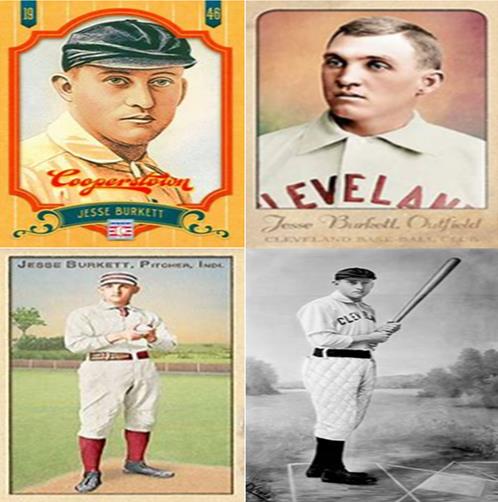
Jesse Burkett
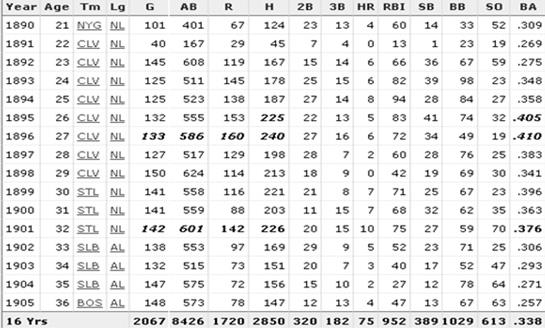
Three time NL batting champion - 1895, 1896, 1901.
Baseball Trailblazers
Page 271
Jesse Cail Burkett, December 4, 1868 - May 27, 1953, nicknamed
"Crab," was a professional baseball left fielder. Burkett batted over .400 twice, thrice if not adjusted back by later baseball scholars, and held the major league single season hits record
Baseball Trailblazers Page 272
for 15 years. After his playing career, Burkett managed in the minor leagues. He was elected into the National Baseball Hall of Fame in 1946. Burkett holds the record for the most inside-the-park home runs in major league baseball history, with 55. He is also regarded as one of the greatest bunters of all time.
Burkett was born in Wheeling, West Virginia, to Granville and Ellen Burkett. His father was a laborer and painter who worked for the Wheeling and Belmont Bridge Company. Beginning his professional career as a pitcher, he acquired his nickname,
"Crab," due to his serious disposition, and willingness to argue, fight and insult sportswriters, umpires, opposing players, and rookies.
Burkett made his major league debut for the New York Giants of the National League in 1890 as a pitcher and outfielder. His pitching was ineffective as he went 3-10 with an earned run average of 5.57. As an outfielder he had a breakout year with a batting average of .309, good for second best on the team. He was then purchased by the Cleveland Spiders in February 1891 and played most of 1891 in the minors, batting .316 for the Lincoln Rustlers and pitching to a 4-6 record. He played the last 40
games of the 1891 season with the Cleveland Spiders and continued to play for them through the 1898 season. In 1892, he hit .275 and was among the league's top ten players in runs
Baseball Trailblazers Page 273
scored and triples. The next season, his batting average increased to .348, sixth highest in the league, and drew 98
walks. He remained in the top ten in walks in almost every season throughout his career.
Burkett was never known as a great defender, but after committing a league leading 46 errors in 1893, he was coached by fellow outfielder Jimmy McAleer to improve his fielding.
Nonetheless, he routinely finished in the top five for errors committed by an outfielder and has the fourth most errors committed by an outfielder in history.
In 1895, Burkett batted .405 and led the NL in batting average, beating Ed Delahanty who also had an average of over .400, and 225 hits, which were 12 more than Hall of Famer Willie Keeler.
The following season, he set a career high in batting average, at .410, and led the league in batting average, hits - 240, and runs scored - 160. His 240 hits were a major league record for 15 years until Ty Cobb hit 248 in 1911. Burkett was the second player in major league history to bat over .400 twice, the first being Ed Delahanty. The Spiders finished second in 1895 and 1896
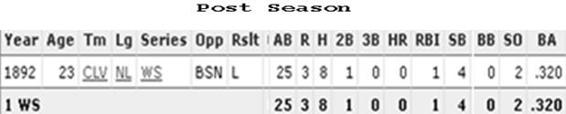
and played the Baltimore Orioles both seasons in the Temple Cup series, beating the Orioles in 1895.
Baseball Trailblazers Page 274
Early in the 1897 season, Burkett was hit in the head by a pitch by Fred Klobedanz which knocked him unconscious. He was out of action for two weeks, but played on May 31, collecting two hits in his first game back. On August 4, 1897 Burkett was ejected from both games of a doubleheader against the Louisville Colonels. In the first game, Burkett and umpire Bill Wolf got into a heated argument and Burkett was thrown out. When he did not leave the field, the umpire threatened to forfeit the game to Louisville. Manager Patsy Tebeau agreed to forfeit the game to the Colonels by a score of 9-0. In the next game of the double header, the arguments with Bill Wolf continued, and by the ninth inning Burkett was ejected again. Similar to the first game, he did not leave the field and two police officers were called in and dragged Burkett from the field. In the 1897
season, Burkett finished third in batting average behind fellow Hall of Famers Willie Keeler and Fred Clarke.
By the end of 1898 the Cleveland Spiders were unable to afford to play in Cleveland and pay their highly paid players, and as a result played 35 of their last 38 games on the road. In the offseason, owner Frank Robison bought the struggling St. Louis Cardinals and in March 1898, Burkett along with teammate Cy Young were moved from the Cleveland Spiders to the St. Louis Perfectos. He played for the Perfectos/Cardinals for three
Baseball Trailblazers Page 275
seasons. In 1899 he had originally finished the season batting
.402, making him the first baseball player to hit .400 or greater in three separate seasons, but it was downgraded by later experts to .396.
In 1901, he led the NL in batting average - .376, on base percentage - .440, hits - 226, and runs scored – 142, This marked the third time he had led the league in batting average.
Before the 1902 season, Burkett jumped to the St. Louis Browns of the American League and batted over .300 for the last time in his career. In 1903 he went under .300 to .293, and the next year his batting average fell again to .271, and had a career low in stolen bases.
In 1905, he was traded to the Boston Americans for George Stone; which meant he could be closer to his home in Worcester. His level of play continued to decrease as he set a career low in batting average as Boston finished in fourth place. At the end of the season, he retired. He had the second most career hits in baseball at the time. He has the highest batting average - .378, and on base percentage - .444 in St. Louis Cardinals history.
Burkett managed the New England League's Worcester Busters from 1906 to 1915 and played some games for the team, as well. In 1906, he led the league with a .344 batting average.
Baseball Trailblazers Page 276
Newspapers described Burkett as retiring from baseball in 1916.
He secured a position with a brass factory in Worcester in December. However, he signed on as a coach with College of the Holy Cross late that month. In four seasons coaching the Holy Cross Crusaders, Burkett amassed an 88-12-1 record, .876. Nine players on his 1919 team were designated All-East players.
Burkett managed sporadically in the minor leagues until 1933.
Burkett died in Worcester, Massachusetts, on May 27, 1953.
Baseball Trailblazers
Page 277
Kid Nicholls
Baseball Trailblazers
Page 278
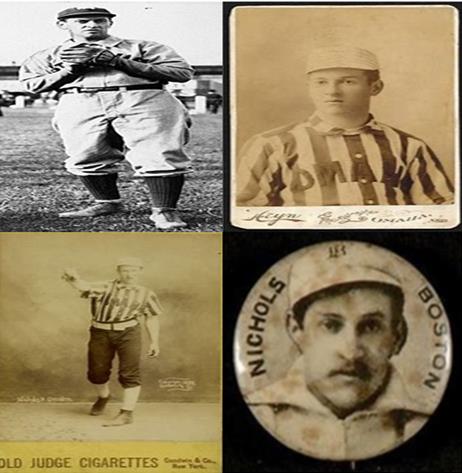
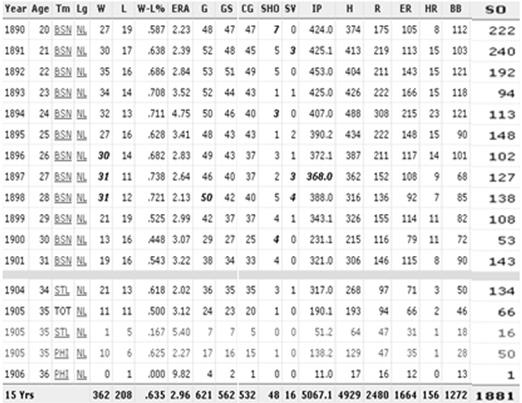
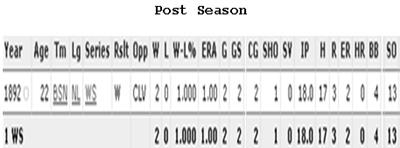
Charles Augustus "Kid" Nichols, September 14, 1869 - April 11, 1953, was a major league baseball pitcher who played for the Boston Beaneaters, St. Louis Cardinals and Philadelphia Phillies
Baseball Trailblazers Page 279
from 1890 to 1906. A switch hitter who threw right handed, he was listed at 5 feet 10 inches and 175 pounds.
Nichols was born in Madison, Wisconsin. His parents were Robert and Christina Nichols. His father had worked as a butcher and owned a grocery store with several locations in Madison. Robert had at least four children from a prior marriage to a woman named Sarah, who died of tuberculosis in 1859. Robert and Christina had several children together.
The family moved from Madison to Kansas City, Missouri when Nichols was a child. While his siblings worked in the family butcher shop, Nichols pursued baseball.
Before he turned 18 years old, Nichols had debuted in the minor leagues with the 1887 Kansas City team in the Western League, earning an 18-12 win-loss record that season. He spent 1888
between Kansas City of the Western Association and Memphis of the Southern League, finishing the year with a combined 27-10
record. In 1889, he registered a 39-8 record for the Omaha Omahogs of the Western Association.
Nichols signed with the Boston Beaneaters in September 1889 and entered the major leagues in with them in 1890. Nichols recorded a 27-19 win-loss record, a 2.23 earned run average and 222
strikeouts, beginning a string of 10 consecutive seasons with 20
Baseball Trailblazers Page 280
wins or more. Nichols also had a major league record seven 30
win seasons in this time, 1891-1894, and 1896-1898, with a career high of 35 in 1892. The Beaneaters won several pennant races during Nichols' tenure, finishing in first place five times between 1891 and 1898. The team had 102 wins per season in 1892 and 1898, which stood as franchise highs until 1998.
Nichols had his first losing season in 1900, when he went 13-16.
He improved to 19-16 the following year. After the 1901 season, Nichols purchased an interest in a minor league franchise in Kansas City. He left the Beaneaters to manage and pitch for the Kansas City club, where he won a total of 48 games in 1902 and 1903. After a two year hiatus from the major leagues, Nichols returned to the 20 win plateau for the 11th and final time in his career in 1904 for a new team, the St. Louis Cardinals. The Philadelphia Phillies picked him up off waivers in 1905, and he finished his career with them in 1906, playing his final game on May 18, 1906.
Nichols retired with 362 wins, 208 losses, 1,881 strikeouts and a 2.96 ERA. Nichols's win total was exceeded at the time only by Cy Young and Pud Galvin and is now the seventh highest total in major league history. His 5067 innings pitched ranks 11th all-time. He was the youngest pitcher to win 300 games, reaching that milestone at the age of 30.
Baseball Trailblazers Page 281
After baseball, Nichols dabbled in the motion picture industry, partnering with Joe Tinker in a business that distributed movies to theatres in the midwest. An accomplished bowler, Nichols also opened bowling alleys in the Kansas City area. He won Kansas City's Class A bowling championship at age 64.
Nichols was inducted into the National Baseball Hall of Fame in 1949. He was said to have been proud of two things; his Hall of Fame selection and the fact that he had never been replaced in a game by a relief pitcher.
In October 1952, the 83 year old Nichols was admitted to Menorah Hospital in Kansas City to investigate a complaint with his neck. Doctors ordered tests, but Nichols would not submit to them until after the seventh game of the World Series ended. He was later diagnosed with carcinomatosis, cancer that had spread throughout his body. He died on April 11, 1953.
Baseball Trailblazers
Page 282
Connie Mack
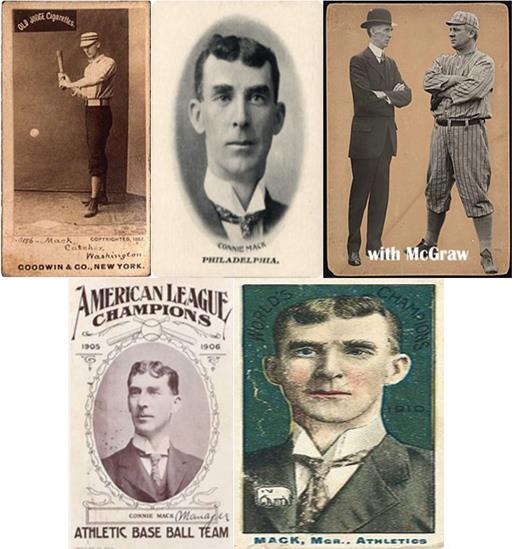
Cornelius McGillicuddy, December 22, 1862 – February 8, 1956, better known as Connie Mack, was a professional baseball catcher, manager, and team owner. The longest serving manager in Major League Baseball history, he holds records for wins -
Baseball Trailblazers Page 283
3,731, losses - 3,948, and games managed - 7,755, with his victory total being almost 1,000 more than any other manager.
Mack was born in Brookfield, Massachusetts, in what is now East Brookfield. He did not have a middle name. As with many Irish immigrants whose names began with "Mc", the McGillicuddys were often referred to as "Mack," except for official and legal documents. His parents, Michael McGillicuddy and Mary McKillop, were both immigrants from Ireland. His nickname on the baseball field was "Slats," for his height of 6 feet 2 inches and thin build.
Mack's father became a wheelwright. During the American Civil War, he served with the 51st Massachusetts Volunteer Infantry Regiment. Michael McGillicuddy suffered from several ailments as the result of his military service. He was able to work only infrequently and drew a disability pension.
Mack was educated in East Brookfield, and began working summers in local cotton mills at age 9 to help support his family. He quit school after completing the eighth grade at age 14, intending to work full time to contribute to the family's support, as several of his siblings had done. He clerked at a store, worked on local farms, and worked on the production lines of the shoe factories in nearby towns.
Baseball Trailblazers Page 284
Mack was also a good athlete and frequently played baseball with local players in East Brookfield. In 1879 his skills landed him a place on East Brookfield's town team, which played other town teams in the area. Though younger than his teammates by several years, Mack was the team's catcher and de facto captain.
Beginning in 1886, Mack played 10 seasons in the National League and one in the Players' League, for a total of 11 seasons in the major leagues, almost entirely as a catcher. He compiled a lifetime batting average of .245, with 659 hits, 265 RBI’s, and five home runs. As a player, Mack was "a light hitting catcher with a reputation as a smart player, but didn't do anything particularly well.”
Beginning in 1884, he played on minor league teams in the Connecticut cities of Meriden and Hartford before being sold to the Washington Nationals, sometimes called the Statesmen or the Senators, of the National League in 1886. In the winter of 1889, he jumped to the Buffalo Bisons of the new Players' League, investing his entire life savings of $500 in shares in the club.
But the Players' League went out of business after only a year, and Mack lost his job and his whole investment. In December 1890
Mack signed a contract with the Pittsburgh Pirates of the National League and remained with them for the rest of his career as a full time player.
Baseball Trailblazers Page 285
Mack was one of the first catchers to position himself directly behind home plate instead of in front of the backstop. According to Wilbert Robinson; "Mack never was mean. But if you had any soft spot, Connie would find it. He could do and say things that got more under your skin than the cuss words used by other catchers."
In addition to verbally needling batters to distract them, he developed skills such as blocking the plate to prevent base runners from scoring and faking the sound of a foul tip. Besides tipping bats to fake the sound of a foul tip, Mack became adept at tipping bats to throw off the hitter's swing. "Tipping" a bat is to brush it with the catcher's mitt as the batter swings, either delaying the swing or putting it off course, so that the batter misses the ball or doesn't hit it solidly. If the umpire is aware that a bat has been tipped, whether intentionally or unintentionally, he calls catcher's interference. Mack never denied such tricks; “Farmer Weaver was a catcher-outfielder for Louisville. I tipped his bat several times when he had two strikes on him one year, and each time the umpire called him out. He got even, though. One time there were two strikes on him and he swung as the pitch was coming in. But he didn't swing at the ball. He swung right at my wrists. Sometimes I think I can still feel the pain. I'll tell you I didn't tip his bat again.
Baseball Trailblazers Page 286
No, sir, not until the last game of the season and Weaver was at bat for the last time. When he had two strikes, I tipped his bat again and got away with it.”
Mack's last three seasons in the National League were as a player-manager with the Pittsburgh Pirates from 1894 to 1896, with a 149–134, .527 record. Fired on September 21, 1896, he retired as a full time player and accepted a deal from Henry Killilea to act as manager and occasional backup catcher for the minor league Milwaukee Brewers. He agreed to a salary of $3,000
and 25% of the club. He managed the Brewers for four seasons from 1897 to 1900, their best year coming in 1900, when they finished second. It was in Milwaukee that he first signed pitcher Rube Waddell, who would follow him to the big leagues.
In 1901 Mack became manager, treasurer and part owner of the new American League's Philadelphia Athletics. He managed the Athletics through the 1950 season, compiling a record of 3,582–
3,814, .484 when he retired at 87. Mack won nine pennants and appeared in eight World Series, winning five.
Mack's 50 year tenure as Athletics manager is the most ever for a coach or manager with the same team in North American professional sports, and has never been seriously threatened.
Baseball Trailblazers Page 287
Mack was widely praised in the newspapers for his intelligent and innovative managing, which earned him the nickname "the Tall Tactician." He valued intelligence and "baseball smarts," always looking for educated players. He traded away Shoeless Joe Jackson despite his talent because of his bad attitude and unintelligent play. "Better than any other manager, Mack understood and promoted intelligence as an element of excellence." He wanted men who were self-directed, self-disciplined and self-motivated. His ideal player was Eddie Collins. Mack was well ahead of his time in having numerous college players on his teams. Several of his players went on to become well-respected college coaches. Jack Coombs, the ace of Mack's 1910-11 champions, became the longtime coach at Duke.
Andy Coakley, who won 20 games for Mack's 1905 pennant winners, coached for over 30 years at Columbia, where he was the college coach for Lou Gehrig. Dick Siebert, longtime coach at Minnesota, played for Mack from 1938 to 1945. James believed that Mack's influence on the game, as great as it was, would have been even greater had the college game been more popular during the 1920s and 1930s, when Mack was at his peak.
As a result of Mack's striving to have his players become better people as well as baseball players, he created a Code of Conduct following the 1916 season; “I will always play the game to the
Baseball Trailblazers Page 288
best of my ability. I will always play to win, but if I lose, I will not look for an excuse to detract from my opponent's victory. I will never take an unfair advantage in order to win.
I will always abide by the rules of the game on the diamond as well as in my daily life. I will always conduct myself as a true sportsman on and off the playing field. I will always strive for the good of the entire team rather than for my own glory. I will never gloat in victory or pity myself in defeat. I will do my utmost to keep myself clean; physically, mentally, and morally.”
He also looked for players with quiet and disciplined personal lives, having seen many players in his playing days destroy themselves and their teams through heavy drinking. Mack himself never drank. Before the 1910 World Series he asked all his players to "take the pledge" not to drink during the Series.
When Topsy Hartsel told Mack he needed a drink the night before the final game, Mack told him to do what he thought best, but in these circumstances "if it was me, I'd die before I took a drink."
In any event, his managerial style was not tyrannical but easygoing. He never imposed curfews or bed checks, and made the best of what he had. Rube Waddell was the best pitcher and biggest gate attraction of Mack's first decade as the A's manager, so he put up with his drinking and general
Baseball Trailblazers Page 289
unreliability for years, until it began to bring the team down and the other players asked Mack to get rid of Waddell.
Mack's strength as a manager was finding the best players, teaching them well and letting them play. "He did not believe that baseball revolved around managerial strategy." He was "one of the first managers to work on repositioning his fielders"
during the game, often directing the outfielders to move left or right, play shallow or deep, by waving his rolled up scorecard from the bench. After he became well known for doing this, he often passed his instructions to the fielders by way of other players, and simply waved his scorecard as a feint.
He favored a set lineup, did not generally platoon hitters; preferred young players to veterans and power hitters to those with high batting averages; did not often pinch hit, use his bench players or sacrifice much, believed in "big inning"
offense rather than small ball; and very rarely issued an intentional walk.
Over the course of his career, he had nine pennant winning teams spanning three peak periods or "dynasties." His original team, with players such as Rube Waddell, Ossee Schrecongost, and Eddie Plank, won the pennant in 1902, when there was no World Series, and 1905. They lost the 1905 World Series to the New York Giants
Baseball Trailblazers Page 290
four games to one, all shutouts, with Christy Mathewson hurling three shutouts for a record 27 scoreless innings. During that season, Giants manager John McGraw said that Mack had "a big white elephant on his hands" with the Athletics. Mack defiantly adopted the white elephant as the team's logo, which the Athletics still use today.
As that first team aged, Mack acquired a core of young players to form his second great team, which featured Mack's famous
"$100,000 infield" of Eddie Collins, Home Run Baker, Jack Barry and Stuffy McInnis. These Athletics, captained by catcher Ira Thomas, won the pennant in 1910, 1911, 1913 and 1914, beating the Cubs in the World Series in 1910 and the Giants in 1911 and 1913, but losing in 1914 in four straight games to the "Miracle"
Boston Braves, who had come from last place in late July to win the National League pennant by 6 games over the Giants.
That team was dispersed due to financial problems, from which Mack did not recover until the 20s, when he built his third great team. The 1927 Athletics featured several future Hall of Fame players including veterans Ty Cobb, Zack Wheat and Eddie Collins as well as young stars like Mickey Cochrane, Lefty Grove, Al Simmons and rookie Jimmie Foxx. That team won the pennant in 1929, 1930 and 1931, beating the Chicago Cubs in the 1929 World Series. and easily defeating the St. Louis Cardinals
Baseball Trailblazers Page 291
in 1930. The following year, St. Louis beat the A's in seven games led by Pepper Martin.
That team was dispersed after 1932 when Mack ran into financial difficulty again. By 1934, the A's had fallen into the second division. Although Mack intended to rebuild for a third time, he would never win another pennant. The Athletics' record from 1935
to 1946 was dismal, finishing in the basement of the AL every year except a 5th place finish in 1944. World War II brought further hardship due to personnel shortages.
In 1938, Mack in his middle seventies successfully battled a blood infection caused when a batted ball injured one of his shinbones. He stopped for treatment at the Medical and Surgical Hospital in San Antonio, Texas, where he was in passage on a train.
In addition, as Mack entered his 80s, his once keen mind began fading rapidly. Mack would make strange decisions, which his coaches and players usually overruled, make inexplicable outbursts, and call for players from decades earlier to pinch hit. He spent most games asleep in the dugout, leaving his coaches to run the team most of the time.
According to outfielder Sam Chapman; "He could remember the old timers, but he had a hard time remembering the names of the
Baseball Trailblazers Page 292
current players." Shortstop Eddie Joost said; "He wasn't senile, but there were lapses." Despite growing speculation he would step down, Mack brushed it all off and stated simply that he would keep managing as long as he was physically able to do so.
His career ended with eighteen years of miserable baseball. It was generally agreed that he stayed in the game too long, hurting his legacy. He was unable to handle the post-World War II changes in baseball, including the growing commercialization of the game. His business style was no longer viable in post-World War II America due to various factors, including the increased expense of running a team. For instance, he never installed a telephone line between the bullpen and dugout.
Despite the circumstances, the octogenarian Mack led the team to three winning seasons in 1947–49. With the A's unexpected resurgence in 1947-49, there was hope that 1950 Mack's 50th anniversary as A's manager would bring a pennant at last.
However, the A's never recovered from a dreadful May in which they only won five games. By May 26, the A's were 11-21, 12
games out of first, and it was obvious the season was a lost cause. On that date, his sons Earle, Roy and Connie, Jr.
persuaded their father to promote Jimmy Dykes, who had been a coach since 1949, to assistant manager for the remainder of the season. Dykes became the team's main operator in the dugout, and
Baseball Trailblazers Page 293
would take over the managerial reins in his own right in 1951.
At the same time, Cochrane was named general manager, thus stripping Connie, Sr. of his remaining authority. Six weeks after his mid-season retirement, Mack was honored by baseball when he threw out the ceremonial first pitch of the 1950 All-Star Game.
Toward the end he was old and sick and saddened, a figure of forlorn dignity bewildered by the bickering around him as the baseball monument that he had built crumbled away."
At the time of his retirement, Mack stated; “I'm not quitting because I'm getting old, I'm quitting because I think people want me to."
Mack was quiet, even tempered, and gentlemanly, never using profanity. He was generally addressed as "Mr. Mack." He always called his players by their given names. Chief Bender, for instance, was "Albert" to Mack. Perhaps due to his great longevity in the game, he appeared to have a kind of saintly image. His long-time friends objected to the image of him as
"the bloodless saint so often painted, a sanctimonious old Puritan patting babies." His friend Red Smith called him "tough and warm and wonderful, kind and stubborn and courtly and
Baseball Trailblazers Page 294
unreasonable and generous and calculating and naive and gentle and proud and humorous and demanding and unpredictable."
“I shall never forget Connie Mack's gentleness and gentility.” -
Ty Cobb
On November 2, 1887, Mack married Margaret Hogan, whom the
“Spencer Leader” described as having "a sunny and vivacious disposition." They had three children, Earle, Roy, and Marguerite. Margaret died in December 1892 after complications from her third childbirth.
Mack married a second time on October 27, 1910. His second wife was Catherine Hoolahan, 1879–1966. The couple had four daughters and a son, Cornelius Jr. A faithful Catholic his entire life, Mack was also a longtime member of the Knights of Columbus.
Santa Maria Council 263 in Germantown, which moved to Flourtown, Pennsylvania in the 1980s.
The end came at his daughter's house in Philadelphia on the afternoon of February 8, 1956. According to his doctor, he'd been fine until the 7th when he "just started to fade away."
Officially, it was announced that he died of "old age and complications from his hip surgery.
Baseball Trailblazers
Page 295
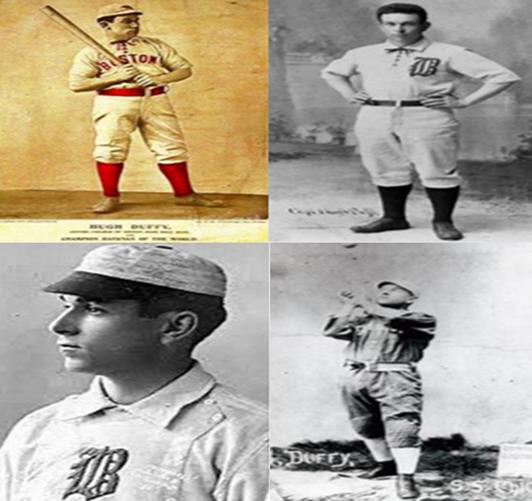
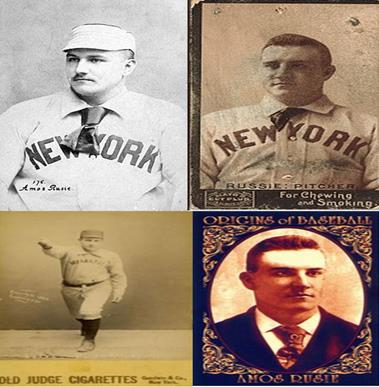
Hugh Duffy
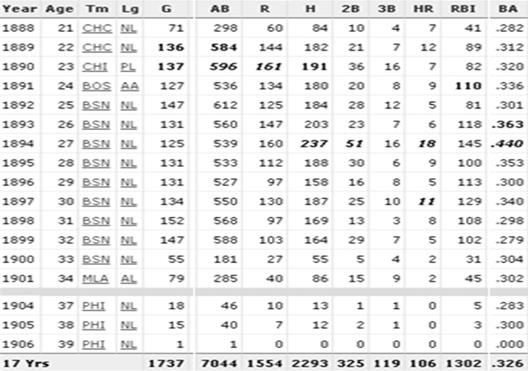
Batting .440 in 1894, still a record, was the zenith of an illustrious career.
Baseball Trailblazers
Page 296
For decades, Hugh Duffy was a franchise fixture in Boston, a small, white haired man who over the years had served the Red Sox as manager, scout, occasional first base coach and batting instructor, tryout camp supervisor, and all around good will
Baseball Trailblazers Page 297
ambassador. To the younger Sox faithful, Duffy seemed to have been a club functionary forever. So when his obituary was published in October 1954, many were surprised to learn that Hugh Duffy had once been baseball’s premier batsman. Some 60
years before his death, the little gent had set a single season, major league batting record by posting a .440 batting average.
Although extraordinary, the mark was far from a fluke. During a 17 season playing career, Duffy had been an outstanding hitter, attaining yet another unique batting distinction. To this day, he is the only player in history to compile a .300+ career batting average in four different major league circuits; National League - .326, Players League - .320, American Association - .336, and American League - .302. On top of that, he had also been a standout defensive outfielder, an accomplished base stealer, and an innovative baseball strategist. It was no wonder, then, that the likeness of Hugh Duffy came to be inscribed on a plaque at Cooperstown.
Like a host of other late nineteenth century ballplayers, Hugh Duffy was the son of Irish Catholic immigrants. But his biography is shrouded by the non-existence of an official birth record, and by Duffy’s lifelong evasiveness about his age. As best as can be ascertained, Duffy was born on November 26, 1866, the oldest child of laborer Michael Duffy (c.1842-1902) and his
Baseball Trailblazers Page 298
wife, the former Margaret Egan (c.1838-1883). According to Hugh himself, he was born in Cranston, Rhode Island. But most everything published during his lifetime put his birthplace as nearby River Point, one of the Pawtuxet Valley mill villages that now make up the town of West Warwick. Whichever the case, many years later one inquisitive journalist wrote; “At the church rectory of St. Anne’s Church, Cranston, we uncovered the official fact that Hugh Duffy, son of Michael and Margaret, was baptized on November 28, 1866.”
A recent Duffy biographer portrays the family as close, affectionate, and religiously devout, but small sized for an Irish Catholic clan of the times. National and Rhode Island censuses place younger daughters (Anna, born 1870, and Catherine, born 1874) in the household, and mention of nieces and nephews in Hugh’s last will and testament suggests that at least one of them may have survived childhood, their non-appearance in subsequent census listings for the Duffy family notwithstanding. Little else is known is about his siblings.
During Hugh’s formative years, the family resided in River Point where Hugh was schooled locally. To census takers in 1940, Duffy maintained that he had gotten through the second year of high school. But contemporaneous records place him in the work force by the time he had reached his early teens. Indeed, he may have
Baseball Trailblazers Page 299
begun working in the River Point mills by age 9. Although short in stature at 5 foot 7, long hours of heavy lifting endowed young Hugh with broad shoulders and a powerful upper torso, physical attributes that he soon put to good use on the diamond.
Duffy’s life in baseball followed a familiar trajectory. As a youth, he played in local sandlots, then graduated to action in faster venues. Originally a catcher, the righty throwing and batting Duffy began playing semipro ball in 1884 with the River Point entry in the Rhode Island State Association, drawing down $5 per week. The following year, he relocated to Jewett City in eastern Connecticut, working in a linen dye factory and playing for the company team for a reported $30/week, plus room and board. In 1886, Duffy worked and played for a company club in Winsted, Connecticut, his recompense rising to $50 perweek, again plus room and board. Late that year, Duffy entered the professional ranks, signing with the Hartford Dark Blues of the Eastern League. He debuted in an October 1 game against Newark.
Starting at catcher and then moving to second base, he earned the distinction of being the only Dark Blues player not to commit a fielding miscue in a 24-8 drubbing. In all, Duffy saw action in seven Hartford contests, batting .278, 5 for 18, for a middling 40-48 club.
Baseball Trailblazers Page 300
Duffy spent the 1887 season on tour of Massachusetts, as the clubs that he joined twice folded financially. He began the season with the Springfield Horsemen of the Eastern League, and was batting .350 in 17 games when the circuit abandoned play in late May. Duffy then moved on to the New England League, which he positively tore up. In 27 games with the unfortunately named Salem Fairies, he batted a torrid .461. When Salem disbanded in early July, Duffy transferred to another New England League team, the Lowell Lions, or Magicians. With new acquisition Duffy leading the way; a .475 BA, with 30 extra base hits and 71 runs scored in 49 games; Lowell, 71-33, surged from middle of the pack to the NEL pennant.
Duffy’s scintillating stick work had been closely observed by major league agents, and soon a bidding war broke out for his services. A shrewd, hard-nosed businessman even as a 21 year old, Hugh leveraged competitive interest in him into a handsome $2,000 contract with a $500 advance from the National League Chicago White Stockings. For the remainder of his long life, Duffy relished telling the story of his introduction to Cap Anson, the brusque, oversized field leader of the White Stockings. Taking his first look at the small, boyish looking Duffy, Anson exclaimed; “What are you doing here? We already have a batboy.” Anson was dumbfounded when informed that Duffy
Baseball Trailblazers Page 301
was the high priced outfield recruit signed by the club’s eastern agent, Boston sportswriter Tim Murnane, and walked away shaking his head. When the 1888 season got started, Anson ignored Duffy and left him on the bench for more than two months. But the departure of flycatcher Billy Sunday and the anemic bat of replacement Marty Sullivan finally prompted Anson to afford Duffy an audition for the right field spot, and Hugh did not miss his chance.
On June 23, 1888, Hugh Duffy made his field leader take notice, going 2 for 6 at the plate and playing flawless defense in his major league debut, a 12-1 thrashing of Pittsburgh. Pleased with the game’s outcome, Anson left Duffy in the lineup, and the rookie continued to produce. By season’s end, he was the club’s everyday right fielder. In 71 games, Duffy batted .282, with 21
extra base hits and 13 stolen bases. He had also played sound defense, recording 19 assists from his post in the pasture. And against the odds, Anson had taken a liking to him.
Cap Anson was a man firmly imbued with nineteenth century wisdoms, and Duffy’s size, religion, and ethnic background were all to be counted against him in Anson’s book. But Anson prized Duffy’s talent, intelligence, sobriety, and seriousness, and, innate biases notwithstanding, invested time and interest in his young charge’s development. Hugh responded with a standout
Baseball Trailblazers Page 302
sophomore campaign. Playing in all 136 of Chicago’s games, Duffy batted .312, with 40 extra base hits and 89 RBIs, and placed among league leaders in runs scored - 144, second best, base hits - 182, third best , home runs - 12, fifth best, and stolen bases - 52, seventh best. But all was not well, for either the Chicago club or the National League. With a tight fisted salary classification system recently imposed atop the hated reserve clause, players were in full rebellion by season’s end. Soon thereafter, Duffy, like virtually all frontline NL players, bolted to the newly formed Players League for the 1890 season.
And much to the chagrin of captain Anson and club boss Al Spalding, he joined the new circuit’s local entry, the Chicago Pirates.
In his third major league campaign, now 23 year old Hugh Duffy became a bona fide star. In a circuit stocked with the game’s very best players, Hugh stood out. He posted a .320 batting average and ranked among Players League leaders in virtually every offensive category. He topped the league in base hits and runs scored; ranked second in extra base hits and total bases; third in stolen bases; fourth in doubles; and fifth in triples.
Hugh also shined defensively, particularly with the arm. His 34
assists ranked second most among PL outfielders.
Baseball Trailblazers Page 303
The collapse of the Players League after its inaugural season left most players scrambling for new berths and at the mercy of their erstwhile employers. But not High Duffy. Pursuant to the reserve system, the rights to Duffy had reverted to the National League and its Chicago club. But Hugh, estranged from field leader Anson and with a hearty dislike of club boss Al Spalding, had no intention of returning to the Chicago fold. Instead, he ignored his reversion designation and negotiated a handsome new contract with the Boston Beaneaters, which Spalding promptly blocked, as was his prerogative with any National League team that attempted to secure Duffy without his consent. This turn of events prompted Duffy to approach the American Association which, having vitiated the National Agreement the previous year, was not obliged to recognize the player reversion claims of National League clubs. In due course, Hugh signed with the AA’s Boston Reds and, in the process, commenced an association with Hub City baseball that would span more than 60 years.
The year 1891 was a watershed for Hugh Duffy. Professionally, he had another banner year, batting .336 with an AA leading 110
RBIs. He stole a career high 85 bases, and achieved top 10
rankings in batting average, on base percentage, slugging, runs scored, base hits, steals, and home runs. Perhaps more important, the Reds, led by field captain Duffy, captured the
Baseball Trailblazers Page 304
Association flag, its outstanding 93-42, .689, record eight and one-half games better than a St. Louis Browns club that featured an outfielder soon to loom large in Boston baseball and the life of Hugh Duffy; Tommy McCarthy. But with the AA now in its death throes, no postseason inter-league championship was conducted.
Rather, for the second consecutive year, a major league circuit folded, leaving Duffy, McCarthy, and their ball playing brethren to fend for themselves.
For the moment, however, baseball was not Duffy’s primary concern. Hugh had matrimony on his mind. In October 1891, he married the “Belle of the Pawtuxet Valley,” the fetching,but consumptive, Katherine Gilland. The happy couple immediately took up residence in River Point, but their union was brief and childless, constantly beset by concern over Katie’s fragile health.
Another close but relatively brief union was formed late that year when both Hugh Duffy and Tommy McCarthy signed contracts to play the upcoming season for the National League Boston Beaneaters. The two men, soon to be dubbed the “Heavenly Twins,”
were hardly look alikes. But they had much in common. Each was New England born from the same ethnic/religious stock; short but sturdily built men who batted and threw righty, were swift afoot, and played the same position, although Hugh would soon
Baseball Trailblazers Page 305
move over to center to leave right field to Mac. More important, they were both aggressive players endowed with keen baseball intelligence. In their several seasons together, Dufy and McCarthy would devise, refine, or popularize much of the game strategy of the 1890s. They also became lifelong friends and, for a time, partners in a popular Boston bowling alley/saloon.
Statistically, their initial season together was not impressive.
While team best, Hugh’s .301 batting average was well beneath his previous marks, while McCarthy’s .242 was well below his.
Yet following each other in the batting order, they triggered a hit and run/stolen base oriented offense that placed the Boston club second in runs scored during that offensively challenged season. And in the outfield the two developed defensive tactics, like close-in positioning and the trapped ball double play, that ably supported the exceptional pitching provided by Kid Nichols, 35-16, Jack Stivetts, 35-16, and Harry Staley, 22-10, that paced the Beaneaters to a pennant-winning 102-48 record in the first season of play for the expanded 12 team National League. With Duffy at .462 and McCarthy at .381 showing the way, Boston then swept the Cleveland Spiders in six games, including one tie, of post season championship play.
The following two years saw the Heavenly Twins at the pinnacle of their prowess. In 1893, McCarthy posted a robust .346 batting
Baseball Trailblazers Page 306
average, but league leading honors went to Duffy at .363, who also placed high in runs scored and base hits. Boston, 86-43, meanwhile, cruised to another National League pennant, but with the ill received postseason competition of the previous year discontinued, most Boston players thereafter busied themselves playing lucrative exhibition matches. Hugh, however, passed on these paydays to attend to his seriously ailing wife. It was hoped that a winter stay on the warmer West Coast might restore Katie’s health, but the sojourn proved to no avail. With the 1894 baseball season fast approaching, the couple began their return home to River Point, but Katie did not make it. Removed from the train and hospitalized in Blackstone, Massachusetts, Katherine Gilland Duffy died on March 31, 1894, age 25.
A grief stricken Hugh Duffy got an understandably late start on the 1894 campaign. But by the time that it was over, he had completed a season like few others in baseball history. Duffy batted .440, still the all-time, major league, single season batting average high. He also led the league in base hits - 237, doubles - 51, home runs - 18, extra base hits - 85, and total bases – 374; while finishing second in RBIs - 145, fourth in runs scored - 160, and ninth in stolen bases – 48. Hugh also played excellent outfield defense, combining with McCarthy, who batted .349, to register 55 assists. But the Beaneaters’
Baseball Trailblazers Page 307
excellent 83-49 record was good for no better than third place that season. And the brief heyday of the Heavenly Twins was now approaching its end.
Although not comparable to his previous year’s numbers, Duffy posted fine stats in 1895. He batted .353, with 9 home runs and 100 RBIs. He also scored 112 runs and stole 42 bases. But Tommy McCarthy, overweight, nagged by minor injuries, and flashing the bad attitude that would soon hasten his departure from the majors, was slipping, posting .290 in only 117 games. Mac’s business partnership with Duffy was also headed toward dissolution. At the close of the 1895 season, Hugh had remarried, and new wife Nora Moore was lace curtain Irish, not the type to humor saloon keeping by her husband for long. Within months, the Duffy-McCarthy business association was terminated.
The two, however, remained friends.
McCarthy was sold to Brooklyn, and 1896, .249 in 104 games, was his final major league season. Boston and Hugh Duffy were also having difficulties. That season, the Beaneaters, 74-57, fell to fourth place, while the name Duffy, .300/5/113, no longer appeared among NL batting leaders. But both rebounded strongly in 1897, with Boston, 93-39, capturing the pennant and Hugh leading the NL in homers - 11, while batting .340, with 129 RBIs and 130 runs scored. Boston dropped the postseason Temple Cup
Baseball Trailblazers Page 308
match in five games to the runner up Baltimore Orioles. But that was no fault of Duffy’s. He hit .524, 11 for 21, with seven runs batted in, a fitting capstone for what was his last truly outstanding major league season.
The next two seasons Hugh posted respectable, if not Duffy-esque, numbers; .298/8/108 in 1898, and .279/5/102 the next year. His playing days, however, were clearly waning. A .304
batting average in an injury plagued 1900 campaign brought his nine season run as a Boston Beaneater to a close. The next year, he was among the multitude of NL stalwarts jumping to Ban Johnson’s new major league circuit, the American League. With Connie Mack and Tommy McCarthy, Duffy also served on the committee that located suitable playing grounds in Boston for the new league.
Engaged as player-manager of the Milwaukee Brewers, Duffy was saddled with a hapless roster, one whose ablest player was its now 34 year old skipper. Appearing in 79 contests, Hugh batted
.302 for the last place, 48-89, Brewers. The league thereupon removed the franchise to St. Louis, but Duffy declined to accompany it. Instead, the “Duffmeier,” as admiring fans in the heavily German city had nicknamed him, chose to remain in Milwaukee and take charge of the city’s entry in the Western League, the Milwaukee Creams.
Baseball Trailblazers Page 309
A close third, 80-54 in 1902, and pennant winning 83-49 in 1903, finishes by Milwaukee prompted the National League Philadelphia Phillies to make Hugh Duffy their manager for the 1904 season.
His two year stint with the Creams had demonstrated that, given first rate playing talent to work with, Duffy could manage a ball club capably. But the mediocre Phillies were another matter. Hugh began his tenure by suffering through a 52-100 last place season, but thereafter guided Philadelphia to consecutive, albeit non-pennant contending, first division finishes. But that did not satisfy club brass, and Duffy was discharged at the close of the 1906 season, having compiled a cumulative 206-251,
.429, record at the Phillies’ helm. Because he had made a handful of game appearances while the Philadelphia manager, Duffy’s entry in the record book was slightly enlarged. But now his major league playing days were behind him. In 1,737 games spread over 17 seasons, Hugh had batted .326, with 1,302 RBIs and 1,554 runs scored. His 550 extra base hits included 106 home runs, seventh highest for a player primarily from the 1893-1919
era. Duffy also stole 574 bases, and was an excellent outfield defender. On top of all that, he had joined with Tommy McCarthy to devise innovative game tactics, both offensively and in the field. In all, Hugh Duffy had enjoyed an exceptional playing career.
Baseball Trailblazers Page 310
Although an intelligent, ambitious man, Duffy rarely pursued outside business opportunities. He was a baseball lifer, and the remainder of his long life was devoted to service to the game.
In 1907, Dufy purchased an ownership interest in the Providence Greys of the Eastern League, and managed the club to three close, but no pennant finishes. He then sold out his Providence holdings to return to the majors, assuming the post of manager of the Chicago White Sox. Sox owner Charles Comiskey and Hugh were old friends. The two had been teammates on the 1890 Chicago Pirates; but Comiskey proved an impatient boss. Despite some modest improvement in club performance under Duffy’s direction, Comiskey fired him at the close of the 1911 season. The termination embittered Duffy, and the friendship never recovered.
In 1912, Duffy returned to Milwaukee to manage the Brewers of the Class AA American Association for a single 78-85 season, his only non-winning campaign as a minor league manager. He then went home to New England, where, as earlier in Providence, he became an owner-manager in Portland, a newly incorporated Maine franchise in the lower Class B New England League. The club, named the “Duffs” in Hugh’s honor, advanced steadily in league standings until it captured the pennant in 1915. When league president Tim Murnane, another long time Duffy friend and his
Baseball Trailblazers Page 311
original pro baseball patron, reorganized the circuit into a new Eastern League, Duffy and his Portland club followed. The 81-37
Duffs finished the 1916 season a close second to the New Loudon Planters of Connecticut. But following Murnane’s unexpected death in February 1917, Duffy sold the Portland club. Shortly thereafter, he was engaged to fill a baseball coach vacancy at Harvard. But between the exigencies of World War I and differences with the university administration, his time with the Crimson was brief and unsuccessful.
Duffy returned to the professional ranks in 1920, guiding the Toronto Maple Leafs of the Class AA International League to a fine 108-46 season. He then got the call from the Boston Red Sox, becoming manager of a once dominant American League club then being divested of playing talent by its cash strapped owner, Harry Frazee. The Red Sox were a non-contending 75-79
fifth place finisher for Duffy in 1921. The next year, the club went a dismal 61-93, .396, and plummeted to the cellar, beginning a decades long occupation of the AL nether regions.
Duffy was relieved of duty at season’s end, and did not manage again. But he remained on hand in Boston for years, serving the Red Sox as a scout, front office functionary, spring training instructor, occasional first base and batting coach, tryout camp supervisor, and good will ambassador. In time, Hugh made the
Baseball Trailblazers Page 312
acquaintance of Sox all-time great Ted Williams. Although men of different generations and temperament, the two shared a mutual love of the art of batting and enjoyed a cordial relationship.
In April 1945, baseball bestowed its highest accolade on Hugh Duffy; induction into the Hall of Fame.
In March 1953, an 86 year old Duffy, still mentally alert and physically fit, reported to spring training, spending hours in uniform instructing Sox recruits on the fine points of batting.
But the end was now coming into view. Later that year, Nora Duffy died, bringing to a close a happy but childless 57 year marriage. Hugh, suffering from prostate cancer, succumbed to a fatal coronary at his home in the Brighton section of Boston on October 19, 1954. He was 87. The High Requiem Mass at St.
Columbkille Church in Brighton was packed with religious dignitaries, baseball big shots, and common fans alike.
Baseball Trailblazers
Page 313
Amos Rusie
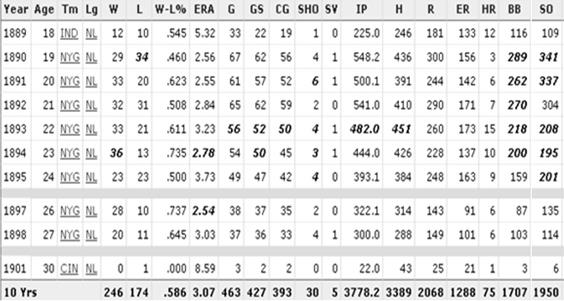
Won Triple Crown - 1894; NL wins leader - 1894; two time NL ERA leader - 1894, 1897; five time NL strikeout leader- 1890-1891, 1893-1895; pitched a no hitter on July 31, 1891.

Baseball Trailblazers
Page 314
Amos Wilson Rusie, May 30, 1871 - December 6, 1942, nicknamed
"The Hoosier Thunderbolt," was a right handed pitcher in a ten season career in the National League.
He is best known for speed and wildness. He led the league in strikeouts five times, won 20 or more games eight times, led the league in walks five times. In 1890 he walked 289 in 548
innings, the all-time single season record.
Baseball Trailblazers Page 315
Rusie was born in Mooresville, Indiana, to mason and plasterer William Asbury Rusie and his wife Mary Donovan. When he was still young, his family moved to nearby Indianapolis, Indiana, where he eventually quit school to work in a factory. It was during this time, when he was playing for a semi-professional Indianapolis baseball team named the "Sturm Avenue Never Sweats," that scouts first took notice of the speed with which he threw a baseball, and his effectiveness as a pitcher when he shut out touring National League baseball teams, the Boston Beaneaters and the Washington Senators.
In 1889, at the age of 18, Rusie signed with the Burlington Babies of the Central Interstate League. However, he also signed shortly thereafter with the Indianapolis Hoosiers of the NL. The Hoosiers disbanded at the conclusion of the 1889 season, and on March 22, 1890, he, along with many of his teammates, were transferred to the New York Giants by the league to strengthen the NL's largest market. Coming into the 1890 season, Rusie filled the starting position that was vacated by future Hall of Famer Tim Keefe, who had joined the New York Giants of the newly formed Players' League. Instead of evenly splitting pitching duties with Mickey Welch, another future Hall of Fame player, as Keefe had done the preceding five seasons, he started 62 games to Welch's 37.
Baseball Trailblazers Page 316
Rusie quickly became a sensation among fans, media, and society owing to the combination of his pitching velocity and physical size at 6 foot 1 inch, 200 pounds, which was considered quite large for the era. The fans began calling him the "Hoosier Thunderbolt,” while famed vaudeville act Weber and Fields used his name. A paperback book, “Secrets of Amos Rusie, The World's Greatest Pitcher, How He Obtained His Incredible Speed on Balls,” was available for a quarter. A drink was named after him, and he received a message from the popular performer Lillian Russell. Rusie married May Smith in Muncie, Indiana on November 8, 1890, in the Delaware County Clerk's Office.
1894 was his banner year. Rusie won pitching's triple crown. He led the league in wins with 36 against 13 losses, strikeouts with 195, and had the league best ERA of 2.78, which was especially spectacular considering that the league average that year was 5.32. He also led the league in walks for the fifth straight time with an even 200. After the conclusion of the 1894
regular season, a Pittsburgh sportsman named William C. Temple sponsored a trophy for the winner between the regular season first and second place teams in the National League. Rusie’s runner up Giants swept the Baltimore Orioles, who featured Hall of Famers John McGraw and Wilbert Robinson, 4-0. Rusie was virtually untouchable in the Temple Cup, giving up only one
Baseball Trailblazers Page 317
earned run while winning two complete games and compiling a 0.50
ERA. If that was not enough, he even batted .429.
After a bitter contract dispute with Giants' owner Andrew Freedman, following the 1895 season, Rusie responded by publicly thumbing his nose at Freedman; the 19th century equivalent of the middle finger. He was fined $200 of his $2,500 annual salary. Rusie refused to play until Freedman returned his money and ended up holding out for the entire 1896 season. It was a fiasco for baseball; fans boycotted and the press railed against the owners. Owners implored Rusie and Freedman to compromise; but neither would budge. The holdout was finally settled just before the 1897 season, as the owners collaborated for recoupment of the garnished wages, as well as a $5,000
settlement. This was partially out of respect for Rusie.
However, the primary motivator was the threat of legal action against the reserve clause had his case gone to court.
Following the 1898 season arm trouble and personal problems kept him out of baseball for two years. In 1900, he was traded to the Cincinnati Reds for Christy Mathewson. In 1901, Rusie pitched poorly in three games before retiring. Rusie died in Seattle, Washington, in 1942.
Baseball Trailblazers
Page 318
Lou Gehrig
Baseball Trailblazers
Page 319
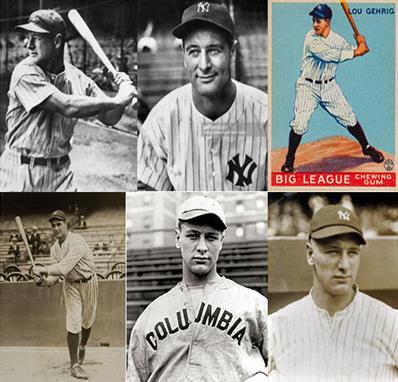
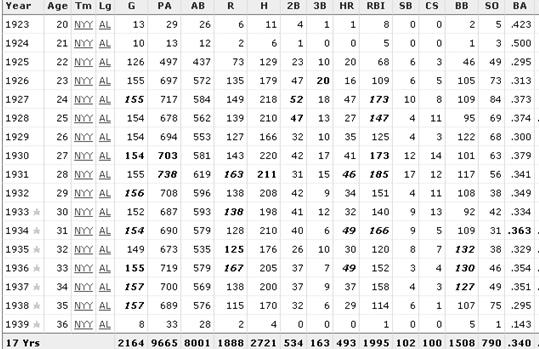
Henry Louis Gehrig, June 19, 1903 – June 2, 1941, was a professional baseball first baseman who played 17 seasons in major league baseball for the New York Yankees, 1923–1939.
Gehrig was renowned for his prowess as a hitter and for his durability, which earned him his nickname "The Iron Horse." He
Baseball Trailblazers Page 320
was an All-Star seven consecutive times, a Triple Crown winner once, an American League Most Valuable Player twice, and a member of six World Series champion teams. He had a career .340
batting average, .632 slugging average, and a .447 on base average. He hit 493 home runs and had 1,995 runs batted in. He was the first major league baseball player to have his uniform number, 4, retired by a team.
A native of New York City and a student at Columbia University, Gehrig signed with the Yankees in 1923. He set several major league records during his career with 23 grand slams and most consecutive games played - 2,130. Gehrig's consecutive game streak ended on May 2, 1939, when he voluntarily took himself out of the lineup, stunning both players and fans, after his performance on the field became hampered by an undiagnosed ailment subsequently confirmed to be amyotrophic lateral sclerosis, an incurable neuromuscular illness; it is now commonly referred to in North America as "Lou Gehrig's disease."
The disease forced him to retire at age 36, and claimed his life two years later. The pathos of his farewell from baseball was capped off by his iconic 1939 "Luckiest Man on the Face of the Earth" speech at Yankee Stadium.
Baseball Trailblazers Page 321
Gehrig was born at 309 East 94th Street in the Yorkville neighborhood of Manhattan. He weighed almost 14 pounds at birth.
He was the second of four children of German immigrants, Christina Foch (1881–1954) and Heinrich Gehrig (1867–1946). His father was a sheet metal worker by trade who was frequently unemployed due to alcoholism and epilepsy, and his mother, a maid, was the main breadwinner and disciplinarian in the family.
His two sisters died at an early age from whooping cough and measles. A brother also died in infancy. From an early age, Gehrig helped his mother with work, doing tasks such as folding laundry and picking up supplies from the local stores. Gehrig spoke German during his childhood, not learning English until the age of five. In 1910 he lived with his parents at 2266
Amsterdam Avenue in Washington Heights. In 1920 the family resided on 8th Avenue in Manhattan.
Gehrig first garnered national attention for his baseball ability while playing in a game at Cubs Park, now Wrigley Field, in Chicago on June 26, 1920. His New York School of Commerce team was playing a local team from Lane Tech High School in front of a crowd of more than 10,000 spectators. With his team leading 8–6 in the top of the ninth inning, Gehrig hit a grand slam completely out of the major league park, which was an unheard of feat for a 17 year old.
Baseball Trailblazers Page 322
Gehrig attended PS 132 in the Washington Heights section of Manhattan, then went to Commerce High School, graduating in 1921. He then studied engineering at Columbia University for two years, finding the schoolwork difficult before leaving to pursue a career in professional baseball. He had been recruited to play football at the school, earning a scholarship there, later joining the baseball squad. Before his first semester began, New York Giants manager John McGraw advised him to play summer professional baseball under an assumed name, Henry Lewis, despite the fact that it could jeopardize his collegiate sports eligibility. After he played a dozen games for the Hartford Senators in the Eastern League, he was discovered and banned from collegiate sports his freshman year. In 1922 Gehrig returned to collegiate sports as a fullback for the Columbia Lions football program. Later, in 1923, he played first base and pitched for the Columbia baseball team. At Columbia, he was a member of the Phi Delta Theta fraternity.
On April 18, 1923, the same day Yankee Stadium opened for the first time and Babe Ruth inaugurated the new stadium with a home run against the Boston Red Sox, Columbia pitcher Gehrig struck out 17 Williams Ephs batters to set a team record, though Columbia lost the game. Only a handful of collegians were at Columbia's South Field that day, but more significant was the
Baseball Trailblazers Page 323
presence of Yankee scout Paul Krichell, who had been trailing Gehrig for some time. Gehrig's pitching did not particularly impress him; rather, it was Gehrig's powerful left handed hitting. Krichell observed Gehrig hit some of the longest home runs ever seen on various eastern campuses, including a 450 foot home run on April 28 at South Field, which landed at 116th Street and Broadway. Scouts saw Gehrig as "the next Babe Ruth."
He signed a contract with the Yankees on April 30. Gehrig returned to the minor league Hartford Senators to play parts of two seasons, 1923 and 1924, batting .344 and hitting 61 home runs in 193 games. Except for his games with Hartford, a two hour car ride away, Gehrig would play his entire baseball life, sandlot, high school, college and professional, with teams based in New York City.
Gehrig joined the New York Yankees midway through the 1923
season and made his major league debut as a pinch hitter at age 19 on June 15, 1923. In his first two seasons, he was mired behind Yankee stalwart Wally Pipp at first base, a two time AL
home run champion and one of the premier power hitters in baseball's Deadball era. Gehrig saw limited playing time, mostly as a pinch hitter, playing in only 23 games and being left off the Yankees' 1923 World Series roster in spite of producing both years, with lofty batting averages of .423 in 1923 and .500 in
Baseball Trailblazers Page 324
1924. Taking over for a slumping Pipp part way into 1925, he batted a very respectable .295, with 20 home runs and 68 runs batted in over 126 games.
Unlike Ruth, Gehrig was not a gifted position player so he played first base, often the position for a strong hitter but weaker fielder. The 23 year old Yankee's breakout season came in 1926, when he batted .313 with 47 doubles, an American League leading 20 triples, 16 home runs, and 112 RBIs. In the 1926
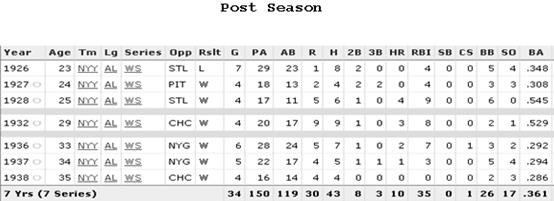
World Series against the St. Louis Cardinals, Gehrig hit .348
with two doubles and four RBIs. The Cardinals won the series four games to three.
In 1927 Gehrig put together one of the greatest seasons by any batter in history, hitting .373, with 218 hits; 101 singles, 52
doubles, 18 triples, 47 home runs, a then record 175 RBIs, surpassing teammate Babe Ruth's 171 six years earlier, and a
.765 slugging percentage. His 117 extra base hits that season are second all-time to Babe Ruth's 119 extra base hits in 1921, and his 447 total bases are third all-time, after Babe Ruth's 457 total bases in 1921 and Rogers Hornsby's 450 in 1922.
Gehrig's production helped the 1927 Yankees to a 110–44 record, the AL pennant by 19 games, and a four game sweep of the Pittsburgh Pirates in the World Series. Although the AL
recognized his season by naming him league MVP, Gehrig's
Baseball Trailblazers Page 325
accomplishments were overshadowed by Babe Ruth's record breaking 60 home runs and the overall dominance of the 1927 Yankees, a team often cited as having the greatest lineup of all time; the famed "Murderers' Row."
Ruth's celebrity was so great that Gehrig's ghostwritten syndicated newspaper column that year was called "Following the Babe." Despite playing in the shadow of Ruth for two-thirds of his career, Gehrig was one of the highest run producers in baseball history. He had 509 RBIs during a three season stretch from 1930–32. Only two other players, Jimmie Foxx with 507 and Hank Greenberg with 503, have surpassed 500 RBIs in any three seasons; their totals not consecutive. Babe Ruth had 498.
Playing 14 complete seasons, Gehrig had 13 consecutive seasons with 100 or more RBIs, a major league record shared with Foxx.
Gehrig had six seasons where he batted .350 or better, with a high of .379 in 1930, plus a seventh season at .349. Gehrig led the American League in runs scored four times, home runs three times, and RBIs five times. His 185 RBIs in 1931 remain the American League record and rank second all-time to Hack Wilson's 191 in 1930. On the single season RBI list, Gehrig ranks second, fifth - 175, and sixth - 174, with four additional seasons of over 150 RBIs. He also holds the baseball record for most seasons with 400 total bases or more, accomplishing this feat
Baseball Trailblazers Page 326
five times in his career. He batted fourth in the lineup behind Ruth, making intentionally or semi-intentionally walking Ruth counterproductive for opposing pitchers.
Unlike Ruth, Gehrig had the physique of a power hitter. Ruth usually hit home runs as high fly balls, while Gehrig's were line drives. During the 10 seasons, 1925–1934, in which Gehrig and Ruth were teammates and next to each other in the batting order and played a majority of the games, Gehrig had more home runs than Ruth only once, in 1934; Ruth's last year with the Yankees, as a 39 year-old, when he hit 49 to Ruth's 22. They tied at 46 in 1931. Ruth had 424 home runs compared to Gehrig's 347; however, Gehrig outpaced Ruth in RBIs, 1,436 to 1,316.
Gehrig had a .343 batting average over their shared Yankee time, compared to .338 for Ruth.
In 1929 the New York Yankees debuted wearing numbers on their uniforms. Gehrig wore number 4 because he hit behind Babe Ruth, who batted third in the lineup.
In 1932, Gehrig became the first player in the 20th century to hit four home runs in a game, when he accomplished the feat on June 3 against the Philadelphia Athletics. He narrowly missed getting a fifth home run when Athletics center fielder Al Simmons made a leaping catch of another fly ball at the center
Baseball Trailblazers Page 327
field fence. After the game, manager Joe McCarthy told him,
"Well, Lou, nobody can take today away from you." On the same day, however, John McGraw announced his retirement after 30
years of managing the New York Giants. McGraw, not Gehrig, got the main headlines in the sports sections the next day.
On August 17, 1933, Gehrig played in his 1,308th consecutive game against the St. Louis Browns at Sportsman's Park, which broke the longest consecutive games played streak previously held by Everett Scott. Scott attended as a guest of the Browns.
Gehrig lived with his parents until 1933, when he was 30 years old. His mother ruined all of Gehrig's romances until he met Eleanor Twitchell (1904–1984) in 1932. They began dating the next year and married in September. She was the daughter of Chicago Parks Commissioner Frank Twitchell. She helped Gehrig leave his mother's influence and hired Christy Walsh, Ruth's sports agent. Walsh helped Gehrig become the first athlete on Wheaties boxes.
In a 1936 World Series cover story about Lou Gehrig and Carl Hubbell, “Time” proclaimed Gehrig "the game's No. 1 batsman,"
who "takes boyish pride in banging a baseball as far, and running around the bases as quickly, as possible."
Baseball Trailblazers Page 328
Also in 1936, at the urging of his wife, Gehrig agreed to hire Babe Ruth's agent, who, in turn, persuaded him to audition for the role of Tarzan, the Ape Man, after Johnny Weissmuller had vacated the iconic movie role. Gehrig only got as far, though, as posing for a widely distributed, and embarrassing, photo of himself in a leopard spotted costume. When Tarzan creator Edgar Rice Burroughs spotted the outfit, he telegrammed Gehrig; "I want to congratulate you on being a swell first baseman."
On June 1, 1925, Gehrig entered the game as a pinch hitter, substituting for shortstop Paul "Pee Wee" Wanninger. The next day, June 2, Yankee manager Miller Huggins started Gehrig in place of regular first baseman Wally Pipp, who had a headache.
Pipp was in a slump, as was the team, so Huggins made several lineup changes in an attempt to boost their performance, replacing Pipp, Aaron Ward, and Wally Schang. Fourteen years later, Gehrig had played 2,130 consecutive games, shattering the previous record of 1,307 along the way.
During the streak sportswriters in 1931 nicknamed Gehrig "the Iron Horse." In a few instances, Gehrig managed to keep the streak intact through pinch hitting appearances and fortuitous timing. In others, the streak continued despite injuries. For example; On April 23, 1933, a pitch by Washington Senators pitcher Earl Whitehill struck Gehrig in the head. Although
Baseball Trailblazers Page 329
almost knocked unconscious, Gehrig remained in the game. On June 14, 1933, Gehrig was ejected from a game, along with manager Joe McCarthy, but he had already been at bat. In a June 1934
exhibition game, Gehrig was hit by a pitch just above the right eye and was knocked unconscious. According to news reports, he was out for five minutes. Batting helmets were not commonly used until the 1940s. He left the game, but was in the lineup the next day. On July 13, 1934, Gehrig suffered a "lumbago attack"
and had to be assisted off the field. In the next day's away game, he was listed in the lineup as "shortstop," batting leadoff. In his first and only plate appearance, he singled and was promptly replaced by a pinch runner to rest his throbbing back, never taking the field. A&E's Biography speculated that this illness, which he also described as "a cold in his back."
might have been the first symptom of his debilitating disease.
In addition, x-rays taken late in his life disclosed that Gehrig had sustained several fractures during his playing career, although he remained in the lineup despite those previously undisclosed injuries. However, the streak was helped when Yankees general manager Ed Barrow postponed a game as a rainout on a day when Gehrig was sick with the flu, though it was not raining.
Baseball Trailblazers Page 330
He was also persuaded, but not convinced, by his wife, Eleanor, to end the streak at 1,999 games by acting sick, as he had already played through flu bouts before, and already had a nearly 700 game lead over the previous record.
Gehrig's record of 2,130 consecutive games endured for 56 years.
Although his performance in the second half of the 1938 season was slightly better than in the first half, Gehrig reported physical changes at the midway point. At the end of that season, he said; "I was tired mid-season. I don't know why, but I just couldn't get going again." Although his final 1938 statistics were well above average; a .295 batting average, 114 RBIs, 170
hits, a .523 slugging percentage, 689 plate appearances with only 75 strikeouts, and 29 home runs; they were significantly down from his 1937 season, in which he batted .351 and slugged
.643. In the 1938 World Series, he had four hits in 14 at bats, all singles.
When the Yankees began their 1939 spring training in St.
Petersburg, Florida, Gehrig clearly no longer possessed his once formidable power. Even his base running was affected, and at one point he collapsed at Al Lang Stadium, then the Yankees' spring training park. By the end of spring training, he had not hit a home run. Throughout his career, Gehrig was considered an
Baseball Trailblazers Page 331
excellent base runner, but as the 1939 season got under way, his coordination and speed had deteriorated significantly.
By the end of April, his statistics were the worst of his career, with one RBI and a .143 batting average. Fans and the press openly speculated on Gehrig's abrupt decline. James Kahn, a reporter who wrote often about Gehrig, said in one article; ”I think there is something wrong with him. Physically wrong, I mean. I don't know what it is, but I am satisfied that it goes far beyond his ball playing. I have seen ballplayers 'go'
overnight, as Gehrig seems to have done. But they were simply washed up as ballplayers. It's something deeper than that in this case, though. I have watched him very closely and this is what I have seen: I have seen him time a ball perfectly, swing on it as hard as he can, meet it squarely, and drive a soft, looping fly over the infield. In other words, for some reason that I do not know, his old power isn't there. He is meeting the ball, time after time, and it isn't going anywhere.”
He was indeed meeting the ball, with only one strikeout in 28 at bats, but hitless in 5 of the first 8 games. However, Joe McCarthy found himself resisting pressure from Yankee management to switch Gehrig to a part time role. Things came to a head when Gehrig struggled to make a routine put out at first base. The pitcher, Johnny Murphy, had to wait for him to drag himself over
Baseball Trailblazers Page 332
to the bag so he could field the throw. Murphy said; "Nice play, Lou." Lou's later assessment was very dismissive. "That was the simplest play you could ever make in baseball, and I knew then that there was something wrong with me."
On April 30, Gehrig went hitless against the Washington Senators. He had just played his 2,130th consecutive major league game.
On May 2, the next game after a day off, Gehrig approached McCarthy before the game in Detroit against the Tigers and said;
"I'm benching myself, Joe," telling the Yankees' skipper that he was doing so "for the good of the team." McCarthy acquiesced, putting Ellsworth "Babe" Dahlgren in at first base, and also said that whenever Gehrig felt he could play again, the position was his. Gehrig, as Yankee captain, himself took the lineup card out to the shocked umpires before the game, ending the 14 year streak. Before the game began, the Briggs Stadium announcer told the fans; "Ladies and gentlemen, this is the first time Lou Gehrig's name will not appear on the Yankee lineup in 2,130
consecutive games." The Detroit Tigers' fans gave Gehrig a standing ovation while he sat on the bench with tears in his eyes. Coincidentally, among those attending the game was Wally Pipp, whom Gehrig had replaced at first base 2,130 games previously. A wire service photograph of Gehrig reclining
Baseball Trailblazers Page 333
against the dugout steps with a stoic expression appeared the next day in the nation's newspapers. He stayed with the Yankees as team captain for the rest of the season, but never played in a major league game again.
As Gehrig's debilitation became steadily worse, his wife Eleanor called the Mayo Clinic in Rochester, Minnesota. Her call was transferred to Charles William Mayo, who had been following Gehrig's career and his mysterious loss of strength. Mayo told Eleanor to bring Gehrig as soon as possible.
Gehrig flew alone to Rochester from Chicago, where the Yankees were playing at the time, and arrived at the Mayo Clinic on June 13, 1939. After six days of extensive testing at the clinic, doctors confirmed the diagnosis of amyotrophic lateral sclerosis (ALS) on June 19, 1939, which was Gehrig's 36th birthday. The prognosis was grim; rapidly increasing paralysis, difficulty in swallowing and speaking, and a life expectancy less than three years, although no impairment of mental functions would occur.
Eleanor Gehrig was told that the cause of ALS was unknown, but it was painless, noncontagious, and cruel. The motor function of the central nervous system is destroyed, but the mind remains fully aware until the end. Gehrig often wrote letters to Eleanor, and in one such note written shortly afterwards, said in part; “The bad news is lateral sclerosis, in our language
Baseball Trailblazers Page 334
chronic infantile paralysis. There isn't any cure. There are very few of these cases. It is probably caused by some germ.
Never heard of transmitting it to mates. There is a 50–50
chance of keeping me as I am. I may need a cane in 10 or 15
years. Playing is out of the question.”
Following Gehrig's visit to the Mayo Clinic, he briefly rejoined the Yankees in Washington, DC. As his train pulled into Union Station, he was greeted by a group of Boy Scouts, happily waving and wishing him luck. Gehrig waved back, but he leaned forward to his companion, Rutherford "Rud" Rennie of the “New York Herald Tribune,” and said; "They're wishing me luck, and I'm dying."
The doctors of the Mayo Clinic had released their ALS diagnosis to the public on June 19, 1939. Two days later, the New York Yankees announced Gehrig's retirement, with an immediate public push to honor Gehrig. The idea of an appreciation day reportedly began with Bill Hirsch, a friend of sports columnist Bill Corum.
Corum spoke of the idea in his column, and other sportswriters picked up on the idea, promoting it far and wide in their respective periodicals. Someone suggested the appreciation day be held during the All-Star Game, but when Yankees president Ed Barrow got hold of the idea, he quickly shot down the All-Star Game suggestion. He did not want Gehrig to share the spotlight
Baseball Trailblazers Page 335
with any other all-star. Believing the idea was valid and the best thing to do, he wanted the appreciation day to be soon, and the Yankees proclaimed Tuesday, July 4, 1939, "Lou Gehrig Appreciation Day" at Yankee Stadium. Between games of the Independence Day doubleheader against the Washington Senators, the poignant ceremonies were held on the diamond. In its coverage the following day, “The New York Times” said it was
"perhaps as colorful and dramatic a pageant as ever was enacted on a baseball field as 61,808 fans thundered a hail and farewell." Dignitaries extolled the dying slugger, and members of the Murderers' Row lineup attended the ceremonies. New York Mayor Fiorello La Guardia called Gehrig the "perfect prototype of the best sportsmanship and citizenship" and Postmaster General James Farley concluded his speech by predicting, "Your name will live long in baseball and wherever the game is played they will point with pride and satisfaction to your record."
Yankees Manager Joe McCarthy, struggling to control his emotions, then spoke of Lou Gehrig, with whom he had a close, almost father and son–like bond. After describing Gehrig as "the finest example of a ballplayer, sportsman, and citizen that baseball has ever known," McCarthy could stand it no longer.
Turning tearfully to Gehrig, the manager said; "Lou, what else can I say except that it was a sad day in the life of everybody
Baseball Trailblazers Page 336
who knew you when you came into my hotel room that day in Detroit and told me you were quitting as a ballplayer because you felt yourself a hindrance to the team. My God, man, you were never that."
The Yankees retired Gehrig's uniform number "4", making him the first player in Major League Baseball history to be accorded that honor. Gehrig was given many gifts, commemorative plaques, and trophies. Some came from VIPs; others came from the stadium's groundskeepers and janitorial staff. Footage of the ceremonies shows Gehrig being handed various gifts, and immediately setting them down on the ground, because he no longer had the arm strength to hold them. The Yankees gave him a silver trophy with all of their signatures engraved on it.
Inscribed on the front was a special poem they asked to be written by “The New York Times” writer John Kieran. The inscription on the trophy presented to Gehrig from his Yankees teammates;
“We've been to the wars together;
We took our foes as they came;
And always you were the leader,
And ever you played the game.
Idol of cheering millions,
Baseball Trailblazers Page 337
Records are yours by sheaves;
Iron of frame they hailed you
Decked you with laurel leaves.
But higher than that we hold you,
We who have known you best;
Knowing the way you came through
Every human test.
Let this be a silent token
Of lasting Friendship's gleam,
And all that we've left unspoken;
Your Pals of the Yankees Team.”
The trophy became one of Gehrig's most prized possessions. It is currently on display at the National Baseball Hall of Fame and Museum.
On July 4, 1939, Gehrig delivered what has been called
"baseball's Gettysburg Address" to a sold out crowd at Yankee Stadium. Having always avoided public attention, Gehrig did not want to speak, but the crowd chanted for him and he had memorized some sentences beforehand. The following text is the official written version.
Baseball Trailblazers Page 338
“Fans, for the past two weeks, you've been reading about a bad break. [pause] Today I consider myself the luckiest man on the face of the earth. I have been in ballparks for 17 years and have never received anything but kindness and encouragement from you fans.
When you look around, wouldn't you consider it a privilege to associate yourself with such fine looking men as are standing in uniform in this ballpark today? Sure, I'm lucky. Who wouldn't consider it an honor to have known Jacob Ruppert? Also, the builder of baseball's greatest empire, Ed Barrow? To have spent six years with that wonderful little fellow, Miller Huggins?
Then to have spent the next nine years with that outstanding leader, that smart student of psychology, the best manager in baseball today, Joe McCarthy? Sure, I'm lucky.
When the New York Giants, a team you would give your right arm to beat, and vice versa, sends you a gift; that's something.
When everybody down to the groundskeepers and those boys in white coats remember you with trophies; that's something. When you have a wonderful mother-in-law who takes sides with you in squabbles with her own daughter; that's something. When you have a father and a mother who work all their lives so you can have an education and build your body; it's a blessing. When you have
Baseball Trailblazers Page 339
a wife who has been a tower of strength and shown more courage than you dreamed existed; that's the finest I know.
So I close in saying that I might have been given a bad break, but I've got an awful lot to live for. Thank you.”
The crowd stood and applauded for almost two minutes. Gehrig was visibly shaken as he stepped back from the microphone, and wiped the tears away from his face with his handkerchief. His sometimes estranged former teammate Babe Ruth came over and hugged him as a band played "I Love You Truly" and the crowd chanted; "We love you, Lou". “The New York Times” account the following day called it "one of the most touching scenes ever witnessed on a ball field," that made even hard boiled reporters
"swallow hard."
Following his retirement from baseball, Lou Gehrig wrote, "Don't think I am depressed or pessimistic about my condition at present." Struggling against his ever worsening physical condition, he added; "I intend to hold on as long as possible and then if the inevitable comes, I will accept it philosophically and hope for the best. That's all we can do."
In October 1939, he accepted Mayor Fiorello La Guardia's appointment to a 10 year term as a New York City Parole Commissioner. Gehrig had moved from New Rochelle to Riverdale to
Baseball Trailblazers Page 340
satisfy a residency requirement for the job. He was sworn into office on January 2, 1940. The Parole Commission commended the ex-ballplayer for his "firm belief in parole, properly administered," stating that Gehrig "indicated he accepted the parole post because it represented an opportunity for public service. He had rejected other job offers, including lucrative speaking and guest appearance opportunities, worth far more financially than the $5,700 a year commissionership." Gehrig visited New York City's correctional facilities, but insisted that the visits not be covered by news media. As always, Gehrig quietly and efficiently performed his duties. He was often helped by his wife Eleanor, who would guide his hand when he had to sign official documents. Gehrig reached the point where his deteriorating physical condition made it impossible for him to continue in the job, and he quietly resigned from the position about a month before his death.
At 10:10 PM on June 2, 1941, 17 days before his 38th birthday, Gehrig died at his home at 5204 Delafield Avenue in the Riverdale neighborhood of the Bronx, New York. Upon hearing the news, Babe Ruth and his wife Claire went to the Gehrig house to console Eleanor. Mayor La Guardia ordered flags in New York to be flown at half-staff, and major-league ballparks around the nation did likewise.
Baseball Trailblazers Page 341
Thousands viewed Gehrig's body at the Church of the Divine Paternity. Ruth cut in line ahead of everyone and wept in front of the casket.
Baseball Trailblazers
Page 342
Eddie Walsh
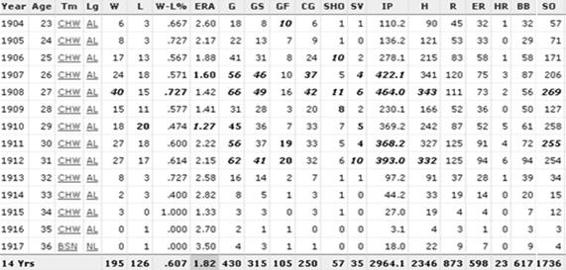
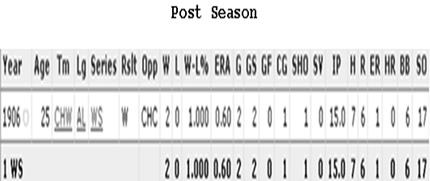
Baseball Trailblazers
Page 343
Edward Augustine "Big Ed" Walsh, May 14, 1881 - May 26, 1959, was a pitcher and manager in major league baseball. From 1906 to 1912, he had several seasons where he was one of the best pitchers in baseball. Injuries shortened his career. Walsh holds the record for lowest career earned run average, 1.82. He is one of two modern pitchers to win 40 or more games in a single
Baseball Trailblazers Page 344
season, and the last pitcher to do so. He is the last pitcher from any team to throw more than 400 innings in a single season, a feat that he most recently accomplished in 1908.
Walsh was born in Plains Township, Pennsylvania, to Michael and Jane Walsh. He worked in the Luzerne County coal mines when he was young. Walsh started his professional baseball career with the 1902 Wilkes-Barre Barons. After the 1903 season, the Chicago White Sox purchased Walsh's contract for $750.
Walsh made his major league debut in 1904 with the Chicago White Sox and pitched his first full season in 1906, going 17-13 with a 1.88 ERA and 171 strikeouts. In Game Three of that year's World Series, which the White Sox won over the Chicago Cubs in six games, Walsh struck out a then World Series record 12
batters. He also struck out at least one batter each inning of that game. This feat has since been duplicated only once. From this season through 1912, Walsh averaged 24 victories and 220
strikeouts and posted an ERA below 2.00 five times. He also led the league in saves five times in this span. His finest individual season came in 1908 when he went 40-15 with 269
strikeouts, 6 saves and a 1.42 ERA, leading the American League in wins and strikeouts. In 1910, he posted the lowest ERA, 1.27, for a pitcher with at least 20 starts and a losing record. Walsh
Baseball Trailblazers Page 345
also set an American League record by pitching 464 innings in a season. On August 27, 1911, Walsh no hit the Boston Red Sox 5-0.
Hall of Famer Sam Crawford referred to Walsh's use of a pitch that was later outlawed; "Big Ed Walsh. Great big, strong, good looking fellow. He threw a spitball. I think that ball disintegrated on the way to the plate, and the catcher put it back together again. I swear, when it went past the plate, it was just the spit went by."
In 1910, the White Sox opened White Sox Park, which was soon nicknamed Comiskey Park by the press in honor of team owner Charles Comiskey. The name was officially changed to Comiskey Park in 1913. An apocryphal story goes that architect Zachary Taylor Davis consulted Walsh in setting the park's field dimensions. Choosing a design that favored himself and other White Sox pitchers, rather than hitters, Walsh made Comiskey Park a "pitcher's park" for its entire 80 year history.
Walsh was a workhorse who pitched an average of 375 innings annually during the six seasons of 1907 through 1912. After the 1912 season, Walsh reportedly requested a full year off to rest his arm. Nevertheless, he showed up for spring training the following season, contending; "The White Sox needed me; implored me to return; so I did."
Baseball Trailblazers Page 346
Walsh's playing time began dwindling in 1913. It has been claimed that he came into spring training in poorer physical shape than other members of the White Sox pitching staff, and his pride led him to try to keep up with the other pitchers in terms of pitch speed before getting into adequate shape, thereby causing damage to his pitching arm. "I could feel the muscles grind and wrench during the game, and it seemed to me my arm would leap out of my socket when I shot the ball across the plate," Walsh later recalled. "My arm would keep me awake till morning with a pain I had never known before." He pitched only 16 games during the 1913 season, and a meager 13 games over the next three years.
By 1916, Walsh's arm was dead. He wanted a year off, but Charles Comiskey released him instead. He attempted a comeback with the Boston Braves in 1917, but was let go, ending his major league career. He later did some pitching in the Eastern League, and gave umpiring a try, after which he was a coach for the White Sox for several seasons; 1923-1924, and 1928-1929.
Walsh retired with 195 wins, 126 losses, and 1736 strikeouts.
His career ERA of 1.82 is the lowest major league ERA ever posted. As a hitter, Walsh posted a .194 batting average, (210
for 1,085, with 92 runs, 3 home runs, 68 RBI, 14 stolen bases and 46 bases on balls.
Baseball Trailblazers Page 347
He died on May 26, 1959 in Pompano Beach, Florida, 12 days after his 78th birthday.
Baseball Trailblazers
Page 348
Time Out – Major League Baseball
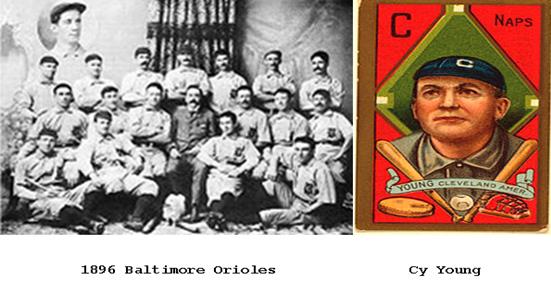
Baseball Trailblazers
Page 349
The term “major league baseball” is used frequently herein.
There is a good reason, especially when referring to pre-1920
accomplishments. You see, the experts have classified some leagues as minor – inferior in talent level; and in most cases they are arguably correct. The problem is that some early players of note made no such distinction, and spent their time with whichever competing league and team paid them the best. The modern day compilers of baseball statistics do not include
“minor” dalliances, and in many cases the information which would be required to do so does not exist.
So, exactly what is “major league baseball” in antiquity?
Major League Baseball (MLB) is a professional baseball organization and the oldest major professional sports league in the world. As of 2021, a total of 30 teams play in Major League
Baseball Trailblazers Page 350
Baseball; 15 teams in the National League (NL), and 15 in the American League (AL). The NL and AL were formed in 1876 and 1901, respectively. Beginning in 1903, the two leagues cooperated but remained legally separate entities until 2000
when they merged into a single organization led by the Commissioner of Baseball.
Baseball's first openly all-professional team was the Cincinnati Red Stockings, who were founded in 1869. Before that, some teams had secretly paid some players. The first few decades of professional baseball were characterized by rivalries between leagues and by players who often jumped from one team or league to another.
In the 1860s, aided by soldiers playing the game in camp during the Civil War, "New York" style baseball expanded into a national game and spawned baseball's first governing body, “The National Association of Base Ball Players.” The NABBP existed as an amateur league for 12 years. By 1867, more than 400 clubs were members. Most of the strongest clubs remained those based in the Northeastern United States. For professional baseball's founding year, MLB uses the year 1869, when the first professional team, the Cincinnati Red Stockings, was established.
Baseball Trailblazers Page 351
A schism developed between professional and amateur ballplayers after the founding of the Cincinnati club. The NABBP split into an amateur organization and a professional organization. The National Association of Professional Base Ball Players, often known as the National Association (NA), was formed in 1871. Its amateur counterpart disappeared after only a few years. The modern Chicago Cubs and Atlanta Braves franchises trace their histories back to the National Association of Professional Base Ball Players in the 1870s.
In 1876, the National League of Professional Base Ball Clubs, later known as the National League or NL, was established after the NA proved ineffective. The league placed its emphasis on clubs rather than on players. Clubs could now enforce player contracts, preventing players from jumping to higher paying clubs. Clubs were required to play the full schedule of games instead of forfeiting scheduled games when the club was no longer in the running for the league championship, which happened frequently under the NA. A concerted effort was made to curb gambling on games, which was leaving the validity of results in doubt. The first game in the NL, on Saturday, April 22, 1876, at the Jefferson Street Grounds, Philadelphia, is often pointed to as the beginning of MLB. That’s the easy part.
Baseball Trailblazers Page 352
The early years of the NL were tumultuous, with threats from rival leagues and a rebellion by players against the hated
"reserve clause," which restricted the free movement of players between clubs. Teams came and went. 1882 was the first season where the league's membership was the same as the preceding season's, and only four franchises survived to see 1900.
Competitor leagues formed regularly and also disbanded regularly. The most successful was the American Association, 1882–1891, sometimes called the "beer and whiskey league" for its tolerance of the sale of alcoholic beverages to spectators.
For several years, the NL and American Association champions met in a postseason championship series, the first attempt at a World Series. The two leagues merged in 1892 as a single 12 team NL, but the NL dropped four teams after the 1899 season. This led to the formation of the American League in 1901 under AL
president Ban Johnson, and the resulting bidding war for players led to widespread contract breaking and legal disputes.
The war between the AL and NL caused shock waves throughout the baseball world. At a meeting at the Leland Hotel in Chicago in 1901, the other baseball leagues negotiated a plan to maintain their independence. A new National Association was formed to oversee these minor leagues. While the NA continues to this day, known as Minor League Baseball, at the time Ban Johnson saw it
Baseball Trailblazers Page 353
as a tool to end threats from smaller rivals who might expand in other territories and threaten his league's dominance. After 1902, the NL, AL, and NA signed a new National Agreement which tied independent contracts to the reserve clause contracts. The agreement also set up a formal classification system for minor leagues, the forerunner of today's system that was refined by Branch Rickey.
Other Recognized Major Leagues
Several other early defunct baseball leagues are officially considered major leagues, and their statistics and records are included with those of the two current major leagues. In 1969, the Special Baseball Records Committee of Major League Baseball officially recognized six major leagues; the National League, American League, American Association, Union Association - 1884, Players' League - 1890, and the Federal League - 1914–1915. To avoid confusion and lengthy footnotes, this book generally conforms to that judgement, but adds the 1871-75 National Association.
The National Association of Professional Base Ball Players (NAPBBP), often known simply as the National Association (NA), was the first fully professional sports league in baseball. The NA was founded in 1871 and continued through the 1875 season. It
Baseball Trailblazers Page 354
succeeded and incorporated several professional clubs from the previous National Association of Base Ball Players (NABBP) of 1857–1870, sometimes called "the amateur Association." In turn, several NA clubs created the succeeding National League of Professional Baseball Clubs, the National League, founded 1876, which joined with the American League of Professional Base Ball Clubs, the American League, founded 1901, to form Major League Baseball (MLB) in 1903.
In addition, the Pacific Coast League, which operated from 1903
to 2021, among others, seems to be of a high standard and many huge stars, including Mickey Cochrane, Ted Williams and Joe DiMaggio have played there. It was classified between single A and triple A during its existence, though that seems less than generous. The status of the National Association as a major league has been a point of dispute among baseball researchers.
While its statistics are not recognized by Major League Baseball, its statistics are included with those of other major leagues by most baseball reference websites. Both the Union Association and American Association are considered major leagues by many baseball researchers because of the perceived high caliber of play and the number of star players featured.
Some researchers dispute the major league status of the Union Association by pointing out that franchises came and went and
Baseball Trailblazers Page 355
that the St. Louis club was deliberately "stacked." The St.
Louis club was owned by the league's president and some say that it was the only club that was close to major league caliber.
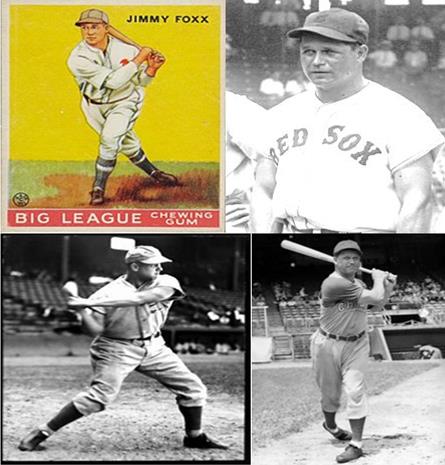
Baseball Trailblazers
Page 356
Jimmie Foxx
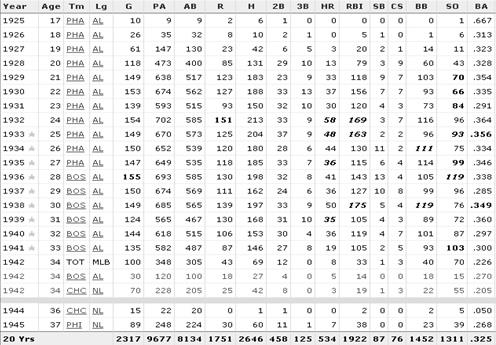
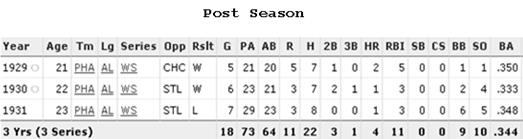
Baseball Trailblazers
Page 357
James Emory Foxx, October 22, 1907 - July 21, 1967, nicknamed
"Double X" and "The Beast," was a professional baseball first baseman who played 20 seasons in major league baseball for the Philadelphia Athletics, Boston Red Sox, Chicago Cubs, and Philadelphia Phillies. His most productive years were with the Philadelphia Athletics and the Boston Red Sox, where he hit 30
Baseball Trailblazers Page 358
or more home runs in 12 consecutive seasons and drove in more than 100 runs in 13 consecutive years.
Foxx was born in rural Sudlersville on the Eastern Shore of Maryland to Dell and Mattie Foxx, who were farmers. Dell Foxx had played baseball for a town team when he was younger. Jimmie Foxx did well in school but excelled in sports, particularly soccer, track, and baseball. He played all three sports at Sudlersville High School, and set the state record in the 220
yard dash in 1923. So great were his athletic exploits he was regarded as "the most promising athletic prospect in the State of Maryland," and a scholarship to the University of Maryland was arranged, for track and field, should he wish to attend.
Instead, Foxx joined the minor league Class D level Easton Farmers, who were managed by former Philadelphia Athletics great and Hall of Fame member Frank "Home Run" Baker. Foxx had hoped to pitch or play third base, but since the team was short on catchers, Foxx moved behind the plate, a position he had played in high school and on summer all-star teams. He immediately drew interest from the Philadelphia Athletics and New York Yankees.
Foxx signed with the A's and made his major league debut in May 1925 at age 17. He was still in his junior year of high school at the time.
Baseball Trailblazers Page 359
The A's catching duties were already filled by future Baseball Hall of Fame member Mickey Cochrane, so by 1927, Foxx was splitting time between catching, first base, and the outfield.
In 1929, installed as the A's regular first baseman, Foxx had a breakthrough year, batting .354 and hitting 33 home runs. That year, Foxx appeared on the cover of “Time” magazine.
In 1932, Foxx hit .364, with 58 home runs with 169 RBIs, missing the Triple Crown by just three points in batting average and falling just short of Babe Ruth's all time Major League record.
Foxx actually hit 60 that year, but two were hit in games that were rained out, erasing them from the official batting records.
Foxx came back strong in 1933, batting .356, driving in 163
runs, and hitting 48 home runs, earning him the Triple Crown and the second of back to back MVP honors.
Foxx was one of the three or four most feared sluggers of his era. The great Yankee pitcher Lefty Gomez once said of him; "He has muscles in his hair."
In 1937, Foxx hit a ball into the third deck of the left field stands at Yankee Stadium, a very rare feat because of the distance and the angle of the stands. Gomez was the pitcher who gave it up, and when asked how far it went, he said; "I don't
Baseball Trailblazers Page 360
know, but I do know it took somebody 45 minutes to go up there and get it back."
When the Great Depression fully hit in the early 1930s, A's owner Connie Mack was unable to pay the salaries of his highly paid stars, and was obliged to sell off a number of them. After a 1936 contract dispute, Mack sold Foxx's contract to the Red Sox for $150,000.
Foxx played six years for Boston, including a 1938 season in which he hit 50 home runs, drove in 175 runs, batted .349, won his third MVP award, and again narrowly missed winning the Triple Crown. Foxx is one of nine players to have won three MVPs.
On June 16, 1938, he set an American League record when he walked six times in a game. In 1939 he hit .360, his second best, all-time season batting average.
Foxx's skills diminished significantly after 1941. Some sources attribute this to alcohol abuse, while others attribute it to a sinus condition.
He split the 1942 season between the Red Sox and Chicago Cubs, playing mostly a reserve role. He sat out the 1943 season and appeared only in 15 games in 1944, mostly as a pinch hitter.
Baseball Trailblazers Page 361
He wound up his career with the Philadelphia Phillies in 1945, filling in at first and third, pinch hitting, and pitching nine games, including two as the starting pitcher. He compiled a 1-0
record and 1.59 ERA over 22 innings. Foxx was often called the right handed Babe Ruth, but his career was the opposite of Ruth in this regard. Ruth began his big league career as a pitcher.
Foxx ended his big-league career as one.
Foxx finished his 20 year career with 534 home runs, 1,922 runs batted in, 1,751 runs scored, 2,646 hits, 458 doubles, 125
triples, 1,452 bases on balls and a .325 batting average. His 12
consecutive seasons with 30 or more home runs was a major league record until 2004. At the end of his career, his 534 home runs placed him second only to Ruth on the all-time list, and first among right handed hitters. Foxx set the record for the youngest player to reach 500 home runs at age 32 years and 338 days in the final week of the 1940 Major League Baseball season.
Foxx worked as a minor league manager and coach after his playing days ended, including managing the Fort Wayne Daisies of the All American Girls Professional Baseball League for one season in 1952. He took them to the playoffs where they lost in the first round 2 games to 1 against the Rockford Peaches. Foxx did not return for the 1953 season.
Baseball Trailblazers Page 362
Foxx served as head coach for the University of Miami baseball team for two seasons, going 9-8 in 1956 and 11-12 in 1957.
A series of bad investments left Foxx broke by 1958. The Red Sox responded by naming Foxx hitting coach of their Triple A affiliate, the Minneapolis Millers of the American Association, that season. In the early 1960s he lived in Galesburg, Illinois where he was reduced to working as a greeter at a locally owned steak house. He eventually retired to suburban Cleveland in Lakewood, and was employed by the Lakewood Recreation Department. His two children, a daughter and son, also lived in Lakewood. His son, Jimmie Foxx, Jr., was an outstanding football player at Lakewood High School and at Kent State University.
Foxx died in 1967 at age 59 in Miami, Florida. He became ill while eating dinner with his brother and was taken to a hospital, where resuscitative efforts failed. An autopsy showed that Foxx had choked on a piece of food. The year before, Foxx's second wife, Dorothy, had also died of choking.
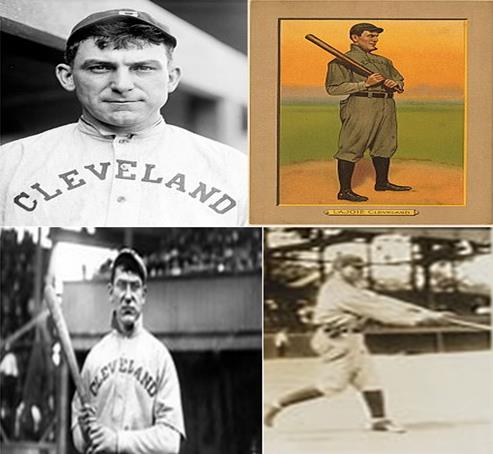
Baseball Trailblazers
Page 363
Nap Lajoie 2b
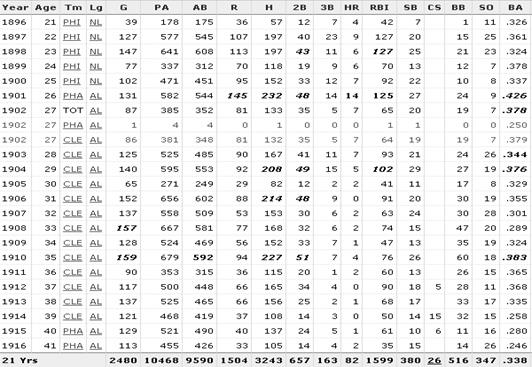
Baseball Trailblazers
Page 364
Napoleon Lajoie, September 5, 1874 - February 7, 1959, also known as Larry Lajoie and nicknamed "The Frenchman," was a professional baseball second baseman and player-manager. He played in major league baseball for the Philadelphia Phillies, Philadelphia Athletics twice, and Cleveland Naps between 1896
and 1916. He managed the Naps from 1905 through 1909.
Lajoie was born in Woonsocket, Rhode Island, to Jean Baptiste and Celina Guertin Lajoie. Jean Lajoie was French-Canadian and had emigrated to the United States. Upon arrival in the US, he first settled in Rutland, Vermont, but then moved to Woonsocket, where Lajoie, the youngest of eight surviving children, was
Baseball Trailblazers Page 365
born. Throughout his childhood Lajoie received little formal education.
Jean, who worked as a teamster and laborer, died not long into Lajoie's childhood, which forced him and his siblings to work to support the family. Lajoie dropped out of school to work in a textile mill. He also began playing semi-professional baseball for the local Woonsocket team, under the alias "Sandy" because his parents did not approve of their son playing baseball. He earned money as a taxi driver with a horse and buggy and locally was called "Slugging Cabby." "When I told my father I had decided to take the job he was very angry. He shouted that ball players were bums and that nobody respected them, but I was determined to give it a try at least one season," Lajoie later said. He also received the nickname "Larry" from a teammate who had trouble pronouncing Lajoie. Lajoie admired baseball players such as King Kelly and Charles Radbourn.
When word of Lajoie's baseball ability spread, he began to play for other semi-professional teams at $2 to $5 per game. He also worked as a teamster. He left Woonsocket and his $7.50 per week working as a taxi driver and joined the Class B New England League's Fall River Indians in 1896. Lajoie played as a center fielder, first baseman and catcher, earning $25 weekly. He recorded 163 hits in 80 games and led the team in batting
Baseball Trailblazers Page 366
average, doubles, triples, home runs and hits. Lajoie was widely regarded as an outstanding prospect, and Indians owner Charlie Marston rejected an offer from the Pittsburgh Pirates for Lajoie in exchange for $500. He was also scouted by the Philadelphia Phillies and Boston Beaneaters.
The Philadelphia Phillies of the National League purchased Lajoie and teammate Phil Geier from Fall River for $1,500 on August 9. Phillies' manager Billy Nash originally went to Fall River intending to sign Geier only, but obtained Lajoie when the team agreed to include him in their asking price. Author David Jordan wrote; “A legend later grew up that Geier was the main target of Nash's pursuit and that Marston ‘threw in’ Lajoie in order to get the Phillies to pay the $1,500 asking price. This is hardly likely. While Geier was considered a good prospect, Lajoie was banging the ball at a .429 clip in his first professional season, was a fine fielder, and had already been sought by several big league clubs. Nap Lajoie clearly represented a financial asset to Marston, who did not give him away. The price the Phillies paid was a substantial sum for two minor leaguers in 1896.”
Lajoie made his major league debut against the Washington Senators on August 12, 1896. He played first base and recorded a single. Ed Delahanty was being considered to play the first base
Baseball Trailblazers Page 367
position after Dan Brouthers retired. Delahanty, however, wanted Lajoie to play first so he could return to his natural position of left field. Delahanty said to Lajoie; "Look, sonny, you tell the boss you're a first baseman and you and me are gonna get along." Lajoie became the team's first baseman, and by the end of the season he and Delahanty were roommates. Later in 1898, new manager George Stallings moved Lajoie to second base, commenting; "Lajoie would have made good no matter where I positioned him."
Lajoie hit .363 and led the NL in slugging percentage in 1897
and doubles and RBIs in 1898. He had a .378 batting average in 1899, though he played only 77 games due to an injury. In 1900, he missed five weeks due to a broken thumb suffered in a fist fight with teammate Elmer Flick.
John Rogers, described as a "penny-pinching" majority owner of the Phillies, assured Lajoie that he would make the same salary as Delahanty. However, Lajoie discovered that while he was earning $2,600, Delahanty earned $3,000. Contracts for NL
players were not allowed to surpass $2,400. Rogers increased Lajoie's pay by $200 but the damage had already been done.
"Because I felt I had been cheated, I was determined to listen to any reasonable American League offer," Lajoie said.
Baseball Trailblazers Page 368
In 1901, the newly created American League had attracted several of the top players in the competing National League to join its ranks. Rogers declined Lajoie's request for an increase in salary, and as a result Lajoie jumped to the crosstown Philadelphia Athletics, owned by former Phillies' part-owner Benjamin Shibe and managed by Connie Mack. Frank Hough offered Lajoie the contract on behalf of Mack. "Hough offered me $24,000
for four years. You can bet I signed in a hurry," Lajoie said.
Lajoie was considered "the first superstar" to join the newly formed AL. He was also the first player whose yearly salary was $4,000. "The Phillies opened their season and drew 6,000 fans. A week later, when we opened, there were 16,000 in the stands. The American League was here to stay," Lajoie later said. Lajoie's batting average that year was .426. The batting average mark became the all-time AL record. That same year in a game against the Chicago White Sox's Clark Griffith, Lajoie became the second major leaguer after Abner Dalrymple in 1881 to be intentionally walked with the bases loaded in an 11-7 game. For the 1901
season, Lajoie led the majors in doubles - 48, and led the majors in hits - 232, batting average - .426, runs - 145, on base percentage - .463, slugging percentage - .643, and total bases - 350. His 125 RBIs led the AL, and his 14 home runs were a career best, and his 48 doubles are a Philadelphia Athletics'
Baseball Trailblazers Page 369
record. Mack said of Lajoie; "He plays so naturally and so easily it looks like lack of effort."
In April 1902, the Supreme Court of Pennsylvania overruled an earlier decision by the Court of Common Pleas and upheld the reserve clause in contracts between players and NL clubs.
President of the Chicago National League Club Jim Hart said the state Supreme Court's decision had dealt "a fatal blow to the rival league" and NL clubs "have won a great victory." The Phillies' Rogers obtained an injunction barring Lajoie from playing baseball for any team other than his team. However, a lawyer discovered that the injunction was enforceable only in the state of Pennsylvania. The courts ruled that the reserve clause was not valid for players who signed with an AL team.
Mack responded by trading Lajoie and Bill Bernhard to the then moribund Cleveland Broncos, whose owner, Charles Somers, had provided considerable financial assistance to the A's in the early years. Lajoie was also pursued by Charles Comiskey, owner of the Chicago White Sox.
Lajoie, considered baseball's most famous player at the time, arrived in Cleveland on June 4. His play was immediately met with approval from fans. The Broncos drew 10,000 fans to League Park in Lajoie's first game. The Broncos' record at the time Lajoie and fellow Athletics teammate, Bill Bernhard, joined was
Baseball Trailblazers Page 370
11-24 and improved to 12-24 after the team's inaugural game with their new players, a 4-3 win over the Boston Americans. The team went on to finish 69-67, fifth in the AL, for the franchise's first winning record. After his first season with the Broncos, Lajoie's .378 average led all AL players. New York Giants manager, John McGraw, was rumored to want to sign Lajoie, but Lajoie said; "I intend to stick to Cleveland."
For the remainder of 1902 and most of 1903, Lajoie and Flick traveled separately from the rest of the team, needing to avoid entering Pennsylvania so as to avoid a subpoena. The only team they could legally play with inside state limits was the Phillies. When the Naps went to play in Philadelphia, Lajoie and Bernhard would go to nearby Atlantic City to help pass the time.
The issue was finally resolved when the leagues made peace through the National Agreement in September 1903, which also brought the formation of the World Series. To begin the 1903
season, the club changed its name from the Broncos to the Naps in honor of Lajoie after a readers' poll result was released by the Cleveland Press. The team was officially the Blues in their inaugural AL season but changed to the Broncos in 1902. The Broncos finished the season 77-63 and Lajoie finished his first full season with the club again the AL's batting champion with a
.344 average. He also led the league in slugging percentage -
Baseball Trailblazers Page 371
.518, finished second in doubles - 41, third in RBIs - 93, and tied for fifth in home runs. In the off season he contracted pleurisy.
During the 1904 season, Lajoie received a suspension after he spat tobacco juice in an umpire's eye. He later informally replaced Bill Armour as the team's manager. After the season had concluded, Lajoie was officially named manager. He still managed to lead the majors with a .376 batting average as he recorded his second consecutive league batting title. He also led the majors in hits, doubles, RBIs, and slugging percentage. Lajoie forbade his players from card playing and gambling during the regular season. As a manager, Lajoie was also described as "much too lenient with his players."
Lajoie contracted sepsis from an untreated spike injury after a game in July 1905. Dye from Lajoie's stockings entered his bloodstream and led to blood poisoning. The injury worsened and Lajoie eventually came to games in a wheelchair, and doctors considered amputation. The injury and illness kept Lajoie out until August 28, when he returned as the team's first baseman.
Near the end of the season he sustained an injury to his ankle from a foul tip during an at bat, and did not play for the remainder of the season but continued to manage from the bench.
He finished the season having only appeared in 65 games. The
Baseball Trailblazers Page 372
Naps finished with a 76-78 record in a season in which they had been 52-29, and held a three game lead in the American League on July 24th.
Lajoie came back in 1906 to lead the majors in hits – 214, and doubles – 48, and the Naps finished third in the AL again with a winning record, 89-64. Lajoie finished second in the AL to George Stone in batting average at .355, slugging and on base percentage. In 1906 he married Myrtle Smith and the couple moved to a small farm outside Cleveland.
In June of the 1907 season, Lajoie's .296 average, "an average even now that scores of players would be glad to accept," put him at risk for hitting below .300 for the first time in his career. He also missed 15 games due to a recurrence of sepsis.
Lajoie and Naps first baseman George Stovall got into an argument in a hotel lobby and Stovall broke a chair over Lajoie's head. "George didn't mean anything by it," Lajoie said, and the two maintained a working relationship. He finished the season with an average of .301. The Naps finished the regular season in second place to the Tigers with a 90-64 record, a half-game behind. Lajoie was partly blamed for the Naps' second place finish. Author Fred McMane described an instance during the season between Naps catcher Nig Clarke and Lajoie. “Clarke was newly married and asked Lajoie for a day off so that he
Baseball Trailblazers Page 373
could go home. Lajoie refused. Clarke sulked and walked over to warm up pitcher Addie Joss. On the first pitch, he stuck out a finger and the ball broke it cleanly. With blood streaming from his hand, Clarke waved it defiantly in front of Lajoie. ‘Now can I go home?’ asked Clarke. He was out five weeks, and Cleveland lost the pennant to Detroit by half a game.”
Lajoie finished the season tied for third most in hits while Cobb's batting average, slugging and on base percentages, and hit total led the American League. Baseball historians have suggested the managerial duties Lajoie took on affected his offensive numbers.
Lajoie's dissatisfaction with the Naps' play worsened. "You can't win in the major leagues unless you have players who know the game. We don't have time to teach and train youngsters up here. Our job is to win pennants, not run schools," he said.
Franklin Lewis, sports writer and author, wrote; "Lajoie, in spite of his marvelous fielding and tremendous batting, was not exactly a darling of the grandstand as a manager." Lajoie recommended to Somers on August 17, 1909, he find the team a new manager, although he wanted to remain on the club as a player.
Somers responded to Lajoie by giving him more time to finalize his decision but when Lajoie came back days later and announced the same decision, Somers acted quickly to find a replacement.
Baseball Trailblazers Page 374
Lajoie later described the decision to take on the added duties as a player-manager as the biggest mistake of his career as he felt it negatively affected his play. The highest paid player in the league, he also offered a $10,000 reduction in salary.
Somers promoted Naps coach Deacon "Jim" McGuire to manager. The team finished 71-82 while Lajoie's .324 average was third in the AL and 33 doubles second. The Naps finished 1910 71-81 but Lajoie had one of his better seasons statistically as he led the majors with a .384 average and 227 hits, both categories bettered only in Lajoie's 1901 campaign. His 51 doubles, a career high, and 304 total bases led the majors, the fourth and final time in his career he would lead the majors in the latter category. Lajoie missed significant parts of back to back seasons, the first in 1911 when he appeared in just 90 games.
Stovall, the former Naps first baseman, replaced McGuire as the club's manager and the Naps finished 80-73. Lajoie was forced to sit out six weeks of the 1912 season when he sprained his back in May during a practice session in Chicago. He played in 117
games on the season, an increase from the 90 he played in one season before, but Cleveland, who had hired Joe Birmingham as the team's fifth manager since Lajoie gave up the role in 1909, finished 75-78. Lajoie and Joe Jackson tied for the team lead with 90 RBIs. He finished fourth in the AL with a .368 batting average. In 1913, Birmingham and Lajoie had arguments in the
Baseball Trailblazers Page 375
open, including one incident in June when Lajoie cursed Birmingham openly to reporters after being benched during a batting slump. Lajoie hit .335 on the year, the last time he would hit over .300 in his career.
Only two other major league players had attained 3,000 career hits before Lajoie hit a double on September 27, 1914, and joined Cap Anson and Honus Wagner in the club. Lajoie recorded the hit off Yankees pitcher Marty McHale in a 5-3 Naps win. His
.258 batting average for the season, however, was the lowest since he had joined the majors in 1896. The Naps finished in last place in the American League standings with a 51-102
record, their worst record since joining the league and the franchise's lowest winning percentage - .333. Lajoie requested that Somers trade him and the club obliged, selling Lajoie to the Athletics for the waiver price and in so doing, Lajoie returned to Philadelphia.
The following season, 1915, Lajoie returned to the Athletics when Mack signed him to a contract. In his first season back with the Athletics, he finished with a .280 batting average but the team ended the season in last place with a 43-109 record.
The 1916 season would be Lajoie's last in the majors. In his final major league game, he hit a triple to help Athletics pitcher Joe Bush win his no hitter. Lajoie, aged 41 years,
Baseball Trailblazers Page 376
played in 113 games and finished with a .246 average.
Philadelphia's season record was worse than the previous season's franchise low record, and the team finished in last place again with a 36-117 record.
In 1917, Lajoie joined the Toronto Maple Leafs of the International League as manager. At the age of 42, Lajoie won the league's batting title with batting average of .380. He appeared in 151 of 156 games and, for the first time in his career, played on a team that won a pennant. He later was signed by the Brooklyn Dodgers for $3,000 in March 1918 but the contract was annulled by the Commissioner's office and Lajoie was made a free agent to which he was "well pleased.” Later that same year he joined the Indianapolis Indians of the American Association as player-manager. He helped lead the team to a third place finish but the season was impacted due to the US'
involvement in World War I. Lajoie made his services available to the draft board but they rejected his offer. On December 27, 1918, Lajoie announced his retirement from baseball.
For the first part of the 20th century, Lajoie and Cobb's statistics rivaled each other like few other players in the American League. In 1908, Honus Wagner and Lajoie each recorded their 2,000th career hits. Baseball historian David Anderson wrote; “Nap Lajoie reached the milestone later in the summer
Baseball Trailblazers Page 377
with even less hoopla, in an age when individual records received little attention from the press and were generally scorned by many players. Players overly worried about their individual stats were often unpopular with teammates. The modesty of Wagner and Lajoie over their achievements contrasted sharply with Cobb's ambition and overriding interest in his individual numbers.”
The Lajoie-Cobb rivalry reached a peak in 1910, when Hugh Chalmers of the Chalmers Auto Company, a direct predecessor to modern day Chrysler, promised a Chalmers 30 Roadster to the season's batting champion. The public became fascinated with the daily statistics of Lajoie and Cobb in what became known as the Chalmers Race. Sports bettors, who by this time followed the sport attentively, also followed the daily reports with interest. Cobb took the final two games, a doubleheader, off against the Chicago White Sox, confident that his average was safe and would allow him to win the AL batting title. Going into the final two games of the season, Cobb's average led Lajoie's,
.383 to .376.
Lajoie and the Naps faced a doubleheader against the St. Louis Browns in Sportsman's Park. After a sun hindered fly ball went for a stand up triple and another batted ball landed for a cleanly hit single, Lajoie had five subsequent hits; all bunt
Baseball Trailblazers Page 378
singles dropped in front of rookie third baseman Red Corriden, who was playing closer to shallow left field on orders, it has been suggested, of manager Jack O'Connor. In his second at bat of the second game, Lajoie reached base on another bunt but the runner on first base advanced. According to the rules of that time, the hit was scored a sacrifice and thus, Lajoie did not record an official at bat. He finished the doubleheader a perfect 8 for 8 and his batting average increased to .384, .001
greater than Cobb's mark. Although the AL office had not officially announced the results, Lajoie began to receive congratulations from fans and players, including eight of Cobb's Detroit Tigers teammates. Most players in the league preferred Lajoie's personality to that of Cobb's. Coach Harry Howell is reported to have said to the game's official scorer, E. V.
Parish, "to do well by Lajoie." Howell was reported to have offered a bribe to Parish, which as described in Al Stump's biography of Cobb, was a $40 suit. Parish refused the offer and the resulting uproar ended in O'Connor and Howell being banned from the major leagues by AL President Ban Johnson.
Johnson had the matter investigated, and after having Cobb's September 24 doubleheader statistics re-checked, discovered only the first game of Cobb's statistics had been scored, but not the second game, in which he went 2 for 3. This put Cobb's suggested
Baseball Trailblazers Page 379
actual batting average at .385, again ahead of Lajoie's. In the end, Johnson ruled that Lajoie's sacrifice bunt should have been recorded as a hit, which would have allowed him to go 9 for 9, but that Cobb's batting average was greater, recording 196 hits in 509 at bats (.3851) to Lajoie's 227 hits in 591 at bats (.3841). Johnson asked Chalmers if his company would award an automobile to each player, to which he agreed. Lajoie initially refused the car, but eventually relented and accepted it. Cobb said; "I am glad that I won an automobile and am especially pleased that Lajoie also gets one. I have no one to criticize. I know the games were on the square and I am greatly pleased to know that the affair has ended so nicely." Lajoie said, "I am quite satisfied that I was treated fairly in every way by President Johnson, but I think the scorer at St. Louis made an error in not crediting me with nine hits. However, I am glad that the controversy is over. I have the greatest respect for Cobb as a batter and am glad of his success."
To further confuse matters, “The Sporting News” published an article in its April 18, 1981 issue stating that historian Pete Palmer had discovered that while Cobb's September 24
doubleheader was not correctly tabulated, perhaps purposefully, according to the correct date, the second game's statistics were in fact included in the next day's ledger, thus incorrectly
Baseball Trailblazers Page 380
recording a second 2 for 3 performance from Cobb which meant Lajoie's average was greater. Author James Vail wrote in 2001;
“To date, it seems that no one knows for certain who won that 1910 batting title.”
Lajoie ended his career with a lifetime .338 batting average.
His career total of 3,252 hits was the second most in major league baseball history at the time of his retirement, behind only Honus Wagner's total of 3,420. Lajoie's 2,522 hits in the American League was that league's record until Cobb surpassed his mark. He was among the second group of players elected to the Hall of Fame in 1937 and was later inducted on June 12, 1939, when the Hall opened that same year. Lajoie obtained the greatest number of votes from the Baseball Writers' Association of America, leading induction mates Tris Speaker and Cy Young.
Lajoie also led all second basemen in the NL in various fielding categories. Baseball historian William McNeil rates Lajoie as the game's greatest second baseman, when combining both offensive and defensive impact.
During spring training before the 1928 season, Lajoie commented on the 1927 New York Yankees. "Of course, you could see a lot of loafing going on but if that club is the greatest of all times, you just know that we had a lot of clubs in my time who were world champions and didn't know it." He died in Daytona Beach,
Baseball Trailblazers Page 381
Florida on February 7, 1959, at the age of 84 from complications associated with pneumonia. He had fallen in the autumn of 1958
and fractured his arm. His wife had died earlier in 1951.
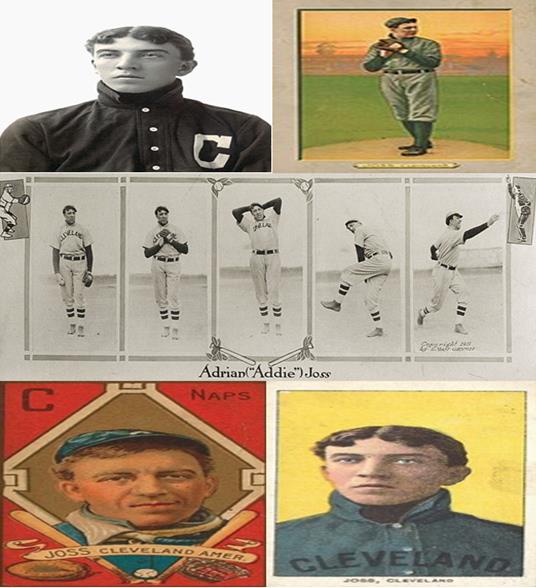
Baseball Trailblazers
Page 382
Addie Joss
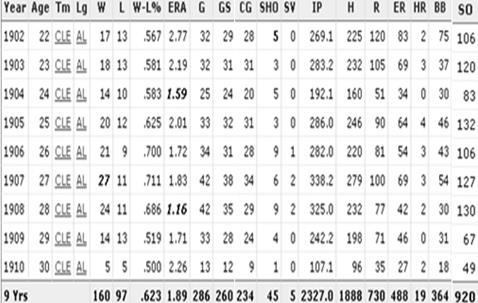
Baseball Trailblazers
Page 383
Adrian "Addie" Joss, April 12, 1880 - April 14, 1911, nicknamed
"The Human Hairpin," was a professional baseball pitcher. He pitched for the Cleveland Broncos of major league baseball, later known as the Naps, between 1902 and 1910. Joss, who was 6
feet 3 inches and weighed 185 pounds, pitched the fourth perfect game in baseball history. His 1.89 career earned run average is the second lowest, behind Ed Walsh.
Addie Joss was born in Woodland, Dodge County, Wisconsin. His parents Jacob and Theresa (née Staudenmeyer) worked as farmers.
His father, a cheesemaker who was involved in local politics, had emigrated from Switzerland. A heavy drinker of alcohol, he died from liver complications in 1890, when Joss was 10 years old. Joss remained sober throughout his life as a result of his
Baseball Trailblazers Page 384
father's death. Joss attended elementary school in Juneau and Portage and high school at Wayland Academy in Beaver Dam, Wisconsin. By age 16 he finished high school and began teaching himself. He was offered a scholarship to attend St. Mary's College in Watertown, where he played on the school's baseball team. He also attended the University of Wisconsin, where he studied engineering. Officials in Watertown were impressed with the quality of play of St. Mary's and put the team on a semi-pro circuit. During his time on the semi-pro circuit, Joss employed his unique pitching windup, which involved hiding the ball until the very last moment in his delivery.
Connie Mack also sent a scout to watch Joss and later offered the young pitcher a job playing on his Albany club in the Western League, which Joss declined. In 1899, Joss played for a team in Oshkosh, earning $10 per week. After player salaries were frozen by team owners, Joss joined the junior team in Manitowoc, which had been split into two teams, as a second baseman and was soon promoted to the senior squad, where he was developed into a pitcher. He was seen by a scout for the Toledo Mud Hens and in 1900 accepted a position with the team for $75
per month. While in Ohio he was considered "the best amateur pitcher in the state." He started the Mud Hens' season opener on
Baseball Trailblazers Page 385
April 28 and earned the win in the team's 16-8 victory. He won 19 games for the club in 1900.
Midway through the 1901 season, the Boston Americans of the upstart American League offered $1,500 to Toledo to buy out Joss' contract. The St. Louis Cardinals of the National League matched Boston's offer. Toledo rejected both offers. Joss continued to pitch for the Mud Hens and by the end of the 1901
season he had won 27 games and had 216 strikeouts. He became known as "the god of the Western League."
After the season ended, Joss returned to Wisconsin where he led Racine to the 1901 Wisconsin baseball state championship against Rube Waddell's Kenosha squad. He also enrolled at Beloit College and played American football. It was reported that Joss had signed with the Brooklyn Dodgers of the National League as early as August 18 and received a $400 advance, but Joss denied receiving any money. Mud Hens owner Charles Stroebel stated that he had signed Joss and other Mud Hens players for the 1902
season on August 12 and that the Western League was under the protection of the National League through September 1901. Before 1901 ended, the Cleveland Broncos offered $500 to Toledo in exchange for Joss and manager Bob Gilks, who would be a scout for Cleveland. Toledo and Joss agreed and Joss was now a member of the American League, which was paying a premium on baseball
Baseball Trailblazers Page 386
talent to rival the National League. Dodgers owner Charles Ebbets invited Joss for a meeting, which Joss declined, and Joss let it be known that he had told Stroebel he would play for the Mud Hens for the 1902 season, and received a $150 advance in February 1902.
In March 1902, Joss signed with Cleveland. Toledo sportswriters took exception to Joss, one writing that "he voluntarily signed a contract with Toledo for this season but when Bill Armour of Cleveland showed him the $500 bill he forgot his pledge and sneaked off like a whipped cur." Stroebel later argued that Joss had returned only $100 of the $150 advance. For not returning the entire advance, Joss was charged with a felony and Stroebel pursued legal action. Joss made his major league debut with the Broncos on April 26, and two days later he arrived in Toledo to turn himself in, accompanied by Broncos majority owner Charles Somers, who was also American League vice president. The court set bond at $500. Stroebel also filed a civil suit against the Broncos, stating that his business had been interfered with, but Stroebel agreed to withdraw his charges in July when he accepted Broncos pitcher Jack Lundbom.
Joss made his major league debut with the Cleveland Broncos against the St. Louis Browns. The Browns' Jesse Burkett hit a shallow pop fly in the direction of right fielder Zaza Harvey.
Baseball Trailblazers Page 387
Home plate umpire Bob Caruthers ruled that Harvey did not make a clean catch, so Burkett was credited with a hit. Harvey and witnesses said the ball never hit the ground. Joss finished his major league debut with a one hitter. Joss compiled a 17-13
record and 2.77 ERA during his major league rookie season. He led the American League with five shutouts.
On October 11, 1902, Joss married Lillian Shinivar in Monroe, Michigan. Shinivar was in attendance when Joss made his professional debut with the Mud Hens in 1900. The couple had a son, Norman, and a daughter, Ruth. Following the conclusion of the 1902 season, Joss was selected to the All-Americans, an all-star team from the American League who played exhibition games against their counterparts from the National League. To begin the 1903 season, the Cleveland organization changed the team's name to the "Naps" in honor of second baseman Nap Lajoie. In Joss' second year, he went 18-13 and lowered his ERA from the season before to 2.19.
For the 1904 season, the 24 year old Joss went 14-10 with a 1.59
ERA and did not give up a home run during the season. Illness reduced his starts. He had his first of four 20 win seasons in 1905 as he ended the season with a 20-12 record and 2.01 ERA. He finished with a career high 132 strikeouts. In 1906 his 1.72 ERA was third in the league and he finished with a 21-9 record and
Baseball Trailblazers Page 388
tied a career high with nine shutouts. To begin the 1907 season, Joss won his first 10 starts. He threw two one hitters, the first on September 4 against the Detroit Tigers and the second on September 25 versus the New York Highlanders. Joss finished the season with career bests in wins, 27-11, and 338 innings pitched. His win total tied with Doc White for highest in the American League and his complete games and shutouts were third best in the league.
Before the 1908 season started, the Naps' home field, League Park, was expanded by about 4,000 seats. The Detroit Tigers, Chicago White Sox, and Naps were engaged in a race for the postseason described as "one of the closest and most exciting known." Three games remained in the regular season and the Naps were a half game behind the Detroit Tigers as they headed into an October 2, 1908, match up against the Chicago White Sox, who trailed the Naps by one game. Game attendance was announced at 10,598, which was labeled by sportswriter Franklin Lewis as an
"excellent turnout for a weekday."
In what proved to be one of the tightest ever pitching duels in baseball history, Joss took the mound for the Naps, while the White Sox pitcher was future Hall of Famer Ed Walsh. Neither pitcher would give up an earned run in the 1-0 game. Walsh, blistering through his own 39 win season, struck out 15 batters,
Baseball Trailblazers Page 389
gave up only one base on balls and allowed only four scattered hits by the Naps. The Naps' Joe Birmingham scored the team's only run, which came in the third inning. The lone, unearned run scored as a result of a botched pickoff play and a wild pitch.
The tension in the ballpark was described by one writer by saying; "a mouse working his way along the grandstand floor would have sounded like a shovel scraping over concrete." Joss, having faced the minimum 24 batters in the first eight innings, retired the first two batters in the top of the ninth. Joss then faced White Sox pinch hitter John Anderson. Anderson hit a line drive that could have resulted in a double had it not gone foul.
He then hit a ball to Naps third baseman Bill Bradley, which Bradley bobbled before throwing to first baseman George Stovall.
Stovall dug the ball out of the dirt to achieve the final out.
With the win, Joss recorded the second ever perfect game in the modern era. He accomplished the feat with just 74 pitches, the lowest known pitch count ever achieved in a perfect game. Fans swarmed the field. After the game, Joss said; "I never could have done it without Larry Lajoie's and Stovall's fielding and without Birmingham's base running. Walsh was marvelous with his spitter, and we needed two lucky strikes to win."
For the season, Joss averaged 0.83 walks per nine innings, becoming one of 29 pitchers in major league baseball history to
Baseball Trailblazers Page 390
average less than one walk per nine innings. The Naps finished with a 90-64 record, a half-game behind Detroit. It was the closest Joss ever got to a World Series appearance.
After amassing four consecutive 20 win seasons, Joss struggled in 1909 as a result of fatigue. By September he was shut down for the season. Joss finished the year with a 14-13 record in 242 innings pitched and recorded a 1.71 ERA, finishing fourth in the American League.
Joss pitched a second no hitter, on April 20, 1910, against the White Sox, becoming the first pitcher in major league baseball history to no hit the same team twice. In the second inning, the White Sox' Freddy Parent hit a ball toward third base. Bill Bradley failed to field the ball cleanly and thus his throw to first base was not in time to get Parent out. The initial ruling on the field was a base hit but it was later changed to an error. Joss gave up two walks and recorded 10 assists. He made just 13 appearances that season due to a torn ligament in his right elbow. Joss made his last appearance of the season on July 25, and left the game in the fifth inning due to arm soreness.
In his final game, he allowed three runs on five hits and two walks with six strikeouts in a 4-0 loss. The Naps finished 71-82. In his final major league season, Joss finished with a 5-5
record in 107 innings. The Naps finished the year 71-81. This
Baseball Trailblazers Page 391
marked the fifth time in Joss' nine years that the franchise finished with a losing record.
Of Joss' 160 major league wins, 45 were shutouts. Joss' 1.89
career ERA is ranked second all-time to Ed Walsh. He finished with a 160-97 record, 234 complete games, and 920 strikeouts.
Joss' repertoire included a fastball, a changeup, and an
"extremely effective" curve. Joss had only one curveball because
"he believed that with a few well mastered deliveries he could acquire great control and success with less strain on his arm."
In an era filled with spitball pitchers, Joss achieved his success without ever altering the baseball. Joss threw with a corkscrew windup motion, described as "an exaggerated pinwheel motion." Shortstop Roger Peckinpaugh described his windup; "He would turn his back toward the batter as he wound up, hiding the ball all the while, and then whip around and fire it in."
Illness and injury accompanied Joss throughout much of his professional career. In 1903, a high fever forced him to miss the last month of the season. He contracted malaria in April 1904 and then missed several starts with a back injury in 1905.
Joss was concerned about supporting his family after his baseball career ended. Many players of the day had little education and few marketable job skills beyond their abilities
Baseball Trailblazers Page 392
on the diamond. As sportswriter Franklin Lewis wrote; "Only a handful of players in the rough, stirring, early days of the major leagues arrived from campuses. And when they did, sometimes the shock was too great for them. Some grizzled holdovers from the 1890s were around and they bore down heavily on the eardrums of the college-boy set." Joss was hired as a sports columnist after the 1906 season for the “Toledo News Bee.” He also served as their Sunday sports editor. His writings proved so popular that sales of the paper increased and a special phone line was installed in his office to field the large volume of calls he received from fans. The increased popularity gave him an advantage when negotiating with the Naps before the 1907 season, and the club agreed to pay him $4,000.
He later also wrote for the “Cleveland Press” and covered the World Series for the “News Bee” and “Press” from 1907-1909. The
“Press” introduced Joss in columns this way; "Of all the baseball players in the land, Addie Joss is far and away the best qualified for this work. A scholarly man, an entertaining writer, an impartial observer of the game." An editorial in the
“Toledo Blade” said; "In taking his vocation seriously, Joss was, in return, taken seriously by the people, who recognized in him a man of more than usual intelligence and one who would have adorned any profession in which he had elected to engage."
Baseball Trailblazers Page 393
During the 1908-1909 off seasons, Joss worked on designing an electric scoreboard that would later be known as the Joss Indicator. The Naps decided to install the scoreboard, which allowed spectators to monitor balls and strikes at League Park.
Joss attended spring training with Cleveland before the start of the 1911 season. He collapsed on the field from heat prostration on April 3 in an exhibition game in Chattanooga, Tennessee. He was taken to a local hospital and released the next day. As early as April 7, press reports had taken note of his ill health, but speculated about "ptomaine poisoning" or "nervous indigestion." The Naps traveled to Toledo for exhibition games on April 10 and Joss went to his home on Fulton Street in Toledo where he was seen by his personal physician, Dr. George W.
Chapman. Chapman thought Joss could be suffering from nervous indigestion or food poisoning. By April 9, as Joss was coughing more and had a severe headache, Chapman changed his diagnosis to pleurisy and reported that Joss would not be able to play for one month and would need ten days of rest to recover. Joss could not stand on his own and his speech was slurred. On April 13, Chapman sought a second opinion from the Naps' team doctor, who performed a lumbar puncture and diagnosed Joss with tuberculous meningitis. The disease had spread to Joss' brain and he died on April 14, 1911, two days after his 31st birthday.
Baseball Trailblazers Page 394
The first "all-star" game was played as a benefit for Joss's family on July 24, 1911. The Naps invited players from the other seven American League teams to play against them. Visiting club players who were involved in the game included Home Run Baker, Ty Cobb, Eddie Collins, Sam Crawford, Walter Johnson, Tris Speaker, Gabby Street, and Smoky Joe Wood. "I'll do anything they want for Addie Joss' family," Johnson said. Washington Senators manager Jimmy McAleer volunteered to manage the all-stars. "The memory of Addie Joss is sacred to everyone with whom he ever came in contact. The man never wore a uniform who was a greater credit to the sport than he." McAleer said. The game was attended by approximately 15,270 fans and raised nearly $13,000
to help Joss' family members pay remaining medical bills. The Naps lost 5-3.
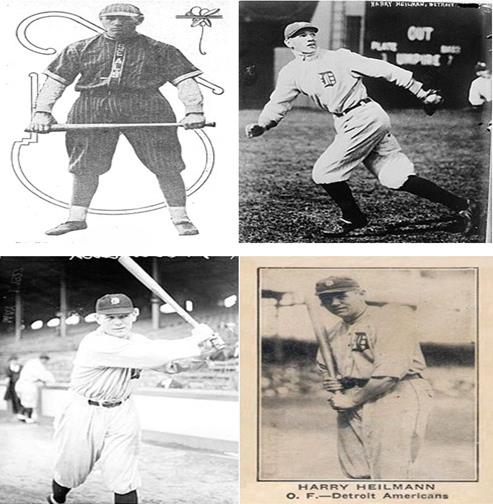
Baseball Trailblazers
Page 395
Harry Heilmann
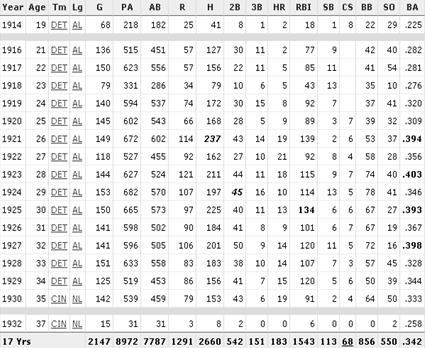
Baseball Trailblazers
Page 396
Harry Edwin Heilmann, August 3, 1894 - July 9, 1951, nicknamed
"Slug," was a baseball player and radio announcer. He played professional baseball for 19 years between 1913 and 1932, including 17 seasons in major league baseball with the Detroit Tigers, 1914, 1916-1929, and Cincinnati Reds, 1930, 1932. He was a play by play announcer for the Tigers for 17 years from 1934
to 1950.
Heilmann won four American League batting championships, securing the honors in 1921, 1923, 1925 and 1927. He appeared in 2,147 major league games, including 1,525 games as a right
Baseball Trailblazers Page 397
fielder and 448 as a first baseman and compiled a career batting average of .342, the 12th highest in major league history, and third highest among right handed batters. At the time of his retirement in 1932, Heilmann ranked sixth in major league history with 542 doubles and eighth with 1,543 RBIs. He remains one of only five players in American League history to hit .400
for a season, having accomplished the feat in 1923 with a .403
batting average. At his peak from 1921 to 1927, Heilmann compiled a .380 batting average, .452 on base percentage, .583
slugging percentage, and averaged 116 RBI, 41 doubles, 11
triples, and 104 runs scored per season. From 1919 through 1930, Heilmann hit over .300 for 12 consecutive years.
Heilmann was born in San Francisco. His father, Richard W.
Heilmann, was born in 1860 in Sacramento, California, the son of an Irish mother and a father from Saxony. His mother, Mary (McVoy) Heilmann, sometimes referred to as Mollie, was born in 1864 in County Roscommon, Ireland. Harry was the couple's fourth surviving child, having an older sister, May, and two older brothers, Richard, Jr., and Walter. Heilmann's father operated a soap business, ran as a Republican for the office of Supervisor of San Francisco's Ninth Ward in 1896, and died in June 1897 at age 36. As a boy in the 1890s Heilmann lived with his family at
Baseball Trailblazers Page 398
708A Brannan Street in what is now the South of Market district of San Francisco.
Heilmann was 11 years old at the time of the 1906 San Francisco earthquake that killed approximately 3,000 people and left nearly 75% of the city's population homeless and living in refugee camps.
Heilmann's older brother, Walter, was a gifted athlete who attended Sacred Heart Cathedral Preparatory in San Francisco. On June 3, 1908, a year after the city's devastation by earthquake, Walter died at age 16 while on a sailboat excursion with three schoolmates to visit the battleship USS Connecticut in drydock at the Hunters Point Naval Shipyard, near the present site of Candlestick Park. The boat capsized in a squall, and Walter drowned while trying to swim to shore; the other three boys were rescued.
As of 1910, Heilmann was living with his mother at 112 Sixteenth Street in the Dogpatch neighborhood of San Francisco. Heilmann followed his older brother to what is now Sacred Heart Cathedral Preparatory, where he played baseball, track and field, and basketball. He graduated from Sacred Heart in 1912 at age 17
with a collegiate certificate. After graduating from Sacred
Baseball Trailblazers Page 399
Heart, Heilmann worked as a bookkeeper for the Mutual Biscuit Company.
Heilmann appeared in a semi-pro baseball game in 1913 for a team from Hanford, California. While playing for Hanford, he was signed by a scout for the Portland Beavers of the Pacific Coast League. After being signed by the Beavers, Heilmann was assigned to the Portland Colts of the Northwestern League. He compiled a
.305 batting average in 122 games for them.
In September 1913, Heilmann was drafted by the Detroit Tigers.
He made his major league debut with the Tigers on May 16, 1914, and played in 68 games that year, batting .225 and committing six errors in 31 games in the outfield for an .870 fielding percentage.
For the 1915 season, the Tigers sent Heilmann to the San Francisco Seals of the Pacific Coast League. Heilmann missed the latter portion of the season after suffering from dizzy spells.
Before the health problems sidelined him, Heilmann appeared in 98 games for the Seals and compiled a .364 batting average and
.544 slugging percentage, with 23 doubles and 12 home runs. His
.364 batting average led the PCL for the 1915 season.
Heilmann returned to the Tigers in 1916 and appeared in 136
games, including 30 games at first base and 77 as an outfielder.
Baseball Trailblazers Page 400
Although his .282 batting average was low by the standards he would set later, he ranked among the American League leaders with 30 doubles, 77 RBIs, and 43 extra base hits. He also became a favorite in Detroit for his actions off the field. On July 25, 1916, he saved a woman whose vehicle had rolled into the Detroit River, diving into the water to rescue her, although two others died in the accident. His heroic act was reported in the national press, and he was loudly applauded at the next day's game.
He continued to improve at the plate in 1917, once again ranking among the American League leaders with 85 RBIs, five home runs, and 11 triples. But he was called "Slug" due to his notoriously slow running and difficulties in the field. In 1917, the Tigers tried playing him in right field for 95 games, center field for 28, and first base for 27, but he was not particularly good at any of the positions.
In 1918, Heilmann appeared in 79 games for the Tigers, 40 in right field and 37 at first base, compiling a .276 batting average. In mid-July 1918, he left the Tigers to enlist in the United States Navy during World War I. He served as a quartermaster on submarines off the West Coast of the United States.
Baseball Trailblazers Page 401
He returned to the Tigers in 1919 and had his best season to date, ranking among the American League leaders with a .320
batting average and seven other major offensive categories. He had another strong year in 1920 with a .309 average, 41 extra base hits and 89 RBIs, but he continued to fall short in the field in those two years. Detroit manager Hughie Jennings made him the Tigers' starting first baseman, and he led the league in errors at that position both years.
Heilmann was married on October 5, 1920, to Mary H. Maynes, commonly known as Mae. They had a daughter, Mary Ellen, and a son, Harry, Jr., and lived in Detroit.
In 1921, Heilmann appeared in 149 games, including 145 as the Tigers' starting right fielder. He won his first batting title, compiling a .394 batting average to outpace his manager and teammate Ty Cobb who hit .389. He was the first right handed batter to win the American League batting title since Nap Lajoie in 1905. Heilmann also led the American League in 1921 with 237
hits and ranked second behind Babe Ruth with 139 RBIs, 365 total bases, a .606 slugging percentage, and 292 times on base. He also ranked among the league leaders with a .444 on base percentage, 43 doubles, and 76 extra base hits.
Baseball Trailblazers Page 402
Heilmann's batting average in 1921 was 85 points higher than his 1920 average and 101 points higher than his career average prior to 1921. Some attributed Heilmann's dramatic improvement to the tutelage of Ty Cobb, who took over as the Tigers' manager in 1921. However, Frank G. Menke, a Hearst sportswriter at the time, attributed his improvement to having learned the game.
Menke observed; “There is nothing picturesque, nothing highly colored, nothing bombastic or spectacular about his methods. He is not a grandstander; not theatrical. And because he isn't, he does not get the acclaim and the plaudits which men, less wonderful, but better showmen, achieve for themselves.”
Though primarily a line drive hitter, Heilmann could also hit for power. His 19 home runs in 1921 ranked fifth in the American League, and he ranked among the league leaders in home runs 11
times. On July 8, 1921, Heilmann hit a home run off "Bullet Joe"
Bush that traveled over the center field fence in Detroit and
"actually made the patrons gasp in astonishment." Heilmann's home run was widely reported to have traveled 610 feet, eclipsing Babe Ruth's longest home run of 465 feet. The Detroit grounds keeper was more conservative, reporting that no measurement was made, but estimating that it traveled more than 500 feet.
Baseball Trailblazers Page 403
The entire Tiger lineup hit remarkably well in 1921. In addition to Heilmann and Cobb's 1-2 finish for the batting title, Detroit's third outfielder, Bobby Veach, was also among the league's best at .338. The 1921 Tigers finished the season with a team batting average of .316, the highest in American League history and second highest in major league history. However, true to the baseball adage that good pitching beats good hitting, the 1921 Tigers lacked good pitching and finished in sixth place, 27 games behind the pennant winning Yankees.
The 1921 season marked the start of a seven year stretch in which Heilmann compiled a .380 batting average, a .452 on base percentage, a .583 slugging percentage, and averaged 116 RBIs, 41 doubles, 11 triples, 15 home runs, and 104 runs scored.
In February 1922, Heilmann refused to sign his contract, demanding to be paid $15,000. On March 3, 1922, Heilmann signed a contract for $12,500 with the Tigers, agreeing to report to spring training the following week. His spring training was then interrupted again in late March when he returned to Detroit to be with his wife for the birth of their son on March 28, 1922.
By late June, Heilmann was batting .387 and battling George Sisler for the American League batting championship. On August 26, 1922, Heilman's season came to an end when he sustained a
Baseball Trailblazers Page 404
complete break of his collarbone when he crashed into Frank Brower while trying to beat out an infield hit. Heilmann had to have his collarbone rebroken and reset, and it was then discovered that Heilmann had also broken his shoulder. The injuries were so severe that Heilmann remained hospitalized until a week before the end of the season, and even after leaving the hospital, he feared he might never play again.
Despite missing the last five weeks of the season, Heilmann hit a career high 21 home runs, fourth in the American League, and also ranked among the league leaders with a .356 batting average, a .432 on base percentage, and a .598 slugging percentage.
In January 1923, while preparing for spring training and recuperating from his collar and shoulder injuries, Heilmann took up handball and quickly developed a reputation as one of the best players in the country. Heilmann's efforts at handball also helped him shed excess weight, reporting in spring training at 200 pounds, 30 pounds less than he had reported in 1922.
During the 1923 season, Heilmann won his second batting title, hitting .403 for the season, edging out Babe Ruth who hit .393.
Heilmann became the fourth American League player to hit .400 or more for a season, joining Ty Cobb, Nap Lajoie and George
Baseball Trailblazers Page 405
Sisler. Only one other American League player, Ted Williams in 1941, has accomplished the feat since 1923.
In addition to winning the 1923 batting crown, Heilmann had one of his best seasons as a slugger. He finished among the leaders in on base percentage, slugging percentage, RBIs, hits, home runs, runs scored, total bases, doubles, and extra base hits.
Despite hitting over .400, he finished third in the 1923
American League Most Valuable Player voting behind Ruth and Eddie Collins.
In 1923 Heilmann denied Ruth a Major League Baseball Triple Crown for the second time. Ruth led the league in home runs and RBIs in both 1921 and 1923, but was edged out in batting average in both years by Heilmann. In 1926, another Tiger, Heinie Manush, won the batting title to deny Ruth the triple crown a third time.
In 1924, Heilmann's batting average dropped by 56 points to
.346, which ranked sixth in the American League. Despite the
"slump" in batting average, Heilmann led the league with 45
doubles and ranked second behind Babe Ruth with a .533 slugging percentage. He also ranked among the league leaders inother offensive categories. He appeared in 145 games as the Tigers'
starting right fielder in 1924 and had his best defensive
Baseball Trailblazers Page 406
season, leading the league with 31 outfield assists and 263
putouts.
In 1925, Heilmann appeared in 150 games, 147 as Detroit's starting right fielder, and won his third batting title, this time in a close race with Tris Speaker. Going into the final day of the season, Heilmann trailed Speaker and needed a strong performance to pass him. On the last day, the Tigers played a doubleheader against the St. Louis Browns, and Heilmann had six hits, including a home run, in nine at bats. Heilmann finished with a .393 average, four points higher than Speaker. He was again among the American League leaders in most offensive categories. Despite his accomplishments, the 1925 American League MVP award went to Roger Peckinpaugh, who hit almost 100
points below Heilmann and had 70 fewer RBIs, but whose Senators repeated as pennant winners.
In 1926, Heilmann appeared in 141 games, and compiled a .367
batting average, a .445 on base percentage, and a .534 slugging percentage. The Detroit outfield took three of the top four spots in the batting race, as center fielder Heinie Manush won the batting crown with a .378 average, and left fielder Bob Fothergill finished third with a .367 average. On August 8, 1926, the Tigers held a Harry Heilmann Day at which Detroit Mayor John W. Smith presented Heilmann with a $5,000 Cadillac
Baseball Trailblazers Page 407
sports sedan, donated by Lawrence Fisher of Fisher Body, in front of a crowd of 40,000 spectators at Briggs Field.
In 1927, Heilmann won his fourth and final batting crown with a
.398 batting average in a close race with Al Simmons who hit
.392. On August 13, Simmons led Heilmann by 26 points, .393 to
.367, but Heilmann took the lead after totaling 27 hits in 11
games in the latter half of August. He then slumped in early September to fall behind Simmons and trailed by one point going into the last day of the season. On the final day, in a doubleheader at Cleveland, Heilmann had seven hits in nine at bats, including two home runs and three doubles, to add seven points to his average and overtake Simmons to win the batting championship. Heilmann still finished second in the American League MVP voting, this time behind Lou Gehrig of the Murderers'
Row 1927 Yankees.
When a reporter reminded him that he had won batting titles every odd numbered year from 1921 to 1927, Heilmann replied;
"Mr. Navin, the Detroit owner, gives me contracts on a two year basis. I always bear down real hard when a new contract is coming up."
In 1928, Heilmann appeared in 151 games for the Tigers, 125 as the team's starting right fielder and 24 as the starting first
Baseball Trailblazers Page 408
baseman. He compiled a .328 batting average, 70 points lower than his 1927 average of .398, but still seventh best in the American League.
In 1929, Heilmann was suspended in the spring for "indifferent training" and then finished the season on the bench. He ended up appearing in 125 games, 111 as the team's starting right fielder, and compiled a .344 batting average, ninth best in the American League.
In October 1929, the Tigers offered Heilmann on waivers to the other American League teams, but he went unclaimed, as no team was willing to pay the waiver price of $7,500. He was then sold by the Tigers to the Cincinnati Reds for a sum reported to be somewhat under $25,000. During the 1930 season, Heilmann appeared in 142 games with the Reds, 106 as the team's starting right fielder and 19 at first base. He compiled a .333 batting average and .416 on base percentage, the highest on the Cincinnati club in 1930. He also totaled 68 extra base hits, 19
home runs and 91 RBIs and ranked among the National League leaders with 43 doubles and 64 bases on balls.
In March 1931, Heilmann was incapacitated by arthritis in his right wrist. The arthritis was so severe that he was
Baseball Trailblazers Page 409
hospitalized for a time in the spring. He ended up missing the entire 1931 season.
In January 1932, Heilmann was reported by the Reds to be in
"great shape." He trained himself in Hot Springs and reported in late February that he believed himself ready. However, he appeared in only 15 games for the Reds, primarily as a pinch hitter and in five games as the team's starting first baseman.
He compiled a .258 batting average in 31 at bats and appeared in his last major league game on May 31, 1932. He was released by the Reds on June 6, 1932. It was reported at the time that his arthritic wrist had "lost its snap, and the power of his bat and throwing arm was gone."
Heilmann worked in the insurance business in Cincinnati while he played for the Reds. After retiring from baseball in 1932, Heilmann returned to Detroit and continued there in the insurance business. He also ran in 1933 for the office of Detroit City Treasurer, losing decisively to Charles L. Williams by a margin of 138,478 votes for Williams to 68,695 for Heilmann. He also played sandlot baseball briefly for the Tool Shop team in the Detroit Amateur Baseball Federation. On June 4, 1933, a crowd of more than 20,000 spectators watched Heilmann's return to baseball, as Heilmann had an RBI single in the first inning and made a "big league catch" in right field before a
Baseball Trailblazers Page 410
thunderstorm forced the cancellation of the game in the second inning. After a few games with Tool Shop, Heilmann organized his own team, known as Harry Heilmann's All-Stars, consisting of former major league players, including Bobby Veach, Oscar Stanage, "Leaping Mike" Menosky, Marty Kavanagh, and Frank Fuller, which played games throughout Michigan and Ohio in July, August and September 1933.
In 1934, Heilmann was hired by WXYZ to handle the play by play responsibility on broadcasts of Detroit Tigers games for the Michigan Radio Network. At the start of the 1934 season, he was paired with Harold True, but became a solo broadcaster by the end of the season and thereafter. During the Tigers' 1935
championship season, Heilmann broadcast all home games for the Tigers, while out of town games were relayed by telegraph with play by play being read by Bob Longstreet from the WXYZ studio in the Maccabees Building. In the fall of 1934, Heilmann also began broadcasting a football highlights show on Saturday evenings on the WXYZ and the Michigan Radio Network. In 1936, he also broadcast out of town Tigers games on CKLW radio. He also began broadcasting a sports interview show on WXYZ in 1936. In 1937, Heilmann further expanded his radio responsibilities with a daily recap of the day's baseball games, broadcast at 5:30 PM.
on WXYZ. In 1938, he continued his broadcasts of Tigers home and
Baseball Trailblazers Page 411
out of town games on WXYZ, and added a 12:45 PM interview show with the fan on the street, broadcast Monday through Saturday on WXYZ.
As his popularity grew, Heilmann expanded outside the sports realm in 1939 with a new interview program co-hosted with WXYZ
staff announcer Johnny Slagle. The program was titled "Town Meeting" and was broadcast at 12:45 PM on Mondays, Wednesdays and Fridays on WXYZ and the Michigan Radio Network. In the fall of 1939, Heilmann also joined Carl Gensel on broadcasts of Michigan State Spartans football games.
Through the 1941 season, Heilmann was part of an unusual broadcasting arrangement. Heilmann's broadcasts for WXYZ
targeted all of Michigan, while Ty Tyson did play by play separately on WWJ targeting metropolitan Detroit. In the years of competing broadcasts, it took time for Heilmann to develop a following. One reporter noted; “A raspy voice, an Eastern accent and the contrast with Tyson's polished delivery irritated some who listened to Harry. There was no such thing as a Tiger fan who liked both announcers. You were either a Tyson fan or a Heilmann fan, never both.”
In 1942, the Tigers gave exclusive broadcast rights to WXYZ, making Heilmann the exclusive radio voice of the Tigers in
Baseball Trailblazers Page 412
Detroit and throughout Michigan. He was the voice of the Tigers in 1940 and 1945 when the Tigers won the American League pennant and won the 1945 World Series over the Chicago Cubs. He became known for his gift as a story-teller and for his knowledge of the game. In 1951, Detroit Free Press sports editor Lyall Smith described Heilmann's broadcasting style; “In an era when radiomen frequently went into hysterics and fabricated spine-tingling situations, Harry was content to inform his listeners merely what actually happened on the diamond. These factual accounts were interspersed with tips on inside baseball and stories from his vast fund of diamond lore.”
One of Heilmann's sponsors was a fly spray called Bugaboo. When an outfielder would catch a fly ball, Heilmann would proclaim;
"Bugaboo! Another dead fly!" His most memorable line, uttered after outstanding plays, was when he would remain silent to emphasize the crowd noise and say; "Listen ... to the voice of baseball."
In March 1946, Heilmann sustained five broken ribs and a broken chest bone in an automobile accident in Florida during spring training. Despite the injuries, he broadcast the Tigers games from opening day forward during the 1946 season.
Baseball Trailblazers Page 413
On September 11, 1948, the Tigers held a Harry Heilmann Day at Briggs Stadium. He was honored between games of a double header and presented with a solid gold pass for all games played at Briggs Stadium.
Heilmann was ill for much of the winter after the 1950 season.
On March 14, 1951, he collapsed at the Tigers' spring training camp in Lakeland, Florida. He was hospitalized at Morrell Hospital in Lakeland, and the “Detroit Free Press” reported two days later that he was in critical condition with a lung condition. At the end of March, after two weeks in the Lakeland hospital, the Tigers' owner Walter O. Briggs flew Heilmann back to Detroit on his private plane. Heilmann was taken by ambulance from the airport to Henry Ford Hospital, where he remained hospitalized through the month of April, and Ty Tyson was selected to fill in for Heilmann on Tiger broadcasts during Heilmann's illness. Heilmann was released from the hospital and returned home in May 1951. On June 1, 1951, he was greeted warmly by the crowd when he and his wife attended a game at Briggs Stadium. He also returned briefly to the Tiger broadcasts in early June, sharing the duties with Tyson and Paul Williams.
Heilmann was hospitalized again at Henry Ford Hospital in Detroit on June 24 as his condition worsened, and he died there
Baseball Trailblazers Page 414
on July 9, 1951. It was only after his death that it was disclosed that the nature of his illness was lung cancer.
Over the course of his major league career, Heilmann appeared in 2,147 games, including 1,525 games as a right fielder and 448 as a first baseman. He compiled a career batting average of .342
with a .410 on-base percentage and a .520 slugging percentage.
Heilmann's notable accomplishments include the following; Heilmann's .342 batting average ranks 12th in major league history. Among right handed batters, his average ranks third behind only Rogers Hornsby and Ed Delahanty. His .410 on base percentage ranks 35th in major league history, and his .520
slugging percentage ranks 58th. Heilmann remains one of only six players in American League history to hit .400 for a season. The others are Nap Lajoie, Shoeless Joe Jackson, Ty Cobb, George Sisler, and Ted Williams. He is one of six players to have won four or more American League batting titles. At the time of his retirement in 1932, his 542 doubles ranked sixth in major league history, and his 1,543 RBIs ranked eighth in major league history.
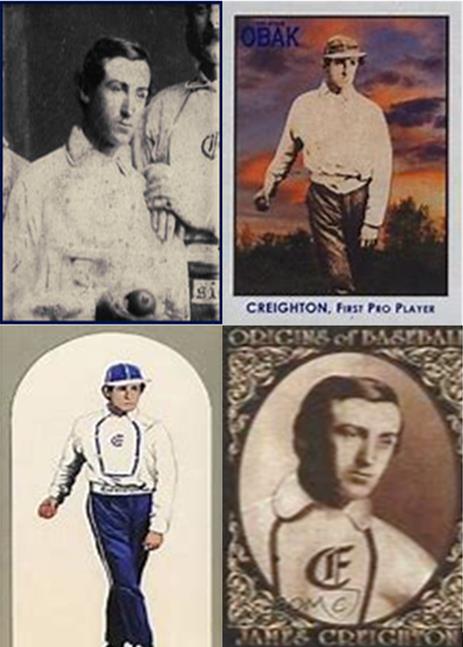
Baseball Trailblazers
Page 415
Jim Creighton
Born on April 15, 1841, Jim Creighton was baseball's first real star and made his pitching debut with the Brooklyn Niagaras at age eighteen in 1859. He would join the Brooklyn Star Club later
Baseball Trailblazers Page 416
that year and then join the Excelsior Club, in 1860, for "under the table inducements." He was probably the first paid player.
On June 30, 1860, the Excelsior Club boarded a train and embarked on the first great baseball tour. They started in upper New York State and on July 2 defeated the Champion Club of Albany, 24–6. On July 3 the Victory Club of Troy fell to the Excelsiors 13–7. They enjoyed a 50–19 victory against the Buffalo Niagaras on July 5. Wins in Rochester, NY and Newburgh, NY followed and the Excelsiors returned to Brooklyn on July 12
to prepare for the Atlantic Base Ball Club. On July 19, some 10,000 fans turned out to watch pitching ace Jim Creighton win easily; 24–4. Afterwards they turned south in response to many invitations and played the Excelsior Club of Baltimore and won 51–6 on July 22. The trip concluded with games in Philadelphia, Maryland and Delaware, with the Excelsiors winning every game.
He inaugurated speed pitching by adding an almost undetectable wrist snap and arm bend to his delivery. From 45 feet away he threw his rising "speedballs" and slow pitches he called "dew drops" to confuse the batter. On November 8, 1860, Creighton would record baseball's first shutout. He was also an excellent hitter, scoring 47 runs in 20 games that same year. During the 1862 season, he was reportedly retired only four times.
Baseball Trailblazers Page 417
On October 18, 1862, playing against the Union Club of Morrisania, NY, Creighton hit a home run. John Chapman, who was on deck, heard something snap during Creighton's swing. After Jim crossed home plate he assured Chapman that his belt had broken. Four days later the Excelsior star was dead having ruptured his spleen or bladder in the process. He had bled to death of internal injuries. He was 21.
Creighton's approach forever changed the essence of the game from a match between hitters and fielders, to a duel between the pitcher and batter.
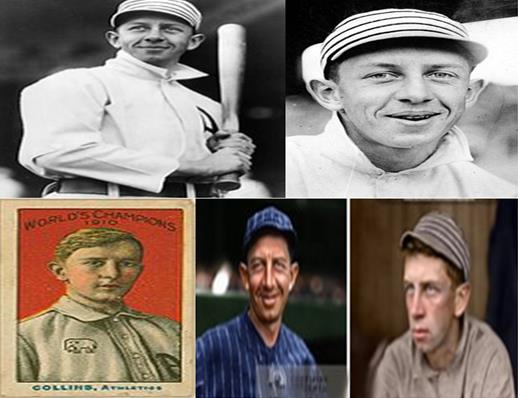
Baseball Trailblazers
Page 418
Eddie Collins
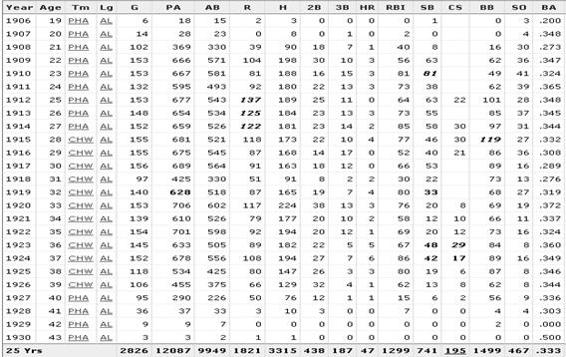
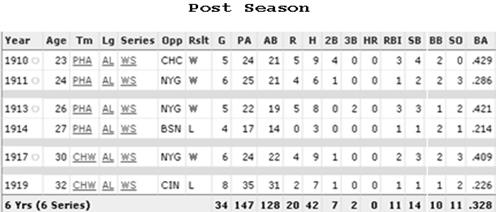
Baseball Trailblazers
Page 419
Edward Trowbridge Collins, May 2, 1887 - March 25, 1951, nicknamed "Cocky," was a professional baseball player, manager
Baseball Trailblazers Page 420
and executive. He played as a second baseman in major league baseball from 1906 to 1930 for the Philadelphia Athletics and Chicago White Sox. A graduate of Columbia University, Collins holds major league career records in several categories and is among the top few players in several other categories. In 1925, Collins became just the sixth person to join the 3,000 hit club, and the last for the next 17 seasons.
Born in Millerton, a 384 acre village in Dutchess County, New York, Collins was unique in his time in that he was focused on both his athletic skills and his education and intelligence. He graduated from Columbia University, where he was a member of Beta Theta Pi fraternity, at a time when few major league players had attended college.
He started his professional baseball career on September 17, 1906, when he signed with the Philadelphia Athletics at the age of 19. When he signed with the Philadelphia organization, Collins was still a student at Columbia. He played some of his initial minor league games under the last name of Sullivan so that he could protect his collegiate status. Collins had lost his collegiate eligibility when it was discovered he played with Plattsburgh and Rutland in the 1906 Northern Independent League.
He then signed with the Athletics and made his major league debut.
Baseball Trailblazers Page 421
After spending all but 14 games of the 1907 season in the minor leagues, he played in 102 games in 1908 and by 1909 was a full time player. That season, he registered a .347 batting average and 67 steals. He would also be named the A's starting second baseman in 1909, a position he would play for the rest of his career, after seeing time at second, third, short, and the outfield the previous two seasons. In 1910, Collins stole a career high 81 bases, the first American League player to steal 80+ bases in a season, and played on the first of his six World Series championship teams.
Collins was renowned for his intelligence, confidence, batting prowess and speed. He is one of only five players to steal six bases in a game, and the only person to do so twice, with both occurrences happening within eleven days, on September 11 and September 22, 1912 respectively. He was part of the Athletics'
"$100,000 infield," and the highest-paid of the quartet, which propelled the team to four American League pennants and three World Series titles between 1910 and 1914. He earned the league's Chalmers Award, early Most Valuable Player recognition, in 1914.
In 1914, the newly formed Federal League disrupted major league contract stability by luring away established stars from the AL
and NL with increased salaries. To retain Collins, Athletics
Baseball Trailblazers Page 422
manager Connie Mack offered his second baseman the longest guaranteed contract; five years; that had ever been offered to a player. Collins declined, and after the 1914 season Mack sold Collins to the White Sox for $50,000, the highest price ever paid for a player up to that point and the first of only three times that a reigning MVP was sold or traded. The Sox paid Collins $15,000 for 1915, making him the third highest paid player in the league, behind Ty Cobb and Tris Speaker.
In Chicago, Collins continued to post top ten batting and stolen base numbers, and he helped the Sox capture pennants in 1917 and 1919. He was part of the notorious "Black Sox" team that threw the 1919 World Series to the Cincinnati Reds. However Collins was not accused of being part of the conspiracy and was considered to have played honestly, his low .226 batting average notwithstanding.
In August 1924, he was named player-manager of the White Sox and held the position through the 1926 season, posting a record of 174-160; .521. HIs two full seasons were the only winning seasons enjoyed by the White Sox from 1921 to 1936.
On June 3, 1925, he collected his 3,000th hit of his career to become the sixth player in major league history to join the 3,000 hit club, doing so for the White Sox off pitcher Rip
Baseball Trailblazers Page 423
Collins of the Detroit Tigers at Navin Field on a single.
Incidentally, this was also the first game in which there were two members of the 3,000 hit club playing in the same game, as Ty Cobb played center field.
Collins returned to Philadelphia to rejoin the Athletics in 1927
as a player-coach. For all intents and purposes, however, his playing career was over. He recorded only 143 games in his last four years, mostly as a pinch hitter. The A's won the World Series in 1929 and 1930, but Collins didn't play in either Series. His last appearance as a player was on August 2, 1930.
Collins finished his career with 1,300 runs batted in. Upon his retirement, he ranked second in major league history in career games - 2,826, walks - 1,499, and stolen bases - 744, third in runs scored - 1,821, fourth in hits - 3,315, and at bats -
9,949, sixth in on base percentage - .424, and eighth in total bases - 4,268. Hhe was also fourth in AL history in triples with 187.
He still holds the major league record of 512 career sacrifice bunts, over 100 more than any other player. He was the first major leaguer in modern history to steal 80 bases in a season, and still shares the major league record of six steals in a game, which he accomplished twice in September 1912. He
Baseball Trailblazers Page 424
regularly batted over .320, retiring with a career average of