

Baseball Trailblazers by Edward Drobinski - HTML preview
Download the book in PDF, ePub, Kindle for a complete version.
812.
Following his dismissal from the Reds, Hornsby worked as a coach for the Chicago Cubs from 1958 to 1960 before becoming a scout and third base coach for the New York Mets in 1962. In 1963, Hornsby died of a heart attack in Chicago, Illinois. He was buried in Hornsby Bend Cemetery near Austin, Texas.
Hornsby is considered to be one of the greatest hitters of all time. His lifetime batting average of .358 is only exceeded by Ty Cobb's career mark of .366, while Hornsby did it with power.
He won seven batting titles in total. He led the National League in slugging percentage nine times, a record that still stands.
He also hit more home runs, drove in more runs, and had a higher batting average than any other National League player during the 1920s.to win the decade Triple Crown. He hit a career total of 301 home runs and was the first player to reach 300 while playing mostly in the National League. Ted Williams, who had the
Baseball Trailblazers Page 224
highest career batting average since Hornsby, said that Hornsby was the greatest hitter for power and average in baseball, and Frankie Frisch said of him; "He's the only guy I know who could hit .350 in the dark." Hornsby is only the second right handed batter in history to hit over .400 three times, and is considered, according to the Los Angeles Times, to be the greatest right handed hitter in history. He led the National League in batting average, on base percentage, slugging percentage, and total bases every year from 1920 to 1925.
Rogers Hornsby was so respected as a hitter that once, when a rookie pitcher complained to umpire Bill Klem that he thought he had thrown Rogers a strike, Klem replied; "Son, when you pitch a strike, Mr. Hornsby will let you know."
Baseball Trailblazers
Page 225
Cy Young
Baseball Trailblazers
Page 226
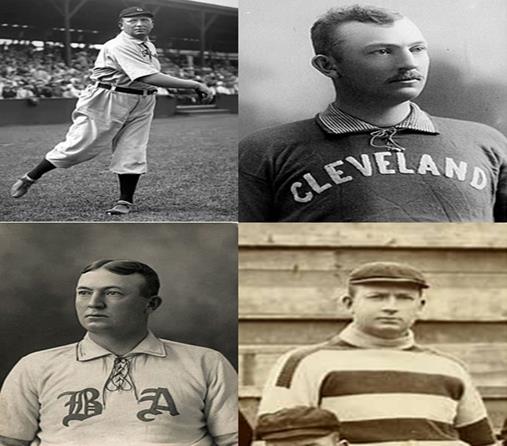
Denton True "Cy" Young, March 29, 1867 – November 4, 1955, was a major league baseball pitcher. Born in Gilmore, Ohio, he worked on his family's farm as a youth before starting his professional baseball career.
Baseball Trailblazers Page 227
Cy Young was the oldest child born to Nancy (Mottmiller) and McKinzie Young, Jr., and was christened Denton True Young. He was of part German descent. The couple had four more children: Jesse Carlton, Alonzo, Ella, and Anthony. When the couple married, McKinzie's father gave him the 54 acres of farm land he owned. Young was born in Gilmore, a tiny farming community located in Washington Township, Tuscarawas County, Ohio.
He was raised on one of the local farms and went by the name Dent Young in his early years. Young was also known as "Farmer Young" and "Farmboy Young." Young stopped his formal education after he completed the sixth grade so he could help out on the family's farm. In 1885, Young moved with his father to Nebraska, and in the summer of 1887, they returned to Gilmore.
Young played for many amateur baseball leagues during his youth, including a semi-professional Carrollton team in 1888. Young pitched and played second base. The first box score known containing the name Young came from that season. In that game, Young played first base and had three hits in three at bats.
After the season, Young received an offer to play for the minor league Canton team, which started Young's professional career.
Young began his professional career in 1889 with the Canton, Ohio, team of the Tri-State League, a professional minor league.
Baseball Trailblazers Page 228
During his tryout, Young impressed the scouts, recalling years later; "I almost tore the boards off the grandstand with my fast ball." Cy Young's nickname came from the fences that he had destroyed using his fastball. The fences looked like a cyclone had hit them. Reporters later shortened the name to "Cy," which became the nickname Young used for the rest of his life. During Young's one year with the Canton team, he won 15 games and lost 15.
In 1890, Young signed with the Cleveland Spiders, a team which had moved from the American Association to the National League the previous year. On August 6, 1890, Young's major league debut, he pitched a three hit, 8–1 victory over the Chicago Colts. While Young was on the Spiders, Chief Zimmer was his catcher more often than any other player.
Early on, Young established himself as one of the harder throwing pitchers in the game. Young continued to perform at a high level during the 1890 season. On the last day of the season, Young won both games of a doubleheader. During the first weeks of Young's career, Cap Anson, the player-manager of the Chicago Colts spotted Young's ability. Anson told Spiders manager Gus Schmelz; "He's too green to do your club much good, but I believe if I taught him what I know, I might make a pitcher out of him in a couple of years. He's not worth it now,
Baseball Trailblazers Page 229
but I'm willing to give you $1,000 for him." Schmelz replied;
"Cap, you can keep your thousand and we'll keep the rube."
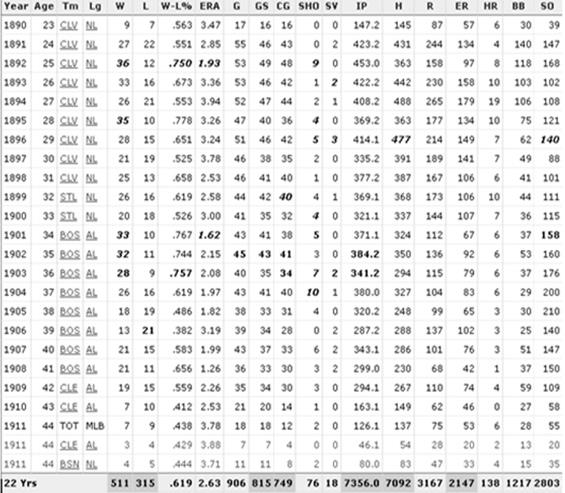
The 1892 regular season was a success for Young, who led the National League in wins with 36, ERA of 1.93, and 9 shutouts.
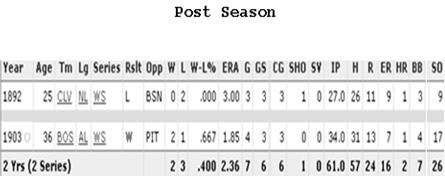
Just as many contemporary minor league baseball leagues operate today, the National League was using a split season format during the 1892 season. The Boston Beaneaters won the first half title, and the Spiders won the second half title, with a best of nine series determining the league champion. Despite the Spiders' second half run, the Beaneaters swept the series, five games to none. Young pitched three complete games in the series, but lost two decisions. He also threw a complete game shutout, but the game ended in a scoreless tie.
The Spiders faced the Baltimore Orioles in the Temple Cup, a precursor to the World Series, in 1895. Young won three games in the series and Cleveland won the Cup, four games to one. It was around this time that Young added what he called a "slow ball"
to his pitching repertoire to reduce stress on his arm. The pitch today is called a changeup.
In 1896, Young lost a no hitter with two outs in the ninth inning when Ed Delahanty of the Philadelphia Phillies hit a single. On September 18, 1897, Young pitched the first no hitter
Baseball Trailblazers Page 230
of his career in a game against the Cincinnati Reds. Although Young did not walk a batter, the Spiders committed four errors while on defense.
Prior to the 1899 season, Frank Robison, the Spiders owner, bought the St. Louis Browns, thus owning two clubs simultaneously. The Browns were renamed the "Perfectos," and restocked with Cleveland talent. Just weeks before the season opener, most of the better Spiders players were transferred to St. Louis, including three future Hall of Famers; Young, Jesse Burkett, and Bobby Wallace. The roster maneuvers failed to create a powerhouse Perfectos team, as St. Louis finished fifth in both 1899 and 1900. Meanwhile, the depleted Spiders lost 134
games, the most in major league baseball history, before folding. Young spent two years with St. Louis, which is where he found his favorite catcher, Lou Criger. The two men were teammates for a decade.
In 1901, the rival American League declared major league status and set about raiding National League rosters. Young left St.
Louis and joined the American League's Boston Americans for a $3,500 contract. Young would remain with the Boston team until 1909. In his first year in the American League, Young was dominant. Pitching to Criger, who had also jumped to Boston, Young led the league in wins, strikeouts, and ERA, thus earning
Baseball Trailblazers Page 231
the AL Triple Crown for pitchers. In February 1902, before the start of the baseball season, Young served as a pitching coach at Harvard University. The sixth grade graduate instructing Harvard students delighted Boston newspapers. The following year, Young coached at Mercer University during the spring. The team went on to win the Georgia state championship in 1903, 1904, and 1905.
The Boston Americans played the Pittsburgh Pirates in the first modern World Series in 1903. Young, who started game one against the visiting Pirates, thus threw the first pitch in modern World Series history. The Pirates scored four runs in that first inning, and Young lost the game. Young performed better in subsequent games, winning his next two starts. He also drove in three runs in Game Five. Young finished the series with a 2–1
record and a 1.85 ERA in four appearances, and Boston defeated Pittsburgh, five games to three.
After one hitting Boston on May 2, 1904, Philadelphia Athletics pitcher Rube Waddell taunted Young to face him so that he could repeat his performance against Boston's ace. Three days later, Young pitched a perfect game against Waddell and the Athletics.
It was the first perfect game in American League history.
Waddell was the 27th and last batter, and when he flied out, Young shouted; "How do you like that, you hayseed?"
Baseball Trailblazers Page 232
Waddell had picked an inauspicious time to issue his challenge.
Young's perfect game was the centerpiece of a pitching streak.
Young set major league records for the most consecutive scoreless innings pitched and the most consecutive innings without allowing a hit. The latter record still stands at 25.1
innings, or 76 hitless batters. Even after allowing a hit, Young's scoreless streak reached a then record 45 shutout innings. Before Young, only two pitchers had thrown perfect games. One year later, on July 4, 1905, Rube Waddell beat Young and the Americans, 4–2, in a 20 inning matchup. Young pitched 13
consecutive scoreless innings before he gave up a pair of unearned runs in the final inning. Young did not walk a batter and was later quoted; "For my part, I think it was the greatest game of ball I ever took part in." In 1907, Young and Waddell faced off in a scoreless 13 inning tie.
In 1908, Young pitched the third no hitter of his career. Three months past his 41st birthday, Cy Young was the oldest pitcher to record a no hitter, a record which would stand 82 years. Only a walk kept Young from his second perfect game. After that runner was caught stealing, no other batter reached base. At this time, Young was the second oldest player in either league.
In another game one month before his no hitter, he allowed just one single while facing 28 batters. On August 13, 1908, the
Baseball Trailblazers Page 233
league celebrated "Cy Young Day." No American League games were played on that day, and a group of All-Stars from the league's other teams gathered in Boston to play against Young and the Red Sox. When the season ended, he posted a 1.26 ERA, which gave him not only the lowest in his career, but also gave him a major league record of being the oldest pitcher with 150+ innings pitched to post a season ERA under 1.50.
Young was traded back to Cleveland, the place where he played over half his career, before the 1909 season, to the Cleveland Naps of the American League. The following season, 1910, he won his 500th career game on July 19 against Washington. He split 1911, his final year, between the Naps and the Boston Rustlers.
On September 22, 1911, Young shut out the Pittsburgh Pirates, 1–
0, for his last career victory.
Young established numerous pitching records, some of which have stood for over a century. Young compiled 511 wins, which is the most in major league history and 94 ahead of Walter Johnson, second on the list. At the time of Young's retirement, Pud Galvin had the second most career wins with 364. In addition to wins, Young still holds the major league records for most career innings pitched - 7,356, most career games started - 815, and most complete games - 749. Young's career record for strikeouts
Baseball Trailblazers Page 234
was broken by Johnson in 1921. Young's 76 career shutouts are fourth all-time.
Young led his league in wins five times, finishing second twice.
His career high was 36 in 1892. He won at least 30 games in a season five times. He had 15 seasons with 20 or more wins, two more than the runners up, Christy Mathewson and Warren Spahn.
Young won two ERA titles during his career, and was three times the runner up. Young's earned run average was below 2.00 six times. He had 40 or more complete games nine times. Young also led his league in strikeouts twice, and in shutouts seven times.
Young led his league in fewest walks per nine innings fourteen times and finished second one season. Only twice in his 22 year career did Young finish lower than 5th in the category. In addition, Young pitched three no hitters, including the third perfect game in baseball history, first in baseball's "modern era."
Young also was an above average hitting pitcher in his career.
He posted a .210 batting average, 623 for 2960, with 325 runs, 18 home runs, 290 RBI and drew 81 bases on balls.
Particularly after his fastball slowed, Young relied upon his control. Young was once quoted as saying; "Some may have thought it was essential to know how to curve a ball before anything
Baseball Trailblazers Page 235
else. Experience, to my mind, teaches to the contrary. Any young player who has good control will become a successful curve pitcher long before the pitcher who is endeavoring to master both curves and control at the same time. The curve is merely an accessory to control." In addition to his exceptional control, Young was also a workhorse who avoided injury, partly due to him being able to pitch in different arm positions; overhand, three-quarters, sidearm and even submarine. For nineteen consecutive years, from 1891 through 1909, Young was in his league's top ten for innings pitched. In fourteen of the seasons, he was in the top five. Not until 1900, a decade into his career, did Young pitch two consecutive incomplete games. By habit, Young restricted his practice throws in spring training. "I figured the old arm had just so many throws in it", said Young, "and there wasn't any use wasting them." Young once described his approach before a game; “I never warmed up ten, fifteen minutes before a game like most pitchers do. I'd loosen up, three, four minutes. Five at the outside. And I never went to the bullpen.
Oh, I'd relieve all right, plenty of times, but I went right from the bench to the box, and I'd take a few warm up pitches and be ready. Then I had good control. I aimed to make the batter hit the ball, and I threw as few pitches as possible.
That's why I was able to work every other day.”
Baseball Trailblazers Page 236
In 1910, it was reported that Young was a vegetarian. Beginning in 1912, Young lived and worked on his farm. In 1913, he served as manager of the Cleveland Green Sox of the Federal League, which at the time was an outlaw league. However, he never worked in baseball after that.
In 1916, he ran for county treasurer in Tuscarawas County, Ohio.
Young's wife, Roba, whom he had known since childhood, died in 1933. After she died, Young tried several jobs, and eventually moved in with friends John and Ruth Benedum and did odd jobs for them. Young took part in many baseball events after his retirement. In 1937, 26 years after he retired from baseball, Young was inducted into the Baseball Hall of Fame.
By 1940, Young's only source of income was stock dividends of $300 per year. On November 4, 1955, Young died on the Benedums'
farm at the age of 88. He was buried in Peoli, Ohio.
Baseball Trailblazers Page 237
AND THEY
DWELT
AMONGST US
Baseball Trailblazers
Page 238
Pud Galvin
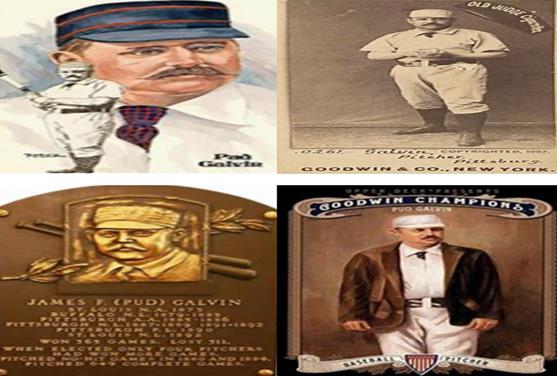
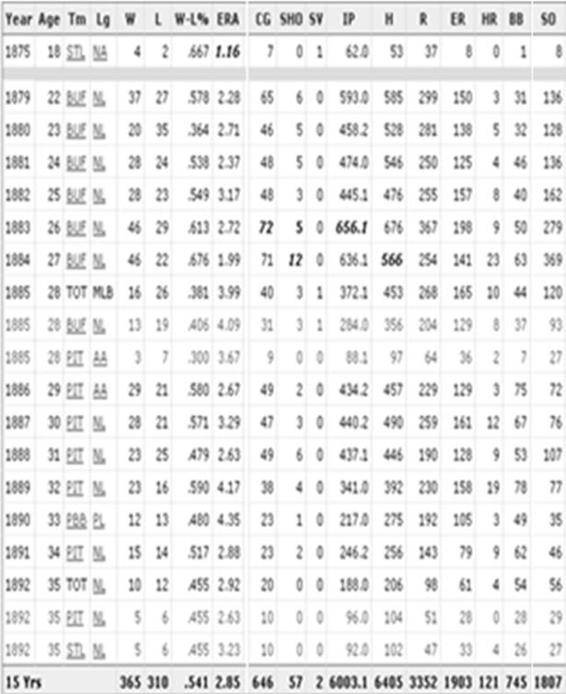
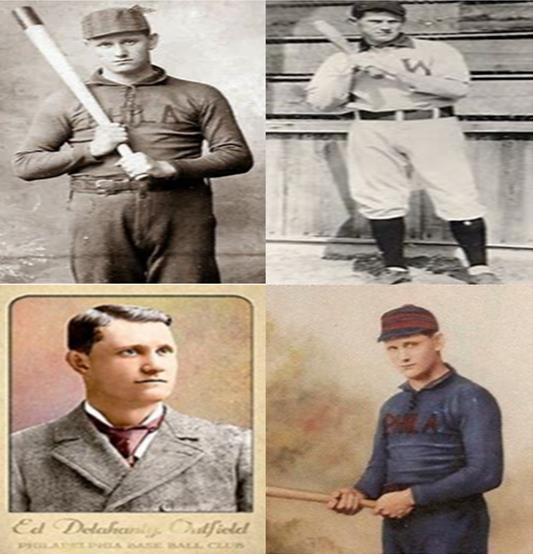
James Francis "Pud" Galvin; December 25, 1856 - March 7, 1902; was major league baseball’s first 300 game winner and pitched the first perfect game after throwing a no hitter earlier that same day. More forgotten than the other old timers’, he was not inducted into the Hall of Fame until 1965.
Baseball Trailblazers
Page 239
Baseball Trailblazers Page 240
Pud Galvin pitched for 15 years during a career that spanned three decades, four major leagues, and countless changes to the rules. He threw the first perfect game on record and was the first pitcher to reach 300 career wins in the major leagues; but his accomplishments came before the existence of the term
“perfect game,” and in an age that had not yet any sense of the significance of the meaning of 300 career victories. And even if some were able to correctly imagine the context to come, they would have been stymied by the fact that there was no source which chronicled baseball player’s exploits.
When the numbers were put together, it became obvious that Galvin’s longevity and durability set him apart, as no other pitcher of his era matched his 6,003 1/3 innings pitched, 705
pitching appearances, 646 complete games, 365 wins, and 310
losses. He was an early practitioner of a highly effective pickoff move, unusual for a right-hander, that baffled baserunners and left opposing captains and managers contesting its legality, Galvin was also arguably the best defender at the position.
James Francis Galvin was born on Christmas Day in 1855 or 1856
in St. Louis, Missouri. He was born to Irish immigrants who lived in the Kerry Patch, a section of the city so named because many of its initial settlers hailed from County Kerry in
Baseball Trailblazers Page 241
southwestern Ireland, an area devastated by the Great Irish Famine of 1845-1849. Inhabitants of the Kerry Patch, located in the northern part of St. Louis, settled the area as squatters since they did not have rights to the land. The district was essentially a concentration of shacks, and was known for particularly tough living conditions and frequent violence. Its inhabitants consisted primarily of laborers, and young James, in preparation for a blue collar life, received training as a steamfitter. However, his life went in a different direction as a result of his ability to play baseball.
Galvin was a star and a fan favorite for his combination of athletic prowess and kind temperament. He was admired for being consistently “cool, collected and self-reliant” on the field, as well as humorous and quick to smile. His three frequently used nicknames reflect these characteristics. He likely was called
“Pud” because of his pudgy physique. He was 5’8” and 190 pounds early and 250 pounds later in his career. He was also called
“The Little Steam Engine” because he was small but powerful, and
“Gentle James” or “Gentle Jeems” for his kind demeanor.
Despite his historic statistics, Galvin was largely forgotten after his death in 1902. He spent his best years in Buffalo and Pittsburg, small markets with poor teams. Unlike several other prominent players, Galvin did not win championships in the major
Baseball Trailblazers Page 242
leagues or play in big markets like New York, Boston, and Chicago, so his achievements were not as well remembered as those of his peers.
His most memorable years, 1883 and 1884, during which he won 92
games, pales under the long shadow of Charles “Old Hoss”
Radbourn’s dominant two year run of pitching, during which he won 108 games, 60 in 1884, the best of that century and any other. Statistics suggest that both moundsmen took 2-3 years to recover from the explosions.
Perhaps the greatest consequence of Galvin’s relative obscurity was an unduly late induction into the Baseball Hall of Fame.
While a few of his equals and many worthy but less accomplished players were elected to the Hall soon after its establishment in 1936, Gentle Jeems was not inducted until 1965.
In contrast to his substantial body, Pud had small hands, which did not allow him to throw a curveball. During a gathering with friends in 1890, attended by a sports reporter, a member of the group showed his hands, damaged playing baseball as a young man.
Galvin responded: “Why, if I was worth $10,000 today, and could spare it, I would give that amount for your hands if an exchange were possible. From the time I went into baseball I have always been handicapped by my hands, which are too small. I never saw
Baseball Trailblazers Page 243
the day yet when I was able to span an ordinary baseball. My fingers are too short to enable me to get grip enough on the ball to pitch a deep curve, so that I have been compelled to depend more on drops, straight balls and the different artifices known to pitchers to deceive the batter.”
Pud could also hit decently, putting up a lifetime .201 batting average, quite high for a pitcher. Early in his career he played the outfield when not pitching.
Galvin’s playing career has an early gap from 1876-78, due to inadequate records available for the leagues. In 1876 he played for the St. Louis Redstockings (probably incorrect) or Brownstockings (baseball mavens have used different names), a team which was part of the “professional” National Association in 1875, though unaffiliated in 1876. No individual records seem to be available, though the Brownstockings are posited to have finished the season with a 45-19, third place win-loss record.
In 1877 Pud played for the Pittsburgh Allegheny Club of the International Association, not considered a major league, though stocked with players who would go on to become major stars in leagues considered major. Individual statistics are unavailable, though it seems to be known that Pud pitched the league’s first
Baseball Trailblazers Page 244
shutout and hit the first home run out of Pittsburgh’s Union Park.
In 1878 he was with the league champion Buffalo Bisons of the same International Association. Partial records available show that he won an unbelievable 72 games, while losing 25; pitching
“at least” 895 innings. If this season alone is added to Galvin’s official record, it brings him to 437-335, .566
lifetime, the win total second only to Cy Young.
After some moves, primarily to San Francisco, Galvin was persuaded to return to the Buffalo Bisons the following season, now a “professional” baseball team. The “Buffalo Express”
celebrated his return with a poem;
“Could we let our pitcher stay
in the Golden City?
Could our boys without him play?
No, ’twould be a pity.
So we pressed our rightful claims
And we won back our Gentle James.”
He went on until 1892, having his next to last 20 win season in 1886 at 23-16. The oddity was that he also has one in his finale, going 20-24 for three different teams in 1892.
Baseball Trailblazers Page 245
By the turn of the century, Galvin and his family were living in poverty. He had married Bridget Griffin in 1878 and had 11
children. Newspapers joked that he had enough children to field his own baseball team. His health declined sharply beginning in late 1901, and on March 7, 1902, at the age of 45, Galvin died in Pittsburgh of “catarrh of the stomach,” also known as chronic stomach inflammation or chronic gastritis. His wife and six of his children survived him.
Galvin was outshined in his era by pitchers who were more dominant for short stretches of time, like Old Hoss Radbourn, or who played on winning teams or in bigger cities, like John Clarkson and Tim Keefe. After his death Galvin was increasingly forgotten as Americans became enamored with pitchers of the Deadball Era like Cy Young, Christy Mathewson, and Walter Johnson. However, at least one fan, M.G. Nowak of Milwaukee, who lived during Galvin’s era, reminded the readers of Sporting Life about Galvin’s accomplishments. In January 1906, while the country was captivated by Christy Mathewson’s three shutouts in the 1905 World Series, Nowak pointed out that Galvin was able to reach similarly legendary heights during that historic series against Detroit in August 1884.
Baseball Trailblazers
Page 246
Ed Delehanty
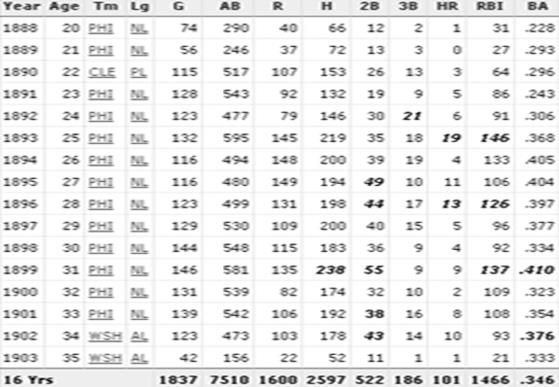
Delahanty batted over .400 three times; along with Rogers Hornsby, the only National Leaguer to accomplish that. He has the fifth highest career batting average in major league baseball history.
Baseball Trailblazers
Page 247
Edward James Delahanty, October 30, 1867 - July 2, 1903, nicknamed "Big Ed" and “The King of Swat,” anticipating Babe Ruth’s Sultanhood, was renowned as one of the game's early power hitters. He was elected to the Baseball Hall of Fame in 1945.
Baseball Trailblazers Page 248
Delahanty died falling into the Niagara River or being swept over Niagara Falls, after being removed from a train while intoxicated.
Delahanty's biographer has argued that baseball for Irish kids was a shortcut to the American dream and to self-indulgent glory and fortune. By the mid-1880s these young Irish men dominated the sport and popularized a style of play that was termed heady, daring, and spontaneous. Delahanty personified the flamboyant, exciting, spectator favorite; the Casey-at-the-bat, Irish slugger; the handsome masculine athlete who is expected to live as large as he played.
A Cleveland, Ohio native, Delahanty attended Cleveland's Central High School and went on to college at St. Joseph's. His baseball career started with the semipro Cleveland Shamrocks.
He began his pro career at age twenty on May 22, 1888, with the Philadelphia Phillies in the National League, playing 74 games that season and finishing with a .228 average; a depth to which he would never again return. The next year, in 56 games, he raised his average to .293.
Delahanty blossomed in 1893 with a .368 average, 19 home runs, and 146 RBI. He narrowly missed the Triple Crown, as Billy Hamilton led the league in batting average with .380. For four
Baseball Trailblazers Page 249
seasons from 1890 to 1893, Big Ed led the Phillies to first division finishes, though the team never won a pennant. Between 1894 and 1896 Delahanty compiled astonishing batting marks;
.407, 4 HR, 131 RBI; .404, 11 HR, 106 RBI; .397, 13 HR, 126 RBI.
On July 13, 1896, Delahanty became the second player to hit four home runs in a game. Two of them were hit into the bleachers while the other two were inside the park. In 1899, Delahanty hit four doubles in the same game. The same year Delahanty collected hits in ten consecutive at bats. He tallied six hit games in 1890 and 1894.
After switching to the new American League in 1902, Delahanty played for the Washington Senators, hitting at a .376 mark.
After the 1902 season, Delahanty commented to a reporter; "I know I am getting along in years and won't be able to last much longer in first class baseball. Therefore I am going to get all the money there is in sight.” He returned to the Senators for the 1903 season. He was hitting .333 that year until the incident at Niagara Falls.
Nearing 34 years of age at the conclusion of the 1901 campaign, in which he batted .354 with 108 RBI for the Phillies, Delahanty decided to seek higher pay and better treatment with the rival American League. During the final two months of the 1901 season,
Baseball Trailblazers Page 250
reports circulated that Delahanty had become an agent for the upstart league, selling his fellow players on the merits of the new circuit. He signed a $4000 contract with the Washington Senators, including a $1000 signing bonus.
Despite his continued on field success, by the end of the 1902
season Delahanty’s personal life was beginning to unravel, as his wife became ill, and Delahanty squandered the couple’s financial resources by gambling on horses and binge drinking.
Looking to pay off his mounting debts, Delahanty signed a three year contract with the New York Giants of the National League, reported at either $6000 or $8000 per season. The deal also included an advance on his salary of $4000.
However, the contract was never fulfilled. Prior to the 1903
season, the leagues agreed to honor each other’s contracts, with the result that Delahanty’s deal with the Giants was declared void and the rights to his contract were returned to Washington.
Even worse news for Delahanty, he was ordered to pay back the $4000 advance he had already received. For a man suddenly on the brink of personal and financial ruin, it was the worst possible outcome. A few days prior to the start of the 1903 season, an accommodation was reached in which Washington agreed to pay the $4000 he owed New York, but in return, $2000 per year would be deducted from the slugger’s salary in 1903 and 1904. Even after
Baseball Trailblazers Page 251
reporting, however, Delahanty continued to seek opportunities to jump from the Senators, including a dalliance with Denver of the Western League which never came to fruition.
Delahanty died when he was swept over Niagara Falls in early July 1903. He was apparently kicked off a train by the train's conductor for being drunk and disorderly. The conductor said Delahanty was brandishing a straight razor and threatening passengers after he consumed five whiskies. After being kicked off the train, Delahanty started his way across the International Railway Bridge connecting Buffalo, New York with Fort Erie (near Niagara Falls) and fell or jumped off the bridge. Some accounts say Delahanty was yelling about death that night. His body was found at the bottom of Niagara Falls two weeks after his death.
In the 21st century, stories with less substance had become entertaining, believed conspiracy theories.
Towards the end of his life, John McGraw was asked how the players of the 1920s and 1930s compared to the players of his era. "Ed Delahanty was as great a hitter as I have ever seen,"
was his reply.
Baseball Trailblazers
Page 252
Rube Waddell
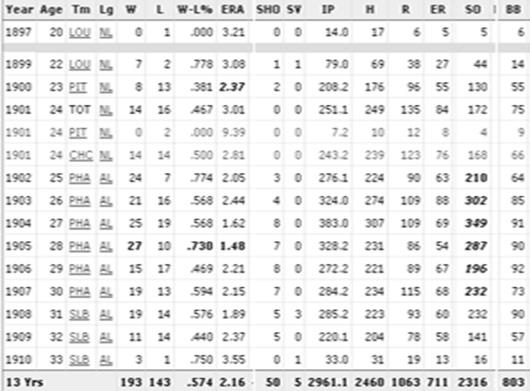
Most dominant American League pitcher from 1902-1908.
Struck out unbelievable numbers when most hitters were just trying to make contact.
Baseball Trailblazers
Page 253
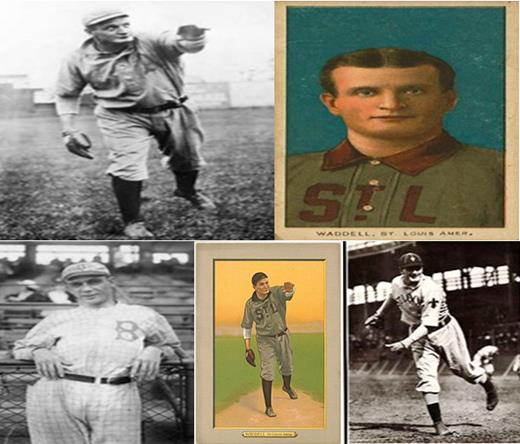
George Edward Waddell, October 13, 1876 - April 1, 1914, is best remembered for his highly eccentric behavior, and for being a remarkably dominant strikeout pitcher in an era when batters mostly slapped at the ball to get singles. He had an excellent
Baseball Trailblazers Page 254
fastball, a sharp breaking curveball, a screwball, and superb control. He led the major leagues in strikeouts for six consecutive years.
Waddell was born just outside Bradford, Pennsylvania and grew up in the countryside. When three he wandered over to a fire station and stayed there for several days. He did not attend school very often. He worked on mining and drilling sites as a youngster, which helped his conditioning.
Waddell's career wound through a number of teams. He was notably unpredictable. He once left in the middle of a game to go fishing. He also had a longstanding fascination with fire trucks and ran off the field to chase after them during games on multiple occasions. Once when scheduled to pitch, he was found under the stands playing marbles with kids. He would disappear for months at a time during the offseason, and it was not known where he went until it was discovered that he was wrestling alligators in a circus. He was easily distracted by opposing fans who held up puppies, which caused him to run over to play with them, and shiny objects, which seemed to put him in a trance. An alcoholic for much of his short life, his eccentric behavior led to constant battles with his managers and scuffles with teammates.
Baseball Trailblazers Page 255
In his prime, Waddell was the game's premier power pitcher, with 302 strikeouts in 1903, 115 more than runner up Bill Donovan.
According to baseball historian Lee Allen in The American League Story, Waddell began the 1903 season sleeping in a firehouse at Camden, New Jersey, and ended it tending bar in a saloon in Wheeling, West Virginia. In between those events, he won 22
games for the Philadelphia Athletics, toured the nation in a vaudeville play called “The Stain of Guilt,” courted, married, and became separated from May Wynne Skinner of Lynn, Massachusetts, saved a woman from drowning, accidentally shot a friend through the hand, and was bitten by a lion.
Waddell followed that season with 349 strikeouts in 1904, the modern era season record for more than 60 years, 110 more than runner-up Jack Chesbro. No other pitcher compiled consecutive 300 strikeout seasons until Sandy Koufax in 1965 and 1966.
In 1905 Waddell won the Triple Crown for pitching. He finished with a 27-10 win-loss record, 287 strikeouts, and a 1.48 earned run average. Waddell also gained more fame for saving the lives of people inside a department store when he picked up a burning oil stove that had overturned and carried it out of the building before it could explode and start a fire.
Baseball Trailblazers Page 256
Waddell's drinking problem was exacerbated by a horrific marriage to May Wynne Skinner, his second of three wives, and a series of injuries in 1905 and 1906. Ken Burns' exemplary documentary “Baseball” claimed Waddell had even lost track of how many women he had married. In time, his alcohol use began to erode his relationships with his Athletics teammates.
Waddell's increasingly erratic behavior included an incident in which he got into a fist fight on a cross country train after making fun of a teammate's straw hat. Complaints from teammates forced Mack to send Waddell to the St. Louis Browns for $5,000
in early 1908 despite his continuing success. Recent commentators have suggested that Waddell suffered from various mental conditions. Though eccentric and childlike, Waddell was not illiterate, and many of his antics could be now seen as brave, selfless heroism and natural self-promotion.
He set the league record for strikeouts in a game with 16 in 1908. Further drinking and marital problems with his third wife, Madge Maguire, plagued Waddell. He passed out in the middle of a game against New York in 1909. These incidents led to his release in 1910. He finished the season pitching with Joe McGinnity for Newark in the Eastern League and never played another major league game.
Baseball Trailblazers Page 257
Waddell's pitching repertoire usually consisted of only two pitches; one of the fastest fastballs in the league and a hard curve. However, he had command of many more pitches, including slow curves, screwballs, "fadeaways," and even a "flutterball."
Connie Mack once said that Waddell's curve was "even better than his speed. He had the fastest and deepest curve I've ever seen".
Waddell enjoyed waving his teammates off the field and then striking out the side. He actually did so only in exhibition games, since official baseball rules prohibit playing with fewer than nine men on the field in regulation play. But in a league game in Detroit, Waddell actually had his outfielders come in close and sit down on the grass to watch him strike out the side.
After his major league career was over, Waddell pitched for parts of three more years in the minor leagues. By that time, however, his health had declined to such an extent that he no longer resembled the muscular, long limbed hero of the prior decade. While in spring training with the Millers, Waddell helped save the city of Hickman, Kentucky, from a devastating flood in the spring of 1912. Catching pneumonia, he lost much of the vitality that had sustained him, and a second flood in Hickman and another ensuing case of pneumonia in 1913 took the rest. That same year, while in Minneapolis, he was diagnosed
Baseball Trailblazers Page 258
with tuberculosis and moved to live with his sister in San Antonio, Texas. His health never recovered, and he was placed in a sanitarium in nearby Elmendorf until he died at the age of 37
on April 1, 1914.
Baseball Trailblazers
Page 259
Wee Willie Keeler
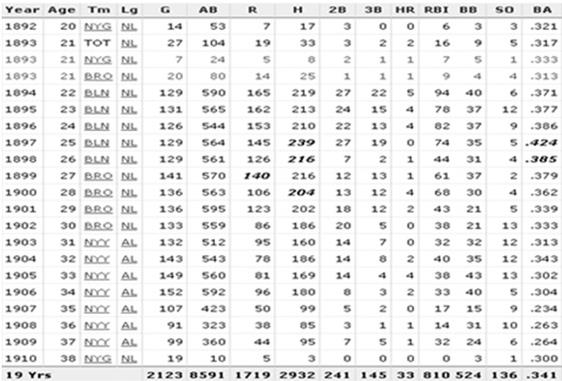
“Hit ‘em where they ain’t,” .341 lifetime, invented the Baltimore chop.
Baseball Trailblazers
Page 260
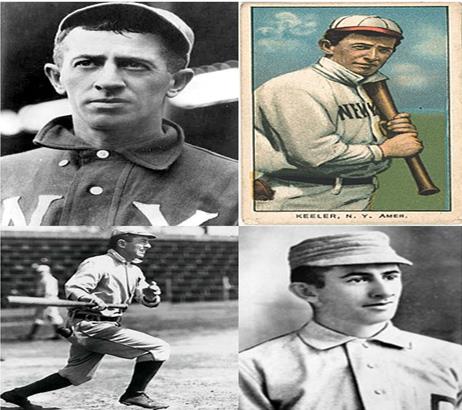
William Henry Keeler, March 3, 1872 - January 1, 1923, was nicknamed "Wee Willie." He was one of the smallest players to play the game, standing 5 feet 4 inches and weighing 140 pounds.
One of the greatest contact hitters of all time and notoriously hard to strike out, Keeler has the highest career at bats to
Baseball Trailblazers Page 261
strikeout ratio in major league history. Throughout his career, on average he went more than 60 at bats between individual strikeouts.
William Henry O'Kelleher (later changed to Keeler), Jr. was born in Brooklyn, New York, the son of William O'Kelleher, Sr., a trolley switch man. He played baseball from an early age, and as a freshman served as captain of his high school team. He quit school the following year, and played semiprofessional baseball in the New York City area.
In 1892, after beginning the season playing his second year with the Plainfield Crescent Cities of the Central New Jersey League, he joined the minor league team in Binghamton, New York, and he was called up to the New York Giants at the end of the season.
After a trip back to the minors because of an injury at the start of the 1893 season, he returned to the Giants later that year. Initially a third baseman, he later moved to the outfield.
He quickly established himself as a star, and played until retiring in 1910.
With Ned Hanlon's Baltimore Orioles, he perfected the "Baltimore chop", in which he would chop the ball into the ground hard enough to cause a high bounce, which enabled him to reach first base before a fielder could glove the ball and throw him out. He
Baseball Trailblazers Page 262
was instrumental in introducing the hit and run strategy to the original Orioles and teammate John McGraw.
In forming the powerful original Baltimore Orioles of the late 19th century, manager Ned Hanlon was given an ownership stake in the team and a free rein to form his team. In one of the most one sided trades in baseball history, Hanlon obtained Dan Brouthers and Keeler from Brooklyn in exchange for Billy Shindle and George Treadway. Keeler and six of his teammates from the Orioles were eventually inducted into the Hall of Fame.
In 1897, Keeler had a 44 game hitting streak to start the season, breaking the previous single season record of 42. Keeler had a hit in his final game of the 1896 season, giving him a National League record 45 game hitting streak, not surpassed until Joe DiMaggio in 1941, who had a 56 game hitting streak. No other player in baseball has ever matched this feat. Keeler also had eight consecutive seasons with 200 hits or more, a record not broken until Ichiro Suzuki in 2009.
After his retirement, Keeler was a scout and coach for the Superbas and the Boston Braves, as well as Brooklyn's Federal League team, the Tip-Tops. He was wealthy after retiring as a player, having invested in mining companies, real estate, and other ventures. His real estate lost value in the post-World War
Baseball Trailblazers Page 263
I economic recession, and by the time of his death, his brothers and he had to sell their childhood home.
Keeler suffered from tuberculosis and endocarditis for the last five years of his life. By late 1922, his condition had worsened and whether he would live into the new year was doubtful.
Seriously ill by New Year's Eve, he heard bells and sirens in the streets when the new year arrived. Keeler sat up and said to his brother, "You see, the new year is here and so am I -still."
He enjoyed a drink and a smoke, then said that he was ready for a long sleep. A short time later, Keeler died. He was 50.
Baseball Trailblazers
Page 264
Dan Brouthers
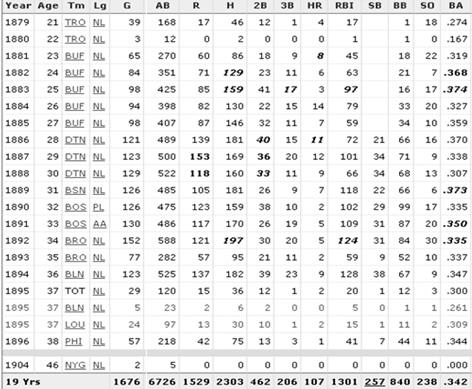
Five time batting champion - 1882, 1883, 1889, 1891, 1892; two time NL home run leader - 1881, 1886; two time NL RBI leader -
1883, 1892.
Baseball Trailblazers
Page 265
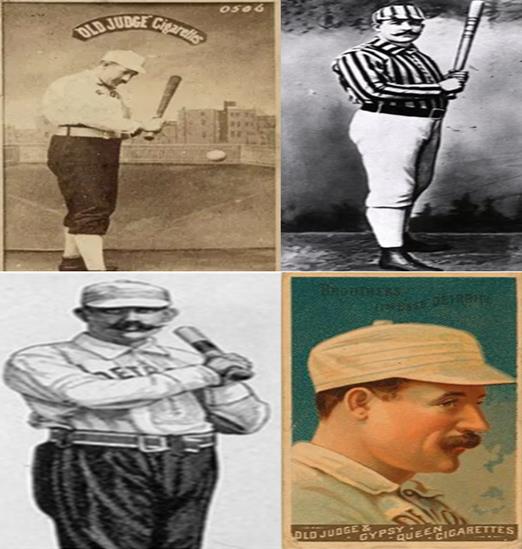
Dennis Joseph "Dan" Brouthers, May 8, 1858 - August 2, 1932, was nicknamed "Big Dan" for his size. He was 6 feet 2 inches and weighed 207 pounds, which was large by 19th century standards.
Recognized as the first great slugger in baseball history, he held the record for career home runs for a short time from 1887
Baseball Trailblazers Page 266
to 1889. His career slugging percentage of .519 remained a major league record until Ty Cobb edged ahead of him in 1922.
A dominant hitter during the prime of his career, he led or was in the top of the league in most offensive categories, including batting average, runs scored, runs batted in, on base percentage and hits. He led the league in batting average five times, the most by a 19th century player, and his career .342 batting average still ranks ninth all-time.
Brouthers was born in Sylvan Lake, New York, to Michael and Annie Brooder, Catholic immigrants from Ireland. Upon arriving in New York, Michael Brooder had been recruited to Dutchess County to work in open pit iron mines in the town of Beekman.
The spelling of the family's name gradually shifted from Brooder to Bruder to Brouthers by 1880. The family eventually moved to the nearby hamlet of Fishkill Plains before settling in the village of Wappingers Falls where Michael found safer work at a textile printing mill.
Brouthers played organized baseball from the time that he was a child; from playing in the local sandlots to the semiprofessional league in Wappingers Falls. Brouthers made his major league debut at age 21, for the Troy Trojans. He didn’t do particularly well and was released the following year.
Baseball Trailblazers Page 267
Brouthers got his first chance to be an everyday player in 1881, when he was signed by the Buffalo Bisons. This time he hit well and quickly established himself as a baseball force majeure.
At the end of the 1885 season, Buffalo was going through financial trouble and were forced to sell off their players. So Brouthers went to the Detroit Wolverines of the NL. In 1886, his first season in Detroit, he again led the league in slugging percentage, the sixth year in a row, and led the league in total bases and doubles and claimed his first home run title. On September 10, 1886, Brouthers hit three home runs‚ along with a double and a single, to set the since broken NL record.
Detroit’s falling attendance numbers, forced the club to fold at 1888’s season end. Brouthers was then purchased by the Boston Beaneaters of the NL.
In 1889, his only season with the Beaneaters, he batted a league-leading .373, along with 105 runs scored and 118 runs batted in. He struck out only six times. After the season, he along with many Major League players, jumped to the Players'
League, a league established by the Brotherhood (a player’s union) which competed against the two other Major Leagues already in existence. Brouthers signed with the Boston Reds, and batted .330 while leading the league in on base percentage and
Baseball Trailblazers Page 268
slugging. The Reds, behind the talents of Brouthers, Harry Stovey, Hardy Richardson, Charles Radbourn and player-manager King Kelly, finished in first place.
The Players' League lasted just that one season, and the Reds were merged into the American Association, carrying many of the championship team's previous players. Again, the team won the league's championship, and Brouthers led the league in batting average, on base percentage, and slugging.
After the American Association folded following the 1891 season, Brouthers was sent to the Brooklyn Grooms of the NL. Despite continuing to hit well, perhaps age and injuries were becoming a factor, as he spent his last four years playing in a limited capacity, quitting the major leagues after age 38 when he batted