

Baseball Trailblazers by Edward Drobinski - HTML preview
Download the book in PDF, ePub, Kindle for a complete version.
Baseball Trailblazers
Page 538
Candy Cummings
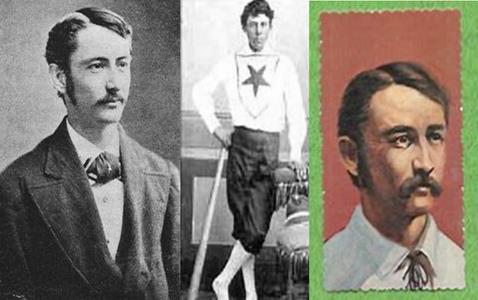
William Arthur "Candy" Cummings, October 18, 1848 - May 16, 1924, was a professional baseball pitcher in the National Association and National League. Cummings is widely credited with inventing the curveball.
Baseball Trailblazers Page 539
Cummings was born in Ware, Massachusetts. He later said that he thought of the idea of the curveball when fooling around with clam shells as a teenager in Ware. At the age of 17, Cummings made his baseball debut in the National Association of Base Ball Players with the Excelsior baseball club of Brooklyn. His first game with the team was on August 14, 1866, against the New York Mutuals. Ten days later he led his team to a 24-2 win against the Newark Eurekas. After the latter game, baseball writer Henry Chadwick commented on the skills of the young Cummings and his promising future with the Excelsior club. Cummings played for the Excelsiors next season and continued as the main pitcher for the Stars of Brooklyn from 1868 to 1871. His pitching skills led to his being called "Candy," a popular 19th century nickname for a man who was the best at his craft.
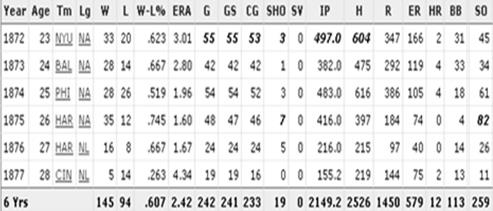
Cummings, who stood 5'9" and weighed 120 pounds, compiled a 145-94 career record and 2.49 earned run average while playing for five different teams from 1872 to 1877. Between 1872 and 1875, Cummings pitched in the National Association with the New York Mutuals, Baltimore Canaries, Philadelphia White Stockings and Hartford Dark Blues. Cummings won between 28 and 35 games in each of his NA seasons. He spent two seasons in the National League, earning a 16-8 win-loss record with Hartford when the league began in 1876 and a 5-14 record with Cincinnati the next
Baseball Trailblazers Page 540
year. Among other records, Cummings was the first player to record two complete games in one day; September 9, 1876 when he beat the Cincinnati Reds twice, 14-4 and 8-4.
Cummings left the NL after pitching only 19 games with the Cincinnati Reds to become the President of the new International Association for Professional Base Ball Players.
After baseball, Cummings received a small royalty from the invention of a railway coupling device. He owned a paint and wallpaper shop in Athol, Massachusetts. Cummings died in Toledo, Ohio.
Baseball Trailblazers
Page 541
Sam Thompson
Baseball Trailblazers
Page 542
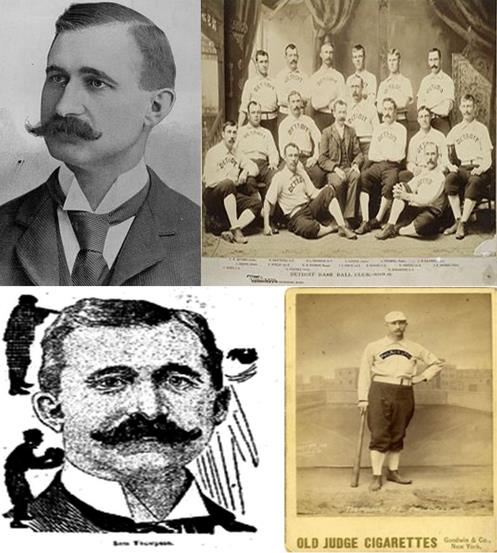
Samuel Luther "Big Sam" Thompson, March 5, 1860 – November 7, 1922, was a professional baseball player from 1884 to 1898 and made a brief comeback in 1906. At 6 feet, 2 inches, the Indiana native was one of the larger players of his day and was known for his prominent handlebar mustache. He played as a right fielder in major league baseball for the Detroit Wolverines, Philadelphia Phillies, and Detroit Tigers.
Baseball Trailblazers Page 543
Thompson was born in Danville, Indiana. He was the fifth of eleven children born to Jesse and Rebecca Thompson. He was educated at the Danville Graded School. After reaching adulthood, Thompson became employed as a carpenter in Danville.
He and five of his brothers also played on a local baseball team known as the Danville Browns.
In July 1884, Thompson began his professional baseball career at age 24, playing for the Evansville, Indiana, team in the Northwestern League. A scout for Evansville travelled to Danville and was referred to "Big Sam", who was working on a roof in Stinesville. Thompson was initially reluctant to give up his carpentry career and travel 150 miles to Evansville, but he ultimately agreed to give it a try. Unfortunately, the league folded in early August 1884, after only five games. In those five games at Evansville, Thompson compiled a .391 batting average.
Thompson signed with the Indianapolis Hoosiers of the newly formed Western League in 1885. He compiled a .321 average in 30
games. He was approached by a Union Association team and offered more money, but in a show of "steadfastness to his word,"
Thompson refused the offer and remained with Indianapolis at a pay of $100 per month. The Hoosiers were the dominant team in the Western League, compiling an .880 winning percentage.
Baseball Trailblazers Page 544
In mid-June 1885, the Western League disbanded, and a mad rush developed to sign the players on the Indianapolis roster, a lineup that included Thompson, Deacon McGuire, Sam Crane, Chub Collins, Jim Donnelly, Mox McQuery, Gene Moriarty, and Dan Casey.
Thompson later told the colorful story of his acquisition by Detroit. Detroit sent two representatives, Marsh and Maloney, to Indianapolis, principally to sign the Hoosiers' battery of Larry McKeon and Jim Keenan. The Wolverines were outbid by the Cincinnati Reds for McKeon and Keenan but wound up with the Hoosiers' manager Bill Watkins and the rest of the team's starting lineup. The only catch was that a 10 day waiting period would allow other teams to outbid Detroit. Marsh and Maloney promptly sent the players to Detroit and quartered them in a hotel there. The next morning, the players were told that the team had arranged a fishing trip for them. The players boarded the steamship Annette and enjoyed the first day and night of successful fishing. After three days, the players became suspicious, but the ship captain laughed when asked when they would return to Detroit. As the players became mutinous on the sixth day, the captain admitted he had been ordered to keep them
"out at sea" for 10 days. In another account, Thompson described his 10 days aboard the Annette as follows; "We were prisoners,
Baseball Trailblazers Page 545
but well cared for prisoners. Anything in the line of creature comforts you could find packed away on ice. We lived on the best in the market, and spent the rest of the time in fishing and playing poker, chips having very thoughtfully been provided. On the night of the tenth day, at midnight, we were all taken ashore where Watkins met us and signed us to our contracts."
The players were only later presented with their accumulated mail which included scores of offers from other clubs. A writer in the Detroit Free Press later noted; "Detroit magnates showed some inside baseball brains and great finessing in sending the players away from all tempters for that period when they belonged to no club."
Regardless of the trickery by Detroit, Thompson considered Detroit to be a mecca. He recalled his first time in 1885
viewing Woodward Avenue with Indianapolis teammate Mox McQuery.
They gazed with "open-mouth amazement" at the "wondrous pavements," having never seen a street as "clean and smooth as a table."
Thompson joined the Wolverines lineup in early July. In his first plate appearance, he had a hit off New York Giants' Hall of Fame pitcher Tim Keefe. The Wolverines were in last place when Thompson joined the club, but won 12 of their first 13
Baseball Trailblazers Page 546
games after Thompson took over in right field. Thompson compiled a .303 batting average in 63 games. Despite playing only the second half of his rookie season, Thompson ranked among the National League leaders with seven home runs and nine triples.
Displaying a strong arm that would be one of the main features of his defensive game, Thompson also ranked fifth in the league with 24 outfield assists.
In 1886, team owner Frederick K. Stearns made a big splash when he purchased the Buffalo infield that had become known as the
"Big Four," consisting of Dan Brouthers, Hardy Richardson, Jack Rowe, and Deacon White. In addition, Detroit pitcher Lady Baldwin won 42 games in 1886, a major league record for a left handed pitcher. The 1886 season was Thompson's first full season in the majors, and made a major contribution, compiling a .310
batting average with 101 runs scored, 13 triples, and eight home runs in 122 games. His 89 runs batted in ranked third in the National League. His defensive statistics continued to impress as well. The 1886 Wolverines compiled an impressive 87–36
record, a .707 winning percentage, but lost the National League pennant, finishing 2½ games behind the Chicago White Stockings.
Thompson had his breakout season in 1887 when he won the National League batting crown with a .372 batting average, and he set a major league record with 166 RBIs. Thompson also led
Baseball Trailblazers Page 547
the league in hits - 203, triples - 23, slugging percentage -
.565, total bases - 308, and at bats - 545. On May 7, 1887, Thompson became the first player in major league history to hit two triples with the bases loaded in the same game. The 1887
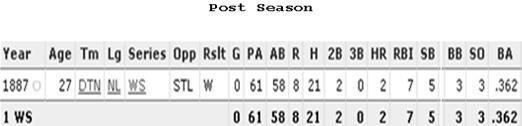
Detroit Wolverines featured four future Hall of Fame inductees; Thompson, Dan Brouthers, Deacon White, and Ned Hanlon; and won the National League pennant with a 79-45 record. The Wolverines then went on to defeat the St. Louis Browns of the American Association in a 15 game World Series challenge. Thompson played in all 15 games of the World Series and led all hitters with a
.362 average, two home runs, seven RBIs and a .621 slugging percentage.
During the 1888 season, Thompson was sidelined with a sore arm during most of the season and appeared in only 56 games. His batting average declined by 90 points to .282, and the fortunes of the entire 1888 Detroit team followed suit. The team finished in fifth place with a 68-63 record. With high salaries owed to the team's star players, and gate receipts declining markedly, the team folded in October 1888 season with the players being sold to other teams.
On October 16, 1888, Thompson was purchased from the Wolverines by the Philadelphia Quakers, known as the Philadelphia Phillies beginning in 1890, for $5,000 cash. In his first season with
Baseball Trailblazers Page 548
Philadelphia, Thompson hit .296 and led the National League with a career high 20 home runs. Thompson improved his batting average to .313 in 1890 and led the league in both hits - 172
and doubles – 41. Thompson's batting average dipped slightly in in 1891, but he bounced back in 1892 to .305. In each of his first four seasons with the Phillies, Thompson finished among the league leaders in total bases and RBIs. He also tallied a career high 32 outfield assists to lead the National League in 1891. The Phillies were a good, but not great team, during Thompson's first four years in Philadelphia, finishing in fourth place in 1889, 1891 and 1892, and in third place in 1890.
From 1893 to 1895, Thompson hit his stride with the Phillies.
During those three years, he hit .390 and averaged 207 hits, 125
runs, 146 RBIs, 21 triples, and 24 stolen bases. And he compiled those numbers while striking out an average of only 14 times per season. Despite Thompson's contributions, the Phillies were unable to compete for the National League pennant, finishing in fourth place in 1893 and 1894 and in third place in 1895.
Thompson's 1893 totals included a league leading 222 hits and 37
doubles. After the 1893 season, Thompson vowed not to return to Philadelphia in protest over the owners' penny pinching ways and the team's inability to compete for a pennant. In October 1893, Thompson announced; "I shall not play again in Philadelphia, and
Baseball Trailblazers Page 549
I told Harry Wright it would be a waste of time for him to write to me about signing. The cheese paring methods of the management have been the causes leading to my resolution. The management has made a barrel of money, but they grind the players into the dirt." Thompson finally agreed in March 1894 to return to the Phillies, after management agreed to improve travel accommodations.
In 1894, Thompson was part of the only all .400-hitting outfield of all time. All four Philadelphia outfielders ended the season with a batting average better than .400; Tuck Turner at .416, Thompson and Ed Delahanty at .407, and Billy Hamilton at .404.
Thompson missed a month from the 1894 season with an injury to the little finger on his left hand. Doctors determined that the smaller bones in the finger were dead, and portions of the finger were surgically removed in mid-May. Despite the injury and partial amputation, and being limited to only 102 games, Thompson compiled that .407 batting average with a career high 28 triples and a league leading 147 RBIs. His 1894 ratio of 1.44
RBIs per game remains the all-time major league record. Also, his 28 triples was the second highest total in major league history up to that time and remains the fifth highest of all time. Thompson also led the National League with a career high
.696 slugging percentage.
Baseball Trailblazers Page 550
In 1895, Thompson compiled a .392 batting average with 211 hits in 119 games and led the National League in slugging percentage, total bases, extra base hits, home runs, and RBIs. His average of 1.39 RBIs per game in 1895 remains second in major league history; trailing only Thompson's own 1.44 ratio in 1894.
Thompson also continued to perform well defensively with 31
outfield assists, second most in the league.
At age 36, Thompson played his last full season of professional baseball in 1896. His average dipped to .298, but he still managed to collect 100 RBIs. Thompson's throwing remained strong as he turned in one of the finest defensive performances of his career. Despite appearing in only 119 games in the outfield, he led the league in outfield fielding percentage, outfield assists, and double plays. One sports writer noted that, even at age 38, Thompson "possessed an arm that the fastest sprinters in the big league had a lot of respect for." As a team, however, the Phillies fell to eighth place in the National League with a 62-68 record.
In 1897, at age 37, Thompson was sidelined by pain and appeared in only three games. Some accounts suggest that Thompson's absence from the lineup may have also been the result of his not getting along with Philadelphia's new manager George
Baseball Trailblazers Page 551
Stallings.[27] Without Thompson, the 1897 Phillies dropped to 10th place with a 55-77 record.
Before the 1898 season began, Thompson gave an interview in which he questioned the Phillies chances to compete in 1898;
"What are the Phillies' chances this season? Six clubs, Cincinnati Baltimore, Boston, New York, Cleveland and Brooklyn are bound to beat them, and they will have to fight hard to lead the second division, and I very much doubt if they can do that."
Though his loyalty to the Phillies was questioned, Thompson did return in 1898 and was batting .349 with 15 RBIs, five doubles, three triples, a home run after 14 games. However, Thompson opted to leave the team in May 1898 and return to his home in Detroit. His sudden retirement has been attributed to a
"combination of homesickness and chronic back pain." Other accounts indicate that continued tension with manager Stallings contributed to Thompson's decision to retire.
Late in the 1906 baseball season, Thompson briefly returned to the major leagues as a player for the Detroit Tigers. With starting outfielders Ty Cobb and Davy Jones out of the Tigers lineup with injuries, Thompson volunteered to fill in. At age 46, Thompson had remained active, playing baseball for the Detroit Athletic Club and other local teams. Accordingly, in late August and early September 1906, he took his old place in
Baseball Trailblazers Page 552
right field for Detroit. Thompson's return to baseball led to an increase in attendance, as "the stands and bleachers were full of special Thompson delegations." After getting a hit and two RBIs in his first game, he totaled seven hits, four runs, three RBIs and a triple in eight games with the Tigers. Detroit sports writer Paul H. Bruske noted that Thompson was still able to throw the ball from deep right field to the plate "on a line"
and that he still had "a lot of speed on the bases."
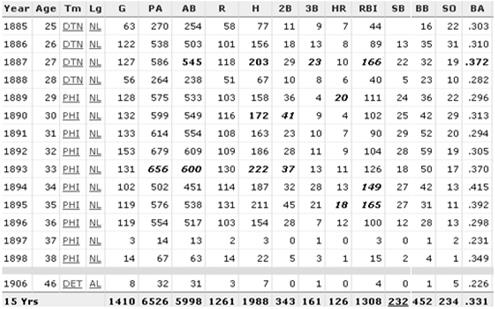
In 15 major league seasons, Thompson compiled a .331 batting average with 1,988 hits, 343 doubles, 161 triples, 126 home runs, 1,305 RBIs, and 232 stolen bases. He was inducted into the Baseball Hall of Fame in 1974.
Thompson was one of the most prolific run producers in baseball history. His career RBI to games played ratio of .923 remains the highest in major league history. Thompson still holds the major league record for most RBIs in a single month with 61 in August 1894 while playing for the Phillies.
Thompson was also one of the best power hitters of the era before Babe Ruth. At the end of the 19th century, Thompson's 126
career home runs ranked second only to Roger Connor.
Defensively, Thompson still ranks among the all-time major league leaders with 61 double plays from the outfield and 283
Baseball Trailblazers Page 553
outfield assists. Thompson has also been credited by baseball historians with perfecting "the art of throwing the ball to the plate on one bounce, which catchers found easier to handle than the usual throw on the fly." Bill Watkins, who managed Thompson in Detroit, recalled; "He was a fine fielder and had a cannon arm and will live in my memory as the greatest natural hitter of all time."
Thompson was married in 1888 to Ida Morasha of Detroit. They had no children and made their home in Detroit until Thompson's death. After retiring from baseball, Thompson invested in real estate and was financially comfortable in his later years. He was appointed a US Deputy Marshall during World War I and also worked as the crier in the courtroom of US District Court Judge Arthur J. Tuttle. He was "well known" and a "well liked" figure at the federal building in Detroit.
Thompson died in 1922 at age 62. He had a heart attack while serving as an election inspector on November 7 and was stricken again later in the morning after being taken to his home located at 6468 Trumbull Avenue in Detroit.
Baseball Trailblazers
Page 554
Old Hoss Radbourn
Baseball Trailblazers
Page 555
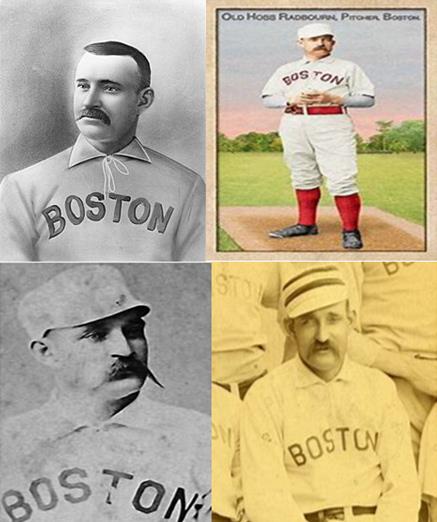
Charles Gardner Radbourn, December 11, 1854 - February 5, 1897, nicknamed "Old Hoss," was a professional baseball pitcher who played 12 seasons for five teams in major league baseball.
Radbourn was born in Rochester, New York, the second of eight children to Charles and Caroline (Gardner) Radbourn. Charles Radbourn (the elder) had immigrated to the United States from
Baseball Trailblazers Page 556
Bristol, England, to find work as a butcher; Caroline followed soon after.
In 1855, the Radbourn family moved to Bloomington, Illinois, where Radbourn was raised. As a teenager, Radbourn worked as a butcher with his father, and as a brakeman for the Indiana, Bloomington and Western Railway company.
In 1878, Radbourn joined the Peoria Reds, a barnstorming team, as their right fielder and "change pitcher." No substitutions were allowed at the time so if the starting pitcher became ineffective in the late innings the change pitcher, usually playing right field, would exchange positions with the starter to try to save the game. In 1879 he signed with Dubuque in the newly formed Northwest League. Radbourn made the major leagues in 1880 as second baseman, right fielder and change pitcher for the Buffalo Bisons of the National League. He played in six games, batted .143, and never pitched an inning, but practiced so hard he developed a sore shoulder and was released. When he recovered, he pitched for a pick-up Bloomington team in an exhibition game against the Providence Grays. He impressed everyone so much that Providence signed him on the spot for a salary of $1,100.
Baseball Trailblazers Page 557
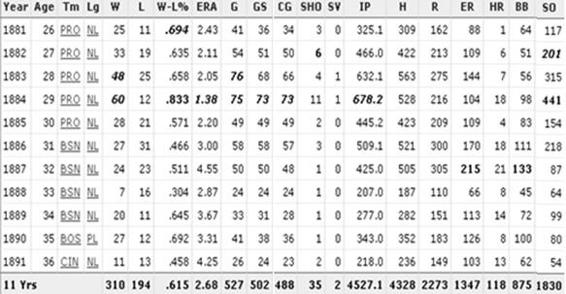
During Radbourn's first season with the Grays in 1881, he split pitching duties with John Montgomery Ward. Radbourn pitched 325
innings and compiled a win-loss record of 25-11. He became the team's primary pitcher in 1882, pitching 466 innings and going 33-19 with a 2.11 earned run average. He led the NL with 201
strikeouts and six shutouts and was second best in wins and ERA.
In 1883, he pitched 632 innings and led the league in wins, going 48-25. His 2.05 ERA and 315 strikeouts both ranked second in the NL. He pitched a no hitter on July 25.
When Providence failed to win the pennant in 1883, the franchise was on shaky financial ground. Ownership brought in a new manager, Frank Bancroft, and made it plain; win the pennant or the team would be disbanded.
Early in the season, Radbourn shared pitching duties with Charlie Sweeney. Radbourn, who had a reputation for being vain, became jealous as Sweeney began to have more success, and the tension eventually broke out into violence in the clubhouse.
Radbourn was faulted as the initiator of the fight and was suspended without pay after a poor outing on July 16, having been accused of deliberately losing the game by lobbing soft pitches over the plate. But on July 22, Sweeney had been drinking before the start of the game and continued drinking in the dugout between innings. Despite being obviously intoxicated,
Baseball Trailblazers Page 558
Sweeney managed to make it to the seventh inning with a 6-2
lead. When Bancroft attempted to relieve him with the change pitcher, Sweeney verbally abused him before being ejected and storming out of the park, leaving Providence with only eight players. With only two players to cover the three outfield positions, the Grays lost the lead, then lost the game.
Afterward, Sweeney was kicked off the Grays, and this left the team in a state of disarray with the consensus view that the team should be disbanded. At that point, Radbourn offered to start every game for the rest of the season, having pitched in 76 of 98 games the season before, in exchange for a small raise and exemption from the reserve clause for the next season. From that point, July 23 to September 24 when the pennant was clinched, Providence played 43 games and Radbourn started 40 of them and won 36. Soon, pitching every other day as he was, his arm became so sore he couldn't raise it to comb his hair. On game day he was at the ballpark hours before the start, getting warmed up. He began his warm up by throwing just a few feet, increasing the distance gradually until he was pitching from second base and finally from short center field.
Radbourn finished the season with a league leading 678 innings pitched and 73 complete games, and he won the Pitcher’s Triple Crown with a record of 60-12, a 1.38 earned run average, and 441
Baseball Trailblazers Page 559
strikeouts. His 60 wins in a season is a record which is expected never to be broken. Also, his 678 innings pitched stands at second all-time, behind only Will White, 680 in 1879, for a single season.
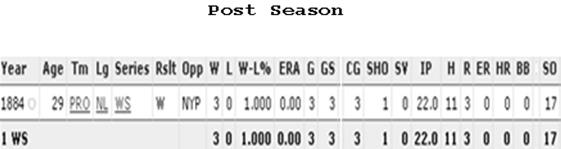
After the regular season ended, the NL champion Grays played the American Association champion New York Metropolitans in the 1884
World Series. Radbourn started each game of the series and won all three, while allowing just three unearned runs.
Radbourn pitched effectively in the majors for several more years but was not able to duplicate his success of 1883 and 1884. In 1885, he pitched 445 innings and went 28-21. The Grays folded after the season, and the roster was transferred to NL
control.
Radbourn was claimed by Boston, and he spent the next four seasons with the club, winning 27, 24, 7, and 20 games. He then jumped to the rebel Players' League and spent 1890 with its Boston club and, after the PL folded, played the 1891 season with Cincinnati where he recorded his 300th victory before retiring. Radbourn's career record was 310-194, with an earned run average of 2.68, and strikeouts totaling 1,830.
After retiring from baseball, Radbourn opened up a successful billiard parlor and saloon in Bloomington, Illinois. He was
Baseball Trailblazers Page 560
seriously injured in a hunting accident soon after retirement, in which he lost an eye, and spent most of his remaining years shut up in a back room of the saloon, apparently too ashamed to be seen after the injury. He died in Bloomington in 1897.
Radbourn is also known for being the first person photographed gesturing the middle finger. In 1886, an image was captured of him "flipping off" a member of the New York Giants in a team photo.
Baseball Trailblazers
Page 561
Billy Hamilton
Baseball Trailblazers
Page 562
William Robert Hamilton, February 16, 1866 - December 15, 1940, nicknamed “Sliding Billy,” was a professional baseball player in major league baseball during the 19th century, playing for the Kansas City Cowboys, Philadelphia Phillies and Boston Beaneaters between 1888 and 1901.
Hamilton was born in Newark, New Jersey. His parents, Samuel and Mary Hamilton, had emigrated to New Jersey from Ireland. When Hamilton was a small child, his family moved to Clinton, Massachusetts. He worked in a Clinton cotton mill as a young teenager.
Hamilton broke into the major leagues in the American Association with the Kansas City Cowboys in 1888. He established
Baseball Trailblazers Page 563
himself as a star the following season by batting .301 with 144
runs and 111 stolen bases. In 1890, the Cowboys, who were ceasing operations, sold Hamilton to the Philadelphia Phillies.
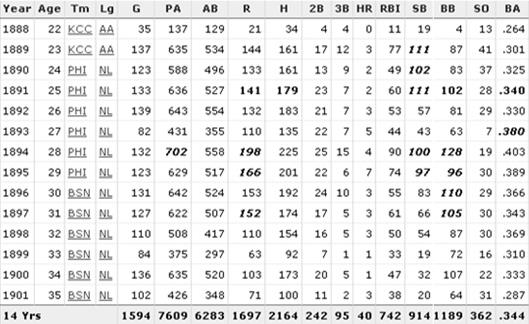
The next year he led the NL in batting average - .340, runs scored – 141, and hits - 179. For a third consecutive season, Hamilton led the NL in stolen bases. He hit .380 in 1893, which led the major leagues.
In 1894 Hamilton set the all-time standard for most runs scored in a season with 198. He also set the record for most stolen bases in one game, with seven on August 31, 1894. He set the record for most consecutive games scoring one or more runs, with 35 runs in 24 games in July-August 1894.
Hamilton led the league in steals for a fifth time in 1895. In 1896, Hamilton moved to Boston, for whom he played his final six seasons. Although his numbers declined, Hamilton still scored over 100 runs in all but two of those seasons.
Hamilton retired after the 1901 season. Over his career he compiled 914 stolen bases, a .344 batting average and 1697 runs in 1594 games. He is one of only three players to average more than a run per game played. His .455 career on base percentage ranks fourth all-time behind Ted Williams, Babe Ruth and John McGraw, and his 914 stolen bases ranks third. Hamilton won the
Baseball Trailblazers Page 564
National League batting title twice and led the NL in stolen bases five times, eclipsing 100 on four occasions. He hit over
.400 in 1894 and set the major league record for runs scored in a season with 198 in 132 games, which equates to an unbelievable 244 for a 162 game season.
After his playing days ended, Hamilton managed several minor league teams in Pennsylvania and Massachusetts and served as a scout with the Boston Nationals. Hamilton died on December 15, 1940, at his home at 6 Lucian Street in Worcester, Massachusetts. He was survived by his wife Rebecca (Carr) Hamilton, four daughters and two grandchildren. He was inducted into the Baseball Hall of Fame in 1961.
Baseball Trailblazers
Page 565
Eddie Plank
Baseball Trailblazers
Page 566
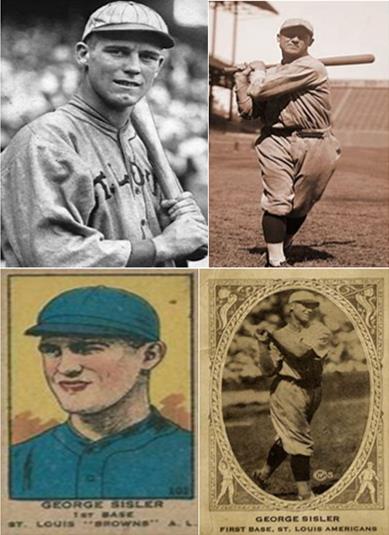
Edward Stewart Plank, August 31, 1875 - February 24, 1926, nicknamed "Gettysburg Eddie," was a professional baseball pitcher. Plank played in major league baseball for the Philadelphia Athletics from 1901 through 1914, the St. Louis Terriers in 1915, and the St. Louis Browns in 1916 and 1917.
Plank grew up on a farm near Gettysburg, Pennsylvania. He was the fourth of seven children born to Martha McCreary and David
Baseball Trailblazers Page 567
Plank. His father was a school director and tax collector. Plank did not play baseball until the age of 17, when he started playing for local teams in the Gettysburg area. He practiced pitching by throwing a baseball against his barn door, drawing lectures from his father for all the dents he left. When Plank was about 22, Frank Foreman, the pitching coach at Gettysburg College, asked him to try out for the school's baseball team.
In 1900, Plank signed with the Richmond Colts of the Virginia League, a minor league. The league folded before Plank could pitch for the Colts. However, next May, Foreman recommended Plank to Connie Mack, the manager of the Philadelphia Athletics, who liked what he saw and signed Plank to a contract.
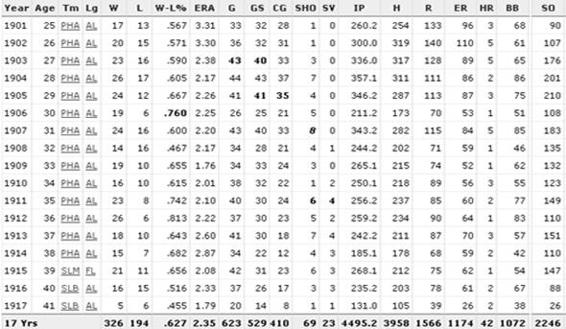
Plank made his major league debut for the Athletics on May 13, 1901. As a rookie, Plank pitched well, posting a 17-13 win-loss record with a 3.31 earned run average, and 28 complete games in 32 games started. He won 20 games for the first time in his career in 1902, posting a 20-15 record and a 3.30 ERA as the Athletics won the American League pennant. Only Rube Waddell won more games that year for the Athletics. He won 23 games in 1903
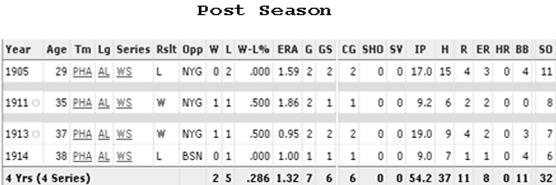
while leading the AL in games started. In 1905, Plank made his first trip to the World Series. He faced Christy Mathewson in the first game and Joe McGinnity in the fourth game. Though Plank gave up only three runs in 17 innings during the series,
Baseball Trailblazers Page 568
the Athletics lost to the New York Giants in five games and did not score an earned run in the entire series. The Athletics returned to the World Series in 1910, but Plank was forced to sit out with a sore arm.
By 1911, Plank was the last member of the Athletics remaining from the 1901 team. The 1911 team made the World Series and faced the Giants again. After Plank won game two and lost in a relief appearance in game five, the Athletics won the series in six games. In 1913, the Athletics and Giants met again in the World Series, and Plank faced Mathewson in games two and five.
Mathewson hit a tenth inning single off of Plank to set up a Giants victory in game two, but Plank and the Athletics bested Mathewson 3-1 in the fifth and deciding game of the series. In 1914, Plank's final year with Philadelphia, he went to the World Series again. Plank pitched a complete game in game two, but he lost 1-0 and the Boston Braves won the series in four games.
During his tenure in Philadelphia, Plank was one of the most consistent pitchers in the game, winning over 20 games seven times. In the four World Series in which he played, Plank earned a 1.32 ERA but only a 2-5 win-loss record. As Plank was one of the best pitchers on the Athletics, Mack would usually match him up against Christy Mathewson, another Hall of Famer, when the Athletics played the Giants in the World Series. Plank pitched
Baseball Trailblazers Page 569
complete games in all six of his World Series starts. His quiet personality led to him getting overshadowed in media coverage by other Athletics pitchers such as Hall of Famers Waddell and Chief Bender, but Plank would win more games than either of these.
In November 1914, it was rumored that Plank would be sold to the New York Highlanders. In December, Plank signed a contract to play in the Federal League. Mack expressed no regret at Plank's departure, saying; "I wish him the best of luck. I was through with him. He was after the money. He was a wonderful pitcher and he is a good one yet." He played for the outlaw league's St.
Louis Terriers and won 21 games, the eighth and final time he reached the 20 win plateau.
When the Federal League folded, Plank applied for free agency but was declared to belong to the St. Louis Browns for 1916. In September of that year, Plank predicted that he might be able to pitch ten more seasons, saying; "I don't know whether it is that I have more on the ball this season than I had in other years, but at any rate I feel that I have just as much stuff as I ever did." However, by June 1917 newspapers reported that Plank's career was nearly over. He had struggled with arm problems and had left the team at one point due to a nervous breakdown. He retired in October 1917, citing stomach difficulties brought on
Baseball Trailblazers Page 570
by the stress of baseball. His final game was a 1-0 11-inning complete game loss to Walter Johnson and the Washington Senators on August 6, 1917. Despite his announcement, the New York Yankees traded pitchers Urban Shocker and Nick Cullop, infielders Fritz Maisel and Joe Gedeon, catcher Les Nunamaker, and cash to the Browns for Plank and Del Pratt. Plank refused to report to New York, insisting he was retired.
Over his career, Plank amassed a 326-194 record, a 2.35 ERA, and 2,246 strikeouts. He won 305 games in the American League, making him that league's winningest left handed pitcher. He was the winningest left hander in baseball history until 1962. In addition, he was the winningest pitcher, left or right handed, in the AL until 1921, when he was surpassed by Walter Johnson.
Plank was known as a finesse pitcher with a good sidearm sweeping curveball. His best known pitch was nicknamed the
"cross-fire." Thrown across his body, it reached home plate at an angle, making it difficult for hitters to track, especially if they were left handed. Plank was active on the mound before he threw a pitch, even sometimes talking to the baseball before he delivered it. This strange behavior helped to unnerve opposing hitters. His consistent performance and strong work ethic led Mack to use him frequently, part of the reason Plank at times developed sore arms during his career. Plank was also
Baseball Trailblazers Page 571
known for his long pauses on the mound, which some claimed lengthened the duration of the games in which he pitched.
Plank married Anna (née Myers) in 1915. They had a son, named Edward Stewart Plank Jr. Friendly by nature, Plank did the unusual by taking time to mentor the rookie pitchers on the Athletics' staff, and he befriended Louis Van Zelst, a hunchback who served as the team's mascot.
After retirement, Plank opened a Buick dealership in Gettysburg.
He pitched the 1918 season for the Steelton club of the Bethlehem Steel League, an industrial baseball league. Steelton was only 40 miles from his home and the arrangement allowed him to manage his business during the week.
Plank did not ever seem to be in ill health after his career, but on February 22, 1936, his wife awoke to discover her husband paralyzed on the left side due to a stroke and suffering garbled speech. Upon arriving at the Plank home, the family physician and Plank's wife decided he should be left where he was for treatment, rather than moved to a hospital. The pitcher showed signs of recovery briefly, then started having bouts of lost consciousness. He lost the ability to speak, and by the 24th, no one expected him to recover. He died at 2:49 PM that day.
Baseball Trailblazers Page 572
In 1943, former teammate Eddie Collins remembered Plank as the greatest pitcher in baseball. "Not the fastest. Not the trickiest, and not the possessor of the most stuff, but just the greatest," Collins said. Babe Ruth thought he was the hardest pitcher to hit, and Ty Cobb selected him to his all-time team.
He was inducted into the Baseball Hall of Fame in 1946.
Baseball Trailblazers
Page 573
George Sisler
Baseball Trailblazers
Page 574
George Harold Sisler, March 24, 1893 - March 26, 1973, nicknamed
"Gorgeous George," was a professional baseball first baseman and player-manager. He played in major league baseball for the St.
Louis Browns, Washington Senators and Boston Braves. He managed the Browns from 1924 through 1926.
Sisler was born in the unincorporated hamlet of Manchester, now part of the city of New Franklin, a suburb of Akron, Ohio. His paternal ancestors were immigrants from Northern Germany in the middle of the 19th century. Manchester did not have a high school and when it was time for George to start. So he moved to
Baseball Trailblazers Page 575
Akron to live with his older brother so that he could attend school there. Sisler was an athletic student and played baseball, basketball and football in high school, but was more focused on baseball. In 1910, when Sisler was a high school senior, his brother Efbert died of tuberculosis, but Sisler was able to move in with a local family and finish school.
In 1911, Sisler signed a contract with the Pittsburgh Pirates to play minor league baseball in the Ohio-Pennsylvania League, but he never played in the league or earned any money[, and instead played college ball for the University of Michigan. As a freshman pitcher, Sisler struck out 20 batters in seven innings during a 1912 game. He lettered in baseball from 1913 to 1915.
At Michigan he played for coach Branch Rickey while earning a degree in mechanical engineering. After he graduated from Michigan, Sisler sought legal advice from Rickey about the status of his contract with Pittsburgh. The three time “Vanity Fair” All-American had become highly sought after by major league scouts. Rickey talked to Pittsburgh owner Barney Dreyfuss about releasing Sisler from the contract he had signed as a minor, but Dreyfuss maintained his claim to Sisler. Rickey wrote to the National Commission, baseball's governing body, who ruled that the contract was illegal. Rickey, now managing the St.
Louis Browns, signed Sisler to a contract worth $7,400.
Baseball Trailblazers Page 576
On June 28, 1915, Sisler made his major league debut, entering as a pitcher in relief against the Chicago White Sox. He pitched three scoreless innings and struck out two batters. While at the plate he collected his first major league hit. A few days later, on July 3, he pitched a complete game victory in his first major league start, in which he struck out nine batters but also walked nine. It was after this start that Rickey decided to transition Sisler to first base. On August 29, Sisler defeated Walter Johnson in a complete game 2-1 victory. In 1916 Sisler transitioned fully to first base and played the position for 141
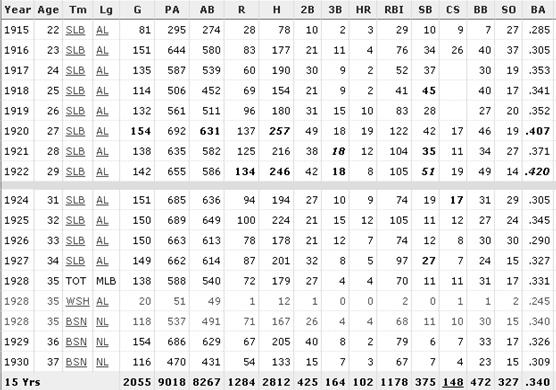
games. His .305 batting average led the team, as did his hits.
On August 11, 1917, in the second game of a doubleheader against the Philadelphia Athletics, Sisler recorded three hits in four at bats. Over the next 26 games he would record at least one hit and bat .422 throughout his 26 game hit streak. Sisler led the team in most offensive categories and his .353 batting average was second in the American League, behind Ty Cobb. The Selective Service Act of 1917 was passed in May 1917, and with it, the draft was enacted in the offseason. Sisler's teammates Urban Shocker and Ken Williams were assigned Class 1 in the draft, placing them at the top of the draft eligibility list. Williams would play only two games in the 1918 season before being drafted. Sisler was listed as Class 4 much further down on the
Baseball Trailblazers Page 577
list. He then enlisted in the army, joining several major league players in a Chemical Warfare Service unit commanded by Rickey.
In 1918 he played in only 114 games but was able to steal 45
bases, which led the league, and placed third in the American league with a .341 batting average. Sisler was preparing to go overseas when World War I ended that November.
In 1920, Sisler played every inning of each game. He stole 42
bases, second in the American League, collected a major league leading 257 hits for an average of .407 and ended the season by hitting .442 in August and .448 in September. In breaking Ty Cobb's 1911 record for hits in a single season, Sisler established a mark which stood until 2004. Sisler finished second in the AL in doubles and triples, as well as second to Babe Ruth in RBIs and home runs. Sisler's record was largely overshadowed by Ruth's 54 record obliterating home runs that season.
As his popularity increased, Sisler drew comparisons to Cobb, Ruth and Tris Speaker. Sisler, however, was much more reserved than those three stars. Writer Floyd Bell described Sisler as
"modest, almost to a point of bashfulness, as far from egotism as a blushing debutante. Shift the conversation to Sisler himself and he becomes a clam."
Baseball Trailblazers Page 578
In 1922, Sisler hit safely in 41 consecutive games, an American League record that stood until Joe DiMaggio broke it in 1941.
His .420 batting average is the third highest of the 20th century, surpassed only by Nap Lajoie's .426 in 1901 and Rogers Hornsby's .424 in 1924. Sisler also led the AL in hits - 246, runs - 134, stolen bases - 51, and triples - 18. He was chosen as the AL's Most Valuable Player that year, the first year an official league award was given, as the Browns finished second to the New York Yankees. Sisler's 1922 season is considered by many historians to be among the best individual all-around, single season performances in baseball history.
A severe attack of sinusitis caused him double vision in 1923, forcing him to miss the entire season. He defied some predictions by returning in 1924 with a batting average over
.300. Sisler later said; "I planned to get back in uniform for 1924. I just had to meet a ball with a good swing again, and then run. The doctors all said I'd never play again, but when you're fighting for something that actually keeps you alive; well, the human will is all you need." Sisler never regained his previous level of play, though he continued to hit over .300 in six of his last seven seasons and led the AL in stolen bases for a fourth time in 1927.
Baseball Trailblazers Page 579
In 1928, the Browns sold Sisler's contract to the Washington Senators, who in turn sold the contract to the Boston Braves in May. After batting .340, .326, and .309 in his three years in Boston, he ended his major league career with the Braves in 1930, and then played in the minor leagues.
Sisler accumulated a .340 lifetime batting average over his 16
years in the majors and stole 375 bases during his career. He had 200+ hits in six seasons. He hit over .300 thirteen times, including two seasons in which he hit over .400. He stole over 25 bases in every year from 1916 through 1922, peaking with 51
the last year and leading the league three times. Sisler holds team records for the St. Louis Browns, and now the Orioles, for career batting average, triples, and stolen bases, as well as batting average, on base percentage, hits, and total bases in a season. In 1939, Sisler became one of the first entrants elected to the Baseball Hall of Fame. He also posted a career pitching record of 5-6 with a 2.35 earned run average in 24 career appearances. He defeated Walter Johnson twice in complete game victories.
After his playing career, Sisler reunited with Rickey as a special assignment scout and front office aide with the St.
Louis Cardinals, Brooklyn Dodgers and Pittsburgh Pirates. Sisler
Baseball Trailblazers Page 580
and Rickey worked with future Hall of Famer Duke Snider to teach the young Dodgers hitter to accurately judge the strike zone.
Sisler also spent some time as commissioner of the National Baseball Congress. He died in Richmond Heights, Missouri, in 1973, while still employed as a scout for the Pirates.
Baseball Trailblazers
Page 581
Three Finger Brown
Baseball Trailblazers
Page 582
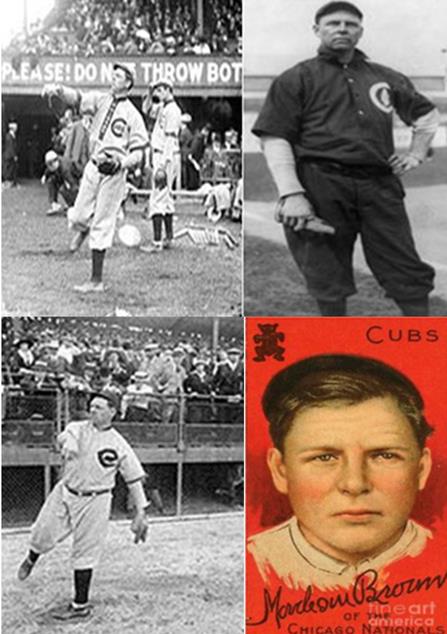
Mordecai Peter Centennial Brown, October 19, 1876 - February 14, 1948, nicknamed Three Finger Brown or Miner, having worked in western Indiana coal mines for a while, was a major league baseball pitcher during the first two decades of the 20th century. Due to a farm machinery accident in his youth, April 17, 1888, Brown lost parts of two fingers on his right hand, and in the process gained a colorful nickname. He turned this
Baseball Trailblazers Page 583
handicap into an advantage by learning how to grip a baseball in a way that resulted in an exceptional curveball, or knuckle curve, which broke radically before reaching the plate. With this technique he became one of the elite pitchers of his era.
Brown was born in Nyesville, Indiana. To fans and friends he was probably best known as "Brownie." To his relatives and close friends, he was also known as "Mort." His three part given name came from the names of his uncle, his father, and the United States Centennial year of his birth, respectively.
He suffered two separate injuries to his right hand. The first and more famous trauma came when he was feeding material into the farm's feed chopper. He slipped and his hand was mangled by the knives, severing much of his index finger and damaging the others. A doctor repaired the rest of his hand as best he could.
While it was still healing, the injury was further aggravated by a fall he took, which broke several finger bones. They were not reset properly, especially the middle finger He learned to pitch, as many children did, by aiming rocks at knot holes on the barn wall and other wooden surfaces. Over time, with constant practice, he developed great control. As a
"bonus," the manner in which he had to grip the ball resulted in an unusual amount of spin. The extra topspin made it difficult
Baseball Trailblazers Page 584
for batters to connect solidly. In short, he "threw ground balls" and was exceptionally effective.
Brown was a third baseman in semipro baseball in 1898 when his team's pitcher failed to appear for a game and Brown was put in to pitch. Players in the league quickly noticed the spin and movement created by Brown's unusual grip. Fred Massey, Brown's great nephew, said; "It didn't only curve, it curved and dropped at the same time. It made it extremely hard to hit and if you did hit it, you hit it into the ground because you couldn't get under it." After a spectacular minor league career commencing in Terre Haute of the Three-I League in 1901, Brown came to the majors rather late, at age 26, in 1903, and lasted until 1916
when he was close to 40.
Brown's most productive period was when he played for the Chicago Cubs from 1904 through 1912. During this stretch, he won 20 or more games six times and was part of two World Series championships. New York Giants manager John McGraw regarded his own Christy Mathewson and Brown as the two best pitchers in the National League. In fact, Brown defeated Mathewson in competition as often as not, most significantly in the final regular season game of the 1908 season. Brown had a career 13-11
edge on Mathewson, with one no decision in their 25 pitching matchups.
Baseball Trailblazers Page 585
Brown's most important single game effort was the pennant deciding contest between the Cubs and the New York Giants on October 8, 1908, at New York. With Mathewson starting for the Giants, Cubs starter Jack Pfiester got off to a weak start and was quickly relieved by Brown, who held the Giants in check the rest of the way as the Cubs prevailed 4-2, to win the pennant.
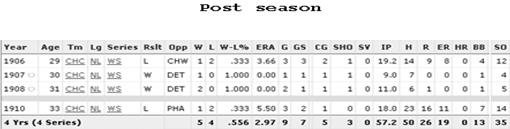
The Cubs then went on to win their second consecutive World Series championship.
In late 1909, Brown was on a team that played some games in Cuba. He planned to spend the winter there, but returned home when he caught a mysterious sickness. Brown saw limited action in 1912 and was released by the Cubs in October, a week before he turned 36. Soon after, he consulted a physician about a minor illness. Examining Brown's knee, the physician advised Brown to retire from baseball because he risked losing the use of his leg. However, Brown continued to play, signing with the Louisville Colonels, who traded him to the Cincinnati Reds for the 1913 season.
After the 1913 season, Brown jumped to the Federal League, signing his contract on the same day as Joe Tinker. While Tinker went to the Chicago Whales, Brown was the player-manager for the St. Louis Terriers in 1914. Brown was dismissed as manager in August, then finished the season with the Brooklyn Tip-Tops, and
Baseball Trailblazers Page 586
was rumored to retire again in October 1914. He stayed in the league and played for the Chicago Whales in 1915. He returned to the Cubs for his final season in 1916. Brown and Mathewson wrapped their respective careers by squaring off on September 4, 1916, in the second game of a Labor Day doubleheader. The game was billed as the final meeting between the two old baseball warriors, and would turn out to be the final game in each of their careers. The game was a high scoring one, the two teams combining for 33 hits. But with both teams well back in the pennant race, the two men pitched the entire game. Mathewson's Reds prevailed 10-8 over Brown's Cubs, as the Cubs' ninth inning rally fell short.
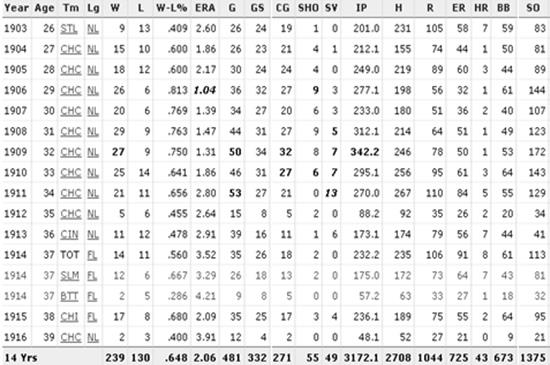
Brown finished his major league career with a 239-130 record, 1375 strikeouts, and a 2.06 ERA, the third best ERA in Major League Baseball history amongst players inducted into the Hall of Fame, after Ed Walsh and Addie Joss. His 2.06 ERA is the best in major league baseball history for any pitcher with more than 200 wins.
Following his retirement from the majors, he returned to his home in Terre Haute, where he continued to pitch in the minor leagues and in exhibition games for more than a decade, as well as coaching and managing. In an exhibition game against the famous House of David touring team in 1928, at the age of 51, he
Baseball Trailblazers Page 587
pitched three innings as a favor to the local team, and struck out all nine batters he faced.
From 1920 to 1945, Brown ran a filling station in Terre Haute that also served as a town gathering place and an unofficial museum. He was also a frequent guest at Old Timers' games in Chicago. In his later years, Brown was plagued by diabetes and then by the effects of a stroke. He died in 1948 of diabetic complications.
Baseball Trailblazers Page 588
Casey Stengel
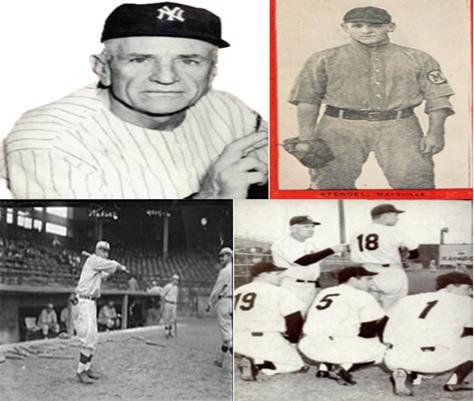
Nine time World Series champion; 1921 and 1922 as a player, and 1949–1953, 1956, and 1958 as a manager. One of the great managers in major league history and one of the game’s great characters and just perhaps one of its most significant pioneers, despite the substantially misleading ‘clown”
attribution.
“So what if he doesn't talk to me? I'll get by and so will he.
DiMaggio doesn't get paid to talk to me and I don't either.” -
Casey Stengel on his relationship with Joe DiMaggio.
Baseball Trailblazers
Page 589
Baseball Trailblazers
Page 590
Baseball Trailblazers
Page 591
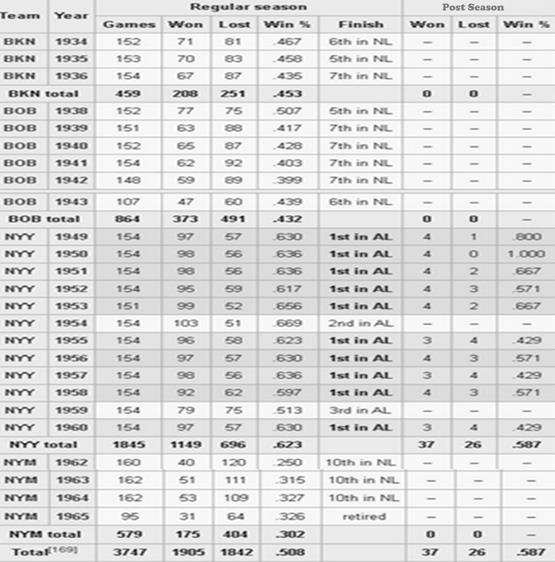
Managerial Record
Baseball Trailblazers Page 592
Charles Dillon "Casey" Stengel, July 30, 1890 – September 29, 1975, was a right fielder and manager, best known as the manager of the championship New York Yankees of the 1950s and later, the expansion New York Mets.
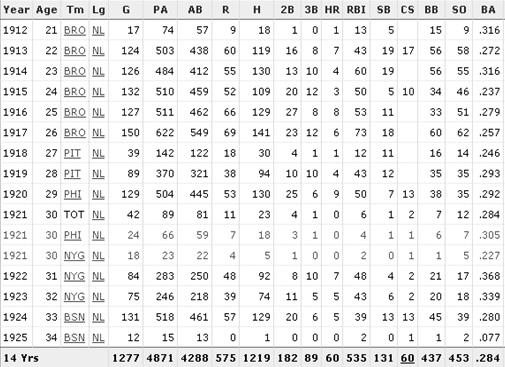
Stengel was born in Kansas City, Missouri. In 1910, he began a professional baseball career that would span over half a century. After almost three seasons in the minor leagues, Stengel reached the major leagues late in 1912, as an outfielder, for the Brooklyn Dodgers. His six seasons there saw some success, among them playing for Brooklyn's 1916 National League championship team; but he also developed a reputation as a clown. After repeated clashes over pay with the Dodgers owner, Charlie Ebbets, Stengel was traded to the Pittsburgh Pirates in 1918; however, he enlisted in the Navy that summer, for the remainder of World War I. After returning to baseball, he continued his pay disputes, resulting in trades to the Philadelphia Phillies in 1919 and to the New York Giants in 1921. There, he learned much about baseball from the manager, John McGraw, and had some of the glorious moments in his career, such as hitting an inside the park home run in Game 1 of the 1923 World Series to defeat the Yankees. His major league playing career ended with the Boston Braves in 1925, but he then began a career as a manager.
Baseball Trailblazers Page 593
The first twenty years of Stengel's second career brought mostly poor finishes, especially during his managerial stints with the Dodgers from 1934–1936 and Braves from 1938–1943. He thereafter enjoyed some success on the minor league level, and Yankee general manager George Weiss hired him as manager in October 1948. Stengel's Yankees won the World Series five consecutive times from 1949–1953, the only time that has been achieved.
Although the team won ten pennants in his twelve seasons, and won seven World Series, his final two years brought less success, with a third place finish in 1959, and a loss in the 1960 World Series. By then aged 70, he was dismissed by the Yankees shortly after the defeat.
Stengel had become famous for his humorous speech while with the Yankees, and these skills of showmanship served the expansion Mets well when they hired him in late 1961. He promoted the team tirelessly, as well as managing it to an atrocious 40–120
win/loss record, the most losses of any twentieth century team.
The team finished last all four years he managed it, but was boosted by considerable support from fans. Stengel retired in 1965, and became a fixture at baseball events for the rest of his life. He is sometimes described as one of the great managers in major league history, and is remembered as one of the great characters in baseball history.
Baseball Trailblazers Page 594
Charles Dillon Stengel’s ancestry is German and Irish. His parents; Louis Stengel and Jennie (Jordan) Stengel; were from the Quad Cities area of Illinois and Iowa, and had moved to Kansas City soon after their 1886 wedding so Louis could take an insurance job. "Charlie" was the youngest of three children, and the second son. Charlie Stengel played sandlot baseball as a child, and also played baseball, football and basketball at Kansas City's Central High School. His basketball team won the city championship, while the baseball team won the state championship.
As a teenager, Stengel played on a number of semipro baseball teams. He played on the traveling team called the Kansas City Red Sox during the summers of 1908 and 1909, going as far west as Wyoming and earning a dollar a day. He was offered a contract by the minor league Kansas City Blues for $135 a month, more money than his father was making. Since young Stengel was underage, his father had to agree, which he did. Louis Stengel recalled; "So I put down my paper and signed. You could never change that boy's mind anyway."
Before reporting to spring training for the Blues in early 1910
at Excelsior Springs, Missouri, Stengel was approached by his neighbor, Kid Nichols, a former star pitcher, who advised him to listen to his manager and to the older players, and if he was
Baseball Trailblazers Page 595
minded to reject their advice, at least think it over for a month or so first. Stengel failed to make the ball club, which was part of the American Association, which was considered one of the top minor leagues. Kansas City optioned Stengel to the Kankakee Kays of the Class D Northern Association, a lower level minor league, to gain experience as an outfielder. He had a .251
batting average with Kankakee when the league folded in July. He found a place with the Shelbyville Grays, who moved mid-season and became the Maysville Rivermen, of the Class D Blue Grass League, batting .221. He returned to the Blues for the final week of the season, with his combined batting average for 1910
at .237.
“I want to thank my parents for letting me play baseball, and I'm thankful I had baseball knuckles and couldn't become a dentist.” - Casey Stengel.
Uncertain of whether he would be successful as a baseball player, Stengel attended Western Dental College in the 1910–1911
offseason. He would later tell stories of his woes as a left handed, would be dentist using right handed equipment. The Blues sold Stengel to the Aurora Blues of the Class C Wisconsin–
Illinois League. He led the league with a .352 batting average.
Brooklyn Dodgers scout Larry Sutton took a trip from Chicago to nearby Aurora, noticed Stengel, and the Dodgers purchased his
Baseball Trailblazers Page 596
contract on September 1, 1911. Brooklyn outfielder Zach Wheat later claimed credit for tipping off Sutton that Stengel was worth signing. Stengel finished the season with Aurora and returned to dental school for the offseason.
The Dodgers assigned Stengel to the Montgomery Rebels of the Class A Southern Association for the 1912 season. Playing for manager Kid Elberfeld, Stengel batted .290 and led the league in outfield assists. He also developed a reputation as an eccentric player. Scout Mike Kahoe referred to Stengel as a "dandy ballplayer, but it's all from the neck down." After reporting to Brooklyn in September and getting a taste of the big leagues, he spent a third offseason at dental school in 1912–1913. He did not graduate, though whenever his baseball career hit a bad patch in the years to follow, his wife Edna would urge him to get his degree.
“They brought me up to the Brooklyn Dodgers, which at that time was in Brooklyn.” - Casey Stengel.
In later years, Casey Stengel told stories of his coming to Brooklyn to play for the Dodgers; most focused on his naïveté.
Mentor Zack Wheat was also from the Kansas City area and watched over Stengel, getting the young player a locker next to his and working with him on outfield technique. Stengel made his debut
Baseball Trailblazers Page 597
at Brooklyn's Washington Park on September 17, 1912, as the starting center fielder, and went 4–4 with a walk, two stolen bases and two tie breaking runs batted in, leading seventh place Brooklyn to a 7–3 win over the Pirates. Stengel continued to play well, finishing the season with a .316 batting average.
After holding out for better pay, Stengel signed with the Dodgers for 1913 and he won the starting center fielder job. The Dodgers had a new ballpark, Ebbets Field, and Stengel became the first person to hit a home run there. It was during the 1913
season that Stengel acquired the nickname "Casey." There are varying stories of how this came to be, though his home town of Kansas City likely played a prominent role, as he had "Charles Stengel — K.C." stenciled on his bags. Although he missed 25
games with injuries, he hit .272 with 7 official home runs in his first full season as a major leaguer. Prior to 1914 spring training, Stengel coached baseball at the University of Mississippi. Though the position was unpaid, he was designated an assistant professor for the time he was there, something that may have been the source of Stengel's nickname, "The Ol'
Perfessor."
The Dodgers were an improving team in Stengel's first years with them, and he was greatly influenced by the manager who joined the team in 1914, Wilbert Robinson. Stengel also avoided a
Baseball Trailblazers Page 598
holdout in 1914 when Dodgers owner Charlie Ebbets was anxious to put his players under contract lest they jump to the new Federal League, and nearly doubled Stengel's salary to $4,000 per year.
Both Brooklyn and Stengel started the season slowly, but both recovered with a hot streak that left the Dodgers only 4 games under .500, their best record since 1903, and Stengel finished with a .316 batting average, fifth best in the league. His on-base percentage led the league at .404. With the Federal League still active, Stengel was rewarded with a two year contract at $6,000 per year.
Stengel reported to spring training ill and thin. He was unable to work out for much of the time the Dodgers spent in Florida, and the team stated that he had typhoid fever, still common in 1915. He batted .237 for the season, the worst full season percentage of his major league career.
Soon after the 1916 season started, it became clear that the Dodgers were one of the better teams in the league. Robinson managed to squeeze one more year of productivity out of some older veterans such as Chief Meyers, who said of Stengel; "It was Casey who kept us on our toes. He was the life of the party and just kept all us old-timers pepped up all season." Stengel, mostly playing right field, hit .279 with eight home runs, one less than the team leader in that category, Wheat. Stengel's
Baseball Trailblazers Page 599
home run off Philadelphia Phillies pitcher Grover Cleveland Alexander, who won 33 games that year, in the second game of a doubleheader on September 30, provided the margin of victory as the Dodgers went into first place to stay, qualifying for their first World Series, against the Boston Red Sox. Despite getting two hits in a Game 1 loss at Boston, Stengel was benched for Game 2 because the Red Sox were pitching a left hander, Babe Ruth, and Stengel hit better against right-handers. Stengel, back in the lineup for Game 3, got a hit in Brooklyn's only victory of the series. He was benched again in Game 4 against left hander Dutch Leonard, though he was inserted as a pinch runner, and got another hit in the Game 5 loss, finishing 4 for 11, .364, the best Dodger batting average of the Series.
Despite the successful season, Ebbets was determined to cut his players' salaries, including Stengel, whom he considered overpaid. By then, the Federal League was defunct, and the reserve clause prevented players from jumping to other major league clubs. The owner sent Stengel a contract for $4,600, and when that was rejected, cut it by another $400. A holdout ensued, together with a war of words waged in the press. With little leverage, Stengel became willing to sign for the original contract, and did on March 27, 1917, but missed most of spring training. Stengel's batting average dropped from .279 to .257 as
Baseball Trailblazers Page 600
the defending league champion Dodgers finished seventh in the eight team league, but he led the team in games, hits, doubles, triples, home runs and runs batted in. After the season, Ebbets sent Stengel a contract for $4,100, and the outfielder eventually signed for that amount, but on January 9, 1918, Ebbets traded him along with George Cutshaw to the Pittsburgh Pirates for Burleigh Grimes, Al Mamaux and Chuck Ward.
The Pirates had been the only National League team to do worse than the Dodgers in 1917, finishing last. Stengel met with the Pirates owner Barney Dreyfuss to seek a salary increase, but found Dreyfuss reluctant to deal until Stengel proved himself as a Pirate. On June 3, 1918, Stengel was ejected for arguing with the umpire, and was fined by the league office for taking off his shirt on the field. The US had been fighting in World War I for a year, and Stengel enlisted in the Navy. His wartime service was playing for and managing the Brooklyn Navy Yard's baseball team, driving in the only run to beat Army, 1–0, before 5,000 spectators at the Polo Grounds. He also occasionally helped paint a ship. He later stated he had guarded the Gowanus Canal, and not a single submarine got into it.
“I had many years that I was not so successful as a ball player, as it is a game of skill.” - Casey Stengel, testifying before a Senate subcommittee, 1958.
Baseball Trailblazers Page 601
The Armistice renewed the conflict between Stengel and Dreyfuss, and the outfielder held out again to begin the 1919 season. Both wanted to see Stengel traded, but no deal was immediately made.
By then, Stengel's position as regular right fielder had been taken by Billy Southworth, and he had difficulty breaking back into the lineup. Stengel played better than he had before he enlisted, and by the time Dreyfuss traded him to the Philadelphia Phillies for Possum Whitted on August 9, he was batting .293 with four home runs. But before being traded, Stengel pulled one of his most famous stunts, on May 25 at Ebbets Field, as a member of the visiting Pirates. It was not unusual at Ebbets Field for right fielders of either team, rather than go to the dugout after three were out, to go to the Dodgers' bullpen, in foul territory down the right field line, if they were not likely to bat in the upcoming inning. Stengel did so to visit old friends, and discovered that pitcher Leon Cadore had captured a sparrow. Stengel took it, and quietly placed it under his cap when called to bat in the sixth inning.
He received mixed boos and cheers from the Brooklyn crowd as a former Dodger, took a deep bow at the plate, and doffed his cap, whereupon the bird flew away to great laughter from the crowd.
The trade to the Phillies ended Stengel's major league season for 1919, as he refused to report unless he got a raise, and
Baseball Trailblazers Page 602
when one was not forthcoming, returned to Kansas City to raise a barnstorming team. In the offseason, he came to terms with William Baker, the owner of the Phillies, and hit .292 in 1920
with nine home runs. However, racked by injuries and no longer young for a ballplayer, he did not play much in the early part of the 1921 season. On June 30, 1921, the Phillies traded Stengel, Red Causey and Johnny Rawlings to the New York Giants for Lee King, Goldie Rapp and Lance Richbourg. The Giants were one of the dominant teams in the National League, and Stengel, who had feared being sent to the minor leagues, quietly placed a long distance call once informed to ensure he was not the victim of a practical joke.
“I learned more from McGraw than anybody.” - Casey Stengel.
When Stengel reported to the Giants on July 1, 1921, they were managed, as they had been for almost 20 years, by John McGraw.
Teacher and student. Casey was about to learn a lot about managing. Stengel had time to learn, playing in only 18 games for the Giants in 1921, mostly as a pinch hitter, and watched from his place on the bench as McGraw led the Giants from a 7
game deficit on August 24 to the National League pennant.
Stengel did not appear in the 1921 World Series against the Yankees, as McGraw used only 13 players in beating the Yankees,
Baseball Trailblazers Page 603
five games to three. The only contribution Stengel made to the box score was being ejected from Game 5 for arguing.
McGraw brought several outfielders into spring training with the Giants. When Stengel was not included with the starters when the manager split the squad, some sportswriters assumed he would not be with the team when the regular season began. Stengel, at McGraw's request, acted as a coach to the young players on the
"B" squad, and worked hard, getting key hits in spring training games, and making the Giants as a reserve outfielder. McGraw and Stengel sometimes stayed up all night, discussing baseball strategy. With two Giant outfielders injured by June, Stengel was put in center field, and hit .368 in 84 games, as McGraw platooned him against right handers. The Giants played the Yankees again in the 1922 World Series. Stengel went 1–4 in Game 1, nursing an injured right leg muscle, which he aggravated running out an infield single in his first at bat in Game 2.
Stengel was obviously limping when he was advanced to second base on another single, and McGraw sent in a pinch runner. He did not use Stengel again in the Series, which the Giants won, four games to zero, with one tie. After the Series, Stengel and other major leaguers went on a barnstorming tour of Japan and the Far East.
Baseball Trailblazers Page 604
The year 1923 started much the same as the year before, with Stengel detailed to the "B" squad as player and coach in spring training, making the team as a reserve, and then inserted as center fielder when righties pitched. Similar also were Stengel's hot batting streaks, helping the Giants as they contended for their third straight pennant. Stengel was ejected several times for brawling or arguing with the umpire, and the league suspended him for ten games in one incident. McGraw continued to use him as a means of exerting some control over the younger players. During that summer, Stengel fell in love with Edna Lawson, a Californian who was running part of her father's building contracting business. They were married the following year. Near the end of the season, he sustained a mild foot injury, causing McGraw to rest him for a week, but he played the final two games of the regular season to finish at
.339 as the Giants and Yankees each won their leagues.
Until 1923, the Yankees had been tenants of the Giants at the Polo Grounds, but new Yankee Stadium had been opened that year, and this was the site for Game 1 of the 1923 World Series on October 10. Casey Stengel's at bat in the ninth inning with the score tied 4–4 was "the stuff of legend." Before the largest crowd he had ever played, Stengel lined a changeup from Joe Bush for a hit that went between the outfielders deep to left center.
Baseball Trailblazers Page 605
Hobbled by his injury and even more as a sponge inside his shoe flew out as he rounded second base, Stengel slowly circled the bases, and evaded the tag from catcher Wally Schang for an inside the park home run, providing the winning margin. Thus, the first World Series home run in Yankee Stadium's history was not hit by Babe Ruth. That honor, with great irony, would fall to the aging reserve outfielder Casey Stengel.
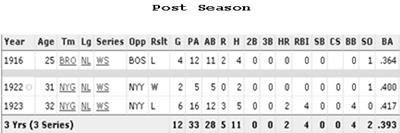
After the Yankees won Game 2 at the Polo Grounds, the Series returned to Yankee Stadium for Game 3. Stengel won it, 1–0, on a home run into the right field bleachers. As the Yankee fans booed Stengel, he thumbed his nose at the crowd and blew a kiss toward the Yankee players, outraging the team's principal owner, Jacob Ruppert, who demanded that Baseball Commissioner Kenesaw Mountain Landis fine or suspend Stengel. Judge Landis declined, saying; "A man who wins two games with home runs may feel a little playful, especially if he's a Stengel." The Yankees won the next three games to take the Series; but Stengel batted .417
in the six games, completing his World Series career as a player with a .393 batting average.
“It's lucky I didn't hit three home runs in three games, or McGraw would have traded me to the Three-I League.” - Casey Stengel on being traded by the Giants to the Boston Braves.
Baseball Trailblazers Page 606
On November 13, 1923, twenty-nine days after the World Series ended, Stengel was traded to the perennial second division dwelling Boston Braves with Dave Bancroft and Bill Cunningham for Joe Oeschger and Billy Southworth. Stengel had enjoyed his time in New York and was initially unhappy at the trade, especially since he had become close to McGraw. He soon cooled down, and later praised McGraw as "the greatest manager I ever played for." Despite nagging pains in his legs, Stengel played in 134 games during the 1924 season, the most since his days with the Dodgers, and hit .280, but the Braves finished last.
After the season, Stengel joined a baseball tour of Europe organized by McGraw and Charles Comiskey, with Edna Stengel accompanying the team. Casey Stengel met King George V and the Duke of York, later to become King George VI. Edna sipped tea with Queen Mary, an experience that strained her nerves. That winter, the Stengels moved into a house built by Edna's father in Glendale, California, where they would live the rest of their lives.
“Never let a losing pitcher drive the bus; especially a left hander. A guy who has just blown a tough one shouldn't be allowed behind the wheel.” - Casey Stengel.
Stengel started 1925 on the active roster of the Braves, but was used as a pinch hitter and started only once. His average sank
Baseball Trailblazers Page 607
to .077. Braves owner Emil Fuchs purchased the Worcester Panthers of the Eastern League, and hired Stengel as player-manager and team president. With fans enjoying Stengel's on-field antics and his World Series heroics still recent, he was the Eastern League's biggest attendance draw. Between run-ins with the umpires, Stengel hit .302 in 100 games as the Panthers finished third.
However, the Panthers were not enough of a box office success to satisfy owner Fuchs, who planned to move the team to Providence, Rhode Island for the 1926 season, with Stengel to remain in his roles. John McGraw, with whom Stengel had remained close, wanted him to take over as manager of the Giants' top affiliate, the Toledo Mud Hens of the American Association, at an increase in salary. Stengel was still under contract to the Braves, and Mud Hens president Joseph O'Brien was unwilling to send them money or players in order to get him. When Stengel asked Fuchs what to do if a higher level club wanted to draft him, Fuchs half-heartedly suggested releasing himself as a player, which would automatically terminate his Braves contract. Stengel took up Fuchs on his suggestion, releasing himself as a player, then firing himself as manager and resigning as president, clearing the way for him to move to the Mud Hens. Fuchs was outraged, and went to Judge Landis, who advised him to let the matter go.
Baseball Trailblazers Page 608
“People talk about all the money I've made. But they never talk about all the money I've lost.” - Casey Stengel.
Stengel's six years in Toledo would be as long as he would spend anywhere as manager, except his time with the Yankees of the 1950s. McGraw sent talented players down to Toledo, and the Mud Hens threatened for the pennant in Stengel's first year before falling back to third. In 1927, the team won its first pennant and defeated the Buffalo Bisons, five games to one, in the Little World Series. Stengel missed part of the 1927 campaign, as he was suspended by the league for inciting the fans to attack the umpire after a close play during the first game of the Labor Day doubleheader. Stengel continued as an occasional player as late as 1931 in addition to his managerial role, hitting a game winning home run in 1927 for the Mud Hens. Since minor league clubs suffer large turnovers in their rosters, the team's success did not carry over to 1928, when it finished sixth, and then eighth in the eight team league in 1929. The team recovered for third in 1930, but by then both Stengel and the team; in which he had invested; were having financial problems due to the start of the Great Depression. The team finished last again in 1931, and, after Landis was convinced no money had been skimmed off to benefit Stengel and other
Baseball Trailblazers Page 609
insiders, the team went into receivership, and Stengel was fired.
Stengel approached the new manager of the Dodgers, Max Carey, an old teammate from his time with the Pirates, seeking a job, and was hired as first base coach. Stengel thus ended an exile of seven years from the major leagues. Brooklyn finished third and then sixth with Stengel in the first base coaching box. Among the players was catcher Al Lopez, and the two became close friends and would eventually be managing rivals in the 1950’s American League.
“The first thing I want to say is that the Dodgers are still in the National League. Tell that to Bill Terry.” - Casey Stengel, on being hired as Dodger manager, February 24, 1934.
During the winter following the 1933 season, the manager of the world champion Giants, Bill Terry was interviewed by the press about the other teams in the National League. When asked about the Dodgers, Terry responded, "Brooklyn? Gee, I haven't heard a peep out of there. Is Brooklyn still in the league?" This angered Brooklyn's management, and they expected Carey to make a full throated response. When he remained silent, he was fired.
On February 24, 1934, Stengel faced the press for the first time as the manager of a major league team. McGraw, Stengel's mentor,
Baseball Trailblazers Page 610
was too ill to issue a statement on seeing him become a major league manager; he died the following day.
Stengel, hired only days before spring training, had a limited opportunity to shape his new ballclub. The Dodgers quickly settled into sixth place, where they would end the season.
Stengel, in later years, enjoyed discussing one 1934 game in Philadelphia's Baker Bowl. With Dodger pitcher Boom-Boom Beck ineffective, Stengel went out to the mound to take out the angry pitcher, who, instead of giving Stengel the baseball, threw it into right field, where it hit the metal wall with a loud noise.
The right fielder, Hack Wilson, lost in thought or beer, heard the boom; assumed the ball had been hit by a batter, and ran to retrieve it and throw it to the infield, to be met by general laughter. Stengel got the last laughs on the Giants as well. The Giants, six games ahead of the Cardinals on Labor Day, squandered that lead, and with two games remaining in the season, were tied with St. Louis. The final two games were against Brooklyn at the Polo Grounds, games played in front of raucous crowds, who well remembered Terry's comments. Brooklyn won both games, while the Cardinals won their two games against the Cincinnati Reds, and won the pennant.
The Dodgers finished fifth in 1935 and seventh in 1936. Dodger management felt Stengel had not done enough with the talent he
Baseball Trailblazers Page 611
had been given, and he was fired during the 1936 World Series between the Yankees and Giants. Stengel was paid for one year left on his contract, and he was not involved in baseball during the 1937 season. Stengel had invested in oil properties, as advised by one of his players, Randy Moore, a Texan. The investment helped make the Stengels well-to-do, and they put the profits in California real estate. Stengel considered going in the oil business full-time, but Braves president Bob Quinn offered him the Boston managerial job in late 1937, and he accepted.
Stengel was both manager and an investor in the Braves. In his six years there, 1938 to 1943, his team never finished in the top half of the league standings. The entry of the United States in World War II meant that many top players went into the service, but for the Braves, the changeover made little difference in the standings.
A few days before the opening of the 1943 season, Stengel was hit by a vehicle while crossing Commonwealth Avenue in Boston, and he severely fractured a leg. He missed the first two months of the season, receiving many well-wishes, and reading get-well cards jokingly misaddressed to the hospital's psychiatric ward.
For the rest of his life, Stengel walked with a limp. At the end
Baseball Trailblazers Page 612
of the season, Braves management, tired of minimal progress, fired Stengel, and he received no immediate job offers.
Stengel testified about this part of his career before a Senate subcommittee fifteen years later. "I became a major league manager in several cities and was discharged. We call it discharged because there is no question I had to leave."
Stengel thought the 1943 season would be his last in baseball; Edna urged him to look after the family business interests full-time, and Casey, who had always been an athlete, was reluctant to show himself at a baseball stadium with the imperfectly-healed injury. But early in the 1944 season, the minor league Milwaukee Brewers had a managing vacancy to fill, as the Chicago Cubs had hired away the Brewer manager, Charlie Grimm, who had played with Stengel on the 1919 Pirates. Grimm told the Cubs he was obliged to see the Brewers had a competent replacement, and urged the Brewers to hire Stengel. The team owner, Bill Veeck, stationed as a Marine on Guadalcanal, thought ill of Stengel as a manager, and was very reluctant in his consent when reached by cable. Stengel was adept at fostering good relations with reporters, and the very talented team continued to win, and by the end of May, Veeck had withdrawn his objections. The team won the American Association pennant, but lost in the playoffs to Louisville. Veeck, having returned to the United States, offered
Baseball Trailblazers Page 613
to rehire Stengel for 1945, but Stengel preferred another offer he received. This was from George Weiss of the New York Yankees, to manage the team Stengel had begun with, the Kansas City Blues, by then a Yankee farm club. Kansas City had finished last in the American Association as Milwaukee won the pennant, making it something of a comedown for Stengel, who hoped to return to the major leagues. Nevertheless, it was in his old home town, allowing him to see friends and relations, and he took the job.
The Blues finished seventh in the eight team league in 1945.
“Every manager wants to throw himself off a bridge sooner or later, and it's very nice for an old man to know he doesn't have to walk fifty miles to find one.” - Casey Stengel on the proximity of the Bay Bridge to the Oaks' stadium.
Although there was no major league managing vacancy Stengel could aspire to, the Oakland Oaks of the Pacific Coast League had fired their manager, and approached Stengel. The baseball played in the PCL was close to major league level, and the league featured many aging big leaguers finishing their careers.
Also attractive to Stengel was that the league had three teams in Southern California, allowing him to spend more time at his home in Glendale. Up until that time, the club had won only one pennant, and was something of a weak sister to its cross-bay
Baseball Trailblazers Page 614
rivals, the San Francisco Seals. But owner Brick Laws believed Stengel could mold the players into a winning team.
The Oaks finished second in the league behind the Seals in 1946, winning the first round of the playoffs against Los Angeles before losing to San Francisco in the finals. They finished fourth in 1947, beating San Francisco in the first round before losing to Los Angeles. Stengel managed the Oaks for a third year in 1948, with the roster heavy with former major leaguers. Among the younger players on the team was 20 year old shortstop Billy Martin. Stengel was impressed by Martin's fielding, baseball acuity, and, when there were brawls on the field, fighting ability. The Oaks clinched the pennant on September 26, and defeated Los Angeles and the Seattle Rainiers to win the Governors' Cup. The Sporting News named Stengel the Minor League Manager of the Year.
“So what if he doesn't talk to me? I'll get by and so will he.
DiMaggio doesn't get paid to talk to me and I don't either.” -
Casey Stengel on his relationship with Joe DiMaggio.
Stengel had been talked about as a possible Yankee manager in the early 1940s, but longtime team boss Ed Barrow, who retired in 1945, refused to consider it. Yankee manager Joe McCarthy retired during the 1946 season, and after the interim
Baseball Trailblazers Page 615
appointment of catcher Bill Dickey as player-manager, Bucky Harris was given the job in 1947. Stengel's name was mentioned for the job before Harris got it. He was backed by Weiss, but Larry MacPhail, then in charge of the franchise, was opposed.
Harris and the Yankees won the World Series that year, but finished third in 1948, though they were not eliminated until the penultimate day. Harris was fired, allegedly because he would not give Weiss his home telephone number. MacPhail could no longer block Stengel's hiring, as he had sold his interest in the Yankees after the 1947 season. Weiss, who became general manager after MacPhail's departure, urged his partners in the Yankees to allow the appointment of Stengel, who aided his own cause by winning the championship with Oakland during the time the Yankee job stood open. Del Webb, who owned part of the Yankees, had initial concerns but went along. Yankee scouts on the West Coast recommended Stengel, and Webb's support helped bring around co-owner Dan Topping.
Stengel was introduced as Yankee manager on October 12, 1948, the 25th anniversary of his second World Series home run to beat the Yankees. Joe DiMaggio attended the press conference as a sign of team support. Stengel faced obstacles to being accepted.
Harris had been popular with the press and public, and the businesslike Yankee corporate culture and successful tradition
Baseball Trailblazers Page 616
were thought to be ill matched with a manager who had the reputation of a clown and who had never had a major league team finish in the top half of the standings. Stengel's major league baseball involvement had been in the National League, and there were several American League parks in which he had neither managed nor played.
Stengel tried to keep a low profile during the 1949 Yankee spring training at St. Petersburg, Florida. But there was considerable media attention as Stengel shuttled rookies from one position on the field to another, and endlessly shuffled his lineup. He had the advantage of diminished expectations, as DiMaggio, the Yankee superstar, was injured with a bone spur in his heel, and few picked New York to win the pennant. There were other injuries once the season began, and Stengel, who had initially planned a conservative, stable lineup in his first American League season, was forced to improvise. Although platooning, playing right handed batters against left handed pitchers and the reverse, against whom they are on average more able to hit, had been known for some years, Stengel popularized it, and his use gave the practice its name.
After the team blew leads and lost both ends of a doubleheader in Philadelphia on May 15th, Stengel called a team meeting in which he criticized the players responsible for the two losses,
Baseball Trailblazers Page 617
but also predicted greatness for them, and told the team it was going to win. The team then won 13 of its next 14 games.
DiMaggio returned from injury on June 28 after missing 65 games.
He hit four home runs in three games to help sweep Boston and extend the Yankees' league lead. Despite DiMaggio's return, the lineup remained plagued with injuries. After consulting with Stengel, Weiss obtained Johnny Mize from the Giants, but he was soon sidelined with a separated shoulder. Twelve games behind on the Fourth of July, the Red Sox steadily gained ground on the Yankees, and tied them by sweeping a two game set at Fenway September 24th and 25th, the first time the Yankees had not been in sole possession of first place since the third game of the season. The Red Sox took the lead the following day with a comeback win in a makeup game, as Stengel lost his temper at the umpire for the first time in Yankee uniform. Although he was not ejected, he was fined by the league.
The season came down to a two game set with the Red Sox at Yankee Stadium, with the home team one game behind and needing to win both. Stengel, during the 1949 season, had shown himself more apt than his peers to bring in a relief pitcher, and when during the first game, starter Allie Reynolds gave up the first two runs in the third inning, the manager brought in Joe Page.
Though Page walked in two more runs, he shut out the Red Sox the
Baseball Trailblazers Page 618
rest of the way as the Yankees came back to win, 5–4. This set up a winner-take-all game for the league title. The Yankees took a 5–0 lead before Boston scored three in the ninth, but Vic Raschi was able to prevent further damage, giving the Yankees the pennant, Stengel's first as a major league manager.
In the 1949 World Series, Stengel's first as a participant since 1923, the Yankees faced the Brooklyn Dodgers, who were assembling the team that would challenge the Yankees through much of his time in New York. The teams split the first two games, at Yankee Stadium. Before Game 3 at Ebbets Field, Stengel was called upon to introduce his surviving teammates from the 1916 pennant winning Brooklyn club, which he did emotionally.
The Yankees won Game 3, and during Game 4, a Yankee victory, Stengel left the dugout to shout to catcher Yogi Berra to throw the ball to second base, which Berra did to catch Pee Wee Reese trying to take an extra base. For this breach of baseball's rules, Stengel was reprimanded after the game by Commissioner Happy Chandler. The Yankees won Game 5 as well to take the Series, and during the celebration after the game, Del Webb said of Stengel to the press; "I knew he would win, whether we got some more players for him or not."
During the 1949 season, Stengel had been more subdued than he usually was, but being the manager of the defending world
Baseball Trailblazers Page 619
champions and the Major League Manager of the Year relieved his inhibitions in 1950, and he was thereafter his talkative self.
He also was more forceful in running the team, not always to the liking of veteran players such as DiMaggio and Phil Rizzuto. As part of his incessant shuffling of the lineup, Stengel had DiMaggio play first base, a position to which he was unaccustomed and refused to play after the first game. Stengel considered DiMaggio's decline in play as he neared the end of his stellar career more important than his resentment. In August, with the slugger in the middle of a batting slump, Stengel benched him, stating he needed a rest. DiMaggio returned after six games, and hit .370 for the rest of the season, to end at .301 and win the slugging percentage title at .585. The younger players on the 1950 team included Billy Martin and Whitey Ford. The ascendance of these rookies meant more of the Yankees accepted Stengel's techniques, and diminished the number of those from the McCarthy era who resented their new manager.
The Detroit Tigers were the Yankees' main competition, leading for much of the summer, but the Yankees passed them in the middle of September to win the pennant by three games. In the 1950 World Series, the Yankees played the Phillies, another of Stengel's old teams. The Yankees swept the four games from the surprising “Whiz Kids.“
Baseball Trailblazers Page 620
“He's just a green pea out there. But he'll be back soon, and you'll see something.” - Casey Stengel on sending Mickey Mantle to the minor leagues.
Before spring training in 1950, the Yankees had pioneered the idea of an instructional school for rookies and other young players. This was the brainchild of Stengel and Weiss.
Complaints from other teams that the Yankees were violating time limits on spring training and were using their money for competitive advantage led to modifications, but the concept survived and was eventually broadly adopted. Among those invited to the 1951 early camp was 19 year old Mickey Mantle, whose speed and talent awed Stengel, and who had spent the previous year in the minor leagues. Stengel moved Mantle from shortstop to the outfield, reasoning that Rizzuto, the shortstop, was likely to play several more years. Both Mantle and the Yankees started the 1951 season slowly, and on July 14th, Mantle was sent to Kansas City to regain his confidence at the plate. He was soon recalled to the Yankees. Although he hit only .267 for the season, this was four points better than DiMaggio, in his final season. Much of the burden of winning a third consecutive pennant fell on Berra, who put together an MVP season. The White Sox and then the Indians led the league for much of the summer,
Baseball Trailblazers Page 621
but the Yankees, never far behind, put together a torrid final month of the season to win the pennant by five games.
The Yankee opponent in the 1951 World Series was the Giants, with Game 1 played the day after they won the National League pennant in the Miracle of Coogan's Bluff featuring Bobby Thomson’s “shot heard ‘round the world.” On an emotional high, the Giants beat the Yankees in Game 1 at Yankee Stadium. Game 2
was a Yankee victory, but Mantle suffered a knee injury and was out for the rest of the Series, the first indication of knee problems that would darken Mantle's career. The Giants won Game 3, but DiMaggio stepped to the fore, with six hits in the following three games, including a home run to crown his career.
The Yankees won Games 4 and 5, and staked Vic Raschi to a 4–1
lead in Game 6 before Stengel had Johnny Sain pitch in relief.
When Sain loaded the bases with none out in the ninth, Stengel brought in Bob Kuzava, a left hander, to pitch against the Giants, even though right handers Monte Irvin and Bobby Thomson were due to bat. The Giants scored twice, but Kuzava hung on, and the Yankees and Stengel had their third straight World Series championship.
DiMaggio's retirement after the 1951 season likely gave Stengel greater control over the players. Stengel moved Mantle from right to center field in DiMaggio's place. The Yankees were not
Baseball Trailblazers Page 622
the favorites to win the pennant again in 1952, with DiMaggio retired, Mantle still recovering from his injury and several Yankees in military service, deployed in the Korean War. The Indians were favored. Younger players, some of whom Stengel had helped to develop, came to the fore, with Martin the regular second baseman for the first time. Mantle proved slow to develop, but hit well towards the end of the season to finish at
.311. The Yankee season was also slow to get on track; the team had a record of 18–17 on May 30th, but they improved thereafter.
Stengel prepared nearly 100 different lineup cards for the 1952
season. The race was still tight in early September, and on September 5th, Stengel lectured the team for excessive levity on the train after the Yankees lost two of three to Philadelphia.
Embarrassed by the episode, which made its way into print, the Yankees responded by winning 15 of their next 19, clinching the pennant on September 27th.
The 1952 World Series was against the Brooklyn Dodgers, who by then had their stars of the 1950’s such as Jackie Robinson, Gil Hodges and Duke Snider, the virtual National League all-star team. The teams split the first four games. With his pitching staff tired, Stengel gave the start to late season acquisition Ewell Blackwell, who surrendered four runs in five innings, and the Yankees lost the game in 11 innings to the Dodgers behind
Baseball Trailblazers Page 623
Carl Erskine's complete game. Needing to win two in a row at Ebbets Field, Stengel pitched Raschi in Game 6, who won it with a save from Allie Reynolds. With no tomorrow in Game 7, Stengel sent four pitchers to the mound. Mantle hit a home run to break a 2–2 tie; Martin preserved the lead by making a difficult catch off a Robinson pop-up; and Kuzava again secured the final outs for a Series victory, as the Yankees won 4–2 for their fourth straight World Series victory, matching the record set in 1936–
1939, also by the Yankees.
The sportswriters had picked other teams to win the pennant in Stengel's first four years as Yankee manager. In 1953 they picked the Yankees, and this time they were proven correct. An 18 game winning streak in June placed them well in front, and they coasted to their fifth consecutive league championship, the first time a team had won five straight pennants. The Yankees played the Dodgers again in the World Series, which was less dramatic than the previous year, as the Yankees won in six games, with Mantle, Martin, Berra and Gil McDougald, players developed under Stengel, taking the fore. The Yankees and Stengel won the World Series for the fifth consecutive year, the only team to accomplish that feat. Stengel, having taken the managerial record for consecutive pennants from McGraw, 1921–
1924, and McCarthy, 1936–1939, and for consecutive titles from
Baseball Trailblazers Page 624
the latter, would say; "You know, John McGraw was a great man in New York and he won a lot of pennants. But Stengel is in town now, and he's won a lot of pennants too."
“If the Yankees don't win the pennant, the owners should discharge me.” - Casey Stengel before the 1954 season.
Even though the Yankees won 103 games, the most regular season victories they would have under Stengel, they lost by 8 games to the Indians, of pitchers Early Wynn, Mike Garcia, Bob Lemon, and Bob Feller, and managed by Stengel's old friend Al Lopez. The Indians' 111–43 record is the all-time record for winning percentage by an American League team at .721. In spite of the defeat, Stengel was given a new two year contract at $75,000 per year.
By the mid-1950’s, Stengel was becoming a national figure, familiar from television broadcasts of the Yankees on NBC's
“Game of the Week,” and from managing in most World Series and All-Star Games during his tenure. National magazines such as
“Look” and “Sports Illustrated” did feature stories about him, and his turn of phrase became known as "Stengelese." The magazines not only told stories about the manager's one-liners and jokes, but recounted the pranks from his playing days, such as the grapefruit dropped from the plane and the sparrow under
Baseball Trailblazers Page 625
the cap. People across the country grew enamored of the grandfatherly fellow with the funny looks and fractured speech, with a knack for winning.
The Yankees won the pennant again in 1955, breaking open a close pennant race in September to take the American League. They played the Dodgers again in the World Series, which the Dodgers won in seven games. The Dodgers won Game 7, 2–0, behind the pitching of Johnny Podres. Stengel, after losing his first World Series as a manager, blamed himself for not instructing his hitters to bat more aggressively against Podres. Billy Martin stated; "It's a shame for a great manager like that to have to lose."
There was not much of a pennant race in the American League in 1956, with the Yankees leading from the second week of the season onwards. With little suspense as to the team's standing, much attention turned to Mantle's batting, as he made a serious run at Babe Ruth's record of 60 home runs in a season, finishing with 52, and won the Triple Crown. On August 25th, Old-Timers'
Day, Stengel and Weiss met with the little used, declining, and ageing Rizzuto, the last of the "McCarthy Yankees" and released him from the team so they could acquire Enos Slaughter.
Baseball Trailblazers Page 626
The World Series that year was again against the Dodgers, who won the first two games at Ebbets Field. Stengel lectured the team before Game 3 at Yankee Stadium and the team responded with a victory in Games 3 and 4. For Game 5, Stengel pitched Don Larsen, who had been knocked out of Game 2. Larsen responded with a perfect game, the only one in major league postseason history, Larsen, an off-speed artist, stating that his control was never as good as it was that day. The Dodgers won Game 6 as the Series returned to Ebbets Field. Many expected Whitey Ford to start Game 7, but Stengel chose Johnny Kucks, an 18 game winner that season who had been used twice in relief in the Series. Kucks threw a three hit shutout as the Yankees won the championship, 9–0, Stengel's sixth as their manager.
New York got off to a slow start in the 1957 season, and by early June was six games out. By then, the team was making headlines off the field. Some of the Yankees were known for partying late into the night, something Stengel turned a blind eye to as long as the team performed well. The May 16th brawl at the Copacabana nightclub in New York, which involved Martin, Berra, Mantle, Ford, Hank Bauer and other Yankees, resulted in the arrest of Bauer. The charge of assault was later dropped.
But, the event exhausted Yankee management's patience with Martin, always considered the instigator. Stengel was close to
Baseball Trailblazers Page 627
Martin, who took great pride in being a Yankee, and Topping and Weiss did not involve the manager in the trade talks that ensued. On June 15th Martin was traded to the Kansas City Athletics. Martin wrote in his autobiography that Stengel could not look him in the eye as the manager told him of the trade.
The two, once close friends, rarely spoke in the years to come.
The Yankees recovered from their slow start, winning the American League pennant by eight games. They faced the Milwaukee Braves in the 1957 World Series. The Braves defeated the Yankees in seven games, with Lew Burdette and his spitball, who had been a Yankee until traded in 1950, beating New York three times.
Stengel stated in an interview; "We're going to have Burditis on our minds next year."
What was seen as a failure to keep discipline on the team hurt Stengel's standing with the Yankee owners, Topping, Weiss and Webb, as did the defeat in the 1957 Series. Stengel was by then aged 67 and had several times fallen asleep in the dugout, and players complained that he was growing more irritable. Former Yankee catcher Ralph Houk, who had been successful as a minor league manager and was Stengel's first base coach, was seen by ownership as the next manager of the Yankees. Stengel's contract, his fifth two year deal, was up after the 1958 season.
As ownership debated whether to renew it, the Yankees led by as
Baseball Trailblazers Page 628
many as 17 games, and won the pennant by 10. Again, the Braves were the opponent in the 1958 World Series. The Braves won three of the first four games. But the Yankees, backed by the pitching of Bob Turley, who got two wins and a save in the final three games, stormed back to win the Series. Firing Stengel under such circumstances was not possible, and ownership gave him another two year contract, to expire after the 1960 season.
The Yankees finished 79–75 in 1959, in third place, their worst record since 1925, as the White Sox, managed by Lopez, won the pennant. There was considerable criticism of Stengel, who was viewed as too old and out of touch with the players. After the 1959 season, Weiss made a trade with Kansas City to bring Roger Maris to the Yankees. Stengel was delighted with the acquisition and batted Maris third in the lineup, just in front of Mantle, and the new Yankee responded with an MVP season in 1960, with 39
home runs and 112 RBI’s. Stengel had health issues during the season, spending ten days in the hospital in late May and early June, with the illness variously reported as a bladder infection, a virus or influenza. The Yankees were challenged by the Baltimore Orioles for most of the year but won the pennant by eight games, Stengel's tenth as manager, tying the major league record held by McGraw. The Yankees played the Pittsburgh Pirates in the 1960 World Series, and Stengel picked Art Ditmar,
Baseball Trailblazers Page 629
who had won the most games, 15, for the Yankees, rather than the established star, Whitey Ford. The Pirates knocked Ditmar out of the box in the first inning, and won Game 1. Ditmar was also knocked out of Game 5, while Ford won Games 3 and 6 of the seven game series with shutouts, but could not pitch Game 7, as he might have if Stengel had used him in Games 1 and 5. The Pirates defeated the Yankees in Game 7, 10–9, on a ninth inning Bill Mazeroski home run.
“I'll never make the mistake of being seventy again.” - Casey Stengel, on being fired by the New York Yankees in 1960.
Shortly after the Yankees returned to New York, Stengel was informed by the team owners that he would not be given a new contract. His request, that the termination be announced at a press conference, was granted and on October 18th, 1960, Topping and Stengel appeared before the microphones. After Topping evaded questions from the press about whether Stengel had been fired, Stengel took the microphone, and when asked if he had been fired, stated; "Quit, fired, whatever you please, I don't care." Topping stated that Stengel was being terminated because of his age, 70, and alleged that this would have happened even had the Yankees won the World Series.
Baseball Trailblazers Page 630
Two days after dismissing Stengel, the Yankees announced the hiring of Houk as his replacement; stating that part of the reason for Stengel's firing was so that New York would not lose Houk to another team. Stengel returned to Glendale, and spent the 1961 season out of baseball for the first time since 1937.
He turned down several job offers to manage, from the Tigers, San Francisco Giants and the expansion Los Angeles Angels. He spent the summer of 1961 as Vice President of the Glendale Valley National Bank, which was owned by members of Edna Stengel's family.
As part of baseball's expansion in the early 1960s, a franchise was awarded to New York, to play in the National League beginning in 1962, and to be known as the New York Mets. It was hoped that the new team would be supported by the many former Giant and Dodger fans left without a team when the franchises moved to California after the 1957 season. There were rumors through the 1961 season that Stengel would be the manager, but he initially showed no interest in managing a team that, given the rules for the expansion draft, was unlikely to be competitive. George Weiss had been forced out as Yankee general manager and hired by the Mets. He wanted Stengel as manager, and after talks with the Mets principal owners, Joan Whitney Payson
Baseball Trailblazers Page 631
and M. Donald Grant, Stengel was introduced as Mets manager at a press conference on October 2, 1961.
“Look at that guy. He can't hit, he can't run, and he can't throw. Of course, that's why they gave him to us.” - Casey Stengel, on a player obtained by the Mets in the expansion draft, who remains anonymous due to the myriad of possibilities.
Weiss was convinced his scouting staff would make the Mets a respectable team in five to six years, but in the interim New York would most likely do poorly. He hoped to overcome the challenge of attracting supporters to a losing team in the "City of Winners" by drafting well-known players who would draw fans to the Polo Grounds, where the Mets would initially play. Thus, the Mets selected a number of over the hill National Leaguers, some of whom had played for the Dodgers or Giants, including Gil Hodges, Roger Craig, Don Zimmer and Frank Thomas. Selected before them all was journeyman catcher Hobie Landrith; as Stengel explained, "You have to have a catcher or you'll have a lot of passed balls."
The return of Casey Stengel to spring training received considerable publicity, and when the Mets played the Yankees in an exhibition game, Stengel played his best pitchers while the Yankees treated it as a meaningless game, and the Mets won, 4–3.
Baseball Trailblazers Page 632
The team won nearly as many games as it lost in spring training, but Stengel warned; "I ain't fooled. They play different when the other side is trying too." The Mets lost their first nine games of the regular season. In the meantime the Pirates were 10–0, meaning the Mets were already ten games out of first place. Some light appeared in May, when the Mets won 11 of 18
games to reach eighth place in the ten team league. They then lost 17 in a row, returning to last place, where they would spend the remainder of the season.
However, the perfect link with the public was formed, and it grew stronger as the team grew zanier. The Mets appealed to the younger generation of fans and became an alternative to the boring, stuffy Yankees who always won. The Mets were the cutest of losers. As the losing continued, a particular fan favorite was "Marvelous" Marv Throneberry, who was a "lightning-rod for disaster" in the 1962 season, striking out to kill rallies, or dropping pop flies and routine throws to first base. During one game, Throneberry hit a massive shot to right, winding up on third base, only to be called out for missing first. Stengel came from the dugout to argue, only to be told that Throneberry had missed second base as well.
“Can't anyone play this here game?” - Casey Stengel, on his 1962
Mets.
Baseball Trailblazers Page 633
Stengel tried incessantly to promote the Mets, talking to reporters or anyone else who would listen. He often used the word "amazin" and soon this became the "Amazin' Mets", a nickname that stuck. Stengel urged the fans; "Come out and see my amazin' Mets. I been in this game a hundred years but I see new ways to lose I never knew existed before." Stengel was successful in selling the team to some extent, as the Mets drew 900,000 fans. The team was less successful on the field, finishing with a record of 40–120, the most losses of any 20th century major league team. They finished 60 games behind the pennant winning Giants, and 18 games behind ninth place Chicago.
The 1963 season unfolded for the Mets much like the previous year, though this time they lost only eight games to begin the season, rather than nine. But they still finished 51–111, in last place. One highlight, though it did not count in the standings, was the Mayor's Trophy Game on June 20 at Yankee Stadium. Stengel played to win; the Yankees under Houk possibly less so, and the Mets beat the Yankees, 6–2.
“It has 57 bathrooms, and I need one now.” - Casey Stengel, on Shea Stadium.
In 1964, the Mets left the Polo Grounds and moved into the new Shea Stadium. Stengel commented that "the park is lovelier than
Baseball Trailblazers Page 634
my team." The Mets finished 53–109, again in last place. By this time, some fans were starting to get a bit impatient with the predictable losing, though for others the “cuteness” had not yet worn off. Stengel was given a contract for 1965.
“And we have this fine young catcher named Goossen, who is only twenty years old, who in ten years, has a chance to be thirty.”
- Casey Stengel.
The early part of the 1965 season saw similar futility. On July 25, the Mets had a party at Toots Shor's for the invitees to the following day's Old-Timers' Game. Sometime during that evening, Stengel fell off a barstool and broke his hip. The circumstances of his fall are not known with certainty, as he did not realize he had been severely injured until the following day. Stengel spent his 75th birthday in the hospital. Recognizing that considerable rehabilitation would be required, he retired as manager of the Mets on August 30th, replaced by Wes Westrum, one of his coaches. The Mets would again finish in last place.
“Most people my age are dead at the present time.” - Casey Stengel, in his final years.
By 1971, Edna Stengel was showing signs of Alzheimer's disease, and in 1973, following a stroke, she was moved into a nursing home. Casey Stengel continued to live in his Glendale home with
Baseball Trailblazers Page 635
the help of his housekeeper. Stengel himself showed signs of senility in his last years, and during the final year of his life, these increased. In his last year, Stengel cut back on his travel schedule, and was too ill to attend the Yankees' Old-Timers Day game in August 1975, at which it was announced that Billy Martin would be the new team manager. A diagnosis of cancer of the lymph glands had been made, and Stengel realized he was dying. In mid-September, he was admitted to Glendale Memorial Hospital, but the cancer was inoperable. He died there on September 29, 1975.
The tributes to Stengel upon his death were many. Sportswriter Maury Allen wrote; "He is gone and I am supposed to cry, but I laugh. Every time I saw the man, every time I heard his voice, every time his name was mentioned, the creases in my mouth would give way and a smile would come to my face." Richie Ashburn, a member of the 1962 Mets, stated; "Don't shed any tears for Casey. He wouldn't want you to. He was the happiest man I've ever seen." Jim Murray of the Los Angeles Times wrote; "God is certainly getting an earful tonight."
“You could look it up.” - Casey Stengel.
“The secret of managing is to keep the five guys who hate you away from the guys who are undecided.” - Casey Stengel.
Baseball Trailblazers
Page 636
Stump Weidman
George Edward "Stump" Weidman, February 17, 1861 – March 2, 1905, was a professional baseball player from 1880 to 1893. He played nine years in major league baseball, principally as a
Baseball Trailblazers Page 637
pitcher and outfielder, for five different major league clubs.
He appeared in 379 major league games, 279 as a pitcher and 122
as an outfielder, and his longest stretches were with the Detroit Wolverines from 1881–85, and 1887, and the Kansas City Cowboys in 1886.
As a pitcher, Weidman compiled a lackluster 101–156 win–loss record with a decent 3.61 earned run average in 2318 innings pitched. He led the National League in 1881 with a 1.80 ERA and totaled 45 wins in the 1882 and 1883 seasons. He pitched more innings for the Wolverines than any other pitcher in the club's history.
Weidman was born in Rochester, New York, in 1861. He attended Rochester University and was a pitcher on the baseball team there in 1880. He also played for the Hop Bitters Club of Rochester, with Buck Ewing as his catcher.
Weidman made his major league debut with the Buffalo Bisons on August 26, 1880. In the final weeks of the 1880 season, Weidman started 13 games for the Bisons and appeared in another four games as a relief pitcher. He compiled a 0–9 record and 3.40
earned run average in 113 innings pitched.
Weidman began the 1881 season with the Washington Nationals, then joined the Albany, New York, club in July 1881. After the
Baseball Trailblazers Page 638
Albany team folded, Weidman joined the Detroit Wolverines and brought his catcher Sam Trott with him. Weidman and Trott made their debut for Detroit on September 3, 1881, a 4-3 loss against Buffalo. Weidman started 13 games for Detroit in the last month of the season, compiling an 8–5 record and 1.18 ERA in 115
innings pitched, leading the National League.
Weidman had another strong year in 1882, winning 25 games, pitching 411 innings and 43 complete games. On August 17, 1882, he was the losing pitcher in one of the great pitching duels in baseball history. Monte Ward was the pitcher for the Providence Grays, and he and Weidman held the game scoreless through 17
innings. Weidman allowed only seven hits but lost the game in the 18th inning on a home run by Old Hoss Radbourn, who was playing in right field.
After the 1885 season, Weidman was released by the Wolverines to league control and then obtained by the newly formed Kansas City Cowboys. He appeared in 51 games as a starting pitcher for the Cowboys, including 48 complete games, and also appeared in three games as an outfielder. He compiled a win–loss record of 12–36
with a 4.52 ERA in 427 innings pitched. The Kansas City club compiled a 30–91 record and disbanded after the 1886 season.
Baseball Trailblazers Page 639
In 1887, Weidman returned to the Wolverines, where he went 13–7, helping them to the 1887 National League pennant. In early August 1887, Weidman was sold by Detroit to the New York Metropolitans for a price estimated at between $800 and $1,000.
Weidman started 12 games for the Metropolitans in the last half of the 1887 season and compiled a 4–8 record with a 4.64 ERA.
At the end of the 1887 season, the Metropolitans sold Weidman to the New York Giants. Weidman appeared in one game for the Giants in 1887 and two games in 1888. He compiled a 1–2 record and 2.77
ERA in his three games with the Giants. He played in his last major league game with the Giants on July 5, 1888, at age 27.
Although his major league career ended in 1888, Weidman continued to pitch in the minor leagues. He compiled a 10–4
record for the Toronto Canucks in 1884. Weidman remained in Canada in 1885, playing for the Hamilton Hams of the International League. He concluded his professional baseball career in 1893 with the Providence Clamdiggers of the Eastern League.
After retiring from baseball, Weidman worked as an umpire for a time, including one season as an umpire in the National League.
He then became a saloon operator in Rochester, New York. His first venture in the saloon business was the firm of Coughlin
Baseball Trailblazers Page 640
and Weidman. He later formed a partnership with his brother-in-law, Silk O'Loughlin, a well-known umpire. Weidman and O'Loughlin operated a saloon for several years at 158 State Street in Rochester. That establishment was sold in 1903, after which Weidman and O'Loughlin conducted business at another location.
By early 1905, Weidman developed a tumor which was believed to be throat cancer. He traveled to New York City where he met with medical specialists and underwent an operation that resulted in his death at age 44.
Baseball Trailblazers
Page 641
Hack Wilson
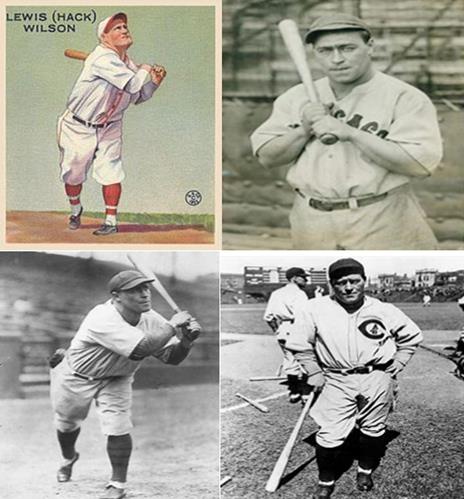
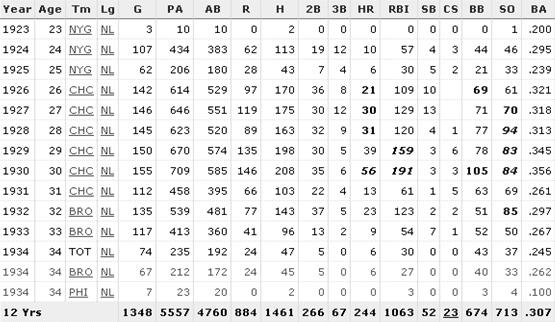
Baseball Trailblazers
Page 642
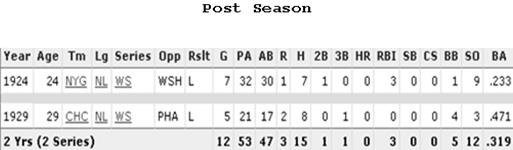
Baseball Trailblazers
Page 643
Lewis Robert "Hack" Wilson, April 26, 1900 – November 23, 1948, was a major league baseball player who played 12 seasons for the New York Giants, Chicago Cubs, Brooklyn Dodgers and Philadelphia Phillies. Despite his diminutive stature, he was one of the most accomplished power hitters in the game during the late 1920s and early 1930s. His 1930 season with the Cubs is widely considered one of the most memorable individual single season hitting performances in baseball history. Highlights included 56 home runs, the National League record for 68 years; and 191 runs batted in, a mark yet to be surpassed. "For a brief span of a few years," wrote a sportswriter of the day, "this hammered down little strongman actually rivaled the mighty Ruth."
While Wilson's combativeness and excessive alcohol consumption made him one of the most colorful sports personalities of his era, his drinking and fighting undoubtedly contributed to a premature end to his athletic career and, ultimately, his
Baseball Trailblazers Page 644
premature death.[5][6] He was inducted into the Baseball Hall of Fame in 1979.
Lewis Robert Wilson was born in the Pennsylvania steel mill town of Ellwood City, north of Pittsburgh. His mother, Jennie Kaughn, 16, was an unemployed drifter from Philadelphia; his father, Robert Wilson, 24, was a steel worker. His parents never married Both were heavy drinkers, and in 1907 his mother died of appendicitis at the age of 24.
In 1916 Lewis left school to take a job at a locomotive factory, swinging a sledge hammer for four dollars a week. Although only five feet six inches tall, he weighed 195 pounds with an 18 inch neck, and feet that fit into size five and one-half shoes. While his unusual physique was considered an oddity at the time, his large head, tiny feet, short legs and broad, flat face are now recognized as hallmarks of Fetal Alcohol Syndrome.
In 1921 Wilson moved to Martinsburg, West Virginia, to join the Martinsburg Mountaineers of the Class "D" Blue Ridge League.
After breaking his leg while sliding into home plate during his first professional game, he was moved from the catcher's position to the outfield. In 1922 he met Virginia Riddleburger, a 34 year old office clerk, and they married the following year.
In 1923, playing for the "B" division Portsmouth Truckers, he
Baseball Trailblazers Page 645
led the Virginia League in hitting with a .388 batting average.
Late in the season, New York Giants manager John McGraw purchased his contract from Portsmouth for $10,500.
Wilson made his major league debut with the Giants on September 29, 1923, at the age of 23, and became the starting left fielder the following season. By mid-July he was ranked second in the National League in hitting. He ended the season with a .295
average, 10 home runs, and 57 runs batted in as New York won the NL pennant. In the 1924 World Series he averaged .233 in a seven game loss to the Washington Senators.
Early in the 1925 season Wilson hit the longest home run on record at Ebbets Field against the Brooklyn Robins, but fell into a slump in May, and was replaced in left field by Irish Meusel. On July 2 he hit two home runs in one inning, tying Ken Williams' major league record set in 1922, but his hitting slump continued. In August McGraw told reporters that he had "... made the mistake of rushing Wilson along," and sent him to the Giants' minor league affiliate, the Toledo Mud Hens of the American Association. At season's end, a front office oversight, or possibly, deliberate inaction, left him unprotected on the Toledo roster, and the last place Chicago Cubs acquired him on waivers. "They let go the best outfielder I ever played
Baseball Trailblazers Page 646
alongside", said Giants right fielder Ross Youngs, "and they're going to regret it."
Wilson regained his form as the Cubs' center fielder in 1926, and he quickly became a favorite of Chicago fans. On May 24 he hit the center field scoreboard with one of the longest home runs in Wrigley Field history as the Cubs came from behind to defeat the Boston Braves. Later that evening he made news again when he was arrested during a police raid of a Prohibition era speakeasy while trying to escape through the rear window, and was fined one dollar. He ended the season with a league leading 21 home runs along with 36 doubles, 109 RBIs, a .321 batting average, and a .406 on base percentage. The Cubs improved to fourth place, and Wilson ended the year ranked fifth in voting for the NL's Most Valuable Player Award.
Another strong performance followed in 1927 as Wilson once again led the league in home runs. Although the Cubs were in first place heading into the final month of the season, the team faltered and again finished fourth. Wilson posted a .318 average with 30 home runs and 129 RBIs, and led NL outfielders with 400
putouts. He led the NL in home runs for a third consecutive year in 1928 with 31, along with 120 RBIs and a .313 average as the Cubs improved to third place.
Baseball Trailblazers Page 647
Wilson had a combative streak and sometimes initiated fights with opposing players and fans. On June 22, 1928, a near riot broke out in the ninth inning at Wrigley Field against the St.
Louis Cardinals when Wilson jumped into the box seats to attack a heckling fan. An estimated 5,000 spectators swarmed the field before police could separate the combatants and restore order.
The fan sued Wilson for $20,000, but a jury ruled in Wilson’s favor. The following year he took offense at a remark by Cincinnati Reds pitcher Ray Kolp, and upon reaching first base after hitting a single, he charged into the Reds dugout, punching Kolp several times before they could be separated.
Later that evening at the train station, Wilson exchanged words and blows with Cincinnati player Pete Donohue. In late 1929 he signed a contract to fight Art Shires of the Chicago White Sox in a boxing match, but reneged after Cubs president William Veeck, Sr. enlisted Hack's wife Virginia to dissuade him, and then Shires lost a fight to George Trafton of the Chicago Bears.
There was nothing to gain, Wilson said, by fighting a defeated boxer.
Wilson's "penchant for festivities" is also well documented.
Biographer Clifton Blue Parker described him as "... the Roaring
'20s epitome of a baseball player, primed for an age of American excess ... at a time when baseball was America's favorite
Baseball Trailblazers Page 648
sport." His love of drinking and partying did not endear him to Cubs owner William Wrigley, who abhorred alcohol consumption.
Wilson always insisted that he never played drunk; "hung over, yes; drunk, no." Manager Joe McCarthy worked hard to shield Wilson from Wrigley, and to keep him on an even keel. "Better than any other manager," wrote sportswriter Frank Graham, "Joe understood Hack, made allowances for him when he failed, and rewarded him with praise when he did well. Joe could be strict and stern with his players ... but he never was with Hack, and Hack repaid him by playing as he never had before, nor would again."
In 1929 Wilson hit .345 with 39 home runs and a league record 159 RBIs. He and new teammate Rogers Hornsby, who also contributed 39 home runs, led the Cubs to their first NL pennant in eleven years. In the World Series against Connie Mack's Philadelphia Athletics, Wilson's .471 hitting performance was eclipsed by two fielding errors at Shibe Park. Though trailing the Series two games to one, the Cubs were leading by a score of 8–0 in the fourth game when the Athletics mounted a 10 run rally in the seventh inning. Wilson lost two fly balls in the sun. The second, with two runners on base, led to an inside the park home run by Mule Haas as the Athletics won 10–8. After the game, McCarthy reportedly told a boy asking for a souvenir baseball;
Baseball Trailblazers Page 649
"Come back tomorrow and stand behind Wilson, and you'll be able to pick up all the balls you want!" The Athletics won again the next day to take the Series in five games.
Wilson's 1930 season is considered one of the best single season hitting performances in baseball history. By the middle of July he had accumulated 82 RBIs. In August he hit 13 home runs and had 53 RBIs, and by September 17 he had reached 174 RBIs, breaking Lou Gehrig's major league record established three years earlier. He finished the season with 191 RBIs, along with an NL record 56 home runs, a .356 batting average, a .454 on base percentage, and a league leading .723 slugging percentage.
He was unofficially voted the NL's most "useful" player by the Baseball Writers' Association of America, which did not inaugurate its official MVP award until 1931. Wilson's 191 RBIs remains one of baseball's most enduring records. Only Gehrig with 185 and Hank Greenberg with 184 ever came close, and there have been no serious challenges in the last 75 years.
Reds catcher Clyde Sukeforth asserted that Wilson should have been credited with an additional home run in 1930 as well. "He hit one in Cincinnati one day," he said, "way up in the seats, hit it so hard that it bounced right back onto the field. The umpire had a bad angle on it and ruled that it had hit the screen and bounced back. I was sitting in the Cincinnati
Baseball Trailblazers Page 650
bullpen, and of course, we weren't going to say anything. But Hack really hit 57 that year." Despite being possibly shortchanged one, Wilson's official total of 56 stood as the NL
record until the 1998 season.
Wilson's success in the 1930 season served to fuel his drinking habits, and in 1931 he reported to spring training 20 pounds overweight. Wilson complained that the new Cubs manager, Hornsby, did not allow him to "swing away" as much as Joe McCarthy had. He hit his 200th career home run at Ebbets Field on June 18; only the fourth player ever reach that mark, behind Ruth, Cy Williams, and Hornsby; but then fell into a protracted slump, and was benched in late May. By late August Wrigley publicly expressed his desire to trade him. On September 6 he was suspended without pay for the remainder of the season after a fight with reporters aboard a train in Cincinnati. He was hitting .261 with only 13 home runs.
In December 1931, the Cubs traded Wilson, along with Bud Teachout, to the St. Louis Cardinals for Burleigh Grimes. Less than a month later, the Cardinals sent him to the Brooklyn Dodgers for minor league outfielder Bob Parham and $25,000.
Wilson hit .297 with 23 home runs and 123 RBIs for Brooklyn in 1932. He began 1933 with a ninth inning, game winning, pinch hit, inside the park, grand slam home run at Ebbets Field. By
Baseball Trailblazers Page 651
season's end his offensive totals had dropped substantially, and he was hitting .262 when the Dodgers released him mid-season in 1934. The Philadelphia Phillies signed him immediately, but after just two hits in 20 at bats he was released again a month later. After a final season with the Albany Senators of the Class "A" New York–Pennsylvania League, Wilson retired at the age of 35.
In a 12 year major league career, Wilson played in 1,348 games and accumulated 1,461 hits in 4,760 at bats for a .307 career batting average and a .395 on-base percentage. He hit 244 home runs and batted in 1,063 runs, led the NL in home runs four times, and surpassed 100 RBIs six times.
Wilson returned to Martinsburg, West Virginia, where he opened a pool hall, but encountered financial problems due to a failed sporting goods business venture, and then a rancorous divorce from Virginia. By 1938 he was working as a bartender near Brooklyn's Ebbets Field where he sang for drinks, but had to quit when customers became too abusive. A night club venture in suburban Chicago was another financial failure. In 1944 he took a job as a good will ambassador for a professional basketball team in Washington, D.C., where he lamented that fans remembered his two dropped fly balls in the 1929 World Series far more vividly than his 56 home runs and 191 RBIs in 1930. Unable to
Baseball Trailblazers Page 652
find work in professional baseball, he moved to Baltimore where he worked as a tool checker in an airplane manufacturing plant and later as a laborer for the City of Baltimore. When municipal authorities realized who he was, he was made the manager of a Baltimore public swimming pool.
On October 4, 1948 Wilson was discovered unconscious after a fall in his home in Baltimore, Maryland. Though the accident did not appear serious at first, pneumonia and other complications developed and he died of internal hemorrhaging on November 23, 1948, at the age of 48. Wilson, once the highest paid player in the National League, died penniless. His son, Robert, refused to claim his remains. NL President Ford Frick finally sent money to cover his funeral expenses.
One week before his death, Wilson gave an interview to CBS Radio which was reprinted in Chicago newspapers. In 1949 Charlie Grimm, the Cubs' new manager, posted a framed excerpt from that interview in the Cubs clubhouse, where it remains. It reads, in part; “Talent isn't enough. You need common sense and good advice. If anyone tries to tell you different, tell them the story of Hack Wilson. ... Kids in and out of baseball who think because they have talent they have the world by the tail, it isn't so. Kids, don't be too big to accept advice. Don't let what happened to me happen to you.”
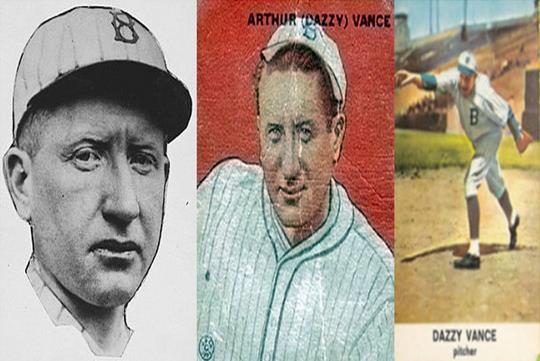
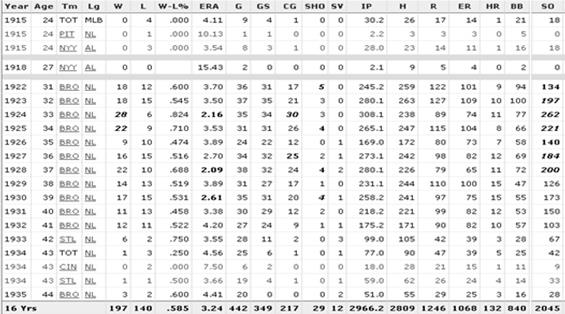
Baseball Trailblazers
Page 653
Dazzy Vance
Baseball Trailblazers
Page 654
Charles Arthur "Dazzy" Vance, March 4, 1891 – February 16, 1961, was a pitcher for five different franchises in major league baseball in a career that spanned twenty years. Known for his impressive fastball, Vance was the only pitcher to lead the National League in strikeouts seven consecutive seasons.
Born in Orient, Iowa, Vance spent most of his childhood in Nebraska. He played semi-pro baseball there, then signed on with a minor league baseball team out of Red Cloud, Nebraska, a member of the Nebraska State League, in 1912. After pitching for two other Nebraska State League teams in 1913 and 1914 , Vance made a brief major league debut with the Pittsburgh Pirates in 1915 and appeared with the New York Yankees that year as well.
However, it took several years before he established himself as a major league player.
Vance was discovered to have an arm injury in 1916 and was given medical treatment. He continued to work on his pitching in the minor leagues, appearing with teams in Columbus, Ohio; Toledo,
Baseball Trailblazers Page 655
Ohio; Memphis, Tennessee; Rochester, New York; and Sacramento, California. Vance only reappeared in the major leagues once for the Yankees, pitching two games in 1918. Vance said he was suddenly able to throw hard again in 1921 while pitching for the New Orleans Pelicans of the Southern Association. He struck out 163 batters and finished the season with a 21–11 win-loss record. The Pelicans sold his contract to the Brooklyn Robins in 1922. The Robins wanted to acquire catcher Hank DeBerry, but the Pelicans refused to complete the deal unless Vance was included in the transaction.
Vance and DeBerry formed a successful battery during their tenure with Brooklyn. In 1922, Vance produced an 18–12 record with a 3.70 earned run average and a league leading 134
strikeouts. His best individual season came in 1924, when he led the National League in wins with 28, strikeouts totaling 262, and an ERA of 2.16, the Pitching Triple Crown, en route to winning the National League Most Valuable Player Award. Vance set the then National League record for strikeouts in a nine inning game when he fanned 15 Chicago Cubs in a game on August 23, 1924. He struck out 17 batters in a 10 inning game in 1925.
On September 24, 1924, Vance struck out three batters on nine pitches in the second inning of a 6–5 win over the Chicago Cubs.
Vance became the fifth National League pitcher and the seventh
Baseball Trailblazers Page 656
pitcher in major league baseball history to accomplish the nine strike/three strikeout half inning. He finished the season with 262 strikeouts, more than any two other National League pitchers combined. Vance pitched a no hitter on September 13, 1925, against the Phillies, winning 10–1.
Vance was involved in one of the most famous flubs in baseball history, the "three men on third" incident during the 1926
season. With Vance on second and Chick Fewster on first, Babe Herman hit a long ball and began racing around the bases. As Herman rounded second, the third base coach yelled at him to go back, since Fewster had not yet passed third. Vance, having rounded third, misunderstood and reversed course, returning to third. Fewster arrived at third. Herman ignored the instruction and also arrived at third. The third baseman tagged out Herman and Fewster; Vance was declared safe by rule.
Vance's play began to decline in the early 1930s and he bounced to the St. Louis Cardinals, becoming a member of the team known as the Gashouse Gang, Cincinnati Reds and back to the Dodgers.
On September 12, 1934, Vance hit his seventh and final major league home run at 43 years and 6 months, the second oldest pitcher to do so to this day. Just a week later commenting for a newspaper article, Vance said that he did not recommend baseball as a career to young men. Vance pointed out that very few people
Baseball Trailblazers Page 657
could make a good living out of it, especially during a time when increasing major league salaries were attracting many college educated men who would have previously chosen other work.
Vance retired after the 1935 season. He led the league in ERA three times, wins twice, and established a National League record by leading the league in strikeouts in seven consecutive years, 1922–1928. Vance retired with a 197–140 record, 2,045
strikeouts and a 3.24 ERA; remarkable numbers considering he only saw 33 innings of big league play during his twenties.
Vance enjoyed hunting and fishing when he retired to Homosassa Springs, Florida, where he had lived since the 1920s. In 1938, Vance became ill with pneumonia. The illness worsened and kept him hospitalized for several months. Vance recovered and became a frequent guest at Brooklyn old timers games. Vance was inducted into the Baseball Hall of Fame in 1955. He learned of his election when a highway patrolman got his attention on a local highway and told him that a photographer was at his house.
A Dazzy Vance Day celebration was held in Brooklyn.
Vance died of a heart attack in 1961 in Homosassa Springs. His obituary in “The Sporting News” said that he had been under a doctor's care but that he was active and thought to be in
Baseball Trailblazers Page 658
relatively good health when he died. His survivors included his wife Edyth and a daughter.
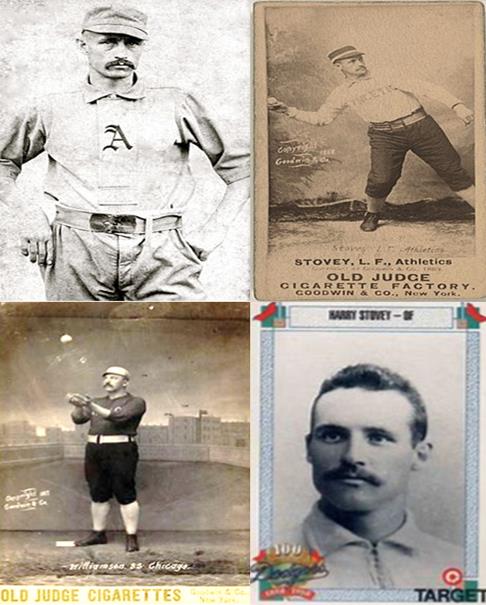
Baseball Trailblazers
Page 659
Harry Stovey
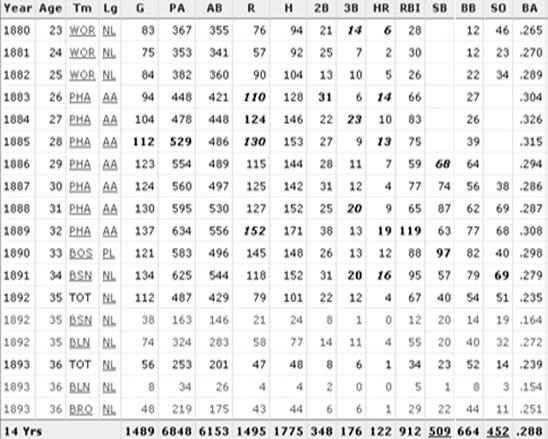
Baseball Trailblazers
Page 660
Harry Duffield Stovey, December 20, 1856 – September 20, 1937, born Harry Duffield Stowe, was a 19th century major league baseball player and the first player in major league history to hit 100 home runs. Born in Philadelphia, Pennsylvania, Stovey played for 14 seasons in the majors and was appointed player-manager on two separate occasions during his career.
In 1877, Harry began his career in the pitcher’s box and graduated out of the ranks of a Philadelphia amateur team called