

Baseball Trailblazers by Edward Drobinski - HTML preview
Download the book in PDF, ePub, Kindle for a complete version.
Baseball Trailblazers Page 661
the Defiance. The Philadelphia Defiance were a professional team, part of the league Alliance.
In 1878, Frank Bancroft, owner/manager of the New Bedford Baseball Club, engaged Stovey to join his pitching staff. When the New Bedfords' John Piggot, first baseman, became ill during their first exhibition game of the season, Stovey was asked to take over, and played brilliantly enough that he replaced Piggott as the starting first basemen for the entire season.
Harry was an outfielder / first baseman in 1880 for the Worcester Worcesters under the surname of Stovey instead of his birth name of Stowe due to his desire to keep his family from discovering he was making his career at baseball, which was seen at the time as not a respectable profession. He made an immediate impact that first season, leading the league with 14
triples and six home runs, while also finishing in the top ten in many other offensive categories. On July 17, he hit his first major league home run off Jim McCormick of the Cleveland Blues.
For the 1881 season, his offensive numbers did not slow down, again finishing in the top ten in several offensive categories, though he did not lead the league in any this time around. On August 17, 1881, Worcester suspended Captain Mike Dorgan‚ and Stovey took over the position for the remainder of the season.
Baseball Trailblazers Page 662
Lee Richmond‚ who had quit because of conflicts with Dorgan‚
rejoined the team after this switch.
In 1882, his last season for the Worcesters, his batting average saw an increase, up to .289 from .270 the year before. He ranked third in the league in runs scored, with 90, and fourth in the league in home runs, with five.
For the 1883 season, Stovey moved on to play for the Philadelphia Athletics of the American Association, and it was during the next seven years when he had his best years, and made his greatest impact on the game. His first season in Philadelphia saw him set the single season record for home runs with 14, breaking the old mark of nine set by Charley Jones in 1879. Not only did he set the home run record, he batted .306, and led the league in runs scored with 110, doubles with 31, and games played with 112, while also finishing in the top five in most offensive categories.
The offensive explosiveness continued throughout his stay in Philadelphia, leading the league in runs scored four times, doubles once, triples three times, and home runs three times.
The accumulation of home runs led to him becoming the career home run leader, overtaking Charley Jones with his 51st career homer on September 28, 1885. He held onto the career lead for a
Baseball Trailblazers Page 663
season until he was passed for a short period of time by Dan Brouthers for the 1886 and the 1887 seasons. Stovey regained the lead, and held it until Roger Connor passed him in 1895.
In 1890, the Players' League, a rival league to the National League and the American Association, began, and it attracted many of the game's star players, including Stovey who "jumped"
to the Boston Reds. He had a good season, batting .299, hit 11
triples, and 12 home runs. On September 3, 1890, Stovey became the first player to hit 100 homers for a career, off of Jersey Bakley in a game against Cleveland, a significant milestone in a day when home runs were relatively rare.
After the 1890 season, the Players' League folded with many of the players returning to their former ball clubs. Stovey‚ who played with the A's in 1889, was not claimed by that club through a clerical error, so on February 5, 1891, he signed with the Boston Beaneaters of the National League. He led the league that season with 16 home runs and 20 triples, while also hitting
.279 with 31 doubles as well. It proved to be last great season of his career.
Stovey played only 38 games for the Beaneaters in 1892, before he was released on June 20, but he was quickly signed by the Baltimore Orioles. He finished the season with a .272 batting
Baseball Trailblazers Page 664
average with the Orioles and hit 11 triples, including three in one game on July 21 in a 10–3 victory over the Pittsburgh Pirates.
The 1893 season was Stovey's last season in the majors. He was released by the Orioles on May 22 after only eight games, and was signed three days later on May 15 by the Brooklyn Grooms. He finished the season with Grooms and retired after the season was over.
In 1489 games over 14 seasons, Stovey posted a .288 batting average, 1775 for 6153, with 1495 runs, 348 doubles, 176
triples, 122 home runs, 912 RBI, 509 stolen bases, and 664 bases on balls.
After his career, Stovey returned to New Bedford, Massachusetts where he had begun his baseball career, in order to manage the local amateur team in 1893. He subsequently worked as a police officer in the city. Stovey died there at the age of 80.
Baseball Trailblazers
Page 665
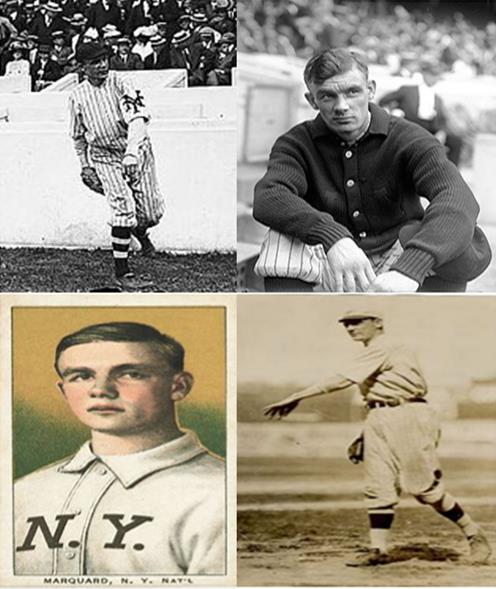
Rube Marquard
Baseball Trailblazers
Page 666
Richard William "Rube" Marquard, October 9, 1886 – June 1, 1980, was a left handed pitcher in major league baseball in the 1910s and early 1920s. He achieved his greatest success with the New
Baseball Trailblazers Page 667
York Giants. He was inducted into the Baseball Hall of Fame in 1971.
Rube Marquard was born in Cleveland, Ohio, to German immigrant Fred Marquard and Lena Heiser Marquard. Lena Marquard died of an abdominal infection in 1899, and Rube's grandmother took responsibility for raising him. Marquard quit school after the fifth grade.
Newspaper reports first mentioned Marquard in 1905, when he played with an amateur team in Cleveland. Though pitching for a poor team that had a 1–15 win-loss record at one point, Marquard attracted attention as a top pitcher. He broke a City League record with 16 strikeouts in a game against a team known as Brittons Printing. In September, the City League season finished and he signed with the semiprofessional Telling Strollers, an independent team sponsored by an ice cream company.
He started his minor league baseball career in 1906. Despite his nickname, he was a city kid. As he told it, a writer in his minor league days compared him favorably with Rube Waddell, and soon he was being called "Rube" also.
In 1907, he went 23–13 with a 2.01 earned run average and led the Central League in wins. In 1908, he went 28–19 with a 1.69
ERA and led the American Association in wins. The New York
Baseball Trailblazers Page 668
Giants purchased Marquard for $11,000; a then unheard of sum to pay for a baseball player's contract; and his lack of success early in his major league career led to his being tagged "the $11,000 lemon."
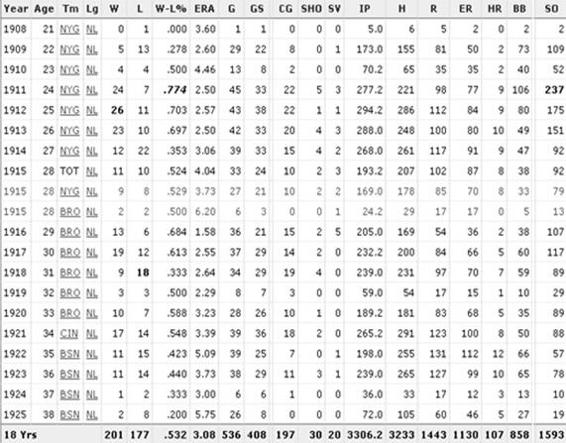
From 1911 to 1913, Marquard won at least 23 games each season, and helped the Giants win three consecutive National League pennants. In 1911, he led the league with 237 strikeouts. In 1912, he led the league with 26 wins. He also made baseball history by winning 19 decisions in a row. Marquard allegedly celebrated by buying an opal stickpin to reward himself. Upon being told by a friend that opals were a jinx, he threw the pin into a river, but apparently, the curse had already done its work, as he lost his next decision.
In 1914, Marquard went 12–22, and in 1915, he joined the Brooklyn Robins. He helped the team win pennants in 1916 and 1920. He then played for the Cincinnati Reds in 1921 and Boston Braves from 1922 to 1925.
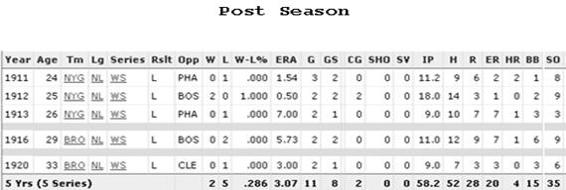
During the 1920 World Series, he was arrested for ticket scalping in Cleveland. He was alleged to be selling eight world box seats for $350, while the original cost was $52.80. He was found guilty and fined $1 plus $3.50 in court costs.
Baseball Trailblazers Page 669
Marquard finished his major league career in 1925 with a record of 201–177 and a 3.08 ERA. His 1,593 strikeouts ranked third in major league history among left handers at the time, behind Rube Waddell and Eddie Plank.
He later pitched and managed in the minor leagues until 1933.
After baseball, he worked as a betting window teller at Narragansett Park. Marquard was a performer in vaudeville, appearing with Blossom Seeley and later marrying her. That same year, Seeley gave birth to a son. Richard Marquard Jr. Marquard died in Baltimore, Maryland, on June 1, 1980, at the age of 93.
Baseball Trailblazers
Page 670
Dave Orr
Baseball Trailblazers
Page 671
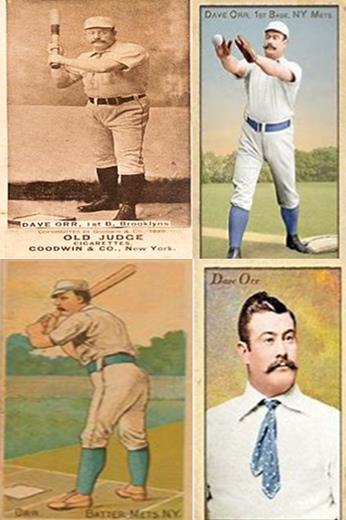
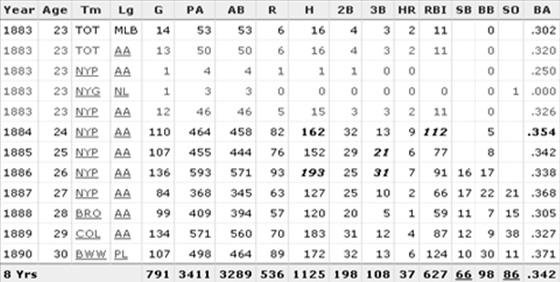
David L. Orr, September 29, 1859 - June 2, 1915, was a first baseman in major league baseball from 1883 through 1890. Orr played most of his career in the American Association for the New York Metropolitans, Brooklyn Bridegrooms, and Columbus Solons. He also played for the New York Gothams in the National League for one game in 1883 and for the Brooklyn Ward's Wonders of the Players' League in 1890.
Baseball Trailblazers Page 672
Orr was born in Brooklyn, New York. His father was an Irish immigrant who worked as a brownstone stonecutter. Orr grew up in Brooklyn and began his baseball career playing for minor league teams, including the Brooklyn Alaskas and teams in Newark, New Jersey, and Hartford, Connecticut.
In 1883, Orr signed with the New York Gothams of the National League and made his major league debut with them on May 17, 1883. He played in only one game for the Gothams and was then transferred to the New York Metropolitans. Both teams were under common ownership by the Metropolitan Exhibition Company. He joined the Metropolitans during the 1883 season and served as the team's first baseman through the 1887 season.
In 1884, Orr's first complete season in the major leagues, he had arguably the best year of his career. He won the American Association batting crown with a .354 batting average and also led the association with 112 runs batted in, 162 hits, and 247
total bases. Despite hitting a career high nine home runs, Orr narrowly missed a Triple Crown as Long John Reilly hit 11.
In 1885, his second full season, Orr compiled a .342 batting average, 56 extra base hits, and 241 total bases, ranking second in the American Association in all three categories. He led the association with a .543 slugging percentage, and 21 triples.
Baseball Trailblazers Page 673
In 1886, Orr had career highs with 136 games, 593 plate appearances, 93 runs, 31 triples, and 301 total bases. His .338
batting average was the third best in the American Association, and he became the first player to reach 300 total bases in a season. He led the association in hits - 193, total bases - 301, extra base hits - 63, triples - 31, and slugging percentage -
.527). His 31 triples was a major league record for 25 years and remains the second highest in major league history.
Orr also had an excellent season as a fielder in 1886. He led the association's first basemen in fielding percentage, putouts, assists, and range factor. Despite Orr's contributions, the Metropolitans finished seventh in the American Association with a 53-82 record.
In 1887, despite multiple injuries, Orr had another fine season.
His .338 batting average was third best in the American Association. In April 1887, Orr sustained serious injuries and reported to be in critical condition after colliding with catcher Andy Sommers, as both players were pursuing a batted ball. Orr's injuries included a dislocated knee, a badly bruised breast, his front teeth broken off, his tongue bitten through, and hemorrhaging. He remained out of the lineup until the middle of May.
Baseball Trailblazers Page 674
The Metropolitans started the 1887 record with a 6-24 record. On June 2, 1887, the manager was fired, and Orr took over on an interim basis as player-manager and captain. In his first game as manager on June 3, 1887, Orr had to be carried off the field after a blood vessel in his leg burst while sliding into second base.
Orr used an unorthodox batting stance that was described by one newspaper reporter as follows; "Big Dave Orr has a position which seems utterly at variance with all the rules of batting.
Instead of standing in the center of the plate he takes his place at the extreme edge furthest from the pitcher and almost behind it, in fact. His feet are placed in a most peculiar way.
The toes of the right foot point almost toward second base, and the heel is placed in the hollow of the left. He swings his body forward, moving his feet but a few inches, all the swing he gives his bat seeming to come from the upper part of his body."
During the off-seasons, Orr worked as a butcher and a brownstone cutter.
On October 20, 1887, Orr was sold to the Brooklyn Bridegrooms along with seven other players. He signed a contract with Brooklyn the following month. Orr appeared in 99 games for the 1888 Brooklyn team and had the fifth highest batting average,
Baseball Trailblazers Page 675
.305, in the American Association. He was also among the league leaders in a few fielding categories. Brooklyn finished the 1888
season in second place in the American Association with a record of 88-52. In December 1888, the Bridegrooms sold Orr and Al Mays to the Columbus Solons for $3,000.
Orr appeared in 134 games for the Columbus Solons in 1889. His
.327 batting average was the fourth best in the American Association, and he was also among the association's leaders in hits, total bases, doubles, triples, and RBIs. Although playing for Columbus, Orr helped Brooklyn win the 1889 American Association pennant. On the last day of the season, Brooklyn needed St. Louis to lose in order to win the pennant. Columbus played St. Louis in that final game of the season, and Orr came to bat with the score tied and two outs in the bottom of the ninth inning. Orr hit a home run that Hugh Fullerton later wrote was "perhaps the most historic hit ever made."
Orr reportedly hit the historic home run against St. Louis with the bat that he famously named "Charlotte." Orr had three bats that he had named Charlotte, Gertrude, and Rose. Charlotte was his favorite, and a sports writer later recalled "the big fellow certainly could clout the ball when she was in his hands."
Baseball Trailblazers Page 676
On January 22, 1890, Orr signed with the Brooklyn Ward's Wonders in the newly formed Players' League. Orr helped lead Brooklyn to second place in the league with a 76-56 record. In June 1890, Orr became the first Brooklyn player to hit the ball over the left field fence at Eastern Park. On June 17, 1890, Orr had two ribs broken when he was hit by a pitch, "but continued to play until he was threatened with erysipelas." Though he had been expected to miss the remainder of the 1890 season, he returned to the lineup on July 7. Orr batted .359 in 48 games before the injury and improved to .397 in 59 games after the injury. He finished second in a close race with Pete Browning for the batting championship. In early September 1890, “Sporting Life”
observed: "Big Dave Orr is batting like great guns, and is keeping the leader, Browning, guessing. How the two must watch for each other's score day after day!"
Despite appearing in only 107 games in 1890, Orr still ranked among the Players' League leaders in batting average - .371, RBIs - 124, slugging percentage - .534, hits - 172, total bases
- 248, and doubles – 32.
In September 1890, Orr sustained a stroke while playing in an exhibition game in Renovo, Pennsylvania. He was paralyzed on his left side, but by January 1891, he was reportedly "able to walk out on pleasant days."
Baseball Trailblazers Page 677
In September 1891, 4,000 tickets were sold for "a grand benefit picnic" held in Orr's honor at Euler's Washington Park, the home of the Brooklyn baseball club. Former teammates, including John Montgomery Ward attended, and the park was lit with Chinese lanterns. A marching band led a parade, and a dance platform was
"festooned with flags." A newspaper account stated that "Dave's big right hand finally grew tired of wagging. His left was there, too, but it has not done duty for almost a year and this is why he was given a picnic."
In March 1892, Orr traveled to Florida to umpire exhibition games. He announced that, although one leg was still "somewhat affected by paralysis," he was contemplating a comeback in 1893.
He was never again able to return to the game as a player.
Though largely forgotten in the modern era, Orr was remembered by both fellow players and sports writers as one of the greatest hitters of the 19th century. In 1894, Baseball Hall of Fame inductee Dan Brouthers opined that Orr was the greatest hitter to ever play the game; "The greatest hitter that ever played ball was old Dave Orr. He didn't care whether they were over the plate or not. If they were within reach of that long bat of his he would hit them out, and when he hit them there was no telling whether they would be found again or not. I have always held
Baseball Trailblazers Page 678
that Dave Orr was the strongest and best hitter that ever played ball."
Pitcher Silver King broke his wrist when he was struck with a ball hit by Orr. He later recalled: "Dave could crack 'em at you like a shot, and the one I stopped had all of Dave's 200 pound avoirdupois good and hard up against it."
In 1898, the editor of “Sporting Life” recalled Orr once hitting a “dead” ball over the fence, 400 feet from home plate, and wrote; "Dave Orr, that broad chested, good natured big chap, who once held down a place on the Brooklyn team, in his day was the hardest hitting batsman in League or Association. I have seen him wallop a ball so far over the outfielders' heads that it took a search warrant to get it back again, and every third baseman crossed himself and muttered the last prayers of the dying whenever he stalked to the plate." Years later, another account in “Sporting Life” observed; "He was a mighty slugger and his home run drives earned him the reputation of being the greatest batter in the world."
In his eight-season career, Orr posted a .342 batting average, 1125 for 3289, with 37 home runs and 627 RBI in 791 games. He added 536 runs, 198 doubles, 108 triples and 66 stolen bases.
Baseball Trailblazers Page 679
While Orr was not able to resume his playing career, he remained active in baseball in other capacities. He worked for many years as a gate keeper at the Polo Grounds in Upper Manhattan, then as caretaker at Ebbets Field in 1913, and finally managing the press box at Washington Park, home field of the Brooklyn Tip-Tops, from 1914 until the time of his death.
In June 1915, Orr died at his niece's home at 1211 Stuthoff Avenue in the Richmond Hill section of the New York City borough of Queens in 1915.
Baseball Trailblazers
Page 680
Burleigh Grimes
Baseball Trailblazers
Page 681
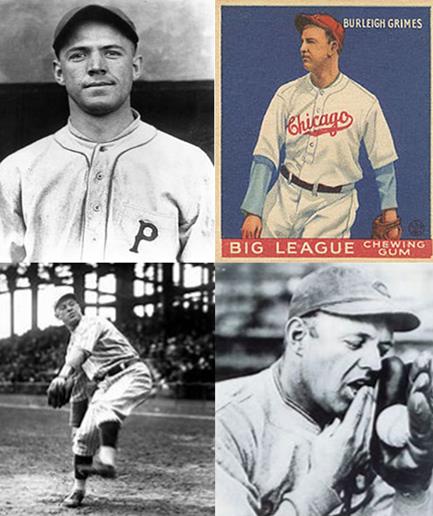
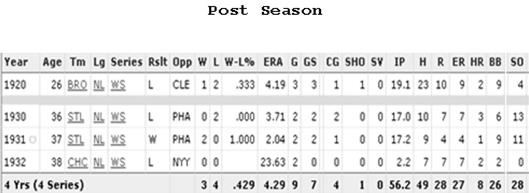
Burleigh Arland Grimes, August 18, 1893 – December 6, 1985, was a professional baseball player and manager, and the last pitcher officially permitted to throw the spitball. Grimes made the most
Baseball Trailblazers Page 682
of this advantage, as well as his unshaven, menacing presence on the mound, which earned him the nickname "Ol' Stubblebeard." He won 270 major league baseball games, pitched in four World Series over the course of his 19 year career, and was elected to the Baseball Hall of Fame in 1964.
Born in Emerald, Wisconsin, Grimes was the first child of Cecil
"Nick" Grimes, a farmer and former day laborer, and the former Ruth Tuttle, the daughter of a former Wisconsin legislator.
Having previously played baseball for several local teams, Nick Grimes managed the Clear Lake Yellow Jackets and taught his son how to play the game early in life. Burleigh Grimes also participated in boxing as a child.
Grimes threw and batted right handed, and was listed as 5 feet 10 inches tall and 175 pounds. He made his professional debut in 1912 for the Eau Claire Commissioners of the Minnesota–Wisconsin League. From almost the beginning of his career, he threw a spitball, using slippery elm to alter the baseball's face. He played in Ottumwa, Iowa, in 1913 for the Ottumwa Packers in the Central Association.
Grimes played for the Pittsburgh Pirates in 1916 and 1917. In 1917, he lost 13 straight decisions. Before the 1918 season, he was sent to the Brooklyn Dodgers in a multiplayer trade. When
Baseball Trailblazers Page 683
the spitball was banned in 1920, he was named as one of 17
established pitchers who were allowed to continue to throw the pitch.
He then pitched for the New York Giants in 1927, the Pirates again from 1928–1929, the Boston Braves in 1930) and the St.
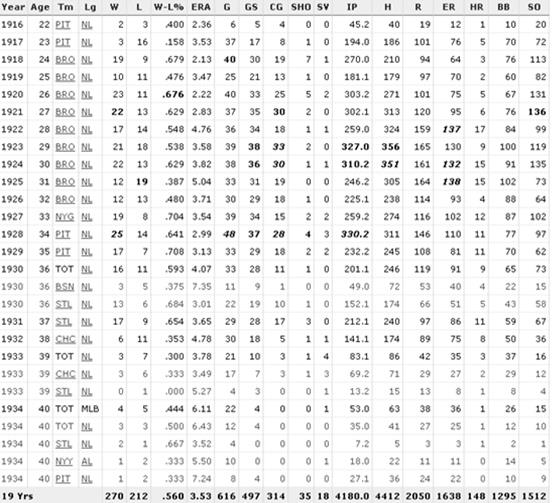
Louis Cardinals from 1930-1931. With the Pirates in 1928, he put up a 25–14 record, posting the most wins, complete games, shutouts, and innings pitched of any NL pitcher. In the 1931
World Series, despite suffering a dislocated vertebra before Game 7, Grimes pitched 8+1⁄3 innings, earning the win to clinch the series victory for the Cardinals. He was traded to the Chicago Cubs before the 1932 season in exchange for Hack Wilson and Bud Teachout. He returned to the Cardinals in 1933 and 1934, then moved to the Pirates and the New York Yankees the same concluding year.
His final win–loss record was 270–212, with an earned run average of 3.53, and 1,512 strikeouts. Grimes was a very good hitting pitcher in his major league career, posting a .248
batting average, 380 for 1535. In four World Series appearances he hit .316, 6 for 19.
At the time of his retirement, he was the last player who was legally allowed to throw a spitball, as he was one of 17
Baseball Trailblazers Page 684
spitballers permitted to throw the pitch after it was otherwise outlawed in 1920. Baseball historian Frank Russo called him
"baseball's most aggressive spitballer." Grimes had acquired a lasting field reputation for his temperament. He was known for wanting to win in any way possible. Prior to a game against the Giants late in 1924, Grimes organized a team meeting and said,
"Anyone who doesn't want to play today's game to win, let me know right now." Then, on his first pitch, he knocked down a Giant. He is listed in the Baseball Hall of Shame series for having thrown a ball at the batter in the on deck circle. The only two batters Grimes apparently could not intimidate were Hall of Famers Frankie Frisch and Paul Waner. If Grimes threw a close pitch to them, the batters usually followed it up with a hard hit line drive. Grimes's friends and supporters note that he was consistently a kind man when off the diamond. Others claim he showed a greedy attitude to many people who 'got on his bad side.' He would speak mainly only to his best friend Ivy Olson in the dugout, and would pitch only to a man named Mathias Schroeder before games. Schroeder's identity was not well known among many Dodger players, as many say he was just “a nice guy from the neighborhood.” Dodger manager Wilbert Robinson did not get along well with Grimes, using a clubhouse attendant to tell Grimes when he pitched so that he could talk to Grimes as little as possible. Grimes had a total of 36 Major League teammates who
Baseball Trailblazers Page 685
would later be elected to the Hall of Fame. No other Hall of Famer had more Hall of Fame teammates.
Grimes moved to the minor leagues in 1935 as a player-manager for the Bloomington Bloomers of the Illinois–Indiana–Iowa League. He started 21 games for the team, recording a 2.34 ERA and a 10–5 record. He did not pitch again after that season, moving on to manage the Louisville Colonels of the American Association.
Grimes was the manager of the Dodgers in 1937–38. He followed Casey Stengel's term as Dodgers manager. He compiled a two year record of 131-171, .434, with his teams finishing sixth and seventh respectively in the National League. Babe Ruth was one of Grimes's coaches. Leo Durocher was the team's shortstop in 1937 and a coach in 1938. When Grimes was fired by general manager Larry MacPhail after the 1938 season, Durocher was hired to replace him. MacPhail said the team's morale had not been right for a long period of time. Grimes remained in baseball for many years as a minor league manager and a scout. He scouted for the Yankees, Athletics, and Orioles.
He managed the Toronto Maple Leafs of the International League from 1942 to 1944, and again in 1952 and 1953, winning the pennant in 1943. As a scout with the Baltimore Orioles, Grimes
Baseball Trailblazers Page 686
discovered Jim Palmer and Dave McNally. Grimes also assisted in managing the Independence Yankees in Independence, Kansas in 1948 and 1949, where Mickey Mantle started his professional career in 1949.
Grimes died following a protracted battle with cancer at age 92
on December 6, 1985, in Clear Lake, Wisconsin. His wife Lillian survived him.
Baseball Trailblazers
Page 687
Arky Vaughan

Baseball Trailblazers
Page 688
Joseph Floyd "Arky" Vaughan, March 9, 1912 – August 30, 1952, was a professional baseball player. He played 14 seasons in major league baseball between 1932 and 1948 for the Pittsburgh Pirates and Brooklyn Dodgers, primarily as a shortstop. He was elected to the National Baseball Hall of Fame in 1985.
Born in Clifty, Arkansas, Vaughan got his nickname early in life, despite leaving Arkansas before his first birthday. He
Baseball Trailblazers Page 689
made his professional debut in 1931 at age 19 for the minor league Wichita Aviators of the Western League, where he hit .338
with 21 home runs. When the Aviators became affiliated with the Chicago Cubs after the season, Vaughan was acquired by the Tulsa Oilers, who were affiliated with the Pittsburgh Pirates. On April 7, 1932, Vaughan was acquired from the Oilers by the Pirates.
Vaughan began the 1932 season as the backup to the Pirates'
starting shortstop, Tommy Thevenow. Through the first thirteen games of the season, Vaughan appeared only twice, once as a late game replacement for Thevenow and once as a pinch hitter.
However, Thevenow was still suffering the effects of a season ending ankle injury he had suffered in 1931, which opened up the door for Vaughan to take over the job. When Thevenow returned at the end of May after missing a month, he found himself in a reserve role.
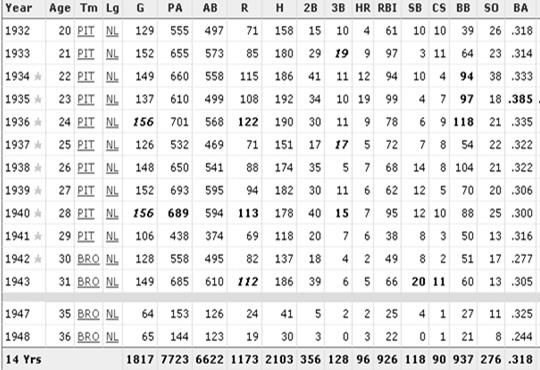
Vaughan, who was the youngest player in the National League in 1932, wound up playing 129 games overall that year, all but one at shortstop. He finished with a .318 batting average and 61 RBI in his rookie season. His defense was a bit shaky, though, as he led the league in errors with 46. His year was impressive enough to garner a modicum of support for Most Valuable Player, finishing 23rd in the voting.
Baseball Trailblazers Page 690
Vaughan solidified his position as the Pirates' starting shortstop in 1933. Improving on almost all of his offensive statistics, Vaughan played in 152 games, batting .314 with 97
RBI, seventh and fifth best in the NL respectively. He also led the league with 19 triples. He finished in the league top five in on base percentage, slugging percentage, and walks. Although he led the league in errors again with an identical 46 to the previous year, due to his increased playing time his fielding percentage improved a bit from .934 to .945. For the second straight year, he finished 23rd in the MVP voting.
Vaughan took his game up another notch in 1934. While finishing fourth in the race for the batting title at .333, he led the league in on base percentage at .431, helped by his league leading walk total of 94. Although he dropped from fifth to sixth in slugging, the raw number improved to .511. His performance earned him a spot on the NL All-Star team, the first of what would be nine straight selections. His defense continued to improve as well, as his error total dropped to 41, no longer the most in the league, and his fielding percentage rose again to .951. For the third straight year, he finished 23rd in the MVP voting.
In 1935, Vaughan had what is universally recognized as his best season. Vaughan not only posted career bests in the three Triple
Baseball Trailblazers Page 691
Crown categories, as he led all of baseball with a .385 average, and a .491 on base percentage. His .607 slugging percentage led the NL, as did his 97 walks. His 19 home runs were eighth in the league, his only time in the top ten, and his 99 RBI were sixth.
Defensively, he finished in the top half of the league in fielding percentage for the first time while finishing second in both putouts and assists. Although he was third in National League MVP voting behind Gabby Hartnett and Dizzy Dean, he was named Player of the Year by The Sporting News. The season has been called the best ever by a shortstop other than Honus Wagner.
Over the next six seasons, Vaughan continued to be one of the best hitting shortstops in the game, batting over .300 in every season, and regularly being at or near the top of the league in most offensive categories. He also continued to improve defensively, as he led the league in total chances in 1938–39
while finishing in the top three in fielding percentage four times. He again finished third in the MVP voting in 1938, when the Pirates finished second and had their best record during his tenure with the team.
In 1940, Vaughan was appointed team captain by new manager Frankie Frisch. Although he led the league in runs scored and triples again, he slumped to a career low .300 batting average.
Baseball Trailblazers Page 692
This prompted Frisch to replace Vaughan as starting shortstop with Alf Anderson to start the 1941 season. However, Anderson didn't hit, and Vaughan was quickly back in the starting lineup.
In the 1941 All-Star Game, Vaughan hit two home runs. Vaughan finished the year batting .316 in 106 games. That would be his last year with the Pirates who wouldn't see a star as bright as Vaughan for almost two decades. The fans were outraged at his trade to Brooklyn and his mysterious death years later helped coin the phrase "The Ghost of Arky" when times got tough.
On December 12, 1941, after a decade as the Pirates' starting shortstop, Vaughan was traded to the Brooklyn Dodgers for Pete Coscarart, Luke Hamlin, Babe Phelps, and Jimmy Wasdell. It is believed that this trade was in part prompted due to bad feelings between Vaughan and Frisch. Since Pee Wee Reese was already at shortstop for the Dodgers, the plan was to move Vaughan to third base.
Vaughan's tenure with the Dodgers got off to a rough start, as he failed to hit .300 for the first time in his career, finishing at .277 with just two home runs. He also established new lows in several other categories, including a career worst on base percentage. He still managed to make the All-Star team as the starter at third base, and actually finished third in the
Baseball Trailblazers Page 693
league in fielding percentage, but the season was a disappointment overall.
With Reese drafted into World War II, Vaughan was moved back to shortstop in 1943. He rebounded on offense, raising his average over .300 once again at .305 and leading the league in runs scored and, for the first and only time, stolen bases with 20.
However, the season was marred by an incident that would nearly lead to the end of Vaughan's career. During the season, temperamental manager Leo Durocher got into a confrontation with pitcher Bobo Newsom after Newsom complained about catcher Bobby Bragan dropping a third strike. On July 10, after Newsom had been suspended for three games, Vaughan threatened to leave the team, handing his uniform to Durocher for disposal. After Vaughan's display, only two players were willing to play for Durocher that day, but upper management intervened. After the season, he left the team, retiring to his ranch. He went on to sit out the next three years.
After Durocher was suspended before the 1947 season, Vaughan decided to try a comeback. Serving as something of a utility player, Vaughan played in 64 games and batted .325. He played in his only World Series that season, which the Dodgers lost to the New York Yankees. Vaughan appeared in three games in the 1947
Baseball Trailblazers Page 694
World Series, all as a pinch hitter, reaching base twice on a walk and a double.
Even with Durocher's suspension over, Vaughan returned to the Dodgers in a similar capacity in 1948. However, after batting a career low .244 in 65 games, he was released at the end of the season. He played the 1949 season with Pacific Coast League's San Francisco Seals before retiring for good.
Vaughan retired with 1,173 runs scored, 96 home runs, 926 RBI, 118 steals, a .318 batting average, a .406 on base percentage and a .453 slugging percentage. In 14 seasons, he hit .300 or better 12 times, only missing the mark in 1942 and 1948.
Vaughan was inducted into the National Baseball Hall of Fame in 1985. Vaughan married his wife, Margaret, in 1931, and they had four children. After leaving the Seals, Vaughan bought a ranch in Eagleville, California, where he retired to fish, hunt and tend cattle. On August 30, 1952, Vaughan was fishing in nearby Lost Lake, with his friend Bill Wimer. According to a witness, Wimer stood up in the boat, causing it to capsize, and both men drowned. Their bodies were recovered the next day. Vaughan was 40.
Baseball Trailblazers
Page 695
Lefty Grove
Baseball Trailblazers
Page 696
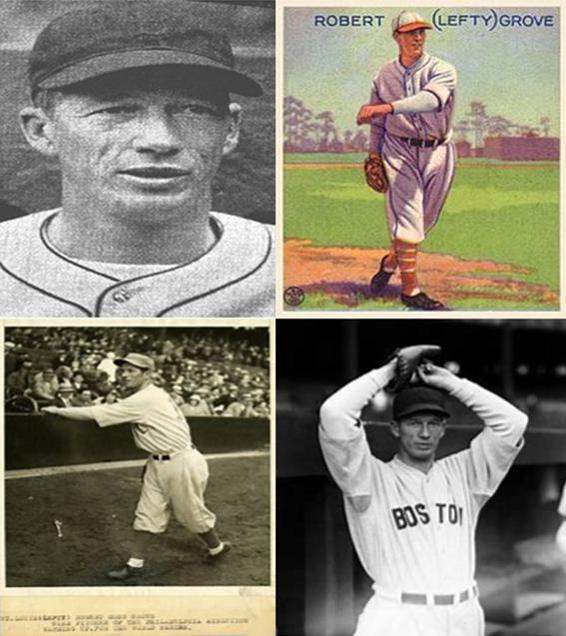
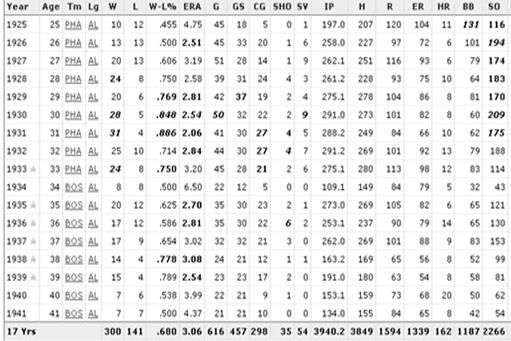
Robert Moses "Lefty" Grove, March 6, 1900 – May 22, 1975, was a professional baseball pitcher. After having success in the minor leagues during the early 1920s, Grove became a star in major league baseball with the American League's Philadelphia Athletics and Boston Red Sox. One of the greatest pitchers in history, Grove led the American League in wins in four separate
Baseball Trailblazers Page 697
seasons, in strikeouts seven years in a row, and had the league's lowest earned run average a record nine times. Over the course of the three years from 1929 to 1931, he twice won the pitcher's Triple Crown, leading the league in wins, strikeouts, and ERA, while amassing a 79–15 record and leading the Athletics to three straight AL championships. Overall, Grove won 300 games in his 17 year career.
Grove was born in Lonaconing, Maryland, one of eight children of John Robert Grove, 1865–1957, and Emma Catherine Beeman 1872–
1959. His father and brothers mined coal.
Grove was a sandlot star in the Baltimore area during the 1910s.
Grove didn't play organized baseball until he was 19 years old.
He purportedly gained the ability to throw hard by hurling rocks. In 1920, he made his professional debut with the Martinsburg Mountaineers of the class D Blue Ridge League, where he appeared in six games. In 59 innings pitched, Grove gave up just 30 hits, and he had an earned run average of 1.68. His performance attracted the attention of Jack Dunn, Sr., the manager/owner of the minor league Baltimore Orioles, who also discovered Babe Ruth. Dunn acquired his services by giving Martinsburg enough cash to replace their center field wall.
Baseball Trailblazers Page 698
Grove joined the Baltimore Orioles in 1920, while they were playing a half century in the minor leagues of first the old Eastern League, 1903–1914, and then after 1916, in the reorganized International League of AAA ball. Grove broke into the team's pitching rotation at midseason and had a 12–2 record the rest of the way. The Orioles were in the middle of winning six straight IL titles from 1919 to 1925. Over the next four seasons, Grove posted marks of 25–10, 18–8, 27–10 and 26–6, leading the International League in strikeouts each season.
Grove remained in the minor leagues through 1924, as owner Jack Dunn refused several offers from the majors to acquire him. At the time, the Orioles were an independent operation with no major league affiliation and the International League had declared its players not subject to a major league draft. Since the reserve clause in all contracts was honored throughout organized baseball, this meant that Grove had no way to reach the majors until the Orioles became willing to trade or sell his contract. Knowing he had such a talented pitcher in Grove, Dunn kept his contract until 1925, when he finally agreed to sell Grove's rights to Connie Mack and his Philadelphia Athletics in the American League for $100,600, the highest amount ever paid for a player at the time.
Baseball Trailblazers Page 699
Grove battled injuries as a major league rookie and posted a 10–
12 mark, which would prove to be his only losing record in 17
major league seasons. He led the league in strikeouts but posted a high 4.75 ERA. Grove then settled down in 1926 and won the first of a record nine earned run average titles with a mark of 2.51. In 1927, Grove won 20 games for the first time, and a year later he tied George Pipgras for the AL lead in wins with 24.
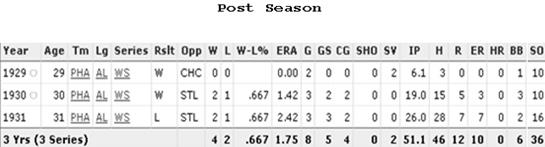
The Athletics won the AL pennant in three successive seasons from 1929 to 1931, as well as consecutive World Series championships in 1929 and 1930. During the Athletics'
championship run, Grove led the way as the league's top pitcher, posting records of 20–6, 28–5 and 31–4. In 1931, Grove led the league in wins, ERA, strikeouts, winning percentage, complete games, and shutouts. His 2.06 ERA was 2.32 runs below the league average. He was also chosen as league MVP in 1931, making him one of only a handful of pitchers to achieve this honor.
During the 1931 season, Grove tied Smokey Joe Wood's and Walter Johnson's AL record with 16 straight wins. He was attempting to win his 17th straight decision when a rookie outfielder filling in for Al Simmons, who had the day off, committed an error that led to the only run of the game. Grove stated; "After that game I went in and tore the clubhouse up. Wrecked the place. Tore
Baseball Trailblazers Page 700
those stall lockers off the wall, giving Al Simmons hell all the while." He followed the loss with eight straight wins.
The Athletics contended for the next two seasons, but finished second to the New York Yankees in 1932 and third behind the Washington Senators and Yankees in 1933. On December 12, 1933, team owner Connie Mack traded Grove, along with Max Bishop and Rube Walberg, to the Boston Red Sox for Bob Kline, Rabbit Warstler and $125,000.
Grove was unable to contribute substantially during his first year in Boston, an arm injury holding him to an 8–8 record. In 1935, however, Grove returned to form with a 20–12 record and a league leading 2.70 ERA. In the 1936 season, he had a 2.81 ERA, winning his 7th ERA title, while recording a 17–12 record and 130 strikeouts. Grove won his eighth ERA title a year later while having a 17–9 record along with 153 strikeouts. He pitched 262 innings for the season. This was his 11th and final season where he pitched over 200 innings. Grove continued to post outstanding records, including 14–4 in 1938 and 15–4 in 1939, as well as lead the AL in ERA four times between 1935 and 1939. He had a 7–6 record in 1940 while recording a 3.99 ERA with 62
strikeouts in 153 innings. In his last season, he won and lost 7
games, winning his 300th game on July 25, giving up 6 runs on 12
hits, but winning 10–6, before losing his last three major
Baseball Trailblazers Page 701
league games, ending his career on September 28, pitching just one inning in the 2nd game of a doubleheader.
Grove married his childhood sweetheart, Ethel Gardner, in 1921.
They had two children, Robert and Doris. The couple would later divorce after Grove had an affair with another woman. Grove was elected to the town council in his native Lonaconing in the 1950s and also served as the town's police chief. During off seasons and after retiring, Grove operated a bowling alley there. Grove befriended a sandlot baseball team whose games he passed on the way home from major league baseball games, purchasing new jerseys and equipment for the team. He often donated equipment to local youth baseball players in his retirement.
Grove retired in 1941 with a career record of 300–141. His .680
lifetime winning percentage is eighth all-time. However, none of the seven men ahead of him won more than 236 games. His lifetime ERA of 3.06, when normalized to overall league ERA and adjusted for the parks in which Grove played during his career, is fifth all-time among pitchers with at least 1,000 innings pitched.
Grove was elected to the National Baseball Hall of Fame in 1947.
He died in Norwalk, Ohio, of a heart attack while watching a
Baseball Trailblazers Page 702
televised baseball game at his daughter-in-law's home on May 22, 1975.
Baseball Trailblazers
Page 703
Bill Terry
Baseball Trailblazers
Page 704
William Harold Terry, October 30, 1898 - January 9, 1989, was a major league baseball first baseman and manager. Nicknamed
"Memphis Bill," he is most remembered for being the last National League player to hit .400, a feat he accomplished by batting .401 in 1930.
Born in Atlanta, Terry made his professional baseball debut in 1915 at the age of 16. He began his career as a pitcher, playing
Baseball Trailblazers Page 705
for two separate minor league teams, the Newnan Cowetas of the Georgia-Alabama League and the Dothan club of the FLAG League.
With Newnan, he had a win-loss record of 7-1, with a 0.60 earned run average in eight games.
After starting 1916 with Newnan, by the end of the year he had moved up to the class B Shreveport Gassers of the Texas League.
He again compiled impressive statistics for his new team, putting up a record of 6-2 with a 1.07 earned run average in 11
games. Terry spent all of 1917 with Shreveport, with a record of 14-11 and an earned run average of 3.00. By this time, he was also beginning to play more in the field, pitching in 40 games and appearing in 55 other games.
After spending several years playing semi-professionally, Terry was picked up by the Toledo Mud Hens of the American Association in 1922. He was now playing in double A, the highest minor league level at that time. While he was still pitching, putting up a 9-9 record in 26 games, his hitting was also starting to pick up. In 88 games with Toledo, Terry batted .336 with 14 home runs.
In 1923, Terry had been converted into a full-time first baseman. In 109 games with Toledo that year, Terry batted .377
with 15 home runs. This gained the notice of the major league
Baseball Trailblazers Page 706
New York Giants, and on September 18 they purchased his contract from the Mud Hens. In an interesting coincidence, Freddie Lindstrom, another future Hall of Fame player, was also purchased by the Giants from the Mud Hens on the same day.
Terry made his major league debut with the Giants on September 24, 1923 in a game against the Cincinnati Reds. In that game, he pinch hit for Giants pitcher Rosy Ryan, going 0 for 1. Terry did not play again until September 30, when he made his first appearance in the starting lineup against the Boston Braves.
Terry got his first major league hit in that game, going 1 for 3
and scoring his first major league run. Terry finished the season with one hit in seven at bats in three games.
Terry played all of 1924 with the Giants, backing up fellow future Hall of Famer George Kelly at first base for the pennant winning team. Terry played in 77 games, 35 at first base and the rest as a pinch hitter. He batted .239 with 5 home runs and 24
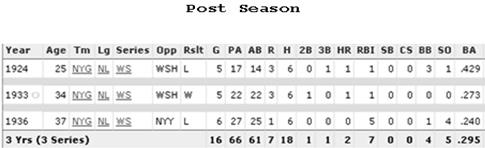
runs batted in. In the World Series against the Washington Senators, he batted .429, including a game 1 home run off Walter Johnson.
In 1925, Giants starting third baseman Heinie Groh suffered an injury early in the season, forcing the team to juggle its lineup a bit. Starting second baseman Frankie Frisch was tried
Baseball Trailblazers Page 707
at third but wound up spending most of the season shifting around the infield when Lindstrom was made the starter. Kelly was moved from first base to second, and Terry was installed as the starting first baseman. He hit .319 in 133 games, with 11
homers and 70 runs batted in.
In 1926, with Lindstrom established as the starter at third, Frisch was reinstated at second and Kelly moved back to first, sending Terry back into a reserve role. In addition to backing up Kelly, Terry played in 14 games in the outfield. This was the only season in which he played more than one game at a position other than first base. Overall, Terry played 98 games, batting
.289 with 5 home runs and 43 runs batted in.
During the following offseason, the Giants made some major changes to their starting lineup. On December 20, 1926, they traded Frisch and pitcher Jimmy Ring to the St. Louis Cardinals for Rogers Hornsby. Then, on February 9, they traded Kelly to the Reds for outfielder Edd Roush, opening a spot once more for Terry in the starting lineup. Terry batted .326 in 1927, with 20
home runs and 121 runs batted in. He finished 13th in the voting for the Most Valuable Player Award, and his days of being a backup were behind him for good.
Baseball Trailblazers Page 708
Over the next two seasons, Terry continued to produce for the Giants, batting .326 again in 1928 with 101 runs batted in, and then .372 in 1929 with 117 runs batted in. In both years, he finished in the top ten in the National League in a number of statistical categories and in 1929 he finished third in the Most Valuable Player Award voting. This led to what is generally considered Terry's best season ever, 1930.
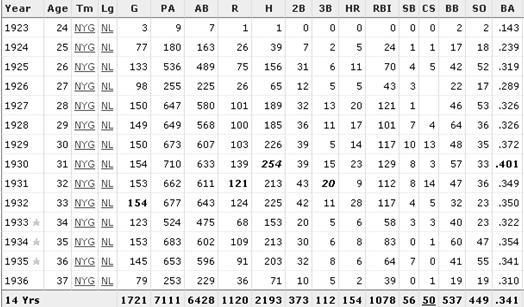
In 1930, Terry had an historic season. He finished first in the National League with a .401 batting average, the first player to hit over .400 since Rogers Hornsby in 1925. It is also the last time to date that anyone in the National League has hit .400.
Only Ted Williams of the American League's Boston Red Sox in 1941 has hit .400 since. Terry also led the league with 254
hits, which is tied for the most in NL history with the Phillies' Lefty O'Doul. He also finished 5th in the league in on-base percentage - .452, 7th in slugging percentage -.619, 6th in runs scored with 139 runs, and led the league in putouts and assists by a first baseman. While there was no official league most valuable player award in 1930, Terry won “The Sporting News” Most Valuable Player Award.
While Terry never again reached the lofty heights of 1930, he had another excellent season in 1931. He led the league in runs scored with 121 and in triples with 20 while batting .349 with
Baseball Trailblazers Page 709
112 runs batted in, and he finished third in the new “Baseball Writers' Association of America” National League Most Valuable Player Award voting. In 1932, Terry set his career high in home runs with 28, batting .350 with 117 runs batted in. He was also named the team's manager in early June, replacing the legendary John McGraw. The team finished in sixth place, going 55-59.
In 1933, Terry's first full season as manager, the team won the National League pennant and the World Series. Although, as a player, Terry missed a month early in the season with an injury, he still hit .322. It was also the first season of the All Star Game, for which Terry was chosen as a starter and in which he got two hits. The Giants once again faced the Senators in the 1933 World Series, which they won four games to one. Terry went 6 for 22, hitting a home run in game 4 off Monte Weaver. Terry finished fourth in the MVP voting, perhaps gaining votes for managing the team to the championship, the Giants' first since 1922, the year before Terry's major league baseball debut.
In 1934 Terry came back to put up big numbers once more, finishing second in the NL in batting at .354 and in hits with 213 while finishing seventh in the Most Valuable Player Award voting. Terry managed the team to a second place finish, just two games behind the pennant winning St. Louis Cardinals
"Gashouse Gang." In 1935, Terry again got over 200 hits with
Baseball Trailblazers Page 710
203, and batted .341 while finishing sixth in the Most Valuable Player Award voting, and managed the team to a third place finish. In both years he was again selected to start in the All-Star game. As manager, Terry became an advocate of platooning, as Hank Leiber and Jimmy Ripple split playing time in center field.
1936 was Terry's last year as a player. Before the season started, the team had purchased Sam Leslie from the Brooklyn Dodgers, and Terry the manager split time with the newcomer, with Leslie getting the lion's share. It worked out well for the team, as they again won the pennant, beating the Cardinals by five games. In the World Series, Terry started all six games, but batted just .240 with no extra base hits. He had five runs batted in, but that was not enough, as the Giants lost to the New York Yankees, four games to two.
Terry continued to manage the Giants until 1941. He also held the title of general manager of the Giants from September 7, 1937, through the end of the 1942 season. The Giants won another pennant in 1937, but they lost another World Series to the New York Yankees, four games to one. The team finished third in 1938, but never again finished in the first division under Terry, finishing fifth, sixth, and fifth in his last three years as manager.
Baseball Trailblazers Page 711
After retiring from playing and managing, Terry settled in Jacksonville, Florida, where he owned a successful Buick automobile dealership and purchased the Jacksonville Braves double A team in 1958. He died there January 9, 1989 at age 90.
Over his 14 year career, Terry posted seven seasons with 100 or more runs, six seasons with 100 or more runs batted in, six seasons with at least 200 hits, and nine consecutive seasons batting .320 or higher, from 1927 through 1935. Additionally he posted three seasons with at least 20 home runs, including a career high of 28 in 1932. Terry retired with 1120 runs scored, 154 home runs, 1078 runs batted in and a .341 batting average, the highest career batting average for a left handed hitter in the National League history. Terry was also one of the best fielding first baseman of his era, compiling a career .992
fielding percentage.
Baseball Trailblazers
Page 712
Bobby Mathews
Baseball Trailblazers
Page 713
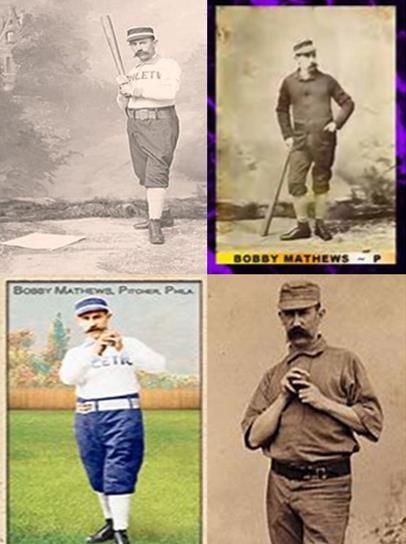
Robert T. Mathews, November 21, 1851 – April 17, 1898, was a right handed professional baseball pitcher who played in the National Association of Professional Base Ball Players, the National League of Major League Baseball and the American Association for twenty years beginning in the late 1860s. He is credited as being one of the inventors of the spitball pitch, which was rediscovered or reintroduced to the major leagues after he died. He is also credited with the first legal pitch which broke away from the batter. He is listed as having been 5
feet 5 inches tall and 140 pounds, which is small for a pro athlete even in his time, when the average height of an American male in the mid-19th century was 5 foot 7.
Baseball Trailblazers Page 714
Mathews was born in 1851, in Baltimore, Maryland, and he played as a teenager with the Maryland club of that city, and he made the team a dangerous one. Mathews began his career at the age of 16 for the Marylands of Baltimore, a junior club, in 1868. A year later, he moved to the senior club, and the following year the club declared themselves professional, resulting in the creation of the National Association of Base Ball Players. On August 19, he made his first start in the league against the Orientals of New York, winning 28-15. For the 1871 season, he and some other Maryland players signed with the Fort Wayne Kekiongas. On May 4, 1871 in Fort Wayne, Indiana, he pitched a shutout in the inaugural game of the National Association of Professional Base Ball Players, the first professional league.
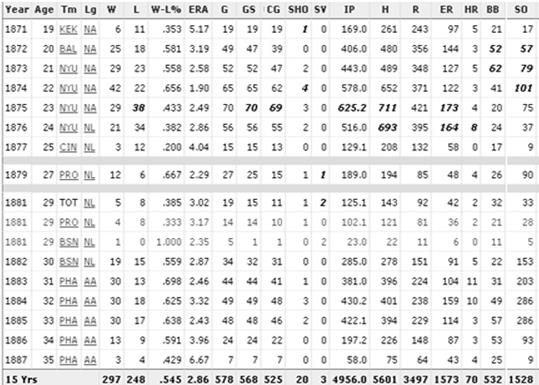
In his first season, he went 6-11 in 19 complete games and 169
innings, with a 5.17 ERA, 17 strikeouts and 21 walks. In the following season, now playing for the Baltimore Canaries, he rebounded with a 25-18 record in 49 games, while pitching 39
complete games, in 406 innings while having a 3.19 ERA, 52 walks and 57 strikeouts, the latter being a league high. He appeared as a batter in 19 games for 89 at bats, batting .270 with 10
RBIs and a .612 OPS, with the latter two being career highs.
Mathews went to the New York Mutuals alongside teammate Dick Higham after the season ended.
Baseball Trailblazers Page 715
In 1873, he played in 52 out of the 53 games the team played for the season, while pitching 47 complete games, going 29-23 with a 2.58 ERA in 443 innings with 79 strikeouts, although the team finished 4th. One notable game was on July 3, when he allowed only two hits in a six inning rain-shortened game against Washington while scoring a run on a triple in a 2-1 win.
For 1874, he pitched in all 65 games of the season for the Mutuals, 62 complete games, and 578 innings while having a 42-22
record and a 1.90 ERA, a career low, and 101 strikeouts, although the Mutuals finished 2nd place to the Boston Red Stockings. On June 18, he pitched in a 38-1 victory over Chicago while allowing two hits in a game with severe wind conditions.
For 1875, he pitched in 70 out of 71 of New York's games, while having 69 complete matches, in the final year in the NA.
However, he went 29-38 with a 2.49 ERA on 625 innings with 75
strikeouts. He led the league in complete games, starts, and innings pitched. He appeared in a career high 70 games as a batter, making 264 at bats and garnering 48 hits and 15 RBIs for a .182 batting average and a .188 OBP. He pitched a one hitter on May 22 in a 4-0 win over Brooklyn in which he faced just 28
batters on no errors. Overall, he went 131-112 in the NA, with his wins being third most in the league behind Albert Spalding
Baseball Trailblazers Page 716
and Dick McBride. He led the Association in career amount of strikeouts and strikeouts per nine innings.
For 1876, he played in 56 out of 57 games for the Mutuals while going 21-34 with a 2.86 ERA with 55 complete games and 516
innings while having 37 strikeouts. During the season, he turned over a telegram that was sent from a gambler, with a sting being set up to try and lure more out of the gambler, with the results being published in the “New York Herald” to try and discourage any more game fixings. In his three years with New York, he had gone 100-83 with a 2.31 ERA on 1,646 innings, with 266
strikeouts.
The dissolving of the Mutuals meant that Mathews joined the Cincinnati Reds for 1877. His season went terribly, going 3-12
in 15 games with a 4.04 ERA in 129 innings pitched with 9
strikeouts. After the season, he joined a team in Janesville in the League Alliance. For 1878, he bounced around between the independent Brooklyn Chelseas and Worcester, a member of the International Association. He was plagued by drunkenness, which led to him being expelled from the latter team in July, and he was replaced by Bud Fowler. He went 8-12 before Worcester left the league. Along with other members, they played as the Baltimore Waverlys for a few games. On October 15, he signed
Baseball Trailblazers Page 717
with the Providence Grays, joining the club in June of the 1879
season.
In 27 games played for the Grays, with 15 complete ones pitched, he went 12-6 with a 2.29 ERA in 189 innings pitched, getting 90
strikeouts. He additionally played 21 games for the Grays as an outfielder, logging in 182 innings with 17 putouts, five assists, and seven errors with one double play turned on a .759
fielding percentage. On June 27, he hit a home run off Boston pitcher Tommy Bond, his only career home run. The Grays won the National League pennant that year, doing so by five games over the Boston Red Caps.
After a short stint in the Pacific League with the San Francisco Stars, he signed back with Providence prior to the 1881 season.
In 14 starts, he went 4-8 with a 3.17 ERA in 102 innings with 28
strikeouts. He was released mid-way through the season due to problems with drinking that troubled the club. He joined Boston not long after, serving time as an outfielder in 18 games and a pitcher for five games, four in relief. He won the only game he started for the team. Ultimately, he threw just 23 innings while getting two saves and five strikeouts.
For 1882, he participated in 34 games as a pitcher, going 19-15
with a 2.87 ERA, throwing 31 complete games in 285 innings with
Baseball Trailblazers Page 718
153 strikeouts, that strikeout total being the most in his career thus far. He joined the Philadelphia Athletics in the American Association the following year. He returned to form, going 30-13 with a 2.46 ERA in 44 games pitched while having 41
complete games with 381 innings pitched while striking out 203
batters. The team won the pennant that year over St. Louis by one game. He went 30-18 with a 3.32 ERA in 49 games the following year, throwing 430 innings with 286 strikeouts. The next year, he won 30 games again while losing only 17 in 48
starts with a 2.43 ERA in 422 innings pitched, striking out 286
batters. He served as coach for the pitchers at the University of Pennsylvania in 1886 while playing with the Athletics. Arm trouble diminished his season, as he pitched in just 24 games while going 13-9 with a 3.96 ERA in 197 innings, with 93
strikeouts. 1887 was his final year in the leagues. He started it by holding out in the spring to get the money back that had been deducted the earlier year for ineffectiveness. They agreed to a deal that would give him a $2,650 salary, but his arm was diminished. His seven appearances as a pitcher were spread out over the season. He went 3-4 with a 6.67 ERA while pitching only 58 innings with nine strikeouts. In his final game on October 10, he pitched a 7-5 loss to the Brooklyn Trolley Dodgers. For 1888, his attempts to try and get back on the team failed, although he did serve as coach for the team's pitchers and
Baseball Trailblazers Page 719
played on the reserve squad. In his five years with the club, he had gone 106-61 with a 3.06 ERA while pitching 1,489innings, garnering 877 strikeouts.
Over his 16 year career, he had 297 wins, 248 losses, 525
complete games, and a career earned run average of 2.86. He had 1,528 strikeouts compared with 532 walks. He won 20 games 8
times, including 42 in 1874 with the New York Mutuals of the National Association, and is the only player to win 50 games or to pitch 100 games in each of three major leagues. He is the 25th winningest pitcher in major league baseball history.
Mathews died in 1898 in Baltimore, at the age of 46, of paresis caused by syphilis.
Baseball Trailblazers
Page 720
Joe Cronin
Baseball Trailblazers
Page 721
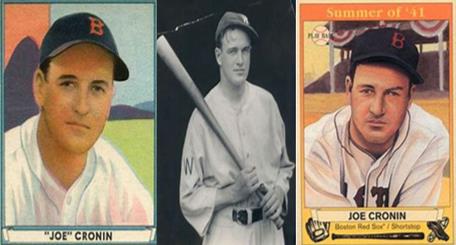
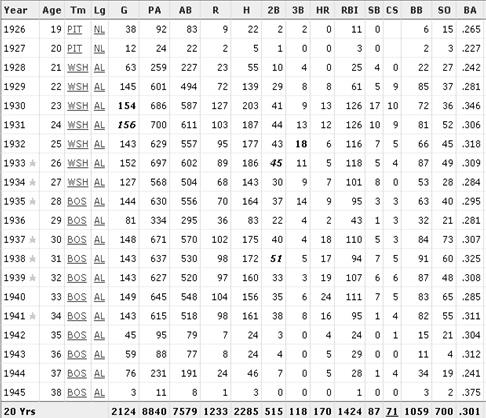
Joseph Edward Cronin, October 12, 1906 - September 7, 1984, was a professional baseball player, manager and executive, who played in major league baseball as a shortstop, most notably as a member of the Boston Red Sox. Cronin spent over 48 years in baseball, culminating with 14 years as president of the American League.
Cronin was born in Excelsior District of San Francisco, California. The 1906 San Francisco earthquake had cost his Irish Catholic parents almost all of their possessions. Cronin attended Sacred Heart High School. He played several sports as a child and he won a city tennis championship for his age group when he was 14. As he was not greatly interested in school, Cronin's grades improved only when the San Francisco Seals of the Pacific Coast League began giving away tickets to students with good conduct and attendance. At the time, the nearest major league baseball team was nearly 2,000 miles from San Francisco.
Baseball Trailblazers Page 722
Baseball promoter Joe Engel, who scouted for the Senators and managed the Chattanooga Lookouts at Engel Stadium, originally signed Cronin. Engel first spotted Cronin playing in Kansas City. "I knew I was watching a great player," Engel said. "I bought Cronin at a time he was hitting .221. When I told Clark Griffith what I had done, he screamed, 'You paid $7,500 for that bum? Well, you didn't buy him for me. You bought him for yourself. He's not my ballplayer; he's yours. You keep him and don't either you or Cronin show up at the ballpark.'"
In 1930, Cronin had a breakout year, batting .346 with 13 home runs and 126 RBI. Cronin won both the AL Writers' MVP and the
“AL Sporting News” MVP. His 1931 season was also outstanding, with him posting a .306 average, 12 home runs, and 126 RBIs.
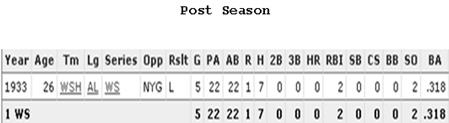
Cronin led the Senators to the 1933 World Series and later married Griffith's niece, Mildred Robertson.
Cronin was named player-manager of the Senators in 1933, a post he would hold for two years. In his first year, he led the Senators to what would be their last pennant in Washington.
While Cronin was on his honeymoon with Mildred in his hometown of San Francisco, he got a message from Griffith that the Boston Red Sox had offered the Senators their starting shortstop, Lyn Lary, in return for Cronin and $250,000. Red Sox owner Tom
Baseball Trailblazers Page 723
Yawkey also offered Cronin a five year contract as player-manager. Well aware of the Senators' perennial financial problems, Cronin accepted the trade. Cronin remained as player-manager of the Red Sox until 1945, then remained solely as manager until 1947.
As early as 1938, it was apparent that Cronin was nearing the end of his playing career. Red Sox farm director Billy Evans thought he had found Cronin's successor in Pee Wee Reese, the star shortstop for the Louisville Colonels of the Triple A American Association. He was so impressed by Reese that he was able to talk Yawkey into buying the Colonels and making them the Red Sox' top farm club. However, when Yawkey and Evans asked Cronin to scout Reese, Cronin realized he was scouting his replacement. Believing that he was still had enough left to be a regular player, Cronin deliberately downplayed Reese's talent and suggested that the Red Sox trade him. Reese was eventually traded to the Brooklyn Dodgers, where he went on to a Hall of Fame career. As it turned out, Evans' and Yawkey's initial concerns about Cronin were valid. His last year as a full-time player was 1941. After that year, he never played more than 76
games on a season.
Even when World War II saw dozens of young players either enlist or be drafted, Cronin limited his playing appearances to cameo
Baseball Trailblazers Page 724
roles as a utility infielder and pinch hitter. On June 17, 1943, Cronin sent himself in to pinch hit in both games of a doubleheader and hit a home run each time.
In April 1945, he broke his leg in a game against the Yankees.
He sat out the remainder of the season, and retired as a player for good at the end of the year.
Over his career, Cronin batted .300 or higher eight times, as well as driving in 100 runs or more eight times. He finished with a .301 average, 170 home runs, and 1,424 RBIs.
As a manager, he compiled a 1,236-1,055 record and won two American League pennants in 1933 and 1946. His 1933 Senators dropped the 1933 World Series to the New York Giants, and his 1946 Red Sox; the franchise's first pennant winner in 28 years; lost the 1946 World Series to the St. Louis Cardinals.
At the end of the 1947 season, Cronin succeeded Eddie Collins as general manager of the Red Sox and held the post for over 11
years, through mid-January 1959. The Red Sox posted winning season records for all but two of Cronin's 11 seasons as general manager.
In January 1959, Cronin was elected president of the American League, the first former player to be so elected and the fourth full-time chief executive in the league's history. When he
Baseball Trailblazers Page 725
replaced the retiring Will Harridge, who became board chairman, Cronin moved the league's headquarters from Chicago to Boston.
Cronin served as AL president until December 31, 1973, when he was succeeded by Lee MacPhail.
In the last months of his life, Cronin struggled with cancer that had invaded his prostate and bones; he suffered a great deal of bone pain as a result. Cronin came to Fenway Park for one of his last public appearances when his jersey number 4 was retired by the Red Sox on May 29, 1984. He died at the age of 77
on September 7, 1984, at his home in Osterville, Massachusetts.
At the number retirement ceremony shortly before Cronin's death, teammate Ted Williams commented on how much he respected Cronin as a father and a man. Cronin was also remembered as a clutch hitter. Manager Connie Mack once commented; "With a man on third and one out, I'd rather have Cronin hitting for me than anybody I've ever seen, and that includes Cobb, Simmons and the rest of them."
Baseball Trailblazers
Page 726
Mickey Welch
Baseball Trailblazers
Page 727
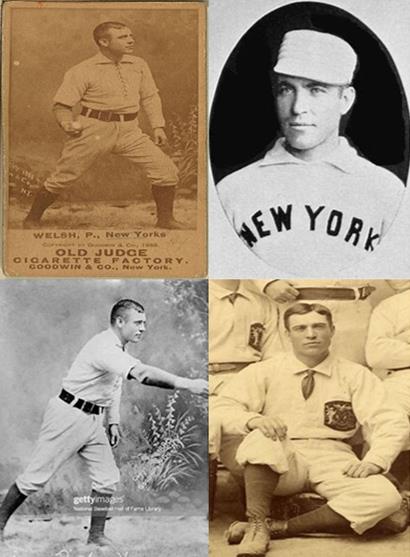
Michael Francis Welch, July 4, 1859 – July 30, 1941, nicknamed
"Smiling Mickey," was a major league baseball pitcher. He stood 5 feet 8 inches tall and weighed 160 pounds. He was the third pitcher to accumulate 300 career victories. Welch played 13
seasons in the major leagues, three with the Troy Trojans, and 10 with the New York Gothams/Giants. He was very successful with
Baseball Trailblazers Page 728
an effective curveball, a change of pace, and a version of the screwball. During his 13 major league seasons, he posted 20 or more wins nine times, seven in succession.
Welch was born Michael Francis Walsh in the 18th Ward of Brooklyn, New York, to Irish immigrant parents John and Mary Walsh. He later adopted the last name Welch. The name change may have been spurred by a sportswriter's mistaken recording of the name in a box score. The new last name may have distinguished him from the high number of men in Brooklyn at the time named Michael Walsh. Off the baseball field, Welch used his birth name throughout his life. Welch's nickname of "Smiling Mickey"
derived from his cheerful disposition.
When he was growing up in the Williamsburg section of Brooklyn, baseball was the popular sport among Irish children. Welch recalled that he had to learn unique baseball skills because of his small size. He depended on strong control of his pitches, a good curveball, change of pace, and a studious approach to opposing batters.
Welch's earliest professional baseball engagement was in Poughkeepsie, New York, as an outfielder-pitcher for the Volunteers baseball club in 1877. In the following year he would briefly play for a club in Auburn before joining the Holyoke
Baseball Trailblazers Page 729
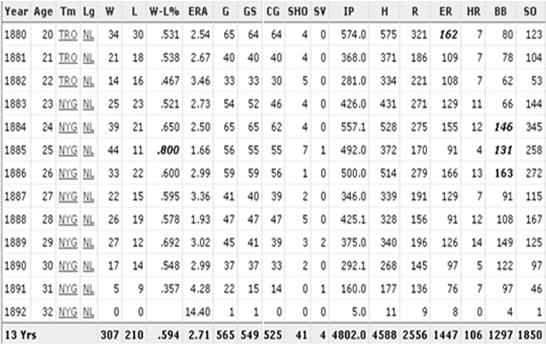
Shamrocks of the National Association. During the 1879 season with the Shamrocks, his pitching resulted in a 23–14 record, during which he was supported by the likes of later major league baseball players Roger Connor, Larry Corcoran, Jerry Dorgan, Peter Gillespie, and Fergy Malone. Welch made his major league debut in 1880. His first game was not very successful, as Troy was defeated 13–1 by the Worcester Ruby Legs. However, he won 34
games for the Troy Trojans, teaming up with Tim Keefe to give Troy a devastating two man starting rotation. On July 6, 1880, he pitched a one hitter against the Cleveland Blues. Welch's totals dipped during the following two seasons, when Keefe, who also went on to win more than 300 games, began getting a greater share of the starts. The duo would only enjoy moderate success over the course of three seasons with the Trojans, a team that never finished higher than fourth in the National League during its four season run.
The Trojans disbanded after the 1882 season, and the New York Gothams replaced them, taking many of the Troy players, including Welch. He resumed a heavy workload in 1883, throwing 426 innings in 54 games. This time he split pitching duties with John Montgomery Ward in what turned out to be Ward's final season as a regular pitcher. In 1884, he went 39–21 with 345
strikeouts and a 2.50 ERA.
Baseball Trailblazers Page 730
Welch holds the record for most consecutive batters struck out to begin a game, with nine, set on August 28, 1884. Only three pitchers in the National League and two in the American League have come close to matching Mickey Welch's record nine strikeouts.
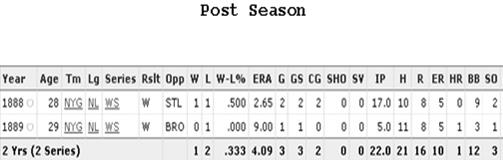
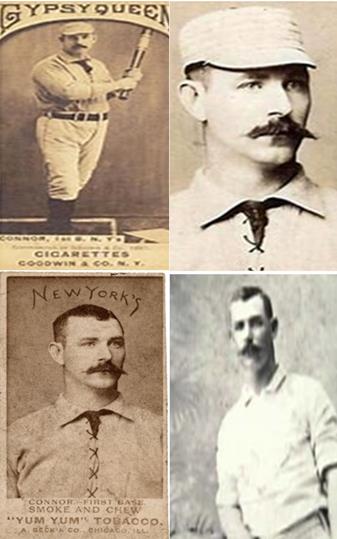
In 1885, he went 44–11 with 258 strikeouts and a 1.66 ERA. In the 1885 season, Welch and Keefe reunited as a two man pitching rotation, with Keefe having a 32–13 win–loss record. The team, now called the Giants, had an incredible record of 85–27, with Welch winning 17 consecutive games at one point, but finished second to the Chicago White Stockings, who finished with a record of 87–25.
Welch had negotiated a clause in his contract, beginning in 1884, that prevented the team from pitching him more than every other day. After the 1885 season, Welch was one of nine Giants players to form baseball's first union, which was known as the Brotherhood of Professional Base Ball Players. The players were upset about the way they had been treated by baseball owners.
The reserve clause, which restricted player movement and tempered increases in player salaries, had been instituted in 1880. The union spent the next several years recruiting new members and talking about the cause of player salaries. Though
Baseball Trailblazers Page 731
Welch was still an active player, he began saving money with the goal of opening a hotel.
In 1886, Welch won 33 games, which was second on the Giants to Keefe's 44 victories. Despite this win total from Welch and Keefe, the team fell to third place in the league. Though they enjoyed a 47–12 record at the Polo Grounds, they were 28–32
while on the road that year. As Keefe and Welch were so overworked by 1887, the Giants picked up young pitchers Bill George and Cannonball Titcomb, but both of them struggled and the Giants finished fourth.
The Giants won the 1889 World Series, but morale was low on the club. Relationships had become strained between players and owners across the league. The league was planning to implement a system of player ratings which would be used to determine player salaries. Welch and the other members of the Brotherhood were outraged by such a system and they began to plan a new baseball league, inviting players to join even if they were not Brotherhood members. The new eight team league became known as the Players' League.
Before the Players' League began its season in 1890, Welch realized that he was coming to the end of his playing career.
Saying that he was in baseball to earn money, Welch agreed to
Baseball Trailblazers Page 732
re-sign with the Giants on a three year contract. Welch said that he had been willing to accept $2,000 less to play in the Players' League, but that deal fell through when the league could only guarantee one year of salary. He met with sharp criticism from Jim O'Rourke and other Brotherhood members, but the Players' League lasted only one season.
On April 24, 1890, with the score tied at 2 in the 7th inning between his Giants and the Boston Beaneaters‚ Welch got into an argument with umpire McDermott, an argument that resulted in the umpire declaring the game forfeited to host Boston. With Welch and Keefe still on the same club, the 1891 New York Giants had two 300 game winners. Until the 1980s, this was the only time that a major league team featured two pitchers with 300 wins each.
After one start in the 1892 season, Welch was sent to the minor leagues, earning a 16–14 record and a 0.87 ERA for the Eastern League's Troy Trojans. He retired from baseball after the season, having compiled 307 victories, 210 losses, 1850
strikeouts and a career 2.71 ERA. He had unique hitting skills for a pitcher, finishing his career with a .224 batting average, 93 doubles, 16 triples and 12 home runs. In addition to his 607
games pitched, Welch made 59 career appearances as an outfielder. Welch attributed his durability to his ability to
Baseball Trailblazers Page 733
get hitters out with slower pitches. His main offerings to hitters were a curveball and a screwball.
Welch did not swear, smoke or drink hard liquor. Welch liked beer enough that he would write poems about it, reciting them for sportswriters or for fans on the carriage ride to the ballpark on game days. Sometimes his poetry also advertised local bars and restaurants. Welch and his wife Mary had nine children, two of which died in infancy. Mary died in 1936.
During his career, Welch, along with most of his Giants teammates, lived at New York's Broadway Central Hotel.
After retiring as a player, Welch lived in Holyoke, Massachusetts. He joined an Elks lodge and remained in the organization for more than 50 years. He owned a saloon for a while and after he sold it, he went into the dairy business with one of his sons. Welch spent summers in New York. He worked as an attendant at the Polo Grounds. In a 1911 book on baseball history, Welch was described as the owner of a hotel in Troy, New York. In 1912, he returned to New York, serving as an usher at the Polo Grounds and captivating fans with tales of his playing days.
Welch and Keefe remained friends long after they retired from baseball. In July 1941, Welch had been staying with his grandson
Baseball Trailblazers Page 734
in Nashua when he had to be taken to a Concord hospital with complications of gangrene of the foot. He died there on July 30
at the age of 82.
Baseball Trailblazers
Page 735
Roger Connor
Baseball Trailblazers
Page 736
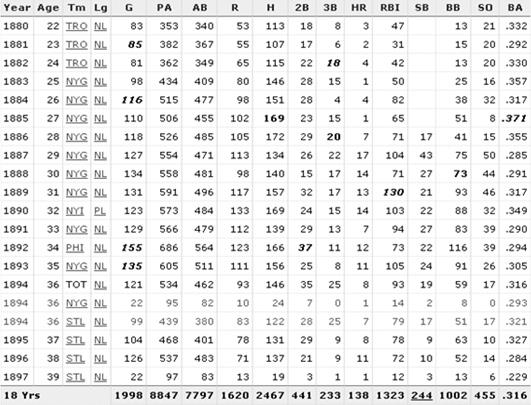
Roger Connor, July 1, 1857 – January 4, 1931, was a 19th century major league baseball player. He played for several teams, but his longest tenure was in New York, where he was responsible for the New York Gothams becoming known as the Giants. He was the player whom Babe Ruth succeeded as the all-time home run
Baseball Trailblazers Page 737
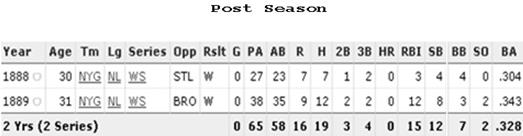
champion. Connor hit 138 home runs during his 18 year career, and his career home run record stood for 23 years after his retirement in 1897.
Connor was born in Waterbury, Connecticut. He was the son of Irish immigrants Mortimer Connor and Catherine Sullivan Connor.
His father had arrived in the United States only five years before Roger's birth. The family lived in the Irish section of Waterbury, known as the Abrigador district, which was separated from the rest of the city by a large granite hill. Connor was the third of eleven children born to the family, though two did not survive childhood. Connor left school around age 12 to work with his father at the local brass works.
Connor entered professional baseball with the Waterbury Monitors of the Eastern League in 1876. Though he was left handed, Connor was initially a third baseman. In early baseball, left handed third basemen were much more common than they are in modern baseball. In 1878 he would transfer to the minor league Holyoke Shamrocks, where he became known for hitting home runs across the field into the Connecticut River. This so impressed Springfield baseball boss Bob Ferguson that he signed Connor onto the National League Troy Trojans when he bought them out in 1880.
Baseball Trailblazers Page 738
In Connor's first year with the Troy Trojans, he teamed with future Hall of Fame players Dan Brouthers, Buck Ewing, Tim Keefe and Mickey Welch, all of whom were just starting their careers.
Also on that 1880 Trojans team, though much older, was player-manager Bob "Death to Flying Things" Ferguson. Though Connor, Ferguson and Welch were regularly in the lineup, the other future stars each played in only a handful of the team's 83
games that season. The team finished in fourth place with a 41–
42 win-loss record. Connor committed 60 errors in 83 games and sustained a shoulder injury, prompting a position change to first baseman for 1881.
He later played for the New York Gothams, and, due to his great stature, gave that team the enduring nickname "Giants." Connor hit baseball's first grand slam on September 10, 1881, at Riverfront Park in Rensselaer, New York. His grand slam came with two outs and his team down three runs in the bottom of the ninth inning, a situation known today as a walk off home run.
He led the NL with a .371 average in 1885. On September 11, 1886, Connor hit a ball completely out of the Polo Grounds, a very difficult park in which to hit home runs. He hit the pitch from Boston's Old Hoss Radbourn over the right field fence and onto 112th Street. The “New York Times” reported of the feat;
"He met it squarely and it soared up with the speed of a carrier
Baseball Trailblazers Page 739
pigeon. All eyes were turned on the tiny sphere as it soared over the head of Charlie Buffington in right field." A group of fans with the New York Stock Exchange took up a collection for Connor and bought him a $500 gold watch in honor of the home run.
Another New York baseball team, also known as the Giants, emerged with the founding of the Players' League in 1890.
Several players from the NL team left for the new league's Giants team, including future Hall of Famers Connor, Keefe, Jim O'Rourke and Hank O'Day. In 123 games, Connor registered 169
hits, a .349 batting average, 14 home runs, 103 runs batted in, and 22 stolen bases. His home run total led the league and it represented the only major league single season home run title that he won. Connor experimented with some changes to his batting style that year. He hit more balls to the opposite field and he sometimes batted right handed, though he did not have much success from the right side.
Though Connor had success in his season with the PL, the league struggled. Some of the teams ran into financial difficulties.
National League teams rescheduled many of their games to conflict with PL games in the same cities, and a high number of PL games were cancelled late in the season due to rainouts.
Baseball Trailblazers Page 740
Connor was optimistic that the league would be successful in 1891, but it officially broke up that January.
Returning to the NL Giants for a season in 1891, Connor hit
.294. In the offseason before 1892, Connor signed with the Philadelphia Athletics. The team broke up shortly after Connor signed, and his contract was awarded to the Philadelphia Phillies for that year. He returned to the Giants in 1893, raising his average to .322 and hitting 11 home runs. During the 1894 season, the Giants looked toward the team's youth and Connor lost his starting position to Jack Doyle. He was released that year and picked up by the St. Louis Browns.
Connor was released by the Browns in May 1897 after starting the season with a .227 batting average. His major league playing career was over. While a major league player, Connor was regularly among the league leaders in batting average and home runs. Connor's career mark of 138 was a benchmark not surpassed until 1921 by Babe Ruth. He finished his career with a .317
batting average. Connor finished in the top ten in batting average ten times, all between 1880 and 1891. Over an 18 year career, Connor finished in the top ten for doubles ten times, finished in the top three for triples seven times and remains fifth all-time in triples with 233. He also established his
Baseball Trailblazers Page 741
power credentials by finishing in the top ten in RBI ten times and top ten in homers twelve times.
In 1886, Connor and his wife Angeline had a daughter named Lulu.
She died as an infant. Connor interpreted the baby's death as God's punishment for marrying Angeline, who was not Catholic.
Angeline had secretly begun receiving Catholic education and was planning to surprise Connor by getting baptized on the day that Lulu would have turned a year old. The couple later adopted a girl named Cecelia from a Catholic orphanage in New York City.
Roger and Angeline Connor lived in Waterbury, Connecticut, for many years, even while Roger played in New York. Every winter, a banquet was held in Waterbury in Connor's honor. Near the end of the 19th century, Angeline gave Roger a weather vane which had been constructed from two of his baseball bats. The weather vane served as a well-known landmark in Waterbury even after the couple moved away.
Connor signed with the Fall River Indians of the New England League in June 1897. Connor attracted some attention by wearing eyeglasses on the field. He hit cleanup, played first base and was popular among fans. In 1898, Connor moved back to his hometown of Waterbury and purchased the local minor league team.
He served as president, manager and played first base on the side. Connor's wife, Angeline, kept the team's books and his
Baseball Trailblazers Page 742
daughter helped by collecting tickets. Joe Connor was the team's catcher. He later returned to the major leagues for several seasons. After the 1899 season, Connor expressed satisfaction with his Waterbury team, saying that the team played well and did not lose money despite not getting strong attendance numbers at their games.
In 1901, Connor became interested in purchasing the minor league franchise in Hartford, Connecticut. The team had been dropped from the Eastern League and had suffered financial losses related to traveling as far away as Canada for games. Connor proposed that he might purchase the team and attempt to have it admitted to the Connecticut State League, decreasing its travel requirements. However, upon selling the Waterbury club at the end of that season, he bought the Springfield Ponies franchise in the same league.
In September 1903, Connor announced his retirement from baseball and placed his team up for sale. He had made a similar statement the year before and apparently on a frequent basis before that.
In June 1902, the local newspaper said; "Roger bobs up every summer and makes his farewell to the baseball public.” His 1903
retirement was earnest though. He attended a 1904 Springfield-Norwich game as a retired spectator.
Baseball Trailblazers Page 743
Connor worked as a school inspector in Waterbury until 1920. He lived to see his career home run record bested by Babe Ruth.
Connor died on January 4, 1931, following a lengthy stomach illness. He was 73. A news article after his death said that his
"likeable personality and his colorful action made him an idol.”
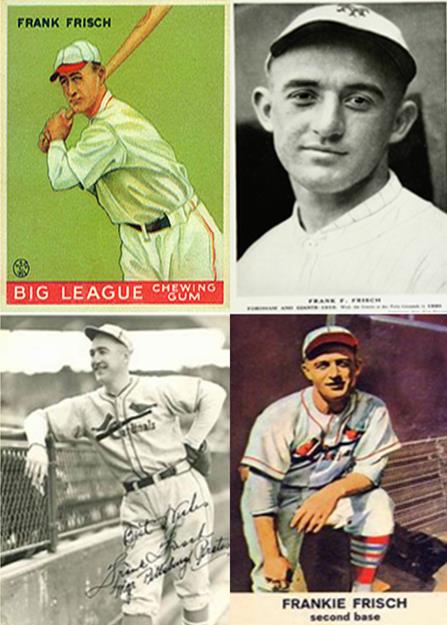
Baseball Trailblazers
Page 744
Frankie Frisch
Frank Francis Frisch, September 9, 1898 — March 12, 1973, nicknamed "The Fordham Flash" or "The Old Flash," was a major
Baseball Trailblazers Page 745
league a switch hitting second baseman who threw right handed, and manager during the first half of the twentieth century. Born in the Bronx, New York City, Frisch attended Fordham Preparatory School, graduating in 1916. He went on to Fordham University where he continued to star in four sports; baseball, football, basketball and track. His speed earned him the nickname "The Fordham Flash."
In 1919, Frisch left Fordham to sign with the New York Giants of the National League, moving directly to the majors without playing in the minor leagues. He made an immediate impact, finishing third in the NL in stolen bases and seventh in RBI in 1920, his first full season. Manager John McGraw was so impressed by Frisch that he soon named him team captain, giving him advice in base running and hitting. The Giants played Frisch at both third base and second base early in his career, but by 1923 he was installed as the team's full time second baseman.
Frisch batted over .300 in his last six seasons with New York.
He was also an expert fielder and a skilled base runner. In 1921, he led the National League with 48 steals, in 1923 in hits, and in 1924 in runs. With Frisch adding his fiery competitiveness to the team, the Giants won the World Series in 1921 and 1922, winning the NL pennant the following two seasons as well.
Baseball Trailblazers Page 746
After the 1926 season, Frisch was traded, with pitcher Jimmy Ring, to the St. Louis Cardinals in exchange for star Rogers Hornsby. After an August 1926 loss in which Frisch had missed a sign, costing the Giants a run, McGraw had loudly berated Frisch in front of the team. Frisch responded by leaving the team, and his previously close relationship with McGraw virtually ended.
Playing second base for the Cardinals, Frisch appeared in four more World Series - 1928, 1930–31, and 1934, bringing his career total to eight. He was the driving force of the "Gashouse Gang,"
the nickname for the Cardinals clubs of the early 1930s, which were built around him to reflect his no holds barred approach.
The Cardinals had won only one pennant before Frisch joined the team, and the Giants would go on to win the pennant only once in Frisch's nine seasons as the Cards' regular second baseman.
Frisch played eleven seasons with the Cardinals. In 1931, he was voted the Most Valuable Player in the National League after batting .311 with 4 home runs, 82 RBI and leading the League in stolen bases with 28. The 1931 Cardinals also triumphed in the World Series, defeating Connie Mack's defending two time champion Philadelphia Athletics in seven games.
Frisch became player-manager of the Cardinals in 1933, and was named to the NL's first three All-Star teams from 1933 to 1935.
Baseball Trailblazers Page 747
In 1934, he managed the Cardinals to another seven game World Series victory, this time over the Detroit Tigers.
Frisch finished his playing career in 1937. His career statistics totaled a .316 batting average, still the highest ever for a switch hitter, with 2,880 hits, 1532 runs, 466
doubles, 138 triples, 105 home runs, 728 walks and 1,244 RBI over 2,311 games. He also stole 419 bases in his nineteen playing seasons. His hit total stood as the record for switch hitters until 1977. Frisch also hit .300 for his career from both sides of the plate.
After his retirement as an active player, Frisch continued to manage the Cardinals, but was never able to capture another pennant. Frisch also had managerial stints with the Pittsburgh Pirates - 1940–46, and the Chicago Cubs - 1949–51, but without the success he had early in St. Louis. Frisch's career ledger as a manager shows a 1,138–1,078; .514 mark. He also spent the first two months of the 1949 season as a New York Giants' coach, working under his old double play partner, Leo Durocher, before leaving June 14 to replace Charlie Grimm as manager of the Cubs.
Frisch also worked for several years as a baseball color commentator on radio and television. In 1939, he called games for the Boston Bees and the Boston Red Sox on the Colonial
Baseball Trailblazers Page 748
Network, a regional radio network serving five New England states. He also called Giants radio in 1947–48, then worked as a post-game host for the team's telecasts in the 1950s. His broadcasting trademark was worrying about pitchers walking batters: "Oh, those bases on balls!" After a heart attack in September 1956 forced Frisch to curtail his activities, Phil Rizzuto, recently released by Yankees as a player, filled in for him on Giants post-game shows for the rest of the season. From 1959 to 1961, Frisch teamed with Jack Whitaker to form the backup crew for Saturday Game of the Week coverage on CBS.
For many years, he lived at 184 Fenimore Road in the Bonnie Crest neighborhood of New Rochelle, New York. He had two hounds named Flash and Patches who kept him company. Frisch eventually moved to Charlestown, Rhode Island, devoting himself mainly to his interests in gardening and classical music.
Frisch died in Wilmington, Delaware from injuries suffered from a car accident near Elkton, Maryland a month earlier. He was 74
years old.
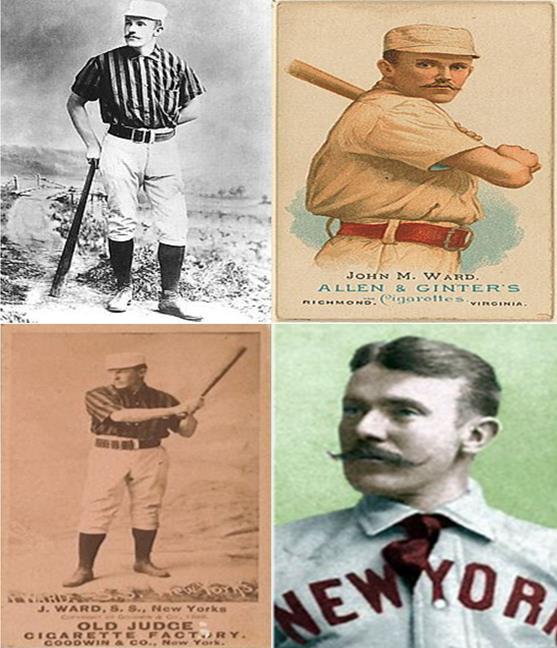
Baseball Trailblazers
Page 749
John Montgomery Ward
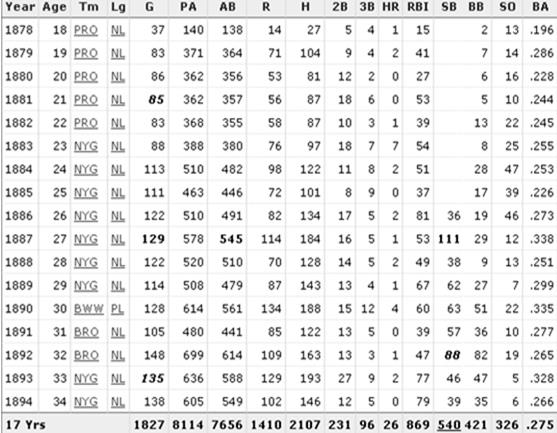
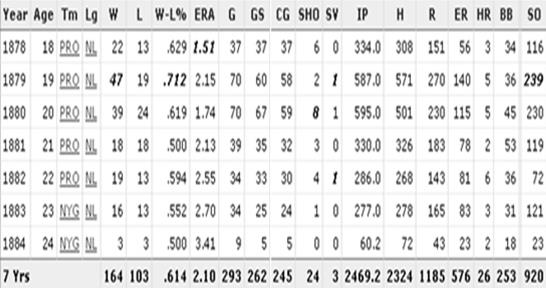
Baseball Trailblazers
Page 750
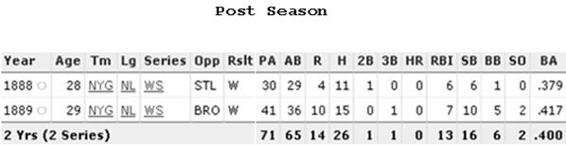
Baseball Trailblazers
Page 751
John Montgomery Ward, March 3, 1860 – March 4, 1925, known as Monte Ward, was a major league baseball pitcher, shortstop, second baseman, third baseman, manager, executive, union organizer, owner and author. Ward, of English descent, was born in Bellefonte, Pennsylvania and grew up in Renovo, Pennsylvania.
He led the formation of the first professional sports players union and a new baseball league, the Players' League.
Ward attended the Bellefonte Academy in the early 1870s, and at 13 years of age, he was sent to Pennsylvania State University.
In his short time there, he helped jumpstart a baseball program and is often credited for developing the first curveball.
However, he was kicked out of school for pushing an upperclassman who attempted to haze him down a flight of stairs, and stealing chickens.
The following year, in 1874, his parents James and Ruth died. He tried to make it as a travelling salesman, but when that proved
Baseball Trailblazers Page 752
unsuccessful, he returned to his hometown. There, he rediscovered baseball. In 1878, the semiprofessional team for which he was playing folded, which opened the door for him to move on to a new opportunity. He was offered a contract to pitch for the Providence Grays of the still new National League, an all professional major league that had begun its operations in 1876.
Ward's first season with the Grays was a successful one, going 22–13 with a 1.51 ERA. He played that season exclusively as a pitcher. Ward had his two finest seasons as a pitcher, going 47–
19 with 239 strikeouts and a 2.15 ERA in 1879 and 39–24 with 230
strikeouts and a 1.74 ERA in 1880. He pitched nearly 600 innings each year, 587 in 1879 and 595 in 1880. As a 19 year old pitcher, his 47 wins led the 1879 Providence Grays to a first place finish.
In 1880, he began to play other positions. On June 17, 1880, Ward pitched the second perfect game in baseball history, defeating future Hall of Famer Pud Galvin and the Buffalo Bisons, 5–0. Lee Richmond had thrown baseball's first perfect game just five days before, on June 12. The next perfect game by a National League pitcher would not happen for 84 years, when Jim Bunning pitched a perfect game in 1964. Ward also expanded his leadership role to include managing when he became a player-
Baseball Trailblazers Page 753
manager for the team's final 32 games, winning 18 of them, as the Grays finished in second place.
The seasons of 1881 and 1882 were the first in which he played more games in the outfield than he pitched. This was due to a nagging arm injury he originally incurred sliding into a base.
He still pitched well when he did pitch, winning 37 games over those two seasons and having ERAs of 2.13 and 2.59 respectively, and on August 17, 1882, he pitched the longest complete game shutout in history, blanking the Detroit Wolverines 1–0 in 18
innings. By this time, however, the Grays felt his best days were behind him and sold their former ace hurler to the New York Giants.
Ward moved to the new New York NL club in 1883. An injury to his right arm while running the bases during the 1884 season ended Ward's pitching career. As he could not wait for his arm to heal before he returned to the field, he taught himself to throw left handed so he could play center field for the remainder of the 1884 season. He replaced Jim Price as the Giants' manager for the final 16 games of the 1884 season.
With his arm fully recuperated, he became the everyday shortstop in 1885. Ward also graduated from Columbia Law School in 1885
and led the players in forming the Brotherhood of Professional
Baseball Trailblazers Page 754
Base Ball Players, the first sports labor union. Ward and the players had become frustrated with the owners' reserve clause, which allowed them to sign players to one year contracts and then not allow them to negotiate with other teams when those contracts expired. The players felt that the owners had absolute power. At first, the players had some success, gaining the freedom to negotiate with other teams when they were asked to take a pay cut by their current team. In October 1887, Ward married actress Helen Dauvray.
In 1888, after the Giants had finished first in the National League, and had won a playoff series known today as a "World Series," they played the St. Louis Browns of the American Association for the "Dauvray Cup," which was named after Ward's wife. Ward then captained an All Star team which, paired with Cap Anson's Chicago club, headed off on a barnstorming world tour. The owners held their winter meetings, and created a classification system that would determine a player's salary.
Under the system, the most a player could earn was $2,500. The Giants then sold Ward to the Washington Nationals for a record price of $12,000. Ward was furious and left the tour early. He then demanded a meeting with the owners, and said he would refuse to play for Washington unless he received a large portion
Baseball Trailblazers Page 755
of his record sale price. Washington eventually refused payment on the transaction, nullifying the deal.
The owners denied Ward's request for a meeting to discuss the new classification system, saying no talks would be held until after the upcoming season. Though Ward and the union fought hard for these issues, this did not distract him or his Giants team, as he hit .299 and helped the Giants capture their second straight "World Series" title in 1889.
Amidst Ward's commitments as a ballplayer and union organizer, he still found time for a third occupation, that of author. His 1888 book, “Baseball: How to Become a Player,” was the first published effort to explore baseball's development from its early roots.
Ward realized that negotiations with the owners were going nowhere and threatened to create a Players' League. The owners thought of it as nothing more than an idle threat but had failed to realize Ward's connections in the business community, and he began to launch the new league. This new Players' League included a profit sharing system for the players and had no reserve clause or classification plan.
The season began in 1890 with over half of the National League's players from the previous year in its ranks. Ward acted as a
Baseball Trailblazers Page 756
player-manager for the Brooklyn club, nicknamed the Ward's Wonders, and finished seventh in the league with a .335 batting average. While the Players' League drew well at the box office, the teams' owners grew nervous when the money did not come in as expected because of the profit sharing system. Soon they began holding secret meetings with their National League counterparts and, one by one, sold their teams to the rival league.
Due to an agreement after the dissolution of the Players'
League, Ward stayed in Brooklyn as player-manager for the National League team, the Brooklyn Grooms. Following the 1892
season, Ward expressed his desire to return to the Giants and was sold to his former club for $6,000. Despite his declining bat, Ward led the league in stolen bases in 1893. Following the 1894 season, he retired at the age of 34. He finished his career with a .275 average, 2,104 hits, and 540 stolen bases. He is the only man in history to win over 100 games as a pitcher and collect over 2,000 hits.
Ward retired from baseball at age 34 in order to enter the legal profession. As a successful lawyer he represented baseball players against the National League. Later he acted as president and part owner of the Boston Braves franchise and became an official in the short lived Federal League in 1914, acting as the business manager of the Brooklyn Tip-Tops.
Baseball Trailblazers Page 757
In the last quarter century of his life, Ward's sporting passion became golf. He won several championships around New York, played all over Europe, and competed regularly in the United States Golf Association US Amateur. He finished second in the prestigious North and South Amateur Championship at Pinehurst Country Club in North Carolina in 1903. The North and South Amateur was the equal of any major golf event at the turn of the century. The first North and South event took place in 1901.
Ever the organizer, he was one of the founders of the New York Golf Association and the Long Island Golf Association.
Ward died in Augusta, Georgia, the day after his 65th birthday on March 4, 1925, after a bout of pneumonia.
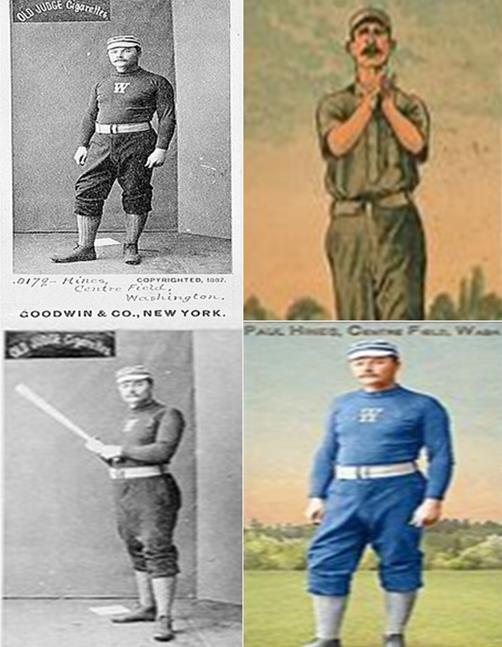
Baseball Trailblazers
Page 758
Paul Hines
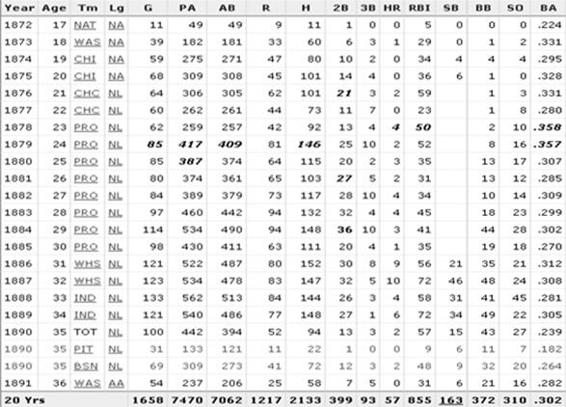
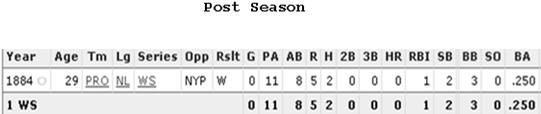
Baseball Trailblazers
Page 759
Paul Aloysius Hines, March 1, 1855 – July 10, 1935, was a center fielder in professional baseball who played in the National Association and major league baseball from 1872 to 1891. Born in Virginia, Hines probably practiced with the original Washington Nationals or played on its junior team before joining the National Association with that club in 1872.
Baseball Trailblazers Page 760
When the original Chicago White Stockings resumed play in 1874, the teenage Hines played every game, usually in center field. He remained with the club four seasons, including the inaugural National League championship season of 1876, and then played eight seasons for the Providence Grays from 1878 to 1885, spanning that club's entire major league association, during which the club won two pennants.
After the Providence club folded in 1885, he remained an everyday major league center fielder through two seasons for a new Washington Nationals club and one for the Indianapolis Hoosiers, shifting to first base for a second Indianapolis season in 1889. He returned to center field with gradually declining playing time for the Pittsburgh Alleghenys, Boston Beaneaters and Washington Statesmen in 1890 and 1891. His last year in the major leagues was 1891, but he continued to play baseball in the minor leagues. He finished his professional career splitting 1896 between the minor league teams Burlington, Iowa and Mobile, Alabama, at the age of 41.
During the first five NL seasons, from 1876 through 1880, Hines had more base hits than any other player, and he retired third to Cap Anson and Jim O'Rourke in career hits in the majors. He also remained among the top 10 major league career home run hitters as late as 1887. His total of 16 seasons as a major
Baseball Trailblazers Page 761
league team's primary center fielder was not surpassed until Tris Speaker and Ty Cobb in 1925.
In 1658 games over 20 seasons, Hines posted a .302 batting average, 2133 for 7062, with 1217 runs, 399 doubles, 93 triples, 57 home runs, 855 RBI, 372 bases on balls, a .340 on base percentage and a .409 slugging percentage. He is credited with winning baseball's first triple crown in 1878.
He was arrested in 1922, at the age of 65, on charges of pickpocketing. Hines died at age 80 in Hyattsville, Maryland, deaf and blind. His hearing had been impaired since 1886 after being hit in the head by a pitch.
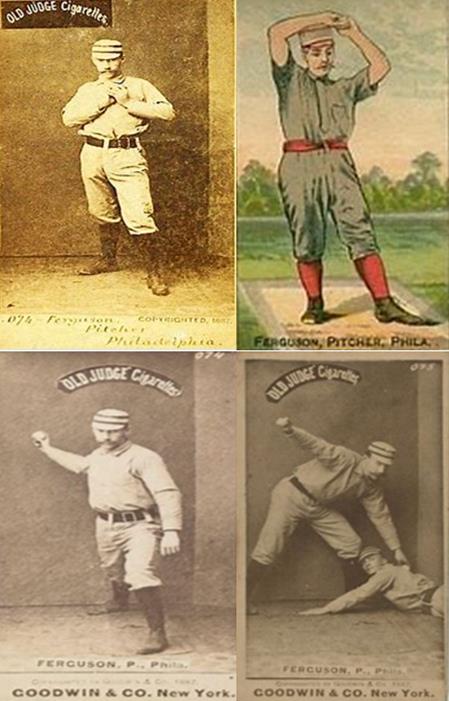
Baseball Trailblazers
Page 762
Charlie Ferguson
Baseball Trailblazers Page 763
Charlie Ferguson, 1863–1888, was the Philadelphia Phillies’
first star pitcher but his untimely death in 1888, allowed Ferguson only four National League seasons. Born on April 1, 1863, Charlie Ferguson made his debut on May 1, 1884, for the then Philadelphia Quakers. He would win 99 games in his career, never winning less than 21 games in any season, while compiling a career earned run average of 2.67. He twice pitched over 400
innings in a season, including his rookie season and would average 378½ innings per year.
On August 29, 1885, he pitched the first no hitter in Phillies history with a 1–0 win over the Providence Grays. In 1886 he had his finest season, winning 30 games while losing only nine. His ERA of 1.98 was second best in the National League and the Phillies won 15 more games than the previous season.
In Ferguson's final season the Phillies would finish in second place, 3.5 games behind the eventual “World Series” winners, the Detroit Wolverines. His 22 wins in 1887, were not the only reason for the teams' great finish. Philadelphia's manager, the legendary player and strategist Harry Wright, saw the hitting potential of Ferguson. Towards the end of the season, Wright decided that Ferguson was too good a hitter to play only when he pitched. Wright decided that Ferguson would play second base for the final eight weeks of the season, replacing two players who
Baseball Trailblazers Page 764
hit a combined .214. Philadelphia would go on to win 16 and tie another in their final 17 games to move ahead of the Chicago White Stockings into second place. Playing every day allowed Ferguson to drive in a team leading 85 runs in only 264 at bats.
He would hit .337, which also led the team and was fourth best in the National League.
During spring training in 1888, Charlie Ferguson contracted typhoid fever. He died on April 29th. Charlie Ferguson was 25
years old.
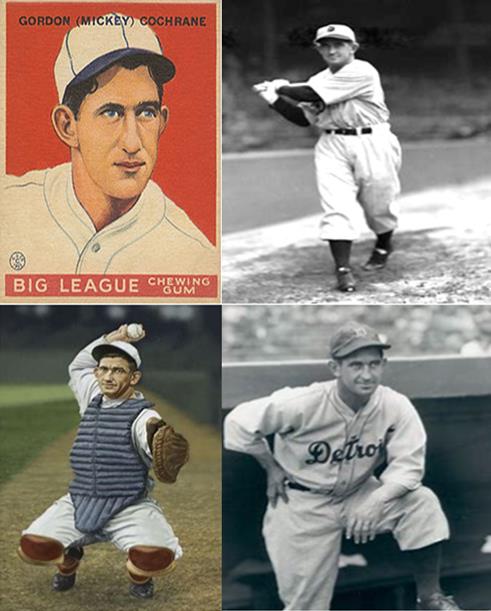
Baseball Trailblazers
Page 765
Mickey Cochrane
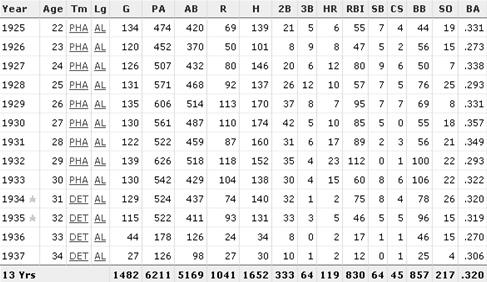
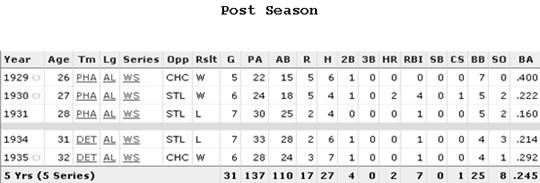
Baseball Trailblazers
Page 766
Gordon Stanley "Mickey" Cochrane, April 6, 1903 – June 28, 1962, nicknamed "Black Mike," was a professional baseball player, manager and coach. He played in Major League Baseball as a catcher for the Philadelphia Athletics and Detroit Tigers.
Cochrane was considered one of the best catchers in baseball history and is a member of the Baseball Hall of Fame.
Baseball Trailblazers Page 767
Cochrane was born in Bridgewater, Massachusetts. His father, John Cochrane, had immigrated from Omagh, County Tyrone in what is now Northern Ireland and his mother, Sadie Campbell, had come from Prince Edward Island, Canada, where her family had immigrated from Scotland. He was known as "Black Mike" because of his fiery, competitive nature. Cochrane was educated at Boston University, where he played five sports, excelling at football and basketball. Although Cochrane considered himself a better football player than a baseball player, professional football was not as established as major league baseball at the time, so he signed with the Portland Beavers of the Pacific Coast League in 1924.
After just one season in the minor leagues, Cochrane was promoted to the major leagues, making his debut with the Philadelphia Athletics on April 14, 1925 at the age of 22. He made an immediate impact by becoming Connie Mack's starting catcher in place of Cy Perkins, who was considered one of the best catchers in the major leagues at the time. A left handed batter, he ran well enough that Mack would occasionally have him bat leadoff. He hit third more often, but whatever his place in the order his primary role was to get on base so that hard hitting Al Simmons and Jimmie Foxx could drive him in. In May, he tied a twentieth century major league record by hitting three
Baseball Trailblazers Page 768
home runs in a game. He ended his rookie season with a .331
batting average and a .397 on base percentage, helping the Athletics to a second place finish.
By the start of the 1926 season, Cochrane was already considered the best catcher in the major leagues. He won the 1928 American League Most Valuable Player Award, mostly for his leadership and defensive skills, when he led the American League in putouts and hit .293 along with 10 home runs and 58 runs batted in. Cochrane was a catalyst in the Athletics' pennant winning years of 1929, 1930 and 1931, during which he hit .331, .357 and .349
respectively. He played in those three World Series, winning the first two, but was sometimes blamed for the loss of the 1931
World Series, when the St. Louis Cardinals, led by Pepper Martin, stole eight bases and the Series.
In 1934, Mack started to disassemble his dynasty for financial reasons and put Cochrane on the trading block. He found a willing recipient in the Detroit Tigers. Their owner, Frank Navin, was also suffering from financial troubles. They had not finished higher than third since 1923, and had developed a reputation for being content with mediocrity. Attendance at Navin Field had sagged for some time. Navin had originally hoped to acquire Babe Ruth and name him player-manager, but after those talks fizzled, he turned to the A's. A deal to send
Baseball Trailblazers Page 769
Cochrane to Detroit was quickly arranged, and Navin immediately named him player-manager.
It was with Detroit where Cochrane cemented his reputation as a team leader and his competitive nature drove the Tigers, who had been picked to finish in fourth or fifth place, to the 1934
American League championship, their first pennant in 25 years.
They won 101 games, which was the most ever by the team, and Cochrane was the first ever rookie manager to achieve 100 wins.
Cochrane routinely platooned Gee Walker, a right handed batter, to spell left fielder Goose Goslin and center fielder Jo Jo White, who were both left handed batters. Cochrane's leadership and strategic skills won him the 1934 Most Valuable Player Award, remarkable considering that Lou Gehrig had won the Triple Crown that year. He followed this by leading the Tigers to another American League pennant in 1935 and earning a victory over the Chicago Cubs in the 1935 World Series. In late 1935, the “Detroit Free Press” speculated Cochrane might eventually succeed Navin as team president. Due in part to his high strung nature, however, he suffered a nervous breakdown during the 1936
season.
On May 25, 1937; Cochrane was hit in the head by a pitch from Yankees pitcher Bump Hadley. Cochrane had homered in his previous at bat that day. Hospitalized for seven days, Cochrane
Baseball Trailblazers Page 770
nearly died from the injury. This accident generated a call for protective helmets for batters, although tradition won out at that time. Cochrane was forced to retire at the age of 34 after doctors ordered him not to attempt to play baseball again.
Cochrane compiled a .320 batting average while hitting 119 home runs and 830 runs batted in over a 13 year playing career. He had 1,652 hits, 1,041 runs scored, 333 doubles, 64 triples, 64
stolen bases and a .478 slugging percentage. His .320 batting average is the highest career mark for catchers. His .419 on base percentage is among the best in baseball history, and is the highest all-time among catchers.
In his first 11 years, he never caught fewer than 110 games. He led American League catchers six times in putouts and twice each in double plays assists and fielding percentage.
Cochrane returned to the dugout to continue managing the Tigers but had lost his competitive fire. He managed for the remainder of the 1937 season but was replaced midway through the 1938
season by coach and former catcher Del Baker. His all-time managerial record was 348-250, for a .582 winning percentage.
Despite his head injury, Cochrane served in the United States Navy during World War II. Commissioned as a lieutenant and assigned to Naval Station Great Lakes, he oversaw physical
Baseball Trailblazers Page 771
training of new recruits and coached the base baseball team. On July 7, 1942, Cochrane managed an All-Service team that played against an American League all-star squad at Cleveland’s Municipal Stadium. The American League team beat the servicemen, 5-0. Later in the war Cochrane, by now a lieutenant commander, was assigned to a similar role in the Pacific Theater.
In 1947, Cochrane became the third catcher enshrined in the Baseball Hall of Fame, after Roger Bresnahan and Buck Ewing.
Cochrane briefly worked in baseball after World War II, notably serving as a coach, and then as general manager, of the Athletics during the 1950 season, Mack's last year as manager.
He also owned an automobile business after his baseball days, which he sold in the mid-1950s. A heavy smoker, Cochrane was only 59 when he died in 1962 in Lake Forest, Illinois of lymphatic cancer. Yankee Hall of Fame slugger Mickey Mantle was named after him.
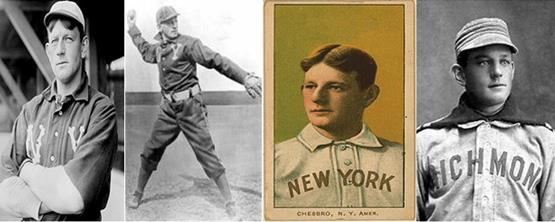
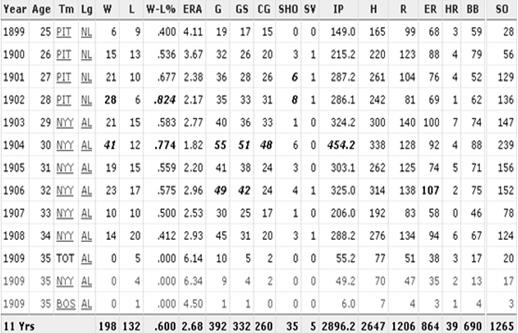
Baseball Trailblazers
Page 772
Jack Chesbro