

Baseball Trailblazers by Edward Drobinski - HTML preview
Download the book in PDF, ePub, Kindle for a complete version.
.369.
During 1917 spring training, Cobb showed up late for a Dallas spring training doubleheader against the New York Giants because of a golf outing. Several of the Giants, including Buck Herzog, called him names from the bench. Cobb retaliated by spiking Herzog during the second game, prompting a bench clearing brawl in which Cobb ground Herzog's face in the dirt. The Dallas Police Department had to help stop the brawl, and Cobb was thrown out of the game. Both teams were staying at the Oriental Hotel, and at dinner that evening, Herzog walked up to Cobb and challenged him to a fight. The two met an hour later in Cobb's room, where the Tiger outfielder had prepared for the fight by
moving furniture out of the way and pouring water on the floor.
Cobb's leather soled shoes enabled him to get better footing than Herzog, who wore tennis shoes. The fight lasted for thirty minutes, over the course of which Cobb knocked down Herzog about six times while Herzog only knocked Cobb down once. The scuffle left Herzog's face bloodied and his eyes nearly shut. With McGraw vowing revenge, Cobb skipped the rest of the exhibition series against the Giants, heading to Cincinnati to train with the Reds, who were managed by Cobb's friend Christy Mathewson.
In 1917, Cobb hit in 35 consecutive games, still the only player with two 35 plus game hitting streaks. He had six hitting streaks of at least 20 games in his career.
Also in 1917, Cobb starred in the motion picture “Somewhere in Georgia” for the sum of $25,000 plus expenses. Based on a story by sports columnist Grantland Rice, the film cast Cobb as
"himself," a small town Georgia bank clerk with a talent for baseball.
In October 1918, Cobb enlisted in the Chemical Corps branch of the United States Army and was sent to the Allied Expeditionary Forces headquarters in Chaumont, France. He served approximately 67 days overseas before receiving an honorable discharge and returning to the United States. He was given the rank of captain underneath the command of Major Branch Rickey, the president of
the St. Louis Cardinals. Other baseball players serving in this unit included Captain Christy Mathewson and Lieutenant George Sisler. All of these men were assigned to the Gas and Flame Division, where they trained soldiers in preparation for chemical attacks by exposing them to gas chambers in a controlled environment, which was eventually responsible for Mathewson's contracting tuberculosis, leading to his premature death on the eve of the 1925 World Series.
On August 19th, 1921, in the second game of a doubleheader, Cobb collected his 3,000th hit. Aged 34 at the time, he is still the youngest ballplayer to reach that milestone, and in the fewest at bats - 8,093.
By 1920, Babe Ruth, sold to the renamed New York Yankees from the Boston Red Sox, had established himself as a power hitter, something Cobb was not considered to be. When his Tigers showed up in New York to play the Yankees for the first time that season, writers billed it as a showdown between two stars of competing styles of play. Ruth hit two homers and a triple during the series, compared to Cobb's one single.
As Ruth's popularity grew, Cobb became increasingly hostile toward him. He saw the Babe not only as a threat to his style of play, but also to his style of life. Perhaps what angered him the most about Ruth was that despite Babe's total disregard for
his physical condition and traditional baseball, he was still an overwhelming success and brought fans to the ballparks in record numbers to see him challenge his own slugging records.
On May 5th, 1925, Cobb told a reporter that, for the first time in his career, he was going to try to hit home runs, saying he wanted to show that he could hit home runs but simply chose not to. That day, he went 6 for 6, with two singles, a double and three homers. The 16 total bases set a new AL record. The next day Cobb had three more hits, two of which were home runs. The single his first time up gave him nine consecutive hits over three games, while his five homers in two games tied the record set by Cap Anson of the old Chicago NL team in 1884. By the end of the series Cobb had gone 12 for 19 with 29 total bases, and afterwards reverted to his old playing style. Even so, when asked in 1930 by Grantland Rice to name the best hitter he'd ever seen, Cobb answered; "You can't beat the Babe. Ruth is one of the few who can take a terrific swing and still meet the ball solidly. His timing is perfect. No one has the combined power and eye of Ruth."
The closest Cobb came to winning another pennant was in 1924, when the Tigers finished in third place, six games behind the pennant winning Washington Senators. The Tigers had also finished third in 1922, but 16 games behind the Yankees. Cobb
blamed his lackluster managerial record, 479 wins against 444
losses, on owner Navin, who was even more frugal than he was, passing up several quality players Cobb wanted to add to the team. In fact, he had saved money by hiring Cobb to both play and manage.
At the end of 1925, Cobb was again embroiled in a batting title race, this time with one of his teammates and players, Harry Heilmann. In a doubleheader against the St. Louis Browns on October 4, 1925, Heilmann got six hits to lead the Tigers to a sweep of the doubleheader and beat Cobb for the batting crown,
.393 to .389. Cobb and Browns player-manager George Sisler each pitched in the final game, Cobb pitching a perfect inning.
Cobb announced his retirement after a 22 year career as a Tiger in November 1926, and headed home to Augusta, Georgia. Shortly thereafter, Tris Speaker also retired as player-manager of the Cleveland Indians. The retirement of two great players at the same time sparked some interest, and it turned out that the two were coerced into retirement because of allegations of game fixing brought about by Dutch Leonard, a former pitcher managed by Cobb. Leonard accused former pitcher and outfielder Smoky Joe Wood and Cobb of betting on a Tiger–Indian game played in Detroit on September 25, 1919, in which they allegedly orchestrated a Tiger victory to win the bet. Leonard claimed
proof existed in letters written to him by Cobb and Wood.
Commissioner Kenesaw Mountain Landis held a secret hearing with Cobb, Speaker and Wood. A second secret meeting among the AL
directors led to the unpublicized resignations of Cobb and Speaker; however, rumors of the scandal led Judge Landis to hold additional hearings in which Leonard subsequently refused to participate. Cobb and Wood admitted to writing the letters, but claimed that a horse racing bet was the subject involved and that Leonard's accusations were in retaliation for Cobb's having released him from the Tigers, thereby demoting him to the minor leagues. Speaker denied any wrongdoing.
On January 27th, 1927, Judge Landis cleared Cobb and Speaker of any wrongdoing because of Leonard's refusal to appear at the hearings. Landis allowed both Cobb and Speaker to return to their original teams, but each team let them know that they were free agents and could sign with any club they wanted. Speaker signed with the Washington Senators for 1927, and Cobb with the Philadelphia Athletics. Speaker then joined Cobb in Philadelphia for the 1928 season. Cobb said he had come back only to seek vindication and say he left baseball on his own terms.
Cobb played regularly in 1927 for a young and talented team that finished second to one of the greatest teams of all time, the 110–44 1927 Yankees, returning to Detroit to a tumultuous
welcome on May 10th and doubling his first time up to the cheers of Tiger fans. On July 18, Cobb became the first member of the 4,000 hit club when he doubled off former teammate Sam Gibson, still pitching for the Tigers, at Navin Field.
Cobb returned for the 1928 season but played less frequently due to his age and the blossoming abilities of the young A's, who were again in a pennant race with the Yankees. On September 3rd, Ty Cobb pinch hit in the ninth inning of the first game of a doubleheader against the Senators and doubled off Bump Hadley for his last career hit although his last at bat wasn't until September 11th against the Yankees. He then announced his retirement, effective the end of the season, after having batted
.300 or higher in 23 consecutive seasons; the only season under
.300 being his rookie season; a major league record that is unlikely to be broken. Despite not being known as a slugger, he led the AL in slugging percentage eight times in his 11 seasons from 1907-1917.
Cobb retired a wealthy and successful man. He toured Europe with his family, went to Scotland for some time and then returned to his farm in Georgia. He spent his retirement pursuing his offseason avocations of hunting, golfing, polo and fishing. His other pastime was trading stocks and bonds, increasing his immense personal wealth. In the winter of 1930, Cobb moved into
a Spanish ranch estate on Spencer Lane in the affluent town of Atherton located south of San Francisco, California on the San Francisco Peninsula. At the same time, his wife filed the first of several divorce suits; but withdrew the suit shortly thereafter. The couple eventually divorced in 1947 after 39
years of marriage; the last few years of which Mrs. Cobb lived in nearby Menlo Park. The couple had three sons and two daughters.
In February 1936, when the first Hall of Fame election results were announced, Cobb had been named on 222 of 226 ballots, outdistancing Babe Ruth, Honus Wagner, Christy Mathewson and Walter Johnson, the only others to earn the necessary 75% of votes to be elected that first year. Those incredible results showed that although many people supposedly disliked him personally, they respected the way he had played and what he had accomplished.
According to sportswriter Grantland Rice, he and Cobb were returning from the Masters golf tournament in the late 1940s and stopped at a Greenville, South Carolina, liquor store. Cobb noticed that the man behind the counter was "Shoeless" Joe Jackson, who had been banned from baseball almost 30 years earlier following the Black Sox scandal. Jackson did not appear to recognize him, and after making his purchase an incredulous
Cobb asked, "Don't you know me, Joe?" "I know you," replied Jackson, "but I wasn't sure you wanted to speak to me. A lot of them don't."
In 1949 Cobb became generous with his wealth, donating $100,000
in his parents' name for his hometown to build a modern 24 bed hospital, Cobb Memorial Hospital, which is now part of the Ty Cobb Healthcare System. He also established the Cobb Educational Fund, which awarded scholarships to needy Georgia students bound for college, by endowing it with a $100,000 donation in 1953.
In December 1959, he was diagnosed with prostate cancer, diabetes, high blood pressure, and Bright's disease. It was also during his final years that Cobb began work on his autobiography, “My Life in Baseball: The True Record.”
In his last days, Cobb spent some time with the old movie comedian Joe E. Brown, talking about the choices he had made in his life. According to Brown, Cobb said he felt that he had made mistakes and that he would do things differently if he could. He had played hard and lived hard all his life, had no friends to show for it at the end, and regretted it. Publicly, however, he claimed to have no regrets: "I've been lucky. I have no right to be regretful of what I did."
He was taken to Emory University Hospital for the last time in June 1961 after falling into a diabetic coma. His first wife,
his son Jimmy and other family members came to be with him for his final days. He died there on July 17, 1961, at age 74.
“...the most sensational player of all the players I have seen in all my life...” - Casey Stengel.
“The greatness of Ty Cobb was something that had to be seen, and to see him was to remember him forever.” - George Sisler.
Baseball Trailblazers
Page 82
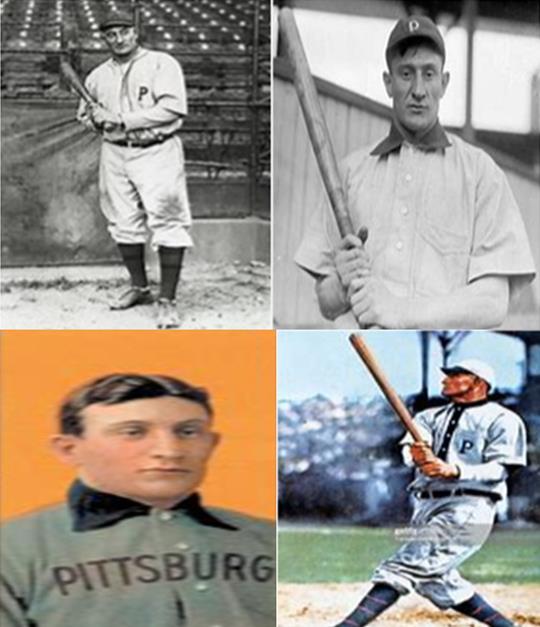
Honus Wagner
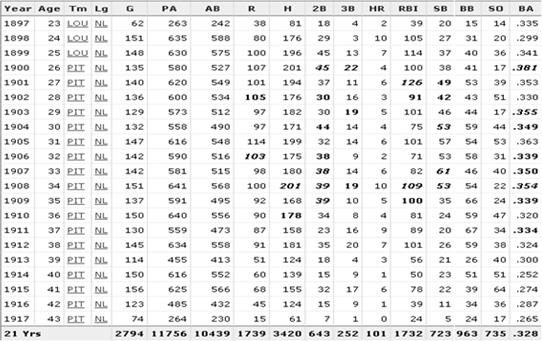
Eight time NL batting champion - 1900, 1903, 1904, 1906–1909, 1911; five time NL RBI leader - 1901, 1902, 1908, 1909, 1912; five time NL stolen base leader - 1901, 1902, 1904, 1907, 1908.
Baseball Trailblazers
Page 83
Johannes Peter "Honus" Wagner, February 24th, 1874 – December 6th, 1955, sometimes referred to as "Hans" Wagner, was a shortstop who played 21 seasons in Major League Baseball from
1897 to 1917, almost entirely for the Pittsburgh Pirates. Wagner won his eighth and final batting title in 1911, a National League record that remains unbroken to this day. He also led the league in slugging six times and stolen bases five times. Wagner was nicknamed "The Flying Dutchman" due to his superb speed and German heritage. Most consider Wagner to be the greatest shortstop ever and one of the greatest players ever. Ty Cobb himself called Wagner "maybe the greatest star ever to take the diamond."
For all-time greatest shortstop there is only one candidate, Honus Wagner. He was just head and shoulders above anyone else in that position. There have been great fielders at that position, but Honus could more than out field all of them. Plus, he was perhaps the greatest right handed hitter of all time.
Wagner was born to German immigrants Peter and Katheryn Wagner in the borough of Chartiers, in what is now Carnegie, Pennsylvania. Wagner was one of nine children. He dropped out of school at age 12 to help his father and brothers in the coal mines. In their free time, he and his brothers played sandlot baseball and developed their skills to such an extent that three of his brothers went on to become professionals as well. In 1916, Wagner married Bessie Baine Smith, and the couple would have three daughters.
Honus' brother Albert "Butts" Wagner was considered the ballplayer of the family. Albert suggested Honus in 1895 when his Inter-State League team was in need of help. Wagner would play for five teams in that first year, in three different leagues over the course of 80 games.
In 1896, Edward Barrow, from the Wheeling, West Virginia, team that Wagner was playing on, decided to take Honus with him to his next team, the Paterson Silk Sox of the Atlantic League.
Barrow proved to be a good talent scout, as Wagner could play wherever he was needed, including all three bases and the outfield. Wagner would hit .313 for Paterson in 1896 and .375 in 74 games in 1897.
Recognizing that Wagner should be playing at the highest level, Barrow contacted the Louisville Colonels, who had finished last in the National League in 1896 with a record of 38–93. They were doing better in 1897 when Barrow persuaded club president Barney Dreyfuss, club secretary Harry Pulliam, and outfielder-manager Fred Clarke to go to Paterson to see Wagner play. Dreyfuss and Clarke were not impressed with the awkward looking man. Wagner was oddly built. He was 5 feet 11 inches tall, weighed 200
pounds, and had a barrel chest, massive shoulders, heavily muscled arms, huge hands, and incredibly bowed legs that deprived him of any grace and several inches of height. Pulliam,
though, persuaded Dreyfuss and Clarke to take a chance on him.
Wagner debuted with Louisville on July 19th and hit .338 in 61
games.
By his second season, Wagner was already one of the best hitters in the National League although he came up short a percentage point from finishing the season at .300. Following the 1899
season, the NL contracted from twelve to eight teams, with the Colonels one of four teams eliminated. Owner Barney Dreyfuss, who had purchased half ownership in the Pirates, took Wagner and many of his other top players with him to the Pittsburgh team.
Tommy Leach recounted his impressions of joining the Louisville club in 1898 with hopes of winning the starting job at third base; “I hardly had time to get settled before it hits me that this guy the Louisville club had at third base was practically doing the impossible. I'm sitting on the bench the first day I reported, and along about the third inning an opposing batter smacks a line drive down the third base line that looked like at least a sure double. Well, this big Louisville third baseman jumped over after it like he was on steel springs, slapped it down with his bare hand, scrambled after it at least ten feet, and fired a bullet over to first base. The runner was out by two or three steps. I'm sitting on the bench and my eyes are popping out. So I poked the guy sitting next to me, and asked him who
the devil that big fellow was on third base. ‘Why, that's Wagner,’ he says. ‘He's the best third baseman in the league.’
And it also turned out that while Honus was the best third baseman in the league, he was also the best first baseman, the best second baseman, the best shortstop, and the best outfielder. That was in fielding. And since he led the league in batting eight times between 1900 and 1911, you know that he was the best hitter, too. As well as the best base runner.” - Tommy Leach.
The move to the Pittsburgh Pirates signified Wagner's emergence as a premier hitter. In 1900, Wagner won his first batting championship with a .381 mark and also led the league in doubles with 45, triples with 22, and slugging percentage at .573, all of which were career highs. For the next nine seasons, Wagner's average did not fall below .330.
In 1901, the American League began to sign National League players, creating a bidding war, which depleted the league of many talented players. Wagner was offered a $20,000 contract by the Chicago White Sox, but turned it down and continued to play with the Pirates.
Prior to 1904, Wagner had played several positions but settled into the shortstop role full time that season, where he became a skilled fielder.
In 1898, Wagner won a distance contest in Louisville by throwing a baseball more than 403 feet. In August 1899, he became the first player credited with stealing second base, third, and home in succession. In September 1905, Wagner signed a contract to produce the first bat with a player's signature, the Louisville Slugger, becoming the first sportsperson to endorse a commercial product. The Honus Wagner was to become a best seller for years.
Shortly before the 1908 season, Wagner retired. In desperation, owner Barney Dreyfuss offered him $10,000 per year, making him the highest paid Pirate for many years. He returned to the Pirates early in the 1908 season, and finished two home runs short of the league's Triple Crown, leading the league in hitting for the sixth time‚ hits‚ total bases‚ doubles‚ triples‚
RBI‚ and stolen bases. Wagner took over the batting lead from the New York Giants' flamboyant outfielder Mike Donlin during a July 25th game against the Giants and their star pitcher Christy Mathewson. Wagner was 5 for 5 in the game. After each hit, he reportedly held up another finger to Donlin, who went hitless, and who had just beaten runner up Wagner by a wide margin in a
"most popular player" poll. Wagner’s third gesture addressed that.
Wagner's 1908 season is a legitimate candidate for the greatest single season of any player in baseball history. The league ERA of 2.35 was the lowest of the dead ball era and about half of the ERAs of modern baseball, though scoring a similar amount of runs; the difference being the old timer’s errors; s function of bare handed and small glove play. Since Wagner hit .354 with 109
RBI in this environment one might speculate as to what a Gold Glove shortstop, like Wagner would be worth today.
He was the first winner of “The World's Championship Batsman's Cup” in 1908, made by Welshman George "Honey Boy" Evans.
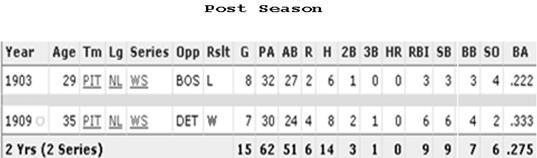
In 1903, the Pirates played the Boston Americans in Major League Baseball's inaugural World Series. Wagner, by this point, was an established star and much was expected of him, especially since the Pirates' starting rotation was decimated by injury. Wagner himself was not at full strength and hit only .222 for the series. The Americans, meanwhile, had some fans, called the
"Royal Rooters" who, whenever Wagner came to bat, sang "Honus, Honus, why do you hit so badly?" to the tune of "Tessie," a popular song of the day. The Rooters, led by Boston bartender Michael "Nuf Ced" McGreevy, even traveled to Pittsburgh to
continue their heckling. Pittsburgh lost in the best of nine series, five games to three, to a team led by pitchers Cy Young and Bill Dinneen and third baseman–manager Jimmy Collins.
Christy Mathewson, in his book "Pitching in a Pinch" wrote; "For some time after Hans Wagner's poor showing in the world's series of 1903 it was reported that he was yellow or poor in the clutch. This grieved the Dutchman deeply, for I don't know a ballplayer in either league who would assay less quit to the ton than Wagner. This was the real tragedy in Wagner's career.
Notwithstanding his stolid appearance, he is a sensitive player, and this has hurt him more than anything else in his life ever has." Wagner was distraught by his performance.
Wagner and the Pirates were given a chance to prove that they were not post season chokers in the 1909 World Series. The Pirates faced Ty Cobb's Detroit Tigers. The series was the only meeting of the two superior batsmen of the day. Wagner was by this time 35 years old, Cobb just 22.
This time, Wagner could not be stifled as he out hit Cobb, .333
to .231, and stole six bases, establishing the new Series record. The speed demon Cobb only managed two steals, one of which Cobb himself admitted was a botched call. Wagner recounted: "We had him out at second. We put up a squawk, but Silk O'Loughlin, the umpire, overruled it. We kept the squawk
going for a minute or so, making no headway of course, and then Cobb spoke up. He turned to O'Loughlin, an American League umpire, by the way, and said, 'Of course I was out. They had me by a foot. You just booted the play, so come on, let's play ball.'"
There was also a story that was widely circulated over the years. At one point Cobb was on first. He bragged to Wagner that he was going to steal second and threatened to assault him physically while doing it. Wagner defiantly dared him to try it and placed an especially rough tag to Cobb's mouth, and the two exchanged choice words. Cobb denied it in his autobiography. The Pirates won the series in seven games behind the pitching of rookie Babe Adams.
In 1910, Wagner's average fell to .320, his lowest average since 1898. Nevertheless, he aged exceptionally well. Wagner won the 1911 batting title by the narrowest of margins, edging the Boston Rustlers' Doc Miller, .334 to .333. The Pirates were in contention into August, but an ankle injury sidelined Wagner for 25 games and the team slid from the race.
On June 9, 1914, at age 40, Wagner recorded his 3,000th hit, the second player in baseball history to reach the figure. This accomplishment, however, came during a down period for Wagner
and the Pirates. Wagner hit only .252 in 1914, the lowest average of his career.
In 1917, following another retirement, Wagner returned for his final, abbreviated season. Returning in June, he was spiked in July and played only sparingly for the remainder of the year, batting .265. He retired as the NL's all-time hit leader.
Wagner was not finished playing baseball after his retirement from major league baseball. He managed and played for a semi-pro team. After retirement, Wagner served the Pirates as a coach for 39 years, most notably as a hitting instructor from 1933 to 1952. Arky Vaughan, Ralph Kiner, Pie Traynor, and Hank Greenberg, all future Hall of Famers, were notable pupils of Wagner. His appearances at National League stadiums during his coaching years were always well received and Wagner remained a beloved ambassador of baseball. Wagner also coached baseball and basketball at Carnegie Institute of Technology, which is now part of Carnegie Mellon University.
Wagner lived the remainder of his life in Pittsburgh, where he was well known as a friendly figure around town. He died on December 6th, 1955, at the age of 81.
“When I was a boy growing up in Kansas, a friend of mine and I went fishing and as we sat there on the warmth of a summer
afternoon we talked about what we wanted to do when we grew up.
I told him I wanted to be a major league baseball player, a genuine professional like Honus Wagner. My friend said that he'd like to be President of the United States. Neither of us got our wish.” - Dwight D. Eisenhower.
Baseball Trailblazers
Page 94
Al Spalding
Baseball Trailblazers
Page 95
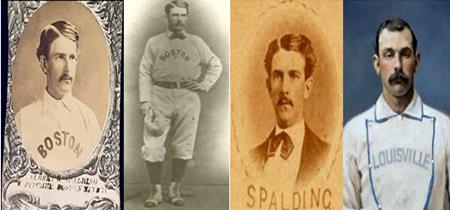
Albert Goodwill Spalding, September 2, 1849 - September 9, 1915, was a pitcher, outfielder, manager, and executive in the early years of professional baseball, and the co-founder of A.G.
Spalding sporting goods company. He was born and raised in Byron, Illinois and graduated from Rockford Central High School in Rockford, Illinois. He played major league baseball between 1871 and 1878.
Having played baseball throughout his youth, Spalding first played competitively with the Rockford Pioneers, a youth team, which he joined in 1865. After pitching his team to a 26-2
victory over a local men's amateur team, the Mercantiles, he was approached at the age of 15 by the Rockford Forest Citys, for whom he played for five years. Following the formation of baseball's first professional organization, the National Association of Professional Base Ball Players, which became known as the National Association in 1871, Spalding joined the
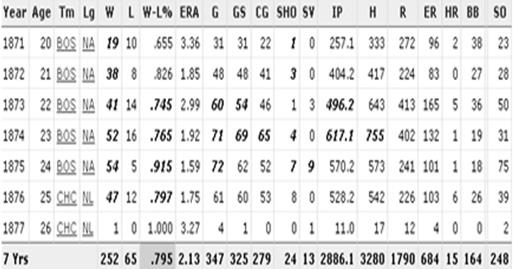
Boston Red Stockings and was highly successful; winning 206
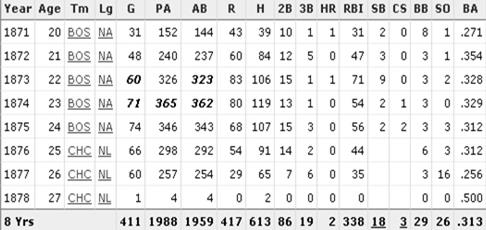
games, and losing only 53 as a pitcher and batting .313 as a hitter.
William Hulbert, principal owner of the Chicago White Stockings, did not like the loose organization of the National Association and the gambling element that influenced it, so he decided to create a new organization, which he dubbed the National League of Baseball Clubs. To aid him in this venture, Hulbert enlisted the help of Spalding. Playing to the pitcher's desire to return to his Midwestern roots and challenging Spalding's integrity, Hulbert convinced Spalding to sign a contract to play for the White Stockings in 1876. Spalding then coaxed teammates Deacon White, Ross Barnes and Cal McVey, as well as Philadelphia Athletics players Cap Anson and Bob Addy, to sign with Chicago.
This was all done under complete secrecy during the playing season because players were all free agents in those days and they did not want their current club and especially the fans to know they were leaving to play elsewhere the next year. News of the signings by the Boston and Philadelphia players leaked to the press before the season ended and all of them faced verbal abuse and physical threats from the fans of those cities.
He was "the premier pitcher of the 1870s," leading the league in victories for each of his six full seasons as a professional.
During each of those years he was his team's only pitcher. In 1876, Spalding won 47 games as the prime pitcher for the White Stockings and led them to win the first National League pennant by a wide margin.
In 1877, Spalding began to use a glove to protect his catching hand. People had used gloves previously, but they were not popular, and Spalding himself was skeptical of wearing one at first. However, once he began donning gloves, he influenced other players to do so.
Spalding retired from playing baseball in 1878 at the age of 27, although he continued as president and part owner of the White Stockings and a major influence on the National League.
Spalding's .796 career winning percentage is the highest ever by a baseball pitcher, far exceeding the second best of .690.
In the months after signing for Chicago, Hulbert and Spalding organized the National League by enlisting the two major teams in the East and the four other top teams in what was then considered to be the West, also known as the jungle. Joining Chicago initially were the leading teams from Cincinnati, Louisville, and St. Louis. The owners of these western clubs accompanied Hulbert and Spalding to New York where they secretly met with owners from New York City, Philadelphia, Hartford, and
Boston. Each signed the league's constitution, and the National League was officially born. "Spalding was thus involved in the transformation of baseball from a game of gentlemen athletes into a business and a professional sport." Although the National Association held on for a few more seasons, it was no longer recognized as the premier organization for professional baseball. Gradually, it faded out of existence and was replaced by a myriad of minor leagues and associations around the country.
In 1886, with Spalding as president of the franchise, the Chicago White Stockings, began holding spring training in Hot Springs, Arkansas, which subsequently has been called the
"birthplace" of spring training baseball. The location and the training concept was the brainchild of Spalding and his player/manager Cap Anson, who saw that the city and the natural springs created positives for their players. They first played in an area called the Hot Springs Baseball Grounds. Many other teams followed the concept and began training in Hot Springs and other locations.
In 1905, after Henry Chadwick wrote an article saying that baseball grew from the British sports of cricket and rounders, Spalding called for a commission to find out the real source of baseball. The commission called for citizens who knew anything
about the founding of baseball to send in letters. After three years of searching, on December 30, 1907, Spalding received a letter that declared baseball to be the invention of Abner Doubleday. The commission was biased, as Spalding would not appoint anyone to the commission if they believed the sport was somewhat related to rounders or cricket. Just before the commission issued its findings, in a letter to sportswriter Tim Murnane, Spalding noted, "Our good old American game of baseball must have an American Dad." The project, later called the Mills Commission, concluded that "Base Ball had its origins in the United States" and "the first scheme for playing baseball, according to the best evidence available to date, was devised by Abner Doubleday at Cooperstown, NY, in 1839."
Receiving the archives of Henry Chadwick in 1908, Spalding combined these records with his own memories to write America's National Game, published 1911, which, despite its flaws, was probably the first scholarly account of the history of baseball.
In 1874 while Spalding was playing and organizing the league, Spalding and his brother Walter began a sporting goods store in Chicago, which grew rapidly and expanded into a manufacturer and distributor of all kinds of sporting equipment. The company became "synonymous with sporting goods" and is still a going concern.
Baseball Trailblazers Page 100
In 1888-1889, Spalding took a group of major league players around the world to promote baseball and Spalding sporting goods. This was the first world baseball tour. Playing across the western US, the tour made stops in Hawaii, New Zealand, Australia, Ceylon, Egypt, Italy, France, and England. The tour returned to grand receptions in New York, Philadelphia, and Chicago. The tour included future Hall of Famers Cap Anson and John Montgomery Ward. While the players were on the tour, the National League instituted new rules regarding player pay that led to a revolt of players, led by Ward, who started the Players' League the following season - 1890. The league lasted one year, partially due to the anti-competitive tactics of Spalding to limit its success.
Spalding had been a prominent member of the Theosophical Society under William Quan Judge. In 1900, Spalding moved to San Diego with his newly acquired second wife, Elizabeth and became a prominent member and supporter of the Theosophical community Lomaland, which was being developed on Point Loma by Katherine Tingley. He built an estate in the Sunset Cliffs area of Point Loma where he lived with Elizabeth for the rest of his life. The Spaldings raised race horses and collected Chinese fine furniture and art. The Spaldings had an extensive library which included many volumes on Theosophy, art, and literature.
Baseball Trailblazers Page 101
He died of a stroke on September 9, 1915, in San Diego, one week after his 66th birthday.
Baseball Trailblazers Page 102
Walter Johnson
Two time AL MVP - 1913, 1924; three time Triple Crown winner -
1913, 1918, 1924; six time AL wins leader - 1913–1916, 1918, 1924; five time AL ERA leader - 1912, 1913, 1918, 1919, 1924; twelve time AL strikeout leader - 1910, 1912–1919, 1921, 1923, 1924; pitched a no-hitter on July 1, 1920.
In one sense an excellent example of the type of team Johnson played for was the 1913 version of the Washington Senators.
Actually they were better than his average team. Overall they were a very respectable second place finisher with a 90-64 win-loss record. However if one deducts the 1.14 ERA, 36-7 season Walter Johnson put up, without him the team was a sub-par 54-57.