

Baseball Trailblazers by Edward Drobinski - HTML preview
Download the book in PDF, ePub, Kindle for a complete version.
.486.
Baseball Trailblazers
Page 103
Baseball Trailblazers
Page 104
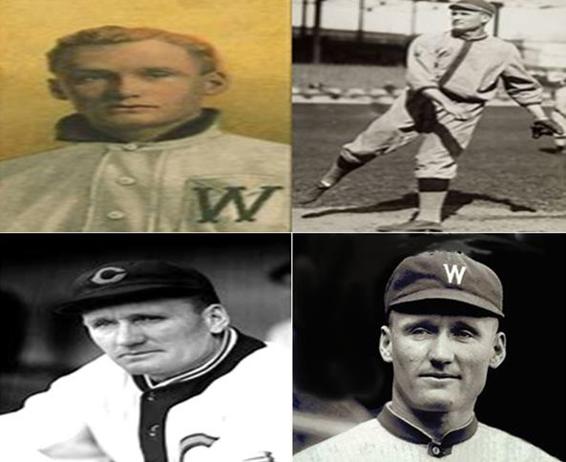
Walter Perry Johnson, November 6, 1887 – December 10, 1946, nicknamed "Barney" and "The Big Train," played his entire 21
year major league baseball career as a right handed pitcher for the Washington Senators from 1907 to 1927. He later served as
Baseball Trailblazers Page 105
manager of the Senators from 1929 through 1932 and of the Cleveland Indians from 1933 through 1935.
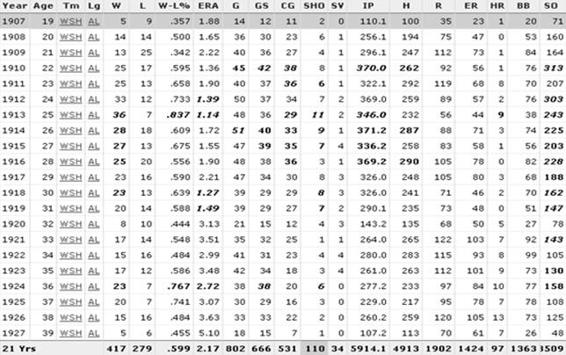
Often thought of as the greatest pitcher in baseball history, Johnson established several pitching records, some of which remain unbroken nine decades after he retired from baseball. He remains by far the all-time career leader in shutouts with 110, second in wins with 417, and fourth in complete games with 531.
He held the career record in strikeouts for nearly 56 years, with 3,508, from the end of his career in 1927 until the 1983
season. Johnson was the only player in the 3,000 strikeout club, achieved July 22, 1923 until July 17, 1974. His gentle nature was legendary, and to this day he is held up as an example of good sportsmanship, while his name has become synonymous with friendly competition.
Walter Johnson was the second of six children born to Frank Edwin Johnson (1861–1921) and Minnie Olive Perry (1867–1967) on a rural farm four miles west of Humboldt, Kansas. Although he was sometimes said to be of Swedish ancestry and was referred to by some sportswriters as "The Big Swede," Johnson's ancestors came from the British Isles.
Soon after he reached his fourteenth birthday, his family moved to California's Orange County in 1902. The Johnsons settled in the town of Olinda, a small oil boomtown located just east of
Baseball Trailblazers Page 106
Brea. In his youth, Johnson split his time among playing baseball, working in the nearby oil fields, and going horseback riding. He later moved to Idaho, where he doubled as a telephone company employee and a pitcher for a team in Weiser, Idaho of the Idaho State League. Johnson was spotted by a talent scout and signed a contract with the Washington Senators in July 1907
at the age of 19.
Johnson was renowned as the premier power pitcher of his era. Ty Cobb recalled his first encounter with the rookie fast baller.
“On August 2, 1907, I encountered the most threatening sight I ever saw in the ball field. He was a rookie. ..... Evidently, manager Pongo Joe Cantillon of the Nats had picked a rube out of the cornfields of the deepest bushes to pitch against us. .....
He was a tall, shambling galoot of about twenty, with arms so long they hung far out of his sleeves, and with a sidearm delivery that looked unimpressive at first glance. ..... One of the Tigers imitated a cow mooing, and we hollered at Cantillon;
'Get the pitchfork ready, Joe. Your hayseed's on his way back to the barn.' ..... The first time I faced him, I watched him take that easy windup, and then something went past me that made me flinch. The thing just hissed with danger. We couldn't touch him. ..... Every one of us knew we'd met the most powerful arm ever turned loose in a ball park.”
Baseball Trailblazers Page 107
His velocity was unmatched in his day, with the possible exception of Smoky Joe Wood. Johnson's sidearm motion was especially difficult for right handed batters to follow, as the ball seemed to be coming at them from third base. His pitching mechanics were superb, generating powerful rotation of his shoulders with excellent balance. In addition to his fastball, Johnson featured an occasional curveball that he developed around 1913 or 1914.
The overpowering fastball was the primary reason for Johnson's exceptional statistics, especially his fabled strikeout totals.
Johnson, as of 2017, ranks ninth on the all-time strikeout list, but his total must be understood in its proper context of an era of much fewer strikeouts. Among his pre–World War II contemporaries, only two men finished within 1,000 strikeouts of Johnson: runner up Cy Young with 2,803, and Tim Keefe at 2,562.
Bob Feller, whose war-shortened career began in 1936, later ended up with 2,581.
In a 21 year career, Johnson had twelve 20 win seasons, including ten in a row. Twice, he topped 30 wins. Johnson's record includes 110 shutouts, the most in baseball history.
Johnson lost 65 games because his team failed to score a run. On September 4, 5 and 7, 1908, he shut out the New York Highlanders in three consecutive games.
Baseball Trailblazers Page 108
His earned run average of 1.14 in 1913 was the fourth lowest ever at the time he recorded it; and it remains the sixth lowest today. It could have been lower if not for one of manager Clark Griffith's traditions. For the last game of the season, Griffith often treated the fans to a farce game. Johnson actually played center field that game until he was brought in to pitch. He allowed two hits before he was taken out of the game. The next pitcher, who was actually a career catcher, allowed both runners to score. The official scorekeeper ignored the game, but later, Johnson was charged with those two runs, raising his ERA from 1.09 to 1.14. For the decade from 1910 to 1919, Johnson averaged 26 wins per season and had an overall ERA of 1.59.
In April and May of 1913, he pitched 55.2 consecutive scoreless innings, still the American League record and the third longest streak in history. In May 1918, Johnson pitched 40 consecutive scoreless innings. He is the only pitcher with two such 40+
inning streaks.
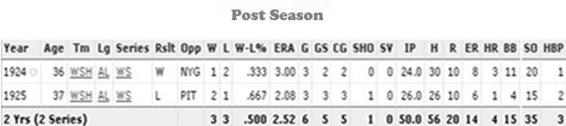
Although he often pitched for losing teams during his career, Johnson finally led the Washington Senators to the World Series in 1924, at age 36, his 18th year in the American League.
Johnson lost the first and fifth games of the 1924 World Series, but became the hero by pitching four scoreless innings of relief in the seventh and deciding game, winning in the 12th inning.
Baseball Trailblazers Page 109
Washington returned to the World Series the following season, but Johnson's experience was close to the opposite. His two early wins were followed by a game seven loss. On October 15, 1927, Johnson's request for an unconditional release from the club was granted.
Johnson was a good hitter for a pitcher, compiling a career batting average of .235, including a record .433 average in 1925. He also made 13 appearances in the outfield during his career. He hit over .200 in 13 of his 21 seasons, hit three home runs in 1914, and hit 12 doubles and a triple in 130 at bats in 1917. His teams historically needed runs.
Johnson had a reputation as a kindly person, and made many friends in baseball. In 1928, he began his career as a manager in the minor leagues, managing the Newark Bears of the International League. He continued on to the major leagues, managing the Washington Senators from 1929–1932, and finally the Cleveland Indians from 1933–1935. His managing record was 529–
432, with his best team managed being in 1930, when the team finished 94–60, 8 games out of first place. In seven seasons, he had five winning seasons. Johnson also served as a radio announcer on station WJSV for the Senators during the 1939
season.
Baseball Trailblazers Page 110
Walter Johnson retired to Germantown, Maryland. A lifelong Republican and friend of President Calvin Coolidge, Johnson was elected as a Montgomery County commissioner in 1938. His father-in-law was Rep. Edwin Roberts, a Republican member of the US
House of Representatives. Walter married Hazel Lee Roberts June 24, 1914, and they had five children. Johnson's eldest daughter died from influenza in 1921. His wife died in August 1930 from complications resulting from heat stroke after a long train ride from Kansas. Cobb was a good friend of Johnson, often bringing the pitcher's children gifts when he visited the family. At 11:40 pm, Tuesday, December 10, 1946 Johnson died of a brain tumor in Washington, D.C., five weeks after his 59th birthday.
Baseball Trailblazers
Page 111
Christy Mathewson
Baseball Trailblazers
Page 112
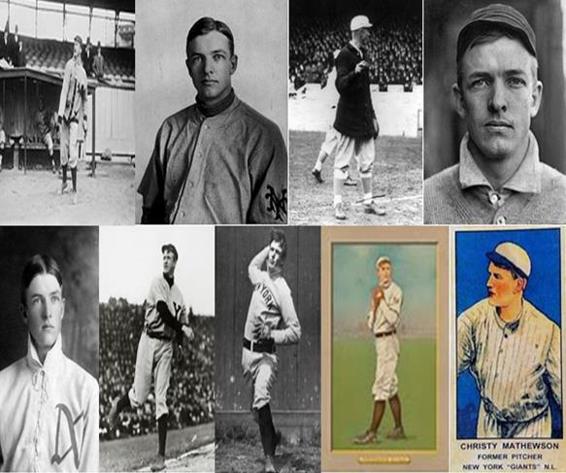
Christopher Mathewson, August 12, 1880 – October 7, 1925, nicknamed "Big Six," "The Christian Gentleman," "Matty," and
"The Gentleman's Hurler," was a major league baseball right handed pitcher, who played 17 seasons with the New York Giants.
He stood 6 ft. 1 in. tall and weighed 195 pounds. He was among the most dominant pitchers in baseball history, and ranks in the
Baseball Trailblazers Page 113
all-time top 10 in several key pitching categories, including wins, shutouts, and ERA. In 1936, Mathewson was elected into the Baseball Hall of Fame as one of its first five members.
Mathewson was born in Factoryville, Pennsylvania and attended high school at Keystone Academy. He attended college at Bucknell University, where he served as class president and played on the school's football, basketball, and baseball teams. He was also a member of the fraternity of Phi Gamma Delta. His first experience of semiprofessional baseball came in 1895, when he was just 14 years old. The manager of the Factoryville ball club asked him to pitch in a game with a rival team in Mill City, Pennsylvania. Mathewson helped his hometown team to a 19–17
victory, but with his batting rather than his pitching. He continued to play baseball during his years at Bucknell, pitching for minor league teams in Honesdale and Meridian, Pennsylvania. Mathewson was selected to the Walter Camp All-American football team in 1900. He was a drop kicker.
In 1899, Mathewson signed to play professional baseball with Taunton of the New England League. The next season, he moved on to play on the Norfolk team of the Virginia-North Carolina League. He finished that season with a 20–2 record. He continued to attend Bucknell during that time.
Baseball Trailblazers Page 114
In July of that year, the New York Giants purchased his contract from Norfolk for $1,500. Between July and September 1900, Mathewson appeared in six games for the Giants. He started one of those games and compiled a 0–3 record. Displeased with his performance, the Giants returned him to Norfolk and demanded their money back. Later that month, the Cincinnati Reds picked up Mathewson off the Norfolk roster. On December 15, 1900, the Reds quickly traded Mathewson back to the Giants for Amos Rusie.
Mathewson played football at Keystone Academy from 1895 to 1897.
He turned pro in 1898, appearing as a fullback with the Greensburg Athletic Association. While a member of the New York baseball Giants, Mathewson played fullback for the Pittsburgh Stars of the first National Football League. However, Mathewson disappeared from the team in the middle of the team's 1902
season. Some historians speculate that the Giants got word that their star pitcher was risking his baseball career for the Stars and ordered him to stop, while others feel that the Stars'
coach, Willis Richardson, got rid of Mathewson because he felt that, since the fullback's punting skills were hardly used, he could replace him with a local player, Shirley Ellis.
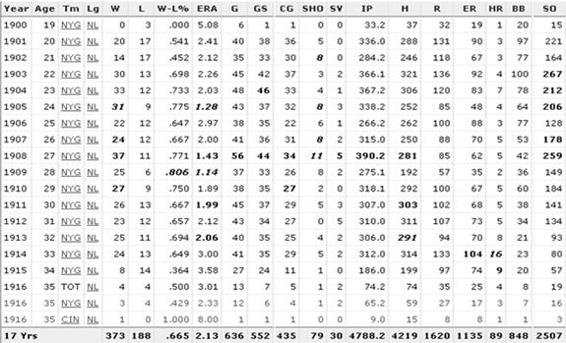
During his 17 year career, Mathewson won 373 games and lost 188
for a .665 winning percentage. His career ERA of 2.13 and 79
career shutouts are among the best all time for pitchers, and
Baseball Trailblazers Page 115
his 373 wins are still number one in the National League, tied with Grover Cleveland Alexander. He employed a good fastball, outstanding control, and, especially a new pitch he termed the
"fadeaway," later known in baseball as the screwball, which he learned from teammate Dave Williams in 1898.
Mathewson recorded 2,507 career strikeouts against only 848
walks. He pitched two no hitters and is further famous for his 25 pitching duels with Mordecai "Three Finger" Brown, who won 13
of the duels against Mathewson's 11, with one no decision.
Mathewson was a very good hitting pitcher in his major league career, posting a .215 batting average, 362 for 1687, with 151
runs, seven home runs, and 167 RBI. In 10 of his 17 years in the majors, he was in double figures in RBIs, with a season high of 20 in 1903. He batted .281, 9 for 32, in 11 World Series games.
By 1903, Mathewson's stature was such that when he briefly signed a contract with the St. Louis Browns of the American League, he was thought to be the spark the Browns needed to win the pennant. The Browns had finished a strong second in 1902, five games behind the Philadelphia Athletics. They offered him four times what he was making with the Giants. However, as part of the settlement that ended the two year war between the American and National Leagues, Mathewson and Browns owner Robert
Baseball Trailblazers Page 116
Lee Hedges tore up the contract. Hedges later said that ensuring the return of peace to the game was more important, even if it meant effectively giving up a pennant.
From 1900 to 1904, Mathewson established himself as a premier pitcher. Posting low ERAs and winning nearly 100 games, Mathewson helped lead the Giants to their first National League title in 1903, and a berth in first World Series. Though no World Series was held in 1904, the Giants captured the pennant, prompting McGraw to proclaim them as the best team in the world.
Mathewson strove even harder in 1905. After switching to catcher, Roger Bresnahan had begun collaborating with Mathewson, whose advanced memory of hitter weaknesses paved the way for a historic season. Pinpoint control guided Mathewson's pitches to Bresnahan's glove. In 338 innings, Mathewson walked only 64
batters. He shut out opposing teams eight times, pitching entire games in brief 90 minute sessions. Besides winning 31 games, Mathewson allowed only 1.28 earned runs for every nine innings.
His 206 strikeouts led the league, earning him the Pitcher’s Triple Crown.
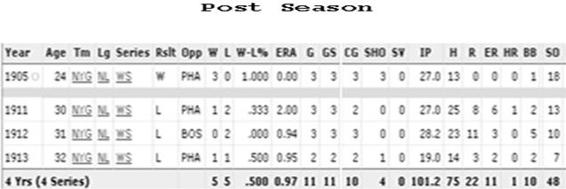
Mathewson's Giants won the 1905 World Series over the Philadelphia Athletics. Mathewson was the starting pitcher in game one, and pitched a four hit shutout for the victory. Three
Baseball Trailblazers Page 117
days later, with the series tied 1–1, he pitched another four hit shutout. Then, two days later in game five, he threw a six hit shutout to clinch the series for the Giants. In a span of only six days, Mathewson had pitched three complete games without allowing a run, while giving up only 14 hits.
In the next year, Mathewson lost much of his edge, owing to an early season diagnosis of diphtheria. McGraw pulled over 260
innings from him, but these were plagued with struggle. Though he maintained a 22–12 record, his ERA was 2.97.
By 1908, Mathewson was back on top as the league's elite pitcher. Winning the most games of his career, 37, coupled with a 1.43 ERA and 259 strikeouts, he claimed a second Triple Crown.
He also led the league in starts, innings pitched, complete games, and shutouts. He even led the league in saves, racking up 5 of them in 12 relief appearances. Unfortunately, the Giants were unable to take home the pennant due to what was ultimately known as Merkle's Boner, an incident that cost the Giants a crucial game against the Chicago Cubs, who eventually defeated the Giants in the standings by one game.
Mathewson returned for an outstanding 1909 season; though not as dominant as the previous year, he posted a better ERA of 1.14, and a record of 25-6. He repeated a strong performance in 1910
Baseball Trailblazers Page 118
and then again in 1911, when the Giants captured their first pennant since 1905. The Giants ultimately lost the 1911 World Series to the Philadelphia Athletics, the same team they had defeated for the 1905 championship. Mathewson and Rube Marquard allowed two game winning home runs to Hall of Famer Frank Baker, earning him the nickname, "Home Run." Mathewson, the team's
"star pitcher," signed a three year contract with the Giants in late 1910, for the upcoming 1911, 1912 and 1913 seasons, the first time he had signed a contract over a year in length.
In 1912, Mathewson gave another stellar performance. Capturing the pennant, the Giants were fueled by the stolen base game and a superior pitching staff capped by Rube Marquard, the "11,000
dollar lemon," who turned around to win 26 games, 19 of them consecutively. In the 1912 World Series, the Giants faced the Boston Red Sox, the 1904 American League pennant winners who would have faced the Giants in the World Series that year had one been played. Though Mathewson threw three complete games and maintained an ERA below 1.00, numerous errors by the Giants, including a lazy popup dropped by Fred Snodgrass in the eighth game; game 2 ended in a tie; cost them the championship. The Giants also lost the 1913 World Series, a 101 win season cemented by Mathewson's final brilliant season on the mound; a
Baseball Trailblazers Page 119
league leading 2.06 ERA in over 300 innings pitched complemented by 0.6 bases on balls per nine innings pitched.
For the remainder of his career with the Giants, Mathewson began to struggle. Soon, the former champions fell into decline. In 1915, Mathewson's penultimate season in New York, the Giants were the worst team in the National League standings. Mathewson had expressed interest in serving as a manager, and wound up with a three year deal to manage the Cincinnati Reds effective July 21, 1916.
He was traded to the Cincinnati Reds along with Edd Roush. He was immediately named as the Reds' player-manager. However, he appeared in only one game as a pitcher for the Reds, on September 4, 1916. He faced Brown in the second half of a doubleheader, which was billed as the final meeting between the two old baseball warriors. The high scoring game was a win for Mathewson's Reds over Brown's Cubs, 10–8.
Mathewson retired as a player after the season and managed the Reds for the entire 1917 season and the first 118 games of 1918, compiling a total record of 164-176 as a manager.
Mathewson married Jane Stoughton, 1880-1967, in 1903. Their only son, Christopher Jr., was born shortly after. During Mathewson's playing years, the family lived in a duplex in upper Manhattan
Baseball Trailblazers Page 120
alongside Mathewson's manager John McGraw and his wife Blanche.
Mathewson and McGraw remained friends for the rest of their lives.
Mathewson was highly regarded in the baseball world during his lifetime. As he was a clean cut, intellectual collegiate, his rise to fame brought a better name to the typical ballplayer, who usually spent his time gambling, boozing, or womanizing. As noted in The National League Story (1961) by Lee Allen, Mathewson was a devout Christian and never pitched on Sunday, a promise he made to his mother that brought him popularity among the more religious New York fans and earned him the nickname
"The Christian Gentleman."
In his free time, Mathewson enjoyed nature walks, reading, golf, and checkers, of which he was a renowned champion player. The combination of athletic skill and intellectual hobbies made him a favorite for many fans, even those opposed to the Giants.
Sportswriters praised him, and in his prime every game he started began with deafening cheers. Sometimes, the distraction prompted him to walk out ten minutes after his fielders took the field. Mathewson soon became the unspoken captain of the Giants.
He was the only player to whom John McGraw ever gave full discretion. McGraw told many younger players to watch and listen to his wisdom.
Baseball Trailblazers Page 121
Mathewson garnered respect throughout the baseball world as a pitcher of great sportsmanship. He was often asked to write columns concerning upcoming games. In 1912, Mathewson published his classic memoir, “Pitching in a Pinch,” or “Pitching from the Inside,” which is still in print. Years later, Mathewson co-wrote a mildly successful play called “The Girl and The Pennant.” He went on to pursue more literary endeavors ending in 1917 with a children's book called “Second Base Sloan.” One of the journalists to unmask the 1919 Black Sox, Hugh Fullerton, consulted Mathewson for information about baseball gambling. He trusted Mathewson for his writing intellect, as well as his unbiased standpoint. Representing the only former ballplayer among the group of investigating journalists, Mathewson played a small role in Fullerton's exposure of the 1919 World Series scandal.
Late in the 1918 season, Mathewson enlisted in the United States Army for World War I. His wife Jane was very much opposed to the decision, but Mathewson insisted on going. He served overseas as a captain in the newly formed Chemical Service along with Ty Cobb. When he arrived in France, he was accidentally gassed during a chemical training exercise and subsequently developed tuberculosis, which more easily infects lungs that have been damaged by chemical gases. Mathewson served with the American
Baseball Trailblazers Page 122
Expeditionary Forces until February 1919 and was discharged later that month.
Although he returned to serve as a coach for the Giants from 1919 to 1921, he spent a good portion of that time in Saranac Lake fighting the tuberculosis, initially at the Trudeau Sanitorium, and later in a house that he had built. In 1923, Mathewson returned to professional baseball when Giants attorney Emil Fuchs and he put together a syndicate that bought the Boston Braves. Although initial plans called for Mathewson to be principal owner and team president, his health had deteriorated so much that he was no more than a figurehead. He turned over the presidency to Fuchs after the season.
Frigid Saranac Lake, New York in the Adirondack Mountains, proved to be his last home. He died there of tuberculosis on October 7, 1925. Some of Mathewson's last words were to his wife; "Now Jane, I want you to go outside and have yourself a good cry. Don't make it a long one; this can't be helped."
Baseball Trailblazers Page 123
John McGraw
Three time World Series champion - 1905, 1921, 1922; winner of ten pennants. Member of the National Baseball Hall of Fame –
1937. Could have been elected as either a player or a manager.
His significance to excellent baseball play, development, and innovation is only rivalled by Babe Ruth. Many of his playing seasons were shortened by ailments, and the only “criticism” one can make is to say that he was injury prone. His .466 career on base percentage, arguably the most important offensive statistic of his playing years, is third best all-time behind Ted Williams (.482) and Babe Ruth (.474).His nickname was "Muggsy," one he strongly disliked,
Baseball Trailblazers
Page 124
Baseball Trailblazers
Page 125
Baseball Trailblazers
Page 126
Baseball Trailblazers Page 127
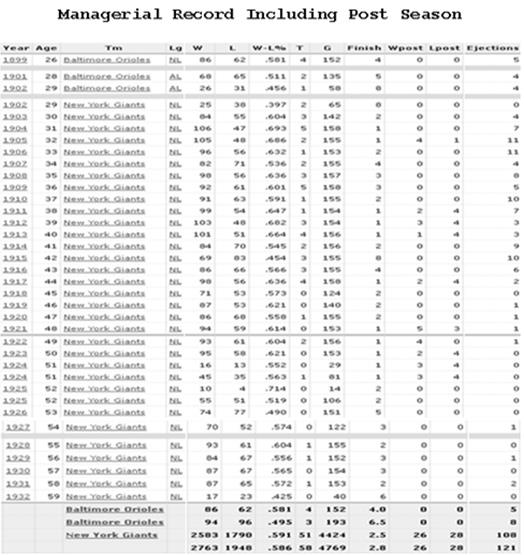
John Joseph McGraw, April 7, 1873 - February 25, 1934, was born into poverty in Truxton, New York. He found an escape from his hometown and a bad family situation through baseball, beginning a quick rise through the minor leagues that led him to the Orioles at the age of 18. Under the tutelage of manager Ned Hanlon, the Orioles of the 1890’s won three National League pennants. McGraw was one of the stalwarts of the team alongside Wee Willie Keeler, Hughie Jennings, and Wilbert Robinson. The Orioles perfected the hit and run play and popularized the Baltimore chop. They also sought to win by intimidating the opposing team and the umpire.
The volatility of major league baseball at the turn of the twentieth century led to McGraw becoming manager of the Orioles at age 26 in 1899, and he was lauded for his leadership. The National League Orioles were dissolved after 1899, and McGraw spent one season with the St. Louis Cardinals before returning to Baltimore as player-manager of the new Orioles of the American League. He quarreled with AL president Ban Johnson and jumped to the Giants in 1902, taking a number of the Orioles'
players with him.
Throughout his thirty-two years of managing the Giants, McGraw exerted control on players and team, and saw great success, winning ten pennants which is only matched by Casey Stengel, who
Baseball Trailblazers Page 128
played for and learned from him, and three World Series. His total of 2,763 victories as a major league baseball manager ranks third overall behind only Connie Mack and Tony La Russa.
He holds the NL record for seasons managed. McGraw is widely held to be one of the greatest managers in baseball history. He retired, ill, in 1932 and died less than two years later after making a final appearance in 1933 as NL manager in the first All-Star Game.
McGraw's father (whose name was also John) emigrated from Ireland in 1856. He arrived before the Civil War, and served in the Union Army. He married, but his first wife soon died, leaving him with a young daughter, and he moved to Truxton, New York in 1871, where he became a railroad worker. There, he married young Ellen Comerfort. The younger John McGraw, her first child, was born in Truxton on April 7, 1873.
The family was poor, with eight children born to the couple, and there was no public assistance available. Young John had a love of baseball from an early age. By doing odd jobs, he was able to save a dollar and send off for one of the Spalding company's cheaper baseballs, which he used to practice his pitching.
Tragedy struck the family in the winter of 1885, when there was a diphtheria epidemic in the area. The disease killed of Ellen
Baseball Trailblazers Page 129
McGraw and four of her children, including John's older half-sister. John Sr. never fully recovered from the trauma of the deaths. Father and son argued over the time young John spent on baseball, especially since the father had to pay for windows the son broke while playing. Later in 1885, after young John broke another window, the father became abusive, and the son ran away to a neighbor, Mary Goddard, who ran the local hotel. She persuaded John Sr. to let his son stay in her care.
During his time in Goddard's household, John attended school and took on several jobs that allowed him to save money to buy baseballs and the Spalding magazines that documented the rule changes in the rival major leagues of baseball, the National League and the American Association. He quickly became the best player on his school team. Shortly after his sixteenth birthday, he began playing for his town's team, the Truxton Grays, making a favorable impression on their manager, Albert "Bert" Kenney.
While he could play any position, his ability to throw a big curveball made him the star pitcher. McGraw's relationship with Kenney precipitated his professional playing career.
In 1890, Kenney bought a portion of the new professional baseball franchise in Olean, New York. The team was to play in the newly formed New York-Pennsylvania League. In return for this investment, he was named Olean's player-manager,
Baseball Trailblazers Page 130
responsible for selecting and signing players. When approached by McGraw, Kenney doubted the boy's curveball would fool professional ballplayers. Persuaded by the assurance McGraw could play any position, Kenney signed him to a contract on April 1, 1890. McGraw would never return to live in Truxton, the place of his birth.
Olean was 200 miles from Truxton, and this was the farthest the youngster had ever traveled from his hometown. He began the season on the bench. After two days, Kenney inserted him into the starting lineup at third base. McGraw later described his first professional game. “For the life of me, I could not run to get it. It seemed like an age before I could get the ball in my hands and then, as I looked over to first, it seemed like the longest throw I ever had to make. The first baseman was the tallest in the league, but I threw the ball far over his head.”
Seven more errors in nine more chances followed that day. Both the team and McGraw remained ineffective, and he was fired by Kenney after six games, though the captain gave him $70 and wished him luck. He signed with a team in Wellsville, New York, who played in the Western New York League. The level of baseball played there was the lowest of the minor leagues, and McGraw still struggled with his fielding. But during the 24 games he
Baseball Trailblazers Page 131
appeared in for the club, he hit with a batting average of .365, a glimpse into his later hitting prowess.
After that first season, McGraw caught on with the offseason team of promoter Alfred Lawson. McGraw joined the team in Ocala, Florida, and the team sailed from Tampa to Havana, Cuba, where they played the local teams in what was then a Spanish colony.
McGraw, who played shortstop, became a favorite of local fans, who dubbed him "el mono Amarillo," “the yellow monkey,”
referring to his speed, diminutive size, and the color of his team's uniforms. McGraw liked Cuba and returned there many times in later years.
Lawson took his team to Gainesville, Florida in February 1891, and persuaded the National League Cleveland Spiders to play his team. McGraw hit three doubles in five times at bat, playing errorless ball at shortstop, and the reports of that game caused a number of minor league teams to seek to sign him. Lawson acted as the boy's agent, and advised him to request $125 monthly and a $75 advance. The manager of the Cedar Rapids club in the Illinois-Iowa League was the first to wire the money, and McGraw signed with them. A number of other teams claimed that McGraw had also taken advance money from them, though McGraw always maintained that he had returned it, and one even threatened
Baseball Trailblazers Page 132
legal action. This came to nothing, allowing McGraw to play with Cedar Rapids.
By August, the league had financial woes but McGraw was hitting
.275 and had become known as a tough shortstop. Billy Barnie, manager of the American Association's Baltimore Orioles, had heard about McGraw, and wrote to the Rockford team's Bill Gleason, a former Oriole, for a recommendation, which according to McGraw biographer Charles C. Alexander must have been favorable, as Barnie then wired Hank Smith, another former Oriole who was playing for Cedar Rapids, asking if there was any chance Baltimore could acquire McGraw. Cedar Rapids agreed to give McGraw his release, and he left by rail for Baltimore.
McGraw arrived at Camden Station in Baltimore on August 24, 1891, still only 18 years old, but now a major league baseball player. McGraw described his new home upon his arrival as "a dirty, dreary, ramshackle sort of place." Barnie was unimpressed by the short stature of the player he had recruited unseen, but McGraw assured him, "I'm bigger than I look."
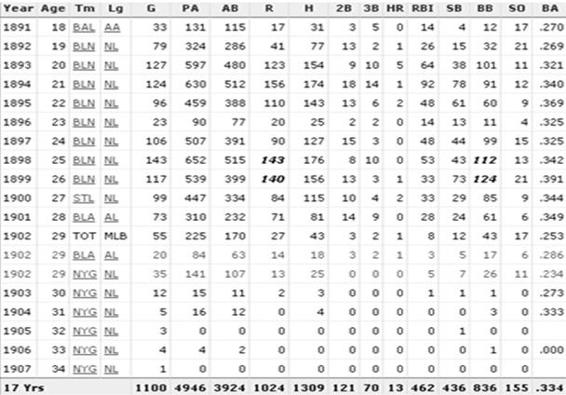
During the short part of the 1891 season McGraw was with the Orioles, he hit .245. Initially he played shortstop, but his poor fielding; 18 errors in 86 chances; caused Barnie, who quit before the end of the season, to try him at other positions.
Despite his poor fielding percentage, McGraw was quickly signed
Baseball Trailblazers Page 133
to a contract for 1892 by club owner Harry Von der Horst. The American Association failed after the 1891 season, and the Orioles and other surviving franchises moved to an expanded twelve-team National League.
Early in the 1892 season, Von der Horst hired outfielder Ned Hanlon of the Pittsburgh Pirates to manage the Orioles. The Orioles lost over 100 games, finishing last by a wide margin. Of the seventeen players Hanlon inherited, he kept only three: pitcher Sadie McMahon, catcher Wilbert Robinson and McGraw.
According to baseball author Burt Solomon, "Hanlon saw that McGraw's value to the Orioles came less from his agility than from his intensity. He never gave up and had contempt for anyone who did. John McGraw could drive his teammates to another level of play." But little of that showed in the 1892 season, in which McGraw hit .267 with 14 stolen bases while playing a variety of positions. During the 1892-93 offseason, McGraw attended Allegany College, soon to be renamed St. Bonaventure, trading his skills as a baseball coach for the right to attend without paying tuition.
In 1893, Hanlon secured Hughie Jennings from the Louisville Colonels, a shortstop whose acquisition caused Hanlon to remove McGraw from that position. The team finished eighth in 1893, while McGraw hit .327, second on the club to Robinson, and led
Baseball Trailblazers Page 134
the league in runs scored. He spent a second winter at St.
Bonaventure, this time with Robinson as his assistant coach and fellow student. During the offseason, McGraw narrowly avoided being dealt to the woeful Washington Senators when a trade for Duke Farrell fell through. Deciding that McGraw could handle third base, Hanlon traded two infielders for five time batting champion Dan Brouthers and diminutive outfielder Willie Keeler.
The Orioles' 1894 spring training took place in Macon, Georgia, where Hanlon taught the players innovative plays that he had thought of during his playing career, and in the evening, drilled them on baseball's rules and possible ways of taking advantage of them. The innovations of the Orioles of the mid-1890’s would include the Baltimore chop, that is hitting a pitched ball so it would bounce high and allow the batter to reach first base safely, having the pitcher cover first base when the first baseman fielded a ball that took him away from the base, and though they probably did not invent the hit and run, they were the first team to employ it as a regular maneuver. McGraw often took the lead in the discussions. When the team played in New Orleans, a local sportswriter called him
"a fine ball-player, yet he adopts every low and contemptible method that his erratic brain can conceive to win a play by a dirty trick." This included shoving, holding, and blocking
Baseball Trailblazers Page 135
baserunners, at a time when there was often only a single umpire. One baserunner, anticipating that McGraw would hold him by the belt, loosened it and when he broke for home, McGraw was left holding the belt in his hand as the runner scored.
By 1894, McGraw was settled in at third base. Under manager Ned Hanlon, an unerring talent spotter, the Orioles won three straight pennants, making them the second best team of the decade. Boston, which won five pennants that decade, was better, but it is the Orioles who are remembered as the team of the
'90s, not just for their skill, but also for their style.
Aggressive and creative, the Orioles either invented or perfected the hit and run, the Baltimore chop, the suicide squeeze, and the bunt single. They also led the league in unsportsmanlike conduct.
McGraw usually batted leadoff for the 1894 Orioles, hitting .340
and stealing 78 bases, second in the league. He would foul off pitch after pitch, a valuable talent in the pre-1901 era in which foul balls generally did not count as strikes and, along with Keeler, elevated it into an art form, as the duo did with the hit and run. Many of the players, including McGraw, lived in the same Baltimore boarding house, and talked baseball deep into the night. From such discussions arose the discovery that a runner on third had an excellent chance of scoring if he left at
Baseball Trailblazers Page 136
the pitcher's first motion and the batter bunted, originating the squeeze play. A reputation for dirty play led to McGraw being dubbed "Muggsy," a nickname he strongly disliked. The Orioles won their first pennant, besting the New York Giants and the Boston Beaneaters. Amid disputes over money, they lost the postseason Temple Cup series to the second place Giants. After a brief visit to Truxton, McGraw spent the winter at St.
Bonaventure.
The Orioles' "Big Four;" McGraw, Jennings, Keeler and Joe Kelley; held out to start 1895, but came to terms with the club in time for spring training. By 1895, McGraw had become controversial for his aggressive style of play. Some urged Hanlon to rein him in, but others argued that fans were flocking to the ballpark precisely to see such play. In spite of the controversy, the Orioles won their second consecutive pennant, though they lost the Temple Cup again, this time to the Spiders.
McGraw, suffering from malaria, missed part of the season, but hit .369 in 96 games, with 61 stolen base and 110 runs scored.
McGraw again went to St. Bonaventure, returning to Baltimore when the fall term ended in mid-December.
During 1896 spring training, McGraw fell ill with typhoid fever in Atlanta. By the time he had convalesced, in late August, the Orioles had nearly secured their third straight pennant, this
Baseball Trailblazers Page 137
time winning the Temple Cup over the Spiders in four games.
McGraw appeared in only 23 games for Baltimore, batting .325.
After the season, the Orioles had planned an exhibition tour of Europe, but it was cancelled over concerns poor weather would preclude too many games. The Big Four went anyway, as tourists, visiting Britain, Belgium and France. Following their return, in February 1897, McGraw married Minnie Doyle, whose father was a city official. McGraw and the Orioles both had seasons that disappointed them in 1897, with McGraw hitting .325, and the team plagued by injuries as Baltimore lost the pennant to the Beaneaters, though the Orioles won the final iteration of the Temple Cup. In 1898, McGraw hit .342, but the Orioles finished second again, six games behind the Beaneaters.
The Orioles' continued success on the field did not translate to increased attendance, which fell substantially as the Orioles won each pennant. Violence on the field spread into the stands.
The Spanish-American War of 1898 also distracted the public from baseball, causing financial problems for the teams. Before the 1899 season, Van der Horst and Hanlon, a co-owner, bought half the shares in the Dodgers, while Brooklyn owners, led by Charlie Ebbets, bought a fifty percent interest in the Orioles. Brooklyn drew better attendance than Baltimore, and under the arrangement, known as "syndicate baseball," manager Hanlon and
Baseball Trailblazers Page 138
the better Oriole players would move to Brooklyn. McGraw and Robinson, who had financial interests in Baltimore, refused to go and before the 1899 season, McGraw was made player-manager of the Orioles.
McGraw schooled his players in the Orioles system, and led by example, hitting .391 for the season. To Hanlon's surprise, attendance in Baltimore rebounded, and the Orioles remained close to Brooklyn in the pennant race through late August, when McGraw had to leave the team due to the illness of his wife. By the time he returned, after her death, Brooklyn had clinched the pennant; while the Orioles finished fourth. Nevertheless, for getting the castoff Orioles to perform so well amid his personal tragedy, McGraw was hailed as a managerial genius in the newspapers.
Syndicate baseball was insufficient to revive the finances of the National League, and before the 1900 season, four NL teams, including Baltimore, were ended. McGraw and Robinson were sold to the St. Louis Cardinals. They did not report until the season had begun, having secured increases in salary and a concession that their contracts would not contain the then standard reserve clause that bound them to the signing team for the following season. Thus, they would be free agents after the 1900 season.
Injured for part of the season, McGraw hit .337 in 98 games as
Baseball Trailblazers Page 139
the Cardinals finished tied for fifth. But when manager Patsy Tebeau resigned in August, McGraw ruled out replacing him. Ban Johnson, president of the minor league Western League, sought to build a second major league, which would seek to attract fans wanting baseball without rowdyism or aggression towards umpires.
McGraw and Robinson, centerpieces of the old Orioles, where such aggression was routine, were an odd fit, but as Johnson renamed his circuit the American League and sought to put franchises in abandoned NL cities like Baltimore, they became key to his plans. He was confident he could control them, since one of the requirements was that franchises grant the league an option to buy a majority stake and thus take them over if necessary.
Even while under contract to the Cardinals, McGraw and Robinson were involved in meetings aimed at upgrading the Western League to major league status, and on November 12, 1900, they signed an agreement with Johnson giving them exclusive rights to form an AL franchise in Baltimore, securing financial backing from a number of local figures. McGraw spent much of the winter seeking to sign players.
McGraw batted leadoff and managed the Orioles as Major League Baseball made its return to Baltimore in 1901, but missed games due to injuries and because of a suspension by Johnson for abusing the umpires. The Orioles finished fifth, with McGraw
Baseball Trailblazers Page 140
batting .349 in 73 games. The team lost money. On January 8, 1902, McGraw married for the second time, to Blanche Sindall, whose father was a Baltimore housing contractor.
McGraw started the 1902 season with a knee injury. Recovery from that, suspensions and a deep cut from the sharpened spikes of a baserunner meant that he again played few games for the Orioles.
The team drifted between fifth and seventh in the league, and there was widespread talk that at the end of the season, Johnson would shift the team to New York. Although being a manager and part owner of a New York AL team would be a major opportunity for him, McGraw was convinced Johnson planned to discard him in the process. So McGraw struck first, as any true Oriole would.
On June 18, 1902, with the Orioles on a western road trip with Robinson as acting manager, McGraw, who was recuperating from the spiking, traveled to New York and met with Andrew Freedman, owner of the Giants. The two came up with a scheme not only for McGraw to switch leagues but to cripple the Orioles and possibly the AL. When McGraw returned to the lineup on June 28, he provoked the umpire into kicking him out of the game and, when he refused to go, Baltimore forfeited the game to Boston. This resulted in his indefinite suspension by Johnson.
Baseball Trailblazers Page 141
McGraw went to the directors of the Baltimore franchise, and demanded that either they reimburse the $7,000 he had advanced towards player salaries or that they release him. The team agreed to his release on July 8, and McGraw sold his interest in the club to John Mahon, a team official and Joe Kelley's father in law. McGraw immediately announced he would sign to manage the Giants, which he did the next day. His salary of $11,000, equivalent to $329,027 in 2020, was the largest of any player or manager in baseball history to that point.
Freedman then secured a controlling interest in the Orioles from Mahon, Kelley and others. Once he had done so, he directed the release of Orioles Joe McGinnity, Dan McGann, Roger Bresnahan and Jack Cronin, all of whom promptly signed with the Giants.
Cincinnati Reds owner John T. Brush, who was also a minority owner of the Giants, was in on the deal. He signed Kelley as manager of the Reds and also outfielder Cy Seymour, both released by the Orioles. Baltimore was left with so few players it had to forfeit its next game. The crisis might have destroyed the American League had not Johnson acted decisively to take over the Baltimore franchise, and getting the other seven teams to contribute players to the Orioles, who finished last. After the season, the two leagues signed a peace agreement, and the AL
replaced the Baltimore franchise with one in New York City. That
Baseball Trailblazers Page 142
team became known as the Highlanders and later as the New York Yankees. McGraw and Johnson never spoke again.
Jack Hendricks, a Giants outfielder until shortly after McGraw became manager said; “There is a story McGraw fired me the first day. That is a big lie. It was the second day. I hid in the clubhouse the first day.”
By the time the Giants returned from a road trip to meet McGraw at their home field, the Polo Grounds, they had a record of 22-50 and were in last place in the NL. Not all of them were kept.
McGraw released four of them by telegraph to Cincinnati, and two more when they returned to New York. McGraw played occasionally, and spent part of the season appearing in AL cities seeking to sign players, much to the discomfiture of the local team's management. The Giants finished last, and at the end of the season, Freedman sold the team to Brush. With his knee injury robbing him of some of his skill, 29 year old McGraw batted .286
in 20 games with Baltimore and .234 in 35 games with the Giants.
It would be his last season as a full-time player, though he nominally remained on the roster until 1906. One stratagem used by McGraw was to have pitcher Dummy Taylor, who was deaf and could not speak, teach his teammates sign language, which both gave the team ways of communicating on the field and improved
Baseball Trailblazers Page 143
Taylor's relationship with his teammates. The Giants used sign language until Chicago's Johnny Evers detected and learned it.
McGraw's knee gave way in 1903 spring training, effectively sidelining him for the entire season. He was also injured early in the year by a ball thrown by Taylor that broke McGraw's nose.
The cartilage did not heal properly, contributing to respiratory problems that plagued McGraw for the rest of his life. During spring training, McGraw took pains to cultivate the team's star, pitcher Christy Mathewson, and the two men, along with their wives, Blanche McGraw and Jane Mathewson, became so close that they shared an apartment in New York City. McGraw also forged a strong relationship with the new Giants owner, Brush.
McGraw's new look Giants got off to a hot start in 1903, and were in first place ahead of the two time defending NL champion Pirates at the end of May, as crowds not seen in a decade flocked to the Polo Grounds. Still coming together as a team, they thereafter faded and finished second, six and a half games behind the Pirates. But McGinnity won 31 games while Mathewson won 30 and led the league in strikeouts. As a player, McGraw appeared in 11 games and batted .273. The Giants' success, and the controversy the belligerent McGraw aroused, meant they attracted larger crowds not only at the Polo Grounds, but on the road as well. Leading the most hated team in the league, McGraw
Baseball Trailblazers Page 144
stated; "It is the prospect of a hot feud that brings out the crowd."
Before the 1904 season, McGraw deemed his team the strongest he had ever led, and predicted the Giants would win the pennant.
The team played accordingly, and opened up a 15 game lead on the Chicago Cubs by the start of September. With the Highlanders leading the AL for much of the year, there was intense pressure on McGraw and Brush to agree to a postseason series against the AL champions, what would later come to be known as the World Series, like the Pirates had the previous year. Both men refused, with McGraw stating that there was nothing in the league rules requiring its champions to play a series against "a victorious club in a minor league." It has been posited that both men disliked Ban Johnson and feared losing the series to the AL champions, as the Pirates had in 1903. The Giants won the pennant, setting a major league record for victories with 106.
McGraw continued building his team in the offseason, purchasing Sammy Strang from Brooklyn. In addition to playing nearly every position, Strang pioneered a McGraw innovation, the pinch hitter. Part of his job was to bat for other players. He schooled them in the aggressive techniques of the old Orioles, stating years later; "It was a team of fighters. They thought they could beat anybody and they generally could." The team was
Baseball Trailblazers Page 145
never really threatened in its drive to a second consecutive pennant, and McGraw always stated this was the best team he ever managed. It won 105 games and the Pirates finished second, nine games behind. McGraw was ejected from games 13 times, a personal record, and Pittsburgh owner Barney Dreyfuss sought to have McGraw disciplined after the manager shouted accusations at him after one ejection. The league Board of Directors refused to suspend McGraw, and when NL president Harry Pulliam suspended McGraw for 15 games for accusing Pulliam of being Dreyfuss's lackey, the suspension was overturned by a court. This time, the Giants had no objection to playing a postseason series against the AL champions, the Philadelphia Athletics, managed by Connie Mack. The 1905 World Series saw a great exhibition of pitching, as every game ended in a shutout, three of them pitched by Mathewson and one by McGinnity. The Giants won, four games to one. McGraw was rewarded with a new contract at $15,000 per year. The victory made the Giants heroes in a city that always admired winners, and McGraw one of the most prominent people in New York.
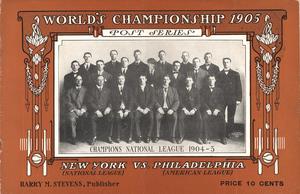
1905 World Series
Baseball Trailblazers
Page 146
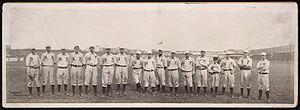
New York Giants, 1904 and 1905 National League Champions.
New York Giants - John McGraw Player-manager - 105-48, .686, Games Ahead: 9.
Philadelphia Athletics - Connie Mack-Manager - 92-56, .622, Games Ahead: 2.
Hall of Famers – Umpire Hank O'Day; Giants’ John McGraw, Roger Bresnahan, Christy Mathewson, and Joe McGinnity; Athletics’
Connie Mack, Chief Bender, Eddie Plank, and Rube Waddell.
Baseball Trailblazers
Page 147
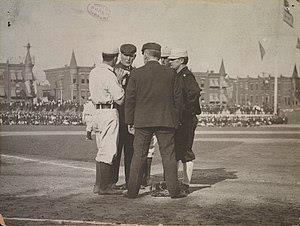
Conference on the field during one of the games at Columbia Park.
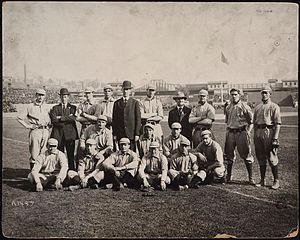
Philadelphia Athletics and Connie Mack before one of the games at the Polo Grounds.
Baseball Trailblazers
Page 148
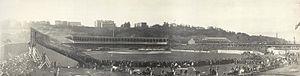
New York Giants at the Polo Grounds before one of the games.
The Polo Grounds during one of the games.
Now, in the best of seven format, still prevalent today, four of the five games featured duels between future Hall of Fame pitchers. Each of the five games was a shutout. Three of those, over a six day span, were pitched and won by Christy Mathewson.
Before the Series began, the Athletics were already at a major disadvantage. For the Series, they were without the services of
Baseball Trailblazers Page 149
Rube Waddell, who was undoubtedly their best pitcher that year; at 27 league leading wins, 10 losses, a league leading .730
winning percentage, a league leading 1.48 ERA, and a league leading 287 strikeouts. The reason for Waddell's absence was listed as a shoulder injury from some sort of “wrestling match”
with teammate Andy Coakley, though in years since some have speculated that Waddell was actually bribed or “paid off” to fake the injury and thus not play in the Series. Philadelphia manager Connie Mack, however, refused to believe this theory, finding it ridiculous. Indeed, had Waddell any intention of throwing the series, he could have accomplished that much better by playing and purposely pitching poorly.
McGraw had previously referred to the Athletics as a "white elephant," which the club defiantly adopted as a symbolic mascot. At the conference at home plate before Game 1, A's team captain Lave Cross gave McGraw a wrapped package, which turned out to contain a toy white elephant. McGraw responded with a big grin, and the crowd laughed. McGraw and the Giants would have the last laugh, easily defeating the A's in the Series.
Game 1 - Monday, October 9, 1905, at Columbia Park in Philadelphia, Pennsylvania - New York Giants - 3, Philadelphia Athletics – 0 - WP: Christy Mathewson (1-0), LP: Eddie Plank (0-1). The opening game was a pitchers' duel between Christy
Baseball Trailblazers Page 150
Mathewson and Eddie Plank. Both got out of jams, shutting the opposing offense down. In the Giants' top of the fifth, Mathewson singled, but was forced by Roger Bresnahan, who stole second shortly afterwards. After George Browne popped out, Mike Donlin singled to left, scoring Bresnahan and advancing Donlin to second. After Dan McGann walked, Sam Mertes doubled, bringing home Donlin. In the Athletics' half of the sixth, Ossee Schreckengost doubled and advanced to third on a wild pitch, but did not score, and was the lone runner to reach third base against Mathewson in the entire series. The Giants added an insurance run in the ninth, when Billy Gilbert scored on Bresnahan's single. This was the first of Mathewson's three consecutive complete game shutouts, a World Series record that may never be matched.
Game 2 - Tuesday, October 10, 1905, at the Polo Grounds in upper Manhattan, New York - Philadelphia Athletics - 3, New York Giants – 0 - WP: Chief Bender (1-0), LP: Joe McGinnity (0-1).
The A's called on Chief Bender to turn the tables on the Giants.
His opponent was 21 game winner "Iron Man" Joe McGinnity. The game was scoreless until the top of the third. Ossee Schreckengost, leading off, reached on a Dan McGann's error.
Bender sacrificed, moving Schreckengost to second. After a groundout by Topsy Hartsel moved Schreckengost to third, Bris
Baseball Trailblazers Page 151
Lord singled to left and drove Ossee home with an unearned run.
The slim margin held until the top of the eighth, when the A's put two more unearned runs on the board. With one out, Schreckengost was once again the catalyst, singling to center.
After Bender flied out to right field, Hartsel's double scored Schreckengost all the way from first, helped by an error by Bresnahan, and a single by Lord brought Hartsel home, making it 3-0 in favor of the A's. Bender cruised, got out of late inning jams and ended up with a complete game shutout that tied the series at 1.
Game 3 - Thursday, October 12, 1905, at Columbia Park - New York Giants - 9, Philadelphia Athletics – 0 - WP: Christy Mathewson (2-0), LP: Andy Coakley (0-1). Christy Mathewson once again took the mound for the Giants in Game 3. Opposing him this time was Andy Coakley, who hit the first batter he faced, Roger Bresnahan, with a pitch. A single to right by Mike Donlin moved Bresnahan to third with one out. Dan McGann singled to right, bringing Bresnahan home. An error by Danny Murphy scored Donlin and put Sam Mertes on base. Bill Dahlen walked, loading the bases with one out, but Art Devlin hit into a double play to end the rally. The Giants put the game away in the top of the fifth.
Bresnahan walked with one out. George Browne singled and went to second on the throw to third base. Donlin was walked
Baseball Trailblazers Page 152
intentionally, setting up a possible inning ending double play, but things continued to crumble for Coakley and the A's. McGann reached on another error by Danny Murphy, reloading the bases and scoring a run. Mertes singled, reloading the bases and driving in another run. Bill Dahlen hit into a force play at second, scoring Donlin. After Dahlen stole second, Devlin singled, bringing home McGann and sending Dahlen to third.
Devlin then stole second and Dahlen stole home on a double steal, scoring the fifth and last run of the Giants' fifth. They scored two more runs in the top of the ninth, when McGann doubled home Browne and Donlin. Mathewson pitched his second complete game shutout, giving the Giants a 2-1 lead in the series.
Game 4 - Friday, October 13, 1905, at the Polo Grounds – New York Giants – 1, Philadelphia Athletics – 0 - WP: Joe McGinnity (1-1), LP: Eddie Plank (0-2). Eddie Plank returned for the A's against Joe McGinnity for the Giants in Game 4. Both left men on base in scoring position early on, and kept the game scoreless until the bottom of the fourth, when Sam Mertes led off the inning by reaching on an error by Monte Cross. After Bill Dahlen flied to right Art Devlin grounded out, moving Mertes to second.
With two outs, Billy Gilbert singled to left, bringing Mertes
Baseball Trailblazers Page 153
home for the only run of the game, McGinnity outdueling Plank 1-0 and giving the Giants a three-games-to-one lead.
Game 5 - Saturday, October 14, 1905, at the Polo Grounds – New York Giants - 2, Philadelphia Athletics – 0 - WP: Christy Mathewson (3-0), LP: Chief Bender (1-1). The Giants looked to wrap up the series behind the dauntless Christy Mathewson, who faced Chief Bender this time. The game was scoreless until the bottom of the fifth, when Sam Mertes scored during anunusual double play involving Bill Dahlen and Billy Gilbert. With one out, Mertes on third, and Dahlen on second, Gilbert hit a sacrifice fly that scored Mertes, but Dahlen was out attempting to advance to third. But this third out was recorded after Mertes had already scored. In the eighth, the Giants got an insurance run when Mathewson scored on George Browne's ground out after Roger Bresnahan's double had sent him to third with less than two out. Mathewson then took the mound for the top of the ninth and induced three ground outs, thereby completing arguably the single greatest performance by any player in World Series history with his third consecutive complete game shutout.
As the only runs McGinnity gave up were unearned, the New York Giants did not yield a single earned run in this Series, thereby setting an unbeatable series record for lowest team ERA of 0.00.
Baseball Trailblazers Page 154
This was likely the zenith of highlights for three greatly accomplished Hall of Famers; McGraw, Mathewson, and McGinnity.
Confident of a third straight NL championship, McGraw put
"World's Champions" on the front of his team's uniforms. But the drive for that was slowed when Mathewson got diphtheria, and outfielder Mike Donlin broke a leg. The Giants finished second, twenty games behind the Cubs. McGraw played the last games of his playing career, going hitless in two plate appearances in the four games he played. His .466 career on base percentage remains third best all-time behind Ted Williams (.482) and Babe Ruth (.474).
McGraw made few changes for the 1907 Giants. But by mid-July, the Cubs pulled away, with New York finishing in fourth place, 25 games behind. McGraw later stated; "It was in 1907 that I discovered my players were growing old and beginning to slip.
Always I have made it a point never to let a club grow old on me."
Al Bridwell, a Giant from 1908 to 1911 said; “He was a wonderful man, a real fighter. Anybody wanted to argue, he was ready. I got along with him fine. He only suspended me once, for two weeks. It was on account of I socked him.”
Baseball Trailblazers Page 155
McGraw brought an unusual number of rookies to spring training in Marlin, Texas, to train alongside the remaining veterans such as Mathewson. Despite low expectations, in early July, the Giants were only a game and a half behind the Cubs, Giants and Pirates. The crucial game of the season was on September 23rd against the Cubs. With the score tied in the ninth inning and two outs, Al Bridwell lined a ball cleanly into center field, scoring the apparent winning run. In a play immortalized as
"Merkle's Boner," rookie Fred Merkle, on first base, did not touch second base, but headed for the clubhouse. This was not unusual at the time, but Chicago second baseman Johnny Evers recovered the ball and stepped on second base. The umpires ruled Merkle out, and the game a tie. The makeup game, to break a tie for first place, was held before a crowd of as many as 40,000, plus many more outside the Polo Grounds. The Giants lost the game and the pennant, 4-2. Despite the incident, McGraw urged Merkle to put the matter behind him, and when Merkle received his 1909 contract, he found McGraw had given him a raise of $300.
Although many of the Giants had played well in 1908; Mathewson had won 37 games, although defeated in the final game against Chicago; McGraw saw a need to rebuild the team. McGinnity was released late in 1908, as was Dummy Taylor, while Bresnahan was
Baseball Trailblazers Page 156
dealt to St. Louis, allowing him to become the Cardinals'
manager. McGraw made baseball history by hiring the first full-time coach to assist him, Arlie Latham. During the 1909 season, the young players were not yet fully developed, while the older ones continued to slip. The Giants finished third, well behind the pennant-winning Pirates. In 1910, Mathewson had another standout season, but the pitching was otherwise erratic, as the Giants finished a distant second to the Cubs. That offseason, content with his maturing team, for the first time in several years, McGraw made no trades with other teams.
The Giants' 1911 season started inauspiciously when the Polo Grounds burned down the night after the team's opening day loss.
The team moved temporarily to Hilltop Park, home of the Highlanders. A young, fast team, the Giants set a post-1900
record for stolen bases with 347 that still stands. However, they languished in third place as late as August, but went on a hot streak and won the pennant. Some credited the Giants'
success to the presence, as mascot and good luck charm, of would be pitcher Charles Faust, whom McGraw, who, like many of his players was superstitious, allowed to sit on the bench in uniform as mascot. The Giants lost the 1911 World Series to the Athletics in six games.
Baseball Trailblazers Page 157
Although McGraw considered that Faust had expired as a good luck charm, he allowed him to sit in the Giants' dugout in street clothes and the Giants won 54 of the first 66 games of the 1912
season, with pitcher Rube Marquard winning 19 in a row, 21
counting two wins in 1911. Both the team and Marquand slumped beginning in early July, with the Cubs getting to within 3
games, but the Giants resurged to win their second consecutive league championship. In the 1912 World Series, the Giants were defeated by the Boston Red Sox, four games to three, with one tie. The Giants had the lead, and Mathewson on the mound, going into the bottom of the tenth inning of the decisive Game Eight, but fielding mistakes, including a notorious "muff" by Fred Snodgrass, helped defeat the Giants.
After the 1912 season, McGraw spent several months as a vaudeville performer; his pay of $3,000 a week was the highest in the industry at the time. Brush died after the season and control of the Giants passed to his heirs, including Harry Hempstead, the new team president, who gave the manager a new five year contract for $30,000 per year. Before the 1913 season, McGraw signed Olympic decathlete and “world’s greatest athlete,”
Native American, Jim Thorpe to a contract. The signing was something of a stunt, but McGraw apparently hoped Thorpe's athleticism would help him develop into a competent major
Baseball Trailblazers Page 158
leaguer. Instead, Thorpe played sporadically for three different teams over six seasons.
The Giants won their third straight pennant in 1913, finishing 12 games in front of the Phillies. The Giants lost their third straight World Series, to the Athletics in five games, sharing the dubious distinction with Cobb’s Detroit Tigers of 1907-1909.
Commentators attributed the lack of success shown by McGraw's Giants in the World Series to his preference for players that fit his system rather than seeking the best players. Others suggested his players mentally froze at key moments out of fear of letting down McGraw. Mathewson, in a column published under his name after the 1913 season, called the Giants a "team of puppets being manipulated from the bench on a string."
During the 1913-14 offseason, John McGraw and White Sox owner Comiskey led two teams of baseball players around the world.
Blanche McGraw accompanied her husband on the tour. Before the 1914 season, backers of a new major league, the Federal League, sought to attract prominent players and managers, including McGraw, who reportedly was offered up to $100,000 to jump to the Federals. He did not, and the Giants led the league on the Fourth of July, with the Boston Braves in last place. The Braves then began their legendary turnaround and within six weeks were
Baseball Trailblazers Page 159
close behind the Giants. Boston defeated the Giants on Labor Day, and finished first, ahead of the Giants by 10 games. McGraw grew surly as his team collapsed, accusing players of overconfidence. Though the Giants played a postseason exhibition series against the Yankees, he did not manage them there, attending the World Series instead.
The Giants finished last in 1915; Mathewson won only eight games. He would win only four more after 1915, having been gassed in WWI. McGraw discarded Marquand, Snodgrass and Thorpe.
The 1916 Giants were a team in transition, as McGraw traded some of the last players from the 1911-1913 teams. Mathewson was sent to Cincinnati. McGraw was emotional at Mathewson's departure, and was widely praised for giving him the opportunity to start a managerial career with the Reds. But McGraw may have both resented the Mathewson column following the 1913 World Series as well as having tried to pass off damaged goods. The Giants attracted large crowds to the Polo Grounds in September by winning 26 games in a row, still a record, but finished only fourth.
Content with his team, McGraw made few changes before the 1917
season. Some described the 1917 Giants as "basically mediocre."
By early June, the Giants were moving to a comfortable lead in the standings, one they held all season. McGraw was fined and
Baseball Trailblazers Page 160
suspended by the league for attacking umpire Bill Byron after a June 7th game in Cincinnati; a suspension that was doubled when he made disparaging comments about league president John Tener.
Nevertheless, the Giants won the pennant by 11 games over the Phillies. Some commentators would do well to be so mediocre. The Giants faced the White Sox in the 1917 World Series, a team with far better players than the Giants had, such as Eddie Collins and Shoeless Joe Jackson, and lost in six games.
The Giants were heavily favored to win the pennant again in 1918. They stayed close to the lead in the early part of the season, but due to players entering the military to fight in World War I, to which the patriotic McGraw did not object, did not have talent enough to catch the Cubs, who finished ahead of the Giants by 10 games. In the winter of 1918-19, after learning that Hempstead and the other Brush heirs wanted to sell, McGraw set about finding a buyer. He eventually found one in stockbroker Charles Stoneham, who, as part of the deal, took McGraw as a partner, and made him the team's vice president.
McGraw bought his minority stake in the Giants with money loaned to him by Stoneham. The new owner of the Giants voiced full confidence in McGraw, and gave him a free hand in baseball matters. He was more than willing to provide funds to make the player transactions McGraw wanted.
Baseball Trailblazers Page 161
In 1919, the Giants got out to their usual hot start, winning 24
of their first 32 games. Giants players Hal Chase and Heinie Zimmerman may have helped to throw key games against Cincinnati during the season as the Giants finished second to the Reds.
After it became clear how corrupt gambling had influenced baseball during the 1919 season, the season of the infamous Chicago "Black Sox," McGraw claimed to have taken action against both players, but though he suspended Zimmerman in mid-September, Chase remained with the Giants almost until the end of the season.
In 1920, the Giants were again a team in transition, with a number of older players remaining, while adding youngsters such as Ross Youngs and Frankie Frisch. There were a number of setbacks, such as Frisch's absence due to appendicitis and two short suspensions for McGraw, who got into a possibly alcohol-fueled brawl at the Lambs' Club on August 8th, afterward secluding himself in his apartment. In his absence, Johnny Evers, the coach, ran the team, though McGraw eventually allowed himself to be questioned by local prosecutors, as well as federal agents seeking to enforce the Prohibition era Volstead Act. McGraw eventually rejoined his team, but they could not overcome their deficit in the standings, and finished second
Baseball Trailblazers Page 162
again, behind Brooklyn. McGraw was acquitted of violating the Volstead Act by a federal jury.
At the start of the 1921 season, McGraw again felt that he had assembled his best team ever. This did not stop him from fiddling with his roster, as in mid-season he made a deal with the Phillies, acquiring, among others, Johnny Rawlings, Irish Meusel and Casey Stengel. The acquisition of Meusel allowed McGraw to shift Frisch to third base, while that of Stengel allowed McGraw to platoon his outfielders. Stengel initially did not receive much playing time, which proved a boon to his own future career as a manager. Not only did he get to watch McGraw in action on the bench, but often spent the night at the McGraw house, talking baseball until dawn. He watched as the Giants fell 7 games behind the Pirates, swept them in a five-game series in late August, passed them on September 11th, and won the pennant by four games.
The 1921 World Series was against the New York Yankees. Tenants of the Giants at the Polo Grounds, the Yankees had substantially outdrawn their landlords since acquiring slugger Babe Ruth before the 1920 season. Facing serious competition for the money of the New York sports fan for the first time, Stoneham and McGraw had considered evicting the Yankees after the AL team set a record by drawing more than a million fans in 1920, but had
Baseball Trailblazers Page 163
settled for a substantial rent increase. Additionally, McGraw, a practitioner of inside or “scientific” baseball, ala Cobb, was offended by the Yankee game strategy, which seemed little more than to get on base and wait for Ruth to hit a home run. In 1921, while winning their first pennant, the Yankees again outdrew the Giants as Ruth hit 59 home runs. The Giants were shut out in the first two games of the best of nine series, but McGraw was confident his team would begin hitting. They did so in winning five of the next six games, with the Yankees hampered by an injury to Ruth that limited him, in the final games, to a pinch hitting appearance in Game Eight. Manager of the World Series champion for the first time since 1905, McGraw stated; "I have the greatest baseball team in the world; and unquestionably the gamest."
Before the 1922 season, Stoneham gave McGraw a new five year contract for $50,000 per year, a $10,000 raise, making McGraw the highest paid figure in baseball excepting Ruth and Kenesaw Mountain Landis, the Commissioner. McGraw made several player transactions before the season, an unusual move when one has
“the greatest baseball team in the world,” but nonetheless acquiring Heinie Groh and Jimmy O'Connell. McGraw also persuaded Bill Terry, who would succeed him as manager, to sign with the Giants as a player, although Terry, who had a well-paying job
Baseball Trailblazers Page 164
with Standard Oil, was reluctant to sign. The Giants led the standings for most of the 1922 season, winning their second straight pennant. It became generally accepted that John McGraw was the greatest manager who'd ever lived. In the 1922 World Series, restored to a best of seven format, the Giants beat the Yankees four games to none, with one tie, as Giant pitchers held Ruth to only two hits and a .118 batting average. McGraw said; a paraphrase, “We threw him off speed stuff, and the big monkey was falling all over himself trying to hit it.” Not only had the Giants defeated the Yankees, but they evicted them as well.
Owner Stoneham had informed the Yankees they could not remain at the Polo Grounds beyond 1922. Yankee Stadium was being built across the Harlem River from the Polo Grounds.
Before the 1923 season, McGraw published his memoirs, “My Thirty Years in Baseball.” The 1923 season saw the Giants in first place the whole season, though they did not run away from the field, earning their third straight pennant. In the 1923 World Series the Yankees defeated the Giants four games to two, both Giant wins on home runs by McGraw's disciple, Casey Stengel.
McGraw had taken pride that Ruth had been held in check during the first two Yankees - Giants World Series, but in the 1923
series, he hit three home runs. The bitterness between the two teams had grown stronger after McGraw refused the Yankees
Baseball Trailblazers Page 165
permission to substitute rookie Lou Gehrig on the World Series roster for the injured Wally Pipp; although Gehrig had joined the Yankees too late in the season to be eligible, the team had obtained Landis's permission, subject to the opposing team's consent, and similar substitutions had been made in earlier years. After the season, McGraw sought to rebuild the Giants, making room for young players such as Terry by trading veterans such as Stengel.
In 1924, the Giants were challenged by the Brooklyn Robins, managed by old McGraw compadre Wilbert Robinson. Brooklyn got off to a league leading start and remained close, taking the league lead for a few hours on September 6th before the Giants won the second game of a doubleheader to edge back ahead. McGraw missed part of the season due to illness, and the Giants were managed by coach Hughie Jennings, another of McGraw's teammates with the old Orioles. The Giants won the pennant by beating the Phillies in the third to last game of the season, but the pennant was marred when Landis expelled O'Connell and coach Cozy Dolan of the Giants from baseball for trying to bribe Phillies shortstop Heinie Sand. Of the gambling scandals in baseball that had followed Landis's banning of the Black Sox, this was the second to involve the Giants. In 1922, pitcher Phil Douglas had been banned for life by Landis for an attempt to bribe Leslie
Baseball Trailblazers Page 166
Mann of the Cardinals. Although Dolan was a close ally of McGraw, who had once said he would be willing to kill a man for him, little suspicion fell on McGraw, who despite his violent reputation, was believed to be honest. In the 1924 World Series, the Giants were defeated in seven games by the Washington Senators. Nevertheless, the four straight pennants made the Giants the first team to play in four consecutive World Series.
During the remainder of McGraw's career, the Giants fielded some capable teams, but none proved good enough to win the pennant.
The Giants were expected to win a fifth straight NL pennant in 1925, but early injuries forced them back, allowing the Pirates to take an early lead. In 1925, the Giants lost a series to the Pirates in August with both teams fighting for the league lead, could not recover, and finished 8 games back. The 1926 season saw the debut of sixteen year old Mel Ott, but the Giants finished with a losing record, 74-77, in fifth place, the worst finish since 1915. It was a bad year financially for McGraw; caught up in the Florida land boom at the Giants' spring training site at Sarasota. McGraw's name had been used to sell lots. To preserve his reputation, he repaid investors $100,000.
Before the 1927 season, McGraw sent Frankie Frisch and Jimmy Ring to the Cardinals for their second baseman, player-manager, Rogers Hornsby. The trade of Hornsby, the World Series winning
Baseball Trailblazers Page 167
manager for Frisch was likely the most sensational in baseball history to that point. Hornsby led the Giants as acting manager, as McGraw missed a number of games in the second half of the season due to sinusitis. Despite being in the pennant race almost until the end, the Giants finished third, two games behind the Pirates. After the season, Hornsby, who had hit .361, second in the league, but had quarreled with Giants team officials, was traded to the Braves.
Despite the loss of Hornsby, McGraw was convinced his 1928 team would win the pennant. The team was buoyed by the signing of pitcher Carl Hubbell. The team stayed in the hunt most of the way, but finished second, two games behind the Cardinals.
Critics of McGraw stated that Giant castoff Hornsby had led the league in hitting at .387, while pitcher Burleigh Grimes, also traded away by McGraw, had won 25 games, and if he had kept them, the Giants would have won the pennant. In 1929, the Giants were no match for the Hornsby-led Cubs, who led second place by 10 games and the Giants by 20 by the end of July. With little chance of a pennant, McGraw missed many games, ill at home, or scouting players, entrusting the team to Ray Schalk. The Giants finished third. In 1930, McGraw's Giants were in the pennant race almost until the end, but finished third, five games behind
Baseball Trailblazers Page 168
the Cardinals. In 1931, despite high expectations from McGraw, the Giants finished second, 13 games behind the Cardinals.
McGraw believed his 1932 team capable of winning the pennant, but the Giants got off to a poor start. McGraw missed much of a western road trip with illness, allowing Bancroft to manage during the subsequent homestead, or running the team from the clubhouse. By June 1, the team had fallen into last place. Some players by then were hostile to McGraw, resentful that he insisted on calling every pitch and, off the field, controlling their lifestyle. Enduring an increasing number of health issues, McGraw decided he could not go on as manager.
Frisch was McGraw's first choice as replacement, but the Cardinals, for whom Frisch was playing, refused. Bancroft was ruled out by his past failures as a manager for the Braves.
Terry was the strongest candidate, and, after McGraw sounded him out, he became manager of the Giants on June 3rd, 1932. McGraw would remain as Vice President of the Giants.
During the remainder of the season, McGraw kept out of the way as Terry, who relaxed some of McGraw's strict rules for the players, led the team to a sixth place finish. After spending much of the offseason in Cuba, McGraw was cheered by the crowd on opening day at the Polo Grounds. When the first All Star Game
Baseball Trailblazers Page 169
was held in July 1933, McGraw was named as manager of the NL
team, opposing Connie Mack, still managing the Athletics.
Although he named the NL starting lineup, he took little part in managing the game itself, leaving that for Frisch and Terry as the AL beat the NL, 4-2. He stated he would not manage again,
"I'm through with it. I have quit."
The Giants won the 1933 NL pennant. McGraw was present for all five games of the 1933 World Series, in which the Giants defeated the Senators, and spoke at the celebration at New York City Hall. By this time, he had been diagnosed with prostate cancer, which had spread elsewhere, and was a dying man. McGraw spent much of late 1933 and early 1934 at home with his wife Blanche in Pelham Manor, New York, going now and then to the Giants offices in Manhattan, and was even able to attend the NL
meetings in New York. He was admitted to the hospital in New Rochelle on February 16th. His wife remained with him, and he received visits from Stoneham and others. On February 24, he slipped into a coma, and was given the last rites of the Catholic Church. He died the following morning, aged 60.
Commissioner Landis stated that McGraw personified "the virile competitive nature of baseball". Terry called him "far and away the greatest baseball manager of all time". Ty Cobb called McGraw someone "who put everything he had into baseball, both as
Baseball Trailblazers Page 170
a player and manager. The game needs more like him". The funeral mass took place at St. Patrick's Cathedral in New York on February 28th, after which McGraw's body was conveyed by train to Baltimore, where it was placed in a vault at New Cathedral Cemetery, pending burial in the spring.
McGraw was one of the first to use a relief pitcher to save games. He pitched Claude Elliott in relief eight times in his ten appearances in 1905. Though saves were not an official statistic until 1969, Elliot was retroactively credited with six saves that season, the most of any pitcher to that point. In 1906, the Giants' George Ferguson became the first reliever with more than 20 appearances, and Doc Crandall repeatedly set records for relief appearances between 1909 and 1913.
Both a detail person and an inspirational leader, McGraw lived to teach young men how to play baseball. He loved the horses, he loved the stage, he loved his cigars, and he loved his whiskey, but teaching young men to play baseball was what he did religiously. Over the course of his career, he took on many, many young men with no minor league experience or very little minor league experience, and worked with them until they became outstanding players. Although McGraw was an exponent of inside baseball and disliked the home run era, which he considered less interesting, he was flexible enough to find himself sluggers in
Baseball Trailblazers Page 171
his drive to win. McGraw believed that he had to eliminate any potential distractions that could cause his teams to lose.
In his almost thirty years with the Giants, McGraw produced many fine players but few true superstars other than Christy Mathewson and to a lesser extent Frankie Frisch. McGraw sought players who would fit his system. McGraw won ten pennants in 30
years based on his ability to work with players like Fred Merkle and Fred Snodgrass. McGraw coaxed four consecutive pennants out of a team led by Ross Youngs, George Kelly, Dave Bancroft, and a foundling Frisch. McGraw had a plan, found the guys who fit into it, and pushed them relentlessly.
McGraw will long be remembered as the argumentative, profane, belligerent leader of the New York Giants who took no prisoners in a battle for baseball supremacy. Opposing clubs had to prepare for any eventuality when they faced him. The Reds, for example, worried that he contaminated their drinking water, forcing them to bring their own supply to the Polo Grounds.
McGraw may not have tainted the water, but it was not thought to be beneath him, and, in any case, Cincinnati's concern gave the Giants an edge.
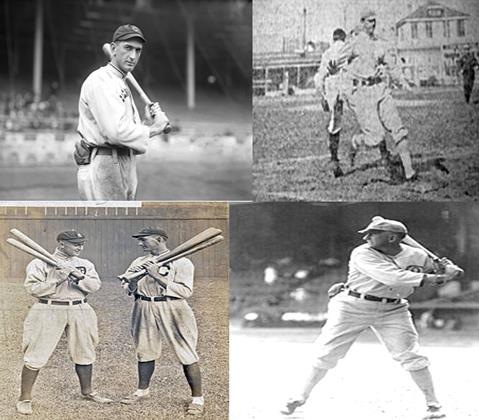
Baseball Trailblazers
Page 172
Shoeless Joe Jackson
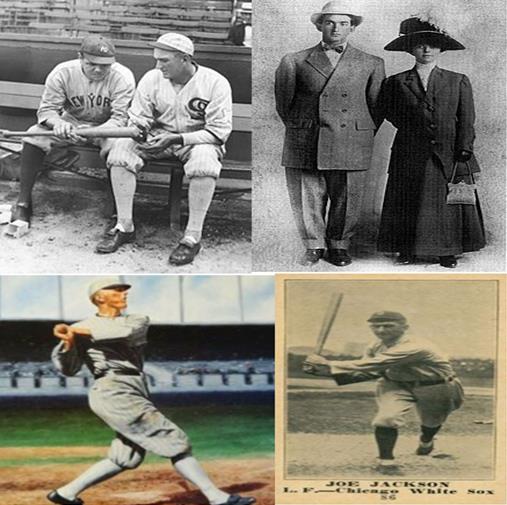
Baseball Trailblazers
Page 173
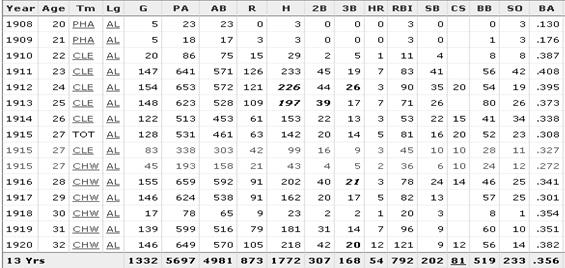
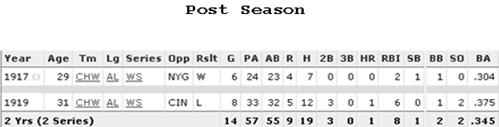
Baseball Trailblazers
Page 174
Joseph Jefferson Jackson, July 16, 1887 – December 5, 1951, nicknamed "Shoeless Joe," was an outfielder who played major league baseball in the early 1900s. He is remembered for his performance on the field and for his association with the Black Sox Scandal, in which eight members of the 1919 Chicago White Sox allegedly participated in a conspiracy to fix the World Series. As a result of Jackson's association with the scandal, Kenesaw Mountain Landis, Major League Baseball's first commissioner, banned Jackson from playing after the 1920 season
Baseball Trailblazers Page 175
despite his exceptional play in the 1919 World Series, in which he led both teams in several statistical categories and set a World Series record with 12 base hits. Since then, Jackson's guilt has been fiercely debated with new accounts claiming his innocence and urging major league baseball to reconsider his banishment. As a result of the scandal, Jackson's career was abruptly halted in his prime. 1920 was his best overall year.
Jackson played for three major league teams during his 12 year career. He spent 1908–1909 as a member of the Philadelphia Athletics and 1910 with the minor league New Orleans Pelicans before joining the Cleveland Naps at the end of the 1910 season.
He remained in Cleveland through the first part of 1915. He played the remainder of the 1915 season through 1920 with the Chicago White Sox. Later in life, Jackson played ball under assumed names throughout the south.
Jackson, who played left field for most of his career, has the third highest career batting average in major league history,
.356. In 1911, Jackson hit for a .408 average. It is still the sixth highest single season total since 1901, which marked the beginning of the modern era for the sport. His average that year also set the record for batting average in a single season by a rookie. Babe Ruth said that he modeled his hitting technique after Jackson's.
Baseball Trailblazers Page 176
Jackson was born in Pickens County, South Carolina, the oldest son in the family. His father George was a sharecropper. He moved the family to Pelzer, South Carolina, while Jackson was still a baby. A few years later, the family moved to a company town called Brandon Mill on the outskirts of Greenville, South Carolina. An attack of measles almost killed Joe when he was 10.
He was in bed for two months, paralyzed, while he was nursed back to health by his mother.
Starting at the age of 6 or 7, Jackson worked in one of the town's textile mills as a "linthead," a derogatory name for a mill hand. Family finances required Joe to take 12 hour shifts in the mill, and since education at the time was a luxury the Jackson family couldn't afford, Jackson was uneducated. His lack of education ultimately became an issue throughout Jackson's life. It even affected the value of his memorabilia in the collectibles market. Because Jackson was illiterate, he often had his wife sign his signature. Consequently, anything actually autographed by Jackson himself brings a premium when sold, including one autograph which was sold for $23,500 in 1990 In restaurants, rather than ask someone to read the menu to him, he would wait until his teammates ordered and then order one of the items that he heard.
Baseball Trailblazers Page 177
In 1900, when he was 13 years old, his mother was approached by one of the owners of the Brandon Mill and he started to play for the mill's baseball team. He was the youngest player on the team. He was paid $2.50 to play on Saturdays. He was originally a pitcher, but one day he accidentally broke another player's arm with a fastball. No one wanted to bat against him so the manager of the team placed him in the outfield. His hitting ability made him a celebrity around town. Around that time he was given a baseball bat that he named Black Betsy. He was compared to Champ Osteen, another player from the mills who made it to the Majors. He moved from mill team to mill team in search of better pay, playing semi-professional baseball by 1905.
In an interview published in the October 1949 edition of “Sport Magazine,” Jackson recalls he got his nickname during a mill game played in Greenville, South Carolina. Jackson had blisters on his foot from a new pair of cleats, which hurt so much that he took his shoes off before he was at bat. As play continued, a heckling fan noticed Jackson running to third base in his socks, and shouted; "You shoeless son of a gun, you!" and the resulting nickname "Shoeless Joe" stuck with him throughout the remainder of his life.
In 1908, Jackson began his professional baseball career with the Greenville Spinners of the Carolina Association, married 15 year
Baseball Trailblazers Page 178
old Katie Wynn. Playing for his hometown team, Jackson hit .346
to lead the 1908 Carolina Association, while also leading the league in hits and RBI. Jackson had a salary of $75.00 a month playing for the Greenville Spinners. In August, 1908, Jackson's contract was purchased by the Connie Mack of the Philadelphia Athletics for $900. Jackson immediately reported to the Athletics and made his major league debut.
For the first two years of his career, Jackson had some trouble adjusting to life with the Athletics. Reports conflict as to whether he just did not like the big city, or if he was bothered by hazing from teammates. Consequently, he spent a great portion of that time in the minor leagues. Between 1908 and 1909, Jackson appeared in just 10 major league baseball games. During the 1909 season, Jackson played 118 games for the South Atlantic League's Savannah Indians. He batted .358 for the year.
The Athletics gave up on Jackson in 1910 and traded him to the Cleveland Naps. He spent most of 1910 with the New Orleans Pelicans of the Southern Association, where he won the batting title and led the team to the pennant. Late in the season, he was called up to play on the big league team. He appeared in 20
games and hit .387.
Baseball Trailblazers Page 179
In 1911, Jackson's first full major league season, he set a number of rookie records. His .408 batting average that season is a record that still stands and was good for second overall in the league behind Ty Cobb. His .468 on base percentage led the league. The following season, Jackson batted .395 and led the American League in hits, triples, and total bases. The next year, he led the league with 197 hits and a .551 slugging percentage.
In August 1915, Jackson was traded to the Chicago White Sox. Two years later, Jackson and the White Sox won the American League pennant and also the World Series. During the series, Jackson hit .307 as the White Sox defeated the New York Giants.
Jackson missed most of the 1918 season while working in a shipyard because of World War I. In 1919, he came back strongly to post a .351 average during the regular season and .375 with perfect fielding in the World Series. However, the heavily favored White Sox lost the series to the Cincinnati Reds. The next season, Jackson batted .382 and was leading the American League in triples when he was suspended, along with seven other members of the White Sox, after allegations surfaced that the team had thrown the previous World Series.
Baseball Trailblazers Page 180
After the White Sox lost the 1919 World Series to the Cincinnati Reds, Jackson and seven other White Sox players were accused of accepting $5,000 each to throw the Series. In September 1920, a grand jury was convened to investigate the allegations.
Jackson's 12 base hits set a Series record that was not broken until 1964, and he led both teams with a .375 batting average.
He committed no errors, and threw out a runner at the plate.
During grand jury on September 28, 1920, Jackson allegedly confessed to participating in the fix. Some news accounts quoted this as; “When a Cincinnati player would bat a ball out in my territory I'd muff it, if I could that is, fail to catch it. But if it would look too much like crooked work to do that I'd be slow and make a throw to the infield that would be short. My work netted the Cincinnati team several runs that they never would have had if we had been playing on the square.” That precise quote does not appear in a stenographic record of Jackson's grand jury appearance.
In 1921, a Chicago jury acquitted Jackson and his seven teammates of wrongdoing. Nevertheless, Kenesaw Mountain Landis, the newly appointed Commissioner of Baseball, imposed a lifetime ban on all eight players. "Regardless of the verdict of juries,"
Landis declared, "no player that throws a ballgame; no player that undertakes or promises to throw a ballgame; no player that
Baseball Trailblazers Page 181
sits in a conference with a bunch of crooked players and gamblers where the ways and means of throwing games are planned and discussed and does not promptly tell his club about it, will ever play professional baseball."
After the grand jury returned its indictments, Charley Owens of the “Chicago Daily News” wrote a regretful tribute headlined,
"Say it ain't so, Joe." The phrase became legendary when another reporter later erroneously attributed it to a child outside the courthouse. When Jackson left the criminal court building in the custody of a sheriff after telling his story to the grand jury, he found several hundred youngsters, aged from 6 to 16, waiting for a glimpse of their idol. One child stepped up to the outfielder, and, grabbing his coat sleeve, said; "It ain't true, is it, Joe?" "Yes, kid, I'm afraid it is," Jackson replied. The boys opened a path for the ball player and stood in silence until he passed out of sight. "Well, I'd never have thought it,"
sighed the lad. In an interview in “Sport” nearly three decades later, Jackson confirmed that the legendary exchange never occurred.
Jackson's involvement in the scandal remains controversial to this day. He reportedly refused the $5,000 bribe on two separate occasions, despite the fact that it would effectively double his salary, only to have teammate Lefty Williams toss the cash on
Baseball Trailblazers Page 182
the floor of his hotel room. Jackson then tried to tell White Sox owner Charles Comiskey about the fix, but Comiskey refused to meet with him. Unable to afford legal counsel, Jackson was represented by team attorney Alfred Austrian, a clear conflict of interest. Before Jackson's grand jury testimony, Austrian allegedly elicited Jackson's admission of his supposed role in the fix by plying him with whiskey. Austrian was also able to persuade the nearly illiterate Jackson to sign a waiver of immunity from prosecution.
Years later, the other seven players implicated in the scandal confirmed that Jackson was never at any of the meetings.
Williams said that they only mentioned Jackson's name to give their plot more credibility, although he did not say why Jackson would have been paid $5,000 had that been the case. Jackson's performance during the series itself lends further credence to his assertions, although the game records show that he hit better during the "clean" games than those which were thrown. A 1993 article in The American Statistician reported the results of a statistical analysis of Jackson's contribution during the 1919 World Series, and concluded that there was "substantial support to Jackson's subsequent claims of innocence."
Jackson remains on major league baseball’s ineligible list, which automatically precludes his election to the National
Baseball Trailblazers Page 183
Baseball Hall of Fame. In November 1999, the US House of Representatives passed a resolution lauding Jackson's sporting achievements and encouraged major league baseball to rescind his ineligibility, to no avail.
In 2015, the Shoeless Joe Jackson Museum formally petitioned Commissioner Rob Manfred for reinstatement, on grounds that Jackson had "more than served his sentence" in the 95 years since his banishment by Landis. Manfred denied the request after an official review. "The results of this work demonstrate to me that it is not possible now, over 95 years since those events took place and were considered by Commissioner Landis, to be certain enough of the truth to overrule Commissioner Landis'
determinations," he wrote.
During the remaining years of his baseball career, Jackson played under different assumed names and managed a number of semi-professional teams, most located in Georgia and South Carolina. In 1922, Jackson moved to Savannah, Georgia, and opened a dry cleaning business with his wife.
In 1933, the Jacksons moved back to Greenville, South Carolina.
After first opening a barbecue restaurant, Jackson and his wife opened "Joe Jackson's Liquor Store," which they operated until his death. One of the better known stories of Jackson's post-
Baseball Trailblazers Page 184
major league life took place at his liquor store. Ty Cobb and sportswriter Grantland Rice entered the store, with Jackson showing no sign of recognition towards Cobb. After making his purchase, Cobb finally asked Jackson; "Don't you know me, Joe?"
Jackson replied; "Sure, I know you, Ty, but I wasn't sure you wanted to know me. A lot of them don't."
As he aged, Jackson began to suffer from heart trouble. In 1951, at the age of 64, Jackson died of a heart attack in Greenville.
He was the first of the eight banned players to die.
In 2006, Jackson's original home was moved to a location adjacent to Fluor Field in downtown Greenville. The home was restored and opened in 2008 as the “Shoeless Joe Jackson Museum.” The address is 356 Field Street, in honor of his lifetime batting average.
The Phil Alden Robinson film “Field of Dreams,” based on
“Shoeless Joe” by W. P. Kinsella, stars Ray Liotta as Jackson.
Kevin Costner plays an Iowa farmer who hears a mysterious voice instructing him to build a baseball field on his farm so Shoeless Joe, among others, can play baseball again.
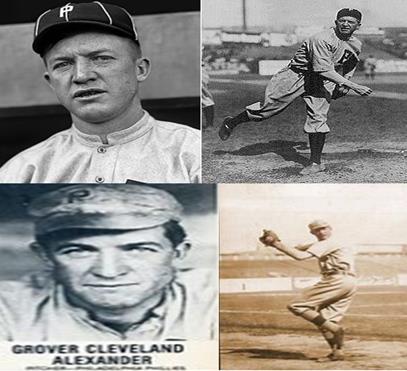
Baseball Trailblazers
Page 185
Grover Cleveland Alexander
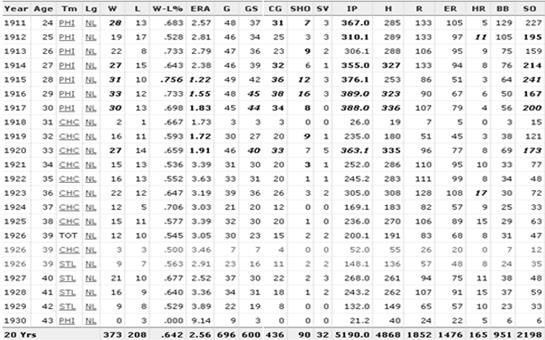
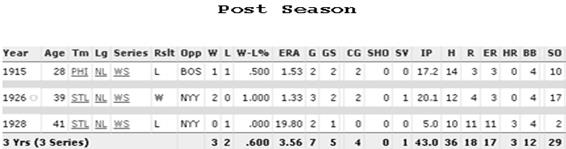
Baseball Trailblazers
Page 186
Grover Cleveland Alexander, February 26, 1887 – November 4, 1950, nicknamed "Old Pete," was a major league baseball pitcher.
He played from 1911 through 1930 for the Philadelphia Phillies, Chicago Cubs, and St. Louis Cardinals.
Baseball Trailblazers Page 187
Alexander was born in Elba, Nebraska, in the first term of President Grover Cleveland and was one of 13 children. He played semi-professional baseball in his youth, signing his first professional contract at age 20 in 1907 for $50 per month. In 1909, he played for the Galesburg Boosters in the Class D
Illinois–Missouri League and went 15–8 that year with a 1.36
ERA. His career was almost ended when he was struck by a thrown ball while base running. Although this ended his 1909 season, he recovered by 1910 to become a star pitcher again, finishing with a 29–11 record for the Syracuse Stars in the Class B New York State League, before being sold to the Philadelphia Phillies.
Alexander made his Philadelphia debut during the pre-season 1911
City Series, pitching five innings of no hit, no run baseball against the Athletics. He made his official major league debut on April 15. He was joined on the Phillies that year by catcher Bill Killefer, who went on to become Alexander's favorite battery mate, catching 250 of his games.
In his rookie year, Alexander led the league with 28 wins, 31
complete games, 367 innings pitched, and seven shutouts, while finishing second in strikeouts and fourth in ERA. From 1912 to 1921, Alexander led the league in ERA four times – 1915, 1916, 1919, and 1920, wins five times - 1914, 1915, 1916, 1917, and 1920, innings six times, strikeouts six times - 1912, 1914,
Baseball Trailblazers Page 188
1915, 1916, 1917, and 1920, complete games five times – 1914, 1915, 1916, 1917, and 1920, and shutouts five times - 1915, 1916
(a single-season record of 16,) 1917, 1919, and 1921). He won the National League Pitching Triple Crown in 1915, 1916, 1917, and 1920. In 1915, he was instrumental in leading the Phillies to their first pennant, pitching a record five one hitters.
Along the way, Alexander began to have problems with alcohol, a struggle that would plague him the rest of his life. In 1915, he won his first World Series game, the opening game of that series. For the Phillies, it would be 65 years before they won another World Series game.
After the 1917 season, the Phillies traded Alexander and catcher Bill Killefer to the Cubs for catcher Pickles Dillhoefer, pitcher Mike Prendergast, and $60,000. Phillies owner William Baker later admitted, "I needed the money."
Alexander was drafted into WWI, and one month before shipping out, he married Amy Marie Arrants on May 31 in a courthouse ceremony in Manhattan, Kansas. Alexander spent most of the 1918
season in France as a sergeant with the 342nd Field Artillery.
While he was serving in France, he was exposed to German mustard gas and a shell exploded near him, causing partial hearing loss and triggering the onset of epilepsy. Following his return from the war, Alexander suffered from shell shock and was plagued
Baseball Trailblazers Page 189
with epileptic seizures, which people often misinterpreted as a sign of drunkenness. This only exacerbated his drinking problem.
In spite of all this, Alexander gave Chicago several successful years and won another pitching triple crown in 1920. Tiring of his increasing drunkenness and insubordination that was often directly related to his epilepsy, the Cubs sold him to the Cardinals in the middle of the 1926 season for the waiver price.
The Cubs manager, Joe McCarthy, supposedly said that even with Alexander, the Cubs had finished last the previous season, "...
and if they finish last again, I'd rather it was without him."
The Cardinals won the National League pennant that year and met the New York Yankees in the World Series, where Alexander pitched complete game victories in Games 2 and 6. After the game six victory, Alexander got drunk that night and was still feeling the effects when he was sent out to pitch the next day in Game 7. In one of baseball’s greatest and memorable performances, Alexander came into the game in the seventh inning after starter Jesse Haines developed a blister, with the Cardinals ahead 3–2, the bases loaded and two out. Facing Yankee slugger Tony Lazzeri, Alexander struck him out and then held the Yankees scoreless for two more innings to preserve the win and give St. Louis the championship.
Baseball Trailblazers Page 190
He had one last 20 win season for the Cardinals in 1927, but his continued drinking cut his career short. After a brief return to the Phillies in 1930, he left the major leagues.
Alexander's 90 shutouts are a National League record and his 373
wins are tied with Christy Mathewson for first in the National League record book. He is also tied for third all-time in wins, tenth in innings pitched, and second in shutouts. Alexander posted a lifetime winning percentage of .642.
As a hitter, he accumulated 378 hits in 1,810 at bats for a .209
batting average with 11 home runs, 163 runs batted in, 154 runs and 77 bases on balls over a 20 year career.
During the late 1930s and early 1940s, Alexander continued to play baseball, touring as a player-coach for the Grover Cleveland Alexander's House of David Team. After the end of prohibition, Alexander operated a tavern in St. Louis with Hughie Miller as his partner.
Alexander attended Game 3 of the 1950 World Series at Yankee Stadium, where he saw the Phillies lose to the Yankees. He died less than a month later, on November 4 in St. Paul, Nebraska, at the age of 63.
Newspapers often mentioned Alexander's full name when writing about him, in addition to just "Grover." He was also sometimes
Baseball Trailblazers Page 191
called "Alec," and on occasions when he succeeded in grand fashion, as in the 1926 World Series, they would call him
"Alexander the Great." He was so dominant during the 1910s that many players and writers of his era referred to him as "the best pitcher to ever put on a pair of shoes."
The nickname of "Old Pete" began as "Alkali Pete," which was in itself a pastiche, based on a series of early silent film westerns based around characters named Alkali Ike and Mustang Pete. While on a hunting trip with Bill Killefer in Texas, Alexander's dusty appearance prompted Killefer to name him
"Alkali Pete" and it stuck. Before going to war, he was given a watch engraved with the nickname, dating its origin to no later than 1918. By the late 1920s, it had morphed into "Old Pete." It is uncertain how frequently Alexander was publicly called by that nickname during his playing days. When he won his 373rd game on August 10, 1929, one newspaper had called him "Old Pete," indicating that the nickname was in public circulation.
On his 1940 Playball baseball card he was referred to as "Ol'
Pete." His nickname among family friends in Nebraska was "Dode.”
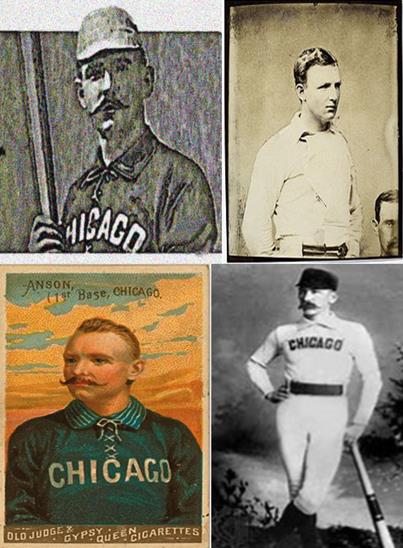
Baseball Trailblazers
Page 192
Cap Anson
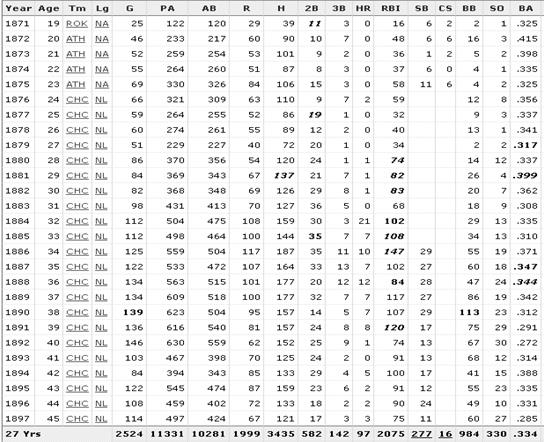
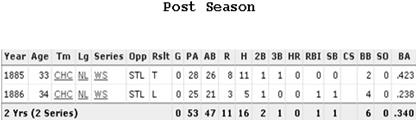
Baseball Trailblazers
Page 193
Adrian Constantine Anson, April 17, 1852 - April 14, 1922, nicknamed "Cap" for "Captain" and "Pop," was a major league baseball first baseman. He played a record 27 consecutive
Baseball Trailblazers Page 194
seasons. Anson was regarded as one of the greatest players of his era and one of the first superstars of the game. He spent most of his career with the Chicago Cubs franchise, then known as the "White Stockings" and later as the "Colts," serving as the club's manager, first baseman and, later in his tenure, minority owner. He led the team to six National League pennants in the 1880s. Anson was one of baseball's first great hitters, and the first to tally over 3,000 career hits.
Anson was born in Marshalltown, Iowa. Beginning in 1866, he spent two years at the high school age boarding school of the University of Notre Dame after being sent there by his father in hopes of curtailing his mischievousness. His time away did little to discipline him. Soon after he returned home, his father sent him to the University of Iowa, where his bad behavior resulted in the school asking him to leave after one semester.
Anson played on a number of competitive baseball clubs in his youth and began to play professionally in the National Association at the age of 19, playing primarily third base for the Rockford Forest Citys, one of the original teams of the Association. He was a large and powerful man, standing 6 ft. 2
in. tall and weighing about 220 pounds.
Baseball Trailblazers Page 195
After being traded to Philadelphia Athletics, in 1872 and 1873, Anson finished in the NA's top five in batting, on base percentage, and on base plus slugging. He led the NA in OBP in 1872. His numbers declined slightly in 1874 and 1875, but he was still good enough that Chicago White Stockings secretary turned president William Hulbert sought him to improve his club for the 1876 season. Hulbert broke league rules by negotiating with Anson and several other stars while the 1875 season was still in progress and ultimately founded the new National League to forestall any disciplinary action. Anson, who had become engaged to a Philadelphia native in the meantime, had second thoughts about going west, but Hulbert held Anson to his contract and he eventually warmed to the Windy City.
The White Stockings won the first league title, but fell off the pace the following two seasons. During this time, Anson was a solid hitter, but not quite a superstar. Both his fortunes and those of his team would change after Anson was named captain-manager of the club in 1879.
His new role led to the nickname "Cap," though newspapers typically called him by the more formal "Captain Anson" or
"Capt. Anson." With Anson pacing the way, the White Stockings won five pennants between 1880 and 1886. They were helped to the titles using new managerial tactics, including the use of a
Baseball Trailblazers Page 196
third base coach, having one fielder back up another, signaling batters, and the rotation of two star pitchers. In the first half of the 1880s, aided by speedy players like Mike Kelly, Anson had his players aggressively run the bases, forcing the opposition into making errors. After the expression first became popular in the 1890s, he retroactively claimed to use some of the first "hit and run" plays.
Anson shares credit as an innovator of modern spring training along with the president of the Chicago club, Albert Spalding.
They were among the first to send their clubs to warmer climates in the South to prepare for the season, beginning in Hot Springs, Arkansas in 1886. On the field, Anson was the team's best hitter and run producer. In the 1880s, he won two batting titles in 1881 and 1888, and finished second four times in 1880, 1882, 1886 and 1887. During the same period, he led the league in runs batted in seven times. His best season was in 1881, when he led the league in batting at .399, OBP of .442, OPS of .952, hits of 137, total bases of 175, and RBIs of 82. He also became the first player to hit three consecutive home runs, five homers in two games, and four doubles in a game, as well as being the first to perform two unassisted double plays in a game. He is one of only a few players to score six runs in a game, a feat he accomplished on August 24, 1886.
Baseball Trailblazers Page 197
Anson signed a ten year contract in 1888 to manage the White Stockings. But his best years were behind him. He led the league in walks in 1890 and garnered his eighth and final RBI crown in 1891. On the managerial front, he failed to win another pennant.
As the end of the 1880s approached, the club had begun trading away its stars in favor of young players, with the exception of the veteran Anson. Local newspapers had started to call the team
"Anson's Colts," or just "Colts," before the decade was out.
With the advent of the Players' League in 1890, what little talent the club still had was drained away, and the team nickname "Colts," though never official, became standard usage in the local media, along with variants such as Anson's White Colts and Anson's Broncos.
He also mellowed enough that he became a fatherly figure and was often called "Pop". When he was fired as manager after the 1897
season, it also marked the end of his 27 year playing career.
The following season, newspapers dubbed the Colts the "Orphans,"
as they had lost their "Pop."
Anson acted in ways that would not be tolerated today, because the sport's rules are stricter in certain respects. One was the relative freedom a captain had in his day to argue with the usually lone umpire. Also, starting in the latter 1880s, he
Baseball Trailblazers Page 198
often bet on baseball, mainly on his team's chances to win the pennant. And yet, he arguably stood out as the player with the greatest integrity. In that era, the big taboo was for players to take bribes to purposely lose games. Betting by players, managers, and owners was regarded as acceptable so long as they did not bet against their team doing well or associate with gamblers.
On corruption in sports, he said the following in 1891. "The time may have been, and probably was, when baseball was as rotten as horse racing, but that time has gone by. The men in control of baseball matters are of the highest personal character, and no one will say anything against them. As to the charges against any individual player, I will believe them when they have been proved. Everything possible has been done to protect the patrons of the National game, and efforts in that direction will never be abated. I don't know of any crookedness in the ball field. If I did I'd undoubtedly say something about it."
Anson briefly made a return to baseball managing the New York Giants in June and July of 1898. He then attempted to buy a Chicago team in the Western League, but failed after being opposed by Al Spalding. In 1900, he helped to organize a new version of the defunct American Association, called the New
Baseball Trailblazers Page 199
American Base Ball Association, and was named its president.
However, at the first sign of trouble he dissolved the league before a single game was played, drawing heated criticism from other backers.
After a number of failed business attempts, including a handball arena and bottled ginger beer that exploded on store shelves, he was later elected city clerk of Chicago in 1905. After serving one term, he failed in the Democratic primary to become sheriff in 1907.
In 1907, Anson made another attempt to come back to baseball, acquiring a semi-pro team in the Chicago City League, which he would call "Anson's Colts." Anson initially had no intention of playing for the team, but in June 1907, at the age of 55, Anson started playing some games at first base in an attempt to boost poor attendance. Despite the draw of seeing Anson play, the team did not attract much attendance, and lost money for Anson. In the fall of 1908, Anson assembled a semi-pro football team, also called Anson's Colts. Although the football team won the city championship, they were not a financial success.
Anson's few successful ventures included a combination billiards hall and a bowling alley he opened in downtown Chicago in 1899.
Anson was named vice president of the American Bowling Congress
Baseball Trailblazers Page 200
in 1903, and led a team to the five man national championship in 1904. Anson was forced to sell the billiards hall in 1909 when faced with mounting financial problems that led to his bankruptcy. Anson was also an avid golfer.
Anson began acting during his baseball career. In 1888, he made his stage debut with a single appearance in Hoyt's play “A Parlor Match” at the Theatre Comique in Harlem. He also played himself in an 1895 Broadway play called “The Runaway Colt,”
written to take advantage of his fame. Later, Anson began touring on the vaudeville circuit, a common practice for athletes of the time, which lasted up until about a year before his death.
He first appeared in vaudeville in 1913 doing a monologue and a short dance. In 1914, George M. Cohan wrote a monologue for him, and in 1917, Cohan, with Chicago Tribune sportswriter Ring Lardner wrote another piece for him, titled “First Aid for Father.” Anson appeared with two of his grown daughters, Adele and Dorothy, and would bat papier mâché baseballs made by Albert Spalding into the audience. He appeared in 1921 accompanied by his two daughters in an act written by Ring Lardner with songs by Herman Timberg.
Baseball Trailblazers Page 201
In 1872, the 20 year old Anson met 13 year old Virginia Fiegal, the daughter of a Philadelphia bar and restaurant owner, whom he married on November 21, 1876. The marriage lasted until her death in 1915. For the first seven years of their marriage, the couple lived in Chicago during the baseball season and Philadelphia during the off season, but they eventually moved to Chicago on a year round basis. The Ansons had seven children, three of whom died in infancy.
Anson retired from vaudeville in 1921, and continued to refuse a pension from Major League Baseball, despite having no other income. In April 1922, he became the general manager of a new golf club in the South Side of Chicago.
Anson died from a glandular ailment on April 14, 1922, in Chicago, three days shy of his 70th birthday.
Anson was inducted into the Baseball Hall of Fame in 1939, one of the first 19th century players selected. Over 100 years after his retirement, he still holds several Cubs franchise records, including most career RBI, runs, hits, singles, and doubles while being the only Cub in the 3,000 hit club. On the managerial side, he was the second manager to ever reach 1,000
wins. Anson won 1,282 games with the Cubs, a mark that still stands after a century.
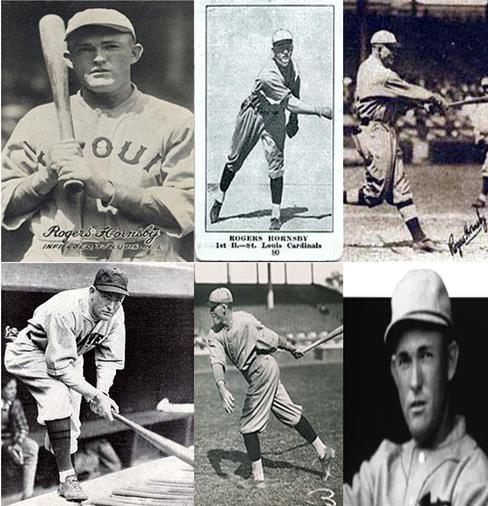
Baseball Trailblazers
Page 202
Rogers Hornsby
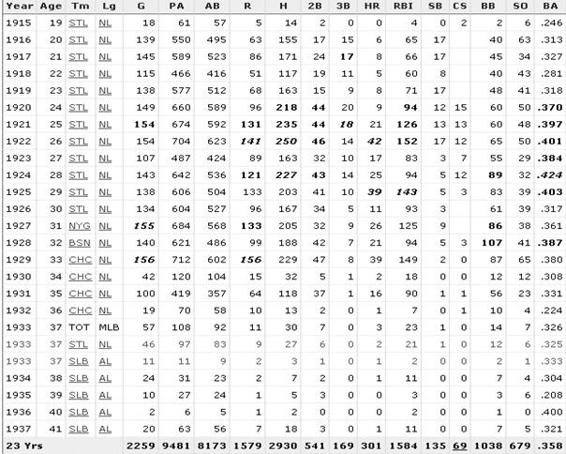
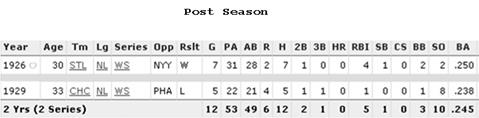
Baseball Trailblazers
Page 203
Rogers Hornsby Sr., April 27, 1896 – January 5, 1963, nicknamed
"The Rajah," was an infielder, manager, and coach who played 23
seasons in major league baseball. He played for the St. Louis Cardinals mostly, New York Giants, Boston Braves, Chicago Cubs,
Baseball Trailblazers Page 204
and St. Louis Browns. He was named the National League Most Valuable Player twice, and was a member of one World Series championship team.
Hornsby was born in Winters, Texas, the last of Ed and Mary (Rogers) Hornsby's six children. Hornsby was 2 when his father died of unknown causes. Four years later, the surviving Hornsbys moved to Fort Worth, Texas, so Hornsby's brothers could get jobs in the meat packing industry to support the family.
Hornsby started playing baseball at a very young age. He once said; "I can't remember anything that happened before I had a baseball in my hand." He took a job with the Swift and Company meat industry plant as a messenger boy when he was 10, and he also served as a substitute infielder on its baseball team. By the age of 15, Hornsby was already playing for several semiprofessional teams. He also played baseball for North Side High School until 10th grade, when he dropped out to take a full time job at Swift and Company. While he was in high school, Hornsby also played on the football team.
In 1914, Hornsby's older brother Everett, a minor league baseball player for many years, arranged for Rogers to get a tryout with the Texas League's Dallas Steers. He made the team, but did not play in any games for them and he was released after
Baseball Trailblazers Page 205
only two weeks. Following his dismissal, he signed with the Hugo Scouts of the Class D Texas–Oklahoma League as their shortstop for $75 per month. The Scouts went out of business a third of the way through the season, and Hornsby's contract was sold to the Denison Champions of the same league for $125. With both teams in 1914, Hornsby batted .232 and committed 45 errors in 113 games.
The Denison team changed its name to the Denison Railroaders and joined the Western Association in 1915. They raised Hornsby's salary to $90 per month. Hornsby's average improved that season to .277 in 119 games, but he made 58 errors. Nonetheless, his contributions helped the Railroaders win the Western Association pennant. At the end of the season, a writer from “The Sporting News” said that Hornsby was one of about a dozen Western Association players to show any major league potential.
Hornsby came to the attention of the St. Louis Cardinals during an exhibition series between that team and the Railroaders during spring training in 1915. Cardinals' manager Miller Huggins told his only scout, Bob Connery, to look for minor league players to fill the roster of their financially struggling team. In September, the Cardinals purchased Hornsby's contract from Denison and added him to their major league roster, although his only professional baseball experience had
Baseball Trailblazers Page 206
been in Class D. Hornsby's first game came on September 10, when he relieved Art Butler at shortstop in a 7–1 loss to the Cincinnati Reds. Three days later he started a game, and he got his first hit the next day against Rube Marquard of the Brooklyn Robins. Hornsby finished the season with a .246 average in 57 at bats while the Cardinals finished in sixth place in the National League. At only 19 years of age, Hornsby was the fourth youngest player in the NL that year.
The Cardinals picked up Roy Corhan from the San Francisco Seals of the Pacific Coast League to play at shortstop in 1916, making Hornsby one of three candidates for the position. Hornsby's great performance in spring training, a shoulder injury to Corhan, and poor hitting by Butler meant Hornsby was the starting shortstop on opening day. He had both runs batted in the Cardinals' 2–1 victory over the Pittsburgh Pirates that day.
On May 14, he hit his first major league home run against Jeff Pfeffer of Brooklyn. He rotated among infield positions before finally settling in at third base for much of the second half of the year. Late in the season, he missed 11 games with a sprained ankle. He finished 1916 with a .313 average, fourth in the NL, and he was one short of the league lead in triples with 15.
Hornsby returned to the shortstop position in 1917 after Corhan returned to San Francisco and Butler was released. After playing
Baseball Trailblazers Page 207
nearly every game throughout the first month of the season, Hornsby was called away from the team on May 29 after his brother William was shot and killed in a saloon. Rogers attended the funeral on June 1 and returned to the Cardinals on June 3, finishing the season without missing any more playing time. His batting statistics improved from the previous season. His .327
batting average was second in the league, and he led the league in triples - 17, total bases - 253, and slugging percentage -