

Baseball Trailblazers by Edward Drobinski - HTML preview
Download the book in PDF, ePub, Kindle for a complete version.
.250.
On September 11, 1906, Ewing dueled Deacon Phillippe and Vic Willis to a scoreless tie in Pittsburgh, scattering eight hits over 15 innings. He ended 1906 with an ERA of 2.38 and almost 300 innings pitched.
The highlight of the 1907 season came early when he was handed the ball for opening day on April 11, 1907. The opponent was the Pittsburgh Pirates, led by the immortal future Hall of Famer Honus Wagner. Ewing pitched a complete game, four hit, 4-3
victory. In what he always viewed as the highlight of his career, Ewing fanned the first six Pirate batters he faced, including such outstanding hitters as Wagner, Fred Clarke and Ginger Beaumont. The Cincinnati Enquirer reported that "He used the spitball when he found himself in a tight place and it was very effective in his hands." The Reds come from behind with two runs in the ninth inning.
Long Bob did his best to ensure his own success in 1907.
Pitching over 330 innings, he compiled a career best ERA of 1.73
and averaged almost twice as many strikeouts as bases on balls.
Although he won 17 games, little offensive help from his
Baseball Trailblazers Page 1372
teammates resulted in 19 losses. Ewing accomplished this at the age of 34.
Bob Ewing concluded his career with the Reds after the 1909
season. In his eight year stint with the Cincinnati club, he compiled an overall earned run average of 2.37. His ERA currently stands as the best Reds' career ERA record ever compiled.
On January 20, 1910, the Reds traded Ewing to the Philadelphia Phillies in a two for two swap of pitchers - Ewing and Ad Brennan for Harry Coveleski and Frank Corridon. In Philadelphia, Long Bob was an afterthought in manager Red Dooin's plans. But when other pitchers faltered, Ewing stepped up. The oldest regular starting pitcher in the league, he went 16–14 for a fourth place team and led the Phillies in complete games and pitched three games in which he allowed three hits or fewer.
Philadelphia dropped him in September 1911.
Roger Bresnahan gave Ewing a brief look in St. Louis in 1912.
The aging spitballer returned to the minor leagues. Now 39 years old, Long Bob appeared in just one game. He reached the end of the line in 1913, failing in a trial with minor league Minneapolis and drawing his release two weeks after his 40th birthday without appearing in a single game. He finished his
Baseball Trailblazers Page 1373
major league career with a win–loss record of 124–118 and an earned run average of 2.49.
On November 5, 1905, Bob married Nelle Hunter, the daughter of a prominent Auglaize County physician. The society pages of a Cincinnati paper described as being a "handsome and clever society girl." She was an avid baseball fan in her own right.
Beginning in the 1890s, she attended what was at the time a major league record of more than 60 straight opening day games of the Reds. She had equal measures of loyalty and superstition, however. Nelle watched several games in 1905 that her husband lost. After that, she refused to go to the park when Ewing pitched, claiming her presence would 'hoodoo' him, according to the newspaper accounts.
Bob and Nelle had nine children. Ewing returned home and agreed to pitch two games for his hometown team, the Wapakoneta Reds.
He had just turned 40 years old when he took the mound to face the Findlay semi-pro team on May 17, 1913. Five hundred paying fans saw Ewing strike out 12 batters while strolling to a 10-0
win. The most important game was to follow, for next up was Wapak's dreaded arch rival, the Botkins Reds.
To turn the pressure up a notch on Botkins, Wapak declared game day to be “Ewing Day.” As he stepped in for his first at bat,
Baseball Trailblazers Page 1374
time was called and Ewing was presented with a horn grip, gold mounted umbrella engraved "Bob, 1913." The crowd cheered lustily. Ewing struck out. Wapak eked out a 4-3 win. It was Long Bob's last local pitching appearance.
After hanging up his baseball spikes, Ewing returned to his offseason occupation of farming. He was an expert horseman as well, raising trotters which competed in races throughout the Midwest.
Bob Ewing was elected to two terms as the Auglaize County Sheriff and later ran the Brunswick Cigar Store in Wapak. Long Bob Ewing died of cancer on June 20, 1947, at age 74.
Baseball Trailblazers
Page 1375
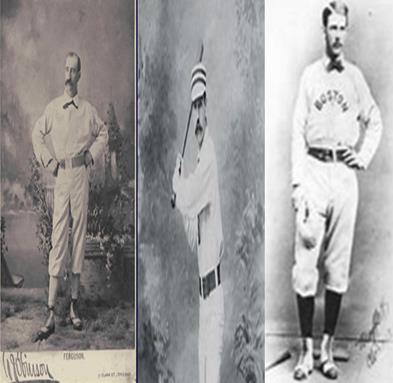
Bob Ferguson
Bob Ferguson, Robert Vavasour Ferguson, was born on January 31, 1845 and raised in Brooklyn, NY. He was an overall average player, hitting over .300 just one time. But it was his character and unquestioned honesty during a period when games were often decided by gamblers which made him different. His bad temper, stubbornness and honesty were traits that caused him to be considered difficult and disliked.
He became the first captain, and third baseman, of the New York Mutuals in the first professional league, the National
Baseball Trailblazers Page 1376
Association of Professional Base Ball Players, formed in 1871.
In the first season the Mutuals would finish fourth. Ferguson who "insisted upon implicit obedience from his men" was forced to leave because of the heavy rumors of gambling surrounding the team. He was also a substitute umpire for the National Association that inaugural season.
The year of 1872 was a busy for Ferguson. He was a convention delegate for the Brooklyn Atlantics, the team he would return to as the player/captain, for the '72 season. During the convention, held in Cleveland, he was elected president of the National Association. Some ball players felt this was only a figurehead position. Ferguson felt otherwise. He wanted the players to have a representative. He would hold that position until the collapse of the NA, in 1875. He also became a regular umpire for the NA.
In 1873, Ferguson was once again a convention delegate for the Atlantics during the meetings held in Baltimore, MD. He stayed on as a regular umpire for the NA but was involved in an incident during a game on July 24. While umpiring a game between the Baltimore Canaries and Ferguson's former team, the NY
Mutuals, he was loudly abused throughout the game by notorious umpire baiter, Mutuals catcher Nat Hicks. The game was close and the Mutuals produced a three run rally in the ninth to win 11-
Baseball Trailblazers Page 1377
10. Ferguson and Hicks got into an altercation at the conclusion of the game. Ferguson hit Hicks with a bat in the left arm and had to have a police escort to get to the clubhouse. Although Hicks ended up with a broken arm in two places and would not play for two months, he refused to press charges and the two reconciled after the game. As a result, Ferguson was only a substitute umpire in the '74 season.
In 1875, Ferguson again became a regular umpire but he left the Atlantics, along with pitcher Tommy Bond, to become the player/captain of the Hartford Dark Blues. This would be his first, and most successful, of three straight winning seasons with the Dark Blues. The team would finish in second place at 54-28, 18 games behind Harry Wright's powerful Boston Red Stockings. The Atlantics started the season at 2-11 and finished with a 31 game losing streak and a 12th place finish.
Ferguson became a League Director when the National League was formed in 1876. He was involved in a landmark decision that season. Jim Devlin, a pitcher for the Louisville Grays, wanted to be released from his contract. He claimed that the team had failed to fulfill the terms of his contract. Surrounding Devlin were rumors of "hippodroming," staging a game to suit gambling interests. Ferguson, along with fellow League Directors Nicholas Appolonio, Boston President and St. Louis club Secretary Charles
Baseball Trailblazers Page 1378
Chase ruled in favor of the Gray's VP Charles Chase. Devlin was compelled to remain with the Grays. The following season, Devlin and three other teammates, shortstop-second baseman William Craver, outfielder George Hall, and third baseman Al Nichols would be suspended for life for throwing games. Devlin would attempt for a number of years to be reinstated, but never was.
In 1878, Al Spalding hired Ferguson to captain the Chicago White Stockings. Spalding openly said he admired Ferguson's style and leadership that made the Hartford teams successful. Ferguson personally had his most successful season as a player. He hit
.351, third in the league, led the league in on base percentage, tied for fourth in RBI, and ranked fourth in hits. However, the supposedly high powered White Stockings finished at .500. In Spalding's memoirs he called Ferguson "tactless" and hopelessly lacking any knowledge "of the subtle science of handling men by strategy rather than by force." Spalding's harsh words helped end Ferguson's career as a player and manager.
In 1879, Ferguson played in only 30 games and managed the last 29 games for the Troy Trojans. He also resumed umpiring for the National League. From 1880-1882 he managed and played full time for the Trojans but did not umpire. Ferguson played for and managed the Philadelphia Quakers in the National League in 1883,
Baseball Trailblazers Page 1379
but was replaced by Blondie Purcell with just 17 games remaining. His lifetime batting average was .271.
Ferguson found work in the American Association in 1884 with the Pittsburgh Alleghenys. He would be the second of five managers for the team that season and he would also play the last 10
games of his career. He returned to umpiring in the National League for the first time in four years, working part time in
'84 and full time during the '85 season.
In 1886, 17 games into the season, Ferguson took over the managing duties for the New York Metropolitans, in the American Association and finished eighth. He also became an umpire in the AA in 1886 and continued until 1889. Ferguson would begin the season managing the Metropolitans in '87 but was replaced 30
games into the season.
Ferguson would never again manage. He turned full time to umpiring and was a replacement umpire in the first game of the first all-New York World Series in '89 between the New York Giants and the Brooklyn Bridegrooms. He worked for the Players league in 1890 and returned to the AA in 1891 and then retired.
Ferguson died in Brooklyn on May 5, 1894, at the age of 49.
Baseball Trailblazers
Page 1380
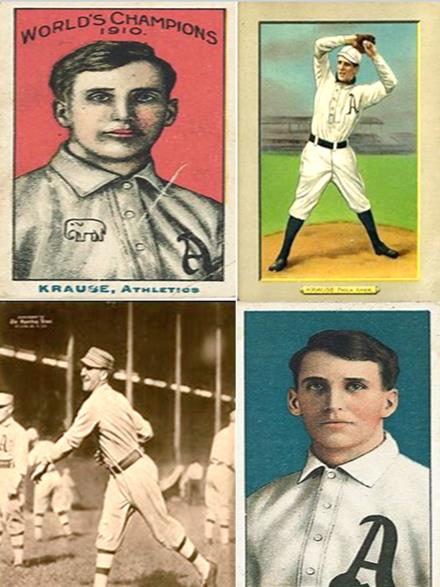
Harry Krause
Harry William "Hal" Krause, July 12, 1888 – October 23, 1940, was a pitcher over parts of five major league seasons, 1908–
1912, with the Philadelphia Athletics and Cleveland Naps. He led the American League in earned run average in 1909 while playing
Baseball Trailblazers Page 1381
for Philadelphia. For his career, he compiled a 36–26 record, with a 2.50 ERA.
Krause was born in San Francisco, California, and attended Saint Mary's College of California. He started his professional baseball career in 1907, heading East at the age of 19 in 1908.
In the Tri-State League he went 17-14, later joining the Athletics.
Krause made an immediate impact in the major leagues. He started out 1909 with a 10 game winning streak, which included six shutouts. He finished the season at 18–8 with a league leading 1.39 ERA. It is the lowest ERA ever for an American League rookie.
Krause didn't pitch as often or as well in 1910 and 1911. He had arm trouble early in 1910 which forced him to miss some time, but pitched well enough in 1911. In 1912 he came down with an out and out sore arm, pitched badly in six games, and then went to the minor league Toledo Mud Hens. He went 13–4 with Toledo.
The following season, he returned to the west coast and joined the Portland Beavers of the Pacific Coast League (PCL). In 1913
and 1914, Krause won a total of 39 games with ERAs below 2.30.
He had an off year in 1915, however, and played in the Western
Baseball Trailblazers Page 1382
League in 1916. He went back to the PCL in 1917 with the Oakland Oaks.
Krause spent twelve years in Oakland. It is perhaps difficult for a 2021 mind to understand that in Krause’s time and much later, unless you were a top ten star, there was little or no financial incentive to play for the eastern major leagues.
Further, many westerners didn’t like spending half the year away from home and found that local endorsement opportunities were readily available. In his first PCL season, he set career highs in wins and innings pitched, going 28–26 with a 2.35 ERA in 428.2 innings. He continued to pitch well for the Oaks over the next decade, becoming a fixture in the starting rotation and winning over 20 games two more times. In 1928, he joined the Mission Reds, where he finished his playing career. Krause won a total of 249 games in the PCL over 16 seasons and is a member of the Pacific Coast League Hall of Fame.
In October 1940, Krause was involved in a car accident. He died eight days later at age 52.
Baseball Trailblazers
Page 1383
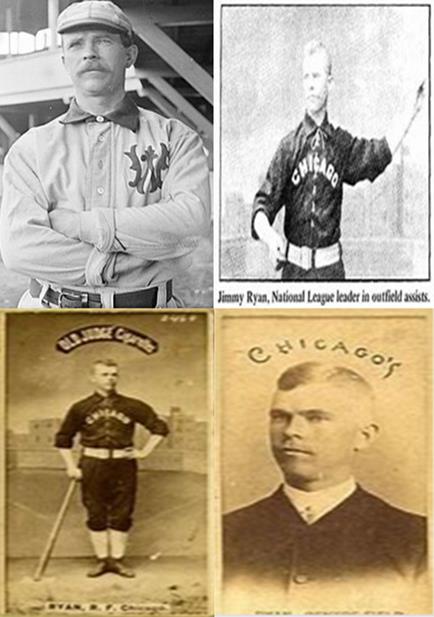
Jimmy Ryan
James Edward Ryan, February 11, 1863 – October 29, 1923, nicknamed "Pony," was a center fielder in major league baseball who played eighteen seasons between 1885 and 1903, primarily for
Baseball Trailblazers Page 1384
the Chicago White Stockings/Colts/Orphans - 1885–1889, 1891–
1900. He held the major league record for career assists by an outfielder (375) from 1900 to 1924.
A native of Clinton, Massachusetts, Ryan enjoyed his best season in 1888, leading the National League in home runs - 16, hits -
182, doubles - 33, total bases – 283, and slugging percentage -
.515; and also was second in batting average - .332, runs – 115, and extra base hits - 59.
Ryan switched to the Chicago Pirates in 1890, the only season of the Players' League, and ended his career with the Washington Senators - 1902–03, in the American League. In 1900, his final season in Chicago, he broke Tom Brown's record of 348 career assists by an outfielder and held it until 1924. Ryan was a .308
career hitter with 2,513 hits, 118 home runs and 1093 runs batted in in 2014 games.
On the tough side, Ryan was one of the few players to punch a reporter at least twice. After his first episode, in 1887, Charlie Seymour of the Chicago Herald wrote; "Ryan slugged the magnificent Chicago reporter in Pittsburgh the other day." In the other, in 1892, he took exception to George Beachel of the Chicago Daily News. In the clubhouse after a game, Ryan "picked a quarrel with Beachel, and then attacked him, using him up
Baseball Trailblazers Page 1385
pretty badly. No arrests have been made." In 1896, he punched a train conductor after losing his place and his teammates had gone to bed. A conductor who intervened was "called down by Mr.
Ryan, who got in one upper cut before his longtime captain manager Cap Anson stopped the fun," wrote Tim Murnane of the Boston Globe.
Ryan, in an article under his byline in 1905, advised against baseball as a profession, because few players last long enough in the big leagues to make money: "Baseball is not a permanent business. Look in the newspapers and you will see that a baseball player 35 years of age is considered an old man."
Ryan died in Chicago at age 60.
Baseball Trailblazers
Page 1386
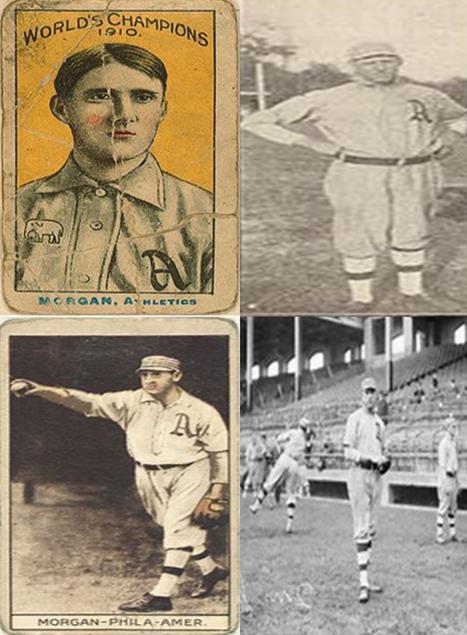
Cy Morgan
Harry Richard "Cy" Morgan, November 10, 1878 – June 28, 1962, was a major league baseball pitcher with the St. Louis Browns,
Baseball Trailblazers Page 1387
Boston Red Sox, Philadelphia Athletics, and the Cincinnati Reds between 1903 and 1913. Morgan batted and threw right handed. He was born in Pomeroy, Ohio. He helped the Athletics win the 1910
and 1911 World Series. Morgan is credited with carrying the pitching burden for the 1911 team while stars Jack Coombs and Chief Bender were less effective than usual early in the season.
In 10 seasons he had a win–Loss record of 78–78 in 210 Games, 15
Shutouts, and a 2.51 ERA.
He died in Wheeling, West Virginia on June 28, 1962 of coronary artery disease.
Baseball Trailblazers
Page 1388
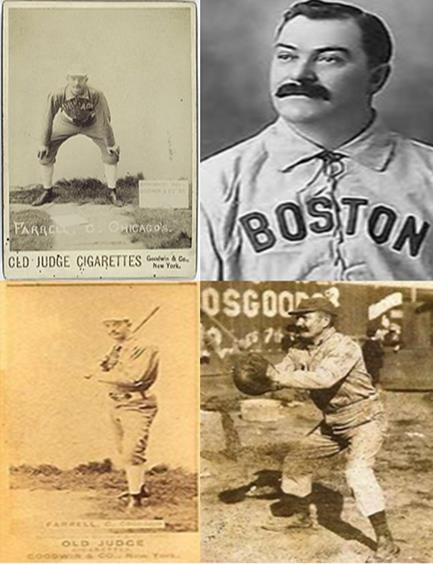
Duke Farrell
Charles Andrew "Duke" Farrell, August 31, 1866 – February 15, 1925, was a major league baseball catcher. Born in Oakdale, Massachusetts, he played for eight teams during his 18 year career. He made his major league debut in 1888 and retired as a
Baseball Trailblazers Page 1389
player after the 1905 season. He then entered coaching, ran a hotel and became a Deputy US Marshal.
Farrell had a career year in 1891 with the Boston Reds of the American Association, batting .302 and recording league leading home run – 12, and RBI – 110, totals.
In a 1900 game for Brooklyn, Farrell was an unwitting party to an argument between a player and umpire that resulted in a forfeit being awarded to Brooklyn. On a close play at home plate, umpire John Gaffney called Farrell safe. St. Louis catcher Wilbert Robinson reacted angrily to Gaffney's call, throwing the ball at the umpire and punching him in the chest.
Gaffney ejected Robinson and then awarded a forfeit to Brooklyn when Robinson would not leave the playing field.
A 1913 newspaper article said that Farrell was widely recognized among old time baseball men as the best dressed man in the game.
Over an 18 season career, Farrell hit .277 in 1,565 games with 1,572 hits in 5,682 at bats with 52 homers and 916 RBI. His teams did well. He won the American Association pennant with the 1891 Boston Reds, the National League pennant with the 1899 and 1900 Brooklyn Superbas, and won the World Series in 1903 with the Boston Americans.
Baseball Trailblazers Page 1390
For over a century, it was believed that Farrell held the single game major league record for most baserunners thrown out attempting to steal by a catcher, at eight. This record supposedly was set during a game on May 11, 1897. However, like much in the archive, current experts have expressed their reservations. Regardless, Farrell was regarded by his peers as the best defensive catcher in the game.
Farrell served as a deputy US marshal after his playing career.
He also managed a hotel in Marlboro, Massachusetts. In 1910 and 1911, Farrell was a coach for the New York Yankees. He coached for the Boston Red Sox in 1912 and then became a scout for a couple of years before rejoining the Yankees as a pitching coach in 1915. In the early 1920s, he became a coach and scout for the Boston Braves.
He died in Boston in 1925, ten days after undergoing abdominal surgery.
Baseball Trailblazers
Page 1391
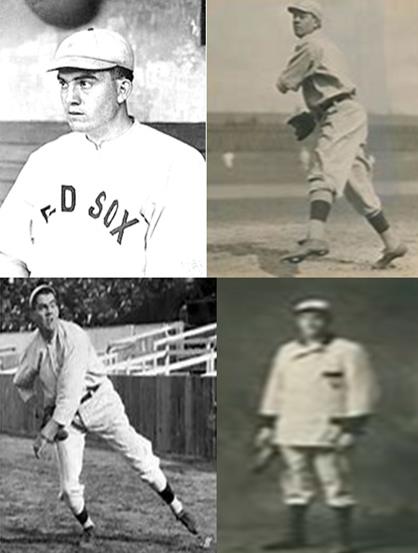
Ray Collins
Ray Williston Collins, February 11, 1887 – January 9, 1970, played his entire big league career for the Boston Red Sox. A native of Colchester, Vermont, Collins batted and threw left handed. He debuted on July 19, 1909, and played his final game
Baseball Trailblazers Page 1392
on October 7, 1915. He was a member of the 1912 Red Sox championship team.
A graduate of the University of Vermont, Collins was a good hitting pitcher and an outstanding fielder, but the key to his success was his remarkable control, consistently ranking among the American League leaders in fewest walks allowed per nine innings. He also averaged 16 wins from 1910 to 1914, including a combined 39 wins in 1913 and 1914. In a seven season career, Collins posted an 84–62 record with 511 strikeouts and a 2.51
ERA in 1336 innings, including 19 shutouts and 90 complete games.
Collins became a regular in Boston rotation in 1910. In his first full season, he pitched a one hitter against the Chicago White Sox and compiled a 13–11 record, making him the second-winningest pitcher on the Red Sox behind Eddie Cicotte. He was 3–6 at one point in 1911, but turned his season around, finishing at 11–12 with a 2.40 ERA.
Collins missed the first two months of the 1912 season with a knee injury, during which time the Red Sox christened their new stadium, Fenway Park. He did not start a game until early June, but won two games in three days over the Philadelphia Athletics at Shibe Park, 7–3 on July 3 and 5–3 on July 5. Collins finished
Baseball Trailblazers Page 1393
fifth in the AL with four shutouts, though all of them came in the second half of the season. He compiled a 13–8 mark and his ERA stood at 2.53, fifth best in the league. The only left hander in Boston rotation, Collins was considered the second-best on the pitching staff behind Smoky Joe Wood as the Red Sox clinched the American League pennant. Collins started Game Two of the World Series against Christy Mathewson and the New York Giants. He led 4–2 after seven innings and was pulled in the eighth with only one out, after which the Giants rallied for three runs. The game was called on account of darkness after 11
innings with the score tied 6–6. Collins was supposed to start again in Game Six, but Red Sox manager Jake Stahl opted for Buck O'Brien, coming off a 20–13 season. The Giants shelled him for five runs in the first inning. Then, Collins relieved in the second and pitched shutout ball for seven innings in a 5–2 lost cause.
Collins enjoyed his best season yet in 1913, finishing at 19–8, as his .714 winning percentage was the second highest in the league. In the midseason, he pitched a four hit, 9–0 shutout and hit a home run against the St. Louis Browns on July 9. Later, on July 26, he pitched a five hitter and hit a bases loaded triple to give Boston a 4–1 victory over the Chicago White Sox. Collins also faced great Walter Johnson and the Washington Senators
Baseball Trailblazers Page 1394
three times that season. Each game finished 1–0, with Collins winning two of them, including scoreless ball for 11 innings on August 29.
Collins became the ace of Boston pitching staff in 1914 with a 20–13 record and a 2.51 ERA. His six shutouts ranked him fourth in the American League that season, and he was one of only three pitchers in the league to reach the 20 win plateau, joining Walter Johnson - 28 and Stan Coveleski - 22.
In 1915, the Red Sox were in the enviable position of having too many good and younger pitchers. Rube Foster, Ernie Shore, Dutch Leonard, and Babe Ruth made up the best rotation in major league baseball. Collins was relegated to the bullpen. Starting only nine games, the fewest since his rookie year, Collins finished with a 4–7 record and a 4.30 ERA in 25 pitching appearances. He did not pitch a single inning in the 1915 World Series as Boston defeated the Philadelphia Phillies in five games. After the season the Red Sox expected him to take a cut in his $5400
salary, but Collins, at age 29, announced his retirement from professional baseball stating simply that he was "discouraged by his failure to show old-time form."
After his playing career, Collins returned to the University of Vermont where he served as baseball coach from 1923 to 1928.
Baseball Trailblazers Page 1395
During and after his baseball career, he was a dairy farmer in Colchester, Vermont, operating the family farm until 1960, and was co-founder of the Burlington Milk Cooperative Creamery.
Collins headed the Colchester draft board during World War II and represented Colchester in the Vermont House of Representatives from 1943 to 1946, serving on the agriculture and traffic committees. During the 1950s, he served on UVM's board of trustees, presiding over the school's transition from private to public university. Collins had five children with wife Lillian. He died in Burlington, Vermont, at age 82.
Baseball Trailblazers
Page 1396
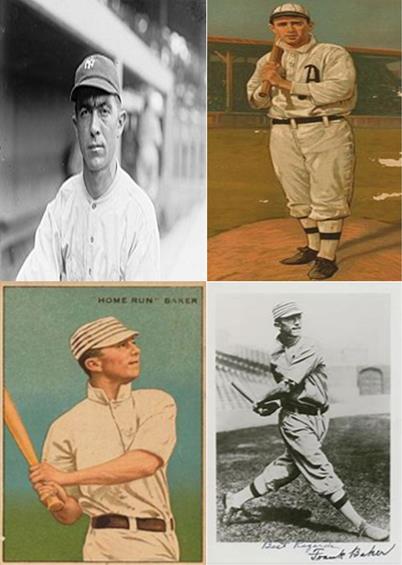
Home Run Baker
John Franklin "Home Run" Baker, March 13, 1886 – June 28, 1963, was a professional third baseman. Baker played in major league baseball from 1908 to 1922 for the Philadelphia Athletics and New York Yankees. Although he never hit more than a dozen home
Baseball Trailblazers Page 1397
runs in a season and hit only 93 homers in his career, Baker has been called the "original home run king of the majors."
Baker was born to Franklin Adams Baker and Mary Catherine (née Fitzhugh) on their farm in Trappe, Maryland. The Bakers, who were of English descent, had been farmers in Trappe for six generations. His mother, of Scottish descent, was reported to be a distant relative of Robert E. Lee.
Baker enjoyed working on his father's farm, but he aspired to become a professional baseball player from the age of ten. In Trappe, most of the residents attended the local baseball team's games on Saturdays. Frank's older brother, Norman, was well known in the town for his playing ability. Norman once tried out for the Philadelphia Athletics, but he did not like that city and stopped pursuing a baseball career.
Baker pitched for the local high school baseball team and worked as a clerk at a butcher shop and grocery store owned by relatives. He signed with a local semi-professional baseball team based in Ridgely, Maryland in 1905, at the age of 19. The team, which was managed by Buck Herzog, paid him $5 per week and covered his boarding costs. Herzog found that Baker could not pitch well, but that he could hit. Baker was unable to play the
Baseball Trailblazers Page 1398
outfield well, but he was able to move into the infield as a third baseman for Ridgely.
In 1906, Baker played for Sparrows Point Club in Baltimore, earning $15 per week. He received an offer to play for a team in the Class C Texas League in 1907, which he turned down. He instead signed with an independent team based in Cambridge, Maryland.
A scout for the New York Giants of the National League noticed Baker while he was playing for Sparrows Point. They arranged for Baker to receive a tryout with the Baltimore Orioles of the Class A Eastern League late in the 1907 season. Playing in five games, Baker recorded two hits, both singles, in 15 at bats.
Orioles' manager Jack Dunn decided that Baker "could not hit."
and he was released.
In 1908, Baker began the season with the Reading Pretzels of the Class B Tri-State League. He had a .299 batting average in 119
games played, adding six home runs, 65 runs scored, and 23
stolen bases.
Connie Mack, the manager of the Philadelphia Athletics, purchased Baker's contract in September 1908. In nine games, Baker batted .290 in 31 at bats to close the 1908 season. Mack named Baker his starting third baseman for the 1909 season. That
Baseball Trailblazers Page 1399
year, Mack established his "$100,000 infield," with Baker joined by first baseman Stuffy McInnis, second baseman Eddie Collins, and shortstop Jack Barry. He hit .305 with a .447 slugging percentage and four home runs for Philadelphia in 1909, including the first home run to go over the fence in right field of Shibe Park. His slugging percentage was fourth best in the American League, while his 85 runs batted in were third best, and his 19 triples led the league. The Athletics improved by 27
wins over their 1908 record in 1909, but finished in second place behind the Detroit Tigers.
In a late season series against the Tigers in 1909, Ty Cobb spiked Baker while sliding into third base, lacerating Baker's arm. Baker referred to the spiking as "deliberate" on the part of Cobb, while Mack called Cobb the dirtiest player he had seen, and asked American League president Ban Johnson to investigate.
A photograph taken for The Detroit News vindicated Cobb, by showing that Baker had to reach across the base to reach Cobb.
Though Baker remained in the game after wrapping his arm, he acquired a reputation for being weak and easily intimidated. Joe S. Jackson, a sportswriter for the Detroit Free Press, referred to Baker as a "soft-fleshed darling." Baker helped the Athletics win the 1910 World Series over the Chicago Cubs, four games to one, as he batted .409 in the five game series.
Baseball Trailblazers Page 1400
Baker led the American League with 11 home runs in 1911, and batted .334. In the 1911 World Series, the Athletics faced off against the Giants. Based on Baker's past run in with Cobb, Giants players believed they could intimidate him. Fred Snodgrass spiked Baker while sliding into third base in Game One, knocking the ball loose and requiring Baker to bandage his arm. In Game Two, Baker hit a go ahead home run off Rube Marquard for an Athletics win. He hit a ninth inning game tying home run off Christy Mathewson in Game Three. Later in the game Snodgrass again attempted to spike Baker, but he was able to hold onto the ball and the Athletics won again. A six day delay between games as a result of rain, which turned Shibe Park into a "virtual quagmire," allowed Baker's feats to be featured by the Philadelphia press, during which time he began to be referred to by the nickname "Home Run." The Athletics defeated the Giants in six games, as Baker led the Athletics with a .375
batting average, nine hits and five RBIs in the series.
Baker again led the American League in home runs in 1912, and led the league with 130 RBIs as well. But his Athletics finished in third place, and the Boston Red Sox defeated the Giants in an exciting eight game World Series. In 1913, he again led the league with 12 home runs and 117 RBIs, and this time the Athletics again defeated the Giants in the World Series, as
Baseball Trailblazers Page 1401
Baker batted .450 with a home run and seven RBIs in the five games. He led the league in home runs for a fourth consecutive season in 1914, with nine, despite suffering from pleurisy during the season. He also batted .319 and added 89 RBIs, 10
triples and 19 stolen bases. Late in the season, Mack sent Baker, Collins and pitcher Chief Bender to scout the Boston Braves, their opponent in the 1914 World Series. Despite predictions that Philadelphia would win the series handily, the Braves defeated the Athletics four games to none, as Baker batted only .250.
After the 1914 World Series, Mack began to sell off some of his best players, though not including Collins, to whom he had given a multi-year contract during the regular season to prevent him from jumping to the upstart Federal League. Baker, who had just completed the first year of a three year contract, attempted to renegotiate his terms, but Mack refused. Baker sat out the entire 1915 season as a result of this contract dispute. He remained in baseball, playing for a team representing Upland, Pennsylvania, in the semi-professional Delaware County League.
Pressured by American League president Ban Johnson, Mack sold Baker's contract in 1916 to the New York Yankees for $35,000.
Even though Baker reported to the Yankees with an injured finger, and he also injured his knee during a game in May, he
Baseball Trailblazers Page 1402
and Wally Pipp combined to form the center of the Yankees'
batting order. Pipp led the American League in home runs with 12
in 1916, and Baker finished second with 10, despite missing almost a third of the Yankees' games. Pipp hit nine home runs in 1917, again leading the league. Baker led the league with 141
games played in the 1919 season. The Yankees hit a league leading 47 home runs that year, of which Baker hit ten. Sports cartoonist Robert Ripley, working for the New York Globe coined the term "Murderer's Row" to refer to the lineup of Baker, Pipp, Roger Peckinpaugh, and Ping Bodie.
Baker sat out of baseball during the 1920 season, as his wife died of scarlet fever. His two daughters were also affected, but they were able to recover. Late in the 1920 season, Baker again played for Upland, and stated his desire to return to New York.
He rejoined the Yankees in 1921, as the Yankees reached the World Series for the first time in franchise history. Missing the last six weeks of the 1921 season, Yankees' manager Miller Huggins started Mike McNally in his place, though he wanted to be sure to take advantage of Baker's World Series experience.
The Giants defeated the Yankees five games to three. Baker played in only four of the eight games, though McNally struggled to a .200 batting average. In the 1922 season, Baker played in 66 games, now overshadowed by Babe Ruth as a home run hitter.
Baseball Trailblazers Page 1403
The Yankees again faced the Giants in the World Series, losing four games to none. Baker received only one at bat in the 1922
World Series. He finished his career as a Yankee with a .288
batting average, 48 home runs and 379 RBIs in 676 games. Walter Johnson referred to Baker as "the most dangerous batter I ever faced."
Baker led the American League in home runs from 1911 to 1914. He had a batting average over .300 in six seasons, had three seasons with more than 100 runs batted in, and had two seasons with over 100 runs scored. Baker's legacy has grown over the years, and he is regarded by many as one of the best power hitters of the dead ball era. During his 13 years as a major league player, Baker never played a single inning at any position other than third base. Baker was elected to the National Baseball Hall of Fame by the Veterans Committee in 1955. His final major league totals included a batting average of .307, home runs of 96, and runs batted in of 991.
Following his retirement as a player, Baker managed the Easton Farmers of the Eastern Shore League during the 1924 and 1925
seasons. He was credited with discovering Jimmie Foxx and recommending him to Mack. After Baker sold Foxx to the Athletics, the Farmers fired Baker, because they believed Mack did not pay a high enough price for Foxx.
Baseball Trailblazers Page 1404
Baker was a modest man who never drank, smoked, or swore. He returned to his Maryland farm every offseason, where he enjoyed duck hunting. While playing in Cambridge, Baker met Ottilie Tschantre, the daughter of a Swiss jeweler. They were married on November 12, 1909. Baker and his wife had twin babies in late January 1914. Though the babies were reported as doing well a couple of days later, they died before they were two weeks old.
After the 1919 season, Baker’s wife contracted scarlet fever and died. He remarried, to Margaret Mitchell, after leaving the Yankees.
In addition to working on his farm, Baker served Trappe as a member of the Trappe Town Board, a tax collector, and a volunteer firefighter. He was also a director of the State Bank of Trappe. On June 28, 1963, Baker suffered a stroke and died there.
Baseball Trailblazers
Page 1405
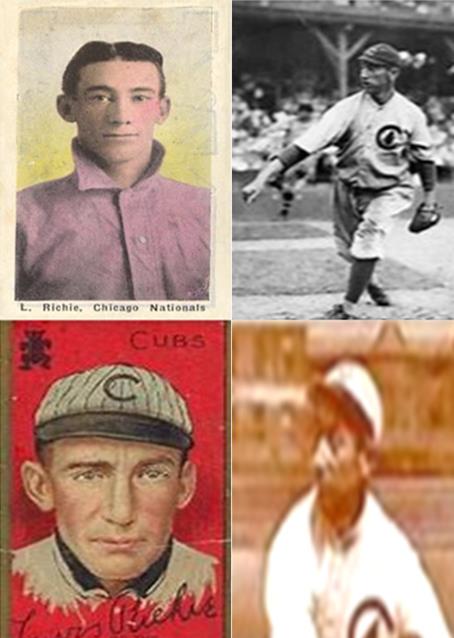
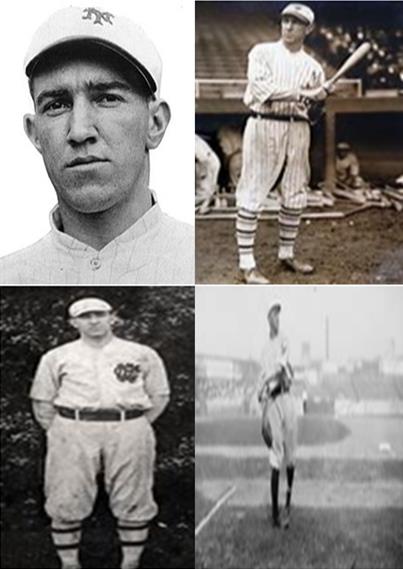
Lew Richie
Elwood Lewis Richie was born August 23, 1883 in Ambler, Pennsylvania, and died August 15, 1936 in South Mountain,
Baseball Trailblazers Page 1406
Pennsylvania. He pitched in the major leagues from 1906 to 1913, for the Chicago Cubs, Boston Doves and Philadelphia Phillies. He compiled a very admirable lifetime record of 74 wins and 65
losses, with an earned run average of 2.54.
Baseball Trailblazers
Page 1407
Dave Robertson
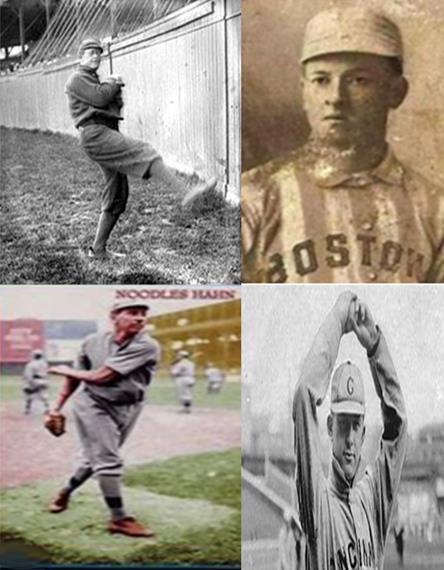
Davis Aydelotte Robertson, September 25, 1889 – November 5, 1970, was a professional, major league baseball player. He was an outfielder over parts of nine seasons with the New York Giants, Chicago Cubs, and Pittsburgh Pirates.
Baseball Trailblazers Page 1408
Robertson was born in Portsmouth, Virginia. He attended North Carolina State University after matriculating at Maury High School and Norfolk Academy.
In 1916 and 1917, he tied for the National League lead in home runs; while playing for New York. The short distanced right field fence at the Polo Grounds was a frequent target of long drives hit by Robertson and his Giants' teammate, Benny Kauff.
Their hits to right field became so much of an issue that National League officials convened following the 1916 baseball season. Baseball officials decided to amend Rule #1, which read the shortest distance from a fence or stand on fair territory to the home base should be 235 feet. The amendment to the rule changed the shortest distance from a stand or fence to 270 feet.
Robertson played for the Giants in the 1917 World Series against the Chicago White Sox, his 11 hits leading the team in the Series in a losing cause. A member of the Giants during the 1922
season, he did not make an appearance in the 1922 World Series.
The champion Giants swept all four games of that Series from their crosstown rival New York Yankees.
In a nine year major league career, Robertson posted a .287
batting average, 812 hits in 2830 at bats, with 366 runs, 47
Baseball Trailblazers Page 1409
home runs and 364 RBI in 804 games played. He surpassed the .300
batting mark three times.
Robertson died at the age of 81 in Virginia Beach, Virginia.
Baseball Trailblazers
Page 1410
Noodles Hahn
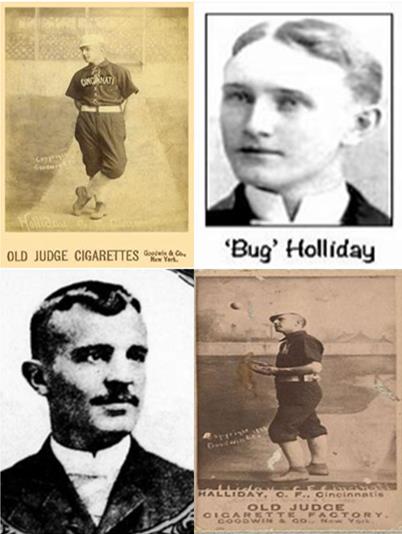
Frank George "Noodles" Hahn, April 29, 1879 - February 6, 1960, played for the Cincinnati Reds and New York Highlanders between 1899 and 1906. The left hander posted a 130-94 win-loss record with 917 strikeouts and a 2.55 earned run average in 2,029
Baseball Trailblazers Page 1411
innings pitched. Hahn was the first pitcher to throw a no hitter in the 20th century. Hahn completed veterinary school while playing for Cincinnati and he entered the profession after he retired from baseball. He worked out with the Reds on game days until he was 68 years old.
Hahn was born in Nashville, Tennessee. Hahn acquired his nickname as a child, but said that he did not know how he had gotten it. Before he turned 15 years old, he signed a contract for $35 per month with a team in Clarksville, Tennessee. Hahn later talked about having to wait outside of saloons as his teammates went in for drinks. He moved on to the Southern League before reaching the major leagues with the Cincinnati Reds at the age of 20.
During his first major league baseball season, Hahn threw a one hit game to defeat the Louisville Colonels. Though not armed with a powerful fastball, Hahn developed a reputation as a strikeout pitcher. Long after Hahn's retirement, sportswriter Grantland Rice described Hahn's pitching style. "Hahn was a left hander who belonged to the Herb Pennock, Eddie Plank school. He lacked the blazing speed of a Grove or a Rube Waddell, but he could tie up batters into more knots than 10 sailors could untie in a week. And you could see the seams on the ball as it came floating up."
Baseball Trailblazers Page 1412
By 1900, Hahn was beginning to look at careers beyond baseball.
Though his friends had urged him to develop his talent for piano, Hahn wanted to pursue the study of electricity. He made plans to work for a large Memphis electrical company in the offseason following the 1900 season. He pitched the first no hitter of the 1900s, on July 12, 1900 against the Philadelphia Phillies. Hahn led the NL in shutouts that season.
In 1901, Hahn recorded 22 wins but Cincinnati finished in last place. He was the first NL pitcher to win 20 or more games with an eighth (last at the time) place team. Winning 22 of his team's 52 victories, Hahn accounted for the highest percentage of a team's victories until 1972. He led the league in innings pitched that season and was the league's strikeout leader for the third consecutive season. In a 1901 game, Hahn struck out 16
batters, the highest single game total in any major league since 1887.
In February 1903, Hahn was a student at Cincinnati Veterinary College. Asked how long he planned to play baseball, he replied that he would like to play a few more seasons. Hahn had given up beer and liquor over the winter and said that he felt good going into the season, but he entertained the possibility that the coming year could be his last. Hahn planned to finish school the next winter and had thoughts of completing postgraduate work and
Baseball Trailblazers Page 1413
taking a trip to Germany before beginning veterinary practice.
In 1904, Hahn turned down an offer to become the city veterinarian for Dallas, Texas and remained with the Cincinnati club.
During the 1905 season, Cincinnati manager Joe Kelley announced that the team was searching for a left handed pitcher who could replace Hahn. Kelley said; "While we have not lost confidence in Hahn, we realize that he can't last forever. He has already passed the limit that usually is fixed for southpaws in fast company, about five or six years at the most."
Hahn retired in 1906 due to arm trouble. Using his education as a veterinary surgeon, he took a position as a government meat inspector in Cincinnati. An Ohio newspaper issued an article in July 1908 stating that Hahn had pitched well in semipro baseball and that he would soon be back with the Reds. In 1909, another newspaper report indicated that Hahn had sought medical attention for the arm issue and that he would attempt a major league comeback. By 1910, Hahn was giving private instruction to pitching prospect Rube Benton, who Cincinnati had signed to a $6,000 contract.
After his retirement from baseball, Hahn continued to work out with the Reds on game days until he was at least 68 years old.
Baseball Trailblazers Page 1414
Author Lee Allen wrote that the members of a Reds team in the 1940s did not know that Hahn had been a successful Reds pitcher until one of the players found an old newspaper clipping about him. Allen said that Hahn was "never one to get a rookie off in a corner and tell him how baseball used to be played or should be played. He was never a mine of misinformation about the game, and was even reluctant to discuss his own career." He died in Candler, North Carolina at the age of 80.
Baseball Trailblazers
Page 1415
Bug Holliday
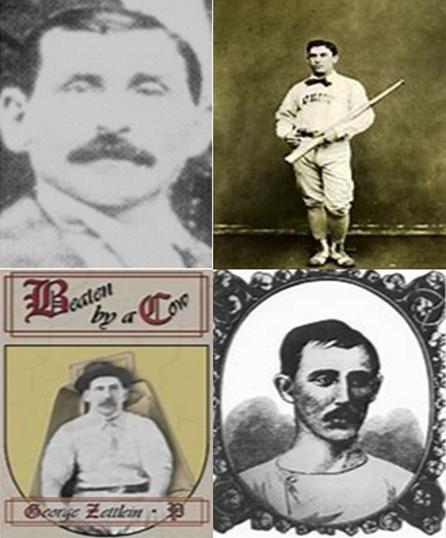
James Wear "Bug" Holliday, February 8, 1867 – February 15, 1910, was a center fielder in major league baseball for ten seasons; in the 1885 World Series for the Chicago White Stockings and from 1889 through 1898 for the Cincinnati Reds, both when they were in the American Association and in the National League. He
Baseball Trailblazers Page 1416
twice led the league in home runs, and was among the leaders in various other offensive categories throughout his career.
Holliday was born in St. Louis, Missouri, and became the first player in major league history to make his debut in the postseason when he was called up, at the age of 18, by the Chicago White Stockings when they needed another outfielder for Game 4
of the 1885 World Series. He played in one game, and had no hits in four at bats.
Holliday made his regular season major league debut in 1889 for the Cincinnati Red Stockings of the American Association. In his first season with the Red Stockings, he led the league in home runs with 19, while finishing in the top ten in many offensive categories. He was fifth in batting average with .321, fifth in runs batted in with 104, third in hits with 181, and ninth in doubles with 28.
Before the 1890 season, the Red Stockings transferred their team over to the National League and officially became the Reds.
Holliday picked up where he left off the previous season, with an opening day home run off Bill Hutchinson in a 5–4 loss to the Chicago Colts. But after that, his season's power numbers dropped significantly, as he hit only four home runs, tallied 75
RBIs, and had a .270 batting average.
Baseball Trailblazers Page 1417
He bounced back the following season, when he hit nine home runs, which was fourth in the league, batted .319 to finish second in the league, and totaled 84 RBIs, which was ninth. He followed the 1891 campaign with an even better 1892 season, when he played in 153 games, batted 602 times, scored 114 runs, and tripled 16 times, all career highs. He also claimed his second home run title that season, with 13, and finished in the top ten with 176 hits as well.
Both 1893 and 1894 saw Holliday continue his batting production.
Although his home runs dipped to five in 1893, he still batted
.310, totaled 84 RBIs, and scored 108 runs. But statistically, 1894 was his greatest season, when his .372 batting average was his career high, as well as his 119 runs scored, 190 hits, 119
RBIs, .420 on-base percentage and .523 slugging percentage.
During the first six years of his career, he slugged 63 home runs, which was second to only Roger Connor during the same span; but in 1895 he had an appendectomy, and was never the same player after that. In his last four seasons he was never more than a part time player.
In 930 games over 10 seasons, Holliday posted a .312 batting average, 1141 for 3658, with 735 runs, 162 doubles, 72 triples,
Baseball Trailblazers Page 1418
65 home runs, 621 RBI, 252 stolen bases, 360 bases on balls,
.377 on-base percentage and .449 slugging percentage.
When Holliday's professional baseball career was over, he played for fellow Cincinnatians Julius and Max Fleischmann on their semi-professional Mountain Athletic Club in 1899. Holliday had married Mary Thurman, daughter of Ohio politician Allen G.
Thurman and the former wife of William S. Cowles, in 1894. In 1903, he was a National League umpire for 53 games. He continued to live in Cincinnati, and worked in a pool room while also covering horse racing for a local newspaper. He died at the age of 43 in Cincinnati of gangrene of foot and leg.
Baseball Trailblazers
Page 1419
George Zettlein
George Zettlein, July 12, 1844 – May 22, 1905, played six seasons in major league baseball from 1871–76 for the Chicago White Stockings, Troy Haymakers, Brooklyn Eckfords, Philadelphia White Stockings of the National Association, and Athletics of Philadelphia in the National League.
Baseball Trailblazers Page 1420
Born in Williamsburg, Brooklyn, Zettlein began playing in 1865
for Eckford of Brooklyn in the National Association of Base Ball Players, the amateur only predecessor to the NA. He joined the Brooklyn Atlantics in 1866, and remained with the team until 1870. In 1871, he joined the professional White Stockings of the NA, and in May 1871 he gave up the new league's first home run.
He went on to give up the league's first grand slam in September of the same year. He had a record of 18-9 with a league leading 2.73 ERA that year.
The following season, Zettlein played for the Troy Haymakers and Brooklyn Eckfords, combining for 15 wins and 16 losses between the two teams. He went on to win 36 games for the Philadelphia White Stockings in 1873, then returned to the Chicago White Stockings for two seasons. Partway through the 1875 season, he rejoined the Philadelphia White Stockings, and ended his career in 1876 with the Philadelphia Athletics. He finished his career with 129 wins, 112 losses, and a 2.55 earned run average.
Zeittlein served in the Civil War, in both the Army and Navy. He died at age 60 in Patchogue, Long Island, New York.
Baseball Trailblazers
Page 1421
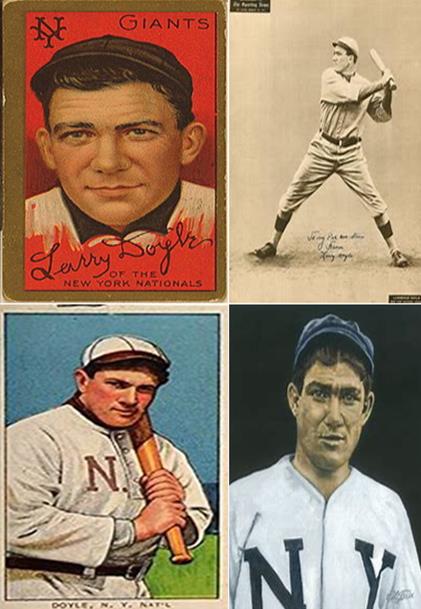
Larry Doyle
Lawrence Joseph Doyle, July 31, 1886 – March 1, 1974, nicknamed
"Laughing Larry," was a second baseman in major league baseball
Baseball Trailblazers Page 1422
from 1907 to 1920, who played almost his entire career for the New York Giants.
Born in Saranac Lake, New York, Doyle was a third baseman in the minor leagues before his contract was purchased by the Giants for a then record $4,500. He debuted with the Giants on July 22, 1907, arriving late after taking the wrong boat across the Hudson River. He cost his team the game with a ninth inning error, though he also had a pair of hits. He expected to be returned to the minor leagues. Instead, he was retained by manager John McGraw, who named him the team's field captain in 1908, a year in which he finished third in the batting race with a .308 average. Doyle, who also became the roommate of Christy Mathewson for several years, followed up with a 1909 season in which he led the NL in hits with 172, and was among the league's top four players in batting - .302, slugging -.419, home runs –
6, and total bases - 239. 1910 saw a slight drop off, though he was still third in the NL in home runs – 8, and fourth in runs scored - 97.
He then entered the strongest part of his career. In 1911 he finished third in the voting for the initial Chalmers (MVP) Award after hitting .310 and finishing second in the league with a .527 slugging average, the highest by an NL second baseman since Ross Barnes slugged .590 in the league's inaugural 1876
Baseball Trailblazers Page 1423
campaign. Doyle also led the league with 25 triples, the most by an NL player since 1899. He stole 30 bases for the third consecutive year, and finished fourth in the league in home runs with 13 and fifth in runs with 102. In the 1911 World Series against the Philadelphia Athletics, he batted .304. With the Giants facing elimination in Game 5, he went 4 for 5, doubling and scoring an intensely disputed run in the 10th inning for a 4–3 victory. He again doubled and scored for a 1–0 lead in the first inning of Game 6, but the Giants lost the game 13–2, and with it the Series.
Doyle then had a 1912 season which was perhaps even better, winning the Chalmers Award after hitting a career high .330 as the Giants repeated as NL champions. In the 1912 World Series against the Boston Red Sox he only hit .242, though he scored the first run in a Game 6 victory and was 3 for 4 with a home run in an 11–4 rout in Game 7. But he was 0 for 5 in Game 8 as the Red Sox won 3–2 in ten innings, after New York took a 2–1
lead in the top of the 10th, to capture the title.
In 1913 the Giants won their third straight pennant. Although he batted only .280, he stole 30 bases for the fifth year in a row and was eighth in the NL with 73 runs batted in. That year, he became the first player to hit a home run out of the Polo Grounds. He had an even more dismal 1913 World Series, hitting
Baseball Trailblazers Page 1424
only .150 against the Athletics as the Giants lost in five games, though he did drive in the first run of the Series. In 1914 he slipped to a .260 average, but was fourth in the league in runs. On July 17, he hit a home run in the top of the 21st inning to defeat the Pittsburgh Pirates 3–1.
He enjoyed renewed success in 1915, however, winning the batting crown with a .320 average. It was the first title won by an NL
second baseman since Barnes in 1876. He also led the league in hits with 189, for the second time, and in doubles with 40.
Doyle was also second in the NL in runs - 86 and fifth in slugging - .442.
He began 1916 with a .278 average before being traded to the Chicago Cubs in late August, a painful move for the fiercely loyal player who had famously said in 1911 that it was "great to be young and a Giant." After hitting .395 for the Cubs in nine games that year, he batted .254 for the team in 1917, finishing fourth in the league with 6 home runs, before a pair of January 1918 trades brought him back to New York. He hit .261 in his return to the Giants before having his last outstanding season in 1919. That year he again was league runner up in slugging with a .433 average, and was fifth in home runs with 7. He batted .285 in his final season in 1920, and was granted his release so he could manage the Toronto Maple Leafs of the
Baseball Trailblazers Page 1425
International League. At the time, he was within five games of Johnny Evers' league record for career games at second base.
The National League's outstanding second baseman during the 1910s, Doyle ended his career with a .290 batting average, The team captain and top everyday star on three consecutive pennant winners, 1911–1913, his .408 career slugging average was the top mark by an NL second baseman when he retired, as were his career totals in hits – 1,887, doubles - 299, triples - 123, total bases – 2654, and extra base hits - 496. He ended his career among the major league leaders in career games, putouts, assists, total chances, and double plays at second base.
Doyle contracted tuberculosis in 1942, and entered the Trudeau Sanitorium in Saranac Lake, New York. When the institution closed in 1954 due to the development of an effective antibiotic treatment, he was the last resident to leave. He stayed on in Saranac Lake, and died there 20 years later, at age 87.
Baseball Trailblazers
Page 1426
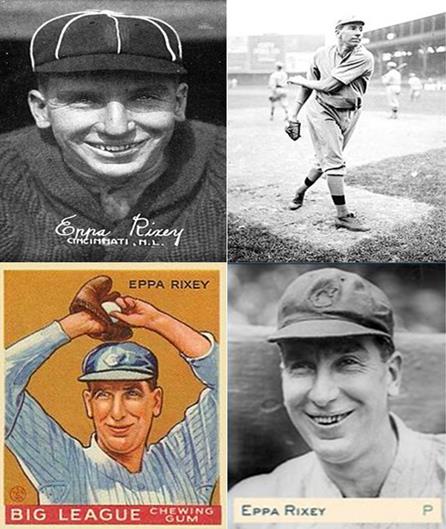
Eppa Rixey
Eppa Rixey Jr., May 3, 1891 – February 28, 1963, nicknamed
"Jephtha," played 21 seasons for the Philadelphia Phillies and Cincinnati Reds in major league baseball from 1912 to 1933 as a left handed pitcher. An intellectual who taught high school Latin during the off-season, he earned the nickname "Jephtha"
for his southern drawl,
Baseball Trailblazers Page 1427
Rixey was best known as the National League's leader in career victories for a left hander with 266 wins until Warren Spahn surpassed his total in 1959.
Eppa Rixey Jr. was born in Culpeper, Virginia, to Eppa Rixey and his wife Willie Alice (née Walton). At the age of ten, his father, a banker, moved his family to Charlottesville, Virginia.
His uncles were John Franklin Rixey, a former congressman, and Presley Marion Rixey, a former Surgeon General of the United States Navy. He attended the University of Virginia, where he played basketball and baseball. He was a member of Delta Tau Delta International Fraternity. Umpire Cy Rigler worked as an assistant coach for the University. He recognized Rixey's talent and tried to sign him to the Philadelphia Phillies. Rixey originally declined, saying he wanted to be a chemist, but Rigler insisted, even offering a substantial portion of the bonus he received for signing a player. Rixey accepted the deal.
The National League, upon hearing of the deal, created a rule that prohibits umpires from signing players.
Rigler convinced him to sign directly with the Phillies, bypassing minor league baseball entirely. His time with the Phillies was marked by inconsistency. He won 22 games in 1916, but also led the league in losses twice. In 1915, the Phillies played in the World Series, and Rixey lost in his only
Baseball Trailblazers Page 1428
appearance. After being traded to the Reds prior to the 1921
season, he won 20 or more games in a season three times, including a league leading 25 in 1922, and posted eight consecutive winning seasons. His skills were declining by the 1929 season, when his record was 10–13 with a 4.16 earned run average. He pitched another four seasons before retiring after the 1933 season.
Rixey was traded to the Reds prior to the 1921 season. In his first season there, he won 19 games, and set a Major League record by allowing just one home run in 301 innings pitched. In three of the next four seasons, he had 20 or more victories each season, with a league leading total of 25 in 1922. He also led the league in innings pitched and shutouts with four in 1924. In 1926 he had 14 wins, followed by seasons of 12, 19 and 10.
Rixey's production began to decline in 1930, when he went 9–13
with a 5.10 ERA, and pitched fewer than 200 innings for the first time since 1919. From 1931 through 1933, Rixey pitched very little, and was used almost exclusively against the Pittsburgh Pirates. For the 1933 season, he was the only Reds pitcher with a winning record, at 6–3 as the Reds finished last in the National League at 58–94. He retired prior to the 1934
season, stating "the manager wasn't giving me enough work."
Rixey completed his career with 266 wins, 251 losses, and a 3.15
Baseball Trailblazers Page 1429
ERA. He appeared in 692 games and completed 290, and had 20 wins and 14 saves as a relief pitcher.
Rixey's approach to the game is exemplified by the following quote. "How dumb can the hitters in this league get? I've been doing this for fifteen years. When they're batting with the count two balls and no strikes, or three and one, they're always looking for the fastball and they never get it." Upon his election to the Hall of Fame on January 27, 1963, he was quoted as saying "They're really scraping the bottom of the barrel, aren't they?"
He was married to Dorothy Meyers of Cincinnati and had two children, and five grandchildren. After his retirement from baseball, Rixey worked for his father-in-law's successful insurance company in Cincinnati, eventually becoming president of the company. He died of a heart attack on February 28, 1963, one month after his election to the Hall of Fame.
Baseball Trailblazers
Page 1430
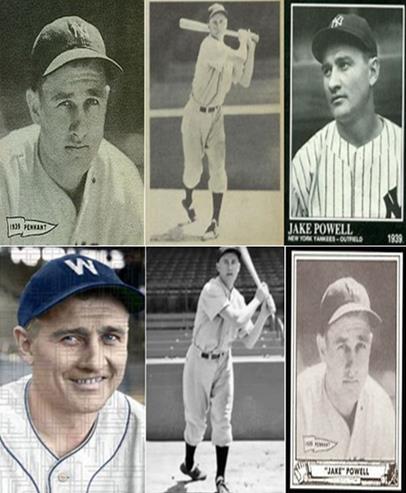
Jake Powell
Alvin Jacob Powell, July 15, 1909 – November 4, 1948, was an outfielder for the Washington Senators - 1930, 1934–1936 and 1943–1945, New York Yankees - 1936–1940, and Philadelphia Phillies – 1945. He was born in Silver Spring, Maryland and helped the Yankees win the World Series every year from 1936 to 1939, batting .455 in the 1936 fall classic. In eleven seasons, Powell was a three time World Series champion. He played in 688
Baseball Trailblazers Page 1431
games and had 2,540 at bats, 353 runs, 689 hits, 116 doubles, 26
triples, 22 home runs, 327 RBIs, 65 stolen bases, 173 walks, and a .271 batting average.
He played in 31 games in 1939 and 12 games in 1940 before the Yankees sold him to the minor leagues. In the fall of 1944, during World War II, Powell served as an emergency police officer in Montgomery County, Maryland. He returned to baseball at the start of the 1945 season. In 1948, Powell tried to make a comeback, playing in 31 games for the Gainesville G-Men of the Florida State League, but batted just .220.
In November 1948, Powell was arrested in Washington, D.C. for passing bad checks. He drew a revolver while at a police station and committed suicide.
Baseball Trailblazers
Page 1432
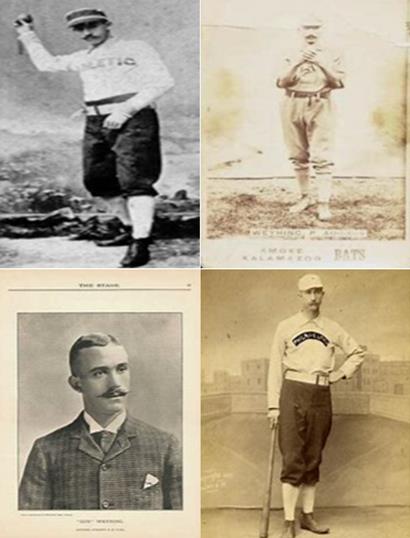
Gus Weyhing
August "Gus" Weyhing, September 29, 1866 – September 4, 1955, was a pitcher for nine professional baseball teams in a career that spanned 14 years from 1887 to 1901. He was listed at 5 feet 10 inches tall and between 120 and 145 pounds. He enjoyed quite a bit of success, winning 25 games or more for six years in a
Baseball Trailblazers Page 1433
row, capped by a 32 win season in 1892 for the Philadelphia Phillies. He completed 46 of his 49 starts that year, hurled six shutouts, and logged 469 innings pitched. He collected 216 wins in his first eight professional seasons. Weyhing was nicknamed
"Cannonball", "Rubber Arm", and "Rubber-Winged Gus." He also holds the dubious honor of having hit the most batters in a career – 277.
Weyhing was a solid pitcher, though he never led the league in any specific categories. He did have a few career highlights. In one memorable week in the 1888 season, Weyhing pitched three consecutive complete game victories against Brooklyn to eliminate that team from the pennant race. In addition, Weyhing came close to throwing a perfect game when he hurled a no hitter on July 31, 1888, against the Kansas City Cowboys. He walked one batter and another reached base via an error.
His total lifetime win–loss record was 264–232, while compiling an earned run average of 3.89. He also has the twelfth most complete games in major league history – 448, four 200+
strikeout seasons, and seven 20 win seasons.
Baseball Trailblazers
Page 1434
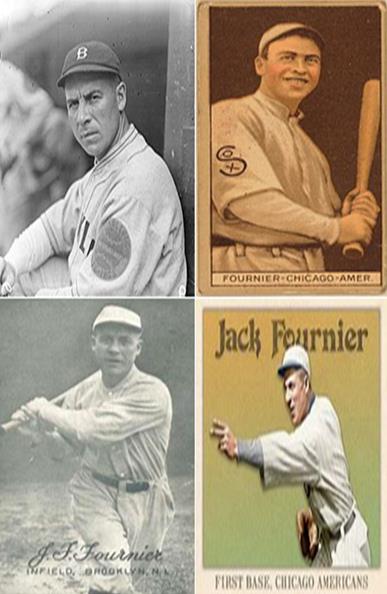
Jack Fournier
John Frank "Jack" Fournier, September 28, 1889 – September 5, 1973, was a professional baseball first baseman and outfielder.
A native of Au Sable, Michigan, he played in major league
Baseball Trailblazers Page 1435
baseball for the Chicago White Sox, New York Yankees, St. Louis Cardinals, Brooklyn Robins, and Boston Braves from 1912 to 1927.
When purchased by the White Sox from the Boston Red Sox in 1912, Fournier presented Pants Rowland and a half dozen other managers with the dilemma of what to do with his pure hitting, but poor fielding abilities. Rowland solved that problem in 1916, a year after Fournier had led the AL in slugging, by replacing him at first base with the marginal Jack Ness. Before 1920, a first baseman was one of the key fielding positions because of the constant threat of the bunt, and Fournier could not field the bunt.
Fournier hit .350 for the Yankees in limited duty in 1918 before they passed him off to the Cardinals. In 1921, he finished 3rd in the league with a .343 batting average while scoring a career best 103 runs. After three productive years in St. Louis, Fournier was dealt to Brooklyn on February 15, 1923. Fournier said he would quit the game rather than leave St. Louis, but he eventually ended his holdout and reported to the Dodgers.
Fournier had found his spot, among an offensive unit that included Zack Wheat, Milt Stock, and Zack Taylor. He turned in a six for six performance on June 29 of that year, and hit .351, though committing a league high 21 errors. In 1924, Fournier led the NL with 27 home runs and was second in the league with 116
Baseball Trailblazers Page 1436
runs batted in. He led the National League with 86 walks in 1925, batting .350 and finishing second in the league to Rogers Hornsby in both RBIs - 130 and on base percentage - .446, still the third highest total in Dodgers history.
Fournier hit 136 career home runs in 14 seasons while batting
.313 with a .392 on base percentage and a .483 slugging percentage. He also racked up three straight seasons (1923–1925) with 20+ home runs, 20+ doubles, a .400 or higher on base percentage, a .330 plus batting average, and 90+ runs.
Following his playing career, Fournier was the head coach at UCLA from 1934 to 1936. He later scouted for the St. Louis Browns, Chicago Cubs, Detroit Tigers, and Cincinnati Reds. He died in Tacoma, Washington September 5, 1973 at the age of 83.
Baseball Trailblazers
Page 1437
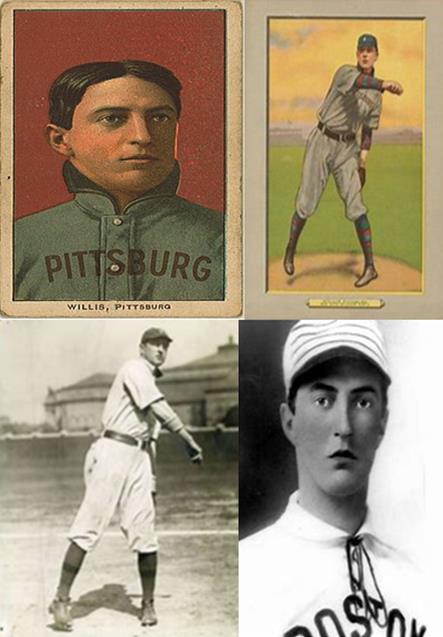
Vic Willis
Victor Gazaway Willis, April 12, 1876 – August 3, 1947, was a major league baseball pitcher during the 1890s and 1900s. In 14
Baseball Trailblazers Page 1438
seasons in the National League, he pitched for the Boston Beaneaters, Pittsburgh Pirates, and St. Louis Cardinals. In 513
career games, Willis pitched 3,996 innings and posted a win–loss record of 249–205, with 388 complete games, 50 shutouts, and a 2.63 earned run average. He was ERA leader in 1899, strikeout leader in 1902, and he pitched a no hitter on August 7, 1899.
Willis was born in Cecil County, Maryland. He moved to Newark, Delaware, as a young boy, where he attended school. He attended high school at Newark Academy, and played both on the high school baseball team and in semi-pro baseball leagues throughout Delaware. Prior to joining the major leagues, Willis played football and baseball for University of Delaware, despite never having attended the college.
Willis began his professional baseball career in 1895 with the Harrisburg Senators of the Pennsylvania State League. After the team ceased operations in June, he moved to the Lynchburg Hill Climbers of the Virginia State League. The following year, he was promoted to the Syracuse Stars of the Eastern League. He finished the season with a 10–6 win-loss record, but had spent most of the season battling illness, which caused him to end his season in July. Willis returned to the Stars for the 1897 season and, after establishing a curveball in the offseason, finished the season with 21 wins, with Syracuse winning the league
Baseball Trailblazers Page 1439
championship in the process. After the season ended, Willis was purchased by the Boston Beaneaters for Fred Lake and $1,000. The Beaneaters acquired Willis to fill the void left by Jack Stivetts, who was near retirement due to an arm injury.
Willis began his major league career with the Beaneaters on April 20, 1898 in a relief appearance against the Baltimore Orioles, allowing eight runs, three walks, and a wild pitch in an 18–2 loss while also hitting two batters. In his next appearance, he beat the Washington Senators, 11–4, in his first career start. He remained in the starting rotation throughout the season, but at times struggled with his control. He finished the season with 25 wins, 13 losses, a 2.84 ERA, 148 walks, and 160 strikeouts. He finished second in walks and third in strikeouts in the National League.
For the seasons from 1903 to 1905, Willis compiled a dismal record with the Boston Beaneaters of 42 wins against 72 losses.
However, his ERA during those three years averaged 3.02 and in two of those years his ERA was under 3.00. Despite Willis'
performance on the mound during those three seasons, the Boston offense could only muster a combined .238 batting average over those seasons. When he changed teams to the Pittsburgh Pirates for 1906, whose offense had a combined batting average of .256
over the four years Willis was with the team, Willis compiled a
Baseball Trailblazers Page 1440
record of 88–46. His ERA for those four years was 2.08. Willis was on one World Series championship team, the 1909 Pirates. He lost one game during the Series, pitching against Ty Cobb's Detroit Tigers.
His final major league season was 1910, with the St. Louis Cardinals. Next season Willis pitched for a semipro team in his hometown Newark, Delaware.
After retirement, Willis purchased and operated the Washington House, a hotel in his hometown of Newark, Delaware. Willis died in 1947.
Baseball Trailblazers
Page 1441
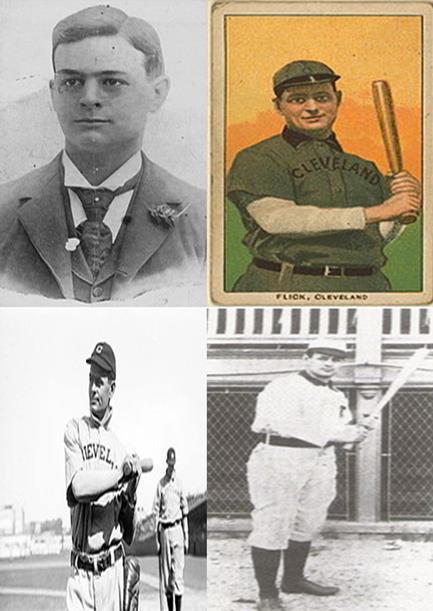
Elmer Flick
Elmer Harrison Flick, January 11, 1876 – January 9, 1971, was an American professional baseball outfielder who played in major
Baseball Trailblazers Page 1442
league baseball from 1898 to 1910 for the Philadelphia Phillies, Philadelphia Athletics, and Cleveland Bronchos/Naps.
Flick was born the third of five children of Zachary and Mary Flick, on the family farm in Bedford, Ohio. His father was a farmer and mechanic who had served in the American Civil War.
Flick attended Bedford High School, where he played catcher on the school's baseball team. He also played football, wrestled, and boxed.
Flick entered semi-professional baseball by chance. When he was 15 years old, he was at a train station to support the local baseball team as it left for a road trip. Only eight of the team's players showed up at the station, so Flick was recruited to go on the trip with the team. Though Flick did not have a uniform or shoes, he hit well in both games of the doubleheader.
He joined the team on a regular basis, and he continued to play semi-pro baseball throughout his teenage years.
In 1896, the manager of the Youngstown Puddlers of the Interstate League signed Flick. Because the team had an established catcher, Flick played in the outfield, where he struggled to learn the position. In 31 games, Flick had a .826
fielding percentage. However, Flick had a strong performance
Baseball Trailblazers Page 1443
offensively. Using his father's lathe, Flick crafted his own baseball bat, which he used to hit for a .438 batting average.
The next year, Flick played for the Dayton Old Soldiers, also in the Interstate League, as their regular left fielder. His defense improved, as he compiled a .921 fielding percentage, and he batted .386. He also led the league with 20 triples and 295
total bases.
George Stallings, the manager of the Philadelphia Phillies of the National League noticed Flick while he played for Dayton.
Stallings signed Flick to the Phillies to serve as a reserve outfielder for the team in the 1898 season. Starting outfielder Sam Thompson injured his back after six games, forcing Stallings to play Flick. In his debut game, Flick went 2 for 3 with two singles against Fred Klobedanz. Thompson returned to the team briefly, but reinjured his back and announced his retirement in May, allowing Flick to play regularly. Flick proved himself a capable big leaguer, batting .302 with eight home runs, 13
triples and 81 runs batted in. In the 1899 season, he batted
.342, with 98 runs scored and 98 RBIs. However, he suffered a serious knee injury in August, and reinjured the knee when he returned to the game too quickly.
Baseball Trailblazers Page 1444
Before the 1900 season, Philadelphia stars Napoleon Lajoie and Ed Delahanty held out of renewing their contracts with the team.
Other members of the team had grown disgruntled. Amid talk of a revival of the American Association, Flick and several other players began to talk about not returning to the team the next year. The Philadelphia Inquirer reported that Flick's father was in the chair business in Cleveland and that he might require Flick's help with the business. Flick agreed to a contract extension before the season started.
That year, he led the NL with 110 RBIs. He finished second in the NL with a .367 batting average, and had a .545 slugging percentage, 11 home runs, 59 extra-base hits, and 297 total bases. He also engaged in a fist fight with Lajoie that caused Lajoie to miss five weeks due to a broken thumb. The race for the batting title came down to the end of the season. The title winner, Honus Wagner, later said, "I've had a lot of thrills, but don't think I was ever happier than in 1900 when I won after battling Elmer Flick to the last day of the season for the title."
Flick was one of many star NL players who jumped to the fledgling American League after the 1901 season, playing for the crosstown Philadelphia Athletics. Flick played in 11 games for the Athletics, before the Phillies obtained an injunction from
Baseball Trailblazers Page 1445
the Pennsylvania Supreme Court prohibiting any player under contract with the Phillies from playing for another team. As a recourse, Flick and teammate Lajoie instead signed with the Cleveland Naps, as the Pennsylvania injunction could not be enforced in Ohio. The two players often traveled separately from their teammates for the next year, never setting foot in Pennsylvania in order to avoid a subpoena. Flick spent the remainder of his career in Cleveland, and the contract dispute was resolved when the leagues made peace in September 1903 with the National Agreement.
By early 1904, Flick did not want to re-sign with Cleveland for the offered $2,500. Plans were being made to run a railroad through a corner of Flick's farm and Flick hoped to hire some of his horses to the construction team. "After July 4, my farm work will be along so that I will be able to give considerable attention to independent ball," he said.
Flick did return to Cleveland for the 1904 season. That year, Flick tied teammate Harry Bay for the league lead with 38 stolen bases. Flick was the AL batting champion in the 1905 season with a .308 average. Flick also led the league with a .462 slugging percentage and 18 triples in 1905. His .383 on base percentage trailed only Topsy Hartsel.
Baseball Trailblazers Page 1446
In the 1906 season, Flick played a league leading 157 games. He led the league with 700 plate appearances, 624 at-bats, 98 runs scored, 22 triples, and 39 stolen bases). However, Flick was said to be dissatisfied with the team, and the Naps considered trading him to the Detroit Tigers for Matty McIntyre. Before the 1907 season, the Naps turned down a trade with the Tigers which would have exchanged Flick for the 21 year old Ty Cobb. Hughie Jennings, the Tigers' manager, was tired of dealing with Cobb's abrasive behavior. The Naps refused to part with Flick, even in exchange for Cobb. They countered with Bunk Congalton, but the Tigers declined. Flick had been holding out but he signed a few days after the proposed trade. After Cobb was nearly traded away, Jennings attempted to repair the difficult relationships between Cobb and the other Detroit players. "Cobb is too good a hitter to let get away, when a little diplomacy will get the boys together," Jennings said. In the 1907 season, Flick again led the league with 18 triples.
However, baseball took its toll on Flick. Before the 1907
season, he considered retiring to pursue other business opportunities. By 1908, he developed stomach problems. Cleveland personnel initially said that the illness was related to Flick's overeating. He left training camp that year, complaining of
"train sickness," and returned home to Cleveland. He missed the
Baseball Trailblazers Page 1447
majority of the 1908 season, playing in only nine games. He missed the beginning of the 1909 season as well, as a doctor recommended Flick have his appendix removed. Now weighing 130
pounds, Flick was afraid of a bad outcome from the surgery, which was a significant risk at the time. He kept his appendix and played in 66 games, batting .255. He played in another 24
games in the 1910 season before he was again sidelined by his stomach ailment.
The Naps acquired Shoeless Joe Jackson from the Athletics in a trade and had him replace Flick in the lineup. In July 1910, the Naps sold Flick to the Kansas City Blues of the American Association, but Flick refused to report to Kansas City, which cancelled the transaction.
In 1911, Flick looked to continue his career. Unable to find a major league team willing to sign him, he returned to the minor leagues. The Toledo Mud Hens of the American Association purchased him from Cleveland. Flick played for Toledo in 1911
and 1912. He batted .326 in the 1911 season and .262 in the 1912
season, but did not hit for power. The Mud Hens released him at the end of the 1912 season. He retired from professional baseball after that release, though he briefly played as a second baseman for a local amateur team in Bedford in 1914.
Baseball Trailblazers Page 1448
In 1,483 career games, Flick recorded a .313 batting average while accumulating 164 triples, 1,752 hits, 330 stolen bases, and 756 runs batted in. Flick was known predominantly for his solid batting and speed. He led the National League in RBIs in 1900, and led the American League in stolen bases in 1904 and 1906, and in batting average in 1905.
Returning to Bedford, Flick hunted, raised horses, built buildings, and became involved in selling real estate. He also scouted for Cleveland. Flick was married to Rosa Ella (née Gates). The couple had five daughters. Flick died of congestive heart failure on January 9, 1971, two days before his 95th birthday, in his hometown of Bedford.
When Cobb died in 1961, stories written about him mentioned the attempted trade between Cleveland and Detroit, which revived interest in Flick. Flick was inducted into the Baseball Hall of Fame in 1963 after being unanimously elected by the Veterans Committee. When he received the call from Branch Rickey that he had been selected, Flick did not believe Rickey at first. He said that he did not even realize that he was being considered for election at the time. Flick's family had to convince him that the call was real. He was the oldest living inductee in Hall of Fame history. At his induction, the 87 year old Flick
Baseball Trailblazers Page 1449
said; "This is a bigger day than I've ever had before. I'm not going to find the words to explain how I feel."
Baseball Trailblazers
Page 1450
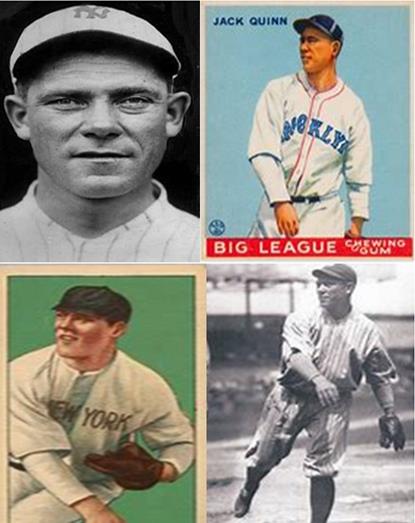
Jack Quinn
John Picus "Jack" Quinn, born Joannes (Jan) Pajkos, July 1, 1883
– April 17, 1946, was a Slovak-American professional baseball player. He played as a pitcher for eight teams in three major leagues; American, Federal, and National, most notably as a member of the Philadelphia Athletics dynasty that won three consecutive American League pennants from 1929 to 1931 and, won the World Series in 1929 and 1930.
Baseball Trailblazers Page 1451
Born in Stefuró, Hungary, Quinn emigrated to America as an infant with his parents Michael Pajkos and Maria Dzjiacsko, arriving in New York on June 18, 1884. His mother died near Hazleton, Pennsylvania, shortly after the family's arrival in the US, and Quinn's father moved the family to Buck Mountain, near Mahanoy City, Pennsylvania. In 1887 Quinn's father remarried, to Anastasia ("Noska") Tzar.
Quinn spent his early years working as a swimmer and blacksmith, while playing recreational ball for mining teams. He got his start as a professional in an unusual way. While watching a semi-pro game in Connellsville, the 14 year old Quinn threw a foul ball back from the stands to the catcher, hitting his mitt right in the middle. The visiting manager, from the nearby town of Dunbar, was impressed by the throw, and he offered Quinn a contract.
Quinn went on to spend 23 seasons in the major leagues with eight different teams. He won 247 games and lost 218, also collecting 57 saves. Quinn debuted on April 15, 1909 and he played until he was 50 years old; his final game was on July 7, 1933.
During his career, Quinn played alongside 31 different members of the Baseball Hall of Fame and collected two World Series
Baseball Trailblazers Page 1452
rings in three tries. He was also one of the last pitchers in baseball permitted to throw the spitball, grandfathered in along with sixteen others reliant on the pitch when it was banned in 1920. He frequently used his spitball after he was grandfathered in, in addition to his fastball, curve, and changeup.
Quinn died in Pottsville, Pennsylvania, at the age of 62.
Baseball Trailblazers
Page 1453
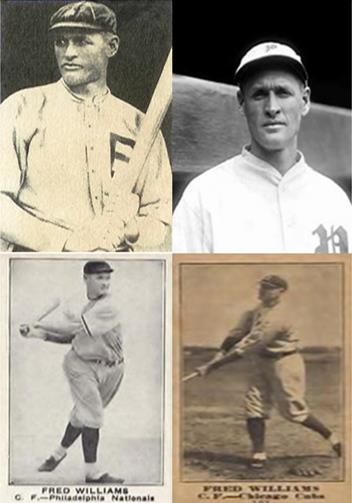
Cy Williams
Frederick "Cy" Williams, December 21, 1887 – April 23, 1974, was a major league baseball player. He played as an outfielder for the Chicago Cubs from 1912–17, and the Philadelphia Phillies from 1918–30. As major league baseball emerged from the dead ball era, Williams became one of the most prominent home run hitters in the National League.
Baseball Trailblazers Page 1454
Born in Wadena, Indiana, Williams attended Notre Dame where he studied architecture and played football with Knute Rockne. His hitting prowess caught the attention of the Chicago Cubs, who purchased his contract after he graduated from college. Williams made his major league debut with the Cubs on July 18, 1912 at the age of 24. From 1915 to 1927 he was a consistent power hitting center fielder, leading the National League in home runs four times during his career.
Williams was the first National League player to hit 200 career home runs, and is one of three players born before 1900 to hit 200 homers in his career. Babe Ruth and Rogers Hornsby are the others. He was the National League's career home run leader until his record of 251 was surpassed by Hornsby in 1929.
In a 19 year major league career, Williams played in 2,002
games, accumulating 1,981 hits in 6,780 at bats for a .292
career batting average along with 251 home runs, 1,005 runs batted in and an on base percentage of .365. He hit over .300
six times in his career.
The Williams Shift, in which defensive players moved to the right side of the playing field, is often associated with Ted Williams, but it was actually first employed against Cy Williams during the 1920s. He played in his final major league game on
Baseball Trailblazers Page 1455
September 22, 1930 at the age of 42. In 1931, Williams served as a player-manager in the minor leagues for the Richmond Byrds of the Eastern League.
After retirement, Williams worked as an architect at the 3 Lakes Theatre in Three Lakes, Wisconsin. Before that, he designed the 3 Lakes Theatre's exterior and interior and later opened it. He died April 23, 1974, aged 86, in Eagle River, Wisconsin.
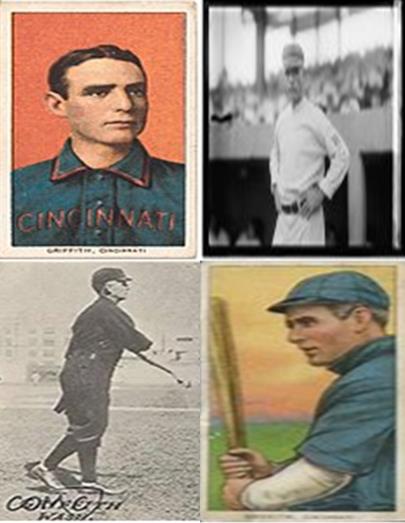
Baseball Trailblazers
Page 1456
Clark Griffith
Clark Calvin Griffith, November 20, 1869 – October 27, 1955, nicknamed "The Old Fox," was a major league baseball pitcher, manager and team owner. He began his playing career with the St.
Baseball Trailblazers Page 1457
Louis Browns - 1891, Boston Reds - 1891, and Chicago Colts/Orphans - 1893–1900). He then served as player-manager for the Chicago White Stockings - 1901–1902 and New York Highlanders
- 1903–1907. He retired as a player after the 1907 season, remaining manager of the Highlanders in 1908. He managed the Cincinnati Reds - 1909–1911 and Washington Senators - 1912–1920, making some appearances as a player with both teams. He owned the Senators from 1920 until his death in 1955. Sometimes known for being a thrifty executive, Griffith is also remembered for attracting talented players from the National League to play for the upstart American League when the Junior Circuit was in its infancy.
Griffith was born in Clear Creek, Missouri, to Isaiah and Sarah Anne Griffith. His parents were of Welsh ancestry. They had lived in Illinois prior to Clark Griffith's birth. The family took a covered wagon west toward the Oklahoma Territory. Along the way, the family encountered hungry and disenchanted people returning from the Oklahoma Territory, so they decided to settle in Missouri. Griffith grew up with five siblings, four of them older.
When Griffith was a small child, his father was killed in a hunting accident. Sarah Griffith struggled to raise her children as a widow, but Clark Griffith later said that his neighbors in
Baseball Trailblazers Page 1458
Missouri had been very helpful to his mother, planting crops for her and the children. But, fearing a malaria epidemic that was sweeping through the area, the Griffith family moved to Bloomington, Illinois.
A childhood incident taught him about the money side to baseball, Griffith recalled. When he was 13, he and a few other young boys had raised $1.25 to buy a baseball. They sent one of the boys 12 miles on horseback to make the purchase. The ball burst on the second time that it was struck. Griffith later found out that the boy who purchased the ball only spent a quarter, keeping the leftover dollar.
At the age of seventeen, Griffith had made ten dollars pitching in a local baseball game in Hoopeston, Illinois. Griffith entered the American Association in 1891, pitching 226 innings and winning 14 games for the St. Louis Browns and Boston Reds.
He began the following season with the Chicago Colts.
Cap Anson was the player-manager of the Colts during Griffith's tenure and he utilized a rotation of only three starting pitchers. Just before Griffith's arrival on the team, pitcher Bill Hutchinson had thrown more than 600 innings in a single season for Anson, which may have contributed to a decline in Hutchinson's career. Griffith tried a new pitch to increase his
Baseball Trailblazers Page 1459
longevity. By modifying the grip of a curveball, he threw a pitch similar to the screwball that Christy Mathewson had developed. He also often scuffed balls with his spikes or rubbed them in the grass.
In 1894, Griffith began a string of six consecutive seasons with 20 or more victories, compiling a 21–14 record and 4.92 earned run average. Griffith lowered his ERA over the following years to a low of 1.88 in 1898, the lowest mark in the league.
When Ban Johnson, a longtime friend, announced plans to form the American League, Griffith was one of the ringleaders in getting National League players to jump ship. Using the cover of his post as vice president of the League Protective Players'
Association, Griffith persuaded 39 players to sign on with the new league for the 1901 season. Griffith himself signed on with the Chicago White Stockings as player-manager. He won 20 games for the final time in his career and led the White Stockings to the first AL pennant with an 83–53 record.
At Johnson's suggestion, Griffith left Chicago in 1903 to take over as manager of the New York Highlanders. The Highlanders had just moved from Baltimore, and Johnson knew that for the league to be successful, it needed a strong franchise in the nation's biggest city. After a falling out with the Highlanders'
Baseball Trailblazers Page 1460
ownership, Griffith was fired during the 1908 season. The team had started strong, but the team's pitching faltered as the season progressed and Griffith was criticized for trading away Jimmy Williams in exchange for a disappointing prospect.
Griffith returned to the National League as manager of the Cincinnati Reds in 1909. Late in the 1911 season, the American League's Washington Senators needed to raise money to pay for the construction of their new park, National Park, which had been hurriedly built just days before the start of the season after its predecessor, Boundary Park, burned down. Principal owner Thomas C. Noyes had been friends with Griffith, and asked one of his minority partners, Ed Walsh, to come to Washington as manager in 1912. At the same time, Griffith also bought stock in the team as part of an effort to finance the construction of National Park. By selling the cattle on his Montana ranch, then mortgaging the ranch, Griffith was able to acquire a 10 percent stake in the Senators in two separate transactions, making him the team's largest single shareholder. At the time, the franchise had little going for it other than star pitcher Walter Johnson. In the American League's first 12 years, the Senators had never had a winning record or finished higher than sixth.
To entertain the fans, Griffith hired Nick Altrock as a first base coach in his first season with Washington. Described as a
Baseball Trailblazers Page 1461
"natural buffoon," Altrock engaged in lighthearted fun while coaching first base. He wrestled with himself, copied the motions of the pitcher and made the fans laugh with other antics. Griffith also engineered one of the biggest turnarounds in major league history, leading the Senators to second place.
In nine years, his Washington teams only twice finished below fifth in the eight team league.
Through this time, Griffith frequently clashed with the Senators executives, who were sometimes unwilling to spend the money he felt necessary to make the team a consistent winner. Noyes had died in the middle of the 1912 season and was succeeded as president by Benjamin Minor. Unlike Noyes, Minor insisted that Griffith clear all transactions with him. Griffith began an effort to increase his interest in the team. Along the way, he used his ties with Secretary of War Newton D. Baker to keep the baseball season going past July after the government issued a
"work or fight" order requiring all able bodied men to either serve in the military or work in an essential occupation.
Griffith persuaded Baker to allow ballplayers to perform military drills on the field with bats rather than rifles, allowing the season to go on through Labor Day.
In late 1919, frustrated by continued resistance on the board, Griffith joined forces with Philadelphia grain broker William
Baseball Trailblazers Page 1462
Richardson, a close friend of Mack's, to buy controlling interest in the Senators. Minor was more than willing to sell, believing he could no longer devote attention to the team.
Griffith boosted his holdings to 44 percent, while Richardson bought a 40.4 percent stake. Richardson and Griffith quickly came to an agreement that allowed Griffith to vote Richardson's shares as well, effectively giving Griffith a commanding 84
percent controlling interest. This all but assured his election as team president that November. At the same time, the Senators'
home park, National Park, was renamed Griffith Stadium.
Griffith stepped down as manager after the 1920 season to devote all his energy to the front office. He finished his managerial career with a 1,491–1,367 record. His 1,491 wins ranked 19th all-time. During his managing tenure, Griffith had a tradition of treating the fans to a farce game as the final game of the season.
Griffith was known for running the Senators on a shoestring.
This was almost out of necessity; unlike most other owners, he had no income other than the Senators and Griffith Stadium.
However, the Washington Redskins, who moved into the stadium in 1937 from Boston, and other tenants enabled him to turn a profit for 21 straight years.
Baseball Trailblazers Page 1463
He was known for his faith in young players. He twice entrusted 27 year old players to manage his teams; Bucky Harris in 1924
and Joe Cronin in 1933. Griffith's wagers appeared to pay off, as the Senators won the pennant in both years under their new youthful managers. In Harris' case, they won the 1924 World Series. Cronin came to the team as a player when Griffith's friend Joe Engel, a former Senators pitcher, was placed in charge of the Chattanooga Lookouts at Engel Stadium. Engel was the first to scout Cronin for the club and said, "I knew I was watching a great player. I bought Cronin at a time he was hitting .221. When I told Clark Griffith what I had done, he screamed; ‘You paid $7,500 for that bum? Well, you didn't buy him for me. You bought him for yourself. He's not my ballplayer.
He's yours. You keep him and don't either you or Cronin show up at the ballpark.’” Cronin later married Griffith's niece, Mildred June Robertson.
Griffith was elected to the Baseball Hall of Fame by the Old Timers Committee in 1946. He is most discussed as an owner-manager. However, as a player-pitcher alone, Griffith had credentials comparable to many Hall of Famers, with a lifetime win–loss record of 237–146 and an earned run average of 3.31, playing for seven different teams. In October 1955, Griffith was in the hospital with neuritis when he suffered a stomach
Baseball Trailblazers Page 1464
hemorrhage. Though he appeared to be improving, Griffith died a few days after he was hospitalized. He was nearing his 86th birthday.
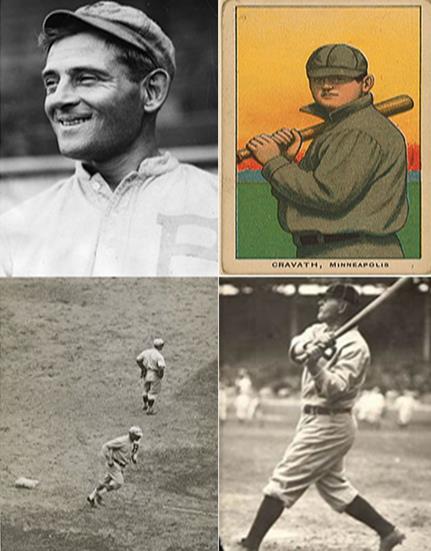
Baseball Trailblazers
Page 1465
Gavvy Cravath
Clifford Carlton "Gavvy" Cravath, March 23, 1881 – May 23, 1963, also nicknamed "Cactus", was a right fielder and right handed batter in major league baseball who played primarily for the Philadelphia Phillies. One of the sport's most prolific power
Baseball Trailblazers Page 1466
hitters of the dead ball era, in the seven years from 1913 to 1920 he led the National League in home runs six times, in runs batted in, total bases and slugging percentage twice each, and in hits, runs and walks once each. He led the NL in several offensive categories in 1915 as the Phillies won the first pennant in the team's 33 year history.
Born in Escondido, California, Cravath was the first baseball player from the San Diego area to play in the major leagues. He began his career during a time of independent minor leagues, when not all good players moved quickly to the majors. He entered professional baseball in 1903 with the Los Angeles Angels of the Pacific Coast League. During 5 seasons with the team, he helped them win two pennants. He batted .274, .270,
.259, .270, and .303, with 7, 13, 9, 6, and 10 home runs, and with 51, 50, 32, 39, and 45 doubles. He led the league in doubles twice - 1906 and 1907, and also finished third twice.
Although he never led the PCL in home runs, he was second in the league three times, third once, and fourth once during his 5
seasons.
At the end of 1907, Cravath's contract was sold to the Boston Red Sox, where he would be a 27 year-old rookie in 1908. His lack of speed was compared unfavorably to Tris Speaker and other swift outfielders of the time. Cravath once said; "They call me
Baseball Trailblazers Page 1467
wooden shoes and piano legs and a few other pet names. I do not claim to be the fastest man in the world, but I can get around the bases with a fair wind and all sails set. And so long as I am busting the old apple on the seam, I am not worrying a great deal about my legs." He was hitting .256 with 11 triples in 277
at bats when his contract was sold to the Chicago White Sox in August 1908. After a slow start in Chicago in 1909, he was traded to the Washington Senators, who moved him to the Minneapolis Millers of the American Association after only four games.
In Minneapolis, Cravath learned to hit to the opposite field to take advantage of the short, 279 foot, right field line at Nicollet Park. That ability would also serve him well with the Phillies, who had a similar short right field porch only 272
feet from home plate at the Baker Bowl. The 1910–11 Millers were one of the greatest minor league teams of all time, and Cravath was their biggest star. In 1910 he led the league in batting average - .326, hits - 200, home runs - 14, doubles - 41, and triples - 13. In 1911 he again led the league in the same categories except for triples, with an average of .363, 221
hits, 53 doubles, 13 triples, and 29 home runs.
The rules of the time did not make it easy for Cravath to move back to the majors. Reportedly, it took a clerical error to get
Baseball Trailblazers Page 1468
Cravath back to the major leagues. In his second chance with the Phillies at age 31 in 1912, he proved he was there to stay by hitting .284 with 11 home runs and 70 RBI. He was also a more than adequate outfielder, sharing the league lead with 26
assists.
In 1913 he enjoyed an even better season, leading the NL in hits
- 179, home runs - 19, RBI - 128, total bases - 298, and slugging - .568, He also placed second in batting with a career high mark of .341. He placed second in the voting for the Chalmers (MVP) Award behind Jake Daubert, though some think Cravath should have won. He repeated as home run champion in 1914, while again sharing the league lead in assists and finishing second in RBI and slugging.
1915 saw his best season as he hit 24 home runs, leading the Phillies to their first pennant. He had a 3 run home run in the pennant clinching game on September 29. He also led the league in runs - 89, RBI - 115, total bases - 266, walks - 86, on base percentage - .393, and slugging - .510, and led the NL in assists for the third time. His 24 home runs were the most in the major leagues since Buck Freeman hit 25 for the 1899
Washington Senators. In the low scoring 1915 World Series against the Red Sox he hit only .125, 2 for 16, though he drove in the winning run on a ground out in Game 1, the only Phillies
Baseball Trailblazers Page 1469
victory. He scored Philadelphia's only runs in Games 2 and 4, both 2–1 losses, and Boston won in five games, outscoring the Phillies 12–10. In Game 5, after the first three Phillie batters reached base, manager Pat Moran gave Cravath the bunt sign on a 3–2 count for unknown reasons. The slugger rolled the next pitch to the pitcher, resulting in a double play.
Regarded as one of the sport's pioneer sluggers of the 20th century, Cravath went on to become the first player to win more than five home run titles. Although his level of play declined gradually after 1915, he again won the home run title in 1917
and 1918. In 1919, at age 38, he had his last outstanding season, winning his sixth home run title with 12 homers in just 214 at bats while hitting .341. In last place midway through the season, the Phillies fired manager Jack Coombs, and Cravath took his place. After he was invited to return as player-manager in 1920, the Phillies improved to 62–91, but ended up in last place again. Cravath was criticized for his easygoing style and was released, ending his major league career. He became player-manager for the Salt Lake City Bees of the Pacific Coast League in 1921. He played his final professional games in 1922 with the Minneapolis Millers.
Cravath had a major league career .287 batting average with 119
home runs; then the fourth most in baseball history. Cravath
Baseball Trailblazers Page 1470
returned to California, where he went into real estate and was elected magistrate judge in September 1927 in Laguna Beach, California. He died there at age 82.
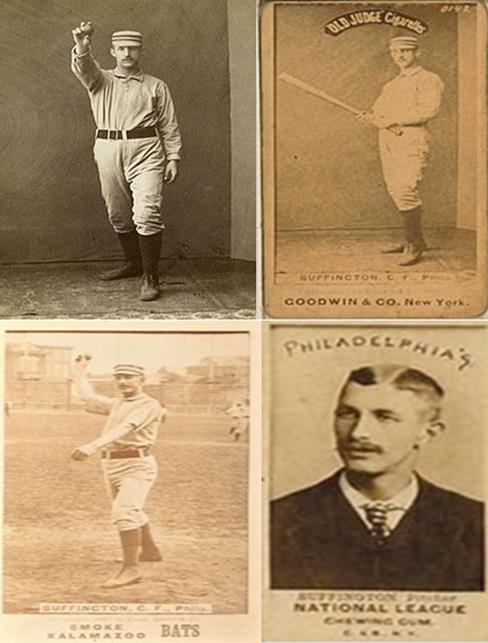
Baseball Trailblazers
Page 1471
Charlie Buffington
Charles "Charlie" G. Buffington, June 14, 1861 – September 23, 1907, was a right handed pitcher in major league baseball from 1882 to 1892. One of the workhorse pitchers of the 1880s, he won
Baseball Trailblazers Page 1472
20 games seven times and his 1,700 career strikeouts are the ninth highest total of the 19th century.
Born in Fall River, Massachusetts, Buffington, mainly known for his brilliant sinker ball began his career with the Boston Red Stockings/Beaneaters. He played in the days of 2 or 3 man pitching staffs and was a big part of many of his teams'
successes. From 1883 to 1885 he was one of Boston's two principal pitchers along with Jim Whitney. Together they picked up 62 of Boston's 63 wins in 1883 when the Beaneaters took the pennant. Buffinton's best season came right after that, when he went 48–16 with a 2.15 ERA in 67 starts in 1884. During that season, he struck out 17 batters in one game, won 13 straight games, and ended the year with 417 strikeouts.
After a poor 1886 season which saw him drop to 7–10 in more limited play due to arm trouble, his contract was sold to the Philadelphia Quakers in 1887. He pitched two one hitters in a row for the team at one point and became the mainstay of their staff during his three years there, winning over 20 games in each. He jumped to the Philadelphia Athletics of the Players'
League in 1890, posting a 19–15 record and managing the team for most of the year, before shifting to the American Association's Boston Reds in 1891. In Boston, he enjoyed a 29–9 year for the league champions, his last 20 win campaign. After a 4–8 record
Baseball Trailblazers Page 1473
with the Baltimore Orioles in 1892, he retired rather than accept a midseason pay cut and went into business as an investor in coal and cotton.
In an 11 year career, Buffington had a record of 233–152 with a 2.96 ERA in 414 games, 396 starts. He pitched 351 complete games, including 30 shutouts, struck out 1,700 and allowed 1,120
earned runs in 3,404 innings pitched. At the time of his retirement he ranked between seventh and tenth in virtually every career pitching category. During his career, he also played as an outfielder for 137 games, and batted .245 for his career. On an individual season basis regarding wins, he was in the top 5 four times, top 10 eight times. In earned run average, he was top 5 three times, top 10 four times. And in strikeouts Buffington was top 5 six times, top 10 seven times.
Buffington died in Fall River, Massachusetts, at the age of 46
from heart disease.
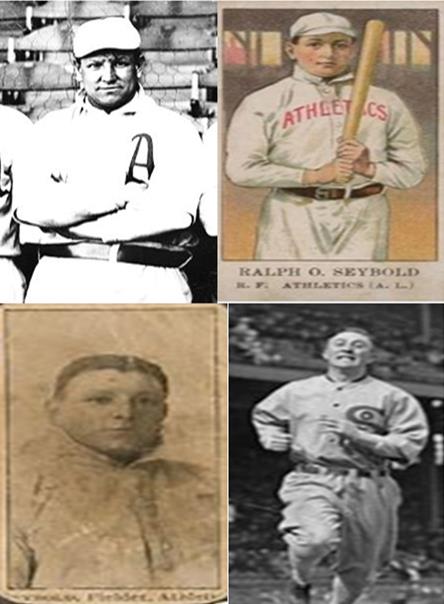
Baseball Trailblazers
Page 1474
Socks Seybold
Ralph Orlando "Socks" Seybold, November 23, 1870 – December 22, 1921, was an outfielder in major league baseball. He played over parts of nine seasons with the Cincinnati Reds and Philadelphia
Baseball Trailblazers Page 1475
Athletics. Known as a power hitter, Seybold set the American League record for home runs in 1902, which would not be broken until 1919. He stood at 5 ft. 11 in. and weighed 200 lbs.
Seybold was born in Washingtonville, Ohio. He started his professional baseball career in 1892, and over the next few years he played in the Pennsylvania State League and Atlantic League. In 1896, he had a breakout season, hitting .352 at Lancaster, and in 1897, he led the team to the pennant by slugging a league leading 14 home runs. Seybold led the Atlantic League in homers again in 1898 and was leading in 1899 when he was purchased by the Cincinnati Reds.
Seybold made his major league debut on August 20. He did not hit well in Cincinnati, and returned to the minors in 1900. He led the American League in home runs, with 9. Seybold then got his second shot in the majors in 1901, with the Philadelphia Athletics, and this time, he stuck. That season, he hit .334 and had a 27 game hitting streak in July and August.
In 1902, Seybold batted .316 and set career highs in home runs with 16, and runs batted in with 97. The home run total led the league and stood as the AL record until Babe Ruth broke it in 1919. The Athletics also won the pennant. In 1903, Seybold's batting average dipped below .300. However, his on base plus
Baseball Trailblazers Page 1476
slugging stayed at exactly 138, and he ripped a league leading 45 doubles. Seybold continued his solid hitting from 1904 to 1907. In 1905, he played in his only World Series, which the Athletics lost to the New York Giants He went 2 for 16 at the plate.
In 1908, Seybold tore some ligaments in his leg sliding into home in a pre-season game at New Orleans. He left the team in June 1908 saying; "I feel that I cannot do myself justice. I have decided to quit for the season." He later returned to the team, but struggled the rest of the year, batting just .215. He played his last major league game on October 7, 1908. In December 1908, Philadelphia manager Connie Mack announced that he was releasing Seybold.
In 997 games over nine seasons, Seybold posted a .294 batting average, 1085 for 3685, with 478 runs, 218 doubles, 54 triples, 51 home runs, 556 RBI, 66 stolen bases, 293 bases on balls, a
.353 on-base percentage and a .424 slugging percentage. He finished his career with a .964 fielding percentage.
Seybold then played and coached in several minor league and industrial teams for a few years. In January 1909, he signed a contract to play for the Toledo Mud Hens, but injuries continued to slow Seybold during the 1909 season. From 1910 to 1911, he
Baseball Trailblazers Page 1477
coached industrial teams in Jeannette, Pennsylvania. On April 4, 1912, he signed with the Richmond Rebels of the United States Baseball League. His baseball career ended with the demise of the league in June.
Seybold was married but had no children. His wife, Wilhelmina
"Minnie" Heitz, died in 1917. In his later years, Seybold was employed as a steward of a social club in Jeannette. In 1921, Seybold was driving a car when it overturned at a sharp curve on the Lincoln Highway east of Jeanette. He was killed instantly.
Baseball Trailblazers
Page 1478
Time Out – Baseball Songs and Poems
Baseball Trailblazers Page 1479
“Gee, It's A Wonderful Game”
by Ring Lardner
Who discovered the land
Of the brave and the free?
I don't know, I don't know.
'Twas Christy Columbus
Is what they tell me.
May be so, I don't know.
There's only one Christy
That I know at all
One Christy that I ever saw.
He's the one who discovered
The fade away ball,
And he pitches for Muggsy McGraw
Baseball, baseball
Ain't it a wonderful game?
Old Christy Colum'
Found this country, by gum
But the extras don't carry his name.
If old man Columbus
Had sat in the stand
Had seen Matty pitching that
"Fader" so grand
Baseball Trailblazers Page 1480
He'd have said
Boys, I'm glad I discovered this land.
Gee! it's a wonderful game.
Who lost out in the battle
Of old Waterloo?
I don't know, I don't know.
They say 'twas Na-po-le-on
May be it's true.
May be so, I don't know.
The pink sheets don't print
Mr. Bonaparte's face
No stories about him today,
'Cause he never could hold down
That old second base
Like his name sake,
Big Nap Lay'-oo-way.
Baseball, baseball
Ain't it a dandy old game?
The gen'ral of France
Couldn't lead 'em like Chance,
So no wonder his Waterloo came.
If down in his pocket
Napoleon had dug,
Baseball Trailblazers Page 1481
Had paid his five francs
To see Tyrus Cobb slug,
He'd have said, I give up:
I'm a bug, I'm a bug!
Gee! it's a wonderful game
“Take Me out to the Ball Game”
by Jack Norworth
Take me out to the ball game
Take me out with the crowd
Buy me some peanuts and Cracker Jack I don't care if I never get back
Let me root, root, root for the home team If they don't win it's a shame
For it's one, two, three strikes, you're out At the old ball game
“Glory Days”
by Bruce Springsteen
I had a friend was a big baseball player back in high school He could throw that speedball by you Make you look like a fool boy
Baseball Trailblazers Page 1482
Saw him the other night at this roadside bar I was walking in, he was walking out We went back inside sat down had a few drinks But all he kept talking about was
Glory days
well they'll pass you by
Glory days
in the wink of a young girl's eye
Glory days, glory days
“All the Way”
by Eddie Vedder
Don’t let anyone say that it’s just a game.
For I’ve seen other teams and it’s never the same When you’re born in Chicago, you’re blessed and you’re healed First time you walk into Wrigley Field Our heroes wear pinstripes; heroes in blue They give us the chance to feel like heroes too Whether we’ll win, and if we should lose We know someday we’ll go all the way Yeah! Someday we’ll go all the way
“Tessie”
Baseball Trailblazers Page 1483
by Dropkick Murphys
Tessie, Nuff Ced McGreevy shouted
We're not here to mess around Boston you know we love you madly
Hear the crowd roar to your sound
Don't blame us if we ever doubt you
You know we couldn't live without you Boston, you are the only, only, only Don't blame us if we ever doubt you
You know we couldn't live without you Red Sox, you are the only, only, only
“Cheap Seats”
by Alabama
This town ain't big
this town ain't small
It's a little of both they say
Our ball club may be minor league
but at least it's Triple-A
We sit below the Marlboro man
Above the right field wall
We do the wave all by ourself
Hey ump, a blind man could've made that call
Baseball Trailblazers Page 1484
“Joltin' Joe DiMaggio”
by the Les Brown Orchestra
He started baseball's famous streak
That's got us all aglow
He's just a man and not a freak
Joltin' Joe DiMaggio
Joe, Joe DiMaggio
We want you on our side
“Subway”
by Jim Nuzzo
I'm gettin' on a subway tonight
I'm headin' to the stadium, that's right The city's gonna rock tonight as we make history Can't you smell the hot dogs, taste the beer Take me back in time to yesteryear
I wouldn't trade this ticket for the world oh not today I'm gettin' on the subway
“Catfish”
Baseball Trailblazers Page 1485
by Bob Dylan
Lazy stadium night
Catfish on the mound
“Strike three,” the umpire said
Batter have to go back and sit down
Catfish, million-dollar-man
Nobody can throw the ball like Catfish can Used to work on Mr. Finley’s farm
But the old man wouldn’t pay
So he packed his glove and took his arm An’ one day he just ran away
“Casey at the Bat”
Ernest Lawrence Thayer
The outlook wasn't brilliant for the Mudville nine that day: The score stood four to two, with but one inning more to play, And then when Cooney died at first, and Barrows did the same, A pall-like silence fell upon the patrons of the game.
A straggling few got up to go in deep despair. The rest Clung to the hope which springs eternal in the human breast; They thought, "If only Casey could but get a whack at that—
We'd put up even money now, with Casey at the bat."
But Flynn preceded Casey, as did also Jimmy Blake,
Baseball Trailblazers Page 1486
And the former was a hoodoo, while the latter was a cake; So upon that stricken multitude grim melancholy sat, For there seemed but little chance of Casey getting to the bat.
But Flynn let drive a single, to the wonderment of all, And Blake, the much despisèd, tore the cover off the ball; And when the dust had lifted, and men saw what had occurred, There was Jimmy safe at second and Flynn a-hugging third.
Then from five thousand throats and more there rose a lusty yell;
It rumbled through the valley, it rattled in the dell; It pounded on the mountain and recoiled upon the flat, For Casey, mighty Casey, was advancing to the bat.
There was ease in Casey's manner as he stepped into his place; There was pride in Casey's bearing and a smile lit Casey's face.
And when, responding to the cheers, he lightly doffed his hat, No stranger in the crowd could doubt 'twas Casey at the bat.
Ten thousand eyes were on him as he rubbed his hands with dirt; Five thousand tongues applauded when he wiped them on his shirt; Then while the writhing pitcher ground the ball into his hip, Defiance flashed in Casey's eye, a sneer curled Casey's lip.
And now the leather-covered sphere came hurtling through the air,
And Casey stood a-watching it in haughty grandeur there.
Close by the sturdy batsman the ball unheeded sped—
"That ain't my style," said Casey. "Strike one!" the umpire said.
Baseball Trailblazers Page 1487
From the benches, black with people, there went up a muffled roar,
Like the beating of the storm-waves on a stern and distant shore;
"Kill him! Kill the umpire!" shouted someone on the stand; And it's likely they'd have killed him had not Casey raised his hand.
With a smile of Christian charity great Casey's visage shone; He stilled the rising tumult; he bade the game go on; He signaled to the pitcher, and once more the dun sphere flew; But Casey still ignored it and the umpire said, "Strike two!"
"Fraud!" cried the maddened thousands, and echo answered
"Fraud!"
But one scornful look from Casey and the audience was awed.
They saw his face grow stern and cold, they saw his muscles strain,
And they knew that Casey wouldn't let that ball go by again.
The sneer is gone from Casey's lip, his teeth are clenched in hate,
He pounds with cruel violence his bat upon the plate; And now the pitcher holds the ball, and now he lets it go, And now the air is shattered by the force of Casey's blow.
Oh, somewhere in this favoured land the sun is shining bright, The band is playing somewhere, and somewhere hearts are light; And somewhere men are laughing, and somewhere children shout, But there is no joy in Mudville; mighty Casey has struck out.
“Baseball’s Sad Lexicon”
Baseball Trailblazers Page 1488
by Franklin Pierce Adams
These are the saddest of possible words:
“Tinker to Evers to Chance.”
Trio of bear cubs, and fleeter than birds, Tinker and Evers and Chance.
Ruthlessly pricking our gonfalon bubble, Making a Giant hit into a double—
Words that are heavy with nothing but trouble:
“Tinker to Evers to Chance.”
Line-Up For Yesterday
by Ogden Nash
A is for Alex
The great Alexander;
More Goose eggs he pitched
Than a popular gander.
B is for Bresnahan
Back of the plate;
The Cubs were his love,
and McGraw his hate.
C is for Cobb,
Baseball Trailblazers Page 1489
Who grew spikes and not corn,
And made all the basemen
Wish they weren't born.
D is for Dean,
The grammatical Diz,
When they asked, Who's the tops?
Said correctly, I is.
E is for Evers,
His jaw in advance;
Never afraid
To Tinker with Chance.
F is for Fordham
And Frankie and Frisch;
I wish he were back
With the Giants, I wish.
G is for Gehrig,
The Pride of the Stadium;
His record pure gold,
His courage, pure radium.
H is for Hornsby;
Baseball Trailblazers Page 1490
When pitching to Rog,
The pitcher would pitch,
Then the pitcher would dodge.
I is for Me,
Not a hard-hitting man,
But an outstanding all-time
Incurable fan.
J is for Johnson
The Big Train in his prime
Was so fast he could throw
Three strikes at a time.
K is for Keeler,
As fresh as green paint,
The fastest and mostest
To hit where they ain't.
L is for Lajoie
Whom Clevelanders love,
Napoleon himself,
With glue in his glove.
M is for Matty,
Baseball Trailblazers Page 1491
Who carried a charm
In the form of an extra
brain in his arm.
N is for Newsom,
Bobo's favorite kin.
You ask how he's here,
He talked himself in.
O is for Ott
Of the restless right foot.
When he leaned on the pellet,
The pellet stayed put.
P is for Plank,
The arm of the A's;
When he tangled with Matty
Games lasted for days.
Q is for Don Quixote
Cornelius Mack;
Neither Yankees nor years
Can halt his attack.
R is for Ruth.
Baseball Trailblazers Page 1492
To tell you the truth,
There's just no more to be said,
Just R is for Ruth.
S is for Speaker,
Swift center-field tender,
When the ball saw him coming,
It yelled, "I surrender."
T is for Terry
The Giant from Memphis
Whose .400 average
You can't overemphis.
U would be 'Ubell
if Carl were a cockney;
We say Hubbell and Baseball
Like Football and Rockne.
V is for Vance
The Dodger's very own Dazzy;
None of his rivals
Could throw as fast as he.
W is for Wagner,
Baseball Trailblazers Page 1493
The bowlegged beauty;
Short was closed to all traffic
With Honus on duty.
X is the first
of two x's in Foxx
Who was right behind Ruth
with his powerful soxx.
Y is for Young
The magnificent Cy;
People battled against him,
But I never knew why.
Z is for Zenith
The summit of fame.
These men are up there.
These men are the game.
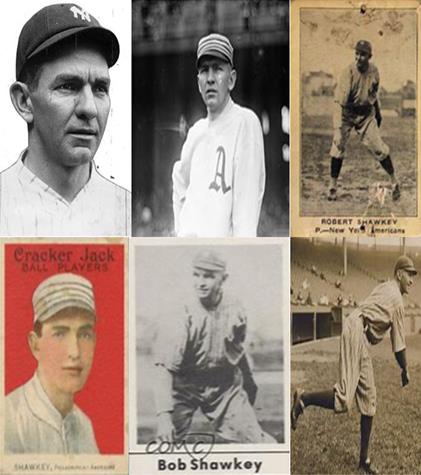
Baseball Trailblazers
Page 1494
Bob Shawkey
James Robert Shawkey, December 4, 1890 – December 31, 1980, was a pitcher who played fifteen seasons in major league baseball.
He played for the Philadelphia Athletics and New York Yankees from 1913 to 1927. He batted and threw right handed and served primarily as a starting pitcher.
Baseball Trailblazers Page 1495
“Bob” Shawkey was born to John William Shawkey, descended from German immigrants named Schaake, and Sarah Catherine Anthony, in Sigel, Pennsylvania. He moved from Slippery Rock State College to an independent league in 1911, then to the American League in 1912 as a pitcher for Connie Mack's Philadelphia Athletics. In 1915, Mack sold him to the New York Yankees where he remained, except for a brief service with the US Navy during World War I when he served on the battleship Arkansas for eight months, until 1931. While facing his former team in 1919, he struck out 15 A's batters in a game, setting the Yankees team record for most strikeouts in a game. This team record lasted for fifty-nine years.
At the start of the 1923 season, Shawkey was chosen to be the Yankees' opening day starting pitcher. This also meant that he was the first player to pitch at the newly built Yankee Stadium.
The Yankees won 4–1 behind Babe Ruth's three run home run, with Shawkey pitching a complete game to become the first winning pitcher at the stadium.
Shawkey won 195 games in his career, and won 20 or more games in five different seasons, with a high of 26. His success was credited to a super fastball and an outstanding curve ball.
Shawkey was a two time World Series champion - 1923, 1927, and the AL ERA leader in 1920.
Baseball Trailblazers Page 1496
He died at age 90 in Syracuse, New York, on New Year's Eve 1980.
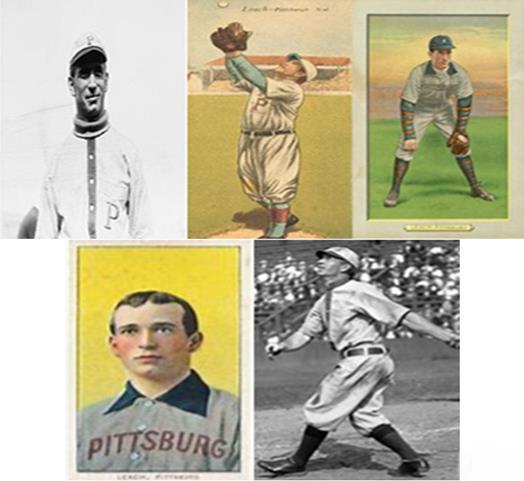
Baseball Trailblazers
Page 1497
Tommy Leach
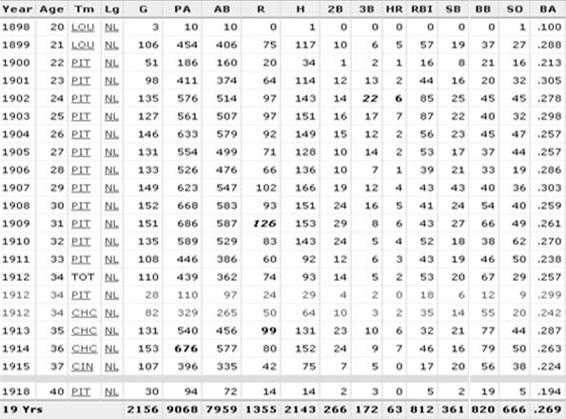
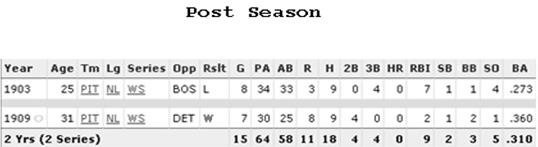
Baseball Trailblazers
Page 1498
Thomas Andrew Leach, November 4, 1877 – September 29, 1969, was a professional baseball outfielder and third baseman. Born in French Creek, New York, he played in major league baseball from
Baseball Trailblazers Page 1499
1898 through 1918 for the Louisville Colonels, Pittsburgh Pirates, Chicago Cubs and Cincinnati Reds.
Leach led the National League in home runs in 1902 with six, and played in the first modern World Series in 1903 with the Pirates, hitting four triples to set a record that still stands.
He played alongside legendary ballplayers such as Honus Wagner and Mordecai Brown. Leach began his career primarily as an infielder including playing shortstop, second base and, mostly, third base. Later, to take advantage of his speed, Leach played mostly outfield.
Leach was well known for his small stature and was nicknamed
"Wee Tommy." During Leach's years in Pittsburgh as a regular and playing with stars such as Honus Wagner, the Pirates won the National League pennant four times and were World Series champions once. Among the swiftest runners of his era, Leach had 361 stolen bases, 1,355 runs scored, and 172 triples.
Following two years of infighting, and a subsequent peace pact signed by the presidents of the National and American leagues, Barney Dreyfuss, owner of the Pirates, saw an opportunity to bring fans back to the game and so proposed a "World Series"
between the top teams in the two leagues, Boston and Pittsburgh.
Baseball Trailblazers Page 1500
With stars Wagner, Leach and player–manager Fred Clarke, Pittsburgh appeared the more formidable of the two, and jumped to a three to one series lead. Leach had the first World Series hit, a triple off Cy Young, and scored the first World Series run in game one with Wagner batting him in. Leach finished the game with two singles and two triples as the Pirates won, seven to three. In game four, Leach again starred, getting two hits, including a two run triple and knocking in three runs, with the Pirates winning a close game five to four.
Pittsburgh, at this point, had a seemingly insurmountable three games to one lead, but would not win again, losing the series to Boston five games to three. Despite the loss, Pittsburgh owner Barney Dreyfuss could feel his vision of a World Series had been a success, since the public had come out in large numbers to watch the games with over 100,000 paying spectators. The games had been hard fought, with the players on both teams giving it their all, and the Pirates had proven to be a mighty foe, with stars such as Leach proving their worth on the field. Leach led both teams in RBIs in the series with seven and finished second on the Pirates in batting average for the series.
After his playing career was over Leach managed in the minor leagues. He was signed as an infield coach for the minor league Atlanta Crackers in 1929, and did some scouting for the Boston
Baseball Trailblazers Page 1501
Braves. He was considered for a few managerial positions, including manager of the New York Yankees as well as the Chicago entry of the Federal League. He finished with a lifetime batting average of .269, 2,143 hits, 63 home runs, all inside-the-park, and 812 runs batted in.
Leach eventually retired in Florida where he went into the citrus business. He died September 29, 1969, at age 91, in Haines City, Florida.
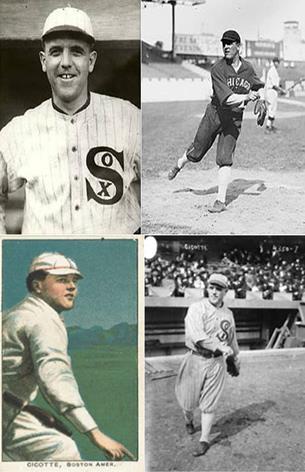
Baseball Trailblazers
Page 1502
Eddie Cicotte
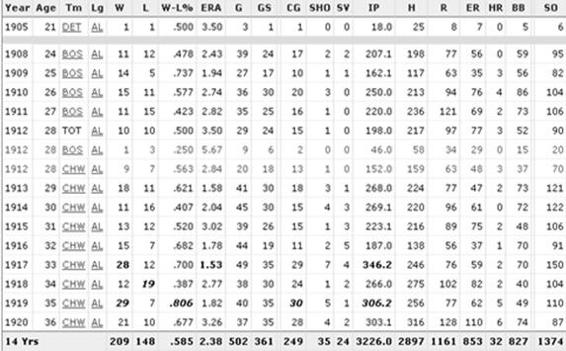
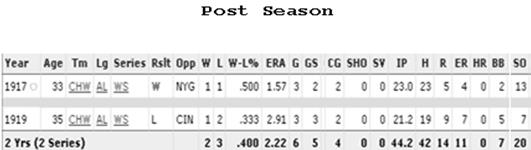
Baseball Trailblazers
Page 1503
Edward Victor Cicotte, June 19, 1884 – May 5, 1969, nicknamed
"Knuckles," was a right handed pitcher in major league baseball best known for his time with the Chicago White Sox. He was one of eight players declared permanently ineligible for professional baseball for his alleged participation in the Black Sox scandal in the 1919 World Series, in which the favored White
Baseball Trailblazers Page 1504
Sox lost to the Cincinnati Reds in eight games. The "fixing" of the 1919 World Series is the only recognized gambling scandal to tarnish a World Series.
Cicotte was born in Springwells, Michigan, the son of Ambrose Cicotte, 1843–1894, and Archange Mary Drouillard, 1843–1909, both of mainly French-Canadian extraction. His father's early death is said to have pushed Cicotte to excel and be very protective of his family. He married Rose Ellen Freer, 1885–
1958, daughter of Russell John Freer, 1852–1932, and Annie Cecile Thornton, 1863–1928, both of whom would later live with the Cicottes. They had two daughters, Rose and Virginia, and one son, Edward Jr.
Cicotte was a starting pitcher and a knuckleball specialist who won 208 games and lost 149 over the course of a 14 year career pitching for the Detroit Tigers, Boston Red Sox, and Chicago White Sox. At the time of his lifetime ban, he was considered one of the premier pitchers in the American League.
A Detroit native, Cicotte played minor league baseball for the Augusta Tourists in Georgia in 1905, where he was a teammate of Ty Cobb. Both players were purchased by the Tigers, and Cicotte made his big league debut on September 3, 1905. Pitching in
Baseball Trailblazers Page 1505
three games for Detroit, Cicotte compiled a 1–1 record with a 3.50 earned run average.
Cicotte didn't return to the major leagues again until 1908, when he resurfaced with the Red Sox. After he compiled a 41–48
record in a Boston uniform, the Red Sox sold him to the White Sox on July 22, 1912.
Cicotte celebrated a breakout year in 1913, going 18–12 on the season with an ERA of 1.58. He led the league in winning percentage in 1916, but his best year was 1917, when he won 28
games and led the league in wins, ERA, and innings pitched. On April 14 he pitched a no hitter against the St. Louis Browns.
That year, the White Sox went to the World Series, defeating the New York Giants 4 games to 2. Cicotte won Game 1, lost Game 3, and pitched six innings of relief in Game 5 for a no decision.
Injuries reduced Cicotte to a 12–19 record in 1918, but in 1919, he rebounded to win 29 games and once again led the league in wins, winning percentage, and innings pitched, as well as in complete games. His 1919 salary was $6,000, but he had a provision for a $10,000 bonus if he won 30 games. Legend has it that as the season drew to a close, owner Charles Comiskey ordered manager Kid Gleason to bench Cicotte for 5 games, denying him a chance at a 30 win season and the bonus money.
Baseball Trailblazers Page 1506
In the 1919 World Series against the Reds, Cicotte pitched in three games, winning one but pitching ineffectively and losing the other two. Cicotte was the first of the eight players to come forward, signing a confession and a waiver of immunity. He later recanted this confession and was acquitted of all charges at trial by jury. Despite this, Cicotte and his alleged co-conspirators were subsequently made permanently ineligible for baseball by Kenesaw Mountain Landis, Major League Baseball's new commissioner, recently hired to restore the integrity of the game in the wake of the 1919 scandal.
After being banned from playing baseball, Cicotte returned to Livonia, Michigan. He managed a service station, served as a game warden in the Michigan Department of Natural Resources, then went to work for Ford Motor Company, where he retired in 1944. Cicotte lived to be 84 years old. He was a strawberry farmer on a 5.5-acre farm near Farmington until his death at Henry Ford Hospital in Detroit on May 5, 1969.
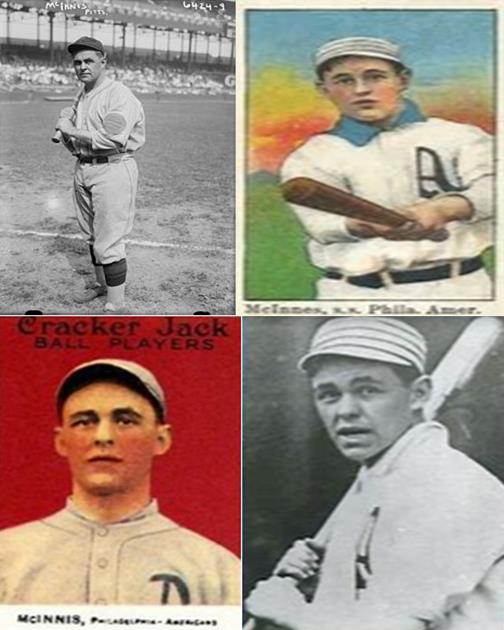
Baseball Trailblazers
Page 1507
Stuffy McInnis
John Phalen "Stuffy" McInnis. September 19, 1890 – February 16, 1960, was a first baseman and manager in major league baseball.
Baseball Trailblazers Page 1508
McInnis gained his nickname as a youngster in the Boston suburban leagues, where his spectacular playing brought shouts of "that's the stuff, kid."
A native of Gloucester, Massachusetts, McInnis broke into baseball with the Philadelphia Athletics as a shortstop in 1909.
Two seasons later, he replaced Harry Davis at first base as a member of the famous $100,000 infield, teaming up with second baseman Eddie Collins, third baseman Frank Baker and shortstop Jack Barry.
The Athletics were in their prime, winning the American League pennant in 1910, 1911, 1913 and 1914, and back to back World Championships in 1910 and 1911. But after they were swept by the Boston Braves in the 1914 World Series, owner Connie Mack asked waivers on three starting pitchers and began to dismantle his team in light of the attempted raids on his stars by the new Federal League. The $100,000 infield was broken up after Collins was sold to the White Sox, Baker went to the Yankees, and Barry was sent to the Red Sox. Only McInnis stayed, and he was traded to the Red Sox at the end of the 1917 season.
McInnis was part of the Red Sox in the 1918 World Series. He drove in the only run of Babe Ruth's 1-0 pitching victory over the Chicago Cubs in Game 1 of the Series.
Baseball Trailblazers Page 1509
He joined Cleveland for one season in 1922 before going to the National League in 1923. He played with the Braves and Pirates, and also managed the Phillies in 1927, his last year in the majors.
A good contact line drive hitter, McInnis batted over .300
during 12 of his 19 seasons, and in each year from 1910 to 1915.
His most productive season came in 1912, when he hit .327, though he batted .368 in 59 games for the Pirates championship team in 1925. Extremely hard to strike out, he fanned only 189
times in 7,822 at bats and amassed 2,405 hits. In 1921, he struck out only 9 times in 584 at bats.
McInnis also excelled in moving runners ahead with sacrifice hits. His career total of 384 sacrifice hits is third best in major league history. He batted and threw right handed. In a 19
season career, McInnis posted a .307 batting average with 20
home runs and 1,063 RBI in 2,128 games.
McInnis also was an especially solid defensive player. For decades, he held major league fielding records for first basemen over one season. In 1921, he played in 152 games with the Red Sox and committed only one error in 1,651 chances for a .9993
mark, and his 1,300 errorless chances, also represented a season mark. Between May 31, 1921, and June 2, 1922, McInnis set a
Baseball Trailblazers Page 1510
third record with 1,700 chances without an error over the course of 163 games. He finished with an overall .991 fielding percentage in the majors.
Following his retirement as a player, McInnis coached the Norwich University baseball team from 1931 until 1944 and the Harvard baseball team from 1949-1954. He died in Ipswich, Massachusetts, at age 69.
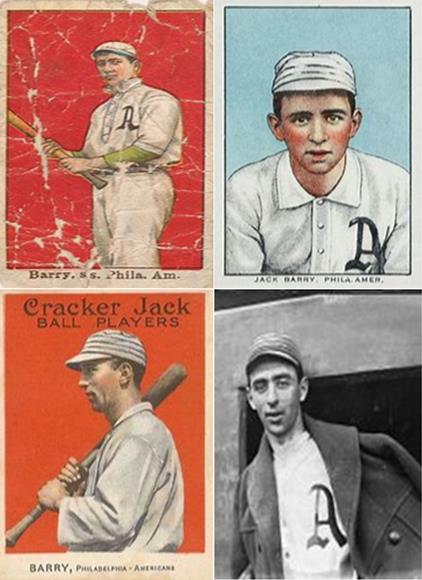
Baseball Trailblazers
Page 1511
Jack Barry
John Joseph "Jack" Barry, April 26, 1887 – April 23, 1961, was a shortstop, second baseman, and manager in major league baseball, and later a college baseball coach. From 1908 through 1919, Barry played for the Philadelphia Athletics and Boston Red Sox.
Baseball Trailblazers Page 1512
Born in Meriden, Connecticut, Barry spent his nearly entire tenure in the big leagues on winning teams, first the Philadelphia Athletics and later the Boston Red Sox. Athletics manager Connie Mack signed Barry off the campus of the College of the Holy Cross to play shortstop on what would become his famous $100,000 infield. The unit, one of the most famous groups of teammates in baseball history, also included first baseman Stuffy McInnis, second baseman Eddie Collins, and third baseman Frank Baker. The group was critical to the Athletics winning the American League pennant in 1910, 1911, 1913 and 1914, and World Championships in 1910, 1911, and 1913.
In 1915, the year after the Boston Braves swept the Athletics in the World Series, Red Sox owner Joe Lannin paid $8,000 for Barry's services, as Mack was dismantling the team. Upon joining the Red Sox, he hit .262 and played reliable defense at shortstop, proving to be the last piece of the puzzle in what was to be another pennant winning team. He played in the World Series in 1915 and 1916 for the Red Sox. Acknowledged as the team's on field leader, he became a player-manager in 1917, leading the team to a 90 win season and a second place finish to the Chicago White Sox. In the war year of 1917, manager Jack Barry chose to enlist and on October 18, 1917 Jack and four other Red Sox players, who had enlisted as yeomen in the naval
Baseball Trailblazers Page 1513
reserve, were called to active duty and ordered to report for duty on November 3, 1917. He served all of 1918 in the military.
After poor play in 1919, he decided to retire rather than be sold away in another fire sale following Harry Frazee's decision to sell his shortstop back to the Athletics.
In an 11 season career, Barry posted a .243 batting average with 10 home runs and 429 RBI in 1223 games. He was a six time American League pennant winner - 1910, 1911, 1913, 1914, 1915, and 1916, and a five time World Series champion - 1910, 1911, 1913, 1915, and 1916. Barry became head baseball coach at Holy Cross in 1921, and continued in that position for 40 years until his death in Shrewsbury, Massachusetts at age 73. During his tenure, he posted the highest career winning percentage - .806, in collegiate history, and won the 1952 College World Series.
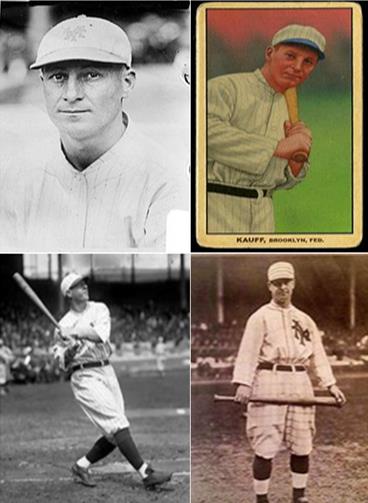
Baseball Trailblazers
Page 1514
Benny Kauff
Bennie Michael "Benny" Kauff, January 5, 1890 – November 17, 1961, originally of Pomeroy, Ohio, was a professional major league baseball player, who played centerfield and batted and threw left handed.
Baseball Trailblazers Page 1515
Kauff played his first game in the majors with the New York Highlanders on April 20, 1912. He played only five games with the Highlanders, playing the rest of the year in the minors.
After spending the 1913 season in the minors, he appeared with the Indianapolis Hoosiers of the short lived third major league, the Federal League. Indianapolis rode his league leading bat to the first league crown in 1914, but traded him to the Brooklyn Tip-Tops before the 1915 season. The Tip-Tops, unable to capitalize on Kauff's hitting, finished seventh in the Federal League's second, and last, season.
Kauff was called "Ty Cobb of the Feds" for his dominant hitting during both years of the Federal League's existence. In 1914, he led the league in batting average - .370, on base percentage -
.447, runs - 120, hits - 211, total bases - 305, doubles – 44, and stolen bases - 75, while finishing 2nd in slugging percentage - .534, and 3rd in RBIs – 95, and walks - 72.
He followed with an almost equally impressive season in 1915.
That year he led the Federal League in batting average - .342, on base percentage - .446, slugging percentage - .509, and steals – 55, while finishing 2nd in walks - 85, 3rd in home runs
– 12, and 4th in RBIs - 83, runs – 92, and hits – 165.
Baseball Trailblazers Page 1516
When the Federal League folded after just two seasons, the National League New York Giants purchased his contract from Brooklyn for $35,000. Kauff was a Giant from 1916 to 1920, winning the pennant in 1917, but never regained his Federal League hitting prowess.
But, in his first year as a Giant, he was 2nd in the NL in stolen bases – 40, and triples - 16, 4th in RBIs - 74, home runs
– 9, and walks - 68, and 9th in slugging percentage - .408.
His best season in the National League was 1917, when he was 3rd in runs – 89, and stolen bases - 30, 4th in batting average -
.308, 5th in on base percentage - .479, 6th in hits - 172, and 7th in RBIs – 68, and walks – 59. That year the Giants made it to the World Series, but lost to the Chicago White Sox 4–2, in Chicago's last World Series victory until 2005. Kauff's two homer game was the only one achieved by a National League player in the World Series until 1948. His best Series performance was in Game 4, with two home runs and three RBI in the Giants' 5–0
victory.
His 1918 campaign was shortened by service in World War I.
In 1919, he led the NL in extra base hits – 44, and was 2nd in home runs - 10, 4th in RBIs – 67, and doubles - 27, 5th in runs
– 73, and 7th in slugging percentage - .422.
Baseball Trailblazers Page 1517
In December of that year, however, Kauff and his brother were implicated in a car theft. According to the criminal complaint, Kauff and two of his employees, James Shields and James Whalen, sold a car to Ignatz Engel after stealing it and giving it a new paint job. Kauff adamantly denied the charges, claiming he didn't know the car was stolen. Specifically, he claimed that Shields and Whalen had given him what turned out to be a false bill of sale, thus leading him to believe the car had been acquired legally. After only 55 games in 1920, the Giants traded him to Toronto of the International League.
Kauff was slated to return to the Giants in 1921, but Baseball Commissioner Judge Kenesaw Mountain Landis suspended Kauff until his auto theft case was resolved. The case finally went to trial on May 10, 1921. Kauff argued that he had not only been deceived by his employees, but also presented evidence that showed he had been eating dinner with his wife at the time the car was stolen.
The jury acquitted Kauff on May 13 after deliberating for less than an hour.
Nonetheless, Landis refused to reinstate him. In a letter to Kauff, Landis said that even though he was acquitted, the trial revealed serious questions about his character and reputation that would raise questions about baseball's integrity if he were ever allowed to play again. He also told baseball writer Fred
Baseball Trailblazers Page 1518
Lieb that he personally believed Kauff was guilty, and claimed his acquittal "smelled to high heaven" and was "one of the worst miscarriages of justice that ever came under my observation.”
According to Kauff's attorney, Emil Fuchs, who would go on to own the Boston Braves, was another factor in Landis' refusal to reinstate Kauff as Kauff tried to compensate Engel for the purchase price of the car after finding out it was stolen; something which Kauff had done on Fuchs' advice. Kauff appealed his banishment in court on the basis of his acquittal, but to no avail. On January 17, 1922, he lost his appeal to a higher court. In his ruling, Justice E. G. Whitaker did agree that "an apparent injustice has been done the plaintiff.” – Kauff.
In 859 games over eight seasons, Kauff posted a .311 batting average, 961 for 3094, with 521 runs, 169 doubles, 57 triples, 49 home runs, 455 RBI, 234 stolen bases, 367 bases on balls, a
.389 on-base percentage and a .450 slugging percentage.
Even though banned from playing, he served as a baseball scout for 22 years before becoming a clothing salesman for John R.
Lyman Co. He died on November 17, 1961, in Columbus, Ohio.
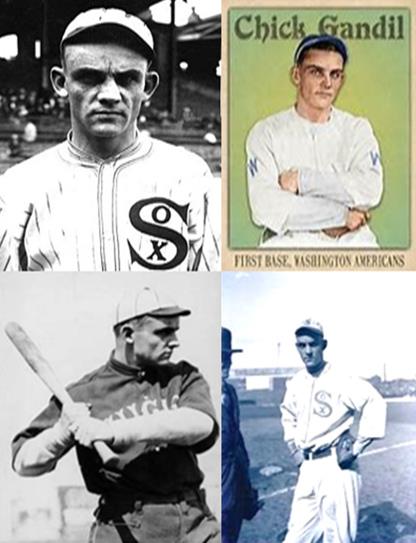
Baseball Trailblazers
Page 1519
Chick Gandil
Charles Arnold "Chick" Gandil, January 19, 1888 – December 13, 1970, was a professional major league baseball player. He played for the Washington Senators, Cleveland Indians, and Chicago White Sox of the American League from 1910-1919. He is best known as the ringleader of the players involved in the 1919
Baseball Trailblazers Page 1520
Black Sox scandal. Described by his contemporaries as a
"professional malcontent," he was physically well-built at 6 ft.
2 in. and 195 pounds, and had a mean and callous expression. He used both to display his toughness, and also did not hesitate to use sheer strength to get his point across.
He was born in St. Paul, Minnesota, to Swiss immigrants Louise Bechel and Christian Gandil. He was their only child. The Gandil family migrated west to Seattle, King County, Washington. After 1900, the Gandils moved to California, settling in Berkeley. The young Gandil soon showed an interest in playing baseball. He joined the Oakland High School baseball team in 1902 and played all positions except first base.
After two years at Oakland High School, Gandil left home to make it on his own. He took a train to Amarillo, Texas, and played catcher in the local semi-pro baseball league for the Amarillo team. In 1907, he migrated to Humboldt, Arizona, and worked as a boilermaker in the copper mines. He played catcher for the semipro team that was sponsored by the local smelting company. The Humboldt baseball club experienced financial problems in 1906, and Gandil moved on to a team in Cananea, Mexico, 40 mi from the United States. "I caught on with an outlaw team in Cananea, Mexico, just across the Arizona border. Cananea was a wide open mining town in those days, which suited me fine. I was a wild,
Baseball Trailblazers Page 1521
rough kid. I did a little heavyweight fighting at $150 a fight.
I also worked part time as a boilermaker in the copper mines."
It was with the Cananea, Mexico, team that Gandil became a first baseman.
Gandil entered professional baseball in 1908. He spent the season with Shreveport in the Texas League and batted .269. That same year, he met 17 year old Laurel Fay Kelly, a Mississippi native, and they were soon married.
After the 1908 season, Gandil was drafted by the St. Louis Browns. Failing to make the club in the spring of 1909, the Browns ordered him back to Shreveport. Gandil refused to report, though. He headed back west with his new bride and joined the Fresno team in the outlaw California State League. For this offense, Gandil faced blacklisting by organized baseball. He reconsidered his decision and joined Sacramento of the Pacific Coast League for the remainder of 1909 season. He was arrested, however, for having stolen $225 from the Fresno team coffers.
Gandil was successful in Sacramento. He batted .282, and late in the 1909 season, was sold to the Chicago White Sox. He was not required to report to Chicago until the following season.
Gandil made his major league debut on April 14, 1910, with the White Sox, which was a disaster. He appeared in just 77 games
Baseball Trailblazers Page 1522
and batted just .193. It was reported that he had trouble hitting the curveball. He was sold to Montreal in 1911 and spent the season in the Eastern League. He had a solid season, batting
.304, and several major league clubs wanted to draft him. The rules at the time stated that only one player could be drafted from each team, so Gandil returned to Montreal to begin the 1912
season. He hit over .300 in the first 29 games and was sold to the Washington Senators. He was now better prepared to play major league baseball, and in 117 games, he batted .305 and was the American League leader for first basemen in fielding percentage.
From 1912 to 1915, Gandil led the Senators in runs batted in three times and batted .293. In the field, he paced American League first basemen in fielding percentage four times and assists three times. Gandil remained with the Senators through the 1915 season and played the 1916 season for the Cleveland Indians.
Early on in his major league career, Gandil was considered a top notch first baseman, both for his play on the field and his solid work ethic. In 1916, a Cleveland newspaper described Gandil as "a most likeable player, and one of excellent habits."
During Gandil's first season with the Senators he met bookie and
Baseball Trailblazers Page 1523
gambler, Joseph "Sport" Sullivan. Sullivan later became a key figure in conspiring with Gandil to fix the 1919 World Series.
On February 25, 1917, he was reacquired by the White Sox for $3,500. That season, Chicago defeated the New York Giants in the World Series. It was later revealed that Gandil and his teammate, Charles "Swede" Risberg, had allegedly collected $45
from each member of the White Sox and paid off the Detroit Tigers in two crucial doubleheaders late in the season. When Tigers pitcher Bill James agreed that his team would go easy, the Tigers lost all four games, allowing the White Sox to win the American League pennant. This incident was officially investigated by Commissioner Landis in 1927, but due to contradictions, no action was taken.
Gandil claims that Sullivan approached him with the idea to fix the 1919 World Series. “I had only social contacts with gamblers until that September day in 1919 when Sullivan walked up to Eddie Cicotte and me as we left our hotel in Boston. As I recall, we were four games in front the final week of the season, and it looked pretty certain that the pennant was ours.
I was kind of surprised when Sullivan suggested that we get a
‘syndicate’ together of seven or eight players to throw the Series to Cincinnati. As I say, I never figured the guy as a fixer but just one who played for the percentages. The idea of
Baseball Trailblazers Page 1524
taking seven or eight people in on the plot scared me. I said to Sullivan it wouldn’t work. He answered, 'Don’t be silly. It's been pulled before and it can be again.' He had a persuasive manner which he backed up with a lot of cash. He said he was willing to pay $10,000 each to all the players we brought in on the deal. Considering our skimpy salaries, $10,000 was quite a chunk, and he knew it."
Sullivan assured Gandil that the fix was on, and that $100,000
in total would be paid to the players. In addition to serving as the contact for the gamblers, Gandil was responsible for recruiting and paying the players involved in the fix. Gandil received $35,000 for his role in throwing the World Series; nearly nine times his 1919 salary of $4,000.
In the spring of 1920, Gandil demanded that the White Sox raise his salary to $6,500 per year. Owner Charles Comiskey would not meet his demand, and Gandil decided to remain in California, in effect retiring from the majors. According to Gandil; "Instead, I played semipro ball twice a week for the Elks Club in Bakersfield, Calif. I earned $75 a game." He was far from Chicago as investigations into the 1919 World Series began during the fall of 1920.
Baseball Trailblazers Page 1525
Gandil and his seven White Sox teammates were indicted, and he came back to Chicago in July 1921 to stand trial for fixing the series. The jury found the eight players not guilty. Following the players' acquittal, Gandil said, "I guess that'll learn Ban Johnson he can't frame an honest bunch of ball players."
However, the players' joy was short lived. Gandil and the others were permanently banned from organized baseball by new commissioner Kenesaw Mountain Landis.
In 1147 games over nine seasons, Gandil posted a .277 batting average, 1176 for 4245, with 449 runs, 173 doubles, 78 triples, 11 home runs, 556 RBI, 151 stolen bases, 273 bases on balls,
.327 on base percentage and .362 slugging percentage. He finished his career with a .992 fielding percentage as a first baseman. In the 1917 and 1919 World Series, he batted .245, 13
for 53, with 10 RBI and 2 stolen bases.
After 1921, he continued to play semi-pro ball on the west coast. He contacted Joe Gedeon, Swede Risberg, Joe Jackson and Fred McMullin and attempted to put together a team in Southern California. In 1925, he played with Hal Chase and other banished players in the Frontier League in Douglas, Arizona. While presiding over the Douglas team in 1927, he reportedly had team manager Buck Weaver banned from the league. It was believed that Gandil did this because he had felt betrayed by his former White
Baseball Trailblazers Page 1526
Sox teammate's lack of support during the 1921 investigation of the 1917 White Sox/Tigers situation. He ended his playing career with semi-pro clubs in the copper mining towns of Bayard and Hurley, New Mexico.
After he ended his baseball career, Gandil settled in his childhood residence, Berkeley, California, with Laurel and his daughter Idella. His primary occupation was as a plumber. His mother and father still lived in Berkeley. His father Christian died in 1941 and his mother Louise in 1952. There is no official record of contact between them. He remained in the area until he retired to Calistoga in 1954 and spent the last part of his life in the Napa Valley region of Northern California. Gandil died at age 82 on December 13, 1970, in a convalescent hospital. He had been suffering from heart disease and emphysema, and the official cause of death was heart failure.
In 1956, Gandil told his version of the events of the 1919 World Series to sportswriter Melvin Durslag. Durslag's account of Gandil's story was published in the September 17, 1956 edition of Sports Illustrated. In the story, Gandil admitted to leading the plot to throw the Series and expressed guilt and remorse over having done so. However, he claimed that after an initial payment was made, the players actually abandoned the plan and had ultimately tried their best to win. According to Gandil's
Baseball Trailblazers Page 1527
story, the rumors which had spread about the Series being fixed, triggered by a sudden influx of money being bet on the Reds, caused the players to conclude that they could never get away with throwing the Series, as their every move would be closely scrutinized. Instead, they decided to betray the gamblers and keep the cash. While he believed that Landis' decision to ban them all was draconian, he felt they deserved to be banned just for talking to the gamblers.
In his account, Gandil suggested that the players were under intense pressure from both observers suspicious of their every move and the gamblers expecting them to go along with the plan.
He said this may have contributed to their making poor plays despite their decision to abandon the fix. However, he was firm in his insistence that all of the players were trying their best throughout all eight games of the Series. Gandil also said that the original deal called for the conspirators to play the first game straight, since a White Sox win would drive the price up further. The White Sox were shelled in that game 9-1. Gandil further claimed in his story that he never received his share of any of the money paid by the gamblers, and that he had no idea what happened to that money. He said; “I never did get any part of Rothstein's $10,000 and I don't know who did. Since Rothstein probably won his bets anyway, he never gave us any trouble.
Baseball Trailblazers Page 1528
Naturally, I would have liked to have had my share of that ten grand, but with all the excitement at the Series' end and with Comiskey's investigation, I was frankly frightened stiff.
Besides, I had the crazy notion that my not touching any of that money would exonerate me from my guilt in the conspiracy. I give you my solemn word I don't know to this day what happened to the cash. During the next two months, after returning to my winter home in Los Angeles, I heard some wild reports about the killing I made on the World Series. One account said I was flashing around a bankbook with a $25,000 entry. Another said I had been paid off in diamonds. And still another had me plunking down cash for a house. The truth was, I did buy a house with $2,500 I had borrowed from the bank for down payment. The loan was repaid when I finally got my World Series check from the White Sox."
In an interview with Dwight Chapin, published in the Los Angeles Times on August 14, 1969, Gandil again denied that he threw the Series stating, "I'm going to my grave with a clear conscience."
You may also like...
-
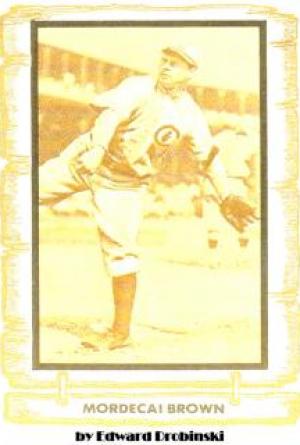
Mordecai Brown Biography by Edward DrobinskiMordecai Brown
Reads:
10Pages:
199Published:
Feb 2026Mordecai Brown was perhaps the best baseball pitcher of all time. He was certainly the most overlooked. He was the most integral and overworked part of the 19...
Formats: PDF, Epub, Kindle, TXT
-
Damn Yankees Biography by Edward DrobinskiDamn Yankees
Reads:
24Pages:
402Published:
Jun 2025What baseball team won the most consecutive pennants and World Series championships? Please tell me why they are excluded from the “expert’s” all-time-greates...
Formats: PDF, Epub, Kindle, TXT
-
Vanished: The Disappearance of Jack O'Sullivan Biography by Dylan HunterVanished: The Disappearance of Jack O'Sullivan
Reads:
28Pages:
20Published:
Mar 2025On March 1, 2024, Jack O’Sullivan vanished without a trace. A bright law student with a promising future, his disappearance in Bristol sent shockwaves through...
Formats: PDF, Epub, Kindle, TXT
-
Huey Long Biography by Edward DrobinskiHuey Long
Reads:
51Pages:
333Published:
Feb 2025A brilliant, young Louisianan matures during the Great Depression, and is compelled to champion the people of Louisiana first, and then the entire US. The sub...
Formats: PDF, Epub, Kindle, TXT