

Baseball Trailblazers by Edward Drobinski - HTML preview
Download the book in PDF, ePub, Kindle for a complete version.
6.
In 1907 he batted .320, behind Ty Cobb and Sam Crawford. He was second in the AL in on base percentage at .387 and hits with 191, behind Ty Cobb. In 1908, he was third in the American League in home runs with 5. He played his last game in 1910.
Apparently regarding the baseball business as a business like any another, after his great initial success, Stone held out for $5,000 to start the 1907 campaign. In order to make sure that team owner Robert Hedges met his demands, Stone did not report to the team until right before the start of the season. The holdout, as one publication put it, “seems to have been the turning point of his career.” On one level, “the papers aired the case and naturally by some Stone was censured for what was termed unreasonable demands.” Moreover, “when he was finally granted the amount he asked, the fans figured that a player
Baseball Trailblazers Page 1364
getting such big money should never fail to deliver the goods.
Any time Stone failed, and unfortunately for him he had a rather tough year in 1908, he was roasted to a turn by the fans. Stone began to show signs of slowing up that year.”
Stone’s statistics fell off in both 1907 and 1908, though he was still an outstanding hitter. One account indicates that he contracted malaria in 1908, and Stone’s production plummeted in 1909 when he suffered an injury to his ankle. That injury cost Stone his speed, which had enabled him to beat out many infield hits. He also had problems with his arm, and “any time a ball was hit into his territory the opposing base runners advanced almost at will. The worry over all these things caused Stone’s batting to suffer and as a result the sensation of the American League of 1906 was a near joke in 1910.” Stone never hit higher than .300 after 1907, and his average fell to .256 in 1910, his last season in the major leagues. Stone returned to the Milwaukee Brewers in 1911, batting .282, but injuries led him to retire from professional baseball just 12 games into the 1912
campaign. He wrote to manager Duffy “that he has retired from the game for good and will spend all of his future time attending to his business in Nebraska.”
Baseball Trailblazers Page 1365
In a seven season major league career, Stone posted a .301
batting average, 984 for 3271, with 23 home runs and 268 RBIs in 848 games played.
Stone entered the banking industry in Coleridge, Nebraska, and owned a Western League team in Lincoln, Nebraska in 1916. In 1940, he and his wife Pearl moved to Clinton, Iowa. Stone died of a heart attack in Clinton at the age of 68.
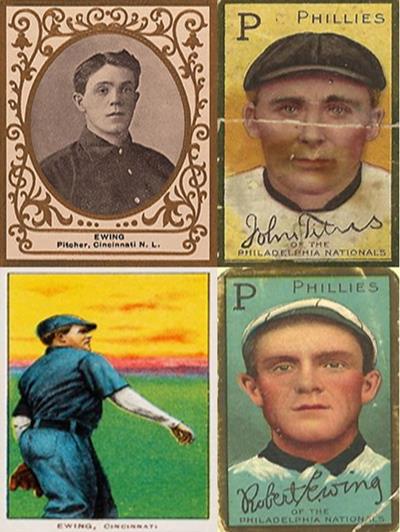
Baseball Trailblazers
Page 1366
Bob Ewing
George Lemuel Ewing, April 24, 1873 – June 20, 1947, played in the majors from 1902 to 1912 for the Cincinnati Reds, Philadelphia Phillies, and St. Louis Cardinals.
Ewing was born in New Hampshire, Ohio. He grew up on a farm in Auglaize County where as a young boy he pitched potatoes against a target on a barn. The nickname Long Bob came about due to him
Baseball Trailblazers Page 1367
being 6 ft. 6 in. Later he would be given the moniker of “Old Wapak,” in reference to the town he called home.
Bob started his baseball career at a relatively late age - 24.
Long Bob played his first game away from New Hampshire in 1895
at the Wapakoneta fairgrounds. He then played for Wapakoneta from 1896 to 1897.
Ewing's first semi-pro experience was in August 1897, when he joined the Toledo Mud Hens team in the Interstate League. His professional debut was a 9–4 victory over Springfield, Ohio. He was consistently the best pitcher in the league, going 21–9 and 25–13 in consecutive seasons. Over the next three seasons, Ewing pitched nearly 900 innings and won more than 20 games annually for Toledo.
In 1901, he next went to the Kansas City Blues in the Western League where he went 21–5 and led the Western League in winning percentage. With Ewing, the Blues won the pennant by 10 games.
Ewing later recalled that Kansas City was "the only pennant winning team I ever played on."
While at home from Kansas City, Bob played ball with a local club in Sidney, Ohio. On October 10, 1901, the Cincinnati Reds arrived in Sidney after going through local Ohio teams looking to find some competition. As the Reds warmed up, they could not
Baseball Trailblazers Page 1368
have anticipated what they were about to see. The visitors were up to bat first. On the mound stood all 6 feet 6 inches of Long Bob Ewing. Ewing dueled Schwab, his Reds counterpart, to a 3–3
tie when the game was called because of darkness after eight innings. Ewing struck out many more batters than Schwab. Within two weeks he was under contract to the Cincinnati Reds.
Long Bob Ewing made his major league game debut on April 19, 1902. He walked ten batters, seven of them in one inning, in a 9–5 loss to Chicago. It was nearly a month before he gained his first victory. Then he missed the second half of the season with a sore arm.
Bob fought for a place on the roster the next two seasons before establishing himself as one of the Reds' top pitchers. Ewing finished with a 6 and 6 won-lost record. He pitched ten complete games in 12 starts and compiled a fine 2.98 earned run average.
A sore arm limited his playing time toward the end of the 1902
season.
In 1903, Long Bob developed into the workhorse of the staff.
Completing 27 of the 28 games he started, Ewing posted 14 wins and lowered his ERA to 2.73. He delivered at the plate as well.
That season Ewing hit .253.
Baseball Trailblazers Page 1369
The season's highlight came on August 18, 1903. The headline in the "Cincinnati Post" told the story: "Kelley Claims Ewing Pitched a No-Hitter." He blanked the New York Giants 7-0, giving up one infield hit by Jack Dunn in the eighth inning. The official scorer recorded the play as an out, but was ordered to score it as a hit. A dispatch from New York after the game stated; "Long Bob Ewing, fed on raw meat and clams for a week, was taken out of his cage and sent against the Giants. Old Wapak fired the leather down the alley so fast that the haze in its wake looked like the smoke in a shooting gallery." A seasoned and confident Bob Ewing barnstormed with the Reds after the season concluded.
On September 30, 1903, the Cincinnati Reds came to Sidney for a rematch. Long Bob was on the mound for Reds, which had just pummeled Lima 9-1 the day before. After the game, the
"Journal's" editor, William Binkley, wryly observed that the Reds came to town to show what a difference there is between a professional team and pumpkin puller aggregations in smaller towns and to prick what bubbles of vanity they entertain. After Long Bob took his seat at the end of the first inning, Sidney led 5-1. Binkley chortled: "The Reds were amazed, and in a figurative sense, more blue than red."
Baseball Trailblazers Page 1370
The Reds outfielders were "as busy as a cow's tail in fly time,"
according to Binkley, while Sidney's infielders "guarded the infield like watch dogs fed on electricity." In the end, Long Bob and the Reds absorbed a 14-2 beating. Mr. Binkley appropriately summed up the event; "In short, the Reds were outclassed. The spectators were given a treat of rare sport, and the visitors gracefully acknowledged the corn."
The Cincinnati Reds returned to Sidney the next year for what the Wapakoneta newspaper described as "Ewing Day in Sidney."
Fifty wagons circled the court square, and banners proclaiming
“Ewing Day” were hung everywhere. A local baker sold “Ewing pies” and bartenders served “Ewing highballs.” Two thousand fans jammed the ball field. As the first Sidney batter whiffed, the crowd screamed; "Don't throw so hard, you'll kill the catcher!"
Ewing and the Reds prevailed, 6-1.
In professional baseball after the turn of the century, the spitball was a legal pitch and Ewing was known as having one of the best in the majors. By late 1904 Ewing became one of the National League's first notable exponents of the wet one. A newspaper writer of the era described him as also having "great speed and a puzzling drop curve." With that new weapon he enjoyed his best year in 1905, securing his 20th victory in the last game of the season. Long Bob won 20 games in 34 starts with
Baseball Trailblazers Page 1371
only 11 losses during the 1905 season. He still batted over