

Baseball Trailblazers by Edward Drobinski - HTML preview
Download the book in PDF, ePub, Kindle for a complete version.
1928.
1926 was a struggle for Maranville. Having been claimed off waivers by the Brooklyn Robins, he spent the first half of the season with them but was released halfway through the year. The Cardinals signed him that November but assigned him to the Rochester Tribe of the International League in 1927. Maranville realized he would have to make a change in his lifestyle if he wanted to continue playing in the major leagues. "Either I had to lay off the booze and get serious with the game or it would be the end of me."
On May 24, 1927, Maranville resolved to stop drinking. Later that year, Cardinals general manager Branch Rickey stated,
"Walter is a changed man. It is apparent that he has seen the light. His change in attitude is remarkable." Called up by St.
Louis at the end of the year, he played in nine games for them in late September before spending all of 1928 on their roster.
Even at age 41, when Maranville batted .218 in 143 games and hit no homers, he finished in a tie for 12th in the 1933 NL MVP
voting. He missed the entire 1934 season after breaking his left fibula and tibia in a collision at home plate during an
Baseball Trailblazers Page 1286
exhibition game. Maranville attempted a comeback in 1935 but was unable to play like he used to.
Following the end of his major league career, Maranville turned to managing, including stints as a minor league manager for Montreal Royals, at Albany, Elmira, and Springfield, Massachusetts. With Elmira in 1936, he served as a player-manager, batting .323 in 123 games.
He retired having compiled a .258 batting average, 2,605 hits, 1,255 runs, 28 home runs, 884 RBI and 291 stolen bases. As a shortstop, he finished his career with a positional record 5,139
putouts. He won his only World Series championship in 1914 as a member of the Braves, and won his only other National League championship in 1928 as a member of the Cardinals.
Maranville was known as one of "baseball's most famous clowns"
due to his practical jokes and lack of inhibitions. He used to don a pair of glasses to make fun of umpires and mimic the actions of hitters or pitchers who took an especially long time to get ready. Other stunts he pulled included throwing firecrackers, stepping out on hotel ledges, and swallowing goldfish. On a road trip to New York, Maranville had teammate Jack Scott cry "Stop, thief!" as Scott chased him through Times Square. Another time, his concerned teammates broke into his
Baseball Trailblazers Page 1287
hotel room after hearing screams, breaking glass, and gunshots emanating from within, as well as Maranville groaning, "Eddie, you're killing me!" An unharmed Maranville and two friends greeted the players like nothing was wrong as they wandered out of the room. When Maranville was appointed manager of the Chicago Cubs in 1925, one of their worst seasons ever, he continued to demonstrate his wild behavior. His only rule with the team was that none of the players could go to bed before he did. One night he went through a Pullman car dumping water on sleeping players' heads, saying, "No sleeping under Maranville management, especially at night." After 53 games with him as the manager, the Cubs were in last place with a 23–30 record. Not long after that, he was out on the street outside Ebbets Field in Brooklyn mimicking a newsboy hawking papers. He cried out,
"Read all about it! Maranville fired!" And so he was, the next day.
After managing in the minor leagues, Maranville was employed by youth baseball programs in Detroit and Rochester. Then, he directed a baseball school sponsored by the New York Journal-American newspaper. He enjoyed working with children and always cautioned them against adopting the same wild lifestyle he had pursued during his earlier career.
Baseball Trailblazers Page 1288
Rabbit Maranville died of a heart attack shortly after midnight on January 6, 1954, at his home in Woodside, New York. Death was nearly instantaneous. He was 62 years old.
Baseball Trailblazers
Page 1289
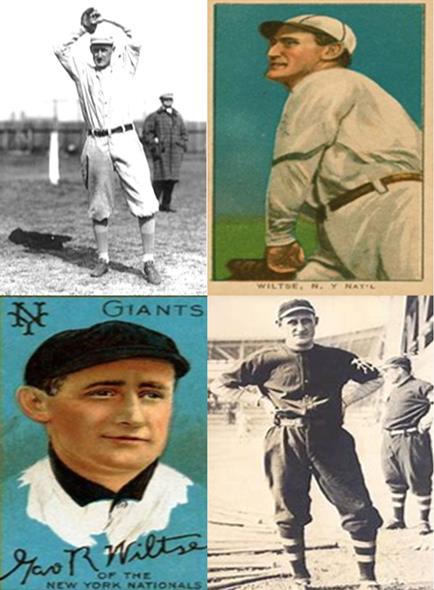
Hooks Wiltse
A native of Hamilton, New York, George Leroy "Hooks" Wiltse, September 7, 1879 – January 21, 1959, played 12 seasons in major league baseball from 1904 to 1915, all for the New York Giants excepting his last year with the Brooklyn Tip-Tops.
Baseball Trailblazers Page 1290
"Hooks" earned his nickname because of his exceptional curveball and was one of the earliest pitchers to have a curveball that was regarded as more effective than his fastball. Wiltse won five pennants with the Giants and pitched in the 1911 World Series.
On July 4, 1908, Wiltse pitched a perfect game through 26
batters until he hit Philadelphia Phillies pitcher George McQuillan on a 2–2 count in a scoreless game, eventually completing the no hitter. Umpire Cy Rigler later admitted that he should have called the previous pitch strike three, which would have ended the inning.
In 1915, he jumped to the Brooklyn Tip-Tops of the Federal League, which is where he ended his major league career with a win–loss record of 139-90, and an earned run average of 2.47. He continued to play minor league baseball on and off until 1926.
His last appearance came with the Reading Keystones, where he played in five games at the age of 46.
Following his retirement from baseball, Hooks returned to his hometown, where he worked in real estate and became involved in local politics, serving as a local alderman and property assessor. Wiltse died of emphysema on January 21, 1959, at age 79 in Long Beach, New York.
Baseball Trailblazers
Page 1291
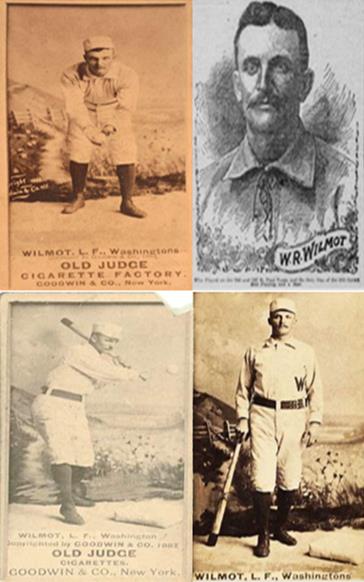
Walt Wilmot
Walter Robert Wilmot, October 18, 1863 – February 1, 1929, was a professional baseball player. He played all or part of 10
seasons in major league baseball with the Washington Nationals -
1888–89, Chicago Colts - 1890-95, and New York Giants - 1897–98,
Baseball Trailblazers Page 1292
primarily as an outfielder. Listed at 5 ft. 9 in. and 165 lb., Wilmot was a switch hitter and threw right handed. He was born in Plover, Wisconsin.
While playing for the Nationals in 1889, Wilmot led the league with 19 triples and 139 games played. The following season, he tied with Oyster Burns and Mike Tiernan for the National League lead in home runs with 13, also a career high. He also set a career best with 76 stolen bases while driving in 99 runs in 1890. On August 22, 1891, he became the first player in major league history to be walked 6 times in 1 game.
Wilmot's most productive season came in 1894, when he posted career highs in batting average - .330, runs scored - 134, hits
- 197, RBI’s - 130, doubles – 45, and extra-base hits - 62 in 133 games.
Overall in his ten season career, Wilmot was a .276 hitter with 58 home runs and 594 RBI in 962 games, including 727 runs, 152
doubles, 92 triples, 381 stolen bases and a .337 on-base percentage.
Wilmot died in Chicago, at the age of 65.
Baseball Trailblazers
Page 1293
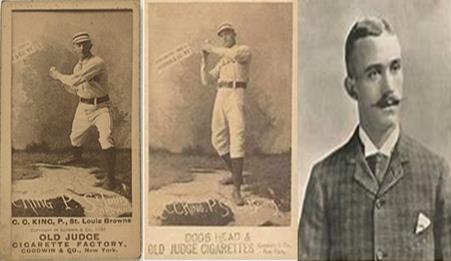
Silver King
Silver King, January 11, 1868 – May 21, 1938, born Charles Frederick Koenig in St. Louis, Missouri, had a ten year career in major league baseball, spent primarily as a pitcher. King played for the Kansas City Cowboys - 1886, St. Louis Browns -
1887–89, Chicago Pirates - 1890, Pittsburgh Pirates - 1891, New York Giants - 1892–93, Cincinnati Reds - 1893, and Washington Senators - 1896–97. The first part of King's nickname was a reference to the color of his hair, while the latter part was a translation of his German surname.
King was an unusual pitcher for his time. Gripping the ball with unusually large hands, he delivered the ball without a windup.
He was also one of the first pitchers in major league history to
Baseball Trailblazers Page 1294
employ a sidearm delivery. The unconventional methods worked, as he went on to pitch 3,190 innings, winning 203 games with 1229
strikeouts and a 3.18 earned run average in 397 games. His strong fastball enabled him to become a notable strikeout artist; he finished among the league's top 10 in that category six times.
King's best season came in 1888, when he led the Browns to their fourth consecutive American Association championship. That year, King led the league with 584 innings pitched in 66 games, 45
wins, and a 1.64 ERA. In 1890, he jumped to Chicago of the Players' League and added another ERA title while winning 30
games. On June 21, 1890, King threw a no hitter for Chicago, the only one in the league's one year history.
After baseball, King returned to his native St. Louis. He died in 1938, at age 70, and was buried at New St. Marcus Cemetery in St. Louis.
Baseball Trailblazers
Page 1295
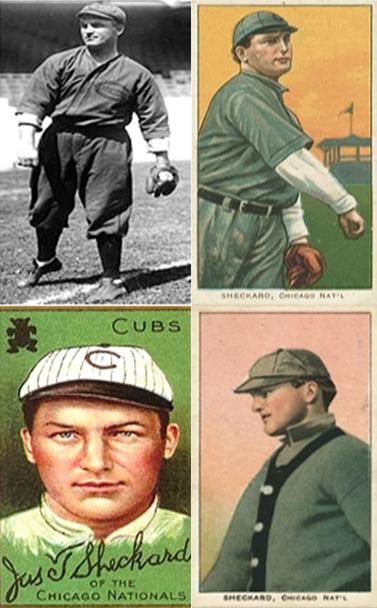
Jimmy Sheckard
Samuel James Tilden Sheckard, November 23, 1878 – January 15, 1947, was a left fielder and left handed leadoff hitter in major league baseball who played for the Brooklyn
Baseball Trailblazers Page 1296
Bridegrooms/Superbas (1897–98, 1900–01, 1902–05), Baltimore Orioles (NL) (1899), Baltimore Orioles (AL) (1902), Chicago Cubs (1906–12), St. Louis Cardinals (1913) and Cincinnati Reds (1913).
Sheckard was born in Chanceford Township, York County, Pennsylvania. He enjoyed a great 1901 season with the Superbas, hitting .353 with 11 home runs and 104 runs batted in, and leading the league with 19 triples and a .534 slugging average.
In that season Sheckard became the first and so far only player to hit inside the park grand slams in two consecutive games.
With Baltimore in 1899, Sheckard led the league with 77 stolen bases. He played in four World Series with the Cubs, winning championships in 1907 and 1908; and he led the league in 1911
with 121 runs and 147 walks; a major league record until broken by Babe Ruth in 1920.
Sheckard was the first man to lead the league in homers and steals in the same season - 1903. Ty Cobb and Chuck Klein are the only other players to do so in the majors.
Sheckard was also an excellent outfielder. He holds the all-time single season major league record for double plays at two separate positions. His 12 double plays as a left fielder in 1911 for the Cubs is 2 more than any other left fielder in
Baseball Trailblazers Page 1297
history. And in 1899, while playing for the Baltimore Orioles, Sheckard played right field and set the record for double plays by a right fielder with 14.
After the 1913 season, Sheckard retired. When the Reds traded Joe Tinker, creating a managerial vacancy, Sheckard warned that Tinker's replacement would have a tough job ahead. "No matter who gets Tinker's place, the new manager will have to get rid of the 'knockers' on that club before he can hope to succeed. There is no chance to win with players who think more of their own records than they do of the success of the club."
In his 17 year career, Sheckard hit .274, with 2,084 hits, 56
home runs, 813 RBI, 1296 runs, 354 doubles, 136 triples, and 465
stolen bases in 2122 games played. He twice led the league in stolen bases, once led the league in home runs, runs, triples, and times on base.
Sheckard died at age 68 in Lancaster, Pennsylvania, from injuries suffered when he was hit by a car while walking to work along a highway.
Baseball Trailblazers
Page 1298
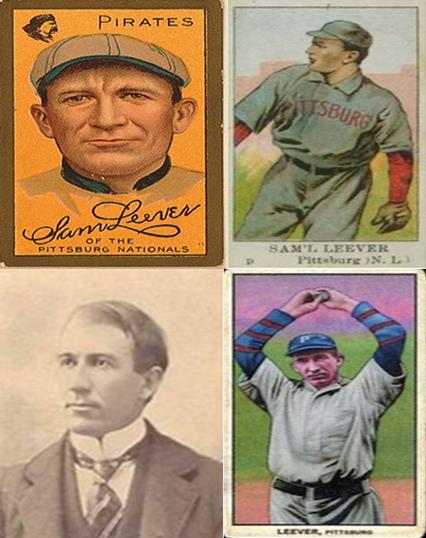
Sam Leever
Samuel Leever, December 23, 1871 – May 19, 1953, nicknamed "The Goshen Schoolmaster," was a right handed pitcher in major league baseball. He spent his entire 1898-1910 career with the Pittsburgh Pirates, a World series champion in 1909, and NL ERA leader in 1903.
Baseball Trailblazers Page 1299
Sam Leever was born in Goshen, Ohio, the fourth child of Edward Leever, a farmer, and Ameredith Andelia (Watson) Leever. He graduated from Goshen High School, and then became a teacher there for several years. Leever's first year in the Major Leagues was 1898 at age 26, making his debut on May 26 against the Washington Senators. That year he pitched in 5 games for the Pirates. However, the following year he led the National League in games pitched with 51 and in innings pitched with 379 as he posted a record of 21–23. In 1901 and 1905 he led the league in winning percentage, 14–5 and 20–5, respectively, as well as in 1903, when he had his best season, going 25–7 with a league leading 2.06 earned run average.
In 1903 Leever also led the Pirates to their third consecutive National League pennant. However he injured his shoulder late in the season and was ineffective in the first World Series, losing both of his starts as the Pirates were defeated by Boston.
Leever later went 8–1 for the 1909 Pirates, when they won their first World Series title. His lifetime ERA was 2.47, and he had a 194–100 record, 847 strikeouts, 39 shutouts, 241 complete games, 587 walks, and only 29 home runs allowed in 2,660
innings.
Baseball Trailblazers Page 1300
Sam Leever married Margaret Leever in 1903 when he was 32 and she was 18. He died in 1953 at age 81 in Batavia, Ohio near his hometown of Goshen.
Baseball Trailblazers
Page 1301
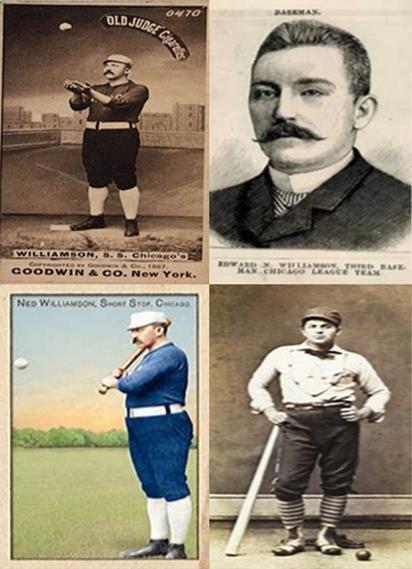
Ned Williamson
Edward Nagle "Ned" Williamson, October 24, 1857 – March 3, 1894, was a shortstop – third baseman in major league baseball. Born in Philadelphia, Williamson began his major league career on May
Baseball Trailblazers Page 1302
1, 1878 for the Indianapolis Blues of the National League. That season he played in all 63 of the team's games as the starting third baseman. His season ending statistics included a .232
batting average, one home run, and 31 runs scored.
The Blues were only a major league team for the 1878 season, resulting in Williamson joining the Chicago White Stockings for the 1879 season. He was their regular third baseman, leading the league in multiple fielding categories for his position, including fielding percentage, assists, putouts, and double plays. That is not as appreciated as it should be in 2022, where the use of large gloves since the 1950’s has made fielding routinely easy. In Williamson’s day, when they were either playing barehanded or with gloves like that of today’s winter wear, it was not unusual for teams to have a ten error game, while today three would signal a bad game. As a hitter, his numbers improved. He finished second in the league with 13
triples, and eighth in doubles with 20, while also raising his batting average to .294. During the next three seasons, his batting statistics fluctuated from year to year. His batting average rose from .251 in 1880 to .282 in 1882; likewise, his 20
doubles in 1880 were good for seventh in the league, but dropped to 12 in 1881. He followed that season with 27 in 1882, which was fourth in the league. During this time period, when his
Baseball Trailblazers Page 1303
level of hitting had dropped, his play in the field did not. He led the league in fielding percentage from 1880 to 1882, and in assists in 1881 and 1882.
In 1883, Williamson set the then major league record for doubles in a single season by hitting 49. On September 6, Chicago scored a record 18 runs in one inning during a 26–6 victory over the Detroit Wolverines. Williamson contributed three hits, and scored three runs in that inning, setting individual records in both categories.
During this time period, the establishment of the ground rules of each park rested with the home team. In 1884, team captain and on-field manager Cap Anson decided that balls hit over the fence were to be home runs. Williamson used these short dimensions and new ground rules to set the single-season home run record by hitting 27 in a 112 game season. This record stood for 35 years until it was broken in 1919 by Babe Ruth, who hit 29 for the Boston Red Sox in a 140 game schedule. The first three of Williamson's 27 home runs came on May 30, in the second game of a doubleheader against the Detroit Wolverines, making Williamson the first major league baseball player to hit three home runs in one game. During these two record breaking seasons, his fielding prowess did not recede. He did not lead the league in fielding percentage in either 1883 or 1884, but did lead in
Baseball Trailblazers Page 1304
assists, capping off a streak of five consecutive years in which he did so, while also leading the league in double plays for the second and third consecutive years.
After the 1884 season, the White Stockings moved to West Side Park, and Williamson's power numbers dropped. Without the short fences, his home run total dropped to three, his doubles went down to 16, and his batting average dropped to .238, his lowest average since he became a White Stocking. Despite his low hitting numbers, he did lead the league in games played with 116, bases on balls with 75, and yet again, led his position in assists, double plays, and for the fifth and last time, fielding percentage. Chicago won the National League championship that season, and agreed to play the American Association champions, the St. Louis Browns in a seven game "World Series." Before game one began, the players of both teams held a field day which included contests of skill, and Williamson won the long throw with a toss that traveled 400 feet, four inches. The 1885 series ended in a tie when each team won three games, and one game ended in a tie. Williamson collected two base hits in 23 at bats, for a .087 batting average, and scored one run.
Beginning in 1886, Williamson switched his fielding position to shortstop, while the Chicago White Stockings again won the National League championship, their fifth in seven years. The
Baseball Trailblazers Page 1305
team's success did not coincide with Williamson's slide in seasonal numbers. His batting average dropped to his career low of .216, and his strikeouts jumped up to a career high of 71, in 430 at bats, although he did finish third in bases on balls. The White Stockings met the St. Louis Browns following the season and agreed to play a best of seven "World Series" for the second consecutive year. The Browns won the series, four games to two, and Williamson's statistics for the series did not improve. In fact, they were worse than in 1885. He gathered one base hit in 18 at bats, for a .056 batting average, and scored two runs.
1887 was Williamson's second season at shortstop, his last full season in the majors, and his numbers began to climb back to what they were during the early part of his career. His batting average jumped back up to .267, and he hit 20 doubles, 14
triples, had 73 bases on balls, and nine home runs. In 1888, his batting average dipped again, this time to .250, but he did finish fourth in the league in both RBIs with 73, and bases on balls with 65. In the field, he led the league in assists and double plays.
At the completion of the 1888 baseball season, Albert Spalding organized an around the world tour to promote the game of baseball. The two teams Spalding selected were the White Stockings and a collection of players from other National League
Baseball Trailblazers Page 1306
teams. The tour departed on October 20, 1888 to play exhibition games throughout the western United States for a month, before departing to Hawaii. The tour visited several foreign countries, such as Australia, Egypt, Ceylon, France, Italy, and England. It was during a game played at the Parc Aristotique in Paris, France on March 8, 1889, when Williamson suffered a torn knee cap which forced him to be bedridden in England on doctor's orders, missing the tour through Britain. Though players in the 19th century were responsible for their own medical care, Williamson asked Spalding to help him financially with the mounting medical costs. Spalding refused, citing that he was not obligated to assist, and Williamson never forgave him for this.
Williamson, among his baseball contemporaries, wrote the most colorful articles to newspapers as the tour was unfolding.
Williamson, an 1880s teammate of Anson in Chicago, had a knack for roasting—poking fun at his teammates while always coming across as good-natured.
The injury to Williamson's knee caused his career to suffer, as he played in only 47 games during the 1889 season. He batted
.237, and of his 41 hits that season, only five of them were extra base hits. He joined the Chicago Pirates of the Players'
League for the 1890 season, his final major league season, and played in 73 games, hitting .195.
Baseball Trailblazers Page 1307
In the spring of 1894, Williamson traveled to Hot Springs, Arkansas, in hopes that he could recover from a liver ailment and lose some weight as well, but the treatments did not work.
Williamson died on March 3 of that year, at the age of 36 in Willow Springs, Arkansas, of dropsy (edema) complicated by consumption (tuberculosis).
From 1883 and 1887, Williamson held the single season record for both doubles and home runs. Although his record for doubles was surpassed in 1887, he held the home run record until 1919, when it was topped by Babe Ruth of the Boston Red Sox. Statistically, he was one of the best fielders of his era. During the first eight years of his career, he led the league at his position in both fielding percentage and double plays five times, and he also led his position in assists six times. Later, when he moved to shortstop, he again led the league in both assists and double plays. His lifetime batting average was .255, with 64 home runs, and 667 runs batted in.
Baseball Trailblazers
Page 1308
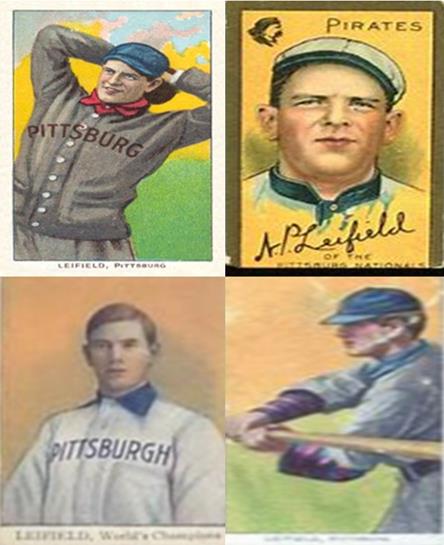
Lefty Leifield
Albert Peter "Lefty" Leifield, September 5, 1883 – October 10, 1970, was a major league baseball pitcher with the Pittsburgh Pirates, Chicago Cubs and the St. Louis Browns between 1905 and 1920. He batted and threw left handed.
Baseball Trailblazers Page 1309
Born in Trenton, Illinois, in 1905, Leifield was the ace of the Western League's Des Moines Underwriters, winning 26 games to help them take the pennant. In September, Pittsburgh Pirates'
owner Barney Dreyfuss purchased his contract for $2,500.
Leifield pitched a shutout in his major league debut.
From 1906 to 1911, Leifield stayed in the Pittsburgh starting rotation, winning 15 or more games each season. In 1909, he went 19-8 to help the Pirates win the National League pennant and World Series. He was traded to the Chicago Cubs in 1912.
On July 4, 1906, in the first game of a doubleheader at Exposition Park, Leifield lost a double one hitter to Mordecai Brown and the Chicago Cubs, 1-0; one of only 5 double one hitters in major league history. Leifield had a no hitter going into the 9th inning but gave up a run on a hit and an error.
Leifield's own single was the only hit for the Pirates. A bit of a recording oddity, he would be the only pitcher in major league baseball history to lose a decision despite throwing at least nine innings with one or fewer hits and no walks allowed, until 2017.
After being released in 1913, Leifield returned home to Trenton, Illinois, and then went to San Francisco, California to pitch in the Pacific Coast League. In 1915, he went to spring training
Baseball Trailblazers Page 1310
with the Pirates but instead played for the St. Paul Saints of the American Association. On August 20, he struck out 15 in a game for the Saints.
In 1918, Leifield returned to the majors as a player-coach for the St. Louis Browns, and then as a full-time coach for the Boston Red Sox and Detroit Tigers. He finished his major league career with 124 wins, 97 losses, and an earned run average of 2.47. Leifield died in Fairfax, Virginia at the age of 87.
Baseball Trailblazers
Page 1311
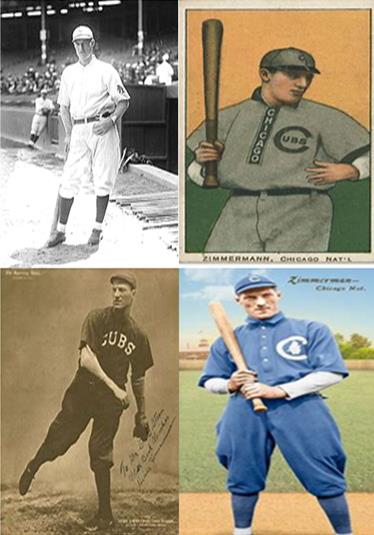
Heinie Zimmerman
Henry Zimmerman, February 9, 1887 – March 14, 1969, known as
"Heinie" or "The Great Zim," was a professional third baseman.
Zimmerman played in major league baseball for the Chicago Cubs and New York Giants from 1907 to 1919. A good hitter, he won the National League Triple Crown in 1912. He was also known for his
Baseball Trailblazers Page 1312
poor performance in the 1917 World Series, and his baseball career ended when he was banned for fixing games.
Zimmerman was born in New York City in 1887. He started his professional baseball career with the New York State League's Wilkes-Barre Barons in 1906. The following season, he was purchased by the Chicago Cubs. He was a part of the Cubs teams that won the World Series in 1907 and 1908, although he received limited playing time. Within the next few years, he became a regular player.
In 1912, Zimmerman won the NL Triple Crown, leading the league with a .372 batting average, 14 home runs, and 104 runs batted in. He also led the league with 207 hits. He never played as well again but remained a productive player.
In 1916, Zimmerman was traded to the New York Giants. He led the NL in RBI that season, with 83. He led the NL in RBI again in 1917, with 100. The Giants then lost the 1917 World Series, and Zimmerman played poorly, batting .120.
Zimmerman became known for an infamous play in the decisive sixth game of the series. In the fourth inning, the game was scoreless when Eddie Collins of the Chicago White Sox was caught between third base and home plate. Catcher Bill Rariden ran up the line to start a rundown, expecting pitcher Rube Benton or
Baseball Trailblazers Page 1313
first baseman Walter Holke to cover the plate. However, neither of them moved, and Collins blew past Rariden to score the series winning run. With no one covering the plate, third baseman Zimmerman was forced to chase Collins, pawing helplessly in the air with the ball in a futile attempt to tag him. Zimmerman was long blamed for losing the game, although Giants manager John McGraw blamed Benton and Holke for failing to cover the plate.
The play was actually quite close, as action photos show Zimmerman leaping over the sliding Collins.
After a lot of public criticism for his World Series performance, Zimmerman had a mediocre season in 1918. In 1919, the Giants acquired Hal Chase, and he and Zimmerman tried to get other players to help them throw games during the season.
Zimmerman's actions got him kicked off the team in September 1919, and he never played in organized baseball again.
Based on testimony by McGraw during the Black Sox Scandal hearings in the early 1920s, Zimmerman and Chase were both indicted for bribery. Zimmerman denied McGraw's accusations, and neither he nor Chase was ever proven to be directly connected to the Black Sox. According to some historians, Zimmerman had been informally banned after the Giants released him.
Baseball Trailblazers Page 1314
Baseball commissioner Kenesaw Mountain Landis later declared that any players who had been involved in throwing games would be banned from baseball, which could have included Zimmerman; however Judge Landis never formally ruled on Zimmerman. But based on Zimmerman's long term pattern of gambling and his role in the Black Sox Scandal, Landis' declaration after the Black Sox trial is seen as formalizing Zimmerman's ban. Regardless, his career was effectively over by the time Landis was appointed.
In 1,456 major league baseball games played, Zimmerman batted
.295, 1566 for 5304, with 695 runs scored, 275 doubles, 105
triples, 58 home runs, 799 RBI, 175 stolen bases, a .331 on-base percentage, and a .419 slugging percentage in 13 seasons. In 12
World Series games, he hit .163, 7 for 43, with 2 RBIs.
Zimmerman died in New York City in 1969.
Baseball Trailblazers
Page 1315
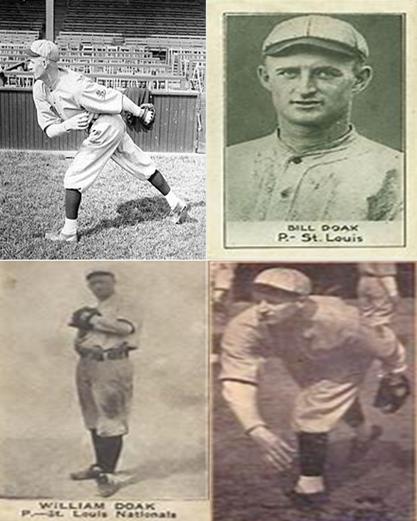
Bill Doak
William Leopold Doak, January 28, 1891 – November 26, 1954, was a major league baseball pitcher who played for three teams between 1912 and 1929, spending portions of 13 seasons with the St. Louis Cardinals. He compiled a lifetime win–loss record of 169–157, and an ERA of 2.98.
Baseball Trailblazers Page 1316
He was nicknamed "Spittin' Bill" because he threw the spitball.
He led the National League in earned run average in 1914 and 1921, and he won 20 games in the 1920 season.
Doak was born in Pittsburgh, Pennsylvania, the son of Bertha Schaltenbrand Doak and William E. Doak, a civil engineer. Both sides of Doak's family came from Germany. He had one sibling, a younger sister. Doak's father pressured him to become a mining engineer, but Doak began playing semipro baseball in 1909. He was in the minor leagues by the next year, and made it to the major leagues by 1912.
The St. Louis Cardinals purchased Doak's contract in the summer of 1913, and he spent the majority of his career with that team.
In 1914 he went 19–6 and led the league with an ERA of 1.72.
Doak won 20 games in 1920, and led the NL in ERA again in 1921
at 2.59. On June 14, 1924, Doak was traded by the Cardinals to the Brooklyn Robins for Leo Dickerman.
He returned to St. Louis for a short time in 1929 before retiring. Even though Doak played with many unremarkable teams, he is among the Cardinals' top 10 in eight pitching categories.
His 32 shutouts rank second behind Bob Gibson.
Doak made a lasting contribution to baseball by innovating the design of the baseball glove. In 1920, he suggested to Rawlings
Baseball Trailblazers Page 1317
that a web should be laced between the first finger and thumb, saying it would create a natural pocket. The “Bill Doak” glove soon replaced all other baseball gloves and is the standard to this day.
Doak retired to Bradenton, Florida, where he owned a candy shop,
“Bill Doak's Sweet Shop,” and also coached the Bradenton High School baseball team, which made it to the state championship.
He died in Bradenton at age 63.
Baseball Trailblazers
Page 1318
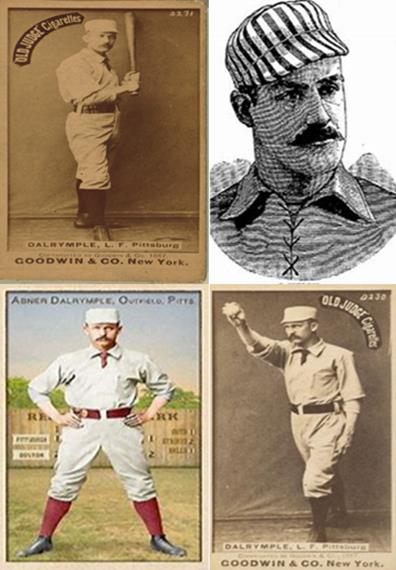
Abner Dalrymple
Abner Frank Dalrymple, September 9, 1857 – January 25, 1939, was a left fielder in major league baseball. Born in Gratiot, Wisconsin, he played for the Milwaukee Grays, White Stockings, Pittsburgh Alleghenys, and Milwaukee Brewers.
Baseball Trailblazers Page 1319
Dalrymple started his major league career in 1878 with the National League's Milwaukee Grays, and that season he had a career high .354 batting average, initially being credited with having led the league, a feat accomplished by few rookies. He spent the next eight seasons with the Chicago White Stockings, for whom he starred as the leadoff hitter on five NL pennant winners. In 1880, Dalrymple led the league in hits – 126, and runs scored - 91. In 1881, he became the first batter known to be given an intentional walk with the bases loaded. He hit four doubles in a game in 1883, which still ties him for the major league record. In 1884 Dalrymple hit a career high 22 home runs.
He hit 11 more in 1885, leading the league for the champion White Stockings. For the remainder of his career, he hit only six home runs. His hitting declined in 1886, and his major league career ended five years later.
He ended with 43 home runs, and batted .288, with 407 RBIs during his 12 season career spent primarily with the Chicago White Stockings. Dalrymple died in Warren, Illinois at age 82.
Baseball Trailblazers
Page 1320
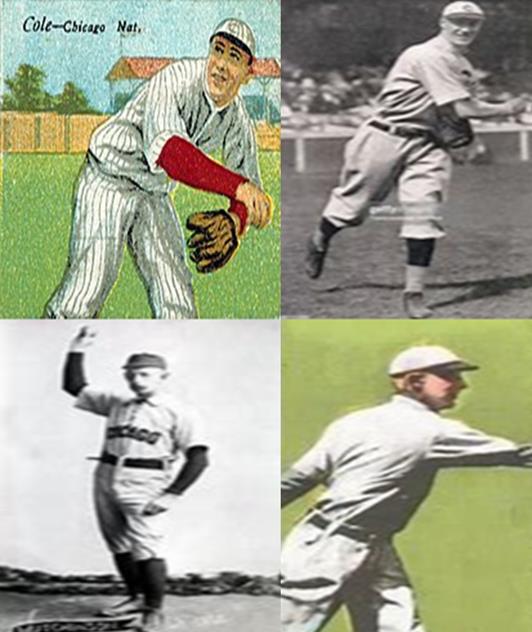
King Cole
Leonard Leslie "King" Cole, April 15, 1886 – January 6, 1916, started his baseball career as a pitcher with the Chicago Cubs
Baseball Trailblazers Page 1321
of major league baseball in 1909. With the 1910 Cubs, Cole had a record of 20–4 and helped the team win the National League pennant. On July 31 of that season, he pitched all seven innings in a 4–0 Cubs win over the St. Louis Cardinals, without giving up a hit.
Cole's 20–4 record in 1910 was the third best single-season winning percentage (.833) for a Cubs pitcher in the 20th century. Cole was traded to the Pittsburgh Pirates in May 1912, did not play in the major leagues in 1913, then played for the New York Yankees in 1914 and 1915. On October 2, 1914, Cole gave up a double to Babe Ruth, then a pitcher for the Boston Red Sox, for Ruth's first hit in the major leagues.
In 1915, Cole was diagnosed with lung cancer. He died in January 1916. He ended up with a major league record of 54–27, an earned run average of 3.12, and was the NL ERA leader of 1910 at 1.80.
Baseball Trailblazers
Page 1322
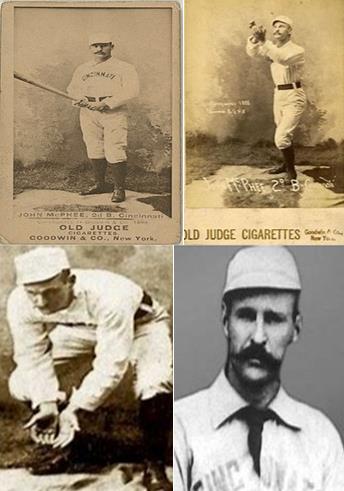
Bid McPhee
John Alexander "Bid" McPhee, November 1, 1859 – January 3, 1943, was a 19th century major league baseball second baseman. He played 18 seasons in the majors, from 1882 until 1899, all for the Cincinnati Reds franchise. Known more for his fielding than
Baseball Trailblazers Page 1323
his hitting, McPhee was the last second baseman to play without a glove.
Born in Massena, New York, McPhee broke into professional baseball in 1877 as a catcher with the Davenport Brown Stockings of the Northwestern League. He played for Davenport for three seasons, shifting to second base during the 1879 season. After not playing baseball in 1880, he joined an independent team in Akron, Ohio in 1881. Before the 1882 season, he signed a contract to play for the Cincinnati Red Stockings, a team in the newly formed American Association.
Making his major league debut on May 2, 1882, the 22 year old McPhee had a batting average of just .228 that year, but he led the league in several fielding categories, including putouts and fielding percentage. With McPhee in the lineup for 78 out of their 80 games, the Red Stockings won the inaugural AA championship. McPhee was the only starting second baseman Cincinnati had for the first 18 seasons of its existence, accompanying the team to the National League in 1890, when they became the Cincinnati Reds. In last two seasons of his career, he was the oldest player in the major leagues.
Over 18 years, McPhee batted a very respectable .272, hit 53
home runs, hit 189 triples, scored 1,684 runs, had 1,072 runs
Baseball Trailblazers Page 1324
batted in, and stole 568 bases. He had ten 100 plus seasons in runs scored and regularly led the league in many defensive categories despite playing without a glove for the first 14
years of his career. Without the benefit of the padding provided by fielding gloves, McPhee toughened his hands by soaking them in salt water.
Shortly after retiring as a player in 1899, McPhee rejoined the Reds as a manager. At the team's helm for 1901 and part of 1902, he posted 79 wins and 124 losses for a .389 winning percentage.
McPhee died January 3rd, 1943 in San Diego, California, at the age of 83.
Baseball Trailblazers
Page 1325
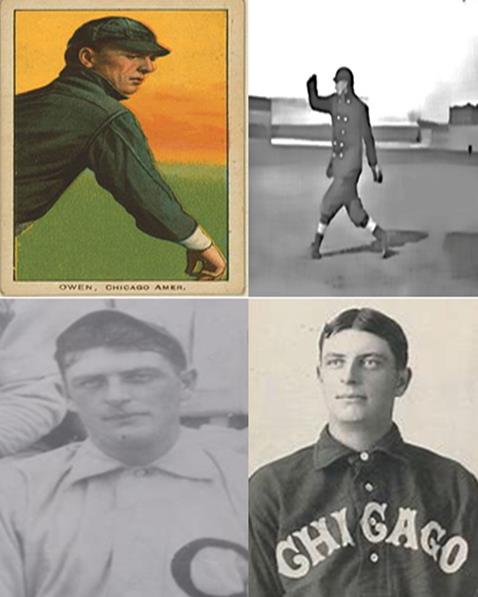
Frank Owen
Frank Malcolm Owen, December 23, 1879 – November 24, 1942, was a pitcher in major league baseball who played eight seasons with the Detroit Tigers and Chicago White Sox. Born in Ypsilanti, Michigan (and nicknamed "Yip" for it), he pitched the final six innings of Game 2 of the 1906 World Series, replacing Doc White.
Baseball Trailblazers Page 1326
He was a World Series champion that year. In 194 career games, Owen had an 82–67 won-loss record with a 2.55 ERA.
Owen was the first American League pitcher to pitch complete game wins in both games of a doubleheader, winning against the St. Louis Browns on July 1, 1905.
Baseball Trailblazers
Page 1327
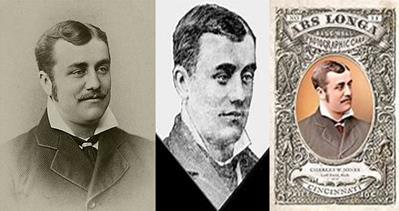
Charley Jones
Charles Wesley Jones, born Benjamin Wesley Rippay, April 30, 1852 – June 6, 1911, was a professional left fielder in the National Association and Major League Baseball. He was born in Alamance County, North Carolina.
Jones played for quite a few teams; the Keokuk Westerns, Hartford Dark Blues, Cincinnati Reds (NL), Chicago White Stockings, Boston Red Caps, Cincinnati Red Stockings (AA), New York Metropolitans, and Kansas City Cowboys. A popular but controversial player, despite his hitting ability he never played for a league champion.
Baseball Trailblazers Page 1328
On June 10, 1880, Jones became the first big leaguer to hit two homers in the same inning. Both home runs came off Buffalo Bisons' pitcher Tom Poorman in the eighth inning of a 19–3 rout.
Jones best period was from 1883 to 1885, when he hit 22 home runs, had 186 RBI, and batted .310. Through the first nine seasons of the major leagues' existence, Jones held the career record for home runs, despite missing two of those seasons, 1881
and 1882 as a result of being blackballed from the sport. In 1887, he dropped to fourth place. By 1889, he was tenth, and by 1890 he was no longer among the top ten.
After the 1880 season he was suspended by the Boston Red Caps and blacklisted for refusing to play. He countered that he had not been paid and sued for his salary. He even had the local sheriff attach Boston's share of the gate at Cleveland on May 14, 1881. A jury sided with the club. The team had him blacklisted for 1881 and 1882. On December 7, 1881 at the National League annual meeting the owners rejected the applications of Jones and Phil Baker for reinstatement.
Subsequently he played for an outlaw team in Portsmouth, Ohio.
He signed with the Cincinnati Red Stockings of the new American Association in 1882 when the AA said they would ignore the NL's blacklist. They honored it that year, though, and Jones remained
Baseball Trailblazers Page 1329
with Portsmouth, even as he had helped put together the Cincinnati team that would win the 1882 AA pennant. The NL and AA came to an agreement in 1883 under the pressure of Opie Caylor, a founder who had departed for sports journalism. Jones played with Cincinnati again from 1883-1887. In 1883, Charley blasted 10 home runs, but by that time the single season home run record had been upped to 14. On July 20, 1884, he became the third man to hit three triples in one game in a 17-4 rout of the Indianapolis Blues. He never played for a league champion.
Jones finished his twelve year major league career with a batting average of .298, and home runs and runs batted in totaling 56 and 553, respectively. He was the NL home run and RBI leader in 1879.
In 1885 Jones' common-law wife found him with another woman and threw cayenne pepper in his face. A year later he married Louisa Horton, who had been involved in a famous divorce a year earlier. After his playing career concluded, Jones spent two seasons as an umpire. He umpired 121 games in the Players'
League in 1890, and 76 games in the American Association in 1891.
Even his death was controversial. After ending his baseball career at age 41, the last piece of information that was known
Baseball Trailblazers Page 1330
about him was that a benefit was held in his honor on Staten Island, NY on August 31, 1909, after he had fallen ill. However, there was no obituary for him, and given his very common first and last names, retracing his death details proved to be like looking for a needle in a haystack. At one point it was determined that he was either dead or 150 years old. A Cincinnati Enquirer was found, which stated that Jones had died at Bellevue Hospital in New York City in July of 1911. That lead allowed the narrowing of the search in the New York City death index, which uncovered a listing for a Charles W. Jones, who died on June 6th of that year. The death certificate in the city archive had names for Charles' parents matching those in earlier census records, confirming that this person was the ballplayer.
Baseball Trailblazers
Page 1331
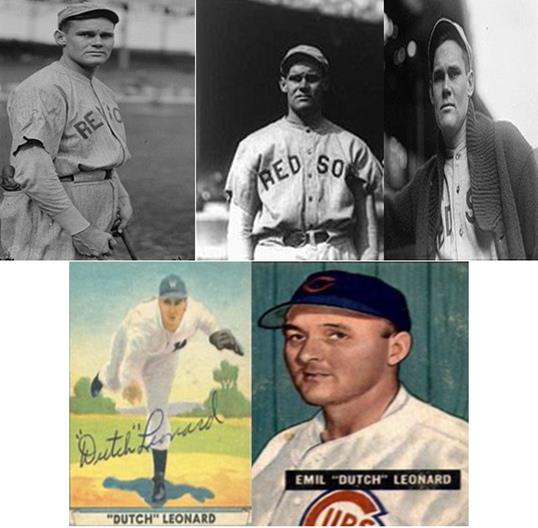
Dutch Leonard
Baseball Trailblazers
Page 1332
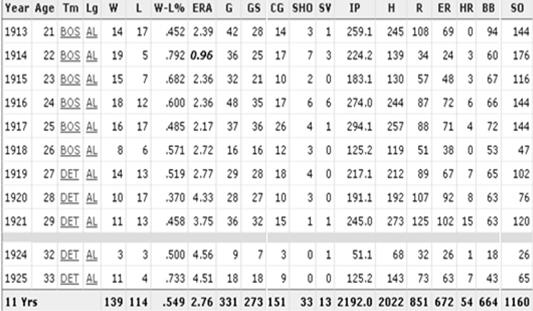
Hubert Benjamin "Dutch" Leonard, April 16, 1892 – July 11, 1952, had an 11 year career from 1913 to 1921, and 1924 to 1925. He played for the Boston Red Sox and Detroit Tigers, and holds the major league modern era record for the lowest single season ERA of all time — 0.96 in 1914.
Born in Birmingham, Ohio, Leonard played baseball for Saint Mary's College of California, then located in Oakland, from 1910
to 1911. In 1912, he played for the Denver Grizzlies of the
Baseball Trailblazers Page 1333
Western League, where he compiled a 22–9 record with 326
strikeouts and an ERA of 2.50.
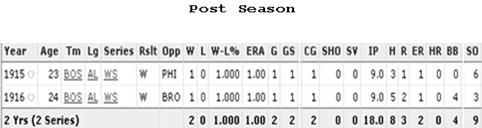
Leonard broke in with the Boston Red Sox in 1913. In his second year in the major leagues, 1914, Leonard led the American League with a remarkable 0.96 ERA. Leonard also pitched well in Boston's 1915 and 1916 World Series victories. He won Game 3 of the 1915 World Series, out-dueling the Phillies' Grover Cleveland Alexander 2–1. He also won Game 4 of the 1916 World Series against the Brooklyn Robins.
Leonard pitched two no hitters for the Red Sox, the first in 1916 against the St. Louis Browns and the second in 1918 against the Detroit Tigers.
In January 1919, the Red Sox sold Leonard to the Detroit Tigers, where Leonard played from 1919 to 1921 and 1924–1925. Leonard became embroiled in a salary dispute with Tigers' owner Frank Navin in 1922, and Leonard opted to play for Fresno, in the San Joaquin Valley League in 1922 and 1923. Leonard was suspended by the American League for his actions, but he rejoined the Tigers in 1924 where he feuded with Tigers manager Ty Cobb. Leonard pitched in his final major league game on July 19, 1925.
Even before their player-manager feud, Leonard and Cobb had a history. In 1914, Leonard hit Cobb in the ribs with a fastball.
Baseball Trailblazers Page 1334
In the next at bat, Cobb dragged a bunt which the Red Sox first baseman was forced to field; as Leonard's foot landed on the bag, Cobb's foot, spikes and all, landed on Leonard's, drawing blood.
A full feud broke when Cobb took over as the Tigers' manager in 1921. Cobb took pleasure in fining Leonard, who enjoyed late nights, for violating curfew. At one point in the 1921 season, Leonard was 11–13, despite a respectable ERA. Cobb left his office door open so that Leonard could hear him on the phone, faking a call; "I'm putting that damned Dutchman on waivers." In 1922, Leonard and Cobb fought over how to pitch to George Sisler and Tris Speaker. Leonard cursed Cobb to his face during the dispute, and Leonard ended up quitting the team in 1921, calling Cobb a "horse's ass."
When Leonard returned to the Tigers in 1924 after two seasons in the San Joaquin Valley League, the feud with Cobb resumed. By the middle of the 1925 season, Leonard was 11–3, but that did not stop Cobb from accusing Leonard of being a shirker. In front of the team, Cobb berated Leonard; "Don't you dare turn bolshevik on me. I'm the boss here." Leonard accused Cobb of over-working him, and Cobb responded in July 1925 by leaving Leonard on the mound for an entire game despite Leonard's giving up 20 hits and taking a 12–4 beating. After that, Leonard
Baseball Trailblazers Page 1335
refused to pitch for Cobb. As a result, the Tigers put Leonard on waivers, and when no team picked him up, his baseball career came to an end.
Rumors began to spread that Leonard was claiming he "had something" on Cobb. Leonard was quoted as saying, "I am going to expose that bastard Cobb, I'll ruin him." And in 1926, Leonard sought his revenge, contacting American League president Ban Johnson and accusing Cobb of being involved in gambling and/or fixing games with Tris Speaker. Leonard claimed that Speaker and Cobb had conspired before a 1919 Tigers–Indians game to allow the Tigers to win, enabling the team to reach third place and qualify for World Series money. To corroborate his story, Leonard produced letters written at the time; one by Cobb and one by Smoky Joe Wood; that obliquely referred to gambling or game-fixing. When Johnson made Leonard's letter public in December 1926, it started a scandal.
Cobb was called to testify at a hearing before Commissioner Kenesaw Mountain Landis, and denied Leonard's allegations. Cobb noted that Leonard "had the reputation in the past of being a bolshevik on the club." Leonard declined to appear and testify at the hearing, saying he feared a physical attack from "that wild man." In the absence of Leonard's testimony, Landis found Cobb and Speaker not guilty.
Baseball Trailblazers Page 1336
Leonard did well for himself after baseball. He became a very successful California fruit farmer and wine maker. He was also an expert left handed golfer. Leonard died in 1952 at age 60
from complications of a stroke.
Baseball Trailblazers
Page 1337
Joe Start
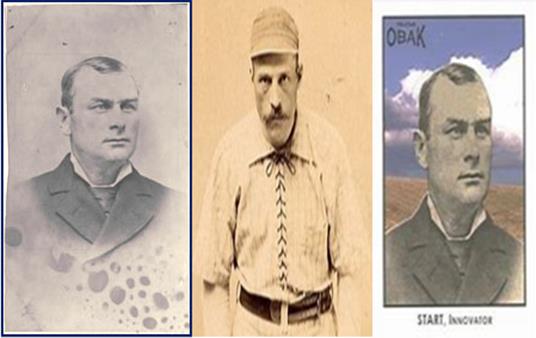
Joe Start (1842–1927) began playing baseball during its organized infancy and retired after the game became big business, 28 years later. He played for one amateur team and six professional teams and attained the reputation of a well-tempered, well-mannered, steady ballplayer.
He played first base for the Enterprise Club of Brooklyn in 1860
and moved to the powerful Atlantic Club of Brooklyn the following year. During the 1864 season, Start hit 11 home runs in 18 games, and led the Atlantic Club to undefeated seasons in 1864 and 1865. On September 6, 1869, Start hit four home runs in a 45–25 win over the Eckfords of Brooklyn and had seven hits on
Baseball Trailblazers Page 1338
the day, totaling 21 bases. Against the undefeated Cincinnati Red Stockings on June 14, 1870, at the Capitoline Grounds in Brooklyn, Start hit a long fly ball in the bottom of the eleventh inning, with the Atlantics trailing 7–5. As Cincinnati's right fielder, Cal McVey, caught up with the ball and attempted to coral the ball on the first bound, which was an out at the time, he was interfered with by an Atlantic supporter. Start ended up on third and Atlantic's third baseman, Charlie Smith who had singled and moved to third on a wild pitch, scored to cut the Red Stockings lead to 7-6. The Atlantics would score two more runs to end the Red Stockings winning streak. Before leaving the Atlantic Club in 1871, Start would help them to Championships in 1861, 1864–1866, and 1869.
Joe Start and his good friend Bob Ferguson moved to the Mutual Base Ball Club of New York for the 1872 season. Both Ferguson and Start were loyal and honest which was a rarity during the early days of baseball which was surrounded by betting scandals, especially the Mutuals. In 1873, Start managed the New York Mutuals for the final 25 games of the season and the Mutuals were 18–7 in those games but still finished in fourth place.
Third baseman John Hatfield began the season as the manager and was 11-17, before being replaced.
Baseball Trailblazers Page 1339
Start broke up Brooklyn Atlantic pitcher Tommy Bond's bid to become the first professional pitcher to throw a no hitter on October 19, 1874. Start, a left handed batter, doubled to left field with two outs in the top of the ninth inning at Brooklyn's Union Grounds, while Brooklyn prevailed 5–0.
On July 21, 1876, he hit three home runs and a triple against the Athletic Club of Philadelphia.
In 1877 he played for the Dark Blue of Hartford, who actually played their home games in Brooklyn at the Union Grounds, and in 1878 he played for the Chicago White Stockings, following Ferguson, who managed both teams. Start was the only player to make 100 hits during the 1878 season. Wanting to return to the east he joined the Providence Grays for the 1879 season, helping to lead them to the National League Whip Pennant.
He played with Providence until 1885 and at the end of the season married a Rhode Island native. In 1886, he played in only 31 games for the Washington Nationals before retiring at the age of 43. He finished with a .299 batting average, 1417 for 4743, and 544 RBIs.
During his career the 5'9' Start was reported to be an excellent fielder and may have been the first first baseman to play off of the bag when not receiving a throw, enabling him to increase the
Baseball Trailblazers Page 1340
area of the infield that he covered. At that time first basemen played close to or on top of the base, waiting to take throws from the infielders.
He returned to Rhode Island and ran the Lakewood Inn in Warwick for several years. He died in March of 1927 at age 84.
Baseball Trailblazers
Page 1341
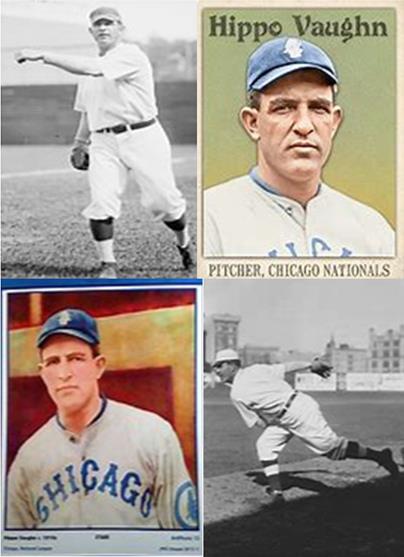
Hippo Vaughn
James Leslie "Hippo" Vaughn, April 9, 1888 – May 29, 1966, had a major league baseball career which spanned thirteen seasons. He played for the New York Highlanders - 1908, 1910–1912, the Washington Senators - 1912, and the Chicago Cubs - 1913–1921.
Baseball Trailblazers Page 1342
Vaughn won over twenty games in five seasons for the Cubs. His highlight year was war shortened 1918, when he won pitching’s Triple Crown, leading the league in wins with 22, ERA at 1.74, and strikeouts with 148. He also had the most innings pitched.
His nickname of "Hippo" came from his height and weight of 6-foot-4 and 215 pounds.
Vaughn was born in Weatherford, Texas to Josephine and stonemason Thomas Vaughn. He began his career in baseball in 1906 in the Texas League, playing for the Temple Boll Weevils.
He played the following year with the Corsicana Oilers/Desperados in the North Texas League. Vaughn played with two teams in 1908. He first played 12 games for the Hot Springs Vaporites of the Arkansas State League, going 9–1 before being called up by the New York Highlanders. Later in the year, he pitched for the Scranton Miners of the New York State League, where he went 2–4 in nine games. Vaughn began 1909 with the Macon Peaches of the South Atlantic League. He went 9–16 with a 1.95 ERA, and threw a no hitter. Later, he played with the Louisville Colonels of the American Association, where he went 8–1 with a 2.05 ERA with another no hitter.
Vaughn made two appearances in the 1908 season for the New York Highlanders. In 2+1⁄3 innings pitched, he allowed one hit and a run with four walks and two strikeouts.
Baseball Trailblazers Page 1343
In 1910, he joined the Highlanders for spring training. His showcase of pitching led to manager George Stallings naming Vaughn to pitch the first game of the season. Facing Eddie Cicotte of the Boston Red Sox on April 14, 1910 at Hilltop Park, Vaughn pitched fourteen innings, allowing four runs, holding the Sox scoreless after the fifth inning. The game was called after 14 innings due to darkness. He pitched a shutout in his next appearance nine days later against the Washington Senators in a shortened six inning effort, although the game ended in a scoreless tie. On May 7 he received his first winning decision when he pitched a complete ten inning victory over Boston, allowing one run on seven hits while striking out four in a 4–1
win. Vaughn appeared in 30 games for the season, going 13–11
with a 1.83 ERA while having 18 complete games and one save. In 221 innings, he had 107 strikeouts with 58 walks. The Highlanders finished in second in the American League by 14.5
games to the Philadelphia Athletics going 88–63.
The following year, he was selected to pitch the opening day game for the Highlanders, this time in Shibe Park against the defending World Series champion Philadelphia Athletics and Chief Bender. He pitched a complete game while allowing one run on four hits with three strikeouts and one walk while earning a 2–1
win. The rest of the year was not as shining. After three games
Baseball Trailblazers Page 1344
in April, he didn't pitch again until June. He went 8–10 with a 4.39 ERA in 26 games in 145 innings, having 74 strikeouts and 54
walks while having ten complete games.
Vaughn spent 1912 with three teams. he appeared for the final two outs of the opening day game against the Boston Red Sox, pitching in relief of Ray Caldwell. He went 2–8 with a 5.14 ERA in 15 games and 63 innings for the Highlanders, having 46
strikeouts and 37 walks while having just five complete games.
On June 26, he was sold to the Washington Senators. He went 4–3
with a 2.89 ERA in 12 games and 81 innings, having 49 strikeouts and 43 walks with four complete games before being sold to the Kansas City Blues of the American Association. He went 2–3 in his appearances with the team.
He spent a majority of the 1913 season with the Blues, going 14–
13 with a 2.05 ERA while hurling another no hitter. He was claimed by the Chicago Cubs in late August of the season. He made seven appearances with the team, the first being a four inning effort on August 22 against the New York Giants, where he allowed three hits and four runs. In his subsequent six games, he went the distance in five of them, winning each while only losing once. In 56 total innings of work, he had a 1.45 ERA with 36 strikeouts and 27 walks. He pitched a two hitter on September 13 against the Brooklyn Dodgers, striking out ten. The Cubs
Baseball Trailblazers Page 1345
finished 88–65, 13.5 games back of the Giants, and Vaughn proved to be their mainstay for the next couple of seasons.
For 1914, he went 21–13 with a 2.05 ERA in 42 games and 293
innings. He had 23 complete games and one save while having 165
strikeouts and 109 walks, the latter a career high. He finished in the top ten of the National League in numerous categories, such as 4th in ERA, 7th in wins, and 3rd in strikeouts.
In 1917, he returned to form, going 23–13 with a 2.01 ERA in 41
games and 295.2 innings. He had a career high 195 strikeouts with 91 walks. On May 2, he participated in what the record books used to refer as a "double no-hitter." At the ballpark now known as Wrigley Field, Vaughn dueled with Fred Toney of the Cincinnati Reds for nine hitless innings. In the top of the 10th, the Reds scored on a couple of hits after Vaughn had retired the first batter. Larry Kopf singled and later scored on a hit by Jim Thorpe. Toney continued to hold the Cubs hitless in the bottom of the inning, winning the game for the Reds. With some questionable changes to the scoring rules in recent years, this game is no longer considered as a no hitter for Vaughn, but is still the only occasion in major league history nine innings were played without a hit.
Baseball Trailblazers Page 1346
The 1921 season proved to be his downfall. He went 3–11 with a 6.01 ERA before flaming out on July 9. In his final appearance against the New York Giants, he went 3 innings while allowing six hits and six runs. His final two batters, Frank Snyder and pitcher Phil Douglas, each hit home runs. After the game, Vaughn could not be found by the team for days. In August, Cubs manager Bill Killefer and Cubs president William Veeck attempted to reinstate him back to the team. However, commissioner Kenesaw Mountain Landis suspended him for the remainder of the season, noting that he had signed a contract to pitch for the Fairbanks-Morse semi-pro team in Beloit, Wisconsin, finding it to be a violation of his contract with the Cubs. For the next fifteen years, Vaughn pitched in minor and semi-pro leagues, such as the Beloit Fairies of the Midwest League, with his minor league/semi-pro record being 223–145.
Vaughn’s major league record ended at a win–loss record of 178–
137, an earned run average of 2.49, and 1,416 strikeouts.
After his career ended, he was an assembler for a refrigeration products company. Vaughn died at age 78 in Chicago, Illinois on May 29, 1966.
Baseball Trailblazers
Page 1347
Buck Freeman
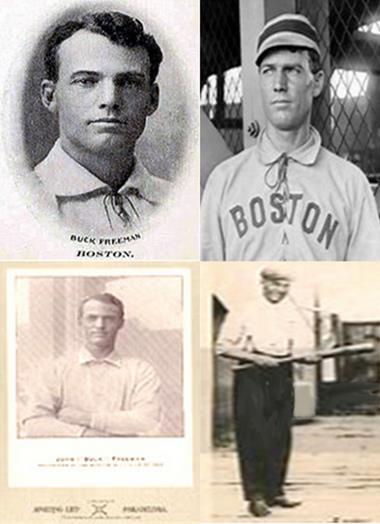
John Frank "Buck" Freeman, October 30, 1871 – June 25, 1949, was a right fielder in major league baseball at the turn of the 20th century. He both batted and threw left handed. Freeman was one of the top sluggers of his era; his most famous feat being the 25 home runs he hit during the 1899 season.
Baseball Trailblazers Page 1348
A native of Catasauqua, Pennsylvania, Freeman showed talent as a pitcher from a young age. He later received advice to practice hitting more.
Freeman made his major league debut as a left handed starting pitcher with the Washington Statesmen of the major league American Association on June 27, 1891, taking the loss in a 4–5
defeat to the Philadelphia Athletics. Freeman played in a further four games during the season, finishing up with a 3–2
record and an earned run average of 3.89 in 44 innings pitched, while striking out 28 but also walking 33.
Following the 1891 season's conclusion, Freeman did not play in the majors again for seven years. From 1892 through 1898, he played in the Pennsylvania State League, Eastern League, New England League, and Western League. His longest stint was in the Eastern League with Toronto from 1896 to 1898.
Freeman returned to the Washington roster in September of the 1898 season, when Arthur Irwin took over as manager. The team was now known as the Senators and played in the National League.
Since Freeman's time as a pitcher with the Statesmen, he had bulked out and had begun to show real skill with the bat. In light of this, the Senators decided to retrain Freeman as a right fielder, believing that he would be even more useful with
Baseball Trailblazers Page 1349
the bat than he was with the ball. Albeit with only 107 at bats in 29 games, he recorded a .364 batting average and a .523
slugging percentage during the final weeks of the 1898 Senators season. Following his strong showing with the bat, he was named as the Senators' first choice right fielder for the following season.
The 25 home runs that Freeman recorded for the 1899 Senators were truly remarkable by the standards of the time. The second highest total that year was 12 by Bobby Wallace of St. Louis.
Although Freeman failed to equal Ned Williamson's record of 27
home runs in a season, recorded in 1884 with Chicago, Freeman's total is generally regarded as the greater achievement, due to Williamson’s friendly home park.
Freeman's contract was sold to Boston in February 1900, as Washington owner J. Earl Wagner correctly foresaw that the National League would be reduced in size. The Senators were one of the teams disbanded as the league contracted from twelve teams to eight.
Freeman spent the 1900 season with the Boston Beaneaters, later known as the Boston Braves, where he did not get along with manager Frank Selee. Freeman's offensive numbers for the season
Baseball Trailblazers Page 1350
were well down from the year before, as he recorded six home runs and 65 runs batted in in 117 games played.
For the 1901 season, Freeman and teammate Jimmy Collins moved across town to the Boston Americans, later known as the Boston Red Sox, for the inaugural season of the American League. The Americans decided to convert Freeman into a first baseman. The 1901 season was something of a return to form. He finished second overall in home runs - 12, RBIs - 114, and slugging percentage - .520, finishing behind Nap Lajoie in all categories.
In 1902, Freeman returned to playing as a right fielder, which was his better position, and led the American League with 121
RBIs. In 1903, he helped Boston to the inaugural World Series by leading the league in both home runs - 13 and RBIs – 104. In doing so, Freeman became the first player to have led both the National League and the American League in home runs. The 1903
World Series was the only postseason series that Freeman ever played in, and it proved to be lackluster by his own standards.
Far from a disaster, he recorded an average of .281, 9 for 32, with three triples and four RBIs over the course of eight games, as Boston defeated the Pittsburgh Pirates.
Baseball Trailblazers Page 1351
In the three years following the championship, Freeman's offense declined sharply. In 1906, he managed a .250 average with one home run and 30 RBIs. After that, he decided to play in Boston for one further season, but after only four games of the 1907
season during which he batted 2 for 12, including a home run, Freeman was sent to the Washington Nationals. However, before playing for Washington, his contract was sold into the minor leagues, effectively ending his major league career.
Freeman went on to finish the 1907 season with the Minneapolis Millers of the American Association, recording an average of
.335 and hitting 18 home runs in 142 games played. Following this successful season, he decided to spend a further season with the Millers. In 1908 he played 92 games there with 10 home runs albeit an average of .218. Freeman then closed his professional career by playing in the New York State League in 1909, the Tri-State League in 1910, and a final 15 games in the New York State League in 1912 at age 40 when he managed the Scranton Miners.
In an 11 season major league career, Freeman was a .293 hitter, 1235 for 4208, with 82 home runs and 713 RBIs in 1126 games, including 199 doubles, 131 triples, 92 stolen bases, a slugging percentage of .462, and a .346 on base percentage. Freeman died at the age of 77 in Wilkes-Barre, Pennsylvania.
Baseball Trailblazers
Page 1352
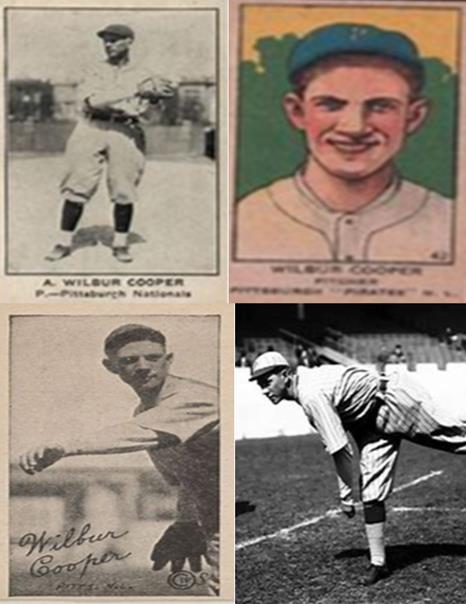
Wilbur Cooper
Arley Wilbur Cooper, February 24, 1892 – August 7, 1973, was a starting pitcher in major league baseball who played most of his career for the Pittsburgh Pirates. A four time winner of 20
Baseball Trailblazers Page 1353
games in the early 1920s, he was the first National League left hander to win 200 games, ending with 216. His career earned run average of 2.89 is also the lowest of any NL left hander with at least 3000 innings.
Cooper was born in Bearsville, West Virginia, and his family moved to Waterford, Ohio when he was a boy. He began his professional career in 1911 with a Marion, Ohio minor league team. In his first start with Pittsburgh in 1912, he pitched a shutout against the St. Louis Cardinals. In 1916 he set a team record, still unbroken, with a 1.87 earned run average. He won at least 17 games each year from 1917 through 1924, peaking with seasons of 24, 22 and 23 wins from 1920 to 1922, and led the league in starts and complete games twice each, and in wins, innings and shutouts once each. He worked quickly in his starts, often not getting the signal from his catcher until he had already begun his windup.
In October 1924 Cooper was traded to the Chicago Cubs, along with Charlie Grimm and Rabbit Maranville, in a decidedly unpopular six player deal. He was greatly disappointed to leave the Pirates, and never pitched as effectively again. In June 1926 he was picked up by the Detroit Tigers, and he ended his major league career after eight games with the team, though he played in the minor leagues through 1930.
Baseball Trailblazers Page 1354
Cooper died of a heart attack at age 81 in Encino, California.
Baseball Trailblazers
Page 1355
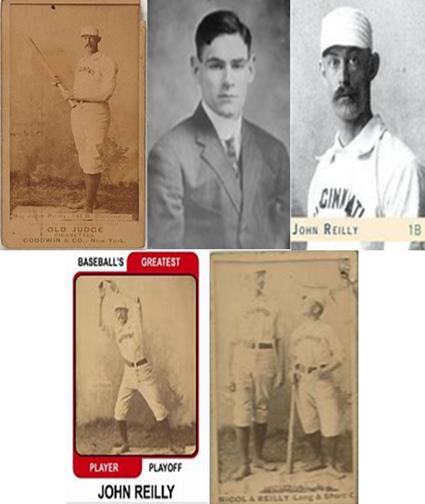
John Reilly
John Good Reilly, October 5, 1858 – May 31, 1937, nicknamed
"Long John," was a first baseman in major league baseball who played for the Cincinnati Stars in 1880 and the Cincinnati Red Stockings/Reds from 1883–1891. During and after his baseball career, Reilly was a commercial artist for the Strobridge Lithographing Company.
Baseball Trailblazers Page 1356
Born in 1858 in Cincinnati, Reilly was the son of a Civil War gunboat captain for the Union named Frank A. Reilly. When his father was killed at the Battle of Fort Donelson in 1862, Reilly was sent by his mother to live with some of her relatives in rural Illinois, and he spent the next several years there.
When he was about 14 years old, Reilly returned to his native Cincinnati to take a course in lithography at a design school.
He apprenticed at the Strobridge Lithographing Company, and he played his first organized baseball for the company team. Reilly showed early ability as a catcher, but by 1877, having become a professional artist with Strobridge, he began playing in the infield to avoid hand injuries that might threaten his lithography career.
Reilly played one season for the Cincinnati Stars in the National League and was out of the major leagues for the following two seasons, playing for the New York Metropolitans in 1882 when it was an independent team. From 1883 to 1891, he played for the Cincinnati Red Stockings/Reds of the American Association and the NL.
He hit 69 home runs and batted .289 during his ten year career.
In 1888, he hit 13 home runs with 103 RBI and a .321 batting
Baseball Trailblazers Page 1357
average. He was American Association home run champion in 1884
and 1888.
Ren Mulford, a writer for Sporting Life, reported in 1914 that Reilly was "a rare old bachelor devoted to his art, and seldom goes to the ball yard where he once reigned a ruling favorite."
Reilly remained employed with Strobridge until 1932. He died in 1937 in Cincinnati.
Baseball Trailblazers
Page 1358
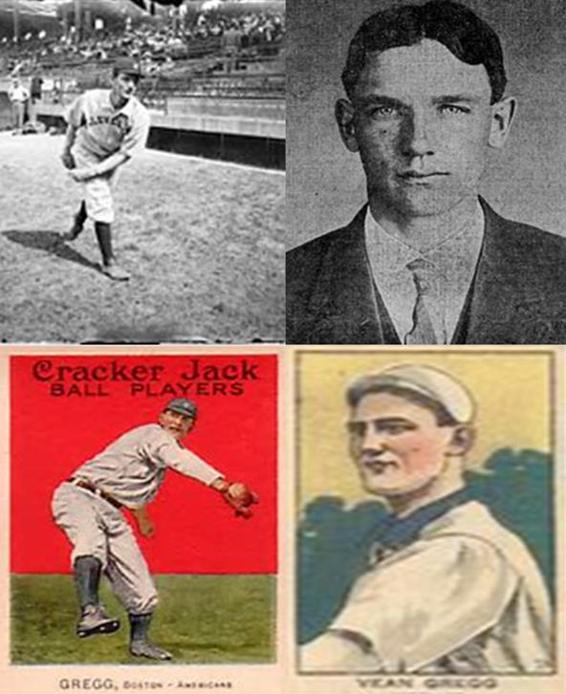
Vean Gregg
Baseball Trailblazers Page 1359
Vean Gregg, April 13, 1885 - July 29, 1964, major league career record was 92–63 with a lifetime 2.70 ERA in 1,393 innings pitched and 720 strikeouts. He was the only pitcher in the 20th century to win 20 games or more in his first three seasons. He played for the Cleveland Naps (1911–1914), Boston Red Sox (1914–
1916), Philadelphia Athletics (1918), and the Washington Senators (1925). Gregg was a World Series champion in 1915 and 1916 and American League ERA leader in 1911.
Gregg started his professional career in Portland, Oregon in 1910 with the Pacific Coast League. He threw 14 shutouts. The next year, he played for the Cleveland Naps, going 23–7 with a league leading 1.80 ERA. In 1912 and 1913, he started 34 games both years with an identical 20–13 record each season.
Gregg was traded to the Boston Red Sox in mid-1914. He played for them on both the 1915 and 1916 World Series championship teams. He developed a sore arm in 1914 and had continual arm problems for the rest of his career.
In December 1917, Connie Mack acquired Gregg for the Philadelphia Athletics. He went 9–14 in 30 games in 1918 with a respectable 3.12 ERA for the last place Athletics. Gregg did not play baseball at any level from 1919 to 1921.
Baseball Trailblazers Page 1360
He returned to the Pacific Coast League in Seattle, Washington in 1922 and played there until 1924. In 1925, he signed with the Washington Senators and went 2–2 with two saves after a 6 year absence from major league baseball. Vean Gregg died on July 29, 1964 in Aberdeen, Washington.
Baseball Trailblazers
Page 1361
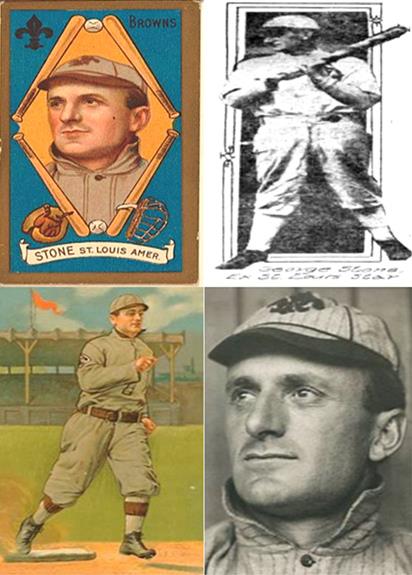
George Stone
George Robert Stone, nicknamed Silent George, September 3, 1876
– January 3, 1945, was a left fielder in major league baseball who played for the Boston Red Sox in 1903 and the St. Louis
Baseball Trailblazers Page 1362
Browns from 1905 to 1910. Stone batted and threw left handed. He was the 1906 American League batting champion.
Stone was born in Lost Nation, Iowa, to George and Hannah Stone and was Jewish. Prior to playing baseball, he had a career in banking in Nebraska. His taste ran to reading, and his hobby was violin playing.
He left his career in banking in 1901 at the age of 24 to join the Omaha Omahogs of the Western League. In 1902 he played for the Omahogs and the Peoria Distillers and led the league with 198 hits, and the next year he again played for the Omahogs.
He made his major league debut in 1903 at the age of 26 with the Boston Americans, though he played most of 1903 for the Milwaukee Creams of the Western League. In 1903 with the Creams he was third in the Western League in home runs with 4.
In 1904 with the Milwaukee Brewers he led the American Association in batting with a .406 batting average, which remained the league record until the league closed down in 1997, in slugging with a .558 average, and in hits with 254, and he was second in the league in triples with 19.
In December 1904 he was traded by the Boston Americans to the St. Louis Browns for Jesse Burkett and cash. In 1905 he led the
Baseball Trailblazers Page 1363
American League in hits – 187, and total bases - 259, and was second in home runs - 7.
In 1906, he batted .358 and won the American League batting championship, beating four time batting champion Napoleon Lajoie. He also led the league in slugging - .501) and in on base percentage - .417, and he was second in the league in hits
– 208, behind Lajoie, and triples – 20, and third in home runs –