

Baseball Trailblazers by Edward Drobinski - HTML preview
Download the book in PDF, ePub, Kindle for a complete version.
.312.
In 1915, the Hoosiers moved east and became the Newark Pepper.
Mullin played in only five games for the Newark club, compiling
Baseball Trailblazers Page 1263
a 2–2 record and a 5.85 ERA. He appeared in his last Federal League game at age 34 on May 23, 1915. He was hit hard and driven from the game in the second inning. Mullin was released by Newark in late June.
Mullin concluded the 1915 season pitching for the Camden Athletic Club. He also pitched in 1916 for teams in Kokomo and Columbus, Indiana.
Mullin was also known for the tactics he used to try to keep batters off balance. The tactics included talking to batters when they came to bat, or even talking to himself. Longtime Detroit sports writer H. G. Salsinger wrote that, while Mullin had an excellent fastball and a good curveball, "most of his success was due to smartness rather than stuff." According to Salsinger, Mullin would try to distract batters with antics in between pitches; combing the pitcher's box, adjusting his belt, cleaning non-existent dirt from his glove, tying or removing his shoes; all in the hope of upsetting the batter and inducing him to swing at a bad pitch. On another occasion, Mullin and catcher Boss Schmidt hatched a successful scheme to induce Jack Chesbro to try to score from third base by bouncing a wild pitch off the stands so that it rebounded to Schmidt who then threw to Mullin for the tag on Chesbro.
Baseball Trailblazers Page 1264
Yet, the pitching prowess and significant achievements of George Mullin seem to have faded away on the brittle pages of baseball history. Not even in the Motor City is the name of George Mullin, the burly right hander from Wabash, Indiana, mentioned.
Mullin was married to the former Grace Aukerman. They had a daughter, Beatrice. After retiring from baseball, Mullin took a job in 1919 with a motor truck company in Wabash, Indiana. In 1923, he was reportedly working as a police officer in Toledo, Ohio. In his later years, Mullin suffered from a long illness that reduced his weight to 100 pounds. He died in 1944 at age 63
in Wabash.
Baseball Trailblazers
Page 1265
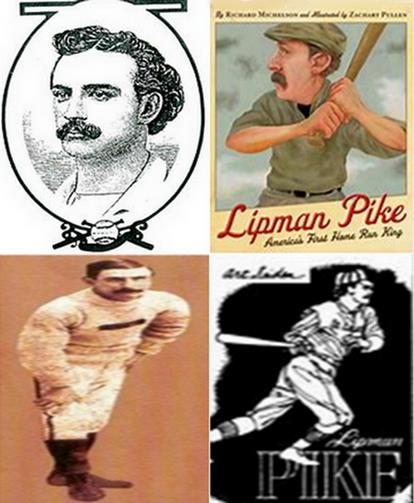
Lip Pike
Lipman Emanuel "Lip" Pike, May 25, 1845 – October 10, 1893, the
"Iron Batter," was one of the stars of 19th century baseball. He was a great slugger and one of the best home run hitters, so much so that stories about balls he hit were told for quite some time after he stopped playing. Pike was Jewish and was born in
Baseball Trailblazers Page 1266
New York into a Jewish Dutch family, and grew up in Brooklyn.
His father, Emanuel was a haberdasher. His mother was Jane, and he had three brothers and a sister.
Pike began in baseball when he was 13. He first rose to prominence playing for the Philadelphia Athletics, who he joined in 1866. He brought an impressive blend of power and speed to the team, hitting many home runs as well as being one of the fastest players around. On one occasion he hit five home runs in one game.
However, it was soon brought to light that he and two other Philadelphia players were being given $20 a week to play. Since all baseball players were ostensibly amateurs, though many were, like Pike, accepting money under the table, a hearing was set up by the sport's governing body, the National Association of Base Ball Players. In the end, no one showed up to the hearing, and the matter was dropped. By 1869, the Cincinnati Red Stockings became the first openly professional team, and Pike's hearing, farcical as it seems to have been, paved the way for Harry Wright's professionalization of baseball. The Athletics were very successful, but Pike was dropped from the team in 1867, because he was from New York, and thus a “foreigner,” which called his loyalty into question.
Baseball Trailblazers Page 1267
He moved on to the Irvington, New Jersey club and later in 1867
to the New York Mutuals, always a leading team, where he returned for 1868, having caught the eye of Boss Tweed. In 1869
he moved to the Brooklyn Atlantics, another perennial leader, where he hit .610. In 1870, the Atlantics, with Pike manning second base, finally ended Cincinnati's 93 game winning streak.
In 1871, the National Association was formed as the first professional baseball league, and Pike joined the Troy Haymakers for its inaugural season. He was their star and captain, batting
.377 - 6th best in the league, and hitting a league leading 4
home runs. He also led the league in extra base hits - 21, and was 2nd in slugging percentage - .654, and doubles - 10, 4th in RBIs - 39, 5th in triples - 7, 6th in on base percentage - .400, 9th in hits - 49, and 10th in runs – 43. The Haymakers only finished 6th, though, and the team's captaincy switched to Bill Craver.
The Haymakers revamped their roster for the 1872 season, and Pike headed for Baltimore, where he played for the Baltimore Canaries. Pike had another excellent season, leading the league in home runs again,, RBIs, and games; and coming in 2nd in total bases, and extra base hits; 3rd in at bats, 5th in doubles and triples, 9th in slugging percentage and stolen bases, and 10th in hits.
Baseball Trailblazers Page 1268
In 1873, Pike led the league in home runs for the 3rd consecutive season, hitting 4, and was again in the top 10 of numerous offensive categories.
Pike was also one of the fastest players in the league. He would occasionally race any challenger for a cash prize, routinely coming out the winner. On August 16, 1873, he raced a fast trotting horse named "Clarence" in a 100 yard sprint at Baltimore's Newington Park, and won by four yards with a time of 10 seconds flat, earning $250.
Baltimore went bankrupt after the 1873 season, so Pike headed off to captain the Hartford Dark Blues for the 1874 season. The Dark Blues were a poor team, but Pike had another fine season, slugging .574 to lead the league, and coming in 2nd with an on base percentage of .368.
Pike abandoned the weak Hartford team after a single season, switching to the St. Louis Brown Stockings. For the first time in his professional career, Pike failed to hit a home run, although he stole 25 bases. He also hit 12 triples and 22
doubles, leading the league, in what was probably his finest offensive season.
In all, Lip Pike has the National Association career home run and extra base hits records, with 15 and 135, respectively.
Baseball Trailblazers Page 1269
In 1876, when the National League replaced the National Association, Pike stuck with St. Louis. The Brown Stockings turned in a very good season, finishing a solid 2nd to the Chicago White Stockings. Pike continued to produce offensively, notching totals of 133 total bases - 5th in the league, and 34
extra base hits - 2nd.
Seemingly never content to stay with a team very long, Pike headed to the Cincinnati Reds for the 1877 season. The Reds finished last. Pike was still a top quality player, leading the league in home runs for the 4th time in the 1870s. However, age was starting to catch up with the 32 year old Pike. He began the season as the 8th oldest player in the league, and was the 4th oldest player of the 1878 season. The 1878 Reds played very well, though. They finished 2nd, but Pike was replaced by Buttercup Dickerson halfway through the season and forced to look elsewhere for a team. He ended up playing a few games for the Providence Grays, and spent the next two years playing for minor league teams.
Pike got a brief call-up in 1881 to play for the Worcester Ruby Legs. But, it was determined that the 36 year old could no longer play effectively, hitting .111 and not managing a single extra base hit in 18 at bats over 5 games. Frankly, the brief stint allowed doesn’t sound like much of a test. His play was so
Baseball Trailblazers Page 1270
poor as to arouse suspicions, and Pike found himself banned from the National League that September. He was added to the National League blacklist in 1881. He turned to haberdashery, the vocation of his father, and spent another 6 years playing only amateur baseball. He was reinstated in 1883.
In 1887, the New York Metropolitans of the American Association gave Pike another chance. At 42, he was the oldest player in baseball. The only game he played was more of a sending off than a new start, though, and Pike headed back to his haberdashery once more.
He finished his major league career with a .322 batting average, 21 home runs, and 332 runs batted in, after having been four time NA home run leader - 1871–1873, 1877, one time NA RBI leader – 1872, and one time NA Doubles leader -1874.
Pike died suddenly of heart disease at the age of 48 in 1893 in Brooklyn. “The Brooklyn Eagle” reported that; "Many wealthy Hebrews and men high in political and old time baseball circles attended the funeral service."
Baseball Trailblazers
Page 1271
Al Orth
Baseball Trailblazers Page 1272
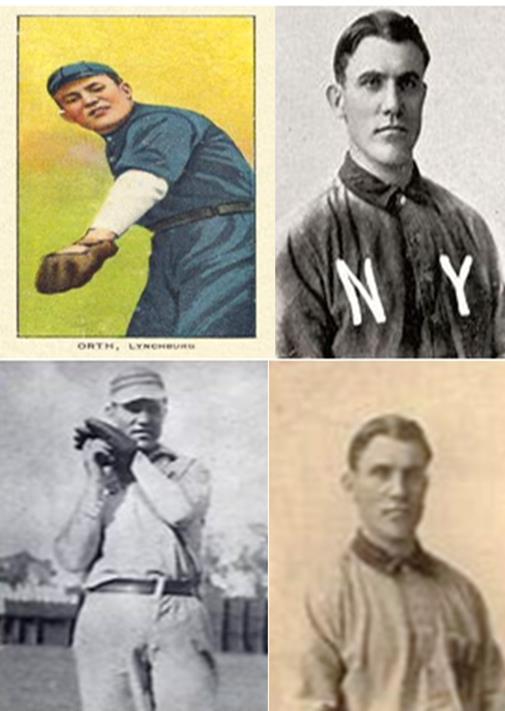
Albert Lewis Orth, September 5, 1872 – October 8, 1948, was born in Sedalia, Missouri and attended DePauw University. He had a win–loss record of 204–189, with a 3.37 ERA, playing fifteen years for the Philadelphia Phillies from 1895–1901, the Washington Senators from 1902–1904, and the New York Highlanders from 1904–1909.
As a young pitcher with the Lynchburg minor league team in the Virginia League in 1895, Orth won 28 games. He was called up to the Philadelphia Phillies and won his first eight starts for them. He finished the year with an 8–1 record and a 3.89 ERA in 11 games, with nine complete games and one save in a total of 88
innings. He had 25 strikeouts and 22 walks. Batting wise, he had a .356 batting average, having 16 hits in 45 at bats with a home run and 13 RBIs. The following year, Orth went 15–10 with a 4.41
ERA in 25 games and 196 innings of work. He had 23 strikeouts and 46 walks while having 19 complete games. In 25 games, he batted .256 while having 13 RBIs and a home run. Before the 1902
season, Orth and several other Phillies left for the American League. Orth joined the Washington Senators. When Orth was traded to the New York Highlanders in 1904 after struggling the year before, he picked up the spitball from Jack Chesbro and had his best year in 1906, going 27–17 and leading the American
Baseball Trailblazers Page 1273
League in wins. During that season, Orth threw 36 complete games in 39 starts.
Known as “The Curveless Wonder,” Orth never relied on the breaking ball. Instead, his pitching success centered on his control and his ability to change pitch speeds. Orth twice finished with the fewest walks in his league. He is one of a handful of pitchers to earn 100 wins in both the National League and the American League.
Orth was also known for his hitting skills, finishing seventh all time among pitchers in hits, with a lifetime total of 464.
He posted a .273 batting average with 12 home runs and 184 RBI.
Orth would frequently hit above .300. The left handed hitter was used as a pinch hitter 78 times and even played the field on a few occasions, including fifty-five games as an outfielder and eight at shortstop during his time with the Washington Senators.
After knee injuries and a sore arm ended his career, he managed for Lynchburg in the Virginia League. He also was a National League umpire, and was officiating when Fred Toney and Hippo Vaughn each pitched 9 innings of no hit baseball, the only time when neither team got a hit. After umpiring for several seasons, knee problems forced him to stop. He later coached at Washington and Lee University as well as the Virginia Military Institute.
Baseball Trailblazers Page 1274
Orth died at age 76 at his Lynchburg, Virginia, home on October 8, 1948. He was survived by his wife and two sons.
Baseball Trailblazers
Page 1275
Tilly Walker
Baseball Trailblazers Page 1276
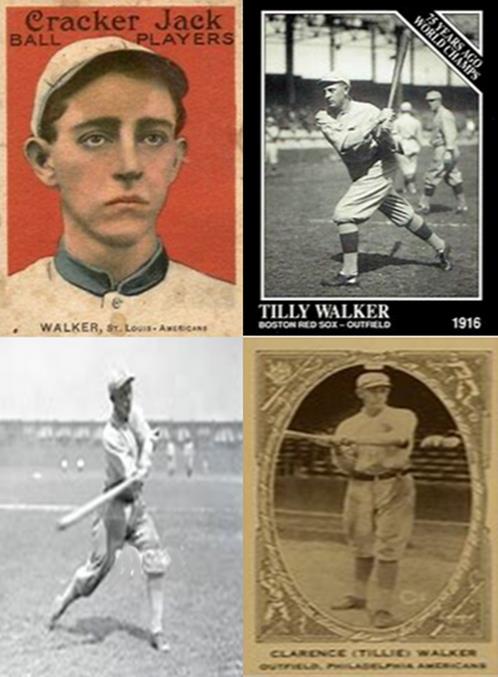
Clarence William "Tilly" Walker, September 4, 1887 – September 21, 1959, was a professional baseball outfielder. After growing up in Limestone, Tennessee, and attending college locally at Washington College, he entered major league baseball, He played for the Washington Senators, St. Louis Browns, Boston Red Sox and Philadelphia Athletics from 1911 to 1923.
Walker was born in Telford, Tennessee. His family moved to Limestone, Tennessee, when he was a child. His father, W. N.
Walker, was an undertaker and a member of the local county high school board of education. Walker later recalled that there was not much to do in Limestone, so he developed his throwing ability by tossing rocks. He pitched and played right field for the baseball team at Washington College in Limestone in the 1908–09 and 1909–10 school years.
Walker's professional baseball career began with the Spartanburg Spartans of the Carolina Association in 1910 and 1911. Hitting for a .390 batting average with Spartanburg in 35 games in 1911, Walker caught the attention of the Washington Senators. The team purchased Walker's contract from Spartanburg and played him in 95 major league games. Walker finished the season with a .278
average, 2 home runs and 12 stolen bases.
Baseball Trailblazers Page 1277
Starting the 1912 season with the Senators, he hit .273 through 35 games, but he committed 8 errors. The Senators started that season poorly, so manager Clark Griffith sold his contract to the minor league Kansas City Blues as part of his attempt to overhaul the team. Walker said that he had been present when Griffith handed a telegram to a telegraph operator one night.
Owing to telegraphy experience from a boyhood job, Walker heard the Morse code and realized that the telegram was requesting waivers on him. He was sold to the Blues after no major league teams were interested. He considered returning to Limestone as a telegraph operator, but he ultimately went to the Blues.
Walker spent most of 1913 with the Blues, hitting .306 with 6
home runs. He made it back to the major leagues that year with the St. Louis Browns, appearing in 23 games. Browns manager Branch Rickey reportedly compared Walker to Ty Cobb in terms of ability, saying that they differed only because Cobb displayed more effort.
Walker hit .278 with 6 home runs, 78 runs batted in, and a career high 29 stolen bases in 151 games during the 1914 season.
His offensive totals dropped with the 1915 Browns. He finished with a .269 average, 5 home runs, 49 RBI and 20 steals. Just before the 1916 season, the Boston Red Sox purchased Walker's contract for $3,500.
Baseball Trailblazers Page 1278
The purchase of Walker indirectly facilitated the sale of Red Sox star outfielder Tris Speaker to the Cleveland Indians. The Walker deal signaled to Cleveland executives that Boston was looking to trade Speaker, so Cleveland executives began negotiations with the Red Sox that resulted in Speaker's purchase for $55,000. Walker was seen as a good hitter and he had a strong arm, having led the league's outfielders in assists for the two previous seasons. However, he had been criticized for his mood swings and for not being a team player.
Walker earned one of his lowest batting averages - .266, that year, but Boston won the 1916 World Series. In that series, he batted twelve times and got three hits, including a triple. He played only 106 games in 1917, hitting a career low .246 for the Red Sox. Before the 1918 season, Walker was sent to the Philadelphia Athletics as the player to be named later in a multiplayer trade for first baseman Stuffy McInnis. He tied Ruth as the league leader in homeruns in 1918 with 11. In 1919, Walker and two other American League players each hit 10 home runs, while Ruth hit 29.
In 1920 Walker slugged 17 home runs. He registered home run totals of 23 the next year and 37 in 1922. He finished second in the AL in home runs in 1922, ahead of Ruth and trailing Ken Williams by two home runs. Walker passed 100 career home runs
Baseball Trailblazers Page 1279
that year, becoming one of the first five major league players to reach that milestone. After the 1922 season, Athletics manager Connie Mack opted to prioritize pitching and defense over hitting, so he moved the fences 30 to 40 feet deeper in Philadelphia. Walker struggled under the new conditions and played only 52 games in 1923.
Walker was given an unconditional release from the Athletics in December 1923. He returned to the minor leagues for the 1924
season. He spent six years with the Minneapolis Millers, Baltimore Orioles, Toronto Maple Leafs and Greenville Spinners.
He hit for double digit home run totals five times as a minor league player, including a 1928 season in which he hit 33 home runs. The 1929 season was his last, and he appeared in only 12
games that year. He spent a year as an umpire in the Piedmont League in 1934. In 1940, he was the manager of the Erwin Mountaineers in the Appalachian League.
In 1421 games over 13 seasons, Walker posted a .281 batting average, 1423 for 5067, with 696 runs, 244 doubles, 71 triples, 118 home runs, 679 RBI, 129 stolen bases, 416 bases on balls, a
.339 on-base percentage and a .427 slugging percentage. He finished his career with a .949 fielding percentage playing at all three outfield positions.
Baseball Trailblazers Page 1280
Beginning in 1940, Walker worked as a patrolman for the Tennessee Highway Patrol, stationed in Bristol. He made his home in Limestone. In 1959, he died of natural causes at his brother's home in Unicoi, Tennessee.
Baseball Trailblazers
Page 1281
Terry Larkin
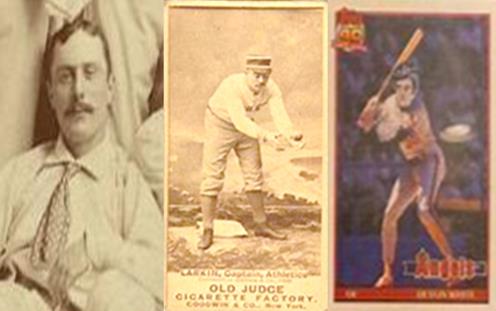
Frank S. "Terry" Larkin, 1856 – September 16, 1894, was a major league baseball pitcher who played for five teams during a six season career from 1876-1884.
Born and raised in Brooklyn, New York, he made his debut on May 20, 1876 for the New York Mutuals, pitching a complete game in his only appearance of the season. He pitched in 1877 for the Hartford Dark Blues, posting a 29–25 record while pitching 501
innings. He then moved to the Chicago White Stockings for the 1878 and 1879 seasons, going 29–26 in 1878 and 31–23 in 1879, pitching over 500 innings each season. Larkin was a good hitter
Baseball Trailblazers Page 1282
for a pitcher and finished 8th in the National League with 32
runs batted in, while hitting for a .288 average in 1878.
He concluded his career with a win–loss record of 89-80, and an earned run average of 2.43, after having one thirty win season and three twenty win ones.
Larkin was later institutionalized after challenging his former employer to a duel with pistols. He died on September 16, 1894
in Brooklyn, New York while still hospitalized, committing suicide by slitting his throat with a razor.
Baseball Trailblazers
Page 1283
Rabbit Maranville
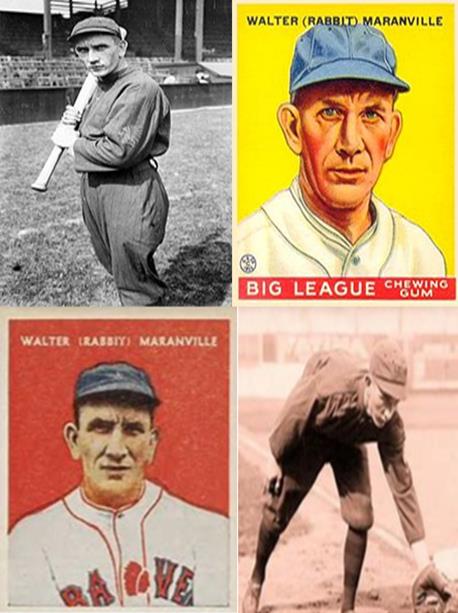
Walter James Vincent "Rabbit" Maranville was born November 11, 1891 in Springfield, Massachusetts. He was a professional baseball shortstop, second baseman and manager. He played in
Baseball Trailblazers Page 1284
major league baseball for the Boston Braves, Pittsburgh Pirates, Chicago Cubs, Brooklyn Robins, and St. Louis Cardinals between 1912 and 1934. At the time of his retirement in 1935, he had played in a record 23 seasons in the National League, a mark which was not broken until 1986.
Maranville finished third in the MVP voting in his first full season, playing for the Boston Braves as a 21 year old in 1913
even though his batting average was just .247 in 143 games with two homers. The following year, Maranville was the runner-up in the MVP voting to teammate Johnny Evers as the Braves won the National League pennant and then went on to sweep the powerful Philadelphia A's in the World Series. That year, Maranville was the Braves' cleanup hitter, despite batting just .246 and hitting four home runs. Following the series, he and several of his teammates went on a vaudeville tour, reenacting plays from the World Series while also singing and telling stories.
Maranville was demonstrating a stolen base to an audience in Lewiston, Maine, when he accidentally slid off the edge of the stage and fell onto a drum in the orchestra pit, suffering a broken leg. Maranville played only 11 games in 1918, spending most of the year in the United States Navy during World War I.
Over a lengthy career which spanned both the dead and live ball era, Maranville played for the Boston Braves - 1912–1920, 1929–
Baseball Trailblazers Page 1285
1933, and 1935, Pittsburgh Pirates - 1921–1924, Chicago Cubs -
1925, Brooklyn Robins – 1926, and St. Louis Cardinals - 1927–