

Baseball Trailblazers by Edward Drobinski - HTML preview
Download the book in PDF, ePub, Kindle for a complete version.
.224.
Cincinnati was removed from the National League after the 1880
season, and the team folded, leaving White without a club. In April 1881, the newest National League club, the Detroit Wolverines, signed White after its principal pitcher, George Bradley, suffered with a pulmonary hemorrhage during a preseason practice. When White was signed, the Detroit Free Press wrote of him; "He is too well known to baseball admirers to need an introduction."
On May 5, 1881, at Buffalo, New York, White appeared in the fourth game played by the Detroit Wolverines. He allowed eight runs and 13 hits, including two hits by his brother, Deacon White, who had joined the Buffalo club. Hardy Richardson also hit a bases loaded triple in the ninth inning and was thrown out at home plate. The Wolverines lost the game 8–1.
White appeared in his second, and final, game for the Wolverines on May 12, 1881. Detroit lost by a 10–4 score to the Worcester Worcesters, and the press was not understanding after a second poor showing. The Detroit Free Press wrote; "White, who is an old fashioned, straight armed pitcher, not a modern underhanded
Baseball Trailblazers Page 1014
thrower, is not the man for a pitcher's position. The Worcesters had no trouble in batting him, and the only wonder is that they made no more base hits and runs."
In his only two games for the 1881 Detroit Wolverines, White compiled an 0–2 record and a 5.00 ERA in 18 innings. The Detroit team settled on George Derby as its lead pitcher, with Stump Wiedman as the change pitcher, and White was released after two starts. White finished the 1881 season playing for a semipro team in Cincinnati.
In November 1881, White signed to play with the Cincinnati Red Stockings for the inaugural season of the new American Association. During the 1882 season, White compiled a 40–12
record with a 1.54 ERA. He led the American Association in wins
- 40, complete games - 52, and innings pitched - 480. White also proved to be a decent hitter during the 1882 season, batting
.266 with 28 runs scored and 25 runs batted in. White pitched right-handed, but he was a switch hitter. Despite refusing to pitch on Sundays, White led the Red Stockings to their first pennant in 1882.
In 1883, White compiled a 43–22 record and led the league with 43 wins, a 2.09 ERA and six shutouts. White also ranked among the American Association's leaders with 577 innings pitched –
Baseball Trailblazers Page 1015
2nd, and 64 complete games - 2nd. In August 1883, White was baptized in the Second Advent denomination by being immersed in the Ohio River near Dayton, Kentucky.
In 1884, White became a player-manager, managing the Reds for the first 71 games of the season and leading the club to a 44–27
record. In August 1884, White decided to step down as manager, believing he was "of too easy a disposition," and he persuaded his catcher, Pop Snyder, to take over as manager. White remained the Reds' ace pitcher during the 1884 season, compiling a 34–18
win-loss record and a 3.32 ERA. He led the league with seven shutouts and again ranked among the league's leading pitchers in wins, innings pitched, and complete games.
White's career suffered in 1884 when the American Association adopted a rule granting a batter a base if he was hit by a pitched ball. The new rule disadvantaged White in the use of one of his chief weapons – intimidation. White set a major league record in 1884 with 35 hit batsmen, a total that remains the ninth highest in major league history. He led the league again in 1885 with 27 batsmen hit by a pitch.
White played his last full major league season for the Reds in 1885. He appeared in 34 games, threw 33 complete games and compiled an 18–15 record with a 3.53 ERA. In late August 1885,
Baseball Trailblazers Page 1016
“The Sporting Life” correspondent from Cincinnati reported that White would not do no further pitching for the Reds "for some time to come", noting that the local fans held a "bitter feeling" toward White, which had caused the club president to employ other pitchers. This does seem strange, and according to baseball historian Joseph M. Overfield, White's "arm simply had nothing left" by the end of the 1885 season.
In January 1886, “The Sporting Life” reported that White had
"gone back to his first love – the grocery business," opening a grocery in Fairmount, near Cincinnati. Another published story that same month reported that White's "delivery wagon can be seen almost any day on the street. White is not a loafer, and when baseball fails he makes money just like other people."
White returned briefly to baseball in June and July 1886, appearing in three games for Cincinnati. He compiled a 1–2
record as his ERA jumped to 4.15 in 26 innings pitched. He appeared in his last major league game on July 5, 1886, at age 31.
In December 1888, White's older brother, Deacon, and Jack Rowe, both of whom had been part of baseball's famed "Big Four"
throughout the 1880s, purchased the Buffalo Bisons, a minor league baseball club, intending to be co-owners, managers, and
Baseball Trailblazers Page 1017
players. In March 1889, Deacon White announced that he was also going into business in Buffalo with his brother, Will, and that Will had agreed to "twirl for the Bisons whenever needed." In June 1889, White agreed to become a regular pitcher and also to serve as an assistant manager. However, the brothers' plans were thwarted by William Nimick, the owner of the Pittsburgh Alleghenys. The Pittsburgh club held the rights to Rowe and Deacon White and refused to release them, saying, "If they don't want to play in Pittsburgh, they'll play nowhere." In July 1889, Rowe and Deacon White agreed to play for Pittsburgh, and Will White was left in Buffalo to take over as "solo manager" of the Bisons. After two years away from baseball, White started 20
games for the 1889 Bisons, threw 17 complete games, and compiled a 7–13 record and a 2.33 ERA in 174 innings pitched.
During his 10 years in the major leagues, White compiled a 229–
166 win-loss record. He ranks among the major leagues' all-time career leaders with a 2.28 ERA – 9th, 394 complete games - 17th, and 36 shutouts - 63rd. White also set a number of single season major league pitching records and still holds several. His 1879
totals of 75 complete games, 75 games started, 680 innings pitched, and 2,906 batters faced remain major league records.
White was married in approximately 1876 to Harriet Holmes. They had a daughter, Katherine, born in December 1876. After retiring
Baseball Trailblazers Page 1018
from baseball, White and his wife lived in Buffalo, New York.
White worked with his brother, Deacon, in the optical supply business, doing business as the Buffalo Optical Company. In 1900
White and his wife were living in Buffalo with their daughter, and White was employed as an optician. In 1910, White remained living in Buffalo working as an optician. His household at that time included his wife and daughter, as well as a nephew and a cousin.
White died in August 1911 at his summer home in Port Carling, Ontario, Canada. The cause of death was drowning. According to one account, he was teaching his niece to swim, suffered a heart attack while in the water and died.
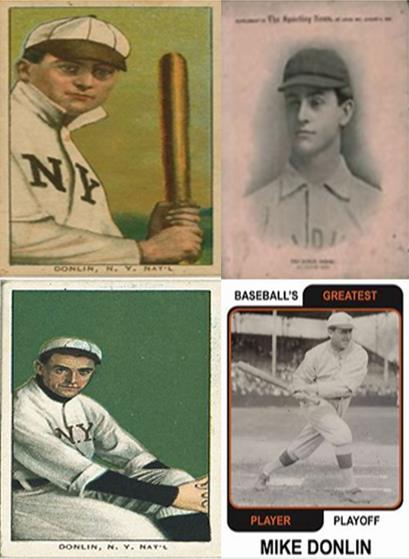
Baseball Trailblazers
Page 1019
Mike Donlin
Michael Joseph Donlin, May 30, 1878 – September 24, 1933, was a major league baseball outfielder and actor. As a professional baseball player, his career spanned from 1899 to 1914 in which he played mainly in the National League for seven teams over 12
seasons.
Baseball Trailblazers Page 1020
Born in Peoria, Illinois, Donlin's family soon moved to Erie, Pennsylvania, where he lost both his father, railroad conductor John Donlin, and mother, Maggie, in a train accident when he was a young boy. He was forced to hustle to survive from a young age, worked as a machinist in his youth and was resultantly sickly child. At 15 years old he found work selling candy on a California bound train. Once in California, he put down roots.
Donlin was playing for the Santa Cruz Sandcrabs in 1899 when he was purchased by the St. Louis Perfectos for "little more than train fare." Donlin learned of the transaction while he was locked up in a Santa Cruz jail for drunkenness. He gained admittance when he first arrived at St. Louis' League Park by pointing the gatekeeper to a newspaper photograph of himself which he had pinned to his lapel.
Despite not joining the team until mid-July, he finished 10th in the National League in home runs and batted .323. The following season he hit .326 and finished 3rd in home runs with 10 while only playing in about half of St. Louis' games. On a team full of good hitters, Donlin found it difficult to get regular playing time because of his poor defense and decided to jump to the Baltimore Orioles of the new American League in 1901 to play for his former teammate in St. Louis, John McGraw.
Baseball Trailblazers Page 1021
"Turkey Mike," nicknamed because of his gait while walking, hit
.340 with Baltimore, which was good for second in the league.
But in March of 1902, he was sentenced to six months in prison for his actions during a drinking binge and was promptly released by the Orioles. After serving his time, Donlin was picked up by the Cincinnati Reds and hit .287 for them in the last month of the season. In 1903, he finished third in the league in hitting at .351 and placed in the top five in the National League in virtually every offensive category.
Donlin hit .356 in 1904, when he had another drunken episode in St. Louis. The Reds first suspended him for 30 days and then traded him to the New York Giants, where he was once again reunited with John McGraw who was now managing the team. Donlin finished out the 1904 season hitting a respectable .280 after the trade and helped the Giants win the National League pennant.
His combined batting average for 1904 ended up at .329, good enough for second in the league for the second time in the career of the 26 year old.
Donlin followed up with the best season of his career in 1905.
Playing a full season for the first time, Donlin hit .356, good for third in the National League, and led the league in runs scored as well as finishing in the top 5 in several other batting categories. He led the Giants to the World Series where
Baseball Trailblazers Page 1022
he hit .263 and scored 4 runs in 5 games as the Giants defeated the Philadelphia Athletics for their first World Series Championship.
On April 11, 1906, Donlin was married to Mabel Hite, a vaudeville and Broadway actress. Tragedy struck early in the 1906 season, however, as he broke his ankle sliding into second base and was lost for the remainder of the season. Cocky and brash as ever, Donlin demanded his same salary for the 1907
season as well as a $600 bonus incentive for staying sober throughout the year. When Giants owner John T. Brush refused, Donlin retired and sat out the entire 1907 season. Donlin spent the time traveling with his wife and became interested in the theater and the high society lifestyle that came with it.
Donlin returned to the Giants for the 1908 season without showing any effects from a year long layoff as he hit .334 and finished 2nd in the league in hitting for the 3rd time in his career. In his first home game back, he hit a game winning, 2
run home run in the bottom of the 9th inning. He was also near the league leaders in virtually every other offensive category and turned in an adequate job defensively for the first time.
On October 26, 1908, Donlin made his stage debut in “Stealing Home,” a one act play written by Donlin and his wife, Mabel.
Baseball Trailblazers Page 1023
Although the reviews for Donlin were mixed, critics raved over his wife's performance and the show became a smash hit. Claiming he made more money from his play, Donlin left baseball and vowed never to return to baseball but after 3 successful years, the play's popularity diminished and with Hite not able to land any successful roles, Donlin did return to baseball.
In 1911, Donlin returned to his old team and manager, John McGraw, after a two year break for acting. Donlin's talents had declined and was no longer worth the problems he created and was sold to the Boston Rustlers, having only played 12 games for his former New York team. Boston immediately inserted him into their starting line-up and Donlin responded by hitting .315 for them.
Unwilling to negotiate with a hard-bargaining, poor defensive outfielder on a poor team, Boston traded him to Pittsburgh, where he played the 1912 season as a reserve for the Pirates, batting .316. In the fall of 1912, Mabel Hite was diagnosed with cancer and died in October. In December Pittsburgh placed Donlin on waivers and he was claimed by the Philadelphia Phillies.
Donlin refused to go to the Phillies and instead retired, once again, from baseball.
He had a change of heart and attempted a comeback late in 1913
with the minor league Jersey City Skeeters and convinced his old
Baseball Trailblazers Page 1024
friend, John McGraw, to select him to a traveling team that barnstormed in Europe, Asia and Africa in the winter of 1913.
Encouraged by his hitting, McGraw gave Donlin a roster spot on the 1914 Giants but the magic in his bat was gone. Hitting only
.161 in 35 games, Donlin called it quits, this time for good.
Starting in 1914, Donlin teamed up with Marty McHale, for an act they titled, "Right Off the Bat.” In October 1914 Donlin married actress Rita Ross, known for her part in the musical comedy team, “Ross and Fenton.”
His most notable time was with the New York Giants, where he starred in the outfield for John McGraw's 1904 pennant winners and 1905 World Series champions. One of the finest hitters of the dead ball era, his .333 career batting average ranks 28th all-time and he finished in the top three in batting five times.
In each of those same seasons, he also finished in the top ten in the league in on base percentage, slugging percentage, and home runs.
Donlin gradually switched from stage to screen. He had more success on the baseball field than in the entertainment industry, although he did appear in a number of movies in small roles, including the silent classic “The General” - (1926), and in Paramount's first sound feature “Warming Up” - (1928). He was also retained as an advisor on a number of baseball movies. One
Baseball Trailblazers Page 1025
of Donlin's great friends and drinking buddies was renowned actor John Barrymore. Donlin appeared in at least two of the actor's silent pictures, “Raffles the Amateur Cracksman” -
(1917) and “The Sea Beast” - (1926).
Donlin was a flamboyant playboy, a sharp dresser and a notorious drinker. With his dashing looks and one who was not opposed to finding trouble, he was popular with women. As a young minor leaguer in California, Donlin had asked a “San Francisco Examiner” employee to run a photograph of him in the paper, saying; "I know I'll get a break. I know I'm going to be great."
A month after Admiral George Dewey's victory at the Battle of Manila Bay, University of Oregon baseball coach Tom Kelly recalled Donlin using a bat that he had painted red, white and blue and named "Dewey."
Mike Donlin died in his sleep of a heart attack on September 24, 1933, at age 55 in Hollywood, California. His forays into acting cut short an undeniable talent that could have been a much more successful major league career. He reached 100 games in just five of his major league baseball seasons.
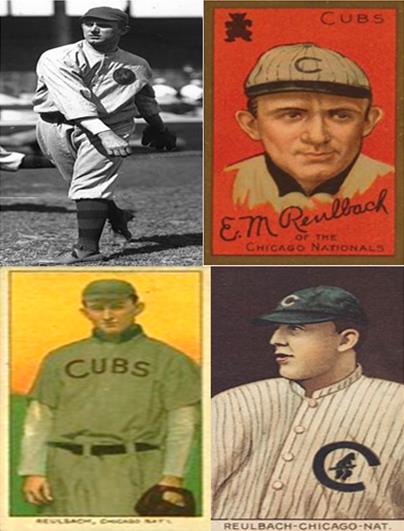
Baseball Trailblazers
Page 1026
Ed Reulbach
Edward Marvin "Big Ed" Reulbach, December 1, 1882 – July 17, 1961, was a major league baseball pitcher for the Chicago Cubs during their glory years of the early 1900s. Born in Detroit, Michigan, Reulbach played college baseball at the University of Notre Dame in 1903 and 1904. He played for the University of
Baseball Trailblazers Page 1027
Vermont in 1905, accumulating a 4-0 record before signing a contract with the Chicago Cubs in May.
In the 1906 World Series, ultimately won in six games by the Chicago White Sox, Reulbach shone in Game 2 at South Side Park, giving up only one hit, a seventh inning single to Jiggs Donahue. Reulbach's best year was 1908, when he won 24 games for the National League and World Series champion Cubs, their last Series championship until 2016. He pitched two shutouts in one day against the Brooklyn Dodgers on September 26, 1908. No other pitcher has ever accomplished this feat in the major leagues.
Reulbach ended his major league career after the 1917 season with the Boston Braves with a win–loss record of 182–106, and an earned run average of 2.28.
At the age of 78, he died in 1961 on the same day, July 17, as Ty Cobb; in Glens Falls, New York.
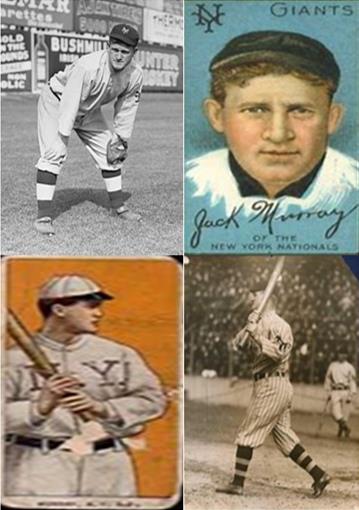
Baseball Trailblazers
Page 1028
Red Murray
John Joseph "Red" Murray, March 4, 1884 – December 4, 1958, was an outfielder in major league baseball. Murray was born in Arnot, Pennsylvania. In 1902, he attended Lock Haven College, where he played football, basketball, and baseball. In 1904, Murray changed schools to the University of Notre Dame, playing as a catcher for the Fighting Irish. In 1906, he was signed by
Baseball Trailblazers Page 1029
the St. Louis Cardinals, and the next year he played right field and hit seven home runs. During the season, Murray hit a 471
foot home run. In 1908, he played in all 154 games and finished second in the National League in stolen bases - 48, and third both in hits – 167, and home runs - 7.
Murray was traded to the New York Giants and helped win John McGraw three consecutive pennants. From 1909 to 1912, he ranked third in the league in runs batted in, trailing only Honus Wagner and Sherry Magee. Murray and Wagner tied for the most home runs in the majors from 1907 through 1909 with 21.
According to popular myth, Murray is remembered for being struck by lightning in a 1914 game. Murray, playing in the outfield for the New York Giants, caught a fly ball which would prove to be the final out of a 21 inning game on July 17, 1914. Immediately after catching the ball Murray was struck by lightning and rendered unconscious, however, he managed to hold on to the ball, ending the game.
Murray last played in the majors in 1917.
In the April 1924 issue of Baseball Magazine, J.C. Kofoed, wrote; "Red Murray was for years noted as one of the greatest outfielders in the National League. His throwing arm was the best ever, and his ground covering ability and sureness of eye
Baseball Trailblazers Page 1030
were classic. Furthermore, he was remarkably fast as a base runner, and noted as a batter as well. In his seven seasons as a regular, Murray led NL outfielders in home runs, runs batted in, stolen bases, and assists a total of 16 times. Despite his impressive statistics in power hitting, base running, and fielding, he remains one of the least recognized stars of the dead ball era."
He batted .270, 1170 for 4334, with 37 home runs, and 321 stolen bases.
Murray died on December 4, 1958 of acute leukemia at the age of 74 in a hospital near Sayre, Pennsylvania.
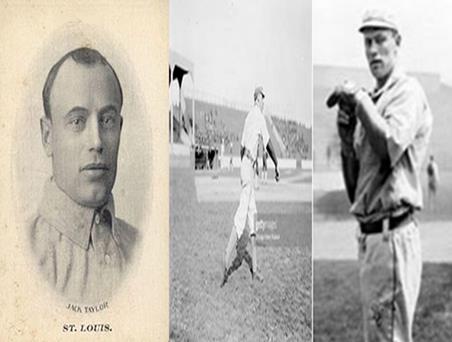
Baseball Trailblazers
Page 1031
Jack Taylor
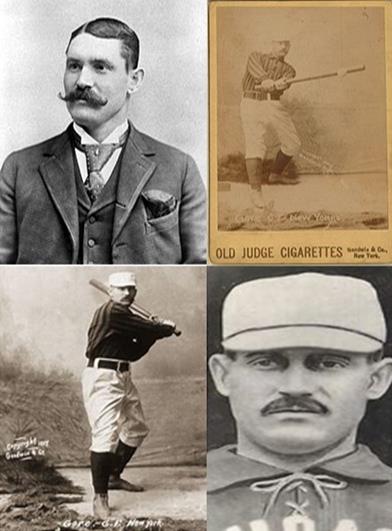
John W. Taylor, December 13, 1873 – March 4, 1938, was a right handed pitcher in major league baseball for the Chicago Cubs and St. Louis Cardinals. He made his major league debut with the Cubs on September 25, 1898. His best years as a pitcher were 1900 with a 2.55 earned run average, 1902 with a 1.33 ERA and 7
shutouts, 1903 - 2.45 ERA, and 1906 - 1.99 ERA. He recorded a career 2.65 ERA with a 152-139 win-loss log.
In 1904, Taylor set a major league record by pitching 39
consecutive complete games. Taylor actually threw 187
consecutive complete games between June 1901 and August 1906,
Baseball Trailblazers Page 1032
but this streak was interrupted by the seemingly silly technicality of him having had 15 additional relief appearances during the period. Thus Taylor appeared in 202 consecutive games without being relieved himself.
Taylor and fellow Cub Larry McLean were traded to the St. Louis Cardinals in return for Mordecai Brown and Jack O'Neill in December 1903; he was then traded back to Chicago in July 1906
in return for Fred Beebe and Pete Noonan.
Thus he was part of the great 1906 Cubs. That year the ERA for the entire pitching staff was 1.76. He also contributed to the World Series winning season in 1907.
Taylor died in Columbus, Ohio at the age of 64.
Baseball Trailblazers
Page 1033
George Gore
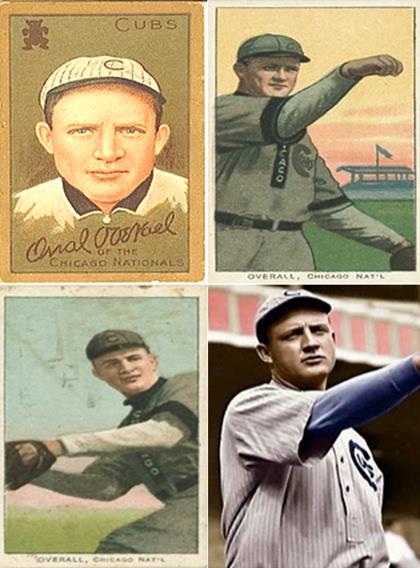
George F. Gore, May 3, 1854 – September 16, 1933, nicknamed
"Piano Legs," was a center fielder in major league baseball for 14 seasons, eight for the Chicago White Stockings, five for the New York Giants, one for the St. Louis Browns of the National League, and the New York Giants of the Players' League.
Baseball Trailblazers Page 1034
Gore was born in Saccarappa, Maine into a poor, country family.
As a young man, he grew up playing baseball in and around his hometown of Hartland. While working for, and playing for the S.D. Warren Paper Mill in Westbrook, Maine, his skills caught the attention of pro scouts and in 1877 he signed a contract with a team in Fall River, Massachusetts of the New England League. He showed up to his first professional baseball tryout without shoes.
The following year, he played for the New Bedford Whalers, batted .324 and helped the team win the New England championship. Scouts from seven major league teams were vying for his services, but it was when he was playing in an exhibition game against Anson's Chicago White Stockings team that he got his opportunity to sign a major league contract.
After the game, White Stockings owner Albert Spalding offered him a contract to play for his team, and Gore signed. Spalding offered him $1,200 a season, and although Gore originally asked for $2,500, they eventually compromised on $1,900.
He made his major league debut with Chicago on May 1, 1879. He played in 63 games that first season as the club's starting center fielder and batted .263. Gore excelled during his second season with Chicago, leading the league with a .360 batting average, as well as a .399 on-base percentage, and .463 slugging
Baseball Trailblazers Page 1035
percentage. Additionally, he finished in the top five among league leaders in runs scored, hits, doubles, runs batted in, bases on balls and singles.
In 1881 and 1882, Gore continued his hitting success, as he finished in the top 10 in multiple offensive categories. He led the league in runs scored both seasons, and walks in 1882] On June 25, 1881, he became the first known player to record eight stolen bases in one game when the Chicago Tribune noted that Gore stole second base five times and third base three times. It considered the all-time record even though at the time stolen bases were not recorded as an official statistic.
The White Stockings failed to finish the 1883 season in first place, after having captured league titles the previous three years. Gore's production did not decline despite his team's sinking performance as he was again among the top players in several offensive categories over the next two seasons, including a league leading 61 walks in 1884.
In 1885 and 1886 the White Stockings returned to the top of the NL. Gore's offensive production continued at a high level, again among league leaders in several categories. On July 9, 1885, in a game against the Providence Grays and their pitcher Charles Radbourn, he gathered five extra base hits; three doubles and
Baseball Trailblazers Page 1036
two triples. He is the first player to accomplish this feat, which has since been equaled many times, but never surpassed.
After the 1885 season, Chicago played the St. Louis Browns, the American Association champion, in a best of seven series of exhibition games known as the "World Series." The series ended with Chicago and St. Louis each winning three games, and one game ending in a tie. After the tie game, Gore was suspended for drunkenness and indifference, and was replaced for the rest of the series by Billy Sunday. Sunday later converted to Christianity and became a well-known evangelist. In 1886, Gore established career highs in bases on balls with 102, which also led the NL, and runs scored with 150, while the White Stockings again finished in first place. Following the season, the White Stockings again played the St. Louis Browns in another exhibition "World Series." St. Louis won the series, four games to two.
In the aftermath of the St. Louis series, there were not only charges of drunkenness among many of the players, but also allegations that players intentionally lost games for money, known then as "hippodroming." King Kelly had the reputation as being the hardest drinker, as well as the having the most active social life, which management tolerated due to his stellar play.
However, that meant instilling discipline in the other players,
Baseball Trailblazers Page 1037
who used Kelly as an example, was extremely difficult. On November 24, 1886, Gore was the first to go, when he was sold to the New York Giants for approximately $3,500. Writer Henry Chadwick said Gore "cannot play in harmony with Captain and Manager Anson, and Mr. Spalding has wisely released a discontented player whose skill as a fielder, batter, and base runner was offset by his unpleasant relations with the team captain."
Weeks after Gore's contract was sold to the New York Giants, Chicago writer Harry Palmer wrote that whenever Gore "failed to play ball for all he was worth, Anson has reprimanded him."
Socially, Palmer added, Anson says that Gore is all right. As an instance of their friendly relations, Anson says Gore applied to him for work this winter, and the big Chicago captain promised him employment on the toboggan slides at the White Stocking Park whenever he wanted it. In 1888, after seeing him in street clothes during a home game, the “New York Star” called him
"Budweiser Gore."
In his 1900 book “A Ball Player's Career,” Anson said Gore was a good player. Also, "Women and wine brought about his downfall, however, and the last time that I saw him in New York he was broken down, both in heart and pocket, and willing to work at anything that would yield him the bare necessities of life."
Baseball Trailblazers Page 1038
Gore joined a New York Giants team that had a roster that contained no less than six future Baseball Hall of Famers; John Montgomery Ward, Roger Connor, Buck Ewing, Tim Keefe, Mickey Welch, and Jim O'Rourke. Gore took his usual position in center field, replacing O'Rourke, who was the starter the previous season. Gore played well that first season in New York, batting
.290 and scoring 95 runs, but the team finished in fourth place in the National League.
For the 1888 season, Gore played in just 64 of the team's 138
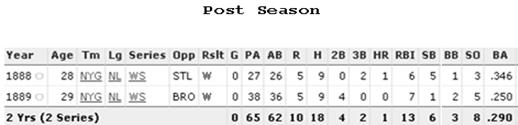
games. O'Rourke had reclaimed a starting position, this time in left field, while Gore split his playing time between center and left field. Gore's popularity waned early in the season, so much so that on May 3, New York fans screamed at on field captain Ewing to play Mike Slattery instead. Gore had already taken his position in left field, but Ewing made the change to Slattery before the game started. New York finished the season as the National League champions, and met the St. Louis Browns in the World Series. Gore appeared in three of the eleven games that were played during this post season exhibition. New York was declared the victor, winning six games, and Gore contributed five hits in eleven at bats for a .455 batting average during the series.
Baseball Trailblazers Page 1039
Gore regained his starting position in center field for the 1889
season, and his play improved over his 1888 performance. He batted .305, scored 132 runs, and hit seven home runs in 120
games played, although he did commit 41 errors in center field, which led the league. The Giants again finished the season as the champions of the NL, and met the Brooklyn Bridegrooms in the 1889 World Series after the season. New York was again declared the victor after winning six of the nine games exhibition games played. Gore played in five of these games, collecting seven hits in 21 at bats for a .333 batting average.
After the 1889 season, Gore's teammate, John Montgomery Ward, had organized a new league, the Players' League, and many players were a part of his new union of baseball players called
"The Brotherhood." The Players' League began play for the 1890
season, and Gore joined many of his fellow Giants as they joined the new league to play for the New York Giants. Again, Gore split his playing time between left and center field with both Slattery and O'Rourke, but did finish the season appearing in 93
of the team's 132 games, and batted .318 with 132 runs scored.
Following the 1890 season, the Players' League folded and all the players were allowed to return to their previous teams. Gore returned to the Giants along with all of his teammates. However, in 1891, the Giants did not return to their previous
Baseball Trailblazers Page 1040
championship status. They finished third among the league's eight teams, with Gore as their starting center fielder, while O'Rourke had moved to left due to the departure of Slattery.
Gore batted .284 and scored 103 runs in 130 games played.
Gore began the 1892 season as the starting center fielder of the Giants, but through an unknown transaction, had moved on to the position of player-manager for the St. Louis Browns of the NL.
He began his tenure on August 1, and it ended on August 18, during which time his Browns had a win–loss record of 6–9 in the games he managed. In the 20 games that he played in, his batting average was .205. He soon departed the team, and he never played major league baseball again.
In 1310 games over 14 seasons, Gore posted a .301 batting average, 1612 for 5357, with 1327 runs, 262 doubles, 94 triples, 46 home runs, 618 RBI, 170 stolen bases, 717 bases on balls,
.386 on-base percentage and .411 slugging percentage.
Gore led the NL in several seasonal offensive categories. He won the batting title in 1880 while playing for Chicago, along with league leading totals in on base percentage and slugging percentage. He also led the league twice in runs scored, and bases on balls three times. Gore was also the all-time leader
Baseball Trailblazers Page 1041
for most errors by major league outfielder upon his retirement with a 368 total.
Gore played for many successful teams throughout his career.
During his eight seasons with the White Stockings, they won the league title five times, including appearances in two World Series. Chicago played the St. Louis Browns in both 1885, which ended in a series tie, and 1886, with St. Louis winning the championship. He was also a member of the New York Giants' two National League championship teams in 1888 and 1889. Both Giants teams went on to claim World Series victories, against the St.
Louis Browns in 1888, and the Brooklyn Bridegrooms in 1889.
Twice he set single game records, one for stealing eight bases, and the other for collecting five extra base hits. Although he had statistics that put him consistently among the seasonal league leaders, he reportedly had a poor work ethic resulting from an active social life outside of baseball. This behavior did not endear him to his team captain, Cap Anson, which caused them to feud during Gore's time in Chicago.
After his career, he had major financial difficulties, having to move from job to job just to support his bare necessities. In 1894, a judge granted a divorce to his wife. Married since 1882, she had accused him of living in 1891 and into 1892 with someone
Baseball Trailblazers Page 1042
else as his wife, and that they lived as man and wife on “One Hundred and Twenty-Ninth Street" in New York City. Gore denied his wife's charge of having had intimate relations with this other woman. In 1933, months before his death at age 79, Gore told a reporter, "I haven't seen a sick day in seventy-five years, and I feel as good today as I did thirty years ago. I can't get around like I used to, but I still am able to walk three or four miles daily. That keeps me in good shape. I eat three hearty meals a day and my favorite diversion now is playing pinochle. I play it every night. It's great sport for us old timers." Gore died in Utica, New York at the age of 79, after having lived in Nutley, New Jersey the previous 13 years.
Baseball Trailblazers
Page 1043
Orval Overall
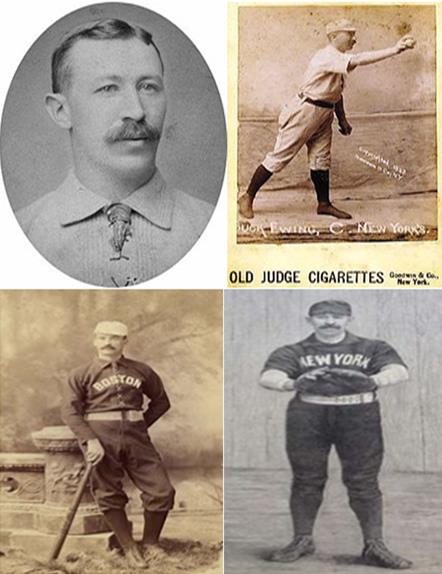
Orval Overall, February 2, 1881 – July 14, 1947, was a pitcher in major league baseball. He was a member of the Chicago Cubs dynasty of the early 1900s, making eight appearances for the Cubs in the World Series, including five as the starting
Baseball Trailblazers Page 1044
pitcher, winning three with a tie and a loss. Overall was born in Farmersville, California. He attended the University of California, Berkeley, where he was a member of Sigma Nu and captain of the football team. He was named an All-American in football.
Overall started his professional baseball career in 1904. With the Pacific Coast League's Tacoma Tigers, he pitched 510
innings, going 32–25 with a 2.78 earned run average. He was drafted by the Cincinnati Reds in September. In 1905, his rookie season, he was the ace of the Reds pitching staff and won 18
games. He struggled early in 1906, though, and was traded to the Chicago Cubs. In 18 games for Chicago, Overall went 12–3 with a 1.88 ERA. The 1906 Cubs set a major league record for wins in a season and won the National League pennant.
Overall pitched even better in 1907. He went 23–7 with eight shutouts and a 1.68 ERA. He also won a game in the 1907 World Series, and the Cubs won their first title. In 1908, Overall
"slumped" to just 15 wins but also won twice in the 1908 World Series as Chicago repeated as champions. In the series clinching game, he shut out the Detroit Tigers on three hits. In the first inning of that game, he became the only pitcher to strike out four hitters in one inning in a World Series game. In 1909, he
Baseball Trailblazers Page 1045
won 20 games and set a career low in ERA of 1.42. He also led the NL in strikeouts, with 205.
Overall retired after the 1910 season. He made a brief comeback in 1913. He played seven years in the major leagues in total, compiling a record of 108–71 with a 2.23 lifetime ERA. He was the vice president and manager of a bank after his baseball career ended. Overall died at the age of 66 in Fresno, California.
Baseball Trailblazers
Page 1046
Buck Ewing
Baseball Trailblazers
Page 1047
William "Buck" Ewing, October 17, 1859 – October 20, 1906, was a major league baseball player and manager. Renowned both for his offensive and defensive skills, he was the first 19th century catcher elected to the Baseball Hall of Fame. Born in Hoagland, Ohio, Ewing caught gloveless, and joined the National League in 1880 as a member of the Troy Trojans, but rose to stardom in 1883 as a member of the New York Gothams, later known as the
Baseball Trailblazers Page 1048
Giants. That year he hit 10 home runs, while batting .303.
Playing in an era when triples were more common than home runs due to the spacious parks, he led the league in 1884 with 20
triples, and was often among the league leaders.
Ewing was equally renowned for his defensive abilities. Writing in the “1938 Spalding Guide,” John Foster said of him; "As a thrower to bases Ewing never had a superior, and there are not to exceed ten men who could come anywhere near being equal to him. Ewing was the man of whom it was said; ‘He handed the ball to the second baseman from the batter's box.’" Primarily a catcher, Ewing was versatile enough to play all nine positions and fast enough to steal 354 bases. He hit .300 in ten different seasons.
Playing until 1897 with the Giants, Cleveland Spiders and Cincinnati Reds, Ewing posted consistently superb offensive numbers. Arguably his best season was in 1893 with the Spiders when he batted .344 with 6 home runs, 117 runs, 122 RBI, and 47
stolen bases.
In 1890, when a player revolt led to the formation of the short-lived Players' League, Ewing led the New York franchise as both star player and manager. Lingering resentment in the wake of the league's establishment and demise has been suspected as a reason
Baseball Trailblazers Page 1049
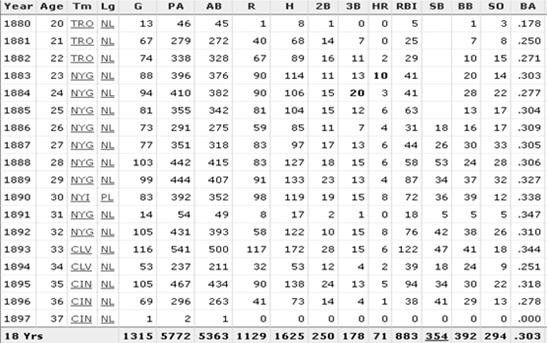
for his limited play in 1891 and subsequent move to Cleveland following the 1892 season. Ewing finished his career with a .303
lifetime batting average, 1129 runs, 883 RBI, 250 doubles, 178
triples, and 71 home runs; totals made more impressive by the fact he was playing annual seasons only 100-130 games long.
In addition to playing, Ewing managed for seven seasons; the 1890 Players' League Giants, the 1895–1899 Cincinnati Reds, and the first half of the season with the 1900 Giants. He compiled a 489-395 record for a .553 winning percentage.
Ewing died of diabetes in Cincinnati in 1906.
In the first elections to the Baseball Hall of Fame, Ewing and Cap Anson led all 19th century players. Three years later, in 1939, they were among the first 19th century players elected and Ewing became the first member who was primarily a catcher.
Baseball Trailblazers
Page 1050
Ed Siever
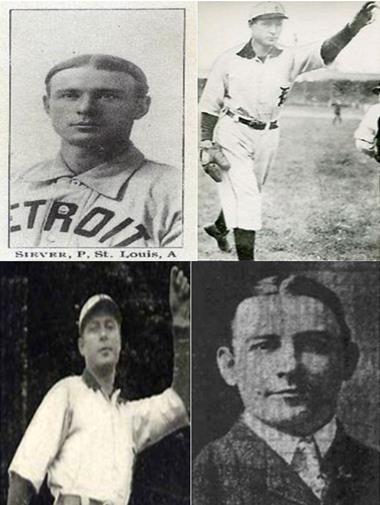
Edward Tilden Siever, April 2, 1875 – February 4, 1920, played professional baseball for 12 seasons from 1899 to 1910, including seven years in major league baseball with the Detroit Tigers and St. Louis Browns. He led the American League with a 1.91 earned run average in 1902. In seven major league seasons, Siever compiled an 83–82 win–loss record with a 2.60 ERA.
Baseball Trailblazers Page 1051
Siever was born in Goddard, Kansas. Prior to his professional baseball career he was a locomotive fireman for the Grand Trunk Railway. Siever began his professional baseball career with the London Cockneys in 1899 and 1900. He compiled a 14-8 record in 1899 and helped lead the Cockneys to the Canadian League pennant.
In 1900, he joined the Detroit Tigers, then a minor league club, compiling a 6-5 record with a 3.97 earned run average. He had a great pitching arm and a physique as strong as a young lion.
In 1901, the American League became a major league. In the Tigers' inaugural season as a major league club, Siever and Roscoe Miller were the team's leading pitchers. Siever appeared in 38 games, 33 as a starter, compiled an 18-14 record and a 3.24 ERA with 30 complete games and 85 strikeouts in 288 innings pitched.
In 1902, Siever led the American League with a 1.91 ERA.
However, the 1902 Tigers lacked hitting and finished in seventh place. Despite his 1.91 ERA, Siever compiled an 8-11 record. On August 11, 1902, Siever and Rube Waddell engaged in a pitching duel that held both sides scoreless through 12 innings. Waddell hit a triple off Siever in the 13th inning to drive in the
Baseball Trailblazers Page 1052
game's only run. Siever suffered from arm strain after the pitching duel with Waddell and was only able to pitch in two more games that season.
In December 1902, contract negotiations between the Tigers and Siever broke down over money. In the end, Siever was sold to the St. Louis Browns. In 1903, he compiled a record of 13-14 with a 2.48 ERA in 254 innings pitched. The following year, he had a 10-15 record 2.65 ERA in 29 games.
In January 1905, the Browns released Siever to the Indianapolis Indians in the minor leagues. He ended up with the Minneapolis Millers and, with his arm in perfect working order, compiled a 23-11 record with a 2.74 ERA in 35 games for the Millers.
In February 1906, Siever again signed with the Detroit Tigers.
He appeared in 30 games for the 1906 Tigers and compiled a 14-11
record and 2.71 ERA in 222+2⁄3 innings pitched. The following year, Siever compiled an 18-11 for the 1907 Tigers team that went 92-58 and lost to the Chicago Cubs in the 1907 World Series. Siever's 2.16 ERA ranked 10th in the American League in 1907. While control and speed were his best assets in his early career, in later years he resorted to the use of a slow ball, using it in conjunction with a ball that burned.
Baseball Trailblazers Page 1053
Although his major league career ended in 1908, he pitched for two additional years in the minor leagues with Aberdeen and Grays Harbor in 1909 and Chattanooga in 1910. After retiring from professional baseball, Siever continued to play amateur baseball in a Detroit Masonic league until he was badly injured in a fall. Siever was employed by the Board of Water Commissioners. He was married and had three sons with his wife, Charlotte. Siever died suddenly in 1920 at age 44. The cause of death was believed to be heart disease.
Baseball Trailblazers
Page 1054
Ping Bodie
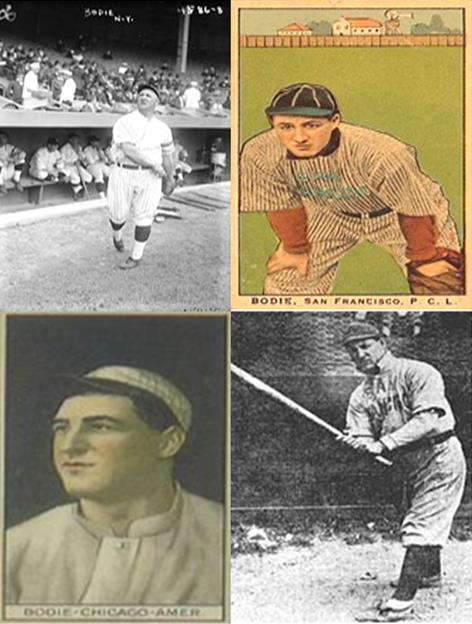
Frank Stephen "Ping" Bodie, October 8, 1887 – December 17, 1961, born Francesco Stephano Pezzolo, was a center fielder in major league baseball who played for the Chicago White Sox from 1911–
Baseball Trailblazers Page 1055
1914, the Philadelphia Athletics in 1917, and the New York Yankees from 1919–1921. Bodie batted and threw right handed. He was born in San Francisco. One of the most feared sluggers in the 1910s, Bodie was nicknamed "Ping" for the sound made when his fifty-two ounce bat crashed into the "dead" ball of his era.
Another nickname given to him was "The Wonderful Wop." He took the surname Bodie from the California town he once lived in.
In 1910, playing for the San Francisco Seals of the Pacific Coast League, Bodie hit the then fantastic total of 30 home runs, and quickly broke into the big leagues with the Chicago White Sox in 1911. Ping became a regular for four years with Chicago hitting .289 with 97 RBIs, .294, .265, and .229. After some clashes with manager Jimmy Callahan in 1914, he was sold back to the San Francisco Seals.
In 1917, Bodie returned to the major leagues with the Philadelphia Athletics. In that season he ranked among the American League top 10 in eight offensive categories including; 7 home runs - 3rd, 74 RBIs - 6th, 233 total bases - 5th, 46 extra base hits - 5th, 11 triples - 8th, 28 doubles - 9th, and a .418
slugging percentage - 6th. He also led AL outfielders with 32
assists.
Baseball Trailblazers Page 1056
In 1918, the New York Yankees purchased first baseman George Burns from the Detroit Tigers and immediately traded him to the Athletics for Bodie. With the Yankees he batted .256, .278 and
.295 in three full seasons. It was during this time that Bodie became Babe Ruth's first Yankee roommate. When asked about rooming with Ruth, Bodie said "Room with him. Why, I room with the big monkey's baggage!"
Noted for a voracious appetite, Bodie competed against a Jacksonville Zoo ostrich named Percy in an eating contest on April 3, 1919 which had been arranged by Yankees co-owner Cap Huston as a publicity stunt. Percy had previously been touted as the "world's greatest eater." The contest was structured similar to a boxing match, with Bodie selecting his favorite dish of spaghetti as the food to be devoured. He was declared the winner after finishing his 11th plate before Percy passed out while starting his.
Bodie was traded to the Boston Red Sox in August 1921. New York went on to win the American League pennant that year. When Bodie asked for a half share of the 1921 World Series money, the Yankees turned him down. After the season was over, he refused to go back to the Red Sox and returned home.
Baseball Trailblazers Page 1057
Bodie spent the next seven seasons in the minors playing with the Vernon Tigers and San Francisco Missions in the Pacific Coast League, the Des Moines club in the Western League, and the Wichita Falls and San Antonio Missions in the Texas League.
In a nine season major league career, Bodie was a .275 hitter with 43 home runs and 514 RBIs in 1,050 games.
After his retirement from baseball, Bodie was an electrician for 32 years on Hollywood movie lots and a bit actor, mostly with Universal Studios. Bodie died of cancer in San Francisco, California, at the age of 74.
Baseball Trailblazers
Page 1058
Reb Russell
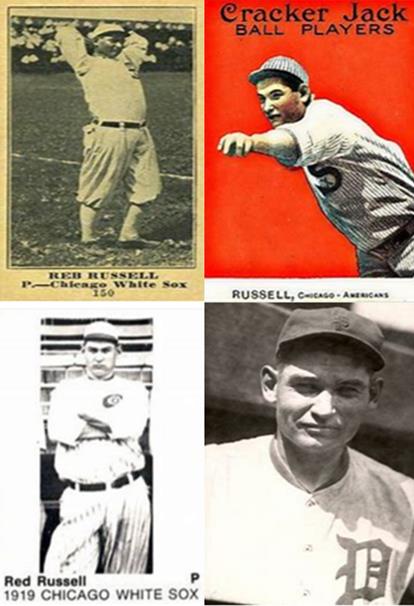
Ewell Albert "Reb" Russell, March 12, 1889 – September 30, 1973, was a major league baseball player for the Chicago White Sox and
Baseball Trailblazers Page 1059
the Pittsburgh Pirates. He hailed from Jackson, Mississippi, and could hit as well as pitch.
Russell was drafted by the White Sox as a pitcher in 1912. In his rookie season, his won-loss record was 22–16 and he led the league in games pitched, with 52. The lefty had a sterling 1.90
ERA while leading the team in innings pitched and wins. Only Washington's ace Walter Johnson topped Reb's eight shutouts.
In 1916, he was Chicago's opening day starter. That year he led the team in wins - 18, innings - 264, and shutouts - 5.
Russell helped the White Sox win the 1917 American League pennant, with a won-loss record of 15–5 and an ERA of 1.95. He was the starting pitcher of Game 5 of the 1917 World Series, but was unable to retire a batter and was replaced in the first inning by Eddie Cicotte.
Russell developed arm trouble in 1918 and, after a poor start, was released by Chicago.
However, in the minor leagues the decent hitting Russell converted to playing the outfield and returned to the majors in 1922, playing with the Pittsburgh Pirates. That year, he batted
.368 with 12 home runs and 75 RBI in 60 games. That concluded his major league career with a win–loss record of 80–59, an earned run average of 2.33, and a batting average of .268.
Baseball Trailblazers Page 1060
On being released at the end of the 1923 season he returned to the minor league American Association, the highest level of minor league play in his era. Russell remained a highly paid star in the AA through age 40, and won the league batting title at .385 when he was 38 years old.
He died at age 84 in Indianapolis, Indiana.
Baseball Trailblazers
Page 1061
King Kelly
Baseball Trailblazers
Page 1062
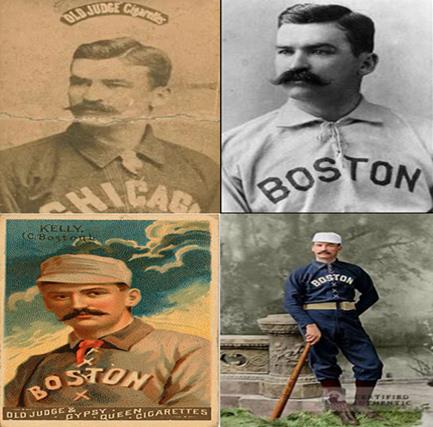
Michael Joseph "King" Kelly, December 31, 1857 - November 8, 1894, also commonly known as "$10,000 Kelly," was an outfielder, catcher, and manager in various professional American baseball
Baseball Trailblazers Page 1063
leagues including the National League, International Association, Players' League, and the American Association. He spent the majority of his 16 season playing career with the Chicago White Stockings and the Boston Beaneaters. Kelly was a player-manager three times in his career; in 1887 for the Beaneaters, in 1890 leading the Boston Reds to the pennant in the only season of the Players' League's existence, and in 1891
for the Cincinnati Kelly's Killers, before his retirement in 1893. He is also often credited with helping to popularize various strategies as a player such as the hit and run, the hook slide, and the catcher's practice of backing up first base.
Kelly was born in Troy, New York, to Michael Kelly Sr. and his wife Catharine, both Irish immigrants. Upon the outbreak of the American Civil War, his father joined the Union Army, and Mike likely learned to play baseball while living with his mother and younger brother James in Washington, D.C. After the war, his ill father moved the family to Paterson, New Jersey. Kelly's parents apparently died within about five years of each other and he was orphaned by age 18.
By 1873, the fifteen year old Kelly was good enough to be invited to play baseball on Blondie Purcell's amateur team in Paterson, which played teams throughout the New York metro area, including the Brooklyn Atlantics from the National Association.
Baseball Trailblazers Page 1064
From 1875 to 1877, he played three seasons as a semi-pro; in Paterson and then other cities.
In 1877, he was with the Paterson Olympics until around June 10, when he joined the Delawares of Port Jervis, New York. In mid-July, a Paterson paper said he had signed with a Springfield, Ohio team after rejecting a Port Jervis offer of $70 a month. A few weeks later, Port Jervis had not played again when he signed
"with the celebrated Buckeye club of Columbus, Ohio."
He made his big league debut in 1878 with Cincinnati. In 1877, Kelly's friend Jim McCormick was signed to play for the Columbus Buckeyes of the International Association, and he recommended that his friend Mike be signed to be his catcher. The year after that, Kelly signed to play for the Cincinnati Reds, then known as the Red Stockings. Although the concept would come later, Mike Kelly was now a major leaguer.
After playing in Cincinnati for two years as an outfielder and backup catcher, Cincinnati and Chicago White Stockings players went on a tour of California. While there, Chicago secured him for 1880, then Chicago Secretary Albert Spalding doing the signing. Later from San Francisco, Kelly wrote Spalding, who was back in Chicago; "Cincinnati Club has gone back on us. Please send expenses. Am broke." Cincinnati had fallen on hard times by
Baseball Trailblazers Page 1065
1879 and released all their players at the end of that season to save having to pay them a last paycheck.
As of 1879, Chicago was the most important city financially in the National League, as it drew the best attendance for teams taking long train rides from the East Coast.
Kelly was now a young, good looking man in the big city with money in his pocket. Rather than buying a house, he immediately moved into the Palmer House, the loudest, brashest, most garish and, according to its literature, "fire-proof" hotel in the world.
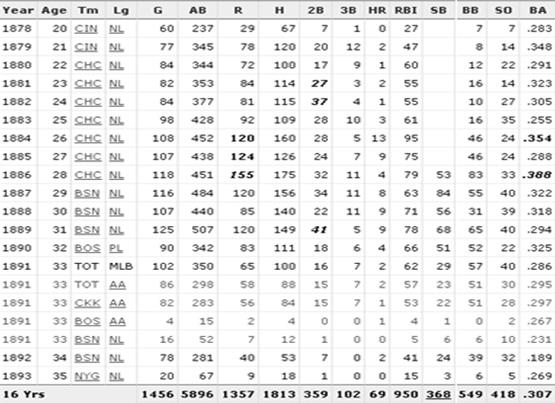
As a member of the White Stockings, he was annually among the league leaders in most offensive categories, including leading the league in runs from 1884 through 1886; 120, 124 and 155
respectively, and batting in 1884 and 1886; .354 and .388. One of the best defensive catchers in baseball, he was also one of the first to use a glove and wear a chest protector. Chicago won five pennants while Kelly played for the White Stockings.
After the 1886 season Spalding sold Kelly to the Boston Beaneaters for a then record $10,000, after Kelly balked at returning to the club. Right before the sale, Chicago writer Happy Palmer quoted Spalding about his plans to manage Kelly;
"Oh, tie him up, I guess, if he really is averse to playing
Baseball Trailblazers Page 1066
here. He may have his ugly up, and I guess from the way he is holding out in his refusal to sign that that is the case. All right, though. I am willing, and if he keeps on in that spirit I'll make him eat hay with his horses before he is much older.
He has been mad long enough now, and it is pretty near time somebody was getting mad at this end of the line. One thing I can certainly predict and that is that if Mr. Mike Kelly does not sign a contract with Chicago pretty damned quick, he will have cause to regret it. That is all."
As a result of the sale, he became known as the "$10,000
Beauty." In 1881, actress Louise Montague had been so dubbed after winning a $10,000 contest for handsomest woman in the world.
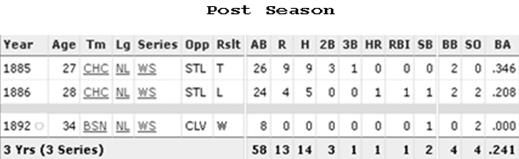
It was in Boston that Mike became "King" Kelly, although he was still overwhelmingly referred to as "Mike" or "The Only" in contemporaneous reporting. As a member of the Beaneaters, he continued to be a key run producer, scoring 120 runs in 1887 and 1889. He continued to play well and was a great box office draw, but Boston didn't win any pennants. Freed from the watchful eye of Spalding and Anson, Kelly became less self-disciplined. One day in 1888, Boston player-manager John Morrill fined him $100
for not reporting to the grounds. After dinner the night before, Kelly had told Morrill he was ill, and Morrill said he should
Baseball Trailblazers Page 1067
still report. The “Boston Herald” said; "Every man on the team thinks the $100 fine was deserved." The “Herald” also said of Kelly; "At times he goes in and plays with his whole spirit, and he puts life into the team. A sample of that was seen in yesterday's game, a game that he won for the Bostons. At other times he plays carelessly and indifferently, puts on a spirit of independence, disobeys Morrill instructions at will, and does as he pleases."
Kelly managed and played for the Boston Reds in the year lived Players' League in 1890, and the Reds won the only Players'
League title.
During the 1890 season, friends bought him a $10,000 house at South Hingham, Massachusetts, about 15 miles southeast of Boston. Contributors included former umpire John Kelly, the owner of their New York bar; Boston fans Arthur "Hi! Hi!"
Dixwell and Frank Norton, and Boston Players' League President Charles A. Prince and Secretary Julian B. Hart. They contributed $300 each. Others who gave included John Graham, Jim McCormick, and captains Buck Ewing of New York and John Montgomery Ward of Brooklyn. The house, worth $10,000, could not be mortgaged based on the $1,100 in donations, $400 of which went for a horse and carriage, so in the winter of 1890-91, father-in-law John Headifen "came to the rescue of his friends and subscribed
Baseball Trailblazers Page 1068
$1800, the “Boston Record” said. The Old Colony Savings Bank in Plymouth then gave a matching $2,500 loan, and with that a mortgage was obtained. When he signed with Boston in August 1891, the club's directors gave him a check for $4,300 for
"lifting the mortgage on his 'popular subscription' home."
The house, stable and land would be put up for sale in the spring of 1893 for unpaid taxes of $123. It also had a $2,000
mortgage left at five percent interest. In October 1893, the house would be sold.
In 1898, Boston National League Director William H. Conant would recall having paid, around the time of the 1891 payment, a $200
bar bill for Kelly and friends and being forwarded, on a visit to the bar later that night, another Kelly tab for $140.
In 1891, Kelly returned to Cincinnati as the captain of a newly established American Association club there. The team was generally known as the Reds, but were also often called "Kelly's Killers" in the media due to Kelly's strong presence. The team was in seventh place when it folded in mid-August, and Kelly signed with the Boston Reds, who had moved to the Association after the Players' League folded. He spent just four games with the Reds before jumping back across town to the Beaneaters to finish out the season.
Baseball Trailblazers Page 1069
After spending the 1892 season with the Beaneaters, batting a career worst .189, his contract was assigned to the New York Giants for 1893. He played just 20 games for the Giants, batting
.269 and driving in 15 runs.
Kelly's big league career ended after the 1893 season, having compiled 1357 runs, 69 home runs, 950 RBI, and a .308 batting average.
In 1894, Kelly signed with Albert L. Johnson, the main benefactor of the 1890 Players' League, to play for his new minor league club in Allentown, Pa. Days before signing him, Johnson had assumed control of the Allentown and Lehigh Valley Traction Company, a trolley line.
In one of the last significant comments about Kelly's baseball-financial career, George W. Floyd said the following to the
“Chicago Herald” in March 1894; "Kelly got the worst of it in every deal he made. When he went from the Boston players' team in 1890 to the local association club in 1891 he helped that team to make over $100,000. The club at that time was no better than fifth and his desertion more than anything else gave the finishing blow to the brotherhood [Players' League]. Mike was popular wherever he played. The trouble with him was that he had no brain as he himself was concerned. He knew enough to make
Baseball Trailblazers Page 1070
money for others, but never could make anything for himself. I don't think that his playing days are over yet, but every club in the league seems inclined to turn him down. Mike has a great many friends in every town where baseball is played and it will be bad policy on the magnates' part to retire him from the game which he has adorned so long."
In mid-August 1894, Allentown left the Pennsylvania State League for the Eastern League and moved to Yonkers, N.Y., where Johnson also had a streetcar line. "The parting may be cruel and mercenary; but regrets; well, hardly any. So au revoir, Mike,"
the “Allentown City Item” said. Before disbanding, Kelly failed to heed Johnson's instructions to release the players. By not releasing them, his old league was able to file a complaint with baseball's Board of Control challenging the maneuver. At a meeting in New York, the board ruled that for the next ten days, the Pennsylvania State League could claim Allentown's players.
Eastern League President Pat Powers said Kelly was to blame "and President A. L. Johnson of the latter club - Allentown, who was also present, voiced the same sentiments," the “New York Sun”
said.
The song, "Slide, Kelly, Slide" was America's first "pop hit"
record, after its release by Edison Studios, and in 1927
inspired a film version of “Slide, Kelly, Slide.” Prior to that
Baseball Trailblazers Page 1071
song, most recordings were opera, religious or patriotic in nature. Kelly is also considered to have been the first man to popularize autographing, as fans pursued him on his way to the ballpark for his signature in the 1890s. Prints of a painting of him sliding into second hung in most Irish saloons in Boston, and he was among the first athletes to perform on the vaudeville stage. His own autobiography, “Play Ball,” was the first written by a baseball player. The book was put together by “Boston Globe” reporter John Drohan.
Kelly took up acting soon after his arrival in Boston. Fellow Boston Elk lodge member and actor Nat Goodwin, repeatedly urged Kelly to abandon his diamond affiliations and embrace the fascinations of stage life, Goodwin claiming that Kelly is a natural born comedian. Goodwin, a native of Boston, had been a founder of its Elks lodge in 1878. George W. Floyd, Goodwin's manager and a native of nearby Quincy, was also a charter member of the lodge and one of its early directors. Floyd was arguably the first player agent in baseball history. For example, in 1892, Floyd told the “Chicago Herald” that he had secured Kelly's new contract with Boston. It included a percentage of the club's earnings above $10,000. Floyd also said; "Kelly is taking the best care of himself and is well fixed. The boodle is
Baseball Trailblazers Page 1072
in the shape of gilt edged securities and 'mammy,' as Kel affectionately terms his wife, has charge of it."
In March 1888, Kelly made his regular play debut, as Dusty Bob in Charles H. "Charley" Hoyt's "A Rag Baby." Hoyt had been a Boston baseball writer and was a Boston Elk. A national fraternal group, the Elks were founded in the 1860s and into the mid-twentieth century had close ties to the theatrical profession.
As an example of his later vaudeville career, during the off seasons of 1892-93, which extended into the 1893 season, he appeared in January 1893 in New York at the Imperial Music Hall on West 29th Street. He was billed as "King Kelly, the Monarch of the Baseball Field." His trousers and shirt collar were too big and he buttoned his jacket wrong. Also, his straw hat was a size too small. "It was impossible to look at this vaudeville makeup and not laugh," the “New York Sun” said. Kelly laughed, too, and shook a roll of music at a lot of friends up in the private boxes. Kelly came on after two French singers of opera.
Stage partner William "Billy" Jerome "took off his hat to him, and introduced him as 'Mr. Kelly, the famous $10,000 peach.'"
They sang a parody. Later, after reciting "Casey at the Bat," he said, according to the “Sun,” "I'm right at home with Casey."
Also, "It's the first time I've been in these clothes, and I
Baseball Trailblazers Page 1073
don't quite understand them. Besides I've been over to Guttenberg [a track in New Jersey] today, and that is an excuse for anything that a man may do. Come and see me again. I'm obliged for your welcome."
In the off-season of 1893-94, Kelly performed with Mark Murphy in "O'Dowd's Neighbors." Of the first city on the tour, Dover, N.J., Murphy said Kelly called it "the very first town I ever played a game of ball in out of Patsy!" Patsy, Murphy explained,
"is Kellyesque for Paterson."
Kelly was an adept base runner, leading the National League in runs scored three times and ranking among the league leaders in stolen bases.
His base running was legendary in other ways as well. His arguably most frequent brilliant play was always legitimate; a feet first hook slide to avoid being tagged. In 1889, Tim Murnane of the Boston Globe said nine times out of ten, Kelly will "throw himself out of the reach of the baseman, and catch the bag from the outside." Also, "Kelly is not a sprinter, but can get a great start, and this counts more than a fine slide, as a catcher is likely to be hurried when he sees the runner well on his way to a base."
Baseball Trailblazers Page 1074
Upon Kelly's death, former teammate Tom Brown said; "He originated the slide which I do now in base running, and which is very generally copied by many ball players. The scheme is to slide to the side and get out of the way of the baseman, and not dash into him in the old way. Owing to the success of Kelly's sliding the topical song, `Slide, Kelly, Slide!' by J. W. Kelly, was written."
Kelly also became famous for making unusual plays. He seems to have performed most just a few times and probably made a bigger mark with verbal trickery, while catcher or coacher at first or third base. Right after his death, his longtime captain-manager in Chicago, Cap Anson, said he was a "genius" as a coacher.
Apparently referring to Kelly's ability to distract opposing fielders, Anson said; "Many a run has been scored through Kelly's trickiness. He was a rattling all around man, but his cleverest work was done behind the plate. He was full of tricks and was never so happy as when playing a practical joke." A year later, Anson said; "Mike Kelly was the prince of base runners.
I've never seen a man equal to him in that line, and he could get away with more sharp tricks than any man who ever wore a baseball uniform."
In November 1894, Kelly died of pneumonia in Boston. He had taken a boat there from New York to appear at the Palace Theatre
Baseball Trailblazers Page 1075
with the London Gaiety Girls. At the start of the final week of his life, an advertisement in Boston read; "’Slide, Kelly, Slide.’ Palace Theatre. The London Gaiety Girls, Chaperoned by King Kelly, the Famous $10,000 Base Ballist." During the week, his name was deleted when he was too ill to appear. "He caught a slight cold on the boat from New York, but thought little of it", a writer said upon his death.
During that week in Boston he stayed in the Plymouth House, owned by Bill Anderson, a fellow Elk. Noticing how ill Kelly seemed, Anderson had him rest and called for a doctor. The doctor had him taken to his private room in the hospital.
Kelly's wife and brother were notified and did not arrive in time to see him alive. Anderson, fellow Elk John Graham and the former secretary of Boston of the Players' League and the American Association, Julian B. Hart, were with him at the end.
Aggie, who never remarried, died in 1937 in New Brunswick, New Jersey. After Mike's death, she made her living by sewing, stopping when her eyesight failed. Seventeen months before her death, and her health declining, she was interviewed by the “New Brunswick Sunday Times.” She said Mike to her was "just an overgrown kid" and, in a reporter's paraphrase, "always eager to help a young fellow on the field, never pugnacious despite his
Baseball Trailblazers Page 1076
marvelous build of 190 pounds and six feet in height, and charitable to the extreme."
Baseball Trailblazers
Page 1077
George McQuillan
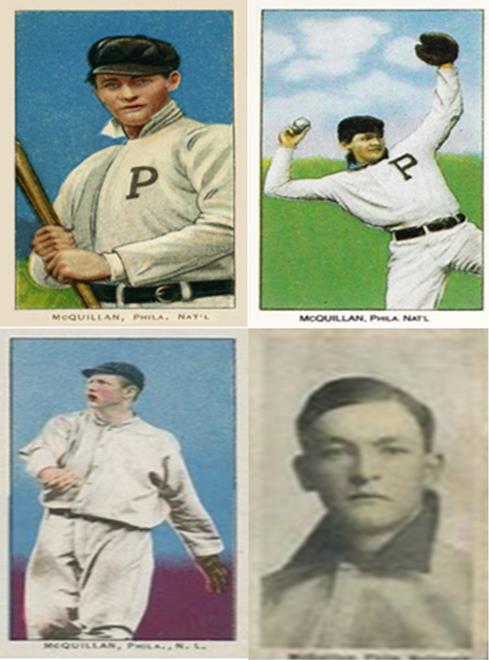
George Watt McQuillan, May 1, 1885 – March 30, 1940, was a professional baseball pitcher from Brooklyn, New York, who
Baseball Trailblazers Page 1078
played in major league baseball from 1907 to 1918 for the Philadelphia Phillies, Cincinnati Reds, Pittsburgh Pirates and Cleveland Indians.
In 1907 he set one of the longest lived records in major league history when he pitched 25 innings before giving up the first earned run of his career. Although others have pitched more consecutive innings without an earned run, until July 2008 no one had gone longer without prior major league experience.
McQuillan's extraordinary success as a rookie was no fluke. He posted a 1.69 ERA in his first four seasons, comprising more than 800 innings pitched. McQuillan helped the Phillies win the 1915 National League Pennant. He is still the Philadelphia Phillies Career Leader in ERA - 1.79, and Hits Allowed Per 9
Innings Pitched (HAPNIP) - 6.93. He currently ranks 23rd on the major league baseball career ERA List at 2.38, and 86th on the HAPNIP list at 7.89.
In 10 seasons he had an 85–89 win–loss record, and 17 Shutouts.
McQuillan's major league career was cut short due to his chronic alcoholism. However, he continued to play and coach in the minor leagues and semi-pro ball. He died in Columbus, Ohio at the age of 54.
Baseball Trailblazers
Page 1079
Tip O’Neill
Baseball Trailblazers
Page 1080
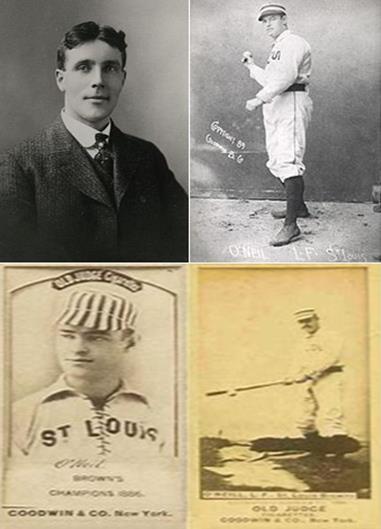
James Edward "Tip" O'Neill, May 15, 1860 - December 31, 1915, was a Canadian professional baseball player from approximately 1875 to 1892. He began playing organized baseball in Woodstock, Ontario, Canada, and later played ten seasons in Major League Baseball, principally as a left fielder, but also as a pitcher, for four major league clubs.
Baseball Trailblazers Page 1081
While playing with the St. Louis Browns, later renamed the Cardinals, from 1884 to 1889, O'Neill helped the club compile a 516-247 record while also winning four pennants and the 1886
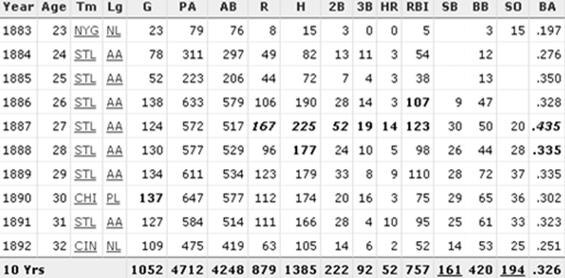
World Series. O'Neill won two American Association batting championships during those years and became the second person in major league history to hit for a triple crown, leading the league in 1887 with a .435 batting average, 14 home runs and 123
runs batted in. He also rewrote the major league record book, establishing new records in at least eight categories, including the highest batting average - .435, on base percentage - .490, slugging percentage - .691, most hits - 225, runs scored - 167, doubles - 52, extra base hits - 84, and total bases - 357 in a single season. His .435 batting average in 1887 remains the second highest in major league history. O'Neill has been dubbed
"Canada's Babe Ruth."
O'Neill was born in Springfield, Ontario, Canada, a village in Southwestern Ontario that was later incorporated into the city of Malahide. While O'Neill was a boy, his family moved approximately 30 miles northeast to Woodstock, Ontario, where his parents operated a hotel.
In 1875, O'Neill began playing organized baseball in Woodstock, Ontario, Canada, and became known as "The Woodstock Wonder." He also traveled with barnstorming teams. In 1881, he reportedly
Baseball Trailblazers Page 1082
played in Detroit, and in 1882, he played for the New York Metropolitans in the League Alliance.
O'Neill made his major league debut on May 5, 1883, as a pitcher for New York Gothams, later renamed the Giants, of the National League. Shortly after his major league debut, “Sporting Life”
wrote; "O'Neill, the New York change pitcher, seems to have but one element of effectiveness in his delivery, viz.: fast and slow. This is a very weak reliance nowadays, as batsmen have only to note the speed of the ball and wait for a good one.
O'Neill's delivery is wild and erratic; hard work for the catcher and busy work for the field." O'Neill appeared in 19
games as a starting pitcher for the Gothams and compiled a win-loss record of 5-12 and a 4.07 earned run average.
In 1884, O'Neill joined Charlie Comiskey's St. Louis Browns, later renamed the Cardinals, of the American Association. He was signed by Comiskey to replace pitcher Tony Mullane, who left the Browns after the 1883 season. O'Neill compiled an 11-4 win-loss record with a 2.68 ERA and led the league with a .733 winning percentage as pitcher. However, his arm reportedly "went back on him" during the 1884 season, requiring him to switch from pitching to playing in the outfield. He ended up playing 64
games as an outfielder in 1884 and was exclusively an outfielder thereafter.
Baseball Trailblazers Page 1083
In 1885, O'Neill missed much of the season, suffering an injury on June 10 and not returning to the lineup until September 3.
Despite the injury, O'Neill established himself as the Browns'
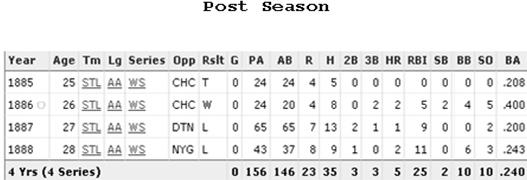
best batter, hitting .350 in 52 games, nearly 80 points higher than any other player on the team. The 1885 Browns won the American Association pennant with a 79-33 record and tied the Chicago White Stockings in the 1885 World Series. O'Neill scored four runs but hit .208 in his first World Series.
O'Neill played his first full season as a position player in 1886 and became one of the most valuable players in baseball. He appeared in 138 games, all as an outfielder, and led the league with 107 runs batted in. He was also among the league leaders with a .328 batting average, a .385 on base percentage, a .440
slugging percentage, 190 hits, 255 total bases, and 45 extra base hits.
O'Neill's hitting helped lead the Browns to the American Association pennant with a 93-46 record. The team also went on to defeat the Chicago White Stockings of the National League in the 1886 World Series. O'Neill hit .400 with a .500 on base percentage, five runs scored, five RBIs, two home runs and two stolen bases in the World Series.
Baseball Trailblazers Page 1084
In 1887, O'Neill rewrote the major league batting record book in just 124 games. That year, he won the American Association triple crown with a .435 batting average, 14 home runs and 123
RBIs. O'Neill's average for 1887 remains the second highest single season batting average in major league history.
O'Neill's hitting in 1887 helped lead the Browns to their third consecutive American Association pennant with a 95-40 record.
The Browns lost the 1887 World Series to the Detroit Wolverines, as O'Neill hit .200 in 65 at bats against Detroit's pitching in the World Series.
In 1888, O'Neill won his second consecutive American Association batting title by hitting .335. He also ranked among the league leaders in multiple hitting categories for the third consecutive year.
With O'Neill again leading the club in hitting, the Browns won their fourth consecutive pennant in 1888 with a 92-43 record.
The Browns lost the 1888 World Series to the New York Giants, though O'Neill compiled a .349 on base percentage with eight runs, 11 RBIs and two home runs in his final World Series.
O'Neill had his fifth consecutive strong season as a batter in 1889. He appeared in 134 games in the outfield and compiled a
.335 batting average, the second highest in the American
Baseball Trailblazers Page 1085
Association. He again ranked among the league leaders in multiple batting categories. The Browns compiled a 90-45 record in 1889 but finished in second place, two games behind the Brooklyn Bridegrooms.
In O'Neill's first six seasons with the Browns from 1884 to 1889, he appeared in 656 games, scored 585 runs, and hit .347
with a .407 on base percentage, a .498 slugging percentage, 925
hits, and 538 RBIs. During those six seasons, he was the Browns'
dominant hitter and helped the club win four pennants and compile a record of 516 wins and 247 losses.
O'Neill followed Charlie Comiskey to the Players' League in 1890, appearing in 137 games as an outfielder for Comiskey's Chicago Pirates. He hit .302 in the Players' League with a .377
on base percentage.
O'Neill followed Comiskey back to the Browns in 1891. He appeared in 127 games in the outfield and was among the league leaders with a .323 batting average, and eight other significant offensive categories.
In 1892, Charlie Comiskey jumped to the Cincinnati Reds of the National League, and O'Neill again followed Comiskey. In nine of ten years of O'Neill's career, he played on teams managed by Comiskey. O'Neill appeared in 109 games as an outfielder for the
Baseball Trailblazers Page 1086
Reds in 1892. At the start of spring training, Ban Johnson, then the Cincinnati correspondent to “The Sporting News,” expressed hope that O'Neill would help the Reds to a pennant; "Tip O'Neill is big, hearty and strong, and gives promise of doing great things for the club in the near approaching campaign for pennant honors." However, his batting average in 1892 dropped 72 points from the prior season to .251, his lowest season since his rookie year as a pitcher in 1883. O'Neill began the season slow, but in mid-May, Comiskey expressed confidence that O'Neill would
"come back to his old form after a while." The following month, the “New York Sun” reported that O'Neill was one of the most frequent recipients of Comiskey's mid-game "lecture, without any curtain." By mid-July, “The Sporting Life” reported; "Tip O'Neill has lately been playing so poorly that the Cincinnati cranks have soured on him." He appeared in his last major league game on August 30, 1892, at age 34.
In December 1892, Comiskey told “The Sporting News” that O'Neill had left the club without permission and had not been heard from since. However, Comiskey added; "If he can play ball for me as well as he did at St. Louis I should like to have him. Last year Tip was in poor health, and that is the reason I assigned for his weak stick work."
Baseball Trailblazers Page 1087
Over 10 major league seasons, O'Neill appeared in 1,052 games and made 4,712 plate appearances and compiled a .326 batting average, .392 on base percentage, and a .458 slugging percentage. He totaled 879 runs scored, 1,385 hits, 222 doubles, 92 triples, 52 home runs, 757 RBIs, 161 stolen bases, 420 bases on balls, and 1,947 total bases.
O'Neill is one of only 15 players in baseball history to have won the Major League Baseball Triple Crown. Of the 14 triple crown winners who are eligible for the Baseball Hall of Fame, O'Neill and Paul Hines are the only two who have not been inducted. At the end of the 2013 season, O'Neill's .326 career batting average was the 36th highest in major league history.
Shortly after O'Neill retired from baseball, “The Sporting Life”
reported in July 1893 that he was "making book" at Sheepshead Bay, a horse racing track in New York City. He also worked as a
"big league umpire" and as a scout for various baseball clubs, including the Chicago White Sox. He moved to Montreal, Quebec where he lived with his brother and assisted in acquiring a minor league baseball club for the city.
On New Year's Eve 1915, O'Neill died suddenly at age 55 while riding on a Montreal streetcar. The cause of death was an
"attack of heart disease."
Baseball Trailblazers
Page 1088
Ed Killian
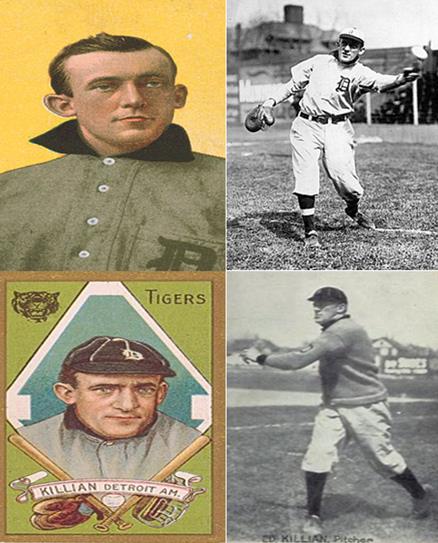
Edwin Henry Killian, November 12, 1876 – July 18, 1928, nicknamed "Twilight Ed" and the "Twilight Twirler," was a left handed pitcher in major league baseball. Killian was born in Racine, Wisconsin. He did not begin playing professional baseball until he was in his mid-20s. He played independent
Baseball Trailblazers Page 1089
baseball in Racine and worked in a planing mill where he was receiving $1.25 per day for ten hours of hard manual labor.
Killian played professional baseball from 1902 to 1912, including seven seasons with the Detroit Tigers from 1904 to 1910. He recorded a major league win-loss record of 103–78 for a winning percentage of .569. Twice a 20 game winner, including a 25–13 season in 1907, Killian's career earned run average of 2.38 ranks 26th best in major league history. He also helped lead the Tigers to three consecutive American League pennants from 1907 to 1909, including winning both games of a doubleheader on September 30, 1909, to clinch the third pennant.
Killian allowed only nine home runs during his major league career. He holds the major league record for the longest streak without allowing a home run; a streak of 1,001 innings that ran from September 19, 1903 to August 7, 1907.
Killian began playing professional baseball in the spring of 1902 with the Rockford Red Sox of the Three-I League for a salary of $75 per month. He started 38 games at Rockford and compiled a 21-15 record with a 2.80 earned run average. Killian returned to Rockford in 1903 and compiled a 14-10 record in 24
games.
Baseball Trailblazers Page 1090
In August 1903, Killian was sold by the Rockford team to the Cleveland Naps. Killian made his major league debut with Cleveland on August 25, 1903. He appeared in nine games in the closing weeks of the 1903 season, compiling a 3-4 record with a 2.48 ERA.
In January 1904, Killian was traded by the Naps with Jesse Stovall to the Detroit Tigers for Billy Lush. Killian pitched the rest of his major league career with the Tigers. In 1904, Killian had 32 complete games and a 2.44 ERA in 331 innings, but lost 20 games. The 1904 Tigers team, one year before the arrival of Ty Cobb, was a weak-hitting group that compiled a .231 team batting average and finished in seventh place of eight teams.
As proof that his 1904 win-loss record was not indicative of his talents, Killian battled Cy Young in one of the most remarkable pitching duels in history on May 11, 1904. Young and Killian each pitched 14 scoreless innings, before the Red Sox scored a run in the 15th inning, winning 1–0. Early in his career with the Tigers, Killian received the nicknames "Twilight Ed" and the
"Twilight Twirler" after pitching multiple extra-inning games that extended into the twilight hours.
In 1905, Killian reduced his ERA further to 2.27. He started 37
games and completed 33. He wound up with a 23–14 record, the
Baseball Trailblazers Page 1091
third best win total in the American League and fourth best in complete games. His eight shutouts in 1905 was tops in the American League.
Killian started only 16 games in 1906 and finished 10–6 with a 3.43 ERA. He missed several weeks of the season in August and September. He was suspended after a series of incidents in which he destroyed a telephone and various articles of furniture in the clubhouse in a rage, showed up on multiple occasions not "in condition to play ball," and trouble under the grandstand in which officers had to be called. During the suspension, Killian left Detroit and pitched semipro ball in Chicago and did not pitch in another game for the Tigers until September 19.
In 1907, Killian had the best season of his career. He started 41 games and compiled a 25–13 record with a 1.78 ERA. He ranked among the American League's leaders with his 1.78 ERA - second, 25 wins - third, 29 complete games - sixth, and 1,270 batters faced - sixth. Killian also excelled as a batter in 1907, compiling a .320 batting average and a .410 slugging percentage.
Killian's performance helped lead the 1907 Tigers to their first American League pennant and was one of the best pitching performances in the club's history. Unfortunately, Killian's arm was worn out for the post-season, and he pitched only four
Baseball Trailblazers Page 1092
innings in relief with no decision during the 1907 World Series against the Chicago Cubs.
In 1908, Killian appeared in 27 games and compiled a 12-9 record and 2.99 ERA as the Tigers won their second consecutive pennant.
He also started one game in the 1908 World Series, giving up five hits, three walks, and three earned runs in 2+1⁄3 innings.
In 1909, Killian did not appear in his first game until mid-May.
He ultimately appeared in 25 games and compiled an 11-9 record with a 1.71 ERA. On September 30, 1909, he pitched both games of a doubleheader against Boston and won both games to help the Tigers clinch their third consecutive American League pennant.
He was pitching a no hitter in the first game until the eighth inning and was then removed after the eighth inning to rest up for the second game. The Tigers won the first game by a 5-0
score. In the second game, Killian pitched a complete game, bringing his day's total to 17 innings, and the Tigers won by an 8-3 score.
In 1910, Killian appeared in only 11 games for the Tigers, compiling a 4-3 record with a 3.04 ERA. He appeared in his final major league game on July 15, 1910. After seven seasons in a Detroit uniform, he was sold to the Toronto Maple Leafs of the International League on August 2, 1910. At the time of his
Baseball Trailblazers Page 1093
release, the Detroit Free Press wrote: "Gameness has been one of Killian's chief assets. He has the reputation of being as nervy a pitcher as ever stepped to the slab and repeatedly won games when his arm was out of condition through sheer pluck. Killian also is the possessor of a great pitching head, studying the opposing batsmen and preying upon their weaknesses. For a slabman, he hits well and also is a good fielder."
In 1910 and 1911, Killian played for the Toronto Maple Leafs of the Eastern League. He compiled a 2-6 record with a 1.96 ERA in 1910 and a 4-3 record and 3.51 ERA in 1911.
Killian was married to Lottie McAfee in June 1908 at Alpena, Michigan. She died in 1920, and he was subsequently married to Millie Ann Moore in 1920. He had no children. In the last years of his life, he worked at an automobile factory in Detroit. In 1928, Killian died at his home in Detroit at age 51 after battling cancer for several months.
Baseball Trailblazers
Page 1094
Pie Traynor
Baseball Trailblazers
Page 1095
Harold Joseph "Pie" Traynor, November 11, 1898 – March 16, 1972, was a professional baseball player, manager, scout and radio broadcaster. He played his entire major league baseball career, 1920–1937, as a third baseman with the Pittsburgh Pirates.
Following World War II, Traynor was often cited as the greatest third baseman in baseball history.
Baseball Trailblazers Page 1096
Traynor was born in Framingham, Massachusetts, to parents who had emigrated from Canada. He received his nickname as a child in Somerville, Massachusetts, because he frequented a grocery store and often asked for pie. The store owner called him "Pie Face," which was later shortened to Pie by his friends.
In 1919, he played in what is now the Cape Cod Baseball League.
Playing for both the Falmouth and Oak Bluffs town teams, he batted .447 for Falmouth and had a combined batting average of
.322 for the two teams.
Traynor began his professional baseball career in 1920 as a shortstop for the Portsmouth Truckers of the Virginia League. He was asked by a Boston Braves scout to work out with the team at Braves Field, but the scout forgot to tell Braves manager George Stallings. Stallings ran Traynor off the field, telling him not to return. Traynor made his major league debut with the Pittsburgh Pirates at the age of 21 on September 15, 1920, appearing in 17 games that season. He appeared in 10 games for the Pirates in 1921, but spent the majority of the season playing for the Birmingham Barons. He posted a .336 batting average in 131 games for the Barons, but he committed 64 errors as a shortstop.
Baseball Trailblazers Page 1097
Traynor became the Pirates' regular third baseman in 1922, hitting for a .282 batting average with 81 runs batted in.
Following the advice of Rogers Hornsby, he began using a heavier bat in 1923 and blossomed into one of the best hitters in the National League. He hit above .300 for the first time with a
.338 batting average along with 12 home runs and 101 runs batted in. With tutoring provided by teammate Rabbit Maranville, his defense also began to improve, leading National League third basemen in putouts and assists.
In 1925, Traynor posted a .320 average with six home runs, 106
runs batted in and led the league in fielding percentage as the Pirates won the NL pennant by 8 games over the New York Giants.
In the 1925 World Series, he hit .346 including a home run off future Hall of Fame pitcher Walter Johnson as the Pirates defeated the Washington Senators in a seven game series. Traynor ended the season eighth in Most Valuable Player Award balloting.
His 41 double plays in 1925 set an NL record for third basemen that stood for 25 years.
The Pirates won the pennant again in 1927 with Traynor hitting
.342 with five home runs and 106 runs batted in, but they lost to the New York Yankees in the 1927 World Series. Traynor hit
.337 and produced a career high 124 runs batted in during the 1928 season despite hitting only three home runs and finished in
Baseball Trailblazers Page 1098
sixth place in the NL MVP Award balloting. He continued to be a cornerstone for the Pirates, posting a .356 batting average in 1929.
Traynor hit for a career high .366 average in 1930. In 1931
Traynor's batting average decreased to .298. In 1933 major league baseball held its inaugural All-Star Game and, Traynor was selected as a reserve player for the NL team.
Traynor's last full season was in 1934 when he hit over .300 for the ninth time in ten seasons, and was named as the starting third baseman for the NL in the 1934 All-Star Game. During the 1934 season, his throwing arm was injured in a play at home plate and his defense began to suffer as a result. Traynor played his final game on August 14, 1937.
In a 17 year major league career, Traynor played in 1,941 games, accumulating 2,416 hits in 7,559 at bats for a .320 career batting average along with 58 home runs, 1,273 runs batted in and an on base percentage of .362. He hit over .300 ten times and had over 100 runs batted in in a season seven times. Among major league third basemen, his seven seasons with more than 100
runs batted in is second only to the nine seasons by Mike Schmidt. He struck out only 278 times in his career. Traynor was considered the best fielding third baseman of his era.
Baseball Trailblazers Page 1099
Traynor became the Pirates' player-manager during the 1934
season. He retired as an active player after the 1937 season, but continued as the Pirates' manager. Traynor almost won another pennant, as a manager in 1938, as the Pirates led the NL
for most of the season before faltering to the Chicago Cubs in the famous "Homer in the Gloamin'" game at Wrigley Field. The loss of the pennant devastated Traynor. He seemed to lose confidence in his team, and after a sixth place finish in 1939, he resigned after five seasons as the manager of the Pirates.
After spending time as a scout for the Pirates, Traynor eventually took a job as a sports director for a Pittsburgh radio station in 1944. His radio broadcasts became popular with Pittsburgh sports fans and he remained at the job for 21 years.
In 1948, Traynor was selected to the Baseball Hall of Fame. In 1969, as part of the observance of the centennial of professional baseball, Traynor was named the third baseman on major league baseball’s all-time team.
He died in 1972 in Pittsburgh, Pennsylvania, not long after the Pirates moved into Three Rivers Stadium.
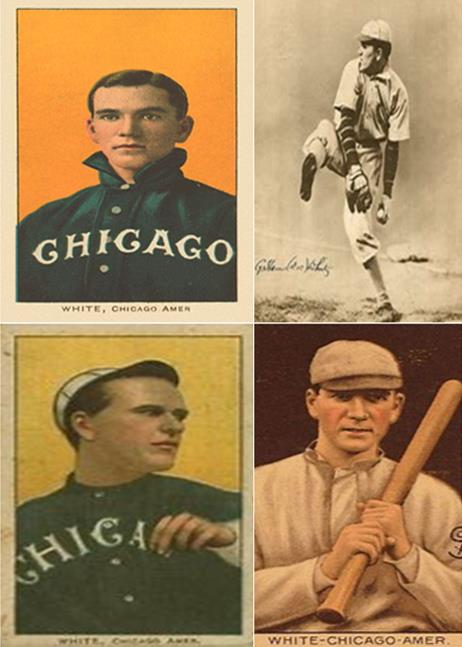
Baseball Trailblazers
Page 1100
Doc White
Guy Harris "Doc" White, April 9, 1879 – February 19, 1969, was a left handed pitcher in major league baseball. He played for two
Baseball Trailblazers Page 1101
teams, the Philadelphia Phillies and the Chicago White Sox, during his career which lasted from 1901 to 1913.
Born in Washington, D.C., "Doc" White was a graduate of the Georgetown University School of Dentistry. He started his professional baseball career in 1901 with the Phillies. In 1903, he jumped to the White Sox of the new American League.
From 1903 to 1906, White won at least 16 games each year; his earned run average was in the league's top four each year, as well. He led the league in ERA in 1906 with a 1.52 mark and went 18–6. That year, the White Sox won the pennant and their first World Series. In Game 5, White recorded the first save in Series history.
The following season, White set a career high in wins with 27.
He pitched effectively for Chicago until 1912, had an off year in 1913, and then went to the Pacific Coast League from 1914 to 1915. His lifetime major league record was a win–loss record of 189-156, and an earned run average of 2.39.
White also gained some recognition as a composer, publishing at least four songs, such as bestseller "Little Puff of Smoke, Good Night" in 1910. White died at age 89 in Silver Spring, Maryland, just eight months after witnessing Don Drysdale surpass his record of 45 consecutive scoreless innings on June 4, 1968.
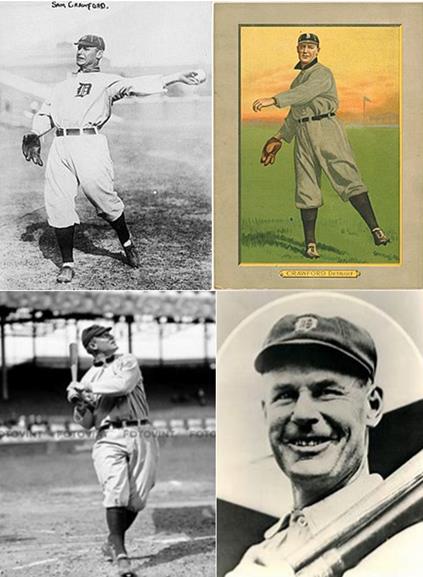
Baseball Trailblazers
Page 1102
Sam Crawford
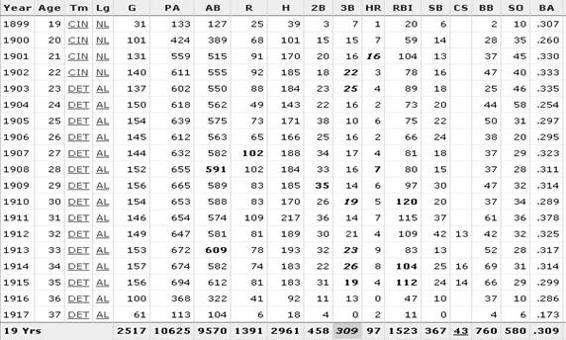
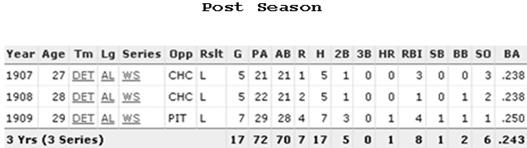
Baseball Trailblazers
Page 1103
Samuel Earl Crawford, April 18, 1880 – June 15, 1968, nicknamed
"Wahoo Sam", was an outfielder in major league baseball.
Crawford was born in Wahoo, Nebraska, in 1880, the son of Stephen O. Crawford and Nellie Crawford. In 1901, he married Ada M. Lattin, born circa 1881 in Nebraska. He had one daughter, Virginia, born circa 1905 in Michigan.
Baseball Trailblazers Page 1104
Crawford was a star athlete at Wahoo High School, leading the team to two state football championships in 1896 and 1897 and was also noted for "foot racing" wherever he played. In 1898, he joined a traveling baseball team in Wahoo. They traveled on a lumber wagon from town to town for weeks at a time, challenging the locals to baseball games, and passing the hat to pay their expenses. Crawford was offered an opportunity in the spring of 1899 to play for the Chatham Reds of the Canadian League for $65
per month, plus board. Crawford seized the opportunity and left behind his job as a barber's apprentice. From Chatham, Crawford moved on to play for the Grand Rapids Prodigals in the Western League.
In September 1899, Grand Rapids sold Crawford to the Cincinnati Reds. Crawford played in 31 games for the Reds at the end of the 1899 season. At age 19, and one year removed from his days playing for Wahoo's traveling team, Crawford was playing in the major leagues with future Hall of Famers Jake Beckley and Bid McPhee. Crawford hit .307 in 31 games with the Reds in 1899. In 1900, at age 20, he played in 101 games and was among the National League leaders in triples with 15 and home runs with seven.
Crawford was one of the best sluggers in baseball in 1901, batting .330 and hitting a major league leading 16 home runs. He
Baseball Trailblazers Page 1105
was also third in the National League in triples, RBIs, and slugging percentage. Crawford had another solid year in 1902, leading the National League in total bases and triples, and placing second in batting average, slugging percentage, and extra base hits. He hit 12 inside-the-park home runs in 1901; a major league record that has never been equaled.
At the end of 1902, a bidding war for players developed between the National League and American League. Crawford signed contracts with both the Reds and the Detroit Tigers. The competing contracts led to a publicized legal dispute, with a judge ultimately awarding Crawford to the Tigers but requiring $3,000 in compensation to the Reds.
Crawford joined the Tigers for the 1903 season and remained there until the end of his major league career in 1917. In 1903, he led the American League with 25 triples, and finished second in the batting race with a .335 batting average.
With the addition of Ty Cobb at the end of the 1905 season, the Tigers had two of the best hitters in baseball. Cobb and Crawford led Detroit to three straight American League pennants in 1907, 1908 and 1909, but both of them slumped in their World Series appearances, as the Tigers lost all three. Crawford hit for a .243 average in three World Series, and Cobb hit an
Baseball Trailblazers Page 1106
uncharacteristic .200 in the 1907 World Series and .231 in the 1909 World Series.
Although Crawford never got to play in another World Series, he remained one of the most feared hitters in baseball through 1915. In 1911, he hit a career high .378 with 115 RBIs and 57
extra base hits. From 1913 to 1915, Crawford played in 472
consecutive games for the Tigers. Crawford was among the American League leaders in hits, RBIs, extra base hits, slugging percentage and total bases every year from 1905 to 1915. He led the American League in triples five times, including an American League record 26 triples in 1914. Crawford remains the all-time major league leader with 309 triples in his career.
Despite Crawford leading the league in both RBI and extra base hits in 1915, the Tigers began transitioning the right field responsibilities from Crawford to their young hitting star, future Baseball Hall of Famer Harry Heilmann in 1916. That year, Crawford played 78 games in right field, and Heilmann played 66, with Crawford's plate appearances cut almost in half from 694 to 368.
In 1917, Crawford lost his spot in the lineup altogether and was relegated principally to a pinch hitting role. In his new limited role, Crawford hit .173 in 104 at bats. At the end of
Baseball Trailblazers Page 1107
the 1917 season, Crawford was released and did not play in Major League Baseball again.
Crawford compiled a lifetime batting average of .309, with 2,961
hits, 97 home runs, and 1,525 runs batted in. Crawford is considered to be one of the greatest sluggers of the dead ball era. He was among the AL leaders in hits, RBIs, extra base hits, slugging percentage and total bases for 11 consecutive years, from 1905 to 1915.
Sam Crawford and Ty Cobb were teammates for parts of 13 seasons.
They played beside each other in right and center field, and Crawford followed Cobb in the batting order year after year.
Despite this, the two had a complicated relationship.
When Cobb entered the major leagues with the Tigers in 1905, Crawford was one of the Detroit veterans who bullied Cobb. Cobb, a volatile personality, took it personally. However, Cobb soon became established as the best hitter in the game and became more accepted on the Tigers team as they won AL championships in 1907, 1908, and 1909. During this time, Cobb and Crawford had a student-teacher relationship. In interviews late in life with Al Stump, Cobb told of studying Crawford's base stealing technique and of how Crawford would teach him about pursuing fly balls and
Baseball Trailblazers Page 1108
throwing out base runners. Cobb said that he would always remember Crawford's kindness.
The student-teacher relationship gradually changed to one of jealous rivals. As Cobb became the biggest star in baseball, Crawford was unhappy with the preferential treatment given Cobb.
Cobb was allowed to report late for spring training and given private quarters on the road; privileges not offered to Crawford. The competition between the two was intense. Crawford recalled that, if he went three for four on a day when Cobb went hitless, Cobb would turn red and sometimes walk out of the park with the game still on. When it was initially, and erroneously, reported that Nap Lajoie had won the 1910 batting title, Crawford was alleged to have been one who sent a telegram to Lajoie congratulating him on beating Cobb.
In retirement, Cobb wrote a letter to a writer for “The Sporting News” accusing Crawford of not helping in the outfield and of intentionally fouling off balls when Cobb was stealing a base.
Crawford learned about the letter in 1946 and accused Cobb of being a "cheapskate" who never helped his teammates. He said that Cobb had not been a very good fielder, "so he blamed me."
Crawford denied intentionally trying to deprive Cobb of stolen bases, saying that Cobb had "dreamed that up." When asked about the feud, Cobb attributed it to jealousy. He felt that Crawford
Baseball Trailblazers Page 1109
was "a hell of a good player", but he was "second best" on the Tigers and "hated to be an also ran." Cobb biographer Richard Bak noted that the two "only barely tolerated each other" and agreed with Cobb that Crawford's attitude was driven by Cobb's having stolen Crawford's thunder.
Although they may not have spoken to each other, Cobb and Crawford developed an uncanny ability to communicate non-verbally with looks and nods on the base paths. They became one of the most successful double steal pairings in baseball history. After Cobb died, a reporter found hundreds of letters in his home responding to letters Cobb had written to influential people, lobbying for Crawford's induction into the Baseball Hall of Fame. Crawford was reportedly unaware of Cobb's efforts until after Cobb died.
After being released by the Tigers Crawford joined the minor league Los Angeles Angels of the Pacific Coast League, helping them to win league championships in 1918 and 1921. In his first game he got two hits, stole a base and threw out two runners.
Crawford played four seasons for the Angels, 1918–1921. In 1918
he played in 96 games, got 104 hits, and batted .292. In 1919 he hit .360 with 239 hits, 41 doubles, 18 triples, 14 home runs and 14 stolen bases in 173 games. In 1920 he batted .332 and had 239
hits, 46 doubles and 21 triples in 187 games. His last year, at
Baseball Trailblazers Page 1110
41 years of age in 1921, he hit .316 with 199 hits and 44
doubles in 175 games.
Crawford decided to stay in Southern California, and in 1924
became the head coach of the University of Southern California baseball team, a position he held until 1929. He was instrumental in the development of the California Intercollegiate Baseball Association in 1927, and led USC to second place finishes in his last two seasons. Crawford was 59–
46–3 as the USC coach. He later worked as an umpire in the Pacific Coast League from 1935 to 1938, quitting after finding it a thankless job and lonely life.
In retirement, Crawford became somewhat reclusive, staying away from official baseball functions. He was elected to the Baseball Hall of Fame by the Veterans Committee in 1957. At the time, he was living in a small cabin on the edge of the Mojave Desert near Pearblossom, California. Reporters showed up there with the news, shocking the locals, who were unaware that their neighbor had even played major league baseball. After his election, Crawford told the curator in Cooperstown that he wanted his plaque to read "Wahoo Sam." He noted: "That's my hometown, and I'm proud of it."
Baseball Trailblazers Page 1111
Crawford spent much of his later years working in his garden and reading in Baywood Park, California. As for how he hoped to be remembered, he said; "When I kick off they'll say, 'Well, good old Sam, he wasn't such a bad guy after all. Everything considered, he was pretty fair and square. We'll miss him.'"
Crawford suffered a stroke on May 26, 1968, and died two weeks later at Hollywood Community Hospital in Los Angeles at age 88.
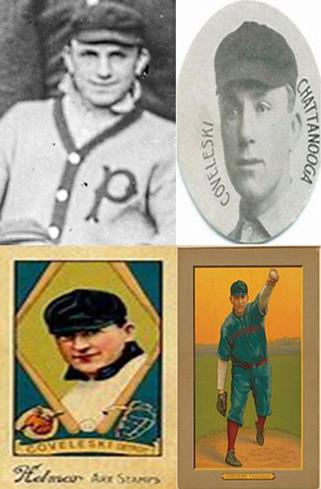
Baseball Trailblazers
Page 1112
Harry Coveleski
Harry Frank Coveleski, April 23, 1886 – August 4, 1950, was a major league baseball pitcher with the Philadelphia Phillies, Cincinnati Reds, and Detroit Tigers. Coveleski was born as the fourth of five ball playing brothers in the coal mining community of Shamokin, Pennsylvania. His oldest brother Jacob died while serving in the Spanish–American War, and his other
Baseball Trailblazers Page 1113
brothers Frank and John played baseball as well, but never reached the major leagues. His younger brother Stan Coveleski went on to become a member of the Baseball Hall of Fame.
Coveleski began his career with the Phillies in 1907. Over a span of five days at the end of the 1908 season, he beat the New York Giants three times, which enabled the Chicago Cubs to catch the first place Giants in the NL standings and force a replay of the "Merkle's Boner" game. Thereafter, Coveleski was called "The Giant Killer." Traded to the Reds after the 1909 season, Coveleski had a disappointing 1910 season, including a game in which he walked sixteen batters, and was out of the major leagues for three seasons.
That year, A. H. "Rick" Woodward, owner of the Southern Association's Birmingham Barons, bought Coveleski's contract from the Reds for $1,000, putting him on the team to be showcased in the brand new steel and-concrete Rickwood Field stadium. Coveleski got the start on the park's August 18, 1910
opening day, and earned a no decision in a 3-2 victory against the Montgomery Climbers in front of 10,000 fans. He ended up pitching two no hitters for the Barons, though he lost one in extra innings, and won 21 games, including eleven straight decisions, to end the season with a 1.55 ERA. His final appearance for Birmingham was a 1-0 shutout against the league
Baseball Trailblazers Page 1114
champion New Orleans Pelicans in which he held their star slugger Shoeless Joe Jackson hitless in four appearances.
Following an arm injury, Woodward traded Coveleski to the Chattanooga Lookouts, where he struggled for two seasons, going 25-37, before regaining his composure. In their 1913 campaign he led the Southern Association with 28 wins and attracted the notice of the Detroit Tigers' scouts.
Coveleski joined the Tigers for the 1914 season, and pitched over 300 innings, completed 23 of his 36 games, and won 22 of them, second in the American League only to Walter Johnson. In four of his five seasons with the Tigers, Coveleski's ERA was under three, and his 2.34 ERA with the Tigers is still the franchise's all-time career record.
The heavy workload proved too great for his well-traveled left arm, however, and, according to newspaper reports, his wing
“went back on him” during 1917 spring training. Coveleski struggled through 11 starts, winding up with a record of 4-6
before he was shelved for the season. He managed only one start in 1918 before drawing his release. His final major league record was 81 wins, and 55 losses, with a 2.39 earned run average.
Baseball Trailblazers Page 1115
In the ensuing years, Coveleski tried to extend his playing career in the minor leagues, making several unsuccessful comeback attempts with Little Rock; Altoona, Pennsylvania; and Oklahoma City and McAlester, Oklahoma. In 1922, he accepted a job as a plainclothesman for Ford’s River Rouge plant in Michigan. Two years later, he returned to Shamokin, where he lived with his wife, the former Cecilia Glassie, and their only child, William. In 1926, he began a four year stint with the Shamokin police force. After leaving the squad in 1930, he operated a café, and was fined for serving alcohol in violation of the prohibition laws. To pay off the fine, Harry took a job as a watchman in a silk mill, eventually earning enough money to once again open his own place, a tavern he called “The Giant Killer.” Coveleski passed away in Shamokin, Pennsylvania on August 4, 1950 at the age of 64.
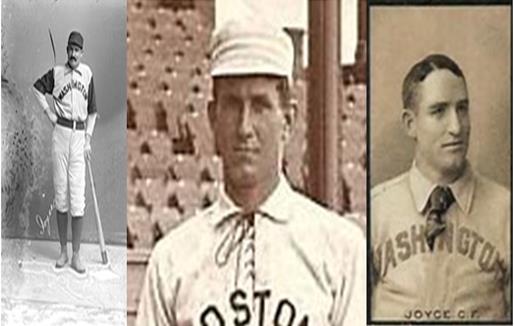
Baseball Trailblazers
Page 1116
Bill Joyce
William Michael Joyce, September 22, 1867 – May 8, 1941, was a professional baseball player and manager. He was a third baseman over parts of eight seasons with the Brooklyn Ward's Wonders of the Players' League, Boston Reds of the American Association, Brooklyn Grooms, Washington Senators, and New York Giants. He also served as manager during his 1896-1898 tenure with the Giants.
Joyce tied for the National League lead in home runs in 1896
with Ed Delahanty while playing for Washington and New York, and finished second three other times. He holds the record with four
Baseball Trailblazers Page 1117
triples in one game, which he accomplished in 1897. In 1891, he reached base in 64 consecutive games, a major league record not bettered until 1941.
In 906 games over eight seasons, Joyce posted a .293 batting average, 971 for 3310, with 822 runs, 153 doubles, 106 triples, 70 home runs, 609 RBI, 266 stolen bases, 721 bases on balls, a
.435 on base percentage, the all-time seventh highest on record, and a .467 slugging percentage.
Joyce was born in St. Louis, Missouri, in 1867, and died in St.
Louis at the age of 75.
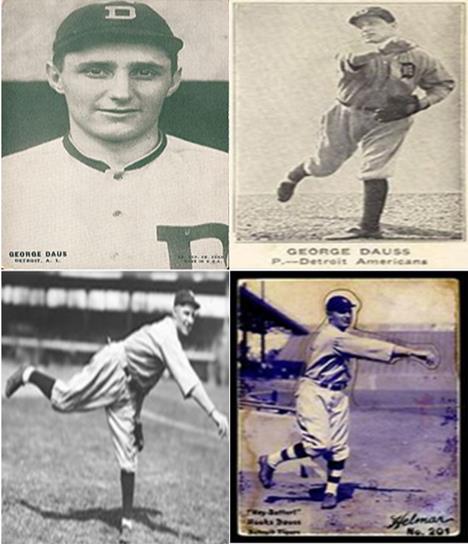
Baseball Trailblazers
Page 1118
Hooks Dauss
George August "Hooks" Dauss, September 22, 1889 – July 27, 1963, played 15 seasons of major league baseball as a right handed pitcher for the Detroit Tigers from 1912 to 1926. He was given the nickname "Hooks," because his curveball was hard to hit. He compiled a career record of 223–182 with a 3.30 earned run
Baseball Trailblazers Page 1119
average. His best years were 1915 when he had a 24–13 record, 1919 with a 21–9 record, and 1923 with a 21–13 record. Dauss continues to hold the Detroit Tigers franchise record for most wins by a pitcher with 223.
Dauss was born in Indianapolis, Indiana, in 1889. His parents were John Dauss, a machinist, and Anna E. (Magel) Dauss, a native of Indiana. He had two older brothers, Raymond and Edward. His parents divorced when he was a child, and he thereafter lived with his mother and grandparents.
Dauss attended the Emmerich Manual High School in Indianapolis, and first gained note as a pitcher there.
Dauss began his professional baseball career in 1908 with the South Bend, Indiana team in the Central League. However, manager Aggie Grant released Dauss before he even appeared in a game. He did pitch an exhibition game, a shutout against the Duluth White Sox of the Northern League. Dauss then signed to play with Duluth in 1909. In his first full season of professional baseball, Dauss compiled a 19–10 record in 33 games. He appeared only 18 games for Duluth in 1910, compiling a 7–7 record.
Dauss pitched for the Winona Pirates in the Class C Minnesota–
Wisconsin League during the 1911 season. He compiled a 22–12
record and 2.13 earned run average. He was next acquired by the
Baseball Trailblazers Page 1120
St. Paul Saints of the Class AA American Association. He compiled a 12–19 record for them in 1912.
Deacon McGuire, a scout for the Detroit Tigers, saw Dauss pitch in St. Paul during the 1912 season. Detroit team president Frank Navin tried unsuccessfully to draft Dauss and ended up purchasing him from St. Paul in September 1912. Dauss made his major league debut on September 28, 1912, pitching a four hit complete game victory over the Cleveland Naps despite giving up eight bases on balls and hitting three batsmen; Shoeless Joe Jackson struck twice. Dauss compiled a 1–1 record and 3.18 ERA in his two appearances at the end of the Tigers 1912 season.
In February 1913, Dauss signed a contract with the Tigers for the 1913 season. He became a regular in Detroit's starting rotation, a position he would hold for the next 14 years. In his first full season in the majors, Dauss started 29 games and compiled a 13–12 record, 2.48 ERA, 22 complete games, and 107
strikeouts. He also finished the 1913 season ranked ninth in the American League with a 7.5 hits per nine innings pitched.[2]
Eddie Onslow, who was a catcher for the Tigers in 1912 and 1913, said Dauss was "fast and had a good curve." Detroit manager Hughie Jennings praised Dauss after the 1913 season; "I consider Dauss to be by far the best young pitcher in the American League and I am not alone in this belief. Clark Griffith, of the
Baseball Trailblazers Page 1121
Nationals, was one of the first of opposing managers to recognize in Dauss a coming star."
Prior to the start of the 1914 season, Dauss and fellow Indianapolis native Donnie Bush, Detroit's shortstop, were recruited to play as hometown talent for the Indianapolis team in the newly formed Federal League. In mid-January 1914, Dauss and Bush issued a joint statement that they had refused the Federal League offer and returned their signed contracts back to Detroit. Both also indicated they had received increases in their 1913 salaries.
During the 1914 season, Dauss became a workhorse for the Tigers, appearing in 45 games and 302 innings pitched. He improved his record to 19–15 and had a 2.86 ERA. He finished among the American League's leaders with 22 complete games - 3rd, 19 wins
- 4th, 302 innings pitched - 4th, and 150 strikeouts - 5th. He also led the league with 18 hit batsmen.
In 1915, Hooks had the best season of his career, as the Tigers compiled a 100-54 record, narrowly losing the American League pennant to the Boston Red Sox. Dauss appeared in 46 games - 309
innings for the 1915 Tigers, compiling a 24–13 record with a 2.50 ERA. For the second consecutive season, Dauss was among the American League's leaders in multiple categories.
Baseball Trailblazers Page 1122
During the 1916 season, Dauss's ERA jumped nearly a full point to 3.21. His playing time was reduced somewhat to 238 innings pitched, but he still compiled a solid 19-12 record, and his 19
wins was fifth best in the American League. As he had in 1914, Dauss again led the league with 16 hit batsmen in 1916.
During spring training in 1917, Dauss' performance raised concerns. His fastball was described as being incapable of denting a felt hat. However, despite the concerns expressed in the spring, Dauss brought his ERA down to 2.43 in 1917 and won 17 games; the seventh highest tally in the American League.
During spring training in 1918, Detroit manager Hughie Jennings opined that lack of confidence and a "carefree manner" was holding Dauss back from stardom. The Detroit Free Press reported; "Were George Dauss possessed of the proper spirit, it is Manager Jennings's profound belief that the little curver would take rank with the greatest hurlers that ever sunk a spiked shoe in the rubber of a major league pitching mound.
Nothing appears to ruffle Dauss; he takes a victory or defeat with the same measure of unconcern. With half as much fight as Cobb displays, or any one of a half a dozen of his teammates, he would be the equal of men like Christy Mathewson. If George could only say to himself, now I am as good as Mathewson, he would be the best pitcher in the major leagues today. There
Baseball Trailblazers Page 1123
isn't anything any other pitcher ever had that George has not got, but confidence in himself. Half the battle is self-assurance."
Dauss went on to compile his first losing record, 12–16, in his major league career. However, his 1918 record was more a reflection of the collapse of the Detroit team as a whole. After winning 100 games in 1915, the 1918 team compiled a 55-71 record and finished seventh in American League.
In 1919, Dauss rebounded and had his second 20 win season in the major leagues. Despite playing for a fourth place team, Dauss compiled a 21–9 record for a career best .700 winning percentage. He ranked among the league leaders in wins, complete games, and innings pitched.
On September 10, 1925, in the first game of a doubleheader, Dauss and the Tigers beat the Cleveland Indians, 6-1. This gavehim his 210th win in a Detroit uniform, surpassing George Mullin's 209. Dauss has held the Tigers record for pitcher wins ever since.
Dauss was married in May 1915 to Ollie Speake of St. Louis. From 1945 until the time of his death, Dauss lived in Fenton, Missouri. He died after a long illness in 1963 at Firmin Desloge Hospital in St. Louis, Missouri at age 73.
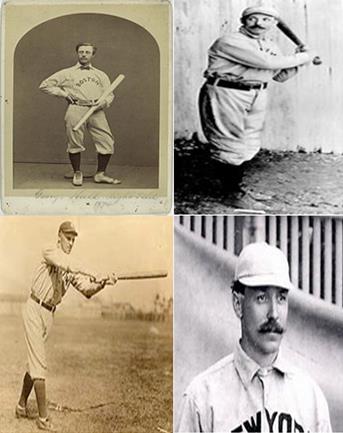
Baseball Trailblazers
Page 1124
George Hall
George William Hall, March 29, 1849 – June 11, 1923, was a professional baseball player who played in the National Association and later the National League. Born in Stepney, England, Hall later immigrated to the US. He made his professional debut on May 5, 1871.
Prior to the inception of professional leagues, Hall played for the Brooklyn Atlantics. He commenced his professional career
Baseball Trailblazers Page 1125
with the Washington Olympics of the National Association in 1871, hitting .294 in 32 games. He played for the Baltimore Canaries in 1872 and 1873 seasons, hitting .336 and .345
respectively. Playing mostly center field up to this point, he shifted from center to right field the following year when he played for the 1874 champion Boston Red Stockings. After just one season with the Red Stockings, he moved on to play for the Philadelphia Athletics, where he had another good season at the plate, hitting .299, with four home runs, which placed second in the league behind Jim O'Rourke's six.
After the 1875 season, the National Association folded, which left room for a new league to begin. In 1876, the National League came into existence, the first official "major league."
Hall's team, the Athletics, had very little success, finishing seventh out of eight teams. One of the bright spots that year for the Athletics was the hitting prowess of their star hitter, Hall. He led the team in almost all major hitting categories including a .366 batting average, 51 runs scored, and a league leading five home runs. On June 17, 1876, he became the first major league baseball player to hit two home runs in one game.
Those five home runs stood as the single season home run record until Charley Jones hit nine in 1879.
Baseball Trailblazers Page 1126
For the 1877 baseball season, Philadelphia had been expelled from the league for refusing to go on a western road trip, late in the 1876 season, for financial reasons, so Hall moved on to play for the Louisville Grays. Again, he had an excellent season, hitting .323, scoring 51 runs, and hitting 8 triples.
Surprisingly, after appearing in the league leaders for home runs the last two seasons, he did not hit one in 1877.
On October 26, 1877, Louisville club vice president Charles Chase confronted Hall and fellow Gray Jim Devlin with charges that they threw some road games in August and September. Both admitted only to throwing non-league games, one of which was an exhibition game in Lowell, Massachusetts, on August 30, and another in Pittsburgh, Pennsylvania, on September 3. The admissions also implicated teammates Al Nichols and Bill Craver.
Hall claimed that he and Devlin helped in losses to the Cincinnati Reds on September 6 and to the minor league Indianapolis Blues on September 24‚ but he argued that since the Reds were about to be suspended and the games nullified‚ it amounted to an exhibition game. As a result of the scandal, all four players were banned for life from major league baseball.
Hall’s major league record was concluded with a lifetime batting average of .322, 13 home runs, and 252 runs batted in, after being the NL’s first home run leader.
Baseball Trailblazers Page 1127
Hall died in Ridgewood, New York, at the age of 74.
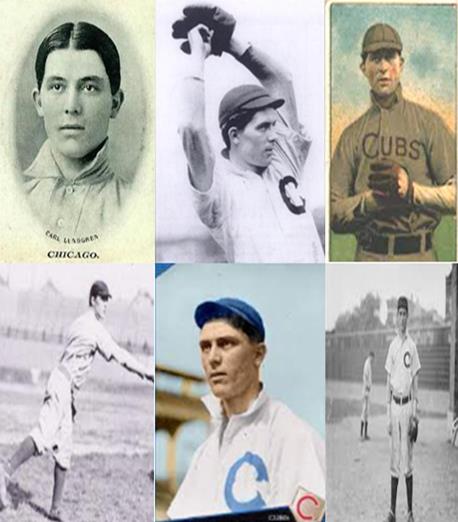
Baseball Trailblazers
Page 1128
Carl Lundgren
Carl Leonard "Lundy" Lundgren, February 16, 1880 – August 21, 1934, was a baseball and football player and coach.
Lundgren was born in Marengo, Illinois. His father, Pehr Hjalmar Lundgren, was born in Östergötland, Sweden, emigrated to the United States in 1868 and worked as a house painter, contractor
Baseball Trailblazers Page 1129
and interior decorator. His mother, Delilah (Renwick) Lundgren, was born on a farm outside Marengo. His father purchased a farm north of Marengo, where the family lived until 1900. Lundgren graduated from Marengo High School in 1898. He was the oldest of four children, having a younger brother, Franz Emil, and two younger sisters, Eva and Alma.
Lundgren enrolled at the University of Illinois Urbana–Champaign in 1898, studied civil engineering, and graduated in 1902. As a senior, he published a paper titled, "Comparative strength of gravel and broken-stone concretes." While at Illinois, he played at the halfback and fullback positions for the Illini football team for three years. He was also a pitcher for the Illini baseball team from 1899 to 1902 and was the team captain in 1902.
The Chicago Cubs saw Lundgren pitch in an exhibition game between the Illinois college team and the Cubs. The Cubs gave Lundgren a tryout, and he made his major league debut for the Cubs on June 19, 1902, shortly after completing his studies at the University of Illinois. One sports writer noted that "the Cubs had a new pitcher, and the world lost a civil engineer." In his rookie season, Lundgren pitched 17 complete games in 18
appearances, and had an earned run average of 1.97.
Baseball Trailblazers Page 1130
Lundgren pitched for the Cubs from 1902 to 1909 and compiled a 91–55, .623 record and career earned run average of 2.42. During his best years, from 1904 to 1907, he compiled a record of 65–
27. The Cubs won three straight pennants in 1906, 1907, and 1908
and World Series championships in 1907 and 1908. During the 1906
and 1907 seasons, Lundgren compiled records of 17–6 and 18–7.
In 1907, Lundgren pitched 207 innings without allowing a home run, threw seven shutouts, and gave up only 27 earned runs in 28
games. His 1.17 earned run average was the second lowest in the major leagues, trailing teammate Jack Pfiester who had a 1.15
ERA, and his average of 5.652 hits allowed per nine innings was the lowest. However, he did not pitch in any of the Cubs' World Series games.
His earned run average jumped from 1.17 in 1907 to 4.22 in 1908.
He appeared in only two games for the Cubs in 1909, pitching his last major league game on April 23. At the end of April 1909, the Cubs placed Lundgren on waivers for a price of $1.50.
Lundgren's biggest weakness as a pitcher was lack of control.
Even in 1907, his best year, Lundgren averaged 4.0 walks per nine innings pitched. In 1909, he averaged 8.3 walks per nine innings before being released. A profile of Lundgren published in 1913 by “The Atlanta Constitution” discussed his strengths
Baseball Trailblazers Page 1131
and weaknesses; "He had everything including speed to burn green hickory and an assortment of curves that would keep a criptograph specialist figuring all night but he was wild as a March hare in a cyclone and couldn't locate the plate with a field glass. He had a strange hold on the art of steering the ball away from the plate that would make Wild Willie Donovan and Cy Seymour look like a brace of pikers who had been touched for their meal tickets."
Lundgren was called "the best cold-weather pitcher in the profession" by the “Reach Baseball Guide.” He developed a reputation for pitching well in the spring and fall, but not faring as well during the hot summer months.
While pitching for the Cubs, he worked in the off season as a draftsman from 1902 to 1904 and as a dairy farmer after 1904.
In the summer of 1909, Lundgren appealed from a decision by the Cubs management to deny him a share of the team's $10,000 World Series bonus for 1908. In June 1909, he won what was described as "a moral victory" when a non-binding decision was entered, declaring the exclusion of Lundgren to be unjust.
After his major league baseball career ended in April 1909, Lundgren played minor league baseball for several years. In the spring of 1909, several teams expressed interest in Lundgren.
Baseball Trailblazers Page 1132
Bill Armour, manager of the Toledo, Ohio team, reportedly lost interest because of Lundgren's reputation as a cold weather pitcher.
The Cubs sold Lundgren to Brooklyn, and Brooklyn farmed him out to the Toronto Maple Leafs in the Eastern League for the 1909
season. However, he was suspended in June 1909 by Toronto manager Joe Kelley. A newspaper account on the suspension noted;
"Lundgren is not in shape for a hard game, and the Toronto Club does not intend to pay him a big salary to get into shape when he's not half trying." In August 1909, he was reported to be
"pitching independent ball around Chicago."
During the 1910 season, he played for the Hartford Senators in the Connecticut State League, compiling a record of 6–3. At the end of the 1910 season, “The Hartford Courant” wrote; "Lundgren was regarded as the ablest pitcher in this league last season and he outclassed the other boxmen." Lungren also played for the Toronto Maple Leafs in 1910, compiling a 1–4 record. In November 1910, he was sold to Topeka in the Western League.
In 1911, he played for the Troy Trojans in the New York State League, compiling a 13–12 record in 31 games. He ended his playing career in 1912 with the Hartford Senators, compiling a record of 6–3 in 16 games. In what appears to have been
Baseball Trailblazers Page 1133
Lundgren's last professional baseball game, he pitched a shutout against the Bridgeport Orators on September 10, 1912.
There were newspaper reports in June 1913 indicating that Lundgren had a tryout with the Mobile team in the Southern League and that he had signed with the Atlanta Crackers or the Charleston Sea Gulls, but no record has been found of his playing for those teams.
In March 1912, Lundgren was hired to assist Boileryard Clarke in coaching the pitchers at Princeton University in 1912. After a short stint with Princeton, Lundgren returned to the field as a player with Hartford in June 1912. In January 1913, the University of Iowa expressed interest in hiring Lundgren as its baseball coach, but it appears that the deal fell through after the Iowa Board of Athletics was asked to meet his salary demands. In February 1913, he was also interviewed, but not hired, for the position of manager of a baseball team in Keokuk, Iowa.
In August 1913, he was hired by the University of Michigan to succeed Branch Rickey as the head coach of the Michigan Wolverines baseball team. He was the baseball coach at Michigan from 1914 through 1920, compiling a record of 93–43–6. Lundgren developed several Major League players at Michigan, including