

Baseball Trailblazers by Edward Drobinski - HTML preview
Download the book in PDF, ePub, Kindle for a complete version.
Baseball Trailblazers Page 1134
George Sisler, who became one of baseball's greatest players. He was also an assistant football coach at Michigan under the legendary football coach, Fielding H. Yost. In his final three years at Michigan, 1918–1920, Lundgren's baseball teams won consecutive Big Ten Conference championships with records of 9–
1, 9–0 and 9–1 in conference play. While coaching at Michigan, Lundgren worked in the off season as a traveling salesman.
In June 1920, Lundgren left Michigan to become the baseball coach at his alma mater, the University of Illinois. He was Illinois' baseball coach for 14 years until his death in 1934.
His Illini teams won Big Ten championships in 5 of Lundgren's 14
years as coach and tied for another. Lundgren also served as the assistant athletic director at Illinois under George Huff.
Lundgren's Michigan and Illinois baseball teams won eight Big Ten Conference baseball championships. Only three coaches have won more Big Ten baseball championships.
Lundgren married S. Maude Cohoon in September 1904. He died in August 1934 of a heart attack at age 54.
Baseball Trailblazers
Page 1135
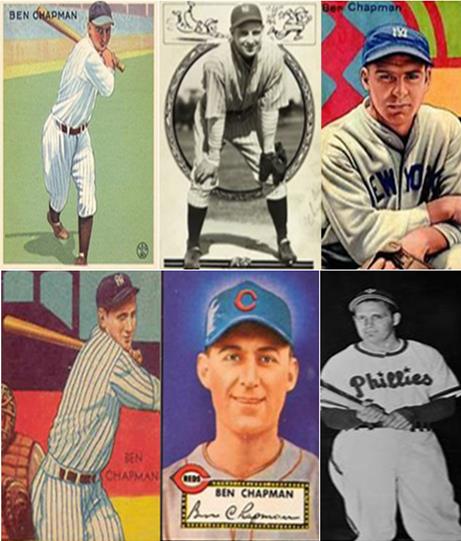
Ben Chapman
William Benjamin Chapman, December 25, 1908 – July 7, 1993, was an outfielder, pitcher, and manager in major league baseball who played for several teams. Born in Nashville, Tennessee, Chapman batted and threw right handed. He began his career with the New York Yankees, playing his first seven seasons there.
Baseball Trailblazers Page 1136
He was a teammate of Babe Ruth, Lou Gehrig, Bill Dickey, Joe DiMaggio and other stars on the Yankees from 1930 through the middle of the 1936 season. In his 1930 rookie season with the Yankees, during which he batted .316, he played exclusively in the infield as a second and third baseman. Chapman was shifted to the outfield to take advantage of his speed and throwing arm.
He led the AL in stolen bases for the next three seasons, 1931–
33, his 1931 total of 61 the highest by a Yankee since Fritz Maisel's 74 in 1914, and was the most by any major leaguer between 1921 and 1961. With the Yankees, he also batted over
.300 and scored 100 runs four times each, batted in 100 runs twice, led the AL in triples in 1934, and made each of the first three AL All-Star teams from 1933–35, leading off in the 1933
game as the first AL hitter in All-Star history. In the 1932
World Series he batted .294 with six runs batted in as the Yankees swept the Chicago Cubs. In one game on July 9, 1932, he had three home runs, two of which were inside the park.
In June 1936, Chapman, then hitting .266, and expendable with the arrival of Joe DiMaggio, was traded to the Senators. The player the Yankees received in return was Jake Powell. After the trade, Chapman rebounded to finish the year with a .315 average, again making the All-Star team and scoring 100 runs, and collecting a career high 50 doubles. In June 1937 the Senators
Baseball Trailblazers Page 1137
sent him to the Boston Red Sox, and he led the AL in steals for the fourth time with 35. The following year he hit a career best
.340 with Boston, after which he was traded to the Cleveland Indians. After seasons hitting .290 and .286, Cleveland sent him back to Washington in December 1940. He hit .255 with the Senators before they released him in May 1941, and after he batted only .226 with the Chicago White Sox over the remainder of the year, his major league career appeared to be finished.
After managing in the Class B Piedmont League in 1942 and 1944; he was suspended for the 1943 season for punching an umpire; Chapman resurfaced, following brief World War II military service, as a pitcher in the National League with the Brooklyn Dodgers in 1944, earning five wins against three losses. After starting the next year 3–3, he was traded to the Phillies on June 15, 1945, becoming player-manager on June 30. He made three relief appearances for the team that year, played his final game in 1946 with 1+2⁄3 innings of relief, and continued on as a non-playing manager.
He appeared in 1,717 games over 15 seasons, batting .302
lifetime with 287 stolen bases, including 15 of home, 1,144
runs, 1,958 hits, 824 walks, 90 home runs, 407 doubles, 107
triples and 977 runs batted in, and winning eight of 14
decisions as a pitcher. His 184 steals with the Yankees placed
Baseball Trailblazers Page 1138
him second in team history behind Hal Chase. During the period from 1926 to 1943, Chapman had more stolen bases than any other player, leading the American League four times.
Chapman's first wife, Mary Elizabeth Payne, divorced Chapman on June 11, 1935, getting the divorce in Birmingham, Alabama.
Chapman later worked in insurance in his home state of Alabama.
Chapman died of a heart attack at age 84 at his home in Hoover, Alabama.
Baseball Trailblazers
Page 1139
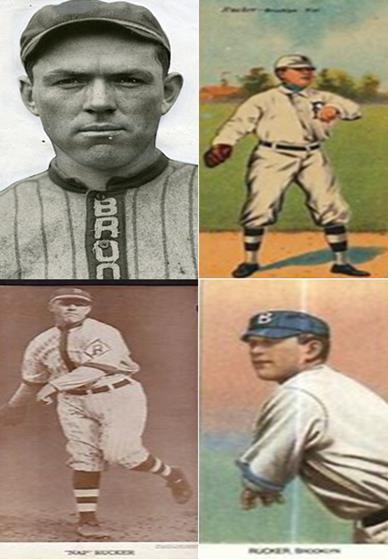
Nap Rucker
George Napoleon "Nap" Rucker, September 30, 1884 – December 19, 1970, was a sportsperson and politician from Crabapple, Georgia.
Rucker was a left handed pitcher in major league baseball for the Brooklyn Superbas/Dodgers/Robins. Over his 10 seasons he
Baseball Trailblazers Page 1140
established a 134-134 win–loss record, an earned run average of 2.42, and had 1,217 strikeouts.
Rucker was a two time NL shutout leader - 1910, 1912; NL
complete game leader – 1910; and NL innings pitched leader –
1910. On September 5, 1908, Rucker threw a no-hitter against the Boston Doves. His best year was 1911, when he won 22 games for the Dodgers. He became strictly a knuckleball pitcher when his speed declined.
After his baseball career, Rucker went on to a successful business career, and served as mayor of Roswell, Georgia from 1935 to 1936, and as the city's water commissioner after his mayoral term. Rucker died in Alpharetta, Georgia in 1970
Baseball Trailblazers
Page 1141
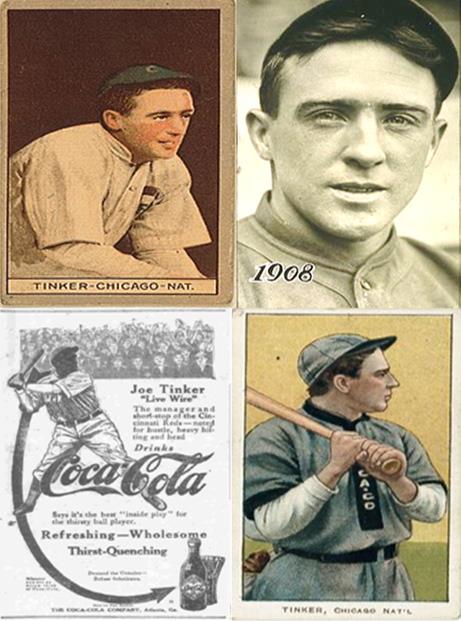
Joe Tinker
Joseph Bert Tinker, July 27, 1880 – July 27, 1948, was a professional baseball player and manager. He played from 1902
Baseball Trailblazers Page 1142
through 1916 for the Chicago Cubs and Cincinnati Reds of major league baseball and the Chicago Whales of the Federal League.
Born in Muscotah, Kansas, Tinker began playing semi-professional baseball in Kansas in the late 19th century. When Tinker was two, his family moved to Kansas City, Kansas. There, he began to play baseball for his school's team when he was 14 years old. He played in semi-professional baseball for Hagen's Tailors in 1898, winning the city championship. In 1899, he played for a team based in Parsons, Kansas, until it disbanded. He then joined a team representing Coffeyville, Kansas, as a third baseman, for the remainder of the year.
Tinker started his professional baseball career in 1900, at the age of 19, when Billy Hulen, a teammate of Tinker's with the Coffeyville squad, recommended him to George Tebeau, the manager of the Denver Grizzlies of the Western League. Playing as a second baseman for Denver, Tinker batted .219 in his first 32
games. Tebeau sold Tinker to the Great Falls Indians of the Montana State League in June. Great Falls sold Tinker to the Helena Senators, also in the Montana State League, for $200
later in the season due to the team's financial insolvency.
In 1901, Tinker batted .290 for the Portland Webfoots of the Pacific Northwest League as their third baseman. He led the
Baseball Trailblazers Page 1143
league with 37 stolen bases. Receiving interest from the Chicago Cubs and the Cincinnati Reds of the National League, Tinker decided on the Cubs when teammate Jack McCarthy told him that he felt mistreated from his time with the Reds.
When he purchased Tinker's contract, Cubs manager Frank Selee was seeking a replacement at shortstop for Barry McCormick, who had joined the St. Louis Browns of the rival American League.
Tinker won the job during spring training. As a rookie in 1902, Tinker batted .261, but also led NL shortstops with 72 errors.
Johnny Evers, also a rookie, played second base for the Cubs.
With Frank Chance, the team's first baseman, the trio first played together on September 13, 1902, and collaborated on their first double play on September 15.
In the 1903 season, Tinker's batting average improved to .291, and he also contributed 70 RBIs. Tinker led all NL shortstops in the 1906 season with a .944 fielding percentage.
Tinker led all shortstops in the NL in double plays turned in the 1905 season. Led by Tinker, Evers and Chance, the Cubs had a 116–36 win-loss record in the 1906 season, a record for victories that only was matched by the Seattle Mariners in the 2001 season, in which the Mariners played ten more games than the 1906 Cubs. Tinker batted .167 in the 1906 World Series as
Baseball Trailblazers Page 1144
the Chicago White Sox defeated the Cubs in six games. Prior to the 1907 season, Tinker underwent surgery for appendicitis.
Tinker batted only .154 in the 1907 World Series, but the Cubs defeated the Detroit Tigers in five games.
In the 1908 season, Tinker played all 157 games on the Cubs'
schedule. In addition to batting .266, he led the team with 146
hits, six home runs, 14 triples, and a .391 slugging percentage.
He also led the league with 570 assists. In the game characterized by Merkle's Boner, Tinker hit an inside the park home run against Christy Mathewson of the New York Giants, prior to Fred Merkle's base running gaffe. In the 1908 NL playoff game, which was a replay of the Merkle game, Tinker hit a leadoff triple off of Mathewson in the third inning, which ignited a four run rally that helped Chicago to clinch the pennant. Tinker then batted .263 as the Cubs defeated the Tigers in the 1908 World Series in five games.
In 1909, Tinker, who earned $1,500, demanded a $2,500 salary. He accepted a $200 raise. The Cubs reached the 1910 World Series, and though Tinker batted .333 in the series, the Cubs lost to the Philadelphia Athletics in five games. Following the 1910
season, Tinker threatened to quit the Cubs and play baseball in Australia over the salary dispute.
Baseball Trailblazers Page 1145
Tinker led the NL with 486 assists in the 1911 season and led all shortstops in putouts with 333. In August 1911, manager Frank Chance suspended Tinker for the remainder of the season for using profanity, though he was reinstated two days later.
Garry Herrmann, the owner of the Reds, identified Tinker as an ideal candidate to become his player-manager for the 1912
season. According to Tinker, shareholders of the Reds approached Tinker about his interest in the job, and he then met with Charles W. Murphy, the Cubs' owner, and Chance, then serving as the Cubs' manager. They forbade him from taking the role with Cincinnati, which left Tinker unhappy. Herrmann began to listen to entreaties from his players, who wanted to retain Clark Griffith as manager, but decided to hire Hank O'Day. In the 1912
season, Tinker had a .282 batting average, and scored 80 runs and recorded 75 RBIs, both career highs. He again led the league in putouts by a shortstop, with 354. Tinker finished in fourth place in the Chalmers Award voting following the season, behind Larry Doyle, Honus Wagner, and Chief Meyers.
Murphy named Evers the new manager of the Cubs for the 1913
season. Tinker did not want to play for Evers and met with Murphy and Evers to discuss his transfer to the Reds. Murphy was unhappy with Tinker's high salary demands, which led him to agree to trade Tinker to the Cincinnati Reds in December 1912.
Baseball Trailblazers Page 1146
The Reds received Tinker, Harry Chapman and Grover Lowdermilk in exchange for Red Corriden, Bert Humphries, Pete Knisely, Mike Mitchell, and Art Phelan. He signed a contract for an undisclosed salary.
Tinker missed several weeks during the 1913 season when he gave blood for his wife's blood transfusion. Tinker finished the season with a .317 batting average, a .445 slugging percentage, and a .968 fielding percentage, all career highs, in 110 games.
However, the Reds as a team struggled, finishing the season with a 64–89 win-loss record. Due to the Reds' struggles, Herrmann challenged Tinker's managerial style and sought his resignation.
Tinker refused to resign.
In October 1913, Tinker and Herrmann conferred, leading to Tinker signing a contract to remain the Reds manager for the 1914 season. However, Herrmann fired Tinker in November, leaving him to seek a contract from another team. Tinker complained that Herrmann did not seek his input on player transactions, while Herrmann charged that Tinker did not accept his authority.
Charles Ebbets, owner of the Brooklyn Dodgers, viewed Tinker as a good replacement for the released Bob Fisher, their shortstop in 1913. The Cubs, Giants, Pittsburgh Pirates, and Philadelphia Phillies were also interested in acquiring Tinker. Ebbets
Baseball Trailblazers Page 1147
secured Tinker's release from the Reds for $15,000, with another $10,000 to be paid to Tinker. The teams also agreed to swap players, with Earl Yingling and Herbie Moran going to Cincinnati and Dick Egan joining Brooklyn. Ebbets entered contract negotiations with Tinker.
However, Tinker never received the $10,000 promised to him by Ebbets. He insisted on a $10,000 salary for the 1914 season, higher than the $5,000 Brooklyn was willing to pay. Tinker was willing to accept a three year contract if it paid $7,500 per season. Tinker decided to jump to the Federal League rather than sign with Brooklyn, signing a three year contract worth $36,000.
He was considered the first "star" player to jump to the Federal League, though he signed with the Federal League the same day as Mordecai (Three Finger) Brown.
Joining the Chicago Federals, later known as the Whales, in the Federal League, Tinker served as player-manager. In his role, he signed other major league players to the Federal League, though he could not lure American League pitchers Walter Johnson from the Washington Senators or Smoky Joe Wood from the Boston Red Sox. The Whales drew more fans than the Cubs in those two seasons. The Whales finished in second place in 1914, with Tinker batting .259 despite suffering a broken rib during the season. Tinker tore a muscle in May 1915, ending his season
Baseball Trailblazers Page 1148
prematurely. With Tinker managing, the Whales won the pennant in 1915. However, the league folded after the season.
Charles Weeghman, the owner of the Whales, purchased the Cubs and consolidated his two Chicago rosters, retaining Tinker as his manager. Due to the high combined salaries of the Cubs and Whales, which included Brown and Roger Bresnahan, Tinker was tasked with releasing extraneous players from their contracts.
He served as the player-manager of the Cubs for the 1916 season.
In December 1916, Tinker became part owner of the Columbus Senators of the American Association, with Thomas E. Wilson serving as the principal owner. The duo paid $65,000 for 75%
ownership of the team. Tinker also served as the team's manager.
He allowed Grover Hartley to succeed him as manager in 1919 and chose Bill Clymer to manage the team for the 1920 season, leading Hartley to request a trade.
Tinker's wife continued to suffer through poor health, so Tinker sold his interest in the Columbus team after the 1920 season and moved to Orlando, Florida. Tinker became owner and manager of the Orlando Tigers of the Florida State League. The team became known as the "Tinker Tigers" and won the league's championship.
Tinker also scouted for the Reds.
Baseball Trailblazers Page 1149
In an overview of Tinker’s major league baseball accomplishments, he was the starting shortstop for the Chicago Cubs from 1902 to 1912. He was a speedy runner, stealing an average of 28 bases a season and even stealing home twice in one game on July 28, 1910. He also excelled at fielding, often leading the National League in a number of statistical categories, including four times in fielding percentage. During his decade with the Cubs, they went to the World Series four times, winning in 1907 and 1908. Tinker batted .268 for his career and had a good amount of success against fellow Hall of Famer Christy Mathewson, batting .350 against Matty over his career. In Mathewson's 1912 book, “Pitching in a Pinch,” he referred to Tinker as "the worst man I have to face in the National League."
With the Cubs, Tinker was a part of the great double play combination with teammates Johnny Evers and Frank Chance that was immortalized as "Tinker-to-Evers-to-Chance" in the poem
"Baseball's Sad Lexicon" by Franklin Pierce Adams;
“These are the saddest of possible words:
‘Tinker to Evers to Chance.’
Trio of bear cubs, and fleeter than birds, Tinker and Evers and Chance.
Ruthlessly pricking our gonfalon bubble,
Baseball Trailblazers Page 1150
Making a Giant hit into a double—
Words that are heavy with nothing but trouble:
‘Tinker to Evers to Chance.’”
Tinker returned to minor league baseball as a part-owner and manager for the Columbus Senators before moving to Orlando, Florida, to manage the Orlando Tigers.
Tinker's wife committed suicide on Christmas Day, 1923, with a revolver during an apparent nervous breakdown. Tinker remarried in 1926, to Mary Ross Eddington of Orlando. He married his third wife, Susanna Margaret Chabot, in 1942.
When Tinker ended his involvement in professional baseball, he focused instead on his real estate ventures during the Florida land boom of the 1920s. He developed a successful real estate firm, buying and selling land in Orange County and Seminole County. He purchased the Longwood Hotel, now listed on the National Register of Historic Places, in 1926. While in Orlando, Tinker’s real estate firm thrived during the Florida land boom of the 1920s. However, the 1926 Miami hurricane and Great Depression cost Tinker most of his fortune, and he returned to professional baseball in the late 1930s.
Baseball Trailblazers Page 1151
Tinker had made up to $250,000 in his real estate business.
However, his fortunes began to change in 1926, when the stock market receded and the 1926 Miami hurricane damaged significant areas of South Florida. During the Great Depression, he was forced to liquidate most of his real estate holdings. Tinker owned a billiard parlor during the Depression. He opened one of Orlando's first bars after the end of Prohibition. He also returned to baseball. Tinker scouted the Philadelphia Athletics'
hitters for the Cubs prior to the 1929 World Series.
During the 1930 season, Tinker returned to minor league baseball as a coach for the Buffalo Bisons of the International League, who were managed by Bill Clymer. Tinker became the manager of the Jersey City Skeeters of the International League after the dismissal of Nick Allen in August. The owner of the Springfield Ponies of the Eastern League attempted to convince Tinker to manage his team in 1931. Tinker assumed managerial duties of the Orlando Gulls in mid-May 1937, succeeding Nelson Leach. However, he resigned the position in July of that year, as the team was unable to pay his salary. During World War II, Tinker worked at Orlando Air Force Base as a boiler inspector.
In 1929, Tinker joined with Johnny Evers in signing a 10 week contract to perform a theatrical skit on baseball in different cities across the United States.
Baseball Trailblazers Page 1152
Tinker had serious health problems in his later life.
Complications of diabetes mellitus and Bright's disease left Tinker near death in 1936, when his physician believed he had 24
hours to live, and 1944, when he was placed in an oxygen tent.
However, he returned to health and scouted minor league players for the Boston Braves in 1946. Tinker developed an infection relating to diabetes that in 1947 required the amputation of a toe and persisted until his left leg above the knee was amputated as well. Tinker died at Orange Memorial Hospital in Orlando on July 27, 1948, his 68th birthday, of complications from diabetes.
Baseball Trailblazers
Page 1153
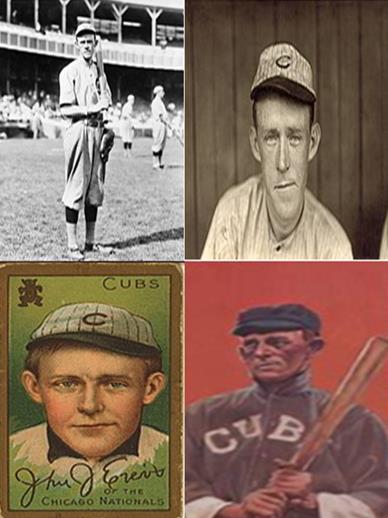
Johnny Evers
John Joseph Evers, July 21, 1881 – March 28, 1947, was a professional baseball second baseman and manager. He played in major league baseball from 1902 through 1917 for the Chicago Cubs, Boston Braves, and Philadelphia Phillies. Evers was born in Troy, New York. His father worked as a saloon keeper. Many of
Baseball Trailblazers Page 1154
Evers' relatives, including his father, brothers, and uncles, played baseball. Evers attended St. Joseph's Elementary School and played sandlot ball in Troy. Evers made his professional debut in minor league baseball for the Troy Trojans of the Class-B New York State League in 1902 as a shortstop. Evers reportedly weighed less than 100 pounds. Evers reportedly weighed no more than 130 pounds during his career.
Evers batted .285 and led the New York State League with 10 home runs. Frank Selee, manager of the Chicago Cubs, scouted Evers's teammate, pitcher Alex Hardy. Selee, also looking for a second baseman due to an injury to starter Bobby Lowe, purchased Hardy's and Evers' contracts for $1,500, and soon made Evers his starting second baseman.
Evers made his major league baseball debut with the Cubs on September 1 at shortstop, as Selee moved Joe Tinker from shortstop to third base. Only three players in the National League were younger than Evers. Three days later, Selee returned Tinker to shortstop and assigned Evers to second base. In his month long tryout with the Cubs, Evers batted .222 without recording an extra base hit and played inconsistent defense.
However, Lowe's injury did not properly heal by spring training in 1903, allowing Evers to win the starting job for the 1903
season. Lowe recovered during the 1903 season, but Evers' strong
Baseball Trailblazers Page 1155
play made Lowe expendable. Evers finished third in the NL in fielding percentage among second basemen, fifth in assists and putouts. The Cubs sold Lowe to the Pittsburgh Pirates after the season. Evers played 152 games in the 1904 season. Defensively, his 518 assists and 381 putouts led the NL.
During the 1906 season, Evers finished fifth in the NL with 49
stolen bases, and led the league with 344 putouts. The Cubs won the NL pennant in 1906, but lost the 1906 World Series to the Chicago White Sox four games to two. Evers batted 3 for 20;
.150; in the series. During the 1907 season, Evers led the NL
with 500 assists. The Cubs repeated as NL champions in 1907, and won the 1907 World Series over the Detroit Tigers, four games to none, as Evers batted 7 for 20; .350.
During the 1908 pennant race, Evers alerted the umpires to Fred Merkle's base running error in a game against the New York Giants, which became known as "Merkle's Boner." Al Bridwell hit what appeared to be the game winning single for the Giants, while Merkle, the baserunner on first base, went to the clubhouse without touching second base. Evers called for the ball, and the umpire ruled Merkle out. NL president Harry Pulliam ruled the game a tie, with a makeup to be played. The Cubs won the makeup game, thereby winning the pennant. The Cubs then won the 1908 World Series over Detroit, four games to one,
Baseball Trailblazers Page 1156
as Evers again batted 7 for 20; .350. For the 1908 season, Evers had a .300 batting average, good for fifth in the NL, and a .402
on base percentage, second only to Honus Wagner.
Evers drew 108 walks during the 1910 season, trailing only Miller Huggins. However, Evers missed the end of the season with a broken leg. Without Evers, the Cubs won the NL pennant, but lost the 1910 World Series to the Philadelphia Athletics, four games to one. Evers agreed to manage the Navy Midshipmen, a college baseball team, in 1911, despite the opposition of Cubs'
manager Frank Chance. He experienced a nervous breakdown in 1911. Returning to the Cubs later in the season, he played in only 46 games that year. Evers indicated that this was a result of a business deal that cost Evers most of his savings. Evers rebounded to bat .341 in 1912, good for fourth in the NL, and he led the NL with a .431 on base percentage. Team owner Charles W.
Murphy named Evers manager in 1913, signing him to a five year contract, succeeding Chance.
After the 1913 season, Evers was offered $100,000 to jump to the Federal League, but he opted to take less money to remain with the Cubs. In February 1914, after Evers signed his players to contracts, Murphy fired Evers as manager and traded him to the Boston Braves for Bill Sweeney and Hub Perdue. Murphy insisted that Evers had resigned as manager, which Evers denied. Evers
Baseball Trailblazers Page 1157
insisted he was a free agent, but the league assigned him to the Braves. He signed a four year contract at $10,000 per season, with a $20,000 signing bonus.
During the 1914 season, the Braves fell into last place of the eight team NL by July 4. However, the Braves came back from last place in the last ten weeks of the season to win the NL pennant.
Evers' .976 fielding percentage led all NL second basemen. The Braves defeated the Philadelphia Athletics in the 1914 World Series, four games to none, as Evers batted 7 for 16; .438.
Evers won the Chalmers Award, the forerunner of the modern day Most Valuable Player award, ahead of teammate Rabbit Maranville.
Evers was limited in 1915 by injuries, and also served suspension for arguing with umpires. After a poor season in 1916, Evers began the 1917 season with a .193 batting average.
Due to Evers' declining performance, the Braves placed Evers on waivers at mid-season, and he was claimed by the Philadelphia Phillies. Evers rejected an offer to become manager of the Jersey City Skeeters of the International League that offseason.
He signed with the Boston Red Sox as a player-coach for the 1918
season, but was released without playing a game for them. Not receiving another offer from another major league team, Evers traveled to Paris as a member of the Knights of Columbus to promote baseball in France.
Baseball Trailblazers Page 1158
Evers joined the New York Giants during the 1920 season, serving as a coach. He managed the Cubs again in 1921, succeeding Fred Mitchell. With the team struggling, Evers was fired in August and replaced with Bill Killefer. The Cubs finished seventh out of eight in the NL that season.
Evers served as a coach for the Chicago White Sox in 1922 and 1923. Evers was named the White Sox acting manager for the 1924
season, succeeding Chance, who was ordered home due to poor health. However, Evers suffered from appendicitis during the season, missing time, and the White Sox opened up a managerial search when Chance died in September. The White Sox replaced Evers with Eddie Collins after the season.
Evers rejoined the Braves as a scout. As Braves owner Emil Fuchs sold manager Rogers Hornsby to the Cubs and assumed managerial duties himself for the 1929 season, Fuchs hired Evers as a coach. Fuchs had no experience as a field manager, and so Evers became captain of the Braves, directing the team during the game and dealing with umpires.
Evers remained a coach for the Braves under Bill McKechnie, who succeeded Fuchs as field manager in 1930, and served in the role through 1932. He continued to scout for the Braves, and then became general manager of the Albany Senators of the New York–
Baseball Trailblazers Page 1159
Pennsylvania League in 1935. He resigned from Albany at the end of the season.
Evers concluded with a lifetime batting average of .270, 12 home runs, 538 runs batted in, and 324 stolen bases. He helped lead the Cubs to four National League pennants, including two World Series championships, and added one with the Braves. Known as one of the smartest ballplayers, Evers also had a surly temper that he took out on umpires. His combative play and fights with umpires earned him the nickname "The Human Crab." Evers was a part of the great double play combination with Joe Tinker and Frank Chance, which was immortalized as "Tinker to Evers to Chance" in the poem "Baseball's Sad Lexicon." Over his managerial career, he posted a 180–192 record.
Evers married Helen Fitzgibbons. Evers operated a sporting goods store in Albany, New York in 1923. However, Evers lost his money and filed for bankruptcy in 1936. The store was passed down to Evers' descendants. He also worked as superintendent of Bleecker Stadium in Albany and spent time teaching baseball to sandlot players. Evers suffered a stroke in August 1942, which paralyzed the right side of his body. He remained bedridden or confined to a wheelchair for most of the next five years. Evers died of a cerebral hemorrhage in 1947 at St. Peter's Hospital in Albany.
Baseball Trailblazers
Page 1160
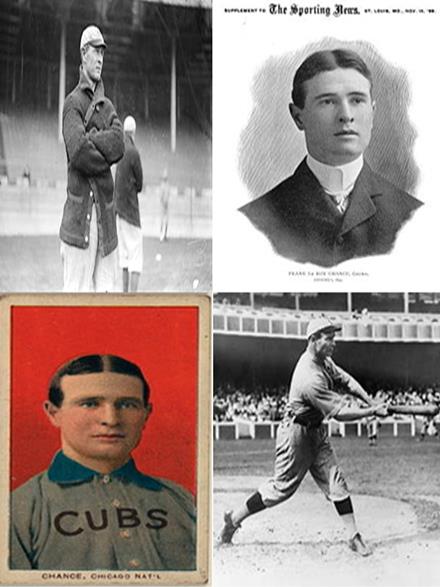
Frank Chance
Frank Leroy Chance, September 9, 1877 – September 15, 1924, was a professional baseball first baseman. Chance played in major league baseball for the Chicago Cubs, initially named the
Baseball Trailblazers Page 1161
Orphans, and the New York Yankees from 1898 through 1914. He also served as manager of the Cubs, Yankees, and Boston Red Sox.
Chance was born in Salida, California, in Stanislaus County.
His family was of English and Scottish descent. He was raised in Fresno, California and attended Fresno High School. His father was president of the First National Bank in Fresno.
Chance enrolled at the University of California, where he pursued a degree in dentistry. He transferred to Washington College in Irvington, California. While playing baseball for the school's baseball team, he received an offer to play semiprofessional baseball for a team in Sullivan, Illinois, for $40
a month, which he accepted.
Returning to college the next year, Chance led his team to a third place finish in an amateur tournament of 50 teams. Bill Lange of the Chicago Cubs discovered Chance and convinced the Cubs to sign him as a backup catcher and outfielder, he receiving $1,200 a year. Chance was scouted by other teams, but chose the Cubs as Tim Donohue was the only catcher ahead of him on the Cubs' depth chart.
Chance began his career in 1898 with the Chicago Cubs, serving as a reserve catcher and outfielder. He played irregularly through the 1902 season. Due in part to finger injuries suffered
Baseball Trailblazers Page 1162
while catching, Chance played in no more than 75 games in a season through 1902. In 1903, Johnny Kling became the Cubs' full time catcher. As Bill Hanlon, the Cubs' first baseman, left the team, manager Frank Selee moved Chance to first base. Though Chance initially balked at the position change, he agreed when he received a pay raise.
In 125 games during the 1903 season, Chance recorded a .327
batting average, and 67 stolen bases; the latter mark leading the National League. His .439 on-base percentage was third best in the league, behind Roy Thomas and Roger Bresnahan, and his 81
runs batted in tied for sixth best. Chance had a .310 batting average in 1904, good for sixth place in the NL. His .382 on base percentage was the fourth best in the league, and his .430
slugging percentage was fifth best. Chance also hit six home runs, tying him for third place, while his 42 stolen bases tied for fourth place, and his 89 runs scored were seventh best.
Selee fell ill in 1905, and Chance was selected to succeed him as manager. That year, he also batted .316 with 92 runs scored and 70 RBIs. His batting average was sixth best in the NL, while he led the league with a .450 on base percentage, and finished seventh with a .434 slugging percentage. His 38 stolen bases were sixth best in the league. In 1906, Chance batted .319 and led the NL with 103 runs scored and 57 stolen bases. His batting
Baseball Trailblazers Page 1163
average was fifth best in the league, while his .419 on base percentage finished in third, and his .430 slugging percentage placed him in fifth. When Chance stole home from second base in a tie game against the Cincinnati Reds, team owner Charles W.
Murphy granted him a ten percent ownership stake in the club to show his gratitude. Chance later sold his share of the franchise for approximately $150,000. Meanwhile, The Cubs won 116 games during the 1906 season, taking the NL pennant, but the crosstown Chicago White Sox of the American League defeated the Cubs in the 1906 World Series.
Chance batted .293 during the 1907 season, finishing sixth in the NL, while his .395 on-base percentage was third best. He tied for seventh with 35 stolen bases. The Cubs returned to the World Series in 1907. Though Chance only batted .154 in post season 1907, the Cubs defeated the Tigers in four games.
Chance began a slow decline during the 1908 season, and his playing time fell off in 1909 and 1910. Though he finished third in the NL with 27 doubles in 1908, he did not finish among the ten best in the categories of batting average, on base percentage, or stolen bases in 1908, 1909, or 1910. Chance batted .421 in the 1908 World Series, as the Cubs again defeated the Tigers, this time in five games.
Baseball Trailblazers Page 1164
By 1910, Chance began to groom Fred Luderus as his successor at first base. He rebuilt the team in 1911 after Evers's nervous breakdown and the departure of Harry Steinfeldt, replacing them with Heinie Zimmerman and Jim Doyle respectively. The Cubs returned to the World Series in 1910, against the Philadelphia Athletics. Chance batted .353 in that 1910 World Series, though the Athletics won it in five games. Chance was ejected in game three, becoming the first player ever ejected from a World Series game. Chance continued to transition himself out of the Cubs' lineup in 1911, as he played in only 31 games.
In 1912, Chance endured surgeries to correct blood clots in his brain that were caused by being hit by pitches in his head.
Meanwhile, Chance argued with Murphy, who had been releasing expensive players from the Cubs in an effort to save the team money. The New York Yankees negotiated for Chance's release from the Cubs after the 1912 season. The Cubs released Chance while he was hospitalized, and in January 1913, Chance signed a three-year contract with the Yankees, worth $120,000, to serve as the Yankees' manager. He also played first base for the Yankees and served as field captain, though he played in no more than 12
games in a season. The Yankees finished in seventh place. In 1914, Chance named Roger Peckinpaugh the Yankees' new captain.
Baseball Trailblazers Page 1165
After struggling during the 1914 season, Chance criticized the talent brought to him by Yankees scout Arthur Irwin. After repeatedly seeking to have Irwin fired, he offered his resignation from the team late in the season on the condition that he still was to receive his 1915 salary. After this was accepted by team owner Frank J. Farrell, Chance resigned with three weeks remaining in the season, and Peckinpaugh served as player–manager for the remainder of the season.
Chance returned to his native California, and was named manager of the Los Angeles Angels of the Pacific Coast League in 1916.
Chance won the league championship in 1916. He re-signed with the Angels for the 1917 season and was also granted a part ownership in the Angels from the majority owner, John F. Powers.
Powers and Chance remained good friends for the rest of his life. He resigned during the 1917 season due to his declining health. He then served as president of the California Winter League, continuing to instill discipline in players. He fined Ty Cobb for "abusing an umpire."
Chance managed the Boston Red Sox in 1923. The Red Sox did not retain Chance after the season. But some sources noted that Chance had only agreed to a one year contract and was not necessarily interested in returning to the Red Sox, a team described by one sportswriter as no better than a minor league
Baseball Trailblazers Page 1166
club. After his relationship with the Red Sox was severed, he was named the Chicago White Sox manager for the 1924 season, but developed severe influenza before he could take the helm. He soon developed other respiratory complications, including asthma. Chance submitted his resignation to owner Charles Comiskey, but Comiskey refused to accept it, giving him the opportunity to return to the team when his health improved. He returned to Chicago briefly in April, but was unable to take charge of the team. Chance returned to Los Angeles where he underwent emergency surgery in April 1924. Johnny Evers was named the White Sox acting manager for the 1924 season.
Chance was part of the trio of infielders remembered for their double-play ability, with Joe Tinker and Johnny Evers. The trio were immortalized as "Tinker to Evers to Chance," also known as
"Baseball's Sad Lexicon." His final statistics included a lifetime batting average of .296, 20 home runs, 596 runs batted in, and 401 stolen bases.
Noted for his leadership abilities, Chance earned the nickname
"Peerless Leader." John McGraw, a contemporary and rival of Chance, considered Chance one of the greatest players he ever saw. Chance's lifetime record as a manager was 946–648; a .593
winning percentage. His .664 winning percentage as manager of the Cubs is the highest in franchise history. As a player,
Baseball Trailblazers Page 1167
Chance is the Cubs' all-time career leader in stolen bases. He led the Cubs in batting average in 1903, 1904, 1905 and 1907. In World Series play, Chance batted .300, recording 21 hits, scoring 11 runs, and stealing 10 bases.
Chance was a disciplinarian. He preached moderation in socializing, including avoiding alcohol, to his players. Chance fined his players for shaking hands with members of the opposing team. During the baseball off seasons, Chance worked as a prizefighter. James J. Corbett and John L. Sullivan, among the best fighters of the era, both considered Chance "the greatest amateur brawler of all time." Chance owned a ranch in Glendora, California, which he sold prior to becoming manager of the Red Sox.
Chance married Edythe Pancake on October 3, 1903. Edythe became an advocate for baseball, imploring women to attend baseball games. Chance died at age 47 in Los Angeles, California. Some sources simply said that he died after a "long illness," while others attributed it to heart disease brought on by severe spasms of bronchial asthma.
Baseball Trailblazers
Page 1168
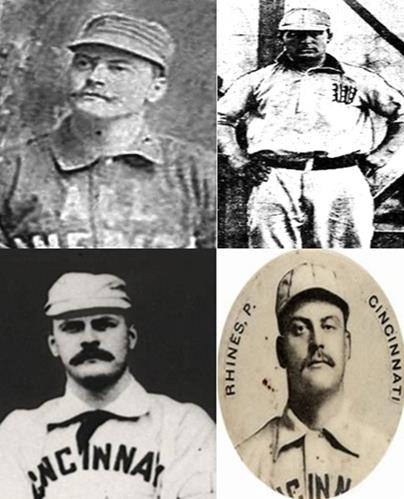
Billy Rhines
William Pearl Rhines, March 14, 1869 – January 30, 1922, hailed from Ridgway, Pennsylvania. He was a pitcher over parts of 9
seasons, 1890–1899, with the Cincinnati Reds, Louisville Colonels and Pittsburgh Pirates. He led the National League in
Baseball Trailblazers Page 1169
ERA twice, 1890 and 1896, while playing for Cincinnati. For his career, he compiled a 114–103 record in 249 appearances, with a 3.47 ERA.
Using an effective submarine delivery, pitcher Billy Rhines won 113 games in nine major league seasons. He burst onto the big league scene with phenomenal success. As a 21 year old rookie on the Cincinnati Reds in 1890, he achieved an 18-2 record in his first 20 starts.
Billy attended Bucknell University in Lewisburg, Pennsylvania.
He left school to play professional baseball for teams in Binghamton, New York, and Jersey City, New Jersey, in 1888, and in Davenport, Iowa, the following year. On June 28, 1889, Rhines pitched all 15 innings in a 6-4 victory over Springfield, Illinois. He struck out 12 batters in the contest. Six days later, he fanned nine in a three hit shutout of Burlington, Iowa. In October 1889, the Cincinnati Reds of the National League signed him and his Davenport battery mate, Jerry Harrington.
Rhines did not receive a decision in his major league debut on April 22, 1890; he allowed two runs in four innings of relief facing the Chicago Colts. Then, with Harrington as his catcher, he won six consecutive starts in impressive fashion; a three-hit
Baseball Trailblazers Page 1170
shutout of the Cleveland Spiders on April 30, a five-hitter against the same team two days later; a triumph over the Colts on May 7, followed by a three hitter against the Pittsburgh Alleghenys on May 10; and a pair of victories over the Philadelphia Phillies on May 16 and 19. The youngster is the best pitcher in league, opined Phillies manager Harry Wright.
Rhines’s winning streak was broken on May 22 when the Reds made five costly errors and fell 6-4 to the Brooklyn Bridegrooms. But he won his next seven starts, including shutouts of Cleveland and Chicago, and his record stood at 13-1 on June 17. He is a
“full-blown phenomenon,” said the Cincinnati Enquirer. “Rhines was discussed in parlors, in bar rooms, in street cars, in the hotels, on the streets, in fact, it was Billy Rhines here, there and everywhere.”
Rhines delivered a bewildering dish of outcurves, inshoots, drops, rise balls and straight balls with remarkable speed and command of the ball. He alternated underhand pitching with high-arm throws. His rise ball was a beauty; It shoots along about a foot from the ground, until near the plate, when it suddenly rises. A batter who managed to hit it usually popped it up.
But the heavy workload took a toll on the rookie, who complained of a sore arm beginning in mid-June. From July 9 to August 1, he
Baseball Trailblazers Page 1171
lost nine of 10 decisions, dropping his season record to 19-11.
He returned to form on August 4, winning his 20th game, a 7-5
victory over the Phillies.
Rhines finished the 1890 season with a 28-17 record, six shutouts, and a league best 1.95 ERA. He worked 401 innings during the regular season and pitched in three postseason exhibition games. Rarely has a pitcher accomplished so much in his rookie year. His sterling first season was followed by an up and down sophomore year. On May 12, 1891, Rhines surrendered 18
runs to the Brooklyn Grooms; his pitches floated up to the bat and the Grooms drove them to all parts of the lot. But on June 1, he fired a three hitter in a 5-2 victory over future Hall of Famer Kid Nichols and the Boston Beaneaters. The efforts of the Boston batsmen to gauge Rhines’s delivery were absolutely futile. Eight days later Rhines fanned 10 batters in a 9-3
triumph at Philadelphia. The Phillies’ Ed Delahanty, one of the greatest hitters of the era, struck out four times.
Bothered by a sore arm, Rhines lost 16-8 at Chicago on July 22.
Yet on August 3, he hurled his only shutout of the season, beating Nichols and the Beaneaters. Rhines finished the year with a 17-24 record in 372 innings and a respectable 2.87 ERA.
Baseball Trailblazers Page 1172
But Rhines’s career spiraled downward the next year. The trouble began in March of 1892 when he suffered a broken collarbone in a wrestling match. He tried pitching in Cleveland on April 23, but was removed from the game after allowing five runs in the first inning. The Reds laid him off without pay until he “gets well enough to permit him to do his usual work.”
To make matters worse, Rhines, Harrington, and Reds outfielder Eddie Burke were out late one night in May when they became
“stupidly drunk,” and Rhines and Burke fought each other “in a disgraceful, drunken brawl.” The Reds fined Harrington and Burke $100 each and suspended Rhines indefinitely. After another drinking incident a week later, Harrington, too, was suspended.
Rhines said defiantly; “I am not compelled to play ball for a living. My folks are well-to-do. My father runs three sawmills at Ridgway and I can go home any time I want to. A rest may do me good.”
The Reds reinstated Rhines and Harrington in July. In his first game back, on July 13, Rhines hurled a four-hitter in a 3-1
victory over the Brooklyn Grooms. A week later, he defeated the Senators, 3-2, in an 11 inning contest at Washington. In the third inning, Rhines slugged a solo home run, the only homer of his career.
Baseball Trailblazers Page 1173
But the success was short lived. In Philadelphia on July 26, Rhines allowed 18 runs in five innings of work in a 26-6 loss to the Phillies. A week later in Louisville, he was “an easy mark”
for the Colonels, who “knocked the ball all over the lot” in an 11-4 pasting of the Reds. And in Cleveland on August 9, Cy Young and the Spiders prevailed 8-5 over Rhines and the Reds.
The final straw came on August 17 in Cincinnati. Rhines was taken out of the game after giving up nine runs in three innings to the New York Giants. After the game, the Reds released both Rhines and Harrington.
The Louisville Colonels gave him a one month trial in 1893, but he failed the test and was let go. Rhines lost four of five starts, and in 31 innings, he walked 19 batters and struck out none. But Rhines would work his way back to the majors.
In 1894 Rhines pitched 406⅔ innings and compiled a 25-19 record for Grand Rapids of the Western League. He was drafted by the Cincinnati Reds, who were willing to give him another chance.
The Reds were desperate for help after their pitching staff recorded a league worst 5.99 ERA in 1894.
An interesting side note to the 1894 season is that Joe McGinnity, a 23 year old pitcher on the Western League’s Kansas City team, observed Rhines’s submarine style with keen interest.
Baseball Trailblazers Page 1174
McGinnity would go on to a Hall of Fame career by emulating Rhines’s delivery.
In 1895 Rhines went 19-10 with a 4.81 ERA, and his 19 wins led the Reds. One of the victories came at Cleveland on August 15, when he defeated Cy Young, 4-3. He continued his rivalry with Young, winning 8-4 on April 24, 1896, but losing 2-1 eight days later. On September 18, 1897, in the first game of a doubleheader, Rhines lost 6-0 to Young, who threw a no-hitter.
On May 6, 1896, Rhines pitched one of the best games of his career, a two hit shutout of the Boston Beaneaters. The Boston hitters appeared in a dazed condition when they were at the plate. They looked at Rhines’s pitching in open-mouthed amazement, like it was something they had never seen before.
Rhines pitched another dazzling two hit shutout on May 20, against the Phillies. But misfortune struck four days later. A
“hot liner” off the bat of Louisville’s Doggie Miller hit the middle finger of Rhines’s pitching hand, fracturing the digit.
The injury caused him to miss more than two months of the 1896
season. He finished the year with an 8-6 record and a league leading 2.45 ERA in 143 innings.
The next season Rhines compiled a 21-15 record with a 4.08 ERA.
On August 7, 1897, he had not only speed, but grand command and
Baseball Trailblazers Page 1175
the best use of his famous underhand ball, in a three hit shutout of the Louisville Colonels. Louisville’s Honus Wagner, a 23 year old rookie, went hitless in the game.
Rhines pitched for an All-American team on a barnstorming tour with the Baltimore Orioles from October to December, 1897. In the midst of the tour, the Reds traded him to the Pittsburgh Pirates.
In 1898 Rhines went 12-16 for the Pirates with a 3.52 ERA, but he was suspended in September after throwing a wild weekend party in New York for returning veterans of the Spanish-American War. Rhines, himself a fine marksman, was fascinated by the war and delighted in interacting with the servicemen. Throwing the party was an act of patriotism, Rhines argued. Pirates manager Bill Watkins disagreed and suspended him for the remainder of the season. “Rhines is anything but a rowdy,” said the Pittsburgh Press. “He is intelligent and ordinarily well behaved.”
Rhines pitched two brilliant games in 1899. He hurled a two hitter against the Chicago Orphans in an 11-1 victory on May 17.
He had that underhand raise ball of his going, and the Orphans never got near it. And two weeks later, he defeated the Washington Senators, 5-1, with a four-hitter. But three times he
Baseball Trailblazers Page 1176
was knocked out of a game after allowing six or more runs in only two innings of work. After the third time, against the New York Giants on June 22, the Pirates released him. He received offers from several teams but decided to rest for the remainder of the year.
Rhines’s father died in September of 1899 and left him an inheritance. Perhaps this affected his decision to leave baseball and stay in Ridgway and work as a lumberman. Except for a brief stint in 1901 with the Grand Rapids team of the Western Association, Rhines was done with professional baseball.
A longtime bachelor, Rhines got married in 1912 at age 43, to 23
year old Kozie Lorraine Milliron. By 1920 they had four children and Billy operated a taxi service. After a long illness, he died of heart disease on January 30, 1922, in Ridgway, at the age of 52.
Baseball Trailblazers
Page 1177
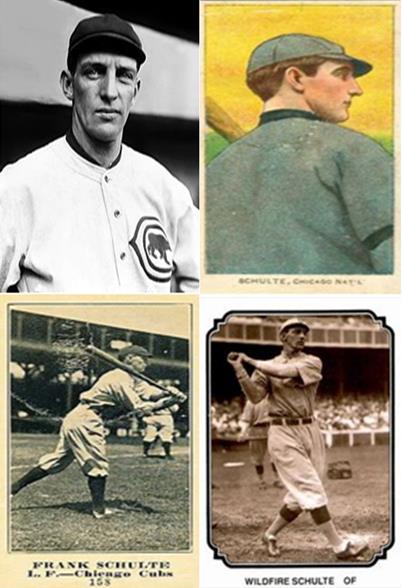
Frank Schulte
Frank M. "Wildfire" Schulte, September 17, 1882 – October 2, 1949, was an outfielder in major league baseball, who played for the Chicago Cubs, Pittsburgh Pirates, Philadelphia Phillies, and
Baseball Trailblazers Page 1178
Washington Senators from 1904 to 1918. He helped the Cubs win four National League championships and two World Series.
Schulte was born in Cochecton, New York to German immigrants. He played independent baseball as a teenager, despite his father's opposition to the idea. From 1902 to 1904, he played for the New York State League's Syracuse Stars. He was purchased by the Chicago Cubs in August 1904.
Schulte made his major league debut for the Cubs in September 1904. He played on the Cubs teams that won National League pennants in 1906, 1907, 1908, and 1910. They won the World Series in 1907 and 1908. In his four World Series appearances, Schulte had an overall batting average of .321.
In 1910, Schulte led the NL with 10 home runs. In 1911, he led the NL in home runs - 21, runs batted in - 107, and slugging percentage - .534. He also became the first player in major league history to have more than 20 doubles, triples, home runs, and stolen bases in a season. The feat was not accomplished again until 1957. Schulte won the 1911 NL Chalmers (MVP) Award.
In July 1916, Schulte was traded to the Pittsburgh Pirates. His hitting declined, and he then played for the Philadelphia Phillies and Washington Senators until the 1918 season, his last as a major leaguer.
Baseball Trailblazers Page 1179
Schulte played in the International League and Pacific Coast League from 1919 to 1922.
In 1806 major league baseball games over 15 seasons, Schulte posted a .270 batting average, 1766 for 6533, with 906 runs, 288
doubles, 124 triples, 92 home runs, 793 runs batted in, 233
stolen bases, 545 bases on balls, a .332 on base percentage, and a .395 slugging percentage.
Schulte acquired his nickname, "Wildfire", after seeing a play called "Wildfire" in Mississippi. He then named one of his race horses "Wildfire" and was eventually known by that name, as well. Schulte married his wife, Mabel Kirby, in 1911. He eventually settled in Oakland, California, where he died in 1949.
Baseball Trailblazers
Page 1180
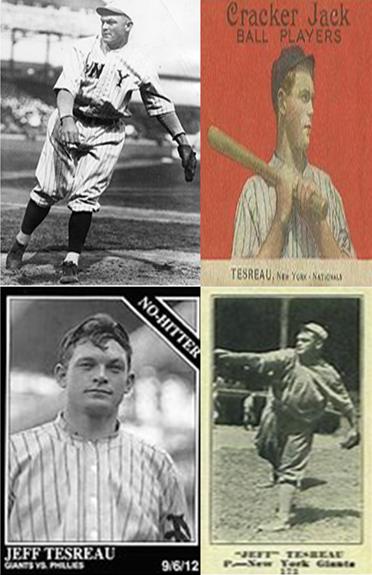
Jeff Tesrau
Charles Monroe "Jeff" Tesreau, March 5, 1888 – October 24, 1946, was a major league baseball player. Born in Ironton, Missouri, he pitched for the New York Giants from 1912-1918.
Baseball Trailblazers Page 1181
Tesreau initially signed with a minor league team of the St.
Louis Browns in 1909. In 1910, his contract was purchased by the New York Giants. After two years in the minors, Tesreau learned how to throw a spitball, which became his signature pitch. He started the second game of the 1912 season for the Giants. The New York Times wrote, "Tesreau has curves which bend like barrel hoops and speed like lightning. He's just the kind of a strong man McGraw has been looking for."
In 1912, Tesreau was 17–7 and had a league leading ERA of 1.96.
On September 6th of that season, Tesreau no hit the Philadelphia Phillies 3-0. In the 1912 World Series, Tesreau went 1–2 against Boston Red Sox ace Smoky Joe Wood.
From 1912 to 1917, Tesreau remained a starting pitcher with the Giants. In 1918, he had an argument with manager John McGraw and quit the team in the middle of the season. In 1919, Tesreau refused to play for the Giants, and McGraw refused to trade or release him. He finished with a win-loss record of 115–72 and an earned run average of 2.43.
Tesreau took a position as baseball coach for the Dartmouth Big Green baseball team of Dartmouth College, a position he held until his death on September 24, 1946. He suffered a stroke while on a fishing trip and died a few days later.
Baseball Trailblazers
Page 1182
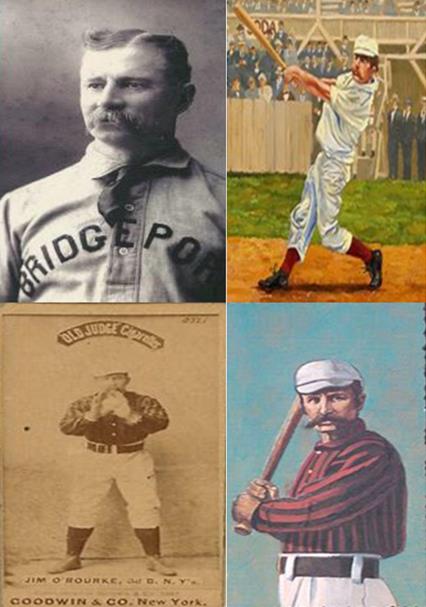
Jim O’Rourke
James Henry O'Rourke, September 1, 1850 – January 8, 1919, nicknamed "Orator Jim," was a professional baseball player in
Baseball Trailblazers Page 1183
the National Association and major league baseball who played primarily as a left fielder.
O'Rourke was born in East Bridgeport, Connecticut, and worked on his family's farm while playing youth league and semi-pro baseball. He began his professional career as a member of the Middletown Mansfields in 1872, joining the one year old National Association team as a catcher. The Mansfields were not a top tier team, and folded in August, but O'Rourke had impressed other teams sufficiently enough to be offered a contract with the Boston Red Stockings, with whom he played until 1878. On April 22, 1876, O'Rourke had the first base hit in National League history.
He graduated from Yale Law School in 1887 with an LL.B., practicing law in Bridgeport between early playing stints, and earning the nickname "Orator Jim" because of his verbosity on the field, his intellect, and his law degree, uncommon in a game regarded as a rough immigrant sport at the time.
After leaving the major leagues following the 1893 season he continued to play in the minor leagues until he was over 50
years old.
For the period 1876–1892, he ranks behind only Cap Anson in career major league games played - 1,644, hits - 2,146, at bats
Baseball Trailblazers Page 1184
- 6,884, doubles – 392, and total bases - 2,936, and behind only Harry Stovey in runs scored - 1,370.
In 1904, he made a final appearance with the New York Giants under manager and friend John McGraw, becoming at age 54 the oldest player ever to appear in the National League, and the oldest player to hit safely in a major league game. O'Rourke is one of only 29 players in baseball history to appear in Major League games in four decades.
His final major league statistics included 1,999 games over 23
seasons, during which O'Rourke posted a .310 batting average, 2,639 for 8,503, with 1,729 runs, 468 doubles, 149 triples, 62
home runs, 1,208 RBI, 229 stolen bases, 513 bases on balls, a
.352 on base percentage and a .422 slugging percentage. He was the NL home run leader in 1880. O'Rourke made a brilliant record for himself as an outfielder, being an excellent judge of a ball, a swift runner, and making the most difficult running catches with the utmost ease and certainty. As a thrower, too, he stood pre-eminent, being credited with a throw of 365 feet, the next to the longest yet accomplished by any player.
He played for the Middletown Mansfields (1872), the Boston Red Stockings / Red Caps (1873–1878), the Providence Grays (1879), the Boston Red Caps (1880), the Buffalo Bisons (1881–1884), the
Baseball Trailblazers Page 1185
New York Giants (1885–1889), the New York Giants (Players'
League) (1890), the New York Giants (1891–1892), the Washington Senators (1893), and the New York Giants (1904). He managed the Buffalo Bisons (1881–1884) and the Washington Senators (1893).
In 1912, he returned to the field to catch a complete minor league game at the age of 60.
O'Rourke died of pneumonia at age 68 in Bridgeport, Connecticut.
Baseball Trailblazers
Page 1186
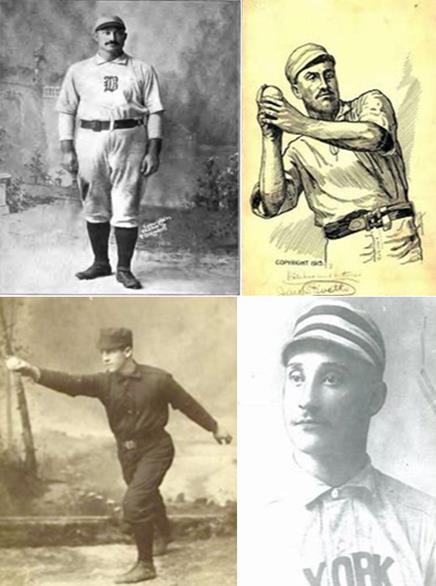
Jack Stivetts
John Elmer "Jack" Stivetts, March 31, 1868 – April 18, 1930, played 11 seasons in major league baseball spanning from 1889 to 1899. He played in the American Association with the St. Louis Browns, and in the National League with the Boston Beaneaters and Cleveland Spiders. His lifetime win-loss record was 203–132,
Baseball Trailblazers Page 1187
while putting up an earned run average of 3.74. Stivetts was the American Association ERA champion in 1889, the strikeout champion in 1891, and pitched a no hitter on August 6, 1892.
"Happy Jack," nicknamed due to his pleasant demeanor, was born to German immigrants and raised in Ashland, Pennsylvania. He initially followed his father into the coal mining industry before playing professional baseball. After playing two and half seasons in minor league baseball, he was signed by the Browns.
Over the next few seasons, he was regarded as one of the best pitchers in baseball.
He led the AA in earned run average in his first season, and then in strikeouts two seasons later. In the years spanning from 1890 through 1896, he posted 20 or more victories in a season six times; two in which he won more than 30. In 1892, he won a career high 35 games, and on August 6, he threw a no hitter.
During his seven seasons with the Beaneaters, he was part of four NL championships, and pitched alongside future Hall of Fame members John Clarkson and Kid Nichols. He was among the best hitting pitchers of his era, and was often used at other positions when he was not pitching. His season total of seven home runs in 1890 stood as the record for pitchers until 1931.
He compiled a .298 lifetime batting average, hit 35 home runs, and delivered 357 runs batted in.
Baseball Trailblazers Page 1188
In his last season in the major leagues, he played for the Spiders, widely considered to be one of the worst teams in history. After his baseball career, he returned to his hometown of Ashland. He worked for the area coal mines as a brewery wagon driver and carpenter, and died there at 62 years of age.
He was one of the fastest pitchers in the league, comparable to Amos Rusie and Ted Breitenstein. Kid Nichols remarked in 1902
that Stivetts' speed was as fast as Rusie, and could have extended his career much longer had he taken better care of his body.
Baseball Trailblazers
Page 1189
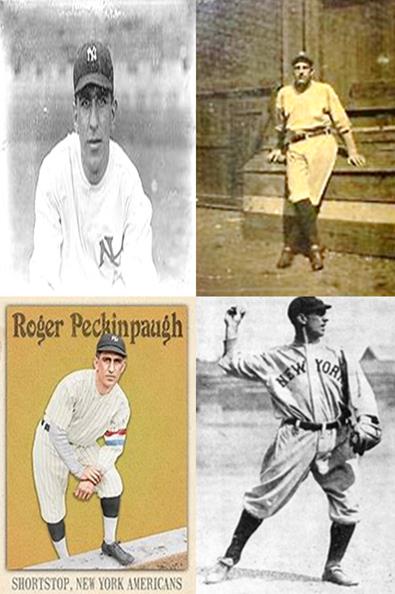
Roger Peckinpaugh
Roger Thorpe Peckinpaugh, February 5, 1891 – November 17, 1977, was a professional baseball shortstop and manager. He played in major league baseball from 1910 through 1927, during which he
Baseball Trailblazers Page 1190
played for the Cleveland Naps, New York Yankees, Washington Senators and Chicago White Sox.
Peckinpaugh was born in Wooster, Ohio, the third child of Frank and Cora Peckinpaugh. His father played semi-professional baseball. At a young age, the Peckinpaughs moved from Wooster to Cleveland. He attended East High School, where he played football, basketball, and baseball. There, Nap Lajoie of the Cleveland Naps, who lived in the same neighborhood, discovered Peckinpaugh. Lajoie signed Peckinpaugh to a contract with a salary of $125 per month when he graduated from high school in 1910.
The Naps started Peckinpaugh's professional career by assigning him to the New Haven Prairie Hens of the Class B Connecticut League. He was promoted to the Naps to make his major league baseball debut in September 1910, playing in 15 games for the Naps at age 19. The Naps assigned Peckinpaugh to the Portland Beavers of the Class A Pacific Coast League for the entire 1911
season. He appeared in 70 games for the Naps in 1912, batting only .212. On May 25, 1913, after giving the starting shortstop position to Ray Chapman, the Naps traded Peckinpaugh to the New York Yankees for Jack Lelivelt and Bill Stumpf.
Baseball Trailblazers Page 1191
The Naps soon regretted the trade. With the Yankees, Peckinpaugh emerged as a team leader. He was named captain in 1914 by manager Frank Chance. Chance resigned with three weeks remaining in the season, and Peckinpaugh served as player–manager for the remainder of the season. At the age of 23, he became the youngest manager in major league baseball history. He finished the 1914 season fifth in the AL with 38 stolen bases.
Bill Donovan was hired as the Yankees manager in the offseason.
In that 1914–15 offseason, Peckinpaugh considered leaving the Yankees to join the Federal League, as he received offers from the Chicago Federals, Buffalo Blues, and Indianapolis Hoosiers.
After considering the offer from Chicago, he chose to stay with the Yankees, and received a three year contract worth $6,000 per season from 1915 through 1917. He re-signed with the Yankees in 1918. Peckinpaugh tied Buck Weaver for fourth in runs scored –
89, and several players for eighth in home runs – 7, in the 1919
season.
By the 1921 season, Peckinpaugh was one of three players, along with Wally Pipp and Bob Shawkey, remaining with the Yankees from the time Jacob Ruppert and Tillinghast L'Hommedieu Huston purchased the team in 1915. The Yankees reached the World Series in 1921, losing to the New York Giants. Peckinpaugh set a major
Baseball Trailblazers Page 1192
league record for most assists in one game by a shortstop with nine.
Peckinpaugh was traded twice during the 1921–22 offseason. On December 20, 1921, the Yankees traded Peckinpaugh with Rip Collins, Bill Piercy, Jack Quinn and $100,000 to the Boston Red Sox for Bullet Joe Bush, Sad Sam Jones and Everett Scott. On January 10, 1922, Pecknipaugh was involved in a three team trade involving the Red Sox, Washington Senators and Philadelphia Athletics, where Peckinpaugh joined the Senators. Joe Dugan and Frank O'Rourke went to the Red Sox, and the Athletics acquired Bing Miller, José Acosta, and $50,000. Though team owner Clark Griffith had indicated that Peckinpaugh would serve as his player-manager at the time of the trade, he named Clyde Milan player-manager for the 1922 season instead. This distracted Peckinpaugh, and along with injuries, limited his performance.
Chance, now managing the Boston Red Sox, attempted to acquire Peckinpaugh from the Senators before the 1923 season. Remaining in Washington, Peckinpaugh rebounded during the 1923 season with timely hitting and solid fielding.
Griffith appointed Bucky Harris as manager before the 1924
season. Harris considered Peckinpaugh his "assistant manager.”
Peckinpaugh was a key contributor in the 1924 World Series, in
Baseball Trailblazers Page 1193
which the Senators defeated the Giants. He won the League Award as the AL's Most Valuable Player in 1925, edging Al Simmons by a small margin.
On January 15, 1927, the Senators traded Peckinpaugh to the Chicago White Sox for Leo Mangum and Sloppy Thurston. However, his playing time with the White Sox was limited by a leg injury.
He acted as an advisor to manager Ray Schalk. After one season with the White Sox, Peckinpaugh retired as a player.
Peckinpaugh was named manager of the Cleveland Indians after the 1927 season. After the Indians fell from first to fifth place during the 1933 season, the Indians fired Peckinpaugh, replacing him with Walter Johnson.
After being considered for the Detroit Tigers' managerial vacancy that offseason, Peckinpaugh took over as manager of the Kansas City Blues of the Class AA American Association for the 1934 season. Out of professional baseball in 1935, Peckinpaugh joined Lew Fonseca on nationwide baseball tours, which involved the viewing of a movie and technical demonstrations. He applied to be manager of the Boston Bees for the 1938 season, but the job was given to Casey Stengel. Peckinpaugh returned to professional baseball as the manager of the New Orleans Pelicans of the Class A1 Southern Association in 1939.
Baseball Trailblazers Page 1194
The Indians rehired Peckinpaugh as their manager in 1941, signing him to a two year contract. Team president Alva Bradley, who fired Peckinpaugh in 1933, promised Peckinpaugh full cooperation and minimal interference. After the 1941 season, he was promoted to vice president, later serving as Cleveland's general manager and president. When Bill Veeck bought the Indians in July 1946, he brought Harry Grabiner and Joseph C.
Hostetler with him to serve in the front office. Peckinpaugh and Bradley resigned.
Peckinpaugh succeeded Harris as GM for the Buffalo Bisons of the International League in the 1946–47 offseason. He was fired after the 1947 season, as the team's directors felt Peckinpaugh didn't sufficiently develop a farm system.
Peckinpaugh was considered an excellent defensive shortstop and strong leader. When he managed the Yankees, he became the youngest manager in major league baseball history. He was named American League Most Valuable Player in 1925. He played in the World Series three times: winning the 1924 World Series with the Senators, losing the 1921 World Series with the Yankees, and losing the 1925 World Series with the Senators. His lifetime batting average was .259, with 48 home runs, 740 runs batted in, and 205 stolen bases. His managerial record was 500–491.
Peckinpaugh was considered a calm baseball player and manager,
Baseball Trailblazers Page 1195
who did not let his temper get the best of him. After the end of his baseball career, Peckinpaugh worked as a manufacturer's representative for the Cleveland Oak Belting Company. He retired in 1976 at the age of 85. Suffering from cancer and heart disease, he was brought to a hospital for a respiratory condition, and died on November 17, 1977 in Cleveland. His wife, Mildred, died five years earlier. Together, they had four sons.
Baseball Trailblazers
Page 1196
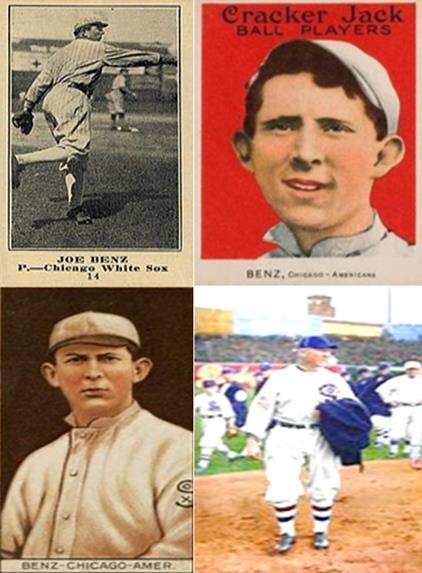
Joe Benz
Joseph Louis Benz, January 21, 1886 – April 22, 1957, pitched major league baseball from 1911 to 1919. The Benz family was of German Catholic stock, Joe's grandfather having emigrated from the Grand Duchy of Baden in 1849. Born in New Alsace, Indiana,
Baseball Trailblazers Page 1197
Joe played solely for the Chicago White Sox. Benz's two main pitches were the spitball and the knuckleball.
Benz pitched a no hitter for the White Sox on May 13, 1914, against the Cleveland Naps. He was a member of the Sox teams that reached the World Series in both 1917 and 1919, but appeared in neither. Benz had a 7-3 record during the 1917
season and was 8-8 a year later, throwing 10 complete games. But he pitched in just one game during the 1919 season, and was not on the roster for the 1919 World Series, which was tainted by the Black Sox Scandal.
He put up a lifetime record of 77 wins with 75 losses, and had an earned run average of 2.43.
After baseball, Benz was the custodian of a church and also worked for O’Hare Field. He died of a heart related illness in 1957 in Chicago.
Baseball Trailblazers
Page 1198
Oyster Burns
Baseball Trailblazers Page 1199
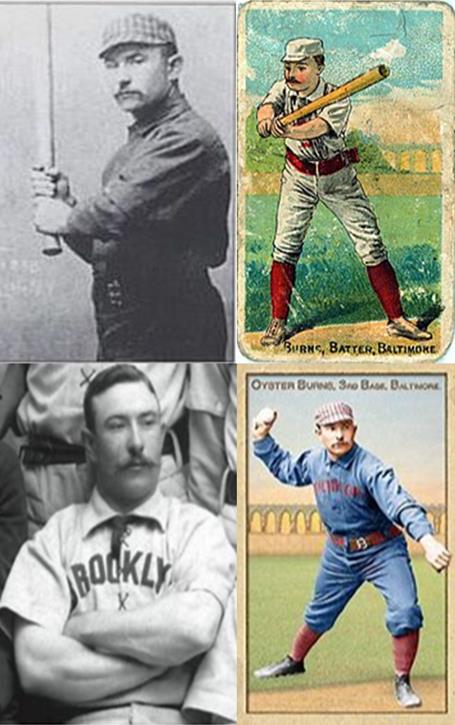
Thomas P. "Oyster" Burns, September 6, 1864 – November 11, 1928, was a professional baseball player. Born in Philadelphia, his parents, Patrick and Mary Burns, were both Irish immigrants.
Burns was nicknamed "Oyster" because he sold shellfish in the off season. He was described as a loudmouth and having had an irritating voice and personality. According to one un-named source; “He was a disturber and one of the worst that ever played ball. His disposition was very bad, and he made it unpleasant for any of the boys that crested him. He was what you would call a bulldozer.”
In 1883, Burns began his professional baseball career as an outfielder and pitcher with Harrisburg of the minor league Interstate Association. He had a batting average of .220 in 69
games. As a pitcher, Burns posted an earned run average of 2.30
over 20 games pitched, 15 of which were starts. Burns began the 1884 season playing for the Wilmington Quicksteps, but left the team after they joined the Union Association, and joined the Baltimore Orioles. Burns was the youngest player on the Orioles and the seventh youngest player in the American Association. He batted .298. Despite playing in only 35 games on the season, Burns recorded a team leading six home runs over 141 plate appearances. He continued his career with the Orioles in 1885, batting .231 with five home runs and 37 RBI, and pitching to a
Baseball Trailblazers Page 1200
7–4 win–loss record. His offensive struggles led him to be demoted to the Newark Domestics for the 1886 season, where he helped the Domestics win the Eastern League pennant. Burns led the league in batting average with .352), slugging percentage of
.558, and home runs with 10. By 1887, Burns had reentered the majors for the Orioles and became the team captain until he threw a baseball at an opposing pitcher following a groundout.
He was later fined $25. On the season, he recorded nine home runs, good for third in the American Association. Burns' 19
triples were enough to tie him with five others for the league lead, and his 140 games played were tied for the league lead with teammate Blondie Purcell.
After playing in 79 games for Baltimore in 1888, Burns was transferred to the Brooklyn Bridegrooms by Harry Von der Horst, the owner of both clubs. He led the Bridegrooms to an American Association championship in 1889 and a National League pennant in 1890. While he was playing for the Bridegrooms, the “New York Clipper” described Burns as "the noisiest man that ever played on the Brooklyn team. His voice reminds one of a buzz-saw." In 1889 he recorded team highs in on base percentage, batting average, and home runs, while the Bridegrooms, with an 89–48
record, became American Association champions. In the 1889 World Series, the Bridegrooms played the New York Giants of the
Baseball Trailblazers Page 1201
National League. Burns hit a three run home run to win the fourth game of the series, giving Brooklyn a 3–1 series lead.
However, the Giants would take the World Series after winning five straight games.
In 1890, the Bridegrooms had moved to the National League.
Burns, now 26, led the league in home runs - 13 and RBI - 128.
The team won the National League pennant, and faced the Louisville Colonels in the 1890 World Series. The series ended in a 3–3–1 tie as bad weather led to the cancellation of more games. After batting .285 with four home runs during the 1891
season, Burns' 1892 RBI total was third in the league, and his hits, doubles, triples, and batting average marks were the second highest on the Brooklyn team, now named the Grooms. In 1893, between games of a doubleheader, a teammate of Burns, Tom Daly, was sleeping in center field when Burns stabbed Daly with a penknife. Daly awoke and turned on the knife, leading to a severed tendon which kept Daly out for two weeks. Burns' 1894
batting average of .355 was the highest of his career and his hit and run totals were also the second highest in his career.
Burns continued to play for the club until 1895, when he played for the New York Giants. In his final major league year, he batted a combined .258 over 53 games.
Baseball Trailblazers Page 1202
In 1896, Burns' contract was purchased by the minor league Newark Colts. The Colts won the Atlantic League with an 82–61
record, two games above the Hartford Bluebirds, as Burns batted
.378. The next season, Burns served as a player-coach for the Bluebirds, where he led the team in doubles and batting average.
In 1901, his final managerial year, he coached Portland, Maine of the New England League.
His career spanned 15 seasons, 11 of which were spent with the major league baseball Wilmington Quicksteps - 1884, Baltimore Orioles - 1884–85, 1887–88, Brooklyn Bridegrooms - 1888–1895, and New York Giants - 1895. Burns, who predominately played as an outfielder, also played as a shortstop, second baseman, third baseman, and pitcher. Over his career, Burns compiled a career batting average of .300 with 870 runs scored, 1,392 hits, 224
doubles, 129 triples, 65 home runs, and 834 runs batted in 1,188
games played. Although the majority of his career was spent in the major leagues, Burns also played in minor league baseball.
After retiring from baseball, Burns lived in Brooklyn until his death on November 11, 1928.
Baseball Trailblazers
Page 1203
Herb Pennock
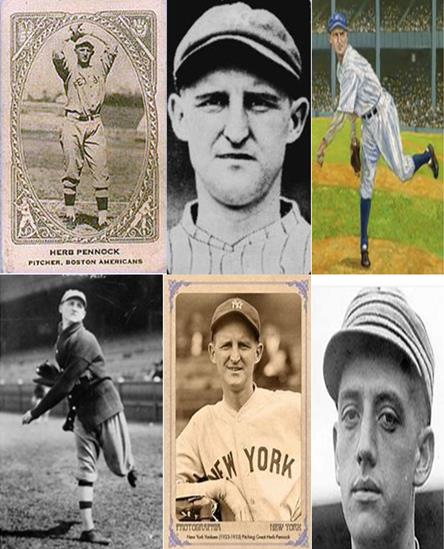
Herbert Jefferis Pennock, February 10, 1894 – January 30, 1948, was a professional baseball pitcher and front office executive.
He played in major league baseball from 1912 through 1933, and is best known for his time spent with the star studded New York Yankee teams of the mid to late 1920s and early 1930s.
Baseball Trailblazers Page 1204
Pennock was born in Kennett Square, Pennsylvania. His father, Theodore Pennock, and mother Mary Louise Pennock (née Sharp) were of Scotch-Irish and Quaker descent. His ancestors came to the United States with William Penn. Herb was the youngest of four children. Pennock attended Westtown School and Cedarcroft Boarding School, where he played for the baseball team. After struggling as a first baseman, with a weak offensive output and throwing arm that resulted in curved throws, his Cedarcroft coach converted Pennock into a pitcher.
While pitching at Cedarcroft, Pennock threw a no hitter to catcher Earle Mack, the son of Connie Mack, manager of the Philadelphia Athletics, in 1910. Pennock agreed to sign with the Athletics at a later date. Mack signed Pennock in 1912 to play for his collegiate team based in Atlantic City. Pennock's father insisted that he sign under an alias in order to protect his collegiate eligibility. Pennock threw a no hitter against a traveling baseball team, and Mack promoted him to the Athletics.
Mack intended for Pennock to be one of the prospects who would replace star pitchers Eddie Plank, Chief Bender, and Jack Coombs.
Mack signed Pennock to his Philadelphia Athletics in 1912.
Pennock made his major league debut with the Athletics on May 14, allowing one hit in four innings pitched. He was the
Baseball Trailblazers Page 1205
youngest person to play in the American League that season.
Former major leaguer Mike Grady, a neighbor of Pennock's in Kennett Square, took Pennock under his wing, while Bender taught Pennock to throw a screwball.
Pennock missed most of the 1913 season with an illness, but was able to rejoin the team late in the season. In the 1914 season, Pennock posted an 11–4 win–loss record with a 2.79 earned run average in 151 innings pitched for the Athletics. He pitched three scoreless innings in the 1914 World Series, which the Athletics lost to the Boston Braves. Mack let Bender go after the season, naming Pennock his Opening Day starting pitcher in 1915. On Opening Day, Pennock threw a one hit complete game shutout against the Boston Red Sox. However, as the Athletics struggled, Pennock's nonchalant playing style drew Mack's ire.
Concluding that Pennock "lacked ambition", Mack sold him to the Red Sox for the waiver price of $2,500. Mack later regarded this sale as his greatest mistake.
With a deep pitching staff in place, the Red Sox loaned Pennock to the Providence Grays of the International League in August for the remainder of the 1915 season. He split the 1916 season between the Red Sox and the Buffalo Bisons, also in the International League. With Buffalo, Pennock pitched to a 1.67
ERA, as Buffalo won the league pennant. Though the Red Sox won
Baseball Trailblazers Page 1206
the 1915 and 1916 World Series, Pennock did not appear in either series. Boston manager Jack Barry used Pennock sparingly in the 1917 season, and Pennock enlisted in the United States Navy in 1918. Pennock pitched for a team fielded by the Navy, defeating a team composed of members of the United States Army in an exhibition for George VI, the King of England, in Stamford Bridge. After the game, Ed Barrow, the new manager of the Red Sox, signed Pennock to a new contract after promising to use him regularly during the 1919 season.
Pennock received only one start apiece in the months of April and May, as the 1919 Red Sox relied on George Dumont, Bill James, and Bullet Joe Bush, leading Pennock to threaten to quit in late May unless Barrow fulfilled his earlier promise. Barrow used Pennock regularly after Memorial Day, and Pennock finished the season with a 16–8 win–loss record and a 2.71 ERA in 219
innings pitched. He served as the team's ace pitcher in the 1920
season, but subsequently settled in as the Red Sox' third starter. After the 1922 Red Sox campaign, in which he went 10–
17, the New York Yankees began to negotiate with the Red Sox to acquire Pennock.
The Yankees acquired Pennock from the Red Sox after the 1922
season. The Yankees traded Norm McMillan, George Murray, and Camp Skinner to the Red Sox for Pennock that offseason. Pennock
Baseball Trailblazers Page 1207
would go on to serve as a key member of the pitching staff as the Yankees won four World Series championships during his tenure with the team.
Pennock pitched to a 19–6 win–loss record in the 1923 season, his first with the Yankees, leading the American League in winning percentage - .760 and finishing sixth in wins. Pitching in the 1923 World Series, Pennock defeated the New York Giants in game two, on October 11, to end their eight game World Series winning streak. He recorded a save in securing the Yankees' win in game four, and pitched to the win in game six on one day of rest, clinching the Yankees' first World Series championship.
Umpire Billy Evans called it "the greatest pitching performance I have ever seen," as Pennock "had nothing."
In the 1924 season, he pitched to a 21–9 win–loss record with a 2.83 ERA while striking out a career high 101 batters. His win total was second in the AL, behind Walter Johnson, while his ERA was third behind Johnson and Tom Zachary, and he finished fourth in strikeouts behind Johnson, Howard Ehmke, and teammate Bob Shawkey.
Pennock's 277 innings pitched and 1.220 walks plus hits per inning pitched (WHIP) ratio led the AL in the 1925 season, while his 2.96 ERA was second best, behind Stan Coveleski. In the 1926
Baseball Trailblazers Page 1208
season, he posted a career high 23 wins, finishing second in the AL to George Uhle. He again led the AL in WHIP at 1.265, and issued the fewest walks per nine innings pitched - 1.453. During the pennant race, The Sporting News called Pennock the "best left hander in the majors." Pennock earned the wins in game one and game five of the 1926 World Series. He finished game seven of the series, which the Yankees lost to the St. Louis Cardinals.
Again in 1927 the Yankees reached the World Series, facing the Pittsburgh Pirates. Pennock pitched a complete game against the Pirates in game three, not allowing a hit until the eighth inning. Pennock's performance drew praise from teammate Babe Ruth. The Yankees swept the series from Pittsburgh.
After pitching a three hit shutout against the Red Sox on August 12, 1928, he missed the remainder of the season, including the 1928 World Series, with an arm injury. His five shutouts led the AL and his 2.56 ERA trailed only Garland Braxton, while his 17
wins tied for eighth place. Though the Yankees defeated the Cardinals in the 1928 World Series, the Yankees' starting rotation without Pennock was likened to "a three-stringed ukulele.”
Baseball Trailblazers Page 1209
In the 1929 season, Pennock saw his pitching time and pitching quality diminish. Over the rest of his career, he never posted more than 189 innings pitched in a season and his ERA rose to over 4.00. He suffered from bouts of neuritis in 1929 and 1930.
Pennock won his 200th career game during the 1929 season, becoming the third left handed pitcher to reach that mark.
Pennock pitched four innings of relief against the Chicago Cubs in the 1932 World Series, recording two saves. The New York chapter of the Baseball Writers' Association of America named him their player of the year.
In 1933, serving exclusively as a relief pitcher, Pennock had a 7–4 win–loss record in 23 appearances. After the 1933 season, the Yankees honored Pennock with a testimonial dinner on January 6, 1934, and then gave him his release.
Eddie Collins, a former teammate with the Athletics now serving as the general manager of the Red Sox, signed Pennock to their 1934 roster. In his last season pitching in the major leagues, Pennock served as a relief pitcher.
Pennock retired with a career record of 241 wins, 162 losses, and a 3.60 ERA. Pennock pitched in five World Series, one with Philadelphia and four with New York. He was a member of four World Series championship teams. In World Series play, Pennock
Baseball Trailblazers Page 1210
amassed a 5–0 career win–loss record with three saves. Pennock was a part of seven World Series championship teams - 1913, 1915, 1916, 1923, 1927, 1928, and 1932. Many, including Mack, consider Pennock among the greatest left-handed pitchers of all time.
Pennock became the general manager of the Charlotte Hornets, a Red Sox' farm team of the Piedmont League, prior to the 1935
season. He returned to the Red Sox in 1936, serving as the first base and pitching coach under manager Joe Cronin. He functioned in this role through the 1938 season. In 1939, Pennock acted as the assistant supervisor of Boston's minor league system, reporting to Billy Evans. Pennock succeeded Evans as Director of Minor League Operations late in the 1940 season.
In December 1943, R. R. M. Carpenter Jr., the new owner of the Philadelphia Phillies, hired Pennock as his general manager, after receiving a recommendation from Mack. Carpenter gave Pennock a lifetime contract. Pennock filled Carpenter's duties when the team's owner was drafted into service during World War II in 1944. As general manager, Pennock changed the team's name to the "Blue Jays," a temporary measure abandoned after the 1949
season, and invested $1 million into players who would become known as the "Whiz Kids", who won the National League pennant in 1950, including Robin Roberts and Curt Simmons.
Baseball Trailblazers Page 1211
Pennock was nicknamed "the Squire of Kennett Square." He married Esther M. Freck, his high school sweetheart and the younger sister of a childhood friend, on October 28, 1915. Esther often attended spring training and traveled with her husband's team during the season. Together, the couple had a daughter, Jane (born 1920), and a son, Joe (born 1925). Jane later married Eddie Collins Jr. While a member of the Yankees, Pennock rented an apartment on Grand Concourse in The Bronx, where his wife and children stayed while the Yankees played their home games.
Pennock was a proficient horse rider. He also raised hounds and silver foxes. He also grew flowers and vegetables on his farm.
In 1948, at the age of 53, one week and four days before his 54th birthday, Pennock collapsed in the lobby of the Waldorf-Astoria Hotel as a result of a cerebral hemorrhage. He was pronounced dead upon his arrival at Midtown Hospital. Pennock had appeared to be in good health, even inviting friends to join him at Madison Square Garden to attend a boxing match, prior to being stricken.
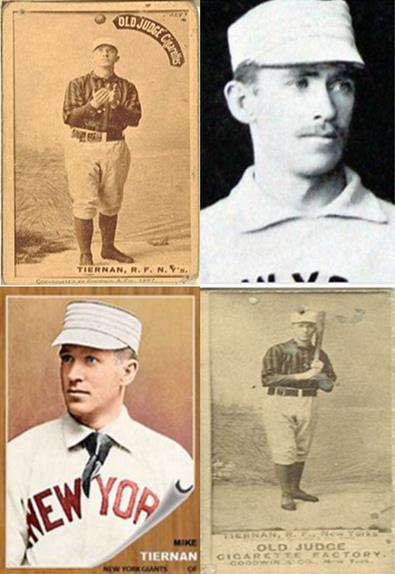
Baseball Trailblazers
Page 1212
Mike Tiernan
Michael Joseph Tiernan, January 21, 1867 – November 7, 1918, was a professional baseball right fielder. He played in the major league, exclusively for the New York Giants, from 1887 to 1899.
Baseball Trailblazers Page 1213
He was nicknamed "Silent Mike" because he generally avoided the press and did not protest when umpires made questionable calls.
A native of Trenton, New Jersey, Tiernan was born across the street from Trenton State Prison, and he participated in ice skating and track as a young man. Beginning in 1884, Tiernan played town baseball in Williamsport, Pennsylvania. The 17 year old attracted attention with his success in exhibitions against major league clubs, once striking out 15 in a game against the Providence Grays.
Because of that success, the New York Giants wanted to sign Tiernan as a pitcher in 1887. Tiernan, however, wanted to play in the outfield rather than pitch. The Giants ultimately agreed to play him in the outfield.
Tiernan's debut major league game was on April 30, 1887. On June 15 of that season, he scored six runs in a single game, and is one of only a handful of major league players to have accomplished that feat.
Tiernan led the National League in home runs in 1890 and 1891, and compiled a .311 lifetime batting average. His final game was played on July 31, 1899. He is the Giants' all time franchise leader in triples and stolen bases. One of the great home run hitters of the 19th century, he hit 106 of them, which ties him
Baseball Trailblazers Page 1214
with Hall of Famer Dan Brouthers for fourth most among 19th century ball players. He had 1,838 hits and 858 RBI’s.
He died November 7, 1918, at age 51, in New York City, New York.
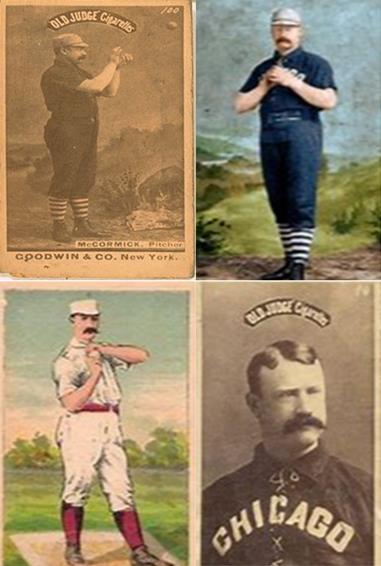
Baseball Trailblazers
Page 1215
Jim McCormick
James McCormick, November 3, 1856 – March 10, 1918, was a Scottish, right handed pitcher in major league baseball. A native of Glasgow, he was the first Glaswegian to appear in a major league game. Pitcher Jim McCormick won 265 games over a
Baseball Trailblazers Page 1216
ten year career and was one of baseball's top pitchers of the 1880s. However, despite his lofty numbers, he is not a member of the Hall of Fame.
McCormick began his career in 1877 with the Columbus Buckeyes of the International Association. The next year, he reached the majors with the Indianapolis Blues of the National League, but the team folded after one season. He then joined the Cleveland Blues as a player and manager in 1879. He lost a league leading 40 games in his first year with Cleveland, but the next summer, he won a league high 45, posted a 1.85 ERA, and paced the NL
with 72 complete games as his club came in third. After stepping down as manager, he won an NL best 36 games in 1882, and the next year, he led the circuit with a 1.84 ERA.
During the 1884 season, McCormick jumped to the Cincinnati Outlaw Reds of the Union Association for $2,500. He won 40 games between the two clubs and paced the UA with a 1.54 ERA. The circuit folded, however, after the season, and he had to pay a $1,000 fine to return to the NL. He began 1885 with the Providence Grays but was sold to the Chicago White Stockings in early July. He went on to throw five complete games in that fall's World Series against the St. Louis Browns of the American Association. He won 31 games for Chicago in 1886 but was traded to the Pittsburgh Alleghenys prior to the 1887 season. He went
Baseball Trailblazers Page 1217
13-23 for Pittsburgh that year and then retired when the team tried to cut his pay. His lifetime win–loss record was 265–214, while putting up an earned run average of 2.43, and striking out 1,704. He was twice the NL wins leader – 1880 and 1882, and NL
ERA leader – 1883. He ranks 33rd on the major league baseball all-time ERA list - 2.43, 36th on the all-time wins list – 265, 28th on the all-time walks per 9 innings list - 1.58, 33rd on the all-time innings pitched list - 4,275, 99th on the all-time strikeouts list - 1,704, 49th on the all-time games started list
– 485, 11th on the all-time complete games list – 466, 87th on the all-time shutouts list – 33, and 32nd on the all-time batters faced list - 16,884.
McCormick was great friends with Mike "King" Kelly and was also very well-liked by Cap Anson, two of the great personalities of early baseball. Anson was McCormick's captain-manager in 1885
and 1886, when Chicago won its last 19th century pennants. In Paterson, New Jersey, starting in 1885, McCormick co-owned a bar with a fellow former local player, Dave Treado. It had a ticker, to post results of games and races. Before the 1888 season and probably at other times, Kelly did some bartending for him. Back in 1885, after their Chicago team won the pennant, Kelly and McCormick returned by train to Paterson with teammate Tom Burns, who was heading to Connecticut. A local social club met the
Baseball Trailblazers Page 1218
players and took them to McCormick's bar. There, a state senator handed a silver ball to McCormick, who was loudly called upon and cheered. He said he was suffering from the effects of a severe cold and he would like to make a speech but even if he did he could not tell them how much he appreciated this token of friendship, more than anything he had ever yet received. Kelly was called on and was cheered. As he arose someone called; “Make a dead hit this time, Mike!” He said on behalf of Mr. McCormick and himself he desired to thank the donors of the ball. They would never forget this occasion and would ever keep this gift and try to be the best club, but we are getting pretty old now.
About Anson, McCormick reportedly said the following in 1887, soon after being sold by Chicago to Pittsburgh. "Before I played ball with Anson I used to think he was a big dub, but I thought him a pretty fair fellow afterward. He never said much to me. If anyone wants to get Anson mad let him say he is in one of those trances (presumably, mellow moments during a game). Kelly used to make him wild by shouting in from the outfield; 'Have you got them again?'"
That offseason, Chicago President Albert G. Spalding sold several of his best known players, mainly for drinking during the 1886 season. After selling George Gore to New York and Kelly to Boston, he traded McCormick. In March, McCormick was still
Baseball Trailblazers Page 1219
the property of Chicago when Spalding said; "The only trouble between McCormick and the club has been a difference of opinion between him and me as to his habits. Anson is and always has been very partial to 'Mac,' and wants him this season." Ten days later in Louisville, Anson said; "I desire his services very much, however, for I think that, under the new pitching rules, allowing for unrestricted overhand throwing, he will be the best pitcher on the diamond. If he is released, it will only be for a good sum of money." About a week after that, Spalding sold him.
He died in Paterson, New Jersey at the age of 61.
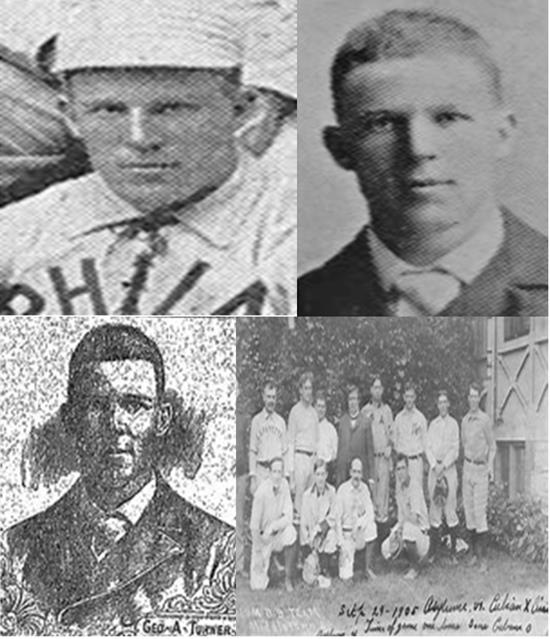
Baseball Trailblazers
Page 1220
Tuck Turner
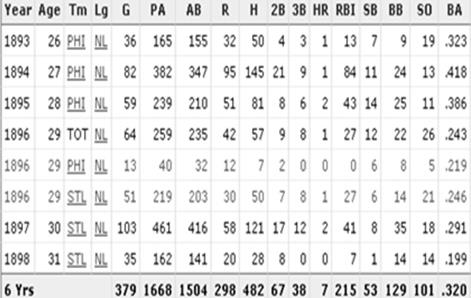
Baseball Trailblazers
Page 1221
George A. Turner, February 13, 1867 – July 16, 1945, was a 19th century major league baseball player for the Philadelphia Phillies and St. Louis Browns.
Born in West New Brighton, Staten Island, "Tuck" broke into the National League with the Philadelphia Phillies in 1893 at the age of 20. In reality he was 26, being born in 1867, but as was a common practice in baseball at the time, Turner told everyone he was younger than he really was. In 1894, Turner was part of one of the great hitting outfields in baseball history with Billy Hamilton, Sam Thompson, Ed Delahanty, and Turner all hitting over .400 for the year. Turner finished second that season with a .418 batting average to Hugh Duffy, who also happened to set the single season batting average record of
.440. For those Phillies teams though, a pennant wasn't to be as
Baseball Trailblazers Page 1222
the late 1890s were the peak of the powerful Original Baltimore Orioles and Boston Beaneaters.
Turner's best seasons were 1894 and 1895, with Tuck leading the league in hitting with a .411 batting average through August 1895. By the tail end of 1895 and the beginning of 1896, Turner had lost his batting touch and so was traded to St. Louis for Duff Cooley. According to accounts in the defunct sports journal, “The Sporting Life,” Turner contracted malaria with recurrent attacks in 1897 and 1898. This was in response to what had happened to cause this promising major leaguer to suddenly lose his touch with the bat.
On October 3, 1897 while playing for St. Louis, Turner accomplished a rare feat by hitting an inside the park grand slam. Turner's .418 batting average in 1894 is ninth all-time for single season major league batting average and also the highest in a single season for a switch hitter.
Before reaching the majors, Turner was a paid player in the Buffalo Amateur Baseball League of the Amateur Athletic Union.
From 1899 to 1901, Turner played with the Hartford Indians in the Eastern League, replacing legendary Louis Sockalexis in the field his first season. Turner's post majors career included
Baseball Trailblazers Page 1223
stops in the Western League, Connecticut League and New England League.
Turner grew up in West New Brighton with Jack Taylor, a solid pitcher for the Phillies in the mid-1890s, Jack Sharrott, George Sharrott and Jack Cronin. All would go on to careers in the National League.
He finished with a lifetime batting average of .320, 298 runs scored, and 215 runs batted in. He died: July 16, 1945, at age 72, on Staten Island, New York.
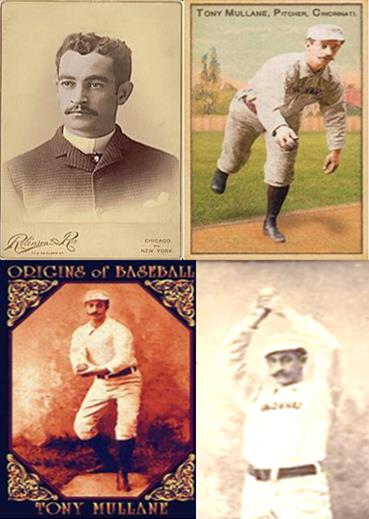
Baseball Trailblazers
Page 1224
Tony Mullane
Anthony John Mullane, January 30, 1859 – April 25, 1944, nicknamed "Count" and "The Apollo of the Box," played major league baseball, pitching for seven teams during his 13 season career. He is best known for having one of the highest career win totals of pitchers not in the Baseball Hall of Fame.
Baseball Trailblazers Page 1225
Born in County Cork, Ireland, Mullane emigrated to the United States in 1864. He made his major league debut with the Detroit Wolverines on August 27, 1881, picking up his first career win 9–1 over the Chicago White Stockings.
Mullane suffered an injury to his right arm and managed to teach himself to throw left handed. He resumed throwing right handed once the injury healed, and he even alternated throwing right handed and left handed in the same game, which was easy for him since, like many of his time, he did not wear a glove. Mullane faced the batter with both hands on the ball, and then used either one to throw a pitch.
In 1882, Mullane moved on to the American Association and joined the Louisville Eclipse, where he started 55 of the team's 80
games and compiled a record of 30–24 with a 1.88 earned run average, the first of five consecutive 30 win seasons. On September 11, he pitched a no hitter against the Cincinnati Red Stockings. He recorded 35 victories with the 1883 St. Louis Browns.
In 1884, Mullane attempted to sign with the St. Louis Maroons of the Union Association, a new independent league, even though under the reserve clause the Browns still had rights to his services. Threatened with banishment for defying his contract,
Baseball Trailblazers Page 1226
Mullane relented. The Browns then sold him to the expansion Toledo Blue Stockings, with whom he won a career high 36 games.
The Browns attempted to reclaim Mullane after the 1884 season when both the Union Association and the Blue Stockings folded, but before the Browns could re-sign him under the rules, Mullane managed to sign with Cincinnati. For this action, the American Association suspended him for the entire 1885 season. Coming in the midst of his string of consecutive 30 win seasons, this may have cost Mullane a 300 win career.
Following the suspension, Mullane joined the Cincinnati Red Stockings for the 1886 season and remained there for the next seven and a half years, over which he won 163 games. At the plate in 1889 he recorded career highs with a .296 batting average, and a slugging percentage of .418.
Mullane started the 1893 season with a mediocre 6–6, and was traded to the Baltimore Orioles on June 16. He staggered to an 18–25 record with the Orioles in a little more than one full season over 1893 and 1894. Mullane set a dubious record on June 18, 1894, by allowing 16 runs in the first inning of a game against the Boston Beaneaters. A month later he was traded again, this time to the Cleveland Spiders, for whom he played only four games.
Baseball Trailblazers Page 1227
Mullane retired after the 1894 season with a record of 284–220
and a 3.05 ERA over a 13 year career. He led the AA in strikeouts in 1882 and shutouts in 1884 and 1887.
After his baseball career, Mullane went on to join the Chicago Police Department, from which he retired in 1924. Mullane died at the age of 85 in Chicago.
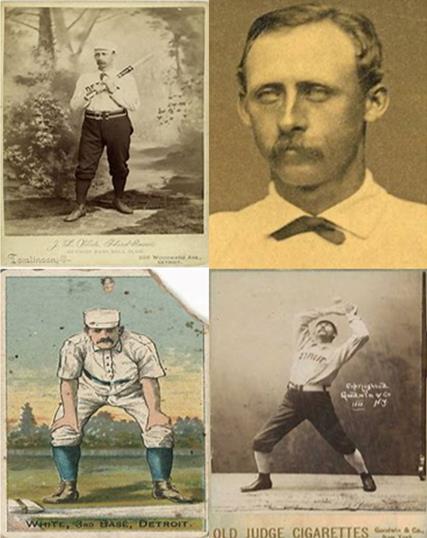
Baseball Trailblazers
Page 1228
Deacon White
James Laurie "Deacon" White, December 2, 1847 – July 7, 1939, was a pro baseball player who was one of the principal stars during the first two decades of the sport's professional era.
The outstanding catcher of the 1870s during baseball's
Baseball Trailblazers Page 1229
barehanded period, he caught more games than any other player during the decade, and was a major figure on five consecutive championship teams from 1873 to 1877; three in the National Association), in which he played throughout its five year existence from 1871 to 1875, and two in the National League, which was formed as the first fully recognized major league in 1876, partially as a result of White and three other stars moving from the powerhouse Boston Red Stockings to the Chicago White Stockings. Although he was already 28 when the NL was established, White played 15 seasons in the major leagues, completing a 23 year career at the top levels of the sport.
White was born in Caton, New York, the son of farmer Lester S.
White, born ca. 1820, and his wife Adeline, born ca. 1823. The couple had at least eight children. White's ancestors likely immigrated to America during the Colonial period.
White learned baseball from a Union soldier who returned to his hometown after the Civil War in 1865. His pro career began in 1868 with the Cleveland Forest Citys club, at a time when no team was entirely composed of professional players. He earned the first hit in baseball's first fully professional league; a double off Bobby Mathews of the Fort Wayne Kekiongas in the first inning of the first game in National Association history on May 4, 1871. He also made the first catch. His long career
Baseball Trailblazers Page 1230
allowed him to play with many of the legendary figures of 19th century professional baseball. White played on the great National Association Boston Red Stockings teams of the early 1870s, and also played with Cap Anson and Al Spalding in Chicago, King Kelly in Cincinnati, Dan Brouthers in Buffalo, and Ned Hanlon and Sam Thompson in Detroit, as well as Jake Beckley and Pud Galvin in Pittsburgh.
White led his league in batting average twice, including the NA in 1875, and in RBI three times, including the NA in 1873. Not until 1953 would another catcher lead his league in RBI. White started out early enough to have played against the undefeated Cincinnati Red Stockings of 1869, baseball's first all-professional team. He was considered the best barehanded catcher of his time, as well as one of the best third baseman during the second half of his career. His combined total of games caught in the NA and NL was eventually passed. On May 16, 1884 White recorded 11 assists at third base, which remains the major league record for a nine inning game. In the rough and tumble 19th century baseball era, White was a nonsmoking, Bible toting, church going deacon.
In 1889, the contracts of White and teammate Jack Rowe were sold to the Pittsburgh Alleghenys, but the pair refused to report unless they were paid additional money, leading to a protracted
Baseball Trailblazers Page 1231
dispute. Eventually the two men were paid, with White telling a reporter; "We appreciate the money, but we ain't worth it.
Rowe's arm is gone. I'm over 40 and my fielding ain't so good, though I can still hit some. But I will say this. No man is going to sell my carcass unless I get half." Complaints like this were part of the reason that the Players' League was formed in 1890.
White's playing career ended after the 1890 season. Over the 20
year period from 1871 to 1890, White batted .312 and had more RBIs – 988, than any player except Cap Anson. White managed the minor league club Elmira Gladiators of the New York–Pennsylvania League in 1891.
In 1871, White was the first batter to come to the plate in the National Association, the first officially recognized professional baseball league. Compiling a .347 batting average over five NA seasons, he led the NL in runs batted in in its first two seasons of play, and also led the league in batting at
.387, slugging average, hits, triples and total bases in his brief shift to first base in 1877. For three years afterward, he joined his younger brother Will, a successful pitcher, with the Cincinnati Reds and Cincinnati Stars. In his mid-30s he became an effective third baseman when the toil of catching had become too great, and was a major force on the championship Detroit
Baseball Trailblazers Page 1232
Wolverines team of 1887, batting .303 at age 39. Over the 20
year period of his career, White batted .312 and had 988 RBIs.
Upon his retirement, he was among baseball's all-time leaders in career games, at bats, hits and total bases. He ranked fourth in career total chances at third base, fifth in assists, and sixth in putouts and double plays.
White married Marium Van Arsdale, born 1851 in Moravia, New York, on April 24, 1871. For much of his career, they lived on his farm in Corning, New York. They moved to Buffalo after he joined the Bisons in 1881. Their only child, Grace Hughson White, was born in Buffalo on September 8, 1882. The family moved to Detroit when White began playing for the Wolverines, but soon returned to Buffalo. By 1900 he was operating a successful livery stable there.
Sometime after 1900, the Whites sent Grace to Mendota College in Mendota, Illinois, beginning a family association with the Advent Christian school which would endure across multiple generations. By 1909, James and Marium had also moved to Mendota, where they became the head residents at Maple Hall, the young ladies' dormitory, until 1912. On August 15, 1912, Grace married fellow Mendota alumnus Roger A. Watkins at the dormitory. That year, the college had relocated fifty miles to the east, becoming Aurora College. Marium died on April 30, 1914
Baseball Trailblazers Page 1233
in Mendota. One of Aurora's students recalled of "Ma" White;
"She was of a cheery disposition, with a word and a smile for all; mingling with the girls as one of us; giving kindly counsel and encouragement. Her interest in each girl is expressed in her own words; 'I am only doing what I would like to have someone else do for my girl, if she were away from home.' Words cannot express our appreciation of such kind and personal interest."
Roger and Grace Watkins continued to be involved with the college, and moved to Aurora in 1920. In 1927 Roger joined the college's board of directors, serving until 1971, all but the first two years also as the board's secretary. By 1930 Deacon White had remarried, and with his wife Alice moved into the Watkins home at 221 Calumet Avenue, next door to the college president.
White died at age 91 in the early morning of July 7, 1939 at the Watkins' summer cottage at Rude Camp, the college's retreat on the Fox River in St. Charles Township. Having been in good health, his death was attributed to a disastrous heat wave. He was survived by his second wife Alice, who had been staying in Winston-Salem, North Carolina at the time of his death, by his younger brother George, by his daughter Grace (1882–1956), and her husband Roger (1888–1977).
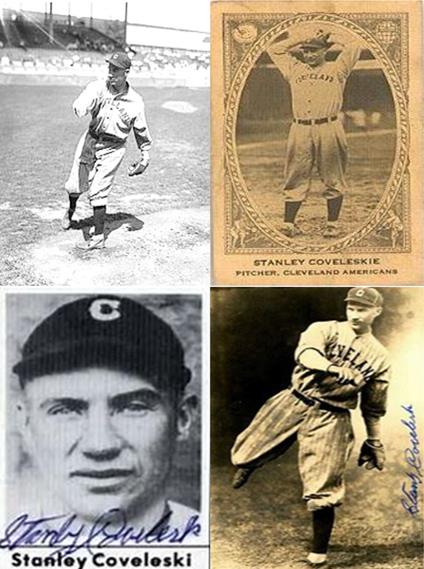
Baseball Trailblazers
Page 1234
Stan Coveleski
Stanley Anthony Coveleski, July 13, 1889 – March 20, 1984, was born in Shamokin, Pennslylvania, and became a right handed pitcher in major league baseball. He played for four American League teams between 1912 and 1928, primarily the Cleveland
Baseball Trailblazers Page 1235
Indians. The star of the Indians pitching staff, he won over 20
games each year from 1918 through 1921, leading the AL in shutouts twice and in strikeouts and earned run average once each during his nine years with the club. The star of the 1920
World Series, he led the Indians to their first title with three complete game victories, including a 3–0 shutout in the Game 7
finale. Traded to the Washington Senators after the 1924 season, he helped that club to its second AL pennant in a row with 20
victories against only 5 losses, including a 13 game winning streak, while again leading the league in ERA.
Coveleski followed in the footsteps of his brother Harry as a major league pitcher. But after making his debut with the Philadelphia Athletics in 1912, he was sidetracked by three more seasons in the minor leagues before joining the Indians in 1916, and won only 13 major league games before turning 27. Coveleski specialized in throwing the spitball, where the pitcher alters the ball with a foreign substance such as chewing tobacco. It was legal when his career began but prohibited in 1920, with Coveleski being one of 17 pitchers permitted to continue throwing the pitch. In 450 career games, Coveleski pitched 3,082
innings and posted a record of 215–142, with 224 complete games, 38 shutouts, and a 2.89 ERA.
Baseball Trailblazers Page 1236
Stan was one of eight children of Anthony (1845–1929) and Ann (Racicz) Kowalewski (1850–1919), who had immigrated from Russian Poland in the early 1870s. They settled in Shamokin, where Anthony worked as a coal miner, in Northumberland County, east of the Susquehanna River and northeast of the state capital of Harrisburg. Stanley was the youngest of five baseball playing brothers. His oldest brother Jacob died serving in the Spanish–
American War. In addition to his older brother, Harry, who pitched in the major leagues between 1907 and 1918, their other brothers Frank and John also played professional baseball, but only in the minor leagues. Harry won 20 games in a season on three occasions during his 14 year major league career.
Like many his age in the Shamokin area, Coveleski began work as a "breaker boy" at a local colliery at the age of 12. In return for 72 hours of labor per week, Coveleski received $3.75, or about five cents an hour. "There was nothing strange in those days about a twelve year old Polish kid working in the mines for 72 hours a week at a nickel an hour," he later recalled. "What was strange is that I ever got out of there." Coveleski was rarely able to play baseball as a child due to his work schedule.
Nevertheless, he worked on his pitching skills during the evenings, when he threw stones at a tin can placed 50 feet away.
Baseball Trailblazers Page 1237
When he was 18 years old, Coveleski's abilities caught the attention of the local semi-professional ball club, which invited him to pitch for them. "When it came to throwing a baseball, why it was easy to pitch," Coveleski recalled. "After all, the plate's a lot bigger than a tin can to throw at." His baseball career in Shamokin was short lived. After five games, Coveleski relocated to Lancaster, Pennsylvania.
Coveleski signed his first professional contract in 1909 with the minor league Lancaster Red Roses, a club affiliated with the Tri-State League. Originally reluctant to sign for the club, he only agreed to do so if his older brother John also joined; at that time he anglicized his name, changing it to Coveleskie, which it would remain throughout his professional career. During his first trip to Lancaster, he recalled that it was "the first time I ever rode on a train," and he added that he "was too shy to eat in the hotel with the rest of the team." In 272 innings of work his first season, Coveleski had a 23–11 win–loss record with an earned run average of 1.95. He pitched two more seasons for Lancaster, earning a record of 53–38 in 109 appearances through three seasons.
In 1912, he pitched for the relocated Lancaster team, the Atlantic City Lanks, where he had a 20–14 record with a 2.53 ERA in 40 appearances, 30 of them starts. In September 1912, manager
Baseball Trailblazers Page 1238
Connie Mack signed him to a contract with the Philadelphia Athletics and brought him to the major leagues. By the time Coveleski made his debut for the Athletics on September 10, pitching one inning in relief in an 8–6 road loss to the Detroit Tigers, the two time defending World Series champions were more than a dozen games out of first place; the only year between 1910 and 1914 they failed to win the pennant. Coveleski won his first game two days later in his first start, a 3–0 three hit shutout of the Tigers, allowing only two singles and a double by Ty Cobb. He pitched in five games for the Athletics that season, starting two of them and finishing the season with a 2–1 record and a 3.43 ERA. After the season ended, Mack felt that Coveleski needed more seasoning, and sent him to the Spokane Indians of the Northwestern League. Coveleski finished the 1913 season with a 17–20 record and a 2.82 ERA. Around that time, he married Mary Stivetts, and the following season he went 20–15, pitched over 300 innings, and led the league in strikeouts.
At the time of his debut, the powerhouse Philadelphia club boasted a strong group of talented pitchers, including Eddie Plank, Chief Bender, and Jack Coombs. Coveleski admitted that he
"didn't know if I could have beat them out for a spot in the rotation." After the 1914 season, the Portland Beavers of the Pacific Coast League wanted Coveleski, and traded five players
Baseball Trailblazers Page 1239
to Spokane to acquire him. While Mack had an agreement with Spokane that Coveleski would be promoted after playing there for a time, the Athletics fell under new ownership in 1913 and lost control of him due to the Athletics' rights expiring. Coveleski spent his time in Portland learning to throw the spitball; originally using chewing tobacco, and later using alum. In his lone season with Portland, he won and lost 17 games, and had a 2.67 ERA. After the season ended, the Cleveland Indians purchased Coveleski from Portland, and he joined the major league squad in 1916.
When Coveleski was brought up to the majors, the original intention was to use him as a relief pitcher. Due to an injury to Ed Klepfer, the Indians used him as a starter early on in the 1916 season, and kept him in the role when he performed well. He was scheduled to pitch in the first week of the season against his brother Harry, but the matchup never took place at Harry's behest. On May 30, Coveleski hit the only home run of his career in the first game of a road doubleheader against the St. Louis Browns; the three-run shot in the tenth inning gave Cleveland a 4–1 lead, but the Browns came back to win 5–4 in 15 innings.
Coveleski fought health problems during the season, suffering from tonsillitis in the middle of the year and pitching one game with a fever of 102. He finished the season with a 15–13 record
Baseball Trailblazers Page 1240
and a 3.41 ERA in 45 games, 27 of them starts. Coveleski had lost 10 pounds due to illness during 1916, but recovered during the offseason, gained 20 pounds, and appeared healthier by the time the season began.
Coveleski's status as the ace of the staff was demonstrated when he was named the starter for opening day of the 1917 season; he beat the Detroit Tigers 6–4 on April 11. He improved statistically during the 1917 season, winning 19 games and losing 14 with an ERA of 1.81 and a career high 133 strikeouts.
On September 19, Coveleski pitched the only one hitter of his career, a 2–0 road win over the New York Yankees. The only hit came from Fritz Maisel in the seventh inning. Coveleski continued to improve during the 1918 season, which was ended on September 1 due to the late summer surge of the Spanish flu pandemic. His outings that year included a 2–1, 13 inning road loss to Philadelphia on May 15, in which he had a career high ten strikeouts, and a 19 inning complete game on May 24 in New York as the Indians won 3–2. He finished the season with a 22–13
record, a 1.82 ERA, and 311 innings pitched in 38 games, 33 of them starts. His wins and ERA were both second in the American League to Walter Johnson. In 1919, Coveleski pitched in 43
games, starting 34, and had a 24–12 record and an ERA of 2.61.
To fellow ballplayers, Coveleski was considered "taciturn and
Baseball Trailblazers Page 1241
ornery" on days when he was scheduled to pitch but was otherwise friendly with a lively sense of humor.
At the beginning of the 1920 season, the spitball was banned by major league baseball. As a current spitball pitcher, Coveleski was grandfathered in, and was allowed to continue using the pitch until his retirement. He won his first seven starting appearances of the season, but on May 28 his wife died suddenly, and he was given some time off to mourn, returning to pitching two weeks later. He picked up his 100th victory on August 2 with a 2–0 shutout win over the Senators. Covaleski was the starting pitcher against the Yankees on August 16, and hit a sacrifice fly to help the Indians win 4–3, but it is best remembered as the game in which a pitch by the Yankees' Carl Mays hit Indians shortstop Ray Chapman in the head, resulting in the only death in major league history. Covaleski finished the 1920 regular season with 24 wins, 14 losses, a 2.49 ERA, and 133 strikeouts.
He led the AL in strikeouts and finished second in ERA to Bob Shawkey.
Coveleski helped the Indians to win the AL pennant and play in the 1920 World Series against the Brooklyn Robins. Coveleski was the star of the Series, in which he pitched three complete game victories. He pitched the first game against Rube Marquard, and allowed one run and five hits in a 3–1 Cleveland victory. Four
Baseball Trailblazers Page 1242
days later, he pitched Game 4, again allowing one run and five hits in a 5–1 win. In Game 7, the final one of the best of nine series, Coveleski threw a complete game shutout with five hits against fellow spitballer Burleigh Grimes. The 3–0 victory gave the Indians the first World Series championship in franchise history. Coveleski had an ERA of 0.67.
After spending the offseason hunting with Smoky Joe Wood, Coveleski returned to the Indians in 1921, and throughout the season, the Indians battled the Yankees for first in the American League. On September 26, the two teams faced off, but Coveleski failed to make it past the third inning. The Yankees won 8–7 to ensure they won the pennant. Coveleski pitched 315
innings in 1921, matching his career high from the year before, and had a 23–13 record with a 3.37 ERA. The following season, Coveleski married Frances Stivetts, the sister of his late wife.
While he did cause the Yankees to move out of first place after winning an August 23 game against them, 4–1, it was his last game of the season. He finished the year with a 17–14 record, the first time since 1917 he did not have 20 wins, and had a 3.32 ERA.
Early on in the 1923 season, Coveleski pitched 27 straight scoreless innings between April 22 and 30, starting with a 10
inning 1–0 shutout of the Tigers and ending when he allowed two
Baseball Trailblazers Page 1243
runs in the ninth inning of a 4–2 road win over the same club.
However, he won less frequently as the season wore on, losing three straight games in mid-August. His last game came on August 15, with over a month left in the season. Coveleski finished the season with a 13–14 record, his first season with a losing record. Despite that, he had an ERA of 2.76 and five shutouts, both of which led the AL. In 1924, Coveleski struggled, and at the end of May, he had four losses and an ERA of 6.49. In his last appearance on September 22, he gave up a career high ten runs in a 10–4 loss to the Yankees, ending the season with a 15–
16 record and a 4.04 ERA. In December 1924, after nine years pitching for Cleveland, Coveleski was traded to the Washington Senators for pitcher By Speece and outfielder Carr Smith.
Despite Coveleski's success in Cleveland, he was not a fan of playing there. He stated that he "didn't like the town. Now the people are all right, but I just didn't like the town." He also stated that it began to affect his performance on the mound and that he began to get "lazy" from being with the club so long. He did, however, have praise for his catcher. "The best thing that happened to me there was pitching to Steve O'Neill. He caught me for nine years in Cleveland and knew me so well he didn't even need to give me a sign."
Baseball Trailblazers Page 1244
Due to the acquisition of Coveleski, combined with winning the 1924 World Series, the Washington Senators were considered favorites to win the AL in 1925. During his first season in Washington, Coveleski bounced back from his 1924 season, and by mid-July, critics regarded his success as the biggest surprise in baseball. From May 9 to July 26 he compiled thirteen consecutive victories, ten of them complete games. He won twenty games and lost five that year, and his ERA of 2.84 led the AL.
Coveleski also finished 12th in MVP voting that year, with Senators shortstop Roger Peckinpaugh winning the award. The Senators won the AL and were to face the Pittsburgh Pirates in the 1925 World Series, but Coveleski suffered from sore back muscles late in the season. Coveleski pitched two games in the World Series. In Game 2, he faced Vic Aldridge in a pitcher's duel. The teams were tied at one apiece in the eighth inning, but a two run home run by the Pirates' Kiki Cuyler led to a 3–2
loss. Aldridge and Coveleski faced off again in Game 5, but Coveleski allowed four runs before being pulled with one out in the seventh inning, leading to a 6–3 Pirates win. The Senators lost the series in seven games, and he finished with a 3.77 ERA, five walks, three strikeouts, and two of the Senators' four losses.
Baseball Trailblazers Page 1245
Coveleski continued to pitch for Washington during the 1926
season. His performances that season included his 200th win.
Coveleski finished the season with 14 wins, 11 losses, 3
shutouts, and a 3.12 ERA in 36 games. To start the 1927 season, due to an injury to Walter Johnson, Coveleski became the Senators' opening day starter against the Red Sox; winning the game 6–2. However, his performance declined due to "a chronically sore arm," which limited his playing time that season. Due to his sore arm, the Senators released him unconditionally on June 17, 1927. He finished the season with a 2–1 record and a 3.14 ERA in five games.
On December 21, 1927, Coveleski signed with the New York Yankees in an attempt at a comeback. In his final season, he posted a 5–
1 record with a 5.74 ERA in 12 appearances. Coveleski failed to regain his form, however, pitching his last game on August 3, and after the signing of Tom Zachary, manager Miller Huggins released Coveleski. He retired from the game later that year.
Coveleski had 215 wins and 142 losses with a 2.89 ERA in 450
games, 385 of them starts, in a 14 year career. He had 224
complete games, 38 shutouts, 981 strikeouts, and pitched 3,082
total innings. His control was highly regarded. He never considered himself a strikeout pitcher, and it was not unusual for him to pitch a complete game having thrown 95 pitches or
Baseball Trailblazers Page 1246
less. He once pitched seven innings of a game where every pitch was either a hit or a strike.
In 1929, after leaving major league baseball, Coveleski relocated to South Bend, Indiana. There, he ran Coveleski Service Station for a time but closed the business during the Great Depression. He became a popular member of the community in South Bend, providing free pitching lessons to local youths in a field behind his garage. In 1969, Coveleski was named to the Baseball Hall of Fame by the Veterans' Committee alongside 1920s pitcher Waite Hoyt. Of his introduction into the Hall, he said,
"I figured I'd make it sooner or later, and I just kept hoping each year would be the one." His health declined in later years, and he was eventually admitted to a local nursing home, where he died on March 20, 1984, at the age of 94.
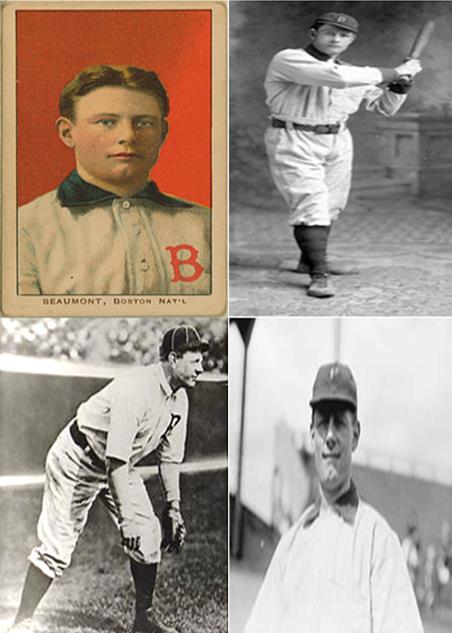
Baseball Trailblazers
Page 1247
Ginger Beaumont
Clarence Howeth "Ginger" Beaumont, July 23, 1876 – April 10, 1956, was a center fielder in major league baseball who spent
Baseball Trailblazers Page 1248
most of his career with the Pittsburgh Pirates from 1899–1906, and the Boston Braves from 1907–1909. He was born in Rochester, Wisconsin, and attended Beloit College. During the years with the Pirates, winning pennants from 1901–1903, Beaumont led the National League in hits three times, scored 100 runs four times, leading the league once, and also captured the 1902 batting championship with a .357 mark. As the Pirates' regular leadoff hitter, he was the first player ever to bat in a World Series game.
Nicknamed "Ginger" for his thick red hair, he used his excellent speed to great advantage. On the day before his 23rd birthday in his rookie season, he had six infield singles and became the first player to score six runs in a game. He was also the first player in major league history to lead his league in hits three consecutive years, which has been duplicated by only five others. He led the NL in hits a fourth time with the 1907
Braves. Often bothered by leg injuries, he joined the Chicago Cubs for the 1910 season, and made pinch hitting appearances in the first three games of the 1910 World Series before leaving the major leagues with a .311 career batting average and on base average of .362.
He played one more season in the minor leagues before retiring to his Honey Creek, Wisconsin farm. Beaumont suffered two
Baseball Trailblazers Page 1249
strokes in his seventies, and died at age 79 in Burlington, Wisconsin.
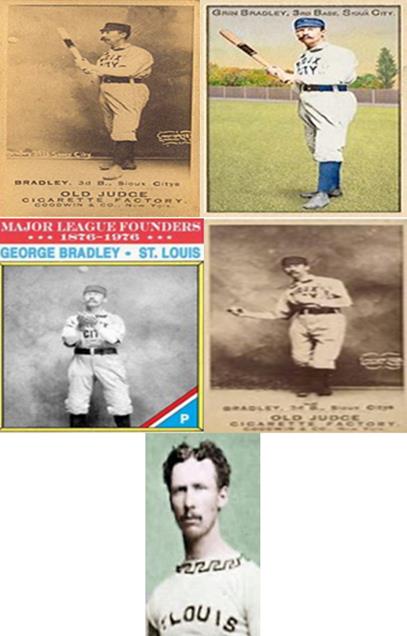
Baseball Trailblazers
Page 1250
George Bradley
George Washington Bradley, July 13, 1852 – October 2, 1931, nicknamed "Grin," was a professional baseball player who was a
Baseball Trailblazers Page 1251
pitcher and third baseman. He was born in Reading, Pennsylvania.
Grin played for multiple teams in the early years of the National League.
Bradley is noted as throwing the first official no hit, no run game in major league history. He pitched for the St. Louis Brown Stockings in the club's victory over the Hartford Dark Blues on July 15, 1876. The score ended 2-0 without a hit being allowed by Bradley. That year, he completed 63 of the 64 games for St.
Louis, winning 45 and leading the league with a 1.23 earned run average. Additionally, he also threw 16 shutouts, setting a record which has not been broken, although was tied in 1916 by Grover Cleveland Alexander.
After 1876, Bradley was not as effective as a pitcher and played mostly other positions after 1879. He was involved in professional baseball for 30 years, 19 of them with the Philadelphia Athletics. In 1883, he was the team's regular third baseman and also went 16-7 on the mound to help the A's win the American Association championship.
In 1887, he served as a player-manager for the Nashville Blues of the Southern League.
Baseball Trailblazers Page 1252
His pro career resulted in a win–loss record of 171–151, with an earned run average of 2.43. At the plate he did less well, compiling a lifetime batting average of .229 with 518 hits.
Bradley became a Philadelphia police officer following his baseball career. He died at his home in Philadelphia on October 2, 1931.
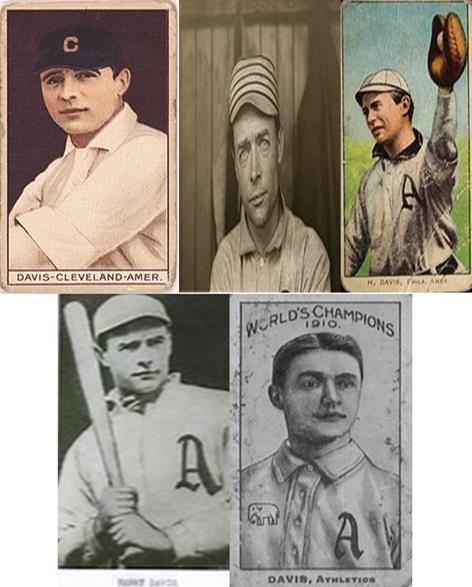
Baseball Trailblazers
Page 1253
Harry Davis
Harry H. Davis, July 19, 1873 – August 11, 1947, was a major league baseball first baseman who played for the New York Giants in 1895 and 1896, the Pittsburgh Pirates from 1896–1898, the Louisville Colonels in 1898, the Washington Senators in 1898 and
Baseball Trailblazers Page 1254
1899, the Philadelphia Athletics from 1901–1911, and again from 1913–1917, and the Cleveland Naps in 1912.
Davis was born in Philadelphia. He had no middle name, but he added the middle initial H to distinguish himself from others who shared his first and last names. He attended Girard College; which served as an elementary and high school. Davis, who picked up the lifelong nickname of "Jasper" at Girard, graduated in 1891 and played amateur baseball until beginning his professional baseball career in 1894.
After having played the 1900 season for the minor league Providence Grays, he decided to quit baseball, but Athletics manager Connie Mack made him an offer too large to refuse to return to baseball in 1901 with the Athletics. He led the American League in home runs from 1904 to 1907, one of only five players to have ever led their league for four consecutive seasons. He led the AL in doubles three times and the NL in triples once.
Davis was the starting first baseman and first captain of manager Connie Mack's Philadelphia Athletics from 1901 to 1910.
In 1905 he not only led the American league in home runs, but also RBIs, runs and doubles, and led the Athletics to the 1905
World Series against the New York Giants. He was the starting
Baseball Trailblazers Page 1255
first baseman for the 1910 World Champions and hit .353 in the 1910 World Series. In 1911, the 37 year old Davis was replaced at first base by the younger Stuffy McInnis, and Davis played a reserve role for the 1911 World Champions.
Davis managed the 1912 Cleveland Naps, but left with 28 games left in the season and a record of 54–71. He returned to the Athletics as a player, coach and assistant captain in 1913, amassing only 33 plate appearances over the next five seasons combined.
In 1755 games over 22 seasons, Davis posted a .277 batting average, 1841 for 6653, with 1001 runs, 361 doubles, 145
triples, 75 home runs, 951 RBI, 285 stolen bases, 525 bases on balls, a .335 on base percentage and a .408 slugging percentage.
He finished his career with an overall .978 fielding percentage primarily as a first baseman. In 16 World Series games he batted
.246, 15 for 61, with 8 runs, 5 doubles, 7 RBI and 3 walks.
He continued as a coach and scout with Mack's Athletics until 1927 and also served as a Philadelphia City Councilman. Davis died in Philadelphia, Pennsylvania, August 11, 1947, at the age of 74.
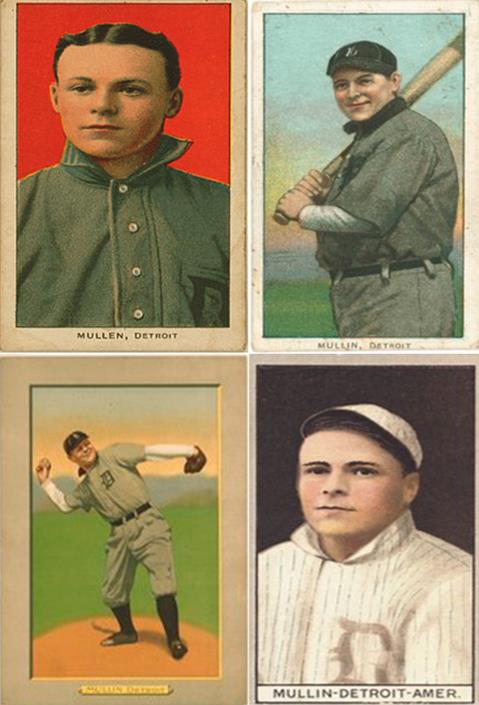
Baseball Trailblazers
Page 1256
George Mullin
Baseball Trailblazers Page 1257
George Joseph Mullin, July 4, 1880 – January 7, 1944, sometimes known by the nickname "Wabash George," was a right handed baseball pitcher. Mullin played in major league baseball for 14
seasons with the Detroit Tigers from 1902 to 1913, Washington Senators in 1913, and the Indianapolis Hoosiers/Newark Pepper of the Federal League from 1914 to 1915. He compiled a career record of 228–196, with a 2.28 earned run average, and 1,482
strikeouts. Mullin was also a strong hitter, twice batting over
.300 for a season and compiling a career batting average of