

Baseball Trailblazers by Edward Drobinski - HTML preview
Download the book in PDF, ePub, Kindle for a complete version.
1907.
Baseball Trailblazers Page 896
After Pfiester's playing career ended, he and his wife settled in Ohio with their son, Jack Jr. Pfiester died in Loveland, Ohio, at the age of 75.
Baseball Trailblazers
Page 897
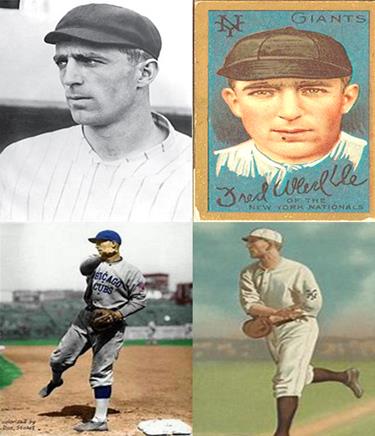
Bonehead Merkle
Baseball Trailblazers
Page 898
Carl Frederick Rudolf Merkle, December 20, 1888 – March 2, 1956, also documented as "Frederick Charles Merkle," and nicknamed
"Bonehead," was a first baseman in major league baseball from 1907 to 1926. Although he had a lengthy career, he is best remembered for a base running mistake he made while still a teenager. Born in Watertown, Wisconsin, to Ernst Merkle, a Swiss
Baseball Trailblazers Page 899
immigrant, and Amalie Thielmann Merkle, a German American, he was raised in Toledo, Ohio.
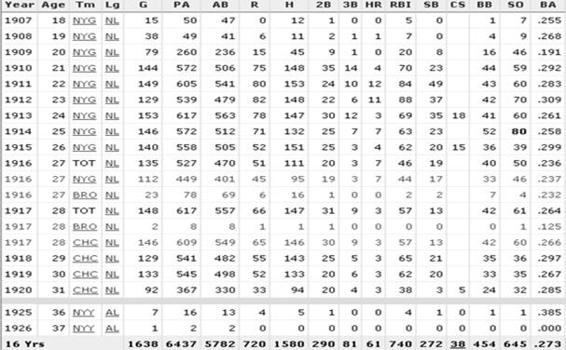
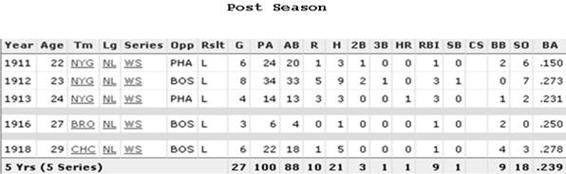
To cut to the early chase, Merkle was a solid if unspectacular, long term, major league performer, who made his ”splash” while still a teenager. During a 16 year, .273 career, in which he batted over .300 once, and hit double digit home runs twice, his most distinctive aspect was having played on five pennant winners. Oddly, each of the five teams lost the World Series, while Merkle batted .239.
Timeless fame came to Merkle on September 23, 1908, while playing for the New York Giants in a game against the Chicago Cubs, while he was at 19 years of age the youngest player in the National League. Merkle committed a base running error that became known as "Merkle's Boner" and earned him the nickname
"Bonehead."
In the bottom of the 9th inning, Merkle came to bat with two outs, and the score tied 1–1. At the time, Moose McCormick was on first base. Merkle singled and McCormick advanced to third base. Al Bridwell, the next batter, followed with a single of his own. McCormick trotted to home plate, apparently scoring the winning run. The fans in attendance, under the impression that the game was over, ran onto the field to celebrate. Meanwhile,
Baseball Trailblazers Page 900
Merkle ran to the Giants' clubhouse without touching second base.
Cubs second baseman Johnny Evers noticed this, and after retrieving a ball and touching second base, he appealed to umpire Hank O'Day, who later managed the Cubs, to call Merkle out. Since Merkle had not touched the base, the umpire called him out on a force play, meaning that McCormick's run did not count.
The run was therefore nullified, the Giants' victory erased, and the score of the game remained tied. Unfortunately, the thousands of fans on the field, as well as the growing darkness in the days long before large electric lights made night games possible, prevented resumption of the game, and it was declared a tie. The Giants and the Cubs ended the season tied for first place and had a rematch at the Polo Grounds, on October 8. The Cubs won this makeup game, 4–2, thus the National League pennant.
Accounts vary as to whether Evers actually retrieved the game ball or not. Some versions of the story have him running to the outfield to retrieve the correct ball. Other versions have it that he shouted for the ball, which was relayed to him from the Cubs' dugout. Still other versions have it that Giants pitcher
Baseball Trailblazers Page 901
Joe McGinnity saw what was transpiring, and threw the game ball into the stands. Thus, the ball that was picked up by or relayed to Evers was a different ball entirely. The New York Times account of the play recalls that Cubs manager and first baseman Frank Chance was the one who "grasped the situation" and directed that the ball be thrown to him covering second base.
At the time, running off the field without touching the base was common, as the rule allowing a force play after a potential game winning run was not well known. However, Evers, who was noted as an avid student of the official rules of the game, had previously attempted the same play only a few weeks earlier, in Pittsburgh, with the same Hank O'Day umpiring. In that instance, O'Day had not seen whether the runner tagged second, so he declined Evers' appeal, but he apparently was thereby alerted to the possibility in the New York game. The outcome ensured that the rule was known to everyone afterward.
Giants manager John McGraw was furious at the league office, feeling his team was robbed of a victory and a pennant, but he never blamed Merkle for his mistake. Bitter over the events of the controversial game, Merkle avoided baseball after his playing career ended in 1926. When he finally appeared at a Giants old timers' game in 1950, he received a standing ovation.
Baseball Trailblazers Page 902
Merkle and his wife Ethel Cynthia Brownson Merkle enjoyed a long marriage, from 1914 to his death in 1956. The Merkles had three daughters; Marjorie, Jeannette, and Marianne. Merkle died in Daytona Beach at age 67. As Fred had before her, Ethel died in Daytona Beach, Florida, in December 1976.
Baseball Trailblazers
Page 903
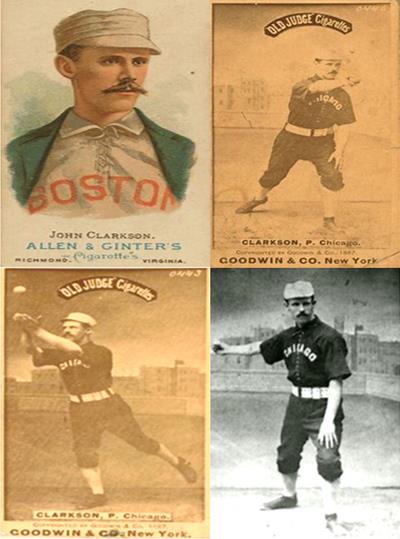
John Clarkson
Baseball Trailblazers
Page 904
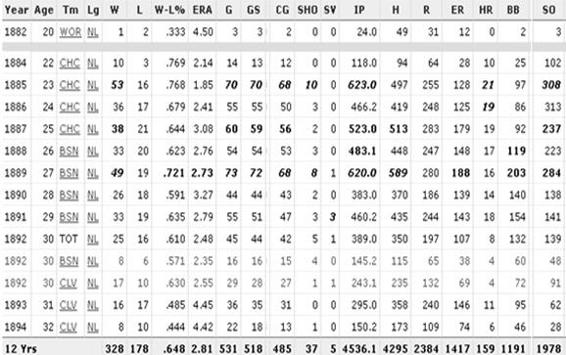
John Gibson Clarkson, July 1, 1861 – February 4, 1909, was a major league baseball right handed pitcher. He played from 1882
to 1894. Born in Cambridge, Massachusetts, Clarkson played for the Worcester Ruby Legs - 1882, Chicago White Stockings - 1884–
Baseball Trailblazers Page 905
1887, Boston Beaneaters - 1888–1892, and Cleveland Spiders -
1892–1894.
Clarkson was one of five sons of a prosperous jeweler. Clarkson had two brothers who were also major league pitchers; Dad Clarkson and Walter Clarkson. The Clarkson's also had two maternal cousins, Walter Hackett and Mortimer "Mert" Hackett who played professional baseball.
After attending business school and playing semipro ball, Clarkson signed as a free agent with the Worcester Ruby Legs of the National League in 1882. Clarkson played his first major league game at age 20 on May 2, 1882. He played in three games for the Ruby Legs, finishing with a 1–2 record in 24 innings.
The Worcester team folded after the 1882 season, and Clarkson pitched in the minors the following two years.
Chicago manager Cap Anson saw Clarkson pitching for Saginaw in the Northwest League in 1884. On August 24, 1884, the White Stockings purchased him from Saginaw. The White Stockings finished in fifth place in 1884, but Clarkson put in a strong performance, going 10–3 in 13 starts. His .769 win percentage was the second best in the league, and his 2.14 ERA was sixth best.
Baseball Trailblazers Page 906
Clarkson was known to be extremely sensitive to criticism.
Shortly after his death in 1909, former Chicago player/manager Cap Anson noted that "not many know what amount of encouragement it took to keep him going." Anson recalled; "Scold him, find fault with him, and he would not pitch at all. Say to him after a game: 'Grand work, John, I will probably use you again tomorrow, for we've got to have that game,' and he would go out the next day and stand all batters on their heads."
In 1885, Clarkson became Chicago's principal starting pitcher.
In a remarkable feat of durability, Clarkson appeared in 70
games that year, pitched 623 innings and threw 68 complete games. He also won 53 games with an ERA of 1.85. On July 27, 1885, he pitched the only no hitter of his career with a 4–0 win over the Providence Grays. Clarkson's performance in 1885 led the National League in wins and 308 strikeouts and ranks as one of the most remarkable in major league history. His 53 wins is the second highest single season total in major league baseball history. His 68 complete games is the seventh highest single season total. His 70 games started is the eighth most. His 632
innings pitched is the eighth most.
The White Stockings won the 1885 National League pennant with 83
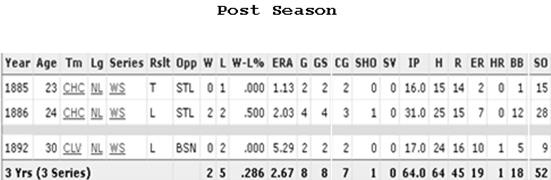
wins, 53 of which came from Clarkson. Clarkson started three games in the 1885 World Series against the St. Louis Browns, and
Baseball Trailblazers Page 907
had a record of 1–1 and an ERA of 1.12, allowing only two earned runs in 16 innings.
In 1886, Clarkson shared the pitching load with Jim McCormick and Jocko Flynn, each of whom won at least 23 games and pitched over 250 innings. Clarkson had a record of 36–17, with 50
complete games and an ERA of 2.41 in 467 innings pitched. He also led the league with a career high 313 strikeouts. On August 8, 1886, Clarkson struck out a team record 16 batters against Kansas City.
The 1886 White Stockings finished with a record of 90–34 with a winning percentage of .726 that ranks as one of the highest in baseball history. After winning the National League pennant by two and one half games over the Detroit Wolverines, the White Stockings faced the St. Louis Browns in the World Series for the second consecutive year.
Clarkson pitched four games, three of which were complete, in the 1886 World Series. He had a record of 2–2 with 28 strikeouts and an ERA of 2.04 in 31 innings pitched.
The sixth game, at St. Louis, was considered one of the greatest games ever played to that time. With the Browns ahead three games to two, Anson called on Clarkson to start his fourth game in six days. Clarkson responded with seven shutout innings, but
Baseball Trailblazers Page 908
gave up three runs in the eighth inning, and the game went to extra innings. In the bottom of the tenth inning, the Browns'
center fielder Curt Welch singled; only the fourth hit off Clarkson; and wound up at third after a sacrifice. Welch and Browns’ third base coach Arlie Latham tried to distract Clarkson with heckling and faking moves toward home. When Welch finally attempted the steal, Chicago's catcher, King Kelly, had called for a pitchout, but Clarkson threw a wild pitch, and Welch scored the World Series winning run.
In 1887, Clarkson was 38–21 for Chicago with 56 complete games and a 3.08 ERA. However, King Kelly was sold to Boston before the season began, and the team began a decline, dropping to third place. Clarkson, always a touchy temperament, reportedly became more difficult to handle after Kelly's departure.
On April 3, 1888, the White Stockings sold Clarkson to the Boston Beaneaters for $10,000; a huge sum at the time. Clarkson followed teammate King Kelly, who had been sold from Chicago to Boston the previous year. Boston had paid $10,000 apiece for Kelly and Clarkson, and they became known as the "$20,000
Battery."
Baseball Trailblazers Page 909
Clarkson pitched five great seasons for Boston. He was 33–20 in 1888, starting 54 games and pitching 53 complete games with an ERA of 2.76.
The 1889 season was Clarkson's best for Boston. He started a career high 72 games and had an astounding record of 49–19 with 68 complete games, 284 strikeouts, and a 2.73 ERA in 620 innings pitched.
While Clarkson's 1889 numbers are comparable to those he posted in 1885, no other pitcher pitched nearly as many games or innings as Clarkson in 1889. As a measure of his dominance, Clarkson's 49 wins were 11 more than any other pitcher; his 620
innings were 200 more than any other pitcher; and his 68
complete games were 22 more than any other pitcher. He also had twice as many shutouts as the next best pitcher. He was only the fourth pitcher to win the pitching Triple Crown, by leading the National League in wins, ERA and strikeouts. On June 4, 1889, Clarkson became the first pitcher in major league history to throw an immaculate inning, striking out all three batters on a total of nine pitches in the third inning of a 4–2 win over the Philadelphia Quakers.
Clarkson became involved in the players' rebellion in 1890, but then opted to remain with the Beaneaters. In 1891, Clarkson
Baseball Trailblazers Page 910
helped lead the Beaneaters to the National League pennant.
Clarkson led the team with a 33–19 record, 47 complete games, and 461 innings pitched. During a game that carried into the dusk hours, Clarkson once pitched a lemon to the plate to persuade the umpire, Jack Kerins to call the game due to darkness. Kerins called the lemon a strike, and when shown by Boston's catcher that he had called a lemon a strike, Kerins finally called the game.
On June 30, 1892, after 16 starts and an 8–6 record, Boston's new manager, Frank Selee, released Clarkson. He was signed as a free agent by the Cleveland Spiders. Clarkson went 17–10 for the remainder of the 1892 season, for a season record of 25–16.
Clarkson was no longer the ace with the Spiders. The Spiders’
pitching staff included Cy Young, who won 36 games in 1892 and 34 games in 1893.
In 1893, Clarkson had the first losing record of his career, finishing 16–17 with a career-high ERA of 4.45.
After the 1893 season, Clarkson went on a hunting trip with his close friend Charlie Bennett, who had been his catcher from 1888
to 1890. Bennett got off the train in Wellsville, Kansas and when he tried to reboard, Bennett slipped and fell under the train's wheels. Bennett lost both of his legs in the accident.
Baseball Trailblazers Page 911
Clarkson witnessed the incident, and it was said to have severely affected his already unstable nature.
In 1894, Clarkson pitched his final year in the major leagues, playing his last game on July 12, 1894, and finishing 8–10 in 18
starts for the Spiders.
Clarkson compiled a career 328–178 record, placing him twelfth on the majorleague list of all time wins. Clarkson pitched over 600 innings in a season twice and won a career high 53 games in 1885. In just five seasons from 1885 to 1889, Clarkson won 209
games.
Clarkson had a wide variety of curve balls and was considered to be a calculating, scientific pitcher who carefully analyzed every hitter's weaknesses. Hall of Fame hitter Sam Thompson said of Clarkson; "I faced him in scores of games and I can truthfully say that never in all that time did I get a pitch that came where I expected it or in the way in which I guessed it was coming."
At the time Clarkson retired from the game, he was the winningest pitcher in National League history.
Aside from being a great pitcher, Clarkson was also a fair hitter. His 24 career home runs in the deadball era ranks 7th on
Baseball Trailblazers Page 912
the List of major league baseball all time leaders in home runs by pitchers. He also had 232 career RBIs and 254 runs scored.
His notable achievements include; National League Pitching Triple Crown – 1889, National League ERA leader – 1889, National League wins leader - 1885, 1887 and 1889, National League winning percentage leader – 1889, National League innings pitched leader - 1885 and 1887–1889, National League strikeouts leader - 1885, 1887 and 1889, National League complete games leader - 1885, 1887 and 1889, six 30 win seasons - 1885–1889 and 1891, two 40 win seasons - 1885 and 1889, his 53 wins in 1885 is second most in major league baseball history, he had two seasons with 600 innings pitched - 1885 and 1889, and he had two 300
strikeout seasons - 1885 and 1886.
After his baseball career ended, Clarkson moved to Bay City, Michigan and ran a cigar store there until 1906. In either 1905
or 1906, Clarkson suffered a breakdown, was declared insane, and was committed to an insane asylum. Clarkson spent much of the next three years in mental hospitals. During a visit with family in 1909, Clarkson fell seriously ill, and was admitted to the McLean Hospital in Belmont, Massachusetts, a well-known psychiatric clinic. He died there, of pneumonia, February 4, 1909, aged 47.
Baseball Trailblazers
Page 913
Sam Rice
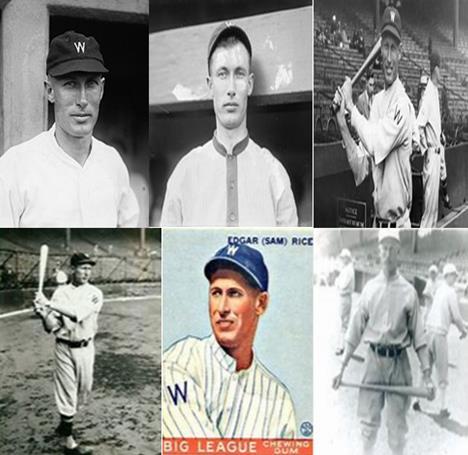
Edgar Charles "Sam" Rice, February 20, 1890 – October 13, 1974, was a pitcher and outfielder in major league baseball. Although Rice made his debut as a relief pitcher, he is best known as an outfielder. Playing for the Washington Senators from 1915 until 1933, he was regularly among the American League leaders in runs scored, hits, stolen bases and batting average. He led the Senators to three postseasons and a World Series championship in
Baseball Trailblazers Page 914
1924. He batted left handed but threw right handed. Rice played his final year, 1934, for the Cleveland Indians.
Rice was best known for making a controversial catch in the 1925
World Series which carried him over the fence and into the stands. While he was alive, Rice maintained a sense of mystery around the catch, which had been ruled an out. He wrote a letter that was only opened after his 1974 death. It claimed that he had maintained possession of the ball the entire time.
Rice was the first of six children born to Charles Rice and Louisa Newmyer. He grew up in various towns near Morocco, Indiana, on the Indiana-Illinois border, and considered Morocco his hometown. He was known as "Eddie" during his childhood. In 1908, Rice married 16 year old Beulah Stam. They lived in Watseka, Illinois, where Rice ran the family farm, worked at several jobs in the area, and attended tryouts for various professional baseball teams.
By April 1912, Rice and his wife had two children, aged 18
months and three years. While Rice's wife cared for the children, Rice traveled to Galesburg, Illinois, to play for a spot on a minor league baseball team; the Galesburg Pavers of the Central Association. Rice spent about a week with the team, appearing in three exhibition games. In an appearance on April
Baseball Trailblazers Page 915
21, Rice entered the game as a relief pitcher and finished the last three innings of a Pavers victory, giving up one run in a game marked by forceful winds.
That same day, Rice's wife took their children on a day trip to the homestead of Rice's parents in Morocco, about 20 miles from Watseka. A storm arose and a tornado swept across the homestead, destroying the house and most of the outbuildings. The tornado killed Rice's wife, his two children, his mother, his two younger sisters and a farmhand. Rice's father survived for another week before also succumbing to his injuries. Rice had to attend two funerals: one for his parents and sisters, and a second for his wife and children.
Rice played for the Muscatine Muskies of the Central Association in 1912, hitting .194 in 18 games. He did not play in 1913.
Probably wracked with grief, Rice spent the next year wandering the area and working at several jobs. In 1913, he joined the United States Navy and served on the USS New Hampshire, a 16,000-ton battleship that was large enough to field a baseball team. Rice played on that team during one season.
In 1914, Rice joined the Petersburg Goobers of the Virginia League as a pitcher. He compiled a 9–2 record with a 1.54 earned run average that year, then returned in 1915, putting up an 11-
Baseball Trailblazers Page 916
12 record with a 1.82 ERA. Petersburg team owner "Doc" Leigh owed a $300 debt to Clark Griffith, who owned the major league Washington Senators at the time, and he offered Rice's contract to Griffith in payment of the debt. Leigh is credited with two acts which influenced Rice's subsequent career. He changed the player's name from "Edgar" to "Sam," and he convinced the Senators to let Rice play in the outfield instead of pitching.
Rice played 19 of his 20 seasons with the Washington Senators.
He appeared in only 62 total major league games in 1915 and 1916. He played 155 games in 1917, registering a .302 batting average in 656 plate appearances. Rice was recalled up to the Army in 1918. He joined the 68th Coast Artillery Regiment and was stationed at Fort Terry in New York. He appeared with the Senators in a few games during two furloughs. By September, his company was sent to France and they prepared for combat, but the men did not see any action before the signing of the Armistice of November 11, 1918.
In 1919, Rice played in 141 games and hit .321, one of 13
seasons in which he hit at least .300. He hit .338 in 1920, and recorded a league leading and career high 63 stolen bases. In 1921, he hit 13 triples, the first of ten consecutive seasons in which he finished in double digits in that category. He collected a league high 216 hits in 1924, which culminated in
Baseball Trailblazers Page 917
Rice and the Senators winning the 1924 World Series in a dramatic 7 game series against the New York Giants. Though not the league leader in 1925, Rice recorded 227 hits, 87 RBI, and a
.350 batting average, career highs among his full seasons.
The most famous moment in Rice's career came on defense. In Game 3 of the 1925 World Series, the Senators were leading the Pittsburgh Pirates, 4–3. In the middle of the 8th inning, Rice was moved from center field to right field. With two out in the top of the inning, Pirate catcher Earl Smith drove a ball to right center field. Rice ran the ball down and appeared to catch it at the fence, robbing Smith of a home run that would have tied the game. After the catch, Rice toppled over the fence and into the stands, disappearing from sight. When Rice reappeared, he had the ball in his glove and the umpire called Smith out.
The umpire's explanation was that as soon as the catch was made the play was over, so it did not matter where Rice ended up.
Rice’ team lost the Series to the Pirates in seven games.
Controversy persisted over whether Rice had actually caught the ball and whether he had kept possession of it. Some Pittsburgh fans sent signed and notarized documents claiming that they saw a fan pick up the ball and put it back in Rice's glove. Rice himself would not tell, answering only; "The umpire said I caught it." Magazines offered to pay him for the story, but Rice
Baseball Trailblazers Page 918
turned them down, saying, "I don't need the money. The mystery is more fun." He would not even tell his wife or his daughter.
The controversy became so great that Rice wrote a letter when he was selected to the Hall of Fame, to be opened upon his death.
After Rice's death, officials could not immediately locate the letter describing his World Series play. However, in an interview, his wife Mary said; "He did catch it. You don't have to worry about that anymore." When the letter was located, its conclusion stated; "At no time did I lose possession of the ball."
Leading the league in hits again in 1926, Rice finished fourth in the Most Valuable Player Award voting. His batting average dipped to .297 in 1927, but he hit .328, .323 and .349 from 1928
through 1930. Though Rice hit .310 in 1931 across 120 games, Dave Harris got significant playing time when the team was facing left handed pitchers. The Senators also began to explore younger players for their outfield spots.
The Senators held "Sam Rice Day" in late 1932, where the team presented him with several gifts, including a check for more than $2200 and a new Studebaker automobile. He played only 106
games that year, often appearing as a pinch hitter. In 1933, the team returned to the World Series. Though the team lost, Rice
Baseball Trailblazers Page 919
batted once in the second game, picking up a pinch hit single.
The Senators released him after the season.
He played in 1934 with the Cleveland Indians, then retired at the age of 44. Cleveland manager Walter Johnson talked to Rice about returning in 1935, but Rice refused. Rice retired with a
.322 career average. He stood erect at the plate and used quick wrists to slash pitches to all fields. He never swung at the first pitch and seldom struck out, once completing a 616 at bat season with nine strikeouts. As the ultimate contact man with the picture perfect swing, Rice was never a home run threat, but his speed often turned singles into doubles, and his 1920 stolen base total of 63 earned him the timely nickname "Man o' War."
He accumulated 2,987 hits. Rice later said; "The truth of the matter is I did not even know how many hits I had. A couple of years after I quit, Senators owner Clark Griffith told me about it, and asked me if I'd care to have a comeback with the Senators and pick up those 13 hits. But I was out of shape, and didn't want to go through all that would have been necessary to make the effort. Nowadays, with radio and television announcers spouting records every time a player comes to bat, I would have known about my hits and probably would have stayed to make 3,000
of them." In postseason play, Rice produced 19 hits and a .302
batting average.
Baseball Trailblazers Page 920
By the 1940s, Rice had become a poultry farmer. His farm was located in Olney, Maryland next to that of Harold L. Ickes, the United States Secretary of the Interior. Rice remarried twice, first to Edith and at age 69 to Mary Kendall Adams. Mary had two daughters by a prior marriage, Margaret and Christine. In 1965, Rice and his family were interviewed in advance of a program to honor his career. The interviewer asked Rice about the tornado, and as he told of the storm and its destruction, his wife and children learned for the first time of the existence of his previous family.
Rice made one of his last public appearances at the Baseball Hall of Fame induction ceremonies honoring Whitey Ford and Mickey Mantle in August 1974. He died of cancer that year on October 13.
Baseball Trailblazers
Page 921
Sherry Magee
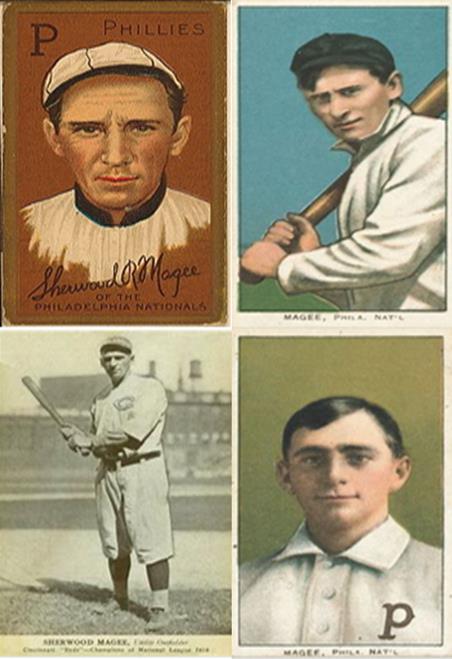
Sherwood Robert "Sherry" Magee, August 6, 1884 – March 13, 1929, was a left fielder in major league baseball. From 1904 through
Baseball Trailblazers Page 922
1919, Magee played with the Philadelphia Phillies from 1904–
1914, the Boston Braves from 1915–1917, and the Cincinnati Reds from 1917–1919. He batted and threw right handed.
A native of Clarendon, Pennsylvania, Magee was one of the premier hitters of the dead ball era. From 1905 through 1914, Magee finished in the National League top ten in home runs and RBIs seven times, including leading the NL in RBIs four times.
He led the league for a fourth time in the 1918 campaign, which was shortened by World War I and the Spanish flu pandemic.
Magee was obtained by the Philadelphia Phillies in 1904 and remained with them for eleven years. His 85 RBIs in 1905 were an NL high. His most productive season came in 1910, when he led the league in batting - .310, RBIs - 123, runs - 110, total bases - 263, on base percentage - .445, slugging average - .507, and finished second in doubles – 39, and triples - 17.
On July 10, 1911, Magee struck umpire Bill Finneran as a result of a dispute over a called third strike, knocking him unconscious. He was suspended for the remainder of the season, although on appeal the suspension was shortened to just over a month, 36 games.
In 1914 Magee led the league in hits - 171, doubles -39, RBIs -
103, extra base hits - 65, total bases – 277, and slugging
Baseball Trailblazers Page 923
percentage - .509. A year later, he was traded to the Boston Braves. He remained at Boston until the 1917 midseason, when he was sent to the Cincinnati Reds. In 1918, he led the league in RBIs for the fourth time, with 76. In 1919, Magee was seriously ill for two months and he concluded his major league career by pinch hitting twice during the 1919 World Series.
His 16 season major league career ended with a lifetime .291
batting average, with 83 home runs, and 1,176 runs batted in through 2,087 games played. Magee hit over .300 five times, while also being known as one of the finest defensive outfielders of his day. He collected 441 stolen bases, including 23 steals of home. He was a World Series champion in 1919, the NL batting champion in 1910, and was four time NL RBI leader in 1907, 1910, 1914, and 1918.
Magee later played in the minors and also umpired in the New York–Penn League and the National League. A victim of pneumonia, Magee died in Philadelphia, at age 44.
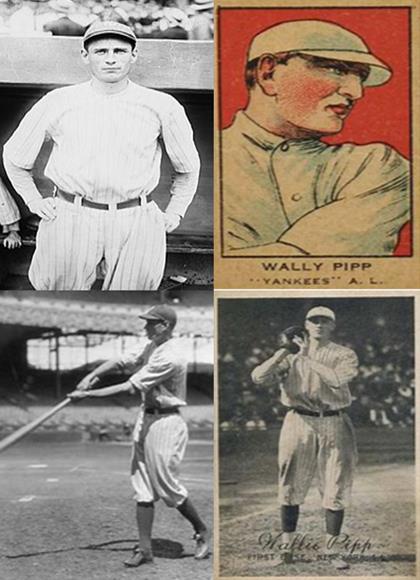
Baseball Trailblazers
Page 924
Wally Pipp
Walter Clement Pipp, February 17, 1893 – January 11, 1965, was a professional first baseman. He played in major league baseball for the Detroit Tigers, New York Yankees, and Cincinnati Reds between 1913 and 1928. Walter Pipp was born in Chicago,
Baseball Trailblazers Page 925
Illinois, to Pauline (née Stroeber) and William H. Pipp. He was raised as a Roman Catholic, and different sources describe him as being of Irish or German ancestry. He was raised in Grand Rapids, Michigan. As a child, Pipp said that he was hit in the head with a hockey puck, which resulted in headaches throughout his life. Pipp enrolled at the Catholic University of America in Washington, D.C., where he studied architecture and played baseball for the Catholic University Cardinals, graduating in 1913.
In 1912, Pipp made his debut in professional baseball with the Kalamazoo Celery Champs of the Class D Southern Michigan League.
In 68 games played, he had a .270 batting average. The Detroit Tigers of the American League purchased his contract late in the 1912 season. Pipp attempted to hold out from the Tigers, demanding a portion of the purchase price, and threatened to return to college, which he did.
After graduating from college, Pipp ended his holdout without receiving a share of the purchase price. Pipp made his major league debut with the Tigers on June 29, 1913. After playing 12
games for Detroit, batting .161, the Tigers reassigned Pipp to the Providence Grays of the Class AA International League. He committed seven errors in 14 games for Providence, and was
Baseball Trailblazers Page 926
demoted to the Scranton Miners of the Class B New York State League, where he only batted .220.
After appearing in 12 games for the Tigers in 1913 he played for in the minor leagues for the Rochester Hustlers of the International League in 1914. Pipp had a .314 batting average and 27 triples. He led all batters in the league with 15 home runs, a .526 slugging percentage, and 290 total bases. He was purchased by the Yankees before the 1915 season. The Yankees had only one winning record in their previous eight seasons. They made Pipp their starting first baseman in time for opening day of the 1915 season. The Yankees added Home Run Baker in 1916, and they formed the center of the Yankees' batting order. Pipp led the American League in home runs with 12 in 1916; Baker finished second with 10. Pipp hit nine home runs in 1917, again leading the league.
In 1918, Pipp hit only two home runs, but batted .304. He missed playing time under the nation's "work or fight" rule during World War I; as he worked as a naval aviation cadet at the Massachusetts Institute of Technology. He batted .275 with seven home runs in 1919, as Babe Ruth surpassed him as the best power hitter in the American League. The Yankees moved to strengthen their team after the 1919 season, adding Ruth and fellow outfielder Bob Meusel and third baseman Joe Dugan. Between 1920
Baseball Trailblazers Page 927
and 1924, Pipp had a .301 average, with season averages of 29
doubles, 94 runs scored, and 97 runs batted in per season. Led by their strong lineup and additions to the pitching staff, such as Waite Hoyt, the Yankees finished in second place in 1920.
Pipp became the cleanup hitter, behind Ruth in the batting order. Pipp hit .296 in 1921, and the Yankees won the American League pennant. However, they lost the 1921 World Series to the crosstown rival New York Giants of the National League.
On July 26, 1922, Pipp bobbled a ball during the fifth inning of a game against the St. Louis Browns. When the Yankees returned to the dugout, Ruth criticized Pipp's fielding. Pipp attacked Ruth, and the two were separated by teammates. Though Ruth insisted they'd "settle this after the game," Ruth and Pipp led the Yankees to a victory with their hitting, and when Pipp approached Ruth after the game, ready to fight, Ruth opted against it. Pipp said this resulted in reduced tension among the Yankees, to which he attributed their improved play from that point forward. Pipp batted .329 in 1922 and the Yankees again won the American League pennant. In a rematch, the Giants again defeated the Yankees in the 1922 World Series. Meanwhile, Pipp scouted Lou Gehrig, who was playing college baseball for Columbia University, and suggested to Yankees’ manager Miller Huggins that he should sign Gehrig. Pipp personally helped
Baseball Trailblazers Page 928
develop Gehrig after he signed. Pipp had a strong 1923 season, but he injured his right ankle while stepping off of a train in Boston late in the year. The Yankees used Gehrig, whom they promoted from the minor leagues, to play in four games at first base replacing Pipp, before calling upon Babe Ruth to substitute at first base for the four games at the very end of the season.
Though Huggins initially thought Pipp would not be able to play in the 1923 World Series, Pipp recovered sufficiently in time to play. The Yankees won the series in six games over the Giants.
The Yankees finished in second place in the American League in 1924, and Pipp led the league with 114 RBIs and 19 triples.
The Yankees began the 1925 season struggling, and Huggins began to replace players in his lineup in response. Huggins benched starting shortstop Everett Scott on May 6, replacing him with Pee Wee Wanninger. At the time, Scott had the longest streak of consecutive games played, with 1,307. The Yankees continued to struggle. The Yankees entered play on June 2 on a five game losing streak. Their 15–26 win-loss record had them in seventh place out of the eight teams in the American League, half a game better than the last place team, and 13 games out of first place in the standings. Before their game against the Washington Senators, Huggins replaced Pipp in the Yankees' lineup with Gehrig, and benched second baseman Aaron Ward and catcher Wally
Baseball Trailblazers Page 929
Schang as well. Pipp was batting .244 with only three home runs and 23 RBIs, and had a .181 batting average over the previous three weeks. This was the second; not the first game of Gehrig's then record 2,130 consecutive games played, which lasted for 14
seasons. The streak started the previous day, as on June 1
Gehrig entered the game as a pinch hitter, substituting for shortstop Paul "Pee Wee" Wanninger.
Although Pipp's replacement on June 2, 1925, was truly historic, and Gehrig had a great game by getting three hits, Gehrig would in fact go 0 for 3 in each of his next two games, before being lifted for a pinch hitter each day. Pipp would finish both of those games defensively at first base.According to the most popular version of the story, Pipp showed up at Yankee Stadium that day with a severe headache, and asked the team's trainer for two aspirin. Miller Huggins, the Yankees' manager, noticed this, and said "Wally, take the day off. We'll try that kid Gehrig at first today and get you back in there tomorrow."
Gehrig played well and became the Yankees' new starting first baseman. Pipp was later quoted to have said, "I took the two most expensive aspirin in history."
Ruth had returned to the Yankees' lineup on June 1, the day before Pipp, Ward, and Schang were benched. Despite Ruth's return and the strong play of Gehrig, who batted .295 with 20
Baseball Trailblazers Page 930
home runs and 68 RBIs, the Yankees finished in seventh place.
Pipp was hospitalized for a week after being hit in the head by Caldwell on July 2, and he played sparingly during the remainder of the season. He ended the year with a .230 average, three home runs, and 24 RBIs.
Due to the team's struggles, Huggins made personnel changes during the offseason. The Yankees attempted to trade Pipp to another American League team, but could not agree on the terms with any team. They put Pipp on waivers, and he was acquired by the Cincinnati Reds of the National League, who reportedly paid the Yankees a greater sum than the $7,500 waiver price. The Reds, who had not had a strong starting first baseman since Jake Daubert died in 1924, had attempted to acquire Bill Terry from the Giants, but refused to part with Edd Roush in the transaction, and so acquired Pipp instead. Pipp again attempted to acquire a portion of the purchase price, but was rebuffed.
Pipp played 372 games for the Reds over the next three seasons.
In 1926, he had a .291 batting average, and his 99 RBIs and 15
triples were both fourth best in the National League. He batted
.260 with 41 RBIs in 1927, and .283 in 1928. With first baseman George Kelly also on their roster, the Reds released Pipp before the 1929 season. Pipp signed with the Newark Bears of the International League for the season. He earned $40,000 that
Baseball Trailblazers Page 931
year, more than he made during his major league career. He batted .312 for Newark, and retired after the season.
Although Pipp is considered to be one of the best power hitters of the dead ball era, Pipp is now best remembered as the man who lost his starting role to Lou Gehrig at the beginning of Gehrig's streak of 2,130 consecutive games. Pipp played 1,872
games. He had three seasons with a .300+ batting average, and two seasons with 100 or more RBI. Pipp had a .281 career batting average. He led both the American and National leagues in fielding percentage.
Pipp often attended Old Timers' Day at Yankee Stadium and Tiger Stadium, playing in 12 games. He was later hired by Sports Illustrated as one of the magazine's first writers. After retiring, Pipp invested in the stock market, but lost his wealth in the Wall Street Crash of 1929. He authored a book, titled
“Buying Cheap and Selling Dear.” He worked as a broadcaster on a pre-game baseball show for the Tigers, wrote radio scripts, and worked in publishing. He organized baseball programs around his community for the National Youth Administration. He also spent time unemployed during the Great Depression. In 1940, Pipp was on the verge of bankruptcy, but he managed to pay off his debts without going bankrupt. During World War II, Pipp worked at the Willow Run manufacturing complex in Ypsilanti, building B-24
Baseball Trailblazers Page 932
bombers. Following the war, Pipp worked for the Rockford Screw Products Corporation as a machine parts salesman, selling bolts and screws to automotive companies based in Detroit and Grand Rapids. Pipp and his wife, Nora, had four children. The Pipps moved to Lansing, Michigan, in 1949. After suffering a number of strokes, Pipp moved to a nursing home in Grand Rapids in September 1963. He died there on January 11, 1965, of a heart attack at the age of 71.
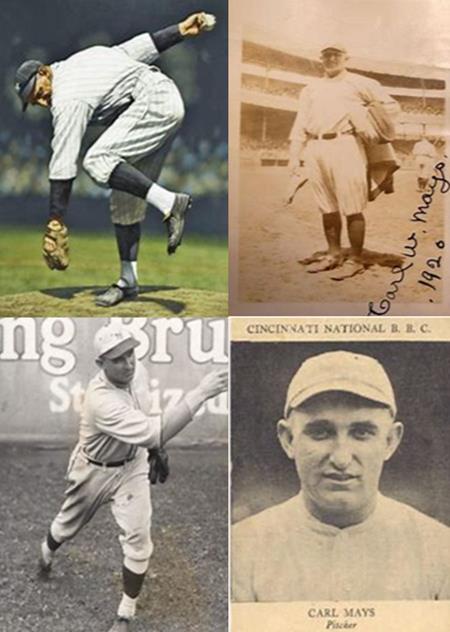
Baseball Trailblazers
Page 933
Carl Mays
Carl William Mays, November 12, 1891 – April 4, 1971, was a pitcher who played 15 seasons in major league baseball from 1915
Baseball Trailblazers Page 934
to 1929. He was a four time World Series champion - 1915, 1916, 1918, 1923; and wins leader in 1921. He won 207 games, 27 in 1921, losing 126, while posting a 2.92 ERA. As fortune would have it, Mays is best remembered for having thrown the pitch that fatally injured Ray Chapman of the Cleveland Indians on August 16, 1920. Chapman became the only major league player to die as a direct result of an on field injury.
He was born in Atterson, Kentucky, one of five sons born to Callie Louisa Mays and William Henry Mays. His father was a Methodist minister, and was responsible for his strict religious upbringing. When Mays was 12, his father died and his mother moved the family to Kingfisher, Oklahoma, to live near her sister-in-law. Mays reportedly settled into a surly persona with few if any close friends. As a professional baseball player, he had few friends in the baseball world, in part because of his strict Methodist upbringing. Mays refused to pitch on Sundays.
Mays quit high school before graduating and began to earn a living as a baseball player on semi-pro teams in Oklahoma, Kansas, and Utah. In 1912, he entered the minor leagues as a member of the Boise, Idaho, team in the Class D Western Tri-State League. After a season in Boise, in 1913 Mays played one season for the Portland, Oregon, team in the Class A Northwest League. In 1914, Mays was drafted by the Triple A International
Baseball Trailblazers Page 935
League's Providence Grays. The Grays were an affiliate of the Detroit Tigers, and the Tigers sold his contract to the Boston Red Sox.
Mays learned his underhand style of pitching from Joe McGinnity when McGinnity coached the Tacoma team during Mays's stint with Portland. Mays was nicknamed "Sub," a reference to his submarine pitching motion, and he was known to throw a spitball. The pitch was legal at the time of the Chapman incident, but Chapman's death was partly responsible for its ban in Major League Baseball. Mays was also known for a habit of throwing inside to any batter who hugged the plate. With a stellar win/loss record, he was typically among the American League leaders in hit batsmen.
In his rookie season of 1915, Mays appeared in 34 games for the Red Sox. Used mostly in relief, he won 6 games and lost 5.
During the regular season, Mays was involved in a heated confrontation with Ty Cobb of the Tigers. Mays threw near Cobb each time he came to bat. In the eighth inning, after another close pitch, Cobb threw his bat in Mays' direction, calling him a "no good son of a bitch." Mays responded by calling Cobb a
"yellow dog." After order was restored, Mays hit Cobb on the wrist. The incident cemented Mays' reputation as a head hunter.
Baseball Trailblazers Page 936
In 1916, Mays appeared in 44 games, and started 24. 18 of his starts were complete games, and he posted a record of 18 wins and 13 losses, with an earned run average of 2.39. In the 1916
World Series, Mays was the losing pitcher in Game 3, but the Red Sox defeated the Brooklyn Robins 4 games to 1. In 1917, The Red Sox posted a second place finish. Mays pitched in 35 games, and his record was 22 wins and 9 losses, with an ERA of 1.74. Mays went 22–13 in the 1918 season, with an ERA of 2.21. The Red Sox returned to the World Series, and defeated the Chicago Cubs in 6
games. Mays was the winning pitcher in games 3 and 6, both by scores of 2–1.
Mays married for the first time shortly after the end of the 1918 season. After a brief honeymoon in Missouri, he departed by train from his home in Mansfield for St. Louis as the leader of a group of 18 men who had enlisted in the United States Army for World War I. The Armistice ended the need to expand the Army, and Mays was discharged in time to begin the 1919 baseball season.
Though he was by now established as one of the game's premier pitchers, Mays began the 1919 season with a record of five wins and eleven losses. His slow start resulted in the Red Sox trading him to the New York Yankees that July. Mays went 9–3
after the trade, resulting in a combined 1919 record of 14–14.
Baseball Trailblazers Page 937
Mays regained his form in 1920. The Yankees finished in third place, but posted a record of 95 wins and 59 losses, only three games out of first place. Mays went 26–11, including 26 complete games.
The Yankees were trailing the Indians when Ray Chapman came to the plate in the fifth inning on August 16, 1920. Mays was pursuing his 100th career win that day. Chapman had a sacrifice bunt in the first inning and popped up to Yankee first baseman Wally Pipp in the third. Chapman was crowding the plate, and Mays let loose with a high fastball that he claimed was in the strike zone but that Chapman apparently never saw. The impact of the ball striking Chapman in the head was so loud that Mays, thinking it had hit Chapman's bat and was in play, caught the ball as it bounced onto the field and threw it to Pipp at first base. Chapman, trying to take his base after the hit by pitch, fell to the ground twice and was unable to get up. Cleveland teammate Tris Speaker raced from the on deck circle to check on Chapman. He was joined by several players from the Indians and Yankees. Mays, however, never left the mound.
Chapman was taken to a hospital, where surgeons operated and discovered a skull fracture. He initially seemed to rally after the surgery but died early in the morning on the following day.
Mays stayed in the game and continued to pitch until being
Baseball Trailblazers Page 938
replaced in the ninth inning. Cleveland won the game 4–3. The New York District Attorney determined that the incident was an accident, and no charges were filed.
In an interview three months after Chapman's death, Mays expressed regret for the outcome, but stated that he did not feel any guilt because he had not hit Chapman on purpose. Mays received the wrath of many opposing players, who believed he beaned Chapman deliberately. Cobb was the most vocal critic, suggesting that someone should give Mays a taste of his own medicine by hitting Mays with a pitch the same way Mays hit Chapman.
Mays enjoyed his best season in 1921, when he led the American League in wins with 27, innings pitched with 336.2, games pitched at 49, and a winning percentage of .750. However, that same season Mays, pitching for the Yankees, played in a World Series that others later accused him of helping to throw, bringing back memories of the Black Sox scandal from just two years prior. These rumors were never proven, but they persisted long enough that, combined with an already negative reputation among other players both from the Chapman incident and from having a personality that few found agreeable, he was never elected to the Baseball Hall of Fame despite having lifetime statistics comparable to some other pitchers who were.
Baseball Trailblazers Page 939
After his playing career, Mays was the owner and operator of a baseball school in Oregon. Among his most notable attendees was Johnny Pesky. Mays also worked as a scout for the Cleveland Indians, Milwaukee and Atlanta Braves, and Kansas City Royals.
He died in El Cajon, California at the age of 79.
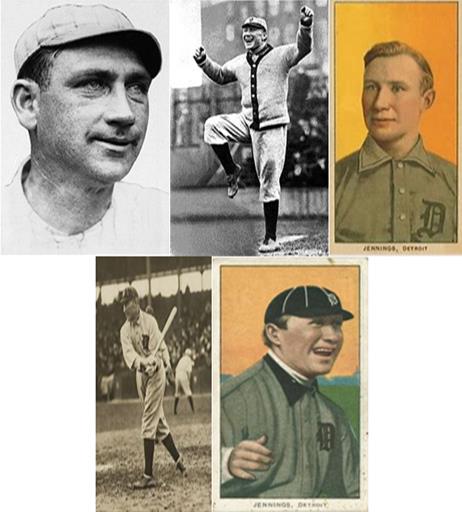
Baseball Trailblazers
Page 940
Hughie Jennings
Hugh Ambrose Jennings, April 2, 1869 – February 1, 1928, was a professional baseball player, coach and manager from 1891 to 1925. Jennings was a leader, both as a batter and as a shortstop, with the Baltimore Orioles teams that won National League championships in 1894, 1895, and 1896. During those three seasons, Jennings had 355 runs batted in and hit .335, .386, and
Baseball Trailblazers Page 941
.401. Born in Pittston, Pennsylvania, Jennings was the son of Irish immigrants, James and Nora, who arrived in Pittston in 1851.
Jennings worked as a breaker boy; young boys who separated the coal from the slate; in the local anthracite coal mines. He drew attention playing shortstop for a semi-professional baseball team in Lehighton, Pennsylvania in 1890. He was signed by the Louisville Colonels of the American Association in 1891 and stayed with the Colonels when they joined the National League in 1892, and was traded on June 7, 1893 to the Baltimore Orioles.
Jennings played with the Orioles for parts of seven seasons and became a star during his years in Baltimore. The Baltimore Orioles teams of 1894, 1895, and 1896 are regarded as one of the greatest teams of all time. The teams featured Hall of Fame manager Ned Hanlon and a lineup with six future Hall of Famers: first baseman Dan Brouthers, second baseman John McGraw, shortstop Jennings, catcher Wilbert Robinson, right fielder "Wee Willie" Keeler, and left fielder Joe Kelley. Amidst all those great players, Jennings was appointed captain in 1894, his first full season with the team.
During the Orioles' championship years, Jennings had some of the best seasons ever by a major league shortstop. In 1895, he hit
Baseball Trailblazers Page 942
.386, scored 159 runs, collected 204 hits, knocked in 125 runs, and stole 53 bases. In 1896, his performance was even better, as he hit .401, with 209 hits, 121 RBI, and 70 stolen bases.
The fiery Jennings was also known as one of the most fearless players of his time, allowing himself to be hit by pitches more than any other player. In one game, he was hit by a pitch three times. In 1896, he was hit by pitches 51 times; a major league record that still stands. In just five seasons with the Orioles from 1894 to 1898, Jennings was hit by pitches an unprecedented 202 times. During one game, Jennings was hit in the head by a pitch from Amos Rusie in the 3rd inning, but managed to finish the game. As soon as the game ended, Jennings collapsed and was unconscious for three days.
Jennings was also one of the best fielding shortstops of the era. He led the National League in fielding percentage and putouts three times each. He had as many as 537 assists and 425
putouts in single seasons during his prime. His 425 putouts ties him with Donie Bush for the single season record for a shortstop. He once handled 20 chances in a game, and on another occasion had 10 assists in a game. In 1898, he threw his arm out, and his career as a shortstop came to an end. After that, Jennings was forced to move to first base.
Baseball Trailblazers Page 943
In 1899, when manager Ned Hanlon moved to the Brooklyn Superbas, several of his star players, including Jennings, Joe Kelley, and Willie Keeler followed. While Jennings was never the same after the injury to his arm in 1898, he contributed to Brooklyn's National League pennants in 1899 and 1900.
In 1901, Jennings was traded to the Philadelphia Phillies.
However, his failing arm cut his career short, as he never played in more than 82 games or hit above .272 in two seasons with the Phillies. Jennings played 6 games for the Superbas in 1903, effectively ending his playing career, with the exception of 9 at bats during his tenure as the manager of the Detroit Tigers.
While playing for the Orioles in the 1890s, Jennings and John McGraw both attended classes at St. Bonaventure University.
After the 1899 season, Jennings was accepted to Cornell Law School. He managed the Cornell University baseball team while studying law and concluded that he was well suited to being a manager. While at Cornell, he joined the Phi Delta Theta fraternity chapter there. Jennings continued as a scholar-athlete until the spring of 1904, when he left campus early to manage the Orioles. Though he never finished his law degree at Cornell, Jennings passed the Maryland bar exam in 1905 and started a law practice. Jennings practiced law in Baltimore and
Baseball Trailblazers Page 944
in Scranton, Pennsylvania. He continued to work at his law practice during the off seasons through the remainder of his baseball career.
In 1907, Jennings was hired as manager of a talented Detroit Tigers team that included future Hall of Famers Ty Cobb and Sam Crawford. Jennings led the Tigers to three consecutive American League pennants in 1907–1908-1909. However, Jennings' teams lost the 1907 and 1908 World Series to the "Tinker to Evers to Chance" Chicago Cubs and the 1909 Series to Honus Wagner's Pittsburgh Pirates. Jennings continued to manage the Tigers through the 1920 season, though his teams never won another pennant.
During his years as Detroit's manager, Jennings became famous for his antics, mostly in the third base coaching box, which variously included shouts of "Ee-Yah," and other whoops, whistles, horns, gyrations, jigs, and grass plucking. The "Ee-Yah" whoop became his trademark and was accompanied with waves of both arms over his head and a sharp raising of his right knee. In 1907, he was suspended for taunting opponents with a tin whistle. The "Ee-Yah" shouts continued and became such a trademark that Jennings became known as Hughie "Ee-Yah"
Jennings, and Detroit fans would shout "Ee-Yah" when Jennings appeared on the field.
Baseball Trailblazers Page 945
Behind the antics was a great coaching mind. Connie Mack called Jennings one of the three greatest managers in history, along with John McGraw and Joe McCarthy. One of his greatest challenges, and accomplishments, during his years in Detroit was to manage the unmanageable Ty Cobb. Jennings recognized Cobb's talent and his complicated psychological makeup and concluded the best strategy would be to let Cobb be Cobb. Jennings reportedly called Cobb aside one day and said; "There isn't anything about baseball I can teach you. Anything I might say to you would merely hinder you in your development. The only thing for you to do is go ahead and do as you please. Use your own judgment. Do what you think is best and I'll back you up."
In 1912, during a game in which "pick-ups" played for the Tigers when the regular team went on strike to protest the suspension of Cobb after an incident involving a fan in the stands whom Cobb assaulted, Jennings, who also sent his coaches in as substitute players, came to bat himself once as a pinch hitter.
According to one source, when the umpire asked him for whom he was batting, Jennings answered, "None of your business." The umpire noted on his lineup sheet, "Jennings - batted for exercise."
He finished his major league career with a batting average of
.311, 18 home runs, and 840 runs batted in.
Baseball Trailblazers Page 946
While Jennings was fiery, hard-nosed, colorful, and even eccentric, he insisted he had always played the game honestly.
When a scandal arose in 1926 concerning whether Ty Cobb and Tris Speaker had fixed a 1919 game between the Detroit and the Cleveland Indians while Jennings was the manager, Jennings initially spoke of how easy it would be to fix a game and issued a "no comment" on the specific game. After his "no comment" drew negative publicity, Jennings issued a statement to the press in December 1926 denying knowledge of the matter and adding; "My slate has been clean baseball for 35 years. Whatever I have done in baseball has been of such a nature that I would be ready any time to go before anyone and place my case before them." After the 1920 season, Jennings stepped down as the Tigers' manager.
His 1,131 wins was the most in Tigers history until 1992.
Jennings signed on as a coach with his old friend, John McGraw, who was managing the New York Giants. Jennings and McGraw, who met as teammates on the Orioles, became close friends. Jennings was the best man at McGraw's wedding and a pallbearer following the death of McGraw's 23 year old wife in 1899. McGraw and Jennings staged a reunion year after year on their birthdays.
Jennings won two World Series as a coach in 1921 and 1922. When McGraw became ill, Jennings filled in as the Giants' manager for
Baseball Trailblazers Page 947
parts of 1924 and 1925. His overall managing record was 1184-995.
Jennings' life was filled with several tragic accidents. There was the beaning incident in Philadelphia that left him unconscious for three days. While attending Cornell, he fractured his skull diving head first into a swimming pool at night, only to find the pool had been emptied. In December 1911, Jennings came close to death after an off season automobile accident. While driving a car given to him by admirers, Jennings' car overturned while crossing a bridge over the Lehigh River near Gouldsboro, 23 miles southeast of Scranton. In the crash, Jennings again fractured his skull, suffered a concussion of the brain, and broke both legs and his left arm. For several days after the accident, doctors were unsure if Jennings would survive.
The physical abuse and blows to the head undoubtedly took their toll. During the 1925 season, McGraw was ill, and Jennings was put in full charge of the Giants. The team finished in second place and the strain caught up with Jennings, who suffered a nervous breakdown when the season ended. According to his obituary, Jennings "was unable to report" to spring training in 1926 due to his condition. Jennings retired to the Winyah Sanatorium in Asheville, North Carolina. He did return home to
Baseball Trailblazers Page 948
Scranton, Pennsylvania, spending much of his time recuperating in the Pocono Mountains. In early 1928, Jennings died from meningitis in Scranton, Pennsylvania at age 58.
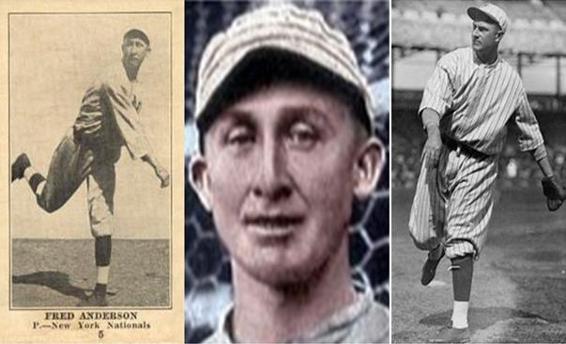
Baseball Trailblazers
Page 949
Fred Anderson
John Frederick Anderson, December 11, 1885 – November 8, 1957, played for the Boston Red Sox in 1909 and 1913, the Buffalo Buffeds/Blues from 1914 to 1915, and the New York Giants from 1916 to 1918. He compiled a win–loss record of 53–57, while posting an earned run average of 2.86, leading the league in 1917 with an amazing 1.44.
He played for Davidson College in 1906, but later transferred to the Maryland Agricultural College, where he played from 1907 to 1909. Then, the 6 ft. 2 in., 180-pound pitcher moved to play for the Boston Red Sox. Anderson played in Boston in 1909 but did not play major league baseball again for the Red Sox again until
Baseball Trailblazers Page 950
1913 due to his practicing dentistry. In 1914, he jumped to the Federal League to play for Buffalo for the 1914 and 1915
seasons. In 1916, he was sold to the New York Giants and Anderson played with them for three seasons. He pitched for the Giants in the 1917 World Series against the Chicago White Sox.
Anderson committed suicide on November 8, 1957, at the age of 71, in his Winston-Salem, North Carolina home.
Baseball Trailblazers
Page 951
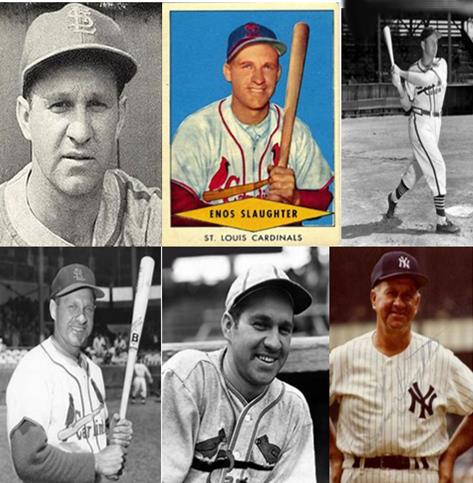
Enos Slaughter
Baseball Trailblazers
Page 952
Baseball Trailblazers Page 953
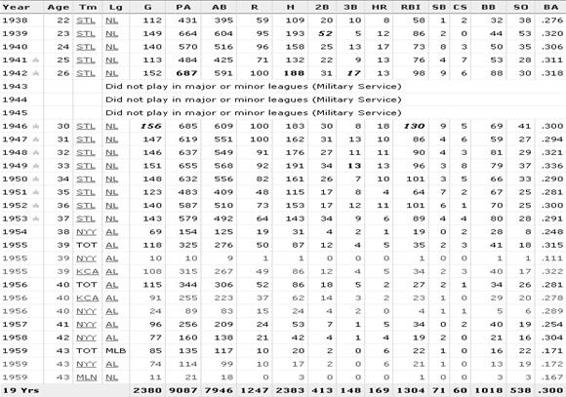
Enos Bradsher Slaughter, April 27, 1916 - August 12, 2002, was a professional baseball right fielder. He played for 19 seasons on four major league teams from 1938-1942 and 1946-1959. He is noted primarily for his playing for the St. Louis Cardinals and is best known for scoring the winning run in Game 7 of the 1946
World Series. A ten time All-Star, he has been elected to the National Baseball Hall of Fame.
Slaughter was born in Roxboro, North Carolina, where he earned the nickname "Country." In 1935, scout Billy Southworth signed him for the St. Louis Cardinals.
The Martinsville Manufacturers were Slaughter's first professional team, in 1935. When Slaughter was a minor leaguer in Columbus, Georgia, he went running towards the dugout from his position in the outfield, slowed down near the infield, and began walking the rest of the way. Manager Eddie Dyer told him;
"Son, if you're tired, we'll try to get you some help." During the remainder of his major league career, Slaughter ran everywhere he went on a baseball field. In 1937, he had 245 hits and 147 runs scored for Columbus.
Slaughter batted left handed and threw right handed. He was renowned for his smooth swing that made him a reliable "contact"
hitter. Slaughter had 2,383 hits in his major league career,
Baseball Trailblazers Page 954
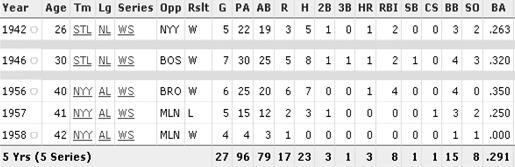
including 169 home runs, and 1,304 RBI in 2,380 games. Slaughter played 19 seasons with the Cardinals, Yankees, Kansas City Athletics, and Milwaukee Braves. During that period, he was a ten time All-Star and played in five World Series.
After debuting with the Cardinals in 1938, Slaughter became an everyday outfielder for them in 1939.
Slaughter served for three years in the Army Air Corps during World War II. He was a Sergeant who taught physical education.
Slaughte helped set up baseball teams in Tinian and Saipan, and their games inspired the troops while drawing upwards of 20,000
spectators. Immediately upon return from his military service in 1946, Slaughter led the National League with 130 RBI and led the Cardinals to a World Series win over the Boston Red Sox. In the decisive seventh game of that series, Slaughter, running with the pitch, made a famous "Mad Dash" for home from first base on Harry Walker's hit in the eighth inning, scoring the winning run after a delayed relay throw by the Red Sox' Johnny Pesky. The hit was ruled a double, though most observers felt it should have been ruled a single, as only the throw home allowed Walker to advance to second base.
Baseball Trailblazers Page 955
Slaughter was known for his hustle, especially for running hard to first base on walks, a habit later imitated by Pete Rose and David Eckstein.
With the Yankees, Slaughter did not play as much, but he excelled as a pinch hitter for the ballclub. He batted fifth and played in left field in Game 5 of the 1956 World Series in which teammate Don Larsen pitched the only perfect game in World Series history, a 2-0 Yankees win. At age 40, he was the oldest player for either team in the game.
Slaughter retired from major league baseball in 1959. He was a player-manager for the Houston Buffs of the Texas League in 1960
and for Raleigh Capitals of the Carolina League in 1961.
Slaughter coached baseball for Duke University from 1971 to 1977. He provided aid to causes such as the Duke Children's Classic, the Person County Museum of History, and Piedmont Community College.
Slaughter had five wives, each of whom he divorced. He had four daughters; Gaye, Patricia, Rhonda, and Sharon. Henry Slaughter, his cousin, was a well-known southern gospel musician.
Slaughter died at age 86 on August 12, 2002. He had battled non-Hodgkin lymphoma, and two weeks before his death, he had undergone colon surgery to fix torn stomach ulcers.
Baseball Trailblazers
Page 956
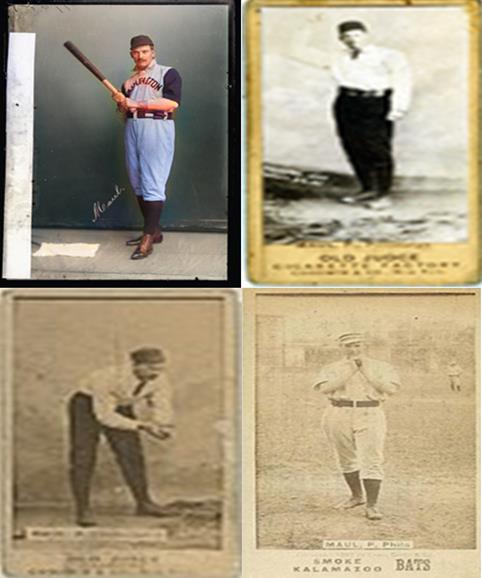
Al Maul
Albert Joseph "Smiling Al" Maul, October 9, 1865 – May 3, 1958, was a pitcher and outfielder over parts of 15 seasons, 1884–
1901, in major league baseball with the Philadelphia Keystones, Philadelphia Quakers/Phillies, Pittsburgh Alleghenys, Pittsburgh
Baseball Trailblazers Page 957
Burghers, Washington Senators, Baltimore Orioles, Brooklyn Superbas, and New York Giants. He led the National League in earned run average at 2.45 in 1895 while playing for Washington.
For his career, he compiled an 84–80 record in 188 appearances, with a 4.45 ERA and 352 strikeouts. His lifetime batting average was .241. Maul was born in Philadelphia, Pennsylvania and died there at the age of 92.
Baseball Trailblazers
Page 958
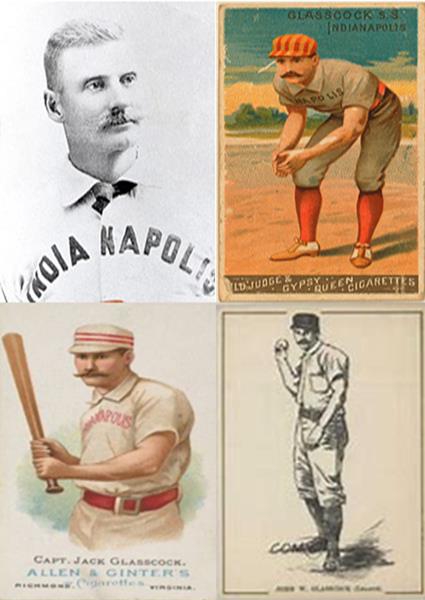
Jack Glasscock
John Wesley "Jack" Glasscock, July 22, 1857 – February 24, 1947, was a shortstop in major league baseball who played for many teams from 1879 to 1895. Jack Glasscock was born in Wheeling,
Baseball Trailblazers Page 959
West Virginia to Thomas Glasscock (born 1830) and the former Julia Collette (born 1833), and dropped out of school in fourth grade to pursue his father's trade of carpentry. Nicknamed
"Pebbly Jack" for his habit of scrutinizing the infield for small stones, typically pocketing them, the practice helped him to avoid the bad hop ground balls which more regularly afflicted other infielders. He played for the local Standard club in 1876, the Champion City club of Springfield, Ohio in 1877, and the Pittsburgh Allegheny Base Ball Club of the International Association in 1878, the latter at third base.
After Allegheny folded, he finished the season with Cleveland and broke into the National League with that club in 1879. After playing second and third bases as a rookie, he switched to shortstop permanently in 1880 with Fred Dunlap taking over at second. In 1881 he led the NL in putouts, assists, and fielding average for the first time. Over five seasons with the team he gradually improved his hitting, and in 1882 he was among the league's top ten players in home runs - 4, doubles - 27, slugging average - .450, and total bases – 161, while also leading the league in assists double plays. In 1883, batting third, Glasscock led the team in runs batted in, and paced the NL in fielding again. In mid-1884 he jumped to the Cincinnati
Baseball Trailblazers Page 960
Outlaw Reds of the Union Association during that league's only season of play and batted .419 in 38 games.
He returned to the NL with the St. Louis Maroons for the next two years, becoming team captain. In 1885 he set an NL record for assists and led the league in fielding average. In 1886 he hit .325 and was fifth in the league in doubles and sixth in hits, also breaking his own NL record with 43 double plays and again leading the NL in assists and fielding. The Maroons moved to Indianapolis and became the Indianapolis Hoosiers before the 1887 season, and Glasscock continued his solid output in Indianapolis with a .294 average that year. He also set new major league records for assists and double plays. Glasscock led the league in fielding again in 1888, and would later break his own NL double play record with 60 in 1889.
1889 marked Glasscock's top all around season as he batted .352, second in the NL behind Dan Brouthers, the best average by a major league shortstop prior to 1893. He led the league in hits with 205, was second in doubles with 40, and total bases with 272, and was fifth in the league with a career high 128 runs.
Further, he led the league in every defensive category; putouts, assists, double plays, and average. His 246 putouts set a new NL
record. He also managed the team for the last half of the season, posting a 34–32 record. Early in the year, he discovered
Baseball Trailblazers Page 961
17 year old future Hall of Famer Amos Rusie pitching for a local semi-pro team, and the young hurler was promptly acquired for Indianapolis.
When the Hoosiers folded after the 1889 season, his contract, as well as Rusie's, was awarded to the Giants to replace John Montgomery Ward, who was leading many of the sport's top players in a shift to the Players' League for the 1890 season. Glasscock had been intending to switch leagues as well but was expelled from the Brotherhood of Professional Base Ball Players after signing his 1890 contract with Indianapolis. He won the 1890
batting championship by eleven points over Billy Hamilton, going 6 for 6 on September 27. Glasscock also became the second player to lead the NL in hits two years in a row, joining Dan Brouthers, and was second in doubles to Sam Thompson and fifth in total bases. His offensive totals dropped off in later seasons, partially as a result of an 1891 hand injury. When the American Association merged with the NL prior to the 1892
season, Glasscock shifted to the St. Louis Browns, hitting .241
and .267 in two full seasons. In June 1893 he was traded to the Pittsburgh Pirates, and he hit .341 over the remainder of the year, finishing with a .320 average and also with 100 RBIs for the first time. The team finished only five games out of first place, the closest he would come to a league title during his
Baseball Trailblazers Page 962
major league career. He batted .280 in his last full season in 1894, leading the NL in fielding for the last time, and ended his major league career in 1895, splitting the year between the Louisville Colonels and the Washington Senators.
Glasscock left the major leagues with a .290 career batting average, 2040 hits, 27 home runs, 1163 runs, 825 runs batted in and 98 triples. He was one of the most difficult players of the 19th century to strike out, doing so just once in every 33 at bats. He played a notable role in the advancement of defensive tactics, being one of the first shortstops to use signals indicating which infielder would cover second base on steal attempts, and also one of the first to back up throws to the second baseman. He was the top player at his position in the 1880s during the sport's bare-handed era. He led the National League in fielding percentage seven times and in assists six times, with both marks remaining league records until the 1980s.
He became the sixth major league player to make 2,000 hits. He was the first player to appear in over 600 games as a shortstop, and ended his career with major league records for games -
1,628, putouts - 2,821, assists - 5,630, total chances - 9,283, double plays – 620, and fielding percentage -.910, at the position. When he retired he ranked fifth in major league
Baseball Trailblazers Page 963
history in games - 1,736 and at bats - 7,030, seventh in total bases - 2,630, and eighth in doubles - 313.
Glasscock returned to Wheeling and played on a minor league team run by Ed Barrow, winning the first pennant of his career. He remained in the minor leagues as a first baseman until 1901, winning an 1896 batting title with a .431 average. After his baseball career ended, he returned to carpentry. He died in Wheeling from a stroke at age 89.
Baseball Trailblazers
Page 964
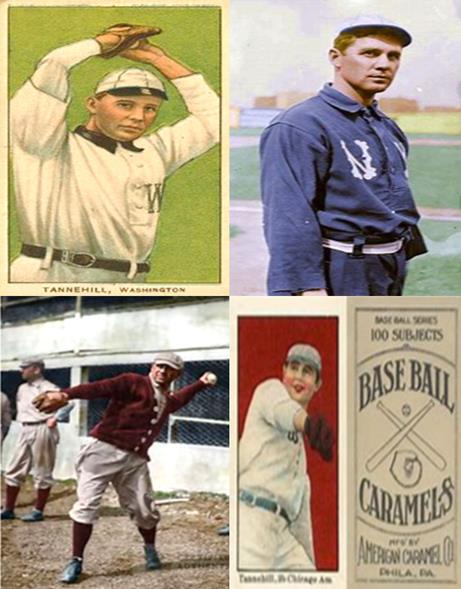
Jesse Tannehill
Jesse Niles Tannehill, July 14, 1874 – September 22, 1956, was a left handed pitcher for the Cincinnati Reds, Pittsburgh Pirates, New York Highlanders, Boston Red Sox, and the Washington
Baseball Trailblazers Page 965
Senators. Tannehill was among the best pitchers of his era and was one of the best hitting pitchers of all time.
Tannehill was born in Dayton, Kentucky. He broke into the National League at the age of 19 with the Cincinnati Reds.
However, he struggled in 29 innings and did not reappear in the major leagues until three years later. After a partial season with the Pittsburgh Pirates in 1897, Tannehill set a career high in both innings pitched – 326, and wins – 25, in 1898. Tannehill had several good years with the Pirates and had his career year in 1901, when he led the National League in ERA at 2.18.
Tannehill posted an even better ERA in 1902 at 1.95, but came out third.
After six years with the Pirates of the National League, Tannehill got involved in a salary dispute with Pirates owner Barney Dreyfuss. As a result, Tannehill jumped to the startup American League franchise the New York Highlanders. After the season, he was traded by the Highlanders to the Boston Americans for Tom L. Hughes, and was an important part of their championship team of 1904. Tannehill pitched a no hitter against the Chicago White Sox on August 17, 1904. After this however, Tannehill went into precipitous decline, as he was traded to the Washington Senators for Case Patten. Tannehill retired from baseball in 1911, with a career ERA of 2.79 and 197 career wins.
Baseball Trailblazers Page 966
Tannehill was also noted for his strong bat in his 15 year major league career, posting a lifetime .255 batting average, 361 for 1414.
After retiring as a player, Tannehill managed the Portsmouth Truckers of the Virginia League in 1914. He then served as an umpire in the Ohio State League, International League, and Western League, before returning to the majors as a coach for the Philadelphia Phillies in 1920, a stint that lasted only one season. In 1923 he managed the Topeka Kaws in the Southwestern League.
In his last years, Tannehill worked in a Cincinnati machine shop and was a frequent visitor to Crosley Field, the home of the Cincinnati Reds from 1912 to 1970. He died of a stroke at Speers Hospital in Dayton, Campbell County, Kentucky on September 22, 1956.
Baseball Trailblazers
Page 967
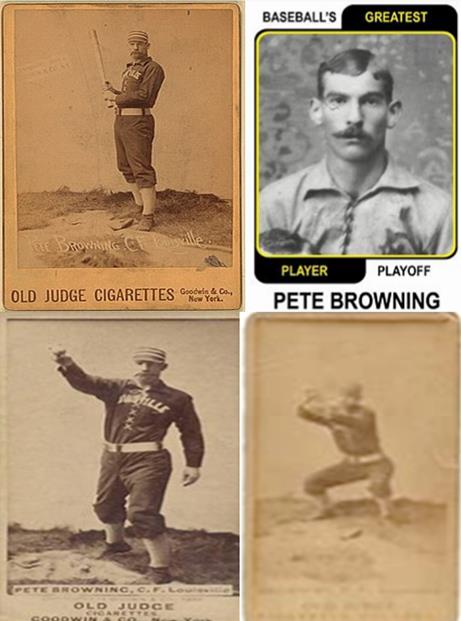
Pete Browning
Baseball Trailblazers
Page 968
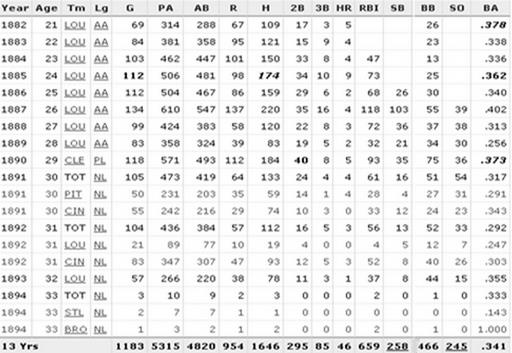
Louis Rogers "Pete" Browning, June 17, 1861 - September 10, 1905, nicknamed "Gladiator" and "The Louisville Slugger," was a professional baseball center fielder and left fielder. He played in major league baseball from 1882 to 1894. He played primarily for the Louisville Eclipse/Colonels, becoming one of the sport's most accomplished batters of the 1880s.
Born in Louisville, Kentucky, Browning was the youngest of eight children. His father, a grocer, was killed by a tornado when Browning was thirteen years old. Young Pete remained with his mother, ultimately living in the house where he had grown up until the day he died.
Baseball Trailblazers Page 969
He displayed considerable athletic prowess from an early age, and in 1877 began playing for a local semipro team, the Louisville Eclipse, and pitched an exhibition win against a National League team. He continued with the Eclipse into 1882, when the franchise became a member of the newly formed American Association, the first major league to rival the NL.
Browning quickly distinguished himself as an exceptional slugger. He led the league in both batting - .378 and slugging -
.510 in its first season, also finishing in the top five in home runs, runs, hits and total bases. He was consistently among the league's top batters through 1888, winning a second batting crown in 1885 and hitting .402 in 1887. In 1884, he acquired his first custom made bat from the Hillerich and Bradsby company, collecting three hits in his first game using it and beginning a baseball tradition.
He led the league in hits, total bases and on base percentage in 1885. After suffering from mastoiditis from a young age, which caused him to lose his hearing and embarrassed him into avoiding school, resulting in essential illiteracy, he underwent the first of several surgeries to alleviate the condition in 1884, though the problem would afflict him throughout his career.
Baseball Trailblazers Page 970
After being used primarily as an infielder in his first three seasons, playing every position except catcher over that span, he was shifted to the outfield on a permanent basis in 1885.
While the inferior equipment of the time is somewhat of a mitigating factor, Browning's playing record presented various evidence against any hidden defensive prowess. So did his unusual habit of playing the infield while standing on one leg, which he claimed to have adopted in order to avoid collisions with other players; however, some sources have noted that his probable rationale was to gain an advantage against baserunners he could not hear by aiming one leg toward them, and that he continued to do so in the outfield because he couldn't hear his teammates on either side. An oft reported story, possibly apocryphal, features one of Browning's managers claiming that the team would be better off with a wooden statue of an Indian in the outfield, since there was at least a slim chance that a batted ball might strike the statue and rebound back in the direction of the field. Indeed, he led league outfielders in errors in both 1886 and 1887.
Browning lost his appetite for playing in Louisville during a hellish 1889 season. That year, the luckless franchise, by then known as the Colonels, finished last in the league with 27 wins and 111 losses, 66.5 games behind the top club. The season
Baseball Trailblazers Page 971
included not only a major league record 26 game losing streak, but also a narrow escape from the Johnstown Flood and the sport's first strike. In the dispute, Browning was one of six players who refused to take the field as a protest against a series of heavy fines assessed by team owner Mordecai Davidson.
The game took place as scheduled with the assistance of three local amateurs, and the striking players returned to work before the next contest. Browning finished the season with a .256
average, the first time he was not among the league's top three hitters. He left the American Association after eight seasons with a .345 career average, which would stand as the best mark by any player with more than one season in the league. Tip O'Neill ranks second at .343.
As a result of these events, as well as other labor disputes throughout the sport, Browning, along with nearly all the game's stars, chose to jump to the Players' League for the 1890 season, and played for the Cleveland Infants. The American Association had long been considered inferior to the NL, but in that season Browning proved that he was indeed among the game's top hitters by winning his third batting title with a .373 mark. The league dissolved after its sole season, and Browning spent the remaining four years of his career bouncing around between franchises in the NL. He began the 1894 season playing minor
Baseball Trailblazers Page 972
league ball for "Kelly's Killers" of Allentown, Pa. in the Pennsylvania State League. The team was managed by future Hall of Famer Mike "King" Kelly.
His last professional season was in 1896 with the Columbus Buckeyes in the Western League.
A three time batting champion, he finished among the top three hitters in the league in each of his first seven years. Only twice in his eleven full seasons did he finish lower than sixth.
Before 1893, Browning ranked third among all major league players in career batting average, and fifth in slugging average. His .341 lifetime batting average remains one of the highest in major league history, and among the top five by a right handed batter. His .345 average over eight American Association seasons was the highest mark by any player during that league's 10 year existence.
"The Louisville Slugger" was enormously attentive to the bats he used, and was the first player to have them custom made, establishing a practice among hitters which continues to the present. Playing in spite of serious medical afflictions which rendered him virtually deaf and subjected him to massive headaches, he resorted to alcohol to subdue the pain, but continued to hit well even as his drinking increased. He was
Baseball Trailblazers Page 973
also known as "The Gladiator," though sources differ as to whether the nickname applied to his struggles with ownership, the press, his drinking problem, or particularly elusive fly balls.
Browning was tormented for his entire life by mastoiditis, which can result in deafness, vertigo, facial palsy, and brain damage.
As a result, he lost his hearing at a young age, and was faced with frequent bouts of crippling head pain. The deafness had led Browning to drop out of school at an early age, In order to deaden the physical pain resulting from his condition, he began drinking heavily in his youth. The drinking quickly spiraled out of control. He often appeared on the field while drunk, and was suspended for the final two months of the 1889 season for drunkenness, along with other shorter suspensions at different times. He was unable to stop, however, frequently stating; "I can't hit the ball until I hit the bottle."
Browning was a man of eccentric personal habits, particularly in relation to his bats. He spoke to them, and gave each one a name, often that of a Biblical figure. In the belief that any individual bat contained only a certain number of hits, he would periodically "retire" bats, keeping vast numbers of the retired ones in the home he shared with his mother. These bats were 37
inches long and 48 ounces in weight, enormous even by the
Baseball Trailblazers Page 974
standards of the time. He also habitually stared at the sun, thinking that by doing so, he would strengthen his eyes. He also
"cleansed" his eyes when travelling by train by sticking his head out the window in an effort to catch cinders in them.
Browning also computed his average on his cuffs on a regular basis, and was not above announcing to all when his train arrived at a depot that he was the champion batter of the American Association.
He remained a lifelong bachelor, though his affection for prostitutes was a matter of much discussion in the newspapers.
He was the uncle of Tod Browning, best known as the director of
“Dracula” (1931) and “Freaks” (1932).
After his retirement as a player, Browning worked as a cigar salesman and owned a bar, which ultimately failed. His physical condition continued to deteriorate due to the mastoiditis and resulting complications. He remained a popular Louisville figure until June 7, 1905, when he was declared insane and committed to a local asylum. A sister released him two weeks later, but a month after that, he was in the hospital, suffering from a general physical collapse.
He died in Louisville on September 10th of that year at age 44.
The specific cause of death was listed as asthenia, a weakening
Baseball Trailblazers Page 975
of the body, a cover all medical term used by doctors of that time. However, he no doubt suffered from a wide variety of serious physical complaints. In addition to the mastoiditis, he was afflicted with cancer, advanced cirrhosis of the liver, alcohol related brain damage, and according to some sources, paresis.
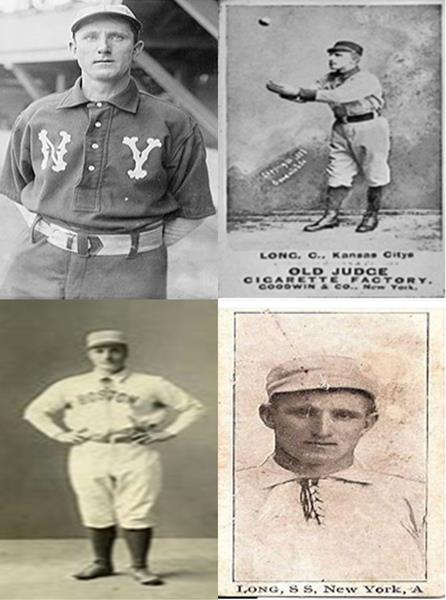
Baseball Trailblazers
Page 976
Herman Long
Herman C. Long, April 13, 1866 – September 16, 1909, was a shortstop in major league baseball who played mostly for the Boston Beaneaters. Long was known for his great fielding range.
Baseball Trailblazers Page 977
A native of Chicago, his parents are thought to have been German immigrants, as Long spoke fluent German. Little else is known about Long's life up until he began playing minor league baseball in 1887 for a team in Arkansas City, Kansas. He played in Kansas City in 1888. After that season, the Kansas City team merged with the major league team of the same city.
Long played for the Kansas City Cowboys in 1889, Boston Beaneaters from 1890–1902, New York Highlanders in 1903, Detroit Tigers in 1903, and Philadelphia Phillies in 1904. Between 1904
and 1906, Long was a player and player-manager in minor league baseball.
Tim Murnane, a former player turned baseball writer, wrote in 1894; "Long is the most brilliant ball player on the field at the present time." In 1903, future Hall of Fame pitcher Kid Nichols said of Long; "Herman Long is the greatest shortstop of them all. You can speak of your Hughie Jennings, and write of your Jack Glasscocks all you want, but this man Long at his best had them beat by a city block. Jennings was a brilliant ball player, and without doubt one of the leading players of the age, but this talk of his being better than Herman Long is all rot."
Long holds the major league record for most errors in a career -
1,096. Only three other players have made more than 1,000 errors
Baseball Trailblazers Page 978
in their careers. Long's total includes a record 1,070 errors committed while playing shortstop. Despite the errors, Long was considered an excellent fielder by his contemporaries. The seeming contradiction between a high error rate and exceptional fielding skill is attributable to the fact that Long had a greater fielding range than most shortstops. He could get to balls batted to his left and right that other fielders would not have reached. A certain percentage of these difficult plays were mishandled, resulting in Long being charged with errors on grounders and flies that lesser shortstops would not have touched, and therefore on which they would not be charged with errors, a statistical, rule based shortcoming. There was also another major factor which contributed to Long's relatively large total of career errors; the comparative abundance of errors during gameplay in 19th century professional baseball. In a typical game played in the 1800s, each team, substantially sans gloves, committed about ten errors, for a one game combined total of about 20.
He finished his career with a batting average of .277, 91 home runs, 1,055 RBI’s, and 537 stolen bases. He was the 1900 NL home run leader.
In August 1909, The New York Times reported that Long was very sick. Several months earlier, he had moved to Denver, Colorado,
Baseball Trailblazers Page 979
because he was suffering from a lung condition. He died there of tuberculosis the next month at the age of 43.
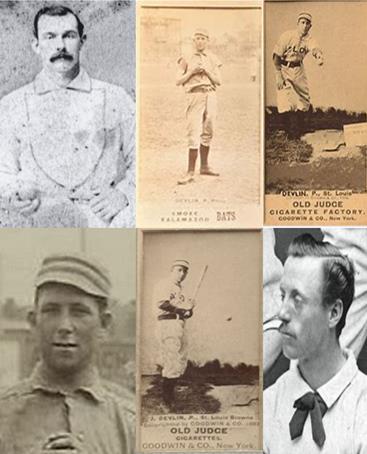
Baseball Trailblazers
Page 980
Jim Devlin
James Alexander Devlin, June 6, 1849 – October 10, 1883, was a major league baseball player who played mainly as a first baseman early in his short career, then as a pitcher in the latter part. He played for three teams during his five year career; the Philadelphia White Stockings and the Chicago White Stockings of the National Association, and the Louisville Grays of the National League. However, after admitting to throwing
Baseball Trailblazers Page 981
games and costing the Grays the pennant in the 1877 Louisville Grays scandal, he and three of his teammates were banished permanently from major league baseball.
Born in Philadelphia, Jim Devlin began his career in the first organized professional league, the National Association, as an infielder for his hometown Philadelphia White Stockings team in 1873. He then joined the Chicago White Stockings for the 1874
and 1875 seasons. In 1876, the National Association folded and was replaced by the National League that lives on to this day.
In this year, Devlin began pitching for the Louisville Grays, starting 68 games with an impeccable 1.56 earned run average and leading the Grays in batting with .315. His best pitch was a
"drop pitch," now known as a sinker, which Devlin may have been the first to throw. In 1877, Devlin, the only pitcher on the roster, threw every pitch of his team's 61 games, the only pitcher ever to do so.
Led by Devlin and slugger George Hall, the Grays opened up a four game lead in the NL pennant race by mid-August. However, the Grays suffered a horrendous road trip and endured a seven game losing streak, which was characterized by uncharacteristic
"bonehead" plays and poor pitching. The Grays relinquished their lead and eventually finished second, seven games behind the Boston Red Caps, who tore up the league afterwards, winning 20
Baseball Trailblazers Page 982
of 21 games to end the season. Meanwhile, certain Grays were seen around town wearing fancy new jewelry and ostentatiously dining at exclusive restaurants.
At the end of the season, suspicion arose that players were being paid to intentionally lose games. This suspicion increased as the players performed very well in post-season exhibition matches and as the Louisville Courier-Journal discovered that utility infielder Al Nichols had received an abnormally high number of telegrams. Courier-Journal writer John Haldeman, who was the son of the team president and sometimes played second base in the team's exhibition games, was the first to publicly accuse the Grays of throwing games. Team vice president Charles Chase, who had earlier received but disregarded telegrams informing him that gamblers were betting against the Grays in certain games, began an investigation. Devlin and Hall confessed, and Chase demanded that his players allow him to inspect their telegrams. The telegrams confirmed that Nichols was coordinating the games with New York gamblers. Bill Craver, the team's shortstop, who was the only player to deny the request, citing lack of pay, and who carried a bad reputation from his days in the National Association, was presumed guilty by association and was suspended.
Baseball Trailblazers Page 983
William Hulbert, the president of the National League, decided to make a stand against gambling. He immediately banned Devlin, Hall, Nichols, and Craver for life. Craver, against whom no evidence of gambling has ever been found, was outraged and appealed the suspension. Devlin also appealed to the League for reinstatement every year for the rest of his life. However, Hulbert remained resolute and none of the Louisville Four ever played major league baseball again.
Devlin’s final major league total was win–loss record of 72–76, an earned run average of 1.90, and a batting average of .287. He was the NL strikeout leader in 1876.
Devlin, who after baseball, found work in Philadelphia as a police officer, died poor of tuberculosis in 1883 and was survived by a wife and son.
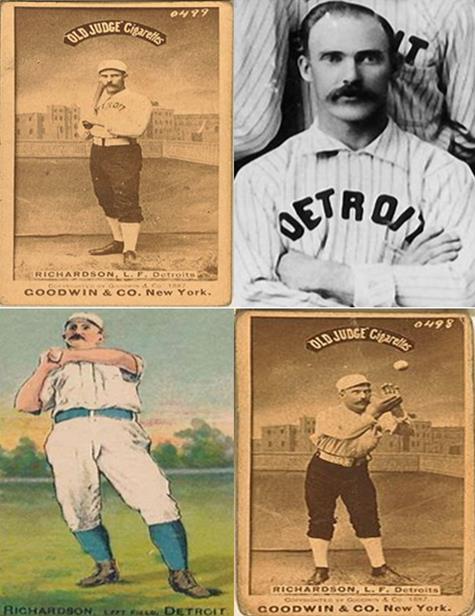
Baseball Trailblazers
Page 984
Hardy Richardson
Abram Harding "Hardy" Richardson, April 21, 1855 – January 14, 1931, also known as "Hardie" and "Old True Blue," was a professional baseball player whose career spanned from 1875 to
Baseball Trailblazers Page 985
1892 with a brief minor league comeback in 1898. He played 14
seasons in major league baseball, playing at every position, including 585 games at second base, 544 games in the outfield, and 178 games at third base. Richardson played for six major league teams, with his longest stretches having been for the Buffalo Bisons - 1879–85, Detroit Wolverines - 1886–88, and Boston Reds - 1890–91.
Richardson appeared in 1,334 major league games, compiled a .299
batting average, a .437 slugging percentage, and totaled 1,127
runs scored, 1,694 hits, 305 doubles, 126 triples, 73 home runs, 828 RBIs, and 377 bases on balls. From 1881 to 1888, he was part of the "Big Four," a group of renowned batters; the others being Dan Brouthers, Jack Rowe, and Deacon White; who played together in Buffalo and Detroit and led Detroit to the National League pennant and 1887 World Series championship.
Richardson was born in Clarksboro, which is located in the existing municipality of East Greenwich Township, New Jersey.
His father, Robert D. Richardson, was a New Jersey native who worked in 1870 as a house carpenter. His mother, Naomi (Jones) Richardson, was a Pennsylvania native. Richardson grew up in Greenwich Township, Gloucester County, and Gloucester City, New Jersey. By 1870, Richardson, at age 15, was working on a farm.
Baseball Trailblazers Page 986
Richardson began playing organized baseball with semipro teams in South Jersey and Philadelphia in the early 1870s. In 1875, he played at third base and catcher for the Gloucester City, New Jersey club. For a portion of the 1876 season, he played with the Philadelphias, but that team disbanded in July 1876.
Richardson next played for the "Crickets" from Binghamton, New York, during the 1876 and 1877 seasons. In 1878, he played for the Utica, New York club in the International Association for Professional Base Ball Players. While playing for Utica, the
“New York Clipper” called him the best fielding center fielder in baseball.
Richardson joined the Buffalo Bisons of the National League in 1879 and remained with Buffalo for seven years from 1879 to 1885. As a rookie, Richardson made his major league debut on May 1, 1879, and promptly became Buffalo's starting third baseman.
He compiled a .283 batting average, and ranked fifth in the National League with 10 triples and fourth with 16 bases on balls. He also led the league's third basemen in games played and double plays turned, and ranked second at the position in assists, putouts, and fielding percentage.
In 1880, Richardson was again positioned at third base. He saw his batting average drop to .259. He still hit for power and ranked among the league leaders with eight triples and 26 extra
Baseball Trailblazers Page 987
base hits. After a poor defensive performance in 1880, Richardson was moved to the outfield in 1881. With the move, his batting average jumped to .291. Showing good power, he ranked among the league’s top ten leaders with nine triples, 53 RBIs, 29 extra base hits, 62 runs scored, 100 hits, and 142 total bases. The move to the outfield also suited Richardson defensively. He led the league's outfielders with 45 assists and ranked third with 179 putouts. Richardson's total of 45 outfield assists, in only 79 games at the position, was five short of Orator Shafer's major league record and remains the third highest season total in major league history.
In 1882, and despite his solid defensive performance in the outfield, Richardson switched positions for the second time in as many years. This time, he was moved to second base, where he played 83 games. Richardson handled the move reasonably well, as he led the league's second basemen with 275 putouts. He also hit
.271, and ranked fourth in the league with 57 RBIs.
From 1881 to 1888, Richardson was one of four Buffalo, later Detroit, infielders with Dan Brouthers, Jack Rowe, and Deacon White who were known in baseball as the "Big Four." The "Big Four" played together for eight years and were regarded for many years as the greatest quartette in the history of the national pastime. “The Sporting News” later wrote; "How the Big Four was
Baseball Trailblazers Page 988
admired! Even in hostile cities the fans praised them in the next breath after they had jeered them."
Richardson remained the Bisons' second baseman in 1883, playing all 92 of his games at the position. He ranked among the league leaders with a .311 batting average, a .347 on base percentage,, 34 doubles, 42 extra base hits, and 146 times on base.
Defensively, he ranked second at the position in assists and putouts.
In a game against Philadelphia on July 20, 1883, both Richardson and Jack Rowe were credited with home runs when outfielder Conny Doyle was unable to find balls they hit into a patch of deep grass in the left field corner.
During the 1884 season, Richardson played 71 games at second base and 24 in the outfield, as the "Big Four" led Buffalo to a third place finish and a 64–47 (.577) record; the highest winning percentage in the club's history. All four players had outstanding seasons.
Richardson was involved in an unusual circumstance in a game against the Chicago White Stockings on August 13, 1884.
Chicago's George Gore was instructed by player-manager Cap Anson to avoid the double play. When the next batter hit a ground ball, Gore tackled Richardson at second base before he could
Baseball Trailblazers Page 989
complete the relay throw. The umpire called both the batter and the runner out, and Anson protested the ruling and refused to resume play, leading the umpire to declare the game forfeited to Buffalo. The two teams then agreed to resume a game which had been postponed earlier in the season, as a way of placating the dissatisfied fans. In the later game, Anson decided to demonstrate of the right way to break up the double play. He reached first base, and when the next batter hit a ground ball to Richardson, Anson waved his arms while running to second in an effort to interfere with Richardson's throw. Possibly flustered by this display, Richardson in turn struck Anson square in the head with his throw, which was delivered hard enough that it bounced all the way into the grandstands. A woozy Anson was forced to leave the game.
During the 1885 season, Richardson split his time between second base and outfield, and even appeared in one game as a pitcher.
He ranked among the league leaders with a .319 batting average, a .458 slugging percentage, 11 triples, six home runs, 195 total bases, and 90 runs scored.
In mid-September 1885, the Detroit Wolverines purchased the "Big Four" from Buffalo, paying $7,000 for entire team. League officials initially halted the sale, but ultimately allowed it to proceed, provided the “Big Four” did not play for Detroit
Baseball Trailblazers Page 990
until the start of the 1886 season. Richardson responded to threats to void the transaction by saying that the "Big Four"
would "retire to Canada."
The merger of the Detroit and Buffalo lineups turned two losing teams; Buffalo was 38-74 in 1885, Detroit 41-67; into one of the best in the game. With the addition of the "Big Four," the Wolverines improved substantially, finishing in second place with an 85-38 record. For Richardson, the 1886 season was the best of his career. He led the league with 189 hits and 11 home runs and was among the league leaders with a .351 batting average, a .402 on-base percentage, a .504 slugging percentage, 125 runs scored, 271 total bases, 27 doubles, 11 triples, 49
extra base hits, and 42 stolen bases. He also had the second highest ratio of at bats to strikeouts at 48.9. Defensively, Richardson played at multiple positions during the 1886 season, including 80 games in the outfield, 42 at second base, and four as a pitcher.
The 1887 season was the pinnacle in the eight year history of the Detroit Wolverines. The team won the National League pennant with a 79-45 record and then defeated the St. Louis Browns in the 1887 World Series. In an article published in 1911, Richardson called the 1887 Detroit team "one of the grandest collection of hitters ever seen together." Richardson
Baseball Trailblazers Page 991
contributed another strong season, splitting his playing time between second base and outfield. He was again among the league leaders with a .328 batting average, 131 runs scored, 178 hits, 263 total bases, 18 triples, 94 RBIs, and 51 extra base hits.
Despite playing only 64 games at the position, he also led the league's second basemen in range factor.
During the 1888 season, the Wolverines finished in fifth place with a 68-63 record. Richardson's playing time was limited to 58
games at second base, and his batting average dropped to .289; Richardson's lowest number since 1880. With high salaries owed to the team's star players, and gate receipts declining markedly, the team folded in October 1888 with the players being sold to other teams. On October 16, 1888, the Wolverines sold Richardson along with Charlie Bennett, Dan Brouthers, Charlie Ganzel and Deacon White to the Boston Beaneaters for an estimated $30,000.
During the 1889 season, Richardson played for the Boston Beaneaters, appearing in 86 games as a second baseman and 46 as an outfielder. He compiled a .304 batting average and ranked among the National League leaders in four other offensive categories. He also had the second highest range factor among the league's second basemen. In his only season with the
Baseball Trailblazers Page 992
Beaneaters, he helped the team to a second place finish with an 83-45 record.
In 1890, Richardson and teammate Dan Brouthers played in the newly-formed Players' League, joining the Boston Reds. The pair helped the Reds win the first and only Players' League pennant with an 81-48 record.
Richardson was a strong supporter of the Brotherhood of Professional Baseball Players, the union that represented the players and organized the Players' League in response to unfair treatment by team owners. In January 1890, he spoke out against players like teammate John Clarkson who had joined the Brotherhood but remained with their old clubs. Richardson said he would remain loyal to the Players' League even if it could only pay him $10 a week and added; "I held up my hand and swore that I would stick to the brotherhood. I respect my word and regard my oath as sacred. You have no idea how hot it makes me to think of the way some of these players have acted."
Richardson played in the outfield for the Boston Players' League club, appearing in 124 games at the position. He compiled a .326
batting average in 1890 and led the Players' League with a career high of 146 RBIs. He also stole 42 bases and ranked among the league leaders with 13 home runs, 274 total bases, 181 hits,
Baseball Trailblazers Page 993
and 126 runs scored. He also set a major league record in July 1890 by hitting home runs in five consecutive games, a record that was unmatched until Babe Ruth accomplished the feat in 1921.
At the end of the 1890 season, the Players' League disbanded, but the Boston Reds remained a major league club in 1891 as part of the American Association. Richardson again played in the outfield for the 1891 Reds, but he was limited to 74 games, having been laid up at his home in Gloucester City, New Jersey, after suffering a broken bone in his foot. His batting average fell by 71 points to .255. He did not rank among the American Association's leaders in any major offensive or defensive category.
Richardson played briefly for the Washington Senators in 1892.
He appeared in 10 games, compiled a .108 batting average and was released on April 28, 1892. Richardson was then signed by the New York Giants of the National League. He appeared in 64 games for the Giants, 33 of them at second base, and compiled a .214
batting average. He was released by the Giants late in the season, having appeared in his final major league game on September 10, 1892, at age 37.
Baseball Trailblazers Page 994
From May to June 1898, Richardson made a brief comeback at age 43 as a player for the Utica Pent-Ups in the New York State League.
Jim Hart, who was Richardson's manager in 1889 with the Beaneaters, offered the following high opinion of Richardson; "I think Ed Williamson and Hardy Richardson would pretty nearly make a tie as to being the best ball player since professional baseball has existed."
In January 1886, Richardson was married in a ceremony at Utica, New York, to Lillie M. Davis. In reporting on the wedding, “The Sporting News wrote;” "Mr. Richardson's fame as a ball player extends from Maine to California, and is only surpassed by his genial gentlemanly bearing and manner, which have earned for him the best wishes of innumerable friends for his future happiness." Richardson and his wife had a daughter, Dorothy, born in 1895. After retiring from baseball, Richardson reportedly operated a hotel in Utica, New York. By 1900, he was living in Utica with his wife, Lillie, and their daughter, Dorothy, and he was employed as an "art glass stainer." By 1905, Richardson and his wife had moved to German Flatts and later to Ilion, both in Herkimer County, New York, where he worked for the Remington Typewriter Company. In late 1910 and early 1911, Richardson wrote about his baseball memories in a series of
Baseball Trailblazers Page 995
articles for the Hearst newspapers. By 1930, Richardson was retired and living with his wife in Utica, New York as boarders at the home of cement salesman, Robert C. Weaver. Richardson died there in January, 1931 at age 75.
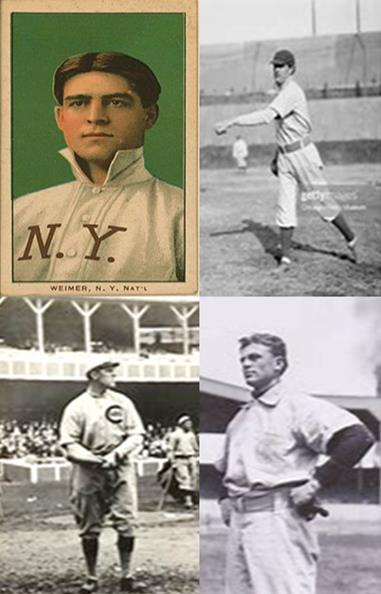
Baseball Trailblazers
Page 996
Jake Weimer
Jacob Weimer, nicknamed "Tornado Jake," November 29, 1873 – June 19, 1928, was a professional baseball player. He played in major league baseball as a left handed pitcher for the Chicago Cubs -
Baseball Trailblazers Page 997
1903–1905, Cincinnati Reds - 1906–1908, and New York Giants -
1909. He batted right handed and threw left handed.
Weimer was born in Ottumwa, Iowa. He toiled for eight years in the minor leagues, before becoming one of the top left handers in major league baseball.
In a seven season career, Weimer posted a 97–69 record with 657
strikeouts and a 2.23 ERA in 1472 innings pitched. His career ERA ranks 14th all-time.
He was also a decent hitting pitcher in the majors, posting a
.213 batting average, 115 for 540.
Weimer emerged as one of the Chicago Cubs' top starting pitchers in the first part of 20th century. He went 21–9 with a 2.30 ERA in his 1903 rookie season and 20–14 with 1.91 in his sophomore year. After going 18–12 with 2.26 in 1905, he was sent to the Cincinnati Reds for third baseman Harry Steinfeldt and Jimmy Sebring before 1906. In a trade that benefited both teams, Steinfeld hit .327 to lead the Cubs to their first World Series and Weimer won 20 games for Cincinnati, but eventually faded and was sent to the New York Giants after two subpar seasons. He played his final game with the Giants in 1909.
Weimer died in Chicago, at the age of 54.
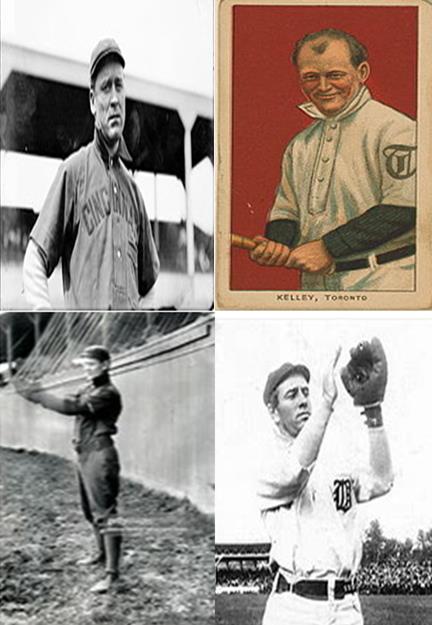
Baseball Trailblazers
Page 998
Joe Kelley
Joseph James Kelley, December 9, 1871 – August 14, 1943, was a left fielder in major league baseball who starred in the
Baseball Trailblazers Page 999
outfield of the Baltimore Orioles teams of the 1890s. Making up the nucleus of the Orioles along with John McGraw, Willie Keeler, and Hughie Jennings, Kelley received the nickname
"Kingpin of the Orioles."
Kelley was born to Patrick Kelly and Ann Kelly (née Carney) in Cambridge, Massachusetts. Kelley's parents emigrated to the United States from Ireland, and he had five siblings. Patrick worked as a marble cutter. As a child, Kelley was educated at a parochial grammar school and St. Thomas Aquinas College in Cambridge, where he starred for the school's baseball team as a pitcher. He worked for a local piano manufacturer and the John P. Lowell Arms Company. He practiced with the Harvard Crimson, the college baseball team of Harvard University, and played semi-professional baseball for the Lowell Arms Company.
Kelley made his professional debut with the Lowell Indians of the New England League in 1891, at age 19. During games he did not pitch, Lowell's manager put him in the lineup as an infielder. Kelley had a 10–3 win–loss record and a NEL leading
.323 batting average.
Lowell folded in July. Three days later, Kelley signed with the Boston Beaneaters of the National League (NL). Kelley made his major league debut in August 1891 with the Beaneaters. After
Baseball Trailblazers Page 1000
batting .244 in twelve games played, the Beaneaters released Kelley after the season. Kelley began the 1892 season with the Omaha Omahogs of the Class A Western League, turning down a $1,200 salary from the Oakland Oaks of the Pacific Coast League.
With Omaha, Kelley batted .316 with 19 stolen bases in 58 games.
The Pittsburgh Pirates of the NL purchased Kelley's contract from Omaha for $500 on July 2, 1892. Ned Hanlon, new manager of the Baltimore Orioles, traded George Van Haltren to the Pirates for Kelley and $2,000 in September 1892. Hanlon had succeeded Van Haltren as Orioles' manager during the season. Remaining with the Orioles as a player, Van Haltren openly criticized Hanlon. Hanlon mentioned that he "had his eye on Kelley for a long time."
Hanlon taught Kelley how to play center field. During the 1893
season, Kelley batted .305, with 120 runs scored, and stole 33
bases. He finished ninth in the NL with a .476 slugging percentage, and tied Eddie Burke for ninth in home runs with 9.
The Orioles won the NL pennant in 1894, 1895, and 1896. Kelley moved to left field in 1894 with the acquisition of Steve Brodie, who played center. That year, he batted .393 with 111
runs batted in, 199 hits, and 165 runs scored, tying teammate Willie Keeler for second in runs and finishing sixth in batting average and eighth in hits. Combined with 107 walks, which were
Baseball Trailblazers Page 1001
tied for second most in the NL with Cupid Childs and behind only Billy Hamilton, Kelley posted a .502 on-base percentage, finishing second in the NL to Hamilton, and hit 48 doubles, good for second in the NL, behind only Hugh Duffy. His .602 slugging percentage was the fourth best in the NL.
These Orioles teams, led by John McGraw, were known to break the rules in order to win, including tampering with their bats and the playing field. Kelley hid baseballs in the un-mown outfield, using the closest hidden ball instead of finding the ball batted. Kelley hit ten home runs in 1895, a then franchise record, tying him for fifth in the NL with five other players.
He also tied Brodie for second with 134 RBI, finished fourth with 54 stolen bases, fifth with a .546 slugging percentage, and sixth with a .456 on base percentage. In 1896, Kelley finished seventh in the NL in batting average - .364, fourth in runs scored - 148, fourth in slugging percentage - .543, fifth in on base percentage - .469, ninth in hits - 189, and tied for eighth in home runs – 8.
In 1897, Kelley agreed to serve as the coach of the Georgetown Hoyas, the college baseball team of Georgetown University. That year, he finished fifth in the NL in batting average - .362, and RBI - 118, seventh in on base percentage - .447, and eighth in slugging percentage - .489.
Baseball Trailblazers Page 1002
By 1898, Kelley earned an annual salary of $2,500, plus a $200
bonus for serving as team captain. He finished third in the league with 110 RBIs and ninth with a .438 slugging percentage.
Due to insolvency, the Brooklyn Superbas purchased the Orioles after the 1898 season and transferred Kelley, Hanlon, Keeler, Joe McGinnity, and Hughie Jennings to Brooklyn. Wanting an opportunity to manage, and to remain near Baltimore, Kelley requested a transfer to the Washington Senators, but Washington did not have enough talent to send to Brooklyn to make a trade.
With McGraw remaining in Baltimore, Hanlon named Kelley team captain. The Superbas won the NL pennant in 1899 and 1900. In 1899 Kelley finished tenth in RBI - 93, on base percentage -
.410, and tied several players for tenth in home runs with 6, and led the team with a .319 batting average. In 1900 he finished fourth in the league in slugging percentage - .485, tying for seventh in RBI - 91, and tying for tenth in home runs
– 6.
Kelley moved back to the infield, becoming the regular first baseman in 1901. After the 1901 season, Kelley denied reports that he would jump from the Superbas to the Detroit Tigers of the American League, the former Western League which had decided to compete with the NL by creating franchises in east coast cities that housed NL franchises. However, the opportunity to
Baseball Trailblazers Page 1003
return to Baltimore proved irresistible to Kelley, and after the AL's successful 1901 season, he jumped from the Superbas to the Baltimore Orioles AL. Kelley's father-in-law, John Mahon, was president and principal shareholder of the AL's Orioles.
Kelley was named Orioles' captain and received some stock in the team. McGraw, player-manager of the Orioles, resigned from the team to take over as manager of the New York Giants on July 7, 1902. In his absence, Kelley and Wilbert Robinson took over in the interim. Under indefinite suspension by Ban Johnson by July 1902 for fighting with umpires, Kelley entertained the idea of leaving the Orioles with McGraw, who was becoming frustrated with Johnson, and had begun negotiating to join the New York Giants of the NL. With the team in financial straits, Kelley sold his shares of the Orioles to Mahon, who had purchased McGraw's shares when he left for New York, becoming principal shareholder of the Orioles. Mahon then sold controlling interest in the Orioles to Andrew Freedman, principal owner of the Giants, and John T. Brush, principal owner of the Cincinnati Reds, on July 17. On the day they owned the franchise, they released the best players on the Orioles from their contracts so that they could be signed by National League teams. Kelley and Cy Seymour signed with the Reds, while McGinnity, Roger Bresnahan, Dan McGann, and Jack Cronin signed with the Giants.
Baseball Trailblazers Page 1004
Johnson, along with Orioles minority owners, took control of the Orioles franchise, which had to forfeit their game that day as they did not have enough players. Kelley stated that the Orioles owed $12,000, and that selling his shares was the only way Mahon could pay the team's debts.
The Superbas lodged a complaint against the Reds, claiming that Kelley was still under their control, seeking compensation from the Reds. However, the other NL owners saw the situation as a coup for their league, and compelled Hanlon to drop his complaint. Kelley did not immediately report to Cincinnati, instead traveling to Boston to attempt to convince members of the Boston Americans to join him in the NL. Kelley joined the Reds on July 31.
With rumors that Kelley was negotiating to become the Reds'
manager, incumbent manager Bid McPhee resigned, and Kelley succeeded him. Kelley served as manager of the Reds from 1902
until 1905. In 1903, Kelley finished ninth in the NL in on base percentage - .402. He was dismissed as manager after the 1905
season, and replaced by Hanlon. He remained as a Reds player for the 1906 season. He batted .228 during the 1906 season, and the Reds released him.
Baseball Trailblazers Page 1005
Kelley signed with the Toronto Maple Leafs of the Class AA International League in 1907, receiving a $5,000 salary, the highest for a minor league player to date. Kelley batted .322
for the Maple Leafs as a part-time player, spending time in left field and first base. The Maple Leafs won the IL pennant that season.
With Fred Tenney set to leave the Boston Doves of the NL for the Giants, the Doves claimed Kelley from the Maple Leafs, signing Kelley to a two year managerial contract with an annual salary of $5,500. Kelley announced that he would play left field.
Kelley feuded with Doves' owner George Dovey, as Dovey wanted George Browne fined for "indifferent play," which Kelley refused to do. Dovey fired Kelley in December 1908. Kelley threatened legal action against Dovey, stating in the press that Dovey was releasing him to cut salarie. Kelley and Dovey settled their case, freeing Kelley from the second year of his Doves contract.
Maple Leafs president James McCafferey secured Kelley's return to the club in 1909. He played with the Maple Leafs through 1910, managing them from 1912 to 1914, winning a second pennant in 1912.
After the 1914 season, the Maple Leafs released Kelley. The New York Yankees considered hiring Kelley as their manager. Kelley
Baseball Trailblazers Page 1006
scouted for the Yankees in 1915 and 1916. Former teammate Wilbert Robinson, then manager of the Brooklyn Robins, hired Kelley and McGinnity to join his coaching staff for the 1926
major league baseball season. Kelley and McGinnity were not retained after that season.
“Joe had no prominent weakness. He was fast on the bases, could hit the ball hard and was as graceful an outfielder as one would care to see. He covered an immense amount of ground and had that necessary faculty, so prominent in Speaker and others, of being able to place himself where the batter would be likely to hit the ball.” – John McGraw.
As a player, Kelley had 11 consecutive .300-plus seasons during his major league baseball career. Kelley was also known as a good base runner and stole a career high 87 bases in 1896. He retired with a career .317 batting average, a .402 on base percentage, 65 home runs, 1,421 runs, 1,194 RBI and 443 stolen bases in 1,853 career games. His 194 triples ranks him ninth all-time. Kelley tied Fred Carroll's record with nine hits in a doubleheader, which he presently shares with eight other players. Additionally, he was known as a great leader. He compiled a 338–321 win–loss record as a manager.
Baseball Trailblazers Page 1007
Kelley married Margaret Mahon on October 26, 1897. Wee Willie Keeler served as Kelley's best man, and John McGraw and Hughie Jennings served as groomsmen. He died August 14, 1943, at age 71, in Baltimore, Maryland.
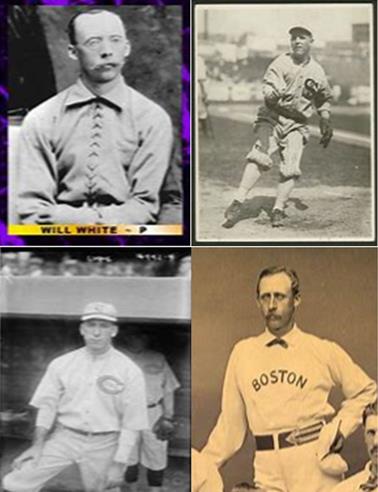
Baseball Trailblazers
Page 1008
Will White
William Henry "Whoop-La" White, October 11, 1854 – August 31, 1911, was a major league baseball pitcher and manager from 1875
to 1889. He played all or parts of 10 seasons in major league baseball, primarily for the Cincinnati Reds in the National League, 1878–1879, and the Cincinnati Red Stockings in the American Association, 1882–1886. He had three 40 win seasons in
Baseball Trailblazers Page 1009
Cincinnati. During the 1882 and 1883 seasons, he led the American Association in wins, compiling an 83–34 win–loss record and a 1.84 earned run average.
White was born in 1854 in the town of Caton in Steuben County, New York. His parents were Lester White, born c. 1820, a farmer, and his wife, Adeline, born c. 1823. The couple had at least eight children. White's ancestors likely immigrated to America during the colonial period.
White came from a baseball playing family. When he was age 13, his older brother, Deacon White, began playing professional baseball. Deacon was eventually inducted into the Baseball Hall of Fame. His cousin, Elmer White, played in the major leagues in 1871, while Will was 16, and died in 1872 at age 21. He was also related to Warren White, a native of Milton, New York, who played in the major leagues from 1871 to 1875.
Records of White's early years in organized minor league baseball during the mid-1870s are scarce. He is thought to be
"about the first" pitcher to develop "the sharp curve ball,"
doing so in 1875. During the 1876 season, White reportedly pitched for the Binghamton Crickets, where John Kelly was his catcher.
Baseball Trailblazers Page 1010
In 1877, White's older brother, Deacon White, was playing first base for the Boston Red Caps of the National League. Deacon, by then an established veteran, brought Will with him to Boston for a tryout. Will was given a three game tryout with the Red Caps, making his major league debut on July 20, 1877, at age 22. He pitched three complete games and compiled a 2–1 record and a 3.00 earned run average in 27 innings pitched. During White's tryout with the Red Caps, Deacon and Will White formed the first brother battery in the game.
Will White accomplished another major league first. He was the first, and for many years the only, major league player to wear eyeglasses on the baseball field. In a later account of White's early years, The Sporting Life wrote; "White was about the only pitcher of consequence who wore glasses. He had great control of the ball, and he could land one over the plate whenever he wanted to notwithstanding he was handicapped by weak eyes." The novelty of his wearing eyeglasses was a regular subject of coverage, and a 1911 newspaper story on "Eye-Glassed Players"
noted that there were none in the game at that time and had been none since White. The famous slugger, Dan Brouthers, was quoted in the article as follows; "Will White, I suppose, was the last of the eye-glassed professionals. Near-sighted as Roosevelt, and Teddy could play a good game of ball, I'll bet, White was
Baseball Trailblazers Page 1011
nevertheless a great pitcher. He had the curves, the speed and all sorts of scientific trickery."
In 1878, the White brothers joined the Cincinnati Reds, where they were battery mates for the next three seasons. The 1878
season was White's first full season in professional baseball.
He appeared in 52 games for the Reds, all complete games, and compiled a 30–21 record and a 1.79 ERA. By July 1878, White had earned the nickname "Whoop-La." After pitching a four hitter against Harry Wright's Boston club, the Cincinnati Enquirer ran a headline, "WHOOP-LA, WILLIAM!" When George Wright struck out swinging to end the eighth inning, the crowd in Cincinnati
"arose almost to a man and such cheers and waving of hats and handkerchiefs were never heard and seen on the grounds." When White then walked to the plate and hit the first pitch for a double, there was more "howling" by screaming, frantic fans.
In 1879, Deacon White took over as the manager of the Red Stockings for the first 16 games of the season. The brothers also continued to work together as pitcher and catcher. After Will threw a four hit shutout in June 1879, the Cincinnati Enquirer wrote that there could be "not a doubt in the world that with Jim [Deacon] to back him Will White as a pitcher is today without a peer." During the 1879 season, Will White established several major league records. Out of the 80 games
Baseball Trailblazers Page 1012
played that year by the Red Stockings, White started 75 of them, threw 75 complete games, totaled 680 innings pitched and 2,906
batters faced, and compiled a 43–31 record with a 1.99 ERA and 232 strikeouts. White's 1879 totals remain major league records in games started, complete games, innings pitched and batters faced. Pud Galvin tied White's games started record in 1883, but White's other records remain unmatched more than 130 years later.
O. P. Caylor, one of the founders of the American Association, recalled that White was given the task in 1879 of demonstrating the curveball to Col. John A. Joyce, the "moving spirit" behind the Red Stockings. White was at the time "one of the most expert curvers in the profession." Caylor described the demonstration that was conducted as follows; "White stood upon the left of the fence at one end so that his hand could not possibly pass beyond the straight line, and pitched the ball so that it passed to the right of the middle post. This it did by three or four inches, but curved so much that it passed the third post a half foot to the left."
In 1880, White pitched in fewer games, but was even more effective by some measures than he had been in his record setting 1879 season. In his third full season, White started 62
games, all complete games, and compiled a 2.14 ERA in 517
Baseball Trailblazers Page 1013
innings pitched. Unfortunately, White played for a team that compiled the lowest batting average in the National League;